
CBSE · Class 10 · Mathematics (Basic) · Free

CBSE Class 10 Maths Basic 2025 Question Paper (Set 430/1/1) with Solutions

The official board paper (Q.P. Code 430/1/1, Series GE1FH). Free paper PDF and step-by-step solutions (also as a PDF to download) written by CogniGuru and checked against CBSE’s answer key. See the paper’s main topics in 1 minute, then quiz yourself to see how much you know and where you stand.

No login to download or read the solutions. Login only to see your quiz report in full.

Board
CBSE
Class
10
Subject
Maths Basic (241)
Year
2025
Set code
430/1/1
Max marks
80
Duration
3 hours
Questions
38 (Sections A to E)
Source
Official CBSE paper
Exam date
March 2025

Paper preview

Three pages of the official paper. Download the PDF for all 27.

  • Cover page of the CBSE Class 10 Maths Basic 2025 paper, set 430/1/1

    Cover page

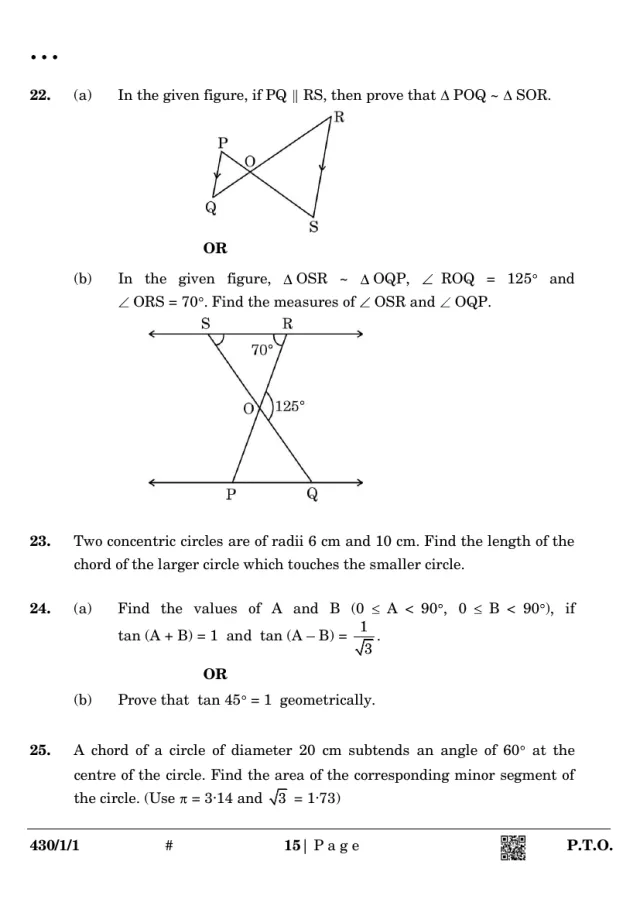
  • Section B of the CBSE Class 10 Maths Basic 2025 paper with figures

    Section B

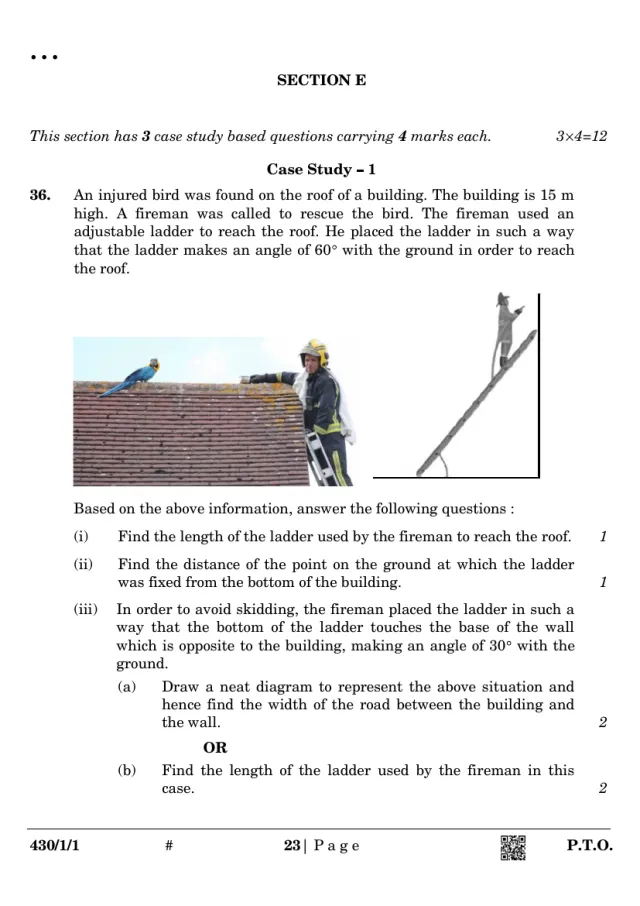
  • Case study 1 with figure from the CBSE Class 10 Maths Basic 2025 paper

    Case study 1

The main topics of this paper, in 1 minute

Your tutor walks you through the paper before you attempt it: the marks, the key ideas, the time plan and the traps.

1-minute paper analysis

With your tutor, in her voice

The main topics of this paper, in about a minute

A short, animated walk through the paper: how it is built, where the marks come from, the four ideas that matter most, how to plan your three hours, and the traps to avoid.

  1. 1The paper at a glance
  2. 2Where the marks come from
  3. 3Four ideas that keep paying off
  4. 4Plan your three hours
  5. 5Four traps to avoid

Sound on for the voice. Captions are shown, and you can mute any time.

Step-by-step solutions

Try each question first, then open its solution. Tap a number to jump.

Download solutions (PDF)

Section A: Multiple choice

20 questions, 1 mark each. MCQs (Q1 to Q18) and assertion-reason (Q19, Q20).

Q1Real Numbers1 mark

If the HCF of two positive integers aa and bb is 11, then their LCM is:

  1. (A)a+ba + b
  2. (B)aa
  3. (C)bb
  4. (D)abab
Solution · answer (D)
  1. For any two positive integers, HCF×LCM=a×b\text{HCF} \times \text{LCM} = a \times b.
  2. With HCF=1\text{HCF} = 1: 1×LCM=ab1 \times \text{LCM} = ab, so the LCM is abab.

Answer: (D) abab

Common mistake: Choosing aa or bb. The LCM equals one of them only when the other divides it, which is not the case for numbers with HCF 11 (such as 44 and 99).

Report an error on this question
Q2Real Numbers1 mark

The number 3+23 + \sqrt{2} is:

  1. (A)a rational number
  2. (B)an irrational number
  3. (C)an integer
  4. (D)a natural number
Solution · answer (B)
  1. 2\sqrt{2} is irrational.
  2. Suppose 3+23 + \sqrt{2} were a rational number rr. Then 2=r−3\sqrt{2} = r - 3 would be rational, which is false.
  3. So the sum of a rational number and an irrational number is irrational.

Answer: (B) an irrational number

Report an error on this question
Q3Quadratic Equations1 mark

The discriminant of the quadratic equation x2−3x−2=0x^2 - 3x - 2 = 0 is:

  1. (A)11
  2. (B)1717
  3. (C)17\sqrt{17}
  4. (D)−17-\sqrt{17}
Solution · answer (B)
  1. Here a=1a = 1, b=−3b = -3, c=−2c = -2.
  2. Discriminant D=b2−4ac=(−3)2−4(1)(−2)=9+8=17D = b^2 - 4ac = (-3)^2 - 4(1)(-2) = 9 + 8 = 17.

Answer: (B) 1717

Common mistake: Giving 17\sqrt{17}. That is a part of the roots' formula. The discriminant itself is b2−4acb^2 - 4ac.

Report an error on this question
Q4Quadratic Equations1 mark

The equation x+1x=3 (x≠0)x + \dfrac{1}{x} = 3\ (x \neq 0) is expressed as a quadratic equation in the form ax2+bx+c=0ax^2 + bx + c = 0. The value of a−b+ca - b + c is:

  1. (A)55
  2. (B)22
  3. (C)11
  4. (D)−1-1
Solution · answer (A)
  1. Multiply both sides by xx: x2+1=3xx^2 + 1 = 3x.
  2. Bring everything to one side: x2−3x+1=0x^2 - 3x + 1 = 0. So a=1a = 1, b=−3b = -3, c=1c = 1.
  3. a−b+c=1−(−3)+1=5a - b + c = 1 - (-3) + 1 = 5.

Answer: (A) 55

Common mistake: Forgetting that b=−3b = -3, which gives 1−3+1=−11 - 3 + 1 = -1.

Report an error on this question
Q5Coordinate Geometry1 mark

For a point (3,−5)(3, -5), the value of (abscissa −- ordinate) is:

  1. (A)−8-8
  2. (B)−2-2
  3. (C)22
  4. (D)88
Solution · answer (D)
  1. In (x,y)(x, y) the abscissa is xx and the ordinate is yy. Here abscissa =3= 3 and ordinate =−5= -5.
  2. Abscissa −- ordinate =3−(−5)=8= 3 - (-5) = 8.

Answer: (D) 88

Report an error on this question
Q6Coordinate Geometry1 mark

The mid-point of a line segment divides the line segment in the ratio:

  1. (A)1:21 : 2
  2. (B)2:12 : 1
  3. (C)1:11 : 1
  4. (D)12:2\dfrac{1}{2} : 2
Solution · answer (C)
  1. The mid-point is the point exactly halfway, so the two parts are equal.
  2. The ratio is 1:11 : 1.

Answer: (C) 1:11 : 1

Report an error on this question
Q7Triangles1 mark

Which of the following is not the criterion for similarity of triangles?

  1. (A)AAA
  2. (B)SSS
  3. (C)SAS
  4. (D)RHS
Solution
  1. The standard similarity criteria are AAA (or AA), SSS and SAS. These three are valid.
  2. RHS is usually taught as a congruence rule, but for right-angled triangles it also works for similarity: if the hypotenuse and one other side of one right triangle are in the same ratio as those of another, the triangles are similar.
  3. So every option can be used to show similarity, and none of them is "not a criterion". CBSE’s own marking scheme for this paper says the same: none of the given options is correct.

Answer: None of the given options is correct (as stated in CBSE’s answer key)

Common mistake: Spending time trying to force one letter. If you meet this in the exam, write your reasoning in a line next to your choice.

Report an error on this question
Q8Triangles1 mark

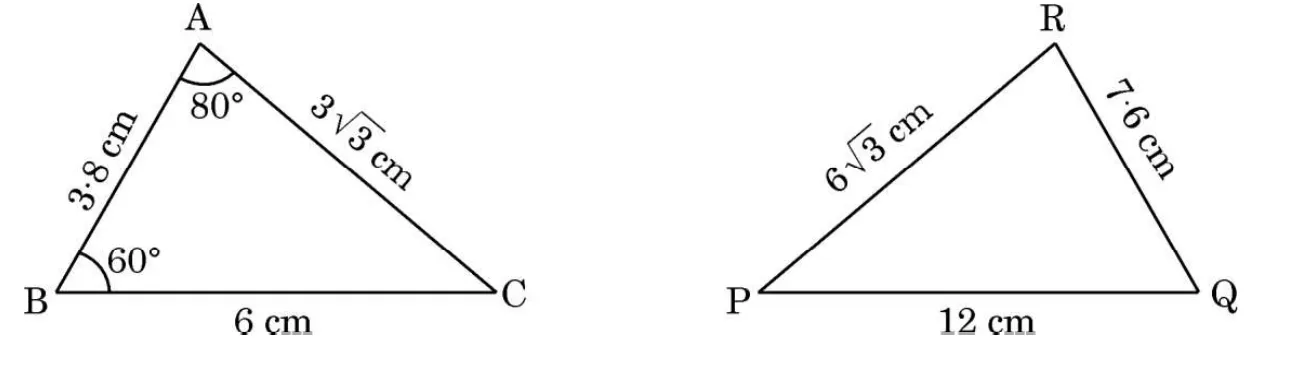
From the figures given below, which of the following is true about the measure of ∠P\angle P?

Two triangles. Triangle ABC has AB = 3.8 cm, BC = 6 cm, AC = 3 root 3 cm, angle A = 80 degrees and angle B = 60 degrees. Triangle PQR has PQ = 12 cm, QR = 7.6 cm and PR = 6 root 3 cm.
  1. (A)∠P=60∘\angle P = 60^\circ
  2. (B)∠P=80∘\angle P = 80^\circ
  3. (C)∠P=40∘\angle P = 40^\circ
  4. (D)The measure of ∠P\angle P cannot be determined
Solution · answer (C)
  1. Compare the sides of △ABC\triangle ABC with those of △PQR\triangle PQR: ABQR=3.87.6=12\dfrac{AB}{QR} = \dfrac{3.8}{7.6} = \dfrac{1}{2}, BCPQ=612=12\dfrac{BC}{PQ} = \dfrac{6}{12} = \dfrac{1}{2}, ACPR=3363=12\dfrac{AC}{PR} = \dfrac{3\sqrt{3}}{6\sqrt{3}} = \dfrac{1}{2}.
  2. All three ratios are equal, so △ABC∼△RQP\triangle ABC \sim \triangle RQP by SSS similarity.
  3. Match angles by the sides opposite them. QRQR (opposite PP) corresponds to ABAB (opposite CC), so ∠P=∠C\angle P = \angle C.
  4. ∠C=180∘−80∘−60∘=40∘\angle C = 180^\circ - 80^\circ - 60^\circ = 40^\circ, so ∠P=40∘\angle P = 40^\circ.

Answer: (C) ∠P=40∘\angle P = 40^\circ

Common mistake: Pairing PP with AA because they are the first letters. In similar triangles the matching vertex is the one opposite the matching side.

Report an error on this question
Q9Circles1 mark

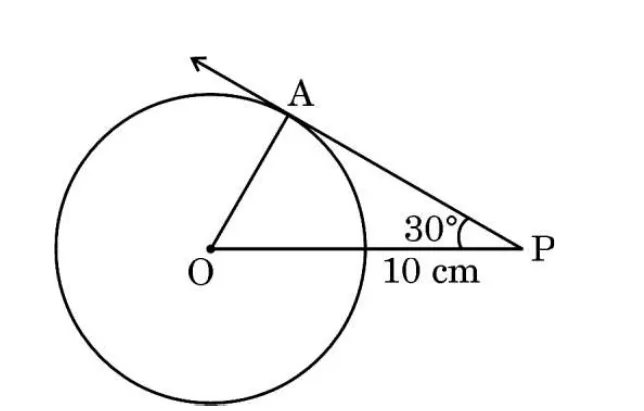
In the given figure, PAPA is a tangent to a circle with centre OO. If OP=10OP = 10 cm, then the length of APAP is:

A circle with centre O. P is outside the circle with OP = 10 cm. PA is a tangent touching the circle at A, and the angle at P between PO and PA is 30 degrees.
  1. (A)10310\sqrt{3} cm
  2. (B)2020 cm
  3. (C)55 cm
  4. (D)535\sqrt{3} cm
Solution · answer (D)
  1. The radius OAOA is perpendicular to the tangent PAPA, so △OAP\triangle OAP has a right angle at AA.
  2. ∠OPA=30∘\angle OPA = 30^\circ and the hypotenuse is OP=10OP = 10 cm. APAP is the side next to the 30∘30^\circ angle.
  3. AP=OPcos⁡30∘=10×32=53AP = OP \cos 30^\circ = 10 \times \dfrac{\sqrt{3}}{2} = 5\sqrt{3} cm.

Answer: (D) 535\sqrt{3} cm

Common mistake: Using sin⁡30∘\sin 30^\circ instead of cos⁡30∘\cos 30^\circ, which gives 55 (that is OAOA, not APAP).

Report an error on this question
Q10Trigonometry1 mark

Which of the following statements is false?

  1. (A)tan⁡45∘=cot⁡45∘\tan 45^\circ = \cot 45^\circ
  2. (B)sin⁡90∘=tan⁡45∘\sin 90^\circ = \tan 45^\circ
  3. (C)sin⁡30∘=cos⁡30∘\sin 30^\circ = \cos 30^\circ
  4. (D)sin⁡45∘=cos⁡45∘\sin 45^\circ = \cos 45^\circ
Solution · answer (C)
  1. (A) tan⁡45∘=1\tan 45^\circ = 1 and cot⁡45∘=1\cot 45^\circ = 1. True.
  2. (B) sin⁡90∘=1\sin 90^\circ = 1 and tan⁡45∘=1\tan 45^\circ = 1. True.
  3. (C) sin⁡30∘=12\sin 30^\circ = \dfrac{1}{2} but cos⁡30∘=32\cos 30^\circ = \dfrac{\sqrt{3}}{2}. False.
  4. (D) sin⁡45∘=cos⁡45∘=12\sin 45^\circ = \cos 45^\circ = \dfrac{1}{\sqrt{2}}. True.

Answer: (C) sin⁡30∘=cos⁡30∘\sin 30^\circ = \cos 30^\circ

Common mistake: Not noticing the question asks for the false statement, and picking a true one.

Report an error on this question
Q11Trigonometry1 mark

The value of (tan⁡2A−1cos⁡2A)\left(\tan^2 A - \dfrac{1}{\cos^2 A}\right) is:

  1. (A)more than 1
  2. (B)11
  3. (C)00
  4. (D)−1-1
Solution · answer (D)
  1. 1cos⁡2A=sec⁡2A\dfrac{1}{\cos^2 A} = \sec^2 A, so the expression is tan⁡2A−sec⁡2A\tan^2 A - \sec^2 A.
  2. Since sec⁡2A=1+tan⁡2A\sec^2 A = 1 + \tan^2 A, we get tan⁡2A−(1+tan⁡2A)=−1\tan^2 A - (1 + \tan^2 A) = -1.

Answer: (D) −1-1

Common mistake: Remembering sec⁡2A−tan⁡2A=1\sec^2 A - \tan^2 A = 1 and answering 11, without noticing the order is reversed.

Report an error on this question
Q12Applications of Trigonometry1 mark

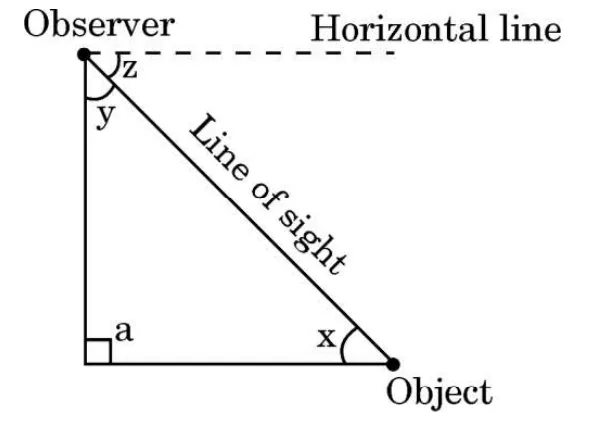
In the given figure, which of the following angles represents the angle of depression?

An observer at the top of a vertical line looks down at an object on the ground. A dashed horizontal line runs from the observer. Angle z is between the horizontal line and the line of sight, angle y is between the vertical and the line of sight, angle x is at the object, and angle a is the right angle at the base.
  1. (A)x
  2. (B)y
  3. (C)z
  4. (D)a
Solution · answer (C)
  1. The angle of depression is measured at the observer’s eye, from the horizontal line down to the line of sight.
  2. In the figure that is the angle between the dashed horizontal line and the line of sight, which is zz.
  3. (xx is equal to zz (alternate angles) but it sits at the object, so it is the angle of elevation of the observer from the object.)

Answer: (C) z

Report an error on this question
Q13Areas Related to Circles1 mark

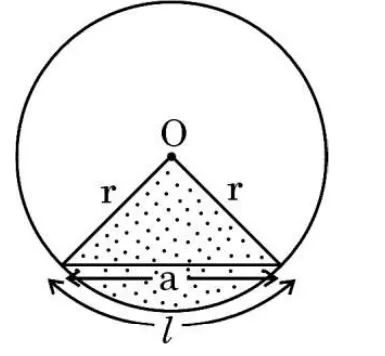
The perimeter of the shaded region in the given figure is:

A circle with centre O. Two radii of length r meet a chord of length a. The shaded region is the triangle formed by the two radii and the chord together with the segment below the chord, which is a sector of the circle. The arc has length l.
  1. (A)ll
  2. (B)l+al + a
  3. (C)l+2rl + 2r
  4. (D)l+2r+al + 2r + a
Solution · answer (C)
  1. The shaded region is the triangle together with the segment under the chord, so the chord is inside the region and is not part of its boundary.
  2. Together they form a sector. Its boundary is the two radii and the arc: r+r+lr + r + l.
  3. Perimeter =l+2r= l + 2r.

Answer: (C) l+2rl + 2r

Common mistake: Adding the chord aa. A line inside a region is not part of its perimeter.

Report an error on this question
Q14Areas Related to Circles1 mark

The ratio of the area of a quadrant of a circle to the area of the same circle is:

  1. (A)1:21 : 2
  2. (B)2:12 : 1
  3. (C)1:41 : 4
  4. (D)4:14 : 1
Solution · answer (C)
  1. A quadrant is 14\dfrac{1}{4} of the circle, so its area is 14πr2\dfrac{1}{4}\pi r^2.
  2. Ratio =14πr2:πr2=1:4= \dfrac{1}{4}\pi r^2 : \pi r^2 = 1 : 4.

Answer: (C) 1:41 : 4

Report an error on this question
Q15Surface Areas and Volumes1 mark

For which of the following solids is the lateral/curved surface area and total surface area the same?

  1. (A)Cube
  2. (B)Cuboid
  3. (C)Hemisphere
  4. (D)Sphere
Solution · answer (D)
  1. Curved and total surface area are equal only when the solid has no flat face.
  2. A cube and a cuboid have flat faces. A hemisphere has a flat circular top, so its total surface area (3πr23\pi r^2) is more than its curved area (2πr22\pi r^2).
  3. A sphere has one curved surface and nothing else: both are 4πr24\pi r^2.

Answer: (D) Sphere

Report an error on this question
Q16Statistics1 mark

The class mark of the median class of the following data is:

Class interval10 – 2525 – 4040 – 5555 – 7070 – 8585 – 100
Frequency237666
  1. (A)4040
  2. (B)5555
  3. (C)47.547.5
  4. (D)62.562.5
Solution · answer (D)
  1. Total frequency N=2+3+7+6+6+6=30N = 2 + 3 + 7 + 6 + 6 + 6 = 30, so N2=15\dfrac{N}{2} = 15.
  2. Cumulative frequencies: 2, 5, 12, 18, 24, 302,\ 5,\ 12,\ 18,\ 24,\ 30.
  3. The first cumulative frequency that is at least 1515 is 1818, so the median class is 55−7055 - 70.
  4. Class mark =55+702=62.5= \dfrac{55 + 70}{2} = 62.5.

Answer: (D) 62.562.5

Common mistake: Taking the class with the highest frequency as the median class. That is the modal class, not the median class.

Report an error on this question
Q17Statistics1 mark

The following distribution shows the number of runs scored by some batsmen in test matches. The lower limit of the modal class is:

Runs scored3000 – 40004000 – 50005000 – 60006000 – 7000
Number of batsmen51098
  1. (A)30003000
  2. (B)40004000
  3. (C)50005000
  4. (D)60006000
Solution · answer (B)
  1. The modal class is the class with the highest frequency.
  2. The highest frequency is 1010, for the class 4000−50004000 - 5000. Its lower limit is 40004000.

Answer: (B) 40004000

Report an error on this question
Q18Probability1 mark

In a random experiment of throwing a die, which of the following is a sure event?

  1. (A)Getting a number between 1 and 6
  2. (B)Getting an odd number < 7
  3. (C)Getting an even number < 7
  4. (D)Getting a natural number < 7
Solution · answer (D)
  1. A sure event is one that happens every time, with probability 1.
  2. A die shows 1, 2, 3, 4, 5 or 6, and each of these is a natural number less than 7.
  3. “Between 1 and 6” leaves out 1 and 6, odd numbers leave out 2, 4 and 6, and even numbers leave out 1, 3 and 5. So only the last option always happens.

Answer: (D) Getting a natural number < 7

Report an error on this question
Q19Real Numbers1 mark

Assertion (A): For any two natural numbers a and b, the HCF of a and b is a factor of the LCM.

Reason (R): HCF of any two natural numbers divides both the numbers.

  1. (A)Both A and R are true and R is the correct explanation of A
  2. (B)Both A and R are true, but R is not the correct explanation of A
  3. (C)A is true, but R is false
  4. (D)A is false, but R is true
Solution · answer (A)
  1. The reason is true: the HCF divides both aa and bb.
  2. Because the HCF divides aa, and aa divides the LCM (the LCM is a multiple of aa), the HCF divides the LCM. So the assertion is true.
  3. The reason is exactly the step that proves the assertion, so R explains A.

Answer: (A) Both true, and R is the correct explanation

Report an error on this question
Q20Linear Equations1 mark

Assertion (A): The value of pp for which the system of equations 4x+py+8=04x + py + 8 = 0 and 2x+2y+2=02x + 2y + 2 = 0 is consistent is 44.

Reason (R): The system of equations a1x+b1y=c1a_1x + b_1y = c_1 and a2x+b2y=c2a_2x + b_2y = c_2 is consistent with infinitely many solutions, if a1a2=b1b2=c1c2\dfrac{a_1}{a_2} = \dfrac{b_1}{b_2} = \dfrac{c_1}{c_2}.

  1. (A)Both A and R are true and R is the correct explanation of A
  2. (B)Both A and R are true, but R is not the correct explanation of A
  3. (C)A is true, but R is false
  4. (D)A is false, but R is true
Solution · answer (D)
  1. For the given system: a1a2=42=2\dfrac{a_1}{a_2} = \dfrac{4}{2} = 2, b1b2=p2\dfrac{b_1}{b_2} = \dfrac{p}{2}, c1c2=82=4\dfrac{c_1}{c_2} = \dfrac{8}{2} = 4.
  2. If p=4p = 4: a1a2=b1b2=2\dfrac{a_1}{a_2} = \dfrac{b_1}{b_2} = 2 but c1c2=4\dfrac{c_1}{c_2} = 4. The lines are parallel, so there is no solution and the system is inconsistent. The assertion is false.
  3. If p≠4p \neq 4, then a1a2≠b1b2\dfrac{a_1}{a_2} \neq \dfrac{b_1}{b_2}, so there is exactly one solution: consistent. So the system is consistent for every pp except 44.
  4. The reason states the standard condition for infinitely many solutions, and it is true.

Answer: (D) A is false, R is true

Common mistake: Reading "consistent" as "infinitely many solutions only". A system with a unique solution is consistent too.

Report an error on this question

Section B: Very short answer

5 questions, 2 marks each.

Q21Linear Equations2 marks

Solve the following system of equations for xx and yy: x2+2y3=−1\dfrac{x}{2} + \dfrac{2y}{3} = -1 and x−y3=3x - \dfrac{y}{3} = 3.

Solution
  1. Clear the fractions. Multiply the first equation by 66: 3x+4y=−63x + 4y = -6. … (i)
  2. Multiply the second by 33: 3x−y=93x - y = 9. … (ii)
  3. Subtract (ii) from (i): 5y=−155y = -15, so y=−3y = -3.
  4. Put y=−3y = -3 in (ii): 3x+3=93x + 3 = 9, so x=2x = 2.
  5. Check in the first equation: 22+2(−3)3=1−2=−1\dfrac{2}{2} + \dfrac{2(-3)}{3} = 1 - 2 = -1 ✓.

Answer: x=2, y=−3x = 2,\ y = -3

Common mistake: Multiplying only one side when clearing fractions.

Report an error on this question
Q22Triangles2 marks

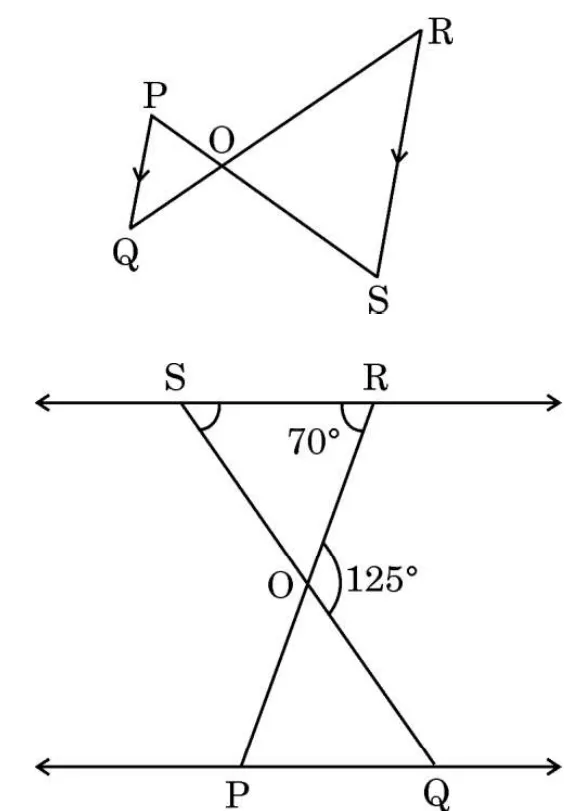
(a) In the given figure, if PQ∥RSPQ \parallel RS, then prove that △POQ∼△SOR\triangle POQ \sim \triangle SOR.

OR

(b) In the given figure, △OSR∼△OQP\triangle OSR \sim \triangle OQP, ∠ROQ=125∘\angle ROQ = 125^\circ and ∠ORS=70∘\angle ORS = 70^\circ. Find the measures of ∠OSR\angle OSR and ∠OQP\angle OQP.

Part (a): two lines PS and QR cross at O, with PQ parallel to RS. Part (b): two parallel lines, SR on top and PQ below. Lines SQ and RP cross at O. Angle ORS is 70 degrees and angle ROQ is 125 degrees.
Solution
  1. (a) PQ∥RSPQ \parallel RS with transversal QRQR, so ∠PQO=∠SRO\angle PQO = \angle SRO (alternate interior angles).
  2. ∠POQ=∠SOR\angle POQ = \angle SOR (vertically opposite angles).
  3. Two pairs of equal angles, so △POQ∼△SOR\triangle POQ \sim \triangle SOR by AA similarity.
  4. (b) ∠ROQ\angle ROQ is an exterior angle of △OSR\triangle OSR (side SOSO is extended to QQ). An exterior angle equals the sum of the two opposite interior angles: ∠ROQ=∠OSR+∠ORS\angle ROQ = \angle OSR + \angle ORS.
  5. 125∘=∠OSR+70∘125^\circ = \angle OSR + 70^\circ, so ∠OSR=55∘\angle OSR = 55^\circ.
  6. △OSR∼△OQP\triangle OSR \sim \triangle OQP (with S↔QS \leftrightarrow Q), so corresponding angles are equal: ∠OQP=∠OSR=55∘\angle OQP = \angle OSR = 55^\circ.

Answer: (a) △POQ∼△SOR\triangle POQ \sim \triangle SOR shown by AA   (b) ∠OSR=55∘, ∠OQP=55∘\angle OSR = 55^\circ,\ \angle OQP = 55^\circ

Common mistake: Using 125∘125^\circ as an angle inside the triangle. It is outside: the straight line SOQSOQ makes the inside angle ∠SOR=55∘\angle SOR = 55^\circ.

Report an error on this question
Q23Circles2 marks

Two concentric circles are of radii 66 cm and 1010 cm. Find the length of the chord of the larger circle which touches the smaller circle.

Solution
  1. Let the chord ABAB of the larger circle touch the smaller circle at CC. The radius OC=6OC = 6 cm is perpendicular to the tangent ABAB, and it bisects the chord.
  2. In right triangle OCBOCB: OB=10OB = 10 (radius of the larger circle), OC=6OC = 6. So CB2=102−62=100−36=64CB^2 = 10^2 - 6^2 = 100 - 36 = 64 and CB=8CB = 8 cm.
  3. The chord AB=2×8=16AB = 2 \times 8 = 16 cm.

Answer: 1616 cm

Common mistake: Stopping at 88 cm, which is only half the chord.

Report an error on this question
Q24Trigonometry2 marks

(a) Find the values of AA and BB (0∘≤A<90∘, 0∘≤B<90∘0^\circ \le A < 90^\circ,\ 0^\circ \le B < 90^\circ), if tan⁡(A+B)=1\tan(A + B) = 1 and tan⁡(A−B)=13\tan(A - B) = \dfrac{1}{\sqrt{3}}.

OR

(b) Prove that tan⁡45∘=1\tan 45^\circ = 1 geometrically.

Solution
  1. (a) tan⁡(A+B)=1=tan⁡45∘\tan(A + B) = 1 = \tan 45^\circ, so A+B=45∘A + B = 45^\circ. … (i)
  2. tan⁡(A−B)=13=tan⁡30∘\tan(A - B) = \dfrac{1}{\sqrt{3}} = \tan 30^\circ, so A−B=30∘A - B = 30^\circ. … (ii)
  3. Add (i) and (ii): 2A=75∘2A = 75^\circ, so A=37.5∘A = 37.5^\circ. Then B=45∘−37.5∘=7.5∘B = 45^\circ - 37.5^\circ = 7.5^\circ.
  4. (b) Take a right triangle ABCABC with the right angle at BB and AB=BC=xAB = BC = x (an isosceles right triangle).
  5. Equal sides have equal angles opposite them, so ∠A=∠C\angle A = \angle C. The angles add to 90∘90^\circ, so ∠A=∠C=45∘\angle A = \angle C = 45^\circ.
  6. tan⁡45∘=tan⁡A=BCAB=xx=1\tan 45^\circ = \tan A = \dfrac{BC}{AB} = \dfrac{x}{x} = 1.

Answer: (a) A=37.5∘, B=7.5∘A = 37.5^\circ,\ B = 7.5^\circ   (b) tan⁡45∘=1\tan 45^\circ = 1

Report an error on this question
Q25Areas Related to Circles2 marks

A chord of a circle of diameter 2020 cm subtends an angle of 60∘60^\circ at the centre of the circle. Find the area of the corresponding minor segment of the circle. (Use π=3.14\pi = 3.14 and 3=1.73\sqrt{3} = 1.73)

Solution
  1. Radius r=10r = 10 cm. In △OAB\triangle OAB, OA=OB=10OA = OB = 10 and ∠AOB=60∘\angle AOB = 60^\circ, so the other two angles are 60∘60^\circ too: the triangle is equilateral.
  2. Area of the sector =60360×πr2=16×3.14×100=52.33= \dfrac{60}{360} \times \pi r^2 = \dfrac{1}{6} \times 3.14 \times 100 = 52.33 cm².
  3. Area of the equilateral triangle =34r2=1.734×100=43.25= \dfrac{\sqrt{3}}{4} r^2 = \dfrac{1.73}{4} \times 100 = 43.25 cm².
  4. Area of the minor segment == sector −- triangle =52.33−43.25=9.08= 52.33 - 43.25 = 9.08 cm² (exactly 10912\dfrac{109}{12} cm²).

Answer: ≈9.08\approx 9.08 cm²

Common mistake: Giving the sector area. The segment is what is left after removing the triangle.

Report an error on this question

Section C: Short answer

6 questions, 3 marks each.

Q26Real Numbers3 marks

(a) Prove that 3\sqrt{3} is an irrational number.

OR

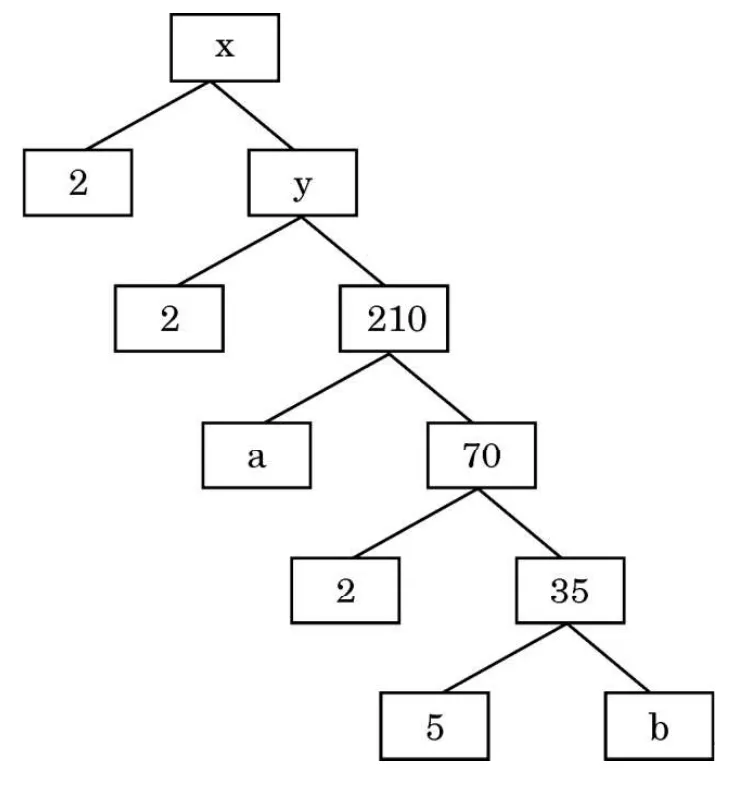
(b) The factor tree of a number xx is shown below. Find the values of xx, yy, aa and bb. Hence, write the product of the prime factors of the number xx so obtained.

A factor tree. x splits into 2 and y. y splits into 2 and 210. 210 splits into a and 70. 70 splits into 2 and 35. 35 splits into 5 and b.
Solution
  1. (a) Suppose 3\sqrt{3} is rational. Then 3=pq\sqrt{3} = \dfrac{p}{q} with integers p,qp, q (q≠0q \neq 0) that have no common factor.
  2. Squaring: 3q2=p23q^2 = p^2. So 33 divides p2p^2, and since 33 is prime, 33 divides pp. Write p=3mp = 3m.
  3. Then 3q2=9m23q^2 = 9m^2, so q2=3m2q^2 = 3m^2. So 33 divides q2q^2, and hence 33 divides qq.
  4. Now 33 divides both pp and qq, which contradicts "no common factor". So 3\sqrt{3} is irrational.
  5. (b) Work upwards from the bottom. 35=5×b35 = 5 \times b, so b=7b = 7. Then 70=2×3570 = 2 \times 35 ✓.
  6. 210=a×70210 = a \times 70, so a=3a = 3. Then y=2×210=420y = 2 \times 210 = 420 and x=2×420=840x = 2 \times 420 = 840.
  7. The prime factors of xx: 840=2×2×2×3×5×7840 = 2 \times 2 \times 2 \times 3 \times 5 \times 7, that is x=23×3×5×7x = 2^3 \times 3 \times 5 \times 7.

Answer: (a) 3\sqrt{3} is irrational   (b) b=7, a=3, y=420, x=840=23×3×5×7b = 7,\ a = 3,\ y = 420,\ x = 840 = 2^3 \times 3 \times 5 \times 7

Common mistake: In the proof, forgetting to say why 3 dividing p squared means 3 divides p (because 3 is prime).

Report an error on this question
Q27Polynomials3 marks

Find a quadratic polynomial whose sum and product of zeroes are 00 and −9-9, respectively. Also, find the zeroes of the polynomial so obtained.

Solution
  1. A quadratic polynomial with zeroes whose sum is SS and product is PP is x2−Sx+Px^2 - Sx + P.
  2. Here S=0S = 0 and P=−9P = -9, so the polynomial is x2−0x−9=x2−9x^2 - 0x - 9 = x^2 - 9.
  3. Zeroes: x2−9=(x+3)(x−3)=0x^2 - 9 = (x + 3)(x - 3) = 0, so x=−3x = -3 or x=3x = 3.
  4. Check: sum =−3+3=0= -3 + 3 = 0 ✓, product =(−3)(3)=−9= (-3)(3) = -9 ✓.

Answer: Polynomial x2−9x^2 - 9; zeroes −3-3 and 33

Common mistake: Writing x2+Sx+Px^2 + Sx + P. The middle term is −S-S.

Report an error on this question
Q28Linear Equations3 marks

(a) Solve the following system of equations graphically: x+3y=6; 2x−3y=12x + 3y = 6;\ 2x - 3y = 12.

OR

(b) xx and yy are complementary angles such that x:y=1:2x : y = 1 : 2. Express the given information as a system of linear equations in two variables and hence solve it.

Solution
  1. (a) Line 1, x+3y=6x + 3y = 6: points (0,2)(0, 2), (3,1)(3, 1), (6,0)(6, 0).
  2. Line 2, 2x−3y=122x - 3y = 12: points (0,−4)(0, -4), (3,−2)(3, -2), (6,0)(6, 0).
  3. Plot both lines on the same axes. They meet at the single point (6,0)(6, 0), so x=6x = 6 and y=0y = 0.
  4. Check: 6+0=66 + 0 = 6 ✓ and 12−0=1212 - 0 = 12 ✓.
  5. (b) Complementary angles add to 90∘90^\circ: x+y=90x + y = 90. … (i)
  6. x:y=1:2x : y = 1 : 2 means y=2xy = 2x, i.e. 2x−y=02x - y = 0. … (ii)
  7. Add (i) and (ii): 3x=903x = 90, so x=30x = 30 and y=60y = 60.

Answer: (a) x=6, y=0x = 6,\ y = 0   (b) x+y=90, y=2xx + y = 90,\ y = 2x; x=30∘, y=60∘x = 30^\circ,\ y = 60^\circ

Common mistake: Plotting with a wrong scale or too few points. Two correct points define a line, but a third point is a free check.

Report an error on this question
Q29Circles3 marks

Prove that a rectangle circumscribing a circle is a square.

Solution
  1. Let rectangle ABCDABCD circumscribe a circle, touching the sides AB,BC,CD,DAAB, BC, CD, DA at P,Q,R,SP, Q, R, S.
  2. Tangents from an outside point are equal: AP=ASAP = AS, BP=BQBP = BQ, CR=CQCR = CQ, DR=DSDR = DS.
  3. Add the four equalities: (AP+BP)+(CR+DR)=(AS+DS)+(BQ+CQ)(AP + BP) + (CR + DR) = (AS + DS) + (BQ + CQ), that is AB+CD=AD+BCAB + CD = AD + BC.
  4. In a rectangle opposite sides are equal: AB=CDAB = CD and AD=BCAD = BC. So 2AB=2AD2AB = 2AD, giving AB=ADAB = AD.
  5. A rectangle whose adjacent sides are equal is a square.

Answer: The circumscribed rectangle is a square

Common mistake: Skipping the labelled figure with the four points of contact. It is worth marks.

Report an error on this question
Q30Trigonometry3 marks

Prove that: 1+cot⁡2A1+tan⁡2A=(1−cot⁡A1−tan⁡A)2\dfrac{1 + \cot^2 A}{1 + \tan^2 A} = \left(\dfrac{1 - \cot A}{1 - \tan A}\right)^2

Solution
  1. Left side: 1+cot⁡2A=cosec2A1 + \cot^2 A = \mathrm{cosec}^2 A and 1+tan⁡2A=sec⁡2A1 + \tan^2 A = \sec^2 A, so LHS=cosec2Asec⁡2A=cos⁡2Asin⁡2A=cot⁡2A\text{LHS} = \dfrac{\mathrm{cosec}^2 A}{\sec^2 A} = \dfrac{\cos^2 A}{\sin^2 A} = \cot^2 A.
  2. Right side: 1−cot⁡A=sin⁡A−cos⁡Asin⁡A1 - \cot A = \dfrac{\sin A - \cos A}{\sin A} and 1−tan⁡A=cos⁡A−sin⁡Acos⁡A1 - \tan A = \dfrac{\cos A - \sin A}{\cos A}.
  3. 1−cot⁡A1−tan⁡A=sin⁡A−cos⁡Asin⁡A×cos⁡Acos⁡A−sin⁡A=−cos⁡Asin⁡A=−cot⁡A\dfrac{1 - \cot A}{1 - \tan A} = \dfrac{\sin A - \cos A}{\sin A} \times \dfrac{\cos A}{\cos A - \sin A} = -\dfrac{\cos A}{\sin A} = -\cot A.
  4. Squaring: (−cot⁡A)2=cot⁡2A\left(-\cot A\right)^2 = \cot^2 A.
  5. So LHS=cot⁡2A=RHS\text{LHS} = \cot^2 A = \text{RHS}.

Answer: Proved

Common mistake: Working on both sides at once. Simplify the left side and the right side separately, and show they meet at the same expression.

Report an error on this question
Q31Probability3 marks

A lot consists of 200 pens of which 180 are good and the rest are defective. A customer will buy a pen if it is not defective. The shopkeeper draws a pen at random and gives it to the customer. What is the probability that the customer will not buy it? Another lot of 100 pens containing 80 good pens is mixed with the previous lot of 200 pens. The shopkeeper now draws one pen at random from the entire lot and gives it to the customer. What is the probability that the customer will buy the pen?

Solution
  1. Defective pens in the first lot: 200−180=20200 - 180 = 20.
  2. The customer does not buy a defective pen. P(not buy)=20200=110P(\text{not buy}) = \dfrac{20}{200} = \dfrac{1}{10}.
  3. After mixing: total pens =200+100=300= 200 + 100 = 300 and good pens =180+80=260= 180 + 80 = 260.
  4. The customer buys a good pen. P(buy)=260300=1315P(\text{buy}) = \dfrac{260}{300} = \dfrac{13}{15}.

Answer: 110\dfrac{1}{10} and 1315\dfrac{13}{15}

Common mistake: Answering the first part with the probability of a good pen. The question asks for the chance the customer will NOT buy.

Report an error on this question

Section D: Long answer

4 questions, 5 marks each.

Q32Quadratic Equations5 marks

(a) The difference of the squares of two positive numbers is 180. The square of the smaller number is 8 times the greater number. Find the two numbers.

OR

(b) Find the value(s) of kk for which the equation 2x2+kx+3=02x^2 + kx + 3 = 0 has real and equal roots. Hence, find the roots of the equations so obtained.

Solution
  1. (a) Let the greater number be xx and the smaller be yy. Then x2−y2=180x^2 - y^2 = 180 and y2=8xy^2 = 8x.
  2. Put y2=8xy^2 = 8x in the first: x2−8x=180x^2 - 8x = 180, so x2−8x−180=0x^2 - 8x - 180 = 0.
  3. Factorise: (x−18)(x+10)=0(x - 18)(x + 10) = 0, so x=18x = 18 or x=−10x = -10.
  4. The numbers are positive, so x=18x = 18. Then y2=8×18=144y^2 = 8 \times 18 = 144 and y=12y = 12.
  5. Check: 182−122=324−144=18018^2 - 12^2 = 324 - 144 = 180 ✓.
  6. (b) Equal roots need the discriminant to be zero: k2−4(2)(3)=0k^2 - 4(2)(3) = 0, so k2=24k^2 = 24 and k=±26k = \pm 2\sqrt{6}.
  7. For k=26k = 2\sqrt{6}: 2x2+26x+3=02x^2 + 2\sqrt{6}x + 3 = 0. The equal roots are x=−b2a=−264=−62x = \dfrac{-b}{2a} = \dfrac{-2\sqrt{6}}{4} = -\dfrac{\sqrt{6}}{2}.
  8. For k=−26k = -2\sqrt{6}: 2x2−26x+3=02x^2 - 2\sqrt{6}x + 3 = 0. The equal roots are x=264=62x = \dfrac{2\sqrt{6}}{4} = \dfrac{\sqrt{6}}{2}.

Answer: (a) 1818 and 1212   (b) k=±26k = \pm 2\sqrt{6}; roots −62-\dfrac{\sqrt{6}}{2} (twice) for k=26k = 2\sqrt{6} and 62\dfrac{\sqrt{6}}{2} (twice) for k=−26k = -2\sqrt{6}

Common mistake: Keeping x=−10x = -10. The question says the numbers are positive, so say clearly why it is rejected.

Report an error on this question
Q33Triangles5 marks

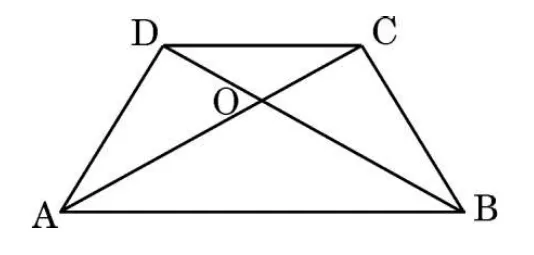
State "Basic Proportionality Theorem" and use it to prove the following: In a quadrilateral ABCDABCD, diagonals ACAC and BDBD intersect each other at OO such that AOBO=CODO\dfrac{AO}{BO} = \dfrac{CO}{DO} as shown in the given figure. Prove that ABCDABCD is a trapezium.

A quadrilateral ABCD with D and C at the top and A and B at the bottom. The diagonals AC and BD cross at O.
Solution
  1. Basic Proportionality Theorem: if a line is drawn parallel to one side of a triangle to meet the other two sides at distinct points, it divides those two sides in the same ratio.
  2. Given: AOBO=CODO\dfrac{AO}{BO} = \dfrac{CO}{DO}. To prove: AB∥CDAB \parallel CD.
  3. Construction: through OO draw OE∥ABOE \parallel AB, meeting ADAD at EE.
  4. In △DAB\triangle DAB, OE∥ABOE \parallel AB, so by the theorem DEEA=DOOB\dfrac{DE}{EA} = \dfrac{DO}{OB}. … (i)
  5. From the given condition, cross-multiplying: AO×DO=CO×BOAO \times DO = CO \times BO, so DOBO=COAO\dfrac{DO}{BO} = \dfrac{CO}{AO}. … (ii)
  6. From (i) and (ii): DEEA=COAO\dfrac{DE}{EA} = \dfrac{CO}{AO}.
  7. In △ADC\triangle ADC, this says EE and OO divide ADAD and ACAC in the same ratio, so by the converse of the theorem OE∥DCOE \parallel DC.
  8. Now OE∥ABOE \parallel AB and OE∥DCOE \parallel DC, so AB∥DCAB \parallel DC. A quadrilateral with one pair of parallel sides is a trapezium. Hence ABCDABCD is a trapezium.

Answer: ABCD is a trapezium

Common mistake: Writing the theorem but not naming the triangle each time you use it, or using the converse without saying so.

Report an error on this question
Q34Surface Areas and Volumes5 marks

(a) A toy is in the form of a cone surmounted on a hemisphere. The cone and hemisphere have the same radii. The height of the conical part of the toy is equal to the diameter of its base. If the radius of the conical part is 5 cm, find the volume of the toy.

OR

(b) A cubical block is surmounted by a hemisphere of radius 3.5 cm. What is the smallest possible length of the edge of the cube so that the hemisphere can totally lie on the cube? Find the total surface area of the solid so formed.

Solution
  1. (a) Radius r=5r = 5 cm. The height of the cone is the diameter: h=2r=10h = 2r = 10 cm. Use π=227\pi = \dfrac{22}{7}.
  2. Volume of the hemisphere =23πr3=23×227×125=550021= \dfrac{2}{3}\pi r^3 = \dfrac{2}{3} \times \dfrac{22}{7} \times 125 = \dfrac{5500}{21} cm³.
  3. Volume of the cone =13πr2h=13×227×25×10=550021= \dfrac{1}{3}\pi r^2 h = \dfrac{1}{3} \times \dfrac{22}{7} \times 25 \times 10 = \dfrac{5500}{21} cm³.
  4. Volume of the toy =550021+550021=1100021≈523.81= \dfrac{5500}{21} + \dfrac{5500}{21} = \dfrac{11000}{21} \approx 523.81 cm³.
  5. (b) For the hemisphere to lie fully on the cube, the cube's face must hold the circular base. The smallest edge equals the diameter: a=2×3.5=7a = 2 \times 3.5 = 7 cm.
  6. The solid's surface is the five exposed faces plus the top face with the circle removed, plus the curved surface of the hemisphere. So the total surface area =6a2−πr2+2πr2=6a2+πr2= 6a^2 - \pi r^2 + 2\pi r^2 = 6a^2 + \pi r^2.
  7. =6×49+227×3.5×3.5=294+38.5=332.5= 6 \times 49 + \dfrac{22}{7} \times 3.5 \times 3.5 = 294 + 38.5 = 332.5 cm².

Answer: (a) 1100021≈523.81\dfrac{11000}{21} \approx 523.81 cm³   (b) edge 77 cm, total surface area 332.5332.5 cm²

Common mistake: In (b), using 6a2+2πr26a^2 + 2\pi r^2 and forgetting that the circle covered by the hemisphere is no longer exposed.

Report an error on this question
Q35Statistics5 marks

The following data gives the information on the observed lifetime (in hours) of 200 electrical components. Find the mean lifetime (in hours) of the electrical components.

Lifetime (in hours)Number of electrical components
0 – 2010
20 – 4035
40 – 6050
60 – 8060
80 – 10030
100 – 12015
Solution
  1. Class marks xix_i: 10,30,50,70,90,11010, 30, 50, 70, 90, 110. Frequencies fif_i: 10,35,50,60,30,1510, 35, 50, 60, 30, 15, with ∑fi=200\sum f_i = 200.
  2. Products fixif_i x_i: 100, 1050, 2500, 4200, 2700, 1650100,\ 1050,\ 2500,\ 4200,\ 2700,\ 1650. Their sum is ∑fixi=12200\sum f_i x_i = 12200.
  3. Mean =∑fixi∑fi=12200200=61= \dfrac{\sum f_i x_i}{\sum f_i} = \dfrac{12200}{200} = 61.
  4. (Step-deviation check with a=50a = 50, h=20h = 20: ui=−2,−1,0,1,2,3u_i = -2, -1, 0, 1, 2, 3 and ∑fiui=−20−35+0+60+60+45=110\sum f_i u_i = -20 - 35 + 0 + 60 + 60 + 45 = 110, so mean =50+110200×20=61= 50 + \dfrac{110}{200} \times 20 = 61 ✓.)

Answer: Mean lifetime =61= 61 hours

Common mistake: Using the class limits instead of the class marks (midpoints) in the products.

Report an error on this question

Section E: Case studies

3 case studies, 4 marks each.

Q36Applications of Trigonometry4 marks

Case study 1. An injured bird was found on the roof of a building. The building is 15 m high. A fireman was called to rescue the bird. The fireman used an adjustable ladder to reach the roof. He placed the ladder in such a way that the ladder makes an angle of 60° with the ground in order to reach the roof.

(i) Find the length of the ladder used by the fireman to reach the roof. [1]

(ii) Find the distance of the point on the ground at which the ladder was fixed from the bottom of the building. [1]

(iii) In order to avoid skidding, the fireman placed the ladder in such a way that the bottom of the ladder touches the base of the wall which is opposite to the building, making an angle of 30° with the ground.

(a) Draw a neat diagram to represent the above situation and hence find the width of the road between the building and the wall. [2]

OR

(b) Find the length of the ladder used by the fireman in this case. [2]

Figure: A photo of a fireman with a ladder against a roof, and a sketch of the same: a vertical building wall, the ground, and a ladder leaning from the ground to the roof.

Solution
  1. (i) The building is 1515 m high and the ladder makes 60∘60^\circ with the ground. The ladder LL is the hypotenuse: sin⁡60∘=15L\sin 60^\circ = \dfrac{15}{L}, so L=153/2=303=103L = \dfrac{15}{\sqrt{3}/2} = \dfrac{30}{\sqrt{3}} = 10\sqrt{3} m.
  2. (ii) Distance xx from the building: tan⁡60∘=15x\tan 60^\circ = \dfrac{15}{x}, so x=153=53x = \dfrac{15}{\sqrt{3}} = 5\sqrt{3} m.
  3. (iii)(a) Diagram: a vertical line for the building (height 1515 m) on the left, the ground as a horizontal line of width yy (the road) to the base of the opposite wall on the right, and the ladder from that point up to the roof of the building, making 30∘30^\circ with the ground. This forms a right triangle with height 1515, base yy and the ladder as hypotenuse.
  4. tan⁡30∘=15y\tan 30^\circ = \dfrac{15}{y}, so y=15×3=153y = 15 \times \sqrt{3} = 15\sqrt{3} m.
  5. (iii)(b) In the same triangle: sin⁡30∘=15l\sin 30^\circ = \dfrac{15}{l}, so 12=15l\dfrac{1}{2} = \dfrac{15}{l} and l=30l = 30 m.

Answer: (i) 10310\sqrt{3} m   (ii) 535\sqrt{3} m   (iii)(a) 15315\sqrt{3} m   (iii)(b) 3030 m

Common mistake: Using tan⁡\tan for the ladder length. The ladder is the hypotenuse, so use sin⁡\sin with the height.

Report an error on this question
Q37Arithmetic Progressions4 marks

Case study 2. In a garden, saplings of rose flowers were planted at equal intervals to form a spiral pattern. The spiral is made up of successive semicircles, with centres alternately at A and B, starting with centre at A, of radii 50 cm, 100 cm, 150 cm, ....... Spiral 1 has 10 flowers, Spiral 2 has 20 flowers, Spiral 3 has 30 flowers and so on.

(i) What is the radius of the 13th spiral? [1]

(ii) If the radius of the nth spiral is 500 cm, find the value of n. [1]

(iii) (a) Find the total number of saplings till the 11th spiral. [2]

OR

(iii) (b) Till which spiral, will there be a total of 450 saplings? [2]

Figure: A spiral made of successive semicircles with centres alternately at the points A and B, which are very close together on a horizontal line. The semicircles are labelled l1, l2, l3, l4, each larger than the one before.

Solution
  1. The radii 50,100,150,…50, 100, 150, \dots form an AP with first term a=50a = 50 and common difference d=50d = 50, so the nnth radius is an=50+(n−1)×50=50na_n = 50 + (n - 1) \times 50 = 50n.
  2. (i) a13=50×13=650a_{13} = 50 \times 13 = 650 cm.
  3. (ii) 50n=50050n = 500, so n=10n = 10.
  4. The numbers of flowers 10,20,30,…10, 20, 30, \dots form a different AP, with a=10a = 10 and d=10d = 10.
  5. (iii)(a) S11=112 [2×10+(11−1)×10]=112×120=660S_{11} = \dfrac{11}{2}\,[2 \times 10 + (11 - 1) \times 10] = \dfrac{11}{2} \times 120 = 660 saplings.
  6. (iii)(b) Sn=n2 [20+(n−1)×10]=450S_n = \dfrac{n}{2}\,[20 + (n - 1) \times 10] = 450, so 5n(n+1)=4505n(n + 1) = 450, i.e. n2+n−90=0n^2 + n - 90 = 0.
  7. (n−9)(n+10)=0(n - 9)(n + 10) = 0, and nn cannot be negative, so n=9n = 9. There are 450450 saplings till the 99th spiral.

Answer: (i) 650650 cm   (ii) n=10n = 10   (iii)(a) 660660   (iii)(b) 99th spiral

Common mistake: Mixing the two progressions: the radii go up by 5050 cm and the flowers go up by 1010 per spiral.

Report an error on this question
Q38Coordinate Geometry4 marks

Case study 3. In a society, there is a circular park having two gates. The gates are placed at points A(10, 20) and B(50, 50), as shown in the figure below. Two fountains are installed at points P and Q on AB such that AP = PQ = QB.

(i) Find the coordinates of the centre C. [1]

(ii) Find the radius of the circular park. [1]

(iii) (a) Find the coordinates of the point P. [2]

OR

(iii) (b) Find the distance of the fountain at Q from gate A. [2]

Figure: A circle with a diameter AB drawn across it. On AB, from A to B, the points P, C (the centre) and Q lie in that order. AP = PQ = QB.

Solution
  1. ABAB is a diameter, so the centre CC is the mid-point of A(10,20)A(10, 20) and B(50,50)B(50, 50).
  2. (i) C=(10+502, 20+502)=(30,35)C = \left(\dfrac{10 + 50}{2},\ \dfrac{20 + 50}{2}\right) = (30, 35).
  3. (ii) Radius =CA=(30−10)2+(35−20)2=400+225=625=25= CA = \sqrt{(30 - 10)^2 + (35 - 20)^2} = \sqrt{400 + 225} = \sqrt{625} = 25 units.
  4. (iii)(a) AP=PQ=QBAP = PQ = QB, so PP divides ABAB in the ratio 1:21 : 2. By the section formula, P=(1×50+2×10³, 1×50+2×203)=(703, 30)P = \left(\dfrac{1 \times 50 + 2 \times 10}{3},\ \dfrac{1 \times 50 + 2 \times 20}{3}\right) = \left(\dfrac{70}{3},\ 30\right).
  5. (iii)(b) AB=2×25=50AB = 2 \times 25 = 50 units. QQ is two-thirds of the way from AA to BB: AQ=23×50=1003AQ = \dfrac{2}{3} \times 50 = \dfrac{100}{3} units.

Answer: (i) (30,35)(30, 35)   (ii) 2525 units   (iii)(a) (703,30)\left(\dfrac{70}{3}, 30\right)   (iii)(b) 1003\dfrac{100}{3} units

Common mistake: Using the ratio 2:12 : 1 for PP. PP is the point nearer to AA, so the ratio AP:PBAP : PB is 1:21 : 2.

Report an error on this question

Questions are from the official CBSE paper. Figures are described in words; see the PDF for the originals. Solutions are written by CogniGuru.

Revise this paper in 1 minute a chapter

Each chapter below is what the paper tested, with a one-minute animated lesson on the idea behind it.

Stuck on a step in any solution?

The CogniGuru AI tutor explains any doubt one minute at a time, in English or Hindi. Join the waitlist.

Mock quiz: 5 questions from this paper

Five real questions from this paper, one each from five chapters. About 2 minutes. See how much you know and where you stand among other students. Attempt free, with no login; log in only for your ranking and full report.

Question 1 of 5 · Q3 of the paperQuadratic Equations

The discriminant of the quadratic equation x2−3x−2=0x^2 - 3x - 2 = 0 is:

0 of 5 answered

Related papers

  • Maths Basic 2024Coming soon
  • Maths Basic 2026Coming soon
  • Maths Standard 2025
  • Science 2025Coming soon

Common questions

Are these the official CBSE Class 10 Maths Basic 2025 questions?
Yes. The questions are from the official Mathematics (Basic) paper (set 430/1/1) that CBSE published after the March 2025 board exam. The solutions are written by CogniGuru and checked against the answer key CBSE published for this paper code.
Can I download the CBSE Class 10 Maths Basic 2025 question paper PDF?
Yes, the official paper PDF is free to download from this page, and so are our step-by-step solutions as a PDF. No login is needed to download either or to read the solutions.
Do all sets of the paper have the same questions?
No. CBSE sets several versions of each paper, with the same blueprint and similar questions in a different order and sometimes with different numbers. This page covers set 430/1/1.
Why does Q7 say none of the options is correct?
CBSE’s own marking scheme for this paper marks Q7 as having no correct option. AAA, SSS and SAS are similarity criteria, and RHS also works as a similarity criterion for right-angled triangles, so all four options are valid ways to show similarity. The solution on this page explains it.
How does the quiz work, and what does “where you stand” mean?
It is a mock quiz of 5 real multiple-choice questions from this paper, scored automatically in about 2 minutes. Your score is compared, anonymously, with other students who took the same quiz. Only the score is stored with the comparison, never your name or number.

Source

CBSE question paper archive, Class X, 2025 (Mathematics Basic, set 430/1/1)
PDF