

CBSE · Class 10 · Mathematics (Standard) · Free

CBSE Class 10 Maths Standard 2025 Question Paper (Set 30/1/1) with Solutions

The official board paper (Q.P. Code 30/1/1, Series GE1FH). Free paper PDF and step-by-step solutions (also as a PDF to download) written by CogniGuru and checked against CBSE’s answer key. See the paper’s main topics in 1 minute, then quiz yourself to see how much you know and where you stand.

No login to download or read the solutions. Login only to see your quiz report in full.

Board
CBSE
Class
10
Subject
Maths Standard (041)
Year
2025
Set code
30/1/1
Max marks
80
Duration
3 hours
Questions
38 (Sections A to E)
Source
Official CBSE paper
Exam date
March 2025

Paper preview

Three pages of the official paper. Download the PDF for all 27.

  • Cover page of the CBSE Class 10 Maths Standard 2025 paper, set 30/1/1

    Cover page

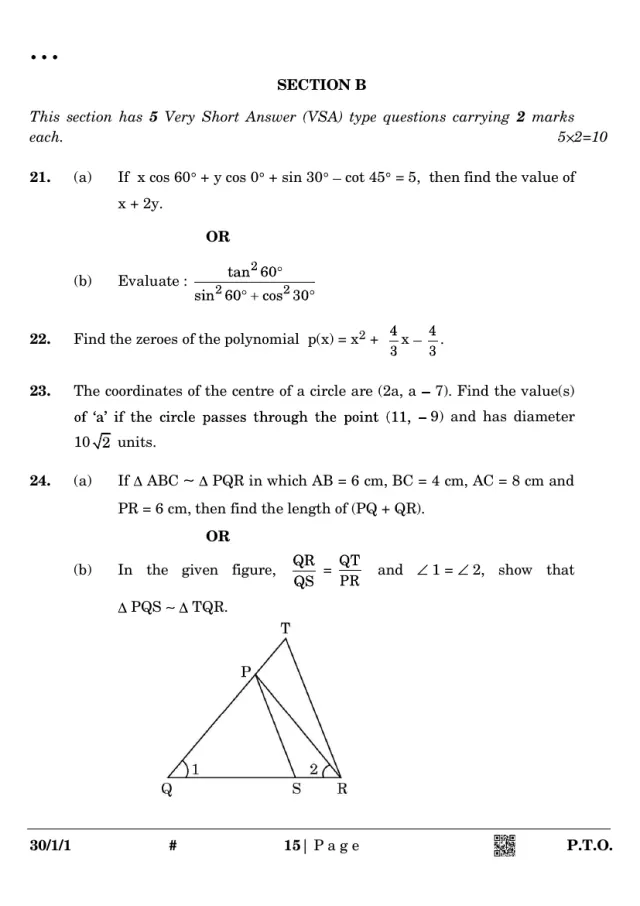
  • Section B of the CBSE Class 10 Maths Standard 2025 paper

    Section B

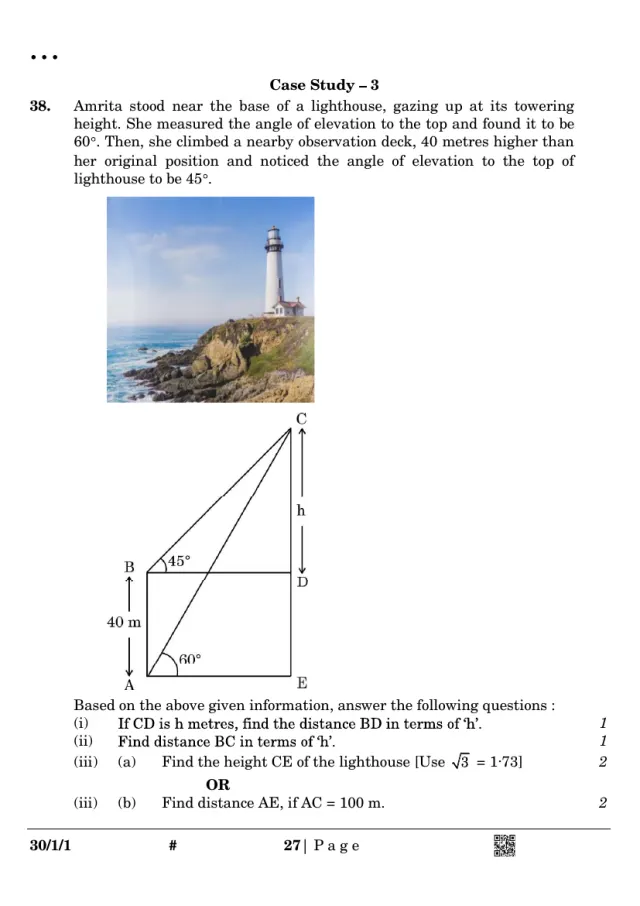
  • Case study 3 with figure from the CBSE Class 10 Maths Standard 2025 paper

    Case study 3

The main topics of this paper, in 1 minute

Your tutor walks you through the paper before you attempt it: the marks, the key ideas, the time plan and the traps.

1-minute paper analysis

With your tutor, in her voice

The main topics of this paper, in about a minute

A short, animated walk through the paper: how it is built, where the marks come from, the four ideas that matter most, how to plan your three hours, and the traps to avoid.

  1. 1The paper at a glance
  2. 2Where the marks come from
  3. 3Four ideas that keep paying off
  4. 4Plan your three hours
  5. 5Four traps to avoid

Sound on for the voice. Captions are shown, and you can mute any time.

Step-by-step solutions

Try each question first, then open its solution. Tap a number to jump.

Download solutions (PDF)

Section A: Multiple choice

20 questions, 1 mark each. MCQs (Q1 to Q18) and assertion-reason (Q19, Q20).

Q1Polynomials1 mark

If α\alpha and β\beta are the zeroes of the polynomial 3x2+6x+k3x^2 + 6x + k such that α+β+αβ=−23\alpha + \beta + \alpha\beta = -\dfrac{2}{3}, then the value of kk is:

  1. (A)−8-8
  2. (B)88
  3. (C)−4-4
  4. (D)44
Solution · answer (D)
  1. For 3x2+6x+k3x^2 + 6x + k: sum of zeroes α+β=−63=−2\alpha + \beta = -\dfrac{6}{3} = -2, and product αβ=k3\alpha\beta = \dfrac{k}{3}.
  2. Put these in the given condition: −2+k3=−23-2 + \dfrac{k}{3} = -\dfrac{2}{3}.
  3. So k3=2−23=43\dfrac{k}{3} = 2 - \dfrac{2}{3} = \dfrac{4}{3}, which gives k=4k = 4.

Answer: (D) 44

Common mistake: Writing α+β=+ba\alpha + \beta = +\dfrac{b}{a} (forgetting the minus sign) gives k=−8k = -8.

Report an error on this question
Q2Linear Equations1 mark

If x=1x = 1 and y=2y = 2 is a solution of the pair of linear equations 2x−3y+a=02x - 3y + a = 0 and 2x+3y−b=02x + 3y - b = 0, then:

  1. (A)a=2ba = 2b
  2. (B)2a=b2a = b
  3. (C)a+2b=0a + 2b = 0
  4. (D)2a+b=02a + b = 0
Solution · answer (B)
  1. Put x=1, y=2x = 1,\ y = 2 in the first equation: 2−6+a=02 - 6 + a = 0, so a=4a = 4.
  2. Put x=1, y=2x = 1,\ y = 2 in the second: 2+6−b=02 + 6 - b = 0, so b=8b = 8.
  3. Compare: b=8=2×4=2ab = 8 = 2 \times 4 = 2a, so 2a=b2a = b.

Answer: (B) 2a=b2a = b

Report an error on this question
Q3Coordinate Geometry1 mark

The mid-point of the line segment joining the points P(−4,5)P(-4, 5) and Q(4,6)Q(4, 6) lies on:

  1. (A)x-axis
  2. (B)y-axis
  3. (C)origin
  4. (D)neither x-axis nor y-axis
Solution · answer (B)
  1. Mid-point =(−4+42, 5+62)=(0, 112)= \left(\dfrac{-4 + 4}{2},\ \dfrac{5 + 6}{2}\right) = \left(0,\ \dfrac{11}{2}\right).
  2. The x-coordinate is 0 and the y-coordinate is not, so the point is on the y-axis (it is not the origin).

Answer: (B) y-axis

Common mistake: Calling it the origin. The origin needs both coordinates to be 0.

Report an error on this question
Q4Trigonometry1 mark

If θ\theta is an acute angle and 7+4sin⁡θ=97 + 4\sin\theta = 9, then the value of θ\theta is:

  1. (A)90∘90^\circ
  2. (B)30∘30^\circ
  3. (C)45∘45^\circ
  4. (D)60∘60^\circ
Solution · answer (B)
  1. 4sin⁡θ=9−7=24\sin\theta = 9 - 7 = 2, so sin⁡θ=12\sin\theta = \dfrac{1}{2}.
  2. sin⁡30∘=12\sin 30^\circ = \dfrac{1}{2} and θ\theta is acute, so θ=30∘\theta = 30^\circ.

Answer: (B) 30∘30^\circ

Report an error on this question
Q5Trigonometry1 mark

The value of tan⁡2θ−(1cos⁡θ×sec⁡θ)\tan^2\theta - \left(\dfrac{1}{\cos\theta} \times \sec\theta\right) is:

  1. (A)11
  2. (B)00
  3. (C)−1-1
  4. (D)22
Solution · answer (C)
  1. 1cos⁡θ=sec⁡θ\dfrac{1}{\cos\theta} = \sec\theta, so the bracket is sec⁡θ×sec⁡θ=sec⁡2θ\sec\theta \times \sec\theta = \sec^2\theta.
  2. The expression is tan⁡2θ−sec⁡2θ\tan^2\theta - \sec^2\theta.
  3. Since sec⁡2θ=1+tan⁡2θ\sec^2\theta = 1 + \tan^2\theta, we get tan⁡2θ−(1+tan⁡2θ)=−1\tan^2\theta - (1 + \tan^2\theta) = -1.

Answer: (C) −1-1

Common mistake: Remembering the identity as sec⁡2θ−tan⁡2θ=1\sec^2\theta - \tan^2\theta = 1 and answering 11, without noticing the order is reversed.

Report an error on this question
Q6Real Numbers1 mark

If HCF(98,28)=m\mathrm{HCF}(98, 28) = m and LCM(98,28)=n\mathrm{LCM}(98, 28) = n, then the value of n−7mn - 7m is:

  1. (A)00
  2. (B)2828
  3. (C)9898
  4. (D)198198
Solution · answer (C)
  1. 98=2×7298 = 2 \times 7^2 and 28=22×728 = 2^2 \times 7. HCF =2×7=14= 2 \times 7 = 14, so m=14m = 14.
  2. LCM =22×72=196= 2^2 \times 7^2 = 196, so n=196n = 196. (Check: 14×196=2744=98×2814 \times 196 = 2744 = 98 \times 28.)
  3. n−7m=196−98=98n - 7m = 196 - 98 = 98.

Answer: (C) 9898

Report an error on this question
Q7Circles1 mark

The tangents drawn at the extremities of the diameter of a circle are always:

  1. (A)parallel
  2. (B)perpendicular
  3. (C)equal
  4. (D)intersecting
Solution · answer (A)
  1. A tangent is perpendicular to the radius at the point of contact.
  2. The two ends of a diameter lie on one straight line through the centre, so both tangents are perpendicular to that same line.
  3. Two lines perpendicular to the same line are parallel.

Answer: (A) parallel

Report an error on this question
Q8Triangles1 mark

In triangles ABCABC and DEFDEF, ∠B=∠E\angle B = \angle E, ∠F=∠C\angle F = \angle C and AB=3 DEAB = 3\,DE. Then the two triangles are:

  1. (A)congruent but not similar
  2. (B)congruent as well as similar
  3. (C)neither congruent nor similar
  4. (D)similar but not congruent
Solution · answer (D)
  1. Two pairs of equal angles (∠B=∠E\angle B = \angle E and ∠C=∠F\angle C = \angle F) give similarity by the AA criterion.
  2. ABAB and DEDE are corresponding sides and AB=3 DEAB = 3\,DE, so the ratio of sides is 3:13 : 1, not 1:11 : 1.
  3. Triangles of equal size would be congruent. These are not the same size.

Answer: (D) similar but not congruent

Common mistake: Treating "similar" as "congruent". Congruent needs equal sides, similar only needs equal angles.

Report an error on this question
Q9Real Numbers1 mark

If (−1)n+(−1)8=0(-1)^n + (-1)^8 = 0, then nn is:

  1. (A)any positive integer
  2. (B)any negative integer
  3. (C)any odd number
  4. (D)any even number
Solution · answer (C)
  1. (−1)8=1(-1)^8 = 1 because 88 is even.
  2. So (−1)n+1=0(-1)^n + 1 = 0, which means (−1)n=−1(-1)^n = -1.
  3. (−1)(-1) raised to a power is −1-1 only when the power is odd.

Answer: (C) any odd number

Report an error on this question
Q10Polynomials1 mark

Two polynomials are shown in the graph below. The number of distinct zeroes of both the polynomials is:

Figure: Two parabolas on the same axes: one opens upward, the other opens downward. They cross each other exactly on the x-axis, at the same two points.

  1. (A)3
  2. (B)5
  3. (C)2
  4. (D)4
Solution · answer (C)
  1. A zero of a polynomial is where its graph meets the x-axis.
  2. Each parabola meets the x-axis at two points, and both parabolas meet it at the same two points.
  3. So the distinct zeroes are only 2, not 4.

Answer: (C) 2

Common mistake: Adding the zeroes of the two graphs (2 + 2 = 4). The question asks for distinct zeroes, and they share both.

Report an error on this question
Q11Arithmetic Progressions1 mark

If the sum of the first mm terms of an AP is 2m2+3m2m^2 + 3m, then its second term is:

  1. (A)1010
  2. (B)99
  3. (C)1212
  4. (D)44
Solution · answer (B)
  1. S1=2+3=5S_1 = 2 + 3 = 5, so a1=5a_1 = 5.
  2. S2=2(4)+3(2)=14S_2 = 2(4) + 3(2) = 14.
  3. Second term =S2−S1=14−5=9= S_2 - S_1 = 14 - 5 = 9.

Answer: (B) 99

Common mistake: Answering 1414, which is the sum of two terms, not the second term.

Report an error on this question
Q12Statistics1 mark

Mode and Mean of a data are 15x15x and 18x18x, respectively. Then the median of the data is:

  1. (A)xx
  2. (B)11x11x
  3. (C)17x17x
  4. (D)34x34x
Solution · answer (C)
  1. Use the empirical relation: Mode =3×= 3 \times Median −2×- 2 \times Mean.
  2. 15x=3 Median−36x15x = 3\,\text{Median} - 36x, so 3 Median=51x3\,\text{Median} = 51x.
  3. Median =17x= 17x.

Answer: (C) 17x17x

Common mistake: Swapping the mean and the mode in the relation.

Report an error on this question
Q13Probability1 mark

A card is selected at random from a deck of 52 playing cards. The probability of it being a red face card is:

  1. (A)313\dfrac{3}{13}
  2. (B)213\dfrac{2}{13}
  3. (C)12\dfrac{1}{2}
  4. (D)326\dfrac{3}{26}
Solution · answer (D)
  1. Face cards are Jack, Queen and King: 3 in each of the 4 suits.
  2. Red suits are hearts and diamonds, so red face cards =3×2=6= 3 \times 2 = 6.
  3. Probability =652=326= \dfrac{6}{52} = \dfrac{3}{26}.

Answer: (D) 326\dfrac{3}{26}

Common mistake: Counting all 12 face cards and answering 313\dfrac{3}{13}.

Report an error on this question
Q14Real Numbers1 mark

Which of the following is a rational number between 3\sqrt{3} and 5\sqrt{5}?

  1. (A)1.4142387954012…1.4142387954012\ldots
  2. (B)2.326‾2.32\overline{6}
  3. (C)π\pi
  4. (D)1.8571421.857142
Solution · answer (D)
  1. 3≈1.732\sqrt{3} \approx 1.732 and 5≈2.236\sqrt{5} \approx 2.236, so we need a rational number between 1.7321.732 and 2.2362.236.
  2. Option A never ends and never repeats, so it is irrational (and it is below 1.732 anyway).
  3. Option B is a repeating decimal, so it is rational, but 2.3266…2.3266\ldots is bigger than 2.2362.236.
  4. π\pi is irrational. Option D, 1.8571421.857142, is a terminating decimal, so it is rational, and 1.732<1.857142<2.2361.732 < 1.857142 < 2.236.

Answer: (D) 1.8571421.857142

Common mistake: Picking B because it is rational, without checking that it lies between the two roots.

Report an error on this question
Q15Areas Related to Circles1 mark

If a sector of a circle has an area of 40π40\pi sq. units and a central angle of 72∘72^\circ, the radius of the circle is:

  1. (A)200200 units
  2. (B)100100 units
  3. (C)2020 units
  4. (D)10210\sqrt{2} units
Solution · answer (D)
  1. Area of sector =θ360×πr2=72360×πr2=πr25= \dfrac{\theta}{360} \times \pi r^2 = \dfrac{72}{360} \times \pi r^2 = \dfrac{\pi r^2}{5}.
  2. πr25=40π\dfrac{\pi r^2}{5} = 40\pi, so r2=200r^2 = 200.
  3. r=200=102r = \sqrt{200} = 10\sqrt{2} units.

Answer: (D) 10210\sqrt{2} units

Common mistake: Stopping at r2=200r^2 = 200 and picking 200200.

Report an error on this question
Q16Circles1 mark

In the given figure, PAPA is a tangent from an external point PP to a circle with centre OO. If ∠POB=115∘\angle POB = 115^\circ, then ∠APO\angle APO is equal to:

Figure: A circle with centre O. AB is a diameter (A at the top, B at the bottom). P is outside the circle on the left, PA is a tangent touching the circle at A, and PO is joined. Angle POB is marked 115 degrees.

  1. (A)25∘25^\circ
  2. (B)65∘65^\circ
  3. (C)90∘90^\circ
  4. (D)35∘35^\circ
Solution · answer (A)
  1. AA, OO, BB lie on one straight line, so ∠POA+∠POB=180∘\angle POA + \angle POB = 180^\circ, giving ∠POA=180∘−115∘=65∘\angle POA = 180^\circ - 115^\circ = 65^\circ.
  2. The tangent PAPA is perpendicular to the radius OAOA, so ∠PAO=90∘\angle PAO = 90^\circ.
  3. In △APO\triangle APO: ∠APO=180∘−90∘−65∘=25∘\angle APO = 180^\circ - 90^\circ - 65^\circ = 25^\circ.

Answer: (A) 25∘25^\circ

Common mistake: Using 115∘115^\circ as ∠POA\angle POA and getting ∠APO=90∘−115∘\angle APO = 90^\circ - 115^\circ, which is impossible. Use the straight line AOBAOB first.

Report an error on this question
Q17Applications of Trigonometry1 mark

A kite is flying at a height of 150150 m from the ground. It is attached to a string inclined at an angle of 30∘30^\circ to the horizontal. The length of the string is:

  1. (A)1003100\sqrt{3} m
  2. (B)300300 m
  3. (C)1502150\sqrt{2} m
  4. (D)1503150\sqrt{3} m
Solution · answer (B)
  1. The height is opposite to the 30° angle, and the string is the hypotenuse.
  2. sin⁡30∘=heightstring\sin 30^\circ = \dfrac{\text{height}}{\text{string}}, so 12=150L\dfrac{1}{2} = \dfrac{150}{L}.
  3. L=300L = 300 m.

Answer: (B) 300300 m

Common mistake: Using cos⁡30∘\cos 30^\circ or tan⁡30∘\tan 30^\circ, which would need the horizontal distance.

Report an error on this question
Q18Areas Related to Circles1 mark

A piece of wire 2020 cm long is bent into the form of an arc of a circle of radius 60π\dfrac{60}{\pi} cm. The angle subtended by the arc at the centre of the circle is:

  1. (A)30∘30^\circ
  2. (B)60∘60^\circ
  3. (C)90∘90^\circ
  4. (D)50∘50^\circ
Solution · answer (B)
  1. Arc length =θ360×2πr= \dfrac{\theta}{360} \times 2\pi r.
  2. 20=θ360×2π×60π=θ360×12020 = \dfrac{\theta}{360} \times 2\pi \times \dfrac{60}{\pi} = \dfrac{\theta}{360} \times 120.
  3. θ=20×360120=60∘\theta = \dfrac{20 \times 360}{120} = 60^\circ.

Answer: (B) 60∘60^\circ

Report an error on this question
Q19Probability1 mark

Assertion (A): The probability of selecting a number at random from the numbers 1 to 20 is 1.

Reason (R): For any event EE, if P(E)=1P(E) = 1, then EE is called a sure event.

  1. (A)Both A and R are true and R is the correct explanation of A
  2. (B)Both A and R are true, but R is not the correct explanation of A
  3. (C)A is true, but R is false
  4. (D)A is false, but R is true
Solution · answer (A)
  1. Picking a number from 1 to 20 means you will certainly get some number from 1 to 20. Every outcome is favourable, so the probability is 2020=1\dfrac{20}{20} = 1. The assertion is true.
  2. An event with probability 11 is called a sure event. The reason is true.
  3. The reason is exactly why the assertion holds: the event is certain, so its probability is 1. So R explains A.

Answer: (A) Both true, and R is the correct explanation

Common mistake: Reading the assertion as "the probability of picking one particular number" (which is 120\dfrac{1}{20}). It says selecting a number from 1 to 20, which is certain.

Report an error on this question
Q20Surface Areas and Volumes1 mark

Assertion (A): If we join two hemispheres of the same radius along their bases, then we get a sphere.

Reason (R): Total surface area of a sphere of radius rr is 3πr23\pi r^2.

  1. (A)Both A and R are true and R is the correct explanation of A
  2. (B)Both A and R are true, but R is not the correct explanation of A
  3. (C)A is true, but R is false
  4. (D)A is false, but R is true
Solution · answer (C)
  1. Two hemispheres of the same radius, joined flat face to flat face, make a full sphere. The assertion is true.
  2. The total surface area of a sphere is 4πr24\pi r^2, not 3πr23\pi r^2. (3πr23\pi r^2 is the total surface area of a solid hemisphere.) The reason is false.

Answer: (C) A is true, R is false

Common mistake: Confusing the sphere's 4πr24\pi r^2 with the solid hemisphere's 3πr23\pi r^2.

Report an error on this question

Section B: Very short answer

5 questions, 2 marks each.

Q21Trigonometry2 marks

(a) If xcos⁡60∘+ycos⁡0∘+sin⁡30∘−cot⁡45∘=5x\cos 60^\circ + y\cos 0^\circ + \sin 30^\circ - \cot 45^\circ = 5, find the value of x+2yx + 2y.

OR

(b) Evaluate: tan⁡260∘sin⁡260∘+cos⁡230∘\dfrac{\tan^2 60^\circ}{\sin^2 60^\circ + \cos^2 30^\circ}

Solution
  1. (a) Standard values: cos⁡60∘=12\cos 60^\circ = \dfrac{1}{2}, cos⁡0∘=1\cos 0^\circ = 1, sin⁡30∘=12\sin 30^\circ = \dfrac{1}{2}, cot⁡45∘=1\cot 45^\circ = 1.
  2. So x2+y+12−1=5\dfrac{x}{2} + y + \dfrac{1}{2} - 1 = 5, which gives x2+y=112\dfrac{x}{2} + y = \dfrac{11}{2}.
  3. Multiply by 2: x+2y=11x + 2y = 11.
  4. (b) tan⁡60∘=3\tan 60^\circ = \sqrt{3}, so tan⁡260∘=3\tan^2 60^\circ = 3. sin⁡60∘=cos⁡30∘=32\sin 60^\circ = \cos 30^\circ = \dfrac{\sqrt{3}}{2}, so sin⁡260∘+cos⁡230∘=34+34=32\sin^2 60^\circ + \cos^2 30^\circ = \dfrac{3}{4} + \dfrac{3}{4} = \dfrac{3}{2}.
  5. The value is 3÷32=23 \div \dfrac{3}{2} = 2.

Answer: (a) x+2y=11x + 2y = 11   (b) 22

Report an error on this question
Q22Polynomials2 marks

Find the zeroes of the polynomial p(x)=x2+43x−43p(x) = x^2 + \dfrac{4}{3}x - \dfrac{4}{3}.

Solution
  1. Multiply by 3 to clear the fractions: 3x2+4x−4=03x^2 + 4x - 4 = 0.
  2. Split the middle term: 3x2+6x−2x−4=3x(x+2)−2(x+2)=(3x−2)(x+2)3x^2 + 6x - 2x - 4 = 3x(x + 2) - 2(x + 2) = (3x - 2)(x + 2).
  3. Set each factor to zero: x=23x = \dfrac{2}{3} or x=−2x = -2.

Answer: Zeroes: 23\dfrac{2}{3} and −2-2

Common mistake: Giving the factors instead of the zeroes, or flipping the sign of a zero.

Report an error on this question
Q23Coordinate Geometry2 marks

The coordinates of the centre of a circle are (2a, a−7)(2a,\ a - 7). Find the value(s) of aa if the circle passes through the point (11, −9)(11,\ -9) and has diameter 10210\sqrt{2} units.

Solution
  1. Radius =1022=52= \dfrac{10\sqrt{2}}{2} = 5\sqrt{2}, so r2=50r^2 = 50.
  2. The distance from the centre (2a, a−7)(2a,\ a - 7) to (11, −9)(11,\ -9) equals the radius: (11−2a)2+(−9−a+7)2=50(11 - 2a)^2 + (-9 - a + 7)^2 = 50.
  3. That is (11−2a)2+(a+2)2=50(11 - 2a)^2 + (a + 2)^2 = 50. Expand: 121−44a+4a2+a2+4a+4=50121 - 44a + 4a^2 + a^2 + 4a + 4 = 50.
  4. 5a2−40a+75=05a^2 - 40a + 75 = 0, so a2−8a+15=0a^2 - 8a + 15 = 0, i.e. (a−3)(a−5)=0(a - 3)(a - 5) = 0.

Answer: a=3a = 3 or a=5a = 5

Common mistake: Stopping after one value. The question asks for value(s), and both work.

Report an error on this question
Q24Triangles2 marks

(a) If △ABC∼△PQR\triangle ABC \sim \triangle PQR in which AB=6AB = 6 cm, BC=4BC = 4 cm, AC=8AC = 8 cm and PR=6PR = 6 cm, find the length of (PQ+QR)(PQ + QR).

OR

(b) In the given figure, QRQS=QTPR\dfrac{QR}{QS} = \dfrac{QT}{PR} and ∠1=∠2\angle 1 = \angle 2. Show that △PQS∼△TQR\triangle PQS \sim \triangle TQR.

Figure: For part (b): T, P and Q lie on one straight line. Q, S and R lie on another line from Q. Angle 1 is the angle at Q and angle 2 is the angle at R (angle PRQ). P is joined to S and to R.

Solution
  1. (a) Corresponding sides are in the same ratio, with A↔PA \leftrightarrow P, B↔QB \leftrightarrow Q, C↔RC \leftrightarrow R. ACAC corresponds to PRPR, so the ratio is PRAC=68=34\dfrac{PR}{AC} = \dfrac{6}{8} = \dfrac{3}{4}.
  2. PQ=AB×34=4.5PQ = AB \times \dfrac{3}{4} = 4.5 cm and QR=BC×34=3QR = BC \times \dfrac{3}{4} = 3 cm.
  3. PQ+QR=4.5+3=7.5PQ + QR = 4.5 + 3 = 7.5 cm.
  4. (b) In △PQR\triangle PQR, ∠1=∠2\angle 1 = \angle 2 means ∠PQR=∠PRQ\angle PQR = \angle PRQ, so the sides opposite them are equal: PR=PQPR = PQ.
  5. Replace PRPR by PQPQ in the given ratio: QRQS=QTPQ\dfrac{QR}{QS} = \dfrac{QT}{PQ}, which can be written QSQR=PQQT\dfrac{QS}{QR} = \dfrac{PQ}{QT}.
  6. In △PQS\triangle PQS and △TQR\triangle TQR: PQQT=QSQR\dfrac{PQ}{QT} = \dfrac{QS}{QR}, and ∠PQS=∠TQR\angle PQS = \angle TQR (the same angle at QQ).
  7. So △PQS∼△TQR\triangle PQS \sim \triangle TQR by the SAS similarity criterion.

Answer: (a) 7.57.5 cm   (b) shown by SAS similarity

Common mistake: Matching the wrong sides in part (a). Write the similarity in vertex order first (A to P, B to Q, C to R).

Report an error on this question
Q25Circles2 marks

A person is standing at PP outside a circular ground at a distance of 2626 m from the centre of the ground. He found that his distances from the points AA and BB on the ground are 1010 m each (PAPA and PBPB are tangents to the circle). Find the radius of the circular ground.

Figure: Circle with centre O. P is outside, 26 m from O. PA and PB are tangents, each 10 m long. OA and OB are radii.

Solution
  1. The radius OAOA is perpendicular to the tangent PAPA, so △OAP\triangle OAP has a right angle at AA.
  2. OA2=OP2−PA2=262−102=676−100=576OA^2 = OP^2 - PA^2 = 26^2 - 10^2 = 676 - 100 = 576.
  3. OA=24OA = 24 m.

Answer: Radius =24= 24 m

Common mistake: Adding instead of subtracting: OP2+PA2OP^2 + PA^2 treats OPOP as a leg, but OPOP is the hypotenuse.

Report an error on this question

Section C: Short answer

6 questions, 3 marks each.

Q26Circles3 marks

(a) In the given figure, OO is the centre of the circle and BCDBCD is a tangent to it at CC. Prove that ∠BAC+∠ACD=90∘\angle BAC + \angle ACD = 90^\circ.

OR

(b) Prove that opposite sides of a quadrilateral circumscribing a circle subtend supplementary angles at the centre of the circle.

Figure: For part (a): B, P, O, A lie along one line, and BCD is a tangent at C, with C directly below O. OC is drawn (dotted) and AC is joined.

Solution
  1. (a) BCDBCD is a tangent at CC and OCOC is a radius, so OC⊥BDOC \perp BD. Hence ∠OCD=90∘\angle OCD = 90^\circ, i.e. ∠OCA+∠ACD=90∘\angle OCA + \angle ACD = 90^\circ. … (1)
  2. In △OAC\triangle OAC, OA=OCOA = OC (radii), so ∠OAC=∠OCA\angle OAC = \angle OCA (angles opposite equal sides).
  3. OO lies on line BABA, so ∠BAC\angle BAC is the same angle as ∠OAC\angle OAC. Put ∠OCA=∠BAC\angle OCA = \angle BAC in (1): ∠BAC+∠ACD=90∘\angle BAC + \angle ACD = 90^\circ.
  4. (b) Let ABCDABCD circumscribe a circle with centre OO, touching AB,BC,CD,DAAB, BC, CD, DA at P,Q,R,SP, Q, R, S. Join OO to A,B,C,DA, B, C, D and to P,Q,R,SP, Q, R, S.
  5. Tangents from an outside point are equal: AP=ASAP = AS. Also OP=OSOP = OS (radii) and OAOA is common, so △OAP≅△OAS\triangle OAP \cong \triangle OAS (SSS). Hence ∠AOP=∠AOS\angle AOP = \angle AOS; call it ∠1\angle 1.
  6. In the same way ∠BOP=∠BOQ=∠2\angle BOP = \angle BOQ = \angle 2, ∠COQ=∠COR=∠3\angle COQ = \angle COR = \angle 3, ∠DOR=∠DOS=∠4\angle DOR = \angle DOS = \angle 4.
  7. The angles around OO add up to 360∘360^\circ: 2(∠1+∠2+∠3+∠4)=360∘2(\angle 1 + \angle 2 + \angle 3 + \angle 4) = 360^\circ, so ∠1+∠2+∠3+∠4=180∘\angle 1 + \angle 2 + \angle 3 + \angle 4 = 180^\circ.
  8. ∠AOB=∠1+∠2\angle AOB = \angle 1 + \angle 2 and ∠COD=∠3+∠4\angle COD = \angle 3 + \angle 4, so ∠AOB+∠COD=180∘\angle AOB + \angle COD = 180^\circ. Likewise ∠AOD+∠BOC=∠1+∠4+∠2+∠3=180∘\angle AOD + \angle BOC = \angle 1 + \angle 4 + \angle 2 + \angle 3 = 180^\circ.

Answer: (a) ∠BAC+∠ACD=90∘\angle BAC + \angle ACD = 90^\circ   (b) opposite sides subtend supplementary angles

Common mistake: Drawing the radius to the point of contact is the step most answers skip. Without OC, there is nothing to connect the tangent to the angle.

Report an error on this question
Q27Trigonometry3 marks

(a) Prove that: tan⁡θ1−cot⁡θ+cot⁡θ1−tan⁡θ=1+sec⁡θ cosec θ\dfrac{\tan\theta}{1 - \cot\theta} + \dfrac{\cot\theta}{1 - \tan\theta} = 1 + \sec\theta\,\mathrm{cosec}\,\theta

OR

(b) Prove that: sin⁡A+cos⁡Asin⁡A−cos⁡A+sin⁡A−cos⁡Asin⁡A+cos⁡A=22sin⁡2A−1\dfrac{\sin A + \cos A}{\sin A - \cos A} + \dfrac{\sin A - \cos A}{\sin A + \cos A} = \dfrac{2}{2\sin^2 A - 1}

Solution
  1. (a) Write everything in sin⁡\sin and cos⁡\cos. tan⁡θ1−cot⁡θ=sin⁡θ/cos⁡θ(sin⁡θ−cos⁡θ)/sin⁡θ=sin⁡2θcos⁡θ(sin⁡θ−cos⁡θ)\dfrac{\tan\theta}{1 - \cot\theta} = \dfrac{\sin\theta/\cos\theta}{(\sin\theta - \cos\theta)/\sin\theta} = \dfrac{\sin^2\theta}{\cos\theta(\sin\theta - \cos\theta)}.
  2. cot⁡θ1−tan⁡θ=cos⁡θ/sin⁡θ(cos⁡θ−sin⁡θ)/cos⁡θ=cos⁡2θsin⁡θ(cos⁡θ−sin⁡θ)=−cos⁡2θsin⁡θ(sin⁡θ−cos⁡θ)\dfrac{\cot\theta}{1 - \tan\theta} = \dfrac{\cos\theta/\sin\theta}{(\cos\theta - \sin\theta)/\cos\theta} = \dfrac{\cos^2\theta}{\sin\theta(\cos\theta - \sin\theta)} = -\dfrac{\cos^2\theta}{\sin\theta(\sin\theta - \cos\theta)}.
  3. Add them: 1sin⁡θ−cos⁡θ[sin⁡2θcos⁡θ−cos⁡2θsin⁡θ]=1sin⁡θ−cos⁡θ⋅sin⁡3θ−cos⁡3θsin⁡θcos⁡θ\dfrac{1}{\sin\theta - \cos\theta}\left[\dfrac{\sin^2\theta}{\cos\theta} - \dfrac{\cos^2\theta}{\sin\theta}\right] = \dfrac{1}{\sin\theta - \cos\theta} \cdot \dfrac{\sin^3\theta - \cos^3\theta}{\sin\theta\cos\theta}.
  4. Use a3−b3=(a−b)(a2+ab+b2)a^3 - b^3 = (a - b)(a^2 + ab + b^2): this becomes sin⁡2θ+sin⁡θcos⁡θ+cos⁡2θsin⁡θcos⁡θ=1+sin⁡θcos⁡θsin⁡θcos⁡θ\dfrac{\sin^2\theta + \sin\theta\cos\theta + \cos^2\theta}{\sin\theta\cos\theta} = \dfrac{1 + \sin\theta\cos\theta}{\sin\theta\cos\theta}.
  5. =1sin⁡θcos⁡θ+1=1+sec⁡θ cosec θ=RHS= \dfrac{1}{\sin\theta\cos\theta} + 1 = 1 + \sec\theta\,\mathrm{cosec}\,\theta = \text{RHS}.
  6. (b) Take the common denominator (sin⁡A−cos⁡A)(sin⁡A+cos⁡A)=sin⁡2A−cos⁡2A(\sin A - \cos A)(\sin A + \cos A) = \sin^2 A - \cos^2 A.
  7. Numerator: (sin⁡A+cos⁡A)2+(sin⁡A−cos⁡A)2=2(sin⁡2A+cos⁡2A)=2(\sin A + \cos A)^2 + (\sin A - \cos A)^2 = 2(\sin^2 A + \cos^2 A) = 2.
  8. Denominator: sin⁡2A−cos⁡2A=sin⁡2A−(1−sin⁡2A)=2sin⁡2A−1\sin^2 A - \cos^2 A = \sin^2 A - (1 - \sin^2 A) = 2\sin^2 A - 1. So LHS =22sin⁡2A−1== \dfrac{2}{2\sin^2 A - 1} = RHS.

Answer: Both identities proved

Common mistake: Starting from both sides at once. Work on the left side only and arrive at the right side.

Report an error on this question
Q28Coordinate Geometry3 marks

Find the ratio in which the y-axis divides the line segment joining the points (5,−6)(5, -6) and (−1,−4)(-1, -4). Also find the point of intersection.

Solution
  1. Let the y-axis divide the segment in the ratio k:1k : 1 at the point (0,y)(0, y).
  2. Section formula for the x-coordinate: k×(−1)+1×5k+1=0\dfrac{k \times (-1) + 1 \times 5}{k + 1} = 0, so −k+5=0-k + 5 = 0 and k=5k = 5.
  3. The ratio is 5:15 : 1.
  4. y=5×(−4)+1×(−6)5+1=−266=−133y = \dfrac{5 \times (-4) + 1 \times (-6)}{5 + 1} = \dfrac{-26}{6} = -\dfrac{13}{3}.

Answer: Ratio 5:15 : 1, point of intersection (0,−133)\left(0, -\dfrac{13}{3}\right)

Common mistake: Using the x-coordinate for the y-axis condition the wrong way round. On the y-axis, x is 0.

Report an error on this question
Q29Real Numbers3 marks

Prove that 15\dfrac{1}{\sqrt{5}} is an irrational number.

Solution
  1. Suppose 15\dfrac{1}{\sqrt{5}} is rational. Then 15=pq\dfrac{1}{\sqrt{5}} = \dfrac{p}{q} for integers p,qp, q with q≠0q \neq 0, and p,qp, q have no common factor.
  2. Flip both sides: 5=qp\sqrt{5} = \dfrac{q}{p}. So 5\sqrt{5} would be rational.
  3. But 5\sqrt{5} is irrational. To see this, suppose 5=ab\sqrt{5} = \dfrac{a}{b} in lowest terms. Then 5b2=a25b^2 = a^2, so 55 divides a2a^2. Since 55 is prime, 55 divides aa. Write a=5ca = 5c: 5b2=25c25b^2 = 25c^2, so b2=5c2b^2 = 5c^2, and 55 divides bb. Now 55 divides both aa and bb, which contradicts "lowest terms".
  4. So our assumption was wrong, and 15\dfrac{1}{\sqrt{5}} is irrational.

Answer: Proved by contradiction

Common mistake: Writing "so it is irrational" without showing the contradiction with the common factor.

Report an error on this question
Q30Surface Areas and Volumes3 marks

A room is in the form of a cylinder surmounted by a hemispherical dome. The base radius of the hemisphere is half of the height of the cylindrical part. If the room contains 140821 m3\dfrac{1408}{21}\ \mathrm{m}^3 of air, find the height of the cylindrical part. (Use π=227\pi = \dfrac{22}{7})

Solution
  1. Let the common radius be rr. The height of the cylinder is twice that, h=2rh = 2r.
  2. Volume of air == cylinder ++ hemisphere =πr2h+23πr3=πr2(2r)+23πr3=83πr3= \pi r^2 h + \dfrac{2}{3}\pi r^3 = \pi r^2(2r) + \dfrac{2}{3}\pi r^3 = \dfrac{8}{3}\pi r^3.
  3. 83×227×r3=140821\dfrac{8}{3} \times \dfrac{22}{7} \times r^3 = \dfrac{1408}{21}, which is 17621 r3=140821\dfrac{176}{21}\,r^3 = \dfrac{1408}{21}.
  4. r3=1408176=8r^3 = \dfrac{1408}{176} = 8, so r=2r = 2 m.
  5. Height of the cylindrical part =2r=4= 2r = 4 m.

Answer: Height =4= 4 m

Common mistake: Answering r=2r = 2 m. The question asks for the height of the cylinder, which is 2r2r.

Report an error on this question
Q31Probability3 marks

Two dice are thrown at the same time. Determine the probability that the difference of the numbers on the two dice is 2.

Solution
  1. Total outcomes when two dice are thrown =6×6=36= 6 \times 6 = 36.
  2. Pairs with difference 2: (1,3),(3,1),(2,4),(4,2),(3,5),(5,3),(4,6),(6,4)(1,3), (3,1), (2,4), (4,2), (3,5), (5,3), (4,6), (6,4). That is 88 pairs.
  3. Probability =836=29= \dfrac{8}{36} = \dfrac{2}{9}.

Answer: P=29P = \dfrac{2}{9}

Common mistake: Counting only 4 pairs, e.g. (1,3)(1,3) but not (3,1)(3,1). The two dice are different, so both orders count.

Report an error on this question

Section D: Long answer

4 questions, 5 marks each.

Q32Linear Equations5 marks

Vijay invested certain amounts of money in two schemes AA and BB, which offer interest at the rate of 8%8\% per annum and 9%9\% per annum, respectively. He received ₹1,860 as the total annual interest. However, had he interchanged the amounts of investments in the two schemes, he would have received ₹20 more as annual interest. How much money did he invest in each scheme?

Solution
  1. Let ₹xx be invested in AA (8%8\%) and ₹yy in BB (9%9\%).
  2. First case: 8x100+9y100=1860\dfrac{8x}{100} + \dfrac{9y}{100} = 1860, so 8x+9y=1860008x + 9y = 186000. … (i)
  3. Interchanged: 9x100+8y100=1860+20=1880\dfrac{9x}{100} + \dfrac{8y}{100} = 1860 + 20 = 1880, so 9x+8y=1880009x + 8y = 188000. … (ii)
  4. Add (i) and (ii): 17x+17y=37400017x + 17y = 374000, so x+y=22000x + y = 22000. … (iii)
  5. Subtract (i) from (ii): x−y=2000x - y = 2000. … (iv)
  6. Add (iii) and (iv): 2x=240002x = 24000, so x=12000x = 12000. Then y=22000−12000=10000y = 22000 - 12000 = 10000.
  7. Check: 8×12000+9×10000=96000+90000=1860008 \times 12000 + 9 \times 10000 = 96000 + 90000 = 186000 ✓.

Answer: ₹12,000 in scheme A and ₹10,000 in scheme B

Common mistake: Forgetting to divide by 100, or using ₹20 less instead of ₹20 more in the second equation.

Report an error on this question
Q33Triangles5 marks

(a) The diagonal BDBD of a parallelogram ABCDABCD intersects the line segment AEAE at the point FF, where EE is any point on the side BCBC. Prove that DF×EF=FB×FADF \times EF = FB \times FA.

OR

(b) In △ABC\triangle ABC, if AD⊥BCAD \perp BC and AD2=BD×DCAD^2 = BD \times DC, then prove that ∠BAC=90∘\angle BAC = 90^\circ.

Figure: For part (a): parallelogram ABCD with E on side BC. Segment AE crosses diagonal BD at F. For part (b): triangle ABC with AD drawn perpendicular to BC, D on BC.

Solution
  1. (a) In a parallelogram AD∥BCAD \parallel BC, so AD∥BEAD \parallel BE. Consider △ADF\triangle ADF and △EBF\triangle EBF.
  2. ∠AFD=∠EFB\angle AFD = \angle EFB (vertically opposite angles).
  3. ∠ADF=∠FBE\angle ADF = \angle FBE (alternate angles, since AD∥BEAD \parallel BE with transversal BDBD).
  4. So △ADF∼△EBF\triangle ADF \sim \triangle EBF by AA similarity. Corresponding sides are proportional: DFFB=FAEF\dfrac{DF}{FB} = \dfrac{FA}{EF}.
  5. Cross-multiply: DF×EF=FB×FADF \times EF = FB \times FA.
  6. (b) AD2=BD×DCAD^2 = BD \times DC gives ADDC=BDAD\dfrac{AD}{DC} = \dfrac{BD}{AD}, i.e. BDAD=ADDC\dfrac{BD}{AD} = \dfrac{AD}{DC}.
  7. In △DBA\triangle DBA and △DAC\triangle DAC: ∠BDA=∠ADC=90∘\angle BDA = \angle ADC = 90^\circ, and BDAD=ADDC\dfrac{BD}{AD} = \dfrac{AD}{DC}. So △DBA∼△DAC\triangle DBA \sim \triangle DAC by SAS similarity.
  8. Hence ∠DBA=∠DAC\angle DBA = \angle DAC and ∠BAD=∠DCA\angle BAD = \angle DCA.
  9. In right triangle ADBADB: ∠DBA+∠BAD=90∘\angle DBA + \angle BAD = 90^\circ. Replace ∠DBA\angle DBA by ∠DAC\angle DAC: ∠DAC+∠BAD=90∘\angle DAC + \angle BAD = 90^\circ.
  10. But ∠BAD+∠DAC=∠BAC\angle BAD + \angle DAC = \angle BAC. So ∠BAC=90∘\angle BAC = 90^\circ.

Answer: (a) DF×EF=FB×FADF \times EF = FB \times FA   (b) ∠BAC=90∘\angle BAC = 90^\circ

Common mistake: Skipping the figure. A clear, labelled figure is worth marks in proof questions.

Report an error on this question
Q34Quadratic Equations5 marks

(a) The perimeter of a right triangle is 60 cm and its hypotenuse is 25 cm. Find the lengths of the other two sides of the triangle.

OR

(b) A train travels a distance of 480 km at a uniform speed. If the speed had been 8 km/h less, then it would have taken 3 hours more to cover the same distance. Find the speed of the train.

Solution
  1. (a) Let the other two sides be xx cm and yy cm. Perimeter: x+y+25=60x + y + 25 = 60, so y=35−xy = 35 - x.
  2. Pythagoras: x2+y2=252=625x^2 + y^2 = 25^2 = 625, so x2+(35−x)2=625x^2 + (35 - x)^2 = 625.
  3. x2+1225−70x+x2=625x^2 + 1225 - 70x + x^2 = 625, so 2x2−70x+600=02x^2 - 70x + 600 = 0, i.e. x2−35x+300=0x^2 - 35x + 300 = 0.
  4. (x−15)(x−20)=0(x - 15)(x - 20) = 0, so x=15x = 15 or 2020, and the other side is 2020 or 1515. The sides are 1515 cm and 2020 cm.
  5. (b) Let the speed be xx km/h. At speed (x−8)(x - 8) the time is 480x−8\dfrac{480}{x - 8}, which is 33 hours more than 480x\dfrac{480}{x}.
  6. 480x−8−480x=3\dfrac{480}{x - 8} - \dfrac{480}{x} = 3. Combine: 480×8x(x−8)=3\dfrac{480 \times 8}{x(x - 8)} = 3, so x(x−8)=1280x(x - 8) = 1280.
  7. x2−8x−1280=0x^2 - 8x - 1280 = 0. Factorise: (x−40)(x+32)=0(x - 40)(x + 32) = 0, so x=40x = 40 or x=−32x = -32.
  8. Speed cannot be negative, so x = 40.

Answer: (a) 1515 cm and 2020 cm   (b) 4040 km/h

Common mistake: Leaving the negative root in (b). Say clearly why it is rejected.

Report an error on this question
Q35Statistics5 marks

Find the missing frequency ff in the following table, if the mean of the given data is 1818. Hence find the mode.

Daily allowance (₹)Number of children
11 – 137
13 – 156
15 – 179
17 – 1913
19 – 21f
21 – 235
23 – 254
Solution
  1. Class marks xix_i: 12,14,16,18,20,22,2412, 14, 16, 18, 20, 22, 24. Products fixif_i x_i: 84,84,144,234,20f,110,9684, 84, 144, 234, 20f, 110, 96.
  2. ∑fi=7+6+9+13+f+5+4=44+f\sum f_i = 7 + 6 + 9 + 13 + f + 5 + 4 = 44 + f and ∑fixi=752+20f\sum f_i x_i = 752 + 20f.
  3. Mean =∑fixi∑fi=18= \dfrac{\sum f_i x_i}{\sum f_i} = 18, so 752+20f=18(44+f)=792+18f752 + 20f = 18(44 + f) = 792 + 18f.
  4. 2f=402f = 40, so f=20f = 20.
  5. The highest frequency is 2020, so the modal class is 19−2119 - 21. Here l=19l = 19, f1=20f_1 = 20, f0=13f_0 = 13, f2=5f_2 = 5, class width h=2h = 2.
  6. Mode =l+f1−f02f1−f0−f2×h=19+20−1340−13−5×2=19+722×2=19+711≈19.64= l + \dfrac{f_1 - f_0}{2f_1 - f_0 - f_2} \times h = 19 + \dfrac{20 - 13}{40 - 13 - 5} \times 2 = 19 + \dfrac{7}{22} \times 2 = 19 + \dfrac{7}{11} \approx 19.64.

Answer: f=20f = 20 and Mode ≈19.64\approx 19.64

Common mistake: Using the wrong class width. Here every class is 22 wide (21−1921 - 19).

About CBSE’s key: CBSE's published marking scheme multiplies by 33 and prints 19.9519.95. The class 19−2119 - 21 is 22 wide, so the multiplier is 22 and the mode is 19.6419.64. Show h=2h = 2 in your working.

Report an error on this question

Section E: Case studies

3 case studies, 4 marks each.

Q36Arithmetic Progressions4 marks

Case study 1. A school organises a charity run as a series of rounds around a track. The first round is 300 metres, and each next round is 50 metres longer than the one before: the second round is 350 m, the third 400 m, and so on. There are 10 rounds in all.

(i) Write the fourth, fifth and sixth terms of the AP so formed. [1]

(ii) Determine the distance of the 8th round. [1]

(iii) (a) Find the total distance run after completing all 10 rounds. [2]

OR

(iii) (b) If a runner completes only the first 6 rounds, what is the total distance run? [2]

Solution
  1. The distances form an AP with first term a=300a = 300 and common difference d=50d = 50.
  2. (i) a4=300+3×50=450a_4 = 300 + 3 \times 50 = 450, a5=500a_5 = 500, a6=550a_6 = 550.
  3. (ii) a8=300+7×50=650a_8 = 300 + 7 \times 50 = 650 m.
  4. (iii)(a) S10=102 [2×300+9×50]=5×(600+450)=5×1050=5250S_{10} = \dfrac{10}{2}\,[2 \times 300 + 9 \times 50] = 5 \times (600 + 450) = 5 \times 1050 = 5250 m.
  5. (iii)(b) S6=62 [2×300+5×50]=3×(600+250)=3×850=2550S_6 = \dfrac{6}{2}\,[2 \times 300 + 5 \times 50] = 3 \times (600 + 250) = 3 \times 850 = 2550 m.

Answer: (i) 450,500,550450, 500, 550   (ii) 650650 m   (iii)(a) 52505250 m   (iii)(b) 25502550 m

Common mistake: Using 9d9d for the sum of 66 terms. The sum formula for nn terms needs (n−1)d(n-1)d, so for 66 terms it is 5d5d.

About CBSE’s key: CBSE's published marking scheme prints 22502250 m for part (iii)(b). 3×8503 \times 850 is 25502550, which is what the working gives.

Report an error on this question
Q37Areas Related to Circles4 marks

Case study 2. A brooch is made with silver wire in the form of a circle of diameter 35 mm. The wire is also used to make 5 diameters, which divide the circle into 10 equal sectors.

(i) Find the central angle of each sector. [1]

(ii) Find the length of the arc ACB. [1]

(iii) (a) Find the area of each sector of the brooch. [2]

OR

(iii) (b) Find the total length of the silver wire used. [2]

Figure: A circle divided into 10 equal sectors by 5 diameters. Points A, C, B lie on the rim at the top right: A and B are the ends of one sector, and C is the point marked between them.

Solution
  1. Radius r=352r = \dfrac{35}{2} mm =17.5= 17.5 mm. Use π=227\pi = \dfrac{22}{7}.
  2. (i) 1010 equal sectors fill 360∘360^\circ, so each central angle is 360∘10=36∘\dfrac{360^\circ}{10} = 36^\circ.
  3. (ii) The arc ACBACB is the rim of one sector (AA and BB are the ends of one sector), so it is 110\dfrac{1}{10} of the circumference: 110×2×227×17.5=110×110=11\dfrac{1}{10} \times 2 \times \dfrac{22}{7} \times 17.5 = \dfrac{1}{10} \times 110 = 11 mm.
  4. (iii)(a) Area of one sector =110πr2=110×227×17.5×17.5=110×962.5=96.25 mm2= \dfrac{1}{10}\pi r^2 = \dfrac{1}{10} \times \dfrac{22}{7} \times 17.5 \times 17.5 = \dfrac{1}{10} \times 962.5 = 96.25\ \mathrm{mm}^2.
  5. (iii)(b) Wire == circumference ++ 55 diameters =110+5×35=110+175=285= 110 + 5 \times 35 = 110 + 175 = 285 mm.

Answer: (i) 36∘36^\circ   (ii) 1111 mm   (iii)(a) 96.25 mm296.25\ \mathrm{mm}^2   (iii)(b) 285285 mm

Common mistake: Using the diameter 35 mm as the radius, or forgetting the 5 diameters when finding the total wire.

Report an error on this question
Q38Applications of Trigonometry4 marks

Case study 3. Amrita stands near the base of a lighthouse and measures the angle of elevation of its top as 60°. She then climbs an observation deck 40 metres higher than her original position and finds the angle of elevation of the top is 45°.

(i) If CD = h metres, find the distance BD in terms of h. [1]

(ii) Find the distance BC in terms of h. [1]

(iii) (a) Find the height CECE of the lighthouse. [Use 3=1.73\sqrt{3} = 1.73] [2]

OR

(iii) (b) Find the distance AE, if AC = 100 m. [2]

Figure: Right triangles on one picture. A is on the ground, E is the foot of the lighthouse, C is the top. B is 40 m directly above A. D is the point on CE level with B, so BD is horizontal and BD = AE. Angle CBD = 45° and angle CAE = 60°. CD = h.

Solution
  1. (i) In right triangle BDCBDC (right angle at DD): tan⁡45∘=CDBD=hBD\tan 45^\circ = \dfrac{CD}{BD} = \dfrac{h}{BD}. tan⁡45∘=1\tan 45^\circ = 1, so BD=hBD = h metres.
  2. (ii) sin⁡45∘=CDBC=hBC\sin 45^\circ = \dfrac{CD}{BC} = \dfrac{h}{BC}. sin⁡45∘=12\sin 45^\circ = \dfrac{1}{\sqrt{2}}, so BC=2 hBC = \sqrt{2}\,h metres.
  3. (iii)(a) The total height CE=CD+DE=h+40CE = CD + DE = h + 40 (DE=AB=40DE = AB = 40 m). Also AE=BD=hAE = BD = h.
  4. In right triangle AECAEC: tan⁡60∘=CEAE\tan 60^\circ = \dfrac{CE}{AE}, so 3=h+40h\sqrt{3} = \dfrac{h + 40}{h}, giving 3 h=h+40\sqrt{3}\,h = h + 40, so h(3−1)=40h(\sqrt{3} - 1) = 40.
  5. h=403−1=40(3+1)2=20(3+1)=20×2.73=54.6h = \dfrac{40}{\sqrt{3} - 1} = \dfrac{40(\sqrt{3} + 1)}{2} = 20(\sqrt{3} + 1) = 20 \times 2.73 = 54.6 m.
  6. CE=54.6+40=94.6CE = 54.6 + 40 = 94.6 m.
  7. (iii)(b) In right triangle AECAEC with AC=100AC = 100 m: cos⁡60∘=AEAC\cos 60^\circ = \dfrac{AE}{AC}, so 12=AE100\dfrac{1}{2} = \dfrac{AE}{100} and AE=50AE = 50 m.

Answer: (i) hh m   (ii) 2 h\sqrt{2}\,h m   (iii)(a) ≈94.6\approx 94.6 m   (iii)(b) 5050 m

Common mistake: Forgetting to add the 4040 m: hh is only the part of the lighthouse above the deck, so CE=h+40CE = h + 40.

Report an error on this question

Questions are from the official CBSE paper. Figures are described in words; see the PDF for the originals. Solutions are written by CogniGuru.

Revise this paper in 1 minute a chapter

Each chapter below is what the paper tested, with a one-minute animated lesson on the idea behind it.

Stuck on a step in any solution?

The CogniGuru AI tutor explains any doubt one minute at a time, in English or Hindi. Join the waitlist.

Mock quiz: 5 questions from this paper

Five real questions from this paper, one each from five chapters. About 2 minutes. See how much you know and where you stand among other students. Attempt free, with no login; log in only for your ranking and full report.

Question 1 of 5 · Q1 of the paperPolynomials

If α\alpha and β\beta are the zeroes of the polynomial 3x2+6x+k3x^2 + 6x + k such that α+β+αβ=−23\alpha + \beta + \alpha\beta = -\dfrac{2}{3}, then the value of kk is:

0 of 5 answered

Related papers

Common questions

Are these the official CBSE Class 10 Maths Standard 2025 questions?
Yes. The questions are from the official Mathematics (Standard) paper (set 30/1/1) that CBSE published after the March 2025 board exam. The solutions are written by CogniGuru and checked against the answer key CBSE published for this paper code.
Can I download the CBSE Class 10 Maths Standard 2025 question paper PDF?
Yes, the official paper PDF is free to download from this page, and so are our step-by-step solutions as a PDF. No login is needed to download either or to read the solutions.
Do all sets of the paper have the same questions?
No. CBSE sets several versions of each paper, with the same blueprint and similar questions in a different order and sometimes with different numbers. This page covers set 30/1/1.
Why does CogniGuru say CBSE’s own answer key differs on two questions?
On Q35 the published key uses a class width of 3 for the mode, but the classes are 2 wide, so the mode is 19.64, not 19.95. On Q36(iii)(b) the key prints 2250 m, but 3 × 850 is 2550 m. Both are explained inside the solutions, with the working shown.
How does the quiz work, and what does “where you stand” mean?
It is a mock quiz of 5 real multiple-choice questions from this paper, scored automatically in about 2 minutes. Your score is compared, anonymously, with other students who took the same quiz. Only the score is stored with the comparison, never your name or number.

Source

CBSE question paper archive, Class X, 2025 (Mathematics Standard, set 30/1/1)
PDF