
Q1Real Numbers1 mark
The value of for the two numbers and is:
- (A)2
- (B)4
- (C)14
- (D)−14
The official board paper (Q.P. Code 430/2/1, Series EGFH2). Free paper PDF and step-by-step solutions (also as a PDF to download) written by CogniGuru and checked against CBSE’s answer key. See the paper’s main topics in 1 minute, then quiz yourself to see how much you know and where you stand.
No login to download or read the solutions. Login only to see your quiz report in full.
Three pages of the official paper. Download the PDF for all 23.
Cover page
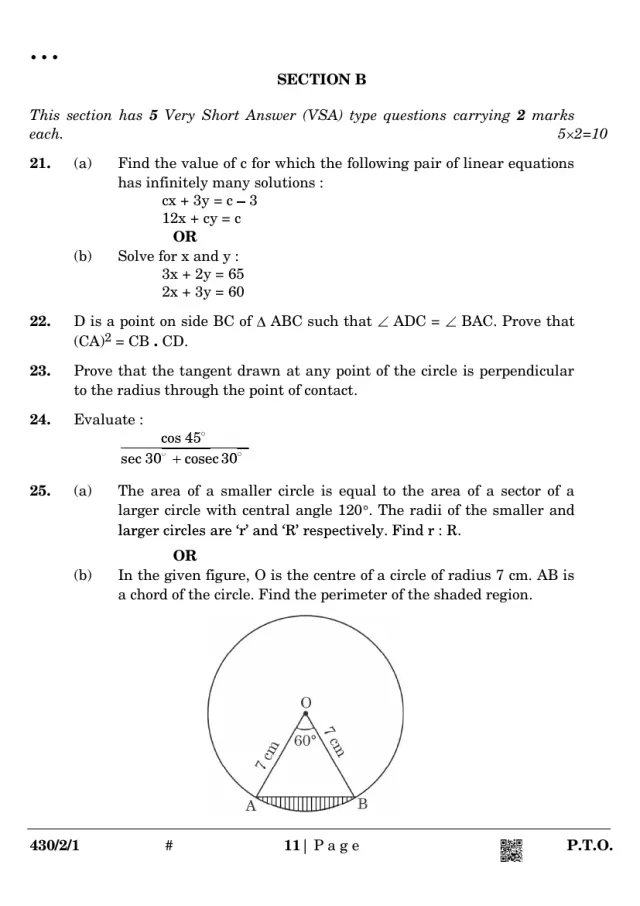
Section B
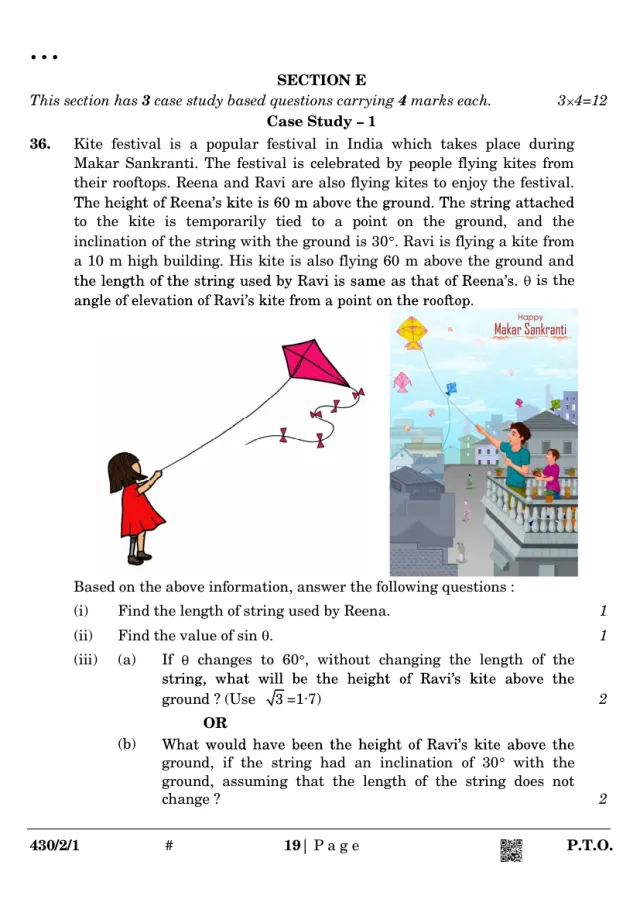
Case study
Your tutor walks you through the paper before you attempt it: the marks, the key ideas, the time plan and the traps.

1-minute paper analysis
With your tutor, in her voice
A short, animated walk through the paper: how it is built, where the marks come from, the four ideas that matter most, how to plan your three hours, and the traps to avoid.
Sound on for the voice. Captions are shown, and you can mute any time.
Try each question first, then open its solution. Tap a number to jump.
20 questions, 1 mark each. MCQs (Q1 to Q18) and assertion-reason (Q19, Q20).
The value of for the two numbers and is:
The number , where is a natural number, cannot end with the digit:
Answer: (D) 0
Report an error on this questionIf is the solution of the equation , then the value of is:
The value of for which has real and equal roots is:
Which of the following equations is a quadratic equation?
Answer: (B)
Report an error on this questionThe distance of the point from the origin is:
The mid-point of the line segment joining points and lies:
Answer: (C) on -axis
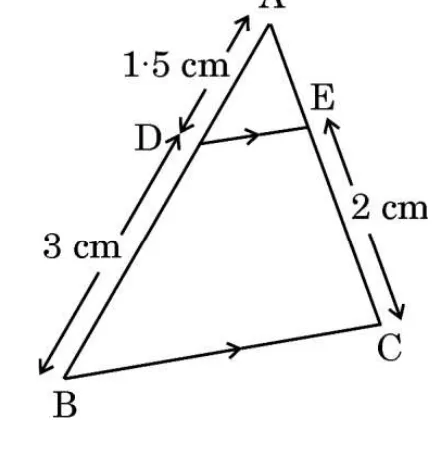
Report an error on this questionIn the given figure, if , cm, cm and cm, the length of is:
In two concentric circles, a tangent to the smaller circle will intersect the larger circle at:
Answer: (C) two points
Report an error on this questionThe value of is:
The value of is:
The length of the shadow of a tower when the sun’s altitude changes from to will:
Answer: (A) become shorter
Report an error on this questionIn the given figure, the shaded region represents:
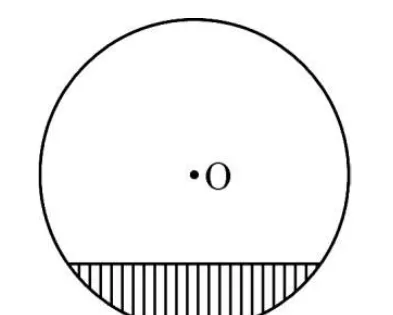
Answer: (C) minor segment
Report an error on this questionThe perimeter of a quadrant of a circle of radius is:
Answer: (D)
Report an error on this questionA cone and a cylinder have the same base radius and volume. The (height of cone : height of cylinder) is:
In the formula of mode given by , denotes the:
Answer: (A) frequency of the modal class
Report an error on this questionFor a distribution, if mean = median = a, then its mode is:
The total number of outcomes in the experiment of simultaneous throw of three dice is:
Assertion (A): The prime numbers which divide also divide .
Reason (R): Any number which divides also divides .
Answer: (C) A is true, but R is false
Report an error on this questionAssertion (A): All congruent triangles are similar.
Reason (R): In congruent triangles, the ratio of corresponding sides is .
Answer: (A) Both A and R are true and R is the correct explanation of A
Report an error on this question5 questions, 2 marks each.
(a) Find the value of for which the following pair of linear equations has infinitely many solutions: , .
OR
(b) Solve for and : , .
Answer: (a) (b) ,
Report an error on this questionis a point on side of such that . Prove that .
Answer: Proved
Report an error on this questionProve that the tangent drawn at any point of the circle is perpendicular to the radius through the point of contact.
Answer: Proved
Report an error on this questionEvaluate:
Answer:
Report an error on this question(a) The area of a smaller circle is equal to the area of a sector of a larger circle with central angle . The radii of the smaller and larger circles are and respectively. Find .
OR
(b) In the given figure, is the centre of a circle of radius cm. is a chord of the circle. Find the perimeter of the shaded region.
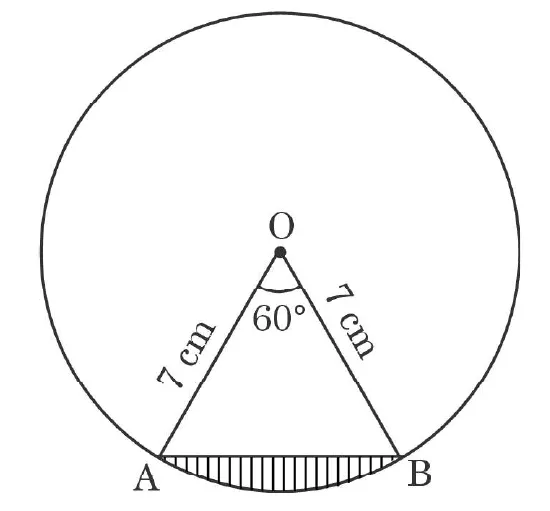
Answer: (a) (b) cm
Report an error on this question6 questions, 3 marks each.
(a) Prove that is an irrational number.
OR
(b) State the “Fundamental Theorem of Arithmetic” and use it to find LCM of and .
Answer: (a) proved (b) LCM
Report an error on this questionFind the zeroes of the polynomial and verify the relationship between the zeroes of and the coefficients of .
Answer: Zeroes and ; both relations verified
Report an error on this question(a) Solve graphically the following pair of linear equations: and . Also, write the coordinates of the points where the lines represented by these equations cut the -axis.
OR
(b) An academy offering cricket coaching bought bats and balls for ₹ . Later, the academy bought bats and balls for ₹ . If there is no change in the cost of the bat and of the ball, find the cost of bat and ball.
Answer: (a) ; -intercepts and (b) bat ₹ , ball ₹
Report an error on this questionIn the given figure, and are tangents at points and of the circle respectively. If reflex , find the measure of each angle of quadrilateral .
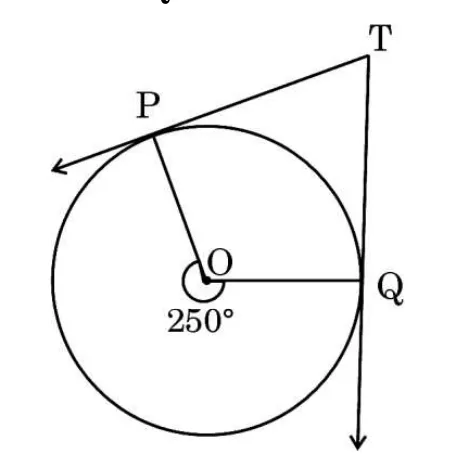
Answer: , ,
Report an error on this questionProve the following trigonometric identity: .
A game of chance consists of spinning a wheel which comes to rest at one of the numbers from 1 to 10 (as shown in the given figure) with equal probabilities.
What is the probability that the wheel stops at:
(i) a prime number greater than 2?
(ii) an odd number less than 9?
(iii) a multiple of 4?
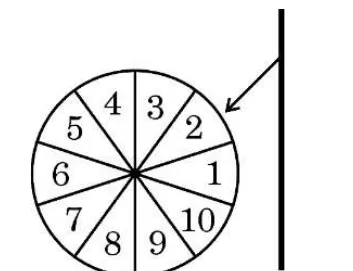
Answer: (i) (ii) (iii)
Report an error on this question4 questions, 5 marks each.
(a) The sum of areas of two squares is cm². If the sum of their perimeters is cm, find the sides of the two given squares.
OR
(b) Express the equation () as a quadratic equation in standard form. Hence, find the roots of the quadratic equation so obtained.
Answer: (a) cm and cm (b) ; roots and
Report an error on this questionState the SAS criteria of similarity of two triangles. In the given figure, it is given that . Use the SAS criteria to prove that .
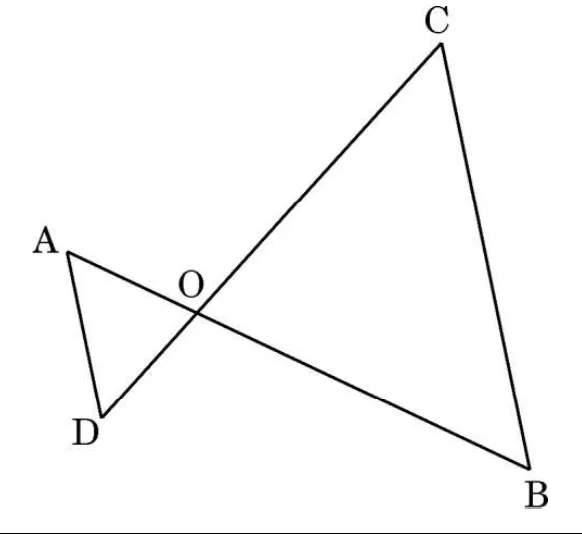
Answer: Proved
Report an error on this questionA wooden article was made by scooping out a hemisphere (of same diameter) from one end of a solid cylinder as shown in the given figure. If the height of the cylinder is cm and the diameter of the cylinder is cm, find the total surface area of the remaining wooden article. (Use )
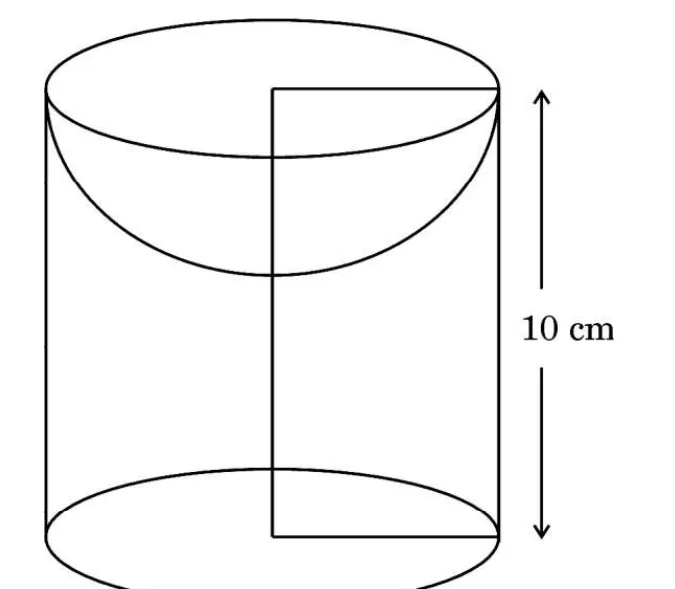
Answer: cm²
Report an error on this question(a) The lengths of leaves of a plant are measured, correct to the nearest millimetre and data obtained is represented in the following table. Find the median length (in mm) of the leaves.
OR
(b) A class teacher has the following absentees record of students of a class. If the mean number of days a student was absent is , find the values of and .
| Length in (mm) | 100–120 | 120–140 | 140–160 | 160–180 | 180–200 |
|---|---|---|---|---|---|
| Number of leaves | 8 | 9 | 12 | 5 | 6 |
Answer: (a) mm (b) ,
Report an error on this question3 case studies, 4 marks each.
Case study 1. Kite festival is a popular festival in India which takes place during Makar Sankranti. The festival is celebrated by people flying kites from their rooftops. Reena and Ravi are also flying kites to enjoy the festival. The height of Reena’s kite is 60 m above the ground. The string attached to the kite is temporarily tied to a point on the ground, and the inclination of the string with the ground is 30°. Ravi is flying a kite from a 10 m high building. His kite is also flying 60 m above the ground and the length of the string used by Ravi is same as that of Reena’s. θ is the angle of elevation of Ravi’s kite from a point on the rooftop.
Based on the above information, answer the following questions:
(i) Find the length of string used by Reena. [1]
(ii) Find the value of sin θ. [1]
(iii) (a) If θ changes to 60°, without changing the length of the string, what will be the height of Ravi’s kite above the ground? (Use √3 = 1.7) [2]
OR
(iii) (b) What would have been the height of Ravi’s kite above the ground, if the string had an inclination of 30° with the ground, assuming that the length of the string does not change? [2]
Answer: (i) m (ii) (iii)(a) m (iii)(b) m
Report an error on this questionCase study 2. A woman borrowed ₹ 10,00,000 from her friend and promised to return the borrowed money in monthly instalments beginning from the next month. After one month, she returned ₹ 10,000, the next month she returned ₹ 15,000, the third month she returned ₹ 20,000 and so on, thereby increasing the monthly instalment uniformly.
Based on the above information, answer the following questions:
(i) Find the amount of instalment paid in the tenth month. [1]
(ii) In which instalment did she pay ₹ 40,000? [1]
(iii) (a) If she returned ₹ 11,50,000 in all, how many instalments did she pay? [2]
OR
(iii) (b) By which instalment has she returned a total amount of ₹ 3,25,000? [2]
Answer: (i) ₹ (ii) (iii)(a) instalments (iii)(b) the instalment
Report an error on this questionCase study 3. A field is in the form of a rectangle. The coordinates of the rectangular field ABCD are A(10, 10), B(40, 10), C(40, 50) and D(x, y). Anil and Anita, two friends decided to have a race. Anita started from point A and moved to point E along the diagonal AC, where E is the point of intersection of both the diagonals of ABCD. From point E, she moved to point B along the other diagonal DB and then moved back to point A along BA. While Anil started from point C and ran to point A via D along the boundary of the field.
Based on the above information, answer the following questions:
(i) Find the coordinates of point E. [1]
(ii) Find the distance between the points B and C. [1]
(iii) (a) Find the coordinates of point D and the distance BD. [2]
OR
(iii) (b) Find the total distance travelled by Anita. [2]
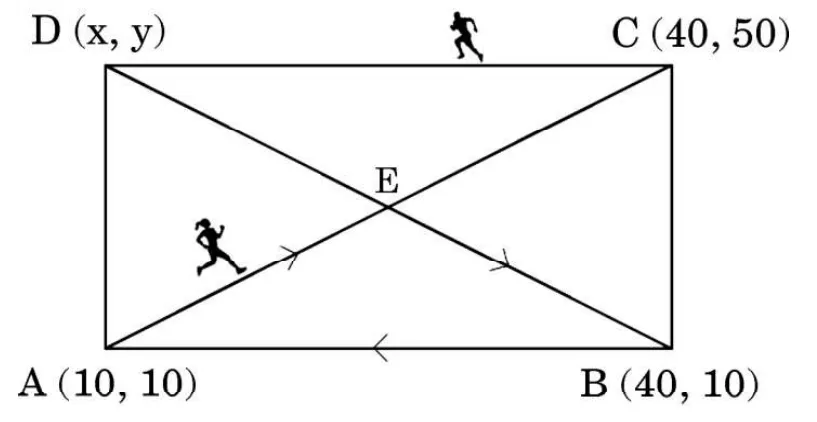
Answer: (i) (ii) (iii)(a) , (iii)(b) units
Report an error on this questionQuestions are from the official CBSE paper. Figures are described in words; see the PDF for the originals. Solutions are written by CogniGuru.
Each chapter below is what the paper tested, with a one-minute animated lesson on the idea behind it.
Trigonometry
Q10, Q11, Q12, Q24, Q30, Q36 (12 marks): standard values and the identity sin² + cos² = 1.
How to remember trig values at 0°, 30°, 45°, 60°, 90° — Class 10Triangles
Q8, Q20, Q22, Q33 (9 marks): similarity criteria, matching angles by sides, and the Basic Proportionality Theorem.
Why are two equal angles enough to prove triangles similar (AA)? — Class 10Congruence vs Similarity — why equal angles alone prove nothingQuadratic Equations
Q4, Q5, Q32 (7 marks): the discriminant, standard form and solving by factorising.
Why does a quadratic have at most two real roots? — Class 10Statistics
Q16, Q17, Q35 (7 marks): mean, median and mode of grouped data.
Mean vs Median vs Mode — why one outlier can lie to youReal Numbers
Q1, Q2, Q19, Q26 (6 marks): HCF and LCM, rational and irrational numbers, and proofs of irrationality.
Rational vs Irrational Numbers — is 22/7 actually equal to π?Why is √2 irrational? The proof — Class 10Linear Equations
Q3, Q21, Q28 (6 marks): solving a pair of equations, graphing it, and when a pair is consistent.
When do two linear equations have no solution? — Class 10Coordinate Geometry
Q6, Q7, Q38 (6 marks): the distance, mid-point and section formulas.
Why is the distance formula just Pythagoras? — Class 10Midpoint Formula vs Section Formula — Class 10Circles
Q9, Q23, Q29 (6 marks): a tangent is perpendicular to the radius, and tangents from one point are equal.
Why is a tangent perpendicular to the radius? — Class 10Probability
Q18, Q31 (4 marks): favourable outcomes over total outcomes, and sure events.
Why is probability always between 0 and 1? — Class 10Arithmetic Progressions
Q37 (4 marks): the nth term and the sum of n terms.
Arithmetic vs Geometric Progression — why doubling always wins eventuallyPolynomials
Q27 (3 marks): zeroes, their sum and product, and reading zeroes from a graph.
Why is the sum of zeroes −b/a and the product c/a? — Class 10Stuck on a step in any solution?
The CogniGuru AI tutor explains any doubt one minute at a time, in English or Hindi. Join the waitlist.
Five real questions from this paper, one each from five chapters. About 2 minutes. See how much you know and where you stand among other students. Attempt free, with no login; log in only for your ranking and full report.
If is the solution of the equation , then the value of is:
0 of 5 answered