CBSE · Class 10 · Mathematics (Standard) · Free

CBSE Class 10 Maths Standard 2023 Question Paper (Set 30/2/1) with Solutions

The official board paper (Q.P. Code 30/2/1, Series WX1YZ/2). Free paper PDF and step-by-step solutions (also as a PDF to download) written by CogniGuru and checked against CBSE’s answer key. See the paper’s main topics in 1 minute, then quiz yourself to see how much you know and where you stand.

No login to download or read the solutions. Login only to see your quiz report in full.

Board
CBSE
Class
10
Subject
Maths Standard (041)
Year
2023
Set code
30/2/1
Max marks
80
Duration
3 hours
Questions
38 (Sections A to E)
Source
Official CBSE paper
Exam date
March 2023

Paper preview

Three pages of the official paper. Download the PDF for all 23.
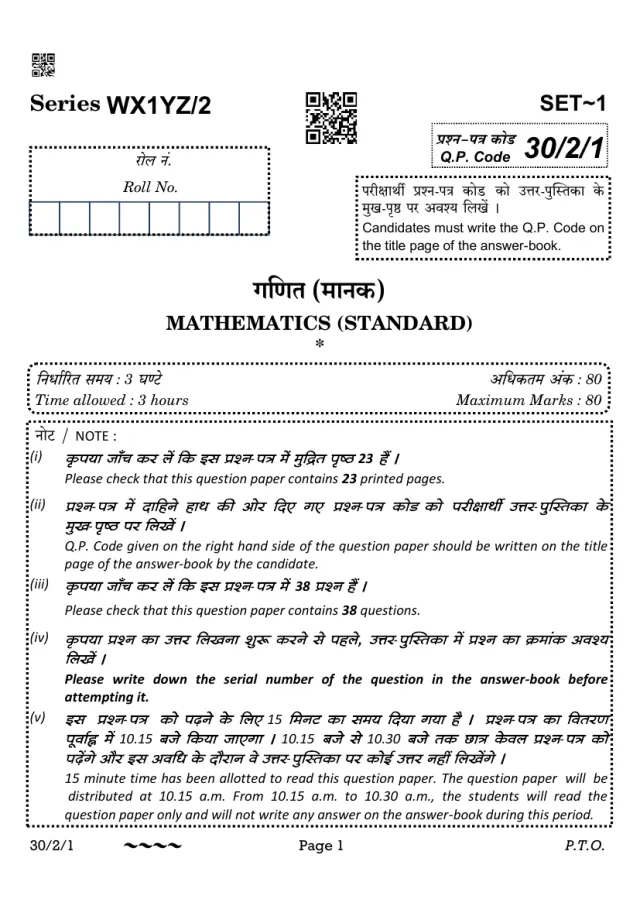
  • Cover page of the CBSE Class 10 Maths Standard 2023 paper, set 30/2/1

    Cover page

  • Section B of the CBSE Class 10 Maths Standard 2023 paper, set 30/2/1

    Section B

  • A case study with its figure from the CBSE Class 10 Maths Standard 2023 paper, set 30/2/1

    Case study

The main topics of this paper, in 1 minute

Your tutor walks you through the paper before you attempt it: the marks, the key ideas, the time plan and the traps.

1-minute paper analysis

With your tutor, in her voice

The main topics of this paper, in about a minute

A short, animated walk through the paper: how it is built, where the marks come from, the four ideas that matter most, how to plan your three hours, and the traps to avoid.

  1. 1The paper at a glance
  2. 2Where the marks come from
  3. 3Four ideas that keep paying off
  4. 4Plan your three hours
  5. 5Four traps to avoid

Sound on for the voice. Captions are shown, and you can mute any time.

Step-by-step solutions

Try each question first, then open its solution. Tap a number to jump.

Download solutions (PDF)

Section A: Multiple choice

20 questions, 1 mark each. MCQs (Q1 to Q18) and assertion-reason (Q19, Q20).

Q1Quadratic Equations1 mark

Which of the following quadratic equations has sum of its roots as 44?

  1. (A)2x2−4x+8=02x^2 - 4x + 8 = 0
  2. (B)−x2+4x+4=0-x^2 + 4x + 4 = 0
  3. (C)2x2−42x+1=0\sqrt{2}x^2 - \dfrac{4}{\sqrt{2}}x + 1 = 0
  4. (D)4x2−4x+4=04x^2 - 4x + 4 = 0
Solution · answer (B)
  1. Sum of roots =−ba= -\dfrac{b}{a}.
  2. (A) −−42=2-\dfrac{-4}{2} = 2. (B) −4−1=4-\dfrac{4}{-1} = 4 ✓. (C) 4/22=2\dfrac{4/\sqrt{2}}{\sqrt{2}} = 2. (D) 44=1\dfrac{4}{4} = 1.

Answer: (B) −x2+4x+4=0-x^2 + 4x + 4 = 0

Report an error on this question
Q2Areas Related to Circles1 mark

What is the length of the arc of the sector of a circle with radius 1414 cm and of central angle 90∘90^\circ?

  1. (A)22 cm
  2. (B)44 cm
  3. (C)88 cm
  4. (D)11 cm
Solution · answer (A)
  1. Arc =90360×2×227×14=14×88=22= \dfrac{90}{360} \times 2 \times \dfrac{22}{7} \times 14 = \dfrac{1}{4} \times 88 = 22 cm.

Answer: (A) 22 cm

Report an error on this question
Q3Triangles1 mark

If △ABC∼△PQR\triangle ABC \sim \triangle PQR with ∠A=32∘\angle A = 32^\circ and ∠R=65∘\angle R = 65^\circ, then the measure of ∠B\angle B is:

  1. (A)32∘32^\circ
  2. (B)65∘65^\circ
  3. (C)83∘83^\circ
  4. (D)97∘97^\circ
Solution · answer (C)
  1. Similar triangles have equal corresponding angles: A↔PA \leftrightarrow P, B↔QB \leftrightarrow Q, C↔RC \leftrightarrow R. So ∠C=∠R=65∘\angle C = \angle R = 65^\circ.
  2. ∠B=180∘−32∘−65∘=83∘\angle B = 180^\circ - 32^\circ - 65^\circ = 83^\circ.

Answer: (C) 83∘83^\circ

Report an error on this question
Q4Real Numbers1 mark

If ‘p’ and ‘q’ are natural numbers and ‘p’ is the multiple of ‘q’, then what is the HCF of ‘p’ and ‘q’?

  1. (A)pq
  2. (B)p
  3. (C)q
  4. (D)p + q
Solution · answer (C)
  1. p=kqp = kq for some natural number kk, so qq divides both pp and qq. No larger number divides qq.
  2. So HCF(p,q)=q\text{HCF}(p, q) = q. (Example: HCF(12,4)=4\text{HCF}(12, 4) = 4.)

Answer: (C) q

Report an error on this question
Q5Coordinate Geometry1 mark

The coordinates of the vertex AA of a rectangle ABCDABCD whose three vertices are given as B(0,0)B(0, 0), C(3,0)C(3, 0) and D(0,4)D(0, 4) are:

  1. (A)(4,0)(4, 0)
  2. (B)(0,3)(0, 3)
  3. (C)(3,4)(3, 4)
  4. (D)(4,3)(4, 3)
Solution · answer (C)
  1. Three corners are B(0,0)B(0, 0), C(3,0)C(3, 0) and D(0,4)D(0, 4). The sides BCBC (along the xx-axis) and BDBD (along the yy-axis) meet at a right angle at BB, so BB is a corner between CC and DD.
  2. The fourth corner is opposite BB: it has the xx-coordinate of CC and the yy-coordinate of DD, so it is (3,4)(3, 4). Check: the diagonal from BB to (3,4)(3, 4) has mid-point (1.5,2)(1.5, 2), which is also the mid-point of CDCD ✓.

Answer: (C) (3,4)(3, 4)

Common mistake: CBSE's key gives (3,4)(3, 4). (The letters ABCDABCD as printed do not go round the rectangle in order, but the fourth vertex is the same.)

Report an error on this question
Q6Linear Equations1 mark

If the pair of equations 3x−y+8=03x - y + 8 = 0 and 6x−ry+16=06x - ry + 16 = 0 represent coincident lines, then the value of ‘rr’ is:

  1. (A)−12-\dfrac{1}{2}
  2. (B)12\dfrac{1}{2}
  3. (C)−2
  4. (D)2
Solution · answer (D)
  1. Coincident lines need 36=−1−r=816\dfrac{3}{6} = \dfrac{-1}{-r} = \dfrac{8}{16}.
  2. 12=1r\dfrac{1}{2} = \dfrac{1}{r}, so r=2r = 2.

Answer: (D) 2

Report an error on this question
Q7Probability1 mark

A bag contains 100 cards numbered 1 to 100. A card is drawn at random from the bag. What is the probability that the number on the card is a perfect cube?

  1. (A)120\dfrac{1}{20}
  2. (B)350\dfrac{3}{50}
  3. (C)125\dfrac{1}{25}
  4. (D)7100\dfrac{7}{100}
Solution · answer (C)
  1. Perfect cubes from 11 to 100100: 13=11^3 = 1, 23=82^3 = 8, 33=273^3 = 27, 43=644^3 = 64. That is 44 cubes (53=1255^3 = 125 is too big).
  2. P=4100=125P = \dfrac{4}{100} = \dfrac{1}{25}.

Answer: (C) 125\dfrac{1}{25}

Report an error on this question
Q8Linear Equations1 mark

The pair of equations x=ax = a and y=by = b graphically represents lines which are:

  1. (A)parallel
  2. (B)intersecting at (b,a)(b, a)
  3. (C)coincident
  4. (D)intersecting at (a,b)(a, b)
Solution · answer (D)
  1. x=ax = a is a vertical line and y=by = b is a horizontal line, so they are perpendicular and meet at one point.
  2. The point has x=ax = a and y=by = b: (a,b)(a, b).

Answer: (D) intersecting at (a,b)(a, b)

Report an error on this question
Q9Polynomials1 mark

If one zero of the polynomial 6x2+37x−(k−2)6x^2 + 37x - (k - 2) is reciprocal of the other, then what is the value of kk?

  1. (A)−4
  2. (B)−6
  3. (C)6
  4. (D)4
Solution · answer (A)
  1. Zeroes that are reciprocals have product 11. Product =−(k−2)6=1= \dfrac{-(k - 2)}{6} = 1.
  2. −(k−2)=6-(k - 2) = 6, so k−2=−6k - 2 = -6 and k=−4k = -4.

Answer: (A) −4

Report an error on this question
Q10Surface Areas and Volumes1 mark

What is the total surface area of a solid hemisphere of diameter ‘dd’?

  1. (A)3πd23\pi d^2
  2. (B)2πd22\pi d^2
  3. (C)12πd2\dfrac{1}{2}\pi d^2
  4. (D)34πd2\dfrac{3}{4}\pi d^2
Solution · answer (D)
  1. Total surface area of a solid hemisphere =3πr2= 3\pi r^2 with r=d2r = \dfrac{d}{2}.
  2. 3π×d24=34πd23\pi \times \dfrac{d^2}{4} = \dfrac{3}{4}\pi d^2.

Answer: (D) 34πd2\dfrac{3}{4}\pi d^2

Common mistake: Using the radius in the answer. The question asks in terms of the diameter d.

Report an error on this question
Q11Probability1 mark

If three coins are tossed simultaneously, what is the probability of getting at most one tail?

  1. (A)38\dfrac{3}{8}
  2. (B)48\dfrac{4}{8}
  3. (C)58\dfrac{5}{8}
  4. (D)78\dfrac{7}{8}
Solution · answer (B)
  1. At most one tail means 00 or 11 tail: HHH,HHT,HTH,THHHHH, HHT, HTH, THH — 44 outcomes out of 88.
  2. P=48P = \dfrac{4}{8}.

Answer: (B) 48\dfrac{4}{8}

Report an error on this question
Q12Triangles1 mark

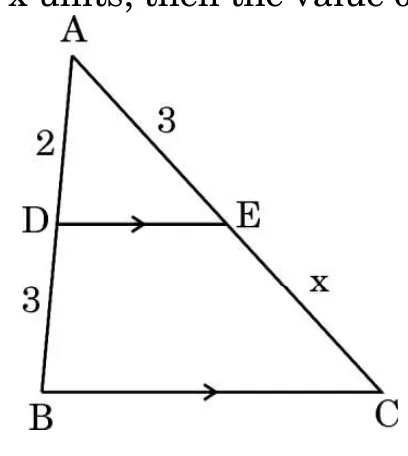
In the given figure, DE∥BCDE \parallel BC. If AD=2AD = 2 units, DB=AE=3DB = AE = 3 units and EC=xEC = x units, then the value of xx is:

Triangle ABC with a line DE parallel to the base BC. AD is marked 2, DB is 3, AE is 3 and EC is x.
  1. (A)2
  2. (B)3
  3. (C)5
  4. (D)92\dfrac{9}{2}
Solution · answer (D)
ABCDEAD/DB = AE/EC → 2/3 = 3/x → x = 9/2
  1. DE∥BCDE \parallel BC, so ADDB=AEEC\dfrac{AD}{DB} = \dfrac{AE}{EC}: 23=3x\dfrac{2}{3} = \dfrac{3}{x}.
  2. x=92x = \dfrac{9}{2}.

Answer: (D) 92\dfrac{9}{2}

Report an error on this question
Q13Areas Related to Circles1 mark

The hour-hand of a clock is 66 cm long. The angle swept by it between 7:207:20 a.m. and 7:557:55 a.m. is:

  1. (A)(354)∘\left(\dfrac{35}{4}\right)^\circ
  2. (B)(352)∘\left(\dfrac{35}{2}\right)^\circ
  3. (C)35∘35^\circ
  4. (D)70∘70^\circ
Solution · answer (B)
  1. Between 7:207{:}20 and 7:557{:}55 is 3535 minutes. The hour hand moves 30∘30^\circ in 6060 minutes, that is 0.5∘0.5^\circ per minute.
  2. Angle =35×12=352= 35 \times \dfrac{1}{2} = \dfrac{35}{2} degrees.

Answer: (B) (352)∘\left(\dfrac{35}{2}\right)^\circ

Common mistake: Using 6° per minute (the minute hand). The hour hand turns only half a degree per minute.

Report an error on this question
Q14Polynomials1 mark

The zeroes of the polynomial p(x)=x2+4x+3p(x) = x^2 + 4x + 3 are given by:

  1. (A)1,31, 3
  2. (B)−1,3-1, 3
  3. (C)1,−31, -3
  4. (D)−1,−3-1, -3
Solution · answer (D)
  1. x2+4x+3=(x+1)(x+3)x^2 + 4x + 3 = (x + 1)(x + 3), so the zeroes are −1-1 and −3-3.

Answer: (D) −1,−3-1, -3

Report an error on this question
Q15Circles1 mark

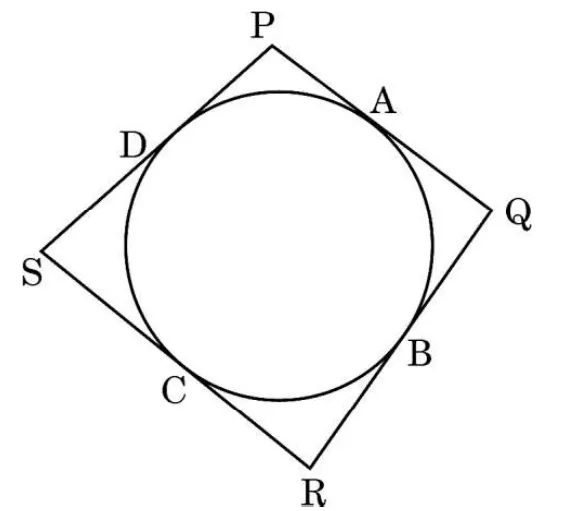
In the given figure, the quadrilateral PQRSPQRS circumscribes a circle. Here PA+CSPA + CS is equal to:

A circle inscribed in the quadrilateral PQRS. The points of contact are A on PQ, B on QR, C on RS and D on SP.
  1. (A)QR
  2. (B)PR
  3. (C)PS
  4. (D)PQ
Solution · answer (C)
  1. Tangents from a point are equal: PA=PDPA = PD (from PP) and CS=DSCS = DS (from SS).
  2. PA+CS=PD+DS=PSPA + CS = PD + DS = PS.

Answer: (C) PS

Report an error on this question
Q16Polynomials1 mark

If α\alpha and β\beta are the zeroes of the quadratic polynomial p(x)=x2−ax−bp(x) = x^2 - ax - b, then the value of α2+β2\alpha^2 + \beta^2 is:

  1. (A)a2−2ba^2 - 2b
  2. (B)a2+2ba^2 + 2b
  3. (C)b2−2ab^2 - 2a
  4. (D)b2+2ab^2 + 2a
Solution · answer (B)
  1. α+β=a\alpha + \beta = a and αβ=−b\alpha\beta = -b.
  2. α2+β2=(α+β)2−2αβ=a2+2b\alpha^2 + \beta^2 = (\alpha + \beta)^2 - 2\alpha\beta = a^2 + 2b.

Answer: (B) a2+2ba^2 + 2b

Report an error on this question
Q17Coordinate Geometry1 mark

The area of the triangle formed by the line xa+yb=1\dfrac{x}{a} + \dfrac{y}{b} = 1 with the coordinate axes is:

  1. (A)abab
  2. (B)12ab\dfrac{1}{2}ab
  3. (C)14ab\dfrac{1}{4}ab
  4. (D)2ab2ab
Solution · answer (B)
  1. The line meets the axes at (a,0)(a, 0) and (0,b)(0, b). With the origin it forms a right triangle with legs ∣a∣|a| and ∣b∣|b|.
  2. Area =12∣ab∣= \dfrac{1}{2}|ab|.

Answer: (B) 12ab\dfrac{1}{2}ab

Report an error on this question
Q18Triangles1 mark

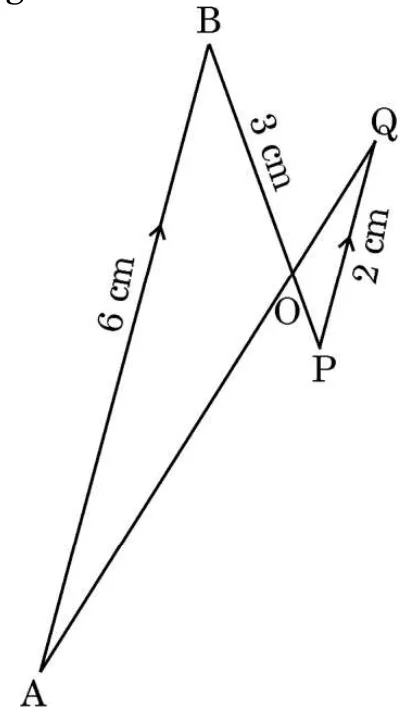
In the given figure, AB∥PQAB \parallel PQ. If AB=6AB = 6 cm, PQ=2PQ = 2 cm and OB=3OB = 3 cm, then the length of OPOP is:

Two lines AQ and BP crossing at O, with AB and PQ drawn parallel to each other, forming two thin triangles. AB is marked 6 cm, PQ 2 cm and OB 3 cm.
  1. (A)9 cm
  2. (B)3 cm
  3. (C)4 cm
  4. (D)1 cm
Solution · answer (D)
62OABPQ△OAB ∼ △OQP: OP/OB = PQ/AB = 1/3, so OP = 1 cm
Not to scale.
  1. AB∥PQAB \parallel PQ, so △OAB∼△OQP\triangle OAB \sim \triangle OQP (alternate angles and vertically opposite angles at OO).
  2. OPOB=PQAB=26=13\dfrac{OP}{OB} = \dfrac{PQ}{AB} = \dfrac{2}{6} = \dfrac{1}{3}, so OP=33=1OP = \dfrac{3}{3} = 1 cm.

Answer: (D) 1 cm

Report an error on this question
Q19Circles1 mark

Assertion (A): A tangent to a circle is perpendicular to the radius through the point of contact.

Reason (R): The lengths of tangents drawn from an external point to a circle are equal.

  1. (A)Both A and R are true and R is the correct explanation of A
  2. (B)Both A and R are true, but R is not the correct explanation of A
  3. (C)A is true, but R is false
  4. (D)A is false, but R is true
Solution · answer (B)
  1. (A) is the standard tangent–radius theorem. True. (R) is also a standard theorem. True.
  2. But the perpendicularity in A is not proved from the equal lengths in R, so R does not explain A.

Answer: (B) Both true, but R is not the correct explanation of A

Report an error on this question
Q20Polynomials1 mark

Assertion (A): The polynomial p(x)=x2+3x+3p(x) = x^2 + 3x + 3 has two real zeroes.

Reason (R): A quadratic polynomial can have at most two real zeroes.

  1. (A)Both A and R are true and R is the correct explanation of A
  2. (B)Both A and R are true, but R is not the correct explanation of A
  3. (C)A is true, but R is false
  4. (D)A is false, but R is true
Solution · answer (D)
  1. (A) D=9−12=−3<0D = 9 - 12 = -3 < 0, so p(x)p(x) has no real zeroes. A is false.
  2. (R) A quadratic has at most two real zeroes. True.

Answer: (D) A is false, R is true

Report an error on this question

Section B: Very short answer

5 questions, 2 marks each.

Q21Real Numbers2 marks

Prove that 2+32 + \sqrt{3} is an irrational number, given that 3\sqrt{3} is an irrational number.

Solution
  1. Suppose 2+32 + \sqrt{3} is rational, equal to pq\dfrac{p}{q} with integers p,qp, q and q≠0q \neq 0.
  2. 3=pq−2=p−2qq\sqrt{3} = \dfrac{p}{q} - 2 = \dfrac{p - 2q}{q}. As p,qp, q are integers, p−2qq\dfrac{p - 2q}{q} is rational, so 3\sqrt{3} would be rational.
  3. This contradicts the given fact that 3\sqrt{3} is irrational. So 2+32 + \sqrt{3} is irrational.

Answer: Proved

Report an error on this question
Q22Trigonometry2 marks

(a) If 4cot⁡245∘−sec⁡260∘+sin⁡260∘+p=344\cot^2 45^\circ - \sec^2 60^\circ + \sin^2 60^\circ + p = \dfrac{3}{4}, then find the value of pp.

OR

(b) If cos⁡A+cos⁡2A=1\cos A + \cos^2 A = 1, then find the value of sin⁡2A+sin⁡4A\sin^2 A + \sin^4 A.

Solution
  1. (a) 4×1−4+34+p=344 \times 1 - 4 + \dfrac{3}{4} + p = \dfrac{3}{4}, so p=0p = 0.
  2. (b) cos⁡A=1−cos⁡2A=sin⁡2A\cos A = 1 - \cos^2 A = \sin^2 A.
  3. sin⁡2A+sin⁡4A=cos⁡A+cos⁡2A=1\sin^2 A + \sin^4 A = \cos A + \cos^2 A = 1.

Answer: (a) p=0p = 0   (b) 11

Report an error on this question
Q23Coordinate Geometry2 marks

Show that the points (−2,3)(-2, 3), (8,3)(8, 3) and (6,7)(6, 7) are the vertices of a right-angled triangle.

Solution
-3-2-11234567891012345678OxyA(−2, 3)B(8, 3)C(6, 7)
AB² = 100 = 20 + 80 = BC² + AC², so ∠C = 90°.
  1. Let A(−2,3)A(-2, 3), B(8,3)B(8, 3), C(6,7)C(6, 7). AB2=102=100AB^2 = 10^2 = 100.
  2. BC2=(8−6)2+(3−7)2=4+16=20BC^2 = (8 - 6)^2 + (3 - 7)^2 = 4 + 16 = 20 and AC2=(6+2)2+(7−3)2=64+16=80AC^2 = (6 + 2)^2 + (7 - 3)^2 = 64 + 16 = 80.
  3. BC2+AC2=100=AB2BC^2 + AC^2 = 100 = AB^2, so by the converse of Pythagoras the triangle is right-angled at CC.

Answer: Shown: right angle at C

Report an error on this question
Q24Applications of Trigonometry2 marks

(a) The length of the shadow of a tower on the plane ground is 3\sqrt{3} times the height of the tower. Find the angle of elevation of the sun.

OR

(b) The angle of elevation of the top of a tower from a point on the ground which is 3030 m away from the foot of the tower, is 30∘30^\circ. Find the height of the tower.

Solution
θ = 30°h√3 hABCtan θ = h / √3h = 1/√3, so θ = 30°
  1. (a) Let the height be hh, so the shadow is 3h\sqrt{3}h. tan⁡θ=h3h=13\tan\theta = \dfrac{h}{\sqrt{3}h} = \dfrac{1}{\sqrt{3}}, so θ=30∘\theta = 30^\circ.
  2. (b) tan⁡30∘=h30\tan 30^\circ = \dfrac{h}{30}, so h=303=103h = \dfrac{30}{\sqrt{3}} = 10\sqrt{3} m.

Answer: (a) 30∘30^\circ   (b) 10310\sqrt{3} m

Report an error on this question
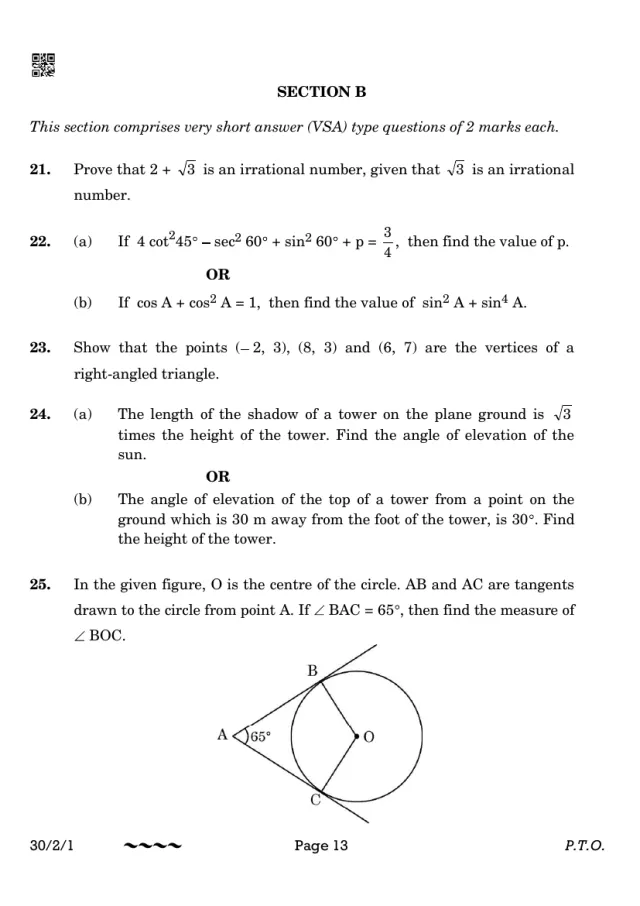
Q25Circles2 marks

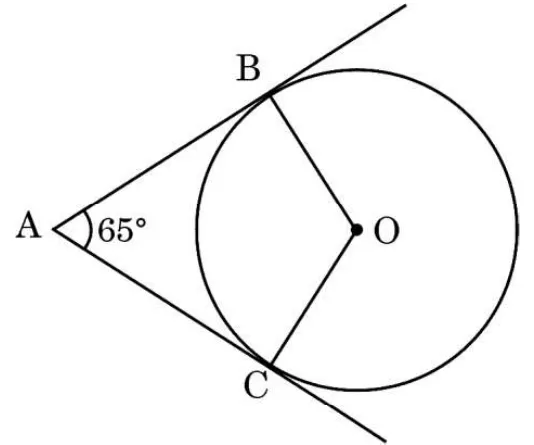
In the given figure, OO is the centre of the circle. ABAB and ACAC are tangents drawn to the circle from point AA. If ∠BAC=65∘\angle BAC = 65^\circ, then find the measure of ∠BOC\angle BOC.

A circle with centre O on the right. Two tangents AB and AC from the point A on the left touch the circle at B (above) and C (below). OB and OC are drawn and the angle BAC is marked 65 degrees.
Solution
65°115°OABCquadrilateral ABOC: ∠BOC = 360° − 90° − 90° − 65° = 115°
  1. OB⊥ABOB \perp AB and OC⊥ACOC \perp AC (radius and tangent), so ∠OBA=∠OCA=90∘\angle OBA = \angle OCA = 90^\circ.
  2. In quadrilateral ABOCABOC: ∠BAC+∠BOC=180∘\angle BAC + \angle BOC = 180^\circ, so ∠BOC=180∘−65∘=115∘\angle BOC = 180^\circ - 65^\circ = 115^\circ.

Answer: ∠BOC=115∘\angle BOC = 115^\circ

Report an error on this question

Section C: Short answer

6 questions, 3 marks each.

Q26Real Numbers3 marks

(a) Find by prime factorisation the LCM of the numbers 1818018180 and 75757575. Also, find the HCF of the two numbers.

OR

(b) Three bells ring at intervals of 66, 1212 and 1818 minutes. If all the three bells rang at 66 a.m., when will they ring together again?

Solution
  1. (a) 18180=22×32×5×10118180 = 2^2 \times 3^2 \times 5 \times 101 and 7575=3×52×1017575 = 3 \times 5^2 \times 101.
  2. LCM (greatest powers) =22×32×52×101=90900= 2^2 \times 3^2 \times 5^2 \times 101 = 90900. HCF (smallest powers) =3×5×101=1515= 3 \times 5 \times 101 = 1515.
  3. (b) They ring together again after the LCM of 6,12,186, 12, 18, which is 3636 minutes.
  4. So they ring together next at 6:366{:}36 a.m.

Answer: (a) LCM =90900= 90900, HCF =1515= 1515   (b) 6:366{:}36 a.m.

Report an error on this question
Q27Trigonometry3 marks

Prove that: (1cos⁡θ−cos⁡θ)(1sin⁡θ−sin⁡θ)=1tan⁡θ+cot⁡θ\left(\dfrac{1}{\cos\theta} - \cos\theta\right)\left(\dfrac{1}{\sin\theta} - \sin\theta\right) = \dfrac{1}{\tan\theta + \cot\theta}

Solution
  1. LHS =1−cos⁡2θcos⁡θ×1−sin⁡2θsin⁡θ=sin⁡2θcos⁡θ×cos⁡2θsin⁡θ=sin⁡θcos⁡θ= \dfrac{1 - \cos^2\theta}{\cos\theta} \times \dfrac{1 - \sin^2\theta}{\sin\theta} = \dfrac{\sin^2\theta}{\cos\theta} \times \dfrac{\cos^2\theta}{\sin\theta} = \sin\theta\cos\theta.
  2. RHS =1sin⁡θcos⁡θ+cos⁡θsin⁡θ=sin⁡θcos⁡θsin⁡2θ+cos⁡2θ=sin⁡θcos⁡θ= \dfrac{1}{\frac{\sin\theta}{\cos\theta} + \frac{\cos\theta}{\sin\theta}} = \dfrac{\sin\theta\cos\theta}{\sin^2\theta + \cos^2\theta} = \sin\theta\cos\theta.
  3. LHS = RHS.

Answer: Proved

Report an error on this question
Q28Coordinate Geometry3 marks

If Q(0,1)Q(0, 1) is equidistant from P(5,−3)P(5, -3) and R(x,6)R(x, 6), find the values of xx.

Solution
  1. PQ=QRPQ = QR, so PQ2=QR2PQ^2 = QR^2: (5−0)2+(−3−1)2=(x−0)2+(6−1)2(5 - 0)^2 + (-3 - 1)^2 = (x - 0)^2 + (6 - 1)^2.
  2. 25+16=x2+2525 + 16 = x^2 + 25, so x2=16x^2 = 16 and x=4x = 4 or x=−4x = -4.

Answer: x=4x = 4 or x=−4x = -4

Report an error on this question
Q29Areas Related to Circles3 marks

A car has two wipers which do not overlap. Each wiper has a blade of length 2121 cm sweeping through an angle of 120∘120^\circ. Find the total area cleaned at each sweep of the two blades.

Solution
462 cm²462 cm²each: 120/360 × π × 21² = 462; both: 924 cm²
  1. Each blade sweeps a sector of radius 2121 cm and angle 120∘120^\circ: area =120360×227×21×21=13×1386=462= \dfrac{120}{360} \times \dfrac{22}{7} \times 21 \times 21 = \dfrac{1}{3} \times 1386 = 462 cm².
  2. Two blades (no overlap): 2×462=9242 \times 462 = 924 cm².

Answer: 924924 cm²

Report an error on this question
Q30Linear Equations3 marks

(a) If the system of linear equations 2x+3y=72x + 3y = 7 and 2ax+(a+b)y=282ax + (a + b)y = 28 has infinitely many solutions, find the values of aa and bb.

OR

(b) If 217x+131y=913217x + 131y = 913 and 131x+217y=827131x + 217y = 827, then solve the equations for the values of xx and yy.

Solution
  1. (a) Infinitely many solutions need 22a=3a+b=728\dfrac{2}{2a} = \dfrac{3}{a + b} = \dfrac{7}{28}.
  2. 1a=14\dfrac{1}{a} = \dfrac{1}{4} gives a=4a = 4. 3a+b=14\dfrac{3}{a + b} = \dfrac{1}{4} gives a+b=12a + b = 12, so b=8b = 8.
  3. (b) Add: 348(x+y)=1740348(x + y) = 1740, so x+y=5x + y = 5. Subtract: 86(x−y)=8686(x - y) = 86, so x−y=1x - y = 1.
  4. Hence x=3x = 3 and y=2y = 2.

Answer: (a) a=4, b=8a = 4,\ b = 8   (b) x=3, y=2x = 3,\ y = 2

Report an error on this question
Q31Circles3 marks

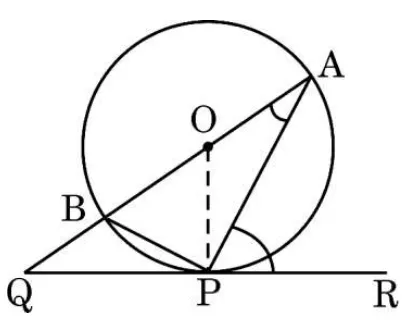
In the given figure, OO is the centre of the circle and QPRQPR is a tangent to it at PP. Prove that ∠QAP+∠APR=90∘\angle QAP + \angle APR = 90^\circ.

A circle with centre O. The line QPR is a tangent touching the circle at P at the bottom. The line from Q passes through B and O to A on the circle, and A is joined to P.
Solution
xxOPABQROA = OP → ∠OPA = ∠OAP = ∠QAP; ∠OPA + ∠APR = 90°
The chord from Q through the centre is drawn as in the figure.
  1. OA=OPOA = OP (radii), so in △OAP\triangle OAP: ∠OPA=∠OAP\angle OPA = \angle OAP. … (i)
  2. OP⊥QROP \perp QR (radius and tangent), so ∠OPA+∠APR=90∘\angle OPA + \angle APR = 90^\circ. … (ii)
  3. ∠OAP\angle OAP is the same as ∠QAP\angle QAP (as QQ, OO, AA are in a line). So from (i), (ii): ∠QAP+∠APR=90∘\angle QAP + \angle APR = 90^\circ.

Answer: Proved

Report an error on this question

Section D: Long answer

4 questions, 5 marks each.

Q32Arithmetic Progressions5 marks

How many terms of the arithmetic progression 45,39,33,…45, 39, 33, \dots must be taken so that their sum is 180180? Explain the double answer.

Solution
  1. a=45a = 45 and d=−6d = -6. Sn=n2[2×45+(n−1)(−6)]=180S_n = \dfrac{n}{2}[2 \times 45 + (n - 1)(-6)] = 180.
  2. n2[96−6n]=180\dfrac{n}{2}[96 - 6n] = 180, so n(48−3n)=180n(48 - 3n) = 180, that is 3n2−48n+180=03n^2 - 48n + 180 = 0 and n2−16n+60=0n^2 - 16n + 60 = 0.
  3. (n−6)(n−10)=0(n - 6)(n - 10) = 0, so n=6n = 6 or n=10n = 10.
  4. Why two answers: the terms are 45,39,33,27,21,15,9,3,−3,−9,…45, 39, 33, 27, 21, 15, 9, 3, -3, -9, \dots. The sum of the 77th, 88th, 99th and 1010th terms is 9+3−3−9=09 + 3 - 3 - 9 = 0, because some terms are positive and some are negative. So the sum is 180180 after 66 terms and again after 1010 terms.

Answer: n=6n = 6 or n=10n = 10 (the terms 77 to 1010 add up to 00)

Report an error on this question
Q33Applications of Trigonometry5 marks

(a) As observed from the top of a 7575 m high lighthouse from the sea-level, the angles of depression of two ships are 30∘30^\circ and 60∘60^\circ. If one ship is exactly behind the other on the same side of the lighthouse, find the distance between the two ships. (Use 3=1.73\sqrt{3} = 1.73)

OR

(b) From a point on the ground, the angle of elevation of the bottom and top of a transmission tower fixed at the top of 3030 m high building are 30∘30^\circ and 60∘60^\circ, respectively. Find the height of the transmission tower. (Use 3=1.73\sqrt{3} = 1.73)

Solution
60°30°75 mBARSBR = 25√3, BS = 75√3: RS = 50√3 ≈ 86.5 m
30°60°CBTUbuilding 30 mtower 60 mCB = 30√3 m
  1. (a) Let PQ=75PQ = 75 m be the lighthouse, with ships RR (60∘60^\circ, nearer) and SS (30∘30^\circ, farther) on the same side.
  2. tan⁡60∘=75PR\tan 60^\circ = \dfrac{75}{PR}, so PR=753=253PR = \dfrac{75}{\sqrt{3}} = 25\sqrt{3} m. tan⁡30∘=75PS\tan 30^\circ = \dfrac{75}{PS}, so PS=753PS = 75\sqrt{3} m.
  3. RS=PS−PR=753−253=503=50×1.73=86.5RS = PS - PR = 75\sqrt{3} - 25\sqrt{3} = 50\sqrt{3} = 50 \times 1.73 = 86.5 m.
  4. (b) Let the building be AB=30AB = 30 m, the tower BP=hBP = h, and the point on the ground CC. tan⁡30∘=30AC\tan 30^\circ = \dfrac{30}{AC}, so AC=303AC = 30\sqrt{3} m.
  5. tan⁡60∘=30+hAC=3\tan 60^\circ = \dfrac{30 + h}{AC} = \sqrt{3}, so 30+h=303×3=9030 + h = 30\sqrt{3} \times \sqrt{3} = 90 and h=60h = 60 m.

Answer: (a) 86.586.5 m   (b) 6060 m

Common mistake: In (a), adding the distances. The ships are on the same side, one behind the other, so subtract.

Report an error on this question
Q34Statistics5 marks

A student noted the number of cars passing through a spot on a road for 100 periods each of 3 minutes and summarised it in the table given below. Find the mean and median of the following data.

Number of cars0 – 1010 – 2020 – 3030 – 4040 – 5050 – 6060 – 7070 – 80
Frequency (periods)71413122011158
Solution
102030405060708048121620Ocarsy71413122011158median 42
Median class: 40 – 50.
  1. Class marks xix_i: 5,15,25,35,45,55,65,755, 15, 25, 35, 45, 55, 65, 75. fixif_i x_i: 35, 210, 325, 420, 900, 605, 975, 60035,\ 210,\ 325,\ 420,\ 900,\ 605,\ 975,\ 600. ∑fi=100\sum f_i = 100 and ∑fixi=4070\sum f_i x_i = 4070.
  2. Mean =4070100=40.7= \dfrac{4070}{100} = 40.7.
  3. Cumulative frequencies: 7,21,34,46,66,77,92,1007, 21, 34, 46, 66, 77, 92, 100. N2=50\dfrac{N}{2} = 50, so the median class is 40−5040 - 50: l=40l = 40, cf=46cf = 46, f=20f = 20, h=10h = 10.
  4. Median =40+50−4620×10=40+2=42= 40 + \dfrac{50 - 46}{20} \times 10 = 40 + 2 = 42.

Answer: Mean =40.7= 40.7 and Median =42= 42

Report an error on this question
Q35Triangles5 marks

(a) Sides ABAB and BCBC and median ADAD of a triangle ABCABC are respectively proportional to sides PQPQ and QRQR and median PMPM of △PQR\triangle PQR. Show that △ABC∼△PQR\triangle ABC \sim \triangle PQR.

OR

(b) Through the mid-point MM of the side CDCD of a parallelogram ABCDABCD, the line BMBM is drawn intersecting ACAC in LL and ADAD (produced) in EE. Prove that EL=2BLEL = 2BL.

Solution
ABCDMEL△BMC ≅ △EMD → AE = 2BC; △AEL ∼ △CBL (2 : 1) → EL = 2BL
  1. (a) DD and MM are mid-points of BCBC and QRQR, so BC=2BDBC = 2BD and QR=2QMQR = 2QM. Given ABPQ=BCQR=ADPM\dfrac{AB}{PQ} = \dfrac{BC}{QR} = \dfrac{AD}{PM}, we get ABPQ=BDQM=ADPM\dfrac{AB}{PQ} = \dfrac{BD}{QM} = \dfrac{AD}{PM}.
  2. So △ABD∼△PQM\triangle ABD \sim \triangle PQM (SSS), giving ∠B=∠Q\angle B = \angle Q.
  3. In △ABC\triangle ABC and △PQR\triangle PQR: ABPQ=BCQR\dfrac{AB}{PQ} = \dfrac{BC}{QR} and ∠B=∠Q\angle B = \angle Q. So △ABC∼△PQR\triangle ABC \sim \triangle PQR (SAS).
  4. (b) In △BMC\triangle BMC and △EMD\triangle EMD: MC=MDMC = MD (MM is the mid-point), ∠CMB=∠DME\angle CMB = \angle DME (vertically opposite) and ∠MBC=∠MED\angle MBC = \angle MED (alternate angles, BC∥AEBC \parallel AE). So △BMC≅△EMD\triangle BMC \cong \triangle EMD and BC=DEBC = DE.
  5. AD=BCAD = BC (parallelogram), so AD=DEAD = DE and AE=2BCAE = 2BC.
  6. Now AE∥BCAE \parallel BC, so △AEL∼△CBL\triangle AEL \sim \triangle CBL: ELBL=AEBC=2BCBC=2\dfrac{EL}{BL} = \dfrac{AE}{BC} = \dfrac{2BC}{BC} = 2, so EL=2BLEL = 2BL.

Answer: (a) △ABC∼△PQR\triangle ABC \sim \triangle PQR   (b) EL=2BLEL = 2BL

Report an error on this question

Section E: Case studies

3 case studies, 4 marks each.

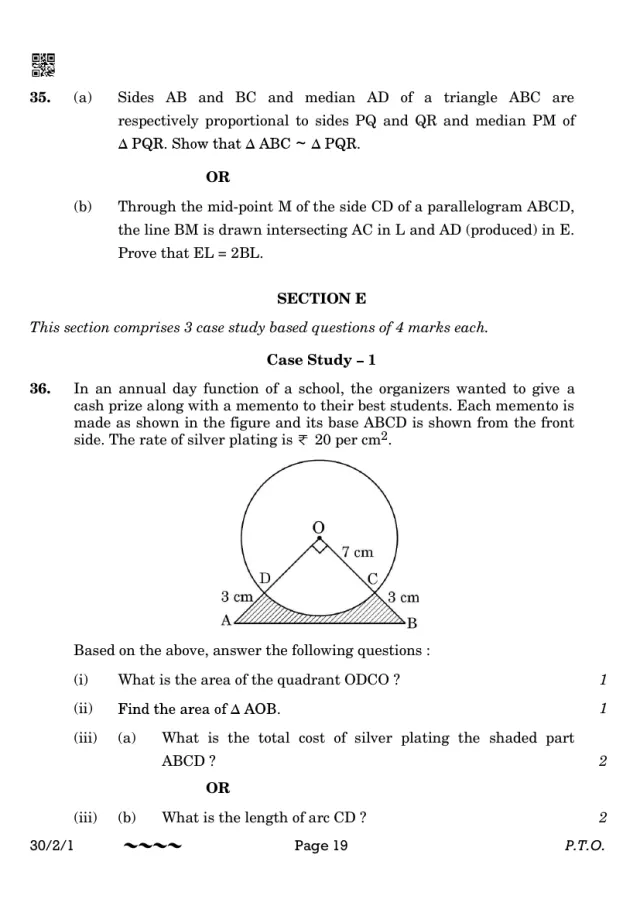
Q36Areas Related to Circles4 marks

Case study 1. In an annual day function of a school, the organizers wanted to give a cash prize along with a memento to their best students. Each memento is made as shown in the figure and its base ABCD is shown from the front side. The rate of silver plating is ₹ 20 per cm².

Based on the above, answer the following questions:

(i) What is the area of the quadrant ODCO? [1]

(ii) Find the area of ΔAOB. [1]

(iii) (a) What is the total cost of silver plating the shaded part ABCD? [2]

OR

(iii) (b) What is the length of arc CD? [2]
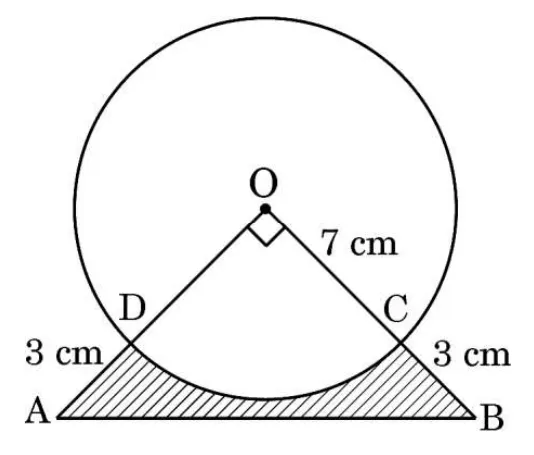
A circle of radius 7 cm with centre O. Lines OA and OB leave O at a right angle, cutting the circle at D and C, with AD and BC each marked 3 cm. The region ABCD below the circle between the line AB and the arc DC is shaded.
Solution
ODCABshaded = △AOB − quadrant = 50 − 38.5 = 11.5 cm²quadrant ODCO
  1. (i) Quadrant of radius 77 cm: 14×227×7×7=772=38.5\dfrac{1}{4} \times \dfrac{22}{7} \times 7 \times 7 = \dfrac{77}{2} = 38.5 cm².
  2. (ii) OA=OB=7+3=10OA = OB = 7 + 3 = 10 cm with ∠AOB=90∘\angle AOB = 90^\circ: area =12×10×10=50= \dfrac{1}{2} \times 10 \times 10 = 50 cm².
  3. (iii)(a) Shaded area =50−38.5=11.5= 50 - 38.5 = 11.5 cm². Cost =11.5×20=₹230= 11.5 \times 20 = ₹230.
  4. (iii)(b) Arc CD=90360×2×227×7=11CD = \dfrac{90}{360} \times 2 \times \dfrac{22}{7} \times 7 = 11 cm.

Answer: (i) 38.538.5 cm²   (ii) 5050 cm²   (iii)(a) ₹ 230230   (iii)(b) 1111 cm

Report an error on this question
Q37Surface Areas and Volumes4 marks

Case study 2. In a coffee shop, coffee is served in two types of cups. One is cylindrical in shape with diameter 7 cm and height 14 cm and the other is hemispherical with diameter 21 cm.

Based on the above, answer the following questions:

(i) Find the area of the base of the cylindrical cup. [1]

(ii) (a) What is the capacity of the hemispherical cup? [2]

OR

(ii) (b) Find the capacity of the cylindrical cup. [2]

(iii) What is the curved surface area of the cylindrical cup? [1]
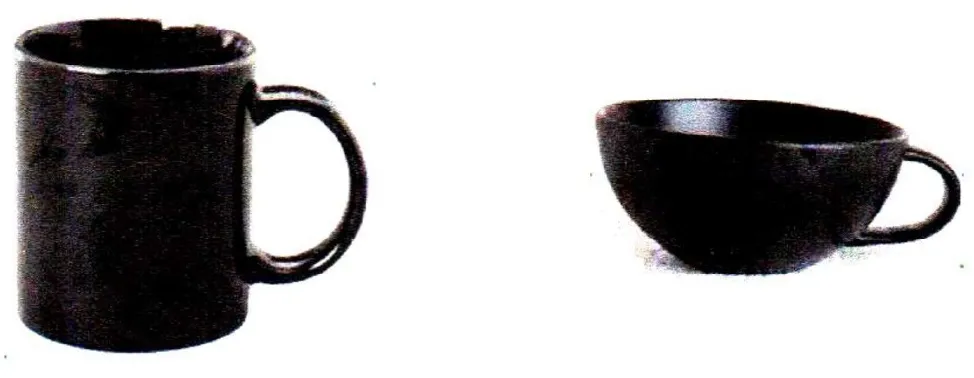
A photo of a black cylindrical mug with a handle on the left and a black hemispherical bowl-shaped cup with a handle on the right.
Solution
  1. Cylindrical cup: r=3.5r = 3.5 cm, h=14h = 14 cm. Hemispherical cup: r=10.5r = 10.5 cm.
  2. (i) Base area =πr2=227×3.5×3.5=38.5= \pi r^2 = \dfrac{22}{7} \times 3.5 \times 3.5 = 38.5 cm².
  3. (ii)(a) Capacity of the hemisphere =23πr3=23×227×10.53=2425.5= \dfrac{2}{3}\pi r^3 = \dfrac{2}{3} \times \dfrac{22}{7} \times 10.5^3 = 2425.5 cm³.
  4. (ii)(b) Capacity of the cylinder =πr2h=38.5×14=539= \pi r^2 h = 38.5 \times 14 = 539 cm³.
  5. (iii) Curved surface area =2πrh=2×227×3.5×14=308= 2\pi r h = 2 \times \dfrac{22}{7} \times 3.5 \times 14 = 308 cm².

Answer: (i) 38.538.5 cm²   (ii)(a) 2425.52425.5 cm³   (ii)(b) 539539 cm³   (iii) 308308 cm²

Report an error on this question
Q38Probability4 marks

Case study 3. Computer-based learning (CBL) refers to any teaching methodology that makes use of computers for information transmission. At an elementary school level, computer applications can be used to display multimedia lesson plans. A survey was done on 1000 elementary and secondary schools of Assam and they were classified by the number of computers they had.

One school is chosen at random. Then:

(i) Find the probability that the school chosen at random has more than 100 computers. [1]

(ii) (a) Find the probability that the school chosen at random has 50 or fewer computers. [2]

OR

(ii) (b) Find the probability that the school chosen at random has no more than 20 computers. [2]

(iii) Find the probability that the school chosen at random has 10 or less than 10 computers. [1]

Number of computers1 – 1011 – 2021 – 5051 – 100101 and more
Number of schools25020029018080
Solution
123454080120160200240280320Oxy25020029018080
Classes left to right: 1–10, 11–20, 21–50, 51–100, 101 and more.
  1. Total schools =250+200+290+180+80=1000= 250 + 200 + 290 + 180 + 80 = 1000.
  2. (i) More than 100100 computers: 8080 schools. P=801000=0.08P = \dfrac{80}{1000} = 0.08.
  3. (ii)(a) 5050 or fewer: 250+200+290=740250 + 200 + 290 = 740. P=7401000=0.74P = \dfrac{740}{1000} = 0.74.
  4. (ii)(b) No more than 2020: 250+200=450250 + 200 = 450. P=4501000=0.45P = \dfrac{450}{1000} = 0.45.
  5. (iii) 1010 or less: 250250 schools. P=2501000=0.25P = \dfrac{250}{1000} = 0.25.

Answer: (i) 0.080.08   (ii)(a) 0.740.74   (ii)(b) 0.450.45   (iii) 0.250.25

Report an error on this question

Questions are from the official CBSE paper. Figures are described in words; see the PDF for the originals. Solutions are written by CogniGuru.

Revise this paper in 1 minute a chapter

Each chapter below is what the paper tested, with a one-minute animated lesson on the idea behind it.

Stuck on a step in any solution?

The CogniGuru AI tutor explains any doubt one minute at a time, in English or Hindi. Join the waitlist.

Mock quiz: 5 questions from this paper

Five real questions from this paper, one each from five chapters. About 2 minutes. See how much you know and where you stand among other students. Attempt free, with no login; log in only for your ranking and full report.

Question 1 of 5 · Q1 of the paperQuadratic Equations

Which of the following quadratic equations has sum of its roots as 44?

0 of 5 answered

Related papers

  • Maths Standard 2022Coming soon
  • Maths Standard 2024
  • Maths Basic 2023Coming soon
  • Science 2023Coming soon

Common questions

Are these the official CBSE Class 10 Maths Standard 2023 questions?
Yes. The questions are from the official Mathematics (Standard) paper (set 30/2/1) that CBSE published after the March 2023 board exam. The solutions are written by CogniGuru and checked against the answer key CBSE published for this paper code.
Can I download the CBSE Class 10 Maths Standard 2023 question paper PDF?
Yes, the official paper PDF is free to download from this page, and so are our step-by-step solutions as a PDF. No login is needed to download either or to read the solutions.
Do all sets of the paper have the same questions?
No. CBSE sets several versions of each paper, with the same blueprint and similar questions in a different order and sometimes with different numbers. This page covers set 30/2/1.
How does the quiz work, and what does “where you stand” mean?
It is a mock quiz of 5 real multiple-choice questions from this paper, scored automatically in about 2 minutes. Your score is compared, anonymously, with other students who took the same quiz. Only the score is stored with the comparison, never your name or number.

Source

CBSE question paper archive, Class X, 2023 (Mathematics (Standard), set 30/2/1)
PDF