CBSE · Class 10 · Mathematics (Standard) · Free

CBSE Class 10 Maths Standard 2024 Question Paper (Set 30/1/1) with Solutions

The official board paper (Q.P. Code 30/1/1, Series C3ABD/1). Free paper PDF and step-by-step solutions (also as a PDF to download) written by CogniGuru and checked against CBSE’s answer key. See the paper’s main topics in 1 minute, then quiz yourself to see how much you know and where you stand.

No login to download or read the solutions. Login only to see your quiz report in full.

Board
CBSE
Class
10
Subject
Maths Standard (041)
Year
2024
Set code
30/1/1
Max marks
80
Duration
3 hours
Questions
38 (Sections A to E)
Source
Official CBSE paper
Exam date
March 2024

Paper preview

Three pages of the official paper. Download the PDF for all 16.
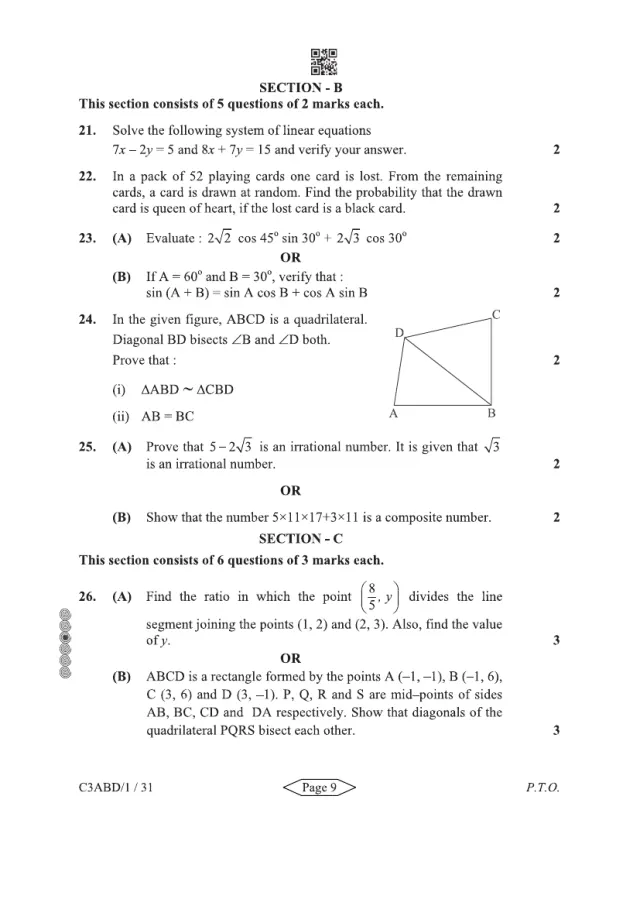
  • Cover page of the CBSE Class 10 Maths Standard 2024 paper, set 30/1/1

    Cover page

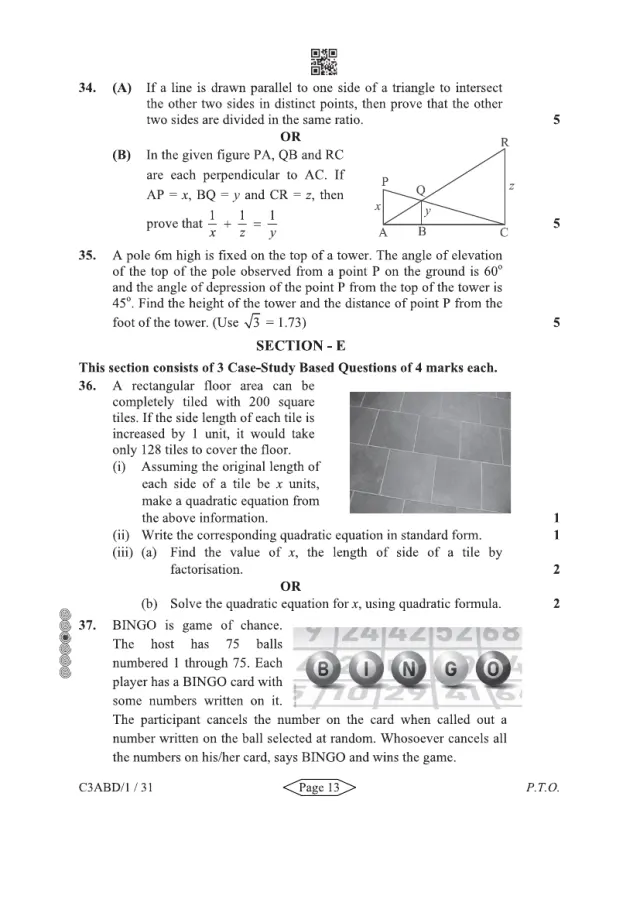
  • Section B of the CBSE Class 10 Maths Standard 2024 paper, set 30/1/1

    Section B

  • A case study with its figure from the CBSE Class 10 Maths Standard 2024 paper, set 30/1/1

    Case study

The main topics of this paper, in 1 minute

Your tutor walks you through the paper before you attempt it: the marks, the key ideas, the time plan and the traps.

1-minute paper analysis

With your tutor, in her voice

The main topics of this paper, in about a minute

A short, animated walk through the paper: how it is built, where the marks come from, the four ideas that matter most, how to plan your three hours, and the traps to avoid.

  1. 1The paper at a glance
  2. 2Where the marks come from
  3. 3Four ideas that keep paying off
  4. 4Plan your three hours
  5. 5Four traps to avoid

Sound on for the voice. Captions are shown, and you can mute any time.

Step-by-step solutions

Try each question first, then open its solution. Tap a number to jump.

Download solutions (PDF)

Section A: Multiple choice

20 questions, 1 mark each. MCQs (Q1 to Q18) and assertion-reason (Q19, Q20).

Q1Polynomials1 mark

If the sum of zeroes of the polynomial p(x)=2x2−k2 x+1p(x) = 2x^2 - k\sqrt{2}\,x + 1 is 2\sqrt{2}, then value of kk is:

  1. (A)2\sqrt{2}
  2. (B)2
  3. (C)222\sqrt{2}
  4. (D)12\dfrac{1}{2}
Solution · answer (B)
  1. Sum of zeroes =−ba=−−k22=k22= -\dfrac{b}{a} = -\dfrac{-k\sqrt{2}}{2} = \dfrac{k\sqrt{2}}{2}.
  2. k22=2\dfrac{k\sqrt{2}}{2} = \sqrt{2}, so k=2k = 2.

Answer: (B) 2

Report an error on this question
Q2Probability1 mark

If the probability of a player winning a game is 0.79, then the probability of his losing the same game is:

  1. (A)1.79
  2. (B)0.31
  3. (C)0.21%
  4. (D)0.21
Solution · answer (D)
  1. P(win)+P(lose)=1P(\text{win}) + P(\text{lose}) = 1, so P(lose)=1−0.79=0.21P(\text{lose}) = 1 - 0.79 = 0.21.
  2. (Option C is 0.21%0.21\%, which is 0.00210.0021, a different number.)

Answer: (D) 0.21

Report an error on this question
Q3Quadratic Equations1 mark

If the roots of equation ax2+bx+c=0ax^2 + bx + c = 0, a≠0a \neq 0 are real and equal, then which of the following relation is true?

  1. (A)a=b2ca = \dfrac{b^2}{c}
  2. (B)b2=acb^2 = ac
  3. (C)ac=b24ac = \dfrac{b^2}{4}
  4. (D)c=b2ac = \dfrac{b^2}{a}
Solution · answer (C)
  1. Real and equal roots need D=b2−4ac=0D = b^2 - 4ac = 0.
  2. So b2=4acb^2 = 4ac, that is ac=b24ac = \dfrac{b^2}{4}.

Answer: (C) ac=b24ac = \dfrac{b^2}{4}

Report an error on this question
Q4Arithmetic Progressions1 mark

In an A.P., if the first term a=7a = 7, nnth term an=84a_n = 84 and the sum of first nn terms Sn=20932S_n = \dfrac{2093}{2}, then nn is equal to:

  1. (A)22
  2. (B)24
  3. (C)23
  4. (D)26
Solution · answer (C)
  1. Sn=n2(a+an)=n2(7+84)=91n2S_n = \dfrac{n}{2}(a + a_n) = \dfrac{n}{2}(7 + 84) = \dfrac{91n}{2}.
  2. 91n2=20932\dfrac{91n}{2} = \dfrac{2093}{2}, so n=209391=23n = \dfrac{2093}{91} = 23.

Answer: (C) 23

Report an error on this question
Q5Real Numbers1 mark

If two positive integers pp and qq can be expressed as p=18a2b4p = 18a^2b^4 and q=20a3b2q = 20a^3b^2, where aa and bb are prime numbers, then LCM(p,q)\text{LCM}(p, q) is:

  1. (A)2a2b22a^2b^2
  2. (B)180a2b2180a^2b^2
  3. (C)12a2b212a^2b^2
  4. (D)180a3b4180a^3b^4
Solution · answer (D)
  1. p=2×32×a2×b4p = 2 \times 3^2 \times a^2 \times b^4 and q=22×5×a3×b2q = 2^2 \times 5 \times a^3 \times b^2.
  2. LCM takes the greatest power of each prime: 22×32×5×a3×b4=180a3b42^2 \times 3^2 \times 5 \times a^3 \times b^4 = 180a^3b^4.

Answer: (D) 180a3b4180a^3b^4

Report an error on this question
Q6Coordinate Geometry1 mark

ADAD is a median of △ABC\triangle ABC with vertices A(5,−6)A(5, -6), B(6,4)B(6, 4) and C(0,0)C(0, 0). Length ADAD is equal to:

  1. (A)68\sqrt{68} units
  2. (B)2152\sqrt{15} units
  3. (C)101\sqrt{101} units
  4. (D)10 units
Solution · answer (A)
  1. DD is the mid-point of BCBC: D=(6+02, 4+02)=(3,2)D = \left(\dfrac{6 + 0}{2},\ \dfrac{4 + 0}{2}\right) = (3, 2).
  2. AD=(5−3)2+(−6−2)2=4+64=68AD = \sqrt{(5 - 3)^2 + (-6 - 2)^2} = \sqrt{4 + 64} = \sqrt{68} units.

Answer: (A) 68\sqrt{68} units

Report an error on this question
Q7Trigonometry1 mark

If sec⁡θ−tan⁡θ=m\sec\theta - \tan\theta = m, then the value of sec⁡θ+tan⁡θ\sec\theta + \tan\theta is:

  1. (A)1−1m1 - \dfrac{1}{m}
  2. (B)m2−1m^2 - 1
  3. (C)1m\dfrac{1}{m}
  4. (D)−m-m
Solution · answer (C)
  1. (sec⁡θ−tan⁡θ)(sec⁡θ+tan⁡θ)=sec⁡2θ−tan⁡2θ=1(\sec\theta - \tan\theta)(\sec\theta + \tan\theta) = \sec^2\theta - \tan^2\theta = 1.
  2. So m(sec⁡θ+tan⁡θ)=1m(\sec\theta + \tan\theta) = 1 and sec⁡θ+tan⁡θ=1m\sec\theta + \tan\theta = \dfrac{1}{m}.

Answer: (C) 1m\dfrac{1}{m}

Report an error on this question
Q8Probability1 mark

From the data 1, 4, 7, 9, 16, 21, 25, if all the even numbers are removed, then the probability of getting at random a prime number from the remaining is:

  1. (A)25\dfrac{2}{5}
  2. (B)15\dfrac{1}{5}
  3. (C)17\dfrac{1}{7}
  4. (D)27\dfrac{2}{7}
Solution · answer (B)
  1. Removing the even numbers 44 and 1616 leaves 1,7,9,21,251, 7, 9, 21, 25: 55 numbers.
  2. Of these only 77 is prime (11 is not prime; 9,21,259, 21, 25 are composite). So P=15P = \dfrac{1}{5}.

Answer: (B) 15\dfrac{1}{5}

Common mistake: Counting 1 as a prime number. It is neither prime nor composite.

Report an error on this question
Q9Statistics1 mark

For some data x1,x2,…,xnx_1, x_2, \dots, x_n with respective frequencies f1,f2,…,fnf_1, f_2, \dots, f_n, the value of ∑i=1nfi(xi−xˉ)\sum_{i=1}^{n} f_i(x_i - \bar{x}) is equal to:

  1. (A)nxˉn\bar{x}
  2. (B)1
  3. (C)∑fi\sum f_i
  4. (D)0
Solution · answer (D)
  1. ∑fi(xi−xˉ)=∑fixi−xˉ∑fi\sum f_i(x_i - \bar{x}) = \sum f_i x_i - \bar{x}\sum f_i.
  2. Since xˉ=∑fixi∑fi\bar{x} = \dfrac{\sum f_i x_i}{\sum f_i}, we have xˉ∑fi=∑fixi\bar{x}\sum f_i = \sum f_i x_i, so the difference is 00. The deviations from the mean always add to zero.

Answer: (D) 0

Report an error on this question
Q10Polynomials1 mark

The zeroes of a polynomial x2+px+qx^2 + px + q are twice the zeroes of the polynomial 4x2−5x−64x^2 - 5x - 6. The value of pp is:

  1. (A)−52-\dfrac{5}{2}
  2. (B)52\dfrac{5}{2}
  3. (C)−5
  4. (D)10
Solution · answer (A)
  1. Sum of zeroes of 4x2−5x−64x^2 - 5x - 6 is 54\dfrac{5}{4}.
  2. The new zeroes are twice these, so their sum is 2×54=522 \times \dfrac{5}{4} = \dfrac{5}{2}.
  3. For x2+px+qx^2 + px + q, the sum of zeroes is −p-p. So −p=52-p = \dfrac{5}{2} and p=−52p = -\dfrac{5}{2}.

Answer: (A) −52-\dfrac{5}{2}

Common mistake: Forgetting the minus sign: the sum of zeroes is −p-p, not pp.

Report an error on this question
Q11Coordinate Geometry1 mark

If the distance between the points (3,−5)(3, -5) and (x,−5)(x, -5) is 1515 units, then the values of xx are:

  1. (A)12, −18
  2. (B)−12, 18
  3. (C)18, 5
  4. (D)−9, −12
Solution · answer (B)
  1. The yy-coordinates are equal, so the distance is ∣x−3∣=15|x - 3| = 15.
  2. x−3=15x - 3 = 15 gives x=18x = 18 and x−3=−15x - 3 = -15 gives x=−12x = -12.

Answer: (B) −12, 18

Report an error on this question
Q12Trigonometry1 mark

If cos⁡(α+β)=0\cos(\alpha + \beta) = 0, then value of cos⁡(α+β2)\cos\left(\dfrac{\alpha + \beta}{2}\right) is equal to:

  1. (A)12\dfrac{1}{\sqrt{2}}
  2. (B)12\dfrac{1}{2}
  3. (C)0
  4. (D)2\sqrt{2}
Solution · answer (A)
  1. cos⁡(α+β)=0\cos(\alpha + \beta) = 0 gives α+β=90∘\alpha + \beta = 90^\circ.
  2. cos⁡(90∘2)=cos⁡45∘=12\cos\left(\dfrac{90^\circ}{2}\right) = \cos 45^\circ = \dfrac{1}{\sqrt{2}}.

Answer: (A) 12\dfrac{1}{\sqrt{2}}

Report an error on this question
Q13Surface Areas and Volumes1 mark

A solid sphere is cut into two hemispheres. The ratio of the surface areas of sphere to that of two hemispheres taken together, is:

  1. (A)1 : 1
  2. (B)1 : 4
  3. (C)2 : 3
  4. (D)3 : 2
Solution · answer (C)
  1. Surface area of the sphere =4πr2= 4\pi r^2.
  2. Each hemisphere has curved surface 2πr22\pi r^2 plus a flat circle πr2\pi r^2, so total surface area 3πr23\pi r^2. Two together: 6πr26\pi r^2.
  3. Ratio =4πr2:6πr2=2:3= 4\pi r^2 : 6\pi r^2 = 2 : 3.

Answer: (C) 2 : 3

Common mistake: Forgetting the two new flat circular faces created when the sphere is cut.

Report an error on this question
Q14Statistics1 mark

The middle most observation of every data arranged in order is called:

  1. (A)mode
  2. (B)median
  3. (C)mean
  4. (D)deviation
Solution · answer (B)
  1. The median is the middle value of data arranged in order. The mode is the most frequent value and the mean is the average.

Answer: (B) median

Report an error on this question
Q15Surface Areas and Volumes1 mark

The volume of the largest right circular cone that can be carved out from a solid cube of edge 2 cm is:

  1. (A)4π3\dfrac{4\pi}{3} cu cm
  2. (B)5π3\dfrac{5\pi}{3} cu cm
  3. (C)8π3\dfrac{8\pi}{3} cu cm
  4. (D)2π3\dfrac{2\pi}{3} cu cm
Solution · answer (D)
ABCDedge 2 cmr = 1V = ⅓ π r² h = ⅓ π × 1 × 2 = 2π/3 cm³
  1. The largest cone has its base inscribed in one face of the cube and its height equal to the edge. So base diameter =2= 2 cm, r=1r = 1 cm and h=2h = 2 cm.
  2. V=13πr2h=13×π×12×2=2π3V = \dfrac{1}{3}\pi r^2 h = \dfrac{1}{3} \times \pi \times 1^2 \times 2 = \dfrac{2\pi}{3} cm³.

Answer: (D) 2π3\dfrac{2\pi}{3} cu cm

Common mistake: Using r=2r = 2. The base circle fits inside a face of side 22 cm, so its diameter is 22 and its radius is 11.

Report an error on this question
Q16Probability1 mark

Two dice are rolled together. The probability of getting sum of numbers on the two dice as 2, 3 or 5, is:

  1. (A)736\dfrac{7}{36}
  2. (B)1136\dfrac{11}{36}
  3. (C)536\dfrac{5}{36}
  4. (D)49\dfrac{4}{9}
Solution · answer (A)
  1. Total outcomes =36= 36.
  2. Sum 22: (1,1)(1, 1) → 11 way. Sum 33: (1,2),(2,1)(1, 2), (2, 1) → 22 ways. Sum 55: (1,4),(2,3),(3,2),(4,1)(1, 4), (2, 3), (3, 2), (4, 1) → 44 ways.
  3. Favourable =1+2+4=7= 1 + 2 + 4 = 7. P=736P = \dfrac{7}{36}.

Answer: (A) 736\dfrac{7}{36}

Report an error on this question
Q17Coordinate Geometry1 mark

The centre of a circle is at (2,0)(2, 0). If one end of a diameter is at (6,0)(6, 0), then the other end is at:

  1. (A)(0,0)(0, 0)
  2. (B)(4,0)(4, 0)
  3. (C)(−2,0)(-2, 0)
  4. (D)(−6,0)(-6, 0)
Solution · answer (C)
  1. The centre is the mid-point of the diameter. Let the other end be (x,y)(x, y): x+62=2\dfrac{x + 6}{2} = 2 and y+02=0\dfrac{y + 0}{2} = 0.
  2. x=−2x = -2 and y=0y = 0. The other end is (−2,0)(-2, 0).

Answer: (C) (−2,0)(-2, 0)

Report an error on this question
Q18Linear Equations1 mark

In the given figure, graphs of two linear equations are shown. The pair of these linear equations is:
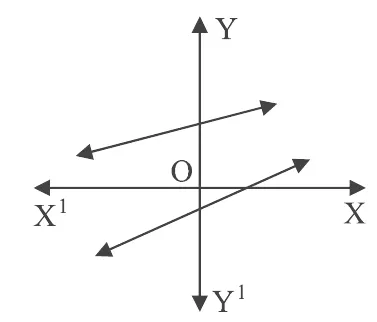
Two straight lines drawn on axes. One line is above the other and they slope upwards at different angles, so if extended they would cross at one point.
  1. (A)consistent with unique solution.
  2. (B)consistent with infinitely many solutions.
  3. (C)inconsistent.
  4. (D)inconsistent but can be made consistent by extending these lines.
Solution · answer (A)
  1. The two lines in the figure have different slopes, so they are not parallel and not the same line.
  2. Lines that are not parallel meet at exactly one point (when extended), so the pair is consistent with a unique solution.

Answer: (A) consistent with unique solution.

Report an error on this question
Q19Circles1 mark

Assertion (A): The tangents drawn at the end points of a diameter of a circle, are parallel.

Reason (R): Diameter of a circle is the longest chord.

  1. (A)Both A and R are true and R is the correct explanation of A
  2. (B)Both A and R are true, but R is not the correct explanation of A
  3. (C)A is true, but R is false
  4. (D)A is false, but R is true
Solution · answer (B)
  1. (A) Each tangent is perpendicular to the diameter at its end, so the two tangents are parallel. True.
  2. (R) The diameter is the longest chord. True.
  3. But the parallel tangents come from "tangent ⊥\perp radius", not from the diameter being the longest chord. So R does not explain A.

Answer: (B) Both true, but R is not the correct explanation of A

Report an error on this question
Q20Polynomials1 mark

Assertion (A): If the graph of a polynomial touches xx-axis at only one point, then the polynomial cannot be a quadratic polynomial.

Reason (R): A polynomial of degree nn (n>1n > 1) can have at most nn zeroes.

  1. (A)Both A and R are true and R is the correct explanation of A
  2. (B)Both A and R are true, but R is not the correct explanation of A
  3. (C)A is true, but R is false
  4. (D)A is false, but R is true
Solution · answer (D)
  1. (A) x2x^2 is a quadratic polynomial whose graph touches the xx-axis at only one point, (0,0)(0, 0). So the assertion is false.
  2. (R) A polynomial of degree nn has at most nn zeroes. True.

Answer: (D) A is false, R is true

Report an error on this question

Section B: Very short answer

5 questions, 2 marks each.

Q21Linear Equations2 marks

Solve the following system of linear equations 7x−2y=57x - 2y = 5 and 8x+7y=158x + 7y = 15 and verify your answer.

Solution
  1. Multiply the first by 77 and the second by 22: 49x−14y=3549x - 14y = 35 and 16x+14y=3016x + 14y = 30.
  2. Add: 65x=6565x = 65, so x=1x = 1. Then 7−2y=57 - 2y = 5 gives y=1y = 1.
  3. Verify: 7(1)−2(1)=57(1) - 2(1) = 5 ✓ and 8(1)+7(1)=158(1) + 7(1) = 15 ✓.

Answer: x=1, y=1x = 1,\ y = 1

Report an error on this question
Q22Probability2 marks

In a pack of 52 playing cards one card is lost. From the remaining cards, a card is drawn at random. Find the probability that the drawn card is queen of heart, if the lost card is a black card.

Solution
  1. The lost card is black, so all red cards, including the queen of hearts, are still in the pack. The pack now has 52−1=5152 - 1 = 51 cards.
  2. There is 11 queen of hearts. P=151P = \dfrac{1}{51}.

Answer: 151\dfrac{1}{51}

Report an error on this question
Q23Trigonometry2 marks

(A) Evaluate: 22cos⁡45∘sin⁡30∘+23cos⁡30∘2\sqrt{2}\cos 45^\circ \sin 30^\circ + 2\sqrt{3}\cos 30^\circ

OR

(B) If A=60∘A = 60^\circ and B=30∘B = 30^\circ, verify that: sin⁡(A+B)=sin⁡Acos⁡B+cos⁡Asin⁡B\sin(A + B) = \sin A\cos B + \cos A\sin B

Solution
  1. (A) 22×12×12+23×32=1+3=42\sqrt{2} \times \dfrac{1}{\sqrt{2}} \times \dfrac{1}{2} + 2\sqrt{3} \times \dfrac{\sqrt{3}}{2} = 1 + 3 = 4.
  2. (B) LHS =sin⁡(60∘+30∘)=sin⁡90∘=1= \sin(60^\circ + 30^\circ) = \sin 90^\circ = 1.
  3. RHS =sin⁡60∘cos⁡30∘+cos⁡60∘sin⁡30∘=32×32+12×12=34+14=1= \sin 60^\circ\cos 30^\circ + \cos 60^\circ\sin 30^\circ = \dfrac{\sqrt{3}}{2} \times \dfrac{\sqrt{3}}{2} + \dfrac{1}{2} \times \dfrac{1}{2} = \dfrac{3}{4} + \dfrac{1}{4} = 1.
  4. LHS == RHS, so the identity is verified.

Answer: (A) 44   (B) verified, both sides are 11

Report an error on this question
Q24Triangles2 marks

In the given figure, ABCD is a quadrilateral. Diagonal BD bisects ∠B and ∠D both. Prove that: (i) △ABD ∼ △CBD (ii) AB = BC
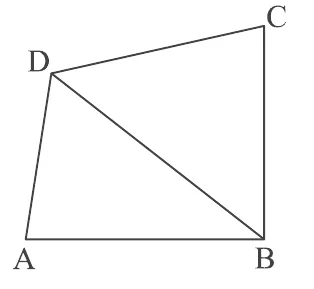
A quadrilateral ABCD with A at the bottom left, B at the bottom right, C at the top right and D at the top left. The diagonal BD is drawn.
Solution
1234ABCD∠1 = ∠2, ∠3 = ∠4 and BD common: △ABD ≅ △CBD
  1. (i) In △ABD\triangle ABD and △CBD\triangle CBD: ∠ABD=∠CBD\angle ABD = \angle CBD (BD bisects ∠B\angle B) and ∠ADB=∠CDB\angle ADB = \angle CDB (BD bisects ∠D\angle D).
  2. So △ABD∼△CBD\triangle ABD \sim \triangle CBD by AA similarity.
  3. (ii) BDBD is common to both triangles, so the similar triangles have a pair of equal corresponding sides (BD=BDBD = BD). They are therefore congruent (ASA), and AB=BCAB = BC.

Answer: (i) △ABD∼△CBD\triangle ABD \sim \triangle CBD   (ii) AB=BCAB = BC

Report an error on this question
Q25Real Numbers2 marks

(A) Prove that 5−235 - 2\sqrt{3} is an irrational number. It is given that 3\sqrt{3} is an irrational number.

OR

(B) Show that the number 5×11×17+3×115 \times 11 \times 17 + 3 \times 11 is a composite number.

Solution
  1. (A) Suppose 5−235 - 2\sqrt{3} is rational, equal to ab\dfrac{a}{b} with integers a,ba, b and b≠0b \neq 0.
  2. Then 23=5−ab=5b−ab2\sqrt{3} = 5 - \dfrac{a}{b} = \dfrac{5b - a}{b}, so 3=5b−a2b\sqrt{3} = \dfrac{5b - a}{2b}, which is rational.
  3. But 3\sqrt{3} is irrational (given), a contradiction. So 5−235 - 2\sqrt{3} is irrational.
  4. (B) 5×11×17+3×11=11(5×17+3)=11×88=9685 \times 11 \times 17 + 3 \times 11 = 11(5 \times 17 + 3) = 11 \times 88 = 968.
  5. The number is a product of two factors, 1111 and 8888, both greater than 11, so it has more than two factors: it is composite.

Answer: (A) proved   (B) 968=11×88968 = 11 \times 88 is composite

Report an error on this question

Section C: Short answer

6 questions, 3 marks each.

Q26Coordinate Geometry3 marks

(A) Find the ratio in which the point (85,y)\left(\dfrac{8}{5}, y\right) divides the line segment joining the points (1,2)(1, 2) and (2,3)(2, 3). Also, find the value of yy.

OR

(B) ABCDABCD is a rectangle formed by the points A(−1,−1)A(-1, -1), B(−1,6)B(-1, 6), C(3,6)C(3, 6) and D(3,−1)D(3, -1). P,Q,RP, Q, R and SS are mid-points of sides AB,BC,CDAB, BC, CD and DADA respectively. Show that diagonals of the quadrilateral PQRSPQRS bisect each other.

Solution
-2-11234-2-11234567OxyP(−1, 5/2)Q(1, 6)R(3, 5/2)S(1, −1)(1, 5/2)
  1. (A) Let the point divide the segment in the ratio k:1k : 1. x=k×2+1×1k+1=85x = \dfrac{k \times 2 + 1 \times 1}{k + 1} = \dfrac{8}{5}.
  2. 10k+5=8k+810k + 5 = 8k + 8, so k=32k = \dfrac{3}{2}. The ratio is 3:23 : 2.
  3. y=3×3+2×23+2=135y = \dfrac{3 \times 3 + 2 \times 2}{3 + 2} = \dfrac{13}{5}.
  4. (B) P=(−1,52)P = \left(-1, \dfrac{5}{2}\right), Q=(1,6)Q = (1, 6), R=(3,52)R = \left(3, \dfrac{5}{2}\right), S=(1,−1)S = (1, -1) (mid-points of ABAB, BCBC, CDCD, DADA).
  5. Mid-point of diagonal PR=(−1+32, 5/2+5/22)=(1,52)PR = \left(\dfrac{-1 + 3}{2},\ \dfrac{5/2 + 5/2}{2}\right) = \left(1, \dfrac{5}{2}\right). Mid-point of diagonal QS=(1+12, 6−12)=(1,52)QS = \left(\dfrac{1 + 1}{2},\ \dfrac{6 - 1}{2}\right) = \left(1, \dfrac{5}{2}\right).
  6. Both diagonals have the same mid-point, so PRPR and QSQS bisect each other.

Answer: (A) ratio 3:23 : 2, y=135y = \dfrac{13}{5}   (B) shown

Report an error on this question
Q27Real Numbers3 marks

In a teachers' workshop, the number of teachers teaching French, Hindi and English are 48, 80 and 144 respectively. Find the minimum number of rooms required if in each room the same number of teachers are seated and all of them are of the same subject.

Solution
  1. The fewest rooms means the most teachers in each room. The number in each room must divide 4848, 8080 and 144144, so use the HCF.
  2. 48=24×348 = 2^4 \times 3, 80=24×580 = 2^4 \times 5, 144=24×32144 = 2^4 \times 3^2. HCF=24=16\text{HCF} = 2^4 = 16.
  3. Rooms: 4816+8016+14416=3+5+9=17\dfrac{48}{16} + \dfrac{80}{16} + \dfrac{144}{16} = 3 + 5 + 9 = 17.

Answer: 17 rooms

Common mistake: Using the LCM. The groups must divide each subject’s count exactly, so the HCF is needed.

Report an error on this question
Q28Trigonometry3 marks

Prove that: tan⁡θ1−cot⁡θ+cot⁡θ1−tan⁡θ=1+sec⁡θ cosec θ\dfrac{\tan\theta}{1 - \cot\theta} + \dfrac{\cot\theta}{1 - \tan\theta} = 1 + \sec\theta\,\mathrm{cosec}\,\theta

Solution
  1. Write tan⁡θ=sin⁡θcos⁡θ\tan\theta = \dfrac{\sin\theta}{\cos\theta} and cot⁡θ=cos⁡θsin⁡θ\cot\theta = \dfrac{\cos\theta}{\sin\theta}. First term: sin⁡θ/cos⁡θ(sin⁡θ−cos⁡θ)/sin⁡θ=sin⁡2θcos⁡θ(sin⁡θ−cos⁡θ)\dfrac{\sin\theta/\cos\theta}{(\sin\theta - \cos\theta)/\sin\theta} = \dfrac{\sin^2\theta}{\cos\theta(\sin\theta - \cos\theta)}.
  2. Second term: cos⁡θ/sin⁡θ(cos⁡θ−sin⁡θ)/cos⁡θ=cos⁡2θsin⁡θ(cos⁡θ−sin⁡θ)=−cos⁡2θsin⁡θ(sin⁡θ−cos⁡θ)\dfrac{\cos\theta/\sin\theta}{(\cos\theta - \sin\theta)/\cos\theta} = \dfrac{\cos^2\theta}{\sin\theta(\cos\theta - \sin\theta)} = -\dfrac{\cos^2\theta}{\sin\theta(\sin\theta - \cos\theta)}.
  3. Sum =1sin⁡θ−cos⁡θ[sin⁡2θcos⁡θ−cos⁡2θsin⁡θ]=1sin⁡θ−cos⁡θ⋅sin⁡3θ−cos⁡3θsin⁡θcos⁡θ= \dfrac{1}{\sin\theta - \cos\theta}\left[\dfrac{\sin^2\theta}{\cos\theta} - \dfrac{\cos^2\theta}{\sin\theta}\right] = \dfrac{1}{\sin\theta - \cos\theta} \cdot \dfrac{\sin^3\theta - \cos^3\theta}{\sin\theta\cos\theta}.
  4. Use a3−b3=(a−b)(a2+ab+b2)a^3 - b^3 = (a - b)(a^2 + ab + b^2): sin⁡3θ−cos⁡3θ=(sin⁡θ−cos⁡θ)(1+sin⁡θcos⁡θ)\sin^3\theta - \cos^3\theta = (\sin\theta - \cos\theta)(1 + \sin\theta\cos\theta).
  5. Sum =1+sin⁡θcos⁡θsin⁡θcos⁡θ=1sin⁡θcos⁡θ+1=1+sec⁡θ cosec θ= \dfrac{1 + \sin\theta\cos\theta}{\sin\theta\cos\theta} = \dfrac{1}{\sin\theta\cos\theta} + 1 = 1 + \sec\theta\,\mathrm{cosec}\,\theta = RHS.

Answer: Proved

Report an error on this question
Q29Linear Equations3 marks

Three years ago, Rashmi was thrice as old as Nazma. Ten years later, Rashmi will be twice as old as Nazma. How old are Rashmi and Nazma now?

Solution
  1. Let Rashmi's present age be xx years and Nazma's be yy years.
  2. Three years ago: x−3=3(y−3)x - 3 = 3(y - 3), so x−3y+6=0x - 3y + 6 = 0. … (i)
  3. Ten years later: x+10=2(y+10)x + 10 = 2(y + 10), so x−2y−10=0x - 2y - 10 = 0. … (ii)
  4. Subtract (i) from (ii): y−16=0y - 16 = 0, so y=16y = 16. Then x=3×16−6=42x = 3 \times 16 - 6 = 42.
  5. Check: 42−3=39=3×1342 - 3 = 39 = 3 \times 13 ✓ and 42+10=52=2×2642 + 10 = 52 = 2 \times 26 ✓.

Answer: Rashmi is 42 years old and Nazma is 16 years old

Report an error on this question
Q30Circles3 marks

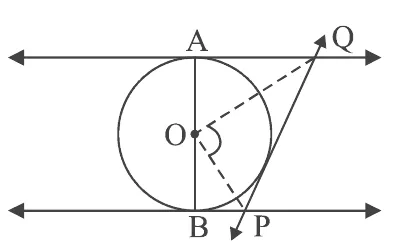
(A) In the given figure, ABAB is a diameter of the circle with centre OO. AQAQ, BPBP and PQPQ are tangents to the circle. Prove that ∠POQ=90∘\angle POQ = 90^\circ.

OR

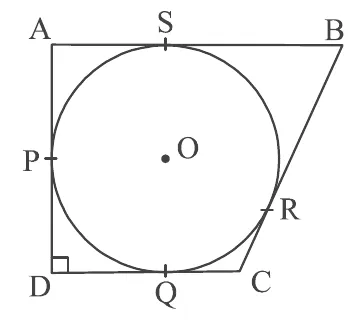
(B) A circle with centre OO and radius 88 cm is inscribed in a quadrilateral ABCDABCD in which P,Q,R,SP, Q, R, S are the points of contact as shown. If ADAD is perpendicular to DCDC, BC=30BC = 30 cm and BS=24BS = 24 cm, then find the length DCDC.

A circle with centre O between two parallel horizontal tangents, with AB a vertical diameter. A third tangent runs from Q on the top tangent to P on the bottom tangent, and OQ and OP are drawn.A circle with centre O inscribed in a quadrilateral ABCD. AD is vertical on the left with a right angle at D, DC is along the bottom, AB is along the top and BC slopes on the right. The points of contact are P on AD, Q on DC, R on BC and S on AB.
Solution
ORQPABAOB is a straight line, so ∠POQ = 90°
  1. (A) Let PQPQ touch the circle at RR. Join OROR. Tangents from QQ: QA=QRQA = QR, and OA=OROA = OR, with OQOQ common, so △AOQ≅△ROQ\triangle AOQ \cong \triangle ROQ (SSS) and ∠AOQ=∠ROQ\angle AOQ = \angle ROQ. … (i)
  2. Likewise △BOP≅△ROP\triangle BOP \cong \triangle ROP, so ∠BOP=∠ROP\angle BOP = \angle ROP. … (ii)
  3. AOBAOB is a straight line: ∠AOR+∠ROB=180∘\angle AOR + \angle ROB = 180^\circ, that is 2∠QOR+2∠ROP=180∘2\angle QOR + 2\angle ROP = 180^\circ.
  4. So ∠QOR+∠ROP=90∘\angle QOR + \angle ROP = 90^\circ, that is ∠POQ=90∘\angle POQ = 90^\circ.
  5. (B) Tangents from BB: BR=BS=24BR = BS = 24 cm. BC=30BC = 30, so CR=30−24=6CR = 30 - 24 = 6 cm. Tangents from CC: CQ=CR=6CQ = CR = 6 cm.
  6. OPDQOPDQ has right angles at PP, QQ (radius ⊥\perp tangent) and DD (given), so it is a square: DQ=OP=8DQ = OP = 8 cm.
  7. DC=DQ+QC=8+6=14DC = DQ + QC = 8 + 6 = 14 cm.

Answer: (A) ∠POQ=90∘\angle POQ = 90^\circ   (B) DC=14DC = 14 cm

Report an error on this question
Q31Surface Areas and Volumes3 marks

The difference between the outer and inner radii of a hollow right circular cylinder of length 1414 cm is 11 cm. If the volume of the metal used in making the cylinder is 176176 cm³, find the outer and inner radii of the cylinder.

Solution
OhollowR = 2.5R − r = 1, R + r = 4, so R = 2.5 and r = 1.5
  1. Let the outer radius be r2r_2 and the inner radius r1r_1. r2−r1=1r_2 - r_1 = 1. … (i)
  2. Volume of metal =πh(r22−r12)=227×14×(r22−r12)=44(r22−r12)=176= \pi h(r_2^2 - r_1^2) = \dfrac{22}{7} \times 14 \times (r_2^2 - r_1^2) = 44(r_2^2 - r_1^2) = 176, so r22−r12=4r_2^2 - r_1^2 = 4.
  3. (r2−r1)(r2+r1)=4(r_2 - r_1)(r_2 + r_1) = 4 and r2−r1=1r_2 - r_1 = 1, so r2+r1=4r_2 + r_1 = 4. … (ii)
  4. Add (i) and (ii): 2r2=52r_2 = 5, so r2=2.5r_2 = 2.5 cm. Then r1=4−2.5=1.5r_1 = 4 - 2.5 = 1.5 cm.

Answer: Outer radius 2.5 cm and inner radius 1.5 cm

Report an error on this question

Section D: Long answer

4 questions, 5 marks each.

Q32Areas Related to Circles5 marks

An arc of a circle of radius 21 cm subtends an angle of 60° at the centre. Find: (i) the length of the arc. (ii) the area of the minor segment of the circle made by the corresponding chord.

Solution
60°2121OABminor segmentsegment = sector (231) − equilateral triangle (441√3/4)
  1. (i) Length of the arc =60360×2πr=16×2×227×21=22= \dfrac{60}{360} \times 2\pi r = \dfrac{1}{6} \times 2 \times \dfrac{22}{7} \times 21 = 22 cm.
  2. (ii) Area of the sector =60360×πr2=16×227×21×21=231= \dfrac{60}{360} \times \pi r^2 = \dfrac{1}{6} \times \dfrac{22}{7} \times 21 \times 21 = 231 cm².
  3. The angle at the centre is 60∘60^\circ and OA=OBOA = OB, so △OAB\triangle OAB is equilateral with side 2121 cm. Its area =34×212=44134= \dfrac{\sqrt{3}}{4} \times 21^2 = \dfrac{441\sqrt{3}}{4} cm² ≈190.95\approx 190.95 cm².
  4. Area of the minor segment == sector −- triangle =231−44134≈40.05= 231 - \dfrac{441\sqrt{3}}{4} \approx 40.05 cm².

Answer: (i) 2222 cm   (ii) (231−44134)\left(231 - \dfrac{441\sqrt{3}}{4}\right) cm² ≈40.05\approx 40.05 cm²

Common mistake: Giving the sector area (231 cm²) as the segment. Subtract the triangle OAB.

Report an error on this question
Q33Arithmetic Progressions5 marks

(A) The sum of first and eighth terms of an A.P. is 3232 and their product is 6060. Find the first term and common difference of the A.P. Hence, also find the sum of its first 2020 terms.

OR

(B) In an A.P. of 4040 terms, the sum of first 99 terms is 153153 and the sum of last 66 terms is 687687. Determine the first term and common difference of A.P. Also, find the sum of all the terms of the A.P.

Solution
  1. (A) a+a8=32a + a_8 = 32: 2a+7d=322a + 7d = 32. … (i) And a×a8=60a \times a_8 = 60: a(a+7d)=60a(a + 7d) = 60. … (ii)
  2. From (i), a+7d=32−aa + 7d = 32 - a. Put in (ii): a(32−a)=60a(32 - a) = 60, so a2−32a+60=0a^2 - 32a + 60 = 0 and (a−2)(a−30)=0(a - 2)(a - 30) = 0. So a=2a = 2 or a=30a = 30.
  3. If a=2a = 2: 7d=287d = 28, d=4d = 4. If a=30a = 30: 7d=−287d = -28, d=−4d = -4.
  4. S20=10[2a+19d]S_{20} = 10[2a + 19d]. For a=2a = 2, d=4d = 4: 10(4+76)=80010(4 + 76) = 800. For a=30a = 30, d=−4d = -4: 10(60−76)=−16010(60 - 76) = -160.
  5. (B) S9=92[2a+8d]=153S_9 = \dfrac{9}{2}[2a + 8d] = 153, so a+4d=17a + 4d = 17. … (i)
  6. Sum of the last 66 terms =S40−S34=687= S_{40} - S_{34} = 687: this is a35+⋯+a40=6a+219d=687a_{35} + \dots + a_{40} = 6a + 219d = 687, that is 2a+73d=2292a + 73d = 229. … (ii)
  7. (ii) −- 2×2 \times (i): 65d=19565d = 195, so d=3d = 3 and a=17−12=5a = 17 - 12 = 5.
  8. S40=402[2×5+39×3]=20×127=2540S_{40} = \dfrac{40}{2}[2 \times 5 + 39 \times 3] = 20 \times 127 = 2540.

Answer: (A) a=2,d=4a = 2, d = 4 with S20=800S_{20} = 800; or a=30,d=−4a = 30, d = -4 with S20=−160S_{20} = -160   (B) a=5,d=3a = 5, d = 3, S40=2540S_{40} = 2540

Common mistake: In (A), stopping after the first pair. The quadratic gives two values of a, so there are two answers.

Report an error on this question
Q34Triangles5 marks

(A) If a line is drawn parallel to one side of a triangle to intersect the other two sides in distinct points, then prove that the other two sides are divided in the same ratio.

OR

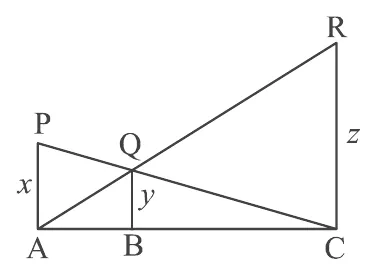
(B) In the given figure PAPA, QBQB and RCRC are each perpendicular to ACAC. If AP=xAP = x, BQ=yBQ = y and CR=zCR = z, then prove that 1x+1z=1y\dfrac{1}{x} + \dfrac{1}{z} = \dfrac{1}{y}.

Three vertical lines PA of length x, QB of length y and RC of length z standing on a horizontal line AC. P is joined to C and A is joined to R, and the two lines cross at Q.
Solution
ABCDEDE ∥ BC ⟹ AD / DB = AE / EC
  1. (A) Given: △ABC\triangle ABC with DE∥BCDE \parallel BC, DD on ABAB and EE on ACAC. To prove: ADDB=AEEC\dfrac{AD}{DB} = \dfrac{AE}{EC}. Construction: join BEBE and CDCD; draw DM⊥ACDM \perp AC and EN⊥ABEN \perp AB.
  2. ar(ADE)=12×AD×EN\text{ar}(ADE) = \dfrac{1}{2} \times AD \times EN and ar(BDE)=12×DB×EN\text{ar}(BDE) = \dfrac{1}{2} \times DB \times EN, so ar(ADE)ar(BDE)=ADDB\dfrac{\text{ar}(ADE)}{\text{ar}(BDE)} = \dfrac{AD}{DB}. Likewise ar(ADE)ar(CDE)=AEEC\dfrac{\text{ar}(ADE)}{\text{ar}(CDE)} = \dfrac{AE}{EC}.
  3. △BDE\triangle BDE and △CDE\triangle CDE are on the same base DEDE and between the same parallels, so ar(BDE)=ar(CDE)\text{ar}(BDE) = \text{ar}(CDE). Hence ADDB=AEEC\dfrac{AD}{DB} = \dfrac{AE}{EC}.
  4. (B) PA∥QB∥RCPA \parallel QB \parallel RC. In △CBQ\triangle CBQ and △CAP\triangle CAP: ∠C\angle C is common and ∠CBQ=∠CAP=90∘\angle CBQ = \angle CAP = 90^\circ, so △CBQ∼△CAP\triangle CBQ \sim \triangle CAP and yx=BCAC\dfrac{y}{x} = \dfrac{BC}{AC}. … (i)
  5. In △ABQ\triangle ABQ and △ACR\triangle ACR: △ABQ∼△ACR\triangle ABQ \sim \triangle ACR, so yz=ABAC\dfrac{y}{z} = \dfrac{AB}{AC}. … (ii)
  6. Add (i) and (ii): yx+yz=BC+ABAC=1\dfrac{y}{x} + \dfrac{y}{z} = \dfrac{BC + AB}{AC} = 1. Divide by yy: 1x+1z=1y\dfrac{1}{x} + \dfrac{1}{z} = \dfrac{1}{y}.

Answer: (A) Basic Proportionality Theorem proved   (B) 1x+1z=1y\dfrac{1}{x} + \dfrac{1}{z} = \dfrac{1}{y}

Report an error on this question
Q35Applications of Trigonometry5 marks

A pole 66 m high is fixed on the top of a tower. The angle of elevation of the top of the pole observed from a point PP on the ground is 60∘60^\circ and the angle of depression of the point PP from the top of the tower is 45∘45^\circ. Find the height of the tower and the distance of point PP from the foot of the tower. (Use 3=1.73\sqrt{3} = 1.73)

Solution
45°60°h6 mxPFTUh = x; (h + 6)/x = √3 → x = 3(√3 + 1) ≈ 8.19 m
  1. Let the tower be FT=hFT = h m, the pole on top TU=6TU = 6 m, and the distance of PP from the foot PF=xPF = x m (see the diagram).
  2. The angle of depression of PP from TT is 45∘45^\circ, so the angle of elevation of TT from PP is 45∘45^\circ: tan⁡45∘=hx=1\tan 45^\circ = \dfrac{h}{x} = 1, so h=xh = x. … (i)
  3. The top of the pole UU is at height h+6h + 6 and is seen at 60∘60^\circ: tan⁡60∘=h+6x=3\tan 60^\circ = \dfrac{h + 6}{x} = \sqrt{3}, so h+6=3 xh + 6 = \sqrt{3}\,x. … (ii)
  4. Put h=xh = x in (ii): x+6=3 xx + 6 = \sqrt{3}\,x, so x(3−1)=6x(\sqrt{3} - 1) = 6 and x=63−1=6(3+1)2=3(3+1)x = \dfrac{6}{\sqrt{3} - 1} = \dfrac{6(\sqrt{3} + 1)}{2} = 3(\sqrt{3} + 1).
  5. With 3=1.73\sqrt{3} = 1.73: x=3×2.73=8.19x = 3 \times 2.73 = 8.19 m. So the height of the tower is h=8.19h = 8.19 m and the distance of PP from the foot is 8.198.19 m.

Answer: Height of the tower =8.19= 8.19 m; distance of PP from the foot =8.19= 8.19 m

Common mistake: Using hh (not h+6h + 6) with tan⁡60∘\tan 60^\circ. The 60∘60^\circ is to the top of the pole, which is h+6h + 6 above the ground.

Report an error on this question

Section E: Case studies

3 case studies, 4 marks each.

Q36Quadratic Equations4 marks

Case study 1. A rectangular floor area can be completely tiled with 200 square tiles. If the side length of each tile is increased by 1 unit, it would take only 128 tiles to cover the floor.

(i) Assuming the original length of each side of a tile be x units, make a quadratic equation from the above information. [1]

(ii) Write the corresponding quadratic equation in standard form. [1]

(iii) (a) Find the value of x, the length of side of a tile by factorisation. [2]

OR

(iii) (b) Solve the quadratic equation for x, using quadratic formula. [2]

Figure: A photo of a floor covered with square stone tiles.

Solution
  1. (i) Area of the floor with the original tiles =200×x2= 200 \times x^2. With side (x+1)(x + 1) it is 128×(x+1)2128 \times (x + 1)^2. The floor is the same, so 200x2=128(x+1)2200x^2 = 128(x + 1)^2.
  2. (ii) Divide by 88: 25x2=16(x+1)2=16x2+32x+1625x^2 = 16(x + 1)^2 = 16x^2 + 32x + 16, so 9x2−32x−16=09x^2 - 32x - 16 = 0.
  3. (iii)(a) Factorise: 9x2−36x+4x−16=9x(x−4)+4(x−4)=(9x+4)(x−4)=09x^2 - 36x + 4x - 16 = 9x(x - 4) + 4(x - 4) = (9x + 4)(x - 4) = 0. So x=−49x = -\dfrac{4}{9} or x=4x = 4. A length cannot be negative, so x=4x = 4 units.
  4. (iii)(b) Quadratic formula: x=32±322+4×9×1618=32±1024+57618=32±4018x = \dfrac{32 \pm \sqrt{32^2 + 4 \times 9 \times 16}}{18} = \dfrac{32 \pm \sqrt{1024 + 576}}{18} = \dfrac{32 \pm 40}{18}.
  5. x=7218=4x = \dfrac{72}{18} = 4 or x=−818=−49x = -\dfrac{8}{18} = -\dfrac{4}{9}. Reject the negative value: x=4x = 4 units.

Answer: (i) 200x2=128(x+1)2200x^2 = 128(x + 1)^2   (ii) 9x2−32x−16=09x^2 - 32x - 16 = 0   (iii) x=4x = 4 units

Common mistake: Forgetting that the number of tiles changes along with the size: area = number of tiles × (side)².

Report an error on this question
Q37Statistics4 marks

Case study 2. BINGO is game of chance. The host has 75 balls numbered 1 through 75. Each player has a BINGO card with some numbers written on it. The participant cancels the number on the card when called out a number written on the ball selected at random. Whosoever cancels all the numbers on his/her card, says BINGO and wins the game. The table given below, shows the data of one such game where 48 balls were used before Tara said ‘BINGO’.

Based on the above information, answer the following:

(i) Write the median class. [1]

(ii) When first ball was picked up, what was the probability of calling out an even number? [1]

(iii) (a) Find median of the given data. [2]

OR

(iii) (b) Find mode of the given data. [2]

Numbers announcedNumber of times
0 – 158
15 – 309
30 – 4510
45 – 6012
60 – 759
Solution
15304560752468101214Oxy8910129mode 51median 40.5
  1. Cumulative frequencies: 8, 17, 27, 39, 488,\ 17,\ 27,\ 39,\ 48. N=48N = 48 and N2=24\dfrac{N}{2} = 24.
  2. (i) The first cumulative frequency above 2424 is 2727, so the median class is 30−4530 - 45.
  3. (ii) Among the balls numbered 11 to 7575 there are 3737 even numbers (2,4,…,742, 4, \dots, 74). P(even)=3775P(\text{even}) = \dfrac{37}{75}.
  4. (iii)(a) l=30l = 30, cf=17cf = 17, f=10f = 10, h=15h = 15. Median =30+24−1710×15=30+10.5=40.5= 30 + \dfrac{24 - 17}{10} \times 15 = 30 + 10.5 = 40.5.
  5. (iii)(b) The highest frequency is 1212, so the modal class is 45−6045 - 60: l=45l = 45, f1=12f_1 = 12, f0=10f_0 = 10, f2=9f_2 = 9, h=15h = 15.
  6. Mode =45+12−1024−10−9×15=45+25×15=45+6=51= 45 + \dfrac{12 - 10}{24 - 10 - 9} \times 15 = 45 + \dfrac{2}{5} \times 15 = 45 + 6 = 51.

Answer: (i) 30−4530 - 45   (ii) 3775\dfrac{37}{75}   (iii)(a) 40.540.5   (iii)(b) 5151

Common mistake: In (ii), using 4848 as the total. When the first ball is picked, all 7575 balls are in the game.

Report an error on this question
Q38Circles4 marks

Case study 3. A backyard is in the shape of a triangle ABC with right angle at B. AB = 7 m and BC = 15 m. A circular pit was dug inside it such that it touches the walls AC, BC and AB at P, Q and R respectively such that AP = x m.

Based on the above information, answer the following questions:

(i) Find the length of AR in terms of x. [1]

(ii) Write the type of quadrilateral BQOR. [1]

(iii) (a) Find the length PC in terms of x and hence find the value of x. [2]

OR

(iii) (b) Find x and hence find the radius r of circle. [2]
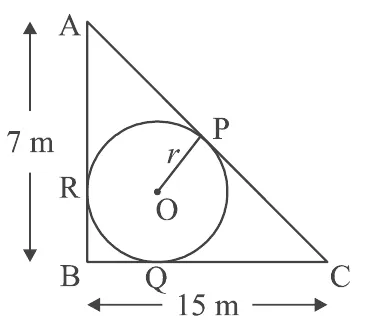
A right triangle ABC with the right angle at B at the bottom left, AB = 7 m on the left and BC = 15 m along the bottom. A circle inside touches AC at P, BC at Q and AB at R, with the radius r drawn from the centre O.
Solution
ABCRQP7 m15 mAP = AR = x, PC = QC = 8 + x, AC = 8 + 2x
  1. (i) Tangents from the same point are equal: AR=AP=xAR = AP = x m.
  2. (ii) ∠B=90∘\angle B = 90^\circ, and OR⊥ABOR \perp AB, OQ⊥BCOQ \perp BC (radius ⊥\perp tangent), so BQORBQOR has four right angles. OR=OQ=rOR = OQ = r, so it is a square.
  3. (iii)(a) BR=AB−AR=7−xBR = AB - AR = 7 - x, so BQ=BR=7−xBQ = BR = 7 - x (a square). QC=BC−BQ=15−(7−x)=8+xQC = BC - BQ = 15 - (7 - x) = 8 + x, and PC=QC=(8+x)PC = QC = (8 + x) m.
  4. AC=AP+PC=x+8+x=8+2xAC = AP + PC = x + 8 + x = 8 + 2x. In right triangle ABCABC: AC2=72+152=274AC^2 = 7^2 + 15^2 = 274, so 8+2x=2748 + 2x = \sqrt{274} and x=−8+2742≈4.28x = \dfrac{-8 + \sqrt{274}}{2} \approx 4.28 m.
  5. (iii)(b) x=−8+2742=−4+2742≈4.28x = \dfrac{-8 + \sqrt{274}}{2} = -4 + \dfrac{\sqrt{274}}{2} \approx 4.28 m, and the radius r=BR=7−x=11−2742≈2.72r = BR = 7 - x = 11 - \dfrac{\sqrt{274}}{2} \approx 2.72 m.

Answer: (i) xx m   (ii) a square   (iii)(a) PC=(8+x)PC = (8 + x) m, x=−8+2742≈4.28x = \dfrac{-8 + \sqrt{274}}{2} \approx 4.28 m   (iii)(b) r=11−2742≈2.72r = 11 - \dfrac{\sqrt{274}}{2} \approx 2.72 m

Common mistake: Using AC=8+xAC = 8 + x. ACAC is made of AP=xAP = x and PC=8+xPC = 8 + x, so AC=8+2xAC = 8 + 2x.

Report an error on this question

Questions are from the official CBSE paper. Figures are described in words; see the PDF for the originals. Solutions are written by CogniGuru.

Revise this paper in 1 minute a chapter

Each chapter below is what the paper tested, with a one-minute animated lesson on the idea behind it.

Stuck on a step in any solution?

The CogniGuru AI tutor explains any doubt one minute at a time, in English or Hindi. Join the waitlist.

Mock quiz: 5 questions from this paper

Five real questions from this paper, one each from five chapters. About 2 minutes. See how much you know and where you stand among other students. Attempt free, with no login; log in only for your ranking and full report.

Question 1 of 5 · Q1 of the paperPolynomials

If the sum of zeroes of the polynomial p(x)=2x2−k2 x+1p(x) = 2x^2 - k\sqrt{2}\,x + 1 is 2\sqrt{2}, then value of kk is:

0 of 5 answered

Related papers

Common questions

Are these the official CBSE Class 10 Maths Standard 2024 questions?
Yes. The questions are from the official Mathematics (Standard) paper (set 30/1/1) that CBSE published after the March 2024 board exam. The solutions are written by CogniGuru and checked against the answer key CBSE published for this paper code.
Can I download the CBSE Class 10 Maths Standard 2024 question paper PDF?
Yes, the official paper PDF is free to download from this page, and so are our step-by-step solutions as a PDF. No login is needed to download either or to read the solutions.
Do all sets of the paper have the same questions?
No. CBSE sets several versions of each paper, with the same blueprint and similar questions in a different order and sometimes with different numbers. This page covers set 30/1/1.
How does the quiz work, and what does “where you stand” mean?
It is a mock quiz of 5 real multiple-choice questions from this paper, scored automatically in about 2 minutes. Your score is compared, anonymously, with other students who took the same quiz. Only the score is stored with the comparison, never your name or number.

Source

CBSE question paper archive, Class X, 2024 (Mathematics (Standard), set 30/1/1)
PDF