CBSE · Class 10 · Mathematics (Standard) · Free

CBSE Class 10 Maths Standard 2026 Question Paper (Set 30/1/1) with Solutions

The official board paper (Q.P. Code 30/1/1, Series NL1KM). Free paper PDF and step-by-step solutions (also as a PDF to download) written by CogniGuru and checked against CBSE’s answer key. See the paper’s main topics in 1 minute, then quiz yourself to see how much you know and where you stand.

No login to download or read the solutions. Login only to see your quiz report in full.

Board
CBSE
Class
10
Subject
Maths Standard (041)
Year
2026
Set code
30/1/1
Max marks
80
Duration
3 hours
Questions
38 (Sections A to E)
Source
Official CBSE paper
Exam date
2026

Paper preview

Three pages of the official paper. Download the PDF for all 16.
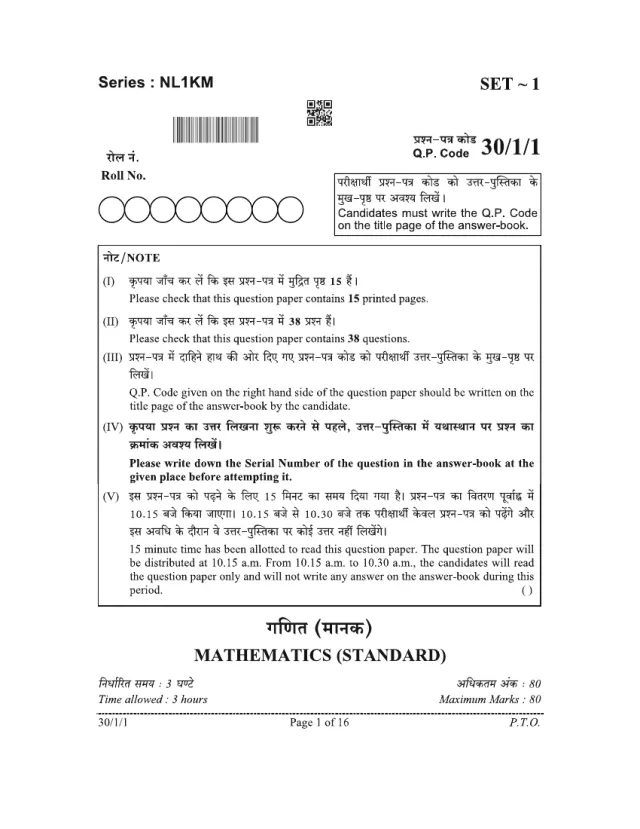
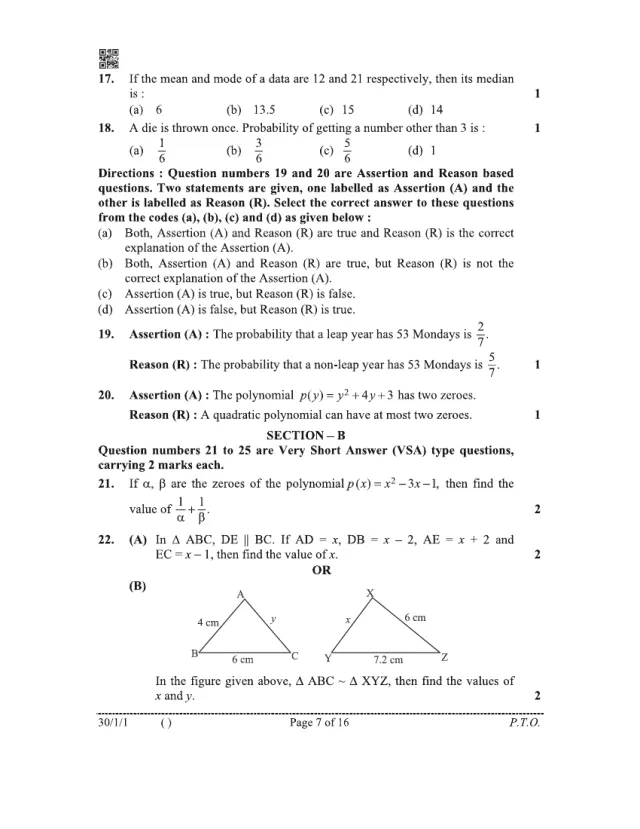
  • Cover page of the CBSE Class 10 Maths Standard 2026 paper, set 30/1/1

    Cover page

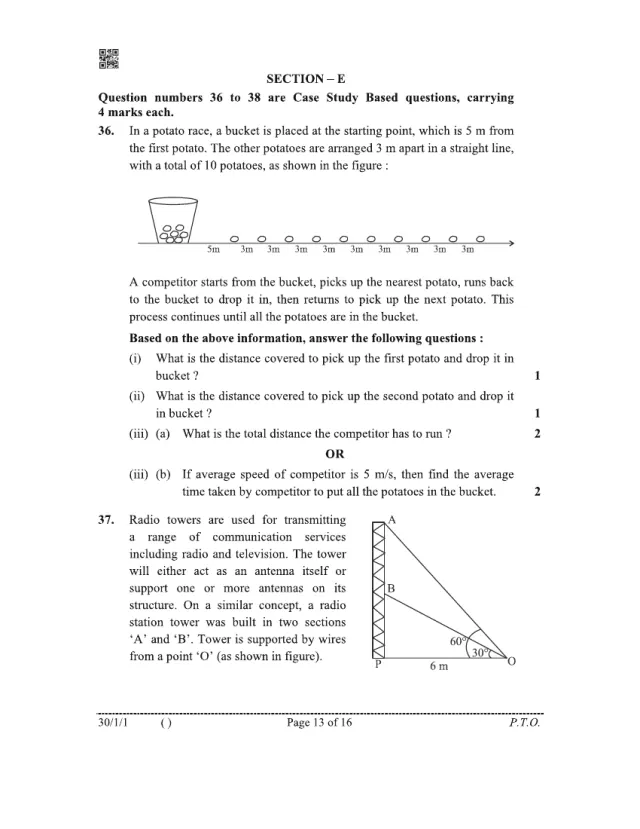
  • Section B of the CBSE Class 10 Maths Standard 2026 paper, set 30/1/1

    Section B

  • A case study with its figure from the CBSE Class 10 Maths Standard 2026 paper, set 30/1/1

    Case study

The main topics of this paper, in 1 minute

Your tutor walks you through the paper before you attempt it: the marks, the key ideas, the time plan and the traps.

1-minute paper analysis

With your tutor, in her voice

The main topics of this paper, in about a minute

A short, animated walk through the paper: how it is built, where the marks come from, the four ideas that matter most, how to plan your three hours, and the traps to avoid.

  1. 1The paper at a glance
  2. 2Where the marks come from
  3. 3Four ideas that keep paying off
  4. 4Plan your three hours
  5. 5Four traps to avoid

Sound on for the voice. Captions are shown, and you can mute any time.

Step-by-step solutions

Try each question first, then open its solution. Tap a number to jump.

Download solutions (PDF)

Section A: Multiple choice

20 questions, 1 mark each. MCQs (Q1 to Q18) and assertion-reason (Q19, Q20).

Q1Real Numbers1 mark

The HCF of 960960 and 432432 is:

  1. (A)48
  2. (B)54
  3. (C)72
  4. (D)36
Solution · answer (A)
  1. 960=26×3×5960 = 2^6 \times 3 \times 5 and 432=24×33432 = 2^4 \times 3^3.
  2. HCF == common primes at the smaller powers =24×3=48= 2^4 \times 3 = 48.

Answer: (A) 48

Report an error on this question
Q2Real Numbers1 mark

The natural number 2 is:

  1. (A)a prime number
  2. (B)a composite number
  3. (C)prime as well as composite
  4. (D)neither prime nor composite
Solution · answer (A)
  1. 22 has exactly two factors, 11 and 22, so it is prime (the only even prime).

Answer: (A) a prime number

Report an error on this question
Q3Real Numbers1 mark

For any natural number nn, 6n6^n ends with the digit:

  1. (A)0
  2. (B)6
  3. (C)3
  4. (D)2
Solution · answer (B)
  1. 6×6=366 \times 6 = 36, 36×6=21636 \times 6 = 216, and any number ending in 66 times 66 ends in 66. So 6n6^n always ends in 66.

Answer: (B) 6

Report an error on this question
Q4Polynomials1 mark

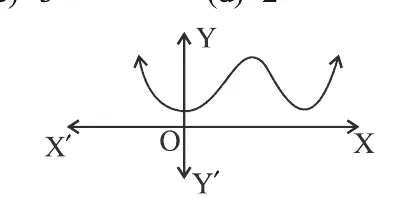
The graph of y=f(x)y = f(x) is given. The number of zeroes of f(x)f(x) is:

A curve that dips down and rises twice like the letter W, drawn entirely above the x-axis, with the origin O marked and X, X prime, Y and Y prime labelled.
  1. (A)0
  2. (B)1
  3. (C)2
  4. (D)4
Solution · answer (A)
  1. The zeroes of f(x)f(x) are the xx-values where the graph meets the xx-axis. This curve stays above the xx-axis everywhere and never touches it, so there are no zeroes.

Answer: (A) 0

Report an error on this question
Q5Linear Equations1 mark

If a pair of linear equations in two variables is represented by two coincident lines, then the pair of equations has:

  1. (A)a unique solution
  2. (B)two solutions
  3. (C)no solution
  4. (D)an infinite number of solutions
Solution · answer (D)
  1. Coincident lines lie on top of each other, so every point of the line satisfies both equations: infinitely many solutions.

Answer: (D) an infinite number of solutions

Report an error on this question
Q6Arithmetic Progressions1 mark

The common difference of the AP: 2,22,32,42,…\sqrt{2}, 2\sqrt{2}, 3\sqrt{2}, 4\sqrt{2}, \dots is:

  1. (A)2\sqrt{2}
  2. (B)1
  3. (C)222\sqrt{2}
  4. (D)−2-\sqrt{2}
Solution · answer (A)
  1. d=22−2=2d = 2\sqrt{2} - \sqrt{2} = \sqrt{2}.

Answer: (A) 2\sqrt{2}

Report an error on this question
Q7Triangles1 mark

If △ABC\triangle ABC and △DEF\triangle DEF are similar such that 2AB=DE2AB = DE and BC=8BC = 8 cm, then EFEF is equal to:

  1. (A)4 cm
  2. (B)8 cm
  3. (C)12 cm
  4. (D)16 cm
Solution · answer (D)
  1. DEAB=2\dfrac{DE}{AB} = 2, so the scale factor is 22 and EF=2×BC=2×8=16EF = 2 \times BC = 2 \times 8 = 16 cm.

Answer: (D) 16 cm

Report an error on this question
Q8Coordinate Geometry1 mark

The mid-point of the line segment joining the points (5,−4)(5, -4) and (6,4)(6, 4) lies on:

  1. (A)xx-axis
  2. (B)yy-axis
  3. (C)origin
  4. (D)neither xx-axis nor yy-axis
Solution · answer (A)
  1. Mid-point =(5+62,−4+42)=(112,0)= \left(\dfrac{5 + 6}{2}, \dfrac{-4 + 4}{2}\right) = \left(\dfrac{11}{2}, 0\right). Its yy-coordinate is 00, so it lies on the xx-axis.

Answer: (A) xx-axis

Report an error on this question
Q9Trigonometry1 mark

Given that sin⁡θ=ab\sin\theta = \dfrac{a}{b}, then cos⁡θ\cos\theta is equal to:

  1. (A)bb2−a2\dfrac{b}{\sqrt{b^2 - a^2}}
  2. (B)ba\dfrac{b}{a}
  3. (C)b2−a2b\dfrac{\sqrt{b^2 - a^2}}{b}
  4. (D)ab2−a2\dfrac{a}{\sqrt{b^2 - a^2}}
Solution · answer (C)
  1. cos⁡θ=1−sin⁡2θ=1−a2b2=b2−a2b\cos\theta = \sqrt{1 - \sin^2\theta} = \sqrt{1 - \dfrac{a^2}{b^2}} = \dfrac{\sqrt{b^2 - a^2}}{b}.

Answer: (C) b2−a2b\dfrac{\sqrt{b^2 - a^2}}{b}

Report an error on this question
Q10Trigonometry1 mark

If cos⁡A=12\cos A = \dfrac{1}{2}, then the value of sin⁡2A+2cos⁡2A\sin^2 A + 2\cos^2 A is:

  1. (A)32\dfrac{3}{2}
  2. (B)54\dfrac{5}{4}
  3. (C)−1
  4. (D)12\dfrac{1}{2}
Solution · answer (B)
  1. sin⁡2A+2cos⁡2A=(sin⁡2A+cos⁡2A)+cos⁡2A=1+cos⁡2A=1+14=54\sin^2 A + 2\cos^2 A = (\sin^2 A + \cos^2 A) + \cos^2 A = 1 + \cos^2 A = 1 + \dfrac{1}{4} = \dfrac{5}{4}.

Answer: (B) 54\dfrac{5}{4}

Report an error on this question
Q11Trigonometry1 mark

A car is moving away from the base of a 3030 m high tower. The angle of elevation of the top of the tower from the car at an instant, when the car is 10310\sqrt{3} m away from the base of the tower, is:

  1. (A)30∘30^\circ
  2. (B)45∘45^\circ
  3. (C)90∘90^\circ
  4. (D)60∘60^\circ
Solution · answer (D)
  1. tan⁡θ=heightdistance=30103=3\tan\theta = \dfrac{\text{height}}{\text{distance}} = \dfrac{30}{10\sqrt{3}} = \sqrt{3}, so θ=60∘\theta = 60^\circ.

Answer: (D) 60∘60^\circ

Report an error on this question
Q12Circles1 mark

If TPTP and TQTQ are two tangents to a circle with centre OO from an external point TT so that ∠POQ=120∘\angle POQ = 120^\circ, then ∠PTQ\angle PTQ is equal to:

  1. (A)60∘60^\circ
  2. (B)70∘70^\circ
  3. (C)80∘80^\circ
  4. (D)90∘90^\circ
Solution · answer (A)
  1. OP⊥TPOP \perp TP and OQ⊥TQOQ \perp TQ, so in the quadrilateral OPTQOPTQ the angles at PP and QQ are 90∘90^\circ.
  2. ∠PTQ=360∘−90∘−90∘−120∘=60∘\angle PTQ = 360^\circ - 90^\circ - 90^\circ - 120^\circ = 60^\circ. (The angle between the tangents and the angle at the centre add to 180∘180^\circ.)

Answer: (A) 60∘60^\circ

Report an error on this question
Q13Circles1 mark

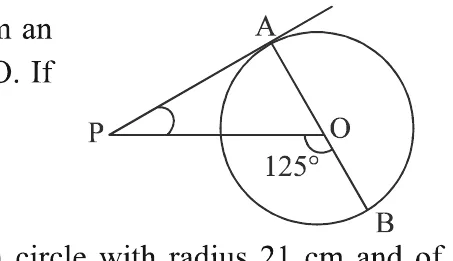
In the given figure, PAPA is a tangent from an external point PP to a circle with centre OO. If ∠POB=125∘\angle POB = 125^\circ, then ∠APO\angle APO is equal to:

A circle with centre O. P is outside on the left, and PA is a tangent touching the circle at A at the top. The line from A through O reaches B on the circle at the bottom right, and the angle POB is marked 125 degrees.
  1. (A)25∘25^\circ
  2. (B)65∘65^\circ
  3. (C)90∘90^\circ
  4. (D)35∘35^\circ
Solution · answer (D)
55°125°OABP35°∠POA = 180° − 125° = 55°; ∠OAP = 90° → ∠APO = 35°
  1. AA, OO, BB are on one straight line (a diameter), so ∠POA=180∘−125∘=55∘\angle POA = 180^\circ - 125^\circ = 55^\circ.
  2. OA⊥PAOA \perp PA (radius and tangent), so in △OAP\triangle OAP: ∠APO=180∘−90∘−55∘=35∘\angle APO = 180^\circ - 90^\circ - 55^\circ = 35^\circ.

Answer: (D) 35∘35^\circ

Report an error on this question
Q14Areas Related to Circles1 mark

The length of the arc of a sector of a circle with radius 2121 cm and of central angle 60∘60^\circ is:

  1. (A)22 cm
  2. (B)44 cm
  3. (C)88 cm
  4. (D)11 cm
Solution · answer (A)
  1. Arc =60360×2πr=16×2×227×21=22= \dfrac{60}{360} \times 2\pi r = \dfrac{1}{6} \times 2 \times \dfrac{22}{7} \times 21 = 22 cm.

Answer: (A) 22 cm

Report an error on this question
Q15Areas Related to Circles1 mark

The hour hand of a clock is 77 cm long. The angle swept by it between 7:007{:}00 a.m. and 8:108{:}10 a.m. is:

  1. (A)(354)∘\left(\dfrac{35}{4}\right)^\circ
  2. (B)(352)∘\left(\dfrac{35}{2}\right)^\circ
  3. (C)35∘35^\circ
  4. (D)70∘70^\circ
Solution · answer (C)
  1. The hour hand turns 360∘360^\circ in 1212 hours, which is 30∘30^\circ per hour, or 0.5∘0.5^\circ per minute.
  2. From 7:007{:}00 to 8:108{:}10 is 7070 minutes, so the angle is 70×0.5=35∘70 \times 0.5 = 35^\circ. (The 77 cm length is not needed for the angle.)

Answer: (C) 35∘35^\circ

Report an error on this question
Q16Surface Areas and Volumes1 mark

The total surface area of a solid hemisphere of diameter 2d2d is:

  1. (A)3πd23\pi d^2
  2. (B)2πd22\pi d^2
  3. (C)12πd2\dfrac{1}{2}\pi d^2
  4. (D)34πd2\dfrac{3}{4}\pi d^2
Solution · answer (A)
  1. Diameter 2d2d means the radius is dd. Total surface area of a solid hemisphere =3πr2=3πd2= 3\pi r^2 = 3\pi d^2.

Answer: (A) 3πd23\pi d^2

Report an error on this question
Q17Statistics1 mark

If the mean and mode of a data are 12 and 21 respectively, then its median is:

  1. (A)6
  2. (B)13.5
  3. (C)15
  4. (D)14
Solution · answer (C)
  1. Mode=3 Median−2 Mean\text{Mode} = 3\,\text{Median} - 2\,\text{Mean}, so 21=3M−2421 = 3M - 24 and M=15M = 15.

Answer: (C) 15

Report an error on this question
Q18Probability1 mark

A die is thrown once. Probability of getting a number other than 3 is:

  1. (A)16\dfrac{1}{6}
  2. (B)36\dfrac{3}{6}
  3. (C)56\dfrac{5}{6}
  4. (D)1
Solution · answer (C)
  1. P(3)=16P(3) = \dfrac{1}{6}, so P(not 3)=1−16=56P(\text{not } 3) = 1 - \dfrac{1}{6} = \dfrac{5}{6}.

Answer: (C) 56\dfrac{5}{6}

Report an error on this question
Q19Probability1 mark

Assertion (A): The probability that a leap year has 5353 Mondays is 27\dfrac{2}{7}.

Reason (R): The probability that a non-leap year has 5353 Mondays is 57\dfrac{5}{7}.

  1. (A)Both A and R are true and R is the correct explanation of A
  2. (B)Both A and R are true, but R is not the correct explanation of A
  3. (C)A is true, but R is false
  4. (D)A is false, but R is true
Solution · answer (C)
  1. (A) A leap year has 366=52366 = 52 weeks +2+ 2 days. The two extra days are one of 77 equally likely pairs, and 22 of them contain a Monday (Sun–Mon and Mon–Tue). So P=27P = \dfrac{2}{7}. True.
  2. (R) A non-leap year has 5252 weeks +1+ 1 day, so P(53 Mondays)=17P(53 \text{ Mondays}) = \dfrac{1}{7}, not 57\dfrac{5}{7}. False.

Answer: (C) A is true, R is false

Report an error on this question
Q20Polynomials1 mark

Assertion (A): The polynomial p(y)=y2+4y+3p(y) = y^2 + 4y + 3 has two zeroes.

Reason (R): A quadratic polynomial can have at most two zeroes.

  1. (A)Both A and R are true and R is the correct explanation of A
  2. (B)Both A and R are true, but R is not the correct explanation of A
  3. (C)A is true, but R is false
  4. (D)A is false, but R is true
Solution · answer (B)
  1. (A) y2+4y+3=(y+1)(y+3)y^2 + 4y + 3 = (y + 1)(y + 3), so the zeroes are −1-1 and −3-3: two zeroes. True.
  2. (R) A polynomial of degree 22 has at most 22 zeroes. True. But R is a general limit, it does not show that this particular polynomial has two (we needed to factorise), so it is not the explanation.

Answer: (B) Both A and R are true, but R is not the correct explanation of A

Report an error on this question

Section B: Very short answer

5 questions, 2 marks each.

Q21Polynomials2 marks

If α,β\alpha, \beta are the zeroes of the polynomial p(x)=x2−3x−1p(x) = x^2 - 3x - 1, then find the value of 1α+1β\dfrac{1}{\alpha} + \dfrac{1}{\beta}.

Solution
  1. α+β=−−31=3\alpha + \beta = -\dfrac{-3}{1} = 3 and αβ=−11=−1\alpha\beta = \dfrac{-1}{1} = -1.
  2. 1α+1β=α+βαβ=3−1=−3\dfrac{1}{\alpha} + \dfrac{1}{\beta} = \dfrac{\alpha + \beta}{\alpha\beta} = \dfrac{3}{-1} = -3.

Answer: −3-3

Report an error on this question
Q22Triangles2 marks

(a) In △ABC\triangle ABC, DE∥BCDE \parallel BC. If AD=xAD = x, DB=x−2DB = x - 2, AE=x+2AE = x + 2 and EC=x−1EC = x - 1, then find the value of xx.

OR

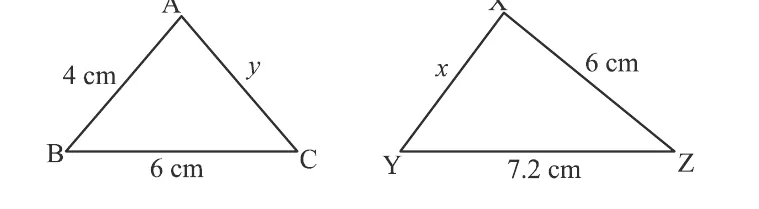
(b) In the figure given, △ABC∼△XYZ\triangle ABC \sim \triangle XYZ, with AB=4AB = 4 cm, BC=6BC = 6 cm, AC=yAC = y and XY=xXY = x, XZ=6XZ = 6 cm, YZ=7.2YZ = 7.2 cm. Find the values of xx and yy.

Two triangles. The first, ABC, has AB marked 4 cm, side AC marked y and BC marked 6 cm. The second, XYZ, has XY marked x, XZ marked 6 cm and YZ marked 7.2 cm.
Solution
x = 4263ABCDEx/(x − 2) = (x + 2)/(x − 1) → x = 4 (both ratios are 2)
46y = 5x = 4.87.26ABCXYZratio BC/YZ = 6/7.2 = 5/6 → x = 4 × 6/5 = 4.8, y = 6 × 5/6 = 5
  1. (a) DE∥BCDE \parallel BC, so ADDB=AEEC\dfrac{AD}{DB} = \dfrac{AE}{EC}: xx−2=x+2x−1\dfrac{x}{x - 2} = \dfrac{x + 2}{x - 1}.
  2. x(x−1)=(x+2)(x−2)x(x - 1) = (x + 2)(x - 2), so x2−x=x2−4x^2 - x = x^2 - 4 and x=4x = 4.
  3. (b) Similar triangles have proportional sides: ABXY=BCYZ=ACXZ\dfrac{AB}{XY} = \dfrac{BC}{YZ} = \dfrac{AC}{XZ}, that is 4x=67.2=y6\dfrac{4}{x} = \dfrac{6}{7.2} = \dfrac{y}{6}.
  4. 67.2=56\dfrac{6}{7.2} = \dfrac{5}{6}. So x=4×65=4.8x = 4 \times \dfrac{6}{5} = 4.8 cm and y=6×56=5y = 6 \times \dfrac{5}{6} = 5 cm.

Answer: (a) x=4x = 4   (b) x=4.8x = 4.8 cm, y=5y = 5 cm

Report an error on this question
Q23Coordinate Geometry2 marks

The coordinates of the centre of a circle are (x−7,2x)(x - 7, 2x). Find the value(s) of xx, if the circle passes through the point (−9,11)(-9, 11) and has radius 525\sqrt{2} units.

Solution
  1. The distance from the centre to the point equals the radius: (x−7+9)2+(2x−11)2=(52)2=50(x - 7 + 9)^2 + (2x - 11)^2 = (5\sqrt{2})^2 = 50.
  2. (x+2)2+(2x−11)2=50(x + 2)^2 + (2x - 11)^2 = 50, so x2+4x+4+4x2−44x+121=50x^2 + 4x + 4 + 4x^2 - 44x + 121 = 50 and 5x2−40x+75=05x^2 - 40x + 75 = 0, that is x2−8x+15=0x^2 - 8x + 15 = 0.
  3. (x−3)(x−5)=0(x - 3)(x - 5) = 0, so x=3x = 3 or x=5x = 5.

Answer: x=3x = 3 or x=5x = 5

Report an error on this question
Q24Trigonometry2 marks

(a) If tan⁡θ=247\tan\theta = \dfrac{24}{7}, then find the value of sin⁡θ+cos⁡θ\sin\theta + \cos\theta.

OR

(b) If cot⁡θ=78\cot\theta = \dfrac{7}{8}, then find the value of (1+sin⁡θ)(1−sin⁡θ)(1+cos⁡θ)(1−cos⁡θ)\dfrac{(1 + \sin\theta)(1 - \sin\theta)}{(1 + \cos\theta)(1 - \cos\theta)}.

Solution
  1. (a) tan⁡θ=247\tan\theta = \dfrac{24}{7}: the hypotenuse is 242+72=25\sqrt{24^2 + 7^2} = 25, so sin⁡θ=2425\sin\theta = \dfrac{24}{25} and cos⁡θ=725\cos\theta = \dfrac{7}{25}.
  2. sin⁡θ+cos⁡θ=24+725=3125\sin\theta + \cos\theta = \dfrac{24 + 7}{25} = \dfrac{31}{25}.
  3. (b) (1+sin⁡θ)(1−sin⁡θ)(1+cos⁡θ)(1−cos⁡θ)=1−sin⁡2θ1−cos⁡2θ=cos⁡2θsin⁡2θ=cot⁡2θ=4964\dfrac{(1 + \sin\theta)(1 - \sin\theta)}{(1 + \cos\theta)(1 - \cos\theta)} = \dfrac{1 - \sin^2\theta}{1 - \cos^2\theta} = \dfrac{\cos^2\theta}{\sin^2\theta} = \cot^2\theta = \dfrac{49}{64}.

Answer: (a) 3125\dfrac{31}{25}   (b) 4964\dfrac{49}{64}

Report an error on this question
Q25Circles2 marks

Two concentric circles are of radii 5 cm and 4 cm. Find the length of the chord of the larger circle which touches the smaller circle.

Solution
5OABM34AM = √(5² − 4²) = 3 cm → AB = 2 × 3 = 6 cm
  1. Let the chord ABAB of the larger circle touch the smaller circle at MM. The radius to the point of contact is perpendicular to the tangent, so OM⊥ABOM \perp AB and OM=4OM = 4 cm.
  2. The perpendicular from the centre bisects the chord. In the right triangle OMAOMA: AM=52−42=3AM = \sqrt{5^2 - 4^2} = 3 cm.
  3. AB=2×3=6AB = 2 \times 3 = 6 cm.

Answer: 66 cm

Report an error on this question

Section C: Short answer

6 questions, 3 marks each.

Q26Real Numbers3 marks

Prove that 3\sqrt{3} is an irrational number.

Solution
  1. Suppose 3\sqrt{3} is rational: 3=pq\sqrt{3} = \dfrac{p}{q} with p,qp, q co-prime integers, q≠0q \neq 0.
  2. Squaring, 3q2=p23q^2 = p^2, so 33 divides p2p^2 and therefore 33 divides pp. Write p=3ap = 3a.
  3. Then 9a2=3q29a^2 = 3q^2, so q2=3a2q^2 = 3a^2; 33 divides q2q^2 and so 33 divides qq.
  4. Now 33 divides both pp and qq, which contradicts that they are co-prime. So 3\sqrt{3} is irrational.

Answer: Proved

Report an error on this question
Q27Coordinate Geometry3 marks

Find the ratio in which the xx-axis divides the line segment joining the points (−6,5)(-6, 5) and (−4,−1)(-4, -1). Also, find the point of intersection.

Solution
-8-7-6-5-4-3-2-11-2-1123456OxyA(−6, 5)B(−4, −1)P(−13/3, 0)
  1. A point on the xx-axis has y=0y = 0. Let it divide the segment from A(−6,5)A(-6, 5) to B(−4,−1)B(-4, -1) in the ratio k:1k : 1.
  2. y=k(−1)+1(5)k+1=0y = \dfrac{k(-1) + 1(5)}{k + 1} = 0, so −k+5=0-k + 5 = 0 and k=5k = 5. The ratio is 5:15 : 1.
  3. x=5(−4)+1(−6)5+1=−266=−133x = \dfrac{5(-4) + 1(-6)}{5 + 1} = \dfrac{-26}{6} = -\dfrac{13}{3}. The point is (−133,0)\left(-\dfrac{13}{3}, 0\right).

Answer: Ratio 5:15 : 1; point (−133,0)\left(-\dfrac{13}{3}, 0\right)

Report an error on this question
Q28Trigonometry3 marks

(a) If x=h+acos⁡θx = h + a\cos\theta, y=k+bsin⁡θy = k + b\sin\theta, then prove that (x−ha)2+(y−kb)2=1\left(\dfrac{x - h}{a}\right)^2 + \left(\dfrac{y - k}{b}\right)^2 = 1.

OR

(b) Prove that tan⁡A1+sec⁡A−tan⁡A1−sec⁡A=2cosec⁡A\dfrac{\tan A}{1 + \sec A} - \dfrac{\tan A}{1 - \sec A} = 2\operatorname{cosec} A.

Solution
  1. (a) x−ha=cos⁡θ\dfrac{x - h}{a} = \cos\theta and y−kb=sin⁡θ\dfrac{y - k}{b} = \sin\theta.
  2. LHS =cos⁡2θ+sin⁡2θ=1== \cos^2\theta + \sin^2\theta = 1 = RHS.
  3. (b) LHS =tan⁡A⋅(1−sec⁡A)−(1+sec⁡A)(1+sec⁡A)(1−sec⁡A)=tan⁡A⋅−2sec⁡A1−sec⁡2A= \tan A \cdot \dfrac{(1 - \sec A) - (1 + \sec A)}{(1 + \sec A)(1 - \sec A)} = \tan A \cdot \dfrac{-2\sec A}{1 - \sec^2 A}.
  4. 1−sec⁡2A=−tan⁡2A1 - \sec^2 A = -\tan^2 A, so LHS =−2tan⁡Asec⁡A−tan⁡2A=2sec⁡Atan⁡A=2cos⁡A⋅cos⁡Asin⁡A=2cosec⁡A== \dfrac{-2\tan A\sec A}{-\tan^2 A} = \dfrac{2\sec A}{\tan A} = \dfrac{2}{\cos A} \cdot \dfrac{\cos A}{\sin A} = 2\operatorname{cosec} A = RHS.

Answer: Proved (both parts)

Report an error on this question
Q29Circles3 marks

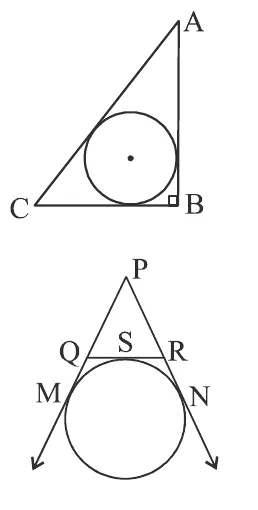
(a) In the given figure, △ABC\triangle ABC is a right triangle in which ∠B=90∘\angle B = 90^\circ, AB=4AB = 4 cm and BC=3BC = 3 cm. Find the radius of the circle inscribed in the triangle ABCABC.

OR

(b) In the given figure, if a circle touches the side QRQR of △PQR\triangle PQR at SS and extended sides PQPQ and PRPR at MM and NN respectively, then prove that PM=12(PQ+QR+PR)PM = \dfrac{1}{2}(PQ + QR + PR).

Two figures. First, a right triangle ABC with the right angle at B at the bottom right and a circle inside touching all three sides. Second, a triangle PQR with a circle below the side QR touching QR at S and the extended sides PQ and PR at M and N.
Solution
435ABCDEFBD = BE = x: (4 − x) + (3 − x) = 5 → x = 1, so r = 1 cm
PQRSMN2PM = PQ + QM + PR + RN = PQ + PR + QR
  1. (a) AC=42+32=5AC = \sqrt{4^2 + 3^2} = 5 cm. Let the circle touch ABAB, BCBC, CACA at DD, EE, FF and let BD=BE=xBD = BE = x.
  2. Tangents from a point are equal: AD=AF=4−xAD = AF = 4 - x and CE=CF=3−xCE = CF = 3 - x. AF+CF=ACAF + CF = AC gives (4−x)+(3−x)=5(4 - x) + (3 - x) = 5, so x=1x = 1.
  3. ∠B=90∘\angle B = 90^\circ and BD=BEBD = BE, so BDIEBDIE is a square and the radius equals x=1x = 1 cm. (Check with areas: 12×3×4=6=12r(3+4+5)=6r\dfrac{1}{2} \times 3 \times 4 = 6 = \dfrac{1}{2} r (3 + 4 + 5) = 6r, so r=1r = 1 ✓.)
  4. (b) Tangents from a point are equal: PM=PNPM = PN, QM=QSQM = QS and RN=RSRN = RS.
  5. 2PM=PM+PN=(PQ+QM)+(PR+RN)=PQ+PR+QS+RS=PQ+PR+QR2PM = PM + PN = (PQ + QM) + (PR + RN) = PQ + PR + QS + RS = PQ + PR + QR. So PM=12(PQ+QR+PR)PM = \dfrac{1}{2}(PQ + QR + PR).

Answer: (a) 11 cm   (b) proved

Report an error on this question
Q30Surface Areas and Volumes3 marks

A solid is in the form of a cylinder with hemispherical ends. The total height of the solid is 2020 cm and the diameter of the cylinder is 77 cm. Find the total volume of the solid. (Use π=227\pi = \dfrac{22}{7})

Solution
cylinder = 13 cmr = 3.5 cmheight = 20 cmV = πr²·13 + (4/3)πr³ = 4081/6 ≈ 680.2 cm³
  1. Radius of the cylinder and of each hemisphere =72= \dfrac{7}{2} cm. The two hemispheres take 72+72=7\dfrac{7}{2} + \dfrac{7}{2} = 7 cm of the height, so the cylinder is 20−7=1320 - 7 = 13 cm tall.
  2. Volume =πr2h+2×23πr3=πr2(13+43×72)=πr2(13+143)= \pi r^2 h + 2 \times \dfrac{2}{3}\pi r^3 = \pi r^2\left(13 + \dfrac{4}{3} \times \dfrac{7}{2}\right) = \pi r^2\left(13 + \dfrac{14}{3}\right).
  3. =227×494×533=772×533=40816≈680.17= \dfrac{22}{7} \times \dfrac{49}{4} \times \dfrac{53}{3} = \dfrac{77}{2} \times \dfrac{53}{3} = \dfrac{4081}{6} \approx 680.17 cm³.

Answer: 40816≈680.17\dfrac{4081}{6} \approx 680.17 cm³

Common mistake: Taking the cylinder as 20 − 7 = 13 only after adding the two radii. Using 20 cm or 20 − 3.5 for the cylinder overcounts.

Report an error on this question
Q31Probability3 marks

Two dice of different colours are thrown at the same time. Write down all the possible outcomes. What is the probability that:

(i) same number appears on both the dice?

(ii) different number appears on both the dice?

Solution
  1. Writing (number on the first die, number on the second): (1,1),(1,2),…,(1,6)(1,1), (1,2), \dots, (1,6); (2,1),…,(2,6)(2,1), \dots, (2,6); (3,1),…,(3,6)(3,1), \dots, (3,6); (4,1),…,(4,6)(4,1), \dots, (4,6); (5,1),…,(5,6)(5,1), \dots, (5,6); (6,1),…,(6,6)(6,1), \dots, (6,6). That is 3636 equally likely outcomes.
  2. (i) Same number: (1,1),(2,2),(3,3),(4,4),(5,5),(6,6)(1,1), (2,2), (3,3), (4,4), (5,5), (6,6), which is 66 outcomes. P=636=16P = \dfrac{6}{36} = \dfrac{1}{6}.
  3. (ii) Different numbers: P=1−16=56P = 1 - \dfrac{1}{6} = \dfrac{5}{6}.

Answer: (i) 16\dfrac{1}{6}   (ii) 56\dfrac{5}{6}

Report an error on this question

Section D: Long answer

4 questions, 5 marks each.

Q32Linear Equations5 marks

Determine graphically, the coordinates of vertices of a triangle whose equations are 2x−3y+6=02x - 3y + 6 = 0; 2x+3y−18=02x + 3y - 18 = 0 and x=0x = 0. Also, find the area of this triangle.

Solution
-4-3-2-112345678910-11234567Oxy2x − 3y + 6 = 02x + 3y − 18 = 0A(0, 2)B(3, 4)C(0, 6)
  1. Line 1, 2x−3y+6=02x - 3y + 6 = 0: points (0,2)(0, 2) and (−3,0)(-3, 0); also (3,4)(3, 4). Line 2, 2x+3y−18=02x + 3y - 18 = 0: points (0,6)(0, 6) and (9,0)(9, 0); also (3,4)(3, 4). Line 3, x=0x = 0, is the yy-axis.
  2. The lines meet in pairs at A(0,2)A(0, 2) (line 1 and the yy-axis), C(0,6)C(0, 6) (line 2 and the yy-axis) and B(3,4)B(3, 4) (lines 1 and 2).
  3. Taking ACAC on the yy-axis as the base: AC=6−2=4AC = 6 - 2 = 4. The height is the distance of BB from the yy-axis, which is 33.
  4. Area =12×4×3=6= \dfrac{1}{2} \times 4 \times 3 = 6 square units.

Answer: Vertices (0,2)(0, 2), (3,4)(3, 4), (0,6)(0, 6); area =6= 6 square units

Report an error on this question
Q33Quadratic Equations5 marks

(a) A faster train takes one hour less than a slower train for a journey of 200200 km. If the speed of the slower train is 1010 km/hr less than that of the faster train, find the speeds of the two trains.

OR

(b) The sum of the areas of two squares is 640640 m². If the difference in their perimeters is 6464 m, find the sides of the two squares.

Solution
  1. (a) Let the faster train go at xx km/h; the slower goes at (x−10)(x - 10) km/h. 200x−10−200x=1\dfrac{200}{x - 10} - \dfrac{200}{x} = 1.
  2. 200x−200(x−10)=x(x−10)200x - 200(x - 10) = x(x - 10), so 2000=x2−10x2000 = x^2 - 10x and x2−10x−2000=0x^2 - 10x - 2000 = 0.
  3. (x−50)(x+40)=0(x - 50)(x + 40) = 0. Speed cannot be negative, so x=50x = 50. The faster train goes at 5050 km/h and the slower at 4040 km/h.
  4. (b) Let the sides be xx and yy (x>yx > y). x2+y2=640x^2 + y^2 = 640 and 4x−4y=644x - 4y = 64, so y=x−16y = x - 16.
  5. x2+(x−16)2=640x^2 + (x - 16)^2 = 640 gives 2x2−32x+256=6402x^2 - 32x + 256 = 640, so x2−16x−192=0x^2 - 16x - 192 = 0 and (x−24)(x+8)=0(x - 24)(x + 8) = 0.
  6. x=24x = 24 (reject −8-8) and y=24−16=8y = 24 - 16 = 8. The sides are 2424 m and 88 m. (Check: 576+64=640576 + 64 = 640 ✓.)

Answer: (a) 5050 km/h and 4040 km/h   (b) 2424 m and 88 m

Report an error on this question
Q34Triangles5 marks

(a) State and prove Basic Proportionality Theorem.

OR

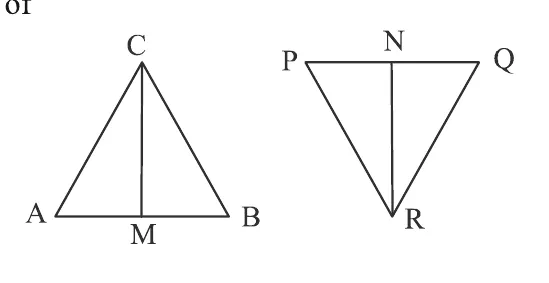
(b) In the given figure, CMCM and RNRN are respectively the medians of △ABC\triangle ABC and △PQR\triangle PQR. If △ABC∼△PQR\triangle ABC \sim \triangle PQR, then prove that: (i) △AMC∼△PNR\triangle AMC \sim \triangle PNR (ii) △CMB∼△RNQ\triangle CMB \sim \triangle RNQ.

Two triangles side by side. In triangle ABC the median CM is drawn from C to M on AB. In triangle PQR the median RN is drawn from R at the bottom to N on PQ.
Solution
  1. (a) **Statement.** If a line is drawn parallel to one side of a triangle to intersect the other two sides in distinct points, then the other two sides are divided in the same ratio.
  2. **Given:** in △ABC\triangle ABC, DE∥BCDE \parallel BC with DD on ABAB and EE on ACAC. **To prove:** ADDB=AEEC\dfrac{AD}{DB} = \dfrac{AE}{EC}. **Construction:** join BEBE and CDCD; draw DM⊥ACDM \perp AC and EN⊥ABEN \perp AB.
  3. ar(△ADE)ar(△BDE)=12⋅AD⋅EN12⋅DB⋅EN=ADDB\dfrac{\text{ar}(\triangle ADE)}{\text{ar}(\triangle BDE)} = \dfrac{\frac{1}{2} \cdot AD \cdot EN}{\frac{1}{2} \cdot DB \cdot EN} = \dfrac{AD}{DB} and ar(△ADE)ar(△CDE)=12⋅AE⋅DM12⋅EC⋅DM=AEEC\dfrac{\text{ar}(\triangle ADE)}{\text{ar}(\triangle CDE)} = \dfrac{\frac{1}{2} \cdot AE \cdot DM}{\frac{1}{2} \cdot EC \cdot DM} = \dfrac{AE}{EC}.
  4. △BDE\triangle BDE and △CDE\triangle CDE are on the same base DEDE and between the same parallels DEDE and BCBC, so their areas are equal. Hence ADDB=AEEC\dfrac{AD}{DB} = \dfrac{AE}{EC}.
  5. (b)(i) △ABC∼△PQR\triangle ABC \sim \triangle PQR gives ∠A=∠P\angle A = \angle P and ABPQ=ACPR\dfrac{AB}{PQ} = \dfrac{AC}{PR}. CMCM and RNRN are medians, so AB=2AMAB = 2AM and PQ=2PNPQ = 2PN, and 2AM2PN=ACPR\dfrac{2AM}{2PN} = \dfrac{AC}{PR}, that is AMPN=ACPR\dfrac{AM}{PN} = \dfrac{AC}{PR}.
  6. So △AMC∼△PNR\triangle AMC \sim \triangle PNR by SAS.
  7. (ii) ∠B=∠Q\angle B = \angle Q and ABPQ=BCQR\dfrac{AB}{PQ} = \dfrac{BC}{QR} gives 2MB2NQ=BCQR\dfrac{2MB}{2NQ} = \dfrac{BC}{QR}, so MBNQ=BCQR\dfrac{MB}{NQ} = \dfrac{BC}{QR}. Hence △CMB∼△RNQ\triangle CMB \sim \triangle RNQ by SAS.

Answer: (a) proved   (b) both proved

Report an error on this question
Q35Statistics5 marks

The mean of the following frequency distribution is 35. Find the values of x and y, if the sum of frequencies is 25:

Class0–1010–2020–3030–4040–5050–6060–70
Frequency1x57y31
Solution
  1. Sum of frequencies: 1+x+5+7+y+3+1=17+x+y=251 + x + 5 + 7 + y + 3 + 1 = 17 + x + y = 25, so x+y=8x + y = 8. (i)
  2. Class marks: 5,15,25,35,45,55,655, 15, 25, 35, 45, 55, 65. ∑fixi=5+15x+125+245+45y+165+65=605+15x+45y\sum f_ix_i = 5 + 15x + 125 + 245 + 45y + 165 + 65 = 605 + 15x + 45y.
  3. Mean =605+15x+45y25=35= \dfrac{605 + 15x + 45y}{25} = 35, so 15x+45y=875−605=27015x + 45y = 875 - 605 = 270 and x+3y=18x + 3y = 18. (ii)
  4. (ii) −- (i): 2y=102y = 10, so y=5y = 5 and x=3x = 3.

Answer: x=3x = 3 and y=5y = 5

Report an error on this question

Section E: Case studies

3 case studies, 4 marks each.

Q36Arithmetic Progressions4 marks

Case study 1. In a potato race, a bucket is placed at the starting point, which is 5 m from the first potato. The other potatoes are arranged 3 m apart in a straight line, with a total of 10 potatoes. A competitor starts from the bucket, picks up the nearest potato, runs back to the bucket to drop it in, then returns to pick up the next potato. This process continues until all the potatoes are in the bucket.

Based on the above information, answer the following questions:

(i) What is the distance covered to pick up the first potato and drop it in bucket? [1]

(ii) What is the distance covered to pick up the second potato and drop it in bucket? [1]

(iii) (a) What is the total distance the competitor has to run? [2]

OR

(iii) (b) If average speed of competitor is 5 m/s, then find the average time taken by competitor to put all the potatoes in the bucket. [2]

Solution
  1. (i) The first potato is 55 m away, so the round trip is 5+5=105 + 5 = 10 m.
  2. (ii) The second potato is 5+3=85 + 3 = 8 m away, so the round trip is 8+8=168 + 8 = 16 m.
  3. (iii)(a) The round trips are 10,16,22,…10, 16, 22, \dots, an A.P. with a=10a = 10 and d=6d = 6 for 1010 terms. S10=102[2(10)+9(6)]=5×74=370S_{10} = \dfrac{10}{2}[2(10) + 9(6)] = 5 \times 74 = 370 m.
  4. (iii)(b) Time =distancespeed=3705=74= \dfrac{\text{distance}}{\text{speed}} = \dfrac{370}{5} = 74 seconds.

Answer: (i) 1010 m   (ii) 1616 m   (iii)(a) 370370 m   (iii)(b) 7474 s

Report an error on this question
Q37Trigonometry4 marks

Case study 2. Radio towers are used for transmitting a range of communication services including radio and television. The tower will either act as an antenna itself or support one or more antennas on its structure. On a similar concept, a radio station tower was built in two sections ‘A’ and ‘B’. Tower is supported by wires from a point ‘O’. Distance between the base of the tower and point ‘O’ is 6 m. From point ‘O’, the angle of elevation of the top of the section ‘B’ is 30° and the angle of elevation of the top of section ‘A’ is 60°.

Based on the above information, answer the following questions:

(i) Find the length of the wire from the point ‘O’ to the top of section ‘B’. [1]

(ii) Find the length of the wire from the point ‘O’ to the top of section ‘A’. [1]

(iii) (a) Find the distance AB. [2]

OR

(iii) (b) Find the area of △OPB. [2]
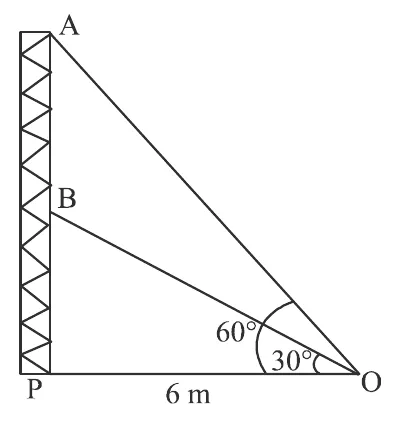
A vertical tower PA standing on the ground at P, with section B partway up and the top of section A at the top. Wires run from the ground point O, 6 m from P, to B and to A. The angle at O to B is marked 30 degrees and to A is marked 60 degrees.
Solution
30°60°POBAOP = 6 mOB = 4√3AB = AP − BP = 6√3 − 2√3 = 4√3 m
  1. (i) In the right triangle OPBOPB: cos⁡30∘=OPOB\cos 30^\circ = \dfrac{OP}{OB}, so 32=6OB\dfrac{\sqrt{3}}{2} = \dfrac{6}{OB} and OB=123=43OB = \dfrac{12}{\sqrt{3}} = 4\sqrt{3} m.
  2. (ii) In the right triangle OPAOPA: cos⁡60∘=OPOA\cos 60^\circ = \dfrac{OP}{OA}, so 12=6OA\dfrac{1}{2} = \dfrac{6}{OA} and OA=12OA = 12 m.
  3. (iii)(a) tan⁡30∘=BP6\tan 30^\circ = \dfrac{BP}{6} gives BP=23BP = 2\sqrt{3} m. tan⁡60∘=AP6\tan 60^\circ = \dfrac{AP}{6} gives AP=63AP = 6\sqrt{3} m. AB=AP−BP=63−23=43AB = AP - BP = 6\sqrt{3} - 2\sqrt{3} = 4\sqrt{3} m.
  4. (iii)(b) Area of △OPB=12×OP×BP=12×6×23=63\triangle OPB = \dfrac{1}{2} \times OP \times BP = \dfrac{1}{2} \times 6 \times 2\sqrt{3} = 6\sqrt{3} m².

Answer: (i) 434\sqrt{3} m   (ii) 1212 m   (iii)(a) 434\sqrt{3} m   (iii)(b) 636\sqrt{3} m²

Report an error on this question
Q38Areas Related to Circles4 marks

Case study 3. A brooch is crafted from silver wire in the shape of a circle with a diameter of 35 cm. The wire is also used to create 5 diameters, dividing the circle into 10 equal sectors as shown in figure.

Based on the above information, answer the following questions:

(i) What is the radius of circle? [1]

(ii) What is the circumference of the brooch? [1]

(iii) (a) What is the total length of silver wire required? [2]

OR

(iii) (b) What is the area of each sector of the brooch? [2]

Solution
36°r = 17.5wire = 5 × 35 + 110 = 285 cm; sector = 385/4 = 96.25 cm²
  1. (i) r=352=17.5r = \dfrac{35}{2} = 17.5 cm.
  2. (ii) Circumference =2πr=2×227×352=110= 2\pi r = 2 \times \dfrac{22}{7} \times \dfrac{35}{2} = 110 cm.
  3. (iii)(a) The wire forms the circle (110110 cm) and five diameters (5×35=1755 \times 35 = 175 cm): 110+175=285110 + 175 = 285 cm.
  4. (iii)(b) Each sector has central angle 360∘10=36∘\dfrac{360^\circ}{10} = 36^\circ. Area =36360×227×352×352=3854=96.25= \dfrac{36}{360} \times \dfrac{22}{7} \times \dfrac{35}{2} \times \dfrac{35}{2} = \dfrac{385}{4} = 96.25 cm².

Answer: (i) 17.517.5 cm   (ii) 110110 cm   (iii)(a) 285285 cm   (iii)(b) 96.2596.25 cm²

Report an error on this question

Questions are from the official CBSE paper. Figures are described in words; see the PDF for the originals. Solutions are written by CogniGuru.

Revise this paper in 1 minute a chapter

Each chapter below is what the paper tested, with a one-minute animated lesson on the idea behind it.

Stuck on a step in any solution?

The CogniGuru AI tutor explains any doubt one minute at a time, in English or Hindi. Join the waitlist.

Mock quiz: 5 questions from this paper

Five real questions from this paper, one each from five chapters. About 2 minutes. See how much you know and where you stand among other students. Attempt free, with no login; log in only for your ranking and full report.

Question 1 of 5 · Q1 of the paperReal Numbers

The HCF of 960960 and 432432 is:

0 of 5 answered

Related papers

  • Maths Standard 2025
  • Maths Standard 2027Coming soon
  • Maths Basic 2026Coming soon
  • Science 2026Coming soon

Common questions

Are these the official CBSE Class 10 Maths Standard 2026 questions?
Yes. The questions are from the official Mathematics (Standard) paper (set 30/1/1) that CBSE published after the 2026 board exam. The solutions are written by CogniGuru and checked against the answer key CBSE published for this paper code.
Can I download the CBSE Class 10 Maths Standard 2026 question paper PDF?
Yes, the official paper PDF is free to download from this page, and so are our step-by-step solutions as a PDF. No login is needed to download either or to read the solutions.
Do all sets of the paper have the same questions?
No. CBSE sets several versions of each paper, with the same blueprint and similar questions in a different order and sometimes with different numbers. This page covers set 30/1/1.
How does the quiz work, and what does “where you stand” mean?
It is a mock quiz of 5 real multiple-choice questions from this paper, scored automatically in about 2 minutes. Your score is compared, anonymously, with other students who took the same quiz. Only the score is stored with the comparison, never your name or number.

Source

CBSE question paper archive, Class X, 2026 (Mathematics (Standard), set 30/1/1)
PDF