CBSE · Class 10 · Mathematics (Standard) · Free

CBSE Class 10 Maths Standard 2026 Question Paper (Set 30/2/1) with Solutions

The official board paper (Q.P. Code 30/2/1, Series 2LKNM). Free paper PDF and step-by-step solutions (also as a PDF to download) written by CogniGuru and checked against CBSE’s answer key. See the paper’s main topics in 1 minute, then quiz yourself to see how much you know and where you stand.

No login to download or read the solutions. Login only to see your quiz report in full.

Board
CBSE
Class
10
Subject
Maths Standard (041)
Year
2026
Set code
30/2/1
Max marks
80
Duration
3 hours
Questions
38 (Sections A to E)
Source
Official CBSE paper
Exam date
2026

Paper preview

Three pages of the official paper. Download the PDF for all 27.
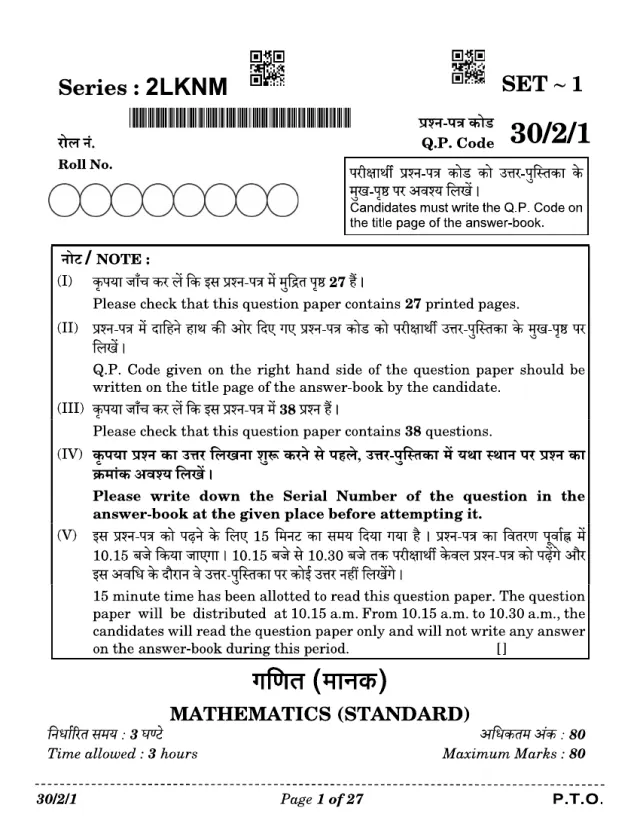
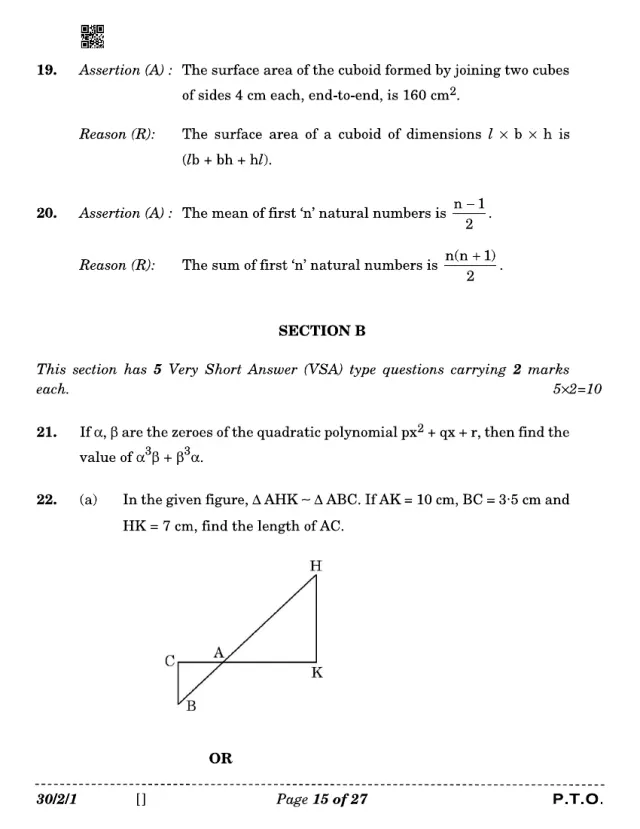
  • Cover page of the CBSE Class 10 Maths Standard 2026 paper, set 30/2/1

    Cover page

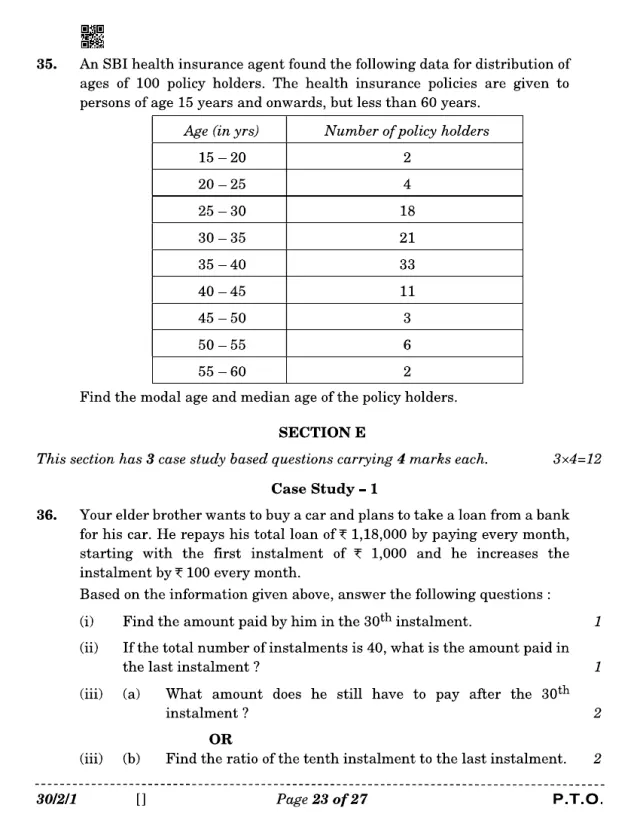
  • Section B of the CBSE Class 10 Maths Standard 2026 paper, set 30/2/1

    Section B

  • A case study with its figure from the CBSE Class 10 Maths Standard 2026 paper, set 30/2/1

    Case study

The main topics of this paper, in 1 minute

Your tutor walks you through the paper before you attempt it: the marks, the key ideas, the time plan and the traps.

1-minute paper analysis

With your tutor, in her voice

The main topics of this paper, in about a minute

A short, animated walk through the paper: how it is built, where the marks come from, the four ideas that matter most, how to plan your three hours, and the traps to avoid.

  1. 1The paper at a glance
  2. 2Where the marks come from
  3. 3Four ideas that keep paying off
  4. 4Plan your three hours
  5. 5Four traps to avoid

Sound on for the voice. Captions are shown, and you can mute any time.

Step-by-step solutions

Try each question first, then open its solution. Tap a number to jump.

Download solutions (PDF)

Section A: Multiple choice

20 questions, 1 mark each. MCQs (Q1 to Q18) and assertion-reason (Q19, Q20).

Q1Real Numbers1 mark

The LCM of 960960 and 240240 is:

  1. (A)960
  2. (B)240
  3. (C)60
  4. (D)15
Solution · answer (A)
  1. 960=4×240960 = 4 \times 240, so 240240 divides 960960.
  2. When one number is a multiple of the other, the LCM is the larger number: 960960. (The HCF is 240240.)

Answer: (A) 960

Report an error on this question
Q2Real Numbers1 mark

The natural number 1 is:

  1. (A)a prime number
  2. (B)a composite number
  3. (C)prime as well as composite
  4. (D)neither prime nor composite
Solution · answer (D)
  1. A prime has exactly two factors and a composite number has more than two. 11 has only one factor (itself), so it is neither.

Answer: (D) neither prime nor composite

Report an error on this question
Q3Real Numbers1 mark

For any natural number nn, 5n5^n ends with the digit:

  1. (A)0
  2. (B)5
  3. (C)3
  4. (D)2
Solution · answer (B)
  1. 5,25,125,625,…5, 25, 125, 625, \dots: a number ending in 55 times 55 always ends in 55. So 5n5^n ends with 55.

Answer: (B) 5

Report an error on this question
Q4Polynomials1 mark

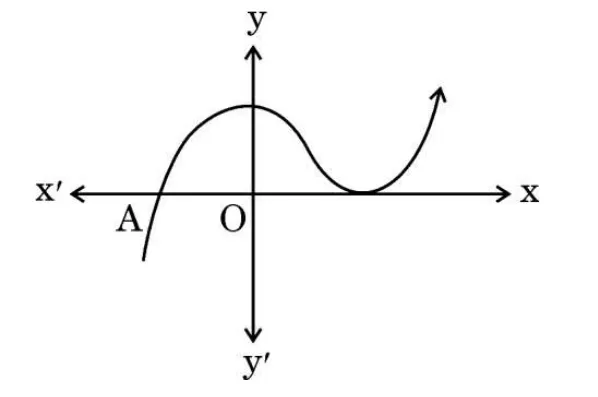
The graph of y=f(x)y = f(x) is given. The number of distinct zeroes of y=f(x)y = f(x) is:

A curve that crosses the x-axis at the point A on the left, rises to a peak above the axis, comes down and just touches the x-axis on the right, then rises again. The origin O and the axes are marked.
  1. (A)0
  2. (B)1
  3. (C)2
  4. (D)3
Solution · answer (C)
  1. The zeroes are the xx-values where the curve meets the xx-axis.
  2. It crosses at AA on the left, and it touches the axis once more at the bottom of the dip on the right. That is 22 distinct points (AA and the touching point).

Answer: (C) 2

Common mistake: Counting the peak or counting the touching point twice. Each meeting point counts once, so there are two distinct zeroes.

Report an error on this question
Q5Polynomials1 mark

If α\alpha and β\beta are two zeroes of a polynomial f(x)=px2−2x+3pf(x) = px^2 - 2x + 3p and α+β=αβ\alpha + \beta = \alpha\beta, then value of pp is:

  1. (A)−23-\dfrac{2}{3}
  2. (B)23\dfrac{2}{3}
  3. (C)13\dfrac{1}{3}
  4. (D)−13-\dfrac{1}{3}
Solution · answer (B)
  1. α+β=−−2p=2p\alpha + \beta = -\dfrac{-2}{p} = \dfrac{2}{p} and αβ=3pp=3\alpha\beta = \dfrac{3p}{p} = 3.
  2. α+β=αβ\alpha + \beta = \alpha\beta gives 2p=3\dfrac{2}{p} = 3, so p=23p = \dfrac{2}{3}.

Answer: (B) 23\dfrac{2}{3}

Report an error on this question
Q6Linear Equations1 mark

If the pair of linear equations a1x+b1y+c1=0a_1x + b_1y + c_1 = 0 and a2x+b2y+c2=0a_2x + b_2y + c_2 = 0 is consistent and dependent, then:

  1. (A)a1a2≠b1b2\dfrac{a_1}{a_2} \neq \dfrac{b_1}{b_2}
  2. (B)a1a2≠b1b2=c1c2\dfrac{a_1}{a_2} \neq \dfrac{b_1}{b_2} = \dfrac{c_1}{c_2}
  3. (C)a1a2=b1b2≠c1c2\dfrac{a_1}{a_2} = \dfrac{b_1}{b_2} \neq \dfrac{c_1}{c_2}
  4. (D)a1a2=b1b2=c1c2\dfrac{a_1}{a_2} = \dfrac{b_1}{b_2} = \dfrac{c_1}{c_2}
Solution · answer (D)
  1. Dependent (coincident) lines have infinitely many solutions, which needs all three ratios equal: a1a2=b1b2=c1c2\dfrac{a_1}{a_2} = \dfrac{b_1}{b_2} = \dfrac{c_1}{c_2}. (Option (A) is a unique solution and (C) is parallel lines, no solution.)

Answer: (D) a1a2=b1b2=c1c2\dfrac{a_1}{a_2} = \dfrac{b_1}{b_2} = \dfrac{c_1}{c_2}

Report an error on this question
Q7Arithmetic Progressions1 mark

Which of the following sequences is **not** an A.P.?

  1. (A)2,52,3,72,…2, \dfrac{5}{2}, 3, \dfrac{7}{2}, \dots
  2. (B)−1.2,−3.2,−5.2,−7.2,…-1.2, -3.2, -5.2, -7.2, \dots
  3. (C)2,8,18,…\sqrt{2}, \sqrt{8}, \sqrt{18}, \dots
  4. (D)12,32,52,72,…1^2, 3^2, 5^2, 7^2, \dots
Solution · answer (D)
  1. (A) common difference 12\dfrac{1}{2} ✓. (B) common difference −2-2 ✓. (C) 2,22,32\sqrt{2}, 2\sqrt{2}, 3\sqrt{2}: common difference 2\sqrt{2} ✓.
  2. (D) 1,9,25,491, 9, 25, 49: differences 8,16,248, 16, 24 are not equal. Not an A.P.

Answer: (D) 12,32,52,72,…1^2, 3^2, 5^2, 7^2, \dots

Report an error on this question
Q8Triangles1 mark

In triangles ABCABC and PQRPQR, ∠A=∠Q\angle A = \angle Q and ∠B=∠R\angle B = \angle R, then AB:ACAB : AC is equal to:

  1. (A)PQ:PRPQ : PR
  2. (B)PQ:QRPQ : QR
  3. (C)QR:QPQR : QP
  4. (D)PR:QRPR : QR
Solution · answer (C)
  1. ∠A=∠Q\angle A = \angle Q and ∠B=∠R\angle B = \angle R, so the correspondence is A↔QA \leftrightarrow Q, B↔RB \leftrightarrow R, C↔PC \leftrightarrow P, and △ABC∼△QRP\triangle ABC \sim \triangle QRP.
  2. ABAB matches QRQR and ACAC matches QPQP, so AB:AC=QR:QPAB : AC = QR : QP.

Answer: (C) QR:QPQR : QP

Report an error on this question
Q9Coordinate Geometry1 mark

The distance of the point A(4a,3a)A(4a, 3a) from xx-axis is:

  1. (A)3a
  2. (B)−3a
  3. (C)4a
  4. (D)−4a
Solution · answer (A)
  1. The distance from the xx-axis is the absolute value of the yy-coordinate, ∣3a∣|3a|, which is 3a3a (taking a>0a > 0, as the options expect). Option (B) and (D) are negative, and 4a4a is the distance from the yy-axis.

Answer: (A) 3a

Report an error on this question
Q10Trigonometry1 mark

If cos⁡A=45\cos A = \dfrac{4}{5}, then the value of tan⁡A\tan A is:

  1. (A)35\dfrac{3}{5}
  2. (B)34\dfrac{3}{4}
  3. (C)43\dfrac{4}{3}
  4. (D)53\dfrac{5}{3}
Solution · answer (B)
  1. Adjacent =4= 4, hypotenuse =5= 5, so opposite =25−16=3= \sqrt{25 - 16} = 3 (the 33-44-55 triangle). tan⁡A=34\tan A = \dfrac{3}{4}.

Answer: (B) 34\dfrac{3}{4}

Report an error on this question
Q11Trigonometry1 mark

If 2sin⁡A=12\sin A = 1, then the value of tan⁡A+cot⁡A\tan A + \cot A is:

  1. (A)3\sqrt{3}
  2. (B)43\dfrac{4}{\sqrt{3}}
  3. (C)32\dfrac{\sqrt{3}}{2}
  4. (D)1
Solution · answer (B)
  1. sin⁡A=12\sin A = \dfrac{1}{2}, so A=30∘A = 30^\circ.
  2. tan⁡30∘+cot⁡30∘=13+3=1+33=43\tan 30^\circ + \cot 30^\circ = \dfrac{1}{\sqrt{3}} + \sqrt{3} = \dfrac{1 + 3}{\sqrt{3}} = \dfrac{4}{\sqrt{3}}.

Answer: (B) 43\dfrac{4}{\sqrt{3}}

Report an error on this question
Q12Trigonometry1 mark

From a point on the ground, which is 6060 m away from the foot of a vertical tower, the angle of elevation of the top of the tower is found to be 45∘45^\circ. The height (in metres) of the tower is:

  1. (A)10310\sqrt{3}
  2. (B)30330\sqrt{3}
  3. (C)60
  4. (D)30
Solution · answer (C)
  1. tan⁡45∘=height60=1\tan 45^\circ = \dfrac{\text{height}}{60} = 1, so the height is 6060 m.

Answer: (C) 60

Report an error on this question
Q13Circles1 mark

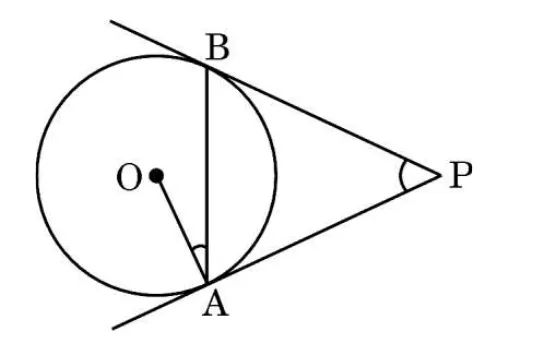
In the given figure, PAPA and PBPB are tangents to a circle centred at OO. If ∠OAB=15∘\angle OAB = 15^\circ, then ∠APB\angle APB equals:

A circle with centre O on the left. Tangents from the outside point P on the right touch the circle at B (top) and A (bottom). The chord AB is drawn vertically and the radius OA is drawn.
  1. (A)30∘30^\circ
  2. (B)15∘15^\circ
  3. (C)45∘45^\circ
  4. (D)10∘10^\circ
Solution · answer (A)
15°30°OABP∠PAB = 90° − 15° = 75° = ∠PBA → ∠APB = 180° − 150° = 30°
  1. OA⊥PAOA \perp PA, so ∠PAB=90∘−∠OAB=90∘−15∘=75∘\angle PAB = 90^\circ - \angle OAB = 90^\circ - 15^\circ = 75^\circ.
  2. Tangents from PP are equal, so PA=PBPA = PB and ∠PBA=∠PAB=75∘\angle PBA = \angle PAB = 75^\circ.
  3. ∠APB=180∘−75∘−75∘=30∘\angle APB = 180^\circ - 75^\circ - 75^\circ = 30^\circ.

Answer: (A) 30∘30^\circ

Report an error on this question
Q14Circles1 mark

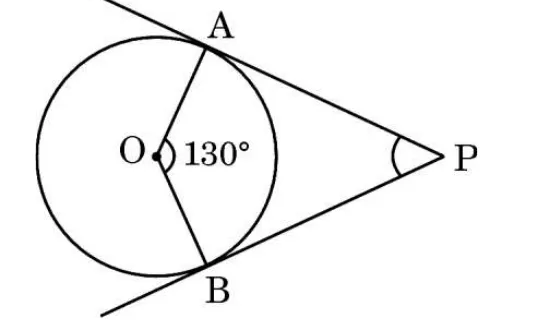
In the given figure, PAPA and PBPB are tangents to a circle centred at OO. If ∠AOB=130∘\angle AOB = 130^\circ, then ∠APB\angle APB is equal to:

A circle with centre O on the left and the outside point P on the right. PA and PB are tangents touching at A (top) and B (bottom), and the angle AOB is marked 130 degrees.
  1. (A)130∘130^\circ
  2. (B)50∘50^\circ
  3. (C)120∘120^\circ
  4. (D)90∘90^\circ
Solution · answer (B)
130°50°OABP∠APB = 180° − ∠AOB = 180° − 130° = 50°
  1. OA⊥PAOA \perp PA and OB⊥PBOB \perp PB, so in the quadrilateral OAPBOAPB: ∠APB=360∘−90∘−90∘−130∘=50∘\angle APB = 360^\circ - 90^\circ - 90^\circ - 130^\circ = 50^\circ. (The angle at the centre and the angle between the tangents add up to 180∘180^\circ.)

Answer: (B) 50∘50^\circ

Report an error on this question
Q15Areas Related to Circles1 mark

Area of a segment of a circle of radius rr and central angle 60∘60^\circ is:

  1. (A)πr22−12r2\dfrac{\pi r^2}{2} - \dfrac{1}{2}r^2
  2. (B)2πr4−34r2\dfrac{2\pi r}{4} - \dfrac{\sqrt{3}}{4}r^2
  3. (C)πr26−34r2\dfrac{\pi r^2}{6} - \dfrac{\sqrt{3}}{4}r^2
  4. (D)2πr4−r2sin⁡60∘\dfrac{2\pi r}{4} - r^2\sin 60^\circ
Solution · answer (C)
  1. Segment == sector −- triangle. Sector =60360πr2=πr26= \dfrac{60}{360}\pi r^2 = \dfrac{\pi r^2}{6}.
  2. The triangle with two sides rr and angle 60∘60^\circ is equilateral: area 34r2\dfrac{\sqrt{3}}{4}r^2.
  3. Segment =πr26−34r2= \dfrac{\pi r^2}{6} - \dfrac{\sqrt{3}}{4}r^2.

Answer: (C) πr26−34r2\dfrac{\pi r^2}{6} - \dfrac{\sqrt{3}}{4}r^2

Report an error on this question
Q16Surface Areas and Volumes1 mark

A hemispherical bowl is made of steel of thickness 11 cm. The outer radius of the bowl is 66 cm. The volume of steel used (in cm³) is:

  1. (A)182π182\pi
  2. (B)1823π\dfrac{182}{3}\pi
  3. (C)6823π\dfrac{682}{3}\pi
  4. (D)3643π\dfrac{364}{3}\pi
Solution · answer (B)
  1. Outer radius R=6R = 6 cm and inner radius r=6−1=5r = 6 - 1 = 5 cm.
  2. Steel =23π(R3−r3)=23π(216−125)=23π×91=1823π= \dfrac{2}{3}\pi(R^3 - r^3) = \dfrac{2}{3}\pi(216 - 125) = \dfrac{2}{3}\pi \times 91 = \dfrac{182}{3}\pi cm³.

Answer: (B) 1823π\dfrac{182}{3}\pi

Report an error on this question
Q17Statistics1 mark

The mean and median of a frequency distribution are 43 and 43.4 respectively. The mode of the distribution is:

  1. (A)43.4
  2. (B)42.4
  3. (C)44.2
  4. (D)49.3
Solution · answer (C)
  1. Mode=3 Median−2 Mean=3(43.4)−2(43)=130.2−86=44.2\text{Mode} = 3\,\text{Median} - 2\,\text{Mean} = 3(43.4) - 2(43) = 130.2 - 86 = 44.2.

Answer: (C) 44.2

Report an error on this question
Q18Probability1 mark

The probability for a randomly selected number out of 1,2,3,4,…,251, 2, 3, 4, \dots, 25 to be a composite number is:

  1. (A)1525\dfrac{15}{25}
  2. (B)1025\dfrac{10}{25}
  3. (C)1125\dfrac{11}{25}
  4. (D)925\dfrac{9}{25}
Solution · answer (A)
  1. Primes up to 2525: 2,3,5,7,11,13,17,19,232, 3, 5, 7, 11, 13, 17, 19, 23, which is 99. The number 11 is neither prime nor composite.
  2. Composite numbers =25−9−1=15= 25 - 9 - 1 = 15, so P=1525P = \dfrac{15}{25}.

Answer: (A) 1525\dfrac{15}{25}

Common mistake: Counting 1 as composite (giving 16) or as prime. It is neither.

Report an error on this question
Q19Surface Areas and Volumes1 mark

Assertion (A): The surface area of the cuboid formed by joining two cubes of sides 44 cm each, end-to-end, is 160160 cm².

Reason (R): The surface area of a cuboid of dimensions l×b×hl \times b \times h is (lb+bh+hl)(lb + bh + hl).

  1. (A)Both A and R are true and R is the correct explanation of A
  2. (B)Both A and R are true, but R is not the correct explanation of A
  3. (C)A is true, but R is false
  4. (D)A is false, but R is true
Solution · answer (C)
  1. (A) The cuboid is 8×4×48 \times 4 \times 4: surface area =2(32+16+32)=2×80=160= 2(32 + 16 + 32) = 2 \times 80 = 160 cm². True. (Also: 1010 outer faces of 1616 cm² each =160= 160 cm².)
  2. (R) The correct formula is 2(lb+bh+hl)2(lb + bh + hl); the factor 22 is missing. False.

Answer: (C) A is true, R is false

Report an error on this question
Q20Arithmetic Progressions1 mark

Assertion (A): The mean of first nn natural numbers is n−12\dfrac{n - 1}{2}.

Reason (R): The sum of first nn natural numbers is n(n+1)2\dfrac{n(n + 1)}{2}.

  1. (A)Both A and R are true and R is the correct explanation of A
  2. (B)Both A and R are true, but R is not the correct explanation of A
  3. (C)A is true, but R is false
  4. (D)A is false, but R is true
Solution · answer (D)
  1. (R) 1+2+⋯+n=n(n+1)21 + 2 + \dots + n = \dfrac{n(n + 1)}{2}. True.
  2. (A) Mean =n(n+1)2÷n=n+12= \dfrac{n(n + 1)}{2} \div n = \dfrac{n + 1}{2}, not n−12\dfrac{n - 1}{2}. False. (For n=3n = 3: mean of 1,2,31, 2, 3 is 2=3+122 = \dfrac{3 + 1}{2}.)

Answer: (D) A is false, R is true

Report an error on this question

Section B: Very short answer

5 questions, 2 marks each.

Q21Polynomials2 marks

If α,β\alpha, \beta are the zeroes of the quadratic polynomial px2+qx+rpx^2 + qx + r, then find the value of α3β+β3α\alpha^3\beta + \beta^3\alpha.

Solution
  1. α+β=−qp\alpha + \beta = -\dfrac{q}{p} and αβ=rp\alpha\beta = \dfrac{r}{p}.
  2. α3β+β3α=αβ(α2+β2)=αβ[(α+β)2−2αβ]\alpha^3\beta + \beta^3\alpha = \alpha\beta(\alpha^2 + \beta^2) = \alpha\beta\left[(\alpha + \beta)^2 - 2\alpha\beta\right].
  3. =rp[q2p2−2rp]=rp×q2−2prp2=r(q2−2pr)p3= \dfrac{r}{p}\left[\dfrac{q^2}{p^2} - \dfrac{2r}{p}\right] = \dfrac{r}{p} \times \dfrac{q^2 - 2pr}{p^2} = \dfrac{r(q^2 - 2pr)}{p^3}.

Answer: rp3(q2−2pr)\dfrac{r}{p^3}(q^2 - 2pr)

Report an error on this question
Q22Triangles2 marks

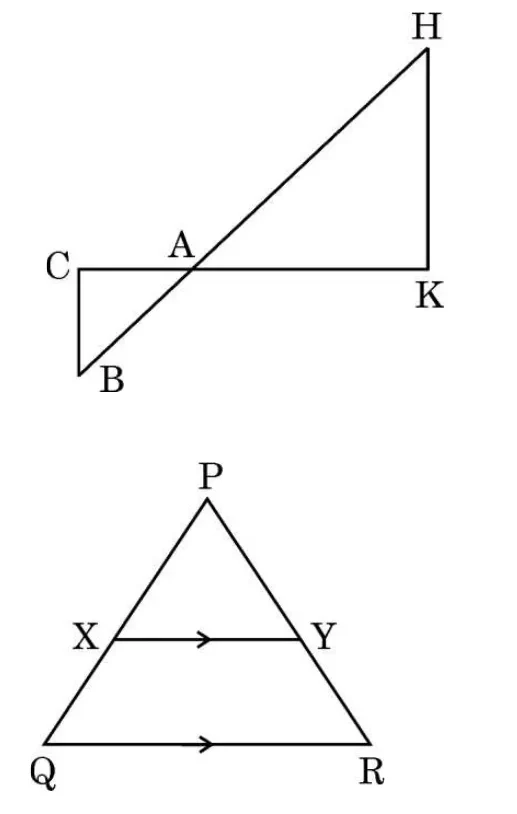
(a) In the given figure, △AHK∼△ABC\triangle AHK \sim \triangle ABC. If AK=10AK = 10 cm, BC=3.5BC = 3.5 cm and HK=7HK = 7 cm, find the length of ACAC.

OR

(b) In the given figure, XY∥QRXY \parallel QR, PQXQ=73\dfrac{PQ}{XQ} = \dfrac{7}{3} and PR=6.3PR = 6.3 cm. Find the length of YRYR.

Two figures. First, two right triangles AHK and ABC that meet at the point A, with C, A, K on one line and B, A, H on another. Second, a triangle PQR with a line XY parallel to the base QR, with X on PQ and Y on PR.
Solution
1073.5AC = 5AKCHBAK/AC = HK/BC → 10/AC = 7/3.5 = 2 → AC = 5 cm
34YR = 2.73.6PQRXYPQ/XQ = PR/YR → 7/3 = 6.3/YR → YR = 2.7 cm
  1. (a) △AHK∼△ABC\triangle AHK \sim \triangle ABC, so AKAC=HKBC\dfrac{AK}{AC} = \dfrac{HK}{BC}: 10AC=73.5=2\dfrac{10}{AC} = \dfrac{7}{3.5} = 2, so AC=5AC = 5 cm.
  2. (b) XY∥QRXY \parallel QR, so PQXQ=PRYR\dfrac{PQ}{XQ} = \dfrac{PR}{YR} (a line parallel to a side cuts the other two sides in the same ratio, so the whole-to-part ratios are equal).
  3. 73=6.3YR\dfrac{7}{3} = \dfrac{6.3}{YR}, so YR=6.3×37=2.7YR = \dfrac{6.3 \times 3}{7} = 2.7 cm.

Answer: (a) 55 cm   (b) 2.72.7 cm

Report an error on this question
Q23Coordinate Geometry2 marks

If the points A(4,5)A(4, 5), B(m,6)B(m, 6), C(4,3)C(4, 3) and D(1,n)D(1, n) taken in this order are the vertices of a parallelogram ABCDABCD, then find the values of mm and nn.

Solution
  1. The diagonals of a parallelogram bisect each other, so the mid-points of ACAC and BDBD coincide.
  2. Mid-point of AC=(4+42,5+32)=(4,4)AC = \left(\dfrac{4 + 4}{2}, \dfrac{5 + 3}{2}\right) = (4, 4). Mid-point of BD=(m+12,6+n2)BD = \left(\dfrac{m + 1}{2}, \dfrac{6 + n}{2}\right).
  3. m+12=4\dfrac{m + 1}{2} = 4 gives m=7m = 7, and 6+n2=4\dfrac{6 + n}{2} = 4 gives n=2n = 2.

Answer: m=7m = 7 and n=2n = 2

Report an error on this question
Q24Trigonometry2 marks

(a) If tan⁡θ+1tan⁡θ=2\tan\theta + \dfrac{1}{\tan\theta} = 2, find the value of tan⁡2θ+1tan⁡2θ\tan^2\theta + \dfrac{1}{\tan^2\theta}.

OR

(b) Prove that: 1−sin⁡θ1+sin⁡θ=sec⁡θ−tan⁡θ\sqrt{\dfrac{1 - \sin\theta}{1 + \sin\theta}} = \sec\theta - \tan\theta.

Solution
  1. (a) Square both sides: tan⁡2θ+2+1tan⁡2θ=4\tan^2\theta + 2 + \dfrac{1}{\tan^2\theta} = 4, so tan⁡2θ+1tan⁡2θ=2\tan^2\theta + \dfrac{1}{\tan^2\theta} = 2.
  2. (b) Multiply the top and bottom inside the root by (1−sin⁡θ)(1 - \sin\theta): LHS =(1−sin⁡θ)21−sin⁡2θ=(1−sin⁡θ)2cos⁡2θ= \sqrt{\dfrac{(1 - \sin\theta)^2}{1 - \sin^2\theta}} = \sqrt{\dfrac{(1 - \sin\theta)^2}{\cos^2\theta}}.
  3. =1−sin⁡θcos⁡θ=sec⁡θ−tan⁡θ== \dfrac{1 - \sin\theta}{\cos\theta} = \sec\theta - \tan\theta = RHS.

Answer: (a) 22   (b) proved

Report an error on this question
Q25Circles2 marks

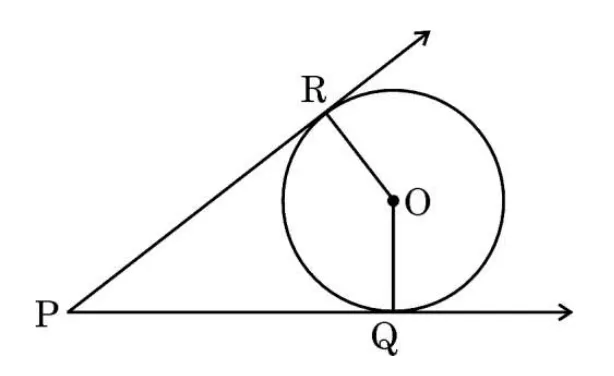
In the given figure, OO is the centre of the circle. PQPQ and PRPR are tangents. Show that the quadrilateral PQORPQOR is cyclic.

A circle with centre O on the right. From the outside point P on the left, two tangents are drawn: PR touches at R at the top and PQ touches at Q at the bottom. The radii OR and OQ are drawn.
Solution
PORQ∠Q + ∠R = 90° + 90° = 180° → PQOR is cyclic
  1. The radius is perpendicular to the tangent at the point of contact: ∠PQO=90∘\angle PQO = 90^\circ and ∠PRO=90∘\angle PRO = 90^\circ.
  2. ∠PQO+∠PRO=180∘\angle PQO + \angle PRO = 180^\circ. A pair of opposite angles of PQORPQOR is supplementary, so the quadrilateral PQORPQOR is cyclic.

Answer: Shown

Report an error on this question

Section C: Short answer

6 questions, 3 marks each.

Q26Real Numbers3 marks

Prove that 5\sqrt{5} is an irrational number.

Solution
  1. Suppose 5=pq\sqrt{5} = \dfrac{p}{q} with p,qp, q co-prime integers and q≠0q \neq 0.
  2. 5q2=p25q^2 = p^2, so 55 divides p2p^2 and therefore 55 divides pp. Write p=5ap = 5a.
  3. 25a2=5q225a^2 = 5q^2, so q2=5a2q^2 = 5a^2; 55 divides q2q^2 and so 55 divides qq.
  4. 55 divides both pp and qq, contradicting that they are co-prime. So 5\sqrt{5} is irrational.

Answer: Proved

Report an error on this question
Q27Coordinate Geometry3 marks

Find the coordinates of the points of trisection of the line segment joining the points A(−1,4)A(-1, 4) and B(−3,−2)B(-3, -2).

Solution
-4-3-2-11-3-2-112345OxyA(−1, 4)B(−3, −2)P(−5/3, 2)Q(−7/3, 0)
  1. Let PP and QQ be the points of trisection, with AP:PB=1:2AP : PB = 1 : 2 and AQ:QB=2:1AQ : QB = 2 : 1.
  2. P=(1(−3)+2(−1)3,1(−2)+2(4)3)=(−53,2)P = \left(\dfrac{1(-3) + 2(-1)}{3}, \dfrac{1(-2) + 2(4)}{3}\right) = \left(-\dfrac{5}{3}, 2\right).
  3. Q=(2(−3)+1(−1)3,2(−2)+1(4)3)=(−73,0)Q = \left(\dfrac{2(-3) + 1(-1)}{3}, \dfrac{2(-2) + 1(4)}{3}\right) = \left(-\dfrac{7}{3}, 0\right). (Check: QQ is the mid-point of PBPB ✓.)

Answer: (−53,2)\left(-\dfrac{5}{3}, 2\right) and (−73,0)\left(-\dfrac{7}{3}, 0\right)

Report an error on this question
Q28Trigonometry3 marks

(a) Prove that: sec⁡3θsec⁡2θ−1+cosec⁡3θcosec⁡2θ−1=sec⁡θ⋅cosec⁡θ (sec⁡θ+cosec⁡θ)\dfrac{\sec^3\theta}{\sec^2\theta - 1} + \dfrac{\operatorname{cosec}^3\theta}{\operatorname{cosec}^2\theta - 1} = \sec\theta\cdot\operatorname{cosec}\theta\,(\sec\theta + \operatorname{cosec}\theta).

OR

(b) If sec⁡αcosec⁡β=p\dfrac{\sec\alpha}{\operatorname{cosec}\beta} = p and tan⁡αcosec⁡β=q\dfrac{\tan\alpha}{\operatorname{cosec}\beta} = q, then prove that (p2−q2)sec⁡2α=p2(p^2 - q^2)\sec^2\alpha = p^2.

Solution
  1. (a) sec⁡2θ−1=tan⁡2θ\sec^2\theta - 1 = \tan^2\theta and cosec⁡2θ−1=cot⁡2θ\operatorname{cosec}^2\theta - 1 = \cot^2\theta. LHS =sec⁡3θtan⁡2θ+cosec⁡3θcot⁡2θ= \dfrac{\sec^3\theta}{\tan^2\theta} + \dfrac{\operatorname{cosec}^3\theta}{\cot^2\theta}.
  2. sec⁡3θtan⁡2θ=1cos⁡3θ×cos⁡2θsin⁡2θ=1cos⁡θsin⁡2θ\dfrac{\sec^3\theta}{\tan^2\theta} = \dfrac{1}{\cos^3\theta} \times \dfrac{\cos^2\theta}{\sin^2\theta} = \dfrac{1}{\cos\theta\sin^2\theta} and, in the same way, cosec⁡3θcot⁡2θ=1sin⁡θcos⁡2θ\dfrac{\operatorname{cosec}^3\theta}{\cot^2\theta} = \dfrac{1}{\sin\theta\cos^2\theta}.
  3. Sum =1sin⁡θcos⁡θ(1sin⁡θ+1cos⁡θ)=sec⁡θcosec⁡θ(cosec⁡θ+sec⁡θ)== \dfrac{1}{\sin\theta\cos\theta}\left(\dfrac{1}{\sin\theta} + \dfrac{1}{\cos\theta}\right) = \sec\theta\operatorname{cosec}\theta(\operatorname{cosec}\theta + \sec\theta) = RHS.
  4. (b) p2−q2=sec⁡2α−tan⁡2αcosec⁡2β=1cosec⁡2βp^2 - q^2 = \dfrac{\sec^2\alpha - \tan^2\alpha}{\operatorname{cosec}^2\beta} = \dfrac{1}{\operatorname{cosec}^2\beta}.
  5. (p2−q2)sec⁡2α=sec⁡2αcosec⁡2β=(sec⁡αcosec⁡β)2=p2(p^2 - q^2)\sec^2\alpha = \dfrac{\sec^2\alpha}{\operatorname{cosec}^2\beta} = \left(\dfrac{\sec\alpha}{\operatorname{cosec}\beta}\right)^2 = p^2.

Answer: Proved (both parts)

Report an error on this question
Q29Circles3 marks

(a) Prove that the lengths of tangents drawn from an external point to a circle are equal.

OR

(b) Two tangents TPTP and TQTQ are drawn to a circle with centre OO from an external point TT. Prove that ∠PTQ=2∠OPQ\angle PTQ = 2\angle OPQ.

Solution
θTOPQ∠POQ = 180° − θ and ∠POQ = 180° − 2∠OPQ → θ = 2∠OPQ
  1. (a) **Given:** a circle with centre OO and tangents TPTP, TQTQ from the external point TT (touching at PP and QQ). **To prove:** TP=TQTP = TQ. Join OPOP, OQOQ and OTOT.
  2. The radius is perpendicular to the tangent: ∠OPT=∠OQT=90∘\angle OPT = \angle OQT = 90^\circ. In the right triangles OPTOPT and OQTOQT: OP=OQOP = OQ (radii), OTOT is common and the angles at P,QP, Q are 90∘90^\circ.
  3. So △OPT≅△OQT\triangle OPT \cong \triangle OQT (RHS) and TP=TQTP = TQ.
  4. (b) OP=OQOP = OQ (radii), so ∠OPQ=∠OQP\angle OPQ = \angle OQP. In △OPQ\triangle OPQ: ∠POQ=180∘−2∠OPQ\angle POQ = 180^\circ - 2\angle OPQ. (i)
  5. In the quadrilateral OPTQOPTQ the angles at PP and QQ are 90∘90^\circ, so ∠POQ+∠PTQ=180∘\angle POQ + \angle PTQ = 180^\circ, that is ∠POQ=180∘−∠PTQ\angle POQ = 180^\circ - \angle PTQ. (ii)
  6. From (i) and (ii): 180∘−2∠OPQ=180∘−∠PTQ180^\circ - 2\angle OPQ = 180^\circ - \angle PTQ, so ∠PTQ=2∠OPQ\angle PTQ = 2\angle OPQ.

Answer: Proved (both parts)

Report an error on this question
Q30Areas Related to Circles3 marks

Find the area of the sector of a circle of radius 4242 cm and of central angle 30∘30^\circ. Also, find the area of the corresponding major sector. (Use π=227\pi = \dfrac{22}{7})

Solution
30°42 cmOABminor: 462 cm²major: 5082 cm²30/360 × 22/7 × 42² = 462; 330/360 × 22/7 × 42² = 5082
  1. Minor sector =30360×227×42×42=112×5544=462= \dfrac{30}{360} \times \dfrac{22}{7} \times 42 \times 42 = \dfrac{1}{12} \times 5544 = 462 cm².
  2. The major sector has central angle 360∘−30∘=330∘360^\circ - 30^\circ = 330^\circ: 330360×227×42×42=1112×5544=5082\dfrac{330}{360} \times \dfrac{22}{7} \times 42 \times 42 = \dfrac{11}{12} \times 5544 = 5082 cm².
  3. (Check: 462+5082=5544462 + 5082 = 5544, the whole circle ✓.)

Answer: Minor sector =462= 462 cm²; major sector =5082= 5082 cm²

Report an error on this question
Q31Probability3 marks

Two dice are thrown at the same time. Determine the probability that the (i) sum of the numbers on the two dice is 5, and (ii) difference of the numbers on the two dice is 3.

Solution
  1. There are 6×6=366 \times 6 = 36 equally likely outcomes.
  2. (i) Sum 55: (1,4),(4,1),(2,3),(3,2)(1,4), (4,1), (2,3), (3,2), which is 44 outcomes. P=436=19P = \dfrac{4}{36} = \dfrac{1}{9}.
  3. (ii) Difference 33: (1,4),(4,1),(2,5),(5,2),(3,6),(6,3)(1,4), (4,1), (2,5), (5,2), (3,6), (6,3), which is 66 outcomes. P=636=16P = \dfrac{6}{36} = \dfrac{1}{6}.

Answer: (i) 19\dfrac{1}{9}   (ii) 16\dfrac{1}{6}

Report an error on this question

Section D: Long answer

4 questions, 5 marks each.

Q32Linear Equations5 marks

Aarush bought 2 pencils and 3 chocolates for ₹ 11 and Tanish bought 1 pencil and 2 chocolates for ₹ 7 from the same shop. Represent this situation in the form of a pair of linear equations. Find the price of 1 pencil and 1 chocolate, graphically.

Solution
-112345678-1123456Oxy2x + 3y = 11x + 2y = 7(1, 3)
  1. Let a pencil cost ₹ xx and a chocolate cost ₹ yy. The equations are 2x+3y=112x + 3y = 11 and x+2y=7x + 2y = 7.
  2. Line 1, 2x+3y=112x + 3y = 11: y=11−2x3y = \dfrac{11 - 2x}{3} gives the points (1,3)(1, 3), (4,1)(4, 1) and (−2,5)(-2, 5).
  3. Line 2, x+2y=7x + 2y = 7: y=7−x2y = \dfrac{7 - x}{2} gives the points (1,3)(1, 3), (3,2)(3, 2) and (5,1)(5, 1).
  4. The two lines meet at (1,3)(1, 3), so x=1x = 1 and y=3y = 3. (Check: 2+9=112 + 9 = 11 ✓ and 1+6=71 + 6 = 7 ✓.)

Answer: A pencil costs ₹ 11 and a chocolate costs ₹ 33

Report an error on this question
Q33Quadratic Equations5 marks

(a) A person on a tour has ₹ 4,2004{,}200 for expenses. If he extends his tour for 33 days, he has to cut down his daily expenses by ₹ 7070. Find the original duration of the tour.

OR

(b) The area of a right-angled triangle is 600600 cm². If the base of the triangle exceeds the altitude by 1010 cm, find all the three dimensions of the triangle.

Solution
  1. (a) Let the tour be xx days. Daily expense =4200x= \dfrac{4200}{x}, and after the extension 4200x+3\dfrac{4200}{x + 3}. 4200x−4200x+3=70\dfrac{4200}{x} - \dfrac{4200}{x + 3} = 70.
  2. 4200×3=70x(x+3)4200 \times 3 = 70x(x + 3), so x2+3x−180=0x^2 + 3x - 180 = 0 and (x+15)(x−12)=0(x + 15)(x - 12) = 0. Days cannot be negative, so x=12x = 12.
  3. (Check: 420012=350\dfrac{4200}{12} = 350 and 420015=280\dfrac{4200}{15} = 280; the difference is 7070 ✓.)
  4. (b) Let the altitude be xx cm and the base (x+10)(x + 10) cm. 12x(x+10)=600\dfrac{1}{2}x(x + 10) = 600, so x2+10x−1200=0x^2 + 10x - 1200 = 0 and (x+40)(x−30)=0(x + 40)(x - 30) = 0.
  5. x=30x = 30 (reject −40-40). Altitude =30= 30 cm, base =40= 40 cm and hypotenuse =302+402=50= \sqrt{30^2 + 40^2} = 50 cm.

Answer: (a) 1212 days   (b) 3030 cm, 4040 cm and 5050 cm

Report an error on this question
Q34Triangles5 marks

(a) Prove that if a line is drawn parallel to one side of a triangle to intersect the other two sides in distinct points, then the other two sides are divided in the same ratio.

OR

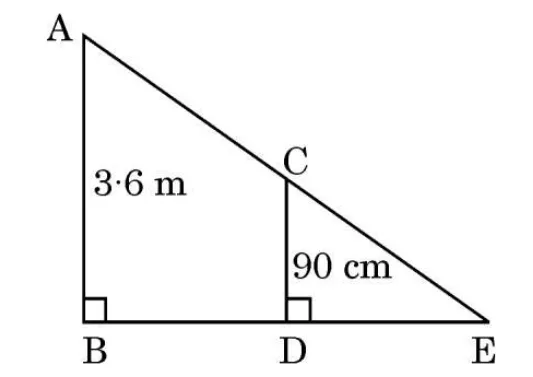
(b) As shown in the given figure, a girl of height 9090 cm is walking away from the base of a lamp post at a speed of 1.21.2 m/s. If the lamp is 3.63.6 m above the ground, find the length of her shadow after 44 seconds.

A tall lamp post AB standing on the ground at B with the lamp at the top A. A shorter vertical line CD stands on the ground at D, joined to the end of the shadow E on the ground. A line from A passes through the top C of the girl to E.
Solution
3.6 m0.9 mABDCEBD = 1.2 × 4 = 4.8 mDE(4.8 + DE)/DE = 3.6/0.9 = 4 → DE = 1.6 m
  1. (a) **Given:** in △ABC\triangle ABC, DE∥BCDE \parallel BC with DD on ABAB and EE on ACAC. **To prove:** ADDB=AEEC\dfrac{AD}{DB} = \dfrac{AE}{EC}. **Construction:** join BEBE and CDCD, and draw DM⊥ACDM \perp AC and EN⊥ABEN \perp AB.
  2. ar(△ADE)ar(△BDE)=12⋅AD⋅EN12⋅DB⋅EN=ADDB\dfrac{\text{ar}(\triangle ADE)}{\text{ar}(\triangle BDE)} = \dfrac{\frac{1}{2} \cdot AD \cdot EN}{\frac{1}{2} \cdot DB \cdot EN} = \dfrac{AD}{DB} and ar(△ADE)ar(△CDE)=12⋅AE⋅DM12⋅EC⋅DM=AEEC\dfrac{\text{ar}(\triangle ADE)}{\text{ar}(\triangle CDE)} = \dfrac{\frac{1}{2} \cdot AE \cdot DM}{\frac{1}{2} \cdot EC \cdot DM} = \dfrac{AE}{EC}.
  3. △BDE\triangle BDE and △CDE\triangle CDE have the same base DEDE and lie between the same parallels DEDE and BCBC, so their areas are equal. Hence ADDB=AEEC\dfrac{AD}{DB} = \dfrac{AE}{EC}.
  4. (b) She walks BD=1.2×4=4.8BD = 1.2 \times 4 = 4.8 m. Let her shadow be DEDE. AB∥CDAB \parallel CD (both vertical), so △ABE∼△CDE\triangle ABE \sim \triangle CDE (AA).
  5. BEDE=ABCD\dfrac{BE}{DE} = \dfrac{AB}{CD}: 4.8+DEDE=3.60.9=4\dfrac{4.8 + DE}{DE} = \dfrac{3.6}{0.9} = 4, so 4.8+DE=4DE4.8 + DE = 4DE and DE=1.6DE = 1.6 m.

Answer: (a) proved   (b) the shadow is 1.61.6 m long

Report an error on this question
Q35Statistics5 marks

An SBI health insurance agent found the following data for distribution of ages of 100 policy holders. The health insurance policies are given to persons of age 15 years and onwards, but less than 60 years.

Find the modal age and median age of the policy holders.

Age (in yrs)15–2020–2525–3030–3535–4040–4545–5050–5555–60
Number of policy holders2418213311362
Solution
  1. Cumulative frequencies: 2,6,24,45,78,89,92,98,1002, 6, 24, 45, 78, 89, 92, 98, 100.
  2. Modal class: the highest frequency is 3333, so it is 35−4035 - 40: l=35l = 35, f1=33f_1 = 33, f0=21f_0 = 21, f2=11f_2 = 11, h=5h = 5.
  3. Mode =35+33−212(33)−21−11×5=35+1234×5=62517≈36.76= 35 + \dfrac{33 - 21}{2(33) - 21 - 11} \times 5 = 35 + \dfrac{12}{34} \times 5 = \dfrac{625}{17} \approx 36.76 years.
  4. Median: n2=50\dfrac{n}{2} = 50 lies in the class 35−4035 - 40 (the previous cfcf is 4545, the next is 7878): l=35l = 35, cf=45cf = 45, f=33f = 33.
  5. Median =35+50−4533×5=35+2533=118033≈35.76= 35 + \dfrac{50 - 45}{33} \times 5 = 35 + \dfrac{25}{33} = \dfrac{1180}{33} \approx 35.76 years.
  6. (The marking scheme gives these as 36.736.7 and 35.735.7 years, approximately; rounding to one decimal place they are 36.836.8 and 35.835.8.)

Answer: Modal age ≈36.76\approx 36.76 years; median age ≈35.76\approx 35.76 years

Report an error on this question

Section E: Case studies

3 case studies, 4 marks each.

Q36Arithmetic Progressions4 marks

Case study 1. Your elder brother wants to buy a car and plans to take a loan from a bank for his car. He repays his total loan of ₹ 1,18,000 by paying every month, starting with the first instalment of ₹ 1,000 and he increases the instalment by ₹ 100 every month.

Based on the information given above, answer the following questions:

(i) Find the amount paid by him in the 30th instalment. [1]

(ii) If the total number of instalments is 40, what is the amount paid in the last instalment? [1]

(iii) (a) What amount does he still have to pay after the 30th instalment? [2]

OR

(iii) (b) Find the ratio of the tenth instalment to the last instalment. [2]

Solution
  1. The instalments form an A.P. with a=1000a = 1000 and d=100d = 100.
  2. (i) a30=1000+29×100=3900a_{30} = 1000 + 29 \times 100 = 3900.
  3. (ii) a40=1000+39×100=4900a_{40} = 1000 + 39 \times 100 = 4900.
  4. (iii)(a) S30=302[2(1000)+29×100]=15×4900=73500S_{30} = \dfrac{30}{2}[2(1000) + 29 \times 100] = 15 \times 4900 = 73500. Left to pay =118000−73500=₹44500= 118000 - 73500 = ₹44500.
  5. (iii)(b) a10=1000+900=1900a_{10} = 1000 + 900 = 1900. a10a40=19004900=1949\dfrac{a_{10}}{a_{40}} = \dfrac{1900}{4900} = \dfrac{19}{49}.
  6. (Check: S40=20(2000+3900)=118000S_{40} = 20(2000 + 3900) = 118000, the full loan ✓.)

Answer: (i) ₹ 39003900   (ii) ₹ 49004900   (iii)(a) ₹ 4450044500   (iii)(b) 19:4919 : 49

Report an error on this question
Q37Trigonometry4 marks

Case study 2. Tejas is standing at the top of a building and observes a car at an angle of depression of 30° as it approaches the base of the building at a uniform speed. 6 seconds later, the angle of depression increases to 60°, and at that moment, the car is 25 m away from the building.

Based on the information given above, answer the following questions:

(i) What is the height of the building? [1]

(ii) What is the distance between the two positions of the car? [1]

(iii) (a) What would be the total time taken by the car to reach the foot of the building from the starting point? [2]

OR

(iii) (b) What is the distance of the observer from the car when it makes an angle of 60°? [2]
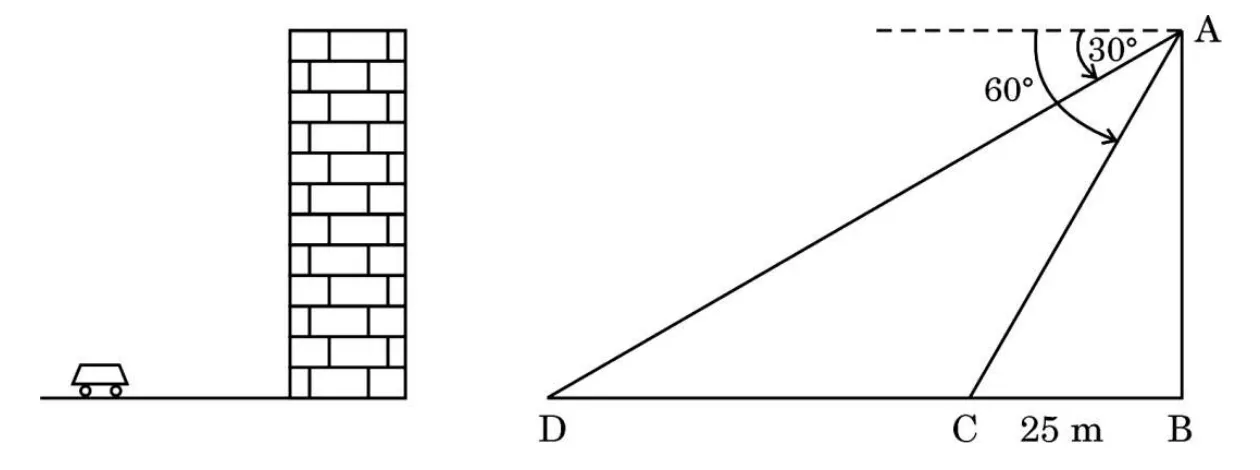
On the left, a brick building with a toy car on the ground. On the right, the geometry: the observer A at the top of the building, the building foot B, and two car positions D (angle of depression 30 degrees) and C (60 degrees), with C 25 m from B.
Solution
30°60°ABCD25√325 m50 mBD = 25√3 × √3 = 75 m; 50 m in 6 s → 75 m in 9 s
  1. (i) The angle of depression 60∘60^\circ equals the angle of elevation at CC. In △ABC\triangle ABC: tan⁡60∘=AB25\tan 60^\circ = \dfrac{AB}{25}, so AB=253AB = 25\sqrt{3} m.
  2. (ii) In △ABD\triangle ABD: tan⁡30∘=253BD=13\tan 30^\circ = \dfrac{25\sqrt{3}}{BD} = \dfrac{1}{\sqrt{3}}, so BD=75BD = 75 m. Distance between the positions =75−25=50= 75 - 25 = 50 m.
  3. (iii)(a) 5050 m takes 66 s, so 7575 m takes 650×75=9\dfrac{6}{50} \times 75 = 9 s.
  4. (iii)(b) cos⁡60∘=BCAC\cos 60^\circ = \dfrac{BC}{AC}, so 12=25AC\dfrac{1}{2} = \dfrac{25}{AC} and AC=50AC = 50 m.

Answer: (i) 25325\sqrt{3} m   (ii) 5050 m   (iii)(a) 99 s   (iii)(b) 5050 m

Report an error on this question
Q38Surface Areas and Volumes4 marks

Case study 3. On a Sunday your parents took you to a fair. You could see lot of toys displayed and you wanted them to buy a Rubik’s cube and a strawberry ice-cream for you.

Based on the information given above, answer the following questions:

(i) Find the length of the diagonal of Rubik’s cube if each edge measures 6 cm. [1]

(ii) Find the volume of Rubik’s cube if the length of the edge is 7 cm. [1]

(iii) (a) What is the curved surface area of hemisphere (ice-cream) if the base radius is 7 cm? [2]

OR

(iii) (b) If two cubes of edges 4 cm are joined end-to-end, then find the surface area of the resulting cuboid. [2]

Solution
  1. (i) The diagonal of a cube of edge aa is a3a\sqrt{3}, so it is 636\sqrt{3} cm.
  2. (ii) Volume =73=343= 7^3 = 343 cm³.
  3. (iii)(a) Curved surface area of a hemisphere =2πr2=2×227×7×7=308= 2\pi r^2 = 2 \times \dfrac{22}{7} \times 7 \times 7 = 308 cm².
  4. (iii)(b) The cuboid is 8×4×48 \times 4 \times 4: surface area =2(8×4+4×4+8×4)=2×80=160= 2(8 \times 4 + 4 \times 4 + 8 \times 4) = 2 \times 80 = 160 cm².

Answer: (i) 636\sqrt{3} cm   (ii) 343343 cm³   (iii)(a) 308308 cm²   (iii)(b) 160160 cm²

Report an error on this question

Questions are from the official CBSE paper. Figures are described in words; see the PDF for the originals. Solutions are written by CogniGuru.

Revise this paper in 1 minute a chapter

Each chapter below is what the paper tested, with a one-minute animated lesson on the idea behind it.

Stuck on a step in any solution?

The CogniGuru AI tutor explains any doubt one minute at a time, in English or Hindi. Join the waitlist.

Mock quiz: 5 questions from this paper

Five real questions from this paper, one each from five chapters. About 2 minutes. See how much you know and where you stand among other students. Attempt free, with no login; log in only for your ranking and full report.

Question 1 of 5 · Q1 of the paperReal Numbers

The LCM of 960960 and 240240 is:

0 of 5 answered

Related papers

  • Maths Standard 2025
  • Maths Standard 2027Coming soon
  • Maths Basic 2026Coming soon
  • Science 2026Coming soon

Common questions

Are these the official CBSE Class 10 Maths Standard 2026 questions?
Yes. The questions are from the official Mathematics (Standard) paper (set 30/2/1) that CBSE published after the 2026 board exam. The solutions are written by CogniGuru and checked against the answer key CBSE published for this paper code.
Can I download the CBSE Class 10 Maths Standard 2026 question paper PDF?
Yes, the official paper PDF is free to download from this page, and so are our step-by-step solutions as a PDF. No login is needed to download either or to read the solutions.
Do all sets of the paper have the same questions?
No. CBSE sets several versions of each paper, with the same blueprint and similar questions in a different order and sometimes with different numbers. This page covers set 30/2/1.
How does the quiz work, and what does “where you stand” mean?
It is a mock quiz of 5 real multiple-choice questions from this paper, scored automatically in about 2 minutes. Your score is compared, anonymously, with other students who took the same quiz. Only the score is stored with the comparison, never your name or number.

Source

CBSE question paper archive, Class X, 2026 (Mathematics (Standard), set 30/2/1)
PDF