CBSE · Class 10 · Mathematics (Standard) · Free

CBSE Class 10 Maths Standard 2026 Question Paper (Set 30/3/1) with Solutions

The official board paper (Q.P. Code 30/3/1, Series L3NMK). Free paper PDF and step-by-step solutions (also as a PDF to download) written by CogniGuru and checked against CBSE’s answer key. See the paper’s main topics in 1 minute, then quiz yourself to see how much you know and where you stand.

No login to download or read the solutions. Login only to see your quiz report in full.

Board
CBSE
Class
10
Subject
Maths Standard (041)
Year
2026
Set code
30/3/1
Max marks
80
Duration
3 hours
Questions
38 (Sections A to E)
Source
Official CBSE paper
Exam date
2026

Paper preview

Three pages of the official paper. Download the PDF for all 27.
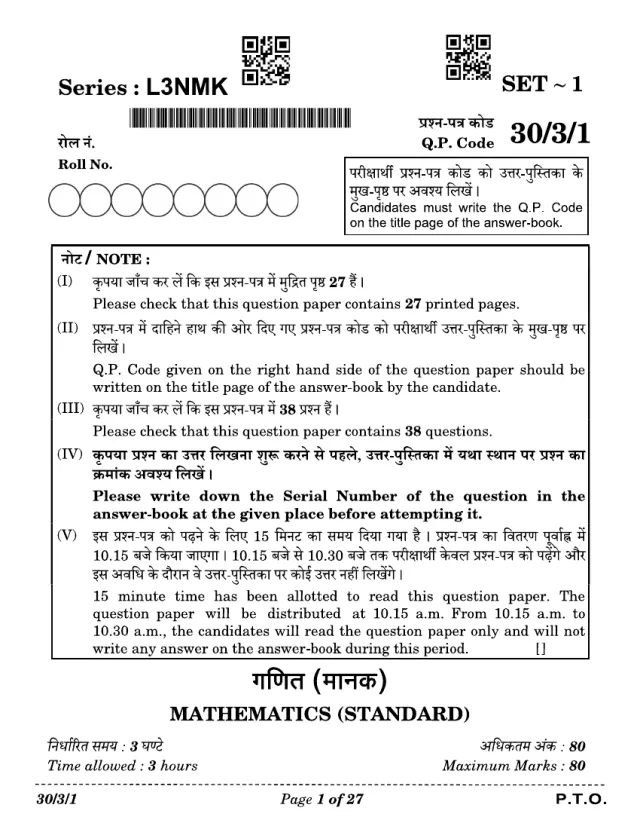
  • Cover page of the CBSE Class 10 Maths Standard 2026 paper, set 30/3/1

    Cover page

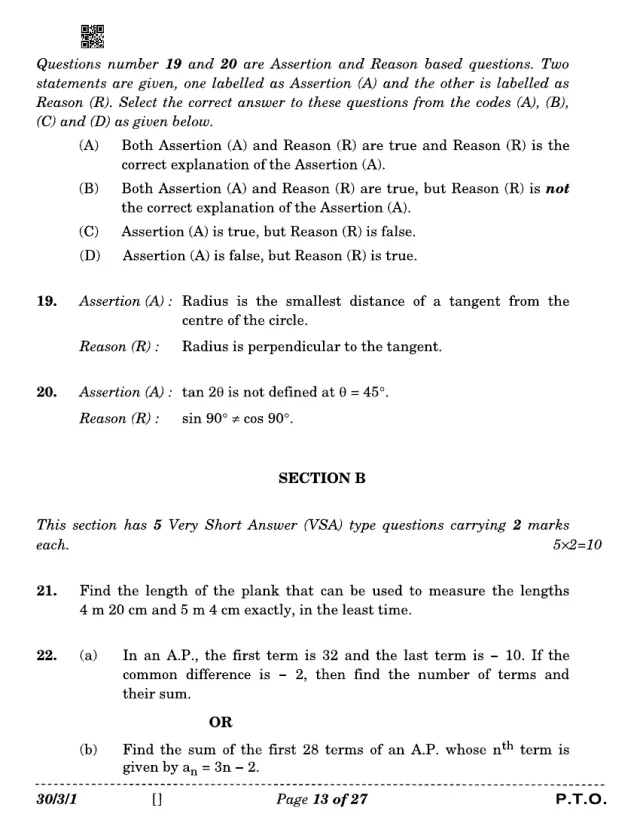
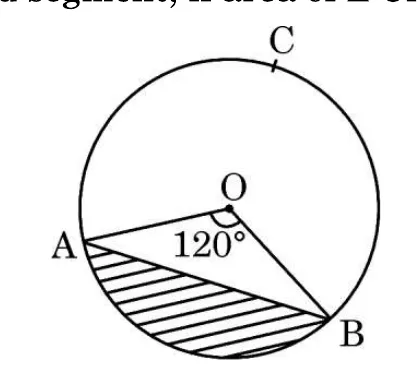
  • Section B of the CBSE Class 10 Maths Standard 2026 paper, set 30/3/1

    Section B

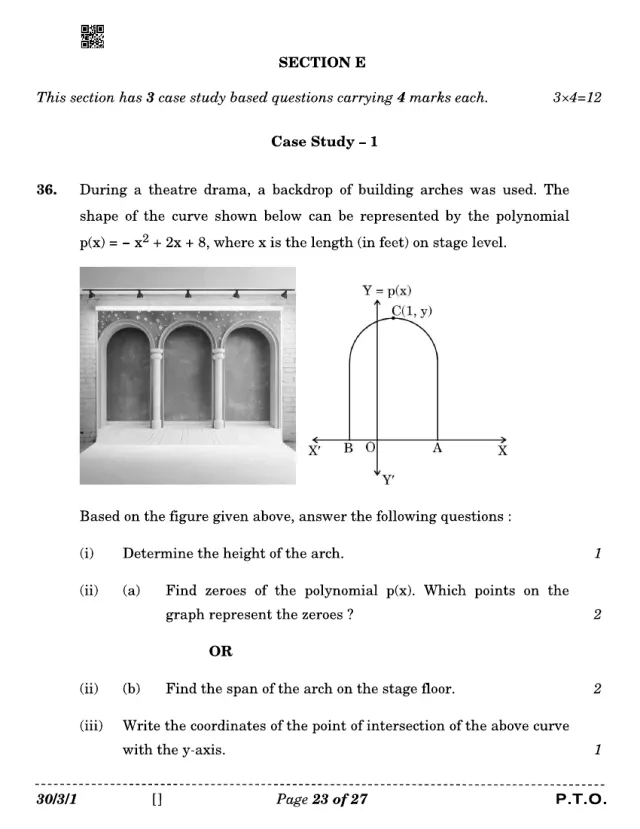
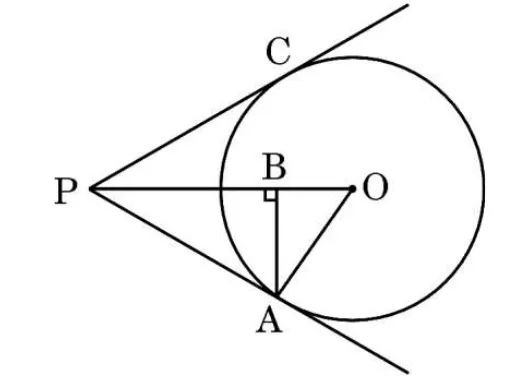
  • A case study with its figure from the CBSE Class 10 Maths Standard 2026 paper, set 30/3/1

    Case study

The main topics of this paper, in 1 minute

Your tutor walks you through the paper before you attempt it: the marks, the key ideas, the time plan and the traps.

1-minute paper analysis

With your tutor, in her voice

The main topics of this paper, in about a minute

A short, animated walk through the paper: how it is built, where the marks come from, the four ideas that matter most, how to plan your three hours, and the traps to avoid.

  1. 1The paper at a glance
  2. 2Where the marks come from
  3. 3Four ideas that keep paying off
  4. 4Plan your three hours
  5. 5Four traps to avoid

Sound on for the voice. Captions are shown, and you can mute any time.

Step-by-step solutions

Try each question first, then open its solution. Tap a number to jump.

Download solutions (PDF)

Section A: Multiple choice

20 questions, 1 mark each. MCQs (Q1 to Q18) and assertion-reason (Q19, Q20).

Q1Quadratic Equations1 mark

The roots of the quadratic equation (x−1)2=16(x - 1)^2 = 16 are:

  1. (A)5, 3
  2. (B)4,−44, -4
  3. (C)5,−35, -3
  4. (D)−5,3-5, 3
Solution · answer (C)
  1. x−1=±4x - 1 = \pm 4, so x=5x = 5 or x=−3x = -3.

Answer: (C) 5,−35, -3

Report an error on this question
Q2Circles1 mark

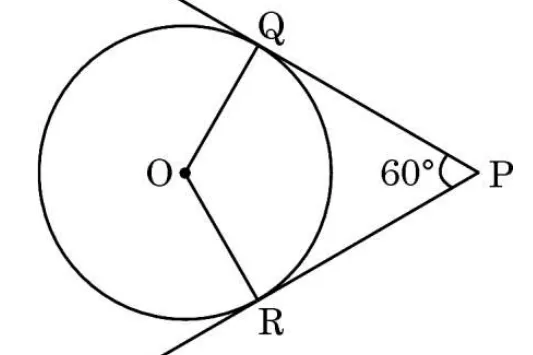
In the given figure, PQPQ and PRPR are tangents to a circle with centre OO and radius 33 cm. If ∠QPR=60∘\angle QPR = 60^\circ, then the length of each tangent is:

A circle with centre O on the left and the outside point P on the right with the angle QPR marked 60 degrees. PQ and PR are tangents touching at Q (top) and R (bottom), and the radii OQ and OR are drawn.
  1. (A)333\sqrt{3} cm
  2. (B)3 cm
  3. (C)6 cm
  4. (D)3\sqrt{3} cm
Solution · answer (A)
60°OPQROQ = 3, ∠OPQ = 30° → PQ = 3 / tan 30° = 3√3 cm
  1. OPOP bisects ∠QPR\angle QPR, so ∠OPQ=30∘\angle OPQ = 30^\circ. OQ⊥PQOQ \perp PQ (radius and tangent).
  2. In the right triangle OQPOQP: tan⁡30∘=OQPQ\tan 30^\circ = \dfrac{OQ}{PQ}, so PQ=31/3=33PQ = \dfrac{3}{1/\sqrt{3}} = 3\sqrt{3} cm.

Answer: (A) 333\sqrt{3} cm

Report an error on this question
Q3Triangles1 mark

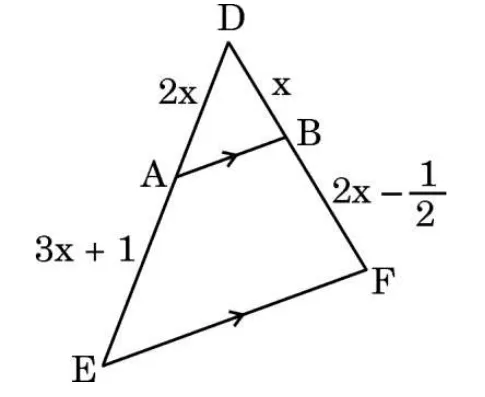
In △DEF\triangle DEF, AB∥EFAB \parallel EF. The value of xx is:

A triangle DEF with A on DE and B on DF and AB parallel to EF. DA is 2x, DB is x, AE is 3x + 1 and BF is 2x minus one half.
  1. (A)0, 2
  2. (B)2 only
  3. (C)−2
  4. (D)1
Solution · answer (B)
  1. AB∥EFAB \parallel EF, so DAAE=DBBF\dfrac{DA}{AE} = \dfrac{DB}{BF}: 2x3x+1=x2x−12\dfrac{2x}{3x + 1} = \dfrac{x}{2x - \frac{1}{2}}.
  2. 2x(2x−12)=x(3x+1)2x\left(2x - \dfrac{1}{2}\right) = x(3x + 1), so 4x2−x=3x2+x4x^2 - x = 3x^2 + x and x2−2x=0x^2 - 2x = 0, giving x=0x = 0 or x=2x = 2.
  3. x=0x = 0 would make the sides DADA and DBDB zero, which is impossible, so x=2x = 2 only.

Answer: (B) 2 only

Report an error on this question
Q4Real Numbers1 mark

(3×11×13+3)(3 \times 11 \times 13 + 3) is:

  1. (A)a prime number
  2. (B)divisible by 13
  3. (C)a composite number
  4. (D)an odd number
Solution · answer (C)
  1. 3×11×13+3=3(143+1)=3×144=4323 \times 11 \times 13 + 3 = 3(143 + 1) = 3 \times 144 = 432. It has factors other than 11 and itself (33, 144144...), and it is even, so it is composite (not prime, not odd, and 432÷13432 \div 13 is not whole).

Answer: (C) a composite number

Report an error on this question
Q5Probability1 mark

Two dice are rolled together. The probability that the sum of the numbers obtained is divisible by 6 is:

  1. (A)16\dfrac{1}{6}
  2. (B)1136\dfrac{11}{36}
  3. (C)112\dfrac{1}{12}
  4. (D)14\dfrac{1}{4}
Solution · answer (A)
  1. The sum is 66 or 1212. Sum 66: (1,5),(5,1),(2,4),(4,2),(3,3)(1,5), (5,1), (2,4), (4,2), (3,3), which is 55 outcomes. Sum 1212: (6,6)(6,6), 11 outcome.
  2. P=636=16P = \dfrac{6}{36} = \dfrac{1}{6}.

Answer: (A) 16\dfrac{1}{6}

Report an error on this question
Q6Arithmetic Progressions1 mark

The number of multiples of 4 lying between 12 and 250 is:

  1. (A)59
  2. (B)59.5
  3. (C)60
  4. (D)61
Solution · answer (A)
  1. The multiples of 44 strictly between 1212 and 250250 are 16,20,…,24816, 20, \dots, 248 (since 1212 and 250250 themselves are excluded and 250250 is not a multiple of 44).
  2. 248=16+(n−1)×4248 = 16 + (n - 1) \times 4, so n−1=58n - 1 = 58 and n=59n = 59.

Answer: (A) 59

Report an error on this question
Q7Surface Areas and Volumes1 mark

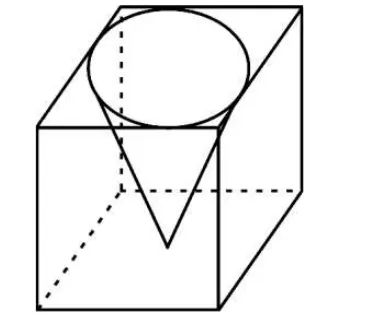
A cone of maximum size is carved out from a solid cube of edge length ll. The volume of the cone is:

A cube with a cone drawn inside it. The circle on the top face is the base of the cone and the tip of the cone touches the middle of the bottom face.
  1. (A)πl312\dfrac{\pi l^3}{12}
  2. (B)πl33\dfrac{\pi l^3}{3}
  3. (C)l3(1−π3)l^3\left(1 - \dfrac{\pi}{3}\right)
  4. (D)πl38\dfrac{\pi l^3}{8}
Solution · answer (A)
  1. The largest cone has its base circle inscribed in a face, so the radius is l2\dfrac{l}{2}, and its height is the edge ll.
  2. V=13π(l2)2l=πl312V = \dfrac{1}{3}\pi\left(\dfrac{l}{2}\right)^2 l = \dfrac{\pi l^3}{12}.

Answer: (A) πl312\dfrac{\pi l^3}{12}

Report an error on this question
Q8Linear Equations1 mark

Equation of another line parallel to the line represented by 2x−6y=72x - 6y = 7 is:

  1. (A)y=3x−7y = 3x - 7
  2. (B)2x=9−6y2x = 9 - 6y
  3. (C)x−3y=7x - 3y = 7
  4. (D)x=72−3yx = \dfrac{7}{2} - 3y
Solution · answer (C)
  1. A parallel line has the same slope: 2x−6y=72x - 6y = 7 gives y=13x−76y = \dfrac{1}{3}x - \dfrac{7}{6}, slope 13\dfrac{1}{3}.
  2. (C) x−3y=7x - 3y = 7 gives y=13x−73y = \dfrac{1}{3}x - \dfrac{7}{3}: the same slope and a different intercept, so it is parallel (and not the same line). The others have slopes 33, −13-\dfrac{1}{3}, −13-\dfrac{1}{3}.

Answer: (C) x−3y=7x - 3y = 7

Report an error on this question
Q9Trigonometry1 mark

If the length of the shadow of a tower is 3\sqrt{3} times that of its height, then altitude of the Sun is:

  1. (A)45∘45^\circ
  2. (B)30∘30^\circ
  3. (C)60∘60^\circ
  4. (D)15∘15^\circ
Solution · answer (B)
  1. tan⁡θ=heightshadow=13\tan\theta = \dfrac{\text{height}}{\text{shadow}} = \dfrac{1}{\sqrt{3}}, so θ=30∘\theta = 30^\circ.

Answer: (B) 30∘30^\circ

Report an error on this question
Q10Quadratic Equations1 mark

If the roots of the quadratic equation 3x2−kx+23=0\sqrt{3}x^2 - kx + 2\sqrt{3} = 0 are real and equal, then the value(s) of kk is/are:

  1. (A)±24\pm\sqrt{24}
  2. (B)0
  3. (C)4
  4. (D)−5
Solution · answer (A)
  1. Equal roots need D=0D = 0: k2−4(3)(23)=k2−24=0k^2 - 4(\sqrt{3})(2\sqrt{3}) = k^2 - 24 = 0, so k=±24k = \pm\sqrt{24}.

Answer: (A) ±24\pm\sqrt{24}

Report an error on this question
Q11Arithmetic Progressions1 mark

The nthn^{\text{th}} term of the A.P. −13,23,53,83,…\dfrac{-1}{3}, \dfrac{2}{3}, \dfrac{5}{3}, \dfrac{8}{3}, \dots is:

  1. (A)3n − 4
  2. (B)n−43n - \dfrac{4}{3}
  3. (C)n−23\dfrac{n - 2}{3}
  4. (D)n−43\dfrac{n - 4}{3}
Solution · answer (B)
  1. a=−13a = -\dfrac{1}{3} and d=23+13=1d = \dfrac{2}{3} + \dfrac{1}{3} = 1. an=−13+(n−1)×1=n−43a_n = -\dfrac{1}{3} + (n - 1) \times 1 = n - \dfrac{4}{3}.

Answer: (B) n−43n - \dfrac{4}{3}

Report an error on this question
Q12Circles1 mark

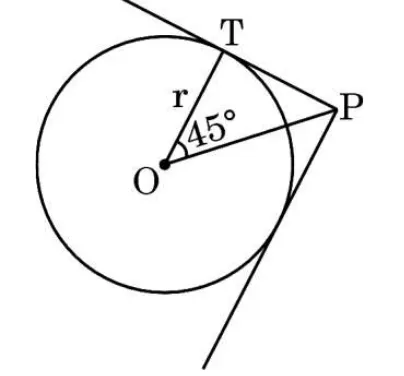
In the given figure, PTPT is a tangent to the circle with centre OO and radius rr. If ∠POT=45∘\angle POT = 45^\circ, then the length of OPOP is:

A circle with centre O and radius r drawn to T at the top. PT is a tangent from the outside point P on the right, and the angle POT is marked 45 degrees.
  1. (A)r2r\sqrt{2}
  2. (B)2r\sqrt{2r}
  3. (C)2r
  4. (D)r2r^2
Solution · answer (A)
  1. OT⊥PTOT \perp PT, so in the right triangle OTPOTP: cos⁡45∘=OTOP=rOP\cos 45^\circ = \dfrac{OT}{OP} = \dfrac{r}{OP}, so OP=r1/2=r2OP = \dfrac{r}{1/\sqrt{2}} = r\sqrt{2}.

Answer: (A) r2r\sqrt{2}

Report an error on this question
Q13Triangles1 mark

It is given that △ABC∼△QRP\triangle ABC \sim \triangle QRP such that AB=9AB = 9 cm, BC=5BC = 5 cm and PR=2PR = 2 cm. Length of side QRQR is:

  1. (A)0.9 cm
  2. (B)518\dfrac{5}{18} cm
  3. (C)109\dfrac{10}{9} cm
  4. (D)3.6 cm
Solution · answer (D)
  1. A↔QA \leftrightarrow Q, B↔RB \leftrightarrow R, C↔PC \leftrightarrow P. So AB↔QRAB \leftrightarrow QR and BC↔RPBC \leftrightarrow RP.
  2. ABQR=BCRP\dfrac{AB}{QR} = \dfrac{BC}{RP}: 9QR=52\dfrac{9}{QR} = \dfrac{5}{2}, so QR=185=3.6QR = \dfrac{18}{5} = 3.6 cm.

Answer: (D) 3.6 cm

Report an error on this question
Q14Polynomials1 mark

The sum and product of zeroes of a quadratic polynomial p(x)p(x) are −13\dfrac{-1}{3} and 22 respectively. The polynomial p(x)p(x) is:

  1. (A)3x2−x+63x^2 - x + 6
  2. (B)x2+13x−2x^2 + \dfrac{1}{3}x - 2
  3. (C)3x2−x+23x^2 - x + 2
  4. (D)−3x2−x−6-3x^2 - x - 6
Solution · answer (D)
  1. k[x2−(sum)x+product]=k[x2+13x+2]k[x^2 - (\text{sum})x + \text{product}] = k\left[x^2 + \dfrac{1}{3}x + 2\right].
  2. With k=−3k = -3: −3x2−x−6-3x^2 - x - 6, which is option (D).

Answer: (D) −3x2−x−6-3x^2 - x - 6

Report an error on this question
Q15Trigonometry1 mark

Given that sin⁡2α=32\sin 2\alpha = \dfrac{\sqrt{3}}{2}, the value of sin⁡3α\sin 3\alpha is:

  1. (A)334\dfrac{3\sqrt{3}}{4}
  2. (B)12\dfrac{1}{2}
  3. (C)1
  4. (D)34\dfrac{\sqrt{3}}{4}
Solution · answer (C)
  1. sin⁡2α=32\sin 2\alpha = \dfrac{\sqrt{3}}{2} gives 2α=60∘2\alpha = 60^\circ for an acute angle, so α=30∘\alpha = 30^\circ.
  2. sin⁡3α=sin⁡90∘=1\sin 3\alpha = \sin 90^\circ = 1.

Answer: (C) 1

Report an error on this question
Q16Statistics1 mark

The median and mode of a distribution are 25.2 and 26.1 respectively. The mean of the distribution is:

  1. (A)24.75
  2. (B)24.25
  3. (C)24.3
  4. (D)25.5
Solution · answer (A)
  1. Mode=3 Median−2 Mean\text{Mode} = 3\,\text{Median} - 2\,\text{Mean}: 26.1=75.6−2 Mean26.1 = 75.6 - 2\,\text{Mean}, so Mean=49.52=24.75\text{Mean} = \dfrac{49.5}{2} = 24.75.

Answer: (A) 24.75

Report an error on this question
Q17Coordinate Geometry1 mark

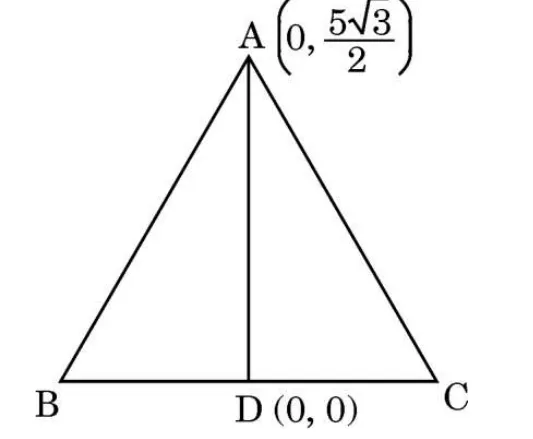
In the given figure, △ABC\triangle ABC is an equilateral triangle. ADAD is a median of the triangle joining the points A(0,532)A\left(0, \dfrac{5\sqrt{3}}{2}\right), D(0,0)D(0, 0). Points BB and CC are (in same order):

An equilateral triangle ABC with A at the top, A at 0 comma 5 root 3 over 2, and the base BC on the x-axis with D at the origin at the middle of the base. The median AD is drawn.
  1. (A)(−5,0),(5,0)(-5, 0), (5, 0)
  2. (B)(−52,0),(52,0)\left(-\dfrac{5}{2}, 0\right), \left(\dfrac{5}{2}, 0\right)
  3. (C)(−10,0),(10,0)(-10, 0), (10, 0)
  4. (D)(−53,0),(53,0)(-5\sqrt{3}, 0), (5\sqrt{3}, 0)
Solution · answer (B)
  1. In an equilateral triangle of side ss, the median (also the altitude) is 32s\dfrac{\sqrt{3}}{2}s. Here AD=532AD = \dfrac{5\sqrt{3}}{2}, so s=5s = 5.
  2. DD is the mid-point of BCBC at the origin, so B=(−52,0)B = \left(-\dfrac{5}{2}, 0\right) and C=(52,0)C = \left(\dfrac{5}{2}, 0\right).

Answer: (B) (−52,0),(52,0)\left(-\dfrac{5}{2}, 0\right), \left(\dfrac{5}{2}, 0\right)

Report an error on this question
Q18Trigonometry1 mark

The value of (12tan⁡245∘−cos⁡260∘)\left(\dfrac{1}{2}\tan^2 45^\circ - \cos^2 60^\circ\right) is:

  1. (A)0
  2. (B)−12-\dfrac{1}{2}
  3. (C)14\dfrac{1}{4}
  4. (D)−14-\dfrac{1}{4}
Solution · answer (C)
  1. tan⁡45∘=1\tan 45^\circ = 1 and cos⁡60∘=12\cos 60^\circ = \dfrac{1}{2}: 12(1)−14=14\dfrac{1}{2}(1) - \dfrac{1}{4} = \dfrac{1}{4}.

Answer: (C) 14\dfrac{1}{4}

Report an error on this question
Q19Circles1 mark

Assertion (A): Radius is the smallest distance of a tangent from the centre of the circle.

Reason (R): Radius is perpendicular to the tangent.

  1. (A)Both A and R are true and R is the correct explanation of A
  2. (B)Both A and R are true, but R is not the correct explanation of A
  3. (C)A is true, but R is false
  4. (D)A is false, but R is true
Solution · answer (A)
  1. (R) The radius to the point of contact is perpendicular to the tangent. True.
  2. (A) Every other point of the tangent is outside the circle, and the perpendicular is the shortest distance from the centre to a line. So the radius is the smallest distance. True, and it follows from (R).

Answer: (A) Both A and R are true and R is the correct explanation of A

Report an error on this question
Q20Trigonometry1 mark

Assertion (A): tan⁡2θ\tan 2\theta is not defined at θ=45∘\theta = 45^\circ.

Reason (R): sin⁡90∘≠cos⁡90∘\sin 90^\circ \neq \cos 90^\circ.

  1. (A)Both A and R are true and R is the correct explanation of A
  2. (B)Both A and R are true, but R is not the correct explanation of A
  3. (C)A is true, but R is false
  4. (D)A is false, but R is true
Solution · answer (B)
  1. (A) At θ=45∘\theta = 45^\circ, tan⁡2θ=tan⁡90∘=sin⁡90∘cos⁡90∘=10\tan 2\theta = \tan 90^\circ = \dfrac{\sin 90^\circ}{\cos 90^\circ} = \dfrac{1}{0}, which is not defined. True.
  2. (R) sin⁡90∘=1\sin 90^\circ = 1 and cos⁡90∘=0\cos 90^\circ = 0, so they are unequal. True. But being unequal is not why tan⁡90∘\tan 90^\circ is undefined (that is because cos⁡90∘=0\cos 90^\circ = 0), so R does not explain A.

Answer: (B) Both A and R are true, but R is not the correct explanation of A

Report an error on this question

Section B: Very short answer

5 questions, 2 marks each.

Q21Real Numbers2 marks

Find the length of the plank that can be used to measure the lengths 44 m 2020 cm and 55 m 44 cm exactly, in the least time.

Solution
  1. In cm: 44 m 2020 cm =420= 420 cm and 55 m 44 cm =504= 504 cm. The longest plank that measures both exactly takes the fewest placements, and it is the HCF.
  2. 420=22×3×5×7420 = 2^2 \times 3 \times 5 \times 7 and 504=23×32×7504 = 2^3 \times 3^2 \times 7. HCF =22×3×7=84= 2^2 \times 3 \times 7 = 84.

Answer: 8484 cm

Report an error on this question
Q22Arithmetic Progressions2 marks

(a) In an A.P., the first term is 3232 and the last term is −10-10. If the common difference is −2-2, then find the number of terms and their sum.

OR

(b) Find the sum of the first 2828 terms of an A.P. whose nthn^{\text{th}} term is given by an=3n−2a_n = 3n - 2.

Solution
  1. (a) 32+(n−1)(−2)=−1032 + (n - 1)(-2) = -10, so −2(n−1)=−42-2(n - 1) = -42 and n=22n = 22. S22=222(32+(−10))=11×22=242S_{22} = \dfrac{22}{2}(32 + (-10)) = 11 \times 22 = 242.
  2. (b) a1=3(1)−2=1a_1 = 3(1) - 2 = 1 and a28=3(28)−2=82a_{28} = 3(28) - 2 = 82. S28=282(1+82)=14×83=1162S_{28} = \dfrac{28}{2}(1 + 82) = 14 \times 83 = 1162.

Answer: (a) 2222 terms, sum 242242   (b) 11621162

Report an error on this question
Q23Coordinate Geometry2 marks

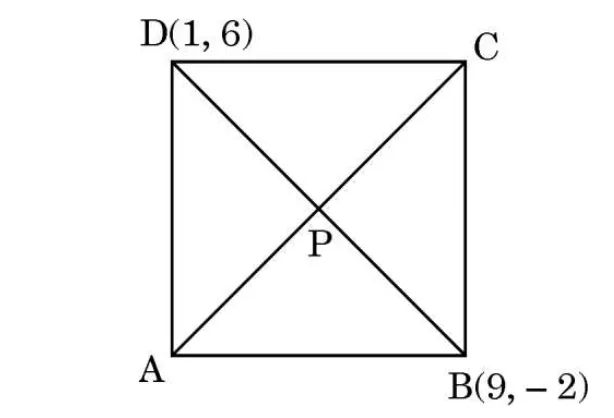
(a) Diagonals ACAC and BDBD of square ABCDABCD intersect at PP. Coordinates of points BB and DD are (9,−2)(9, -2) and (1,6)(1, 6) respectively. (i) Find the co-ordinates of point PP. (ii) Find the length of the side of the square.

OR

(b) Find the coordinates of a point on the line x+y=5x + y = 5 which is equidistant from (6,4)(6, 4) and (5,2)(5, 2).

A square ABCD with D at the top left marked D(1, 6) and B at the bottom right marked B(9, minus 2). The diagonals AC and BD cross at the centre P.
Solution
-11234567891011-4-3-2-112345678OxyB(9, −2)D(1, 6)P(5, 2)AC
  1. (a)(i) The diagonals of a square bisect each other, so PP is the mid-point of BDBD: P=(9+12,−2+62)=(5,2)P = \left(\dfrac{9 + 1}{2}, \dfrac{-2 + 6}{2}\right) = (5, 2).
  2. (a)(ii) BD=(9−1)2+(−2−6)2=128=82BD = \sqrt{(9 - 1)^2 + (-2 - 6)^2} = \sqrt{128} = 8\sqrt{2}. A square of side ss has diagonal s2s\sqrt{2}, so s=8s = 8.
  3. (b) Let the point be (x,y)(x, y). (x−6)2+(y−4)2=(x−5)2+(y−2)2(x - 6)^2 + (y - 4)^2 = (x - 5)^2 + (y - 2)^2 gives −12x−8y+52=−10x−4y+29-12x - 8y + 52 = -10x - 4y + 29, that is 2x+4y=232x + 4y = 23.
  4. With x+y=5x + y = 5: 2(5−y)+4y=232(5 - y) + 4y = 23, so 2y=132y = 13 and y=132y = \dfrac{13}{2}, x=−32x = -\dfrac{3}{2}. The point is (−32,132)\left(-\dfrac{3}{2}, \dfrac{13}{2}\right).

Answer: (a) P(5,2)P(5, 2), side =8= 8 units   (b) (−32,132)\left(-\dfrac{3}{2}, \dfrac{13}{2}\right)

Report an error on this question
Q24Triangles2 marks

The diagonals of a quadrilateral ABCDABCD intersect each other at the point OO such that AOOC=BOOD\dfrac{AO}{OC} = \dfrac{BO}{OD}. Show that quadrilateral ABCDABCD is a trapezium.

Solution
  1. AOOC=BOOD\dfrac{AO}{OC} = \dfrac{BO}{OD} means AOBO=OCOD\dfrac{AO}{BO} = \dfrac{OC}{OD}. Also ∠AOB=∠COD\angle AOB = \angle COD (vertically opposite).
  2. So △AOB∼△COD\triangle AOB \sim \triangle COD by SAS, and ∠OAB=∠OCD\angle OAB = \angle OCD. These are alternate angles for ABAB and DCDC with transversal ACAC, so AB∥DCAB \parallel DC.
  3. One pair of opposite sides is parallel, so ABCDABCD is a trapezium.

Answer: Shown

Report an error on this question
Q25Surface Areas and Volumes2 marks

A toy is in the form of a cone mounted on a hemisphere of radius 77 cm. The total height of the toy is 3131 cm. Find the total surface area of the toy.
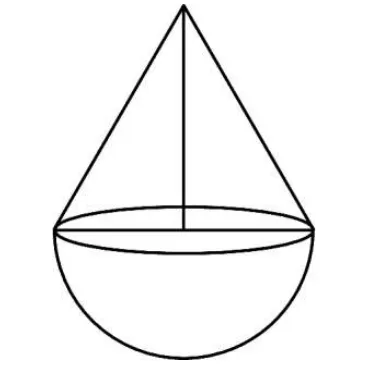
A toy made of a cone standing on a hemisphere, drawn as a cone on top with the hemispherical bowl below.
Solution
OTh = 24l = 25r = 7TSA = πrl + 2πr² = 550 + 308 = 858 cm²
  1. Height of the cone =31−7=24= 31 - 7 = 24 cm and its radius =7= 7 cm. Slant height l=72+242=25l = \sqrt{7^2 + 24^2} = 25 cm.
  2. The total surface area is the curved area of the cone plus the curved area of the hemisphere (the joining base is hidden): πrl+2πr2=227×7×25+2×227×49=550+308=858\pi r l + 2\pi r^2 = \dfrac{22}{7} \times 7 \times 25 + 2 \times \dfrac{22}{7} \times 49 = 550 + 308 = 858 cm².

Answer: 858858 cm²

Report an error on this question

Section C: Short answer

6 questions, 3 marks each.

Q26Trigonometry3 marks

(a) If sin⁡θ+cos⁡θ=3\sin\theta + \cos\theta = \sqrt{3}, then prove that tan⁡θ+cot⁡θ=1\tan\theta + \cot\theta = 1.

OR

(b) Prove that: (sin⁡A+sec⁡A)2+(cos⁡A+cosec⁡A)2=(1+sec⁡Acosec⁡A)2(\sin A + \sec A)^2 + (\cos A + \operatorname{cosec} A)^2 = (1 + \sec A\operatorname{cosec} A)^2.

Solution
  1. (a) Square: sin⁡2θ+cos⁡2θ+2sin⁡θcos⁡θ=3\sin^2\theta + \cos^2\theta + 2\sin\theta\cos\theta = 3, so sin⁡θcos⁡θ=1\sin\theta\cos\theta = 1.
  2. tan⁡θ+cot⁡θ=sin⁡2θ+cos⁡2θsin⁡θcos⁡θ=1sin⁡θcos⁡θ=1\tan\theta + \cot\theta = \dfrac{\sin^2\theta + \cos^2\theta}{\sin\theta\cos\theta} = \dfrac{1}{\sin\theta\cos\theta} = 1.
  3. (Note: sin⁡θcos⁡θ≤12\sin\theta\cos\theta \leq \dfrac{1}{2} for every real angle, so no real θ\theta satisfies the given condition; the result follows from the algebra, which is what the question asks.)
  4. (b) LHS =sin⁡2A+2sin⁡Asec⁡A+sec⁡2A+cos⁡2A+2cos⁡Acosec⁡A+cosec⁡2A= \sin^2 A + 2\sin A\sec A + \sec^2 A + \cos^2 A + 2\cos A\operatorname{cosec} A + \operatorname{cosec}^2 A. Here sin⁡Asec⁡A=tan⁡A\sin A\sec A = \tan A and cos⁡Acosec⁡A=cot⁡A\cos A\operatorname{cosec} A = \cot A, so LHS =1+2(tan⁡A+cot⁡A)+sec⁡2A+cosec⁡2A= 1 + 2(\tan A + \cot A) + \sec^2 A + \operatorname{cosec}^2 A.
  5. tan⁡A+cot⁡A=1sin⁡Acos⁡A=sec⁡Acosec⁡A\tan A + \cot A = \dfrac{1}{\sin A\cos A} = \sec A\operatorname{cosec} A and sec⁡2A+cosec⁡2A=1cos⁡2Asin⁡2A=sec⁡2Acosec⁡2A\sec^2 A + \operatorname{cosec}^2 A = \dfrac{1}{\cos^2 A\sin^2 A} = \sec^2 A\operatorname{cosec}^2 A.
  6. LHS =1+2sec⁡Acosec⁡A+sec⁡2Acosec⁡2A=(1+sec⁡Acosec⁡A)2== 1 + 2\sec A\operatorname{cosec} A + \sec^2 A\operatorname{cosec}^2 A = (1 + \sec A\operatorname{cosec} A)^2 = RHS.

Answer: Proved (both parts)

Report an error on this question
Q27Areas Related to Circles3 marks

In the given figure, chord ABAB subtends an angle of 120∘120^\circ at the centre of the circle with radius 77 cm. Find (i) perimeter of major sector OACBOACB, and (ii) area of the shaded segment, if area of △OAB=21.2\triangle OAB = 21.2 cm².

A circle with centre O and a chord AB. The angle AOB is marked 120 degrees. The part of the circle between the chord AB and the minor arc is shaded with lines. C is a point on the major arc.
Solution
120°OABsegment = ⅓πr² − 21.2 = 51.33 − 21.2 = 30.1 cm²major sector perimeter = 240/360 × 2πr + 2r = 130/3 cm
  1. (i) The major sector has central angle 360∘−120∘=240∘360^\circ - 120^\circ = 240^\circ. Perimeter == major arc +2r=240360×2×227×7+14=883+14=1303≈43.3+ 2r = \dfrac{240}{360} \times 2 \times \dfrac{22}{7} \times 7 + 14 = \dfrac{88}{3} + 14 = \dfrac{130}{3} \approx 43.3 cm.
  2. (ii) Segment == minor sector −- triangle =120360×227×7×7−21.2=1543−21.2≈51.33−21.2=30.1= \dfrac{120}{360} \times \dfrac{22}{7} \times 7 \times 7 - 21.2 = \dfrac{154}{3} - 21.2 \approx 51.33 - 21.2 = 30.1 cm².

Answer: (i) 1303≈43.3\dfrac{130}{3} \approx 43.3 cm   (ii) ≈30.1\approx 30.1 cm²

Report an error on this question
Q28Real Numbers3 marks

Prove that 5\sqrt{5} is an irrational number.

Solution
  1. Suppose 5=pq\sqrt{5} = \dfrac{p}{q} with p,qp, q co-prime integers and q≠0q \neq 0.
  2. 5q2=p25q^2 = p^2, so 55 divides p2p^2 and therefore 55 divides pp. Write p=5ap = 5a.
  3. 25a2=5q225a^2 = 5q^2, so q2=5a2q^2 = 5a^2; 55 divides q2q^2 and so 55 divides qq.
  4. 55 divides both pp and qq, contradicting that they are co-prime. So 5\sqrt{5} is irrational.

Answer: Proved

Report an error on this question
Q29Quadratic Equations3 marks

Find two consecutive negative integers, sum of whose squares is 481.

Solution
  1. Let the integers be xx and x+1x + 1. x2+(x+1)2=481x^2 + (x + 1)^2 = 481, so 2x2+2x−480=02x^2 + 2x - 480 = 0 and x2+x−240=0x^2 + x - 240 = 0.
  2. (x+16)(x−15)=0(x + 16)(x - 15) = 0, so x=−16x = -16 or x=15x = 15. We need negative integers, so x=−16x = -16 and the other is −15-15.
  3. (Check: 256+225=481256 + 225 = 481 ✓.)

Answer: −16-16 and −15-15

Report an error on this question
Q30Coordinate Geometry3 marks

A point P(x,7)P(x, 7) divides a line segment joining the points A(−5,4)A(-5, 4) and B(7,9)B(7, 9) in a certain ratio. Find the ratio and hence find the value of xx.

Solution
  1. Let AP:PB=k:1AP : PB = k : 1. The yy-coordinate: 9k+4k+1=7\dfrac{9k + 4}{k + 1} = 7, so 9k+4=7k+79k + 4 = 7k + 7 and k=32k = \dfrac{3}{2}. The ratio is 3:23 : 2.
  2. x=3(7)+2(−5)3+2=21−105=115x = \dfrac{3(7) + 2(-5)}{3 + 2} = \dfrac{21 - 10}{5} = \dfrac{11}{5}.

Answer: Ratio 3:23 : 2; x=115x = \dfrac{11}{5}

Report an error on this question
Q31Circles3 marks

(a) Two tangents PAPA and PBPB are drawn to a circle with centre OO from an external point PP. Prove that ∠APB=2∠OAB\angle APB = 2\angle OAB.

OR

(b) In the given figure, PAPA is the tangent to the circle with centre OO such that OA=10OA = 10 cm, AB=8AB = 8 cm and AB⊥OPAB \perp OP. Find the length of PBPB.

A circle with centre O on the right. A tangent PA touches it at A at the bottom, and C is another point where the line from P touches at the top. The line PO is drawn and B is the point on it where AB meets it at a right angle.
Solution
θαPOAB∠PAB = 90° − α → θ = 180° − 2(90° − α) = 2α
108POBA6PB = 32/3PA² = PB² + 64 = (PB + 6)² − 100 → PB = 32/3 cm
  1. (a) OA⊥APOA \perp AP, so ∠PAB=90∘−∠OAB\angle PAB = 90^\circ - \angle OAB. (i)
  2. Tangents from PP are equal, PA=PBPA = PB, so ∠PAB=∠PBA\angle PAB = \angle PBA and ∠APB=180∘−2∠PAB\angle APB = 180^\circ - 2\angle PAB.
  3. Using (i): ∠APB=180∘−2(90∘−∠OAB)=2∠OAB\angle APB = 180^\circ - 2(90^\circ - \angle OAB) = 2\angle OAB.
  4. (b) In the right triangle OBAOBA: OB=102−82=6OB = \sqrt{10^2 - 8^2} = 6 cm. Let PB=yPB = y, so OP=y+6OP = y + 6.
  5. PA2=PB2+AB2=y2+64PA^2 = PB^2 + AB^2 = y^2 + 64 (right angle at BB) and PA2=OP2−OA2=(y+6)2−100PA^2 = OP^2 - OA^2 = (y + 6)^2 - 100 (right angle at AA).
  6. y2+64=y2+12y+36−100y^2 + 64 = y^2 + 12y + 36 - 100, so 12y=12812y = 128 and y=323y = \dfrac{32}{3} cm ≈10.67\approx 10.67 cm.

Answer: (a) proved   (b) PB=323PB = \dfrac{32}{3} cm

Report an error on this question

Section D: Long answer

4 questions, 5 marks each.

Q32Statistics5 marks

(a) The median of the following data is 137137. Find the values of xx and yy, given that total of frequencies is 6868.

OR

(b) Find mean and mode of the following distribution (classes 0−10,10−20,20−30,30−40,40−50,50−60,60−700-10, 10-20, 20-30, 30-40, 40-50, 50-60, 60-70 with frequencies 3,6,11,10,13,3,43, 6, 11, 10, 13, 3, 4).

Class65–8585–105105–125125–145145–165165–185185–205
Frequency (a)45x2014y4
Solution
  1. (a) Cumulative frequencies: 4,9,9+x,29+x,43+x,43+x+y,47+x+y4, 9, 9 + x, 29 + x, 43 + x, 43 + x + y, 47 + x + y. The total is 47+x+y=6847 + x + y = 68, so x+y=21x + y = 21.
  2. N2=34\dfrac{N}{2} = 34 and the median 137137 lies in 125−145125 - 145: l=125l = 125, cf=9+xcf = 9 + x, f=20f = 20, h=20h = 20. Median =125+34−(9+x)20×20=125+25−x=150−x= 125 + \dfrac{34 - (9 + x)}{20} \times 20 = 125 + 25 - x = 150 - x.
  3. 150−x=137150 - x = 137, so x=13x = 13 and y=21−13=8y = 21 - 13 = 8.
  4. (b) The table is: classes 0−10,10−20,20−30,30−40,40−50,50−60,60−700-10, 10-20, 20-30, 30-40, 40-50, 50-60, 60-70 with frequencies 3,6,11,10,13,3,43, 6, 11, 10, 13, 3, 4 (total 5050). Take a=35a = 35, h=10h = 10, u=x−3510=−3,−2,−1,0,1,2,3u = \dfrac{x - 35}{10} = -3, -2, -1, 0, 1, 2, 3.
  5. ∑fiui=−9−12−11+0+13+6+12=−1\sum f_iu_i = -9 - 12 - 11 + 0 + 13 + 6 + 12 = -1. Mean =35+−150×10=34.8= 35 + \dfrac{-1}{50} \times 10 = 34.8.
  6. Modal class 40−5040 - 50 (f1=13f_1 = 13, f0=10f_0 = 10, f2=3f_2 = 3): Mode =40+13−1026−10−3×10=40+3013≈42.3= 40 + \dfrac{13 - 10}{26 - 10 - 3} \times 10 = 40 + \dfrac{30}{13} \approx 42.3.

Answer: (a) x=13x = 13, y=8y = 8   (b) mean =34.8= 34.8, mode ≈42.3\approx 42.3

Report an error on this question
Q33Triangles5 marks

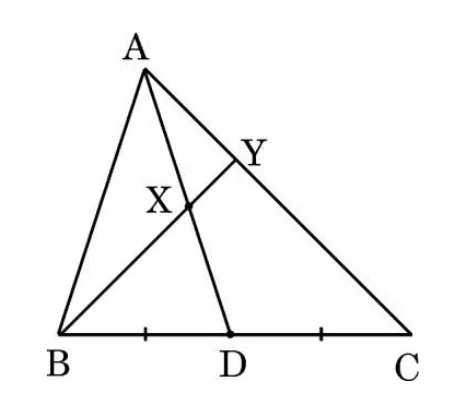
In △ABC\triangle ABC, ADAD is a median. XX is a point on ADAD such that AX:XD=2:3AX : XD = 2 : 3. BXBX is extended so that it intersects ACAC at YY. Prove that BX=4XYBX = 4XY.

A triangle ABC with A at the top, B at the bottom left and C at the bottom right. AD is a median to the mid-point D of BC. X is a point on AD, and the line from B through X meets AC at Y.
Solution
ABCDXYDZ ∥ BY: BY = 2DZ and DZ = 5/2 XY → BY = 5XY, BX = 4XY
  1. Draw DZ∥BYDZ \parallel BY with ZZ on ACAC (the ZZ lies between YY and CC).
  2. In △CBY\triangle CBY, DD is the mid-point of BCBC and DZ∥BYDZ \parallel BY, so ZZ is the mid-point of CYCY and DZ=12BYDZ = \dfrac{1}{2}BY, that is BY=2DZBY = 2DZ. (i)
  3. In △ADZ\triangle ADZ, XY∥DZXY \parallel DZ, so △AXY∼△ADZ\triangle AXY \sim \triangle ADZ: AXAD=XYDZ\dfrac{AX}{AD} = \dfrac{XY}{DZ}. AX:AD=2:5AX : AD = 2 : 5, so DZ=52XYDZ = \dfrac{5}{2}XY. (ii)
  4. From (i) and (ii): BY=2×52XY=5XYBY = 2 \times \dfrac{5}{2}XY = 5XY.
  5. BX=BY−XY=5XY−XY=4XYBX = BY - XY = 5XY - XY = 4XY.

Answer: Proved

Report an error on this question
Q34Linear Equations5 marks

(a) Solve the following system of equations graphically: x−2y=3x - 2y = 3, 3x−8y=73x - 8y = 7.

OR

(b) Five years ago, Adil was thrice as old as Bharat. Ten years later Adil shall be twice as old as Bharat. To know the present ages of Adil and Bharat: (i) form the linear equations representing the above information. (ii) show that the system of equations is consistent with unique solution. (iii) find the present ages of Adil and Bharat.

Solution
-4-3-2-112345678-3-2-1123Oxyx − 2y = 33x − 8y = 7(5, 1)
  1. (a) x−2y=3x - 2y = 3: points (3,0)(3, 0), (5,1)(5, 1), (1,−1)(1, -1). 3x−8y=73x - 8y = 7: points (5,1)(5, 1), (−3,−2)(-3, -2), (1,−12)(1, -\tfrac{1}{2}). The lines meet at (5,1)(5, 1), so x=5x = 5, y=1y = 1. (Check: 5−2=35 - 2 = 3 ✓, 15−8=715 - 8 = 7 ✓.)
  2. (b)(i) Let Adil be xx and Bharat yy years old. Five years ago: x−5=3(y−5)x - 5 = 3(y - 5), that is x−3y=−10x - 3y = -10. Ten years later: x+10=2(y+10)x + 10 = 2(y + 10), that is x−2y=10x - 2y = 10.
  3. (ii) a1a2=11=1\dfrac{a_1}{a_2} = \dfrac{1}{1} = 1 and b1b2=−3−2=32\dfrac{b_1}{b_2} = \dfrac{-3}{-2} = \dfrac{3}{2}. Since a1a2≠b1b2\dfrac{a_1}{a_2} \neq \dfrac{b_1}{b_2}, the system is consistent with a unique solution.
  4. (iii) Subtracting: (x−2y)−(x−3y)=10−(−10)(x - 2y) - (x - 3y) = 10 - (-10) gives y=20y = 20, and then x=10+40=50x = 10 + 40 = 50. Adil is 5050 and Bharat is 2020 years old.

Answer: (a) x=5x = 5, y=1y = 1   (b) Adil 5050 years, Bharat 2020 years

Report an error on this question
Q35Trigonometry5 marks

A boy standing on a horizontal plane is flying a kite with a string of length 6060 m, at an angle of elevation of 30∘30^\circ. Another boy standing on the roof of a 2020 m high building, finds the angle of elevation of same kite to be 45∘45^\circ. If both the boys are on opposite sides of the kite, find the distance of the first boy from the base of the building. Also, find the height of the kite from the ground. (Use 3=1.73\sqrt{3} = 1.73)

Solution
30°45°GLKCM60 m30 m30√3 = 51.9 m20 mkite height 30 m; distance = 51.9 + 10 = 61.9 m
  1. Let the kite be KK, with the first boy at GG. In the right triangle formed by the string: height of KK above the ground =60sin⁡30∘=30= 60\sin 30^\circ = 30 m.
  2. Horizontal distance from the first boy to the point below the kite: 60cos⁡30∘=303=30×1.73=51.960\cos 30^\circ = 30\sqrt{3} = 30 \times 1.73 = 51.9 m.
  3. The roof of the building is 2020 m high, so the kite is 30−20=1030 - 20 = 10 m above the second boy. His angle of elevation is 45∘45^\circ, so he is 10cot⁡45∘=1010 \cot 45^\circ = 10 m horizontally from the point below the kite.
  4. The boys are on opposite sides of the kite, so the first boy is 51.9+10=61.951.9 + 10 = 61.9 m from the base of the building. The kite is 3030 m above the ground.

Answer: 61.961.9 m from the base of the building; kite height 3030 m

Report an error on this question

Section E: Case studies

3 case studies, 4 marks each.

Q36Polynomials4 marks

Case study 1. During a theatre drama, a backdrop of building arches was used. The shape of the curve shown below can be represented by the polynomial p(x) = − x² + 2x + 8, where x is the length (in feet) on stage level.

Based on the figure given above, answer the following questions:

(i) Determine the height of the arch. [1]

(ii) (a) Find zeroes of the polynomial p(x). Which points on the graph represent the zeroes? [2]

OR

(ii) (b) Find the span of the arch on the stage floor. [2]

(iii) Write the coordinates of the point of intersection of the above curve with the y-axis. [1]

Solution
-3-2-112345-2246810Oxp(x)B(−2, 0)A(4, 0)C(1, 9)(0, 8)
  1. (i) The top of the arch is at x=1x = 1 (the point C(1,y)C(1, y)): p(1)=−1+2+8=9p(1) = -1 + 2 + 8 = 9. The arch is 99 feet high.
  2. (ii)(a) −x2+2x+8=−(x−4)(x+2)=0-x^2 + 2x + 8 = -(x - 4)(x + 2) = 0, so the zeroes are x=−2x = -2 and x=4x = 4, which are the points BB and AA where the graph meets the xx-axis.
  3. (ii)(b) A=(4,0)A = (4, 0) and B=(−2,0)B = (-2, 0), so the span is 4−(−2)=64 - (-2) = 6 feet.
  4. (iii) At x=0x = 0: p(0)=8p(0) = 8. The curve meets the yy-axis at (0,8)(0, 8).

Answer: (i) 99 ft   (ii)(a) zeroes −2-2 and 44 (points BB and AA)   (ii)(b) 66 ft   (iii) (0,8)(0, 8)

Report an error on this question
Q37Probability4 marks

Case study 2. A group of friends wanted to play cards with two identical packs together. While shuffling the cards, three cards are dropped. Rest of the cards are shuffled and one card is drawn at random. Assuming that the dropped cards were a queen of hearts, a ten of spades and an ace of clubs, answer the following questions:

(i) Find the probability that the drawn card is a face card. [1]

(ii) Find the probability that the drawn card is either a king or a queen. [1]

(iii) (a) Do you think that the probability of getting a queen was higher if none of the cards were dropped? Justify your answer. [2]

OR

(iii) (b) Find the probability that the drawn card is a jack. Compare it with the probability when none of the cards were dropped. In which case is the probability of getting a jack higher? [2]

Solution
  1. Two packs have 104104 cards; after dropping 33 there are 101101 cards.
  2. (i) Face cards in two packs: 3×4×2=243 \times 4 \times 2 = 24. The dropped queen of hearts was one, so 2323 remain. P=23101P = \dfrac{23}{101}.
  3. (ii) Kings and queens: 8+8=168 + 8 = 16 in two packs, minus the dropped queen =15= 15. P=15101P = \dfrac{15}{101}.
  4. (iii)(a) Queens with nothing dropped: 8104≈0.0769\dfrac{8}{104} \approx 0.0769. With the three cards dropped: 7101≈0.0693\dfrac{7}{101} \approx 0.0693. Since 8×101=808>728=7×1048 \times 101 = 808 > 728 = 7 \times 104, 8104>7101\dfrac{8}{104} > \dfrac{7}{101}. Yes, the probability of a queen was higher when no card was dropped.
  5. (iii)(b) Jacks: none of the dropped cards is a jack, so P(jack)=8101P(\text{jack}) = \dfrac{8}{101} now, against 8104\dfrac{8}{104} before. 8101>8104\dfrac{8}{101} > \dfrac{8}{104} (same top, smaller bottom), so a jack is more likely after the three cards were dropped.

Answer: (i) 23101\dfrac{23}{101}   (ii) 15101\dfrac{15}{101}   (iii)(a) yes, 8104>7101\dfrac{8}{104} > \dfrac{7}{101}   (iii)(b) 8101\dfrac{8}{101}, higher than 8104\dfrac{8}{104}

Report an error on this question
Q38Surface Areas and Volumes4 marks

Case study 3. A model of Leafy Ball Fountain is made to be kept on the tabletop. Water gently cascades down the ball into a decorative cylindrical pool where it is recycled. The diameter of spherical ball is 21 cm. Cylindrical pool – Outer diameter is 50 cm and inner diameter is 40 cm. Height of solid base is 14 cm. Height of water filled is 7 cm.

Observe the figure and answer the following questions:

(i) Determine the total height of the fountain. [1]

(ii) Find the volume of the ball. [1]

(iii) (a) If one-third of the ball is submerged in the water, find the volume of the water filled in the pool. [2]

OR

(iii) (b) Find the sum of the outer curved surface area of the cylindrical part and surface area of the ball. [2]
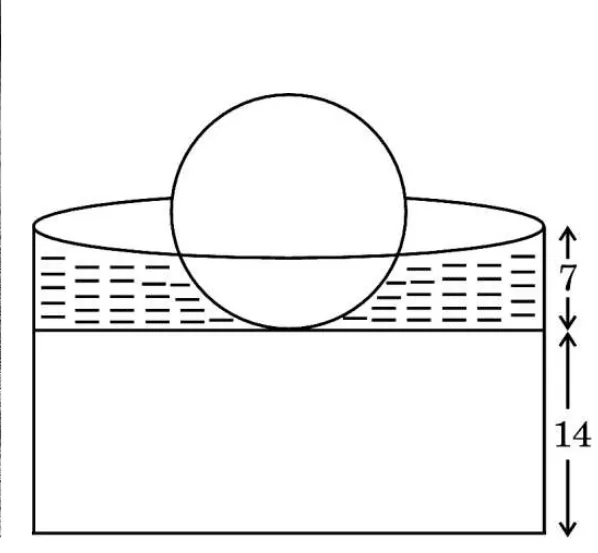
A drawing of the pool: a cylinder with a solid base 14 cm high and water 7 cm deep above it, with a ball of diameter 21 cm resting on the base.
Solution
147Ø 50 outer, Ø 40 innerball Ø 21height = 14 + 21 = 35 cm; ball = 4851 cm³water = π·20²·7 − ⅓·4851 = 7183 cm³
  1. (i) The ball rests on the solid base: total height =14+21=35= 14 + 21 = 35 cm.
  2. (ii) Radius =212= \dfrac{21}{2} cm. Volume =43πr3=43×227×212×212×212=4851= \dfrac{4}{3}\pi r^3 = \dfrac{4}{3} \times \dfrac{22}{7} \times \dfrac{21}{2} \times \dfrac{21}{2} \times \dfrac{21}{2} = 4851 cm³.
  3. (iii)(a) The water fills a cylinder of inner radius 2020 cm and depth 77 cm, less the submerged third of the ball: 227×20×20×7−13×4851=8800−1617=7183\dfrac{22}{7} \times 20 \times 20 \times 7 - \dfrac{1}{3} \times 4851 = 8800 - 1617 = 7183 cm³.
  4. (iii)(b) The outer cylinder has radius 2525 cm and height 14+7=2114 + 7 = 21 cm: curved area =2πrh=2×227×25×21=3300= 2\pi r h = 2 \times \dfrac{22}{7} \times 25 \times 21 = 3300 cm². The ball: 4πr2=4×227×212×212=13864\pi r^2 = 4 \times \dfrac{22}{7} \times \dfrac{21}{2} \times \dfrac{21}{2} = 1386 cm². Sum =4686= 4686 cm².

Answer: (i) 3535 cm   (ii) 48514851 cm³   (iii)(a) 71837183 cm³   (iii)(b) 46864686 cm²

Report an error on this question

Questions are from the official CBSE paper. Figures are described in words; see the PDF for the originals. Solutions are written by CogniGuru.

Revise this paper in 1 minute a chapter

Each chapter below is what the paper tested, with a one-minute animated lesson on the idea behind it.

Stuck on a step in any solution?

The CogniGuru AI tutor explains any doubt one minute at a time, in English or Hindi. Join the waitlist.

Mock quiz: 5 questions from this paper

Five real questions from this paper, one each from five chapters. About 2 minutes. See how much you know and where you stand among other students. Attempt free, with no login; log in only for your ranking and full report.

Question 1 of 5 · Q1 of the paperQuadratic Equations

The roots of the quadratic equation (x−1)2=16(x - 1)^2 = 16 are:

0 of 5 answered

Related papers

  • Maths Standard 2025
  • Maths Standard 2027Coming soon
  • Maths Basic 2026Coming soon
  • Science 2026Coming soon

Common questions

Are these the official CBSE Class 10 Maths Standard 2026 questions?
Yes. The questions are from the official Mathematics (Standard) paper (set 30/3/1) that CBSE published after the 2026 board exam. The solutions are written by CogniGuru and checked against the answer key CBSE published for this paper code.
Can I download the CBSE Class 10 Maths Standard 2026 question paper PDF?
Yes, the official paper PDF is free to download from this page, and so are our step-by-step solutions as a PDF. No login is needed to download either or to read the solutions.
Do all sets of the paper have the same questions?
No. CBSE sets several versions of each paper, with the same blueprint and similar questions in a different order and sometimes with different numbers. This page covers set 30/3/1.
How does the quiz work, and what does “where you stand” mean?
It is a mock quiz of 5 real multiple-choice questions from this paper, scored automatically in about 2 minutes. Your score is compared, anonymously, with other students who took the same quiz. Only the score is stored with the comparison, never your name or number.

Source

CBSE question paper archive, Class X, 2026 (Mathematics (Standard), set 30/3/1)
PDF