
CBSE · Class 10 · Mathematics (Standard) · Free

CBSE Class 10 Maths Standard 2026 Question Paper (Set 30/4/1) with Solutions

The official board paper (Q.P. Code 30/4/1, Series 4MNKL). Free paper PDF and step-by-step solutions (also as a PDF to download) written by CogniGuru and checked against CBSE’s answer key. See the paper’s main topics in 1 minute, then quiz yourself to see how much you know and where you stand.

No login to download or read the solutions. Login only to see your quiz report in full.

Board
CBSE
Class
10
Subject
Maths Standard (041)
Year
2026
Set code
30/4/1
Max marks
80
Duration
3 hours
Questions
38 (Sections A to E)
Source
Official CBSE paper
Exam date
2026

Paper preview

Three pages of the official paper. Download the PDF for all 24.

  • Cover page of the CBSE Class 10 Maths Standard 2026 paper, set 30/4/1

    Cover page

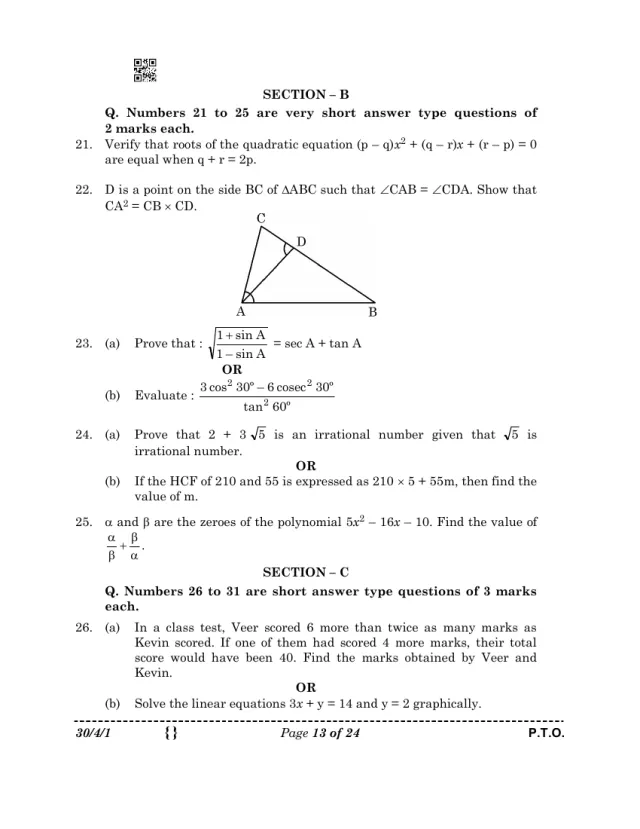
  • Section B of the CBSE Class 10 Maths Standard 2026 paper, set 30/4/1

    Section B

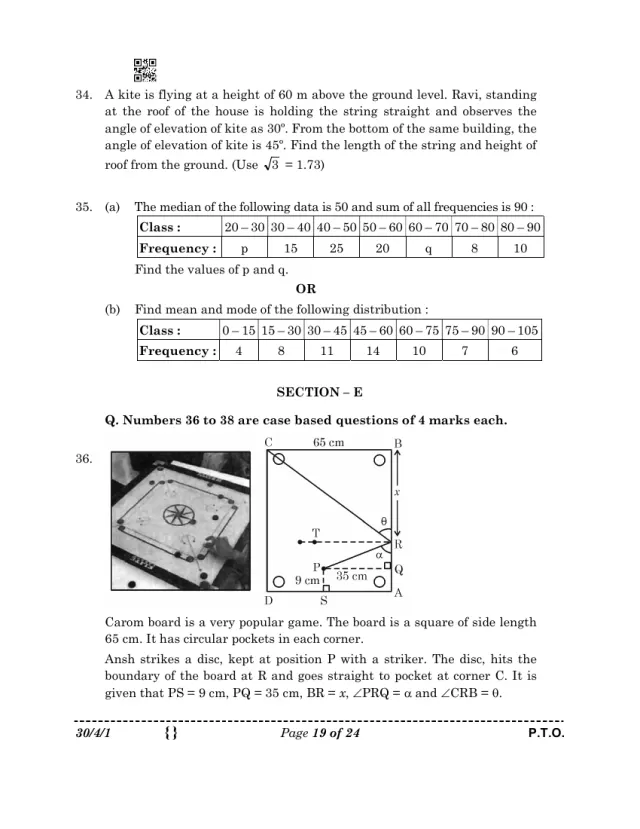
  • A case study with its figure from the CBSE Class 10 Maths Standard 2026 paper, set 30/4/1

    Case study

The main topics of this paper, in 1 minute

Your tutor walks you through the paper before you attempt it: the marks, the key ideas, the time plan and the traps.

1-minute paper analysis

With your tutor, in her voice

The main topics of this paper, in about a minute

A short, animated walk through the paper: how it is built, where the marks come from, the four ideas that matter most, how to plan your three hours, and the traps to avoid.

  1. 1The paper at a glance
  2. 2Where the marks come from
  3. 3Four ideas that keep paying off
  4. 4Plan your three hours
  5. 5Four traps to avoid

Sound on for the voice. Captions are shown, and you can mute any time.

Step-by-step solutions

Try each question first, then open its solution. Tap a number to jump.

Download solutions (PDF)

Section A: Multiple choice

20 questions, 1 mark each. MCQs (Q1 to Q18) and assertion-reason (Q19, Q20).

Q1Quadratic Equations1 mark

If the quadratic equation 9x2+8kx+16=09x^2 + 8kx + 16 = 0 has real and equal roots, then the value of kk is:

  1. (A)3
  2. (B)−3
  3. (C)−4
  4. (D)32\dfrac{3}{2}
Solution · answer (A)
  1. Equal roots need D=0D = 0: (8k)2−4(9)(16)=64k2−576=0(8k)^2 - 4(9)(16) = 64k^2 - 576 = 0, so k2=9k^2 = 9 and k=±3k = \pm 3.
  2. Both 33 and −3-3 are in the options, so options (A) and (B) are both correct. CBSE's key accepts either.

Answer: (A) 3 or (B) −3

Common mistake: Picking only one sign. The equation gives k² = 9, so k can be 3 or −3, and both are among the options.

Report an error on this question
Q2Triangles1 mark

It is given that △ABC∼△EDF\triangle ABC \sim \triangle EDF. Which of the following is **not** true?

  1. (A)Perimeter of △ABCPerimeter of △EDF=ABED\dfrac{\text{Perimeter of }\triangle ABC}{\text{Perimeter of }\triangle EDF} = \dfrac{AB}{ED}
  2. (B)ABED=ACEF\dfrac{AB}{ED} = \dfrac{AC}{EF}
  3. (C)∠A=∠D, ∠C=∠F\angle A = \angle D,\ \angle C = \angle F
  4. (D)AB+BCAC=DE+DFEF\dfrac{AB + BC}{AC} = \dfrac{DE + DF}{EF}
Solution · answer (C)
  1. The correspondence is A↔EA \leftrightarrow E, B↔DB \leftrightarrow D, C↔FC \leftrightarrow F.
  2. (A), (B) and (D) are true: the perimeters and all pairs of corresponding sides are in the same ratio, and AB+BCAB + BC matches ED+DFED + DF while ACAC matches EFEF.
  3. (C) says ∠A=∠D\angle A = \angle D, but ∠A\angle A corresponds to ∠E\angle E, so this is not true (the true statement is ∠A=∠E\angle A = \angle E, ∠C=∠F\angle C = \angle F).

Answer: (C) ∠A=∠D, ∠C=∠F\angle A = \angle D,\ \angle C = \angle F

Report an error on this question
Q3Arithmetic Progressions1 mark

The nthn^{\text{th}} term of an A.P. is 2 n+1\sqrt{2}\,n + 1. Its common difference is:

  1. (A)2\sqrt{2}
  2. (B)2 n\sqrt{2}\,n
  3. (C)1
  4. (D)2+1\sqrt{2} + 1
Solution · answer (A)
  1. an+1−an=(2(n+1)+1)−(2n+1)=2a_{n+1} - a_n = (\sqrt{2}(n + 1) + 1) - (\sqrt{2}n + 1) = \sqrt{2}.

Answer: (A) 2\sqrt{2}

Report an error on this question
Q4Circles1 mark

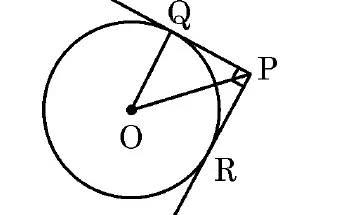
If PQPQ and PRPR are tangents to the circle with centre OO and radius 44 cm such that ∠QPR=90∘\angle QPR = 90^\circ, then the length OPOP is:

A circle with centre O. Two tangents from the outside point P on the right touch the circle at Q (top) and R (bottom). The radii OQ and OR are drawn.
  1. (A)4 cm
  2. (B)424\sqrt{2} cm
  3. (C)8 cm
  4. (D)222\sqrt{2} cm
Solution · answer (B)
OPQROQPR is a square of side 4: OP = 4√2 cm
  1. OQ⊥PQOQ \perp PQ, OR⊥PROR \perp PR and ∠QPR=90∘\angle QPR = 90^\circ, so OQPROQPR has four right angles. OQ=OR=4OQ = OR = 4 and PQ=PRPQ = PR, so it is a square of side 44.
  2. OPOP is its diagonal: OP=42OP = 4\sqrt{2} cm.

Answer: (B) 424\sqrt{2} cm

Report an error on this question
Q5Polynomials1 mark

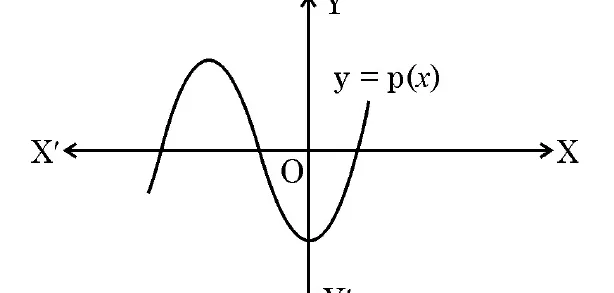
Observe the graph of polynomial p(x)p(x). Number of zeroes of p(x)p(x) is:

A wavy curve y equals p of x that starts below the x-axis on the left, crosses it going up, makes a peak, crosses down, dips to a trough below the axis and crosses up again, so it meets the x-axis three times.
  1. (A)5
  2. (B)4
  3. (C)6
  4. (D)3
Solution · answer (D)
  1. The zeroes are the points where the graph meets the xx-axis. The curve crosses the axis three times (up, down, up), so there are 33 zeroes.

Answer: (D) 3

Report an error on this question
Q6Triangles1 mark

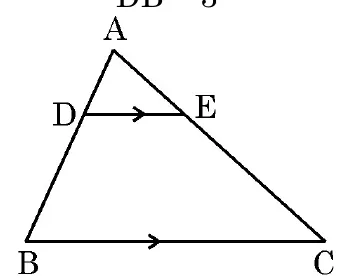
In the given figure, DE∥BCDE \parallel BC. If ADDB=13\dfrac{AD}{DB} = \dfrac{1}{3} and AC=6AC = 6 cm, then length AEAE is:

A triangle ABC with DE drawn parallel to the base BC, D on AB and E on AC.
  1. (A)1.5 cm
  2. (B)1 cm
  3. (C)2 cm
  4. (D)3 cm
Solution · answer (A)
  1. DE∥BCDE \parallel BC, so AEEC=ADDB=13\dfrac{AE}{EC} = \dfrac{AD}{DB} = \dfrac{1}{3}. So AE:AC=1:4AE : AC = 1 : 4.
  2. AE=64=1.5AE = \dfrac{6}{4} = 1.5 cm.

Answer: (A) 1.5 cm

Report an error on this question
Q7Coordinate Geometry1 mark

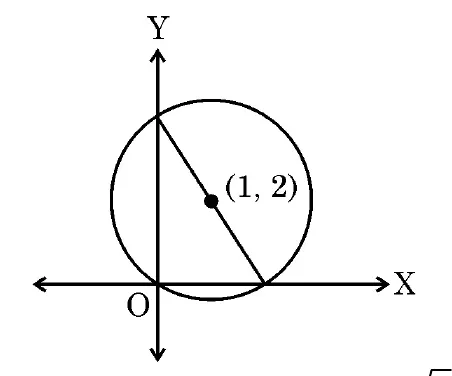
In the given figure, a circle is centred at (1,2)(1, 2). The diameter of the circle is:

A circle centred at the point 1 comma 2, passing through the origin O. A line through the centre meets the circle at a point on the y-axis and a point on the x-axis, forming a diameter.
  1. (A)4
  2. (B)222\sqrt{2}
  3. (C)5\sqrt{5}
  4. (D)252\sqrt{5}
Solution · answer (D)
  1. The circle passes through the origin, so the radius is the distance from the centre (1,2)(1, 2) to (0,0)(0, 0): 12+22=5\sqrt{1^2 + 2^2} = \sqrt{5}.
  2. Diameter =25= 2\sqrt{5}.

Answer: (D) 252\sqrt{5}

Report an error on this question
Q8Linear Equations1 mark

The value of kk for which the system of linear equations x2+y3=5\dfrac{x}{2} + \dfrac{y}{3} = 5 and 2x+ky=72x + ky = 7 is inconsistent, is:

  1. (A)34\dfrac{3}{4}
  2. (B)43\dfrac{4}{3}
  3. (C)13\dfrac{1}{3}
  4. (D)3
Solution · answer (B)
  1. The first equation is 3x+2y=303x + 2y = 30. Inconsistent (parallel lines) needs 32=2k≠307\dfrac{3}{2} = \dfrac{2}{k} \neq \dfrac{30}{7}.
  2. 32=2k\dfrac{3}{2} = \dfrac{2}{k} gives k=43k = \dfrac{4}{3}, and then 2k=32≠307\dfrac{2}{k} = \dfrac{3}{2} \neq \dfrac{30}{7} ✓.

Answer: (B) 43\dfrac{4}{3}

Report an error on this question
Q9Areas Related to Circles1 mark

A circle is divided into 1616 identical sectors. If radius of the circle is 77 cm, area of each sector is:

  1. (A)774\dfrac{77}{4} cm²
  2. (B)77 cm²
  3. (C)154 cm²
  4. (D)778\dfrac{77}{8} cm²
Solution · answer (D)
  1. Area of the circle =227×7×7=154= \dfrac{22}{7} \times 7 \times 7 = 154 cm². Each of 1616 sectors: 15416=778\dfrac{154}{16} = \dfrac{77}{8} cm².

Answer: (D) 778\dfrac{77}{8} cm²

Report an error on this question
Q10Probability1 mark

Two different dice are rolled together. The probability that both the obtained numbers are less than 4, is:

  1. (A)29\dfrac{2}{9}
  2. (B)736\dfrac{7}{36}
  3. (C)14\dfrac{1}{4}
  4. (D)23\dfrac{2}{3}
Solution · answer (C)
  1. Each die must show 1,21, 2 or 33: 3×3=93 \times 3 = 9 outcomes out of 3636. P=936=14P = \dfrac{9}{36} = \dfrac{1}{4}.

Answer: (C) 14\dfrac{1}{4}

Report an error on this question
Q11Trigonometry1 mark

When sin⁡A=13\sin A = \dfrac{1}{3}, the value of cot⁡A\cot A is:

  1. (A)223\dfrac{2\sqrt{2}}{3}
  2. (B)222\sqrt{2}
  3. (C)122\dfrac{1}{2\sqrt{2}}
  4. (D)3
Solution · answer (B)
  1. Opposite =1= 1, hypotenuse =3= 3, adjacent =9−1=22= \sqrt{9 - 1} = 2\sqrt{2}. cot⁡A=adjacentopposite=22\cot A = \dfrac{\text{adjacent}}{\text{opposite}} = 2\sqrt{2}.

Answer: (B) 222\sqrt{2}

Report an error on this question
Q12Trigonometry1 mark

1+tan⁡2A1+cot⁡2A\dfrac{1 + \tan^2 A}{1 + \cot^2 A} equals to:

  1. (A)tan⁡2A\tan^2 A
  2. (B)−1
  3. (C)−tan⁡2A-\tan^2 A
  4. (D)cot⁡2A\cot^2 A
Solution · answer (A)
  1. 1+tan⁡2A=sec⁡2A1 + \tan^2 A = \sec^2 A and 1+cot⁡2A=cosec⁡2A1 + \cot^2 A = \operatorname{cosec}^2 A. The ratio is sec⁡2Acosec⁡2A=sin⁡2Acos⁡2A=tan⁡2A\dfrac{\sec^2 A}{\operatorname{cosec}^2 A} = \dfrac{\sin^2 A}{\cos^2 A} = \tan^2 A.

Answer: (A) tan⁡2A\tan^2 A

Report an error on this question
Q13Surface Areas and Volumes1 mark

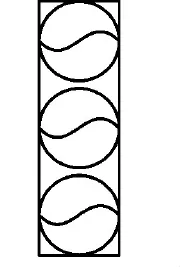
Three tennis balls are just packed in a cylindrical jar. If radius of each ball is rr, volume of air inside the jar is:

A tall cylinder holding three spherical balls stacked one above the other, each touching the walls.
  1. (A)2πr32\pi r^3
  2. (B)3πr33\pi r^3
  3. (C)5πr35\pi r^3
  4. (D)4πr34\pi r^3
Solution · answer (A)
  1. The jar has radius rr and height 3×2r=6r3 \times 2r = 6r: volume πr2×6r=6πr3\pi r^2 \times 6r = 6\pi r^3.
  2. The three balls: 3×43πr3=4πr33 \times \dfrac{4}{3}\pi r^3 = 4\pi r^3. Air =6πr3−4πr3=2πr3= 6\pi r^3 - 4\pi r^3 = 2\pi r^3.

Answer: (A) 2πr32\pi r^3

Report an error on this question
Q14Circles1 mark

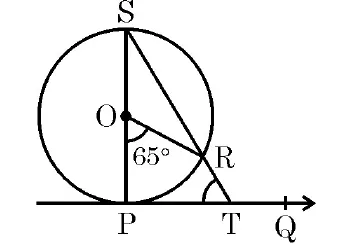
PQPQ is tangent to a circle with centre OO. If ∠POR=65∘\angle POR = 65^\circ, then m∠PTRm\angle PTR is:

A circle with centre O, the diameter SP vertical with S at the top and P at the bottom on the tangent line PQ. R is on the circle, the angle POR is marked 65 degrees, and the line from S through R meets the tangent at T.
  1. (A)65∘65^\circ
  2. (B)58.5∘58.5^\circ
  3. (C)57.5∘57.5^\circ
  4. (D)45∘45^\circ
Solution · answer (C)
65°OSPRT32.5°57.5°∠PSR = ½ × 65° = 32.5°; ∠PTR = 90° − 32.5° = 57.5°
  1. SPSP is a diameter, and the angle at the circle is half the angle at the centre on the same arc PRPR: ∠PSR=65∘2=32.5∘\angle PSR = \dfrac{65^\circ}{2} = 32.5^\circ.
  2. SP⊥PTSP \perp PT (radius and tangent), so in the right triangle SPTSPT: ∠PTR=90∘−32.5∘=57.5∘\angle PTR = 90^\circ - 32.5^\circ = 57.5^\circ.

Answer: (C) 57.5∘57.5^\circ

Report an error on this question
Q15Coordinate Geometry1 mark

The distance between the points (acos⁡θ+bsin⁡θ,0)(a\cos\theta + b\sin\theta, 0) and (0,asin⁡θ−bcos⁡θ)(0, a\sin\theta - b\cos\theta) is:

  1. (A)a2+b2\sqrt{a^2 + b^2}
  2. (B)a2−b2a^2 - b^2
  3. (C)a2−b2\sqrt{a^2 - b^2}
  4. (D)a2+b2a^2 + b^2
Solution · answer (A)
  1. d2=(acos⁡θ+bsin⁡θ)2+(asin⁡θ−bcos⁡θ)2d^2 = (a\cos\theta + b\sin\theta)^2 + (a\sin\theta - b\cos\theta)^2.
  2. =a2cos⁡2θ+2absin⁡θcos⁡θ+b2sin⁡2θ+a2sin⁡2θ−2absin⁡θcos⁡θ+b2cos⁡2θ=a2+b2= a^2\cos^2\theta + 2ab\sin\theta\cos\theta + b^2\sin^2\theta + a^2\sin^2\theta - 2ab\sin\theta\cos\theta + b^2\cos^2\theta = a^2 + b^2. So d=a2+b2d = \sqrt{a^2 + b^2}.

Answer: (A) a2+b2\sqrt{a^2 + b^2}

Report an error on this question
Q16Surface Areas and Volumes1 mark

An ice-cream cone of radius rr and height hh is completely filled by two spherical scoops of ice-cream. If radius of each spherical scoop is r2\dfrac{r}{2}, then h:2rh : 2r equals:

  1. (A)1 : 8
  2. (B)1 : 2
  3. (C)1 : 1
  4. (D)2 : 1
Solution · answer (B)
  1. Two scoops: 2×43π(r2)3=83π×r38=πr332 \times \dfrac{4}{3}\pi\left(\dfrac{r}{2}\right)^3 = \dfrac{8}{3}\pi \times \dfrac{r^3}{8} = \dfrac{\pi r^3}{3}.
  2. The cone: 13πr2h\dfrac{1}{3}\pi r^2 h. Setting them equal, h=rh = r, so h:2r=r:2r=1:2h : 2r = r : 2r = 1 : 2.

Answer: (B) 1 : 2

Report an error on this question
Q17Areas Related to Circles1 mark

Arc PQPQ subtends an angle θ\theta at the centre of the circle with radius 6.36.3 cm. If length of arc PQ=11PQ = 11 cm, then the value of θ\theta is:

  1. (A)10∘10^\circ
  2. (B)60∘60^\circ
  3. (C)45∘45^\circ
  4. (D)100∘100^\circ
Solution · answer (D)
  1. Arc =θ360×2πr= \dfrac{\theta}{360} \times 2\pi r: 11=θ360×2×227×6.3=θ360×39.611 = \dfrac{\theta}{360} \times 2 \times \dfrac{22}{7} \times 6.3 = \dfrac{\theta}{360} \times 39.6.
  2. θ=11×36039.6=100∘\theta = \dfrac{11 \times 360}{39.6} = 100^\circ.

Answer: (D) 100∘100^\circ

Report an error on this question
Q18Statistics1 mark

Mean and Median of a frequency distribution are 43 and 40 respectively. The value of mode is:

  1. (A)34
  2. (B)43
  3. (C)38.5
  4. (D)41.5
Solution · answer (A)
  1. Mode=3 Median−2 Mean=3(40)−2(43)=120−86=34\text{Mode} = 3\,\text{Median} - 2\,\text{Mean} = 3(40) - 2(43) = 120 - 86 = 34.

Answer: (A) 34

Report an error on this question
Q19Probability1 mark

Assertion (A): If probability of happening of an event is 0.2p0.2p, p>0p > 0, then pp can’t be more than 55.

Reason (R): P(Eˉ)=1−P(E)P(\bar{E}) = 1 - P(E) for an event EE.

  1. (A)Both A and R are true and R is the correct explanation of A
  2. (B)Both A and R are true, but R is not the correct explanation of A
  3. (C)A is true, but R is false
  4. (D)A is false, but R is true
Solution · answer (B)
  1. (A) A probability cannot exceed 11, so 0.2p≤10.2p \leq 1 and p≤5p \leq 5. True.
  2. (R) The complement rule is true. But the bound on pp comes from probability being at most 11, not from the complement rule, so R does not explain A.

Answer: (B) Both A and R are true, but R is not the correct explanation of A

Report an error on this question
Q20Real Numbers1 mark

Assertion (A): (3+5)(\sqrt{3} + \sqrt{5}) is an irrational number.

Reason (R): Sum of the any two irrational numbers is always irrational.

  1. (A)Both A and R are true and R is the correct explanation of A
  2. (B)Both A and R are true, but R is not the correct explanation of A
  3. (C)A is true, but R is false
  4. (D)A is false, but R is true
Solution · answer (C)
  1. (A) 3+5\sqrt{3} + \sqrt{5} is irrational (if it were rational =r= r, then squaring 8+215=r28 + 2\sqrt{15} = r^2 would make 15\sqrt{15} rational, which it is not). True.
  2. (R) False: 2\sqrt{2} and −2-\sqrt{2} are irrational but their sum is 00, a rational number.

Answer: (C) A is true, but R is false

Report an error on this question

Section B: Very short answer

5 questions, 2 marks each.

Q21Quadratic Equations2 marks

Verify that roots of the quadratic equation (p−q)x2+(q−r)x+(r−p)=0(p - q)x^2 + (q - r)x + (r - p) = 0 are equal when q+r=2pq + r = 2p.

Solution
  1. D=(q−r)2−4(p−q)(r−p)D = (q - r)^2 - 4(p - q)(r - p). Expand: (q−r)2−4(pr−p2−qr+pq)=q2−2qr+r2−4pr+4p2+4qr−4pq=q2+2qr+r2+4p2−4pr−4pq=(q+r−2p)2(q - r)^2 - 4(pr - p^2 - qr + pq) = q^2 - 2qr + r^2 - 4pr + 4p^2 + 4qr - 4pq = q^2 + 2qr + r^2 + 4p^2 - 4pr - 4pq = (q + r - 2p)^2.
  2. If q+r=2pq + r = 2p, then D=0D = 0, so the roots are real and equal.

Answer: Verified

Report an error on this question
Q22Triangles2 marks

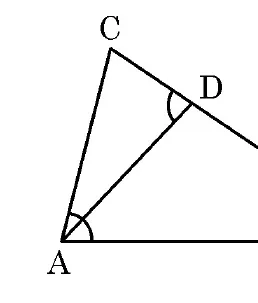
DD is a point on the side BCBC of △ABC\triangle ABC such that ∠CAB=∠CDA\angle CAB = \angle CDA. Show that CA2=CB×CDCA^2 = CB \times CD.

A triangle ABC with C at the top, A at the bottom left and B at the bottom right. D is a point on the side CB and AD is drawn. The angles CAB and CDA are marked as equal.
Solution
xxABCD△CDA ∼ △CAB (AA) → CD/CA = CA/CB → CA² = CB × CD
  1. In △CDA\triangle CDA and △CAB\triangle CAB: ∠C\angle C is common and ∠CDA=∠CAB\angle CDA = \angle CAB (given).
  2. So △CDA∼△CAB\triangle CDA \sim \triangle CAB by AA, and CDCA=CACB\dfrac{CD}{CA} = \dfrac{CA}{CB}.
  3. Cross-multiplying, CA2=CB×CDCA^2 = CB \times CD.

Answer: Shown

Report an error on this question
Q23Trigonometry2 marks

(a) Prove that: 1+sin⁡A1−sin⁡A=sec⁡A+tan⁡A\sqrt{\dfrac{1 + \sin A}{1 - \sin A}} = \sec A + \tan A

OR

(b) Evaluate: 3cos⁡230∘−6cosec⁡230∘tan⁡260∘\dfrac{3\cos^2 30^\circ - 6\operatorname{cosec}^2 30^\circ}{\tan^2 60^\circ}

Solution
  1. (a) Multiply the top and bottom by (1+sin⁡A)(1 + \sin A): (1+sin⁡A)21−sin⁡2A=(1+sin⁡A)2cos⁡2A=1+sin⁡Acos⁡A=sec⁡A+tan⁡A\sqrt{\dfrac{(1 + \sin A)^2}{1 - \sin^2 A}} = \sqrt{\dfrac{(1 + \sin A)^2}{\cos^2 A}} = \dfrac{1 + \sin A}{\cos A} = \sec A + \tan A.
  2. (b) cos⁡30∘=32\cos 30^\circ = \dfrac{\sqrt{3}}{2}, cosec⁡30∘=2\operatorname{cosec} 30^\circ = 2, tan⁡60∘=3\tan 60^\circ = \sqrt{3}.
  3. 3×34−6×43=94−243=−8743=−294\dfrac{3 \times \frac{3}{4} - 6 \times 4}{3} = \dfrac{\frac{9}{4} - 24}{3} = \dfrac{-\frac{87}{4}}{3} = -\dfrac{29}{4}.

Answer: (a) proved   (b) −294-\dfrac{29}{4}

Report an error on this question
Q24Real Numbers2 marks

(a) Prove that 2+352 + 3\sqrt{5} is an irrational number given that 5\sqrt{5} is irrational number.

OR

(b) If the HCF of 210210 and 5555 is expressed as 210×5+55m210 \times 5 + 55m, then find the value of mm.

Solution
  1. (a) Suppose 2+35=pq2 + 3\sqrt{5} = \dfrac{p}{q} with integers p,qp, q and q≠0q \neq 0. Then 5=p−2q3q\sqrt{5} = \dfrac{p - 2q}{3q}, a ratio of integers, so 5\sqrt{5} would be rational. That contradicts the given fact, so 2+352 + 3\sqrt{5} is irrational.
  2. (b) 210=2×3×5×7210 = 2 \times 3 \times 5 \times 7 and 55=5×1155 = 5 \times 11, so HCF =5= 5. 5=1050+55m5 = 1050 + 55m gives 55m=−104555m = -1045 and m=−19m = -19.

Answer: (a) proved   (b) m=−19m = -19

Report an error on this question
Q25Polynomials2 marks

α\alpha and β\beta are the zeroes of the polynomial 5x2−16x−105x^2 - 16x - 10. Find the value of αβ+βα\dfrac{\alpha}{\beta} + \dfrac{\beta}{\alpha}.

Solution
  1. α+β=165\alpha + \beta = \dfrac{16}{5} and αβ=−105=−2\alpha\beta = \dfrac{-10}{5} = -2.
  2. αβ+βα=(α+β)2−2αβαβ=25625+4−2=35625−2=−17825\dfrac{\alpha}{\beta} + \dfrac{\beta}{\alpha} = \dfrac{(\alpha + \beta)^2 - 2\alpha\beta}{\alpha\beta} = \dfrac{\frac{256}{25} + 4}{-2} = \dfrac{\frac{356}{25}}{-2} = -\dfrac{178}{25}.

Answer: −17825-\dfrac{178}{25}

Report an error on this question

Section C: Short answer

6 questions, 3 marks each.

Q26Linear Equations3 marks

(a) In a class test, Veer scored 66 more than twice as many marks as Kevin scored. If one of them had scored 44 more marks, their total score would have been 4040. Find the marks obtained by Veer and Kevin.

OR

(b) Solve the linear equations 3x+y=143x + y = 14 and y=2y = 2 graphically.

Solution
-112345672468101214Oxy3x + y = 14y = 2(4, 2)
  1. (a) Let Veer have VV and Kevin KK. V=2K+6V = 2K + 6 and V+K+4=40V + K + 4 = 40 (one of them having 44 more adds 44 to the total).
  2. 2K+6+K=362K + 6 + K = 36, so 3K=303K = 30 and K=10K = 10, V=26V = 26. (Check: 26=2×10+626 = 2 \times 10 + 6 ✓ and 26+10+4=4026 + 10 + 4 = 40 ✓.)
  3. (b) 3x+y=143x + y = 14: points (4,2)(4, 2), (3,5)(3, 5) and (2,8)(2, 8). y=2y = 2 is the horizontal line through (0,2)(0, 2). They meet at (4,2)(4, 2): x=4x = 4, y=2y = 2.

Answer: (a) Veer 2626, Kevin 1010   (b) x=4x = 4, y=2y = 2

Report an error on this question
Q27Areas Related to Circles3 marks

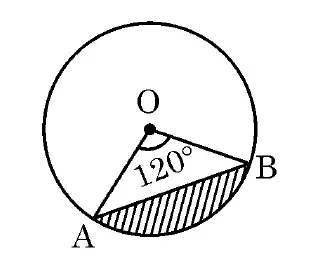
Chord ABAB of a circle with centre OO and radius 2121 mm subtends an angle of 120∘120^\circ at the centre. Find the perimeters of the shaded region. (Use 3=1.73\sqrt{3} = 1.73)

A circle with centre O and a chord AB that makes a 120 degree angle at O. The segment between the chord AB and the minor arc is shaded with lines.
Solution
120°OABarc AB = ⅓ × 2π × 21 = 44 mmchord = 21√3 = 36.33 mm → perimeter 80.33 mm
  1. The shaded region is the minor segment, bounded by the minor arc ABAB and the chord ABAB.
  2. Arc AB=120360×2×227×21=44AB = \dfrac{120}{360} \times 2 \times \dfrac{22}{7} \times 21 = 44 mm.
  3. Chord: draw OC⊥ABOC \perp AB; it bisects the angle and the chord, so ∠AOC=60∘\angle AOC = 60^\circ and AC=21sin⁡60∘=2132AC = 21\sin 60^\circ = \dfrac{21\sqrt{3}}{2}. AB=213=21×1.73=36.33AB = 21\sqrt{3} = 21 \times 1.73 = 36.33 mm.
  4. Perimeter =44+36.33=80.33= 44 + 36.33 = 80.33 mm.

Answer: 44+213≈80.3344 + 21\sqrt{3} \approx 80.33 mm

Report an error on this question
Q28Trigonometry3 marks

Prove that: sin⁡θ−cos⁡θ+1sin⁡θ+cos⁡θ−1=1sec⁡θ−tan⁡θ\dfrac{\sin\theta - \cos\theta + 1}{\sin\theta + \cos\theta - 1} = \dfrac{1}{\sec\theta - \tan\theta}

Solution
  1. Divide the top and bottom of the LHS by cos⁡θ\cos\theta: tan⁡θ−1+sec⁡θtan⁡θ+1−sec⁡θ\dfrac{\tan\theta - 1 + \sec\theta}{\tan\theta + 1 - \sec\theta}.
  2. Write 1=sec⁡2θ−tan⁡2θ1 = \sec^2\theta - \tan^2\theta in the top: tan⁡θ+sec⁡θ−(sec⁡2θ−tan⁡2θ)=(sec⁡θ+tan⁡θ)(1−sec⁡θ+tan⁡θ)\tan\theta + \sec\theta - (\sec^2\theta - \tan^2\theta) = (\sec\theta + \tan\theta)(1 - \sec\theta + \tan\theta).
  3. So the LHS =(sec⁡θ+tan⁡θ)(1−sec⁡θ+tan⁡θ)tan⁡θ+1−sec⁡θ=sec⁡θ+tan⁡θ= \dfrac{(\sec\theta + \tan\theta)(1 - \sec\theta + \tan\theta)}{\tan\theta + 1 - \sec\theta} = \sec\theta + \tan\theta.
  4. Multiply and divide by (sec⁡θ−tan⁡θ)(\sec\theta - \tan\theta): sec⁡2θ−tan⁡2θsec⁡θ−tan⁡θ=1sec⁡θ−tan⁡θ=\dfrac{\sec^2\theta - \tan^2\theta}{\sec\theta - \tan\theta} = \dfrac{1}{\sec\theta - \tan\theta} = RHS.

Answer: Proved

Report an error on this question
Q29Surface Areas and Volumes3 marks

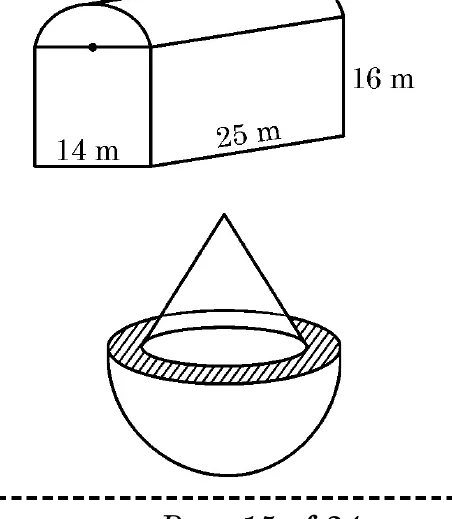
(a) To protect plants from heat, a shed of iron rods covered with green cloth is made. The lower part of the shed is a cuboid mounted by semi-cylinder as shown in the figure. Find the area of the cloth required to make this shed, if dimensions of the cuboid are 1414 m ×\times 2525 m ×\times 1616 m.

OR

(b) The internal and external radii of a hollow hemisphere are 525\sqrt{2} cm and 1010 cm respectively. A cone of height 575\sqrt{7} cm and radius 525\sqrt{2} cm is surmounted on the hemisphere as shown in the figure. Find the total surface area of the object in terms of π\pi. (Use 2=1.4\sqrt{2} = 1.4)

Two figures. First, a shed made of a box with a half-cylinder roof, labelled 14 m, 25 m and 16 m. Second, a hollow hemisphere bowl with a cone standing on top of it.
Solution
  1. (a) The cloth covers the four walls and the semi-cylindrical roof with its two semicircular ends (the floor is not covered).
  2. Four walls: 2(14×16+25×16)=2(224+400)=12482(14 \times 16 + 25 \times 16) = 2(224 + 400) = 1248 m².
  3. The semi-cylinder has radius 77 m and length 2525 m. Curved area =πrl=227×7×25=550= \pi r l = \dfrac{22}{7} \times 7 \times 25 = 550 m². The two semicircular ends: πr2=227×49=154\pi r^2 = \dfrac{22}{7} \times 49 = 154 m². Roof =704= 704 m².
  4. Total cloth =1248+704=1952= 1248 + 704 = 1952 m².
  5. (b) Cone slant height l=(52)2+(57)2=50+175=15l = \sqrt{(5\sqrt{2})^2 + (5\sqrt{7})^2} = \sqrt{50 + 175} = 15 cm.
  6. The surface of the object: the outer curved area of the hemisphere 2πR22\pi R^2, the cone's curved area πrl\pi r l, and the ring-shaped rim of the hollow hemisphere π(R2−r2)\pi(R^2 - r^2).
  7. =π(2×100+52×15+100−50)=π(200+752+50)=π(250+105)=355π= \pi(2 \times 100 + 5\sqrt{2} \times 15 + 100 - 50) = \pi(200 + 75\sqrt{2} + 50) = \pi(250 + 105) = 355\pi cm² (with 2=1.4\sqrt{2} = 1.4).

Answer: (a) 19521952 m²   (b) 355π355\pi cm²

Report an error on this question
Q30Probability3 marks

A bag contains 30 balls out of which ‘m’ number of balls are blue in colour.

(i) Find the probability that a ball drawn at random from the bag is not blue.

(ii) If 66 more blue balls are added in the bag, then the probability of drawing a blue ball will be 54\dfrac{5}{4} times the probability of drawing a blue ball in the first case. Find the value of mm.

Solution
  1. (i) P(not blue)=30−m30=1−m30P(\text{not blue}) = \dfrac{30 - m}{30} = 1 - \dfrac{m}{30}.
  2. (ii) Now there are 3636 balls and m+6m + 6 blue, so P(blue)=m+636P(\text{blue}) = \dfrac{m + 6}{36}. The condition: m+636=54×m30=m24\dfrac{m + 6}{36} = \dfrac{5}{4} \times \dfrac{m}{30} = \dfrac{m}{24}.
  3. 24(m+6)=36m24(m + 6) = 36m, so 24m+144=36m24m + 144 = 36m and m=12m = 12. (Check: 1836=12\dfrac{18}{36} = \dfrac{1}{2} and 54×1230=12\dfrac{5}{4} \times \dfrac{12}{30} = \dfrac{1}{2} ✓.)

Answer: (i) 30−m30\dfrac{30 - m}{30}   (ii) m=12m = 12

Report an error on this question
Q31Real Numbers3 marks

Find the greatest number less than 10,000 which is exactly divisible by 48, 60 and 65.

Solution
  1. 48=24×348 = 2^4 \times 3, 60=22×3×560 = 2^2 \times 3 \times 5, 65=5×1365 = 5 \times 13. LCM =24×3×5×13=3120= 2^4 \times 3 \times 5 \times 13 = 3120.
  2. Numbers divisible by all three are multiples of 31203120: 3120,6240,9360,12480,…3120, 6240, 9360, 12480, \dots. The greatest below 1000010000 is 3×3120=93603 \times 3120 = 9360.

Answer: 93609360

Report an error on this question

Section D: Long answer

4 questions, 5 marks each.

Q32Quadratic Equations5 marks

(a) A person on tour has ₹ 5,4005{,}400 for his expenses. If he extends his tour by 55 days, he has to cut down his daily expenses by ₹ 180180. Find the original duration of the tour and daily expense.

OR

(b) The total cost of certain piece of cloth was ₹ 2,1002{,}100. During special sale time, the shopkeeper offered 22 m extra cloth for free thus reducing the price of cloth per metre by ₹ 120120. What was the original per metre price of cloth and its length?

Solution
  1. (a) Let the tour be xx days: daily expense 5400x\dfrac{5400}{x}, and after the extension 5400x+5\dfrac{5400}{x + 5}. 5400x−5400x+5=180\dfrac{5400}{x} - \dfrac{5400}{x + 5} = 180.
  2. 5400×5=180x(x+5)5400 \times 5 = 180x(x + 5), so x2+5x−150=0x^2 + 5x - 150 = 0 and (x+15)(x−10)=0(x + 15)(x - 10) = 0. Days cannot be negative: x=10x = 10.
  3. The tour was 1010 days and the daily expense ₹ 540010=540\dfrac{5400}{10} = 540.
  4. (b) Let the length be xx m, so the price per metre is 2100x\dfrac{2100}{x}. With 22 m extra the price is 2100x+2\dfrac{2100}{x + 2}, and 2100x−2100x+2=120\dfrac{2100}{x} - \dfrac{2100}{x + 2} = 120.
  5. 2100×2=120x(x+2)2100 \times 2 = 120x(x + 2), so x2+2x−35=0x^2 + 2x - 35 = 0 and (x+7)(x−5)=0(x + 7)(x - 5) = 0. x=5x = 5 m (reject −7-7).
  6. The original price per metre is 21005=₹420\dfrac{2100}{5} = ₹420. (Check: 21007=300\dfrac{2100}{7} = 300 and 420−300=120420 - 300 = 120 ✓.)

Answer: (a) 1010 days, ₹ 540540 a day   (b) ₹ 420420 per metre, 55 m

Report an error on this question
Q33Circles5 marks

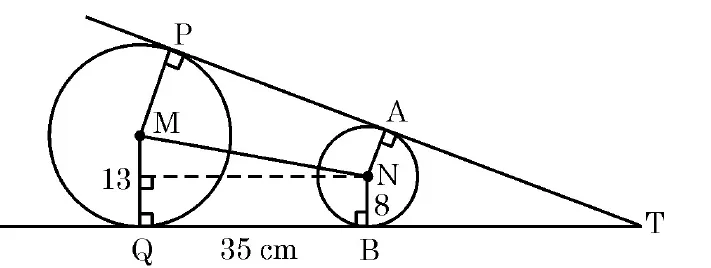
In the given figure, TPTP and TQTQ are tangents to a circle with centre MM, touching another circle with centre NN at AA and BB respectively. It is given that MQ=13MQ = 13 cm, NB=8NB = 8 cm, BQ=35BQ = 35 cm and TP=80TP = 80 cm.

(i) Name the quadrilateral MQBN. [1]

(ii) Is MN parallel to PA? Justify your answer. [1]

(iii) Find length TB. [1]

(iv) Find length MN. [2]

Two circles standing on a line, the larger with centre M on the left and the smaller with centre N on the right, with Q and B at the bottom points. A tangent from T on the far right touches the larger circle at P and the smaller one at A. The radii MQ, NB, MP and NA are drawn, with MQ marked 13, NB marked 8 and QB marked 35.
Solution
QBTMNPA35TB = 4580TB = TQ − QB = 80 − 35 = 45; MN² = 35² + 5² → MN = 25√2
  1. (i) MQ⊥QTMQ \perp QT and NB⊥QTNB \perp QT (radius to the point of contact), so MQ∥NBMQ \parallel NB. MNMN is not parallel to QBQB (the radii differ), so exactly one pair of opposite sides is parallel: MQBNMQBN is a trapezium.
  2. (ii) No. PM⊥PAPM \perp PA and NA⊥PANA \perp PA, so PM∥NAPM \parallel NA. If MN∥PAMN \parallel PA too, then PMNAPMNA would be a parallelogram and PM=NAPM = NA, but PM=13≠8=NAPM = 13 \neq 8 = NA.
  3. (iii) Tangents from TT to the circle with centre MM are equal: TQ=TP=80TQ = TP = 80 cm. TB=TQ−QB=80−35=45TB = TQ - QB = 80 - 35 = 45 cm.
  4. (iv) Draw NS⊥MQNS \perp MQ with SS on MQMQ. Then NS=QB=35NS = QB = 35 and MS=MQ−NB=13−8=5MS = MQ - NB = 13 - 8 = 5. MN2=NS2+MS2=1225+25=1250MN^2 = NS^2 + MS^2 = 1225 + 25 = 1250, so MN=252MN = 25\sqrt{2} cm.
  5. (Note: the data are not fully consistent; if MM, NN, TT were assumed collinear, similar triangles would give TB=56TB = 56 cm, which CBSE's key also accepts.)

Answer: (i) trapezium   (ii) no   (iii) 4545 cm   (iv) 25225\sqrt{2} cm

Report an error on this question
Q34Trigonometry5 marks

A kite is flying at a height of 6060 m above the ground level. Ravi, standing at the roof of the house is holding the string straight and observes the angle of elevation of kite as 30∘30^\circ. From the bottom of the same building, the angle of elevation of kite is 45∘45^\circ. Find the length of the string and height of roof from the ground. (Use 3=1.73\sqrt{3} = 1.73)

Solution
30°45°GRK60 mGT = 60 mKS = 20√3roof = 60 − 20√3 = 25.4 m; string KR = 40√3 = 69.2 m
  1. Let the kite be KK, the roof RR and the foot of the building GG. From GG: tan⁡45∘=60GT=1\tan 45^\circ = \dfrac{60}{GT} = 1, so the kite is GT=60GT = 60 m away horizontally.
  2. From the roof, the horizontal distance is the same 6060 m. The kite is KSKS above the roof level: tan⁡30∘=KS60\tan 30^\circ = \dfrac{KS}{60}, so KS=603=203=34.6KS = \dfrac{60}{\sqrt{3}} = 20\sqrt{3} = 34.6 m.
  3. Height of the roof =60−203=60−34.6=25.4= 60 - 20\sqrt{3} = 60 - 34.6 = 25.4 m.
  4. String: sin⁡30∘=KSKR\sin 30^\circ = \dfrac{KS}{KR}, so KR=2×203=403=69.2KR = 2 \times 20\sqrt{3} = 40\sqrt{3} = 69.2 m.

Answer: String =403≈69.2= 40\sqrt{3} \approx 69.2 m; roof height ≈25.4\approx 25.4 m

Report an error on this question
Q35Statistics5 marks

(a) The median of the following data is 5050 and sum of all frequencies is 9090. Find the values of pp and qq.

OR

(b) Find mean and mode of the following distribution (classes 0−15,15−30,30−45,45−60,60−75,75−90,90−1050-15, 15-30, 30-45, 45-60, 60-75, 75-90, 90-105 with frequencies 4,8,11,14,10,7,64, 8, 11, 14, 10, 7, 6).

Class20–3030–4040–5050–6060–7070–8080–90
Frequencyp152520q810
Solution
  1. (a) Cumulative frequencies: pp, p+15p + 15, p+40p + 40, p+60p + 60, p+q+60p + q + 60, p+q+68p + q + 68, p+q+78p + q + 78. Total p+q+78=90p + q + 78 = 90, so p+q=12p + q = 12.
  2. The median is 5050, which is the lower limit of the class 50−6050 - 60, so that is the median class: l=50l = 50, cf=p+40cf = p + 40, f=20f = 20, h=10h = 10, N2=45\dfrac{N}{2} = 45. 50+45−(p+40)20×10=5050 + \dfrac{45 - (p + 40)}{20} \times 10 = 50 gives 45−p−40=045 - p - 40 = 0, so p=5p = 5.
  3. q=12−5=7q = 12 - 5 = 7.
  4. (b) N=60N = 60. Take a=52.5a = 52.5, h=15h = 15: u=x−52.515=−3,−2,−1,0,1,2,3u = \dfrac{x - 52.5}{15} = -3, -2, -1, 0, 1, 2, 3 for the class marks 7.5,22.5,37.5,52.5,67.5,82.5,97.57.5, 22.5, 37.5, 52.5, 67.5, 82.5, 97.5. ∑fiui=−12−16−11+0+10+14+18=3\sum f_iu_i = -12 - 16 - 11 + 0 + 10 + 14 + 18 = 3.
  5. Mean =52.5+360×15=52.5+0.75=53.25= 52.5 + \dfrac{3}{60} \times 15 = 52.5 + 0.75 = 53.25.
  6. Modal class 45−6045 - 60 (f1=14f_1 = 14, f0=11f_0 = 11, f2=10f_2 = 10): Mode =45+14−1128−11−10×15=45+457≈51.4= 45 + \dfrac{14 - 11}{28 - 11 - 10} \times 15 = 45 + \dfrac{45}{7} \approx 51.4.

Answer: (a) p=5p = 5, q=7q = 7   (b) mean =53.25= 53.25, mode ≈51.4\approx 51.4

Report an error on this question

Section E: Case studies

3 case studies, 4 marks each.

Q36Triangles4 marks

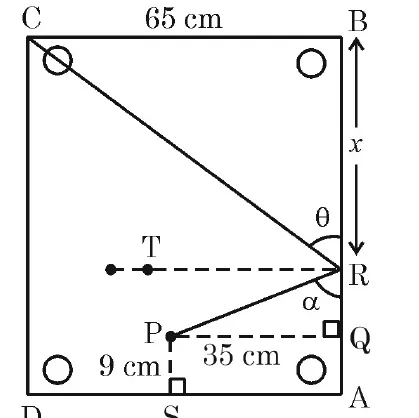
Case study 1. Carom board is a very popular game. The board is a square of side length 65 cm. It has circular pockets in each corner. Ansh strikes a disc, kept at position P with a striker. The disc, hits the boundary of the board at R and goes straight to pocket at corner C. It is given that PS = 9 cm, PQ = 35 cm, BR = x, ∠PRQ = α and ∠CRB = θ.

Based on the above information, answer the following questions:

(i) Using law of reflection i.e. ∠PRT = ∠CRT, prove that θ = α. [1]

(ii) Prove that △PQR ∼ △CBR given that PQ is perpendicular to AB. [1]

(iii) (a) Find the value of x using similarity of triangles. [2]

OR

(iii) (b) If Area △PQRArea △CBR=PQ2CB2\dfrac{\text{Area }\triangle PQR}{\text{Area }\triangle CBR} = \dfrac{PQ^2}{CB^2}, then find the value of xx. [2]

The carom board seen from above as a square with pockets at the corners C, B, A and D. P is near the bottom, S is below it on the bottom side, Q is on the right side level with P, R is on the right side higher up, and T is a dotted point to the left of R.
Solution
αθDABCPQRxPQ = 35α = θ → △PQR ∼ △CBR: 35/65 = (56 − x)/x → x = 36.4 cm
Sketch, not to scale.
  1. (i) TR⊥ABTR \perp AB, so ∠PRT=90∘−α\angle PRT = 90^\circ - \alpha and ∠CRT=90∘−θ\angle CRT = 90^\circ - \theta (the angles on a straight line at RR with the normal TRTR). The law of reflection gives ∠PRT=∠CRT\angle PRT = \angle CRT, so α=θ\alpha = \theta.
  2. (ii) In △PQR\triangle PQR and △CBR\triangle CBR: ∠PRQ=α=θ=∠CRB\angle PRQ = \alpha = \theta = \angle CRB and ∠PQR=∠CBR=90∘\angle PQR = \angle CBR = 90^\circ. So △PQR∼△CBR\triangle PQR \sim \triangle CBR by AA.
  3. (iii)(a) QR=AB−AQ−BR=65−9−x=56−xQR = AB - AQ - BR = 65 - 9 - x = 56 - x (since AQ=PS=9AQ = PS = 9). From the similarity, PQCB=QRBR\dfrac{PQ}{CB} = \dfrac{QR}{BR}: 3565=56−xx\dfrac{35}{65} = \dfrac{56 - x}{x}.
  4. 35x=65(56−x)=3640−65x35x = 65(56 - x) = 3640 - 65x, so 100x=3640100x = 3640 and x=36.4x = 36.4 cm.
  5. (iii)(b) The triangles are similar, so the ratio of their areas is the square of the ratio of corresponding sides: Area △PQRArea △CBR=(QRBR)2\dfrac{\text{Area }\triangle PQR}{\text{Area }\triangle CBR} = \left(\dfrac{QR}{BR}\right)^2. Equating with PQ2CB2\dfrac{PQ^2}{CB^2} gives QRBR=PQCB=3565\dfrac{QR}{BR} = \dfrac{PQ}{CB} = \dfrac{35}{65}, so 56−xx=3565\dfrac{56 - x}{x} = \dfrac{35}{65} and x=36.4x = 36.4 cm.

Answer: (i) θ=α\theta = \alpha   (ii) △PQR∼△CBR\triangle PQR \sim \triangle CBR   (iii) x=36.4x = 36.4 cm

Report an error on this question
Q37Arithmetic Progressions4 marks

Case study 2. ‘Kolam’ is a decorative art which is made with rice flour in South Indian States. It is drawn on grid pattern of dots. One such art work is shown below. Observe the given figure carefully. There are 4 dots in first square, 8 dots in second square, 12 dots in third square and so on.

Based on the above, answer the following questions:

(i) Show that number of dots given above form an A.P. Write the first term and common difference. [1]

(ii) Write nth term of the A.P. formed. [1]

(iii) (a) The pattern is expanded on a large ground. If total 220 dots are used, then find the number of squares formed. [2]

OR

(iii) (b) Is it possible to complete n number of squares using 100 dots? If yes, then find the value of n. [2]

Solution
  1. (i) The numbers of dots 4,8,12,…4, 8, 12, \dots have a constant difference 8−4=12−8=48 - 4 = 12 - 8 = 4, so they form an A.P. with a=4a = 4 and d=4d = 4.
  2. (ii) an=4+(n−1)×4=4na_n = 4 + (n - 1) \times 4 = 4n.
  3. (iii)(a) Sn=n2[2×4+(n−1)×4]=2n(n+1)=220S_n = \dfrac{n}{2}[2 \times 4 + (n - 1) \times 4] = 2n(n + 1) = 220, so n2+n−110=0n^2 + n - 110 = 0 and (n+11)(n−10)=0(n + 11)(n - 10) = 0. n=10n = 10 squares (reject −11-11).
  4. (iii)(b) 2n(n+1)=1002n(n + 1) = 100 gives n2+n−50=0n^2 + n - 50 = 0, with D=1+200=201D = 1 + 200 = 201, which is not a perfect square, so n=−1±2012n = \dfrac{-1 \pm \sqrt{201}}{2} is not a natural number. It is not possible.

Answer: (i) A.P., a=4a = 4, d=4d = 4   (ii) an=4na_n = 4n   (iii)(a) 1010 squares   (iii)(b) not possible

Report an error on this question
Q38Coordinate Geometry4 marks

Case study 3. Observe the map of Jaipur city placed on a Cartesian plane. Taking Rambagh Palace as origin, the location of some places are given below: Point A: (–4, 2) Rajasthan High Court; Point B: (4, –4) Birla Mandir; Point C: (4, 3) Heera Bagh; Point D: (–5, –2) Amar Jawan Jyoti.

Based on the above, answer the following questions:

(i) Advocate Rehana stays at Heera Bagh. How much distance she has to cover daily to go to the court and coming back home? [1]

(ii) There is a crossing on X-axis which divides AD in a certain ratio. Find the ratio. [1]

(iii) (a) Is Birla Mandir equidistant from Heera Bagh and Amar Jawan Jyoti? Justify your answer. [2]

OR

(iii) (b) Using section formula, show that points A, O and B are not collinear. [2]

Solution
-6-5-4-3-2-1123456-5-4-3-2-11234OxyA(−4, 2)B(4, −4)C(4, 3)D(−5, −2)(−4.5, 0)
  1. (i) AC=(4+4)2+(3−2)2=65AC = \sqrt{(4 + 4)^2 + (3 - 2)^2} = \sqrt{65}. She goes to the court and back: 2652\sqrt{65} units.
  2. (ii) Let the crossing P(x,0)P(x, 0) divide ADAD in the ratio K:1K : 1 with A(−4,2)A(-4, 2) and D(−5,−2)D(-5, -2). The yy-coordinate: K(−2)+2K+1=0\dfrac{K(-2) + 2}{K + 1} = 0 gives K=1K = 1. The ratio is 1:11 : 1.
  3. (iii)(a) BC=0+72=7BC = \sqrt{0 + 7^2} = 7 and BD=(4+5)2+(−4+2)2=85BD = \sqrt{(4 + 5)^2 + (-4 + 2)^2} = \sqrt{85}. Since 7≠857 \neq \sqrt{85}, Birla Mandir is not equidistant from Heera Bagh and Amar Jawan Jyoti.
  4. (iii)(b) Suppose OO divides ABAB in the ratio K:1K : 1, with A(−4,2)A(-4, 2) and B(4,−4)B(4, -4). xx: 4K−4K+1=0\dfrac{4K - 4}{K + 1} = 0 gives K=1K = 1. yy: −4K+2K+1=0\dfrac{-4K + 2}{K + 1} = 0 gives K=12K = \dfrac{1}{2}.
  5. The two values of KK differ, so OO does not lie on ABAB: AA, OO, BB are not collinear.

Answer: (i) 2652\sqrt{65} units   (ii) 1:11 : 1   (iii)(a) no (7≠857 \neq \sqrt{85})   (iii)(b) not collinear

Report an error on this question

Questions are from the official CBSE paper. Figures are described in words; see the PDF for the originals. Solutions are written by CogniGuru.

Revise this paper in 1 minute a chapter

Each chapter below is what the paper tested, with a one-minute animated lesson on the idea behind it.

Stuck on a step in any solution?

The CogniGuru AI tutor explains any doubt one minute at a time, in English or Hindi. Join the waitlist.

Mock quiz: 5 questions from this paper

Five real questions from this paper, one each from five chapters. About 2 minutes. See how much you know and where you stand among other students. Attempt free, with no login; log in only for your ranking and full report.

Question 1 of 5 · Q3 of the paperArithmetic Progressions

The nthn^{\text{th}} term of an A.P. is 2 n+1\sqrt{2}\,n + 1. Its common difference is:

0 of 5 answered

Related papers

  • Maths Standard 2025
  • Maths Standard 2027Coming soon
  • Maths Basic 2026Coming soon
  • Science 2026Coming soon

Common questions

Are these the official CBSE Class 10 Maths Standard 2026 questions?
Yes. The questions are from the official Mathematics (Standard) paper (set 30/4/1) that CBSE published after the 2026 board exam. The solutions are written by CogniGuru and checked against the answer key CBSE published for this paper code.
Can I download the CBSE Class 10 Maths Standard 2026 question paper PDF?
Yes, the official paper PDF is free to download from this page, and so are our step-by-step solutions as a PDF. No login is needed to download either or to read the solutions.
Do all sets of the paper have the same questions?
No. CBSE sets several versions of each paper, with the same blueprint and similar questions in a different order and sometimes with different numbers. This page covers set 30/4/1.
How does the quiz work, and what does “where you stand” mean?
It is a mock quiz of 5 real multiple-choice questions from this paper, scored automatically in about 2 minutes. Your score is compared, anonymously, with other students who took the same quiz. Only the score is stored with the comparison, never your name or number.

Source

CBSE question paper archive, Class X, 2026 (Mathematics (Standard), set 30/4/1)
PDF