CBSE · Class 10 · Mathematics (Standard) · Free

CBSE Class 10 Maths Standard 2026 Question Paper (Set 30/5/1) with Solutions

The official board paper (Q.P. Code 30/5/1, Series 5LMKN). Free paper PDF and step-by-step solutions (also as a PDF to download) written by CogniGuru and checked against CBSE’s answer key. See the paper’s main topics in 1 minute, then quiz yourself to see how much you know and where you stand.

No login to download or read the solutions. Login only to see your quiz report in full.

Board
CBSE
Class
10
Subject
Maths Standard (041)
Year
2026
Set code
30/5/1
Max marks
80
Duration
3 hours
Questions
38 (Sections A to E)
Source
Official CBSE paper
Exam date
2026

Paper preview

Three pages of the official paper. Download the PDF for all 24.
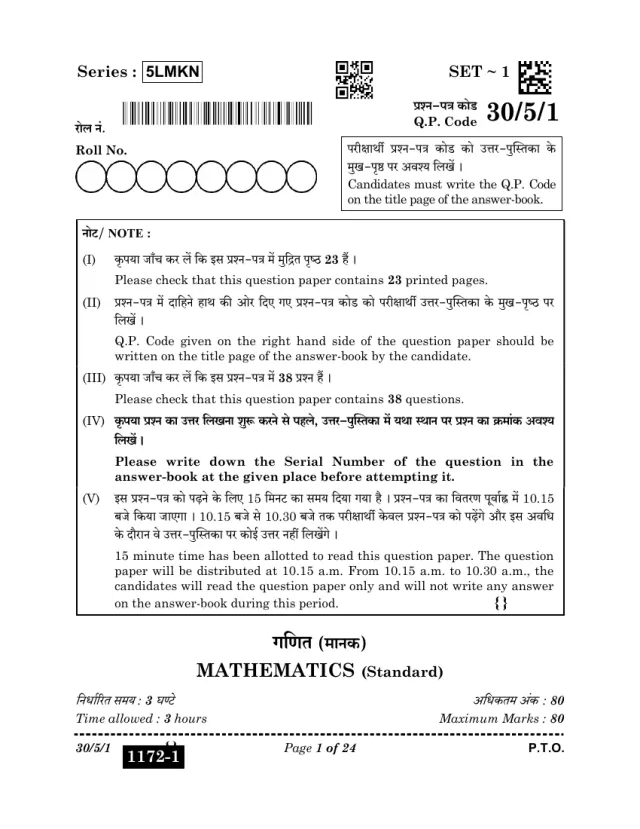
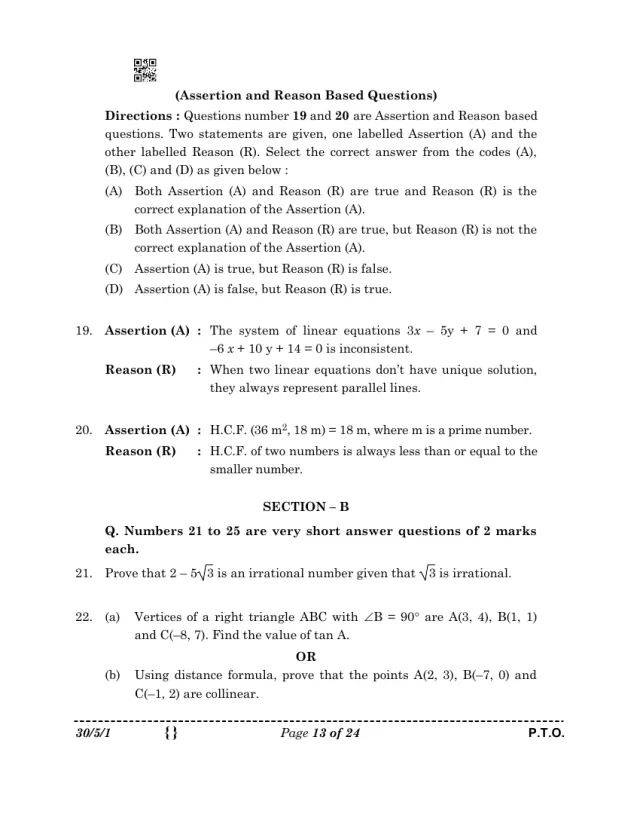
  • Cover page of the CBSE Class 10 Maths Standard 2026 paper, set 30/5/1

    Cover page

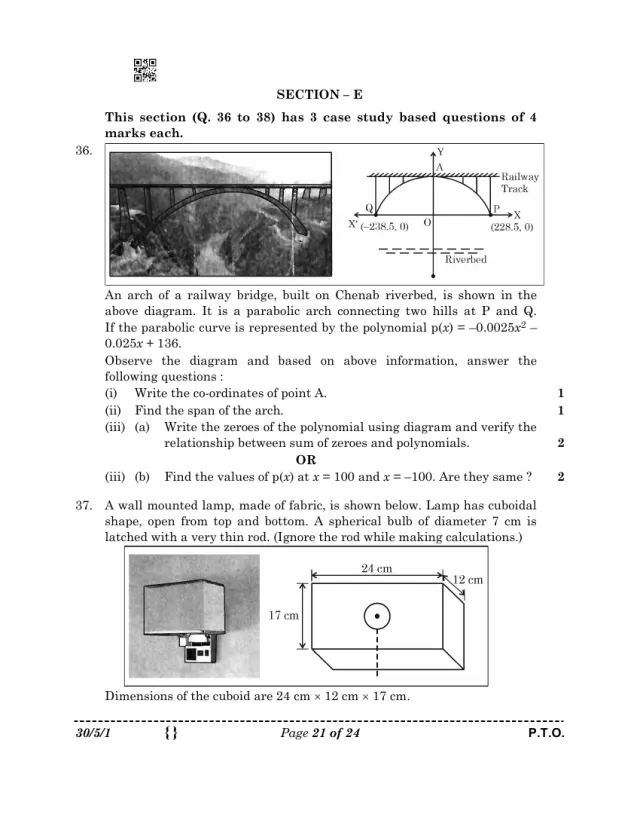
  • Section B of the CBSE Class 10 Maths Standard 2026 paper, set 30/5/1

    Section B

  • A case study with its figure from the CBSE Class 10 Maths Standard 2026 paper, set 30/5/1

    Case study

The main topics of this paper, in 1 minute

Your tutor walks you through the paper before you attempt it: the marks, the key ideas, the time plan and the traps.

1-minute paper analysis

With your tutor, in her voice

The main topics of this paper, in about a minute

A short, animated walk through the paper: how it is built, where the marks come from, the four ideas that matter most, how to plan your three hours, and the traps to avoid.

  1. 1The paper at a glance
  2. 2Where the marks come from
  3. 3Four ideas that keep paying off
  4. 4Plan your three hours
  5. 5Four traps to avoid

Sound on for the voice. Captions are shown, and you can mute any time.

Step-by-step solutions

Try each question first, then open its solution. Tap a number to jump.

Download solutions (PDF)

Section A: Multiple choice

20 questions, 1 mark each. MCQs (Q1 to Q18) and assertion-reason (Q19, Q20).

Q1Quadratic Equations1 mark

The value of kk for which the equation kx2−6x−4=0kx^2 - 6x - 4 = 0 has real and equal roots, is:

  1. (A)94\dfrac{9}{4}
  2. (B)−4
  3. (C)−94-\dfrac{9}{4}
  4. (D)−2
Solution · answer (C)
  1. Equal roots need D=0D = 0: (−6)2−4(k)(−4)=36+16k=0(-6)^2 - 4(k)(-4) = 36 + 16k = 0, so k=−3616=−94k = -\dfrac{36}{16} = -\dfrac{9}{4}.

Answer: (C) −94-\dfrac{9}{4}

Report an error on this question
Q2Coordinate Geometry1 mark

The line segment joining the points P(−4,−2)P(-4, -2) and Q(10,4)Q(10, 4) is divided by yy-axis in the ratio:

  1. (A)2 : 5
  2. (B)1 : 2
  3. (C)2 : 1
  4. (D)5 : 2
Solution · answer (A)
  1. A point on the yy-axis has x=0x = 0. Let it divide PQPQ in the ratio k:1k : 1: 10k+(−4)k+1=0\dfrac{10k + (-4)}{k + 1} = 0.
  2. 10k=410k = 4, so k=25k = \dfrac{2}{5}. The ratio is 2:52 : 5.

Answer: (A) 2 : 5

Report an error on this question
Q3Polynomials1 mark

If the zeroes of a polynomial p(x)p(x) are −3-3 and 88, then p(x)p(x) equals:

  1. (A)x2+5x−4x^2 + 5x - 4
  2. (B)(x+3)(−x+8)(x + 3)(-x + 8)
  3. (C)a(x2+5x−24)a(x^2 + 5x - 24)
  4. (D)x2−24x^2 - 24
Solution · answer (B)
  1. A polynomial with zeroes −3-3 and 88 has the form k(x+3)(x−8)k(x + 3)(x - 8) with k≠0k \neq 0.
  2. Option (B) (x+3)(−x+8)=−(x+3)(x−8)(x + 3)(-x + 8) = -(x + 3)(x - 8) is of this form with k=−1k = -1. The others have different zeroes: x2+5x−24=(x+8)(x−3)x^2 + 5x - 24 = (x + 8)(x - 3) has zeroes −8-8 and 33.

Answer: (B) (x+3)(−x+8)(x + 3)(-x + 8)

Report an error on this question
Q4Circles1 mark

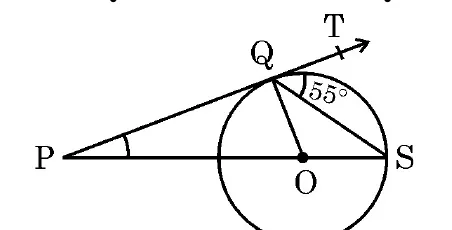
In the given figure, PQPQ is tangent to the circle with centre OO. SS is a point on the circle such that ∠SQT=55∘\angle SQT = 55^\circ. The m∠QPSm\angle QPS is:

A circle with centre O. A line from the outside point P on the left touches the circle at Q at the top and carries on to T. S is the point on the circle at the right end of the line PS, which passes through O. The angle SQT is marked 55 degrees.
  1. (A)55∘55^\circ
  2. (B)20∘20^\circ
  3. (C)35∘35^\circ
  4. (D)70∘70^\circ
Solution · answer (B)
20°55°OPQST∠PQS = 125°, ∠OSQ = 35° → ∠QPS = 20°
  1. PP, QQ, TT are on a tangent line, so ∠PQS=180∘−55∘=125∘\angle PQS = 180^\circ - 55^\circ = 125^\circ. OQ⊥PQOQ \perp PQ gives ∠PQO=90∘\angle PQO = 90^\circ, so ∠OQS=125∘−90∘=35∘\angle OQS = 125^\circ - 90^\circ = 35^\circ.
  2. OQ=OSOQ = OS, so ∠OSQ=∠OQS=35∘\angle OSQ = \angle OQS = 35^\circ.
  3. In △PQS\triangle PQS (with PP, OO, SS in a line): ∠QPS=180∘−125∘−35∘=20∘\angle QPS = 180^\circ - 125^\circ - 35^\circ = 20^\circ.

Answer: (B) 20∘20^\circ

Report an error on this question
Q5Triangles1 mark

Devansh proved that △ABC∼△PQR\triangle ABC \sim \triangle PQR using SAS similarity criteria. If he found ∠C=∠R\angle C = \angle R, then which of the following was proved true?

  1. (A)ACAB=PRPQ\dfrac{AC}{AB} = \dfrac{PR}{PQ}
  2. (B)BCAC=PRQR\dfrac{BC}{AC} = \dfrac{PR}{QR}
  3. (C)ACBC=PRPQ\dfrac{AC}{BC} = \dfrac{PR}{PQ}
  4. (D)ACBC=PRQR\dfrac{AC}{BC} = \dfrac{PR}{QR}
Solution · answer (D)
  1. For SAS with the equal angles at CC and RR, the two sides that include them must be in proportion: the sides of ∠C\angle C are CACA and CBCB, and of ∠R\angle R are RPRP and RQRQ.
  2. CARP=CBRQ\dfrac{CA}{RP} = \dfrac{CB}{RQ}, that is ACBC=PRQR\dfrac{AC}{BC} = \dfrac{PR}{QR}.

Answer: (D) ACBC=PRQR\dfrac{AC}{BC} = \dfrac{PR}{QR}

Report an error on this question
Q6Statistics1 mark

While calculating mean of a grouped frequency distribution, step deviation method was used (x−ah=u)\left(\dfrac{x - a}{h} = u\right). It was found that xˉ=64\bar{x} = 64, h=5h = 5 and a=62.5a = 62.5. The value of uˉ\bar{u} is:

  1. (A)0.5
  2. (B)1.5
  3. (C)0.3
  4. (D)7.5
Solution · answer (C)
  1. xˉ=a+huˉ\bar{x} = a + h\bar{u}, so uˉ=xˉ−ah=64−62.55=1.55=0.3\bar{u} = \dfrac{\bar{x} - a}{h} = \dfrac{64 - 62.5}{5} = \dfrac{1.5}{5} = 0.3.

Answer: (C) 0.3

Report an error on this question
Q7Surface Areas and Volumes1 mark

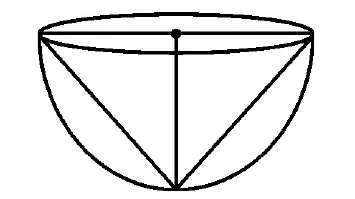
A conical cavity of maximum volume is carved out from a wooden solid hemisphere of radius 1010 cm. Curved surface area of the cavity carved out is (use π=3.14\pi = 3.14):

A hemisphere shown from the front with a cone carved inside it: the cone has its base on the flat top face of the hemisphere and its tip at the bottom of the curved part.
  1. (A)3142314\sqrt{2} cm²
  2. (B)314314 cm²
  3. (C)31403\dfrac{3140}{3} cm²
  4. (D)314023140\sqrt{2} cm²
Solution · answer (A)
OVh = 10l = 10√2CSA = πrl = 3.14 × 10 × 10√2 = 314√2 cm²
  1. The largest cone has the base of the hemisphere as its base and its tip on the pole: radius r=10r = 10 and height h=10h = 10.
  2. Slant height l=102+102=102l = \sqrt{10^2 + 10^2} = 10\sqrt{2}. Curved surface area =πrl=3.14×10×102=3142= \pi r l = 3.14 \times 10 \times 10\sqrt{2} = 314\sqrt{2} cm².

Answer: (A) 3142314\sqrt{2} cm²

Report an error on this question
Q8Arithmetic Progressions1 mark

If ana_n represents nthn^{\text{th}} term of the A.P. −154,−104,−54,…-\dfrac{15}{4}, -\dfrac{10}{4}, -\dfrac{5}{4}, \dots, then value of a16−a12a_{16} - a_{12} is:

  1. (A)4
  2. (B)54\dfrac{5}{4}
  3. (C)5
  4. (D)254\dfrac{25}{4}
Solution · answer (C)
  1. d=−104+154=54d = -\dfrac{10}{4} + \dfrac{15}{4} = \dfrac{5}{4}. a16−a12=(16−12)d=4×54=5a_{16} - a_{12} = (16 - 12)d = 4 \times \dfrac{5}{4} = 5.

Answer: (C) 5

Report an error on this question
Q9Quadratic Equations1 mark

The value of pp for which roots of the quadratic equation x2−px+6=0x^2 - px + 6 = 0 are rational, is:

  1. (A)1
  2. (B)−5
  3. (C)25
  4. (D)5\sqrt{5}
Solution · answer (B)
  1. The roots are rational when D=p2−24D = p^2 - 24 is a perfect square.
  2. Check: p=1p = 1 gives −23-23 (no real roots), p=25p = 25 gives 601601 (not a square), p=5p = \sqrt{5} gives −19-19. p=−5p = -5 gives 25−24=125 - 24 = 1, a perfect square: x2+5x+6=(x+2)(x+3)x^2 + 5x + 6 = (x + 2)(x + 3) with roots −2-2 and −3-3.

Answer: (B) −5

Report an error on this question
Q10Probability1 mark

Which of the following can not be the probability of an event?

  1. (A)39100\dfrac{39}{100}
  2. (B)0.00120\dfrac{0.001}{20}
  3. (C)100.2\dfrac{10}{0.2}
  4. (D)10%
Solution · answer (C)
  1. A probability must lie between 00 and 11.
  2. 100.2=50>1\dfrac{10}{0.2} = 50 > 1, so it cannot be a probability. The others are 0.390.39, 0.000050.00005 and 0.10.1, all between 00 and 11.

Answer: (C) 100.2\dfrac{10}{0.2}

Report an error on this question
Q11Probability1 mark

A card is drawn at random from a well shuffled deck of 52 playing cards. The probability that it is either a ten or a king is:

  1. (A)126\dfrac{1}{26}
  2. (B)213\dfrac{2}{13}
  3. (C)113\dfrac{1}{13}
  4. (D)826\dfrac{8}{26}
Solution · answer (B)
  1. There are 44 tens and 44 kings, 88 cards in all. P=852=213P = \dfrac{8}{52} = \dfrac{2}{13}.

Answer: (B) 213\dfrac{2}{13}

Report an error on this question
Q12Surface Areas and Volumes1 mark

A camping tent in hemispherical shape of radius 1.41.4 m, has a door opening of area 0.500.50 m². Outer surface area of the tent is:

  1. (A)11.78 m²
  2. (B)12.32 m²
  3. (C)11.82 m²
  4. (D)12.86 m²
Solution · answer (C)
  1. Curved surface of the hemisphere =2πr2=2×227×1.4×1.4=12.32= 2\pi r^2 = 2 \times \dfrac{22}{7} \times 1.4 \times 1.4 = 12.32 m².
  2. The door is an opening, so subtract it: 12.32−0.50=11.8212.32 - 0.50 = 11.82 m².

Answer: (C) 11.82 m²

Report an error on this question
Q13Areas Related to Circles1 mark

An arc of length 2.22.2 cm subtends an angle θ\theta at the centre of the circle with radius 2.82.8 cm. The value of θ\theta is:

  1. (A)50∘50^\circ
  2. (B)60∘60^\circ
  3. (C)45∘45^\circ
  4. (D)30∘30^\circ
Solution · answer (C)
  1. Arc =θ360×2πr= \dfrac{\theta}{360} \times 2\pi r: 2.2=θ360×2×227×2.8=θ360×17.62.2 = \dfrac{\theta}{360} \times 2 \times \dfrac{22}{7} \times 2.8 = \dfrac{\theta}{360} \times 17.6, so θ=2.2×36017.6=45∘\theta = \dfrac{2.2 \times 360}{17.6} = 45^\circ.

Answer: (C) 45∘45^\circ

Report an error on this question
Q14Trigonometry1 mark

For an acute angle θ\theta, if sin⁡θ=19\sin\theta = \dfrac{1}{9}, then value of 9cosec⁡θ+19cosec⁡θ−1\dfrac{9\operatorname{cosec}\theta + 1}{9\operatorname{cosec}\theta - 1} is:

  1. (A)0
  2. (B)8081\dfrac{80}{81}
  3. (C)1
  4. (D)8280\dfrac{82}{80}
Solution · answer (D)
  1. cosec⁡θ=1sin⁡θ=9\operatorname{cosec}\theta = \dfrac{1}{\sin\theta} = 9, so 9cosec⁡θ=819\operatorname{cosec}\theta = 81. The expression is 81+181−1=8280\dfrac{81 + 1}{81 - 1} = \dfrac{82}{80}.

Answer: (D) 8280\dfrac{82}{80}

Report an error on this question
Q15Triangles1 mark

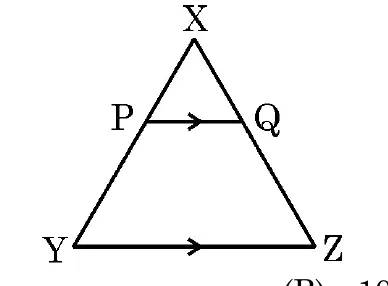
In the given figure, PQ∥YZPQ \parallel YZ such that XP:PY=2:3XP : PY = 2 : 3. If PQ=5PQ = 5 cm, then YZYZ equals:

A triangle XYZ with X at the top and YZ as the base. P is on XY and Q is on XZ with PQ drawn parallel to YZ.
  1. (A)12.5 cm
  2. (B)10 cm
  3. (C)15 cm
  4. (D)7.5 cm
Solution · answer (A)
  1. PQ∥YZPQ \parallel YZ, so △XPQ∼△XYZ\triangle XPQ \sim \triangle XYZ and PQYZ=XPXY\dfrac{PQ}{YZ} = \dfrac{XP}{XY}.
  2. XP:PY=2:3XP : PY = 2 : 3 gives XP:XY=2:5XP : XY = 2 : 5. 5YZ=25\dfrac{5}{YZ} = \dfrac{2}{5}, so YZ=12.5YZ = 12.5 cm.

Answer: (A) 12.5 cm

Report an error on this question
Q16Probability1 mark

Meena calculates that the probability of her winning the first prize in a lottery is 0.08. If total 800 tickets were sold, the number of tickets bought by her is:

  1. (A)64
  2. (B)640
  3. (C)100
  4. (D)10
Solution · answer (A)
  1. P=her tickets800=0.08P = \dfrac{\text{her tickets}}{800} = 0.08, so her tickets =0.08×800=64= 0.08 \times 800 = 64.

Answer: (A) 64

Report an error on this question
Q17Trigonometry1 mark

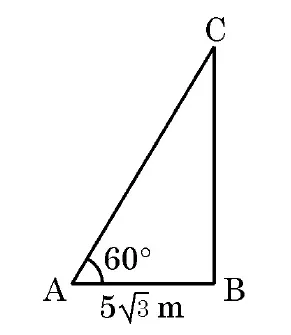
A wire is attached from a point AA on the ground to the top of a pole BCBC, making an angle of elevation as 60∘60^\circ. If AB=53AB = 5\sqrt{3} m, then length of the wire is:

A right triangle with the right angle at B. A is at the bottom left with the angle 60 degrees marked, AB along the ground is 5 root 3 m, and the pole BC stands at B with the wire AC as the slanting side.
  1. (A)10 m
  2. (B)10310\sqrt{3} m
  3. (C)15 m
  4. (D)523\dfrac{5}{2}\sqrt{3} m
Solution · answer (B)
  1. In the right triangle ABCABC: cos⁡60∘=ABAC\cos 60^\circ = \dfrac{AB}{AC}, so AC=531/2=103AC = \dfrac{5\sqrt{3}}{1/2} = 10\sqrt{3} m.

Answer: (B) 10310\sqrt{3} m

Report an error on this question
Q18Trigonometry1 mark

Simplest form of sec⁡Asec⁡2A−1\dfrac{\sec A}{\sqrt{\sec^2 A - 1}} is:

  1. (A)sin⁡A\sin A
  2. (B)tan⁡A\tan A
  3. (C)cosec⁡A\operatorname{cosec} A
  4. (D)cos⁡A\cos A
Solution · answer (C)
  1. sec⁡2A−1=tan⁡2A\sec^2 A - 1 = \tan^2 A, so sec⁡2A−1=tan⁡A\sqrt{\sec^2 A - 1} = \tan A. sec⁡Atan⁡A=1/cos⁡Asin⁡A/cos⁡A=1sin⁡A=cosec⁡A\dfrac{\sec A}{\tan A} = \dfrac{1/\cos A}{\sin A/\cos A} = \dfrac{1}{\sin A} = \operatorname{cosec} A.

Answer: (C) cosec⁡A\operatorname{cosec} A

Report an error on this question
Q19Linear Equations1 mark

Assertion (A): The system of linear equations 3x−5y+7=03x - 5y + 7 = 0 and −6x+10y+14=0-6x + 10y + 14 = 0 is inconsistent.

Reason (R): When two linear equations don’t have unique solution, they always represent parallel lines.

  1. (A)Both A and R are true and R is the correct explanation of A
  2. (B)Both A and R are true, but R is not the correct explanation of A
  3. (C)A is true, but R is false
  4. (D)A is false, but R is true
Solution · answer (C)
  1. (A) a1a2=3−6=−12\dfrac{a_1}{a_2} = \dfrac{3}{-6} = -\dfrac{1}{2}, b1b2=−510=−12\dfrac{b_1}{b_2} = \dfrac{-5}{10} = -\dfrac{1}{2} and c1c2=714=12\dfrac{c_1}{c_2} = \dfrac{7}{14} = \dfrac{1}{2}. The first two are equal and the third is different: parallel lines, inconsistent. True.
  2. (R) Without a unique solution the lines may also be coincident (infinitely many solutions), not only parallel. False.

Answer: (C) A is true, but R is false

Report an error on this question
Q20Real Numbers1 mark

Assertion (A): H.C.F. (36m2,18m)=18m(36m^2, 18m) = 18m, where mm is a prime number.

Reason (R): H.C.F. of two numbers is always less than or equal to the smaller number.

  1. (A)Both A and R are true and R is the correct explanation of A
  2. (B)Both A and R are true, but R is not the correct explanation of A
  3. (C)A is true, but R is false
  4. (D)A is false, but R is true
Solution · answer (B)
  1. (A) 36m2=2×18×m×m36m^2 = 2 \times 18 \times m \times m and 18m18m divides 36m236m^2 (as 36m2=18m×2m36m^2 = 18m \times 2m). So the HCF is 18m18m. True.
  2. (R) The HCF divides both numbers, so it cannot exceed the smaller one. True. But it does not tell us that the HCF is 18m18m here, so it is not the explanation.

Answer: (B) Both A and R are true, but R is not the correct explanation of A

Report an error on this question

Section B: Very short answer

5 questions, 2 marks each.

Q21Real Numbers2 marks

Prove that 2−532 - 5\sqrt{3} is an irrational number given that 3\sqrt{3} is irrational.

Solution
  1. Suppose 2−53=ab2 - 5\sqrt{3} = \dfrac{a}{b} with integers a,ba, b and b≠0b \neq 0.
  2. Then 3=2b−a5b\sqrt{3} = \dfrac{2b - a}{5b}, a ratio of integers, so 3\sqrt{3} would be rational. That contradicts the given fact, so 2−532 - 5\sqrt{3} is irrational.

Answer: Proved

Report an error on this question
Q22Coordinate Geometry2 marks

(a) Vertices of a right triangle ABCABC with ∠B=90∘\angle B = 90^\circ are A(3,4)A(3, 4), B(1,1)B(1, 1) and C(−8,7)C(-8, 7). Find the value of tan⁡A\tan A.

OR

(b) Using distance formula, prove that the points A(2,3)A(2, 3), B(−7,0)B(-7, 0) and C(−1,2)C(-1, 2) are collinear.

Solution
-10-9-8-7-6-5-4-3-2-112345-1123456789OxyA(3, 4)B(1, 1)C(−8, 7)
  1. (a) BC=(−8−1)2+(7−1)2=117=313BC = \sqrt{(-8 - 1)^2 + (7 - 1)^2} = \sqrt{117} = 3\sqrt{13} and AB=(3−1)2+(4−1)2=13AB = \sqrt{(3 - 1)^2 + (4 - 1)^2} = \sqrt{13}.
  2. tan⁡A=BCAB=31313=3\tan A = \dfrac{BC}{AB} = \dfrac{3\sqrt{13}}{\sqrt{13}} = 3 (opposite over adjacent, as the right angle is at BB).
  3. (b) AB=81+9=90=310AB = \sqrt{81 + 9} = \sqrt{90} = 3\sqrt{10}, BC=36+4=40=210BC = \sqrt{36 + 4} = \sqrt{40} = 2\sqrt{10} and AC=9+1=10AC = \sqrt{9 + 1} = \sqrt{10}.
  4. AC+BC=10+210=310=ABAC + BC = \sqrt{10} + 2\sqrt{10} = 3\sqrt{10} = AB, so the points are collinear.

Answer: (a) tan⁡A=3\tan A = 3   (b) collinear

Report an error on this question
Q23Triangles2 marks

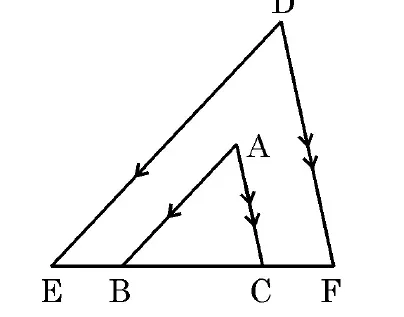
In the given figure, AB∥DEAB \parallel DE and AC∥DFAC \parallel DF. Show that △ABC∼△DEF\triangle ABC \sim \triangle DEF. If BC=10BC = 10 cm, EB=CF=5EB = CF = 5 cm and AB=7AB = 7 cm, then find the length DEDE.

A line with the points E, B, C and F in order. A triangle with the apex A above BC has sides BA and CA, and a bigger triangle with the apex D above has sides ED and FD. AB is parallel to DE and AC is parallel to DF.
Solution
EBCFADBC = 10EF = 5 + 10 + 5 = 20 = 2 × BC → DE = 2 × AB = 14 cm
  1. AB∥DEAB \parallel DE, so ∠DEF=∠ABC\angle DEF = \angle ABC (corresponding angles). AC∥DFAC \parallel DF, so ∠DFE=∠ACB\angle DFE = \angle ACB. By AA, △ABC∼△DEF\triangle ABC \sim \triangle DEF.
  2. EF=EB+BC+CF=5+10+5=20EF = EB + BC + CF = 5 + 10 + 5 = 20 cm. BCEF=ABDE\dfrac{BC}{EF} = \dfrac{AB}{DE}: 1020=7DE\dfrac{10}{20} = \dfrac{7}{DE}, so DE=14DE = 14 cm.

Answer: DE=14DE = 14 cm

Report an error on this question
Q24Trigonometry2 marks

(a) Evaluate: sin⁡360∘−tan⁡30∘cos⁡245∘\dfrac{\sin^3 60^\circ - \tan 30^\circ}{\cos^2 45^\circ}

OR

(b) For acute angles AA and BB, A+2BA + 2B and 2A+B2A + B are acute if tan⁡(A+2B)=3\tan(A + 2B) = \sqrt{3} and sin⁡(2A+B)=12\sin(2A + B) = \dfrac{1}{\sqrt{2}}, then find the measures of angles AA and BB.

Solution
  1. (a) sin⁡60∘=32\sin 60^\circ = \dfrac{\sqrt{3}}{2}, so sin⁡360∘=338\sin^3 60^\circ = \dfrac{3\sqrt{3}}{8}. tan⁡30∘=13=33\tan 30^\circ = \dfrac{1}{\sqrt{3}} = \dfrac{\sqrt{3}}{3}. cos⁡245∘=12\cos^2 45^\circ = \dfrac{1}{2}.
  2. 338−3312=2×3(9−824)=312\dfrac{\frac{3\sqrt{3}}{8} - \frac{\sqrt{3}}{3}}{\frac{1}{2}} = 2 \times \sqrt{3}\left(\dfrac{9 - 8}{24}\right) = \dfrac{\sqrt{3}}{12} (which is the same as 143\dfrac{1}{4\sqrt{3}}).
  3. (b) A+2B=60∘A + 2B = 60^\circ and 2A+B=45∘2A + B = 45^\circ. Adding: 3(A+B)=105∘3(A + B) = 105^\circ, so A+B=35∘A + B = 35^\circ. Then B=60∘−35∘=25∘B = 60^\circ - 35^\circ = 25^\circ and A=10∘A = 10^\circ.

Answer: (a) 312\dfrac{\sqrt{3}}{12}   (b) A=10∘A = 10^\circ, B=25∘B = 25^\circ

Report an error on this question
Q25Probability2 marks

A bag contains 25 balls. Some of them are yellow and others are green. One ball is drawn at random. If probability of getting a green ball is 3/5, then find the number of yellow balls.

Solution
  1. P(yellow)=1−P(green)=1−35=25P(\text{yellow}) = 1 - P(\text{green}) = 1 - \dfrac{3}{5} = \dfrac{2}{5}.
  2. Yellow balls =25×25=10= \dfrac{2}{5} \times 25 = 10.

Answer: 1010 yellow balls

Report an error on this question

Section C: Short answer

6 questions, 3 marks each.

Q26Areas Related to Circles3 marks

A circle of diameter 20 cm is equally divided into five sectors. Find the area and perimeter of one of the sectors.

Solution
72°10 cmOABarea = 62.86 cm²perimeter = 32.57 cm72/360 × π × 10² = 440/7; arc 44/7 × 2 + 20 = 228/7
  1. Radius =10= 10 cm. Each sector has central angle 360∘5=72∘\dfrac{360^\circ}{5} = 72^\circ.
  2. Area =72360×227×10×10=4407≈62.86= \dfrac{72}{360} \times \dfrac{22}{7} \times 10 \times 10 = \dfrac{440}{7} \approx 62.86 cm².
  3. Perimeter == arc +2r=72360×2×227×10+10+10=887+20=2287≈32.57+ 2r = \dfrac{72}{360} \times 2 \times \dfrac{22}{7} \times 10 + 10 + 10 = \dfrac{88}{7} + 20 = \dfrac{228}{7} \approx 32.57 cm.

Answer: Area =4407≈62.86= \dfrac{440}{7} \approx 62.86 cm²; perimeter =2287≈32.57= \dfrac{228}{7} \approx 32.57 cm

Report an error on this question
Q27Arithmetic Progressions3 marks

(a) In an A.P., 15th15^{\text{th}} term exceeds the 8th8^{\text{th}} term by 2121. If sum of first 1010 terms is 5555, then form the A.P.

OR

(b) The sum of first nn terms of an A.P. is 2n2+13n2n^2 + 13n. Find its nthn^{\text{th}} term and hence 10th10^{\text{th}} term.

Solution
  1. (a) a15−a8=7d=21a_{15} - a_8 = 7d = 21, so d=3d = 3. S10=102[2a+9×3]=55S_{10} = \dfrac{10}{2}[2a + 9 \times 3] = 55 gives 2a+27=112a + 27 = 11 and a=−8a = -8.
  2. The A.P. is −8,−5,−2,1,…-8, -5, -2, 1, \dots.
  3. (b) a1=S1=2+13=15a_1 = S_1 = 2 + 13 = 15. S2=8+26=34S_2 = 8 + 26 = 34, so a2=34−15=19a_2 = 34 - 15 = 19 and d=4d = 4.
  4. an=15+(n−1)×4=4n+11a_n = 15 + (n - 1) \times 4 = 4n + 11. a10=40+11=51a_{10} = 40 + 11 = 51.

Answer: (a) −8,−5,−2,…-8, -5, -2, \dots   (b) an=4n+11a_n = 4n + 11, a10=51a_{10} = 51

Report an error on this question
Q28Trigonometry3 marks

Prove that: tan⁡θ1−cot⁡θ+cot⁡θ1−tan⁡θ=1+tan⁡θ+cot⁡θ\dfrac{\tan\theta}{1 - \cot\theta} + \dfrac{\cot\theta}{1 - \tan\theta} = 1 + \tan\theta + \cot\theta.

Solution
  1. LHS =sin⁡θcos⁡θ1−cos⁡θsin⁡θ+cos⁡θsin⁡θ1−sin⁡θcos⁡θ=sin⁡2θcos⁡θ(sin⁡θ−cos⁡θ)+cos⁡2θsin⁡θ(cos⁡θ−sin⁡θ)= \dfrac{\frac{\sin\theta}{\cos\theta}}{1 - \frac{\cos\theta}{\sin\theta}} + \dfrac{\frac{\cos\theta}{\sin\theta}}{1 - \frac{\sin\theta}{\cos\theta}} = \dfrac{\sin^2\theta}{\cos\theta(\sin\theta - \cos\theta)} + \dfrac{\cos^2\theta}{\sin\theta(\cos\theta - \sin\theta)}.
  2. =1sin⁡θ−cos⁡θ[sin⁡2θcos⁡θ−cos⁡2θsin⁡θ]=sin⁡3θ−cos⁡3θsin⁡θcos⁡θ(sin⁡θ−cos⁡θ)= \dfrac{1}{\sin\theta - \cos\theta}\left[\dfrac{\sin^2\theta}{\cos\theta} - \dfrac{\cos^2\theta}{\sin\theta}\right] = \dfrac{\sin^3\theta - \cos^3\theta}{\sin\theta\cos\theta(\sin\theta - \cos\theta)}.
  3. sin⁡3θ−cos⁡3θ=(sin⁡θ−cos⁡θ)(sin⁡2θ+sin⁡θcos⁡θ+cos⁡2θ)=(sin⁡θ−cos⁡θ)(1+sin⁡θcos⁡θ)\sin^3\theta - \cos^3\theta = (\sin\theta - \cos\theta)(\sin^2\theta + \sin\theta\cos\theta + \cos^2\theta) = (\sin\theta - \cos\theta)(1 + \sin\theta\cos\theta).
  4. LHS =1+sin⁡θcos⁡θsin⁡θcos⁡θ=1sin⁡θcos⁡θ+1=sin⁡2θ+cos⁡2θsin⁡θcos⁡θ+1=tan⁡θ+cot⁡θ+1== \dfrac{1 + \sin\theta\cos\theta}{\sin\theta\cos\theta} = \dfrac{1}{\sin\theta\cos\theta} + 1 = \dfrac{\sin^2\theta + \cos^2\theta}{\sin\theta\cos\theta} + 1 = \tan\theta + \cot\theta + 1 = RHS.

Answer: Proved

Report an error on this question
Q29Coordinate Geometry3 marks

(a) A circle centered at (2,1)(2, 1) passes through the points A(5,6)A(5, 6) and B(−3,K)B(-3, K). Find the value(s) of KK. Hence find length of chord ABAB.

OR

(b) Prove that the point PP dividing the line segment joining the points A(−1,7)A(-1, 7) and B(4,−3)B(4, -3) in the ratio 3:23 : 2, lies on the line x−3y=−1x - 3y = -1. Also find length of PAPA and PBPB.

Solution
(2, 1)A(5, 6)B(−3, 4)B(−3, −2)(K − 1)² = 9 → K = 4 (AB = 2√17) or K = −2 (AB = 8√2)
  1. (a) The centre O(2,1)O(2, 1) is equidistant from AA and BB: OA=OBOA = OB, so (5−2)2+(6−1)2=(−3−2)2+(K−1)2(5 - 2)^2 + (6 - 1)^2 = (-3 - 2)^2 + (K - 1)^2.
  2. 34=25+(K−1)234 = 25 + (K - 1)^2, so (K−1)2=9(K - 1)^2 = 9 and K=4K = 4 or K=−2K = -2.
  3. For K=−2K = -2: AB=(5+3)2+(6+2)2=128=82AB = \sqrt{(5 + 3)^2 + (6 + 2)^2} = \sqrt{128} = 8\sqrt{2}. For K=4K = 4: AB=64+4=68=217AB = \sqrt{64 + 4} = \sqrt{68} = 2\sqrt{17}.
  4. (b) P=(3(4)+2(−1)5,3(−3)+2(7)5)=(2,1)P = \left(\dfrac{3(4) + 2(-1)}{5}, \dfrac{3(-3) + 2(7)}{5}\right) = (2, 1). On the line: x−3y=2−3=−1x - 3y = 2 - 3 = -1 ✓.
  5. PA=(2+1)2+(1−7)2=45=35PA = \sqrt{(2 + 1)^2 + (1 - 7)^2} = \sqrt{45} = 3\sqrt{5} and PB=(2−4)2+(1+3)2=20=25PB = \sqrt{(2 - 4)^2 + (1 + 3)^2} = \sqrt{20} = 2\sqrt{5} (ratio 3:23 : 2 ✓).

Answer: (a) K=4K = 4 (AB=217AB = 2\sqrt{17}) or K=−2K = -2 (AB=82AB = 8\sqrt{2})   (b) P(2,1)P(2, 1) on the line, PA=35PA = 3\sqrt{5}, PB=25PB = 2\sqrt{5}

Report an error on this question
Q30Linear Equations3 marks

Solve the system of linear equations: x=4x = 4 and 3x−2y=63x - 2y = 6 graphically.

Solution
-11234567-4-3-2-1123456Oxy3x − 2y = 6x = 4(4, 3)
  1. x=4x = 4 is a vertical line through (4,0)(4, 0).
  2. 3x−2y=63x - 2y = 6: when x=2x = 2, y=0y = 0; when x=4x = 4, y=3y = 3; when x=0x = 0, y=−3y = -3.
  3. The lines meet at (4,3)(4, 3), so x=4x = 4 and y=3y = 3.

Answer: x=4x = 4, y=3y = 3

Report an error on this question
Q31Real Numbers3 marks

The dimensions of a window are 156156 cm ×\times 216216 cm. Arjun wants to put grill on the window creating complete squares of maximum size. Determine the side length of the square and hence find the number of squares formed.

Solution
  1. 156=22×3×13156 = 2^2 \times 3 \times 13 and 216=23×33216 = 2^3 \times 3^3. The largest square side that fits an exact number of times along both is the HCF =22×3=12= 2^2 \times 3 = 12 cm.
  2. Number of squares =15612×21612=13×18=234= \dfrac{156}{12} \times \dfrac{216}{12} = 13 \times 18 = 234.

Answer: Side 1212 cm; 234234 squares

Report an error on this question

Section D: Long answer

4 questions, 5 marks each.

Q32Quadratic Equations5 marks

Venkat can row a boat in still water at the speed of 12 km/h. He ferries tourists 15 km upstream and 18 km downstream in 3 hours. Find the speed of the stream.

Solution
  1. Let the stream go at xx km/h. Upstream speed =12−x= 12 - x and downstream speed =12+x= 12 + x. 1512−x+1812+x=3\dfrac{15}{12 - x} + \dfrac{18}{12 + x} = 3.
  2. 15(12+x)+18(12−x)=3(144−x2)15(12 + x) + 18(12 - x) = 3(144 - x^2), so 396−3x=432−3x2396 - 3x = 432 - 3x^2 and 3x2−3x−36=03x^2 - 3x - 36 = 0, that is x2−x−12=0x^2 - x - 12 = 0.
  3. (x−4)(x+3)=0(x - 4)(x + 3) = 0. A speed cannot be negative, so x=4x = 4. (Check: 158+1816=1.875+1.125=3\dfrac{15}{8} + \dfrac{18}{16} = 1.875 + 1.125 = 3 ✓.)

Answer: 44 km/h

Report an error on this question
Q33Triangles5 marks

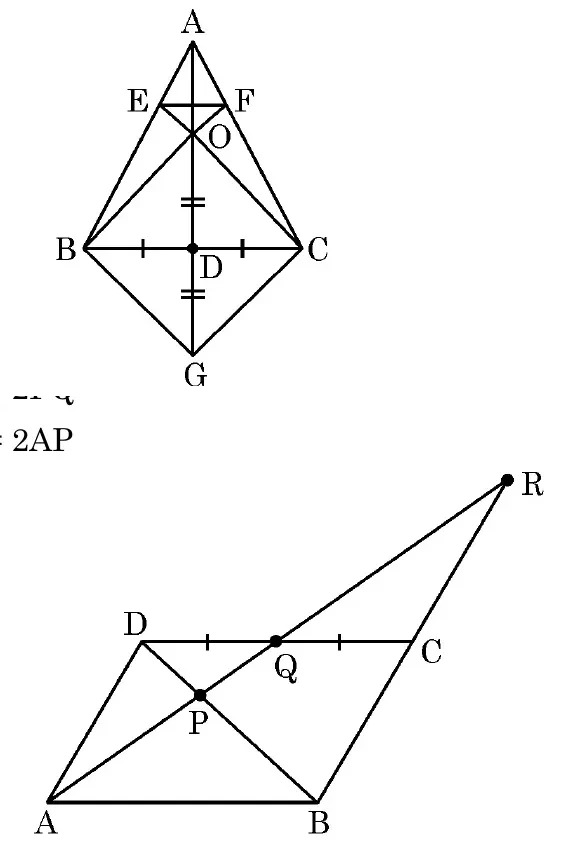
(a) DD is the mid-point of side BCBC of △ABC\triangle ABC. CECE and BFBF intersect at OO, a point on ADAD. ADAD is produced to GG such that OD=DGOD = DG. Prove that (i) OBGCOBGC is a parallelogram (ii) EF∥BCEF \parallel BC (iii) △AEF∼△ABC\triangle AEF \sim \triangle ABC.

OR

(b) Through the mid-point QQ of side CDCD of a parallelogram ABCDABCD, the line ARAR is drawn which intersects BDBD at PP and produced BCBC at RR. Prove that (i) AQ=QRAQ = QR (ii) AP=2PQAP = 2PQ (iii) PR=2APPR = 2AP.

Two figures. First, a triangle ABC with the median AD, the lines CE and BF crossing at O on AD, and G below D so that OBGC is a four-sided figure. Second, a parallelogram ABCD with Q the mid-point of CD, the line AQ extended to R beyond C, and the diagonal BD crossing AQ at P.
Solution
ABCDQRP△RQC ∼ △RAB → AQ = QR; △PQD ∼ △PAB → AP = 2PQ
  1. (a)(i) DD is the mid-point of BCBC and OD=DGOD = DG, so the diagonals OGOG and BCBC of OBGCOBGC bisect each other. So OBGCOBGC is a parallelogram.
  2. (ii) CO∥GBCO \parallel GB, so CE∥GBCE \parallel GB. In △AGB\triangle AGB, OE∥GBOE \parallel GB, so AOOG=AEEB\dfrac{AO}{OG} = \dfrac{AE}{EB}. In the same way in △AGC\triangle AGC, AOOG=AFFC\dfrac{AO}{OG} = \dfrac{AF}{FC}.
  3. Hence AEEB=AFFC\dfrac{AE}{EB} = \dfrac{AF}{FC}, so EF∥BCEF \parallel BC (converse of the basic proportionality theorem).
  4. (iii) In △AEF\triangle AEF and △ABC\triangle ABC: ∠AEF=∠ABC\angle AEF = \angle ABC (corresponding angles, EF∥BCEF \parallel BC) and ∠A\angle A is common. So △AEF∼△ABC\triangle AEF \sim \triangle ABC.
  5. (b)(i) QC∥ABQC \parallel AB (as ABCDABCD is a parallelogram), so △RQC∼△RAB\triangle RQC \sim \triangle RAB and QRAR=QCAB=12\dfrac{QR}{AR} = \dfrac{QC}{AB} = \dfrac{1}{2} (QQ is the mid-point of CDCD and CD=ABCD = AB). So AR=2QRAR = 2QR and AQ=QRAQ = QR.
  6. (ii) DQ∥ABDQ \parallel AB, so △PQD∼△PAB\triangle PQD \sim \triangle PAB and PQAP=DQAB=12\dfrac{PQ}{AP} = \dfrac{DQ}{AB} = \dfrac{1}{2}. So AP=2PQAP = 2PQ.
  7. (iii) AQ=QRAQ = QR gives AP+PQ=PR−PQAP + PQ = PR - PQ. With PQ=12APPQ = \dfrac{1}{2}AP: AP+12AP=PR−12APAP + \dfrac{1}{2}AP = PR - \dfrac{1}{2}AP, so PR=2APPR = 2AP.

Answer: Proved (both parts)

Report an error on this question
Q34Statistics5 marks

(a) The mean of the following frequency distribution is 2828. If sum of all frequencies is 100100, then find the values of pp and qq:

OR

(b) Find median and mode of the following distribution (classes 0−15,15−30,30−45,45−60,60−75,75−90,90−1050-15, 15-30, 30-45, 45-60, 60-75, 75-90, 90-105 with frequencies 15,10,12,9,8,10,615, 10, 12, 9, 8, 10, 6).

Class Interval0–1010–2020–3030–4040–5050–60
Frequency12p2720q6
Solution
  1. (a) The sum of frequencies: 12+p+27+20+q+6=65+p+q=10012 + p + 27 + 20 + q + 6 = 65 + p + q = 100, so p+q=35p + q = 35.
  2. Class marks: 5,15,25,35,45,555, 15, 25, 35, 45, 55. ∑fixi=60+15p+675+700+45q+330=1765+15p+45q\sum f_ix_i = 60 + 15p + 675 + 700 + 45q + 330 = 1765 + 15p + 45q. Mean =28= 28: 1765+15p+45q=28001765 + 15p + 45q = 2800, so p+3q=69p + 3q = 69.
  3. Subtracting: 2q=342q = 34, so q=17q = 17 and p=18p = 18.
  4. (b) Cumulative frequencies: 15,25,37,46,54,64,7015, 25, 37, 46, 54, 64, 70. N2=35\dfrac{N}{2} = 35 lies in 30−4530 - 45: l=30l = 30, cf=25cf = 25, f=12f = 12, h=15h = 15. Median =30+35−2512×15=30+12.5=42.5= 30 + \dfrac{35 - 25}{12} \times 15 = 30 + 12.5 = 42.5.
  5. Modal class 0−150 - 15 (the highest frequency 1515): f1=15f_1 = 15, f0=0f_0 = 0, f2=10f_2 = 10. Mode =0+15−030−0−10×15=22520=11.25= 0 + \dfrac{15 - 0}{30 - 0 - 10} \times 15 = \dfrac{225}{20} = 11.25.

Answer: (a) p=18p = 18, q=17q = 17   (b) median =42.5= 42.5, mode =11.25= 11.25

Report an error on this question
Q35Circles5 marks

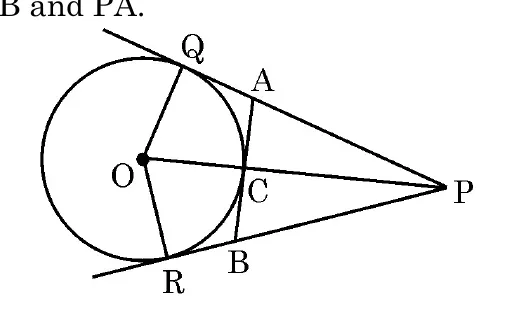
PQPQ and PRPR are two tangents to a circle with centre OO and radius 55 cm. ABAB is another tangent to the circle at CC which lies on OPOP. If OP=13OP = 13 cm, then find the length ABAB and PAPA.

A circle with centre O on the left and the outside point P on the right. PQ and PR are tangents touching at Q at the top and R at the bottom. A third tangent AB touches the circle at C on the line OP, with A on PQ and B on PR.
Solution
OPQRCABPQ = 12; PC = 8; (12 − x)² = x² + 8² → x = 10/3; AB = 20/3 cm
  1. OQ⊥PQOQ \perp PQ, so PQ=132−52=12PQ = \sqrt{13^2 - 5^2} = 12 cm. CC is on OPOP with OC=5OC = 5, so PC=13−5=8PC = 13 - 5 = 8 cm.
  2. Let AC=xAC = x. Tangents from AA are equal: AQ=AC=xAQ = AC = x, so PA=12−xPA = 12 - x.
  3. AC⊥OPAC \perp OP (radius and tangent), so in the right triangle PCAPCA: (12−x)2=x2+82(12 - x)^2 = x^2 + 8^2, that is 144−24x=64144 - 24x = 64 and x=103x = \dfrac{10}{3}.
  4. AB=2AC=203AB = 2AC = \dfrac{20}{3} cm ≈6.67\approx 6.67 cm (by symmetry BC=ACBC = AC) and PA=12−103=263PA = 12 - \dfrac{10}{3} = \dfrac{26}{3} cm ≈8.67\approx 8.67 cm.

Answer: AB=203AB = \dfrac{20}{3} cm, PA=263PA = \dfrac{26}{3} cm

Report an error on this question

Section E: Case studies

3 case studies, 4 marks each.

Q36Polynomials4 marks

Case study 1. An arch of a railway bridge, built on Chenab riverbed, is shown in the above diagram. It is a parabolic arch connecting two hills at P and Q. If the parabolic curve is represented by the polynomial p(x) = −0.0025x² − 0.025x + 136.

Observe the diagram and based on above information, answer the following questions:

(i) Write the co-ordinates of point A. [1]

(ii) Find the span of the arch. [1]

(iii) (a) Write the zeroes of the polynomial using diagram and verify the relationship between sum of zeroes and polynomials. [2]

OR

(iii) (b) Find the values of p(x) at x = 100 and x = −100. Are they same? [2]
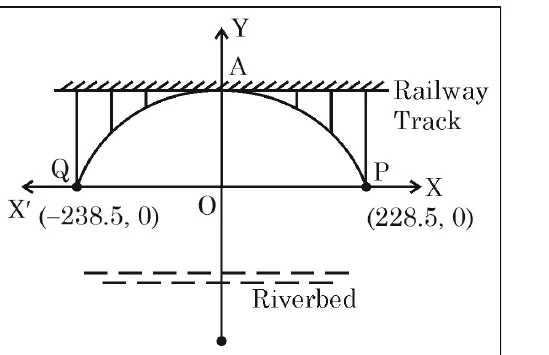
The parabolic arch of a railway bridge drawn on axes. A is the top of the arch on the y-axis under the railway track, Q is the left foot at minus 238.5 comma 0 and P is the right foot at 228.5 comma 0, with the riverbed far below the origin.
Solution
-250-200-150-100-5050100150200250-2020406080100120140160Oxp(x)Q(−238.5, 0)P(228.5, 0)A(0, 136)
  1. (i) AA is on the yy-axis (x=0x = 0): p(0)=136p(0) = 136. So A=(0,136)A = (0, 136).
  2. (ii) Q=(−238.5,0)Q = (-238.5, 0) and P=(228.5,0)P = (228.5, 0), so the span =228.5+238.5=467= 228.5 + 238.5 = 467 units.
  3. (iii)(a) From the diagram the zeroes are 228.5228.5 and −238.5-238.5. Sum =−10= -10. For p(x)=−0.0025x2−0.025x+136p(x) = -0.0025x^2 - 0.025x + 136 the sum of zeroes is −ba=−−0.025−0.0025=−10-\dfrac{b}{a} = -\dfrac{-0.025}{-0.0025} = -10 ✓ (the product relation ca\dfrac{c}{a} agrees with the diagram only approximately, as the figure's readings are rounded).
  4. (iii)(b) p(100)=−25−2.5+136=108.5p(100) = -25 - 2.5 + 136 = 108.5 and p(−100)=−25+2.5+136=113.5p(-100) = -25 + 2.5 + 136 = 113.5. They are not the same, since the −0.025x-0.025x term changes sign with xx.

Answer: (i) (0,136)(0, 136)   (ii) 467467 units   (iii)(a) zeroes 228.5228.5 and −238.5-238.5, sum −10-10   (iii)(b) 108.5108.5 and 113.5113.5, not the same

Report an error on this question
Q37Surface Areas and Volumes4 marks

Case study 2. A wall mounted lamp, made of fabric, is shown below. Lamp has cuboidal shape, open from top and bottom. A spherical bulb of diameter 7 cm is latched with a very thin rod. (Ignore the rod while making calculations.) Dimensions of the cuboid are 24 cm × 12 cm × 17 cm.

Based on the above information, answer the following questions:

(i) Find the surface area of the bulb. [1]

(ii) What could be the maximum diameter of the bulb if at least 1 cm space is left from each side? [1]

(iii) (a) Find the area of the fabric used if there is a fold of 2 cm on top and bottom edges. [2]

OR

(iii) (b) Find the space available inside the lamp. [2]
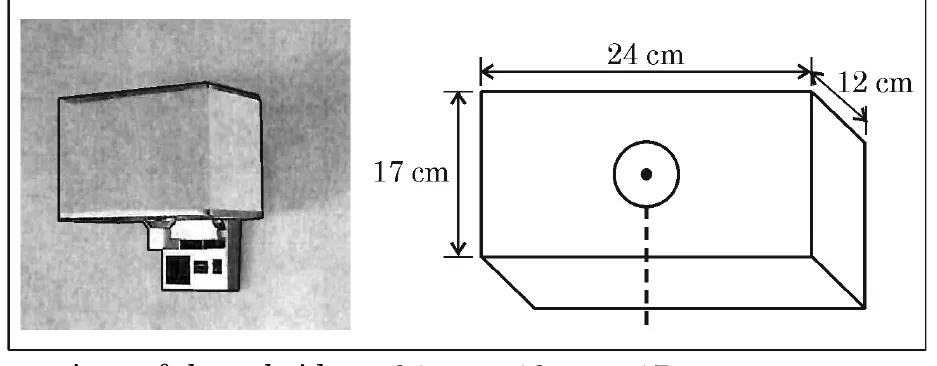
A wall-mounted fabric lamp shaped like a cuboid, shown in a photo and in a drawing marked 24 cm long, 12 cm deep and 17 cm tall, with the round bulb at the centre of the front face.
Solution
  1. (i) Surface area of a sphere of diameter 77 cm =4πr2=4×227×72×72=154= 4\pi r^2 = 4 \times \dfrac{22}{7} \times \dfrac{7}{2} \times \dfrac{7}{2} = 154 cm².
  2. (ii) The smallest dimension of the lamp is 1212 cm. Leaving at least 11 cm on each side takes 22 cm off, so the maximum diameter is 12−2=1012 - 2 = 10 cm.
  3. (iii)(a) The fabric forms the four vertical faces (open top and bottom). With 22 cm folded over at the top and the bottom, the height becomes 17+2+2=2117 + 2 + 2 = 21 cm. Area =2×21×(24+12)=1512= 2 \times 21 \times (24 + 12) = 1512 cm².
  4. (iii)(b) Space inside == volume of the cuboid −- volume of the bulb =24×12×17−43×227×(72)3=4896−5393=141493≈4716.3= 24 \times 12 \times 17 - \dfrac{4}{3} \times \dfrac{22}{7} \times \left(\dfrac{7}{2}\right)^3 = 4896 - \dfrac{539}{3} = \dfrac{14149}{3} \approx 4716.3 cm³.

Answer: (i) 154154 cm²   (ii) 1010 cm   (iii)(a) 15121512 cm²   (iii)(b) 141493≈4716.3\dfrac{14149}{3} \approx 4716.3 cm³

Report an error on this question
Q38Trigonometry4 marks

Case study 3. Elevated water storage tanks are built to store and supply water to nearby colonies. In the diagram given above, AB is an elevated water tank and CD is a nearby multistorey building. The building is 54 metres away from the water tank. From a window (W) of the building, the angle of elevation of top of the tank is 45° and angle of depression of its foot is 30°.

Based on the above information, answer the following questions:

(i) Write a relation between d (the height of window) and y. [1]

(ii) Determine the value of h. [1]

(iii) (a) Determine height of the water tank. [2]

OR

(iii) (b) Find the value of x and height of the window above ground level. [2]
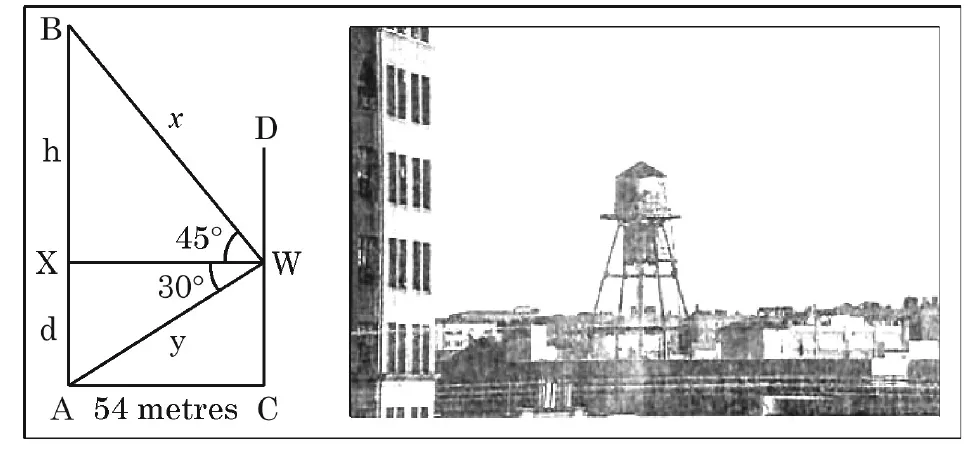
A vertical water tank AB on the left with the foot A on the ground and the top B, and a building on the right with the window W. A horizontal line from X on the tank to W is 54 m long. The line WB makes 45 degrees with the horizontal and has length x, and the line WA makes 30 degrees below the horizontal and has length y. XB is h and AX is d.
Solution
45°30°ABXWCDh = 54d = 18√354 mtank = 54 + 18√3 my = 2d
  1. (i) The angle of depression of AA from WW is 30∘30^\circ, so ∠XWA=30∘\angle XWA = 30^\circ in the right triangle AXWAXW, and sin⁡30∘=dy=12\sin 30^\circ = \dfrac{d}{y} = \dfrac{1}{2}. So y=2dy = 2d.
  2. (ii) tan⁡45∘=hWX\tan 45^\circ = \dfrac{h}{WX}, so 1=h541 = \dfrac{h}{54} and h=54h = 54 m.
  3. (iii)(a) tan⁡30∘=d54\tan 30^\circ = \dfrac{d}{54}, so d=543=183d = \dfrac{54}{\sqrt{3}} = 18\sqrt{3} m. Height of the tank =h+d=54+183= h + d = 54 + 18\sqrt{3} m ≈85.2\approx 85.2 m.
  4. (iii)(b) The window is dd above the ground, which is WC=183WC = 18\sqrt{3} m ≈31.2\approx 31.2 m. sin⁡45∘=hx\sin 45^\circ = \dfrac{h}{x}, so x=542x = 54\sqrt{2} m ≈76.4\approx 76.4 m.

Answer: (i) y=2dy = 2d   (ii) h=54h = 54 m   (iii)(a) 54+18354 + 18\sqrt{3} m   (iii)(b) x=542x = 54\sqrt{2} m; window height 18318\sqrt{3} m

Report an error on this question

Questions are from the official CBSE paper. Figures are described in words; see the PDF for the originals. Solutions are written by CogniGuru.

Revise this paper in 1 minute a chapter

Each chapter below is what the paper tested, with a one-minute animated lesson on the idea behind it.

Stuck on a step in any solution?

The CogniGuru AI tutor explains any doubt one minute at a time, in English or Hindi. Join the waitlist.

Mock quiz: 5 questions from this paper

Five real questions from this paper, one each from five chapters. About 2 minutes. See how much you know and where you stand among other students. Attempt free, with no login; log in only for your ranking and full report.

Question 1 of 5 · Q2 of the paperCoordinate Geometry

The line segment joining the points P(−4,−2)P(-4, -2) and Q(10,4)Q(10, 4) is divided by yy-axis in the ratio:

0 of 5 answered

Related papers

  • Maths Standard 2025
  • Maths Standard 2027Coming soon
  • Maths Basic 2026Coming soon
  • Science 2026Coming soon

Common questions

Are these the official CBSE Class 10 Maths Standard 2026 questions?
Yes. The questions are from the official Mathematics (Standard) paper (set 30/5/1) that CBSE published after the 2026 board exam. The solutions are written by CogniGuru and checked against the answer key CBSE published for this paper code.
Can I download the CBSE Class 10 Maths Standard 2026 question paper PDF?
Yes, the official paper PDF is free to download from this page, and so are our step-by-step solutions as a PDF. No login is needed to download either or to read the solutions.
Do all sets of the paper have the same questions?
No. CBSE sets several versions of each paper, with the same blueprint and similar questions in a different order and sometimes with different numbers. This page covers set 30/5/1.
How does the quiz work, and what does “where you stand” mean?
It is a mock quiz of 5 real multiple-choice questions from this paper, scored automatically in about 2 minutes. Your score is compared, anonymously, with other students who took the same quiz. Only the score is stored with the comparison, never your name or number.

Source

CBSE question paper archive, Class X, 2026 (Mathematics (Standard), set 30/5/1)
PDF