CBSE · Class 10 · Mathematics (Basic) · Free

CBSE Class 10 Maths Basic 2023 Question Paper (Set 430/1/1) with Solutions

The official board paper (Q.P. Code 430/1/1, Series WX1YZ/1). Free paper PDF and step-by-step solutions (also as a PDF to download) written by CogniGuru and checked against CBSE’s answer key. See the paper’s main topics in 1 minute, then quiz yourself to see how much you know and where you stand.

No login to download or read the solutions. Login only to see your quiz report in full.

Board
CBSE
Class
10
Subject
Maths Basic (241)
Year
2023
Set code
430/1/1
Max marks
80
Duration
3 hours
Questions
38 (Sections A to E)
Source
Official CBSE paper
Exam date
March 2023

Paper preview

Three pages of the official paper. Download the PDF for all 24.
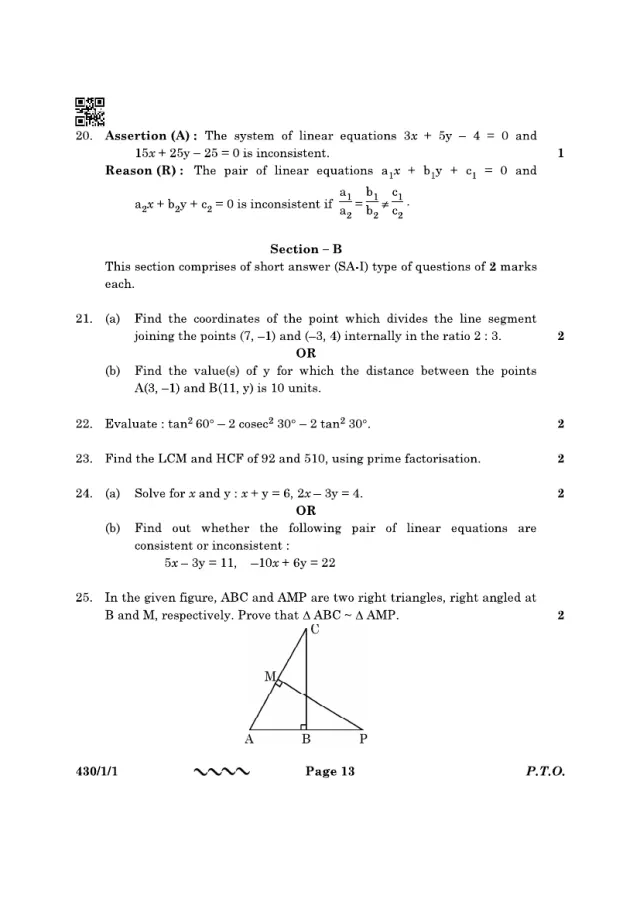
  • Cover page of the CBSE Class 10 Maths Basic 2023 paper, set 430/1/1

    Cover page

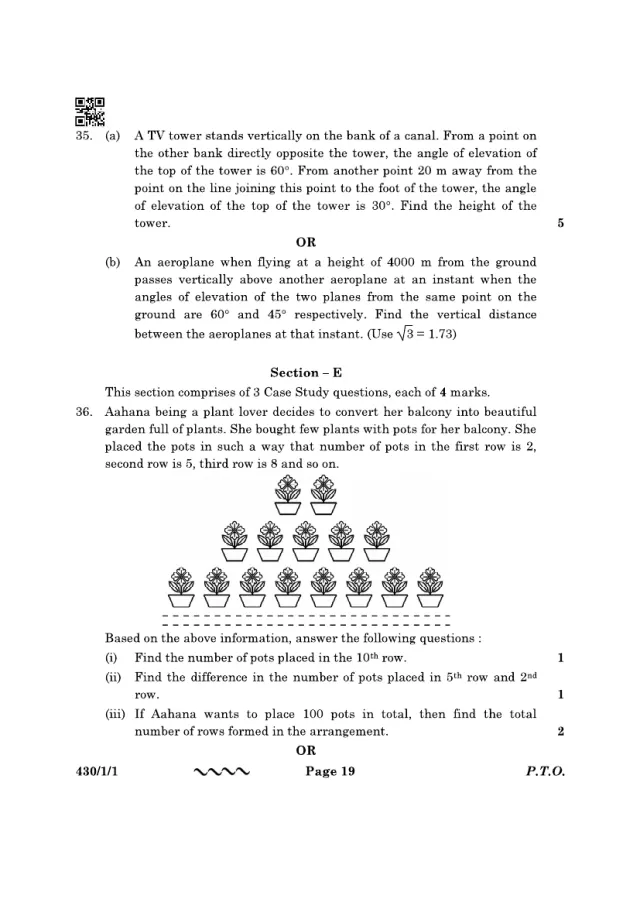
  • Section B of the CBSE Class 10 Maths Basic 2023 paper, set 430/1/1

    Section B

  • A case study with its figure from the CBSE Class 10 Maths Basic 2023 paper, set 430/1/1

    Case study

The main topics of this paper, in 1 minute

Your tutor walks you through the paper before you attempt it: the marks, the key ideas, the time plan and the traps.

1-minute paper analysis

With your tutor, in her voice

The main topics of this paper, in about a minute

A short, animated walk through the paper: how it is built, where the marks come from, the four ideas that matter most, how to plan your three hours, and the traps to avoid.

  1. 1The paper at a glance
  2. 2Where the marks come from
  3. 3Four ideas that keep paying off
  4. 4Plan your three hours
  5. 5Four traps to avoid

Sound on for the voice. Captions are shown, and you can mute any time.

Step-by-step solutions

Try each question first, then open its solution. Tap a number to jump.

Download solutions (PDF)

Section A: Multiple choice

20 questions, 1 mark each. MCQs (Q1 to Q18) and assertion-reason (Q19, Q20).

Q1Real Numbers1 mark

The prime factorisation of natural number 288288 is:

  1. (A)24×332^4 \times 3^3
  2. (B)24×322^4 \times 3^2
  3. (C)25×322^5 \times 3^2
  4. (D)25×312^5 \times 3^1
Solution · answer (C)
  1. 288=2×144=2×24×32=25×32288 = 2 \times 144 = 2 \times 2^4 \times 3^2 = 2^5 \times 3^2. (Check: 32×9=28832 \times 9 = 288 ✓.)

Answer: (C) 25×322^5 \times 3^2

Report an error on this question
Q2Trigonometry1 mark

If 2cos⁡θ=12\cos\theta = 1, then the value of θ\theta is:

  1. (A)45∘45^\circ
  2. (B)60∘60^\circ
  3. (C)30∘30^\circ
  4. (D)90∘90^\circ
Solution · answer (B)
  1. cos⁡θ=12\cos\theta = \dfrac{1}{2}, so θ=60∘\theta = 60^\circ.

Answer: (B) 60∘60^\circ

Report an error on this question
Q3Probability1 mark

A card is drawn at random from a well-shuffled deck of 52 cards. The probability of getting a red card is:

  1. (A)126\dfrac{1}{26}
  2. (B)113\dfrac{1}{13}
  3. (C)14\dfrac{1}{4}
  4. (D)12\dfrac{1}{2}
Solution · answer (D)
  1. There are 2626 red cards out of 5252: P=2652=12P = \dfrac{26}{52} = \dfrac{1}{2}.

Answer: (D) 12\dfrac{1}{2}

Report an error on this question
Q4Quadratic Equations1 mark

The discriminant of the quadratic equation 2x2−5x−3=02x^2 - 5x - 3 = 0 is:

  1. (A)1
  2. (B)49
  3. (C)7
  4. (D)19
Solution · answer (B)
  1. D=(−5)2−4(2)(−3)=25+24=49D = (-5)^2 - 4(2)(-3) = 25 + 24 = 49.

Answer: (B) 49

Report an error on this question
Q5Coordinate Geometry1 mark

The distance between the points (3,0)(3, 0) and (0,−3)(0, -3) is:

  1. (A)232\sqrt{3} units
  2. (B)6 units
  3. (C)3 units
  4. (D)323\sqrt{2} units
Solution · answer (D)
  1. d=32+32=18=32d = \sqrt{3^2 + 3^2} = \sqrt{18} = 3\sqrt{2} units.

Answer: (D) 323\sqrt{2} units

Report an error on this question
Q6Arithmetic Progressions1 mark

The seventh term of an A.P. whose first term is 2828 and common difference −4-4, is:

  1. (A)0
  2. (B)4
  3. (C)52
  4. (D)56
Solution · answer (B)
  1. a7=28+6(−4)=4a_7 = 28 + 6(-4) = 4.

Answer: (B) 4

Report an error on this question
Q7Polynomials1 mark

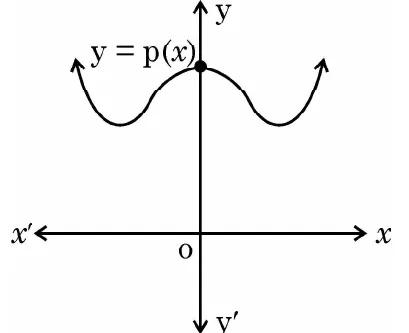
The graph of y=p(x)y = p(x) is shown in the figure for some polynomial p(x)p(x). The number of zeroes of p(x)p(x) is/are:

A curve y equals p of x that dips down, rises to a peak at the y-axis and dips again, drawn entirely above the x-axis so that it never meets the x-axis.
  1. (A)0
  2. (B)1
  3. (C)2
  4. (D)3
Solution · answer (A)
  1. The zeroes are where the graph meets the xx-axis. This curve lies above the xx-axis and never touches it, so there are 00 zeroes.

Answer: (A) 0

Report an error on this question
Q8Triangles1 mark

The sides of two similar triangles are in the ratio 4:74 : 7. The ratio of their perimeters is:

  1. (A)4 : 7
  2. (B)12 : 21
  3. (C)16 : 49
  4. (D)7 : 4
Solution · answer (A)
  1. The perimeters of similar triangles are in the same ratio as the sides: 4:74 : 7. (The areas would be in the ratio 16:4916 : 49.)

Answer: (A) 4 : 7

Report an error on this question
Q9Triangles1 mark

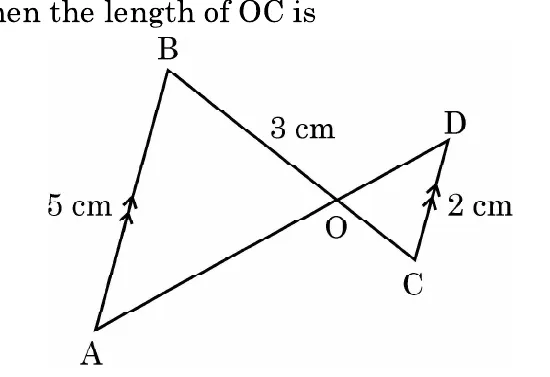
In the given figure, AB∥CDAB \parallel CD. If AB=5AB = 5 cm, CD=2CD = 2 cm and OB=3OB = 3 cm, then the length of OCOC is:

Two lines AD and BC crossing at O. AB is marked 5 cm, CD is marked 2 cm and OB is marked 3 cm, and AB and CD have arrows showing they are parallel.
  1. (A)152\dfrac{15}{2} cm
  2. (B)103\dfrac{10}{3} cm
  3. (C)65\dfrac{6}{5} cm
  4. (D)35\dfrac{3}{5} cm
Solution · answer (C)
52ABODC3OC△OAB ∼ △ODC → OB/OC = AB/CD → 3/OC = 5/2 → OC = 6/5
Sketch, not to scale.
  1. AB∥CDAB \parallel CD, so △OAB∼△ODC\triangle OAB \sim \triangle ODC (vertically opposite angles and alternate angles).
  2. OBOC=ABCD\dfrac{OB}{OC} = \dfrac{AB}{CD}: 3OC=52\dfrac{3}{OC} = \dfrac{5}{2}, so OC=65OC = \dfrac{6}{5} cm.

Answer: (C) 65\dfrac{6}{5} cm

Report an error on this question
Q10Polynomials1 mark

The sum and the product of zeroes of the polynomial p(x)=x2+5x+6p(x) = x^2 + 5x + 6 are respectively:

  1. (A)5,−65, -6
  2. (B)−5,6-5, 6
  3. (C)2,32, 3
  4. (D)−2,−3-2, -3
Solution · answer (B)
  1. Sum =−ba=−5= -\dfrac{b}{a} = -5 and product =ca=6= \dfrac{c}{a} = 6. (The zeroes are −2-2 and −3-3.)

Answer: (B) −5,6-5, 6

Report an error on this question
Q11Probability1 mark

A die is thrown once. Find the probability of getting a number less than 7.

  1. (A)56\dfrac{5}{6}
  2. (B)1
  3. (C)16\dfrac{1}{6}
  4. (D)0
Solution · answer (B)
  1. Every number on a die (11 to 66) is less than 77, so it is a sure event: P=1P = 1.

Answer: (B) 1

Report an error on this question
Q12Trigonometry1 mark

The angle subtended by a vertical pole of height 100100 m at a point on the ground 1003100\sqrt{3} m from the base, has measure of:

  1. (A)90∘90^\circ
  2. (B)60∘60^\circ
  3. (C)45∘45^\circ
  4. (D)30∘30^\circ
Solution · answer (D)
30°PAB100 m100√3 mtan θ = 100/(100√3) = 1/√3 → θ = 30°
  1. tan⁡θ=1001003=13\tan\theta = \dfrac{100}{100\sqrt{3}} = \dfrac{1}{\sqrt{3}}, so θ=30∘\theta = 30^\circ.

Answer: (D) 30∘30^\circ

Report an error on this question
Q13Surface Areas and Volumes1 mark

The volume of a cone of radius ‘rr’ and height ‘3r3r’ is:

  1. (A)13πr3\dfrac{1}{3}\pi r^3
  2. (B)3πr33\pi r^3
  3. (C)9πr39\pi r^3
  4. (D)πr3\pi r^3
Solution · answer (D)
  1. V=13πr2h=13πr2(3r)=πr3V = \dfrac{1}{3}\pi r^2 h = \dfrac{1}{3}\pi r^2 (3r) = \pi r^3.

Answer: (D) πr3\pi r^3

Report an error on this question
Q14Circles1 mark

The distance between two parallel tangents of a circle of diameter 77 cm is:

  1. (A)7 cm
  2. (B)14 cm
  3. (C)72\dfrac{7}{2} cm
  4. (D)28 cm
Solution · answer (A)
  1. Two parallel tangents touch the circle at the two ends of a diameter, so the distance between them is the diameter, 77 cm.

Answer: (A) 7 cm

Report an error on this question
Q15Triangles1 mark

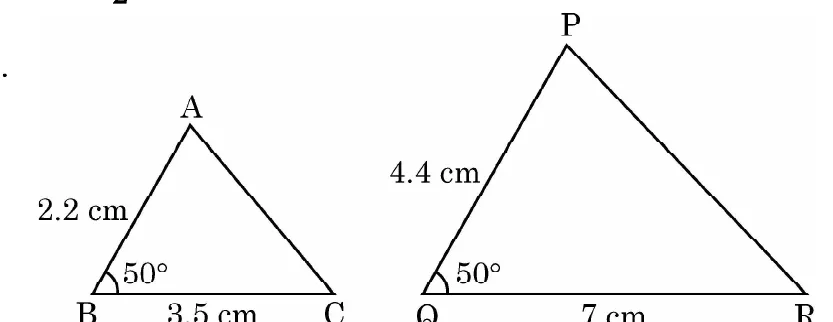
In the above figure, the criterion of similarity by which △ABC∼△PQR\triangle ABC \sim \triangle PQR is:

Two triangles. In triangle ABC, AB is 2.2 cm, BC is 3.5 cm and the angle at B is 50 degrees. In triangle PQR, PQ is 4.4 cm, QR is 7 cm and the angle at Q is 50 degrees.
  1. (A)SSA (Side – Side – Angle) Similarity
  2. (B)ASA (Angle – Side – Angle) Similarity
  3. (C)SAS (Side – Angle – Side) Similarity
  4. (D)AA (Angle – Angle) Similarity
Solution · answer (C)
  1. ABPQ=2.24.4=12\dfrac{AB}{PQ} = \dfrac{2.2}{4.4} = \dfrac{1}{2} and BCQR=3.57=12\dfrac{BC}{QR} = \dfrac{3.5}{7} = \dfrac{1}{2}: two sides in proportion, with the included angles ∠B=∠Q=50∘\angle B = \angle Q = 50^\circ equal. That is SAS similarity.

Answer: (C) SAS (Side – Angle – Side) Similarity

Report an error on this question
Q16Linear Equations1 mark

The larger of two supplementary angles exceeds the smaller by 1818 degrees. What is the measure of larger angle?

  1. (A)81∘81^\circ
  2. (B)99∘99^\circ
  3. (C)36∘36^\circ
  4. (D)54∘54^\circ
Solution · answer (B)
  1. x+y=180x + y = 180 and x−y=18x - y = 18 give x=99x = 99 and y=81y = 81. The larger angle is 99∘99^\circ.

Answer: (B) 99∘99^\circ

Report an error on this question
Q17Circles1 mark

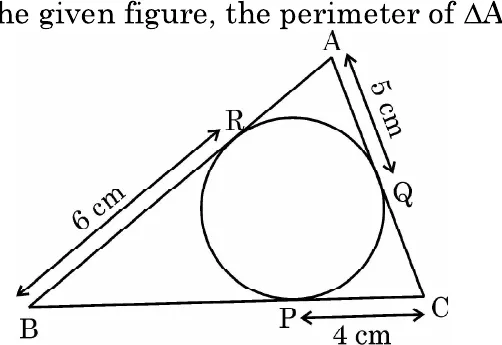
In the given figure, the perimeter of △ABC\triangle ABC is:

A triangle ABC with a circle inside touching AB at R, BC at P and AC at Q. The marked lengths are 6 cm from B to R, 5 cm from A to Q and 4 cm from P to C.
  1. (A)30 cm
  2. (B)15 cm
  3. (C)45 cm
  4. (D)60 cm
Solution · answer (A)
ABCPBP = 6CP = 4BR = 6AQ = AR = 5CQ = 4perimeter = 2(5 + 6 + 4) = 30 cm
  1. Tangents from a point to a circle are equal: BP=BR=6BP = BR = 6, AR=AQ=5AR = AQ = 5 and CP=CQ=4CP = CQ = 4.
  2. The perimeter is 2(6+5+4)=302(6 + 5 + 4) = 30 cm.

Answer: (A) 30 cm

Report an error on this question
Q18Circles1 mark

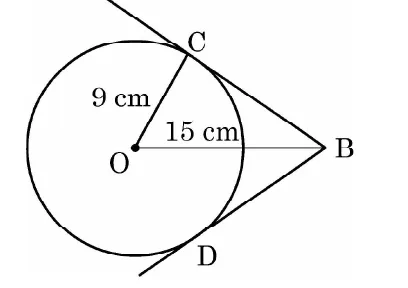
In the given figure, BCBC and BDBD are tangents to the circle with centre OO and radius 99 cm. If OB=15OB = 15 cm, then the length (BC+BD)(BC + BD) is:

A circle with centre O and radius 9 cm. Tangents from the outside point B on the right touch the circle at C (top) and D (bottom). OB is 15 cm.
  1. (A)18 cm
  2. (B)12 cm
  3. (C)24 cm
  4. (D)36 cm
Solution · answer (C)
OBCDBC = √(15² − 9²) = 12 = BD → BC + BD = 24 cm
  1. OC⊥BCOC \perp BC, so BC=152−92=144=12BC = \sqrt{15^2 - 9^2} = \sqrt{144} = 12 cm. BD=BC=12BD = BC = 12 cm (equal tangents), so BC+BD=24BC + BD = 24 cm.

Answer: (C) 24 cm

Report an error on this question
Q19Circles1 mark

Assertion (A): A tangent to a circle is perpendicular to the radius through the point of contact.

Reason (R): The lengths of tangents drawn from the external point to a circle are equal.

  1. (A)Both A and R are true and R is the correct explanation of A
  2. (B)Both A and R are true but R is not the correct explanation of A
  3. (C)A is true, but R is false
  4. (D)A is false, but R is true
Solution · answer (B)
  1. (A) This is the standard tangent–radius theorem. True. (R) Equal tangent lengths from an external point. True.
  2. But (R) is a different theorem and does not explain (A); the perpendicularity comes from the radius being the shortest distance from the centre to the tangent line.

Answer: (B) Both A and R are true but R is not the correct explanation of A

Report an error on this question
Q20Linear Equations1 mark

Assertion (A): The system of linear equations 3x+5y−4=03x + 5y - 4 = 0 and 15x+25y−25=015x + 25y - 25 = 0 is inconsistent.

Reason (R): The pair of linear equations a1x+b1y+c1=0a_1x + b_1y + c_1 = 0 and a2x+b2y+c2=0a_2x + b_2y + c_2 = 0 is inconsistent if a1a2=b1b2≠c1c2\dfrac{a_1}{a_2} = \dfrac{b_1}{b_2} \neq \dfrac{c_1}{c_2}.

  1. (A)Both A and R are true and R is the correct explanation of A
  2. (B)Both A and R are true but R is not the correct explanation of A
  3. (C)A is true, but R is false
  4. (D)A is false, but R is true
Solution · answer (A)
  1. (R) Parallel lines (no solution) need equal first two ratios and a different third ratio. True.
  2. (A) 315=15\dfrac{3}{15} = \dfrac{1}{5}, 525=15\dfrac{5}{25} = \dfrac{1}{5} and −4−25=425≠15\dfrac{-4}{-25} = \dfrac{4}{25} \neq \dfrac{1}{5}. So the lines are parallel and the system is inconsistent, exactly by the rule in (R). True.

Answer: (A) Both A and R are true and R is the correct explanation of A

Report an error on this question

Section B: Very short answer

5 questions, 2 marks each.

Q21Coordinate Geometry2 marks

(a) Find the coordinates of the point which divides the line segment joining the points (7,−1)(7, -1) and (−3,4)(-3, 4) internally in the ratio 2:32 : 3.

OR

(b) Find the value(s) of yy for which the distance between the points A(3,−1)A(3, -1) and B(11,y)B(11, y) is 1010 units.

Solution
  1. (a) x=2(−3)+3(7)5=155=3x = \dfrac{2(-3) + 3(7)}{5} = \dfrac{15}{5} = 3 and y=2(4)+3(−1)5=55=1y = \dfrac{2(4) + 3(-1)}{5} = \dfrac{5}{5} = 1. The point is (3,1)(3, 1).
  2. (b) AB2=100AB^2 = 100: (11−3)2+(y+1)2=100(11 - 3)^2 + (y + 1)^2 = 100, so (y+1)2=36(y + 1)^2 = 36 and y+1=±6y + 1 = \pm 6, giving y=5y = 5 or y=−7y = -7.

Answer: (a) (3,1)(3, 1)   (b) y=5y = 5 or −7-7

Report an error on this question
Q22Trigonometry2 marks

Evaluate: tan⁡260∘−2cosec⁡230∘−2tan⁡230∘\tan^2 60^\circ - 2\operatorname{cosec}^2 30^\circ - 2\tan^2 30^\circ.

Solution
  1. (3)2−2(2)2−2(13)2=3−8−23=−173(\sqrt{3})^2 - 2(2)^2 - 2\left(\dfrac{1}{\sqrt{3}}\right)^2 = 3 - 8 - \dfrac{2}{3} = -\dfrac{17}{3}.

Answer: −173-\dfrac{17}{3}

Report an error on this question
Q23Real Numbers2 marks

Find the LCM and HCF of 92 and 510, using prime factorisation.

Solution
  1. 92=22×2392 = 2^2 \times 23 and 510=2×3×5×17510 = 2 \times 3 \times 5 \times 17.
  2. HCF =2= 2 and LCM =22×3×5×17×23=23460= 2^2 \times 3 \times 5 \times 17 \times 23 = 23460. (Check: 2×23460=46920=92×5102 \times 23460 = 46920 = 92 \times 510 ✓.)

Answer: HCF =2= 2, LCM =23460= 23460

Report an error on this question
Q24Linear Equations2 marks

(a) Solve for xx and yy: x+y=6x + y = 6, 2x−3y=42x - 3y = 4.

OR

(b) Find out whether the following pair of linear equations are consistent or inconsistent: 5x−3y=115x - 3y = 11, −10x+6y=22-10x + 6y = 22.

Solution
  1. (a) From the first, y=6−xy = 6 - x. Then 2x−18+3x=42x - 18 + 3x = 4 gives 5x=225x = 22, so x=225x = \dfrac{22}{5} and y=85y = \dfrac{8}{5}.
  2. (b) a1a2=5−10=−12\dfrac{a_1}{a_2} = \dfrac{5}{-10} = -\dfrac{1}{2}, b1b2=−36=−12\dfrac{b_1}{b_2} = \dfrac{-3}{6} = -\dfrac{1}{2} and c1c2=−11−22\dfrac{c_1}{c_2} = \dfrac{-11}{-22} (writing both as ax+by+c=0ax + by + c = 0) =12= \dfrac{1}{2}. The first two are equal and the third differs: the lines are parallel and the pair is inconsistent.

Answer: (a) x=225x = \dfrac{22}{5}, y=85y = \dfrac{8}{5}   (b) inconsistent

Report an error on this question
Q25Triangles2 marks

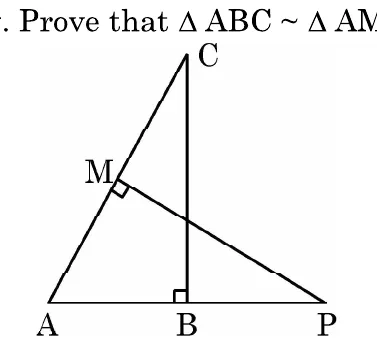
In the given figure, ABCABC and AMPAMP are two right triangles, right angled at BB and MM, respectively. Prove that △ABC∼△AMP\triangle ABC \sim \triangle AMP.

A figure with the points A, B and P on a horizontal line and C above B. The segment CP is drawn through a point M, with the right angles at B and at M marked.
Solution
  1. In △ABC\triangle ABC and △AMP\triangle AMP: ∠ABC=∠AMP=90∘\angle ABC = \angle AMP = 90^\circ (given) and ∠BAC=∠MAP\angle BAC = \angle MAP (common angle).
  2. By AA similarity, △ABC∼△AMP\triangle ABC \sim \triangle AMP.

Answer: Proved

Report an error on this question

Section C: Short answer

6 questions, 3 marks each.

Q26Trigonometry3 marks

(a) Prove that sec⁡θ(1−sin⁡θ)(sec⁡θ+tan⁡θ)=1\sec\theta(1 - \sin\theta)(\sec\theta + \tan\theta) = 1.

OR

(b) Prove that 1+sec⁡θsec⁡θ=sin⁡2θ1−cos⁡θ\dfrac{1 + \sec\theta}{\sec\theta} = \dfrac{\sin^2\theta}{1 - \cos\theta}.

Solution
  1. (a) LHS =1cos⁡θ(1−sin⁡θ)(1cos⁡θ+sin⁡θcos⁡θ)=(1−sin⁡θ)(1+sin⁡θ)cos⁡2θ=1−sin⁡2θcos⁡2θ=1= \dfrac{1}{\cos\theta}(1 - \sin\theta)\left(\dfrac{1}{\cos\theta} + \dfrac{\sin\theta}{\cos\theta}\right) = \dfrac{(1 - \sin\theta)(1 + \sin\theta)}{\cos^2\theta} = \dfrac{1 - \sin^2\theta}{\cos^2\theta} = 1.
  2. (b) LHS =1+1cos⁡θ1cos⁡θ=cos⁡θ+1= \dfrac{1 + \frac{1}{\cos\theta}}{\frac{1}{\cos\theta}} = \cos\theta + 1. Multiply and divide by (1−cos⁡θ)(1 - \cos\theta): (1+cos⁡θ)(1−cos⁡θ)1−cos⁡θ=1−cos⁡2θ1−cos⁡θ=sin⁡2θ1−cos⁡θ=\dfrac{(1 + \cos\theta)(1 - \cos\theta)}{1 - \cos\theta} = \dfrac{1 - \cos^2\theta}{1 - \cos\theta} = \dfrac{\sin^2\theta}{1 - \cos\theta} = RHS.

Answer: Proved (both parts)

Report an error on this question
Q27Coordinate Geometry3 marks

Show that the points A(1,7)A(1, 7), B(4,2)B(4, 2), C(−1,−1)C(-1, -1) and D(−4,4)D(-4, 4) are vertices of the square ABCDABCD.

Solution
-6-5-4-3-2-11234567-3-2-1123456789OxyA(1, 7)B(4, 2)C(−1, −1)D(−4, 4)
  1. AB=(4−1)2+(2−7)2=34AB = \sqrt{(4 - 1)^2 + (2 - 7)^2} = \sqrt{34}, BC=(4+1)2+(2+1)2=34BC = \sqrt{(4 + 1)^2 + (2 + 1)^2} = \sqrt{34}, CD=(−4+1)2+(4+1)2=34CD = \sqrt{(-4 + 1)^2 + (4 + 1)^2} = \sqrt{34} and DA=(−4−1)2+(4−7)2=34DA = \sqrt{(-4 - 1)^2 + (4 - 7)^2} = \sqrt{34}. All four sides are equal.
  2. Diagonals: AC=(1+1)2+(7+1)2=68AC = \sqrt{(1 + 1)^2 + (7 + 1)^2} = \sqrt{68} and BD=(4+4)2+(2−4)2=68BD = \sqrt{(4 + 4)^2 + (2 - 4)^2} = \sqrt{68}. They are equal.
  3. A quadrilateral with four equal sides and equal diagonals is a square.

Answer: Shown

Report an error on this question
Q28Circles3 marks

Prove that the tangents drawn from an external point to a circle are equal in length.

Solution
  1. **Given:** a circle with centre OO and tangents PQPQ and PRPR from the external point PP. **To prove:** PQ=PRPQ = PR. **Construction:** join OPOP, OQOQ, OROR.
  2. In △OPQ\triangle OPQ and △OPR\triangle OPR: OPOP is common, OQ=OROQ = OR (radii) and ∠OQP=∠ORP=90∘\angle OQP = \angle ORP = 90^\circ (radius and tangent).
  3. So △OPQ≅△OPR\triangle OPQ \cong \triangle OPR (RHS) and PQ=PRPQ = PR by CPCT.

Answer: Proved

Report an error on this question
Q29Polynomials3 marks

If α,β\alpha, \beta are zeroes of the quadratic polynomial x2+3x+2x^2 + 3x + 2, find a quadratic polynomial whose zeroes are α+1\alpha + 1, β+1\beta + 1.

Solution
  1. α+β=−3\alpha + \beta = -3 and αβ=2\alpha\beta = 2.
  2. New sum =(α+1)+(β+1)=α+β+2=−1= (\alpha + 1) + (\beta + 1) = \alpha + \beta + 2 = -1. New product =(α+1)(β+1)=αβ+(α+β)+1=2−3+1=0= (\alpha + 1)(\beta + 1) = \alpha\beta + (\alpha + \beta) + 1 = 2 - 3 + 1 = 0.
  3. The polynomial is x2+xx^2 + x (or k(x2+x)k(x^2 + x)). (Check: the zeroes of x2+3x+2x^2 + 3x + 2 are −1-1 and −2-2, so the new zeroes are 00 and −1-1 ✓.)

Answer: x2+xx^2 + x

Report an error on this question
Q30Real Numbers3 marks

Prove that 3+723 + 7\sqrt{2} is an irrational number, given that 2\sqrt{2} is an irrational number.

Solution
  1. Suppose 3+72=pq3 + 7\sqrt{2} = \dfrac{p}{q} with integers p,qp, q and q≠0q \neq 0. Then 2=p−3q7q\sqrt{2} = \dfrac{p - 3q}{7q}, a rational number.
  2. This contradicts the given fact that 2\sqrt{2} is irrational. So 3+723 + 7\sqrt{2} is irrational.

Answer: Proved

Report an error on this question
Q31Triangles3 marks

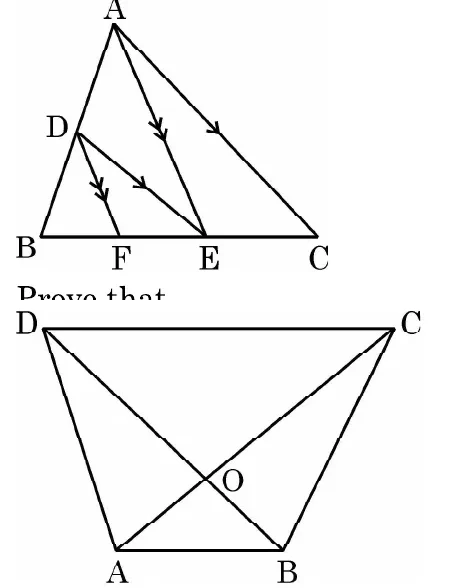
(a) In the given figure, DE∥ACDE \parallel AC and DF∥AEDF \parallel AE. Prove that BFFE=BEEC\dfrac{BF}{FE} = \dfrac{BE}{EC}.

OR

(b) The diagonals of a quadrilateral ABCDABCD intersect each other at the point OO such that AOBO=COOD\dfrac{AO}{BO} = \dfrac{CO}{OD}. Show that quadrilateral ABCDABCD is a trapezium.

Two figures. First, a triangle ABC with the line AE from A to E on BC, the line DE parallel to AC from D on AB, and the line DF parallel to AE from D to F on BC. Second, a quadrilateral ABCD with its diagonals crossing at O, drawn with the short side AB at the bottom and DC at the top.
Solution
ABCDEFDE ∥ AC: BD/DA = BE/EC; DF ∥ AE: BD/DA = BF/FE
  1. (a) In △ABE\triangle ABE, DF∥AEDF \parallel AE, so by the basic proportionality theorem BDDA=BFFE\dfrac{BD}{DA} = \dfrac{BF}{FE}. (i)
  2. In △ABC\triangle ABC, DE∥ACDE \parallel AC, so BDDA=BEEC\dfrac{BD}{DA} = \dfrac{BE}{EC}. (ii) From (i) and (ii): BFFE=BEEC\dfrac{BF}{FE} = \dfrac{BE}{EC}.
  3. (b) AOBO=COOD\dfrac{AO}{BO} = \dfrac{CO}{OD} gives OAOC=OBOD\dfrac{OA}{OC} = \dfrac{OB}{OD}, and ∠AOB=∠COD\angle AOB = \angle COD (vertically opposite angles). By SAS, △AOB∼△COD\triangle AOB \sim \triangle COD.
  4. So ∠CAB=∠ACD\angle CAB = \angle ACD, which are alternate interior angles for ABAB and CDCD with the transversal ACAC. Hence AB∥CDAB \parallel CD, and ABCDABCD is a trapezium.

Answer: Proved (both parts)

Report an error on this question

Section D: Long answer

4 questions, 5 marks each.

Q32Quadratic Equations5 marks

(a) The diagonal of a rectangular field is 6060 m more than the shorter side. If the longer side is 8080 m more than the shorter side, find the length of the sides of the field.

OR

(b) The sum of the ages of a father and his son is 4545 years. Five years ago, the product of their ages (in years) was 124124. Determine their present ages.

Solution
  1. (a) **This question is flawed.** Let the shorter side be xx. The longer side is x+80x + 80 and the diagonal is x+60x + 60. But a diagonal is always longer than either side, so the diagonal x+60x + 60 cannot be shorter than the side x+80x + 80. No such rectangle exists. CBSE’s marking scheme notes the error and awards full marks to everyone who attempted it.
  2. (b) Let the father be xx years old, so the son is (45−x)(45 - x) years old. Five years ago: (x−5)(40−x)=124(x - 5)(40 - x) = 124.
  3. −x2+45x−200=124-x^2 + 45x - 200 = 124 gives x2−45x+324=0x^2 - 45x + 324 = 0, so (x−36)(x−9)=0(x - 36)(x - 9) = 0. x=9x = 9 is rejected (the father cannot be 99), so x=36x = 36.
  4. The father is 3636 years old and the son is 99 years old. (Check: five years ago 31×4=12431 \times 4 = 124 ✓.)

Answer: (a) no such rectangle (flawed question)   (b) father 3636 years, son 99 years

Report an error on this question
Q33Surface Areas and Volumes5 marks

A vessel is in the form of a hemispherical bowl surmounted by a hollow cylinder of same diameter. The diameter of the hemispherical bowl is 14 cm and the total height of the vessel is 13 cm. Find the inner surface area of the vessel. Also, find the volume of the vessel.

Solution
  1. Radius r=7r = 7 cm. The height of the cylinder is 13−7=613 - 7 = 6 cm.
  2. Inner surface area =2πrh+2πr2=2πr(h+r)=2×227×7×13=44×13=572= 2\pi r h + 2\pi r^2 = 2\pi r(h + r) = 2 \times \dfrac{22}{7} \times 7 \times 13 = 44 \times 13 = 572 cm².
  3. Volume =πr2h+23πr3=πr2(h+2r3)=227×49×(6+143)=154×323=49283≈1642.67= \pi r^2 h + \dfrac{2}{3}\pi r^3 = \pi r^2\left(h + \dfrac{2r}{3}\right) = \dfrac{22}{7} \times 49 \times \left(6 + \dfrac{14}{3}\right) = 154 \times \dfrac{32}{3} = \dfrac{4928}{3} \approx 1642.67 cm³.

Answer: Inner surface area =572= 572 cm²; volume =49283≈1642.67= \dfrac{4928}{3} \approx 1642.67 cm³

Report an error on this question
Q34Statistics5 marks

The table given below shows the daily expenditure on food of 25 households in a locality:

Find the mean daily expenditure on food. Also, find the mode of the data.

Daily expenditure (₹)100–150150–200200–250250–300300–350
Number of households451222
Solution
  1. Class marks: 125,175,225,275,325125, 175, 225, 275, 325. ∑fixi=4(125)+5(175)+12(225)+2(275)+2(325)=500+875+2700+550+650=5275\sum f_ix_i = 4(125) + 5(175) + 12(225) + 2(275) + 2(325) = 500 + 875 + 2700 + 550 + 650 = 5275.
  2. Mean =527525=211= \dfrac{5275}{25} = 211.
  3. The modal class is 200−250200 - 250 (frequency 1212): l=200l = 200, f1=12f_1 = 12, f0=5f_0 = 5, f2=2f_2 = 2, h=50h = 50. Mode =200+12−524−5−2×50=200+35017=375017≈220.59= 200 + \dfrac{12 - 5}{24 - 5 - 2} \times 50 = 200 + \dfrac{350}{17} = \dfrac{3750}{17} \approx 220.59.

Answer: Mean =₹211= ₹211; mode ≈₹220.59\approx ₹220.59

Report an error on this question
Q35Trigonometry5 marks

(a) A TV tower stands vertically on the bank of a canal. From a point on the other bank directly opposite the tower, the angle of elevation of the top of the tower is 60∘60^\circ. From another point 2020 m away from this point on the line joining this point to the foot of the tower, the angle of elevation of the top of the tower is 30∘30^\circ. Find the height of the tower.

OR

(b) An aeroplane when flying at a height of 40004000 m from the ground passes vertically above another aeroplane at an instant when the angles of elevation of the two planes from the same point on the ground are 60∘60^\circ and 45∘45^\circ respectively. Find the vertical distance between the aeroplanes at that instant. (Use 3=1.73\sqrt{3} = 1.73)

Solution
60°30°ABCDh = 17.3 mx = 10 m20 mh = x√3, √3 h = x + 20 → x = 10
60°45°PHA1A24000 m4000/√3 mx = 4000/√3difference = 4000 − 4000/√3 ≈ 1693 m
  1. (a) Let the tower be AB=hAB = h, the nearer point CC with AC=xAC = x, and the farther point DD with CD=20CD = 20. tan⁡60∘=hx\tan 60^\circ = \dfrac{h}{x} gives h=x3h = x\sqrt{3}. tan⁡30∘=hx+20\tan 30^\circ = \dfrac{h}{x + 20} gives 3h=x+20\sqrt{3}h = x + 20.
  2. Substituting: 3x=x+203x = x + 20, so x=10x = 10 and h=103≈17.3h = 10\sqrt{3} \approx 17.3 m.
  3. (b) Let the higher plane be at 40004000 m and the lower at height hh, with the observation point at horizontal distance xx from the common vertical. tan⁡60∘=4000x\tan 60^\circ = \dfrac{4000}{x} gives x=40003x = \dfrac{4000}{\sqrt{3}}. tan⁡45∘=hx=1\tan 45^\circ = \dfrac{h}{x} = 1 gives h=x=40003h = x = \dfrac{4000}{\sqrt{3}}.
  4. The vertical distance =4000−40003=4000(1−33)=4000(1−0.577)≈1693.33= 4000 - \dfrac{4000}{\sqrt{3}} = 4000\left(1 - \dfrac{\sqrt{3}}{3}\right) = 4000(1 - 0.577) \approx 1693.33 m with 3=1.73\sqrt{3} = 1.73 in the form 33\dfrac{\sqrt{3}}{3} (the exact value is about 1690.61690.6 m).

Answer: (a) 103≈17.310\sqrt{3} \approx 17.3 m   (b) about 1693.331693.33 m

Report an error on this question

Section E: Case studies

3 case studies, 4 marks each.

Q36Arithmetic Progressions4 marks

Case study 1. Aahana being a plant lover decides to convert her balcony into beautiful garden full of plants. She bought few plants with pots for her balcony. She placed the pots in such a way that number of pots in the first row is 2, second row is 5, third row is 8 and so on.

Based on the above information, answer the following questions:

(i) Find the number of pots placed in the 10th row. [1]

(ii) Find the difference in the number of pots placed in 5th row and 2nd row. [1]

(iii) If Aahana wants to place 100 pots in total, then find the total number of rows formed in the arrangement. [2]

OR

(iii) If Aahana has sufficient space for 12 rows, then how many total number of pots are placed by her with the same arrangement? [2]
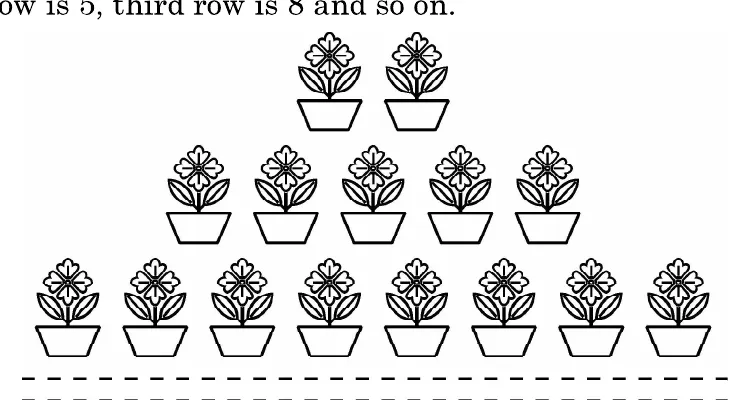
A pyramid-shaped arrangement of potted plants: two pots in the top row, five in the next row and eight in the bottom row shown.
Solution
  1. The pots per row are 2,5,8,…2, 5, 8, \dots, an A.P. with a=2a = 2 and d=3d = 3.
  2. (i) a10=2+9×3=29a_{10} = 2 + 9 \times 3 = 29.
  3. (ii) a5−a2=3d=9a_5 - a_2 = 3d = 9.
  4. (iii) Sn=n2[2(2)+(n−1)3]=100S_n = \dfrac{n}{2}[2(2) + (n - 1)3] = 100 gives 3n2+n−200=03n^2 + n - 200 = 0, that is (3n+25)(n−8)=0(3n + 25)(n - 8) = 0 and n=8n = 8 (the root −253-\dfrac{25}{3} is rejected): 88 rows.
  5. (iii) OR: S12=122[2(2)+11×3]=6×37=222S_{12} = \dfrac{12}{2}[2(2) + 11 \times 3] = 6 \times 37 = 222 pots.

Answer: (i) 2929   (ii) 99   (iii) 88 rows   (OR) 222222 pots

Report an error on this question
Q37Areas Related to Circles4 marks

Case study 2. Interschool Rangoli Competition was organized by one of the reputed schools of Odisha. The theme of the Rangoli Competition was Diwali celebrations where students were supposed to make mathematical designs. Students from various schools participated and made beautiful Rangoli designs. One such design is given below. Rangoli is in the shape of square marked as ABCD, side of square being 40 cm. At each corner of a square, a quadrant of circle of radius 10 cm is drawn (in which diyas are kept). Also a circle of diameter 20 cm is drawn inside the square.

Based on the above information, answer the following questions:

(i) What is the area of square ABCD? [1]

(ii) Find the area of the circle. [1]

(iii) If the circle and the four quadrants are cut off from the square ABCD and removed, then find the area of remaining portion of square ABCD. [2]

OR

(iii) Find the combined area of 4 quadrants and the circle, removed. [2]
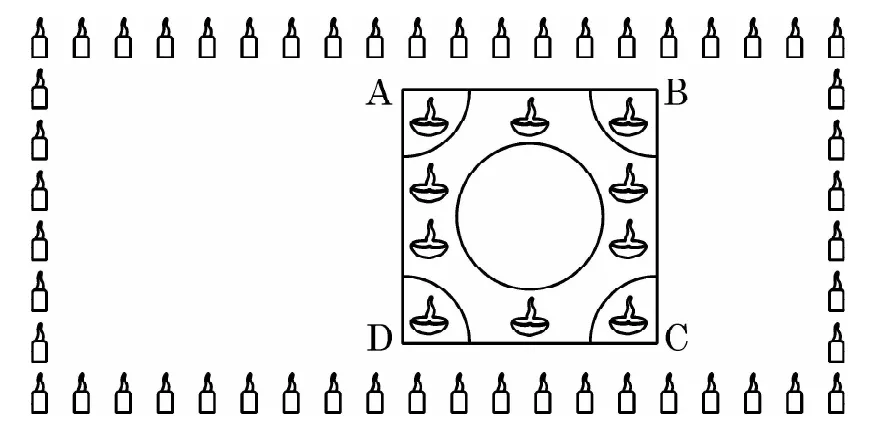
A rangoli design: a square ABCD with a quadrant of a circle at each corner holding diyas and a circle in the middle, with a row of lit lamps around the outside.
Solution
ABCD40 cmsquare 1600 − (quadrants 2200/7 + circle 2200/7) = 6800/7 ≈ 971.4 cm²
  1. (i) Area of the square =402=1600= 40^2 = 1600 cm².
  2. (ii) Area of the circle (radius 1010) =227×10×10=22007≈314.29= \dfrac{22}{7} \times 10 \times 10 = \dfrac{2200}{7} \approx 314.29 cm².
  3. (iii) The four quadrants of radius 1010 together make one full circle: 4×14πr2=220074 \times \dfrac{1}{4}\pi r^2 = \dfrac{2200}{7} cm². Removed area =22007+22007=44007= \dfrac{2200}{7} + \dfrac{2200}{7} = \dfrac{4400}{7} cm². Remaining =1600−44007=68007≈971.43= 1600 - \dfrac{4400}{7} = \dfrac{6800}{7} \approx 971.43 cm².
  4. (iii) OR: the combined area removed is 44007≈628.57\dfrac{4400}{7} \approx 628.57 cm².

Answer: (i) 16001600 cm²   (ii) 22007\dfrac{2200}{7} cm²   (iii) remaining 68007≈971.43\dfrac{6800}{7} \approx 971.43 cm²   (OR) removed 44007≈628.57\dfrac{4400}{7} \approx 628.57 cm²

Report an error on this question
Q38Probability4 marks

Case study 3. Blood group describes the type of blood a person has. It is a classification of blood based on the presence or absence of inherited antigenic substances on the surface of red blood cells. Blood types predict whether a serious reaction will occur in a blood transfusion. In a sample of 50 people, 21 had type O blood, 22 had type A, 5 had type B and rest had type AB blood group.

Based on the above, answer the following questions:

(i) What is the probability that a person chosen at random had type O blood? [1]

(ii) What is the probability that a person chosen at random had type AB blood group? [1]

(iii) What is the probability that a person chosen at random had neither type A nor type B blood group? [2]

OR

(iii) What is the probability that person chosen at random had either type A or type B or type O blood group? [2]
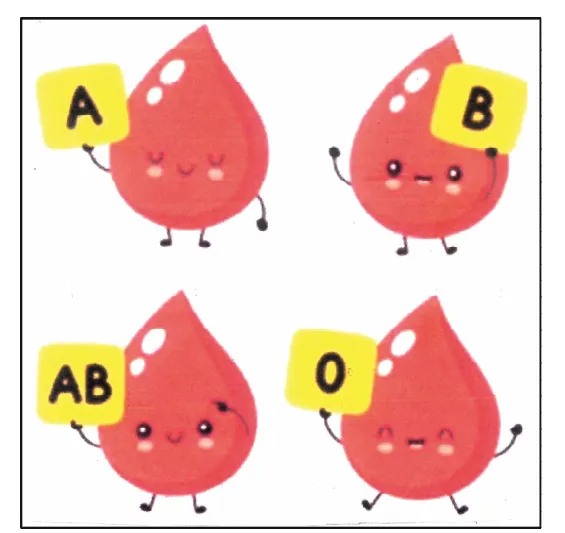
Four cartoon red blood drops, each holding a sign: A, B, AB and O.
Solution
  1. The people with type AB =50−(21+22+5)=2= 50 - (21 + 22 + 5) = 2.
  2. (i) P(type O)=2150P(\text{type O}) = \dfrac{21}{50}.
  3. (ii) P(type AB)=250=125P(\text{type AB}) = \dfrac{2}{50} = \dfrac{1}{25}.
  4. (iii) Neither A nor B means type O or AB: P=21+250=2350P = \dfrac{21 + 2}{50} = \dfrac{23}{50}. (OR) A or B or O: P=21+22+550=4850=2425P = \dfrac{21 + 22 + 5}{50} = \dfrac{48}{50} = \dfrac{24}{25}.

Answer: (i) 2150\dfrac{21}{50}   (ii) 125\dfrac{1}{25}   (iii) 2350\dfrac{23}{50}   (OR) 2425\dfrac{24}{25}

Report an error on this question

Questions are from the official CBSE paper. Figures are described in words; see the PDF for the originals. Solutions are written by CogniGuru.

Revise this paper in 1 minute a chapter

Each chapter below is what the paper tested, with a one-minute animated lesson on the idea behind it.

Stuck on a step in any solution?

The CogniGuru AI tutor explains any doubt one minute at a time, in English or Hindi. Join the waitlist.

Mock quiz: 5 questions from this paper

Five real questions from this paper, one each from five chapters. About 2 minutes. See how much you know and where you stand among other students. Attempt free, with no login; log in only for your ranking and full report.

Question 1 of 5 · Q1 of the paperReal Numbers

The prime factorisation of natural number 288288 is:

0 of 5 answered

Related papers

Common questions

Are these the official CBSE Class 10 Maths Basic 2023 questions?
Yes. The questions are from the official Mathematics (Basic) paper (set 430/1/1) that CBSE published after the March 2023 board exam. The solutions are written by CogniGuru and checked against the answer key CBSE published for this paper code.
Can I download the CBSE Class 10 Maths Basic 2023 question paper PDF?
Yes, the official paper PDF is free to download from this page, and so are our step-by-step solutions as a PDF. No login is needed to download either or to read the solutions.
Do all sets of the paper have the same questions?
No. CBSE sets several versions of each paper, with the same blueprint and similar questions in a different order and sometimes with different numbers. This page covers set 430/1/1.
How does the quiz work, and what does “where you stand” mean?
It is a mock quiz of 5 real multiple-choice questions from this paper, scored automatically in about 2 minutes. Your score is compared, anonymously, with other students who took the same quiz. Only the score is stored with the comparison, never your name or number.

Source

CBSE question paper archive, Class X, 2023 (Mathematics (Basic), set 430/1/1)
PDF