
CBSE · Class 10 · Mathematics (Standard) · Free

CBSE Class 10 Maths Standard 2023 Question Paper (Set 30/1/1) with Solutions

The official board paper (Q.P. Code 30/1/1, Series WX1YZ/1). Free paper PDF and step-by-step solutions (also as a PDF to download) written by CogniGuru and checked against CBSE’s answer key. See the paper’s main topics in 1 minute, then quiz yourself to see how much you know and where you stand.

No login to download or read the solutions. Login only to see your quiz report in full.

Board
CBSE
Class
10
Subject
Maths Standard (041)
Year
2023
Set code
30/1/1
Max marks
80
Duration
3 hours
Questions
38 (Sections A to E)
Source
Official CBSE paper
Exam date
March 2023

Paper preview

Three pages of the official paper. Download the PDF for all 24.

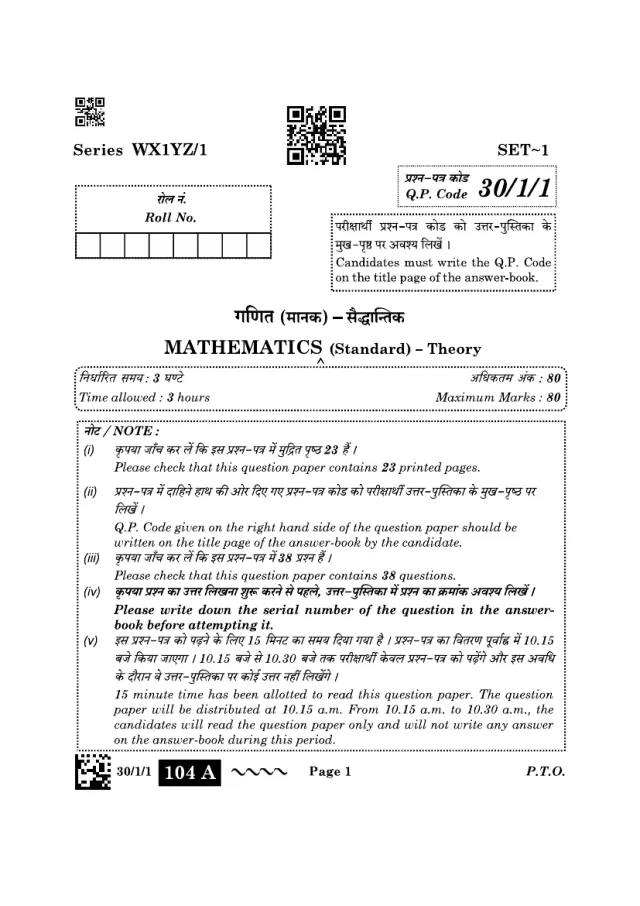
  • Cover page of the CBSE Class 10 Maths Standard 2023 paper, set 30/1/1

    Cover page

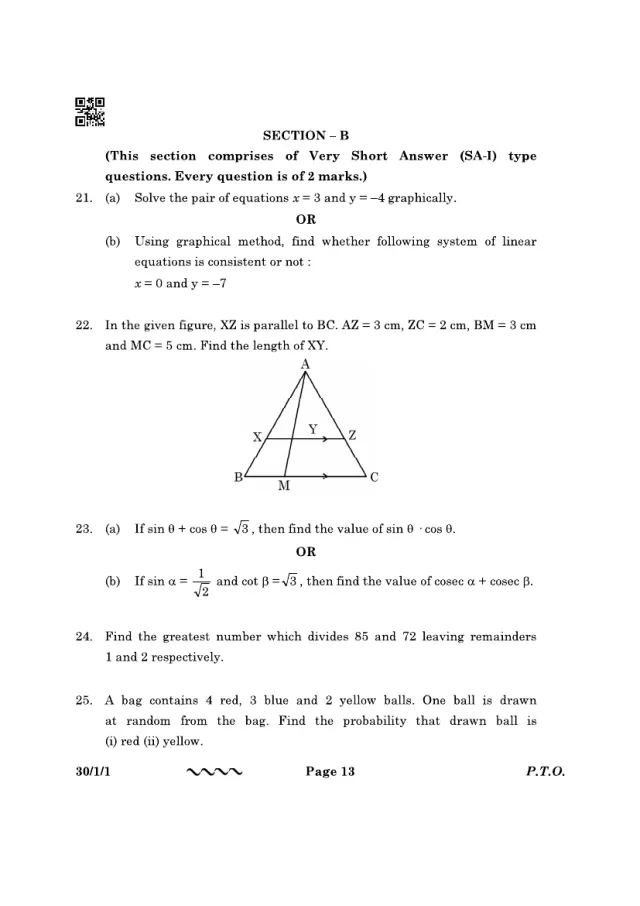
  • Section B of the CBSE Class 10 Maths Standard 2023 paper, set 30/1/1

    Section B

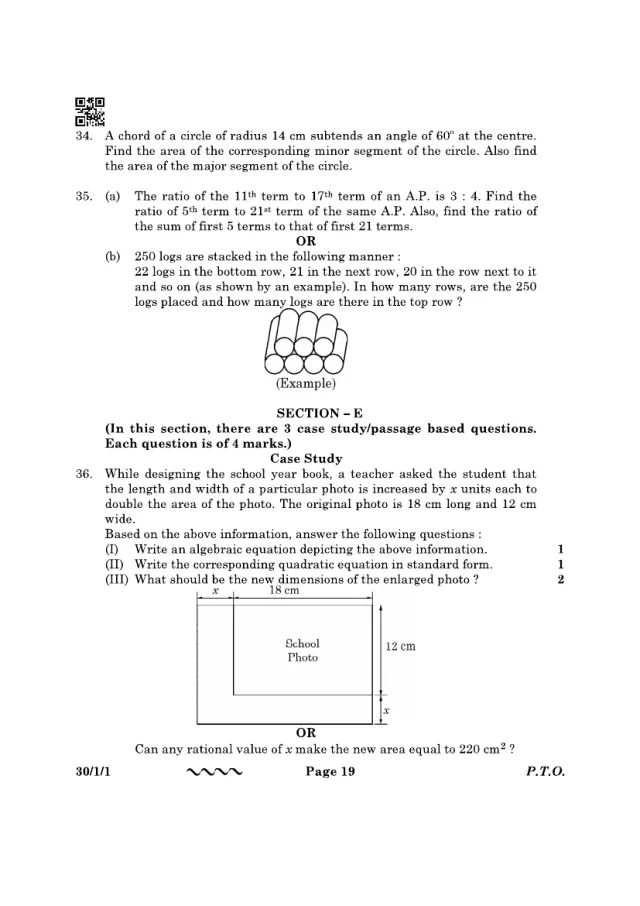
  • A case study with its figure from the CBSE Class 10 Maths Standard 2023 paper, set 30/1/1

    Case study

The main topics of this paper, in 1 minute

Your tutor walks you through the paper before you attempt it: the marks, the key ideas, the time plan and the traps.

1-minute paper analysis

With your tutor, in her voice

The main topics of this paper, in about a minute

A short, animated walk through the paper: how it is built, where the marks come from, the four ideas that matter most, how to plan your three hours, and the traps to avoid.

  1. 1The paper at a glance
  2. 2Where the marks come from
  3. 3Four ideas that keep paying off
  4. 4Plan your three hours
  5. 5Four traps to avoid

Sound on for the voice. Captions are shown, and you can mute any time.

Step-by-step solutions

Try each question first, then open its solution. Tap a number to jump.

Download solutions (PDF)

Section A: Multiple choice

20 questions, 1 mark each. MCQs (Q1 to Q18) and assertion-reason (Q19, Q20).

Q1Polynomials1 mark

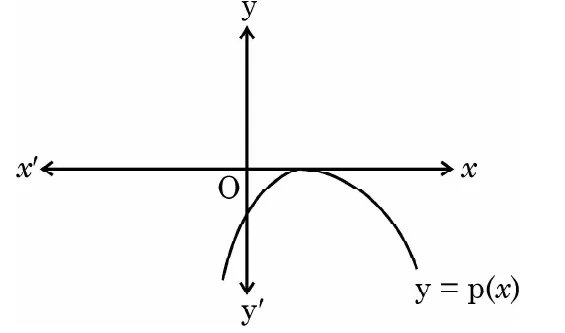
The graph of y=p(x)y = p(x) is given, for a polynomial p(x)p(x). The number of zeroes of p(x)p(x) from the graph is

A coordinate graph with a curve that opens downward, like an upside-down U, whose highest point touches the x-axis just to the right of the origin.
  1. (A)3
  2. (B)1
  3. (C)2
  4. (D)0
Solution · answer (B)
  1. The zeroes of a polynomial are the xx-coordinates of the points where its graph meets the xx-axis.
  2. The curve touches the xx-axis at exactly one point (the top of the arch), so p(x)p(x) has 11 zero.

Answer: (B) 1

Report an error on this question
Q2Linear Equations1 mark

The value of kk for which the pair of equations kx=y+2kx = y + 2 and 6x=2y+36x = 2y + 3 has infinitely many solutions,

  1. (A)is k=3k = 3
  2. (B)does not exist
  3. (C)is k=−3k = -3
  4. (D)is k=4k = 4
Solution · answer (B)
  1. Write kx−y−2=0kx - y - 2 = 0 and 6x−2y−3=06x - 2y - 3 = 0. For infinitely many solutions k6=−1−2=−2−3\dfrac{k}{6} = \dfrac{-1}{-2} = \dfrac{-2}{-3}.
  2. k6=12\dfrac{k}{6} = \dfrac{1}{2} gives k=3k = 3, but 12≠23\dfrac{1}{2} \neq \dfrac{2}{3}. The three ratios can never be equal, so no such kk exists. (With k=3k = 3 the lines are parallel.)

Answer: (B) does not exist

Report an error on this question
Q3Arithmetic Progressions1 mark

If p−1p - 1, p+1p + 1 and 2p+32p + 3 are in A.P., then the value of pp is

  1. (A)−2
  2. (B)4
  3. (C)0
  4. (D)2
Solution · answer (C)
  1. In an A.P. the middle term is the mean of the other two, so 2(p+1)=(p−1)+(2p+3)2(p + 1) = (p - 1) + (2p + 3).
  2. 2p+2=3p+22p + 2 = 3p + 2, so p=0p = 0.

Answer: (C) 0

Report an error on this question
Q4Coordinate Geometry1 mark

In what ratio, does xx-axis divide the line segment joining the points A(3,6)A(3, 6) and B(−12,−3)B(-12, -3)?

  1. (A)1 : 2
  2. (B)1 : 4
  3. (C)4 : 1
  4. (D)2 : 1
Solution · answer (D)
  1. Let the point on the xx-axis divide ABAB in the ratio k:1k : 1. Its yy-coordinate is 00: −3k+6k+1=0\dfrac{-3k + 6}{k + 1} = 0.
  2. k=2k = 2, so the ratio is 2:12 : 1.

Answer: (D) 2 : 1

Report an error on this question
Q5Circles1 mark

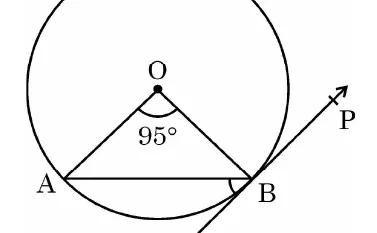
In the given figure, PQPQ is tangent to the circle centred at OO. If ∠AOB=95∘\angle AOB = 95^\circ, then the measure of ∠ABQ\angle ABQ will be

A circle with centre O. The chord AB is drawn with A at the left and B at the right on the circle, and OA and OB are joined with the angle AOB marked 95 degrees. A tangent PQ touches the circle at B.
  1. (A)47.5∘47.5^\circ
  2. (B)42.5∘42.5^\circ
  3. (C)85∘85^\circ
  4. (D)95∘95^\circ
Solution · answer (A)
95°OAB∠ABQ = ½ ∠AOB = 47.5° (tangent–chord angle)
  1. OA=OBOA = OB, so in △OAB\triangle OAB: ∠OBA=180∘−95∘2=42.5∘\angle OBA = \dfrac{180^\circ - 95^\circ}{2} = 42.5^\circ.
  2. OB⊥PQOB \perp PQ, so ∠OBQ=90∘\angle OBQ = 90^\circ, and ∠ABQ=90∘−42.5∘=47.5∘\angle ABQ = 90^\circ - 42.5^\circ = 47.5^\circ.

Answer: (A) 47.5∘47.5^\circ

Report an error on this question
Q6Trigonometry1 mark

If 2tan⁡A=32\tan A = 3, then the value of 4sin⁡A+3cos⁡A4sin⁡A−3cos⁡A\dfrac{4\sin A + 3\cos A}{4\sin A - 3\cos A} is

  1. (A)713\dfrac{7}{\sqrt{13}}
  2. (B)113\dfrac{1}{\sqrt{13}}
  3. (C)3
  4. (D)does not exist
Solution · answer (C)
  1. Divide the numerator and denominator by cos⁡A\cos A: 4tan⁡A+34tan⁡A−3\dfrac{4\tan A + 3}{4\tan A - 3}.
  2. tan⁡A=32\tan A = \dfrac{3}{2}, so the value is 6+36−3=93=3\dfrac{6 + 3}{6 - 3} = \dfrac{9}{3} = 3.

Answer: (C) 3

Report an error on this question
Q7Polynomials1 mark

If α\alpha, β\beta are the zeroes of a polynomial p(x)=x2+x−1p(x) = x^2 + x - 1, then 1α+1β\dfrac{1}{\alpha} + \dfrac{1}{\beta} equals to

  1. (A)1
  2. (B)2
  3. (C)−1
  4. (D)−12\dfrac{-1}{2}
Solution · answer (A)
  1. α+β=−1\alpha + \beta = -1 and αβ=−1\alpha\beta = -1.
  2. 1α+1β=α+βαβ=−1−1=1\dfrac{1}{\alpha} + \dfrac{1}{\beta} = \dfrac{\alpha + \beta}{\alpha\beta} = \dfrac{-1}{-1} = 1.

Answer: (A) 1

Report an error on this question
Q8Quadratic Equations1 mark

The least positive value of kk, for which the quadratic equation 2x2+kx−4=02x^2 + kx - 4 = 0 has rational roots, is

  1. (A)±22\pm 2\sqrt{2}
  2. (B)2
  3. (C)±2\pm 2
  4. (D)2\sqrt{2}
Solution · answer (B)
  1. Roots are rational when the discriminant is a perfect square: D=k2+32D = k^2 + 32.
  2. k=2k = 2 gives D=36=62D = 36 = 6^2 ✓. (Smaller positive integers: k=1k = 1 gives 3333, not a square.)
  3. Roots for k=2k = 2: −2±64=1, −2\dfrac{-2 \pm 6}{4} = 1,\ -2, both rational.

Answer: (B) 2

Report an error on this question
Q9Trigonometry1 mark

[34tan⁡230∘−sec⁡245∘+sin⁡260∘]\left[\dfrac{3}{4}\tan^2 30^\circ - \sec^2 45^\circ + \sin^2 60^\circ\right] is equal to

  1. (A)−1
  2. (B)56\dfrac{5}{6}
  3. (C)−32\dfrac{-3}{2}
  4. (D)16\dfrac{1}{6}
Solution · answer (A)
  1. tan⁡230∘=13\tan^2 30^\circ = \dfrac{1}{3}, sec⁡245∘=2\sec^2 45^\circ = 2 and sin⁡260∘=34\sin^2 60^\circ = \dfrac{3}{4}.
  2. 34×13−2+34=14−2+34=−1\dfrac{3}{4} \times \dfrac{1}{3} - 2 + \dfrac{3}{4} = \dfrac{1}{4} - 2 + \dfrac{3}{4} = -1.

Answer: (A) −1

Report an error on this question
Q10Surface Areas and Volumes1 mark

Curved surface area of a cylinder of height 55 cm is 94.294.2 cm². Radius of the cylinder is (Take π=3.14\pi = 3.14)

  1. (A)2 cm
  2. (B)3 cm
  3. (C)2.9 cm
  4. (D)6 cm
Solution · answer (B)
  1. 2πrh=94.22\pi r h = 94.2, so 2×3.14×r×5=94.22 \times 3.14 \times r \times 5 = 94.2 and 31.4 r=94.231.4\,r = 94.2.
  2. r=3r = 3 cm.

Answer: (B) 3 cm

Report an error on this question
Q11Statistics1 mark

The distribution below gives the marks obtained by 80 students on a test:

The modal class of this distribution is:

MarksLess than 10Less than 20Less than 30Less than 40Less than 50Less than 60
Number of students31227577580
  1. (A)10 – 20
  2. (B)20 – 30
  3. (C)30 – 40
  4. (D)50 – 60
Solution · answer (C)
  1. Convert the cumulative frequencies to class frequencies by differences: 00–1010: 33; 1010–2020: 99; 2020–3030: 1515; 3030–4040: 3030; 4040–5050: 1818; 5050–6060: 55.
  2. The highest frequency is 3030, so the modal class is 30−4030 - 40.

Answer: (C) 30 – 40

Common mistake: Reading the cumulative numbers as frequencies. The tallest class is found from the differences.

Report an error on this question
Q12Surface Areas and Volumes1 mark

The curved surface area of a cone having height 2424 cm and radius 77 cm, is

  1. (A)528528 cm²
  2. (B)10561056 cm²
  3. (C)550550 cm²
  4. (D)500500 cm²
Solution · answer (C)
  1. Slant height l=242+72=625=25l = \sqrt{24^2 + 7^2} = \sqrt{625} = 25 cm.
  2. CSA =πrl=227×7×25=550= \pi r l = \dfrac{22}{7} \times 7 \times 25 = 550 cm².

Answer: (C) 550550 cm²

Report an error on this question
Q13Coordinate Geometry1 mark

The distance between the points (0,25)(0, 2\sqrt{5}) and (−25,0)(-2\sqrt{5}, 0) is

  1. (A)2102\sqrt{10} units
  2. (B)4104\sqrt{10} units
  3. (C)2202\sqrt{20} units
  4. (D)0
Solution · answer (A)
  1. Distance =(25)2+(25)2=20+20=40=210= \sqrt{(2\sqrt{5})^2 + (2\sqrt{5})^2} = \sqrt{20 + 20} = \sqrt{40} = 2\sqrt{10} units.

Answer: (A) 2102\sqrt{10} units

Report an error on this question
Q14Polynomials1 mark

Which of the following is a quadratic polynomial having zeroes −23\dfrac{-2}{3} and 23\dfrac{2}{3}?

  1. (A)4x2−94x^2 - 9
  2. (B)49(9x2+4)\dfrac{4}{9}(9x^2 + 4)
  3. (C)x2+94x^2 + \dfrac{9}{4}
  4. (D)5(9x2−4)5(9x^2 - 4)
Solution · answer (D)
  1. Sum of zeroes =0= 0 and product =−49= -\dfrac{4}{9}, so the polynomial is k(x2−49)=k9(9x2−4)k\left(x^2 - \dfrac{4}{9}\right) = \dfrac{k}{9}(9x^2 - 4).
  2. Option (D), 5(9x2−4)5(9x^2 - 4), has this form (check: 9x2=49x^2 = 4 gives x=±23x = \pm\dfrac{2}{3} ✓).

Answer: (D) 5(9x2−4)5(9x^2 - 4)

Report an error on this question
Q15Statistics1 mark

If the value of each observation of a statistical data is increased by 3, then the mean of the data

  1. (A)remains unchanged
  2. (B)increases by 3
  3. (C)increases by 6
  4. (D)increases by 3n
Solution · answer (B)
  1. If each of nn values grows by 33, the sum grows by 3n3n, and the mean sumn\dfrac{\text{sum}}{n} grows by 33.

Answer: (B) increases by 3

Report an error on this question
Q16Probability1 mark

Probability of happening of an event is denoted by p and probability of non-happening of the event is denoted by q. Relation between p and q is

  1. (A)p+q=1p + q = 1
  2. (B)p=1, q=1p = 1,\ q = 1
  3. (C)p=q−1p = q - 1
  4. (D)p+q+1=0p + q + 1 = 0
Solution · answer (A)
  1. An event either happens or does not happen, so the two probabilities add to 11: p+q=1p + q = 1.

Answer: (A) p+q=1p + q = 1

Report an error on this question
Q17Probability1 mark

A girl calculates that the probability of her winning the first prize in a lottery is 0.08. If 6000 tickets are sold, how many tickets has she bought?

  1. (A)40
  2. (B)240
  3. (C)480
  4. (D)750
Solution · answer (C)
  1. Probability =her tickets6000=0.08= \dfrac{\text{her tickets}}{6000} = 0.08, so her tickets =0.08×6000=480= 0.08 \times 6000 = 480.

Answer: (C) 480

Report an error on this question
Q18Probability1 mark

In a group of 20 people, 5 can’t swim. If one person is selected at random, then the probability that he/she can swim, is

  1. (A)34\dfrac{3}{4}
  2. (B)13\dfrac{1}{3}
  3. (C)1
  4. (D)14\dfrac{1}{4}
Solution · answer (A)
  1. People who can swim: 20−5=1520 - 5 = 15.
  2. P=1520=34P = \dfrac{15}{20} = \dfrac{3}{4}.

Answer: (A) 34\dfrac{3}{4}

Report an error on this question
Q19Coordinate Geometry1 mark

Assertion (A): Point P(0,2)P(0, 2) is the point of intersection of yy-axis with the line 3x+2y=43x + 2y = 4.

Reason (R): The distance of point P(0,2)P(0, 2) from xx-axis is 22 units.

  1. (A)Both A and R are true and R is the correct explanation of A
  2. (B)Both A and R are true, but R is not the correct explanation of A
  3. (C)A is true, but R is false
  4. (D)A is false, but R is true
Solution · answer (B)
  1. (A) On the yy-axis x=0x = 0: 2y=42y = 4 gives y=2y = 2, so the point is (0,2)(0, 2). True.
  2. (R) The distance of (0,2)(0, 2) from the xx-axis is ∣y∣=2|y| = 2. True.
  3. R does not explain why the line meets the yy-axis at (0,2)(0, 2), so R is not the explanation of A.

Answer: (B) Both true, but R is not the correct explanation of A

Report an error on this question
Q20Real Numbers1 mark

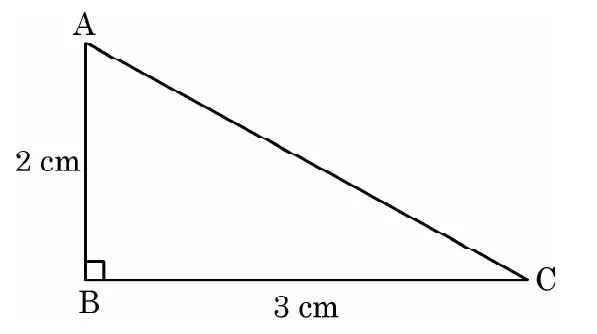
Assertion (A): The perimeter of △ABC\triangle ABC is a rational number.

Reason (R): The sum of the squares of two rational numbers is always rational.

A right triangle ABC with the right angle at B at the bottom left. AB is vertical and 2 cm, and BC is horizontal and 3 cm.
  1. (A)Both A and R are true and R is the correct explanation of A
  2. (B)Both A and R are true, but R is not the correct explanation of A
  3. (C)A is true, but R is false
  4. (D)A is false, but R is true
Solution · answer (D)
  1. (A) AC=22+32=13AC = \sqrt{2^2 + 3^2} = \sqrt{13}, which is irrational. The perimeter 2+3+132 + 3 + \sqrt{13} is irrational. So A is false.
  2. (R) The sum of the squares of two rational numbers is rational. True.

Answer: (D) A is false, R is true

Report an error on this question

Section B: Very short answer

5 questions, 2 marks each.

Q21Linear Equations2 marks

(a) Solve the pair of equations x=3x = 3 and y=−4y = -4 graphically.

OR

(b) Using graphical method, find whether following system of linear equations is consistent or not: x=0x = 0 and y=−7y = -7.

Solution
-2-1123456-6-5-4-3-2-112Oxyx = 3y = −4(3, −4)
  1. (a) x=3x = 3 is a vertical line through (3,0)(3, 0) and y=−4y = -4 is a horizontal line through (0,−4)(0, -4). They meet at (3,−4)(3, -4), so x=3x = 3, y=−4y = -4.
  2. (b) x=0x = 0 is the yy-axis and y=−7y = -7 is a horizontal line. They cross at (0,−7)(0, -7), so the system has a solution: it is consistent.

Answer: (a) x=3, y=−4x = 3,\ y = -4   (b) consistent

Report an error on this question
Q22Triangles2 marks

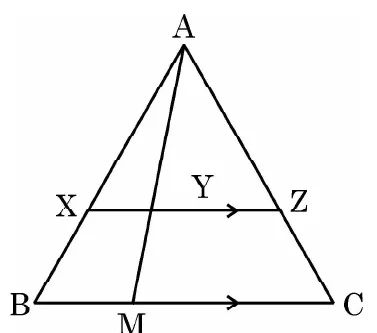
In the given figure, XZXZ is parallel to BCBC. AZ=3AZ = 3 cm, ZC=2ZC = 2 cm, BM=3BM = 3 cm and MC=5MC = 5 cm. Find the length of XYXY.

Triangle ABC with a line from A down to the point M on BC, and a line XZ parallel to BC meeting AB at X, AM at Y and AC at Z.
Solution
ABCMXZYAX/AB = AZ/AC = 3/5; △AXY ∼ △ABM, so XY = 3/5 × 3 = 1.8 cm
  1. XZ∥BCXZ \parallel BC, so AXXB=AZZC=32\dfrac{AX}{XB} = \dfrac{AZ}{ZC} = \dfrac{3}{2}, hence AXAB=35\dfrac{AX}{AB} = \dfrac{3}{5}.
  2. XY∥BMXY \parallel BM, so △AXY∼△ABM\triangle AXY \sim \triangle ABM: XYBM=AXAB=35\dfrac{XY}{BM} = \dfrac{AX}{AB} = \dfrac{3}{5}.
  3. XY=35×3=95=1.8XY = \dfrac{3}{5} \times 3 = \dfrac{9}{5} = 1.8 cm.

Answer: XY=1.8XY = 1.8 cm

Report an error on this question
Q23Trigonometry2 marks

(a) If sin⁡θ+cos⁡θ=3\sin\theta + \cos\theta = \sqrt{3}, then find the value of sin⁡θcos⁡θ\sin\theta\cos\theta.

OR

(b) If sin⁡α=12\sin\alpha = \dfrac{1}{2} and cot⁡β=3\cot\beta = \sqrt{3}, then find the value of cosec α+cosec β\mathrm{cosec}\,\alpha + \mathrm{cosec}\,\beta.

Solution
  1. (a) Square both sides: sin⁡2θ+cos⁡2θ+2sin⁡θcos⁡θ=3\sin^2\theta + \cos^2\theta + 2\sin\theta\cos\theta = 3, so 1+2sin⁡θcos⁡θ=31 + 2\sin\theta\cos\theta = 3.
  2. sin⁡θcos⁡θ=1\sin\theta\cos\theta = 1.
  3. (b) cosec α=1sin⁡α=2\mathrm{cosec}\,\alpha = \dfrac{1}{\sin\alpha} = 2. cosec β=1+cot⁡2β=1+3=2\mathrm{cosec}\,\beta = \sqrt{1 + \cot^2\beta} = \sqrt{1 + 3} = 2.
  4. cosec α+cosec β=2+2=4\mathrm{cosec}\,\alpha + \mathrm{cosec}\,\beta = 2 + 2 = 4.

Answer: (a) 11   (b) 44

Common mistake: (For (a): sin⁡θ+cos⁡θ\sin\theta + \cos\theta is at most 2\sqrt{2} for any real angle, so 3\sqrt{3} cannot occur. CBSE's key still gives 11 by algebra, which is what is shown here.)

Report an error on this question
Q24Real Numbers2 marks

Find the greatest number which divides 85 and 72 leaving remainders 1 and 2 respectively.

Solution
  1. The number must divide 85−1=8485 - 1 = 84 and 72−2=7072 - 2 = 70 exactly, and the greatest such number is their HCF.
  2. 84=22×3×784 = 2^2 \times 3 \times 7 and 70=2×5×770 = 2 \times 5 \times 7, so HCF=2×7=14\text{HCF} = 2 \times 7 = 14.

Answer: 14

Report an error on this question
Q25Probability2 marks

A bag contains 4 red, 3 blue and 2 yellow balls. One ball is drawn at random from the bag. Find the probability that drawn ball is (i) red (ii) yellow.

Solution
  1. Total balls =4+3+2=9= 4 + 3 + 2 = 9.
  2. (i) P(red)=49P(\text{red}) = \dfrac{4}{9}. (ii) P(yellow)=29P(\text{yellow}) = \dfrac{2}{9}.

Answer: (i) 49\dfrac{4}{9}   (ii) 29\dfrac{2}{9}

Report an error on this question

Section C: Short answer

6 questions, 3 marks each.

Q26Linear Equations3 marks

Half of the difference between two numbers is 2. The sum of the greater number and twice the smaller number is 13. Find the numbers.

Solution
  1. Let the numbers be xx and yy with x>yx > y. 12(x−y)=2\dfrac{1}{2}(x - y) = 2, so x−y=4x - y = 4. … (i)
  2. x+2y=13x + 2y = 13. … (ii)
  3. Subtract (i) from (ii): 3y=93y = 9, so y=3y = 3 and x=7x = 7. (Check: 7+6=137 + 6 = 13 ✓.)

Answer: The numbers are 7 and 3

Report an error on this question
Q27Real Numbers3 marks

Prove that 5\sqrt{5} is an irrational number.

Solution
  1. Suppose 5=pq\sqrt{5} = \dfrac{p}{q} with p,qp, q co-prime and q≠0q \neq 0. Then 5q2=p25q^2 = p^2, so 55 divides pp. Write p=5ap = 5a.
  2. 25a2=5q225a^2 = 5q^2, so q2=5a2q^2 = 5a^2, so 55 divides qq.
  3. Both pp and qq are divisible by 55, contradicting that they are co-prime. So 5\sqrt{5} is irrational.

Answer: Proved by contradiction

Report an error on this question
Q28Coordinate Geometry3 marks

If (−5,3)(-5, 3) and (5,3)(5, 3) are two vertices of an equilateral triangle, then find co-ordinates of the third vertex, given that origin lies inside the triangle. (Take 3=1.7\sqrt{3} = 1.7)

Solution
-7-6-5-4-3-2-11234567-7-6-5-4-3-2-112345OxyA(−5, 3)B(5, 3)C(0, 3 − 5√3)O
  1. Let A(−5,3)A(-5, 3), B(5,3)B(5, 3) and the third vertex C(x,y)C(x, y). AB=10AB = 10, so AC=BC=10AC = BC = 10.
  2. AC=BCAC = BC: (x+5)2+(y−3)2=(x−5)2+(y−3)2(x + 5)^2 + (y - 3)^2 = (x - 5)^2 + (y - 3)^2, giving 20x=020x = 0 and x=0x = 0.
  3. AC2=100AC^2 = 100: 25+(y−3)2=10025 + (y - 3)^2 = 100, so (y−3)2=75(y - 3)^2 = 75 and y−3=±53y - 3 = \pm 5\sqrt{3}.
  4. The origin lies inside the triangle, and ABAB is at height 33 above it, so CC must be below: y=3−53=3−8.5=−5.5y = 3 - 5\sqrt{3} = 3 - 8.5 = -5.5.

Answer: C=(0,−5.5)C = (0, -5.5)

Common mistake: Taking the upper vertex (0, 11.5). The origin must be inside, so the third vertex is below AB.

Report an error on this question
Q29Circles3 marks

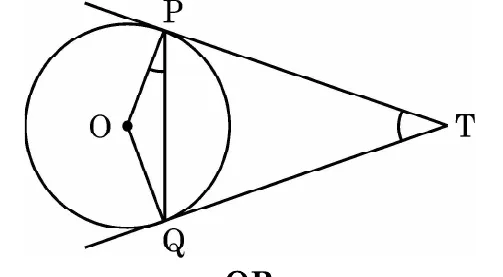
(a) Two tangents TPTP and TQTQ are drawn to a circle with centre OO from an external point TT. Prove that ∠PTQ=2∠OPQ\angle PTQ = 2\angle OPQ.

OR

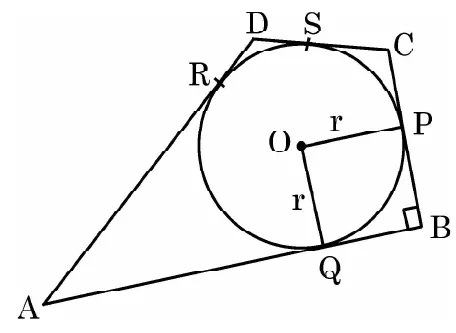
(b) In the given figure, a circle is inscribed in a quadrilateral ABCDABCD in which ∠B=90∘\angle B = 90^\circ. If AD=17AD = 17 cm, AB=20AB = 20 cm and DS=3DS = 3 cm, then find the radius of the circle.

A circle with centre O on the left and two tangents TP and TQ from T on the right touching at P (above) and Q (below). OP and the chord PQ are drawn.A quadrilateral ABCD with a circle inside touching all four sides. The points of contact are P on BC, Q on AB, R on AD and S on CD. The right angle at B is marked and the radii from O to P and Q are drawn and marked r.
Solution
θθ/2OTPQ∠TPQ = 90° − θ/2, so ∠OPQ = 90° − (90° − θ/2) = θ/2
ABCQPDR = DS = 3, AR = 14 = AQ, QB = 20 − 14 = 6 = rr = 6
Only the corner at B is drawn.
  1. (a) TP=TQTP = TQ (tangents from TT), so ∠TPQ=∠TQP\angle TPQ = \angle TQP. Let ∠PTQ=θ\angle PTQ = \theta. Then each base angle is 180∘−θ2=90∘−θ2\dfrac{180^\circ - \theta}{2} = 90^\circ - \dfrac{\theta}{2}.
  2. OP⊥TPOP \perp TP, so ∠OPT=90∘\angle OPT = 90^\circ and ∠OPQ=90∘−(90∘−θ2)=θ2\angle OPQ = 90^\circ - \left(90^\circ - \dfrac{\theta}{2}\right) = \dfrac{\theta}{2}.
  3. So ∠PTQ=θ=2∠OPQ\angle PTQ = \theta = 2\angle OPQ.
  4. (b) Tangents from DD: DR=DS=3DR = DS = 3 cm, so AR=AD−DR=17−3=14AR = AD - DR = 17 - 3 = 14 cm.
  5. Tangents from AA: AQ=AR=14AQ = AR = 14 cm, so QB=AB−AQ=20−14=6QB = AB - AQ = 20 - 14 = 6 cm.
  6. OQ⊥ABOQ \perp AB, OP⊥BCOP \perp BC and ∠B=90∘\angle B = 90^\circ, so BQOPBQOP is a square: r=QB=6r = QB = 6 cm.

Answer: (a) proved   (b) radius =6= 6 cm

Report an error on this question
Q30Trigonometry3 marks

Prove that: tan⁡θ+sec⁡θ−1tan⁡θ−sec⁡θ+1=1+sin⁡θcos⁡θ\dfrac{\tan\theta + \sec\theta - 1}{\tan\theta - \sec\theta + 1} = \dfrac{1 + \sin\theta}{\cos\theta}

Solution
  1. Write 1=sec⁡2θ−tan⁡2θ1 = \sec^2\theta - \tan^2\theta in the numerator: tan⁡θ+sec⁡θ−(sec⁡θ−tan⁡θ)(sec⁡θ+tan⁡θ)\tan\theta + \sec\theta - (\sec\theta - \tan\theta)(\sec\theta + \tan\theta).
  2. =(tan⁡θ+sec⁡θ)(1−sec⁡θ+tan⁡θ)= (\tan\theta + \sec\theta)(1 - \sec\theta + \tan\theta), and the bracket is the denominator. So LHS =tan⁡θ+sec⁡θ= \tan\theta + \sec\theta.
  3. =sin⁡θcos⁡θ+1cos⁡θ=1+sin⁡θcos⁡θ== \dfrac{\sin\theta}{\cos\theta} + \dfrac{1}{\cos\theta} = \dfrac{1 + \sin\theta}{\cos\theta} = RHS.

Answer: Proved

Report an error on this question
Q31Surface Areas and Volumes3 marks

(a) A room is in the form of cylinder surmounted by a hemi-spherical dome. The base radius of hemisphere is one-half the height of cylindrical part. Find total height of the room if it contains (140821)\left(\dfrac{1408}{21}\right) m³ of air. (Take π=227)\left(\text{Take } \pi = \dfrac{22}{7}\right)

OR

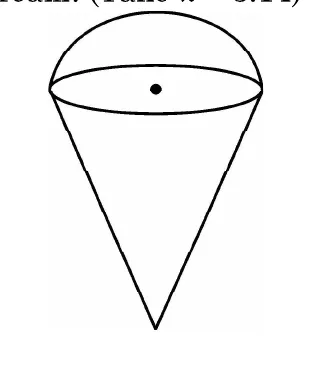
(b) An empty cone is of radius 33 cm and height 1212 cm. Ice-cream is filled in it so that lower part of the cone which is (16)th\left(\dfrac{1}{6}\right)^{\text{th}} of the volume of the cone is unfilled but hemisphere is formed on the top. Find volume of the ice-cream. (Take π=3.14\pi = 3.14)

An ice-cream cone drawn upside-down as a cone with its point at the bottom and a hemispherical dome of ice-cream on top.
Solution
  1. (a) Let the radius of the hemisphere be rr. The height of the cylinder is h=2rh = 2r.
  2. Volume of air =πr2h+23πr3=2πr3+23πr3=83πr3=140821= \pi r^2 h + \dfrac{2}{3}\pi r^3 = 2\pi r^3 + \dfrac{2}{3}\pi r^3 = \dfrac{8}{3}\pi r^3 = \dfrac{1408}{21}.
  3. 83×227×r3=140821\dfrac{8}{3} \times \dfrac{22}{7} \times r^3 = \dfrac{1408}{21}, so r3=140821×21176=8r^3 = \dfrac{1408}{21} \times \dfrac{21}{176} = 8 and r=2r = 2 m. Then h=4h = 4 m.
  4. Total height =h+r=4+2=6= h + r = 4 + 2 = 6 m.
  5. (b) Volume of the cone =13π×32×12=36π= \dfrac{1}{3}\pi \times 3^2 \times 12 = 36\pi cm³. The filled part is 56\dfrac{5}{6} of it: 30π30\pi cm³.
  6. The hemisphere on top has radius 33 cm: 23π×27=18π\dfrac{2}{3}\pi \times 27 = 18\pi cm³.
  7. Ice-cream =30π+18π=48π=48×3.14=150.72= 30\pi + 18\pi = 48\pi = 48 \times 3.14 = 150.72 cm³.

Answer: (a) 66 m   (b) 150.72150.72 cm³

Report an error on this question

Section D: Long answer

4 questions, 5 marks each.

Q32Triangles5 marks

If a line is drawn parallel to one side of a triangle to intersect the other two sides at distinct points, prove that the other two sides are divided in the same ratio.

Solution
  1. Given: △ABC\triangle ABC with DE∥BCDE \parallel BC, DD on ABAB and EE on ACAC. To prove: ADDB=AEEC\dfrac{AD}{DB} = \dfrac{AE}{EC}.
  2. Construction: join BEBE and CDCD; draw DM⊥ACDM \perp AC and EN⊥ABEN \perp AB.
  3. ar(ADE)ar(BDE)=12⋅AD⋅EN12⋅DB⋅EN=ADDB\dfrac{\text{ar}(ADE)}{\text{ar}(BDE)} = \dfrac{\frac{1}{2} \cdot AD \cdot EN}{\frac{1}{2} \cdot DB \cdot EN} = \dfrac{AD}{DB} and ar(ADE)ar(CDE)=12⋅AE⋅DM12⋅EC⋅DM=AEEC\dfrac{\text{ar}(ADE)}{\text{ar}(CDE)} = \dfrac{\frac{1}{2} \cdot AE \cdot DM}{\frac{1}{2} \cdot EC \cdot DM} = \dfrac{AE}{EC}.
  4. △BDE\triangle BDE and △CDE\triangle CDE are on the same base DEDE and between the same parallels DEDE and BCBC, so ar(BDE)=ar(CDE)\text{ar}(BDE) = \text{ar}(CDE).
  5. Therefore ADDB=AEEC\dfrac{AD}{DB} = \dfrac{AE}{EC}.

Answer: Basic Proportionality Theorem proved

Report an error on this question
Q33Applications of Trigonometry5 marks

(a) The angle of elevation of the top of a tower 2424 m high from the foot of another tower in the same plane is 60∘60^\circ. The angle of elevation of the top of second tower from the foot of the first tower is 30∘30^\circ. Find the distance between two towers and the height of the other tower. Also, find the length of the wire attached to the tops of both the towers.

OR

(b) A spherical balloon of radius rr subtends an angle of 60∘60^\circ at the eye of an observer. If the angle of elevation of its centre is 45∘45^\circ from the same point, then prove that height of the centre of the balloon is 2\sqrt{2} times its radius.

Solution
60°30°24 m8√3 m8 mBADCEwire AC = √(16² + (8√3)²) = √448 = 8√7 m
45°BOGOB = 2r (half-angle 30°); height OG = OB sin 45° = √2 r
  1. (a) Let AB=24AB = 24 m be the first tower and CD=hCD = h the second, with BD=xBD = x between their feet.
  2. From the foot DD of the second tower, the top AA of the first is at 60∘60^\circ: tan⁡60∘=24x\tan 60^\circ = \dfrac{24}{x}, so x=243=83x = \dfrac{24}{\sqrt{3}} = 8\sqrt{3} m.
  3. From the foot BB of the first tower, the top CC of the second is at 30∘30^\circ: tan⁡30∘=hx\tan 30^\circ = \dfrac{h}{x}, so h=833=8h = \dfrac{8\sqrt{3}}{\sqrt{3}} = 8 m.
  4. Wire ACAC: the vertical difference of the tops is 24−8=1624 - 8 = 16 m. AC=162+(83)2=256+192=448=87AC = \sqrt{16^2 + (8\sqrt{3})^2} = \sqrt{256 + 192} = \sqrt{448} = 8\sqrt{7} m.
  5. (b) The observer is at BB and the balloon has centre OO and radius rr. The two tangent lines from BB make 60∘60^\circ, and BOBO bisects it: the angle between BOBO and a tangent line is 30∘30^\circ.
  6. The radius to the point of contact is perpendicular to the tangent line, so sin⁡30∘=rOB\sin 30^\circ = \dfrac{r}{OB} and OB=2rOB = 2r. … (i)
  7. The centre is at an elevation of 45∘45^\circ: the height OAOA of the centre above the ground level satisfies sin⁡45∘=OAOB\sin 45^\circ = \dfrac{OA}{OB}, so OA=OB2OA = \dfrac{OB}{\sqrt{2}}. … (ii)
  8. From (i) and (ii): OA=2r2=2 rOA = \dfrac{2r}{\sqrt{2}} = \sqrt{2}\,r.

Answer: (a) distance 838\sqrt{3} m, height 88 m, wire 878\sqrt{7} m   (b) proved

Report an error on this question
Q34Areas Related to Circles5 marks

A chord of a circle of radius 1414 cm subtends an angle of 60∘60^\circ at the centre. Find the area of the corresponding minor segment of the circle. Also find the area of the major segment of the circle.

Solution
60°OABminor segmentmajor segmentminor = 308/3 − 49√3 ≈ 17.9; major = circle − minor ≈ 598.1 cm²
  1. Sector area =60360×227×14×14=3083= \dfrac{60}{360} \times \dfrac{22}{7} \times 14 \times 14 = \dfrac{308}{3} cm².
  2. The triangle OABOAB has OA=OBOA = OB and an angle of 60∘60^\circ, so it is equilateral with side 1414: area =34×142=493= \dfrac{\sqrt{3}}{4} \times 14^2 = 49\sqrt{3} cm².
  3. Minor segment =3083−493= \dfrac{308}{3} - 49\sqrt{3} cm² ≈17.9\approx 17.9 cm².
  4. Area of the circle =227×14×14=616= \dfrac{22}{7} \times 14 \times 14 = 616 cm². Major segment =616−(3083−493)=15403+493= 616 - \left(\dfrac{308}{3} - 49\sqrt{3}\right) = \dfrac{1540}{3} + 49\sqrt{3} cm² ≈598.1\approx 598.1 cm².

Answer: Minor segment (3083−493)≈17.9\left(\dfrac{308}{3} - 49\sqrt{3}\right) \approx 17.9 cm²; major segment (15403+493)≈598.1\left(\dfrac{1540}{3} + 49\sqrt{3}\right) \approx 598.1 cm²

Report an error on this question
Q35Arithmetic Progressions5 marks

(a) The ratio of the 11th11^{\text{th}} term to 17th17^{\text{th}} term of an A.P. is 3:43 : 4. Find the ratio of 5th5^{\text{th}} term to 21st21^{\text{st}} term of the same A.P. Also, find the ratio of the sum of first 55 terms to that of first 2121 terms.

OR

(b) 250250 logs are stacked in the following manner: 2222 logs in the bottom row, 2121 in the next row, 2020 in the row next to it and so on (as shown by an example). In how many rows, are the 250250 logs placed and how many logs are there in the top row?

Solution
  1. (a) a+10da+16d=34\dfrac{a + 10d}{a + 16d} = \dfrac{3}{4}, so 4a+40d=3a+48d4a + 40d = 3a + 48d and a=8da = 8d.
  2. a5a21=a+4da+20d=12d28d=37\dfrac{a_5}{a_{21}} = \dfrac{a + 4d}{a + 20d} = \dfrac{12d}{28d} = \dfrac{3}{7}.
  3. S5S21=52(2a+4d)212(2a+20d)=5×20d21×36d=25189\dfrac{S_5}{S_{21}} = \dfrac{\frac{5}{2}(2a + 4d)}{\frac{21}{2}(2a + 20d)} = \dfrac{5 \times 20d}{21 \times 36d} = \dfrac{25}{189}.
  4. (b) The rows form an A.P.: 22,21,20,…22, 21, 20, \dots with a=22a = 22, d=−1d = -1 and Sn=250S_n = 250.
  5. n2[44−(n−1)]=250\dfrac{n}{2}[44 - (n - 1)] = 250, so n(45−n)=500n(45 - n) = 500 and n2−45n+500=0n^2 - 45n + 500 = 0, giving (n−25)(n−20)=0(n - 25)(n - 20) = 0.
  6. n=25n = 25 would make the top row 22−24=−222 - 24 = -2 logs, which is not possible. So n=20n = 20 rows and the top row has a20=22−19=3a_{20} = 22 - 19 = 3 logs.

Answer: (a) 3:73 : 7 and 25:18925 : 189   (b) 2020 rows; 33 logs in the top row

Common mistake: In (b), keeping n = 25. A row cannot have negative logs, so n = 20.

Report an error on this question

Section E: Case studies

3 case studies, 4 marks each.

Q36Quadratic Equations4 marks

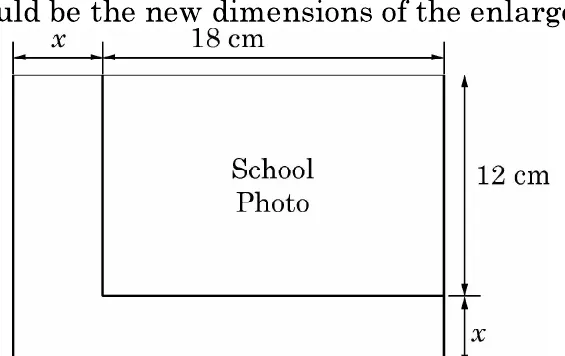
Case study 1. While designing the school year book, a teacher asked the student that the length and width of a particular photo is increased by x units each to double the area of the photo. The original photo is 18 cm long and 12 cm wide.

Based on the above information, answer the following questions:

(I) Write an algebraic equation depicting the above information. [1]

(II) Write the corresponding quadratic equation in standard form. [1]

(III) What should be the new dimensions of the enlarged photo? [2]

OR

(III) Can any rational value of x make the new area equal to 220 cm²? [2]

A rectangle for the school photo, 18 cm long and 12 cm wide, placed inside a bigger rectangle that is x units larger on the left and at the bottom.
Solution
ABCDphoto 18 × 12x(18 + x)(12 + x) = 2 × 18 × 12 = 432 → x = 6 → 24 cm × 18 cm
  1. (I) New length =18+x= 18 + x and new width =12+x= 12 + x. The area is doubled: (18+x)(12+x)=2×18×12=432(18 + x)(12 + x) = 2 \times 18 \times 12 = 432.
  2. (II) 216+30x+x2=432216 + 30x + x^2 = 432, so x2+30x−216=0x^2 + 30x - 216 = 0.
  3. (III) (x+36)(x−6)=0(x + 36)(x - 6) = 0. A length is positive, so x=6x = 6. The new dimensions are 2424 cm ×\times 1818 cm.
  4. (III) OR: if (18+x)(12+x)=220(18 + x)(12 + x) = 220, then x2+30x+216−220=0x^2 + 30x + 216 - 220 = 0, that is x2+30x−4=0x^2 + 30x - 4 = 0.
  5. D=900+16=916D = 900 + 16 = 916, which is not a perfect square, so xx cannot be rational. No rational xx gives the area 220220 cm².

Answer: (I) (18+x)(12+x)=432(18 + x)(12 + x) = 432   (II) x2+30x−216=0x^2 + 30x - 216 = 0   (III) 2424 cm ×\times 1818 cm; OR no rational xx

Report an error on this question
Q37Statistics4 marks

Case study 2. India meteorological department observes seasonal and annual rainfall every year in different sub-divisions of our country. It helps them to compare and analyse the results. The table given below shows sub-division wise seasonal (monsoon) rainfall (mm) in 2018:

Based on the above information, answer the following questions:

(I) Write the modal class. [1]

(II) Find the median of the given data. [2]

OR

(II) Find the mean rainfall in this season. [2]

(III) If sub-division having at least 1000 mm rainfall during monsoon season, is considered good rainfall sub-division, then how many sub-divisions had good rainfall? [1]

Rainfall (mm)Number of Sub-divisions
200 – 4002
400 – 6004
600 – 8007
800 – 10004
1000 – 12002
1200 – 14003
1400 – 16001
1600 – 18001
Solution
2004006008001000120014001600180012345678Ommy24742311median ≈ 771.4
Modal and median class: 600 – 800.
  1. (I) The highest frequency is 77, so the modal class is 600−800600 - 800.
  2. (II) Cumulative frequencies: 2,6,13,17,19,22,23,242, 6, 13, 17, 19, 22, 23, 24. N=24N = 24, N2=12\dfrac{N}{2} = 12, so the median class is 600−800600 - 800 (l=600l = 600, cf=6cf = 6, f=7f = 7, h=200h = 200).
  3. Median =600+12−67×200=600+12007=54007≈771.4= 600 + \dfrac{12 - 6}{7} \times 200 = 600 + \dfrac{1200}{7} = \dfrac{5400}{7} \approx 771.4 mm.
  4. (II) OR: Class marks 300,500,…,1700300, 500, \dots, 1700 with frequencies 2,4,7,4,2,3,1,12, 4, 7, 4, 2, 3, 1, 1: ∑fixi=600+2000+4900+3600+2200+3900+1500+1700=20400\sum f_i x_i = 600 + 2000 + 4900 + 3600 + 2200 + 3900 + 1500 + 1700 = 20400. Mean =2040024=850= \dfrac{20400}{24} = 850 mm.
  5. (III) At least 10001000 mm: 2+3+1+1=72 + 3 + 1 + 1 = 7 sub-divisions.

Answer: (I) 600−800600 - 800   (II) median ≈771.4\approx 771.4 mm (or mean 850850 mm)   (III) 77

Report an error on this question
Q38Circles4 marks

Case study 3. The discus throw is an event in which an athlete attempts to throw a discus. The athlete spins anti-clockwise around one and a half times through a circle, then releases the throw. When released, the discus travels along tangent to the circular spin orbit.

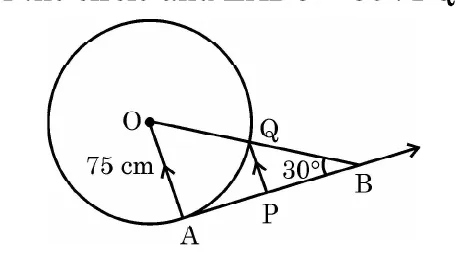
In the given figure, AB is one such tangent to a circle of radius 75 cm. Point O is centre of the circle and ∠ABO = 30°. PQ is parallel to OA.

Based on above information:

(a) find the length of AB. [1]

(b) find the length of OB. [1]

(c) find the length of AP. [2]

OR

find the length of PQ. [2]

A circle of radius 75 cm with centre O, the tangent AB touching at A, and the line OB. Q is on OB and P is on AB with PQ parallel to OA. The angle ABO is 30 degrees.
Solution
30°OBAQPAB = 75√3, OB = 150, AP = 75√3/2, PQ = 37.5 cm
  1. OA⊥ABOA \perp AB (radius and tangent), so △OAB\triangle OAB is right-angled at AA with OA=75OA = 75 cm and ∠B=30∘\angle B = 30^\circ.
  2. (a) tan⁡30∘=OAAB\tan 30^\circ = \dfrac{OA}{AB}, so 13=75AB\dfrac{1}{\sqrt{3}} = \dfrac{75}{AB} and AB=753AB = 75\sqrt{3} cm.
  3. (b) sin⁡30∘=OAOB\sin 30^\circ = \dfrac{OA}{OB}, so 12=75OB\dfrac{1}{2} = \dfrac{75}{OB} and OB=150OB = 150 cm.
  4. (c) QQ lies on the circle, so OQ=75OQ = 75 and QB=150−75=75QB = 150 - 75 = 75 cm: QQ is the mid-point of OBOB. Since PQ∥OAPQ \parallel OA, PP is the mid-point of ABAB, so AP=7532AP = \dfrac{75\sqrt{3}}{2} cm.
  5. OR: PQPQ joins the mid-points of ABAB and OBOB in △OAB\triangle OAB, so PQ=12OA=37.5PQ = \dfrac{1}{2}OA = 37.5 cm.

Answer: (a) 75375\sqrt{3} cm   (b) 150150 cm   (c) 7532\dfrac{75\sqrt{3}}{2} cm; OR PQ=37.5PQ = 37.5 cm

Report an error on this question

Questions are from the official CBSE paper. Figures are described in words; see the PDF for the originals. Solutions are written by CogniGuru.

Revise this paper in 1 minute a chapter

Each chapter below is what the paper tested, with a one-minute animated lesson on the idea behind it.

Stuck on a step in any solution?

The CogniGuru AI tutor explains any doubt one minute at a time, in English or Hindi. Join the waitlist.

Mock quiz: 5 questions from this paper

Five real questions from this paper, one each from five chapters. About 2 minutes. See how much you know and where you stand among other students. Attempt free, with no login; log in only for your ranking and full report.

Question 1 of 5 · Q2 of the paperLinear Equations

The value of kk for which the pair of equations kx=y+2kx = y + 2 and 6x=2y+36x = 2y + 3 has infinitely many solutions,

0 of 5 answered

Related papers

  • Maths Standard 2022Coming soon
  • Maths Standard 2024
  • Maths Basic 2023Coming soon
  • Science 2023Coming soon

Common questions

Are these the official CBSE Class 10 Maths Standard 2023 questions?
Yes. The questions are from the official Mathematics (Standard) paper (set 30/1/1) that CBSE published after the March 2023 board exam. The solutions are written by CogniGuru and checked against the answer key CBSE published for this paper code.
Can I download the CBSE Class 10 Maths Standard 2023 question paper PDF?
Yes, the official paper PDF is free to download from this page, and so are our step-by-step solutions as a PDF. No login is needed to download either or to read the solutions.
Do all sets of the paper have the same questions?
No. CBSE sets several versions of each paper, with the same blueprint and similar questions in a different order and sometimes with different numbers. This page covers set 30/1/1.
How does the quiz work, and what does “where you stand” mean?
It is a mock quiz of 5 real multiple-choice questions from this paper, scored automatically in about 2 minutes. Your score is compared, anonymously, with other students who took the same quiz. Only the score is stored with the comparison, never your name or number.

Source

CBSE question paper archive, Class X, 2023 (Mathematics (Standard), set 30/1/1)
PDF