CBSE · Class 10 · Mathematics (Basic) · Free

CBSE Class 10 Maths Basic 2024 Question Paper (Set 430/1/3) with Solutions

The official board paper (Q.P. Code 430/1/3, Series C3ABD/1). Free paper PDF and step-by-step solutions (also as a PDF to download) written by CogniGuru and checked against CBSE’s answer key. See the paper’s main topics in 1 minute, then quiz yourself to see how much you know and where you stand.

No login to download or read the solutions. Login only to see your quiz report in full.

Board
CBSE
Class
10
Subject
Maths Basic (241)
Year
2024
Set code
430/1/3
Max marks
80
Duration
3 hours
Questions
38 (Sections A to E)
Source
Official CBSE paper
Exam date
March 2024

Paper preview

Three pages of the official paper. Download the PDF for all 16.
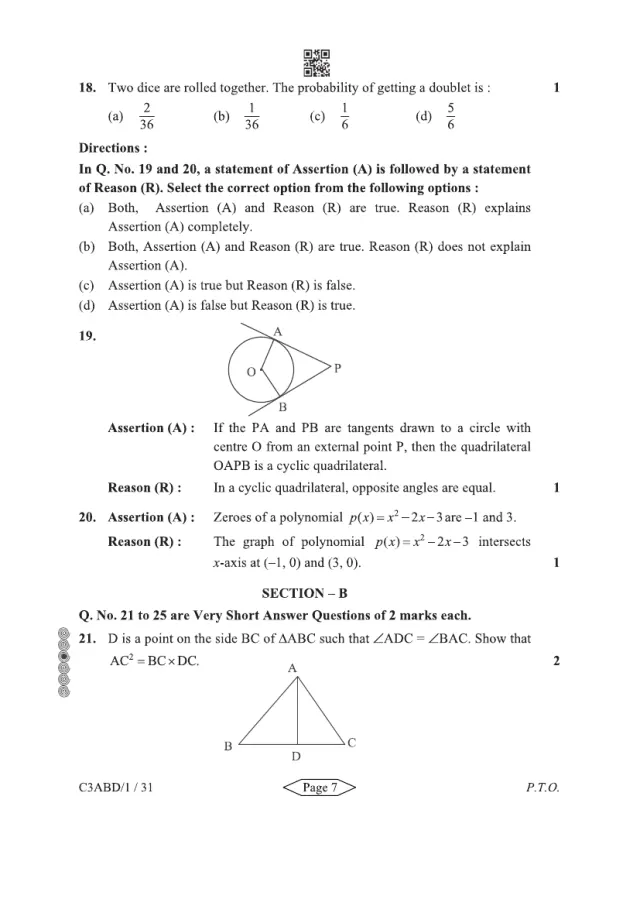
  • Cover page of the CBSE Class 10 Maths Basic 2024 paper, set 430/1/3

    Cover page

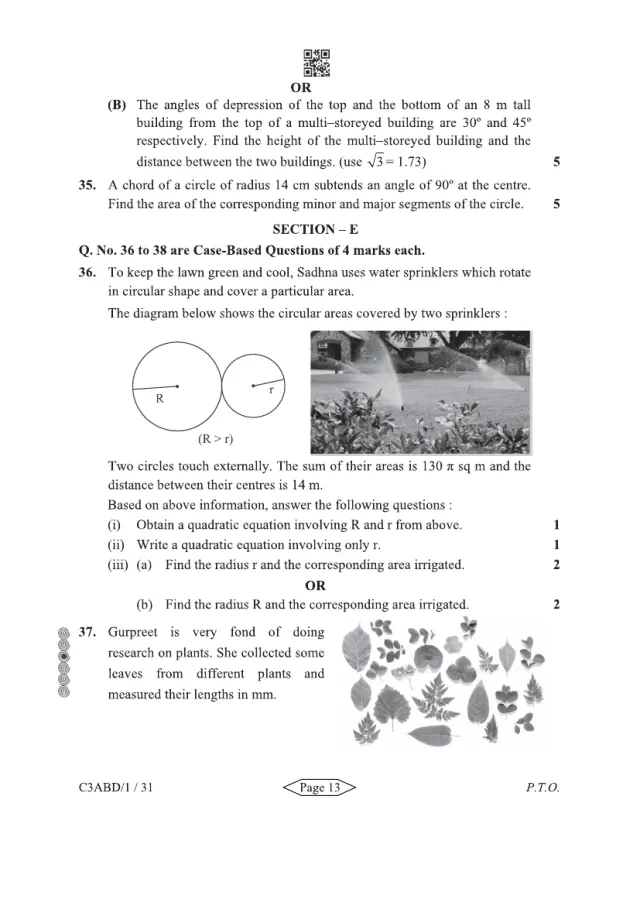
  • Section B of the CBSE Class 10 Maths Basic 2024 paper, set 430/1/3

    Section B

  • A case study with its figure from the CBSE Class 10 Maths Basic 2024 paper, set 430/1/3

    Case study

The main topics of this paper, in 1 minute

Your tutor walks you through the paper before you attempt it: the marks, the key ideas, the time plan and the traps.

1-minute paper analysis

With your tutor, in her voice

The main topics of this paper, in about a minute

A short, animated walk through the paper: how it is built, where the marks come from, the four ideas that matter most, how to plan your three hours, and the traps to avoid.

  1. 1The paper at a glance
  2. 2Where the marks come from
  3. 3Four ideas that keep paying off
  4. 4Plan your three hours
  5. 5Four traps to avoid

Sound on for the voice. Captions are shown, and you can mute any time.

Step-by-step solutions

Try each question first, then open its solution. Tap a number to jump.

Download solutions (PDF)

Section A: Multiple choice

20 questions, 1 mark each. MCQs (Q1 to Q18) and assertion-reason (Q19, Q20).

Q1Polynomials1 mark

For what value of kk, the product of zeroes of the polynomial kx2−4x−7kx^2 - 4x - 7 is 22?

  1. (A)−114-\dfrac{1}{14}
  2. (B)−72-\dfrac{7}{2}
  3. (C)72\dfrac{7}{2}
  4. (D)−27-\dfrac{2}{7}
Solution · answer (B)
  1. Product of zeroes =ca=−7k=2= \dfrac{c}{a} = \dfrac{-7}{k} = 2, so k=−72k = -\dfrac{7}{2}.

Answer: (B) −72-\dfrac{7}{2}

Report an error on this question
Q2Arithmetic Progressions1 mark

In an A.P., if a=8a = 8 and a10=−19a_{10} = -19, then value of dd is:

  1. (A)3
  2. (B)−119-\dfrac{11}{9}
  3. (C)−2710-\dfrac{27}{10}
  4. (D)−3
Solution · answer (D)
  1. a10=a+9da_{10} = a + 9d: −19=8+9d-19 = 8 + 9d, so 9d=−279d = -27 and d=−3d = -3.

Answer: (D) −3

Report an error on this question
Q3Coordinate Geometry1 mark

The mid-point of the line segment joining the points (−1,3)(-1, 3) and (8,32)\left(8, \dfrac{3}{2}\right) is:

  1. (A)(72,−34)\left(\dfrac{7}{2}, -\dfrac{3}{4}\right)
  2. (B)(72,92)\left(\dfrac{7}{2}, \dfrac{9}{2}\right)
  3. (C)(92,−34)\left(\dfrac{9}{2}, -\dfrac{3}{4}\right)
  4. (D)(72,94)\left(\dfrac{7}{2}, \dfrac{9}{4}\right)
Solution · answer (D)
  1. (−1+82,3+322)=(72,94)\left(\dfrac{-1 + 8}{2}, \dfrac{3 + \frac{3}{2}}{2}\right) = \left(\dfrac{7}{2}, \dfrac{9}{4}\right).

Answer: (D) (72,94)\left(\dfrac{7}{2}, \dfrac{9}{4}\right)

Report an error on this question
Q4Trigonometry1 mark

If sin⁡θ=13\sin\theta = \dfrac{1}{3}, then sec⁡θ\sec\theta is equal to:

  1. (A)223\dfrac{2\sqrt{2}}{3}
  2. (B)322\dfrac{3}{2\sqrt{2}}
  3. (C)3
  4. (D)13\dfrac{1}{\sqrt{3}}
Solution · answer (B)
  1. cos⁡θ=1−19=223\cos\theta = \sqrt{1 - \dfrac{1}{9}} = \dfrac{2\sqrt{2}}{3}, so sec⁡θ=322\sec\theta = \dfrac{3}{2\sqrt{2}}.

Answer: (B) 322\dfrac{3}{2\sqrt{2}}

Report an error on this question
Q5Real Numbers1 mark

HCF(132,77)\text{HCF}(132, 77) is:

  1. (A)11
  2. (B)77
  3. (C)22
  4. (D)44
Solution · answer (A)
  1. 132=22×3×11132 = 2^2 \times 3 \times 11 and 77=7×1177 = 7 \times 11. The common prime is 1111: HCF =11= 11.

Answer: (A) 11

Report an error on this question
Q6Quadratic Equations1 mark

If the roots of quadratic equation 4x2−5x+k=04x^2 - 5x + k = 0 are real and equal, then value of kk is:

  1. (A)54\dfrac{5}{4}
  2. (B)2516\dfrac{25}{16}
  3. (C)−54-\dfrac{5}{4}
  4. (D)−2516-\dfrac{25}{16}
Solution · answer (B)
  1. Equal roots need D=25−16k=0D = 25 - 16k = 0, so k=2516k = \dfrac{25}{16}.

Answer: (B) 2516\dfrac{25}{16}

Report an error on this question
Q7Probability1 mark

If probability of winning a game is p, then probability of losing the game is:

  1. (A)1+p1 + p
  2. (B)−p-p
  3. (C)p−1p - 1
  4. (D)1−p1 - p
Solution · answer (D)
  1. Losing is the complement of winning: P=1−pP = 1 - p.

Answer: (D) 1−p1 - p

Report an error on this question
Q8Coordinate Geometry1 mark

The distance between the points (2,−3)(2, -3) and (−2,3)(-2, 3) is:

  1. (A)2132\sqrt{13} units
  2. (B)5 units
  3. (C)13213\sqrt{2} units
  4. (D)10 units
Solution · answer (A)
  1. d=(2+2)2+(−3−3)2=16+36=52=213d = \sqrt{(2 + 2)^2 + (-3 - 3)^2} = \sqrt{16 + 36} = \sqrt{52} = 2\sqrt{13}.

Answer: (A) 2132\sqrt{13} units

Report an error on this question
Q9Trigonometry1 mark

For what value of θ\theta, sin⁡2θ+sin⁡θ+cos⁡2θ\sin^2\theta + \sin\theta + \cos^2\theta is equal to 22?

  1. (A)45∘45^\circ
  2. (B)0∘0^\circ
  3. (C)90∘90^\circ
  4. (D)30∘30^\circ
Solution · answer (C)
  1. sin⁡2θ+cos⁡2θ=1\sin^2\theta + \cos^2\theta = 1, so the expression is 1+sin⁡θ=21 + \sin\theta = 2, giving sin⁡θ=1\sin\theta = 1 and θ=90∘\theta = 90^\circ.

Answer: (C) 90∘90^\circ

Report an error on this question
Q10Probability1 mark

A card is drawn from a well shuffled deck of 52 playing cards. The probability that drawn card is a red queen, is:

  1. (A)113\dfrac{1}{13}
  2. (B)213\dfrac{2}{13}
  3. (C)152\dfrac{1}{52}
  4. (D)126\dfrac{1}{26}
Solution · answer (D)
  1. There are 22 red queens (hearts and diamonds). P=252=126P = \dfrac{2}{52} = \dfrac{1}{26}.

Answer: (D) 126\dfrac{1}{26}

Report an error on this question
Q11Statistics1 mark

If a certain variable x divides a statistical data arranged in order into two equal parts; then the value of x is called the:

  1. (A)mean
  2. (B)median
  3. (C)mode
  4. (D)range of the data
Solution · answer (B)
  1. The value that divides ordered data into two equal halves is the median.

Answer: (B) median

Report an error on this question
Q12Surface Areas and Volumes1 mark

The radius of a sphere is 72\dfrac{7}{2} cm. The volume of the sphere is:

  1. (A)2313\dfrac{231}{3} cu cm
  2. (B)53912\dfrac{539}{12} cu cm
  3. (C)5393\dfrac{539}{3} cu cm
  4. (D)154 cu cm
Solution · answer (C)
  1. V=43πr3=43×227×3438=5393V = \dfrac{4}{3}\pi r^3 = \dfrac{4}{3} \times \dfrac{22}{7} \times \dfrac{343}{8} = \dfrac{539}{3} cm³.

Answer: (C) 5393\dfrac{539}{3} cu cm

Report an error on this question
Q13Statistics1 mark

The mean and median of a statistical data are 21 and 23 respectively. The mode of the data is:

  1. (A)27
  2. (B)22
  3. (C)17
  4. (D)23
Solution · answer (A)
  1. Mode=3 Median−2 Mean=69−42=27\text{Mode} = 3\,\text{Median} - 2\,\text{Mean} = 69 - 42 = 27.

Answer: (A) 27

Report an error on this question
Q14Surface Areas and Volumes1 mark

The height and radius of a right circular cone are 2424 cm and 77 cm respectively. The slant height of the cone is:

  1. (A)24 cm
  2. (B)31 cm
  3. (C)26 cm
  4. (D)25 cm
Solution · answer (D)
  1. l=242+72=576+49=625=25l = \sqrt{24^2 + 7^2} = \sqrt{576 + 49} = \sqrt{625} = 25 cm.

Answer: (D) 25 cm

Report an error on this question
Q15Polynomials1 mark

If one of the zeroes of the quadratic polynomial (α−1)x2+αx+1(\alpha - 1)x^2 + \alpha x + 1 is −3-3, then the value of α\alpha is:

  1. (A)−23-\dfrac{2}{3}
  2. (B)23\dfrac{2}{3}
  3. (C)43\dfrac{4}{3}
  4. (D)34\dfrac{3}{4}
Solution · answer (C)
  1. (α−1)(9)−3α+1=0(\alpha - 1)(9) - 3\alpha + 1 = 0 gives 9α−9−3α+1=09\alpha - 9 - 3\alpha + 1 = 0, so 6α=86\alpha = 8 and α=43\alpha = \dfrac{4}{3}.

Answer: (C) 43\dfrac{4}{3}

Report an error on this question
Q16Coordinate Geometry1 mark

The diameter of a circle is of length 66 cm. If one end of the diameter is (−4,0)(-4, 0), the other end on xx-axis is at:

  1. (A)(0, 2)
  2. (B)(6, 0)
  3. (C)(2, 0)
  4. (D)(4, 0)
Solution · answer (C)
  1. The other end lies on the xx-axis, at distance 66 from (−4,0)(-4, 0): (−4+6,0)=(2,0)(-4 + 6, 0) = (2, 0) (or (−10,0)(-10, 0), which is not in the options).

Answer: (C) (2, 0)

Report an error on this question
Q17Linear Equations1 mark

The value of kk for which the pair of linear equations 5x+2y−7=05x + 2y - 7 = 0 and 2x+ky+1=02x + ky + 1 = 0 don’t have a solution, is:

  1. (A)5
  2. (B)45\dfrac{4}{5}
  3. (C)54\dfrac{5}{4}
  4. (D)52\dfrac{5}{2}
Solution · answer (B)
  1. No solution needs 52=2k≠−71\dfrac{5}{2} = \dfrac{2}{k} \neq \dfrac{-7}{1}. 52=2k\dfrac{5}{2} = \dfrac{2}{k} gives k=45k = \dfrac{4}{5}, and the third ratio −7-7 is different ✓.

Answer: (B) 45\dfrac{4}{5}

Report an error on this question
Q18Probability1 mark

Two dice are rolled together. The probability of getting a doublet is:

  1. (A)236\dfrac{2}{36}
  2. (B)136\dfrac{1}{36}
  3. (C)16\dfrac{1}{6}
  4. (D)56\dfrac{5}{6}
Solution · answer (C)
  1. A doublet means both dice show the same number: (1,1),(2,2),…,(6,6)(1,1), (2,2), \dots, (6,6), which is 66 of 3636. P=16P = \dfrac{1}{6}.

Answer: (C) 16\dfrac{1}{6}

Report an error on this question
Q19Circles1 mark

Assertion (A): If the PAPA and PBPB are tangents drawn to a circle with centre OO from an external point PP, then the quadrilateral OAPBOAPB is a cyclic quadrilateral.

Reason (R): In a cyclic quadrilateral, opposite angles are equal.
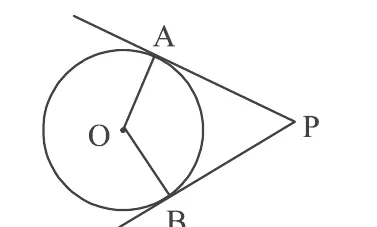
A circle with centre O and the outside point P on the right. Tangents PA and PB touch the circle at A (top) and B (bottom), and the radii OA and OB are drawn.
  1. (A)Both A and R are true and R explains A completely
  2. (B)Both A and R are true, but R does not explain A
  3. (C)A is true but R is false
  4. (D)A is false but R is true
Solution · answer (C)
  1. (A) ∠OAP=∠OBP=90∘\angle OAP = \angle OBP = 90^\circ (radius and tangent), so ∠A+∠B=180∘\angle A + \angle B = 180^\circ for the opposite angles at AA and BB of OAPBOAPB. A quadrilateral with a pair of supplementary opposite angles is cyclic. True.
  2. (R) In a cyclic quadrilateral the opposite angles are supplementary (they add to 180∘180^\circ), not equal. False.

Answer: (C) A is true but R is false

Report an error on this question
Q20Polynomials1 mark

Assertion (A): Zeroes of a polynomial p(x)=x2−2x−3p(x) = x^2 - 2x - 3 are −1-1 and 33.

Reason (R): The graph of polynomial p(x)=x2−2x−3p(x) = x^2 - 2x - 3 intersects xx-axis at (−1,0)(-1, 0) and (3,0)(3, 0).

  1. (A)Both A and R are true and R explains A completely
  2. (B)Both A and R are true, but R does not explain A
  3. (C)A is true but R is false
  4. (D)A is false but R is true
Solution · answer (A)
  1. (A) x2−2x−3=(x+1)(x−3)x^2 - 2x - 3 = (x + 1)(x - 3), so the zeroes are −1-1 and 33. True.
  2. (R) The zeroes are exactly the xx-values where the graph meets the xx-axis, so it meets it at (−1,0)(-1, 0) and (3,0)(3, 0). True, and this is the reason for (A).

Answer: (A) Both A and R are true and R explains A completely

Report an error on this question

Section B: Very short answer

5 questions, 2 marks each.

Q21Triangles2 marks

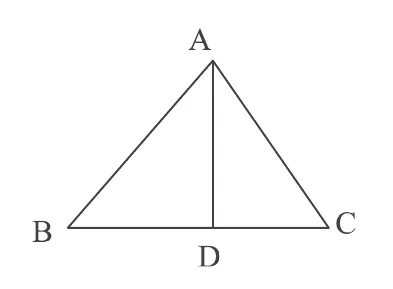
DD is a point on the side BCBC of △ABC\triangle ABC such that ∠ADC=∠BAC\angle ADC = \angle BAC. Show that AC2=BC×DCAC^2 = BC \times DC.

A triangle ABC with A at the top and the base BC. D is a point on BC and AD is drawn as a vertical line.
Solution
  1. In △ADC\triangle ADC and △BAC\triangle BAC: ∠ADC=∠BAC\angle ADC = \angle BAC (given) and ∠C\angle C is common.
  2. So △ADC∼△BAC\triangle ADC \sim \triangle BAC by AA, and ACBC=DCAC\dfrac{AC}{BC} = \dfrac{DC}{AC}. Hence AC2=BC×DCAC^2 = BC \times DC.

Answer: Shown

Report an error on this question
Q22Linear Equations2 marks

(A) Solve the following pair of linear equations for xx and yy algebraically: x+2y=9x + 2y = 9 and y−2x=2y - 2x = 2.

OR

(B) Check whether the point (−4,3)(-4, 3) lies on both the lines represented by the linear equations x+y+1=0x + y + 1 = 0 and x−y=1x - y = 1.

Solution
  1. (A) From the second equation y=2x+2y = 2x + 2. Substituting, x+4x+4=9x + 4x + 4 = 9, so x=1x = 1 and y=4y = 4. (Check: 1+8=91 + 8 = 9 ✓.)
  2. (B) x+y+1x + y + 1 at (−4,3)(-4, 3): −4+3+1=0-4 + 3 + 1 = 0 ✓, so it lies on the first line. x−y=−4−3=−7≠1x - y = -4 - 3 = -7 \neq 1, so it does not lie on the second.

Answer: (A) x=1x = 1, y=4y = 4   (B) on the first line only

Report an error on this question
Q23Real Numbers2 marks

(A) Prove that 6−456 - 4\sqrt{5} is an irrational number, given that 5\sqrt{5} is an irrational number.

OR

(B) Show that 11×19×23+3×1111 \times 19 \times 23 + 3 \times 11 is not a prime number.

Solution
  1. (A) Suppose 6−45=x6 - 4\sqrt{5} = x is rational. Then 5=6−x4\sqrt{5} = \dfrac{6 - x}{4}, a rational number, which contradicts the given fact. So 6−456 - 4\sqrt{5} is irrational.
  2. (B) 11×19×23+3×11=11(19×23+3)=11×44011 \times 19 \times 23 + 3 \times 11 = 11(19 \times 23 + 3) = 11 \times 440. It has more than two factors, so it is not prime.

Answer: (A) proved   (B) =11×440= 11 \times 440, not prime

Report an error on this question
Q24Trigonometry2 marks

Evaluate: sin⁡Acos⁡B+cos⁡Asin⁡B\sin A\cos B + \cos A\sin B; if A=30∘A = 30^\circ and B=45∘B = 45^\circ.

Solution
  1. sin⁡30∘=12\sin 30^\circ = \dfrac{1}{2}, cos⁡45∘=12\cos 45^\circ = \dfrac{1}{\sqrt{2}}, cos⁡30∘=32\cos 30^\circ = \dfrac{\sqrt{3}}{2}, sin⁡45∘=12\sin 45^\circ = \dfrac{1}{\sqrt{2}}.
  2. 12×12+32×12=1+322\dfrac{1}{2} \times \dfrac{1}{\sqrt{2}} + \dfrac{\sqrt{3}}{2} \times \dfrac{1}{\sqrt{2}} = \dfrac{1 + \sqrt{3}}{2\sqrt{2}}. (This equals sin⁡75∘\sin 75^\circ.)

Answer: 3+122\dfrac{\sqrt{3} + 1}{2\sqrt{2}}

Report an error on this question
Q25Probability2 marks

A bag contains 44 red, 55 white and some yellow balls. If probability of drawing a red ball at random is 15\dfrac{1}{5}, then find the probability of drawing a yellow ball.

Solution
  1. Let there be nn yellow balls: total =9+n= 9 + n. P(red)=49+n=15P(\text{red}) = \dfrac{4}{9 + n} = \dfrac{1}{5}, so 9+n=209 + n = 20 and n=11n = 11.
  2. P(yellow)=1120P(\text{yellow}) = \dfrac{11}{20}.

Answer: 1120\dfrac{11}{20}

Report an error on this question

Section C: Short answer

6 questions, 3 marks each.

Q26Real Numbers3 marks

Two alarm clocks ring their alarms at regular intervals of 20 minutes and 25 minutes respectively. If they first beep together at 12 noon, at what time will they beep again together next time?

Solution
  1. They beep together again after the LCM of 2020 and 2525 minutes. 20=22×520 = 2^2 \times 5 and 25=5225 = 5^2, so LCM =22×52=100= 2^2 \times 5^2 = 100 minutes.
  2. 100100 minutes after 12:0012{:}00 noon is 1:401{:}40 p.m.

Answer: At 1:401{:}40 p.m.

Report an error on this question
Q27Linear Equations3 marks

The greater of two supplementary angles exceeds the smaller by 18°. Find measures of these two angles.

Solution
  1. Let the angles be x>yx > y. x+y=180∘x + y = 180^\circ and x−y=18∘x - y = 18^\circ.
  2. Adding, 2x=198∘2x = 198^\circ, so x=99∘x = 99^\circ and y=81∘y = 81^\circ.

Answer: 99∘99^\circ and 81∘81^\circ

Report an error on this question
Q28Coordinate Geometry3 marks

Find the co-ordinates of the points of trisection of the line segment joining the points (−2,2)(-2, 2) and (7,−4)(7, -4).

Solution
-4-3-2-1123456789-6-5-4-3-2-11234OxyA(−2, 2)B(7, −4)P(1, 0)Q(4, −2)
  1. Let A(−2,2)A(-2, 2) and B(7,−4)B(7, -4). The point PP with AP:PB=1:2AP : PB = 1 : 2: (1(7)+2(−2)3,1(−4)+2(2)3)=(1,0)\left(\dfrac{1(7) + 2(-2)}{3}, \dfrac{1(-4) + 2(2)}{3}\right) = (1, 0).
  2. The point QQ with AQ:QB=2:1AQ : QB = 2 : 1: (2(7)+1(−2)3,2(−4)+1(2)3)=(4,−2)\left(\dfrac{2(7) + 1(-2)}{3}, \dfrac{2(-4) + 1(2)}{3}\right) = (4, -2).

Answer: (1,0)(1, 0) and (4,−2)(4, -2)

Report an error on this question
Q29Circles3 marks

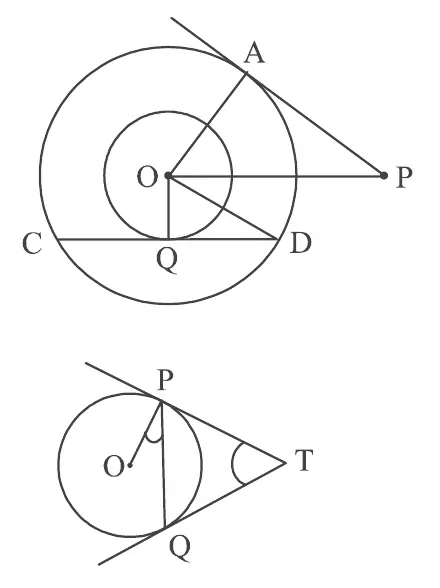
(A) In two concentric circles, the radii are OA=rOA = r cm and OQ=6OQ = 6 cm, as shown in the figure. Chord CDCD of larger circle is a tangent to smaller circle at QQ. PAPA is tangent to larger circle. If PA=16PA = 16 cm and OP=20OP = 20 cm, find the length CDCD.

OR

(B) In given figure, two tangents PTPT and QTQT are drawn to a circle with centre OO from an external point TT. Prove that ∠PTQ=2∠OPQ\angle PTQ = 2\angle OPQ.

Two figures. First, two concentric circles with centre O, a tangent PA to the larger circle from the point P on the right, and the chord CD of the larger circle touching the smaller circle at Q below O. Second, a circle with centre O and two tangents TP and TQ from T on the right, with the chord PQ and the radius OP.
Solution
OQCDPAOA = √(20² − 16²) = 12; QD = √(12² − 6²) = 6√3; CD = 12√3 cm
  1. (A) OA⊥PAOA \perp PA, so OA2=OP2−PA2=400−256=144OA^2 = OP^2 - PA^2 = 400 - 256 = 144 and OA=r=12OA = r = 12 cm.
  2. OQ⊥CDOQ \perp CD (radius and tangent), so in the right triangle OQDOQD: QD=OD2−OQ2=144−36=108=63QD = \sqrt{OD^2 - OQ^2} = \sqrt{144 - 36} = \sqrt{108} = 6\sqrt{3} cm.
  3. The perpendicular from the centre bisects the chord, so CD=2×63=123CD = 2 \times 6\sqrt{3} = 12\sqrt{3} cm.
  4. (B) Let ∠PTQ=θ\angle PTQ = \theta. TP=TQTP = TQ, so ∠TPQ=∠TQP=90∘−θ2\angle TPQ = \angle TQP = 90^\circ - \dfrac{\theta}{2}.
  5. OP⊥PTOP \perp PT, so ∠OPQ=∠OPT−∠TPQ=90∘−(90∘−θ2)=θ2\angle OPQ = \angle OPT - \angle TPQ = 90^\circ - \left(90^\circ - \dfrac{\theta}{2}\right) = \dfrac{\theta}{2}. Hence ∠PTQ=2∠OPQ\angle PTQ = 2\angle OPQ.

Answer: (A) CD=123CD = 12\sqrt{3} cm   (B) proved

Report an error on this question
Q30Surface Areas and Volumes3 marks

(A) A solid is in the form of a cylinder with hemi-spherical ends of same radii. The total height of the solid is 2020 cm and the diameter of the cylinder is 1414 cm. Find the surface area of the solid.

OR

(B) A juice glass is cylindrical in shape with hemi-spherical raised up portion at the bottom. The inner diameter of glass is 1010 cm and its height is 1414 cm. Find the capacity of the glass. (use π=3.14\pi = 3.14)

Solution
  1. (A) r=7r = 7 cm. The hemispheres take 2×7=142 \times 7 = 14 cm of the height, so the cylinder is 20−14=620 - 14 = 6 cm tall.
  2. Surface area =2πrh+2×2πr2=2πr(h+2r)=2×227×7×20=880= 2\pi r h + 2 \times 2\pi r^2 = 2\pi r(h + 2r) = 2 \times \dfrac{22}{7} \times 7 \times 20 = 880 cm².
  3. (B) r=5r = 5 cm and h=14h = 14 cm. Capacity == cylinder −- raised hemisphere =πr2h−23πr3=3.14×25×14−23×3.14×125= \pi r^2 h - \dfrac{2}{3}\pi r^3 = 3.14 \times 25 \times 14 - \dfrac{2}{3} \times 3.14 \times 125.
  4. =1099−261.67≈837.33= 1099 - 261.67 \approx 837.33 cm³ (exactly 25123\dfrac{2512}{3} cm³).

Answer: (A) 880880 cm²   (B) 25123≈837.33\dfrac{2512}{3} \approx 837.33 cm³

Report an error on this question
Q31Trigonometry3 marks

Prove that: (cot⁡θ−cosec⁡θ)2=1−cos⁡θ1+cos⁡θ(\cot\theta - \operatorname{cosec}\theta)^2 = \dfrac{1 - \cos\theta}{1 + \cos\theta}.

Solution
  1. LHS =(cos⁡θsin⁡θ−1sin⁡θ)2=(cos⁡θ−1)2sin⁡2θ=(1−cos⁡θ)21−cos⁡2θ= \left(\dfrac{\cos\theta}{\sin\theta} - \dfrac{1}{\sin\theta}\right)^2 = \dfrac{(\cos\theta - 1)^2}{\sin^2\theta} = \dfrac{(1 - \cos\theta)^2}{1 - \cos^2\theta}.
  2. 1−cos⁡2θ=(1−cos⁡θ)(1+cos⁡θ)1 - \cos^2\theta = (1 - \cos\theta)(1 + \cos\theta), so LHS =(1−cos⁡θ)2(1−cos⁡θ)(1+cos⁡θ)=1−cos⁡θ1+cos⁡θ== \dfrac{(1 - \cos\theta)^2}{(1 - \cos\theta)(1 + \cos\theta)} = \dfrac{1 - \cos\theta}{1 + \cos\theta} = RHS.

Answer: Proved

Report an error on this question

Section D: Long answer

4 questions, 5 marks each.

Q32Triangles5 marks

(A) If a line is drawn parallel to one side of a triangle to intersect the other two sides in distinct points, then prove that other two sides are divided in the same ratio.

OR

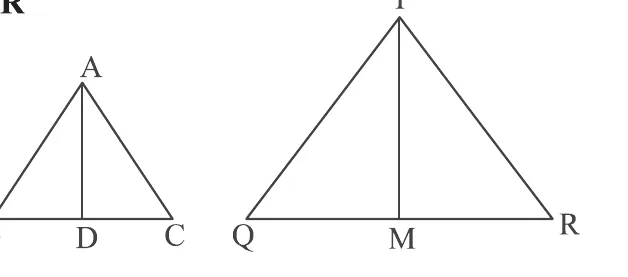
(B) Sides ABAB and BCBC and median ADAD of a △ABC\triangle ABC are respectively proportional to sides PQPQ and PRPR and median PMPM of △PQR\triangle PQR. Show that △ABC∼△PQR\triangle ABC \sim \triangle PQR.

Two triangles side by side. In triangle ABC with the base BC, the median AD joins A to the mid-point D of BC. In triangle PQR with the base QR, the median PM joins P to the mid-point M of QR.
Solution
  1. (A) **Given:** DE∥BCDE \parallel BC in △ABC\triangle ABC. **To prove:** ADDB=AEEC\dfrac{AD}{DB} = \dfrac{AE}{EC}. **Construction:** join BEBE and CDCD; draw DM⊥ACDM \perp AC and EN⊥ABEN \perp AB.
  2. ar(△ADE)ar(△BDE)=12⋅AD⋅EN12⋅DB⋅EN=ADDB\dfrac{\text{ar}(\triangle ADE)}{\text{ar}(\triangle BDE)} = \dfrac{\frac{1}{2} \cdot AD \cdot EN}{\frac{1}{2} \cdot DB \cdot EN} = \dfrac{AD}{DB} and ar(△ADE)ar(△CDE)=12⋅AE⋅DM12⋅EC⋅DM=AEEC\dfrac{\text{ar}(\triangle ADE)}{\text{ar}(\triangle CDE)} = \dfrac{\frac{1}{2} \cdot AE \cdot DM}{\frac{1}{2} \cdot EC \cdot DM} = \dfrac{AE}{EC}.
  3. △BDE\triangle BDE and △CDE\triangle CDE are on the same base DEDE and between the same parallels, so their areas are equal. Hence ADDB=AEEC\dfrac{AD}{DB} = \dfrac{AE}{EC}.
  4. (B) In the figure the equal-ratio sides are the two sides from the apex, ABAB with PQPQ and ACAC with PRPR (the printed “BCBC” is a typo for ACAC). Given ABPQ=ACPR=ADPM\dfrac{AB}{PQ} = \dfrac{AC}{PR} = \dfrac{AD}{PM}.
  5. Extend ADAD to EE with DE=ADDE = AD and PMPM to NN with MN=PMMN = PM; join CECE and RNRN. △ADB≅△EDC\triangle ADB \cong \triangle EDC (SAS), so CE=ABCE = AB; likewise RN=PQRN = PQ.
  6. CERN=ABPQ=ACPR=ADPM=AEPN\dfrac{CE}{RN} = \dfrac{AB}{PQ} = \dfrac{AC}{PR} = \dfrac{AD}{PM} = \dfrac{AE}{PN} (as AE=2ADAE = 2AD, PN=2PMPN = 2PM), so △AEC∼△PNR\triangle AEC \sim \triangle PNR (SSS) and ∠1=∠2\angle 1 = \angle 2. In the same way ∠3=∠4\angle 3 = \angle 4, so ∠BAC=∠QPR\angle BAC = \angle QPR.
  7. With ABPQ=ACPR\dfrac{AB}{PQ} = \dfrac{AC}{PR}, we get △ABC∼△PQR\triangle ABC \sim \triangle PQR by SAS.

Answer: Proved (both parts)

Report an error on this question
Q33Arithmetic Progressions5 marks

How many terms of the A.P. 27, 24, 21, ……. must be taken so that their sum is 105? Which term of the A.P. is zero?

Solution
  1. a=27a = 27 and d=−3d = -3. Sn=n2[54+(n−1)(−3)]=n2(57−3n)=105S_n = \dfrac{n}{2}[54 + (n - 1)(-3)] = \dfrac{n}{2}(57 - 3n) = 105, so 3n2−57n+210=03n^2 - 57n + 210 = 0, that is n2−19n+70=0n^2 - 19n + 70 = 0 and (n−5)(n−14)=0(n - 5)(n - 14) = 0.
  2. So n=5n = 5 or n=14n = 14. Both work: the first 55 terms 27+24+21+18+15=10527 + 24 + 21 + 18 + 15 = 105, and the terms 66 to 1414 (12,9,6,3,0,−3,−6,−9,−1212, 9, 6, 3, 0, -3, -6, -9, -12) add to 00, so 1414 terms also give 105105.
  3. The zero term: 27+(n−1)(−3)=027 + (n - 1)(-3) = 0 gives n−1=9n - 1 = 9 and n=10n = 10: the 10th10^{\text{th}} term is zero.

Answer: 55 or 1414 terms; the 10th10^{\text{th}} term is zero

Report an error on this question
Q34Trigonometry5 marks

(A) The shadow of a tower standing on a level ground is found to be 4040 m longer when the Sun’s altitude is 30∘30^\circ than when it was 60∘60^\circ. Find the height of the tower and the length of original shadow. (use 3=1.73\sqrt{3} = 1.73)

OR

(B) The angles of depression of the top and the bottom of an 88 m tall building from the top of a multi-storeyed building are 30∘30^\circ and 45∘45^\circ respectively. Find the height of the multi-storeyed building and the distance between the two buildings. (use 3=1.73\sqrt{3} = 1.73)

Solution
60°30°BACDh = 34.6 m40 m longer shadowh = 20√3; original shadow = h/√3 = 20 m
30°CDABEh = 18.92 m8 mx = h45°x = h, h − 8 = x/√3 → h = 12 + 4√3 = 18.92 m
  1. (A) Let the tower be hh. The shadow at 60∘60^\circ is htan⁡60∘=h3\dfrac{h}{\tan 60^\circ} = \dfrac{h}{\sqrt{3}} and at 30∘30^\circ it is h3h\sqrt{3}. h3−h3=40h\sqrt{3} - \dfrac{h}{\sqrt{3}} = 40.
  2. 2h3=40\dfrac{2h}{\sqrt{3}} = 40, so h=203=34.6h = 20\sqrt{3} = 34.6 m. The original shadow (at 60∘60^\circ) =2033=20= \dfrac{20\sqrt{3}}{\sqrt{3}} = 20 m.
  3. (B) Let the tall building be CD=hCD = h and the distance between the buildings xx. The bottom of the small building is at 45∘45^\circ: tan⁡45∘=hx=1\tan 45^\circ = \dfrac{h}{x} = 1, so x=hx = h.
  4. Its top is h−8h - 8 below DD at 30∘30^\circ: tan⁡30∘=h−8x\tan 30^\circ = \dfrac{h - 8}{x}, so h−8=x3=h3h - 8 = \dfrac{x}{\sqrt{3}} = \dfrac{h}{\sqrt{3}}.
  5. h(1−13)=8h\left(1 - \dfrac{1}{\sqrt{3}}\right) = 8 gives h=833−1=43(3+1)=12+43=12+6.92=18.92h = \dfrac{8\sqrt{3}}{\sqrt{3} - 1} = 4\sqrt{3}(\sqrt{3} + 1) = 12 + 4\sqrt{3} = 12 + 6.92 = 18.92 m. The distance is also x=h=18.92x = h = 18.92 m.

Answer: (A) height =203≈34.6= 20\sqrt{3} \approx 34.6 m; original shadow =20= 20 m   (B) height and distance both ≈18.92\approx 18.92 m

Report an error on this question
Q35Areas Related to Circles5 marks

A chord of a circle of radius 1414 cm subtends an angle of 90∘90^\circ at the centre. Find the area of the corresponding minor and major segments of the circle.

Solution
OABminor segment= 154 − 98 = 56 cm²major segment= 616 − 56 = 560 cm²
  1. Sector OAB=90360×227×14×14=154OAB = \dfrac{90}{360} \times \dfrac{22}{7} \times 14 \times 14 = 154 cm².
  2. Triangle OABOAB (right-angled at OO with both legs 1414): 12×14×14=98\dfrac{1}{2} \times 14 \times 14 = 98 cm².
  3. Minor segment =154−98=56= 154 - 98 = 56 cm². Area of the circle =227×196=616= \dfrac{22}{7} \times 196 = 616 cm², so the major segment =616−56=560= 616 - 56 = 560 cm².

Answer: Minor segment =56= 56 cm²; major segment =560= 560 cm²

Report an error on this question

Section E: Case studies

3 case studies, 4 marks each.

Q36Quadratic Equations4 marks

Case study 1. To keep the lawn green and cool, Sadhna uses water sprinklers which rotate in circular shape and cover a particular area. The diagram below shows the circular areas covered by two sprinklers (R > r). Two circles touch externally. The sum of their areas is 130π sq m and the distance between their centres is 14 m.

Based on above information, answer the following questions:

(i) Obtain a quadratic equation involving R and r from above. [1]

(ii) Write a quadratic equation involving only r. [1]

(iii) (a) Find the radius r and the corresponding area irrigated. [2]

OR

(iii) (b) Find the radius R and the corresponding area irrigated. [2]
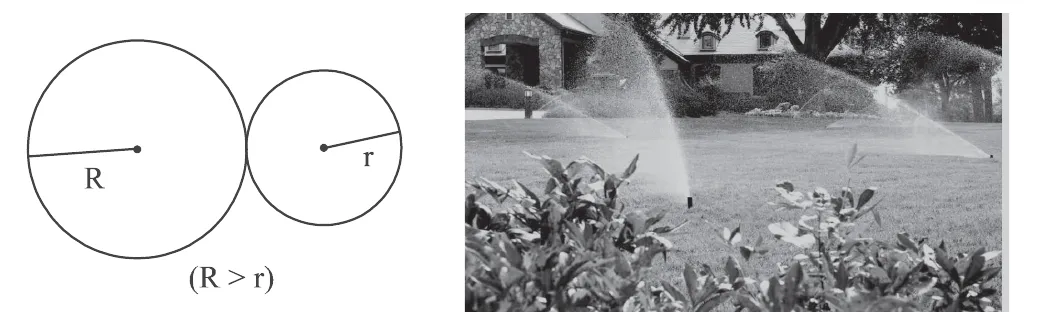
Two circles side by side that touch each other, the larger with radius R and the smaller with radius r, next to a photo of garden water sprinklers on a lawn.
Solution
R = 11r = 3R + r = 14R² + r² = 130, R = 14 − r → r² − 14r + 33 = 0
  1. (i) The sum of the areas is πR2+πr2=130π\pi R^2 + \pi r^2 = 130\pi, so R2+r2=130R^2 + r^2 = 130.
  2. (ii) The circles touch externally, so R+r=14R + r = 14 and R=14−rR = 14 - r. (14−r)2+r2=130(14 - r)^2 + r^2 = 130 gives 2r2−28r+66=02r^2 - 28r + 66 = 0, that is r2−14r+33=0r^2 - 14r + 33 = 0.
  3. (iii)(a) (r−3)(r−11)=0(r - 3)(r - 11) = 0, so r=3r = 3 or 1111. As r<Rr < R, r=3r = 3 m. Area irrigated =πr2=9π= \pi r^2 = 9\pi m² (≈28.3\approx 28.3 m²).
  4. (iii)(b) R=14−3=11R = 14 - 3 = 11 m (the quadratic R2−14R+33=0R^2 - 14R + 33 = 0 gives R=11R = 11 or 33, and R>rR > r). Area irrigated =πR2=121π= \pi R^2 = 121\pi m² (≈380.1\approx 380.1 m²).

Answer: (i) R2+r2=130R^2 + r^2 = 130   (ii) r2−14r+33=0r^2 - 14r + 33 = 0   (iii)(a) r=3r = 3 m, area 9π9\pi m²   (iii)(b) R=11R = 11 m, area 121π121\pi m²

Report an error on this question
Q37Statistics4 marks

Case study 2. Gurpreet is very fond of doing research on plants. She collected some leaves from different plants and measured their lengths in mm. The data obtained is represented in the following table:

Based on the above information, answer the following questions:

(i) Write the median class of the data. [1]

(ii) How many leaves are of length equal to or more than 10 cm? [1]

(iii) (a) Find median of the data. [2]

OR

(iii) (b) Write the modal class and find the mode of the data. [2]

Length (in mm)70–8080–9090–100100–110110–120120–130130–140
Number of leaves35912542
Solution
  1. N=3+5+9+12+5+4+2=40N = 3 + 5 + 9 + 12 + 5 + 4 + 2 = 40. Cumulative frequencies: 3,8,17,29,34,38,403, 8, 17, 29, 34, 38, 40. N2=20\dfrac{N}{2} = 20.
  2. (i) The cumulative frequency passes 2020 in the class 100−110100 - 110, so that is the median class.
  3. (ii) 1010 cm =100= 100 mm. Leaves of length 100100 mm or more: 12+5+4+2=2312 + 5 + 4 + 2 = 23.
  4. (iii)(a) l=100l = 100, cf=17cf = 17, f=12f = 12, h=10h = 10. Median =100+20−1712×10=102.5= 100 + \dfrac{20 - 17}{12} \times 10 = 102.5 mm.
  5. (iii)(b) The highest frequency is 1212, so the modal class is 100−110100 - 110: f1=12f_1 = 12, f0=9f_0 = 9, f2=5f_2 = 5. Mode =100+12−924−9−5×10=103= 100 + \dfrac{12 - 9}{24 - 9 - 5} \times 10 = 103 mm.

Answer: (i) 100−110100 - 110   (ii) 2323   (iii)(a) 102.5102.5 mm   (iii)(b) modal class 100−110100 - 110, mode =103= 103 mm

Report an error on this question
Q38Circles4 marks

Case study 3. The picture given below shows a circular mirror hanging on the wall with a cord. The diagram represents the mirror as a circle with centre O. AP and AQ are tangents to the circle at P and Q respectively such that AP = 30 cm and ∠PAQ = 60°.

Based on the above information; answer the following questions:

(i) Find the length PQ. [1]

(ii) Find m ∠POQ. [1]

(iii) (a) Find the length OA. [2]

OR

(iii) (b) Find the radius of the mirror. [2]
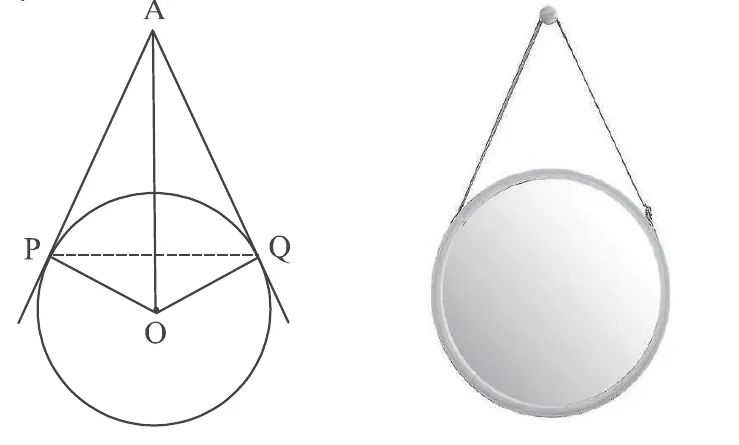
A diagram of a circle with centre O and a cord drawn as two tangents AP and AQ meeting at the point A above it, with the chord PQ, next to a photo of a round mirror hanging by a cord.
Solution
60°APQO30PQ = 30120°OA = 20√3; radius OP = 10√3 cm
  1. (i) AP=AQAP = AQ (tangents from AA) and ∠PAQ=60∘\angle PAQ = 60^\circ, so △APQ\triangle APQ is isosceles with an apex angle of 60∘60^\circ, which makes it equilateral. PQ=AP=30PQ = AP = 30 cm.
  2. (ii) OP⊥APOP \perp AP and OQ⊥AQOQ \perp AQ, so ∠POQ=360∘−90∘−90∘−60∘=120∘\angle POQ = 360^\circ - 90^\circ - 90^\circ - 60^\circ = 120^\circ.
  3. (iii)(a) AOAO bisects ∠PAQ\angle PAQ, so ∠PAO=30∘\angle PAO = 30^\circ. In the right triangle APOAPO: cos⁡30∘=APAO=30AO\cos 30^\circ = \dfrac{AP}{AO} = \dfrac{30}{AO}, so AO=30×23=203AO = \dfrac{30 \times 2}{\sqrt{3}} = 20\sqrt{3} cm.
  4. (iii)(b) tan⁡30∘=OPAP\tan 30^\circ = \dfrac{OP}{AP}, so OP=30×13=103OP = 30 \times \dfrac{1}{\sqrt{3}} = 10\sqrt{3} cm, the radius of the mirror.

Answer: (i) 3030 cm   (ii) 120∘120^\circ   (iii)(a) 20320\sqrt{3} cm   (iii)(b) 10310\sqrt{3} cm

Report an error on this question

Questions are from the official CBSE paper. Figures are described in words; see the PDF for the originals. Solutions are written by CogniGuru.

Revise this paper in 1 minute a chapter

Each chapter below is what the paper tested, with a one-minute animated lesson on the idea behind it.

Stuck on a step in any solution?

The CogniGuru AI tutor explains any doubt one minute at a time, in English or Hindi. Join the waitlist.

Mock quiz: 5 questions from this paper

Five real questions from this paper, one each from five chapters. About 2 minutes. See how much you know and where you stand among other students. Attempt free, with no login; log in only for your ranking and full report.

Question 1 of 5 · Q1 of the paperPolynomials

For what value of kk, the product of zeroes of the polynomial kx2−4x−7kx^2 - 4x - 7 is 22?

0 of 5 answered

Related papers

Common questions

Are these the official CBSE Class 10 Maths Basic 2024 questions?
Yes. The questions are from the official Mathematics (Basic) paper (set 430/1/3) that CBSE published after the March 2024 board exam. The solutions are written by CogniGuru and checked against the answer key CBSE published for this paper code.
Can I download the CBSE Class 10 Maths Basic 2024 question paper PDF?
Yes, the official paper PDF is free to download from this page, and so are our step-by-step solutions as a PDF. No login is needed to download either or to read the solutions.
Do all sets of the paper have the same questions?
No. CBSE sets several versions of each paper, with the same blueprint and similar questions in a different order and sometimes with different numbers. This page covers set 430/1/3.
How does the quiz work, and what does “where you stand” mean?
It is a mock quiz of 5 real multiple-choice questions from this paper, scored automatically in about 2 minutes. Your score is compared, anonymously, with other students who took the same quiz. Only the score is stored with the comparison, never your name or number.

Source

CBSE question paper archive, Class X, 2024 (Mathematics (Basic), set 430/1/3)
PDF