CBSE · Class 10 · Mathematics (Basic) · Free

CBSE Class 10 Maths Basic 2025 Question Paper (Set 430/3/1) with Solutions

The official board paper (Q.P. Code 430/3/1, Series EF3GH). Free paper PDF and step-by-step solutions (also as a PDF to download) written by CogniGuru and checked against CBSE’s answer key. See the paper’s main topics in 1 minute, then quiz yourself to see how much you know and where you stand.

No login to download or read the solutions. Login only to see your quiz report in full.

Board
CBSE
Class
10
Subject
Maths Basic (241)
Year
2025
Set code
430/3/1
Max marks
80
Duration
3 hours
Questions
38 (Sections A to E)
Source
Official CBSE paper
Exam date
March 2025

Paper preview

Three pages of the official paper. Download the PDF for all 27.
  • Cover page of the CBSE Class 10 Maths Basic 2025 paper, set 430/3/1

    Cover page

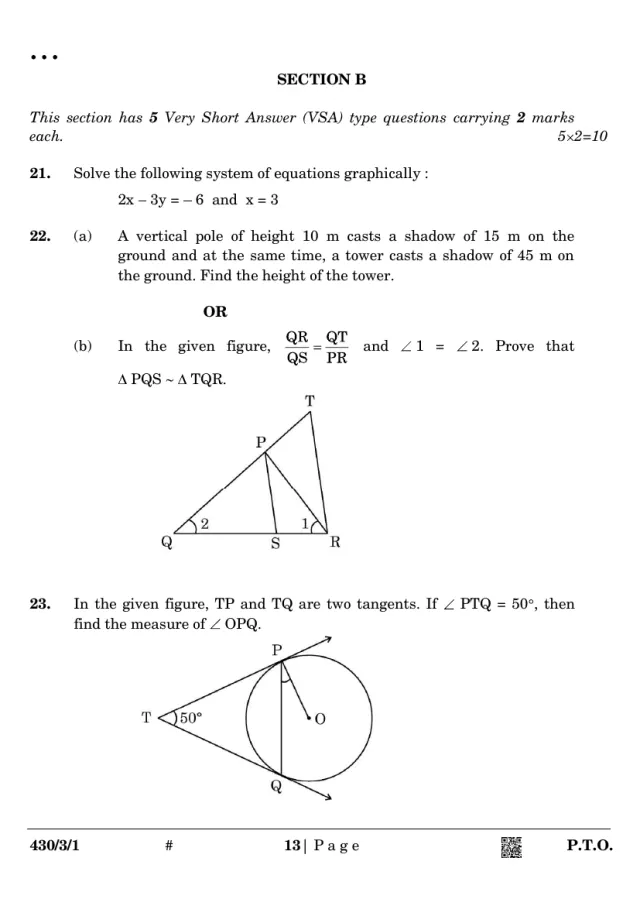
  • Section B of the CBSE Class 10 Maths Basic 2025 paper, set 430/3/1

    Section B

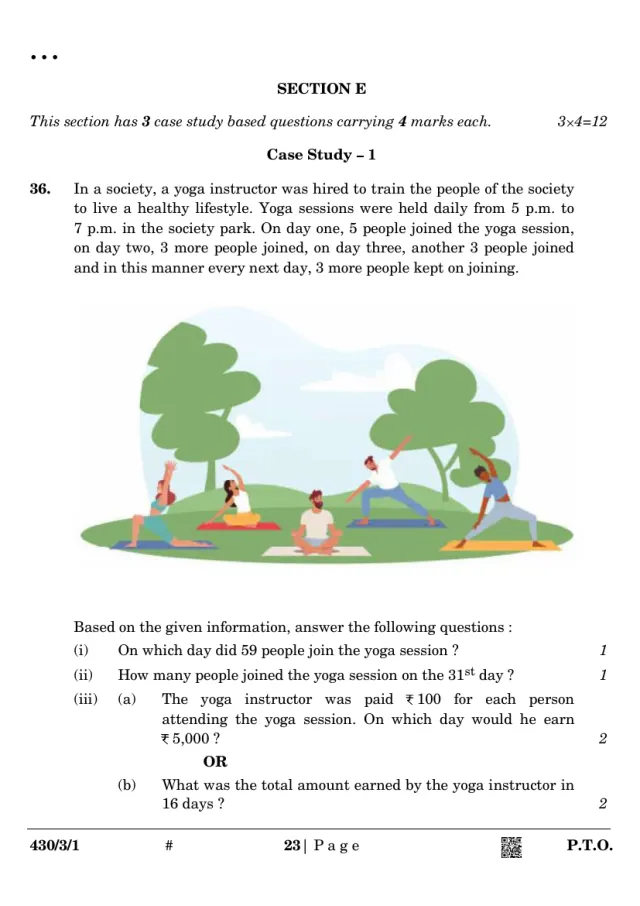
  • A case study with its figure from the CBSE Class 10 Maths Basic 2025 paper, set 430/3/1

    Case study

The main topics of this paper, in 1 minute

Your tutor walks you through the paper before you attempt it: the marks, the key ideas, the time plan and the traps.

1-minute paper analysis

With your tutor, in her voice

The main topics of this paper, in about a minute

A short, animated walk through the paper: how it is built, where the marks come from, the four ideas that matter most, how to plan your three hours, and the traps to avoid.

  1. 1The paper at a glance
  2. 2Where the marks come from
  3. 3Four ideas that keep paying off
  4. 4Plan your three hours
  5. 5Four traps to avoid

Sound on for the voice. Captions are shown, and you can mute any time.

Step-by-step solutions

Try each question first, then open its solution. Tap a number to jump.

Download solutions (PDF)

Section A: Multiple choice

20 questions, 1 mark each. MCQs (Q1 to Q18) and assertion-reason (Q19, Q20).

Q1Real Numbers1 mark

If p=23×32×5p = 2^3 \times 3^2 \times 5 and q=22×33q = 2^2 \times 3^3, then the LCM of pp and qq is:

  1. (A)23×332^3 \times 3^3
  2. (B)22×322^2 \times 3^2
  3. (C)22×32×52^2 \times 3^2 \times 5
  4. (D)23×33×52^3 \times 3^3 \times 5
Solution · answer (D)
  1. LCM takes each prime at its highest power: 232^3, 333^3 and 55. LCM =23×33×5= 2^3 \times 3^3 \times 5.

Answer: (D) 23×33×52^3 \times 3^3 \times 5

Report an error on this question
Q2Real Numbers1 mark

3n3^n, where nn is a natural number, cannot end with the digit:

  1. (A)3
  2. (B)5
  3. (C)7
  4. (D)9
Solution · answer (B)
  1. A number ending in 55 is divisible by 55, but 3n3^n has only the prime factor 33. So 3n3^n can never end in 55. (Its last digits go 3,9,7,13, 9, 7, 1.)

Answer: (B) 5

Report an error on this question
Q3Real Numbers1 mark

A prime number has:

  1. (A)exactly two prime factors
  2. (B)exactly one prime factor
  3. (C)at least one prime factor
  4. (D)at least two prime factors
Solution · answer (B)
  1. A prime pp has the factors 11 and pp only, and the only prime among them is pp itself: exactly one prime factor.

Answer: (B) exactly one prime factor

Report an error on this question
Q4Linear Equations1 mark

For what value(s) of kk does the system of equations kx+2y=3kx + 2y = 3 and 2x+y=52x + y = 5 have a unique solution?

  1. (A)k = a real number
  2. (B)k≠8k \neq 8
  3. (C)k≠4k \neq 4
  4. (D)k = 4
Solution · answer (C)
  1. A unique solution needs a1a2≠b1b2\dfrac{a_1}{a_2} \neq \dfrac{b_1}{b_2}: k2≠21\dfrac{k}{2} \neq \dfrac{2}{1}, so k≠4k \neq 4.

Answer: (C) k≠4k \neq 4

Report an error on this question
Q5Quadratic Equations1 mark

If x=xx = \sqrt{x}, (x≠0)(x \neq 0) is expressed as a quadratic equation in the form ax2+bx+c=0ax^2 + bx + c = 0, then the value of a+b+ca + b + c is:

  1. (A)0
  2. (B)1
  3. (C)2
  4. (D)3
Solution · answer (A)
  1. Squaring both sides, x2=xx^2 = x, that is x2−x+0=0x^2 - x + 0 = 0. So a=1a = 1, b=−1b = -1, c=0c = 0 and a+b+c=0a + b + c = 0.

Answer: (A) 0

Report an error on this question
Q6Coordinate Geometry1 mark

If point (1,2)(1, 2) is the mid-point of the line segment joining the points (3,5)(3, 5) and (2a,b)(2a, b), then (a,b)=(a, b) =

  1. (A)(−1,−1)(-1, -1)
  2. (B)(−12,−12)\left(-\dfrac{1}{2}, -\dfrac{1}{2}\right)
  3. (C)(−12,−1)\left(-\dfrac{1}{2}, -1\right)
  4. (D)(−1,−12)\left(-1, -\dfrac{1}{2}\right)
Solution · answer (C)
  1. 3+2a2=1\dfrac{3 + 2a}{2} = 1 gives 2a=−12a = -1 and a=−12a = -\dfrac{1}{2}.
  2. 5+b2=2\dfrac{5 + b}{2} = 2 gives b=−1b = -1. So (a,b)=(−12,−1)(a, b) = \left(-\dfrac{1}{2}, -1\right).

Answer: (C) (−12,−1)\left(-\dfrac{1}{2}, -1\right)

Report an error on this question
Q7Coordinate Geometry1 mark

The distance of point (−3,4)(-3, 4) from yy-axis is:

  1. (A)−3
  2. (B)3
  3. (C)4
  4. (D)5
Solution · answer (B)
  1. The distance from the yy-axis is the absolute value of the xx-coordinate: ∣−3∣=3|-3| = 3. (A distance cannot be negative.)

Answer: (B) 3

Report an error on this question
Q8Trigonometry1 mark

The value of sec⁡230∘+tan⁡230∘sin⁡245∘+cos⁡245∘\dfrac{\sec^2 30^\circ + \tan^2 30^\circ}{\sin^2 45^\circ + \cos^2 45^\circ} is:

  1. (A)1
  2. (B)53\dfrac{5}{3}
  3. (C)133\dfrac{13}{3}
  4. (D)7
Solution · answer (B)
  1. sec⁡230∘=43\sec^2 30^\circ = \dfrac{4}{3}, tan⁡230∘=13\tan^2 30^\circ = \dfrac{1}{3}, and sin⁡245∘+cos⁡245∘=1\sin^2 45^\circ + \cos^2 45^\circ = 1. The value is 4/3+1/31=53\dfrac{4/3 + 1/3}{1} = \dfrac{5}{3}.

Answer: (B) 53\dfrac{5}{3}

Report an error on this question
Q9Triangles1 mark

Which types of triangles are always similar?

  1. (A)Right-angled triangles
  2. (B)Acute-angled triangles
  3. (C)Isosceles triangles
  4. (D)Equilateral triangles
Solution · answer (D)
  1. All equilateral triangles have angles 60∘,60∘,60∘60^\circ, 60^\circ, 60^\circ, so any two are similar by AAA. The other types can have different angles.

Answer: (D) Equilateral triangles

Report an error on this question
Q10Triangles1 mark

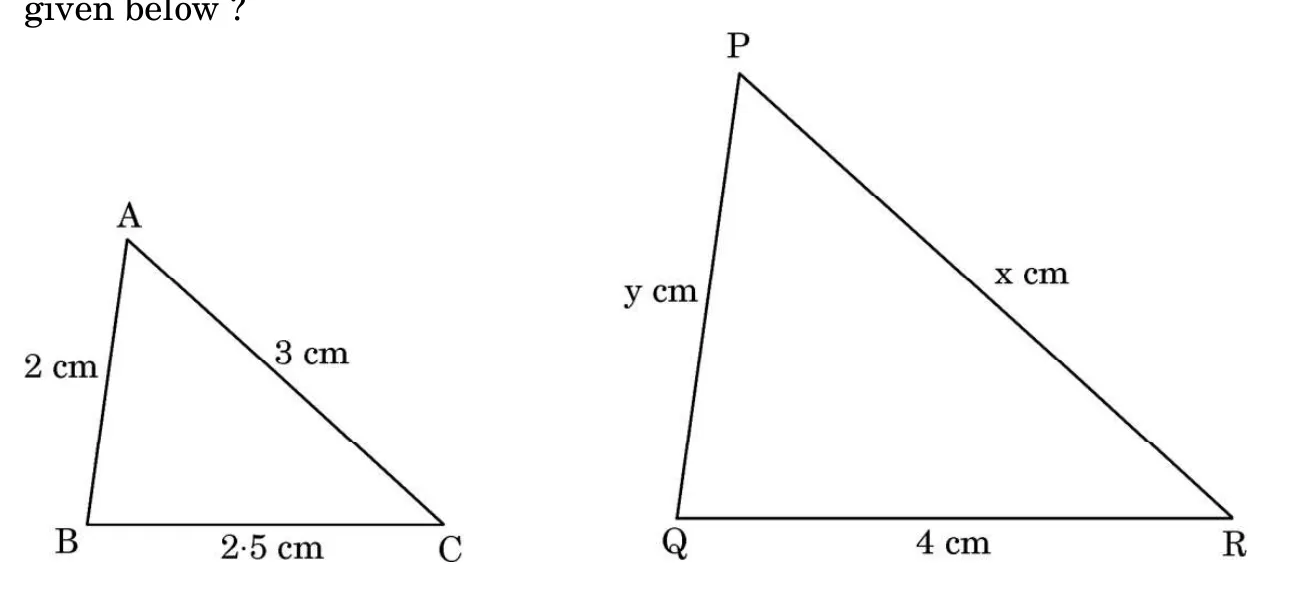
What values of xx and yy will make △ABC\triangle ABC similar to △QRP\triangle QRP in the figures given below?

Two triangles. Triangle ABC has AB marked 2 cm, AC marked 3 cm and BC marked 2.5 cm. Triangle QRP is larger with QR marked 4 cm, RP marked x cm and QP marked y cm.
  1. (A)x=6, y=5x = 6,\ y = 5
  2. (B)x=5, y=6x = 5,\ y = 6
  3. (C)x=6, y=6x = 6,\ y = 6
  4. (D)x=12, y=3.2x = 12,\ y = 3.2
Solution · answer (B)
22.534x = 5y = 6ABCQRPratio AB/QR = 1/2 → x = 5, y = 6
  1. △ABC∼△QRP\triangle ABC \sim \triangle QRP matches A↔QA \leftrightarrow Q, B↔RB \leftrightarrow R, C↔PC \leftrightarrow P. So ABQR=BCRP=ACQP\dfrac{AB}{QR} = \dfrac{BC}{RP} = \dfrac{AC}{QP}.
  2. 24=2.5x=3y=12\dfrac{2}{4} = \dfrac{2.5}{x} = \dfrac{3}{y} = \dfrac{1}{2}, so x=5x = 5 and y=6y = 6.

Answer: (B) x=5, y=6x = 5,\ y = 6

Report an error on this question
Q11Circles1 mark

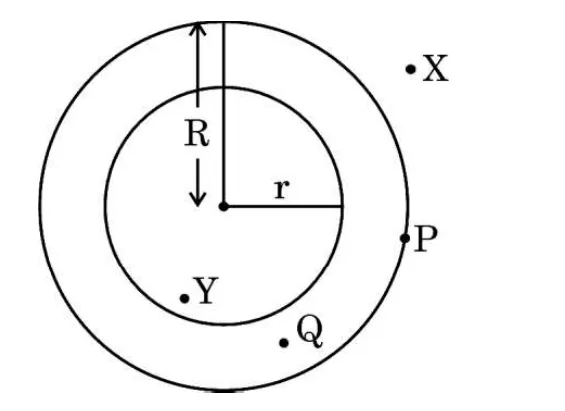
In the given figure, from which point can the tangent **not** be drawn to the circle with radius rr?

Two concentric circles with the inner one of radius r and the outer of radius R. Points X and P are outside or on the outer region, Q is between the circles and Y is inside the inner circle.
  1. (A)X
  2. (B)P
  3. (C)Q
  4. (D)Y
Solution · answer (D)
  1. A tangent to the inner circle can be drawn from a point on it or outside it. YY lies inside the circle of radius rr, and no tangent can be drawn from an interior point.

Answer: (D) Y

Report an error on this question
Q12Trigonometry1 mark

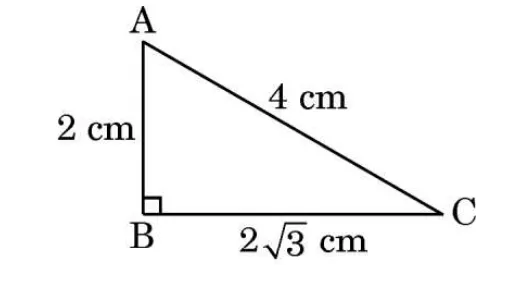
In the given figure, the angle of elevation of point AA from point CC is:

A right triangle ABC with the right angle at B, AB marked 2 cm, BC marked 2 root 3 cm and the hypotenuse AC marked 4 cm.
  1. (A)30∘30^\circ
  2. (B)45∘45^\circ
  3. (C)60∘60^\circ
  4. (D)Cannot be determined
Solution · answer (A)
  1. In the right triangle ABCABC at BB: sin⁡C=ABAC=24=12\sin C = \dfrac{AB}{AC} = \dfrac{2}{4} = \dfrac{1}{2}, so ∠C=30∘\angle C = 30^\circ. (Check: tan⁡C=223=13\tan C = \dfrac{2}{2\sqrt{3}} = \dfrac{1}{\sqrt{3}} ✓.)

Answer: (A) 30∘30^\circ

Report an error on this question
Q13Areas Related to Circles1 mark

The angle of the sector of a circle whose area is one-eighth of the area of the circle is:

  1. (A)2212∘22\tfrac{1}{2}^\circ
  2. (B)45∘45^\circ
  3. (C)60∘60^\circ
  4. (D)90∘90^\circ
Solution · answer (B)
  1. θ360=18\dfrac{\theta}{360} = \dfrac{1}{8}, so θ=45∘\theta = 45^\circ.

Answer: (B) 45∘45^\circ

Report an error on this question
Q14Areas Related to Circles1 mark

The perimeter of a quadrant of a circle of circumference 22 cm is:

  1. (A)29 cm
  2. (B)22 cm
  3. (C)12.5 cm
  4. (D)5.5 cm
Solution · answer (C)
  1. 2πr=222\pi r = 22, so r=22×72×22=3.5r = \dfrac{22 \times 7}{2 \times 22} = 3.5 cm.
  2. Perimeter of a quadrant =14(22)+2r=5.5+7=12.5= \dfrac{1}{4}(22) + 2r = 5.5 + 7 = 12.5 cm.

Answer: (C) 12.5 cm

Report an error on this question
Q15Surface Areas and Volumes1 mark

A cone and cylinder have same height and same radius. The volume of the cone and the volume of the cylinder are in the ratio:

  1. (A)1 : 1
  2. (B)1 : 3
  3. (C)3 : 1
  4. (D)1 : 2
Solution · answer (B)
  1. VconeVcylinder=13πr2hπr2h=13\dfrac{V_{\text{cone}}}{V_{\text{cylinder}}} = \dfrac{\frac{1}{3}\pi r^2 h}{\pi r^2 h} = \dfrac{1}{3}. The ratio is 1:31 : 3.

Answer: (B) 1 : 3

Report an error on this question
Q16Statistics1 mark

The following table shows the marks scored by 23 students of a class (marks 0–10, 10–20, 20–30, 30–40, 40–50 with 5, 3, 4, 8, 3 students). The lower limit of the modal class is:

Marks0–1010–2020–3030–4040–50
Number of Students53483
  1. (A)10
  2. (B)20
  3. (C)30
  4. (D)40
Solution · answer (C)
  1. The modal class has the highest frequency, which is 88, for the class 30−4030 - 40. Its lower limit is 3030.

Answer: (C) 30

Report an error on this question
Q17Statistics1 mark

For a distribution, if mean = 15 and mode = 12, then its median is:

  1. (A)12
  2. (B)13
  3. (C)14
  4. (D)15
Solution · answer (C)
  1. Mode=3 Median−2 Mean\text{Mode} = 3\,\text{Median} - 2\,\text{Mean}: 12=3M−3012 = 3M - 30, so 3M=423M = 42 and M=14M = 14.

Answer: (C) 14

Report an error on this question
Q18Probability1 mark

A pair of dice is thrown simultaneously. Let E denote the event that “The sum of numbers obtained on both dice is at least 9.” The number of outcomes in favour of event E is:

  1. (A)4
  2. (B)6
  3. (C)10
  4. (D)26
Solution · answer (C)
  1. Sum 99: (3,6),(4,5),(5,4),(6,3)(3,6), (4,5), (5,4), (6,3) — 44. Sum 1010: (4,6),(5,5),(6,4)(4,6), (5,5), (6,4) — 33. Sum 1111: (5,6),(6,5)(5,6), (6,5) — 22. Sum 1212: (6,6)(6,6) — 11.
  2. Total =4+3+2+1=10= 4 + 3 + 2 + 1 = 10.

Answer: (C) 10

Report an error on this question
Q19Trigonometry1 mark

Assertion (A): For sin⁡θ=1\sin\theta = 1, cos⁡θ\cos\theta must be 00.

Reason (R): sin⁡2θ−cos⁡2θ=1\sin^2\theta - \cos^2\theta = 1.

  1. (A)Both A and R are true and R is the correct explanation of A
  2. (B)Both A and R are true, but R is not the correct explanation of A
  3. (C)A is true, but R is false
  4. (D)A is false, but R is true
Solution · answer (C)
  1. (A) sin⁡θ=1\sin\theta = 1 gives cos⁡2θ=1−1=0\cos^2\theta = 1 - 1 = 0, so cos⁡θ=0\cos\theta = 0. True.
  2. (R) The identity is sin⁡2θ+cos⁡2θ=1\sin^2\theta + \cos^2\theta = 1, not with a minus sign. False.

Answer: (C) A is true, but R is false

Report an error on this question
Q20Quadratic Equations1 mark

Assertion (A): Every quadratic equation has two real roots.

Reason (R): A quadratic polynomial can have at most two zeroes.

  1. (A)Both A and R are true and R is the correct explanation of A
  2. (B)Both A and R are true, but R is not the correct explanation of A
  3. (C)A is true, but R is false
  4. (D)A is false, but R is true
Solution · answer (D)
  1. (A) x2+1=0x^2 + 1 = 0 has no real roots, so a quadratic equation need not have two real roots. False.
  2. (R) A polynomial of degree 22 has at most 22 zeroes. True.

Answer: (D) A is false, but R is true

Report an error on this question

Section B: Very short answer

5 questions, 2 marks each.

Q21Linear Equations2 marks

Solve the following system of equations graphically: 2x−3y=−62x - 3y = -6 and x=3x = 3.

Solution
-5-4-3-2-1123456-112345678Oxy2x − 3y = −6x = 3(3, 4)
  1. x=3x = 3 is a vertical line. 2x−3y=−62x - 3y = -6: points (0,2)(0, 2), (−3,0)(-3, 0) and (3,4)(3, 4).
  2. The lines meet at (3,4)(3, 4): x=3x = 3 and y=4y = 4. (Check: 6−12=−66 - 12 = -6 ✓.)

Answer: x=3x = 3, y=4y = 4

Report an error on this question
Q22Triangles2 marks

(a) A vertical pole of height 1010 m casts a shadow of 1515 m on the ground and at the same time, a tower casts a shadow of 4545 m on the ground. Find the height of the tower.

OR

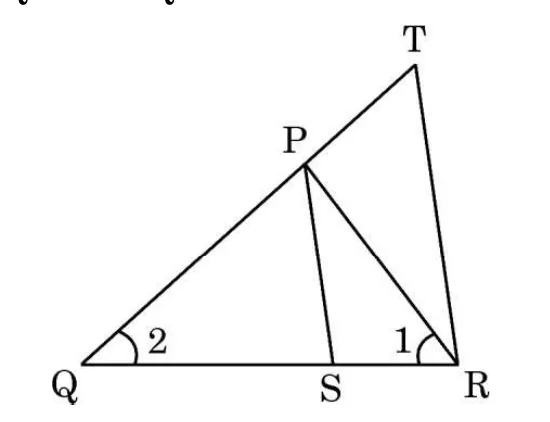
(b) In the given figure, QRQS=QTPR\dfrac{QR}{QS} = \dfrac{QT}{PR} and ∠1=∠2\angle 1 = \angle 2. Prove that △PQS∼△TQR\triangle PQS \sim \triangle TQR.

A triangle PQR with a point S on QR and T above P on the extension of QP. PS is drawn, and the angles marked 1 at R and 2 at Q are equal.
Solution
ABCDEF1015h4510/15 = h/45 → h = 30 m (triangles are similar)
  1. (a) At the same time the sun’s rays make the same angle, so the two right triangles (pole and shadow, tower and shadow) are similar: 1015=h45\dfrac{10}{15} = \dfrac{h}{45}.
  2. h=10×4515=30h = \dfrac{10 \times 45}{15} = 30 m.
  3. (b) In △PQR\triangle PQR, ∠1=∠2\angle 1 = \angle 2, so the sides opposite them are equal: PQ=PRPQ = PR.
  4. The given QRQS=QTPR\dfrac{QR}{QS} = \dfrac{QT}{PR} becomes QRQS=QTPQ\dfrac{QR}{QS} = \dfrac{QT}{PQ}, that is QRQT=QSQP\dfrac{QR}{QT} = \dfrac{QS}{QP}. Also ∠Q\angle Q is common to △PQS\triangle PQS and △TQR\triangle TQR.
  5. So △PQS∼△TQR\triangle PQS \sim \triangle TQR by SAS similarity.

Answer: (a) 3030 m   (b) proved

Report an error on this question
Q23Circles2 marks

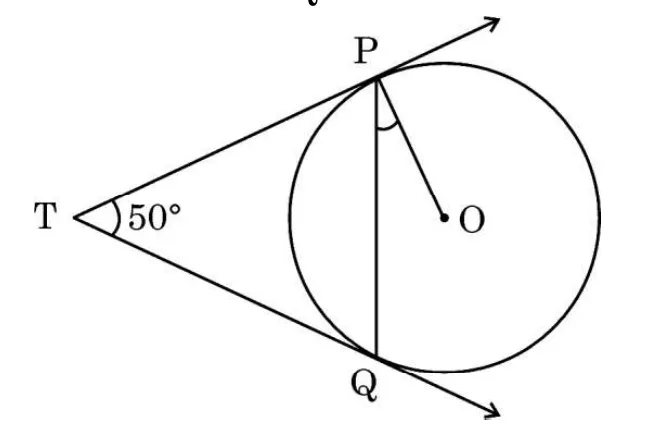
In the given figure, TPTP and TQTQ are two tangents. If ∠PTQ=50∘\angle PTQ = 50^\circ, then find the measure of ∠OPQ\angle OPQ.

A circle with centre O on the right. Tangents from T on the left touch the circle at P (top) and Q (bottom), with the angle PTQ marked 50 degrees. The chord PQ and the radius OP are drawn.
Solution
50°OTPQ∠TPQ = (180° − 50°)/2 = 65°; ∠OPQ = 90° − 65° = 25°
  1. TP=TQTP = TQ (tangents from an external point), so ∠TPQ=∠TQP\angle TPQ = \angle TQP. In △TPQ\triangle TPQ: 50∘+2∠TPQ=180∘50^\circ + 2\angle TPQ = 180^\circ, so ∠TPQ=65∘\angle TPQ = 65^\circ.
  2. OP⊥TPOP \perp TP, so ∠OPT=90∘\angle OPT = 90^\circ and ∠OPQ=90∘−65∘=25∘\angle OPQ = 90^\circ - 65^\circ = 25^\circ.

Answer: ∠OPQ=25∘\angle OPQ = 25^\circ

Report an error on this question
Q24Trigonometry2 marks

(a) If sin⁡3A=1\sin 3A = 1, then find the value of cos⁡2A−tan⁡245∘\cos 2A - \tan^2 45^\circ.

OR

(b) If (sec⁡A+tan⁡A)(1−sin⁡A)=kcos⁡A(\sec A + \tan A)(1 - \sin A) = k\cos A, then find the value of kk.

Solution
  1. (a) sin⁡3A=1\sin 3A = 1 gives 3A=90∘3A = 90^\circ, so A=30∘A = 30^\circ. cos⁡2A−tan⁡245∘=cos⁡60∘−1=12−1=−12\cos 2A - \tan^2 45^\circ = \cos 60^\circ - 1 = \dfrac{1}{2} - 1 = -\dfrac{1}{2}.
  2. (b) (1cos⁡A+sin⁡Acos⁡A)(1−sin⁡A)=(1+sin⁡A)(1−sin⁡A)cos⁡A=1−sin⁡2Acos⁡A=cos⁡2Acos⁡A\left(\dfrac{1}{\cos A} + \dfrac{\sin A}{\cos A}\right)(1 - \sin A) = \dfrac{(1 + \sin A)(1 - \sin A)}{\cos A} = \dfrac{1 - \sin^2 A}{\cos A} = \dfrac{\cos^2 A}{\cos A}.
  3. So the left side is cos⁡A=1×cos⁡A\cos A = 1 \times \cos A, and k=1k = 1.

Answer: (a) −12-\dfrac{1}{2}   (b) k=1k = 1

Report an error on this question
Q25Areas Related to Circles2 marks

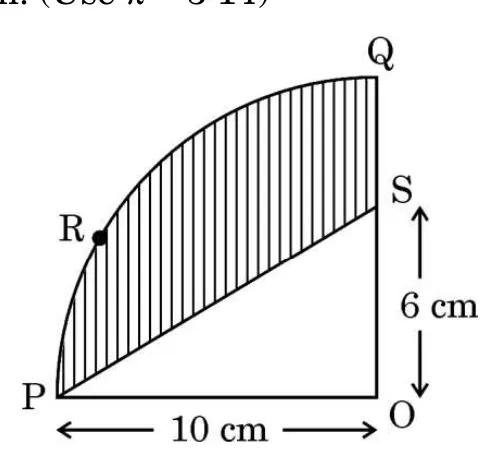
In the given figure, OPRQOPRQ is a quadrant of a circle with centre OO and radius 1010 cm. If OP=10OP = 10 cm and OS=6OS = 6 cm, find the area of the shaded region. (Use π=3.14\pi = 3.14)

A quadrant of a circle with centre O at the bottom right, P at the bottom left and Q at the top, with R on the arc. S is on the radius OQ, 6 cm from O. The region between the arc and the line PS is shaded.
Solution
OPQS106¼π·10² − ½·10·6 = 78.5 − 30 = 48.5 cm²
  1. Area of the quadrant =14×3.14×10×10=78.5= \dfrac{1}{4} \times 3.14 \times 10 \times 10 = 78.5 cm².
  2. The unshaded part is the right triangle POSPOS with legs OP=10OP = 10 and OS=6OS = 6: area =12×10×6=30= \dfrac{1}{2} \times 10 \times 6 = 30 cm².
  3. Shaded area =78.5−30=48.5= 78.5 - 30 = 48.5 cm².

Answer: 48.548.5 cm²

Report an error on this question

Section C: Short answer

6 questions, 3 marks each.

Q26Real Numbers3 marks

(a) Prove that 2\sqrt{2} is an irrational number.

OR

(b) Find which among the following numbers aa, bb and cc is/are composite numbers. a=7×11×13+13a = 7 \times 11 \times 13 + 13, b=6×5×4+4b = 6 \times 5 \times 4 + 4, c=7×13+6c = 7 \times 13 + 6.

Solution
  1. (a) Suppose 2=pq\sqrt{2} = \dfrac{p}{q} with p,qp, q co-prime and q≠0q \neq 0. 2q2=p22q^2 = p^2, so 22 divides p2p^2 and so 22 divides pp. Write p=2mp = 2m.
  2. 2q2=4m22q^2 = 4m^2 gives q2=2m2q^2 = 2m^2, so 22 divides qq. Then 22 divides both pp and qq, contradicting that they are co-prime. So 2\sqrt{2} is irrational.
  3. (b) a=13(77+1)=13×78a = 13(77 + 1) = 13 \times 78: composite. b=4(30+1)=4×31b = 4(30 + 1) = 4 \times 31: composite. c=91+6=97c = 91 + 6 = 97, which is prime.

Answer: (a) proved   (b) aa and bb are composite

Report an error on this question
Q27Polynomials3 marks

Find the zeroes of the polynomial 9s2−6s+19s^2 - 6s + 1 and verify the relationship between the zeroes and the coefficients of the given polynomial.

Solution
  1. 9s2−6s+1=(3s−1)29s^2 - 6s + 1 = (3s - 1)^2, so both zeroes are s=13s = \dfrac{1}{3}.
  2. Sum =13+13=23= \dfrac{1}{3} + \dfrac{1}{3} = \dfrac{2}{3} and −(−6)9=23-\dfrac{(-6)}{9} = \dfrac{2}{3} ✓. Product =19= \dfrac{1}{9} and constantcoefficient of s2=19\dfrac{\text{constant}}{\text{coefficient of } s^2} = \dfrac{1}{9} ✓.

Answer: Zeroes 13,13\dfrac{1}{3}, \dfrac{1}{3}; relations verified

Report an error on this question
Q28Linear Equations3 marks

(a) A fraction becomes 13\dfrac{1}{3}, when 11 is subtracted from the numerator and it becomes 14\dfrac{1}{4}, when 88 is added to its denominator. Find the fraction.

OR

(b) Find the value of kk for which the following pair of linear equations will have infinitely many solutions: kx+3y−(k−3)=0kx + 3y - (k - 3) = 0 and 12x+ky−k=012x + ky - k = 0. Hence, find any two solutions of the given pair of equations.

Solution
  1. (a) Let the fraction be xy\dfrac{x}{y}. x−1y=13\dfrac{x - 1}{y} = \dfrac{1}{3} gives 3x−y=33x - y = 3, and xy+8=14\dfrac{x}{y + 8} = \dfrac{1}{4} gives 4x−y=84x - y = 8.
  2. Subtracting: x=5x = 5 and y=12y = 12. The fraction is 512\dfrac{5}{12}.
  3. (b) Infinitely many solutions need k12=3k=k−3k\dfrac{k}{12} = \dfrac{3}{k} = \dfrac{k - 3}{k}. k2=36k^2 = 36 and k2−6k=0k^2 - 6k = 0 hold only for k=6k = 6.
  4. For k=6k = 6 both equations become 2x+y=12x + y = 1. Two solutions: (0,1)(0, 1) and (1,−1)(1, -1).

Answer: (a) 512\dfrac{5}{12}   (b) k=6k = 6; solutions (0,1)(0, 1) and (1,−1)(1, -1)

Report an error on this question
Q29Trigonometry3 marks

Prove that: 1+cosec⁡Acosec⁡A=cos⁡2A1−sin⁡A\dfrac{1 + \operatorname{cosec} A}{\operatorname{cosec} A} = \dfrac{\cos^2 A}{1 - \sin A}

Solution
  1. LHS =1+1sin⁡A1sin⁡A=sin⁡A+1sin⁡A×sin⁡A=1+sin⁡A= \dfrac{1 + \frac{1}{\sin A}}{\frac{1}{\sin A}} = \dfrac{\sin A + 1}{\sin A} \times \sin A = 1 + \sin A.
  2. Multiply and divide by (1−sin⁡A)(1 - \sin A): (1+sin⁡A)(1−sin⁡A)1−sin⁡A=1−sin⁡2A1−sin⁡A=cos⁡2A1−sin⁡A=\dfrac{(1 + \sin A)(1 - \sin A)}{1 - \sin A} = \dfrac{1 - \sin^2 A}{1 - \sin A} = \dfrac{\cos^2 A}{1 - \sin A} = RHS.

Answer: Proved

Report an error on this question
Q30Probability3 marks

A box contains 6 blue, 4 white and 8 red marbles. A marble is drawn at random from this box. Find the probability that the marble so drawn is:

(i) white

(ii) white or red

(iii) not red

Solution
  1. Total marbles =6+4+8=18= 6 + 4 + 8 = 18.
  2. (i) P(white)=418=29P(\text{white}) = \dfrac{4}{18} = \dfrac{2}{9}. (ii) P(white or red)=1218=23P(\text{white or red}) = \dfrac{12}{18} = \dfrac{2}{3}. (iii) P(not red)=1018=59P(\text{not red}) = \dfrac{10}{18} = \dfrac{5}{9}.

Answer: (i) 29\dfrac{2}{9}   (ii) 23\dfrac{2}{3}   (iii) 59\dfrac{5}{9}

Report an error on this question
Q31Circles3 marks

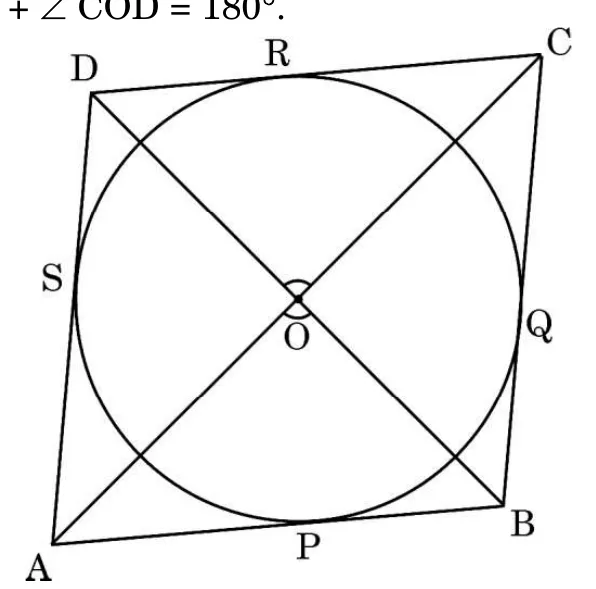
In the given figure, a circle is inscribed in a quadrilateral ABCDABCD which touches the sides ABAB, BCBC, CDCD and DADA at PP, QQ, RR and SS respectively. Prove that ∠AOB+∠COD=180∘\angle AOB + \angle COD = 180^\circ.

A quadrilateral ABCD with a circle inside it touching AB at P, BC at Q, CD at R and DA at S. The centre O is joined to A, B, C and D.
Solution
  1. Join OO to A,B,C,DA, B, C, D and to the points of contact P,Q,R,SP, Q, R, S. Tangents from a point are equal and radii are equal, so △OAP≅△OAS\triangle OAP \cong \triangle OAS (SSS: AP=ASAP = AS, OP=OSOP = OS, OAOA common). Hence ∠AOP=∠AOS\angle AOP = \angle AOS.
  2. In the same way ∠BOP=∠BOQ\angle BOP = \angle BOQ, ∠COQ=∠COR\angle COQ = \angle COR and ∠DOR=∠DOS\angle DOR = \angle DOS.
  3. The eight angles round OO add up to 360∘360^\circ: 2(∠AOP+∠BOP+∠COQ+∠DOR)=360∘2(\angle AOP + \angle BOP + \angle COQ + \angle DOR) = 360^\circ. So (∠AOP+∠BOP)+(∠COQ+∠DOR)=180∘(\angle AOP + \angle BOP) + (\angle COQ + \angle DOR) = 180^\circ, that is ∠AOB+∠COD=180∘\angle AOB + \angle COD = 180^\circ.

Answer: Proved

Report an error on this question

Section D: Long answer

4 questions, 5 marks each.

Q32Quadratic Equations5 marks

(a) Find two consecutive odd integers, sum of whose squares is 290290.

OR

(b) A charity trust decides to build a rectangular hall having an area of 300300 m². The length of the hall is one metre more than twice its width. Find the length and breadth of the hall.

Solution
  1. (a) Let the integers be xx and x+2x + 2. x2+(x+2)2=290x^2 + (x + 2)^2 = 290 gives 2x2+4x−286=02x^2 + 4x - 286 = 0, that is x2+2x−143=0x^2 + 2x - 143 = 0 and (x−11)(x+13)=0(x - 11)(x + 13) = 0.
  2. x=11x = 11 gives 1111 and 1313. (The root x=−13x = -13 gives the pair −13-13 and −11-11, which also fit the words of the question; the key lists 1111 and 1313.)
  3. (b) Let the breadth be xx m, so the length is (2x+1)(2x + 1) m. (2x+1)x=300(2x + 1)x = 300 gives 2x2+x−300=02x^2 + x - 300 = 0 and (x−12)(2x+25)=0(x - 12)(2x + 25) = 0.
  4. A width cannot be negative, so x=12x = 12. Length =25= 25 m and breadth =12= 12 m. (Check: 25×12=30025 \times 12 = 300 ✓.)

Answer: (a) 1111 and 1313 (also −13-13 and −11-11)   (b) length 2525 m, breadth 1212 m

Report an error on this question
Q33Triangles5 marks

(a) State and prove “Basic Proportionality Theorem”.

OR

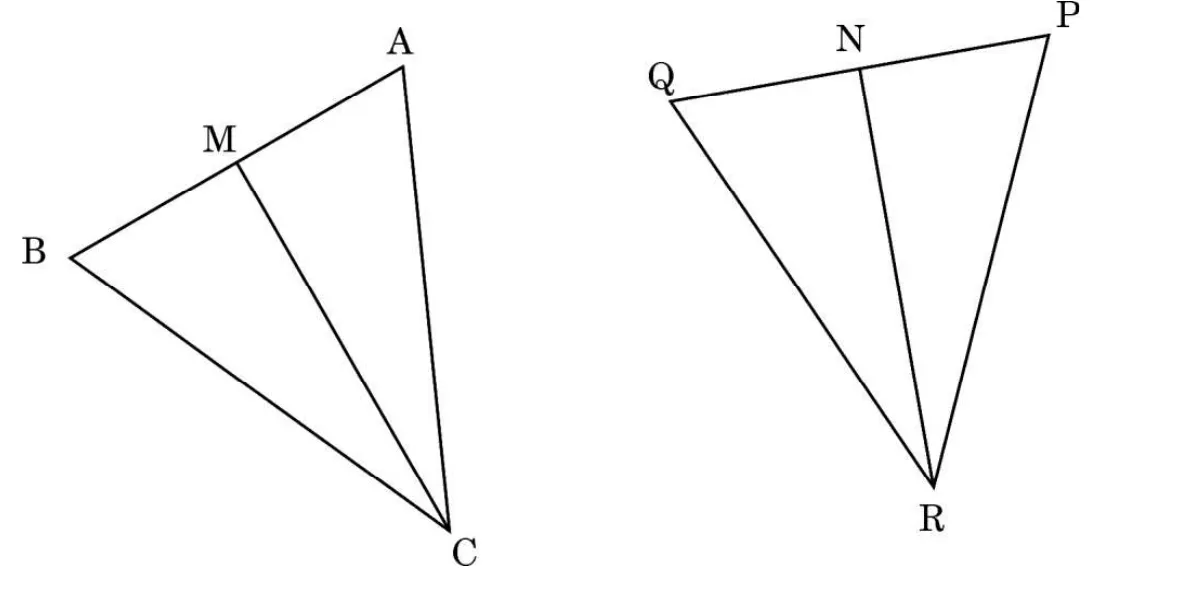
(b) In the given figure, CMCM and RNRN are respectively the medians of △ABC\triangle ABC and △PQR\triangle PQR. If △ABC∼△PQR\triangle ABC \sim \triangle PQR, prove that: (i) △AMC∼△PNR\triangle AMC \sim \triangle PNR (ii) ∠BCM=∠QRN\angle BCM = \angle QRN (iii) △BMC∼△QNR\triangle BMC \sim \triangle QNR

Two triangles side by side. In triangle ABC the median CM is drawn from C to M on AB. In triangle PQR the median RN is drawn from R to N on PQ.
Solution
  1. (a) **Statement.** If a line is drawn parallel to one side of a triangle to intersect the other two sides in distinct points, the other two sides are divided in the same ratio.
  2. **Given:** DE∥BCDE \parallel BC in △ABC\triangle ABC. **To prove:** ADDB=AEEC\dfrac{AD}{DB} = \dfrac{AE}{EC}. **Construction:** draw DM⊥ACDM \perp AC and EN⊥ABEN \perp AB; join BEBE and CDCD.
  3. ar(△ADE)ar(△DBE)=12⋅AD⋅EN12⋅DB⋅EN=ADDB\dfrac{\text{ar}(\triangle ADE)}{\text{ar}(\triangle DBE)} = \dfrac{\frac{1}{2} \cdot AD \cdot EN}{\frac{1}{2} \cdot DB \cdot EN} = \dfrac{AD}{DB} and ar(△ADE)ar(△ECD)=12⋅AE⋅DM12⋅EC⋅DM=AEEC\dfrac{\text{ar}(\triangle ADE)}{\text{ar}(\triangle ECD)} = \dfrac{\frac{1}{2} \cdot AE \cdot DM}{\frac{1}{2} \cdot EC \cdot DM} = \dfrac{AE}{EC}.
  4. △DBE\triangle DBE and △ECD\triangle ECD are on the same base DEDE and between the same parallels BCBC and DEDE, so their areas are equal. Hence ADDB=AEEC\dfrac{AD}{DB} = \dfrac{AE}{EC}.
  5. (b)(i) △ABC∼△PQR\triangle ABC \sim \triangle PQR gives ABPQ=ACPR\dfrac{AB}{PQ} = \dfrac{AC}{PR} and ∠A=∠P\angle A = \angle P. Since CMCM, RNRN are medians, AB=2AMAB = 2AM and PQ=2PNPQ = 2PN, so ACPR=AMPN\dfrac{AC}{PR} = \dfrac{AM}{PN}. So △AMC∼△PNR\triangle AMC \sim \triangle PNR (SAS).
  6. (ii) From (i), ∠ACM=∠PRN\angle ACM = \angle PRN. Also ∠ACB=∠PRQ\angle ACB = \angle PRQ. Subtracting, ∠ACB−∠ACM=∠PRQ−∠PRN\angle ACB - \angle ACM = \angle PRQ - \angle PRN, so ∠BCM=∠QRN\angle BCM = \angle QRN.
  7. (iii) BCQR=ABPQ=2BM2QN=BMQN\dfrac{BC}{QR} = \dfrac{AB}{PQ} = \dfrac{2BM}{2QN} = \dfrac{BM}{QN} and ∠B=∠Q\angle B = \angle Q. So △BMC∼△QNR\triangle BMC \sim \triangle QNR (SAS).

Answer: Proved (both parts)

Report an error on this question
Q34Surface Areas and Volumes5 marks

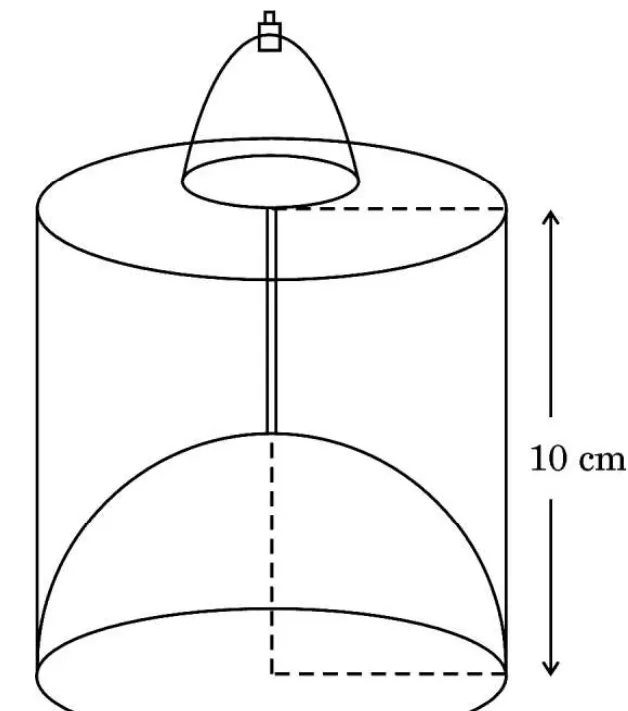
A perfume bottle is in the form of a cylinder but the bottom of the bottle has a hemispherical raised portion to reduce the capacity of the bottle. The inner diameter of the bottle is 55 cm and the height of the bottle is 1010 cm. Find the capacity of the perfume bottle in mL. (Use π=3.14\pi = 3.14 and 1 cm3=11\ \text{cm}^3 = 1 mL)

A cylindrical perfume bottle with a small stopper on top. Inside, the bottom has a raised dome in the form of a hemisphere. The height of the bottle is marked 10 cm.
Solution
h = 10r = 5/2V = πr²h − ⅔πr³ = 196.25 − 32.71 ≈ 163.5 cm³
  1. Radius r=52r = \dfrac{5}{2} cm and height h=10h = 10 cm. The capacity is the cylinder minus the raised hemisphere.
  2. Cylinder =πr2h=3.14×52×52×10=196.25= \pi r^2 h = 3.14 \times \dfrac{5}{2} \times \dfrac{5}{2} \times 10 = 196.25 cm³.
  3. Hemisphere =23πr3=23×3.14×52×52×52≈32.71= \dfrac{2}{3}\pi r^3 = \dfrac{2}{3} \times 3.14 \times \dfrac{5}{2} \times \dfrac{5}{2} \times \dfrac{5}{2} \approx 32.71 cm³.
  4. Capacity =196.25−32.71=163.54≈163.5= 196.25 - 32.71 = 163.54 \approx 163.5 cm³, that is 392524≈163.5\dfrac{3925}{24} \approx 163.5 mL.

Answer: About 163.5163.5 mL

Report an error on this question
Q35Statistics5 marks

The weights of 30 students of a class are given in the following distribution table:

Find the median weight of the students.

Weight (in kg)40–4545–5050–5555–6060–6565–70
Number of students258663
Solution
  1. Cumulative frequencies: 2,7,15,21,27,302, 7, 15, 21, 27, 30. N2=15\dfrac{N}{2} = 15.
  2. The cumulative frequency 1515 is reached at the class 50−5550 - 55, which is the median class: l=50l = 50, cf=7cf = 7, f=8f = 8, h=5h = 5.
  3. Median =50+15−78×5=50+5=55= 50 + \dfrac{15 - 7}{8} \times 5 = 50 + 5 = 55 kg.

Answer: 5555 kg

Report an error on this question

Section E: Case studies

3 case studies, 4 marks each.

Q36Arithmetic Progressions4 marks

Case study 1. In a society, a yoga instructor was hired to train the people of the society to live a healthy lifestyle. Yoga sessions were held daily from 5 p.m. to 7 p.m. in the society park. On day one, 5 people joined the yoga session, on day two, 3 more people joined, on day three, another 3 people joined and in this manner every next day, 3 more people kept on joining.

Based on the given information, answer the following questions:

(i) On which day did 59 people join the yoga session? [1]

(ii) How many people joined the yoga session on the 31st day? [1]

(iii) (a) The yoga instructor was paid ₹ 100 for each person attending the yoga session. On which day would he earn ₹ 5,000? [2]

OR

(iii) (b) What was the total amount earned by the yoga instructor in 16 days? [2]

Solution
  1. The numbers joining on days 1,2,3,…1, 2, 3, \dots are 5,8,11,…5, 8, 11, \dots, an A.P. with a=5a = 5 and d=3d = 3.
  2. (i) 5+(n−1)×3=595 + (n - 1) \times 3 = 59 gives n−1=18n - 1 = 18 and n=19n = 19.
  3. (ii) a31=5+30×3=95a_{31} = 5 + 30 \times 3 = 95.
  4. (iii)(a) ₹ 50005000 at ₹ 100100 a person means 5050 people: 5+(n−1)×3=505 + (n - 1) \times 3 = 50 gives n=16n = 16.
  5. (iii)(b) S16=162[2×5+15×3]=8×55=440S_{16} = \dfrac{16}{2}[2 \times 5 + 15 \times 3] = 8 \times 55 = 440 people in all, so he earned 440×100=₹44,000440 \times 100 = ₹44{,}000.

Answer: (i) day 1919   (ii) 9595 people   (iii)(a) day 1616   (iii)(b) ₹ 44,00044{,}000

Report an error on this question
Q37Trigonometry4 marks

Case study 2. Two motorboats A and B are waiting at the opposite banks of a river in order to reach the opposite side. From a point P on the bridge, 20 m above the river, the angles of depression of the boats are 30° and 45° respectively, as shown in the figure given below. Both the boats leave at the same time at the speed of 10 m/s and 5 m/s, respectively.

Based on the above information, answer the following questions:

(i) Find the distance travelled by boat A to reach point D in the river, vertically below the point P. (Use √3 = 1.73) [1]

(ii) What is the width of the river? [1]

(iii) (a) Which boat will reach point D first, and how much earlier, than the other boat? [2]

OR

(iii) (b) What is the distance between the two boats after 3 seconds? [2]
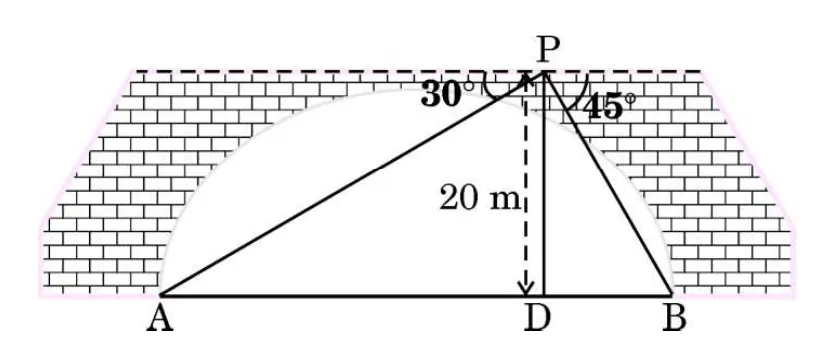
A bridge arch with the point P at the top and a river below. Boat A is on the left bank and boat B on the right. D is directly below P. The angles of depression are marked 30 degrees and 45 degrees and the height PD is marked 20 m.
Solution
30°45°PADB20 mAD = 20√3 = 34.6DB = 20width 54.6 m; A is earlier by 0.54 s
  1. (i) In the right triangle PDAPDA: tan⁡30∘=PDAD=20AD\tan 30^\circ = \dfrac{PD}{AD} = \dfrac{20}{AD}, so AD=203=20×1.73=34.6AD = 20\sqrt{3} = 20 \times 1.73 = 34.6 m.
  2. (ii) In △PDB\triangle PDB: tan⁡45∘=20DB=1\tan 45^\circ = \dfrac{20}{DB} = 1, so DB=20DB = 20 m. Width =AD+DB=34.6+20=54.6= AD + DB = 34.6 + 20 = 54.6 m.
  3. (iii)(a) Boat AA takes 34.610=3.46\dfrac{34.6}{10} = 3.46 s and boat BB takes 205=4\dfrac{20}{5} = 4 s. Boat AA reaches DD first, by 4−3.46=0.544 - 3.46 = 0.54 s.
  4. (iii)(b) In 33 s boat AA covers 3030 m and boat BB covers 1515 m. They move towards each other, so the distance between them is 54.6−(30+15)=9.654.6 - (30 + 15) = 9.6 m.

Answer: (i) 34.634.6 m   (ii) 54.654.6 m   (iii)(a) boat A, 0.540.54 s earlier   (iii)(b) 9.69.6 m

Report an error on this question
Q38Coordinate Geometry4 marks

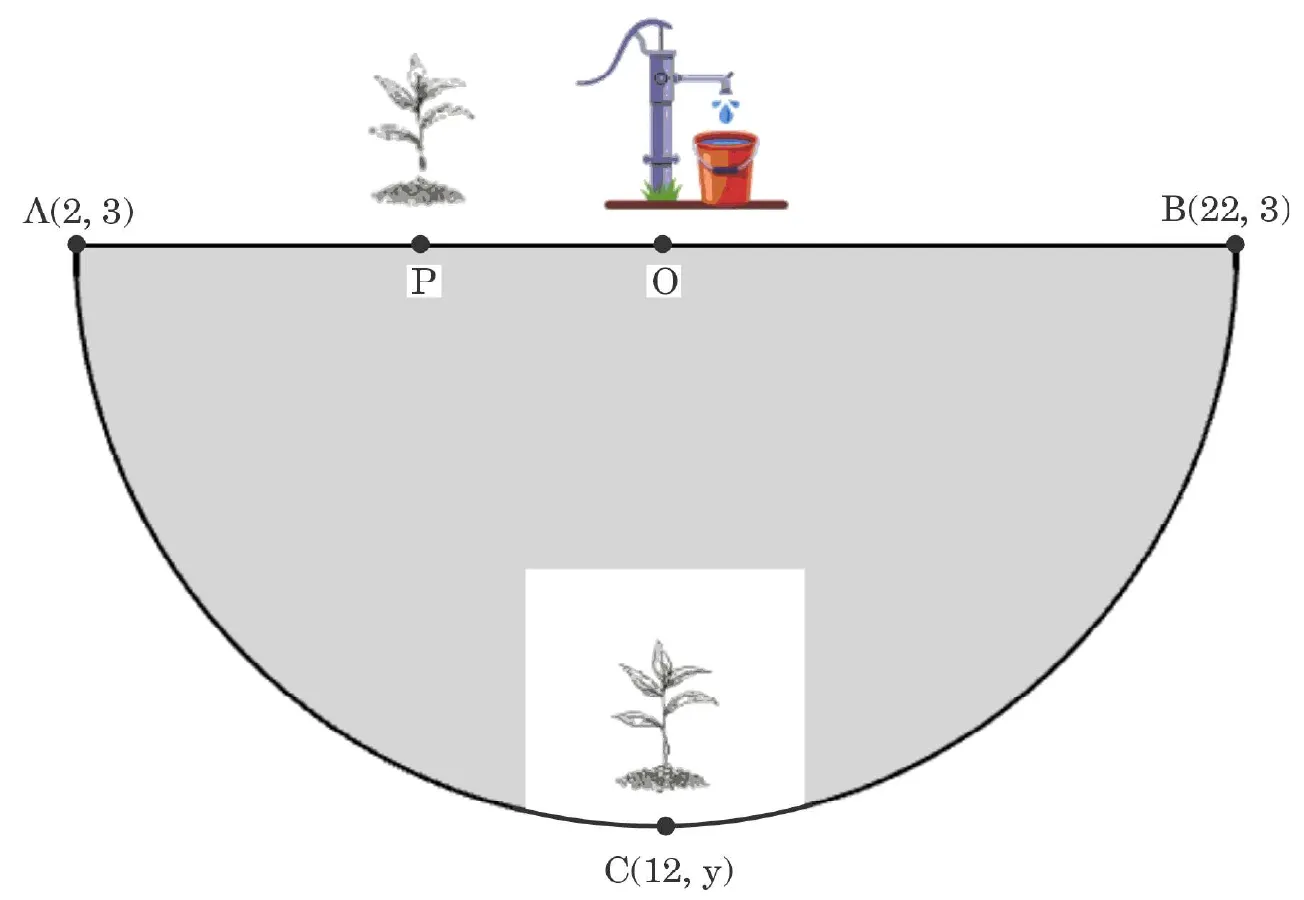
Case study 3. There is a semicircular park in Aman’s society. He wishes to plant saplings along the boundary of the park. There is a borewell at the centre O of the park along the diameter AB as shown in the figure below. A(2, 3), B(22, 3) and C(12, y).

Based on the above information, answer the following questions:

(i) Find the coordinates of point O. [1]

(ii) Find the radius of the semicircular park. [1]

(iii) (a) One sapling is kept at point C(12, y). Find the coordinates of C. [2]

OR

(iii) (b) One sapling is kept at point P along AB so that PA=13PBPA = \dfrac{1}{3}PB. Find the coordinates of P. [2]

A semicircular park drawn below its diameter AB, with A(2, 3) on the left, B(22, 3) on the right, the centre O and a point P on the diameter, and C(12, y) at the lowest point of the boundary.
Solution
A(2, 3)B(22, 3)O(12, 3)P(7, 3)C(12, −7)r = 10C = (12, 3 − 10); AP : PB = 1 : 3 → P = (7, 3)
  1. (i) OO is the centre, the mid-point of the diameter ABAB: O=(2+222,3+32)=(12,3)O = \left(\dfrac{2 + 22}{2}, \dfrac{3 + 3}{2}\right) = (12, 3).
  2. (ii) Radius =OA=12−2=10= OA = 12 - 2 = 10 (the distance from (12,3)(12, 3) to (2,3)(2, 3)).
  3. (iii)(a) CC is on the boundary, so OC=10OC = 10: (12−12)2+(y−3)2=10\sqrt{(12 - 12)^2 + (y - 3)^2} = 10 gives y−3=±10y - 3 = \pm 10, that is y=13y = 13 or y=−7y = -7. The park is the semicircle below ABAB, so C=(12,−7)C = (12, -7) (the key also lists (12,13)(12, 13) as a solution of the equation).
  4. (iii)(b) PA=13PBPA = \dfrac{1}{3}PB means AP:PB=1:3AP : PB = 1 : 3. P=(1×22+3×24,1×3+3×34)=(284,124)=(7,3)P = \left(\dfrac{1 \times 22 + 3 \times 2}{4}, \dfrac{1 \times 3 + 3 \times 3}{4}\right) = \left(\dfrac{28}{4}, \dfrac{12}{4}\right) = (7, 3).

Answer: (i) (12,3)(12, 3)   (ii) 1010   (iii)(a) (12,−7)(12, -7)   (iii)(b) (7,3)(7, 3)

Report an error on this question

Questions are from the official CBSE paper. Figures are described in words; see the PDF for the originals. Solutions are written by CogniGuru.

Revise this paper in 1 minute a chapter

Each chapter below is what the paper tested, with a one-minute animated lesson on the idea behind it.

Stuck on a step in any solution?

The CogniGuru AI tutor explains any doubt one minute at a time, in English or Hindi. Join the waitlist.

Mock quiz: 5 questions from this paper

Five real questions from this paper, one each from five chapters. About 2 minutes. See how much you know and where you stand among other students. Attempt free, with no login; log in only for your ranking and full report.

Question 1 of 5 · Q2 of the paperReal Numbers

3n3^n, where nn is a natural number, cannot end with the digit:

0 of 5 answered

Related papers

Common questions

Are these the official CBSE Class 10 Maths Basic 2025 questions?
Yes. The questions are from the official Mathematics (Basic) paper (set 430/3/1) that CBSE published after the March 2025 board exam. The solutions are written by CogniGuru and checked against the answer key CBSE published for this paper code.
Can I download the CBSE Class 10 Maths Basic 2025 question paper PDF?
Yes, the official paper PDF is free to download from this page, and so are our step-by-step solutions as a PDF. No login is needed to download either or to read the solutions.
Do all sets of the paper have the same questions?
No. CBSE sets several versions of each paper, with the same blueprint and similar questions in a different order and sometimes with different numbers. This page covers set 430/3/1.
How does the quiz work, and what does “where you stand” mean?
It is a mock quiz of 5 real multiple-choice questions from this paper, scored automatically in about 2 minutes. Your score is compared, anonymously, with other students who took the same quiz. Only the score is stored with the comparison, never your name or number.

Source

CBSE question paper archive, Class X, 2025 (Mathematics (Basic), set 430/3/1)
PDF