CBSE · Class 10 · Mathematics (Basic) · Free

CBSE Class 10 Maths Basic 2025 Question Paper (Set 430/4/1) with Solutions

The official board paper (Q.P. Code 430/4/1, Series H4EFG). Free paper PDF and step-by-step solutions (also as a PDF to download) written by CogniGuru and checked against CBSE’s answer key. See the paper’s main topics in 1 minute, then quiz yourself to see how much you know and where you stand.

No login to download or read the solutions. Login only to see your quiz report in full.

Board
CBSE
Class
10
Subject
Maths Basic (241)
Year
2025
Set code
430/4/1
Max marks
80
Duration
3 hours
Questions
38 (Sections A to E)
Source
Official CBSE paper
Exam date
March 2025

Paper preview

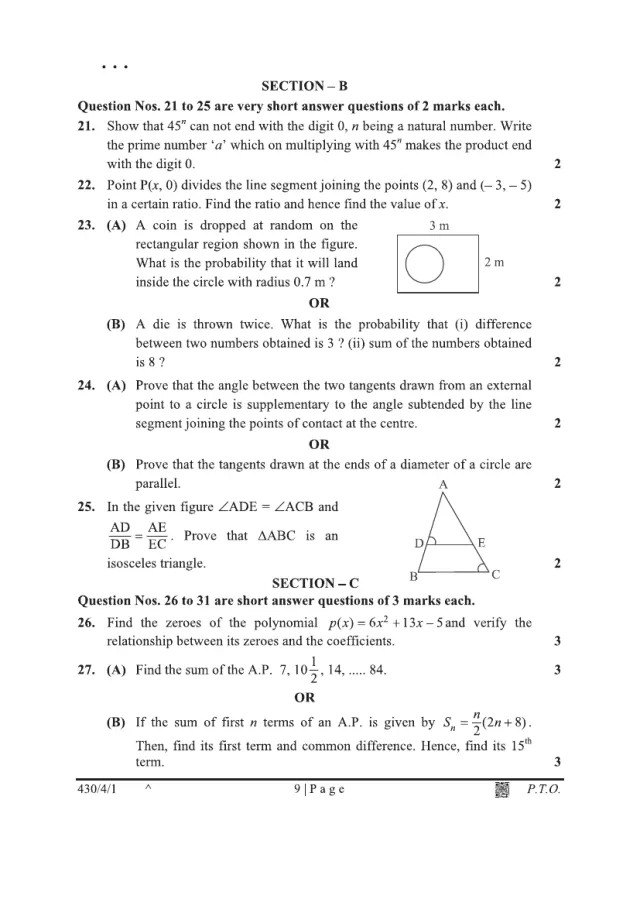
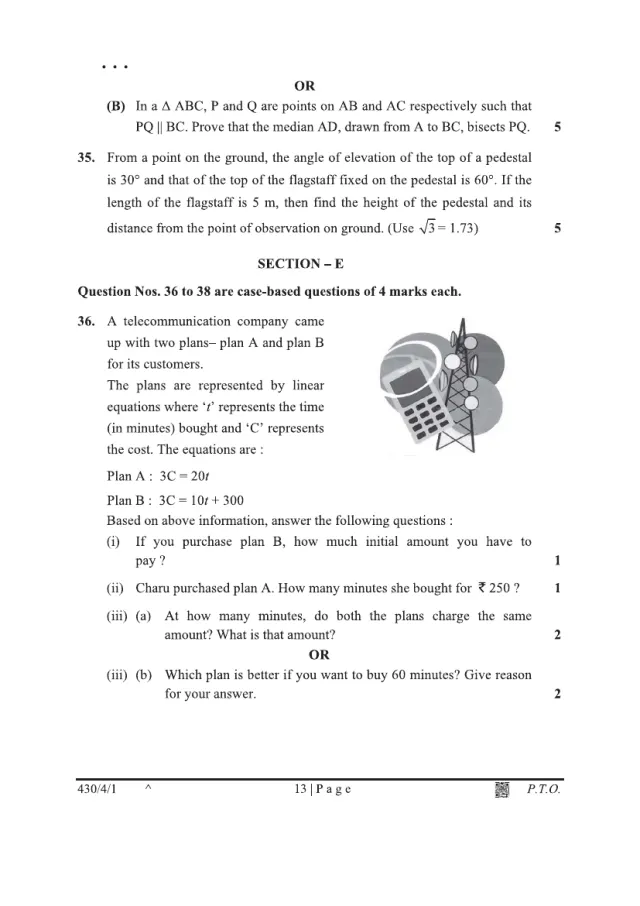
Three pages of the official paper. Download the PDF for all 16.
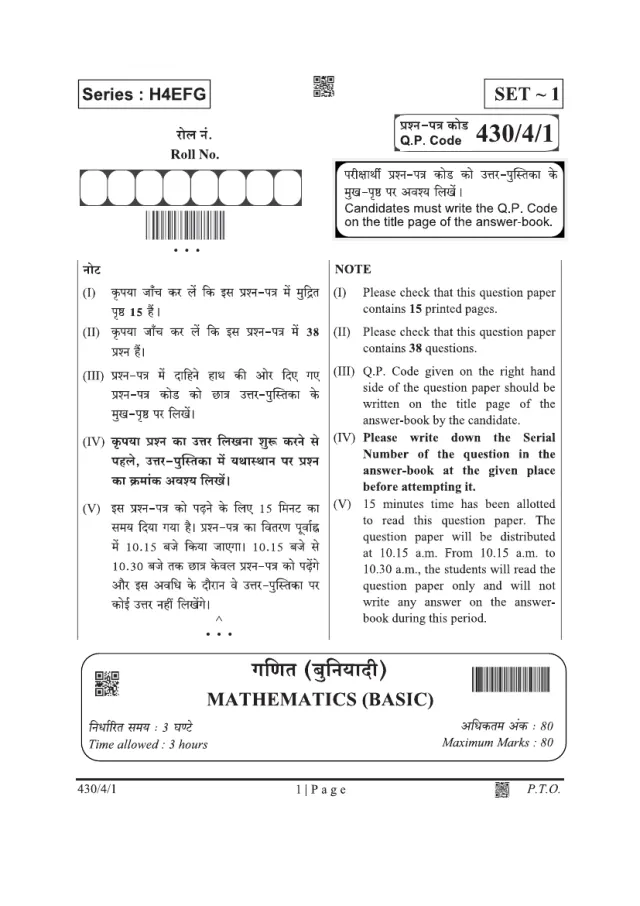
  • Cover page of the CBSE Class 10 Maths Basic 2025 paper, set 430/4/1

    Cover page

  • Section B of the CBSE Class 10 Maths Basic 2025 paper, set 430/4/1

    Section B

  • A case study with its figure from the CBSE Class 10 Maths Basic 2025 paper, set 430/4/1

    Case study

The main topics of this paper, in 1 minute

Your tutor walks you through the paper before you attempt it: the marks, the key ideas, the time plan and the traps.

1-minute paper analysis

With your tutor, in her voice

The main topics of this paper, in about a minute

A short, animated walk through the paper: how it is built, where the marks come from, the four ideas that matter most, how to plan your three hours, and the traps to avoid.

  1. 1The paper at a glance
  2. 2Where the marks come from
  3. 3Four ideas that keep paying off
  4. 4Plan your three hours
  5. 5Four traps to avoid

Sound on for the voice. Captions are shown, and you can mute any time.

Step-by-step solutions

Try each question first, then open its solution. Tap a number to jump.

Download solutions (PDF)

Section A: Multiple choice

20 questions, 1 mark each. MCQs (Q1 to Q18) and assertion-reason (Q19, Q20).

Q1Real Numbers1 mark

If HCF(x,20)=2\text{HCF}(x, 20) = 2 and LCM(x,20)=60\text{LCM}(x, 20) = 60, then the value of xx is:

  1. (A)3
  2. (B)6
  3. (C)20
  4. (D)10
Solution · answer (B)
  1. HCF×LCM=x×20\text{HCF} \times \text{LCM} = x \times 20, so 2×60=20x2 \times 60 = 20x and x=6x = 6. (Check: HCF(6,20)=2\text{HCF}(6, 20) = 2 ✓ and LCM(6,20)=60\text{LCM}(6, 20) = 60 ✓.)

Answer: (B) 6

Report an error on this question
Q2Coordinate Geometry1 mark

The distance between the points (−6,9)(-6, 9) and (2,7)(2, 7) is:

  1. (A)2172\sqrt{17}
  2. (B)4174\sqrt{17}
  3. (C)252\sqrt{5}
  4. (D)2152\sqrt{15}
Solution · answer (A)
  1. d=(2+6)2+(7−9)2=64+4=68=217d = \sqrt{(2 + 6)^2 + (7 - 9)^2} = \sqrt{64 + 4} = \sqrt{68} = 2\sqrt{17}.

Answer: (A) 2172\sqrt{17}

Report an error on this question
Q3Arithmetic Progressions1 mark

If nthn^{\text{th}} term of an A.P. is 5n−65n - 6, then its common difference is:

  1. (A)−6
  2. (B)5n
  3. (C)5
  4. (D)6
Solution · answer (C)
  1. an+1−an=(5(n+1)−6)−(5n−6)=5a_{n+1} - a_n = (5(n + 1) - 6) - (5n - 6) = 5.

Answer: (C) 5

Report an error on this question
Q4Polynomials1 mark

One of the zeroes of the polynomial p(x)=kx2−9x+3p(x) = kx^2 - 9x + 3 is (−32)\left(-\dfrac{3}{2}\right). The value of kk is:

  1. (A)223\dfrac{22}{3}
  2. (B)−143-\dfrac{14}{3}
  3. (C)143\dfrac{14}{3}
  4. (D)−223-\dfrac{22}{3}
Solution · answer (D)
  1. A zero makes the polynomial 00: k(−32)2−9(−32)+3=0k\left(-\dfrac{3}{2}\right)^2 - 9\left(-\dfrac{3}{2}\right) + 3 = 0.
  2. 9k4+272+3=0\dfrac{9k}{4} + \dfrac{27}{2} + 3 = 0, so 9k4=−332\dfrac{9k}{4} = -\dfrac{33}{2} and k=−223k = -\dfrac{22}{3}.

Answer: (D) −223-\dfrac{22}{3}

Report an error on this question
Q5Probability1 mark

Three coins are tossed together. The probability that only one coin shows tail, is:

  1. (A)12\dfrac{1}{2}
  2. (B)38\dfrac{3}{8}
  3. (C)78\dfrac{7}{8}
  4. (D)1
Solution · answer (B)
  1. There are 23=82^3 = 8 outcomes. Exactly one tail: THHTHH, HTHHTH, HHTHHT, which is 33. P=38P = \dfrac{3}{8}.

Answer: (B) 38\dfrac{3}{8}

Report an error on this question
Q6Surface Areas and Volumes1 mark

Two right circular cylinders of equal volumes have their heights in the ratio 1:21 : 2. The ratio of their radii is:

  1. (A)2:1\sqrt{2} : 1
  2. (B)1 : 2
  3. (C)1 : 4
  4. (D)1:21 : \sqrt{2}
Solution · answer (A)
  1. πr12h1=πr22h2\pi r_1^2 h_1 = \pi r_2^2 h_2, so r12r22=h2h1=21\dfrac{r_1^2}{r_2^2} = \dfrac{h_2}{h_1} = \dfrac{2}{1} and r1:r2=2:1r_1 : r_2 = \sqrt{2} : 1.

Answer: (A) 2:1\sqrt{2} : 1

Report an error on this question
Q7Trigonometry1 mark

If 2sin⁡θ=1\sqrt{2}\sin\theta = 1, then cot⁡θ×cosec⁡θ\cot\theta \times \operatorname{cosec}\theta is equal to:

  1. (A)12\dfrac{1}{\sqrt{2}}
  2. (B)122\dfrac{1}{2\sqrt{2}}
  3. (C)2\sqrt{2}
  4. (D)12\dfrac{1}{2}
Solution · answer (C)
  1. sin⁡θ=12\sin\theta = \dfrac{1}{\sqrt{2}}, so θ=45∘\theta = 45^\circ. cot⁡45∘×cosec⁡45∘=1×2=2\cot 45^\circ \times \operatorname{cosec} 45^\circ = 1 \times \sqrt{2} = \sqrt{2}.

Answer: (C) 2\sqrt{2}

Report an error on this question
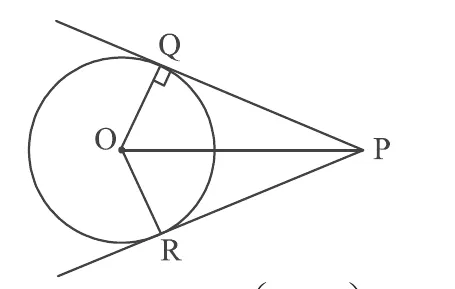
Q8Circles1 mark

PQPQ and PRPR are tangents to the circle of radius 33 cm and centre OO. If length of each tangent is 44 cm, perimeter of △OQP\triangle OQP is:

A circle of radius 3 cm with centre O. Tangents PQ and PR from the outside point P on the right touch the circle at Q (top) and R (bottom). The radii OQ and OR are drawn.
  1. (A)5 cm
  2. (B)12 cm
  3. (C)9 cm
  4. (D)8 cm
Solution · answer (B)
43OPQROP = √(3² + 4²) = 5 → perimeter of △OQP = 3 + 4 + 5 = 12 cm
  1. OQ⊥PQOQ \perp PQ, so OP=32+42=5OP = \sqrt{3^2 + 4^2} = 5 cm.
  2. Perimeter of △OQP=OQ+QP+OP=3+4+5=12\triangle OQP = OQ + QP + OP = 3 + 4 + 5 = 12 cm.

Answer: (B) 12 cm

Report an error on this question
Q9Polynomials1 mark

α,β\alpha, \beta are zeroes of the polynomial 2x2+5x+12x^2 + 5x + 1. The value of (1α+1β)\left(\dfrac{1}{\alpha} + \dfrac{1}{\beta}\right) is:

  1. (A)−54-\dfrac{5}{4}
  2. (B)5
  3. (C)54\dfrac{5}{4}
  4. (D)−5
Solution · answer (D)
  1. α+β=−52\alpha + \beta = -\dfrac{5}{2} and αβ=12\alpha\beta = \dfrac{1}{2}. 1α+1β=α+βαβ=−5/21/2=−5\dfrac{1}{\alpha} + \dfrac{1}{\beta} = \dfrac{\alpha + \beta}{\alpha\beta} = \dfrac{-5/2}{1/2} = -5.

Answer: (D) −5

Report an error on this question
Q10Arithmetic Progressions1 mark

The 20th20^{\text{th}} term of the A.P.: 102,62,22,…10\sqrt{2}, 6\sqrt{2}, 2\sqrt{2}, \dots is:

  1. (A)−76+102-76 + 10\sqrt{2}
  2. (B)−622-62\sqrt{2}
  3. (C)−662-66\sqrt{2}
  4. (D)86286\sqrt{2}
Solution · answer (C)
  1. a=102a = 10\sqrt{2} and d=62−102=−42d = 6\sqrt{2} - 10\sqrt{2} = -4\sqrt{2}. a20=102+19(−42)=102−762=−662a_{20} = 10\sqrt{2} + 19(-4\sqrt{2}) = 10\sqrt{2} - 76\sqrt{2} = -66\sqrt{2}.

Answer: (C) −662-66\sqrt{2}

Report an error on this question
Q11Trigonometry1 mark

If sec⁡θ−tan⁡θ=2\sec\theta - \tan\theta = 2, then sec⁡θ+tan⁡θ\sec\theta + \tan\theta is equal to:

  1. (A)12\dfrac{1}{2}
  2. (B)2\sqrt{2}
  3. (C)12\dfrac{1}{\sqrt{2}}
  4. (D)2
Solution · answer (A)
  1. (sec⁡θ+tan⁡θ)(sec⁡θ−tan⁡θ)=sec⁡2θ−tan⁡2θ=1(\sec\theta + \tan\theta)(\sec\theta - \tan\theta) = \sec^2\theta - \tan^2\theta = 1. So sec⁡θ+tan⁡θ=12\sec\theta + \tan\theta = \dfrac{1}{2}.

Answer: (A) 12\dfrac{1}{2}

Report an error on this question
Q12Probability1 mark

A card is drawn at random from a well shuffled deck of 5252 playing cards. The probability that drawn card shows number ‘9’ is:

  1. (A)126\dfrac{1}{26}
  2. (B)413\dfrac{4}{13}
  3. (C)152\dfrac{1}{52}
  4. (D)113\dfrac{1}{13}
Solution · answer (D)
  1. There are 44 nines in the deck. P=452=113P = \dfrac{4}{52} = \dfrac{1}{13}.

Answer: (D) 113\dfrac{1}{13}

Report an error on this question
Q13Areas Related to Circles1 mark

The length of arc subtending an angle of 210∘210^\circ at the centre of the circle, is 443\dfrac{44}{3} cm. The radius of the circle is:

  1. (A)222\sqrt{2} cm
  2. (B)4 cm
  3. (C)8 cm
  4. (D)14\dfrac{1}{4} cm
Solution · answer (B)
  1. Arc =210360×2πr=712×2×227r=113r=443= \dfrac{210}{360} \times 2\pi r = \dfrac{7}{12} \times 2 \times \dfrac{22}{7} r = \dfrac{11}{3}r = \dfrac{44}{3}, so r=4r = 4 cm.

Answer: (B) 4 cm

Report an error on this question
Q14Linear Equations1 mark

The value of mm for which lines 14x+my=2014x + my = 20 and −3x+2y=16-3x + 2y = 16 are parallel, is:

  1. (A)−314-\dfrac{3}{14}
  2. (B)−73-\dfrac{7}{3}
  3. (C)−283-\dfrac{28}{3}
  4. (D)−328-\dfrac{3}{28}
Solution · answer (C)
  1. Parallel lines need 14−3=m2≠2016\dfrac{14}{-3} = \dfrac{m}{2} \neq \dfrac{20}{16}. So m=−283m = -\dfrac{28}{3} (then m2=−143≠54\dfrac{m}{2} = -\dfrac{14}{3} \neq \dfrac{5}{4} ✓).

Answer: (C) −283-\dfrac{28}{3}

Report an error on this question
Q15Surface Areas and Volumes1 mark

The curved surface area of a cone with base radius 77 cm, is 550550 cm². The slant height of the cone is:

  1. (A)25 cm
  2. (B)14 cm
  3. (C)20 cm
  4. (D)24 cm
Solution · answer (A)
  1. πrl=550\pi r l = 550: 227×7×l=22l=550\dfrac{22}{7} \times 7 \times l = 22l = 550, so l=25l = 25 cm.

Answer: (A) 25 cm

Report an error on this question
Q16Trigonometry1 mark

If sin⁡A=23\sin A = \dfrac{2}{3}, then cos⁡A\cos A is equal to:

  1. (A)32\dfrac{3}{2}
  2. (B)53\dfrac{\sqrt{5}}{3}
  3. (C)13\dfrac{1}{3}
  4. (D)13\dfrac{1}{\sqrt{3}}
Solution · answer (B)
  1. cos⁡A=1−sin⁡2A=1−49=53\cos A = \sqrt{1 - \sin^2 A} = \sqrt{1 - \dfrac{4}{9}} = \dfrac{\sqrt{5}}{3}.

Answer: (B) 53\dfrac{\sqrt{5}}{3}

Report an error on this question
Q17Circles1 mark

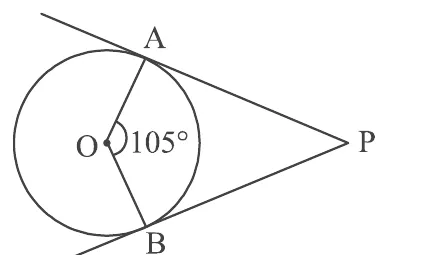
PAPA and PBPB are tangents to a circle with centre OO. If ∠AOB=105∘\angle AOB = 105^\circ then ∠OAP+∠APB\angle OAP + \angle APB is equal to:

A circle with centre O on the left. Tangents PA and PB from the outside point P on the right touch the circle at A (top) and B (bottom). The angle AOB is marked 105 degrees.
  1. (A)75∘75^\circ
  2. (B)175∘175^\circ
  3. (C)180∘180^\circ
  4. (D)165∘165^\circ
Solution · answer (D)
OPAB105°75°∠APB = 180° − 105° = 75°; ∠OAP = 90° → sum = 165°
  1. OA⊥PAOA \perp PA, so ∠OAP=90∘\angle OAP = 90^\circ. In the quadrilateral OAPBOAPB: ∠APB=360∘−90∘−90∘−105∘=75∘\angle APB = 360^\circ - 90^\circ - 90^\circ - 105^\circ = 75^\circ.
  2. ∠OAP+∠APB=90∘+75∘=165∘\angle OAP + \angle APB = 90^\circ + 75^\circ = 165^\circ.

Answer: (D) 165∘165^\circ

Report an error on this question
Q18Triangles1 mark

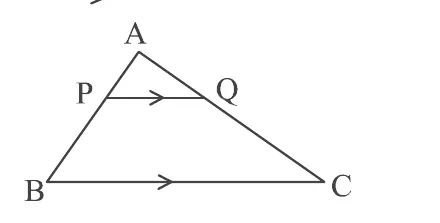
In △ABC\triangle ABC, PQ∥BCPQ \parallel BC. It is given that AP=2.4AP = 2.4 cm, PB=3.6PB = 3.6 cm and BC=5.4BC = 5.4 cm. PQPQ is equal to:

A triangle ABC with A at the top and the base BC at the bottom. PQ is drawn parallel to BC with P on AB and Q on AC.
  1. (A)2.7 cm
  2. (B)1.8 cm
  3. (C)3.6 cm
  4. (D)2.16 cm
Solution · answer (D)
2.43.65.4PQ = 2.16ABCPQAB = 6; PQ/BC = AP/AB = 2.4/6 = 2/5 → PQ = 2.16 cm
  1. AB=AP+PB=2.4+3.6=6AB = AP + PB = 2.4 + 3.6 = 6 cm. PQ∥BCPQ \parallel BC gives △APQ∼△ABC\triangle APQ \sim \triangle ABC, so PQBC=APAB\dfrac{PQ}{BC} = \dfrac{AP}{AB}.
  2. PQ=5.4×2.46=2.16PQ = 5.4 \times \dfrac{2.4}{6} = 2.16 cm.

Answer: (D) 2.16 cm

Report an error on this question
Q19Statistics1 mark

Assertion (A): Median marks of students in a class test is 1616. It means half of the class got marks less than 1616.

Reason (R): Median divides the distribution in two equal parts.

  1. (A)Both A and R are true and R is the correct explanation of A
  2. (B)Both A and R are true, but R is not the correct explanation of A
  3. (C)A is true, but R is false
  4. (D)A is false, but R is true
Solution · answer (A)
  1. (R) The median is the middle value: half of the data lie below it and half above. True.
  2. (A) That is exactly what a median of 1616 means: half of the class scored less than 1616. True, and R explains it.

Answer: (A) Both A and R are true and R is the correct explanation of A

Report an error on this question
Q20Probability1 mark

Assertion (A): If E is an event such that P(E)=1999P(E) = \dfrac{1}{999}, then P(Eˉ)=0.001P(\bar{E}) = 0.001.

Reason (R): P(E)+P(Eˉ)=1P(E) + P(\bar{E}) = 1.

  1. (A)Both A and R are true and R is the correct explanation of A
  2. (B)Both A and R are true, but R is not the correct explanation of A
  3. (C)A is true, but R is false
  4. (D)A is false, but R is true
Solution · answer (D)
  1. (R) The probabilities of an event and its complement add up to 11. True.
  2. (A) P(Eˉ)=1−1999=998999≈0.999P(\bar{E}) = 1 - \dfrac{1}{999} = \dfrac{998}{999} \approx 0.999, not 0.0010.001 (that is close to P(E)P(E) itself). False.

Answer: (D) A is false, R is true

Report an error on this question

Section B: Very short answer

5 questions, 2 marks each.

Q21Real Numbers2 marks

Show that 45n45^n can not end with the digit 00, nn being a natural number. Write the prime number ‘aa’ which on multiplying with 45n45^n makes the product end with the digit 00.

Solution
  1. 45n=(3×3×5)n=32n×5n45^n = (3 \times 3 \times 5)^n = 3^{2n} \times 5^n. A number ends in 00 only if it is divisible by both 22 and 55. 45n45^n has no factor 22, so it cannot end with 00.
  2. Multiplying by the prime a=2a = 2 gives the factors 22 and 55 together, so 2×45n2 \times 45^n ends with 00.

Answer: Shown; a=2a = 2

Report an error on this question
Q22Coordinate Geometry2 marks

Point P(x,0)P(x, 0) divides the line segment joining the points (2,8)(2, 8) and (−3,−5)(-3, -5) in a certain ratio. Find the ratio and hence find the value of xx.

Solution
  1. Let PP divide the segment in the ratio k:1k : 1. The yy-coordinate of PP is 00: −5k+8k+1=0\dfrac{-5k + 8}{k + 1} = 0, so k=85k = \dfrac{8}{5}. The ratio is 8:58 : 5.
  2. x=8(−3)+5(2)13=−24+1013=−1413x = \dfrac{8(-3) + 5(2)}{13} = \dfrac{-24 + 10}{13} = -\dfrac{14}{13}.

Answer: Ratio 8:58 : 5; x=−1413x = -\dfrac{14}{13}

Report an error on this question
Q23Probability2 marks

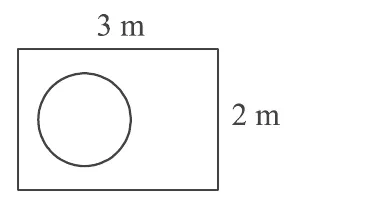
(a) A coin is dropped at random on the rectangular region shown in the figure (a rectangle 33 m by 22 m with a circle of radius 0.70.7 m inside). What is the probability that it will land inside the circle with radius 0.70.7 m?

OR

(b) A die is thrown twice. What is the probability that (i) difference between two numbers obtained is 33? (ii) sum of the numbers obtained is 88?

A rectangle marked 3 m wide and 2 m tall with a circle drawn inside it.
Solution
3 m2 mr = 0.7P = π(0.7)² / (3 × 2) = 1.54 / 6 = 77/300
  1. (a) Area of the circle =227×0.7×0.7=1.54= \dfrac{22}{7} \times 0.7 \times 0.7 = 1.54 m². Area of the rectangle =3×2=6= 3 \times 2 = 6 m². P=1.546=77300P = \dfrac{1.54}{6} = \dfrac{77}{300}.
  2. (b) There are 3636 equally likely outcomes. (i) Difference 33: (1,4),(4,1),(2,5),(5,2),(3,6),(6,3)(1,4), (4,1), (2,5), (5,2), (3,6), (6,3), which is 66: P=636=16P = \dfrac{6}{36} = \dfrac{1}{6}.
  3. (ii) Sum 88: (2,6),(6,2),(3,5),(5,3),(4,4)(2,6), (6,2), (3,5), (5,3), (4,4), which is 55: P=536P = \dfrac{5}{36}.

Answer: (a) 77300\dfrac{77}{300}   (b) (i) 16\dfrac{1}{6} (ii) 536\dfrac{5}{36}

Report an error on this question
Q24Circles2 marks

(a) Prove that the angle between the two tangents drawn from an external point to a circle is supplementary to the angle subtended by the line segment joining the points of contact at the centre.

OR

(b) Prove that the tangents drawn at the ends of a diameter of a circle are parallel.

Solution
  1. (a) Let PAPA and PBPB be tangents from PP to a circle with centre OO. OA⊥PAOA \perp PA and OB⊥PBOB \perp PB, so ∠OAP=∠OBP=90∘\angle OAP = \angle OBP = 90^\circ.
  2. In the quadrilateral OAPBOAPB: ∠APB+∠PBO+∠BOA+∠OAP=360∘\angle APB + \angle PBO + \angle BOA + \angle OAP = 360^\circ, so ∠APB+∠AOB=180∘\angle APB + \angle AOB = 180^\circ. The two angles are supplementary.
  3. (b) Let ABAB be a diameter with the tangents PQPQ at AA and RSRS at BB. ∠OAP=∠OBR=90∘\angle OAP = \angle OBR = 90^\circ (radius and tangent). These are alternate (co-interior) angles that add to 180∘180^\circ with the transversal ABAB, so PQ∥RSPQ \parallel RS.

Answer: Proved (both parts)

Report an error on this question
Q25Triangles2 marks

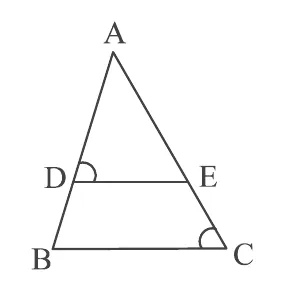
In the given figure, ∠ADE=∠ACB\angle ADE = \angle ACB and ADDB=AEEC\dfrac{AD}{DB} = \dfrac{AE}{EC}. Prove that △ABC\triangle ABC is an isosceles triangle.

A triangle ABC with a line DE drawn across it, D on AB and E on AC, and the angles ADE and ACB marked.
Solution
  1. ADDB=AEEC\dfrac{AD}{DB} = \dfrac{AE}{EC}, so DE∥BCDE \parallel BC (converse of the basic proportionality theorem).
  2. Then ∠ADE=∠ABC\angle ADE = \angle ABC (corresponding angles). It is given that ∠ADE=∠ACB\angle ADE = \angle ACB, so ∠ABC=∠ACB\angle ABC = \angle ACB.
  3. The sides opposite equal angles are equal: AC=ABAC = AB, so △ABC\triangle ABC is isosceles.

Answer: Proved

Report an error on this question

Section C: Short answer

6 questions, 3 marks each.

Q26Polynomials3 marks

Find the zeroes of the polynomial p(x)=6x2+13x−5p(x) = 6x^2 + 13x - 5 and verify the relationship between its zeroes and the coefficients.

Solution
  1. 6x2+13x−5=(3x−1)(2x+5)6x^2 + 13x - 5 = (3x - 1)(2x + 5), so the zeroes are 13\dfrac{1}{3} and −52-\dfrac{5}{2}.
  2. Sum =13−52=−136= \dfrac{1}{3} - \dfrac{5}{2} = -\dfrac{13}{6} and −136-\dfrac{13}{6} ✓. Product =13×(−52)=−56= \dfrac{1}{3} \times \left(-\dfrac{5}{2}\right) = -\dfrac{5}{6} and −56\dfrac{-5}{6} ✓.

Answer: Zeroes 13\dfrac{1}{3} and −52-\dfrac{5}{2}; relations verified

Report an error on this question
Q27Arithmetic Progressions3 marks

(a) Find the sum of the A.P. 7,1012,14,…,847, 10\dfrac{1}{2}, 14, \dots, 84.

OR

(b) If the sum of first nn terms of an A.P. is given by Sn=n2(2n+8)S_n = \dfrac{n}{2}(2n + 8), then find its first term and common difference. Hence, find its 15th15^{\text{th}} term.

Solution
  1. (a) a=7a = 7 and d=1012−7=72d = 10\dfrac{1}{2} - 7 = \dfrac{7}{2}. 84=7+(n−1)×7284 = 7 + (n - 1) \times \dfrac{7}{2} gives n−1=22n - 1 = 22 and n=23n = 23.
  2. S23=232(7+84)=23×912=20932=1046.5S_{23} = \dfrac{23}{2}(7 + 84) = \dfrac{23 \times 91}{2} = \dfrac{2093}{2} = 1046.5.
  3. (b) Sn=n(n+4)=n2+4nS_n = n(n + 4) = n^2 + 4n. a=S1=5a = S_1 = 5 and S2=12S_2 = 12, so a2=7a_2 = 7 and d=2d = 2.
  4. a15=5+14×2=33a_{15} = 5 + 14 \times 2 = 33.

Answer: (a) 20932\dfrac{2093}{2}   (b) a=5a = 5, d=2d = 2, a15=33a_{15} = 33

Report an error on this question
Q28Real Numbers3 marks

Prove that 3\sqrt{3} is an irrational number.

Solution
  1. Suppose 3=pq\sqrt{3} = \dfrac{p}{q} with p,qp, q co-prime and q≠0q \neq 0. 3q2=p23q^2 = p^2, so 33 divides p2p^2 and so 33 divides pp. Write p=3mp = 3m.
  2. 3q2=9m23q^2 = 9m^2 gives q2=3m2q^2 = 3m^2, so 33 divides qq. Then 33 divides both pp and qq, contradicting that they are co-prime. So 3\sqrt{3} is irrational.

Answer: Proved

Report an error on this question
Q29Coordinate Geometry3 marks

(a) If points A(−5,y)A(-5, y), B(2,−2)B(2, -2), C(8,4)C(8, 4) and D(x,5)D(x, 5) taken in order, form a parallelogram ABCDABCD, then find the values of xx and yy. Hence, find lengths of sides of the parallelogram.

OR

(b) A(6,−3)A(6, -3), B(0,5)B(0, 5) and C(−2,1)C(-2, 1) are vertices of △ABC\triangle ABC. Points P(3,1)P(3, 1) and Q(2,−1)Q(2, -1) lie on sides ABAB and ACAC respectively. Check whether APPB=AQQC\dfrac{AP}{PB} = \dfrac{AQ}{QC}.

Solution
  1. (a) The diagonals of a parallelogram bisect each other: the mid-point of BDBD equals the mid-point of ACAC. (2+x2,−2+52)=(−5+82,y+42)\left(\dfrac{2 + x}{2}, \dfrac{-2 + 5}{2}\right) = \left(\dfrac{-5 + 8}{2}, \dfrac{y + 4}{2}\right).
  2. 2+x2=32\dfrac{2 + x}{2} = \dfrac{3}{2} gives x=1x = 1, and 32=y+42\dfrac{3}{2} = \dfrac{y + 4}{2} gives y=−1y = -1.
  3. AB=(2+5)2+(−2+1)2=50=52AB = \sqrt{(2 + 5)^2 + (-2 + 1)^2} = \sqrt{50} = 5\sqrt{2} and BC=(8−2)2+(4+2)2=72=62BC = \sqrt{(8 - 2)^2 + (4 + 2)^2} = \sqrt{72} = 6\sqrt{2}. The sides are 525\sqrt{2} and 626\sqrt{2}.
  4. (b) AP=(3−6)2+(1+3)2=5AP = \sqrt{(3 - 6)^2 + (1 + 3)^2} = 5 and PB=(3−0)2+(1−5)2=5PB = \sqrt{(3 - 0)^2 + (1 - 5)^2} = 5, so APPB=1\dfrac{AP}{PB} = 1.
  5. AQ=(2−6)2+(−1+3)2=25AQ = \sqrt{(2 - 6)^2 + (-1 + 3)^2} = 2\sqrt{5} and QC=(2+2)2+(−1−1)2=25QC = \sqrt{(2 + 2)^2 + (-1 - 1)^2} = 2\sqrt{5}, so AQQC=1\dfrac{AQ}{QC} = 1. Hence APPB=AQQC\dfrac{AP}{PB} = \dfrac{AQ}{QC} ✓.

Answer: (a) x=1x = 1, y=−1y = -1; sides 525\sqrt{2} and 626\sqrt{2}   (b) yes, both ratios are 11

Report an error on this question
Q30Areas Related to Circles3 marks

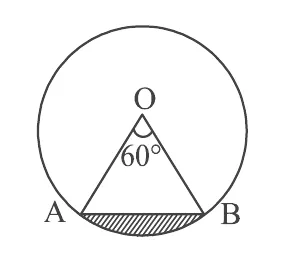
A chord of a circle of radius 1010 cm subtends an angle of 60∘60^\circ at the centre OO. Find the area of the shaded region. (Use 3=1.73\sqrt{3} = 1.73, 2=1.41\sqrt{2} = 1.41 and π=3.14\pi = 3.14)

A circle with centre O and a chord AB. The angle AOB is marked 60 degrees and the thin segment between the chord and the arc is shaded.
Solution
60°OABsector = 60/360 × 3.14 × 100 = 52.33 cm²triangle = (√3/4) × 100 = 43.25 → shaded = 9.08 cm²
  1. Area of the sector OAB=60360×3.14×102=3146≈52.33OAB = \dfrac{60}{360} \times 3.14 \times 10^2 = \dfrac{314}{6} \approx 52.33 cm².
  2. OA=OBOA = OB and ∠AOB=60∘\angle AOB = 60^\circ, so △OAB\triangle OAB is equilateral with side 1010: area =34×102=1734=43.25= \dfrac{\sqrt{3}}{4} \times 10^2 = \dfrac{173}{4} = 43.25 cm².
  3. Shaded segment =52.33−43.25=9.08= 52.33 - 43.25 = 9.08 cm².

Answer: 3146−1734≈9.08\dfrac{314}{6} - \dfrac{173}{4} \approx 9.08 cm²

Report an error on this question
Q31Circles3 marks

Prove that the opposite sides of a quadrilateral circumscribing a circle subtend supplementary angles at the centre of the circle.

Solution
  1. Let ABCDABCD circumscribe a circle with centre OO, touching ABAB, BCBC, CDCD, DADA at P,Q,R,SP, Q, R, S. Join OO to A,B,C,DA, B, C, D and to P,Q,R,SP, Q, R, S.
  2. Tangents from a point are equal and radii are equal, so △OAP≅△OAS\triangle OAP \cong \triangle OAS and ∠AOP=∠AOS\angle AOP = \angle AOS. In the same way ∠BOP=∠BOQ\angle BOP = \angle BOQ, ∠COQ=∠COR\angle COQ = \angle COR, ∠DOR=∠DOS\angle DOR = \angle DOS.
  3. The eight angles round OO add up to 360∘360^\circ: 2(∠AOP+∠BOP+∠COQ+∠DOR)=360∘2(\angle AOP + \angle BOP + \angle COQ + \angle DOR) = 360^\circ. So ∠AOB+∠COD=180∘\angle AOB + \angle COD = 180^\circ, and likewise ∠BOC+∠AOD=180∘\angle BOC + \angle AOD = 180^\circ.

Answer: Proved

Report an error on this question

Section D: Long answer

4 questions, 5 marks each.

Q32Quadratic Equations5 marks

(a) It is given that p2x2+(p2−q2)x−q2=0p^2x^2 + (p^2 - q^2)x - q^2 = 0; (p≠0p \neq 0). (i) Show that the discriminant (DD) of the above equation is a perfect square. (ii) Find the roots of the equation.

OR

(b) Three consecutive positive integers are such that the sum of the square of smallest and product of other two is 6767. Find the numbers, using quadratic equation.

Solution
  1. (a)(i) D=(p2−q2)2−4(p2)(−q2)=(p2−q2)2+4p2q2=(p2+q2)2D = (p^2 - q^2)^2 - 4(p^2)(-q^2) = (p^2 - q^2)^2 + 4p^2q^2 = (p^2 + q^2)^2, a perfect square.
  2. (ii) x=−(p2−q2)±(p2+q2)2p2x = \dfrac{-(p^2 - q^2) \pm (p^2 + q^2)}{2p^2}. With ++: x=2q22p2=q2p2x = \dfrac{2q^2}{2p^2} = \dfrac{q^2}{p^2}. With −-: x=−2p22p2=−1x = \dfrac{-2p^2}{2p^2} = -1.
  3. (b) Let the integers be xx, x+1x + 1, x+2x + 2. x2+(x+1)(x+2)=67x^2 + (x + 1)(x + 2) = 67 gives 2x2+3x−65=02x^2 + 3x - 65 = 0, that is (2x+13)(x−5)=0(2x + 13)(x - 5) = 0.
  4. xx is positive, so x=5x = 5 (reject −132-\dfrac{13}{2}). The numbers are 5,6,75, 6, 7. (Check: 25+42=6725 + 42 = 67 ✓.)

Answer: (a) roots q2p2\dfrac{q^2}{p^2} and −1-1   (b) 5,6,75, 6, 7

Report an error on this question
Q33Statistics5 marks

Find ‘mean’ and ‘mode’ of the following data:

Class15–2020–2525–3030–3535–4040–45
Frequency61617452
Solution
  1. N=6+16+17+4+5+2=50N = 6 + 16 + 17 + 4 + 5 + 2 = 50. Class marks: 17.5,22.5,27.5,32.5,37.5,42.517.5, 22.5, 27.5, 32.5, 37.5, 42.5. Take a=27.5a = 27.5 and h=5h = 5: u=−2,−1,0,1,2,3u = -2, -1, 0, 1, 2, 3.
  2. ∑fiui=−12−16+0+4+10+6=−8\sum f_iu_i = -12 - 16 + 0 + 4 + 10 + 6 = -8. Mean =27.5+−850×5=27.5−0.8=26.7= 27.5 + \dfrac{-8}{50} \times 5 = 27.5 - 0.8 = 26.7.
  3. The modal class is 25−3025 - 30 (highest frequency 1717): f1=17f_1 = 17, f0=16f_0 = 16, f2=4f_2 = 4. Mode =25+17−1634−16−4×5=25+514≈25.36= 25 + \dfrac{17 - 16}{34 - 16 - 4} \times 5 = 25 + \dfrac{5}{14} \approx 25.36.

Answer: Mean =26.7= 26.7; mode ≈25.36\approx 25.36

Report an error on this question
Q34Triangles5 marks

(a) If a line is drawn parallel to one side of a triangle to intersect the other two sides in distinct points, then prove that the other two sides are divided in the same ratio.

OR

(b) In a △ABC\triangle ABC, PP and QQ are points on ABAB and ACAC respectively such that PQ∥BCPQ \parallel BC. Prove that the median ADAD, drawn from AA to BCBC, bisects PQPQ.

Solution
  1. (a) **Given:** in △ABC\triangle ABC, DE∥BCDE \parallel BC. **To prove:** ADDB=AEEC\dfrac{AD}{DB} = \dfrac{AE}{EC}. **Construction:** join BEBE and CDCD; draw DG⊥ACDG \perp AC and EF⊥ABEF \perp AB.
  2. ar(△ADE)ar(△BDE)=12⋅AD⋅EF12⋅DB⋅EF=ADDB\dfrac{\text{ar}(\triangle ADE)}{\text{ar}(\triangle BDE)} = \dfrac{\frac{1}{2} \cdot AD \cdot EF}{\frac{1}{2} \cdot DB \cdot EF} = \dfrac{AD}{DB} and ar(△ADE)ar(△CED)=12⋅AE⋅DG12⋅EC⋅DG=AEEC\dfrac{\text{ar}(\triangle ADE)}{\text{ar}(\triangle CED)} = \dfrac{\frac{1}{2} \cdot AE \cdot DG}{\frac{1}{2} \cdot EC \cdot DG} = \dfrac{AE}{EC}.
  3. △BDE\triangle BDE and △CED\triangle CED have the same base DEDE and lie between the same parallels DEDE and BCBC, so their areas are equal. Hence ADDB=AEEC\dfrac{AD}{DB} = \dfrac{AE}{EC}.
  4. (b) Let ADAD meet PQPQ at RR. Since PQ∥BCPQ \parallel BC, PR∥BDPR \parallel BD, so △ARP∼△ADB\triangle ARP \sim \triangle ADB and ARAD=PRBD\dfrac{AR}{AD} = \dfrac{PR}{BD}. (i)
  5. Similarly △ARQ∼△ADC\triangle ARQ \sim \triangle ADC and ARAD=RQDC\dfrac{AR}{AD} = \dfrac{RQ}{DC}. (ii)
  6. From (i) and (ii): PRBD=RQDC\dfrac{PR}{BD} = \dfrac{RQ}{DC}. ADAD is a median, so BD=DCBD = DC and hence PR=RQPR = RQ: ADAD bisects PQPQ.

Answer: Proved (both parts)

Report an error on this question
Q35Trigonometry5 marks

From a point on the ground, the angle of elevation of the top of a pedestal is 30∘30^\circ and that of the top of the flagstaff fixed on the pedestal is 60∘60^\circ. If the length of the flagstaff is 55 m, then find the height of the pedestal and its distance from the point of observation on ground. (Use 3=1.73\sqrt{3} = 1.73)

Solution
30°60°CABDx = 4.33 mh = 2.5 mflagstaff 5 mtan 30° = h/x, tan 60° = (h + 5)/x → h = 2.5 m
  1. Let the pedestal be AB=hAB = h and the distance from the point of observation CC be AC=xAC = x. The flagstaff goes from BB to DD with BD=5BD = 5.
  2. In △ABC\triangle ABC: tan⁡30∘=hx\tan 30^\circ = \dfrac{h}{x}, so x=h3x = h\sqrt{3}. (i)
  3. In △ADC\triangle ADC: tan⁡60∘=h+5x\tan 60^\circ = \dfrac{h + 5}{x}, so h+5=x3h + 5 = x\sqrt{3}. (ii)
  4. Substituting (i) in (ii): h+5=3hh + 5 = 3h, so h=2.5h = 2.5 m. Then x=2.5×1.73=4.325≈4.33x = 2.5 \times 1.73 = 4.325 \approx 4.33 m.

Answer: Pedestal height =2.5= 2.5 m; distance ≈4.33\approx 4.33 m

Report an error on this question

Section E: Case studies

3 case studies, 4 marks each.

Q36Linear Equations4 marks

Case study 1. A telecommunication company came up with two plans – plan A and plan B for its customers. The plans are represented by linear equations where ‘t’ represents the time (in minutes) bought and ‘C’ represents the cost. The equations are: Plan A: 3C = 20t; Plan B: 3C = 10t + 300.

Based on the above information, answer the following questions:

(i) If you purchase plan B, how much initial amount do you have to pay? [1]

(ii) Charu purchased plan A. How many minutes she bought for ₹ 250? [1]

(iii) (a) At how many minutes, do both the plans charge the same amount? What is that amount? [2]

OR

(iii) (b) Which plan is better if you want to buy 60 minutes? Give reason for your answer. [2]

Solution
  1. (i) Initial amount means t=0t = 0: 3C=3003C = 300, so C=₹100C = ₹100.
  2. (ii) 3×250=20t3 \times 250 = 20t, so t=75020=37.5t = \dfrac{750}{20} = 37.5 minutes.
  3. (iii)(a) Equal charges: 20t=10t+30020t = 10t + 300 gives t=30t = 30 minutes. C=20×303=₹200C = \dfrac{20 \times 30}{3} = ₹200.
  4. (iii)(b) At t=60t = 60: plan A costs C=20×603=₹400C = \dfrac{20 \times 60}{3} = ₹400 and plan B costs C=600+3003=₹300C = \dfrac{600 + 300}{3} = ₹300. Plan B is better because it saves ₹ 100100.

Answer: (i) ₹ 100100   (ii) 37.537.5 min   (iii)(a) 3030 min, ₹ 200200   (iii)(b) plan B (₹ 300300 against ₹ 400400)

Report an error on this question
Q37Surface Areas and Volumes4 marks

Case study 2. Playing in a ball pool is good entertainment for kids. Suhana bought 600 new balls of diameter 7 cm to fill in the pool for her kids. The cuboidal box containing 600 balls has dimensions 42 cm × 91 cm × 50 cm (l × b × h).

Based on above information, answer the following questions:

(i) Find the volume of one ball. [1]

(ii) 10 balls are painted with neon colours. Determine the area of painted surface. [1]

(iii) (a) Find the volume of empty space in the box. [2]

OR

(iii) (b) The lowermost layer of the balls covers the base of the box edge to edge when balls are placed evenly adjacent to each other. (A) How much area is covered by one ball? (B) How many balls are there in lowermost layer? [2]

Solution
  1. (i) Radius =72= \dfrac{7}{2} cm. Volume =43πr3=43×227×72×72×72=5393≈179.67= \dfrac{4}{3}\pi r^3 = \dfrac{4}{3} \times \dfrac{22}{7} \times \dfrac{7}{2} \times \dfrac{7}{2} \times \dfrac{7}{2} = \dfrac{539}{3} \approx 179.67 cm³.
  2. (ii) Surface of one ball =4πr2=4×227×72×72=154= 4\pi r^2 = 4 \times \dfrac{22}{7} \times \dfrac{7}{2} \times \dfrac{7}{2} = 154 cm². For 1010 balls: 15401540 cm².
  3. (iii)(a) Volume of the box =42×91×50=191100= 42 \times 91 \times 50 = 191100 cm³. Volume of 600600 balls =600×5393=107800= 600 \times \dfrac{539}{3} = 107800 cm³. Empty space =191100−107800=83300= 191100 - 107800 = 83300 cm³.
  4. (iii)(b) Each ball sits in a square of side 77 cm: area covered =7×7=49= 7 \times 7 = 49 cm². In the base 42×9142 \times 91 cm: 427×917=6×13=78\dfrac{42}{7} \times \dfrac{91}{7} = 6 \times 13 = 78 balls.

Answer: (i) 5393\dfrac{539}{3} cm³   (ii) 15401540 cm²   (iii)(a) 8330083300 cm³   (iii)(b) 4949 cm², 7878 balls

Report an error on this question
Q38Trigonometry4 marks

Case study 3. Rahim and Nadeem are two friends whose plots are adjacent to each other. Rahim’s son made a drawing of the plots with necessary details. It is decided that Rahim will fence the triangular plot ABC and Nadeem will fence along the sides AF, FE and BE. Observe the diagram carefully and answer the following questions: (Use √2 = 1.41 and √3 = 1.73). Figure data: BH = 40 m, HD = 10 m, DG = 40 m, GF = 38 m, FE = 53 m, AF = 53.58 m; the angles are 60° at C, 45° at B above AB and 30° at B below AB, 45° at A below AB.

(i) Find length BC. [1]

(ii) Find length AG. [1]

(iii) (a) Calculate perimeter of △ABC. [2]

OR

(iii) (b) Calculate length of (AF + FE + EB). [2]
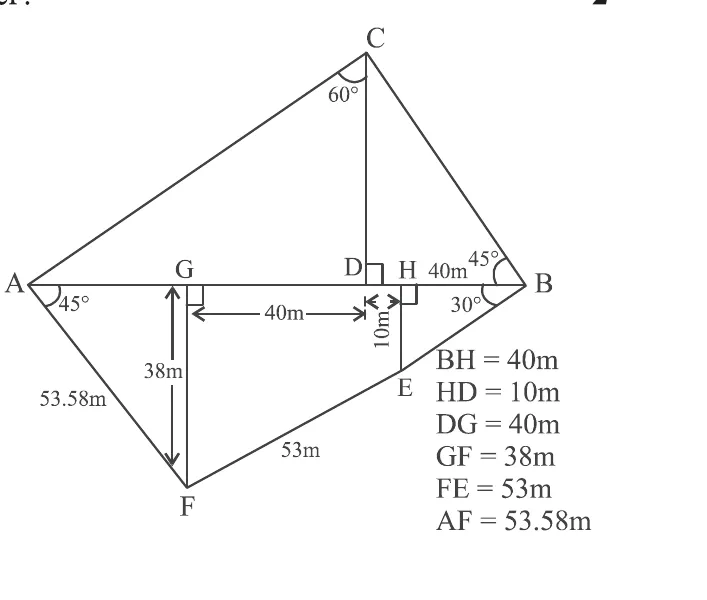
A plot drawn on a horizontal line AB. C is above D on the line with the angle 60 degrees at C, and the angle 45 degrees at B. Below the line, the points F and E are joined to A and B, the angle at A is 45 degrees and the angle at B is 30 degrees. The labelled lengths are BH 40 m, HD 10 m, DG 40 m, GF 38 m, FE 53 m and AF 53.58 m.
Solution
  1. (i) BD=BH+HD=40+10=50BD = BH + HD = 40 + 10 = 50 m. In the right triangle CDBCDB with ∠B=45∘\angle B = 45^\circ: cos⁡45∘=BDBC=50BC\cos 45^\circ = \dfrac{BD}{BC} = \dfrac{50}{BC}, so BC=50×1.41=70.5BC = 50 \times 1.41 = 70.5 m.
  2. (ii) In the right triangle AGFAGF with ∠A=45∘\angle A = 45^\circ: tan⁡45∘=GFAG=38AG=1\tan 45^\circ = \dfrac{GF}{AG} = \dfrac{38}{AG} = 1, so AG=38AG = 38 m.
  3. (iii)(a) AD=AG+GD=38+40=78AD = AG + GD = 38 + 40 = 78 m. In the right triangle ADCADC with ∠C=60∘\angle C = 60^\circ: sin⁡60∘=ADAC\sin 60^\circ = \dfrac{AD}{AC}, so AC=783/2=1561.73≈90.2AC = \dfrac{78}{\sqrt{3}/2} = \dfrac{156}{1.73} \approx 90.2 m (CBSE’s key takes 89.9689.96 m). AB=AD+DB=78+50=128AB = AD + DB = 78 + 50 = 128 m.
  4. Perimeter of △ABC=AB+BC+AC≈128+70.5+90≈288.5\triangle ABC = AB + BC + AC \approx 128 + 70.5 + 90 \approx 288.5 m (the key gives 288.46288.46 m).
  5. (iii)(b) In the right triangle BHEBHE with ∠B=30∘\angle B = 30^\circ: cos⁡30∘=BHBE=40BE\cos 30^\circ = \dfrac{BH}{BE} = \dfrac{40}{BE}, so BE=803≈46.1BE = \dfrac{80}{\sqrt{3}} \approx 46.1 m. AF+FE+EB=53.58+53+46.13≈152.7AF + FE + EB = 53.58 + 53 + 46.13 \approx 152.7 m.

Answer: (i) 70.570.5 m   (ii) 3838 m   (iii)(a) about 288.5288.5 m   (iii)(b) about 152.7152.7 m

Common mistake: The figure is not fully consistent: AD = 78 m from the labels, but a 45° angle at B and a 60° angle at C would make AD = 50√3 ≈ 86.6 m. The answers above follow the key, which uses AD = 78 m and angle C = 60°.

Report an error on this question

Questions are from the official CBSE paper. Figures are described in words; see the PDF for the originals. Solutions are written by CogniGuru.

Revise this paper in 1 minute a chapter

Each chapter below is what the paper tested, with a one-minute animated lesson on the idea behind it.

Stuck on a step in any solution?

The CogniGuru AI tutor explains any doubt one minute at a time, in English or Hindi. Join the waitlist.

Mock quiz: 5 questions from this paper

Five real questions from this paper, one each from five chapters. About 2 minutes. See how much you know and where you stand among other students. Attempt free, with no login; log in only for your ranking and full report.

Question 1 of 5 · Q1 of the paperReal Numbers

If HCF(x,20)=2\text{HCF}(x, 20) = 2 and LCM(x,20)=60\text{LCM}(x, 20) = 60, then the value of xx is:

0 of 5 answered

Related papers

Common questions

Are these the official CBSE Class 10 Maths Basic 2025 questions?
Yes. The questions are from the official Mathematics (Basic) paper (set 430/4/1) that CBSE published after the March 2025 board exam. The solutions are written by CogniGuru and checked against the answer key CBSE published for this paper code.
Can I download the CBSE Class 10 Maths Basic 2025 question paper PDF?
Yes, the official paper PDF is free to download from this page, and so are our step-by-step solutions as a PDF. No login is needed to download either or to read the solutions.
Do all sets of the paper have the same questions?
No. CBSE sets several versions of each paper, with the same blueprint and similar questions in a different order and sometimes with different numbers. This page covers set 430/4/1.
How does the quiz work, and what does “where you stand” mean?
It is a mock quiz of 5 real multiple-choice questions from this paper, scored automatically in about 2 minutes. Your score is compared, anonymously, with other students who took the same quiz. Only the score is stored with the comparison, never your name or number.

Source

CBSE question paper archive, Class X, 2025 (Mathematics (Basic), set 430/4/1)
PDF