CBSE · Class 10 · Mathematics (Basic) · Free

CBSE Class 10 Maths Basic 2025 Question Paper (Set 430/5/1) with Solutions

The official board paper (Q.P. Code 430/5/1, Series EH5GF). Free paper PDF and step-by-step solutions (also as a PDF to download) written by CogniGuru and checked against CBSE’s answer key. See the paper’s main topics in 1 minute, then quiz yourself to see how much you know and where you stand.

No login to download or read the solutions. Login only to see your quiz report in full.

Board
CBSE
Class
10
Subject
Maths Basic (241)
Year
2025
Set code
430/5/1
Max marks
80
Duration
3 hours
Questions
38 (Sections A to E)
Source
Official CBSE paper
Exam date
March 2025

Paper preview

Three pages of the official paper. Download the PDF for all 24.
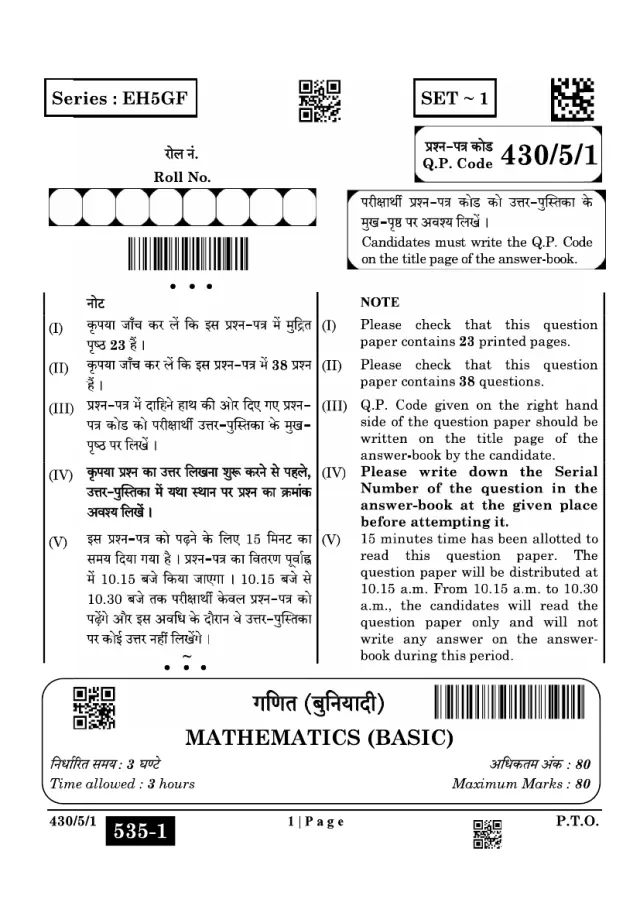
  • Cover page of the CBSE Class 10 Maths Basic 2025 paper, set 430/5/1

    Cover page

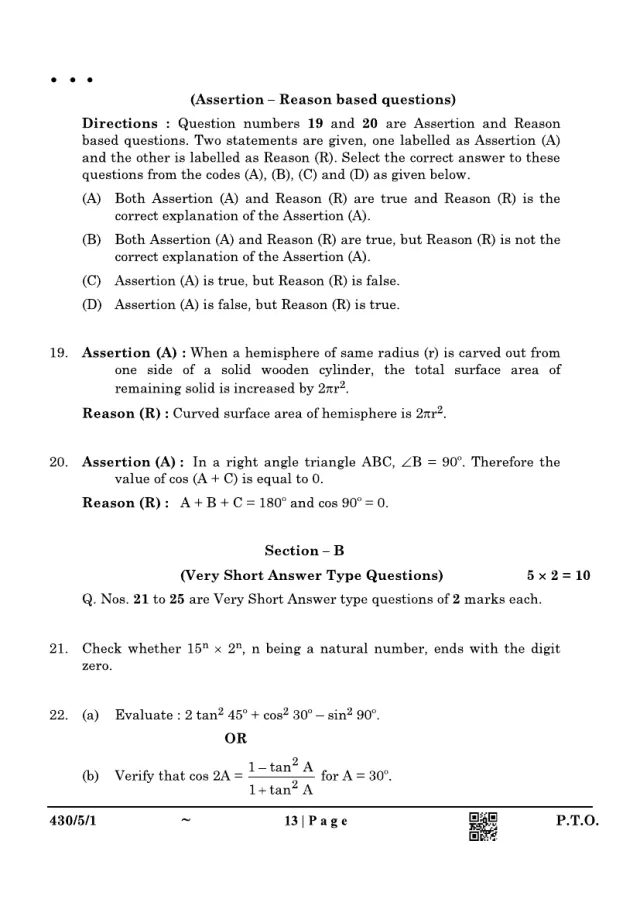
  • Section B of the CBSE Class 10 Maths Basic 2025 paper, set 430/5/1

    Section B

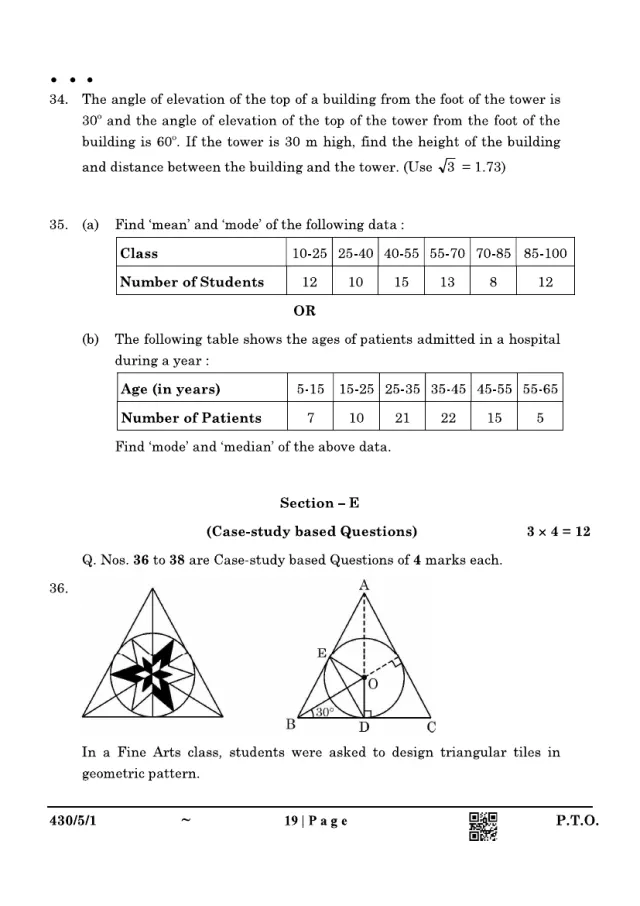
  • A case study with its figure from the CBSE Class 10 Maths Basic 2025 paper, set 430/5/1

    Case study

The main topics of this paper, in 1 minute

Your tutor walks you through the paper before you attempt it: the marks, the key ideas, the time plan and the traps.

1-minute paper analysis

With your tutor, in her voice

The main topics of this paper, in about a minute

A short, animated walk through the paper: how it is built, where the marks come from, the four ideas that matter most, how to plan your three hours, and the traps to avoid.

  1. 1The paper at a glance
  2. 2Where the marks come from
  3. 3Four ideas that keep paying off
  4. 4Plan your three hours
  5. 5Four traps to avoid

Sound on for the voice. Captions are shown, and you can mute any time.

Step-by-step solutions

Try each question first, then open its solution. Tap a number to jump.

Download solutions (PDF)

Section A: Multiple choice

20 questions, 1 mark each. MCQs (Q1 to Q18) and assertion-reason (Q19, Q20).

Q1Real Numbers1 mark

(2−53)2(2 - 5\sqrt{3})^2 is:

  1. (A)a negative integer
  2. (B)an irrational number
  3. (C)a rational number
  4. (D)a positive integer
Solution · answer (B)
  1. (2−53)2=4−203+75=79−203(2 - 5\sqrt{3})^2 = 4 - 20\sqrt{3} + 75 = 79 - 20\sqrt{3}. Since 3\sqrt{3} is irrational, this is irrational.

Answer: (B) an irrational number

Report an error on this question
Q2Quadratic Equations1 mark

The value of kk for which the roots of the quadratic equation 6x2+4kx+k=06x^2 + 4kx + k = 0 are real and equal, is:

  1. (A)0
  2. (B)34\dfrac{3}{4}
  3. (C)−32\dfrac{-3}{2}
  4. (D)23\dfrac{2}{3}
Solution · answer (A)
  1. Equal roots need D=(4k)2−4(6)(k)=16k2−24k=8k(2k−3)=0D = (4k)^2 - 4(6)(k) = 16k^2 - 24k = 8k(2k - 3) = 0, so k=0k = 0 or k=32k = \dfrac{3}{2}.
  2. Only k=0k = 0 is among the options (then 6x2=06x^2 = 0 has the equal roots 0,00, 0).

Answer: (A) 0

Report an error on this question
Q3Coordinate Geometry1 mark

The distance between the points (2,3)(2, 3) and (−2,−3)(-2, -3) is:

  1. (A)4134\sqrt{13}
  2. (B)40\sqrt{40}
  3. (C)2132\sqrt{13}
  4. (D)5
Solution · answer (C)
  1. d=(2+2)2+(3+3)2=16+36=52=213d = \sqrt{(2 + 2)^2 + (3 + 3)^2} = \sqrt{16 + 36} = \sqrt{52} = 2\sqrt{13}.

Answer: (C) 2132\sqrt{13}

Report an error on this question
Q4Polynomials1 mark

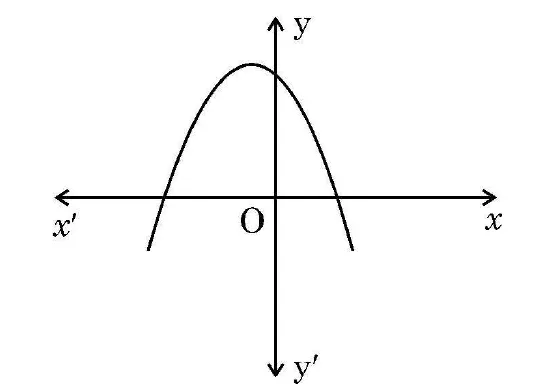
Observe the given graph of polynomial p(x)p(x). The number of zeroes of p(x)p(x) is:

A downward-opening parabola with its top on the y-axis above the origin, crossing the x-axis at two points, one on each side of the y-axis.
  1. (A)0
  2. (B)1
  3. (C)3
  4. (D)2
Solution · answer (D)
  1. The zeroes are the points where the graph meets the xx-axis. The parabola crosses it twice, so p(x)p(x) has 22 zeroes.

Answer: (D) 2

Report an error on this question
Q5Circles1 mark

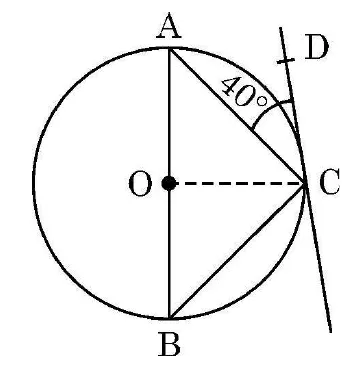
In the given figure, ABAB is diameter of the circle with centre OO. CDCD is tangent to the circle so that ∠ACD=40∘\angle ACD = 40^\circ. The value of ∠CBA\angle CBA is:

A circle with centre O and vertical diameter AB. The tangent line CD touches the circle at C on the right, the chord AC is drawn and the angle ACD is marked 40 degrees.
  1. (A)50∘50^\circ
  2. (B)40∘40^\circ
  3. (C)80∘80^\circ
  4. (D)45∘45^\circ
Solution · answer (B)
40°OABCDtangent–chord angle = alternate segment angle40°
  1. The angle between the tangent CDCD and the chord CACA equals the angle in the alternate segment: ∠CBA=∠ACD=40∘\angle CBA = \angle ACD = 40^\circ.
  2. (Check: ∠ACB=90∘\angle ACB = 90^\circ (angle in a semicircle), so ∠CAB=50∘\angle CAB = 50^\circ and ∠OCA=50∘\angle OCA = 50^\circ, giving ∠OCD=90∘=50∘+40∘\angle OCD = 90^\circ = 50^\circ + 40^\circ ✓.)

Answer: (B) 40∘40^\circ

Report an error on this question
Q6Arithmetic Progressions1 mark

10th10^{\text{th}} term of the A.P.: −12,−19,−26,…-12, -19, -26, \dots is:

  1. (A)−75
  2. (B)−65
  3. (C)51
  4. (D)−82
Solution · answer (A)
  1. a=−12a = -12 and d=−7d = -7. a10=−12+9(−7)=−75a_{10} = -12 + 9(-7) = -75.

Answer: (A) −75

Report an error on this question
Q7Quadratic Equations1 mark

The roots of the equation x2−8=0x^2 - 8 = 0 are:

  1. (A)rational and distinct
  2. (B)irrational and distinct
  3. (C)real and equal
  4. (D)not real
Solution · answer (B)
  1. x2=8x^2 = 8 gives x=±22x = \pm 2\sqrt{2}: two different irrational numbers. (D=32>0D = 32 > 0, not a perfect square.)

Answer: (B) irrational and distinct

Report an error on this question
Q8Coordinate Geometry1 mark

The point (x,0)(x, 0) divides the line segment joining the points (−4,5)(-4, 5) and (0,−10)(0, -10) in the ratio:

  1. (A)1 : 3
  2. (B)2 : 1
  3. (C)1 : 1
  4. (D)1 : 2
Solution · answer (D)
  1. Let the ratio be k:1k : 1. The yy-coordinate is 00: −10k+5k+1=0\dfrac{-10k + 5}{k + 1} = 0, so k=12k = \dfrac{1}{2}. The ratio is 1:21 : 2.

Answer: (D) 1 : 2

Report an error on this question
Q9Probability1 mark

A black card is lost from a deck of 52 playing cards. Rest of the cards are shuffled and one card is drawn at random from the available cards. The probability that drawn card is ‘king of hearts’, is:

  1. (A)152\dfrac{1}{52}
  2. (B)14\dfrac{1}{4}
  3. (C)151\dfrac{1}{51}
  4. (D)126\dfrac{1}{26}
Solution · answer (C)
  1. 5151 cards remain. The king of hearts is red, so it is still there: P=151P = \dfrac{1}{51}.

Answer: (C) 151\dfrac{1}{51}

Report an error on this question
Q10Surface Areas and Volumes1 mark

The largest possible cone is just fitted inside a hollow cube of edge 25 cm. The radius of the base of the cone is:

  1. (A)5 cm
  2. (B)12.5 cm
  3. (C)25 cm
  4. (D)10 cm
Solution · answer (B)
  1. The biggest cone has its base circle inscribed in a face of the cube, so its diameter is 2525 cm and the radius is 12.512.5 cm.

Answer: (B) 12.5 cm

Report an error on this question
Q11Probability1 mark

If EE is an event such that P(E)=0.1P(E) = 0.1, then P(Eˉ)P(\bar{E}) is equal to:

  1. (A)0.9
  2. (B)12\dfrac{1}{2}
  3. (C)0.99
  4. (D)−1
Solution · answer (A)
  1. P(Eˉ)=1−0.1=0.9P(\bar{E}) = 1 - 0.1 = 0.9.

Answer: (A) 0.9

Report an error on this question
Q12Trigonometry1 mark

If tan⁡A=1\tan A = 1, then 3sin⁡A+cos⁡A3\sin A + \cos A is equal to:

  1. (A)424\sqrt{2}
  2. (B)4
  3. (C)222\sqrt{2}
  4. (D)4×45∘4 \times 45^\circ
Solution · answer (C)
  1. tan⁡A=1\tan A = 1 gives A=45∘A = 45^\circ, so sin⁡A=cos⁡A=12\sin A = \cos A = \dfrac{1}{\sqrt{2}}. 3sin⁡A+cos⁡A=42=223\sin A + \cos A = \dfrac{4}{\sqrt{2}} = 2\sqrt{2}.

Answer: (C) 222\sqrt{2}

Report an error on this question
Q13Polynomials1 mark

A quadratic polynomial having only zero (−2)(-2) is:

  1. (A)(x−2)2(x - 2)^2
  2. (B)x2−2x^2 - 2
  3. (C)x2+2xx^2 + 2x
  4. (D)(x+2)2(x + 2)^2
Solution · answer (D)
  1. (x+2)2=(x+2)(x+2)(x + 2)^2 = (x + 2)(x + 2) has the repeated zero −2-2 and no other. (x2+2xx^2 + 2x has the zeroes 00 and −2-2.)

Answer: (D) (x+2)2(x + 2)^2

Report an error on this question
Q14Circles1 mark

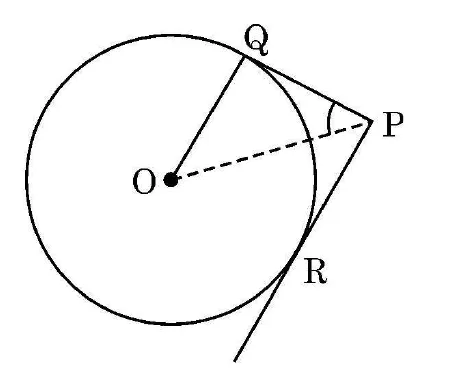
PQPQ and PRPR are tangents to a circle with centre OO such that OQ=QPOQ = QP. The value of ∠OPQ\angle OPQ is equal to:

A circle with centre O and the outside point P on the right. PQ and PR are tangents touching at Q (top) and R (bottom). The segment OP is drawn dotted and the angle at P is marked.
  1. (A)45∘45^\circ
  2. (B)30∘30^\circ
  3. (C)60∘60^\circ
  4. (D)90∘90^\circ
Solution · answer (A)
OQPR45°OQ ⟂ QP and OQ = QP → ∠OPQ = 45°
  1. OQ⊥PQOQ \perp PQ, so △OQP\triangle OQP is right-angled at QQ with OQ=QPOQ = QP. The two base angles are equal and add to 90∘90^\circ: ∠OPQ=45∘\angle OPQ = 45^\circ.

Answer: (A) 45∘45^\circ

Report an error on this question
Q15Statistics1 mark

Which of the following depends on all observations of a given data?

  1. (A)Median
  2. (B)Mean
  3. (C)Range
  4. (D)Mode
Solution · answer (B)
  1. The mean uses every value (sum divided by the number of values). The median and mode depend on the position and frequency, and the range on only the largest and smallest values.

Answer: (B) Mean

Report an error on this question
Q16Circles1 mark

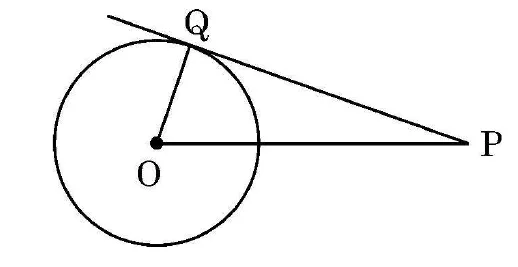
PQPQ is tangent to the circle centred at OO. If OQ=3OQ = 3 cm, PQ=5PQ = 5 cm, then OPOP is equal to:

A circle with centre O and a tangent line from P on the right touching the circle at Q at the top left. OQ and OP are drawn.
  1. (A)5 cm
  2. (B)4 cm
  3. (C)15\sqrt{15} cm
  4. (D)34\sqrt{34} cm
Solution · answer (D)
35OPQOP = √(3² + 5²) = √34 cm
  1. OQ⊥PQOQ \perp PQ, so OP=OQ2+PQ2=9+25=34OP = \sqrt{OQ^2 + PQ^2} = \sqrt{9 + 25} = \sqrt{34} cm.

Answer: (D) 34\sqrt{34} cm

Report an error on this question
Q17Probability1 mark

Two dice are rolled together. The probability that only one die shows number 4, is:

  1. (A)1136\dfrac{11}{36}
  2. (B)13\dfrac{1}{3}
  3. (C)518\dfrac{5}{18}
  4. (D)14\dfrac{1}{4}
Solution · answer (C)
  1. Exactly one 44: the first die shows 44 and the second does not (55 ways) or the other way round (55 ways), 1010 outcomes in 3636. P=1036=518P = \dfrac{10}{36} = \dfrac{5}{18}.

Answer: (C) 518\dfrac{5}{18}

Report an error on this question
Q18Areas Related to Circles1 mark

An arc of length 2222 cm subtends an angle of x∘x^\circ at the centre of the circle. If radius of circle is 3636 cm, the value of xx is:

  1. (A)35
  2. (B)40
  3. (C)60
  4. (D)30
Solution · answer (A)
  1. 22=x360×2×227×3622 = \dfrac{x}{360} \times 2 \times \dfrac{22}{7} \times 36, so x=22×360×72×22×36=35x = \dfrac{22 \times 360 \times 7}{2 \times 22 \times 36} = 35.

Answer: (A) 35

Report an error on this question
Q19Surface Areas and Volumes1 mark

Assertion (A): When a hemisphere of same radius (rr) is carved out from one side of a solid wooden cylinder, the total surface area of remaining solid is increased by 2πr22\pi r^2.

Reason (R): Curved surface area of hemisphere is 2πr22\pi r^2.

  1. (A)Both A and R are true and R is the correct explanation of A
  2. (B)Both A and R are true, but R is not the correct explanation of A
  3. (C)A is true, but R is false
  4. (D)A is false, but R is true
Solution · answer (D)
  1. (R) The curved surface area of a hemisphere is 2πr22\pi r^2. True.
  2. (A) Carving out the hemisphere removes the flat circle πr2\pi r^2 of the cylinder’s top and adds the hollow of area 2πr22\pi r^2. The net increase is 2πr2−πr2=πr22\pi r^2 - \pi r^2 = \pi r^2, not 2πr22\pi r^2. False.

Answer: (D) A is false, but R is true

Report an error on this question
Q20Trigonometry1 mark

Assertion (A): In a right angle triangle ABCABC, ∠B=90∘\angle B = 90^\circ. Therefore the value of cos⁡(A+C)\cos(A + C) is equal to 00.

Reason (R): A+B+C=180∘A + B + C = 180^\circ and cos⁡90∘=0\cos 90^\circ = 0.

  1. (A)Both A and R are true and R is the correct explanation of A
  2. (B)Both A and R are true, but R is not the correct explanation of A
  3. (C)A is true, but R is false
  4. (D)A is false, but R is true
Solution · answer (A)
  1. (R) The angle sum is 180∘180^\circ and cos⁡90∘=0\cos 90^\circ = 0. True.
  2. (A) A+C=180∘−90∘=90∘A + C = 180^\circ - 90^\circ = 90^\circ, so cos⁡(A+C)=cos⁡90∘=0\cos(A + C) = \cos 90^\circ = 0. True, and R is exactly this reasoning.

Answer: (A) Both A and R are true and R is the correct explanation of A

Report an error on this question

Section B: Very short answer

5 questions, 2 marks each.

Q21Real Numbers2 marks

Check whether 15n×2n15^n \times 2^n, nn being a natural number, ends with the digit zero.

Solution
  1. 15n×2n=(3×5)n×2n=3n×5n×2n15^n \times 2^n = (3 \times 5)^n \times 2^n = 3^n \times 5^n \times 2^n. Both 22 and 55 are prime factors.
  2. A number divisible by both 22 and 55 is divisible by 1010, so it ends with the digit 00. (Indeed, 15n×2n=30n15^n \times 2^n = 30^n.)

Answer: Yes, it ends with 0

Report an error on this question
Q22Trigonometry2 marks

(a) Evaluate: 2tan⁡245∘+cos⁡230∘−sin⁡290∘2\tan^2 45^\circ + \cos^2 30^\circ - \sin^2 90^\circ.

OR

(b) Verify that cos⁡2A=1−tan⁡2A1+tan⁡2A\cos 2A = \dfrac{1 - \tan^2 A}{1 + \tan^2 A} for A=30∘A = 30^\circ.

Solution
  1. (a) 2(1)2+(32)2−(1)2=2+34−1=742(1)^2 + \left(\dfrac{\sqrt{3}}{2}\right)^2 - (1)^2 = 2 + \dfrac{3}{4} - 1 = \dfrac{7}{4}.
  2. (b) LHS =cos⁡60∘=12= \cos 60^\circ = \dfrac{1}{2}. RHS =1−131+13=2/34/3=12= \dfrac{1 - \frac{1}{3}}{1 + \frac{1}{3}} = \dfrac{2/3}{4/3} = \dfrac{1}{2}. LHS == RHS ✓.

Answer: (a) 74\dfrac{7}{4}   (b) verified

Report an error on this question
Q23Coordinate Geometry2 marks

Find the coordinates of the points of trisection of line segment joining the points (−4,1)(-4, 1) and (6,5)(6, 5).

Solution
-6-5-4-3-2-112345678-11234567OxyA(−4, 1)B(6, 5)P(−2/3, 7/3)Q(8/3, 11/3)
  1. Let A(−4,1)A(-4, 1) and B(6,5)B(6, 5). The point PP with AP:PB=1:2AP : PB = 1 : 2 is (1(6)+2(−4)3,1(5)+2(1)3)=(−23,73)\left(\dfrac{1(6) + 2(-4)}{3}, \dfrac{1(5) + 2(1)}{3}\right) = \left(-\dfrac{2}{3}, \dfrac{7}{3}\right).
  2. The point QQ with AQ:QB=2:1AQ : QB = 2 : 1 is (2(6)+1(−4)3,2(5)+1(1)3)=(83,113)\left(\dfrac{2(6) + 1(-4)}{3}, \dfrac{2(5) + 1(1)}{3}\right) = \left(\dfrac{8}{3}, \dfrac{11}{3}\right).

Answer: (−23,73)\left(-\dfrac{2}{3}, \dfrac{7}{3}\right) and (83,113)\left(\dfrac{8}{3}, \dfrac{11}{3}\right)

Report an error on this question
Q24Probability2 marks

(a) A bag contains 4040 marbles out of which some are white and others are black. If the probability of drawing a black marble is 35\dfrac{3}{5}, then find the number of white marbles.

OR

(b) In a pre-primary class, a teacher put cards numbered 2020 to 5959 in a bowl. A student picked up a card at random and read the number. Find the probability that the number read was (i) a prime number (ii) a perfect square.

Solution
  1. (a) Black marbles =35×40=24= \dfrac{3}{5} \times 40 = 24, so white marbles =40−24=16= 40 - 24 = 16.
  2. (b) The cards 2020 to 5959 number 59−20+1=4059 - 20 + 1 = 40. (i) Primes: 23,29,31,37,41,43,47,53,5923, 29, 31, 37, 41, 43, 47, 53, 59, which is 99: P=940P = \dfrac{9}{40}.
  3. (ii) Perfect squares: 25,36,4925, 36, 49, which is 33: P=340P = \dfrac{3}{40}.

Answer: (a) 1616   (b) (i) 940\dfrac{9}{40} (ii) 340\dfrac{3}{40}

Report an error on this question
Q25Coordinate Geometry2 marks

Using distance formula, prove that the points (1,5)(1, 5), (2,3)(2, 3) and (3,1)(3, 1) are collinear.

Solution
  1. Let A(1,5)A(1, 5), B(2,3)B(2, 3), C(3,1)C(3, 1). AB=12+(−2)2=5AB = \sqrt{1^2 + (-2)^2} = \sqrt{5}, BC=12+(−2)2=5BC = \sqrt{1^2 + (-2)^2} = \sqrt{5} and AC=22+(−4)2=20=25AC = \sqrt{2^2 + (-4)^2} = \sqrt{20} = 2\sqrt{5}.
  2. AB+BC=5+5=25=ACAB + BC = \sqrt{5} + \sqrt{5} = 2\sqrt{5} = AC, so the three points lie on one straight line.

Answer: Proved

Report an error on this question

Section C: Short answer

6 questions, 3 marks each.

Q26Polynomials3 marks

(a) If α,β\alpha, \beta are zeroes of the polynomial 3x2−8x+43x^2 - 8x + 4, then form a quadratic polynomial in xx whose zeroes are 1α\dfrac{1}{\alpha} and 1β\dfrac{1}{\beta}.

OR

(b) Find zeroes of the polynomial 6x2−7x−36x^2 - 7x - 3 and verify the relationship between zeroes and its coefficients.

Solution
  1. (a) α+β=83\alpha + \beta = \dfrac{8}{3} and αβ=43\alpha\beta = \dfrac{4}{3}. The new sum =1α+1β=α+βαβ=8/34/3=2= \dfrac{1}{\alpha} + \dfrac{1}{\beta} = \dfrac{\alpha + \beta}{\alpha\beta} = \dfrac{8/3}{4/3} = 2 and the new product =1αβ=34= \dfrac{1}{\alpha\beta} = \dfrac{3}{4}.
  2. The polynomial is x2−2x+34x^2 - 2x + \dfrac{3}{4}, or k(4x2−8x+3)k(4x^2 - 8x + 3) for any non-zero kk.
  3. (b) 6x2−7x−3=(2x−3)(3x+1)6x^2 - 7x - 3 = (2x - 3)(3x + 1), so the zeroes are 32\dfrac{3}{2} and −13-\dfrac{1}{3}.
  4. Sum =32−13=76=−−76= \dfrac{3}{2} - \dfrac{1}{3} = \dfrac{7}{6} = -\dfrac{-7}{6} ✓. Product =32×(−13)=−12=−36= \dfrac{3}{2} \times \left(-\dfrac{1}{3}\right) = -\dfrac{1}{2} = \dfrac{-3}{6} ✓.

Answer: (a) x2−2x+34x^2 - 2x + \dfrac{3}{4}   (b) zeroes 32,−13\dfrac{3}{2}, -\dfrac{1}{3}; relations verified

Report an error on this question
Q27Quadratic Equations3 marks

The sum of the squares of two consecutive even numbers is 452. Find the numbers.

Solution
  1. Let the numbers be xx and x+2x + 2. x2+(x+2)2=452x^2 + (x + 2)^2 = 452 gives 2x2+4x−448=02x^2 + 4x - 448 = 0, so x2+2x−224=0x^2 + 2x - 224 = 0 and (x+16)(x−14)=0(x + 16)(x - 14) = 0.
  2. x=14x = 14 gives 1414 and 1616. (Check: 196+256=452196 + 256 = 452 ✓. The root x=−16x = -16 gives the pair −16,−14-16, -14, which also fits the words; the key lists 1414 and 1616.)

Answer: 1414 and 1616

Report an error on this question
Q28Trigonometry3 marks

Prove that: (cosec⁡A+sin⁡A)2+(sec⁡A+cos⁡A)2=7+tan⁡2A+cot⁡2A(\operatorname{cosec} A + \sin A)^2 + (\sec A + \cos A)^2 = 7 + \tan^2 A + \cot^2 A.

Solution
  1. LHS =cosec⁡2A+2cosec⁡Asin⁡A+sin⁡2A+sec⁡2A+2sec⁡Acos⁡A+cos⁡2A= \operatorname{cosec}^2 A + 2\operatorname{cosec} A\sin A + \sin^2 A + \sec^2 A + 2\sec A\cos A + \cos^2 A.
  2. Since cosec⁡Asin⁡A=1\operatorname{cosec} A\sin A = 1 and sec⁡Acos⁡A=1\sec A\cos A = 1: LHS =(sin⁡2A+cos⁡2A)+(1+cot⁡2A)+(1+tan⁡2A)+2+2= (\sin^2 A + \cos^2 A) + (1 + \cot^2 A) + (1 + \tan^2 A) + 2 + 2.
  3. =1+1+cot⁡2A+1+tan⁡2A+4=7+tan⁡2A+cot⁡2A== 1 + 1 + \cot^2 A + 1 + \tan^2 A + 4 = 7 + \tan^2 A + \cot^2 A = RHS.

Answer: Proved

Report an error on this question
Q29Real Numbers3 marks

The traffic lights at three different road crossings change after every 45 seconds, 75 seconds and 60 seconds respectively. If they change together at 5.00 a.m., then at what time they will change together next?

Solution
  1. They change together again after the LCM of 4545, 7575 and 6060 seconds. 45=32×545 = 3^2 \times 5, 75=3×5275 = 3 \times 5^2, 60=22×3×560 = 2^2 \times 3 \times 5.
  2. LCM =22×32×52=900= 2^2 \times 3^2 \times 5^2 = 900 seconds =15= 15 minutes. They next change together at 5:155{:}15 a.m.

Answer: At 5:155{:}15 a.m.

Report an error on this question
Q30Surface Areas and Volumes3 marks

(a) A spherical glass vessel has a cylindrical neck 77 cm long and 88 cm in diameter. The radius of the spherical part is 1010 cm. Find the volume of the vessel.

OR

(b) From each end of a solid cylinder of height 2020 cm and base radius 77 cm, a cone of base radius 2.12.1 cm and height 55 cm is scooped out. Find the volume of the remaining solid.

Solution
  1. (a) Sphere: 43×227×103≈4190.48\dfrac{4}{3} \times \dfrac{22}{7} \times 10^3 \approx 4190.48 cm³. Neck (a cylinder of radius 44 and length 77): 227×4×4×7=352\dfrac{22}{7} \times 4 \times 4 \times 7 = 352 cm³.
  2. Volume =4190.48+352=4542.48= 4190.48 + 352 = 4542.48 cm³.
  3. (b) Cylinder: 227×7×7×20=3080\dfrac{22}{7} \times 7 \times 7 \times 20 = 3080 cm³. The two cones: 2×13×227×2.1×2.1×5=46.22 \times \dfrac{1}{3} \times \dfrac{22}{7} \times 2.1 \times 2.1 \times 5 = 46.2 cm³.
  4. Remaining volume =3080−46.2=3033.8= 3080 - 46.2 = 3033.8 cm³.

Answer: (a) ≈4542.48\approx 4542.48 cm³   (b) 3033.83033.8 cm³

Report an error on this question
Q31Triangles3 marks

Point EE lies on the extended side ADAD of parallelogram ABCDABCD. BEBE intersects CDCD at FF. Show that (i) △DFE∼△CFB\triangle DFE \sim \triangle CFB (ii) △AEB∼△CBF\triangle AEB \sim \triangle CBF.

Solution
  1. (i) In △DFE\triangle DFE and △CFB\triangle CFB: ∠DFE=∠CFB\angle DFE = \angle CFB (vertically opposite angles) and ∠EDF=∠BCF\angle EDF = \angle BCF (alternate angles, since AD∥BCAD \parallel BC and DCDC is a transversal... with EE on ADAD produced and DF⊂DCDF \subset DC). So △DFE∼△CFB\triangle DFE \sim \triangle CFB by AA.
  2. (ii) In △AEB\triangle AEB and △CBF\triangle CBF: ∠AEB=∠CBF\angle AEB = \angle CBF (alternate angles, AE∥BCAE \parallel BC with transversal BEBE) and ∠EAB=∠BCF\angle EAB = \angle BCF (opposite angles of the parallelogram ABCDABCD).
  3. So △AEB∼△CBF\triangle AEB \sim \triangle CBF by AA.

Answer: Shown

Report an error on this question

Section D: Long answer

4 questions, 5 marks each.

Q32Linear Equations5 marks

Determine graphically whether the following pair of linear equations 2x+3y=122x + 3y = 12 and x−y=1x - y = 1 has unique solution or infinitely many solutions.

Solution
  1. 2x+3y=122x + 3y = 12: points (0,4)(0, 4), (6,0)(6, 0), (3,2)(3, 2). x−y=1x - y = 1: points (0,−1)(0, -1), (1,0)(1, 0), (3,2)(3, 2).
  2. The two lines are drawn on the same axes and intersect at exactly one point, (3,2)(3, 2). (Check: 6+6=126 + 6 = 12 ✓ and 3−2=13 - 2 = 1 ✓.)
  3. Since the lines intersect at a single point, the pair has a unique solution, x=3x = 3, y=2y = 2.

Answer: Unique solution: x=3x = 3, y=2y = 2

Report an error on this question
Q33Triangles5 marks

(a) If a line is drawn parallel to one side of a triangle to intersect the other two sides in distinct points, then prove that the other two sides are divided in the same ratio.

OR

(b) It is given that sides ABAB and ACAC and median ADAD of △ABC\triangle ABC are respectively proportional to sides PQPQ and PRPR and median PMPM of another △PQR\triangle PQR. Show that △ABC∼△PQR\triangle ABC \sim \triangle PQR.

Solution
  1. (a) **Given:** DE∥BCDE \parallel BC in △ABC\triangle ABC. **To prove:** ADDB=AEEC\dfrac{AD}{DB} = \dfrac{AE}{EC}. **Construction:** join BEBE and DCDC; draw DG⊥ACDG \perp AC and EF⊥ABEF \perp AB.
  2. ar(△ADE)ar(△BDE)=12⋅AD⋅EF12⋅DB⋅EF=ADDB\dfrac{\text{ar}(\triangle ADE)}{\text{ar}(\triangle BDE)} = \dfrac{\frac{1}{2} \cdot AD \cdot EF}{\frac{1}{2} \cdot DB \cdot EF} = \dfrac{AD}{DB} and ar(△ADE)ar(△CDE)=12⋅AE⋅DG12⋅EC⋅DG=AEEC\dfrac{\text{ar}(\triangle ADE)}{\text{ar}(\triangle CDE)} = \dfrac{\frac{1}{2} \cdot AE \cdot DG}{\frac{1}{2} \cdot EC \cdot DG} = \dfrac{AE}{EC}.
  3. △BDE\triangle BDE and △CDE\triangle CDE are on the same base DEDE and between the same parallels, so their areas are equal. Hence ADDB=AEEC\dfrac{AD}{DB} = \dfrac{AE}{EC}.
  4. (b) Given ABPQ=ADPM=ACPR\dfrac{AB}{PQ} = \dfrac{AD}{PM} = \dfrac{AC}{PR}. Extend ADAD to EE with DE=ADDE = AD and PMPM to NN with MN=PMMN = PM; join CECE and RNRN.
  5. △DAB≅△DEC\triangle DAB \cong \triangle DEC (SAS: BD=DCBD = DC, AD=DEAD = DE, vertically opposite angles), so CE=ABCE = AB. Likewise △MPQ≅△MNR\triangle MPQ \cong \triangle MNR and RN=PQRN = PQ.
  6. Then CENR=ABPQ=ADPM=AEPN\dfrac{CE}{NR} = \dfrac{AB}{PQ} = \dfrac{AD}{PM} = \dfrac{AE}{PN} (as AE=2ADAE = 2AD, PN=2PMPN = 2PM) =ACPR= \dfrac{AC}{PR}. So △CAE∼△RPN\triangle CAE \sim \triangle RPN (SSS) and ∠1=∠2\angle 1 = \angle 2. In the same way ∠3=∠4\angle 3 = \angle 4.
  7. Adding, ∠1+∠3=∠2+∠4\angle 1 + \angle 3 = \angle 2 + \angle 4, that is ∠BAC=∠QPR\angle BAC = \angle QPR. With ABPQ=ACPR\dfrac{AB}{PQ} = \dfrac{AC}{PR}, we get △ABC∼△PQR\triangle ABC \sim \triangle PQR by SAS.

Answer: Proved (both parts)

Report an error on this question
Q34Trigonometry5 marks

The angle of elevation of the top of a building from the foot of the tower is 30∘30^\circ and the angle of elevation of the top of the tower from the foot of the building is 60∘60^\circ. If the tower is 3030 m high, find the height of the building and distance between the building and the tower. (Use 3=1.73\sqrt{3} = 1.73)

Solution
60°30°CDAB30 mx = 17.3 mh = 10 mtan 60° = 30/x → x = 10√3; tan 30° = h/x → h = 10
  1. Let the building be AB=hAB = h and the tower CD=30CD = 30 m, with AC=xAC = x.
  2. From the foot AA of the building, the top of the tower is at 60∘60^\circ: tan⁡60∘=30x\tan 60^\circ = \dfrac{30}{x}, so x=103x = 10\sqrt{3}. (i)
  3. From the foot CC of the tower, the top of the building is at 30∘30^\circ: tan⁡30∘=hx\tan 30^\circ = \dfrac{h}{x}, so x=h3x = h\sqrt{3}. (ii)
  4. From (i) and (ii), h3=103h\sqrt{3} = 10\sqrt{3}, so h=10h = 10 m. x=10×1.73=17.3x = 10 \times 1.73 = 17.3 m.

Answer: Building height =10= 10 m; distance =17.3= 17.3 m

Report an error on this question
Q35Statistics5 marks

(a) Find ‘mean’ and ‘mode’ of the following data (classes 10−25,25−40,40−55,55−70,70−85,85−10010-25, 25-40, 40-55, 55-70, 70-85, 85-100 with 12,10,15,13,8,1212, 10, 15, 13, 8, 12 students).

OR

(b) The following table shows the ages of patients admitted in a hospital during a year (ages 5−15,15−25,25−35,35−45,45−55,55−655-15, 15-25, 25-35, 35-45, 45-55, 55-65 with 7,10,21,22,15,57, 10, 21, 22, 15, 5 patients). Find ‘mode’ and ‘median’ of the above data.

Class10–2525–4040–5555–7070–8585–100
Number of Students12101513812
Solution
  1. (a) N=70N = 70. Take a=47.5a = 47.5 and h=15h = 15: u=−2,−1,0,1,2,3u = -2, -1, 0, 1, 2, 3 for the class marks 17.5,32.5,47.5,62.5,77.5,92.517.5, 32.5, 47.5, 62.5, 77.5, 92.5. ∑fiui=−24−10+0+13+16+36=31\sum f_iu_i = -24 - 10 + 0 + 13 + 16 + 36 = 31.
  2. Mean =47.5+3170×15≈54.14= 47.5 + \dfrac{31}{70} \times 15 \approx 54.14. Modal class 40−5540 - 55 (f1=15f_1 = 15, f0=10f_0 = 10, f2=13f_2 = 13): Mode =40+15−1030−10−13×15=40+757≈50.71= 40 + \dfrac{15 - 10}{30 - 10 - 13} \times 15 = 40 + \dfrac{75}{7} \approx 50.71.
  3. (b) Cumulative frequencies: 7,17,38,60,75,807, 17, 38, 60, 75, 80. N=80N = 80 and N2=40\dfrac{N}{2} = 40 lies in 35−4535 - 45: l=35l = 35, cf=38cf = 38, f=22f = 22, h=10h = 10. Median =35+40−3822×10≈35.91= 35 + \dfrac{40 - 38}{22} \times 10 \approx 35.91.
  4. The modal class is 35−4535 - 45 (frequency 2222): f1=22f_1 = 22, f0=21f_0 = 21, f2=15f_2 = 15. Mode =35+22−2144−21−15×10=35+1.25=36.25= 35 + \dfrac{22 - 21}{44 - 21 - 15} \times 10 = 35 + 1.25 = 36.25.

Answer: (a) mean ≈54.14\approx 54.14, mode ≈50.71\approx 50.71   (b) median ≈35.91\approx 35.91, mode =36.25= 36.25

Report an error on this question

Section E: Case studies

3 case studies, 4 marks each.

Q36Circles4 marks

Case study 1. In a Fine Arts class, students were asked to design triangular tiles in geometric pattern. Neelima made a circular design inside an equilateral triangle ABC. The radius of the circle is 4 cm. Observe the diagram and answer the following questions:

(i) Determine the length OB. [1]

(ii) Is DE || CA? Give reason for your answer. [1]

(iii) (a) Write all angles of quadrilateral OEBD and show that it is a cyclic quadrilateral. [2]

OR

(iii) (b) Find the perimeter of △ABC. (Use √3 = 1.73) [2]
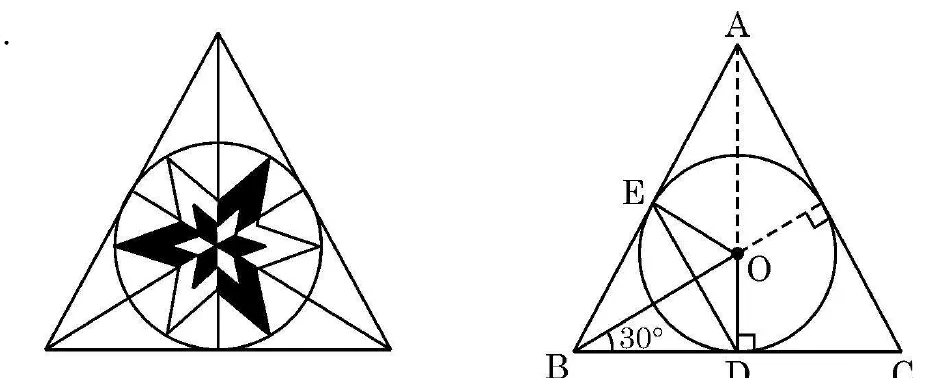
Two pictures of a triangular tile. The first shows an equilateral triangle with a circle inside and a star pattern. The second shows the triangle ABC with the circle inside, centre O, touching BC at D and AB at E, with OB joined and the angle at B marked 30 degrees.
Solution
ABCDE30°4OB = 8BD = 4√3OB = 4/sin 30° = 8; BC = 2 × 8cos 30° = 8√3 = 13.84 cm
  1. (i) OO is the centre of the circle inscribed in the equilateral triangle, so OBOB bisects ∠B=60∘\angle B = 60^\circ: ∠OBD=30∘\angle OBD = 30^\circ. In the right triangle ODBODB (OD=4OD = 4): sin⁡30∘=4OB\sin 30^\circ = \dfrac{4}{OB}, so OB=8OB = 8 cm.
  2. (ii) Yes, DE∥CADE \parallel CA. ABCABC is equilateral and AD⊥BCAD \perp BC, so DD is the mid-point of BCBC. In the same way EE is the mid-point of ABAB, and the line joining the mid-points of two sides is parallel to the third side: DE∥CADE \parallel CA.
  3. (iii)(a) ∠EBD=60∘\angle EBD = 60^\circ. The radii to the points of contact are perpendicular to the tangents: ∠OEB=∠ODB=90∘\angle OEB = \angle ODB = 90^\circ. So ∠EOD=360∘−60∘−90∘−90∘=120∘\angle EOD = 360^\circ - 60^\circ - 90^\circ - 90^\circ = 120^\circ. ∠OEB+∠ODB=180∘\angle OEB + \angle ODB = 180^\circ (opposite angles supplementary), so OEBDOEBD is a cyclic quadrilateral.
  4. (iii)(b) cos⁡30∘=BDOB\cos 30^\circ = \dfrac{BD}{OB}, so BD=8×32=43=6.92BD = 8 \times \dfrac{\sqrt{3}}{2} = 4\sqrt{3} = 6.92 cm. BC=2BD=13.84BC = 2BD = 13.84 cm. Perimeter =3×13.84=41.52= 3 \times 13.84 = 41.52 cm.

Answer: (i) 88 cm   (ii) yes (mid-point theorem)   (iii)(a) 60∘,90∘,120∘,90∘60^\circ, 90^\circ, 120^\circ, 90^\circ; cyclic   (iii)(b) 41.5241.52 cm

Report an error on this question
Q37Areas Related to Circles4 marks

Case study 2. A farmer has put up a decorative windmill in his farm in which there are eight blades of equal width and equally placed in a circular arrangement. A circular wire goes through them. The diagram shows two blades OAB and OPQ in a quarter circle with centre O. ∠AOB = ∠POQ = 30°, OA = 28 cm, OC = 21 cm. O is the centre of both the circles.

Based on the above information, answer the following questions:

(i) Determine the measure of ∠BOP. [1]

(ii) Find length of arc CD. [1]

(iii) (a) Find the area of region CABD. [2]

OR

(iii) (b) Find perimeter of region CABD. [2]
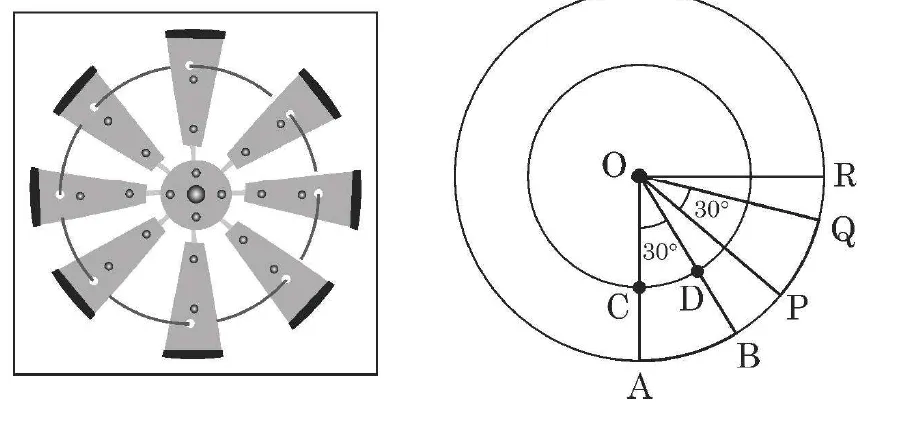
A photo of a windmill with eight blades, and a drawing of two concentric circles with centre O. Radii OA, OB, OP, OQ and OR are drawn to the outer circle at angles of 30 degrees, and C and D are on the inner circle.
Solution
30°OABCD217area = 30/360 × 22/7 × (28² − 21²) = 89.83 cm²
  1. (i) The blades are equally placed in the quarter circle (∠AOR=90∘\angle AOR = 90^\circ), and two blades of 30∘30^\circ each leave 90∘−60∘=30∘90^\circ - 60^\circ = 30^\circ for the gaps, shared equally: ∠BOP=30∘2=15∘\angle BOP = \dfrac{30^\circ}{2} = 15^\circ.
  2. (ii) Arc CD=30360×2×227×21=11CD = \dfrac{30}{360} \times 2 \times \dfrac{22}{7} \times 21 = 11 cm.
  3. (iii)(a) Area CABD=30360×227×(282−212)=112×227×343=5396≈89.8CABD = \dfrac{30}{360} \times \dfrac{22}{7} \times (28^2 - 21^2) = \dfrac{1}{12} \times \dfrac{22}{7} \times 343 = \dfrac{539}{6} \approx 89.8 cm².
  4. (iii)(b) Arc AB=30360×2×227×28=443≈14.67AB = \dfrac{30}{360} \times 2 \times \dfrac{22}{7} \times 28 = \dfrac{44}{3} \approx 14.67 cm. Perimeter =AB arc+CD arc+CA+DB=14.67+11+2×(28−21)=39.67= AB\text{ arc} + CD\text{ arc} + CA + DB = 14.67 + 11 + 2 \times (28 - 21) = 39.67 cm.

Answer: (i) 15∘15^\circ   (ii) 1111 cm   (iii)(a) ≈89.8\approx 89.8 cm²   (iii)(b) ≈39.67\approx 39.67 cm

Report an error on this question
Q38Arithmetic Progressions4 marks

Case study 3. A tent house owner provides furniture on rent. He stacks chairs in his shop to save space. In the diagram, the height of seat of chair from ground is represented by h₁, h₂, h₃, …. The height of first seat is 44 cm from ground level and gap between every two seats is 10 cm.

Based on the above information, answer the following questions:

(i) Write the values of h₁, h₂, h₃, h₄ and h₅ in this order only. [1]

(ii) Show that the above values form an A.P. Write its first term and common difference. [1]

(iii) (a) If chairs can be stacked up to the maximum height of 160 cm, then find the maximum number of chairs in a stack. [2]

OR

(iii) (b) Is it possible to stack 15 chairs if maximum height of the stack can not be more than 180 cm? Justify your answer. [2]
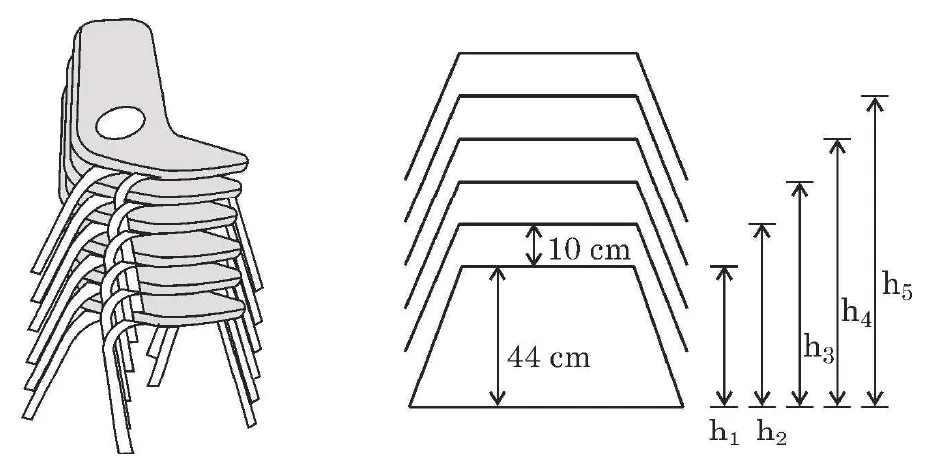
A photo of stacked plastic chairs and a drawing of five nested seats. The lowest seat is 44 cm above the ground and the gap between seats is 10 cm. The heights h1 to h5 are marked by arrows beside the stack.
Solution
12345620406080100Ochairh (cm)h₁ = 4454647484
  1. (i) h1=44h_1 = 44, h2=44+10=54h_2 = 44 + 10 = 54, h3=64h_3 = 64, h4=74h_4 = 74, h5=84h_5 = 84.
  2. (ii) The difference between consecutive heights is always 1010 (54−44=64−54=74−64=84−74=1054 - 44 = 64 - 54 = 74 - 64 = 84 - 74 = 10), so they form an A.P. with first term a=44a = 44 and common difference d=10d = 10.
  3. (iii)(a) hn=44+(n−1)×10≤160h_n = 44 + (n - 1) \times 10 \leq 160 gives (n−1)×10≤116(n - 1) \times 10 \leq 116, so n≤12.6n \leq 12.6. The maximum number of chairs is 1212.
  4. (iii)(b) h15=44+14×10=184h_{15} = 44 + 14 \times 10 = 184 cm, and 184>180184 > 180. So 1515 chairs cannot be stacked within 180180 cm.

Answer: (i) 44,54,64,74,8444, 54, 64, 74, 84   (ii) A.P., a=44a = 44, d=10d = 10   (iii)(a) 1212 chairs   (iii)(b) no, h15=184>180h_{15} = 184 > 180

Report an error on this question

Questions are from the official CBSE paper. Figures are described in words; see the PDF for the originals. Solutions are written by CogniGuru.

Revise this paper in 1 minute a chapter

Each chapter below is what the paper tested, with a one-minute animated lesson on the idea behind it.

Stuck on a step in any solution?

The CogniGuru AI tutor explains any doubt one minute at a time, in English or Hindi. Join the waitlist.

Mock quiz: 5 questions from this paper

Five real questions from this paper, one each from five chapters. About 2 minutes. See how much you know and where you stand among other students. Attempt free, with no login; log in only for your ranking and full report.

Question 1 of 5 · Q3 of the paperCoordinate Geometry

The distance between the points (2,3)(2, 3) and (−2,−3)(-2, -3) is:

0 of 5 answered

Related papers

Common questions

Are these the official CBSE Class 10 Maths Basic 2025 questions?
Yes. The questions are from the official Mathematics (Basic) paper (set 430/5/1) that CBSE published after the March 2025 board exam. The solutions are written by CogniGuru and checked against the answer key CBSE published for this paper code.
Can I download the CBSE Class 10 Maths Basic 2025 question paper PDF?
Yes, the official paper PDF is free to download from this page, and so are our step-by-step solutions as a PDF. No login is needed to download either or to read the solutions.
Do all sets of the paper have the same questions?
No. CBSE sets several versions of each paper, with the same blueprint and similar questions in a different order and sometimes with different numbers. This page covers set 430/5/1.
How does the quiz work, and what does “where you stand” mean?
It is a mock quiz of 5 real multiple-choice questions from this paper, scored automatically in about 2 minutes. Your score is compared, anonymously, with other students who took the same quiz. Only the score is stored with the comparison, never your name or number.

Source

CBSE question paper archive, Class X, 2025 (Mathematics (Basic), set 430/5/1)
PDF