CBSE · Class 10 · Mathematics (Basic) · Free

CBSE Class 10 Maths Basic 2025 Question Paper (Set 430/6/1) with Solutions

The official board paper (Q.P. Code 430/6/1, Series F6EGH). Free paper PDF and step-by-step solutions (also as a PDF to download) written by CogniGuru and checked against CBSE’s answer key. See the paper’s main topics in 1 minute, then quiz yourself to see how much you know and where you stand.

No login to download or read the solutions. Login only to see your quiz report in full.

Board
CBSE
Class
10
Subject
Maths Basic (241)
Year
2025
Set code
430/6/1
Max marks
80
Duration
3 hours
Questions
38 (Sections A to E)
Source
Official CBSE paper
Exam date
March 2025

Paper preview

Three pages of the official paper. Download the PDF for all 24.

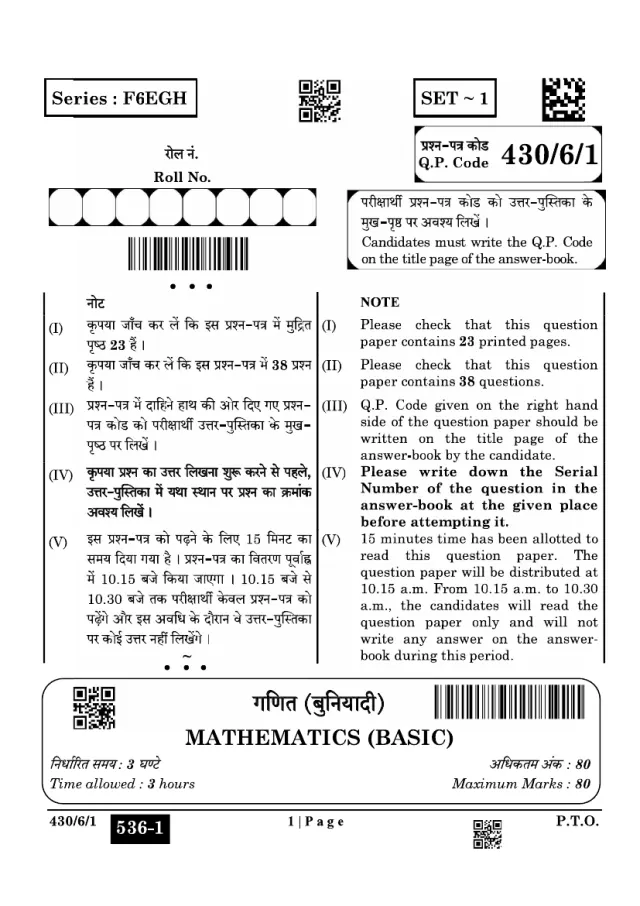
  • Cover page of the CBSE Class 10 Maths Basic 2025 paper, set 430/6/1

    Cover page

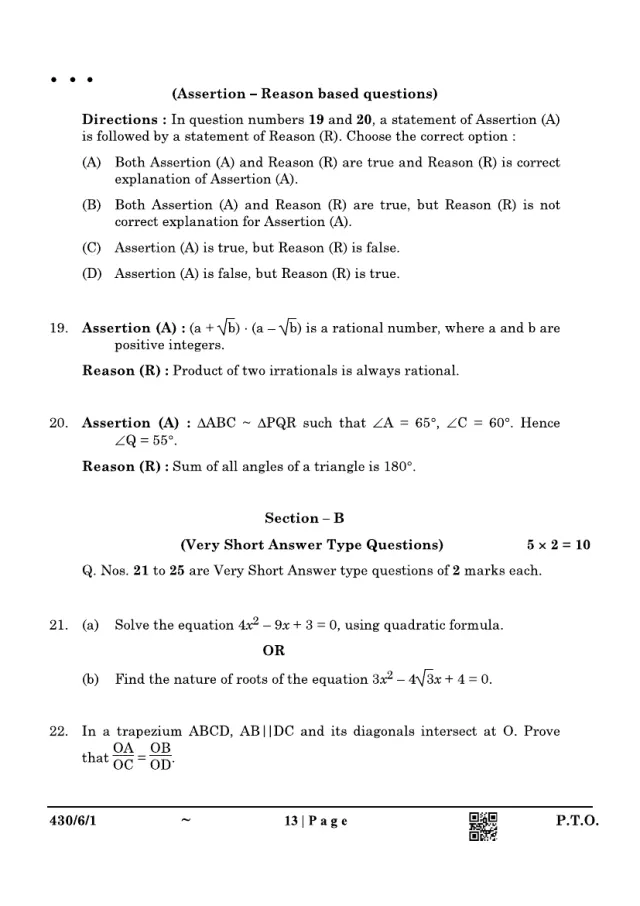
  • Section B of the CBSE Class 10 Maths Basic 2025 paper, set 430/6/1

    Section B

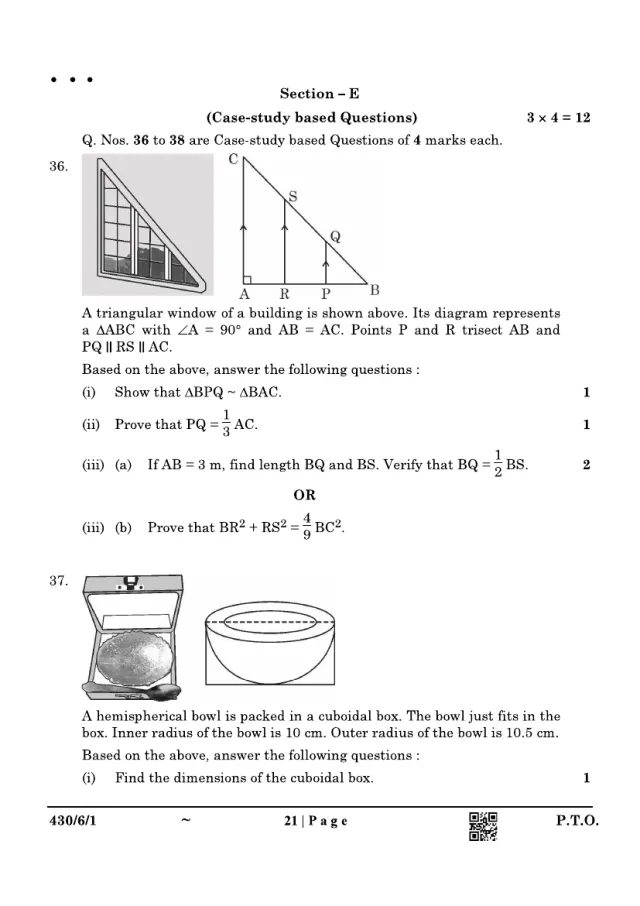
  • A case study with its figure from the CBSE Class 10 Maths Basic 2025 paper, set 430/6/1

    Case study

The main topics of this paper, in 1 minute

Your tutor walks you through the paper before you attempt it: the marks, the key ideas, the time plan and the traps.

1-minute paper analysis

With your tutor, in her voice

The main topics of this paper, in about a minute

A short, animated walk through the paper: how it is built, where the marks come from, the four ideas that matter most, how to plan your three hours, and the traps to avoid.

  1. 1The paper at a glance
  2. 2Where the marks come from
  3. 3Four ideas that keep paying off
  4. 4Plan your three hours
  5. 5Four traps to avoid

Sound on for the voice. Captions are shown, and you can mute any time.

Step-by-step solutions

Try each question first, then open its solution. Tap a number to jump.

Download solutions (PDF)

Section A: Multiple choice

20 questions, 1 mark each. MCQs (Q1 to Q18) and assertion-reason (Q19, Q20).

Q1Polynomials1 mark

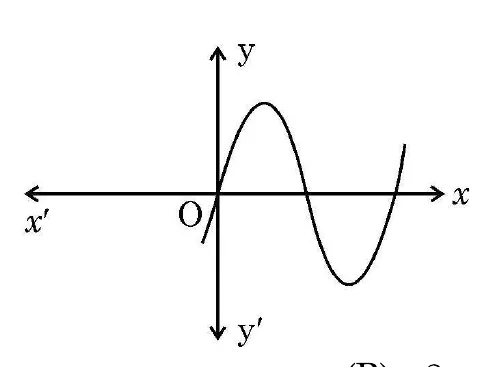
In the given figure, graph of polynomial p(x)p(x) is shown. Number of zeroes of p(x)p(x) is:

A wavy curve that starts below the x-axis on the left, rises above it, comes down below it again and then goes up, crossing the x-axis three times in all.
  1. (A)3
  2. (B)2
  3. (C)1
  4. (D)4
Solution · answer (A)
  1. The zeroes are the points where the graph meets the xx-axis. The curve crosses it at 33 points.

Answer: (A) 3

Report an error on this question
Q2Arithmetic Progressions1 mark

22nd22^{\text{nd}} term of the A.P.: 32,12,−12,−32,…\dfrac{3}{2}, \dfrac{1}{2}, \dfrac{-1}{2}, \dfrac{-3}{2}, \dots is:

  1. (A)452\dfrac{45}{2}
  2. (B)−9
  3. (C)−392\dfrac{-39}{2}
  4. (D)−21
Solution · answer (C)
  1. a=32a = \dfrac{3}{2} and d=12−32=−1d = \dfrac{1}{2} - \dfrac{3}{2} = -1. a22=32+21(−1)=−392a_{22} = \dfrac{3}{2} + 21(-1) = -\dfrac{39}{2}.

Answer: (C) −392-\dfrac{39}{2}

Report an error on this question
Q3Linear Equations1 mark

The line 2x−3y=62x - 3y = 6 intersects xx-axis at:

  1. (A)(0, −2)
  2. (B)(0, 3)
  3. (C)(−2, 0)
  4. (D)(3, 0)
Solution · answer (D)
  1. On the xx-axis y=0y = 0, so 2x=62x = 6 and x=3x = 3. The point is (3,0)(3, 0).

Answer: (D) (3, 0)

Report an error on this question
Q4Surface Areas and Volumes1 mark

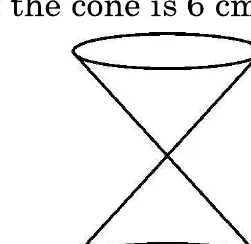
Two identical cones are joined as shown in the figure. If radius of base is 44 cm and slant height of the cone is 66 cm, then height of the solid is:

Two identical cones joined at their tips, one pointing up and the other pointing down, like an hourglass.
  1. (A)8 cm
  2. (B)454\sqrt{5} cm
  3. (C)252\sqrt{5} cm
  4. (D)12 cm
Solution · answer (B)
Vl = 6r = 42√5h = √(6² − 4²) = 2√5; solid = 2 × 2√5 = 4√5 cm
  1. Height of one cone =62−42=20=25= \sqrt{6^2 - 4^2} = \sqrt{20} = 2\sqrt{5} cm.
  2. The solid is two such cones tip to tip: height =2×25=45= 2 \times 2\sqrt{5} = 4\sqrt{5} cm.

Answer: (B) 454\sqrt{5} cm

Report an error on this question
Q5Linear Equations1 mark

The value of kk for which the system of equations 3x−7y=13x - 7y = 1 and kx+14y=6kx + 14y = 6 is inconsistent, is:

  1. (A)−6
  2. (B)23\dfrac{2}{3}
  3. (C)6
  4. (D)−32\dfrac{-3}{2}
Solution · answer (A)
  1. Inconsistent needs 3k=−714≠16\dfrac{3}{k} = \dfrac{-7}{14} \neq \dfrac{1}{6}. 3k=−12\dfrac{3}{k} = -\dfrac{1}{2} gives k=−6k = -6, and then 3k=−12≠16\dfrac{3}{k} = -\dfrac{1}{2} \neq \dfrac{1}{6} ✓.

Answer: (A) −6

Report an error on this question
Q6Probability1 mark

Two dice are rolled together. The probability of getting a sum more than 9 is:

  1. (A)56\dfrac{5}{6}
  2. (B)518\dfrac{5}{18}
  3. (C)16\dfrac{1}{6}
  4. (D)12\dfrac{1}{2}
Solution · answer (C)
  1. Sum 1010: (4,6),(5,5),(6,4)(4,6), (5,5), (6,4) — 33. Sum 1111: (5,6),(6,5)(5,6), (6,5) — 22. Sum 1212: (6,6)(6,6) — 11. Total 66 of 3636: P=16P = \dfrac{1}{6}.

Answer: (C) 16\dfrac{1}{6}

Report an error on this question
Q7Coordinate Geometry1 mark

ABCDABCD is a rectangle with its vertices at (2,−2)(2, -2), (8,4)(8, 4), (4,8)(4, 8) and (−2,2)(-2, 2) taken in order. Length of its diagonal is:

  1. (A)424\sqrt{2}
  2. (B)626\sqrt{2}
  3. (C)4264\sqrt{26}
  4. (D)2262\sqrt{26}
Solution · answer (D)
  1. A diagonal joins the opposite vertices (2,−2)(2, -2) and (4,8)(4, 8): (4−2)2+(8+2)2=4+100=104=226\sqrt{(4 - 2)^2 + (8 + 2)^2} = \sqrt{4 + 100} = \sqrt{104} = 2\sqrt{26}. (The other diagonal, (8,4)(8, 4) to (−2,2)(-2, 2), gives 100+4\sqrt{100 + 4}, the same.)

Answer: (D) 2262\sqrt{26}

Report an error on this question
Q8Circles1 mark

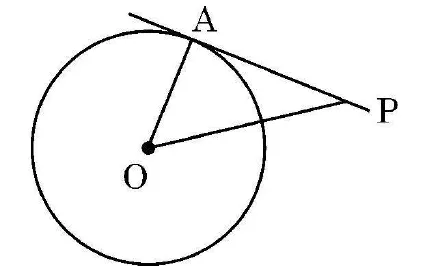
In the given figure, PAPA is tangent to a circle with centre OO. If ∠APO=30∘\angle APO = 30^\circ and OA=2.5OA = 2.5 cm, then OPOP is equal to:

A circle with centre O and a tangent from the outside point P on the right touching the circle at A at the top. OA and OP are drawn.
  1. (A)2.5 cm
  2. (B)5 cm
  3. (C)53\dfrac{5}{\sqrt{3}} cm
  4. (D)2 cm
Solution · answer (B)
30°OPAOP = OA / sin 30° = 2.5 / ½ = 5 cm
  1. OA⊥PAOA \perp PA, so in the right triangle OAPOAP: sin⁡30∘=OAOP\sin 30^\circ = \dfrac{OA}{OP}, giving OP=2.51/2=5OP = \dfrac{2.5}{1/2} = 5 cm.

Answer: (B) 5 cm

Report an error on this question
Q9Probability1 mark

If probability of happening of an event is 57%, then probability of non-happening of the event is:

  1. (A)0.43
  2. (B)0.57
  3. (C)53%
  4. (D)157\dfrac{1}{57}
Solution · answer (A)
  1. P(not happening)=1−0.57=0.43P(\text{not happening}) = 1 - 0.57 = 0.43.

Answer: (A) 0.43

Report an error on this question
Q10Areas Related to Circles1 mark

OABOAB is sector of a circle with centre OO and radius 77 cm. If length of arc AB=223AB = \dfrac{22}{3} cm, then ∠AOB\angle AOB is equal to:

  1. (A)(1207)∘\left(\dfrac{120}{7}\right)^\circ
  2. (B)45∘45^\circ
  3. (C)60∘60^\circ
  4. (D)30∘30^\circ
Solution · answer (C)
  1. 223=θ360×2×227×7=θ360×44\dfrac{22}{3} = \dfrac{\theta}{360} \times 2 \times \dfrac{22}{7} \times 7 = \dfrac{\theta}{360} \times 44, so θ=22×3603×44=60∘\theta = \dfrac{22 \times 360}{3 \times 44} = 60^\circ.

Answer: (C) 60∘60^\circ

Report an error on this question
Q11Triangles1 mark

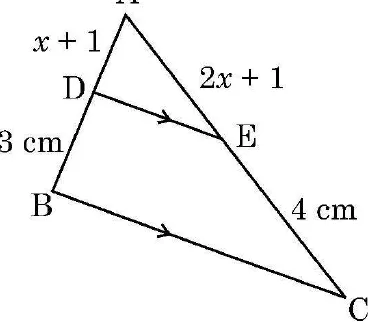
In △ABC\triangle ABC, DE∥BCDE \parallel BC. If AE=(2x+1)AE = (2x + 1) cm, EC=4EC = 4 cm, AD=(x+1)AD = (x + 1) cm and DB=3DB = 3 cm, then value of xx is:

A triangle ABC with DE drawn parallel to BC. AD is x + 1, DB is 3 cm, AE is 2x + 1 and EC is 4 cm.
  1. (A)1
  2. (B)12\dfrac{1}{2}
  3. (C)−1
  4. (D)13\dfrac{1}{3}
Solution · answer (B)
x + 132x + 14ABCDE(x + 1)/3 = (2x + 1)/4 → x = ½
  1. DE∥BCDE \parallel BC, so ADDB=AEEC\dfrac{AD}{DB} = \dfrac{AE}{EC}: x+13=2x+14\dfrac{x + 1}{3} = \dfrac{2x + 1}{4}. 4x+4=6x+34x + 4 = 6x + 3, so x=12x = \dfrac{1}{2}.

Answer: (B) 12\dfrac{1}{2}

Report an error on this question
Q12Probability1 mark

Three coins are tossed together. The probability that exactly one coin shows head, is:

  1. (A)18\dfrac{1}{8}
  2. (B)14\dfrac{1}{4}
  3. (C)1
  4. (D)38\dfrac{3}{8}
Solution · answer (D)
  1. There are 88 outcomes. Exactly one head: HTTHTT, THTTHT, TTHTTH, which is 33. P=38P = \dfrac{3}{8}.

Answer: (D) 38\dfrac{3}{8}

Report an error on this question
Q13Circles1 mark

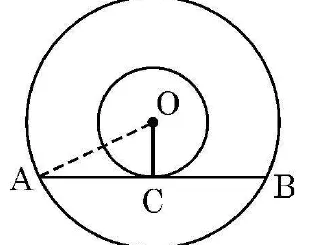
In two concentric circles centred at OO, a chord ABAB of the larger circle touches the smaller circle at CC. If OA=3.5OA = 3.5 cm, OC=2.1OC = 2.1 cm, then ABAB is equal to:

Two concentric circles with centre O. A chord AB of the larger circle touches the smaller circle at C. OA is drawn dashed and OC is drawn to the chord.
  1. (A)5.6 cm
  2. (B)2.8 cm
  3. (C)3.5 cm
  4. (D)4.2 cm
Solution · answer (A)
3.5OCAB2.1AC = √(3.5² − 2.1²) = 2.8 → AB = 5.6 cm
  1. OC⊥ABOC \perp AB (radius and tangent). AC=OA2−OC2=12.25−4.41=7.84=2.8AC = \sqrt{OA^2 - OC^2} = \sqrt{12.25 - 4.41} = \sqrt{7.84} = 2.8 cm.
  2. The perpendicular from the centre bisects the chord, so AB=2×2.8=5.6AB = 2 \times 2.8 = 5.6 cm.

Answer: (A) 5.6 cm

Report an error on this question
Q14Trigonometry1 mark

If 3sin⁡θ=cos⁡θ\sqrt{3}\sin\theta = \cos\theta, then value of θ\theta is:

  1. (A)3\sqrt{3}
  2. (B)60∘60^\circ
  3. (C)13\dfrac{1}{\sqrt{3}}
  4. (D)30∘30^\circ
Solution · answer (D)
  1. tan⁡θ=sin⁡θcos⁡θ=13\tan\theta = \dfrac{\sin\theta}{\cos\theta} = \dfrac{1}{\sqrt{3}}, so θ=30∘\theta = 30^\circ.

Answer: (D) 30∘30^\circ

Report an error on this question
Q15Statistics1 mark

To calculate mean of a grouped data, Rahul used assumed mean method. He used d=(x−A)d = (x - A), where AA is assumed mean. Then xˉ\bar{x} is equal to:

  1. (A)A+dˉA + \bar{d}
  2. (B)A+hdˉA + h\bar{d}
  3. (C)h(A+dˉ)h(A + \bar{d})
  4. (D)A−dˉA - \bar{d}
Solution · answer (A)
  1. With d=x−Ad = x - A, x=A+dx = A + d, so the mean is xˉ=A+dˉ\bar{x} = A + \bar{d}. (The factor hh appears only in the step-deviation method, where u=x−Ahu = \dfrac{x - A}{h}.)

Answer: (A) A+dˉA + \bar{d}

Report an error on this question
Q16Arithmetic Progressions1 mark

If the sum of first nn terms of an A.P. is given by Sn=n2(3n+1)S_n = \dfrac{n}{2}(3n + 1), then the first term of the A.P. is:

  1. (A)2
  2. (B)32\dfrac{3}{2}
  3. (C)4
  4. (D)52\dfrac{5}{2}
Solution · answer (A)
  1. The first term is S1=12(3+1)=2S_1 = \dfrac{1}{2}(3 + 1) = 2.

Answer: (A) 2

Report an error on this question
Q17Trigonometry1 mark

In △ABC\triangle ABC, ∠B=90∘\angle B = 90^\circ. If ABAC=12\dfrac{AB}{AC} = \dfrac{1}{2}, then cos⁡C\cos C is equal to:

  1. (A)32\dfrac{3}{2}
  2. (B)12\dfrac{1}{2}
  3. (C)32\dfrac{\sqrt{3}}{2}
  4. (D)13\dfrac{1}{\sqrt{3}}
Solution · answer (C)
  1. sin⁡C=ABAC=12\sin C = \dfrac{AB}{AC} = \dfrac{1}{2}, so C=30∘C = 30^\circ and cos⁡C=cos⁡30∘=32\cos C = \cos 30^\circ = \dfrac{\sqrt{3}}{2}.

Answer: (C) 32\dfrac{\sqrt{3}}{2}

Report an error on this question
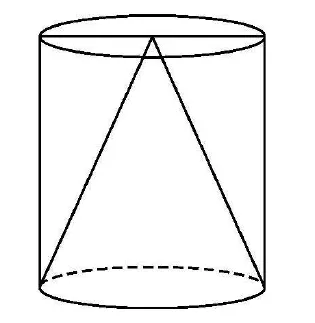
Q18Surface Areas and Volumes1 mark

The volume of air in a hollow cylinder is 450450 cm³. A cone of same height and radius as that of cylinder is kept inside it. The volume of empty space in the cylinder is:

A hollow cylinder with a cone standing inside it on the bottom face, with its tip touching the top rim.
  1. (A)225 cm³
  2. (B)150 cm³
  3. (C)250 cm³
  4. (D)300 cm³
Solution · answer (D)
  1. The cone has one third of the volume of the cylinder: 13×450=150\dfrac{1}{3} \times 450 = 150 cm³. The empty space is 450−150=300450 - 150 = 300 cm³.

Answer: (D) 300300 cm³

Report an error on this question
Q19Real Numbers1 mark

Assertion (A): (a+b)⋅(a−b)(a + \sqrt{b}) \cdot (a - \sqrt{b}) is a rational number, where aa and bb are positive integers.

Reason (R): Product of two irrationals is always rational.

  1. (A)Both A and R are true and R is the correct explanation of A
  2. (B)Both A and R are true, but R is not the correct explanation of A
  3. (C)A is true, but R is false
  4. (D)A is false, but R is true
Solution · answer (C)
  1. (A) (a+b)(a−b)=a2−b(a + \sqrt{b})(a - \sqrt{b}) = a^2 - b, an integer, so it is rational. True.
  2. (R) 2×3=6\sqrt{2} \times \sqrt{3} = \sqrt{6} is irrational, so the product of two irrationals need not be rational. False.

Answer: (C) A is true, but R is false

Report an error on this question
Q20Triangles1 mark

Assertion (A): △ABC∼△PQR\triangle ABC \sim \triangle PQR such that ∠A=65∘\angle A = 65^\circ, ∠C=60∘\angle C = 60^\circ. Hence ∠Q=55∘\angle Q = 55^\circ.

Reason (R): Sum of all angles of a triangle is 180∘180^\circ.

  1. (A)Both A and R are true and R is the correct explanation of A
  2. (B)Both A and R are true, but R is not the correct explanation of A
  3. (C)A is true, but R is false
  4. (D)A is false, but R is true
Solution · answer (B)
  1. (R) The angle sum of a triangle is 180∘180^\circ. True.
  2. (A) ∠B=180∘−65∘−60∘=55∘\angle B = 180^\circ - 65^\circ - 60^\circ = 55^\circ, and in similar triangles ∠Q=∠B=55∘\angle Q = \angle B = 55^\circ. True. But the equality ∠Q=∠B\angle Q = \angle B comes from similarity, which R does not state, so R alone is not the full explanation.

Answer: (B) Both A and R are true, but R is not the correct explanation of A

Report an error on this question

Section B: Very short answer

5 questions, 2 marks each.

Q21Quadratic Equations2 marks

(a) Solve the equation 4x2−9x+3=04x^2 - 9x + 3 = 0, using quadratic formula.

OR

(b) Find the nature of roots of the equation 3x2−43x+4=03x^2 - 4\sqrt{3}x + 4 = 0.

Solution
  1. (a) D=(−9)2−4(4)(3)=81−48=33D = (-9)^2 - 4(4)(3) = 81 - 48 = 33. x=9±338x = \dfrac{9 \pm \sqrt{33}}{8}.
  2. (b) D=(−43)2−4(3)(4)=48−48=0D = (-4\sqrt{3})^2 - 4(3)(4) = 48 - 48 = 0, so the roots are real and equal.

Answer: (a) 9±338\dfrac{9 \pm \sqrt{33}}{8}   (b) real and equal

Report an error on this question
Q22Triangles2 marks

In a trapezium ABCDABCD, AB∥DCAB \parallel DC and its diagonals intersect at OO. Prove that OAOC=OBOD\dfrac{OA}{OC} = \dfrac{OB}{OD}.

Solution
ABCDO△OAB ∼ △OCD (AA) → OA/OC = OB/OD
  1. In △OAB\triangle OAB and △OCD\triangle OCD: ∠OAB=∠OCD\angle OAB = \angle OCD and ∠OBA=∠ODC\angle OBA = \angle ODC (alternate angles, AB∥DCAB \parallel DC).
  2. So △OAB∼△OCD\triangle OAB \sim \triangle OCD by AA, and the corresponding sides are proportional: OAOC=OBOD\dfrac{OA}{OC} = \dfrac{OB}{OD}.

Answer: Proved

Report an error on this question
Q23Probability2 marks

A box contains 120120 discs, which are numbered from 11 to 120120. If one disc is drawn at random from the box, find the probability that (i) it bears a 22-digit number (ii) the number is a perfect square.

Solution
  1. (i) 22-digit numbers from 1010 to 9999: 9090 of the 120120 discs. P=90120=34P = \dfrac{90}{120} = \dfrac{3}{4}.
  2. (ii) Perfect squares up to 120120: 1,4,9,16,25,36,49,64,81,1001, 4, 9, 16, 25, 36, 49, 64, 81, 100, which is 1010. P=10120=112P = \dfrac{10}{120} = \dfrac{1}{12}.

Answer: (i) 34\dfrac{3}{4}   (ii) 112\dfrac{1}{12}

Report an error on this question
Q24Trigonometry2 marks

(a) Evaluate: cos⁡45∘tan⁡30∘+sin⁡60∘\dfrac{\cos 45^\circ}{\tan 30^\circ + \sin 60^\circ}

OR

(b) Verify that sin⁡2A=2tan⁡A1+tan⁡2A\sin 2A = \dfrac{2\tan A}{1 + \tan^2 A}, for A=30∘A = 30^\circ.

Solution
  1. (a) tan⁡30∘+sin⁡60∘=13+32=2+323=523\tan 30^\circ + \sin 60^\circ = \dfrac{1}{\sqrt{3}} + \dfrac{\sqrt{3}}{2} = \dfrac{2 + 3}{2\sqrt{3}} = \dfrac{5}{2\sqrt{3}}. The value is 1/25/(23)=2352=65\dfrac{1/\sqrt{2}}{5/(2\sqrt{3})} = \dfrac{2\sqrt{3}}{5\sqrt{2}} = \dfrac{\sqrt{6}}{5}.
  2. (b) LHS =sin⁡60∘=32= \sin 60^\circ = \dfrac{\sqrt{3}}{2}. RHS =2/31+1/3=2/34/3=32= \dfrac{2/\sqrt{3}}{1 + 1/3} = \dfrac{2/\sqrt{3}}{4/3} = \dfrac{\sqrt{3}}{2}. LHS == RHS ✓.

Answer: (a) 65\dfrac{\sqrt{6}}{5}   (b) verified

Report an error on this question
Q25Real Numbers2 marks

Using prime factorisation, find the HCF of 180180, 140140 and 210210.

Solution
  1. 180=22×32×5180 = 2^2 \times 3^2 \times 5, 140=22×5×7140 = 2^2 \times 5 \times 7, 210=2×3×5×7210 = 2 \times 3 \times 5 \times 7.
  2. The common primes at their smallest powers are 22 and 55: HCF =2×5=10= 2 \times 5 = 10.

Answer: 1010

Report an error on this question

Section C: Short answer

6 questions, 3 marks each.

Q26Polynomials3 marks

(a) If α,β\alpha, \beta are zeroes of the polynomial 8x2−5x−18x^2 - 5x - 1, then form a quadratic polynomial in xx whose zeroes are 2α\dfrac{2}{\alpha} and 2β\dfrac{2}{\beta}.

OR

(b) Find the zeroes of the polynomial p(x)=3x2+x−10p(x) = 3x^2 + x - 10 and verify the relationship between zeroes and its coefficients.

Solution
  1. (a) α+β=58\alpha + \beta = \dfrac{5}{8} and αβ=−18\alpha\beta = -\dfrac{1}{8}. New sum =2α+2β=2(α+β)αβ=2×5/8−1/8=−10= \dfrac{2}{\alpha} + \dfrac{2}{\beta} = \dfrac{2(\alpha + \beta)}{\alpha\beta} = \dfrac{2 \times 5/8}{-1/8} = -10. New product =4αβ=−32= \dfrac{4}{\alpha\beta} = -32.
  2. The polynomial is x2+10x−32x^2 + 10x - 32 (or k(x2+10x−32)k(x^2 + 10x - 32) for any non-zero kk).
  3. (b) 3x2+x−10=(x+2)(3x−5)3x^2 + x - 10 = (x + 2)(3x - 5), so the zeroes are −2-2 and 53\dfrac{5}{3}.
  4. Sum =−2+53=−13=−13= -2 + \dfrac{5}{3} = -\dfrac{1}{3} = -\dfrac{1}{3} ✓. Product =−2×53=−103=−103= -2 \times \dfrac{5}{3} = -\dfrac{10}{3} = \dfrac{-10}{3} ✓.

Answer: (a) x2+10x−32x^2 + 10x - 32   (b) zeroes −2,53-2, \dfrac{5}{3}; relations verified

Report an error on this question
Q27Quadratic Equations3 marks

Find length and breadth of a rectangular park whose perimeter is 100100 m and area is 600600 m².

Solution
  1. Let the length be aa and the breadth bb. 2(a+b)=1002(a + b) = 100 gives a+b=50a + b = 50 and ab=600ab = 600.
  2. a(50−a)=600a(50 - a) = 600 gives a2−50a+600=0a^2 - 50a + 600 = 0, so (a−30)(a−20)=0(a - 30)(a - 20) = 0 and a=30a = 30 or 2020.
  3. The length is 3030 m and the breadth 2020 m (the other root just swaps the two).

Answer: Length 3030 m, breadth 2020 m

Report an error on this question
Q28Real Numbers3 marks

Three measuring rods are of lengths 120120 cm, 100100 cm and 150150 cm. Find the least length of a fence that can be measured an exact number of times, using any of the rods. How many times each rod will be used to measure the length of the fence?

Solution
  1. 120=23×3×5120 = 2^3 \times 3 \times 5, 100=22×52100 = 2^2 \times 5^2, 150=2×3×52150 = 2 \times 3 \times 5^2. LCM =23×3×52=600= 2^3 \times 3 \times 5^2 = 600 cm.
  2. The rods are used 600120=5\dfrac{600}{120} = 5, 600100=6\dfrac{600}{100} = 6 and 600150=4\dfrac{600}{150} = 4 times respectively.

Answer: 600600 cm; used 55, 66 and 44 times

Report an error on this question
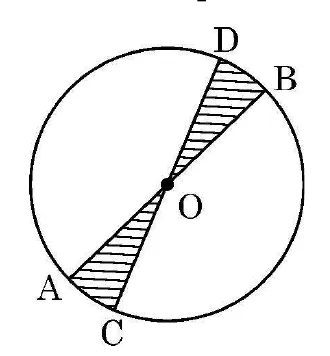
Q29Areas Related to Circles3 marks

ABAB and CDCD are diameters of a circle with centre OO and radius 77 cm. If ∠BOD=30∘\angle BOD = 30^\circ, then find the area and perimeter of the shaded region.

A circle with centre O and two diameters AB and CD. The thin sectors between OB and OD at the upper right and between OA and OC at the lower left are shaded with lines.
Solution
30°OBDACarea = 2 × 30/360 × π × 7² = 77/3 ≈ 25.67 cm²perimeter = 2 × (7 + 7 + 11/3) = 106/3 ≈ 35.33 cm
  1. The shaded region is two sectors of 30∘30^\circ (the vertically opposite angles ∠BOD\angle BOD and ∠AOC\angle AOC), each of radius 77 cm.
  2. Area =2×30360×227×7×7=773≈25.67= 2 \times \dfrac{30}{360} \times \dfrac{22}{7} \times 7 \times 7 = \dfrac{77}{3} \approx 25.67 cm².
  3. Perimeter =2×(arc+2 radii)=2(30360×2×227×7+14)=2(113+14)=1063≈35.33= 2 \times (\text{arc} + 2 \text{ radii}) = 2\left(\dfrac{30}{360} \times 2 \times \dfrac{22}{7} \times 7 + 14\right) = 2\left(\dfrac{11}{3} + 14\right) = \dfrac{106}{3} \approx 35.33 cm.

Answer: Area ≈25.67\approx 25.67 cm²; perimeter ≈35.33\approx 35.33 cm

Report an error on this question
Q30Trigonometry3 marks

Prove that tan⁡θ1−cot⁡θ+cot⁡θ1−tan⁡θ=sec⁡θcosec⁡θ+1\dfrac{\tan\theta}{1 - \cot\theta} + \dfrac{\cot\theta}{1 - \tan\theta} = \sec\theta\operatorname{cosec}\theta + 1.

Solution
  1. LHS =sin⁡2θcos⁡θ(sin⁡θ−cos⁡θ)+cos⁡2θsin⁡θ(cos⁡θ−sin⁡θ)=1sin⁡θ−cos⁡θ[sin⁡2θcos⁡θ−cos⁡2θsin⁡θ]= \dfrac{\sin^2\theta}{\cos\theta(\sin\theta - \cos\theta)} + \dfrac{\cos^2\theta}{\sin\theta(\cos\theta - \sin\theta)} = \dfrac{1}{\sin\theta - \cos\theta}\left[\dfrac{\sin^2\theta}{\cos\theta} - \dfrac{\cos^2\theta}{\sin\theta}\right].
  2. =sin⁡3θ−cos⁡3θ(sin⁡θ−cos⁡θ)sin⁡θcos⁡θ=(sin⁡θ−cos⁡θ)(1+sin⁡θcos⁡θ)(sin⁡θ−cos⁡θ)sin⁡θcos⁡θ= \dfrac{\sin^3\theta - \cos^3\theta}{(\sin\theta - \cos\theta)\sin\theta\cos\theta} = \dfrac{(\sin\theta - \cos\theta)(1 + \sin\theta\cos\theta)}{(\sin\theta - \cos\theta)\sin\theta\cos\theta}.
  3. =1+sin⁡θcos⁡θsin⁡θcos⁡θ=1sin⁡θcos⁡θ+1=sec⁡θcosec⁡θ+1== \dfrac{1 + \sin\theta\cos\theta}{\sin\theta\cos\theta} = \dfrac{1}{\sin\theta\cos\theta} + 1 = \sec\theta\operatorname{cosec}\theta + 1 = RHS.

Answer: Proved

Report an error on this question
Q31Arithmetic Progressions3 marks

(a) Find the A.P. whose third term is 1616 and seventh term exceeds the fifth term by 1212. Also, find the sum of first 2929 terms of the A.P.

OR

(b) Find the sum of first 2020 terms of an A.P. whose nthn^{\text{th}} term is given by an=5+2na_n = 5 + 2n. Can 5252 be a term of this A.P.?

Solution
  1. (a) a+2d=16a + 2d = 16 and a7−a5=2d=12a_7 - a_5 = 2d = 12, so d=6d = 6 and a=4a = 4. The A.P. is 4,10,16,…4, 10, 16, \dots.
  2. S29=292[2(4)+28×6]=292×176=2552S_{29} = \dfrac{29}{2}[2(4) + 28 \times 6] = \dfrac{29}{2} \times 176 = 2552.
  3. (b) a1=7a_1 = 7 and d=2d = 2. S20=202[14+19×2]=10×52=520S_{20} = \dfrac{20}{2}[14 + 19 \times 2] = 10 \times 52 = 520.
  4. If 5252 is a term: 7+(n−1)×2=527 + (n - 1) \times 2 = 52 gives n=472n = \dfrac{47}{2}, which is not a natural number. So 5252 is not a term.

Answer: (a) 4,10,16,…4, 10, 16, \dots; S29=2552S_{29} = 2552   (b) S20=520S_{20} = 520; 5252 is not a term

Report an error on this question

Section D: Long answer

4 questions, 5 marks each.

Q32Linear Equations5 marks

(a) Solve the following pair of linear equations by graphical method: 2x+y=92x + y = 9 and x−2y=2x - 2y = 2.

OR

(b) Nidhi received simple interest of ₹ 1,2001{,}200 when invested ₹ xx at 6%6\% p.a. and ₹ yy at 5%5\% p.a. for 11 year. Had she invested ₹ xx at 3%3\% p.a. and ₹ yy at 8%8\% p.a. for that year, she would have received simple interest of ₹ 1,2601{,}260. Find the values of xx and yy.

Solution
-1123456-3-2-112345678910Oxy2x + y = 9x − 2y = 2(4, 1)
  1. (a) 2x+y=92x + y = 9: points (4,1)(4, 1), (3,3)(3, 3), (0,9)(0, 9). x−2y=2x - 2y = 2: points (2,0)(2, 0), (4,1)(4, 1), (0,−1)(0, -1). The lines meet at (4,1)(4, 1), so x=4x = 4, y=1y = 1. (Check: 8+1=98 + 1 = 9 ✓, 4−2=24 - 2 = 2 ✓.)
  2. (b) 6x100+5y100=1200\dfrac{6x}{100} + \dfrac{5y}{100} = 1200 gives 6x+5y=1200006x + 5y = 120000 (i). 3x100+8y100=1260\dfrac{3x}{100} + \dfrac{8y}{100} = 1260 gives 3x+8y=1260003x + 8y = 126000 (ii).
  3. (ii) ×2\times 2: 6x+16y=2520006x + 16y = 252000. Subtracting (i): 11y=13200011y = 132000, so y=12000y = 12000. Then 6x=120000−600006x = 120000 - 60000 and x=10000x = 10000.

Answer: (a) x=4x = 4, y=1y = 1   (b) x=₹10,000x = ₹10{,}000, y=₹12,000y = ₹12{,}000

Report an error on this question
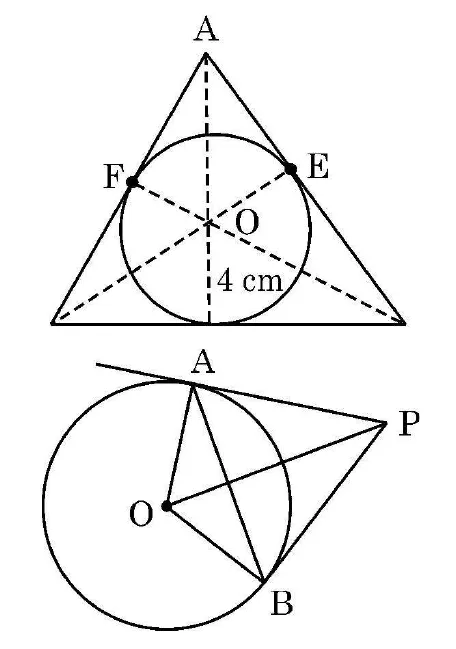
Q33Circles5 marks

(a) The given figure shows a circle with centre OO and radius 44 cm circumscribed by △ABC\triangle ABC. BCBC touches the circle at DD such that BD=6BD = 6 cm, DC=10DC = 10 cm. Find the length of AEAE.

OR

(b) PAPA and PBPB are tangents drawn to a circle with centre OO. If ∠AOB=120∘\angle AOB = 120^\circ and OA=10OA = 10 cm, then (i) Find ∠OPA\angle OPA. (ii) Find the perimeter of △OAP\triangle OAP. (iii) Find the length of chord ABAB.

Two figures. First, a triangle ABC drawn around a circle of radius 4 cm with centre O, touching BC at D (BD 6 cm, DC 10 cm) and AC at E and AB at F. Second, a circle with centre O, the tangents PA and PB from P on the right, and the radii OA and OB and the chord AB.
Solution
ABCDEF6104AE = AF = xx = 64/11 ≈ 5.8
120°OPAB∠OPA = 30°, OP = 20, PA = 10√3 = AB
  1. (a) Tangents from a point are equal: BF=BD=6BF = BD = 6, CE=CD=10CE = CD = 10 and AE=AF=xAE = AF = x. The sides are AB=6+xAB = 6 + x, AC=10+xAC = 10 + x, BC=16BC = 16, so s=16+xs = 16 + x.
  2. By Heron's formula, area =(16+x)(x)(6)(10)= \sqrt{(16 + x)(x)(6)(10)}. Also, area =12×r×perimeter=12×4×2(16+x)=4(16+x)= \dfrac{1}{2} \times r \times \text{perimeter} = \dfrac{1}{2} \times 4 \times 2(16 + x) = 4(16 + x).
  3. Equating the squares: 60x(16+x)=16(16+x)260x(16 + x) = 16(16 + x)^2, so 60x=16(16+x)60x = 16(16 + x) and 44x=25644x = 256, x=6411≈5.8x = \dfrac{64}{11} \approx 5.8 cm. AE=6411AE = \dfrac{64}{11} cm.
  4. (b)(i) OA⊥APOA \perp AP and OPOP bisects ∠AOB\angle AOB, so ∠AOP=60∘\angle AOP = 60^\circ and ∠OPA=30∘\angle OPA = 30^\circ.
  5. (ii) sin⁡30∘=OAOP\sin 30^\circ = \dfrac{OA}{OP} gives OP=20OP = 20 cm. tan⁡30∘=OAPA\tan 30^\circ = \dfrac{OA}{PA} gives PA=103PA = 10\sqrt{3} cm. Perimeter =10+20+103=30+103= 10 + 20 + 10\sqrt{3} = 30 + 10\sqrt{3} cm.
  6. (iii) PA=PBPA = PB and ∠APB=60∘\angle APB = 60^\circ, so △APB\triangle APB is equilateral and AB=PA=103AB = PA = 10\sqrt{3} cm.

Answer: (a) 6411\dfrac{64}{11} cm   (b) (i) 30∘30^\circ (ii) (30+103)(30 + 10\sqrt{3}) cm (iii) 10310\sqrt{3} cm

Report an error on this question
Q34Trigonometry5 marks

The angles of depression of the top and the foot of a 99 m tall building from the top of a multi-storeyed building are 30∘30^\circ and 60∘60^\circ respectively. Find the height of the multi-storeyed building and the distance between the two buildings. (Use 3=1.73\sqrt{3} = 1.73)

Solution
30°CDABEh = 13.5 m9 mx = 7.79 m60°x = h/√3 and x = (h − 9)√3 → h = 13.5 m
  1. Let the multi-storeyed building be CD=hCD = h, the small one AB=9AB = 9 m, and the distance between them xx.
  2. The foot AA is at 60∘60^\circ from the top DD: tan⁡60∘=hx\tan 60^\circ = \dfrac{h}{x}, so h=x3h = x\sqrt{3}. (i)
  3. The top BB is at 30∘30^\circ: it is h−9h - 9 below DD, so tan⁡30∘=h−9x\tan 30^\circ = \dfrac{h - 9}{x} and x=(h−9)3x = (h - 9)\sqrt{3}. (ii)
  4. Substituting (i) in (ii): x=(x3−9)3=3x−93x = (x\sqrt{3} - 9)\sqrt{3} = 3x - 9\sqrt{3}, so x=932=7.79x = \dfrac{9\sqrt{3}}{2} = 7.79 m. Then h=7.79×1.73=13.5h = 7.79 \times 1.73 = 13.5 m.

Answer: Height =13.5= 13.5 m; distance ≈7.79\approx 7.79 m

Report an error on this question
Q35Statistics5 marks

Find ‘mean’ and ‘mode’ of the following data:

Class15–2020–2525–3030–3535–4040–45
Frequency1210151175
Solution
  1. N=12+10+15+11+7+5=60N = 12 + 10 + 15 + 11 + 7 + 5 = 60. Class marks: 17.5,22.5,27.5,32.5,37.5,42.517.5, 22.5, 27.5, 32.5, 37.5, 42.5. Take a=27.5a = 27.5 and h=5h = 5: u=−2,−1,0,1,2,3u = -2, -1, 0, 1, 2, 3.
  2. ∑fiui=−24−10+0+11+14+15=6\sum f_iu_i = -24 - 10 + 0 + 11 + 14 + 15 = 6. Mean =27.5+660×5=28= 27.5 + \dfrac{6}{60} \times 5 = 28.
  3. The modal class is 25−3025 - 30 (f1=15f_1 = 15, f0=10f_0 = 10, f2=11f_2 = 11): Mode =25+15−1030−10−11×5=25+259≈27.78= 25 + \dfrac{15 - 10}{30 - 10 - 11} \times 5 = 25 + \dfrac{25}{9} \approx 27.78.

Answer: Mean =28= 28; mode ≈27.78\approx 27.78

Report an error on this question

Section E: Case studies

3 case studies, 4 marks each.

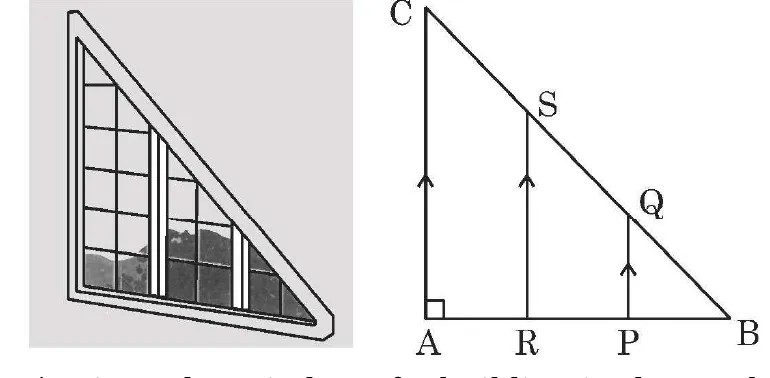
Q36Triangles4 marks

Case study 1. A triangular window of a building is shown above. Its diagram represents a △ABC with ∠A = 90° and AB = AC. Points P and R trisect AB and PQ ∥ RS ∥ AC.

Based on the above, answer the following questions:

(i) Show that △BPQ ∼ △BAC. [1]

(ii) Prove that PQ=13ACPQ = \dfrac{1}{3}AC. [1]

(iii) (a) If AB=3AB = 3 m, find length BQBQ and BSBS. Verify that BQ=12BSBQ = \dfrac{1}{2}BS. [2]

OR

(iii) (b) Prove that BR2+RS2=49BC2BR^2 + RS^2 = \dfrac{4}{9}BC^2. [2]

A photo of a triangular window with a grid of panes, and a diagram of a right triangle ABC with the right angle at A at the bottom left and C at the top. The points R and P divide AB, and the points S and Q on BC are joined to R and P by vertical lines.
Solution
ABCRPQSPQ = 1 m, BQ = √2 mRS = 2 m, BS = 2√2 m△BPQ ∼ △BAC; P, R trisect AB → BP = 1, BR = 2
  1. (i) PQ∥ACPQ \parallel AC, so ∠BQP=∠BCA\angle BQP = \angle BCA (corresponding angles) and ∠B\angle B is common. By AA, △BPQ∼△BAC\triangle BPQ \sim \triangle BAC.
  2. (ii) PP and RR trisect ABAB, so BP=13BABP = \dfrac{1}{3}BA. From the similarity, PQAC=BPBA=13\dfrac{PQ}{AC} = \dfrac{BP}{BA} = \dfrac{1}{3}, that is PQ=13ACPQ = \dfrac{1}{3}AC.
  3. (iii)(a) AB=AC=3AB = AC = 3 m, so PQ=1PQ = 1 m and BP=1BP = 1 m. In the right triangle BPQBPQ: BQ=12+12=2BQ = \sqrt{1^2 + 1^2} = \sqrt{2} m.
  4. BR=23×3=2BR = \dfrac{2}{3} \times 3 = 2 m and in the same way RS=2RS = 2 m, so BS=22+22=22BS = \sqrt{2^2 + 2^2} = 2\sqrt{2} m. 12BS=2=BQ\dfrac{1}{2}BS = \sqrt{2} = BQ ✓.
  5. (iii)(b) △BRS∼△BAC\triangle BRS \sim \triangle BAC with ratio 23\dfrac{2}{3}, so BR=23ABBR = \dfrac{2}{3}AB and RS=23ACRS = \dfrac{2}{3}AC. BR2+RS2=49(AB2+AC2)=49BC2BR^2 + RS^2 = \dfrac{4}{9}(AB^2 + AC^2) = \dfrac{4}{9}BC^2 (Pythagoras in △ABC\triangle ABC).

Answer: (iii)(a) BQ=2BQ = \sqrt{2} m, BS=22BS = 2\sqrt{2} m; BQ=12BSBQ = \dfrac{1}{2}BS   (iii)(b) proved

Report an error on this question
Q37Surface Areas and Volumes4 marks

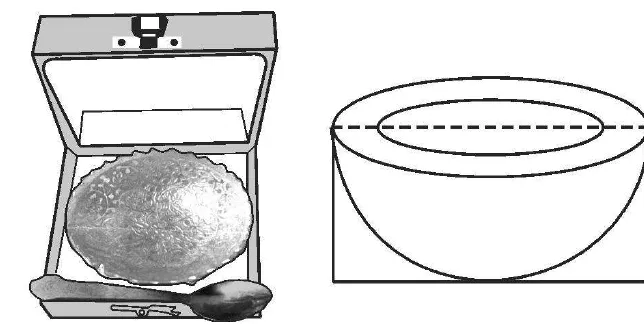
Case study 2. A hemispherical bowl is packed in a cuboidal box. The bowl just fits in the box. Inner radius of the bowl is 10 cm. Outer radius of the bowl is 10.5 cm.

Based on the above, answer the following questions:

(i) Find the dimensions of the cuboidal box. [1]

(ii) Find the total outer surface area of the box. [1]

(iii) (a) Find the difference between the capacity of the bowl and the volume of the box. (use π = 3.14) [2]

OR

(iii) (b) The inner surface of the bowl and the thickness is to be painted. Find the area to be painted. [2]

A photo of a steel bowl packed in an open box, and a drawing of a hemispherical bowl resting inside a cuboidal box that it just fits.
Solution
  1. (i) The bowl just fits, so the box is as wide as the outer diameter, 2×10.5=212 \times 10.5 = 21 cm, and as tall as the outer radius, 10.510.5 cm. The box is 21×21×10.521 \times 21 \times 10.5 cm.
  2. (ii) Total outer surface area =2(lb+bh+hl)=2(441+220.5+220.5)=2×882=1764= 2(lb + bh + hl) = 2(441 + 220.5 + 220.5) = 2 \times 882 = 1764 cm².
  3. (iii)(a) Capacity of the bowl (inner radius 1010) =23×3.14×103=62803≈2093.33= \dfrac{2}{3} \times 3.14 \times 10^3 = \dfrac{6280}{3} \approx 2093.33 cm³. Volume of the box =21×21×10.5=4630.5= 21 \times 21 \times 10.5 = 4630.5 cm³.
  4. Difference =4630.5−2093.33≈2537.17= 4630.5 - 2093.33 \approx 2537.17 cm³ (here the capacity is taken as the volume, as in the key’s note).
  5. (iii)(b) Painted area = inner curved surface ++ the ring of the rim =2πr2+π(R2−r2)=2×227×100+227(110.25−100)=44007+45114=925114≈660.79= 2\pi r^2 + \pi(R^2 - r^2) = 2 \times \dfrac{22}{7} \times 100 + \dfrac{22}{7}(110.25 - 100) = \dfrac{4400}{7} + \dfrac{451}{14} = \dfrac{9251}{14} \approx 660.79 cm².

Answer: (i) 21×21×10.521 \times 21 \times 10.5 cm   (ii) 17641764 cm²   (iii)(a) ≈2537.17\approx 2537.17 cm³   (iii)(b) ≈660.79\approx 660.79 cm²

Report an error on this question
Q38Coordinate Geometry4 marks

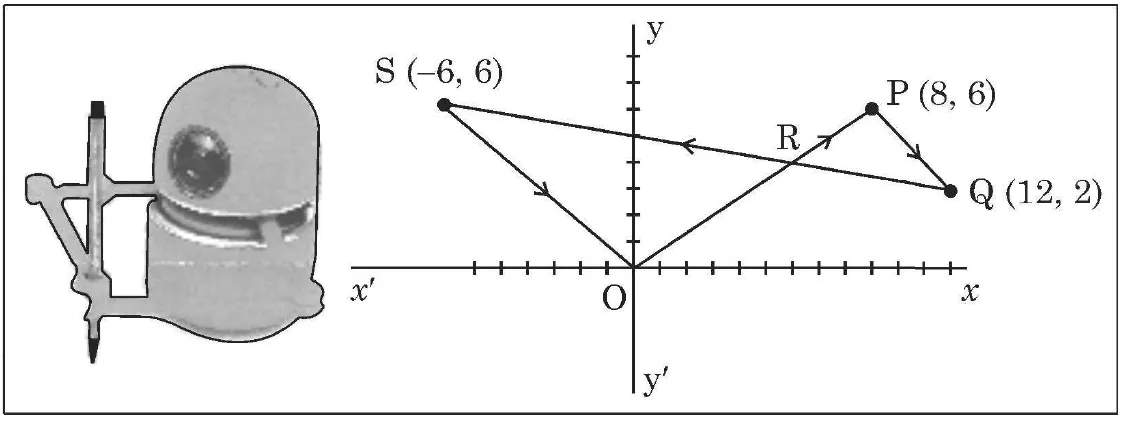
Case study 3. Gurveer and Arushi built a robot that can paint a path as it moves on a graph paper. Some co-ordinate of points are marked on it. It starts from (0, 0), moves to the points listed in order (in straight lines) and ends at (0, 0). Arushi entered the points P(8, 6), Q(12, 2) and S(−6, 6) in order. The path drawn by robot is shown in the figure.

Based on the above, answer the following questions:

(i) Determine the distance OP. [1]

(ii) QS is represented by equation 2x + 9y = 42. Find the co-ordinates of the point where it intersects y-axis. [1]

(iii) (a) Point R(4.8, y) divides the line segment OP in a certain ratio, find the ratio. Hence, find the value of y. [2]

OR

(iii) (b) Using distance formula, show that PQOS=23\dfrac{PQ}{OS} = \dfrac{2}{3}. [2]

A photo of a small painting robot and a graph with axes. The robot’s path goes from the origin O to P(8, 6), then to Q(12, 2), then to S(−6, 6) and back to O, with the point R marked on OP.
Solution
-8-6-4-22468101214-22468OxyP(8, 6)Q(12, 2)S(−6, 6)R(4.8, 3.6)(0, 14/3)
  1. (i) OP=82+62=100=10OP = \sqrt{8^2 + 6^2} = \sqrt{100} = 10.
  2. (ii) On the yy-axis x=0x = 0: 9y=429y = 42, so y=143y = \dfrac{14}{3}. The point is (0,143)\left(0, \dfrac{14}{3}\right).
  3. (iii)(a) Let RR divide OPOP in the ratio k:1k : 1: k×8+0k+1=4.8\dfrac{k \times 8 + 0}{k + 1} = 4.8, so 8k=4.8k+4.88k = 4.8k + 4.8 and k=32k = \dfrac{3}{2}. The ratio is 3:23 : 2.
  4. y=k×6k+1=95/2=185=3.6y = \dfrac{k \times 6}{k + 1} = \dfrac{9}{5/2} = \dfrac{18}{5} = 3.6.
  5. (iii)(b) PQ=(12−8)2+(2−6)2=32=42PQ = \sqrt{(12 - 8)^2 + (2 - 6)^2} = \sqrt{32} = 4\sqrt{2} and OS=(−6)2+62=72=62OS = \sqrt{(-6)^2 + 6^2} = \sqrt{72} = 6\sqrt{2}. PQOS=4262=23\dfrac{PQ}{OS} = \dfrac{4\sqrt{2}}{6\sqrt{2}} = \dfrac{2}{3}.

Answer: (i) 1010   (ii) (0,143)\left(0, \dfrac{14}{3}\right)   (iii)(a) 3:23 : 2, y=185y = \dfrac{18}{5}   (iii)(b) shown

Report an error on this question

Questions are from the official CBSE paper. Figures are described in words; see the PDF for the originals. Solutions are written by CogniGuru.

Revise this paper in 1 minute a chapter

Each chapter below is what the paper tested, with a one-minute animated lesson on the idea behind it.

Stuck on a step in any solution?

The CogniGuru AI tutor explains any doubt one minute at a time, in English or Hindi. Join the waitlist.

Mock quiz: 5 questions from this paper

Five real questions from this paper, one each from five chapters. About 2 minutes. See how much you know and where you stand among other students. Attempt free, with no login; log in only for your ranking and full report.

Question 1 of 5 · Q2 of the paperArithmetic Progressions

22nd22^{\text{nd}} term of the A.P.: 32,12,−12,−32,…\dfrac{3}{2}, \dfrac{1}{2}, \dfrac{-1}{2}, \dfrac{-3}{2}, \dots is:

0 of 5 answered

Related papers

Common questions

Are these the official CBSE Class 10 Maths Basic 2025 questions?
Yes. The questions are from the official Mathematics (Basic) paper (set 430/6/1) that CBSE published after the March 2025 board exam. The solutions are written by CogniGuru and checked against the answer key CBSE published for this paper code.
Can I download the CBSE Class 10 Maths Basic 2025 question paper PDF?
Yes, the official paper PDF is free to download from this page, and so are our step-by-step solutions as a PDF. No login is needed to download either or to read the solutions.
Do all sets of the paper have the same questions?
No. CBSE sets several versions of each paper, with the same blueprint and similar questions in a different order and sometimes with different numbers. This page covers set 430/6/1.
How does the quiz work, and what does “where you stand” mean?
It is a mock quiz of 5 real multiple-choice questions from this paper, scored automatically in about 2 minutes. Your score is compared, anonymously, with other students who took the same quiz. Only the score is stored with the comparison, never your name or number.

Source

CBSE question paper archive, Class X, 2025 (Mathematics (Basic), set 430/6/1)
PDF