CBSE · Class 10 · Mathematics (Standard) · Free

CBSE Class 10 Maths Standard 2023 Question Paper (Set 30/4/1) with Solutions

The official board paper (Q.P. Code 30/4/1, Series WX1YZ/4). Free paper PDF and step-by-step solutions (also as a PDF to download) written by CogniGuru and checked against CBSE’s answer key. See the paper’s main topics in 1 minute, then quiz yourself to see how much you know and where you stand.

No login to download or read the solutions. Login only to see your quiz report in full.

Board
CBSE
Class
10
Subject
Maths Standard (041)
Year
2023
Set code
30/4/1
Max marks
80
Duration
3 hours
Questions
38 (Sections A to E)
Source
Official CBSE paper
Exam date
March 2023

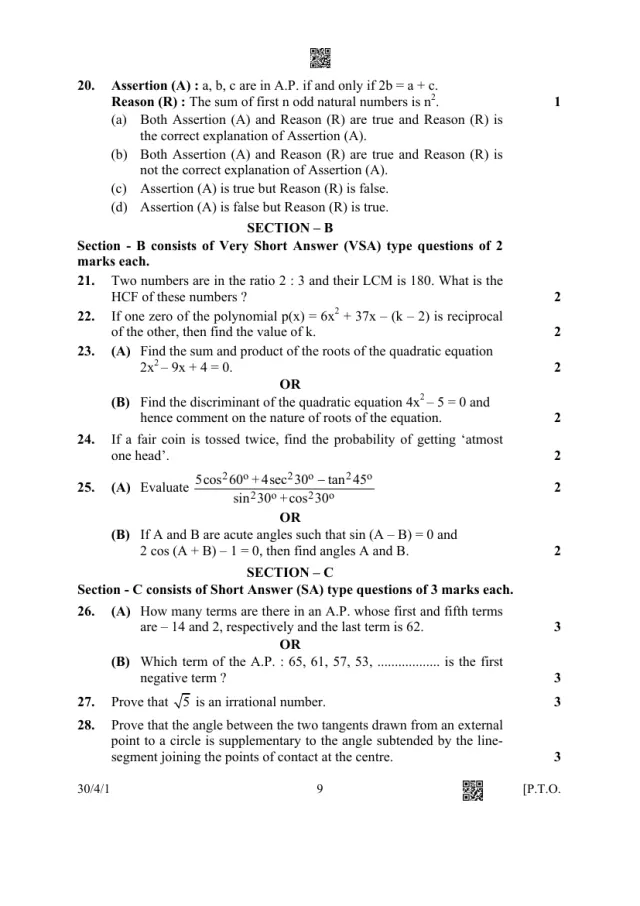
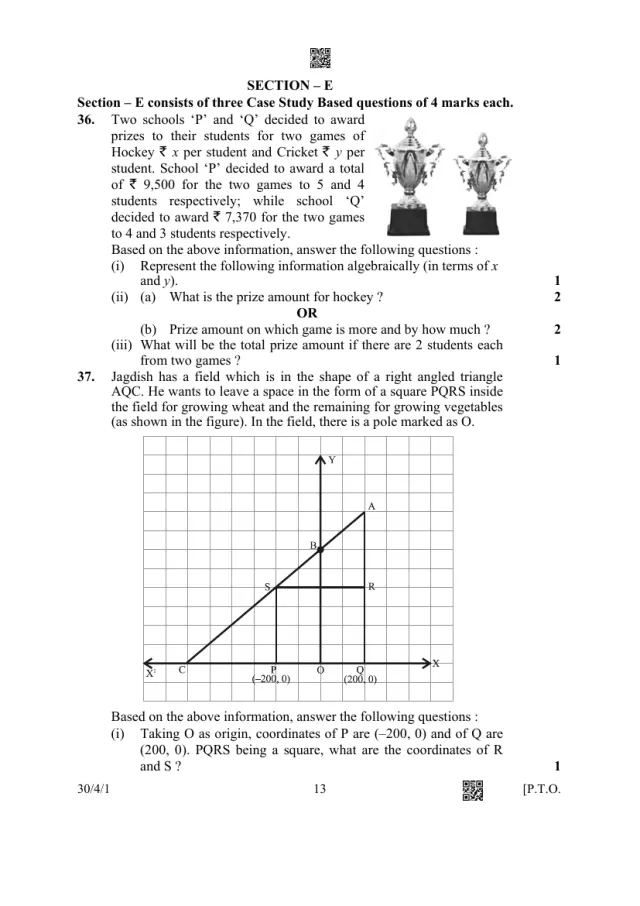
Paper preview

Three pages of the official paper. Download the PDF for all 16.

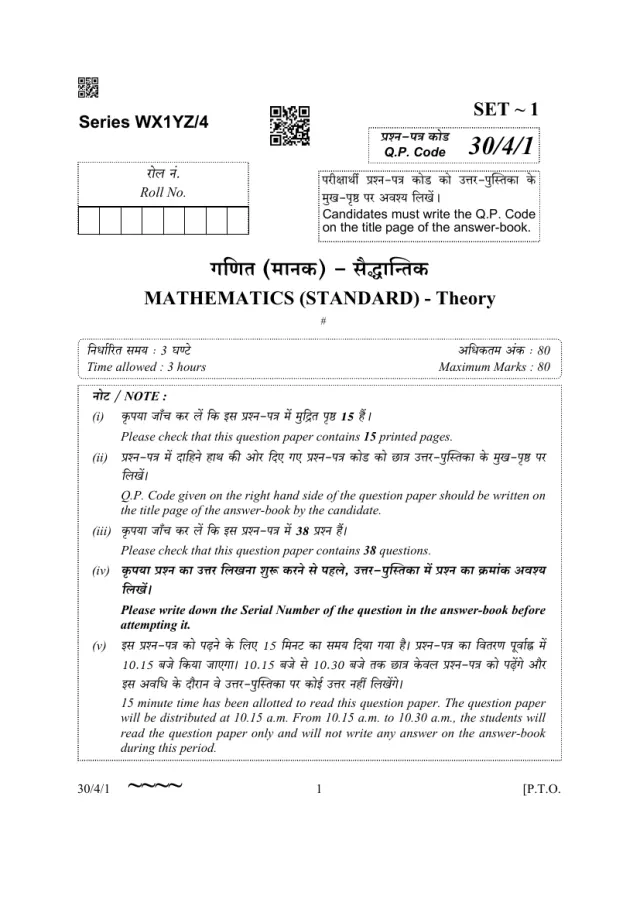
  • Cover page of the CBSE Class 10 Maths Standard 2023 paper, set 30/4/1

    Cover page

  • Section B of the CBSE Class 10 Maths Standard 2023 paper, set 30/4/1

    Section B

  • A case study with its figure from the CBSE Class 10 Maths Standard 2023 paper, set 30/4/1

    Case study

The main topics of this paper, in 1 minute

Your tutor walks you through the paper before you attempt it: the marks, the key ideas, the time plan and the traps.

1-minute paper analysis

With your tutor, in her voice

The main topics of this paper, in about a minute

A short, animated walk through the paper: how it is built, where the marks come from, the four ideas that matter most, how to plan your three hours, and the traps to avoid.

  1. 1The paper at a glance
  2. 2Where the marks come from
  3. 3Four ideas that keep paying off
  4. 4Plan your three hours
  5. 5Four traps to avoid

Sound on for the voice. Captions are shown, and you can mute any time.

Step-by-step solutions

Try each question first, then open its solution. Tap a number to jump.

Download solutions (PDF)

Section A: Multiple choice

20 questions, 1 mark each. MCQs (Q1 to Q18) and assertion-reason (Q19, Q20).

Q1Real Numbers1 mark

The ratio of HCF to LCM of the least composite number and the least prime number is:

  1. (A)1 : 2
  2. (B)2 : 1
  3. (C)1 : 1
  4. (D)1 : 3
Solution · answer (A)
  1. The least composite number is 44 and the least prime is 22.
  2. HCF(4,2)=2\text{HCF}(4, 2) = 2 and LCM(4,2)=4\text{LCM}(4, 2) = 4. The ratio is 2:4=1:22 : 4 = 1 : 2.

Answer: (A) 1 : 2

Report an error on this question
Q2Quadratic Equations1 mark

The roots of the equation x2+3x−10=0x^2 + 3x - 10 = 0 are:

  1. (A)2, −5
  2. (B)−2, 5
  3. (C)2, 5
  4. (D)−2, −5
Solution · answer (A)
  1. x2+5x−2x−10=x(x+5)−2(x+5)=(x−2)(x+5)=0x^2 + 5x - 2x - 10 = x(x + 5) - 2(x + 5) = (x - 2)(x + 5) = 0, so the roots are 22 and −5-5.

Answer: (A) 2, −5

Report an error on this question
Q3Arithmetic Progressions1 mark

The next term of the A.P.: 6, 24, 54\sqrt{6},\ \sqrt{24},\ \sqrt{54} is:

  1. (A)60\sqrt{60}
  2. (B)96\sqrt{96}
  3. (C)72\sqrt{72}
  4. (D)216\sqrt{216}
Solution · answer (B)
  1. Simplify: 6\sqrt{6}, 24=26\sqrt{24} = 2\sqrt{6}, 54=36\sqrt{54} = 3\sqrt{6}. The common difference is 6\sqrt{6}.
  2. The next term is 46=964\sqrt{6} = \sqrt{96}.

Answer: (B) 96\sqrt{96}

Report an error on this question
Q4Coordinate Geometry1 mark

The distance of the point (−1,7)(-1, 7) from xx-axis is:

  1. (A)−1
  2. (B)7
  3. (C)6
  4. (D)50\sqrt{50}
Solution · answer (B)
  1. The distance from the xx-axis is the absolute value of the yy-coordinate: ∣7∣=7|7| = 7.

Answer: (B) 7

Report an error on this question
Q5Areas Related to Circles1 mark

What is the area of a semi-circle of diameter ‘dd’?

  1. (A)116πd2\dfrac{1}{16}\pi d^2
  2. (B)14πd2\dfrac{1}{4}\pi d^2
  3. (C)18πd2\dfrac{1}{8}\pi d^2
  4. (D)12πd2\dfrac{1}{2}\pi d^2
Solution · answer (C)
  1. Radius =d2= \dfrac{d}{2}. Area =12π(d2)2=18πd2= \dfrac{1}{2}\pi\left(\dfrac{d}{2}\right)^2 = \dfrac{1}{8}\pi d^2.

Answer: (C) 18πd2\dfrac{1}{8}\pi d^2

Report an error on this question
Q6Statistics1 mark

The empirical relation between the mode, median and mean of a distribution is:

  1. (A)Mode = 3 Median − 2 Mean
  2. (B)Mode = 3 Mean − 2 Median
  3. (C)Mode = 2 Median − 3 Mean
  4. (D)Mode = 2 Mean − 3 Median
Solution · answer (A)
  1. The empirical relation is Mode=3 Median−2 Mean\text{Mode} = 3\,\text{Median} - 2\,\text{Mean}.

Answer: (A) Mode = 3 Median − 2 Mean

Report an error on this question
Q7Linear Equations1 mark

The pair of linear equations 2x=5y+62x = 5y + 6 and 15y=6x−1815y = 6x - 18 represents two lines which are:

  1. (A)intersecting
  2. (B)parallel
  3. (C)coincident
  4. (D)either intersecting or parallel
Solution · answer (C)
  1. Write 2x−5y−6=02x - 5y - 6 = 0 and 6x−15y−18=06x - 15y - 18 = 0. 26=−5−15=−6−18=13\dfrac{2}{6} = \dfrac{-5}{-15} = \dfrac{-6}{-18} = \dfrac{1}{3}.
  2. All three ratios are equal, so the lines are coincident.

Answer: (C) coincident

Report an error on this question
Q8Polynomials1 mark

If α\alpha, β\beta are zeroes of the polynomial x2−1x^2 - 1, then value of (α+β)(\alpha + \beta) is:

  1. (A)2
  2. (B)1
  3. (C)−1
  4. (D)0
Solution · answer (D)
  1. x2−1=(x−1)(x+1)x^2 - 1 = (x - 1)(x + 1) has zeroes 11 and −1-1. Their sum is 00 (also −ba=0-\dfrac{b}{a} = 0).

Answer: (D) 0

Report an error on this question
Q9Applications of Trigonometry1 mark

If a pole 66 m high casts a shadow 232\sqrt{3} m long on the ground, then sun’s elevation is:

  1. (A)60∘60^\circ
  2. (B)45∘45^\circ
  3. (C)30∘30^\circ
  4. (D)90∘90^\circ
Solution · answer (A)
θ = 60°6 m2√3 mABCtan θ = 6 / 2√3 = √3, so θ = 60°
  1. tan⁡θ=poleshadow=623=3\tan\theta = \dfrac{\text{pole}}{\text{shadow}} = \dfrac{6}{2\sqrt{3}} = \sqrt{3}.
  2. So θ=60∘\theta = 60^\circ.

Answer: (A) 60∘60^\circ

Report an error on this question
Q10Trigonometry1 mark

sec⁡θ\sec\theta when expressed in terms of cot⁡θ\cot\theta, is equal to:

  1. (A)1+cot⁡2θcot⁡θ\dfrac{1 + \cot^2\theta}{\cot\theta}
  2. (B)1+cot⁡2θ\sqrt{1 + \cot^2\theta}
  3. (C)1+cot⁡2θcot⁡θ\dfrac{\sqrt{1 + \cot^2\theta}}{\cot\theta}
  4. (D)1−cot⁡2θcot⁡θ\dfrac{\sqrt{1 - \cot^2\theta}}{\cot\theta}
Solution · answer (C)
  1. sec⁡θ=1cos⁡θ=sin⁡θcos⁡θ×1sin⁡θ=cosec θcot⁡θ\sec\theta = \dfrac{1}{\cos\theta} = \dfrac{\sin\theta}{\cos\theta} \times \dfrac{1}{\sin\theta} = \dfrac{\mathrm{cosec}\,\theta}{\cot\theta}.
  2. cosec θ=1+cot⁡2θ\mathrm{cosec}\,\theta = \sqrt{1 + \cot^2\theta}, so sec⁡θ=1+cot⁡2θcot⁡θ\sec\theta = \dfrac{\sqrt{1 + \cot^2\theta}}{\cot\theta}.

Answer: (C) 1+cot⁡2θcot⁡θ\dfrac{\sqrt{1 + \cot^2\theta}}{\cot\theta}

Report an error on this question
Q11Probability1 mark

Two dice are thrown together. The probability of getting the difference of numbers on their upper faces equals to 3 is:

  1. (A)19\dfrac{1}{9}
  2. (B)29\dfrac{2}{9}
  3. (C)16\dfrac{1}{6}
  4. (D)112\dfrac{1}{12}
Solution · answer (C)
  1. Total outcomes =36= 36. Difference 33: (1,4),(4,1),(2,5),(5,2),(3,6),(6,3)(1, 4), (4, 1), (2, 5), (5, 2), (3, 6), (6, 3) — 66 outcomes.
  2. P=636=16P = \dfrac{6}{36} = \dfrac{1}{6}.

Answer: (C) 16\dfrac{1}{6}

Report an error on this question
Q12Triangles1 mark

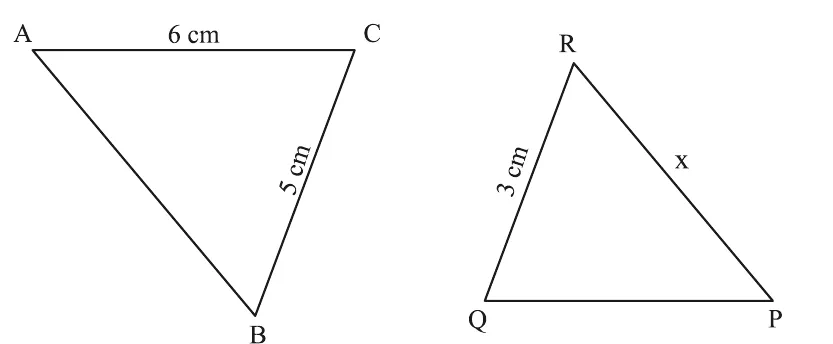
In the given figure, △ABC∼△QPR\triangle ABC \sim \triangle QPR. If AC=6AC = 6 cm, BC=5BC = 5 cm, QR=3QR = 3 cm and PR=xPR = x; then the value of xx is:

Two triangles side by side: triangle ABC on the left with AC = 6 cm along the top and BC = 5 cm, and triangle QPR on the right with QR = 3 cm and PR = x.
  1. (A)3.6 cm
  2. (B)2.5 cm
  3. (C)10 cm
  4. (D)3.2 cm
Solution · answer (B)
ACBQRPAC = 6BC = 5QR = 3PR = xAC/QR = BC/PR → 6/3 = 5/x → x = 2.5 cm
Not to scale.
  1. △ABC∼△QPR\triangle ABC \sim \triangle QPR means A↔QA \leftrightarrow Q, B↔PB \leftrightarrow P, C↔RC \leftrightarrow R. So AC↔QRAC \leftrightarrow QR and BC↔PRBC \leftrightarrow PR.
  2. ACQR=BCPR\dfrac{AC}{QR} = \dfrac{BC}{PR}: 63=5x\dfrac{6}{3} = \dfrac{5}{x}, so x=2.5x = 2.5 cm.

Answer: (B) 2.5 cm

Report an error on this question
Q13Coordinate Geometry1 mark

The distance of the point (−6,8)(-6, 8) from origin is:

  1. (A)6
  2. (B)−6
  3. (C)8
  4. (D)10
Solution · answer (D)
  1. Distance =(−6)2+82=36+64=10= \sqrt{(-6)^2 + 8^2} = \sqrt{36 + 64} = 10.

Answer: (D) 10

Report an error on this question
Q14Circles1 mark

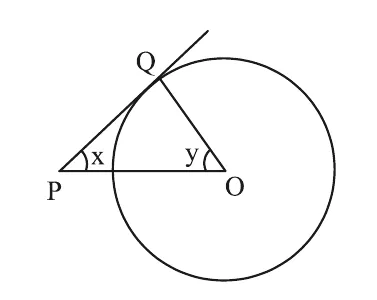
In the given figure, PQPQ is a tangent to the circle with centre OO. If ∠OPQ=x\angle OPQ = x, ∠POQ=y\angle POQ = y, then x+yx + y is:

A circle with centre O on the right and a point P on the left. The line PQ touches the circle at Q at the top left. The angle OPQ is marked x and the angle POQ is marked y.
  1. (A)45∘45^\circ
  2. (B)90∘90^\circ
  3. (C)60∘60^\circ
  4. (D)180∘180^\circ
Solution · answer (B)
xyOPQ∠Q = 90°, so x + y = 90°
  1. PQPQ is a tangent at QQ, so OQ⊥PQOQ \perp PQ and ∠OQP=90∘\angle OQP = 90^\circ.
  2. In △POQ\triangle POQ: x+y+90∘=180∘x + y + 90^\circ = 180^\circ, so x+y=90∘x + y = 90^\circ.

Answer: (B) 90∘90^\circ

Report an error on this question
Q15Circles1 mark

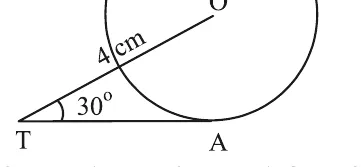
In the given figure, TATA is a tangent to the circle with centre OO such that OT=4OT = 4 cm, ∠OTA=30∘\angle OTA = 30^\circ, then length of TATA is:

A circle with centre O. The tangent TA touches the circle at A on the bottom. The line TO is drawn from T on the left to O, with OT marked 4 cm and the angle OTA marked 30 degrees.
  1. (A)232\sqrt{3} cm
  2. (B)2 cm
  3. (C)222\sqrt{2} cm
  4. (D)3\sqrt{3} cm
Solution · answer (A)
30°OTAOA = 2, TA = OT cos 30° = 4 × √3/2 = 2√3 cm
Not to scale.
  1. OA⊥TAOA \perp TA (radius and tangent), so △OAT\triangle OAT is right-angled at AA.
  2. cos⁡30∘=TAOT\cos 30^\circ = \dfrac{TA}{OT}, so TA=4×32=23TA = 4 \times \dfrac{\sqrt{3}}{2} = 2\sqrt{3} cm. (Check: OA=4sin⁡30∘=2OA = 4\sin 30^\circ = 2 and TA2=16−4=12TA^2 = 16 - 4 = 12.)

Answer: (A) 232\sqrt{3} cm

Report an error on this question
Q16Triangles1 mark

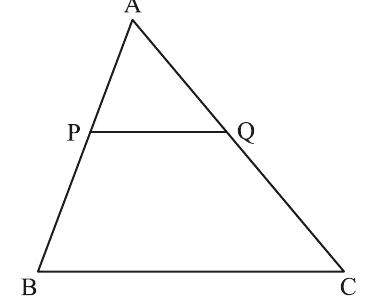
In △ABC\triangle ABC, PQ∥BCPQ \parallel BC. If PB=6PB = 6 cm, AP=4AP = 4 cm, AQ=8AQ = 8 cm, find the length of ACAC.

Triangle ABC with a line PQ drawn parallel to the base BC, P on AB and Q on AC.
  1. (A)12 cm
  2. (B)20 cm
  3. (C)6 cm
  4. (D)14 cm
Solution · answer (B)
ABCPQAP/PB = AQ/QC → 4/6 = 8/QC → QC = 12; AC = 8 + 12 = 20 cm
  1. PQ∥BCPQ \parallel BC, so APPB=AQQC\dfrac{AP}{PB} = \dfrac{AQ}{QC}: 46=8QC\dfrac{4}{6} = \dfrac{8}{QC}, so QC=12QC = 12 cm.
  2. AC=AQ+QC=8+12=20AC = AQ + QC = 8 + 12 = 20 cm.

Answer: (B) 20 cm

Common mistake: Stopping at QC = 12 cm. The question asks for AC.

Report an error on this question
Q17Polynomials1 mark

If α\alpha, β\beta are the zeroes of the polynomial p(x)=4x2−3x−7p(x) = 4x^2 - 3x - 7, then (1α+1β)\left(\dfrac{1}{\alpha} + \dfrac{1}{\beta}\right) is equal to:

  1. (A)73\dfrac{7}{3}
  2. (B)−73\dfrac{-7}{3}
  3. (C)37\dfrac{3}{7}
  4. (D)−37\dfrac{-3}{7}
Solution · answer (D)
  1. α+β=34\alpha + \beta = \dfrac{3}{4} and αβ=−74\alpha\beta = -\dfrac{7}{4}.
  2. 1α+1β=α+βαβ=3/4−7/4=−37\dfrac{1}{\alpha} + \dfrac{1}{\beta} = \dfrac{\alpha + \beta}{\alpha\beta} = \dfrac{3/4}{-7/4} = -\dfrac{3}{7}.

Answer: (D) −37-\dfrac{3}{7}

Report an error on this question
Q18Probability1 mark

A card is drawn at random from a well-shuffled pack of 52 cards. The probability that the card drawn is not an ace is:

  1. (A)113\dfrac{1}{13}
  2. (B)913\dfrac{9}{13}
  3. (C)413\dfrac{4}{13}
  4. (D)1213\dfrac{12}{13}
Solution · answer (D)
  1. There are 44 aces, so 52−4=4852 - 4 = 48 cards are not aces. P=4852=1213P = \dfrac{48}{52} = \dfrac{12}{13}.

Answer: (D) 1213\dfrac{12}{13}

Report an error on this question
Q19Probability1 mark

Assertion (A): The probability that a leap year has 5353 Sundays is 27\dfrac{2}{7}.

Reason (R): The probability that a non-leap year has 5353 Sundays is 57\dfrac{5}{7}.

  1. (A)Both A and R are true and R is the correct explanation of A
  2. (B)Both A and R are true, but R is not the correct explanation of A
  3. (C)A is true, but R is false
  4. (D)A is false, but R is true
Solution · answer (C)
  1. (A) A leap year has 366=52366 = 52 weeks +2+ 2 days. The 22 extra days include a Sunday in 22 of the 77 equally likely pairs, so P=27P = \dfrac{2}{7}. True.
  2. (R) A non-leap year has 5252 weeks +1+ 1 day, and that day is a Sunday with probability 17\dfrac{1}{7}, not 57\dfrac{5}{7}. False.

Answer: (C) A is true, R is false

Report an error on this question
Q20Arithmetic Progressions1 mark

Assertion (A): a,b,ca, b, c are in A.P. if and only if 2b=a+c2b = a + c.

Reason (R): The sum of first nn odd natural numbers is n2n^2.

  1. (A)Both A and R are true and R is the correct explanation of A
  2. (B)Both A and R are true and R is not the correct explanation of A
  3. (C)A is true but R is false
  4. (D)A is false but R is true
Solution · answer (B)
  1. (A) b−a=c−bb - a = c - b is the same as 2b=a+c2b = a + c, so this is the definition of three terms in A.P. True.
  2. (R) 1+3+5+⋯+(2n−1)=n21 + 3 + 5 + \dots + (2n - 1) = n^2. True, but it does not explain the condition in A.

Answer: (B) Both true, but R is not the correct explanation of A

Report an error on this question

Section B: Very short answer

5 questions, 2 marks each.

Q21Real Numbers2 marks

Two numbers are in the ratio 2 : 3 and their LCM is 180. What is the HCF of these numbers?

Solution
  1. Let the numbers be 2x2x and 3x3x, where xx is their HCF. Their LCM is 6x6x.
  2. 6x=1806x = 180, so x=30x = 30. The numbers are 6060 and 9090, and their HCF is 3030.

Answer: 30

Report an error on this question
Q22Polynomials2 marks

If one zero of the polynomial p(x)=6x2+37x−(k−2)p(x) = 6x^2 + 37x - (k - 2) is reciprocal of the other, then find the value of kk.

Solution
  1. Let the zeroes be α\alpha and 1α\dfrac{1}{\alpha}. Their product is 11.
  2. Product of zeroes =−(k−2)6=1= \dfrac{-(k - 2)}{6} = 1, so −(k−2)=6-(k - 2) = 6 and k=−4k = -4.

Answer: k=−4k = -4

Report an error on this question
Q23Quadratic Equations2 marks

(A) Find the sum and product of the roots of the quadratic equation 2x2−9x+4=02x^2 - 9x + 4 = 0.

OR

(B) Find the discriminant of the quadratic equation 4x2−5=04x^2 - 5 = 0 and hence comment on the nature of roots of the equation.

Solution
  1. (A) Sum =−ba=92= -\dfrac{b}{a} = \dfrac{9}{2} and product =ca=42=2= \dfrac{c}{a} = \dfrac{4}{2} = 2.
  2. (B) D=b2−4ac=0−4×4×(−5)=80>0D = b^2 - 4ac = 0 - 4 \times 4 \times (-5) = 80 > 0, so the roots are real and distinct.

Answer: (A) sum 92\dfrac{9}{2}, product 22   (B) D=80D = 80: real and distinct roots

Report an error on this question
Q24Probability2 marks

If a fair coin is tossed twice, find the probability of getting ‘atmost one head’.

Solution
  1. Outcomes: HH,HT,TH,TTHH, HT, TH, TT. At most one head: HT,TH,TTHT, TH, TT — 33 outcomes.
  2. P=34P = \dfrac{3}{4}.

Answer: 34\dfrac{3}{4}

Report an error on this question
Q25Trigonometry2 marks

(A) Evaluate: 5cos⁡260∘+4sec⁡230∘−tan⁡245∘sin⁡230∘+cos⁡230∘\dfrac{5\cos^2 60^\circ + 4\sec^2 30^\circ - \tan^2 45^\circ}{\sin^2 30^\circ + \cos^2 30^\circ}

OR

(B) If AA and BB are acute angles such that sin⁡(A−B)=0\sin(A - B) = 0 and 2cos⁡(A+B)−1=02\cos(A + B) - 1 = 0, then find angles AA and BB.

Solution
  1. (A) Numerator =5×14+4×43−1=54+163−1=15+64−1212=6712= 5 \times \dfrac{1}{4} + 4 \times \dfrac{4}{3} - 1 = \dfrac{5}{4} + \dfrac{16}{3} - 1 = \dfrac{15 + 64 - 12}{12} = \dfrac{67}{12}. Denominator =14+34=1= \dfrac{1}{4} + \dfrac{3}{4} = 1. Value =6712= \dfrac{67}{12}.
  2. (B) sin⁡(A−B)=0\sin(A - B) = 0 gives A−B=0∘A - B = 0^\circ. cos⁡(A+B)=12\cos(A + B) = \dfrac{1}{2} gives A+B=60∘A + B = 60^\circ. So A=B=30∘A = B = 30^\circ.

Answer: (A) 6712\dfrac{67}{12}   (B) A=B=30∘A = B = 30^\circ

Report an error on this question

Section C: Short answer

6 questions, 3 marks each.

Q26Arithmetic Progressions3 marks

(A) How many terms are there in an A.P. whose first and fifth terms are −14-14 and 22, respectively and the last term is 6262.

OR

(B) Which term of the A.P.: 65,61,57,53,…65, 61, 57, 53, \dots is the first negative term?

Solution
36912151821-20-1010203040506070Onyaₙ = −14 + 4(n − 1)−14262
  1. (A) a=−14a = -14 and a5=a+4d=2a_5 = a + 4d = 2, so −14+4d=2-14 + 4d = 2 and d=4d = 4.
  2. an=62a_n = 62: −14+(n−1)×4=62-14 + (n - 1) \times 4 = 62, so (n−1)×4=76(n - 1) \times 4 = 76 and n=20n = 20.
  3. (B) a=65a = 65 and d=−4d = -4. The nnth term is negative when 65−4(n−1)<065 - 4(n - 1) < 0, that is 69−4n<069 - 4n < 0 and n>694=17.25n > \dfrac{69}{4} = 17.25.
  4. The least whole number is n=18n = 18. So the first negative term is the 1818th term (a18=65−68=−3a_{18} = 65 - 68 = -3).

Answer: (A) 2020 terms   (B) the 1818th term

Report an error on this question
Q27Real Numbers3 marks

Prove that 5\sqrt{5} is an irrational number.

Solution
  1. Suppose 5=pq\sqrt{5} = \dfrac{p}{q} with p,qp, q co-prime and q≠0q \neq 0. Then 5q2=p25q^2 = p^2, so 55 divides pp. Write p=5ap = 5a.
  2. 25a2=5q225a^2 = 5q^2, so q2=5a2q^2 = 5a^2 and 55 divides qq.
  3. 55 divides both pp and qq, contradicting that they are co-prime. So 5\sqrt{5} is irrational.

Answer: Proved by contradiction

Report an error on this question
Q28Circles3 marks

Prove that the angle between the two tangents drawn from an external point to a circle is supplementary to the angle subtended by the line-segment joining the points of contact at the centre.

Solution
∠APB∠AOBOPAB∠APB + ∠AOB = 360° − 90° − 90° = 180°
  1. Let PAPA and PBPB be tangents from PP to a circle with centre OO. Join OAOA and OBOB.
  2. A radius is perpendicular to the tangent at the point of contact: ∠OAP=∠OBP=90∘\angle OAP = \angle OBP = 90^\circ.
  3. In quadrilateral OAPBOAPB the angles add up to 360∘360^\circ: 90∘+∠APB+90∘+∠AOB=360∘90^\circ + \angle APB + 90^\circ + \angle AOB = 360^\circ.
  4. So ∠APB+∠AOB=180∘\angle APB + \angle AOB = 180^\circ: the angles are supplementary.

Answer: Proved

Report an error on this question
Q29Trigonometry3 marks

(A) Prove that sin⁡A−2sin⁡3A2cos⁡3A−cos⁡A=tan⁡A\dfrac{\sin A - 2\sin^3 A}{2\cos^3 A - \cos A} = \tan A

OR

(B) Prove that sec⁡A(1−sin⁡A)(sec⁡A+tan⁡A)=1\sec A(1 - \sin A)(\sec A + \tan A) = 1.

Solution
  1. (A) LHS =sin⁡A(1−2sin⁡2A)cos⁡A(2cos⁡2A−1)= \dfrac{\sin A(1 - 2\sin^2 A)}{\cos A(2\cos^2 A - 1)}. Using sin⁡2A=1−cos⁡2A\sin^2 A = 1 - \cos^2 A: 1−2sin⁡2A=2cos⁡2A−11 - 2\sin^2 A = 2\cos^2 A - 1.
  2. So LHS =sin⁡Acos⁡A×2cos⁡2A−12cos⁡2A−1=tan⁡A== \dfrac{\sin A}{\cos A} \times \dfrac{2\cos^2 A - 1}{2\cos^2 A - 1} = \tan A = RHS.
  3. (B) sec⁡A+tan⁡A=1+sin⁡Acos⁡A\sec A + \tan A = \dfrac{1 + \sin A}{\cos A}. So LHS =1cos⁡A(1−sin⁡A)1+sin⁡Acos⁡A=1−sin⁡2Acos⁡2A=cos⁡2Acos⁡2A=1= \dfrac{1}{\cos A}(1 - \sin A)\dfrac{1 + \sin A}{\cos A} = \dfrac{1 - \sin^2 A}{\cos^2 A} = \dfrac{\cos^2 A}{\cos^2 A} = 1.

Answer: Both proved

Report an error on this question
Q30Circles3 marks

Two concentric circles are of radii 5 cm and 3 cm. Find the length of the chord of the larger circle which touches the smaller circle.

Solution
345OPABAP² = 5² − 3² = 16, AP = 4, AB = 2AP = 8 cm
  1. Let the chord ABAB of the larger circle touch the smaller circle at PP. OP⊥ABOP \perp AB (radius and tangent), OP=3OP = 3 cm and OA=5OA = 5 cm.
  2. The perpendicular from the centre bisects the chord: AP=PBAP = PB. In right △OPA\triangle OPA: AP2=52−32=16AP^2 = 5^2 - 3^2 = 16, so AP=4AP = 4 cm.
  3. AB=2×4=8AB = 2 \times 4 = 8 cm.

Answer: AB=8AB = 8 cm

Report an error on this question
Q31Quadratic Equations3 marks

Find the value of ‘pp’ for which the quadratic equation px(x−2)+6=0px(x - 2) + 6 = 0 has two equal real roots.

Solution
  1. Write in standard form: px2−2px+6=0px^2 - 2px + 6 = 0, with a=pa = p, b=−2pb = -2p, c=6c = 6.
  2. Equal roots need D=b2−4ac=0D = b^2 - 4ac = 0: 4p2−24p=04p^2 - 24p = 0, so 4p(p−6)=04p(p - 6) = 0.
  3. p=0p = 0 would make the equation 6=06 = 0 (not quadratic), so it is rejected. p=6p = 6.

Answer: p=6p = 6

Common mistake: Keeping p=0p = 0. Then the x2x^2 term vanishes and it is not a quadratic equation.

Report an error on this question

Section D: Long answer

4 questions, 5 marks each.

Q32Applications of Trigonometry5 marks

(A) A straight highway leads to the foot of a tower. A man standing on the top of the 7575 m high tower observes two cars at angles of depression of 30∘30^\circ and 60∘60^\circ, which are approaching the foot of the tower. If one car is exactly behind the other on the same side of the tower, find the distance between the two cars. (use 3=1.73\sqrt{3} = 1.73)

OR

(B) From the top of a 77 m high building, the angle of elevation of the top of a cable tower is 60∘60^\circ and the angle of depression of its foot is 30∘30^\circ. Determine the height of the tower.

Solution
60°30°75 mBAPQBP = 25√3, BQ = 75√3: PQ = 50√3 ≈ 86.5 m
60°30°BEDT7 mtower h = 28 m7√3 mx = 7√3; (h − 7)/(7√3) = tan 60° = √3 → h − 7 = 21
  1. (A) Let the tower be AB=75AB = 75 m with the cars at PP (60∘60^\circ, nearer) and QQ (30∘30^\circ, farther).
  2. tan⁡60∘=75BP\tan 60^\circ = \dfrac{75}{BP}, so BP=253BP = 25\sqrt{3} m. tan⁡30∘=75BQ\tan 30^\circ = \dfrac{75}{BQ}, so BQ=753BQ = 75\sqrt{3} m.
  3. PQ=BQ−BP=753−253=503=50×1.73=86.5PQ = BQ - BP = 75\sqrt{3} - 25\sqrt{3} = 50\sqrt{3} = 50 \times 1.73 = 86.5 m.
  4. (B) Let the building be BE=7BE = 7 m with its top BB, the cable tower CDCD with foot DD and top TT. The horizontal distance is xx.
  5. The foot DD is 77 m below BB at 30∘30^\circ depression: tan⁡30∘=7x\tan 30^\circ = \dfrac{7}{x}, so x=73x = 7\sqrt{3} m.
  6. The top TT is (h−7)(h - 7) m above BB at 60∘60^\circ elevation: tan⁡60∘=h−773=3\tan 60^\circ = \dfrac{h - 7}{7\sqrt{3}} = \sqrt{3}, so h−7=21h - 7 = 21 and h=28h = 28 m.

Answer: (A) 86.586.5 m   (B) 2828 m

Report an error on this question
Q33Triangles5 marks

(A) DD is a point on the side BCBC of a triangle ABCABC such that ∠ADC=∠BAC\angle ADC = \angle BAC, prove that CA2=CB⋅CDCA^2 = CB \cdot CD.

OR

(B) If ADAD and PMPM are medians of triangles ABCABC and PQRPQR, respectively where △ABC∼△PQR\triangle ABC \sim \triangle PQR, prove that ABPQ=ADPM\dfrac{AB}{PQ} = \dfrac{AD}{PM}.

Solution
xxABCD
△CBA ∼ △CAD (AA), so CA² = CB · CD.
  1. (A) In △CBA\triangle CBA and △CAD\triangle CAD: ∠C=∠C\angle C = \angle C (common) and ∠BAC=∠ADC\angle BAC = \angle ADC (given).
  2. So △CBA∼△CAD\triangle CBA \sim \triangle CAD by AA. Corresponding sides are proportional: CBCA=CACD\dfrac{CB}{CA} = \dfrac{CA}{CD}, so CA2=CB⋅CDCA^2 = CB \cdot CD.
  3. (B) △ABC∼△PQR\triangle ABC \sim \triangle PQR, so ABPQ=BCQR\dfrac{AB}{PQ} = \dfrac{BC}{QR} and ∠B=∠Q\angle B = \angle Q.
  4. DD and MM are mid-points: BC=2BDBC = 2BD and QR=2QMQR = 2QM. So ABPQ=2BD2QM=BDQM\dfrac{AB}{PQ} = \dfrac{2BD}{2QM} = \dfrac{BD}{QM}.
  5. In △ABD\triangle ABD and △PQM\triangle PQM: ABPQ=BDQM\dfrac{AB}{PQ} = \dfrac{BD}{QM} and ∠B=∠Q\angle B = \angle Q, so △ABD∼△PQM\triangle ABD \sim \triangle PQM (SAS). Hence ABPQ=ADPM\dfrac{AB}{PQ} = \dfrac{AD}{PM}.

Answer: (A) CA2=CB⋅CDCA^2 = CB \cdot CD   (B) ABPQ=ADPM\dfrac{AB}{PQ} = \dfrac{AD}{PM}

Report an error on this question
Q34Surface Areas and Volumes5 marks

A student was asked to make a model shaped like a cylinder with two cones attached to its ends by using a thin aluminium sheet. The diameter of the model is 3 cm and its total length is 12 cm. If each cone has a height of 2 cm, find the volume of air contained in the model.

Solution
cylinder 8 cmcone 2 cmcone 2 cmtotal 12 cm, diameter 3 cmV = πr²h + 2 × ⅓πr²H = 66 cm³
  1. Radius r=32r = \dfrac{3}{2} cm. Each cone has height H=2H = 2 cm. The cylinder has height h=12−2−2=8h = 12 - 2 - 2 = 8 cm.
  2. Volume of air =πr2h+2×13πr2H=πr2(h+2H3)= \pi r^2 h + 2 \times \dfrac{1}{3}\pi r^2 H = \pi r^2\left(h + \dfrac{2H}{3}\right).
  3. =227×94×(8+43)=227×94×283=66= \dfrac{22}{7} \times \dfrac{9}{4} \times \left(8 + \dfrac{4}{3}\right) = \dfrac{22}{7} \times \dfrac{9}{4} \times \dfrac{28}{3} = 66 cm³.

Answer: 6666 cm³

Common mistake: Taking the cylinder as 12 cm long. The two cones use 2 + 2 = 4 cm, leaving 8 cm for the cylinder.

Report an error on this question
Q35Statistics5 marks

The monthly expenditure on milk in 200 families of a Housing Society is given below:

Find the value of x and also, find the median and mean expenditure on milk.

Monthly expenditure (₹)1000–15001500–20002000–25002500–30003000–35003500–40004000–45004500–5000
Number of families244033x3022167
Solution
10001500200025003000350040004500500051015202530354045O₹y244033283022167
x = 28: the median class is 2500 – 3000.
  1. The total is 200200: 24+40+33+x+30+22+16+7=172+x=20024 + 40 + 33 + x + 30 + 22 + 16 + 7 = 172 + x = 200, so x=28x = 28.
  2. Cumulative frequencies: 24,64,97,125,155,177,193,20024, 64, 97, 125, 155, 177, 193, 200. N2=100\dfrac{N}{2} = 100, so the median class is 2500−30002500 - 3000 (l=2500l = 2500, cf=97cf = 97, f=28f = 28, h=500h = 500).
  3. Median =2500+100−9728×500=2500+150028≈2553.6= 2500 + \dfrac{100 - 97}{28} \times 500 = 2500 + \dfrac{1500}{28} \approx 2553.6.
  4. Mean by the step-deviation method: take a=2750a = 2750, h=500h = 500, ui=xi−2750500u_i = \dfrac{x_i - 2750}{500} for −3,−2,−1,0,1,2,3,4-3, -2, -1, 0, 1, 2, 3, 4. ∑fiui=−72−80−33+0+30+44+48+28=−35\sum f_i u_i = -72 - 80 - 33 + 0 + 30 + 44 + 48 + 28 = -35.
  5. Mean =2750+−35200×500=2750−87.5=2662.5= 2750 + \dfrac{-35}{200} \times 500 = 2750 - 87.5 = 2662.5.

Answer: x=28x = 28; median ≈₹2553.6\approx ₹2553.6; mean =₹2662.5= ₹2662.5

Report an error on this question

Section E: Case studies

3 case studies, 4 marks each.

Q36Linear Equations4 marks

Case study 1. Two schools ‘P’ and ‘Q’ decided to award prizes to their students for two games of Hockey ₹ x per student and Cricket ₹ y per student. School ‘P’ decided to award a total of ₹ 9,500 for the two games to 5 and 4 students respectively; while school ‘Q’ decided to award ₹ 7,370 for the two games to 4 and 3 students respectively.

Based on the above information, answer the following questions:

(i) Represent the following information algebraically (in terms of x and y). [1]

(ii) (a) What is the prize amount for hockey? [2]

OR

(ii) (b) Prize amount on which game is more and by how much? [2]

(iii) What will be the total prize amount if there are 2 students each from two games? [1]

Two silver trophy cups, one larger and one smaller, standing on black bases.
Solution
5001000150020005001000150020002500Ohockey xcricket y5x + 4y = 95004x + 3y = 7370(980, 1150)
  1. (i) School PP: 5x+4y=95005x + 4y = 9500. … (1) School QQ: 4x+3y=73704x + 3y = 7370. … (2)
  2. (ii)(a) Multiply (1) by 33 and (2) by 44: 15x+12y=2850015x + 12y = 28500 and 16x+12y=2948016x + 12y = 29480. Subtract: x=980x = 980. Hockey prize =₹980= ₹980.
  3. (ii)(b) From (1): 4y=9500−4900=46004y = 9500 - 4900 = 4600, so y=1150y = 1150. Cricket (₹1150)(₹1150) is more than hockey (₹980)(₹980) by ₹170₹170.
  4. (iii) 22 students each: 2(980+1150)=2×2130=₹42602(980 + 1150) = 2 \times 2130 = ₹4260.

Answer: (i) 5x+4y=9500, 4x+3y=73705x + 4y = 9500,\ 4x + 3y = 7370   (ii)(a) ₹ 980980   (ii)(b) cricket, by ₹ 170170   (iii) ₹ 42604260

Report an error on this question
Q37Coordinate Geometry4 marks

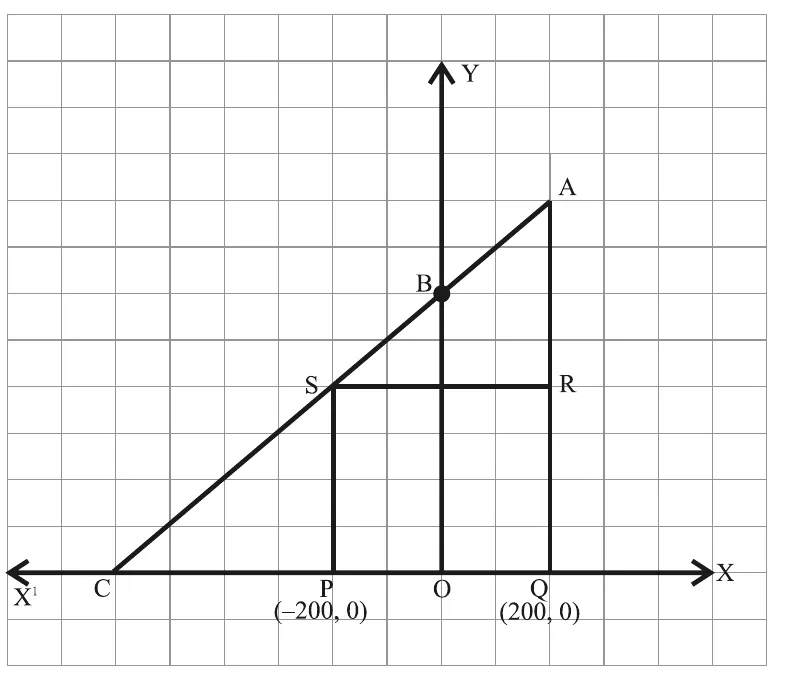
Case study 2. Jagdish has a field which is in the shape of a right angled triangle AQC. He wants to leave a space in the form of a square PQRS inside the field for growing wheat and the remaining for growing vegetables (as shown in the figure). In the field, there is a pole marked as O.

Based on the above information, answer the following questions:

(i) Taking O as origin, coordinates of P are (−200, 0) and of Q are (200, 0). PQRS being a square, what are the coordinates of R and S? [1]

(ii) (a) What is the area of square PQRS? [2]

OR

(ii) (b) What is the length of diagonal PR in square PQRS? [2]

(iii) If S divides CA in the ratio K : 1, what is the value of K, where point A is (200, 800)? [1]

A right triangle AQC drawn on a grid with the right angle at Q. The origin O is the pole. The square PQRS stands inside the triangle with P at (−200, 0) and Q at (200, 0), R above Q and S above P, on the sloping side CA.
Solution
-700-600-500-400-300-200-100100200300-100100200300400500600700800900OxyP(−200, 0)Q(200, 0)R(200, 400)S(−200, 400)A(200, 800)C(−600, 0)
  1. (i) PQ=400PQ = 400 and PQRSPQRS is a square, so QR=SP=400QR = SP = 400. R=(200,400)R = (200, 400) and S=(−200,400)S = (-200, 400).
  2. (ii)(a) Area =400×400=160000= 400 \times 400 = 160000 square units.
  3. (ii)(b) Diagonal PR=4002+4002=4002PR = \sqrt{400^2 + 400^2} = 400\sqrt{2} units.
  4. (iii) CC is on the xx-axis and on the line through A(200,800)A(200, 800) and S(−200,400)S(-200, 400), which has slope 11: C=(−600,0)C = (-600, 0). SS divides CACA in K:1K : 1: xS=200K−600K+1=−200x_S = \dfrac{200K - 600}{K + 1} = -200, so 200K−600=−200K−200200K - 600 = -200K - 200 and K=1K = 1.

Answer: (i) R(200,400), S(−200,400)R(200, 400),\ S(-200, 400)   (ii)(a) 160000160000   (ii)(b) 4002400\sqrt{2}   (iii) K=1K = 1

Report an error on this question
Q38Areas Related to Circles4 marks

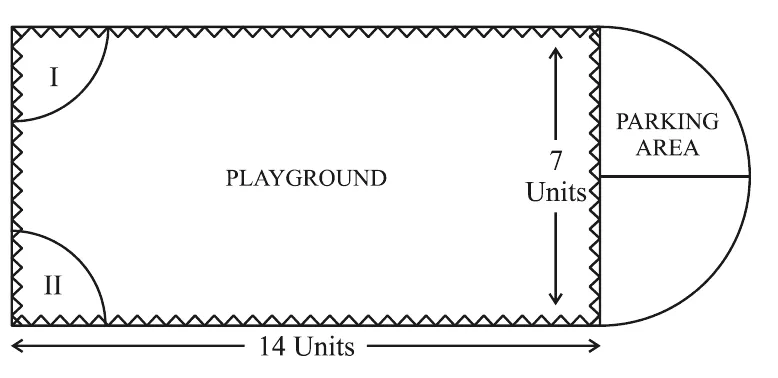
Case study 3. Governing council of a local public development authority of Dehradun decided to build an adventurous playground on the top of a hill, which will have adequate space for parking. After survey, it was decided to build rectangular playground, with a semi-circular area allotted for parking at one end of the playground. The length and breadth of the rectangular playground are 14 units and 7 units, respectively. There are two quadrants of radius 2 units on one side for special seats.

Based on the above information, answer the following questions:

(i) What is the total perimeter of the parking area? [1]

(ii) (a) What is the total area of parking and the two quadrants? [2]

OR

(ii) (b) What is the ratio of area of playground to the area of parking area? [2]

(iii) Find the cost of fencing the playground and parking area at the rate of ₹ 2 per unit. [1]

A rectangular playground 14 units long and 7 units wide with a semicircular parking area on its right side. Two quadrants of radius 2 units are marked at the left corners for special seats.
Solution
ABCDplayground 14 × 7parking14 unitsparking: perimeter 18, area 77/4; quadrants 2 × ¼π2² = 44/7
  1. The parking is a semicircle on the 77-unit side, so its radius is r=3.5r = 3.5 units.
  2. (i) Perimeter of the parking area =πr+2r=227×72+7=11+7=18= \pi r + 2r = \dfrac{22}{7} \times \dfrac{7}{2} + 7 = 11 + 7 = 18 units.
  3. (ii)(a) Parking area =12πr2=12×227×72×72=774= \dfrac{1}{2}\pi r^2 = \dfrac{1}{2} \times \dfrac{22}{7} \times \dfrac{7}{2} \times \dfrac{7}{2} = \dfrac{77}{4}. Two quadrants of radius 22: 2×14×227×4=4472 \times \dfrac{1}{4} \times \dfrac{22}{7} \times 4 = \dfrac{44}{7}. Total =774+447=71528≈25.54= \dfrac{77}{4} + \dfrac{44}{7} = \dfrac{715}{28} \approx 25.54 square units.
  4. (ii)(b) Playground area =14×7=98= 14 \times 7 = 98. Ratio =98:774=98×477=5611= 98 : \dfrac{77}{4} = \dfrac{98 \times 4}{77} = \dfrac{56}{11}, that is 56:1156 : 11.
  5. (iii) CBSE's key takes the length of fencing as 2(14+7)+πr=42+11=532(14 + 7) + \pi r = 42 + 11 = 53 units. Cost =53×2=₹106= 53 \times 2 = ₹106.

Answer: (i) 1818 units   (ii)(a) 71528≈25.54\dfrac{715}{28} \approx 25.54 square units   (ii)(b) 56:1156 : 11   (iii) ₹ 106106

Common mistake: In (i), giving only the curved part (11 units). The perimeter of the parking area includes the diameter edge of 7 units.

Report an error on this question

Questions are from the official CBSE paper. Figures are described in words; see the PDF for the originals. Solutions are written by CogniGuru.

Revise this paper in 1 minute a chapter

Each chapter below is what the paper tested, with a one-minute animated lesson on the idea behind it.

Stuck on a step in any solution?

The CogniGuru AI tutor explains any doubt one minute at a time, in English or Hindi. Join the waitlist.

Mock quiz: 5 questions from this paper

Five real questions from this paper, one each from five chapters. About 2 minutes. See how much you know and where you stand among other students. Attempt free, with no login; log in only for your ranking and full report.

Question 1 of 5 · Q1 of the paperReal Numbers

The ratio of HCF to LCM of the least composite number and the least prime number is:

0 of 5 answered

Related papers

  • Maths Standard 2022Coming soon
  • Maths Standard 2024
  • Maths Basic 2023Coming soon
  • Science 2023Coming soon

Common questions

Are these the official CBSE Class 10 Maths Standard 2023 questions?
Yes. The questions are from the official Mathematics (Standard) paper (set 30/4/1) that CBSE published after the March 2023 board exam. The solutions are written by CogniGuru and checked against the answer key CBSE published for this paper code.
Can I download the CBSE Class 10 Maths Standard 2023 question paper PDF?
Yes, the official paper PDF is free to download from this page, and so are our step-by-step solutions as a PDF. No login is needed to download either or to read the solutions.
Do all sets of the paper have the same questions?
No. CBSE sets several versions of each paper, with the same blueprint and similar questions in a different order and sometimes with different numbers. This page covers set 30/4/1.
How does the quiz work, and what does “where you stand” mean?
It is a mock quiz of 5 real multiple-choice questions from this paper, scored automatically in about 2 minutes. Your score is compared, anonymously, with other students who took the same quiz. Only the score is stored with the comparison, never your name or number.

Source

CBSE question paper archive, Class X, 2023 (Mathematics (Standard), set 30/4/1)
PDF