CBSE Class 10 Maths Standard 2023 Question Paper (Set 30/5/1) with Solutions
The official board paper (Q.P. Code 30/5/1, Series WX1YZ/5). Free paper PDF and step-by-step solutions (also as a PDF to download) written by CogniGuru and checked against CBSE’s answer key. See the paper’s main topics in 1 minute, then quiz yourself to see how much you know and where you stand.
No login to download or read the solutions. Login only to see your quiz report in full.
Board
CBSE
Class
10
Subject
Maths Standard (041)
Year
2023
Set code
30/5/1
Max marks
80
Duration
3 hours
Questions
38 (Sections A to E)
Source
Official CBSE paper
Exam date
March 2023
Paper preview
Three pages of the official paper. Download the PDF for all 27.
Cover page
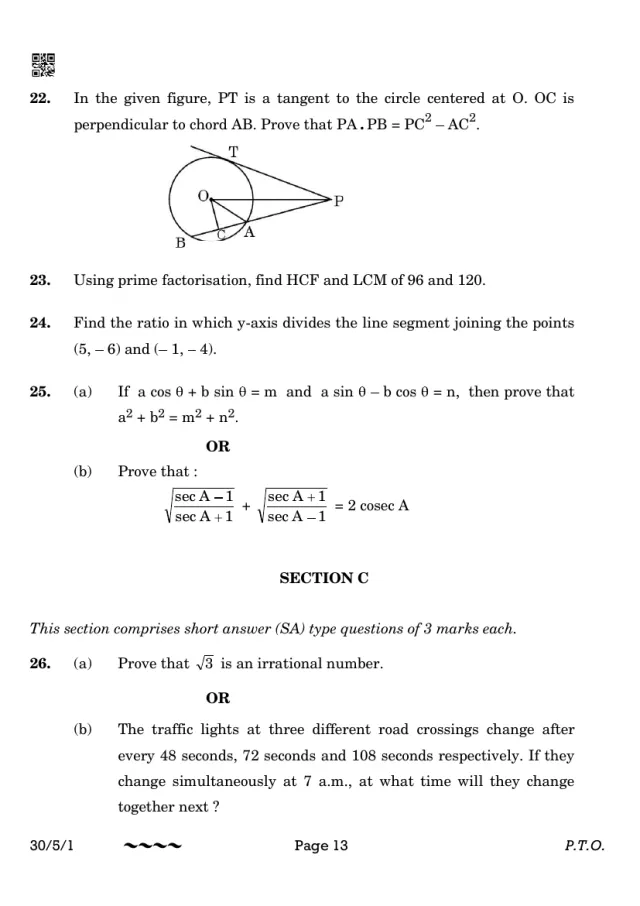
Section B
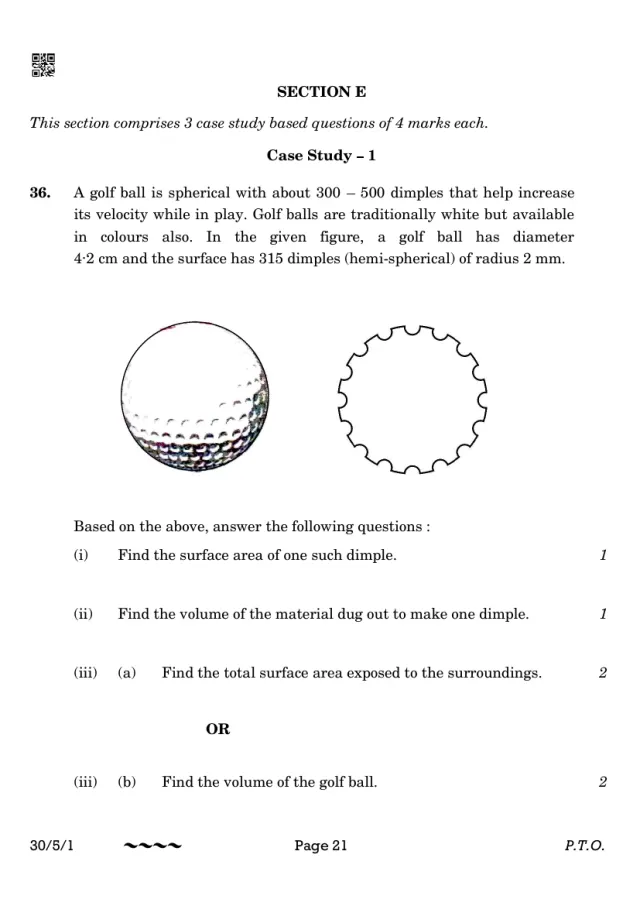
Case study
The main topics of this paper, in 1 minute
Your tutor walks you through the paper before you attempt it: the marks, the key ideas, the time plan and the traps.
1-minute paper analysis
With your tutor, in her voice
The main topics of this paper, in about a minute
A short, animated walk through the paper: how it is built, where the marks come from, the four ideas that matter most, how to plan your three hours, and the traps to avoid.
1The paper at a glance
2Where the marks come from
3Four ideas that keep paying off
4Plan your three hours
5Four traps to avoid
Sound on for the voice. Captions are shown, and you can mute any time.
Step-by-step solutions
Try each question first, then open its solution. Tap a number to jump.
(b) The traffic lights at three different road crossings change after every 48 seconds, 72 seconds and 108 seconds respectively. If they change simultaneously at 7 a.m., at what time will they change together next?
Solution
(a) Suppose 3=qp with p,q co-prime and q=0. Then 3q2=p2, so 3 divides p. Write p=3a.
9a2=3q2, so q2=3a2 and 3 divides q. Now 3 divides both p and q, contradicting that they are co-prime. So 3 is irrational.
(b) They change together again after the LCM of 48,72,108. 48=24×3, 72=23×32, 108=22×33. LCM =24×33=432 seconds.
432 seconds =7 minutes 12 seconds. They next change together at 7:07:12 a.m.
Two people are 16 km apart on a straight road. They start walking at the same time. If they walk towards each other with different speeds, they will meet in 2 hours. Had they walked in the same direction with same speeds as before, they would have met in 8 hours. Find their walking speeds.
Solution
Let the speeds be x km/h and y km/h with x>y.
Towards each other: they cover the 16 km together in 2 h: 2x+2y=16, so x+y=8. … (i)
In the same direction: the faster one gains 16 km in 8 h: 8x−8y=16, so x−y=2. … (ii)
One observer estimates the angle of elevation to the basket of a hot air balloon to be 60∘, while another observer 100 m away estimates the angle of elevation to be 30∘. Find: (a) The height of the basket from the ground. (b) The distance of the basket from the first observer's eye. (c) The horizontal distance of the second observer from the basket.
Solution
Take both observers on the same side of the basket. Let the first (nearer) observer be at horizontal distance x from the point below the basket, and the height be h.
tan60∘=xh, so h=3x. … (i) tan30∘=x+100h, so x+100=3h. … (ii)
Put (i) in (ii): x+100=3×3x=3x, so x=50 m and h=503 m.
(a) Height of the basket =503 m ≈86.6 m.
(b) sin60∘=yh, so y=3/2503=100 m.
(c) Horizontal distance of the second observer =x+100=150 m.
Answer: (a) 503 m (b) 100 m (c) 150 m
Common mistake: CBSE also accepts the case where the observers are on opposite sides of the basket (h=253 m, 75 m from the second observer). The nearer-observer figure above is the standard one.
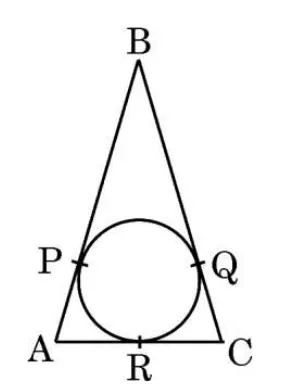
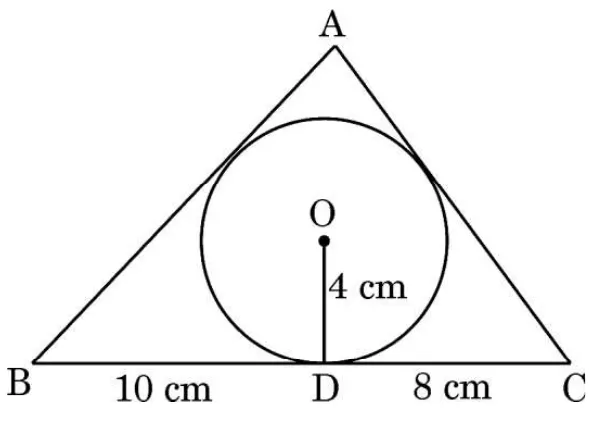
(a) A triangle ABC is drawn to circumscribe a circle of radius 4 cm such that the segments BD and DC are of lengths 10 cm and 8 cm respectively. Find the lengths of the sides AB and AC, if it is given that area △ABC=90 cm².
OR
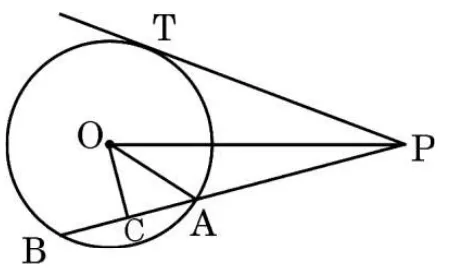
(b) Two circles with centres O and O′ of radii 6 cm and 8 cm, respectively intersect at two points P and Q such that OP and O′P are tangents to the two circles. Find the length of the common chord PQ.
Solution
Sketch, not to scale.
(a) Let the circle touch AB at F and AC at E. Tangents from a point are equal: BF=BD=10, CE=CD=8, and AF=AE=x.
The sides are BC=18, AB=10+x, AC=8+x. The area is the sum of the areas of △OBC, △OCA, △OAB (each with height 4): 90=21×4×(BC+CA+AB)=2(18+8+x+10+x).
45=36+2x, so x=4.5. AB=14.5 cm and AC=12.5 cm.
(b) OP⊥O′P (tangents), so in the right triangle OPO′: OO′=62+82=10 cm.
The common chord PQ is perpendicular to OO′ at A and is bisected there. Let OA=x, so O′A=10−x. AP2=36−x2 and AP2=64−(10−x)2.
36−x2=64−100+20x−x2, so 20x=72 and x=3.6. AP2=36−12.96=23.04, so AP=4.8 cm and PQ=2×4.8=9.6 cm.
(a) A train travels at a certain average speed for a distance of 54 km and then travels a distance of 63 km at an average speed of 6 km/h more than the first speed. If it takes 3 hours to complete the journey, what was its first average speed?
OR
(b) Two pipes together can fill a tank in 815 hours. The pipe with larger diameter takes 2 hours less than the pipe with smaller diameter to fill the tank separately. Find the time in which each pipe can fill the tank separately.
Solution
(a) Let the first speed be x km/h. x54+x+663=3.
54(x+6)+63x=3x(x+6), so 117x+324=3x2+18x and x2−33x−108=0.
(x−36)(x+3)=0. Speed is positive, so x=36 km/h.
(b) Let the smaller pipe take x hours and the larger (x−2) hours. x−21+x1=158.
15(2x−2)=8x(x−2), so 8x2−46x+30=0, that is 4x2−23x+15=0 and (4x−3)(x−5)=0.
x=43 is rejected because x−2 would be negative. So x=5: the smaller pipe takes 5 hours and the larger takes 3 hours.
A horse is tied to a peg at one corner of a square shaped grass field of side 15 m by means of a 5 m long rope. Find the area of that part of the field in which the horse can graze. Also, find the increase in grazing area if length of the rope is increased to 10 m. (Use π=3.14)
Solution
At a corner the horse can graze a quarter circle, since the field covers a 90∘ angle there.
With the 5 m rope: 41×3.14×52=19.625 m².
With the 10 m rope (still less than the side 15 m): 41×3.14×102=78.5 m².
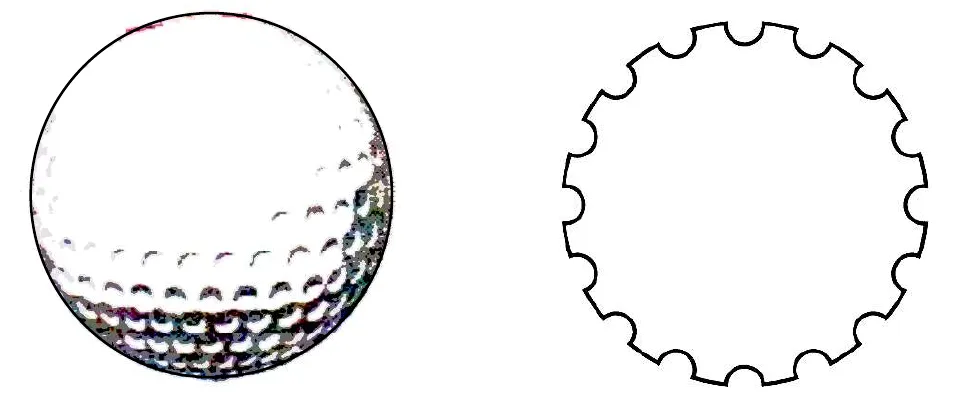
Case study 1. A golf ball is spherical with about 300 – 500 dimples that help increase its velocity while in play. Golf balls are traditionally white but available in colours also. In the given figure, a golf ball has diameter 4.2 cm and the surface has 315 dimples (hemi-spherical) of radius 2 mm.
Based on the above, answer the following questions:
(i) Find the surface area of one such dimple. [1]
(ii) Find the volume of the material dug out to make one dimple. [1]
(iii) (a) Find the total surface area exposed to the surroundings. [2]
OR
(iii) (b) Find the volume of the golf ball. [2]
Solution
All lengths in mm: ball radius R=21 mm and dimple radius r=2 mm.
(i) Curved surface of one dimple =2πr2=2×722×4=7176≈25.1 mm².
(ii) Volume dug out =32πr3=32×722×8=21352≈16.76 mm³.
(iii)(a) Each dimple takes away a flat circle πr2 of the sphere and adds a curved surface 2πr2. Exposed area =4πR2−315πr2+315×2πr2=4πR2+315πr2=5544+3960=9504 mm².
(iii)(b) Volume of the ball =34πR3−315×32πr3=38808−5280=33528 mm³.
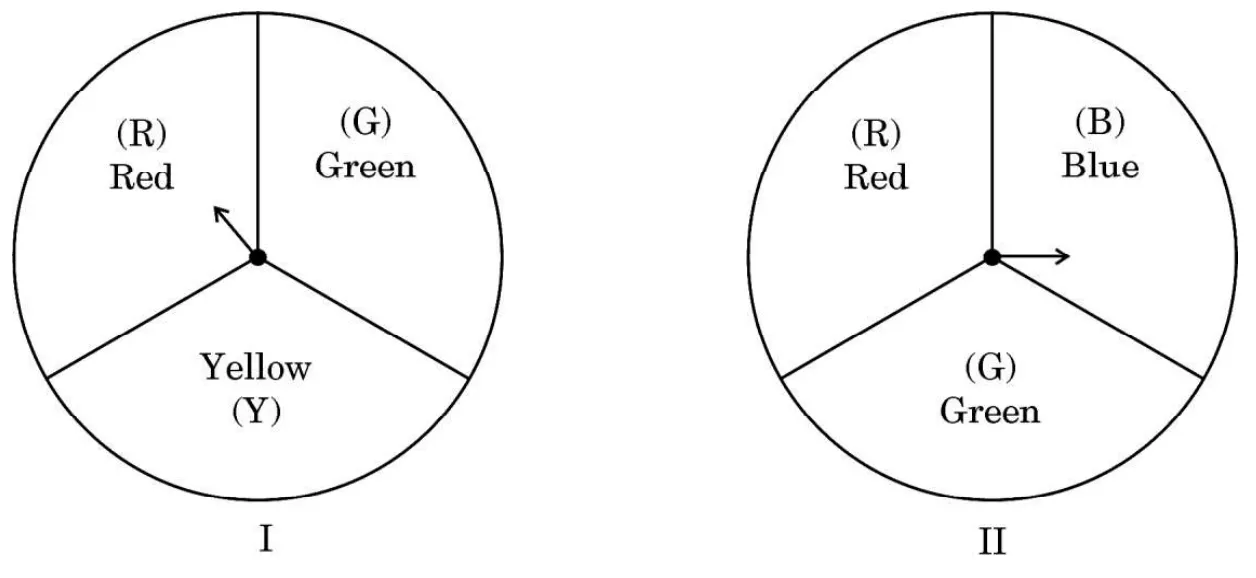
Case study 2. A middle school decided to run the following spinner game as a fund-raiser on Christmas Carnival. Spinner I has three equal sectors Red (R), Green (G) and Yellow (Y); spinner II has three equal sectors Red (R), Blue (B) and Green (G).
Making Purple: Spin each spinner once. Blue and red make purple. So, if one spinner shows Red (R) and another Blue (B), then you ‘win’. One such outcome is written as ‘RB’.
Based on the above, answer the following questions:
(i) List all possible outcomes of the game. [1]
(ii) Find the probability of ‘Making Purple’. [1]
(iii) (a) For each win, a participant gets ₹ 10, but if he/she loses, he/she has to pay ₹ 5 to the school. If 99 participants played, calculate how much fund could the school have collected. [2]
OR
(iii) (b) If the same amount of ₹ 5 has been decided for winning or losing the game, then how much fund had been collected by school? (Number of participants = 99) [2]
Solution
(i) First spinner: R,G,Y. Second spinner: R,B,G. All outcomes (first, second): RR,RB,RG,GR,GB,GG,YR,YB,YG — 9 outcomes.
(ii) Only RB is red and blue, so P(purple)=91.
(iii)(a) Wins =91×99=11 and losses =99−11=88. The school pays ₹10 for each win and receives ₹5 for each loss: 88×5−11×10=440−110=₹330.
(iii)(b) If the amount is ₹5 both ways: 88×5−11×5=440−55=₹385.
Case study 3. In a pool at an aquarium, a dolphin jumps out of the water travelling at 20 cm per second. Its height above water level after t seconds is given by h = 20t − 16t².
Based on the above, answer the following questions:
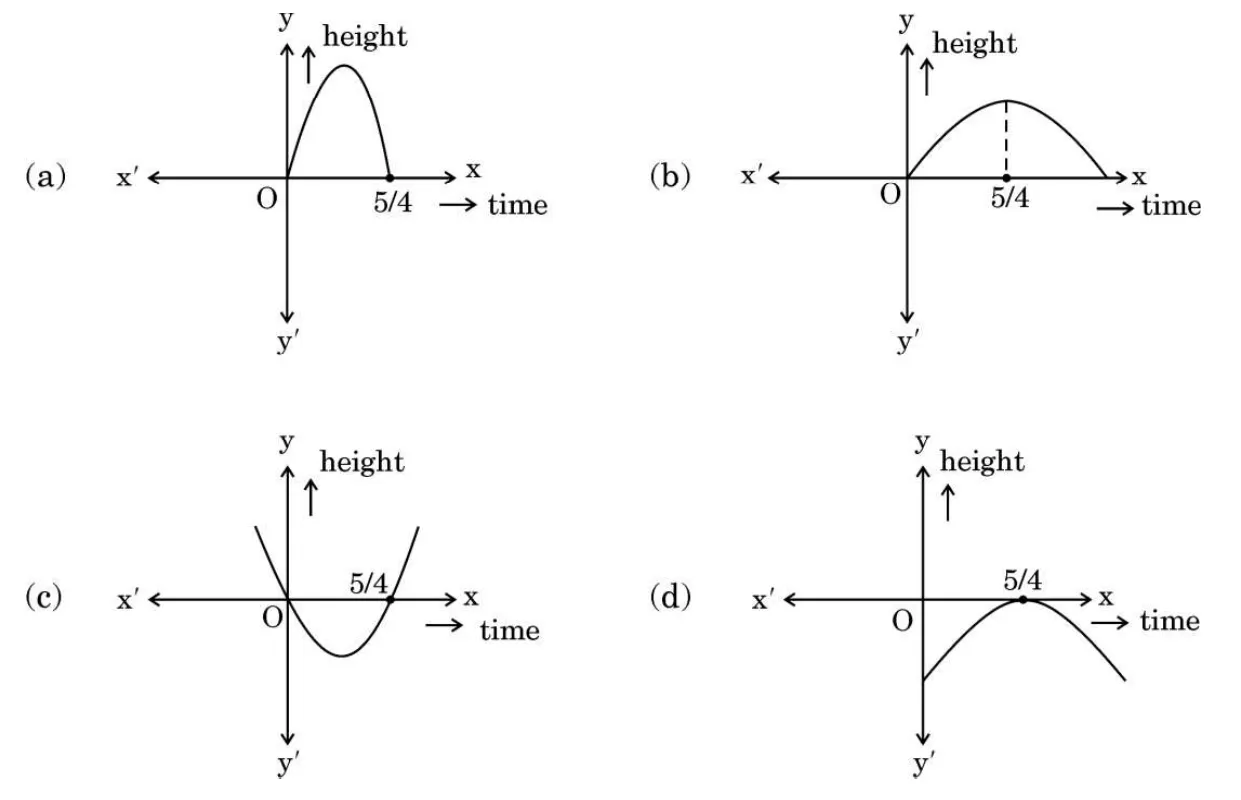
(ii) Which of the following types of graph represents p(t)? [1]
(iii) (a) What would be the value of h at t = 3/2? Interpret the result. [2]
OR
(iii) (b) How much distance has the dolphin covered before hitting the water level again? [2]
Solution
(i) 20t−16t2=4t(5−4t)=0, so t=0 or t=45.
(ii) The coefficient of t2 is negative, so the graph opens downwards (an arch), and it meets the t-axis at 0 and 45. That is graph (a).
(iii)(a) At t=23: h=20×23−16×49=30−36=−6 cm. The negative height means that after 23 s the dolphin is 6 cm below the water level (it came back into the water at t=45).
(iii)(b) The dolphin travels at 20 cm per second and is out of the water for 45 s, so the distance is 20×45=25 cm.
Answer: (i) 0 and 45 (ii) graph (a) (iii)(a) h=−6 cm: 6 cm below water (iii)(b) 25 cm
The CogniGuru AI tutor explains any doubt one minute at a time, in English or Hindi. Join the waitlist.
Mock quiz: 5 questions from this paper
Five real questions from this paper, one each from five chapters. About 2 minutes. See how much you know and where you stand among other students. Attempt free, with no login; log in only for your ranking and full report.
Question 1 of 5 · Q2 of the paperLinear Equations
The pair of equations ax+2y=9 and 3x+by=18 represent parallel lines, where a,b are integers, if:
Are these the official CBSE Class 10 Maths Standard 2023 questions?
Yes. The questions are from the official Mathematics (Standard) paper (set 30/5/1) that CBSE published after the March 2023 board exam. The solutions are written by CogniGuru and checked against the answer key CBSE published for this paper code.
Can I download the CBSE Class 10 Maths Standard 2023 question paper PDF?
Yes, the official paper PDF is free to download from this page, and so are our step-by-step solutions as a PDF. No login is needed to download either or to read the solutions.
Do all sets of the paper have the same questions?
No. CBSE sets several versions of each paper, with the same blueprint and similar questions in a different order and sometimes with different numbers. This page covers set 30/5/1.
How does the quiz work, and what does “where you stand” mean?
It is a mock quiz of 5 real multiple-choice questions from this paper, scored automatically in about 2 minutes. Your score is compared, anonymously, with other students who took the same quiz. Only the score is stored with the comparison, never your name or number.