CBSE · Class 10 · Mathematics (Standard) · Free

CBSE Class 10 Maths Standard 2023 Question Paper (Set 30/6/1) with Solutions

The official board paper (Q.P. Code 30/6/1, Series WX1YZ/6). Free paper PDF and step-by-step solutions (also as a PDF to download) written by CogniGuru and checked against CBSE’s answer key. See the paper’s main topics in 1 minute, then quiz yourself to see how much you know and where you stand.

No login to download or read the solutions. Login only to see your quiz report in full.

Board
CBSE
Class
10
Subject
Maths Standard (041)
Year
2023
Set code
30/6/1
Max marks
80
Duration
3 hours
Questions
38 (Sections A to E)
Source
Official CBSE paper
Exam date
March 2023

Paper preview

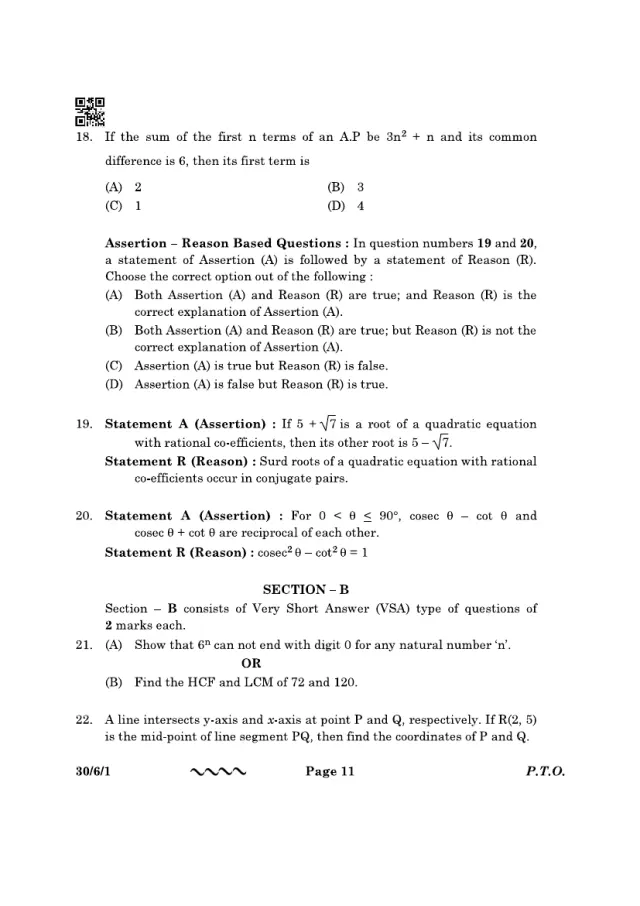
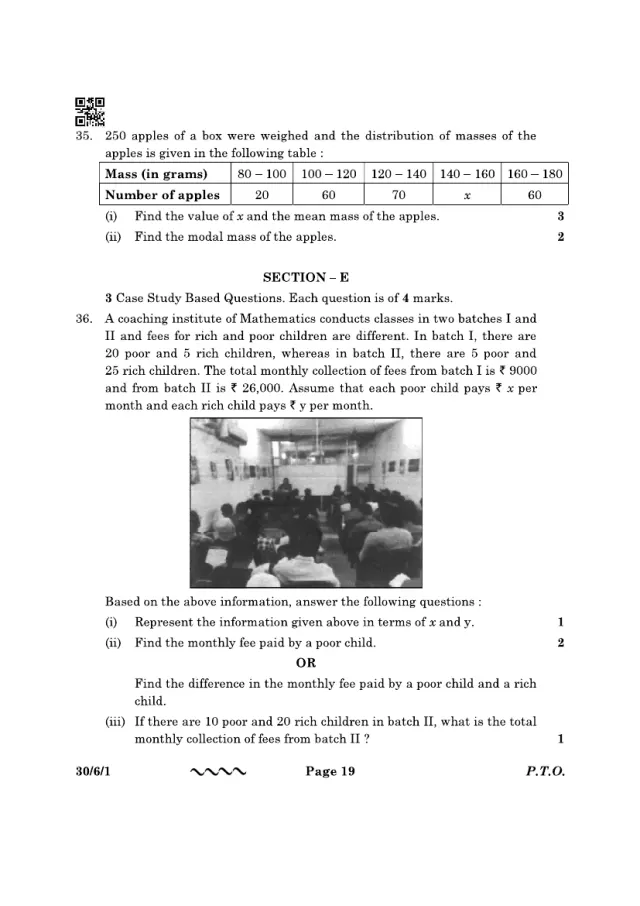
Three pages of the official paper. Download the PDF for all 24.

  • Cover page of the CBSE Class 10 Maths Standard 2023 paper, set 30/6/1

    Cover page

  • Section B of the CBSE Class 10 Maths Standard 2023 paper, set 30/6/1

    Section B

  • A case study with its figure from the CBSE Class 10 Maths Standard 2023 paper, set 30/6/1

    Case study

The main topics of this paper, in 1 minute

Your tutor walks you through the paper before you attempt it: the marks, the key ideas, the time plan and the traps.

1-minute paper analysis

With your tutor, in her voice

The main topics of this paper, in about a minute

A short, animated walk through the paper: how it is built, where the marks come from, the four ideas that matter most, how to plan your three hours, and the traps to avoid.

  1. 1The paper at a glance
  2. 2Where the marks come from
  3. 3Four ideas that keep paying off
  4. 4Plan your three hours
  5. 5Four traps to avoid

Sound on for the voice. Captions are shown, and you can mute any time.

Step-by-step solutions

Try each question first, then open its solution. Tap a number to jump.

Download solutions (PDF)

Section A: Multiple choice

20 questions, 1 mark each. MCQs (Q1 to Q18) and assertion-reason (Q19, Q20).

Q1Real Numbers1 mark

If p2=3250p^2 = \dfrac{32}{50}, then pp is a/an:

  1. (A)whole number
  2. (B)integer
  3. (C)rational number
  4. (D)irrational number
Solution · answer (C)
  1. p2=3250=1625p^2 = \dfrac{32}{50} = \dfrac{16}{25}, so p=45p = \dfrac{4}{5} (or −45-\dfrac{4}{5}), which is a ratio of two integers: a rational number.

Answer: (C) rational number

Report an error on this question
Q2Coordinate Geometry1 mark

The distance of the point (−6,8)(-6, 8) from the xx-axis is:

  1. (A)6 units
  2. (B)−6 units
  3. (C)8 units
  4. (D)10 units
Solution · answer (C)
  1. The distance from the xx-axis is the absolute value of the yy-coordinate: ∣8∣=8|8| = 8 units. (The 66 would be the distance from the yy-axis.)

Answer: (C) 8 units

Report an error on this question
Q3Polynomials1 mark

The number of quadratic polynomials having zeroes −5-5 and −3-3 is:

  1. (A)1
  2. (B)2
  3. (C)3
  4. (D)more than 3
Solution · answer (D)
  1. k(x+5)(x+3)k(x + 5)(x + 3) has the zeroes −5-5 and −3-3 for every non-zero constant kk, so there are infinitely many such polynomials.

Answer: (D) more than 3

Report an error on this question
Q4Linear Equations1 mark

The point of intersection of the line represented by 3x−y=33x - y = 3 and yy-axis is given by:

  1. (A)(0,−3)(0, -3)
  2. (B)(0,3)(0, 3)
  3. (C)(2,0)(2, 0)
  4. (D)(−2,0)(-2, 0)
Solution · answer (A)
  1. On the yy-axis x=0x = 0, so −y=3-y = 3 and y=−3y = -3. The point is (0,−3)(0, -3).

Answer: (A) (0,−3)(0, -3)

Report an error on this question
Q5Areas Related to Circles1 mark

The circumferences of two circles are in the ratio 4 : 5. What is the ratio of their radii?

  1. (A)16 : 25
  2. (B)25 : 16
  3. (C)2:52 : \sqrt{5}
  4. (D)4 : 5
Solution · answer (D)
  1. Circumference =2πr= 2\pi r is proportional to rr, so the radii are in the same ratio, 4:54 : 5. (The areas would be in the ratio 16:2516 : 25.)

Answer: (D) 4 : 5

Report an error on this question
Q6Polynomials1 mark

If α\alpha and β\beta are the zeroes of the polynomial x2−1x^2 - 1, then the value of (α+β)(\alpha + \beta) is:

  1. (A)2
  2. (B)1
  3. (C)−1
  4. (D)0
Solution · answer (D)
  1. x2−1=(x−1)(x+1)x^2 - 1 = (x - 1)(x + 1), so the zeroes are 11 and −1-1 and α+β=0\alpha + \beta = 0. (Also, the sum of zeroes is −ba=0-\dfrac{b}{a} = 0.)

Answer: (D) 0

Report an error on this question
Q7Trigonometry1 mark

cos⁡2θsin⁡2θ−1sin⁡2θ\dfrac{\cos^2\theta}{\sin^2\theta} - \dfrac{1}{\sin^2\theta}, in simplified form, is:

  1. (A)tan⁡2θ\tan^2\theta
  2. (B)sec⁡2θ\sec^2\theta
  3. (C)1
  4. (D)−1
Solution · answer (D)
  1. cos⁡2θ−1sin⁡2θ=−sin⁡2θsin⁡2θ=−1\dfrac{\cos^2\theta - 1}{\sin^2\theta} = \dfrac{-\sin^2\theta}{\sin^2\theta} = -1.

Answer: (D) −1

Report an error on this question
Q8Triangles1 mark

If △PQR∼△ABC\triangle PQR \sim \triangle ABC; PQ=6PQ = 6 cm, AB=8AB = 8 cm and the perimeter of △ABC\triangle ABC is 3636 cm, then the perimeter of △PQR\triangle PQR is:

  1. (A)20.25 cm
  2. (B)27 cm
  3. (C)48 cm
  4. (D)64 cm
Solution · answer (B)
  1. The perimeters of similar triangles are in the ratio of the corresponding sides: perimeter PQRperimeter ABC=PQAB=68\dfrac{\text{perimeter } PQR}{\text{perimeter } ABC} = \dfrac{PQ}{AB} = \dfrac{6}{8}.
  2. Perimeter of △PQR=36×34=27\triangle PQR = 36 \times \dfrac{3}{4} = 27 cm.

Answer: (B) 27 cm

Report an error on this question
Q9Quadratic Equations1 mark

If the quadratic equation ax2+bx+c=0ax^2 + bx + c = 0 has two real and equal roots, then cc is equal to:

  1. (A)−b2a\dfrac{-b}{2a}
  2. (B)b2a\dfrac{b}{2a}
  3. (C)−b24a\dfrac{-b^2}{4a}
  4. (D)b24a\dfrac{b^2}{4a}
Solution · answer (D)
  1. Equal roots need the discriminant to be zero: b2−4ac=0b^2 - 4ac = 0, so c=b24ac = \dfrac{b^2}{4a}.

Answer: (D) b24a\dfrac{b^2}{4a}

Report an error on this question
Q10Triangles1 mark

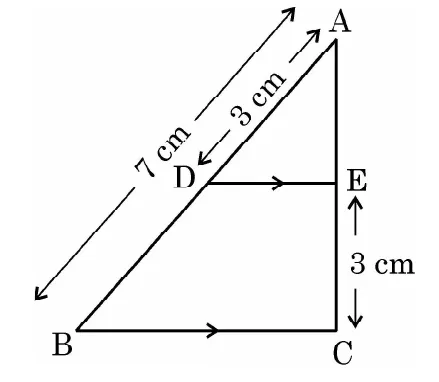
In the given figure, DE∥BCDE \parallel BC. If AD=3AD = 3 cm, AB=7AB = 7 cm and EC=3EC = 3 cm, then the length of AEAE is:

A right triangle ABC with the right angle at C, A at the top. DE is drawn parallel to BC with D on AB and E on AC. AD is 3 cm, AB is 7 cm and EC is 3 cm.
  1. (A)2 cm
  2. (B)2.25 cm
  3. (C)3.5 cm
  4. (D)4 cm
Solution · answer (B)
3432.25ABCDEAE/EC = AD/DB = 3/4 → AE = 3 × ¾ = 2.25 cm
  1. DB=AB−AD=7−3=4DB = AB - AD = 7 - 3 = 4 cm. By the basic proportionality theorem (DE∥BCDE \parallel BC): AEEC=ADDB=34\dfrac{AE}{EC} = \dfrac{AD}{DB} = \dfrac{3}{4}.
  2. AE=3×34=2.25AE = 3 \times \dfrac{3}{4} = 2.25 cm.

Answer: (B) 2.25 cm

Report an error on this question
Q11Probability1 mark

A bag contains 5 pink, 8 blue and 7 yellow balls. One ball is drawn at random from the bag. What is the probability of getting neither a blue nor a pink ball?

  1. (A)14\dfrac{1}{4}
  2. (B)25\dfrac{2}{5}
  3. (C)720\dfrac{7}{20}
  4. (D)1320\dfrac{13}{20}
Solution · answer (C)
  1. Total =5+8+7=20= 5 + 8 + 7 = 20 balls. "Neither blue nor pink" means yellow: P=720P = \dfrac{7}{20}.

Answer: (C) 720\dfrac{7}{20}

Report an error on this question
Q12Surface Areas and Volumes1 mark

The volume of a right circular cone whose area of the base is 156156 cm² and the vertical height is 88 cm, is:

  1. (A)24962496 cm³
  2. (B)12481248 cm³
  3. (C)16641664 cm³
  4. (D)416416 cm³
Solution · answer (D)
  1. V=13×(base area)×h=13×156×8=52×8=416V = \dfrac{1}{3} \times (\text{base area}) \times h = \dfrac{1}{3} \times 156 \times 8 = 52 \times 8 = 416 cm³.

Answer: (D) 416416 cm³

Report an error on this question
Q13Linear Equations1 mark

33 chairs and 11 table cost ₹ 900900; whereas 55 chairs and 33 tables cost ₹ 2,1002{,}100. If the cost of 11 chair is ₹ xx and the cost of 11 table is ₹ yy, then the situation can be represented algebraically as:

  1. (A)3x+y=900, 3x+5y=21003x + y = 900,\ 3x + 5y = 2100
  2. (B)x+3y=900, 3x+5y=2100x + 3y = 900,\ 3x + 5y = 2100
  3. (C)3x+y=900, 5x+3y=21003x + y = 900,\ 5x + 3y = 2100
  4. (D)x+3y=900, 5x+3y=2100x + 3y = 900,\ 5x + 3y = 2100
Solution · answer (C)
  1. 33 chairs cost 3x3x and 11 table costs yy: 3x+y=9003x + y = 900.
  2. 55 chairs cost 5x5x and 33 tables cost 3y3y: 5x+3y=21005x + 3y = 2100.

Answer: (C) 3x+y=900, 5x+3y=21003x + y = 900,\ 5x + 3y = 2100

Report an error on this question
Q14Circles1 mark

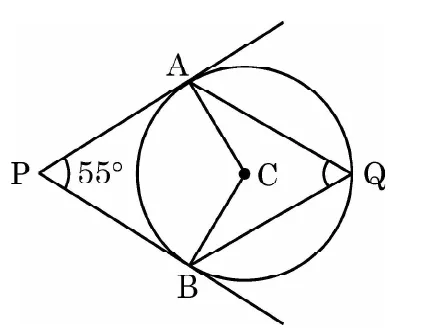
In the given figure, PAPA and PBPB are tangents from external point PP to a circle with centre CC and QQ is any point on the circle. Then the measure of ∠AQB\angle AQB is:

A circle with centre C. Tangents PA and PB from the outside point P on the left touch the circle at A (top) and B (bottom). The angle at P is marked 55 degrees. Q is a point on the circle on the right, joined to A and B.
  1. (A)6212∘62\tfrac{1}{2}^\circ
  2. (B)125∘125^\circ
  3. (C)55∘55^\circ
  4. (D)90∘90^\circ
Solution · answer (A)
55°125°OPABQ62.5°∠AOB = 180° − 55° = 125°; ∠AQB = ½ × 125° = 62.5°
  1. The radii CACA and CBCB are perpendicular to the tangents, so in the quadrilateral PACBPACB: ∠ACB=360∘−90∘−90∘−55∘=125∘\angle ACB = 360^\circ - 90^\circ - 90^\circ - 55^\circ = 125^\circ.
  2. The angle at the centre is twice the angle at the circle on the same arc: ∠AQB=125∘2=6212∘\angle AQB = \dfrac{125^\circ}{2} = 62\tfrac{1}{2}^\circ.

Answer: (A) 6212∘62\tfrac{1}{2}^\circ

Common mistake: Choosing 125° (the angle at the centre) or 55° (the angle at P) instead of half the central angle.

Report an error on this question
Q15Probability1 mark

A card is drawn at random from a well shuffled deck of 52 playing cards. The probability of getting a face card is:

  1. (A)12\dfrac{1}{2}
  2. (B)313\dfrac{3}{13}
  3. (C)413\dfrac{4}{13}
  4. (D)113\dfrac{1}{13}
Solution · answer (B)
  1. A deck has 33 face cards (J, Q, K) in each of 44 suits: 1212 cards. P=1252=313P = \dfrac{12}{52} = \dfrac{3}{13}.

Answer: (B) 313\dfrac{3}{13}

Report an error on this question
Q16Trigonometry1 mark

If θ\theta is an acute angle of a right angled triangle, then which of the following equations is **not** true?

  1. (A)sin⁡θcot⁡θ=cos⁡θ\sin\theta\cot\theta = \cos\theta
  2. (B)cos⁡θtan⁡θ=sin⁡θ\cos\theta\tan\theta = \sin\theta
  3. (C)cosec⁡2θ−cot⁡2θ=1\operatorname{cosec}^2\theta - \cot^2\theta = 1
  4. (D)tan⁡2θ−sec⁡2θ=1\tan^2\theta - \sec^2\theta = 1
Solution · answer (D)
  1. (A) sin⁡θ⋅cos⁡θsin⁡θ=cos⁡θ\sin\theta \cdot \dfrac{\cos\theta}{\sin\theta} = \cos\theta ✓. (B) cos⁡θ⋅sin⁡θcos⁡θ=sin⁡θ\cos\theta \cdot \dfrac{\sin\theta}{\cos\theta} = \sin\theta ✓. (C) is a standard identity ✓.
  2. (D) The identity is sec⁡2θ−tan⁡2θ=1\sec^2\theta - \tan^2\theta = 1, so tan⁡2θ−sec⁡2θ=−1\tan^2\theta - \sec^2\theta = -1, not 11. This one is not true.

Answer: (D) tan⁡2θ−sec⁡2θ=1\tan^2\theta - \sec^2\theta = 1

Report an error on this question
Q17Polynomials1 mark

If the zeroes of the quadratic polynomial x2+(a+1)x+bx^2 + (a + 1)x + b are 22 and −3-3, then:

  1. (A)a=−7, b=−1a = -7,\ b = -1
  2. (B)a=5, b=−1a = 5,\ b = -1
  3. (C)a=2, b=−6a = 2,\ b = -6
  4. (D)a=0, b=−6a = 0,\ b = -6
Solution · answer (D)
  1. Sum of zeroes =−(a+1)=2+(−3)=−1= -(a + 1) = 2 + (-3) = -1, so a+1=1a + 1 = 1 and a=0a = 0.
  2. Product of zeroes =b=2×(−3)=−6= b = 2 \times (-3) = -6.

Answer: (D) a=0, b=−6a = 0,\ b = -6

Report an error on this question
Q18Arithmetic Progressions1 mark

If the sum of the first nn terms of an A.P. is 3n2+n3n^2 + n and its common difference is 66, then its first term is:

  1. (A)2
  2. (B)3
  3. (C)1
  4. (D)4
Solution · answer (D)
  1. The first term is the sum of the first one term: a=S1=3(1)2+1=4a = S_1 = 3(1)^2 + 1 = 4.
  2. (Check: S2=14S_2 = 14, so a2=10a_2 = 10 and d=10−4=6d = 10 - 4 = 6 ✓.)

Answer: (D) 4

Report an error on this question
Q19Quadratic Equations1 mark

Assertion (A): If 5+75 + \sqrt{7} is a root of a quadratic equation with rational coefficients, then its other root is 5−75 - \sqrt{7}.

Reason (R): Surd roots of a quadratic equation with rational coefficients occur in conjugate pairs.

  1. (A)Both A and R are true and R is the correct explanation of A
  2. (B)Both A and R are true, but R is not the correct explanation of A
  3. (C)A is true, but R is false
  4. (D)A is false, but R is true
Solution · answer (A)
  1. (R) For a quadratic with rational coefficients, x=−b±b2−4ac2ax = \dfrac{-b \pm \sqrt{b^2 - 4ac}}{2a}, so an irrational root p+qp + \sqrt{q} always comes with p−qp - \sqrt{q}. True.
  2. (A) is exactly that rule applied to 5+75 + \sqrt{7}, so it is true and R explains it.

Answer: (A) Both A and R are true and R is the correct explanation of A

Report an error on this question
Q20Trigonometry1 mark

Assertion (A): For 0<θ≤90∘0 < \theta \leq 90^\circ, cosec⁡θ−cot⁡θ\operatorname{cosec}\theta - \cot\theta and cosec⁡θ+cot⁡θ\operatorname{cosec}\theta + \cot\theta are reciprocal of each other.

Reason (R): cosec⁡2θ−cot⁡2θ=1\operatorname{cosec}^2\theta - \cot^2\theta = 1.

  1. (A)Both A and R are true and R is the correct explanation of A
  2. (B)Both A and R are true, but R is not the correct explanation of A
  3. (C)A is true, but R is false
  4. (D)A is false, but R is true
Solution · answer (A)
  1. (R) is a standard identity, so it is true.
  2. (A) (cosec⁡θ−cot⁡θ)(cosec⁡θ+cot⁡θ)=cosec⁡2θ−cot⁡2θ=1(\operatorname{cosec}\theta - \cot\theta)(\operatorname{cosec}\theta + \cot\theta) = \operatorname{cosec}^2\theta - \cot^2\theta = 1, so the two expressions multiply to 11: they are reciprocals. R is exactly why.

Answer: (A) Both A and R are true and R is the correct explanation of A

Report an error on this question

Section B: Very short answer

5 questions, 2 marks each.

Q21Real Numbers2 marks

(a) Show that 6n6^n cannot end with the digit 00 for any natural number nn.

OR

(b) Find the HCF and LCM of 7272 and 120120.

Solution
  1. (a) A number ends in 00 only if it is divisible by 55. 6n=(2×3)n=2n×3n6^n = (2 \times 3)^n = 2^n \times 3^n, and by the fundamental theorem of arithmetic its only prime factors are 22 and 33. There is no 55 in it, so 6n6^n never ends in 00.
  2. (b) 72=23×3272 = 2^3 \times 3^2 and 120=23×3×5120 = 2^3 \times 3 \times 5. HCF =23×3=24= 2^3 \times 3 = 24 and LCM =23×32×5=360= 2^3 \times 3^2 \times 5 = 360.
  3. (Check: 24×360=8640=72×12024 \times 360 = 8640 = 72 \times 120 ✓.)

Answer: (a) shown   (b) HCF =24= 24, LCM =360= 360

Report an error on this question
Q22Coordinate Geometry2 marks

A line intersects yy-axis and xx-axis at point PP and QQ, respectively. If R(2,5)R(2, 5) is the mid-point of line segment PQPQ, then find the coordinates of PP and QQ.

Solution
-1123456-1123456789101112OxyP(0, 10)Q(4, 0)R(2, 5)
  1. PP is on the yy-axis, so P=(0,y)P = (0, y). QQ is on the xx-axis, so Q=(x,0)Q = (x, 0).
  2. Mid-point formula: 0+x2=2\dfrac{0 + x}{2} = 2 gives x=4x = 4, and y+02=5\dfrac{y + 0}{2} = 5 gives y=10y = 10.

Answer: P(0,10)P(0, 10) and Q(4,0)Q(4, 0)

Report an error on this question
Q23Trigonometry2 marks

Find the length of the shadow on the ground of a pole of height 1818 m when angle of elevation θ\theta of the sun is such that tan⁡θ=67\tan\theta = \dfrac{6}{7}.

Solution
θ18 mAP = 21 mABPtan θ = 18/AP = 6/7 → AP = 21 m
  1. Let the pole be AB=18AB = 18 m and the shadow APAP. In the right triangle PABPAB: tan⁡θ=ABAP=18AP\tan\theta = \dfrac{AB}{AP} = \dfrac{18}{AP}.
  2. 67=18AP\dfrac{6}{7} = \dfrac{18}{AP}, so AP=18×76=21AP = \dfrac{18 \times 7}{6} = 21 m.

Answer: 2121 m

Report an error on this question
Q24Circles2 marks

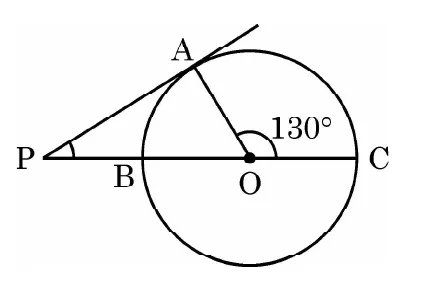
In the given figure, PAPA is a tangent to the circle drawn from the external point PP and PBCPBC is the secant to the circle with BCBC as diameter. If ∠AOC=130∘\angle AOC = 130^\circ, then find the measure of ∠APB\angle APB, where OO is the centre of the circle.

A circle with centre O and horizontal diameter BC. The line from the outside point P on the left passes through B and O to C. PA is a tangent from P touching the circle at A on the upper left. The angle AOC is marked 130 degrees.
Solution
130°50°OBCAP40°∠AOB = 50°, ∠OAP = 90° → ∠APB = 180° − 50° − 90° = 40°
  1. BB, OO, CC are on one straight line, so ∠AOB=180∘−130∘=50∘\angle AOB = 180^\circ - 130^\circ = 50^\circ.
  2. A tangent is perpendicular to the radius at the point of contact, so ∠OAP=90∘\angle OAP = 90^\circ.
  3. In △AOP\triangle AOP: ∠APB=180∘−(50∘+90∘)=40∘\angle APB = 180^\circ - (50^\circ + 90^\circ) = 40^\circ.

Answer: ∠APB=40∘\angle APB = 40^\circ

Report an error on this question
Q25Triangles2 marks

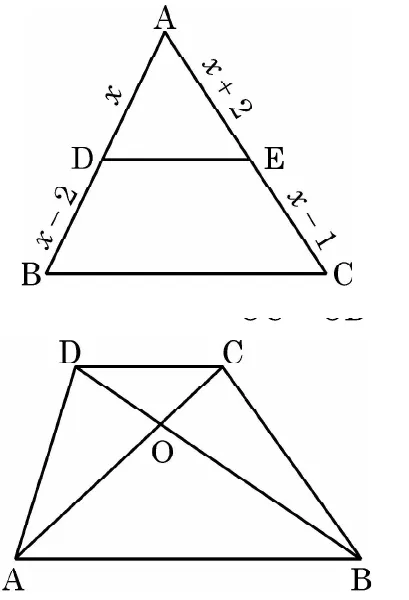
(a) In the given figure, ABCABC is a triangle in which DE∥BCDE \parallel BC. If AD=xAD = x, DB=x−2DB = x - 2, AE=x+2AE = x + 2 and EC=x−1EC = x - 1, then find the value of xx.

OR

(b) Diagonals ACAC and BDBD of trapezium ABCDABCD with AB∥DCAB \parallel DC intersect each other at point OO. Show that OAOC=OBOD\dfrac{OA}{OC} = \dfrac{OB}{OD}.

Two figures. First, a triangle ABC with a line DE parallel to the base BC, D on AB and E on AC, the sides labelled x, x minus 2, x plus 2 and x minus 1. Second, a trapezium ABCD with the parallel sides AB at the bottom and DC at the top and diagonals crossing at O.
Solution
x = 4263ABCDEx/(x − 2) = (x + 2)/(x − 1) → x = 4 (AD/DB = 2 = AE/EC)
ABCDO△AOB ∼ △COD (AA) → OA/OC = OB/OD
  1. (a) DE∥BCDE \parallel BC, so ADDB=AEEC\dfrac{AD}{DB} = \dfrac{AE}{EC}: xx−2=x+2x−1\dfrac{x}{x - 2} = \dfrac{x + 2}{x - 1}.
  2. x(x−1)=(x+2)(x−2)x(x - 1) = (x + 2)(x - 2), so x2−x=x2−4x^2 - x = x^2 - 4 and x=4x = 4.
  3. (b) In △AOB\triangle AOB and △COD\triangle COD: ∠OAB=∠OCD\angle OAB = \angle OCD and ∠OBA=∠ODC\angle OBA = \angle ODC (alternate angles, AB∥DCAB \parallel DC).
  4. So △AOB∼△COD\triangle AOB \sim \triangle COD by AA, and the corresponding sides are proportional: OAOC=OBOD\dfrac{OA}{OC} = \dfrac{OB}{OD}.

Answer: (a) x=4x = 4   (b) shown

Report an error on this question

Section C: Short answer

6 questions, 3 marks each.

Q26Coordinate Geometry3 marks

Find the ratio in which the line segment joining the points A(6,3)A(6, 3) and B(−2,−5)B(-2, -5) is divided by xx-axis.

Solution
-3-2-11234567-6-5-4-3-2-11234OxyA(6, 3)B(−2, −5)P(3, 0)
  1. A point on the xx-axis has y=0y = 0. Let PP divide ABAB in the ratio k:1k : 1.
  2. y=k(−5)+1(3)k+1=0y = \dfrac{k(-5) + 1(3)}{k + 1} = 0, so −5k+3=0-5k + 3 = 0 and k=35k = \dfrac{3}{5}.
  3. The ratio is 35:1=3:5\dfrac{3}{5} : 1 = 3 : 5. (So P=(3(−2)+5(6)8,0)=(3,0)P = \left(\dfrac{3(-2) + 5(6)}{8}, 0\right) = (3, 0).)

Answer: 3:53 : 5

Report an error on this question
Q27Real Numbers3 marks

(a) Find the HCF and LCM of 2626, 6565 and 117117, using prime factorisation.

OR

(b) Prove that 2\sqrt{2} is an irrational number.

Solution
  1. (a) 26=2×1326 = 2 \times 13, 65=5×1365 = 5 \times 13, 117=32×13117 = 3^2 \times 13.
  2. HCF =13= 13 (the only common prime). LCM =2×32×5×13=1170= 2 \times 3^2 \times 5 \times 13 = 1170.
  3. (b) Suppose 2\sqrt{2} is rational: 2=pq\sqrt{2} = \dfrac{p}{q} with p,qp, q co-prime integers and q≠0q \neq 0.
  4. Squaring, 2q2=p22q^2 = p^2, so p2p^2 is even and therefore pp is even: p=2ap = 2a.
  5. Then 4a2=2q24a^2 = 2q^2, so q2=2a2q^2 = 2a^2 is even and qq is even: q=2bq = 2b.
  6. Now 22 divides both pp and qq, which contradicts that they are co-prime. So 2\sqrt{2} is irrational.

Answer: (a) HCF =13= 13, LCM =1170= 1170   (b) proved

Report an error on this question
Q28Triangles3 marks

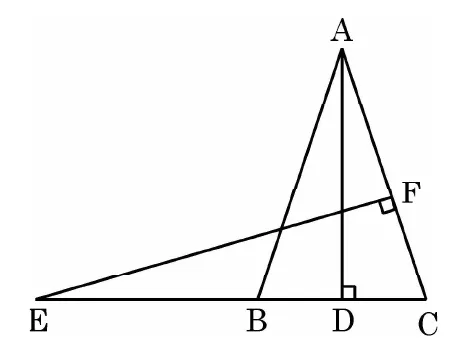
In the given figure, EE is a point on the side CBCB produced of an isosceles triangle ABCABC with AB=ACAB = AC. If AD⊥BCAD \perp BC and EF⊥ACEF \perp AC, then prove that △ABD∼△ECF\triangle ABD \sim \triangle ECF.

An isosceles triangle ABC with A at the top. The base is extended to the left to the point E. D is on BC with AD perpendicular to BC. EF is drawn perpendicular to AC with F on AC.
Solution
∠B∠CABCDEF∠ADB = ∠EFC = 90° and ∠B = ∠C (AB = AC) → △ABD ∼ △ECF
  1. AB=ACAB = AC, so the angles opposite them are equal: ∠ABC=∠ACB\angle ABC = \angle ACB. Since EE is on CBCB produced and FF is on ACAC, ∠ECF\angle ECF is the same angle as ∠ACB\angle ACB. So ∠ABD=∠ECF\angle ABD = \angle ECF.
  2. ∠ADB=∠EFC=90∘\angle ADB = \angle EFC = 90^\circ (given: AD⊥BCAD \perp BC, EF⊥ACEF \perp AC).
  3. In △ABD\triangle ABD and △ECF\triangle ECF two angles are equal, so △ABD∼△ECF\triangle ABD \sim \triangle ECF by AA.

Answer: Proved

Report an error on this question
Q29Quadratic Equations3 marks

(a) The sum of two numbers is 1515. If the sum of their reciprocals is 310\dfrac{3}{10}, find the two numbers.

OR

(b) If α\alpha and β\beta are roots of the quadratic equation x2−7x+10=0x^2 - 7x + 10 = 0, find the quadratic equation whose roots are α2\alpha^2 and β2\beta^2.

Solution
  1. (a) Let the numbers be xx and 15−x15 - x. 1x+115−x=310\dfrac{1}{x} + \dfrac{1}{15 - x} = \dfrac{3}{10}, so 15x(15−x)=310\dfrac{15}{x(15 - x)} = \dfrac{3}{10}.
  2. 150=3x(15−x)150 = 3x(15 - x), so 3x2−45x+150=03x^2 - 45x + 150 = 0, that is x2−15x+50=0x^2 - 15x + 50 = 0 and (x−10)(x−5)=0(x - 10)(x - 5) = 0. The numbers are 1010 and 55.
  3. (b) α+β=7\alpha + \beta = 7 and αβ=10\alpha\beta = 10. α2+β2=(α+β)2−2αβ=49−20=29\alpha^2 + \beta^2 = (\alpha + \beta)^2 - 2\alpha\beta = 49 - 20 = 29, and α2β2=100\alpha^2\beta^2 = 100.
  4. The equation is x2−(α2+β2)x+α2β2=0x^2 - (\alpha^2 + \beta^2)x + \alpha^2\beta^2 = 0, that is x2−29x+100=0x^2 - 29x + 100 = 0.

Answer: (a) 1010 and 55   (b) x2−29x+100=0x^2 - 29x + 100 = 0

Report an error on this question
Q30Trigonometry3 marks

Prove that 1+sec⁡Asec⁡A=sin⁡2A1−cos⁡A\dfrac{1 + \sec A}{\sec A} = \dfrac{\sin^2 A}{1 - \cos A}.

Solution
  1. LHS =1+1cos⁡A1cos⁡A=cos⁡A+1cos⁡A×cos⁡A=1+cos⁡A= \dfrac{1 + \frac{1}{\cos A}}{\frac{1}{\cos A}} = \dfrac{\cos A + 1}{\cos A} \times \cos A = 1 + \cos A.
  2. Multiply and divide by (1−cos⁡A)(1 - \cos A): 1+cos⁡A=(1+cos⁡A)(1−cos⁡A)1−cos⁡A=1−cos⁡2A1−cos⁡A1 + \cos A = \dfrac{(1 + \cos A)(1 - \cos A)}{1 - \cos A} = \dfrac{1 - \cos^2 A}{1 - \cos A}.
  3. 1−cos⁡2A=sin⁡2A1 - \cos^2 A = \sin^2 A, so LHS =sin⁡2A1−cos⁡A== \dfrac{\sin^2 A}{1 - \cos A} = RHS.

Answer: Proved

Report an error on this question
Q31Areas Related to Circles3 marks

In a circle of radius 2121 cm, an arc subtends an angle of 60∘60^\circ at the centre. Find the area of the sector formed by the arc. Also, find the length of the arc.

Solution
60°21 cmOABsector = 231 cm²arc = 22 cm
  1. Area of the sector =60360×πr2=16×227×21×21=231= \dfrac{60}{360} \times \pi r^2 = \dfrac{1}{6} \times \dfrac{22}{7} \times 21 \times 21 = 231 cm².
  2. Length of the arc =60360×2πr=16×2×227×21=22= \dfrac{60}{360} \times 2\pi r = \dfrac{1}{6} \times 2 \times \dfrac{22}{7} \times 21 = 22 cm.

Answer: Area =231= 231 cm²; arc length =22= 22 cm

Report an error on this question

Section D: Long answer

4 questions, 5 marks each.

Q32Circles5 marks

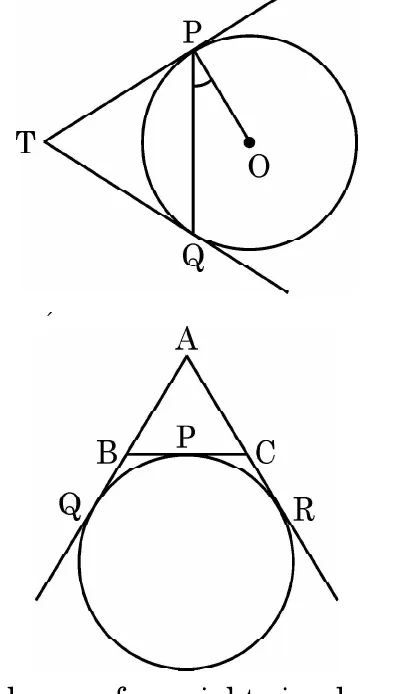
(a) Two tangents TPTP and TQTQ are drawn to a circle with centre OO from an external point TT. Prove that ∠PTQ=2∠OPQ\angle PTQ = 2\angle OPQ.

OR

(b) A circle touches the side BCBC of a △ABC\triangle ABC at a point PP and touches ABAB and ACAC when produced at QQ and RR respectively. Show that AQ=12(Perimeter of △ABC)AQ = \dfrac{1}{2}(\text{Perimeter of } \triangle ABC).

Two figures. First, a circle with centre O and two tangents TP and TQ from the outside point T on the left, with the chord PQ and the radius OP drawn. Second, a triangle ABC with a circle below the side BC touching BC at P and the extended sides AB and AC at Q and R.
Solution
θθ/2TOPQ∠TPQ = 90° − θ/2, so ∠OPQ = 90° − (90° − θ/2) = θ/2
ABCPQR2AQ = AB + BQ + AC + CR = AB + AC + BC
  1. (a) Tangents from an external point are equal, so TP=TQTP = TQ and ∠TPQ=∠TQP\angle TPQ = \angle TQP. Let ∠PTQ=θ\angle PTQ = \theta. Then ∠TPQ=180∘−θ2=90∘−θ2\angle TPQ = \dfrac{180^\circ - \theta}{2} = 90^\circ - \dfrac{\theta}{2}.
  2. OP⊥TPOP \perp TP, so ∠OPT=90∘\angle OPT = 90^\circ. Hence ∠OPQ=∠OPT−∠TPQ=90∘−(90∘−θ2)=θ2\angle OPQ = \angle OPT - \angle TPQ = 90^\circ - \left(90^\circ - \dfrac{\theta}{2}\right) = \dfrac{\theta}{2}.
  3. So ∠PTQ=θ=2∠OPQ\angle PTQ = \theta = 2\angle OPQ.
  4. (b) Tangents from a point are equal: AQ=ARAQ = AR, BQ=BPBQ = BP and CR=CPCR = CP.
  5. 2AQ=AQ+AR=(AB+BQ)+(AC+CR)=AB+AC+(BP+CP)=AB+AC+BC2AQ = AQ + AR = (AB + BQ) + (AC + CR) = AB + AC + (BP + CP) = AB + AC + BC.
  6. So AQ=12(AB+AC+BC)=12(Perimeter of △ABC)AQ = \dfrac{1}{2}(AB + AC + BC) = \dfrac{1}{2}(\text{Perimeter of } \triangle ABC).

Answer: (a) proved   (b) proved

Report an error on this question
Q33Surface Areas and Volumes5 marks

A solid is in the shape of a right-circular cone surmounted on a hemisphere, the radius of each of them being 7 cm and the height of the cone is equal to its diameter. Find the volume of the solid.

Solution
OTh = 14 cmr = 7 cmV = ⅔πr³ + ⅓πr²h = 686π/3 + 686π/3 = 4312/3 cm³
  1. Radius of both =7= 7 cm. The height of the cone equals the diameter, so h=14h = 14 cm.
  2. Volume of the hemisphere =23πr3=23π×343=686π3= \dfrac{2}{3}\pi r^3 = \dfrac{2}{3}\pi \times 343 = \dfrac{686\pi}{3} cm³.
  3. Volume of the cone =13πr2h=13π×49×14=686π3= \dfrac{1}{3}\pi r^2 h = \dfrac{1}{3}\pi \times 49 \times 14 = \dfrac{686\pi}{3}.
  4. Total volume =1372π3=13×227×7×7×28=43123≈1437.33= \dfrac{1372\pi}{3} = \dfrac{1}{3} \times \dfrac{22}{7} \times 7 \times 7 \times 28 = \dfrac{4312}{3} \approx 1437.33 cm³.

Answer: 43123≈1437.33\dfrac{4312}{3} \approx 1437.33 cm³

Report an error on this question
Q34Arithmetic Progressions5 marks

(a) The ratio of the 11th11^{\text{th}} term to the 18th18^{\text{th}} term of an A.P. is 2:32 : 3. Find the ratio of the 5th5^{\text{th}} term to the 21st21^{\text{st}} term. Also, find the ratio of the sum of first 55 terms to the sum of first 2121 terms.

OR

(b) If the sum of first 66 terms of an A.P. is 3636 and that of the first 1616 terms is 256256, find the sum of first 1010 terms.

Solution
  1. (a) a+10da+17d=23\dfrac{a + 10d}{a + 17d} = \dfrac{2}{3}, so 3a+30d=2a+34d3a + 30d = 2a + 34d and a=4da = 4d.
  2. a5a21=a+4da+20d=8d24d=13\dfrac{a_5}{a_{21}} = \dfrac{a + 4d}{a + 20d} = \dfrac{8d}{24d} = \dfrac{1}{3}.
  3. S5S21=52(2a+4d)212(2a+20d)=5×12d21×28d=549\dfrac{S_5}{S_{21}} = \dfrac{\frac{5}{2}(2a + 4d)}{\frac{21}{2}(2a + 20d)} = \dfrac{5 \times 12d}{21 \times 28d} = \dfrac{5}{49}.
  4. (b) S6=36S_6 = 36: 3(2a+5d)=363(2a + 5d) = 36, so 2a+5d=122a + 5d = 12. S16=256S_{16} = 256: 8(2a+15d)=2568(2a + 15d) = 256, so 2a+15d=322a + 15d = 32.
  5. Subtracting, 10d=2010d = 20, so d=2d = 2 and a=1a = 1.
  6. S10=102[2(1)+9(2)]=5×20=100S_{10} = \dfrac{10}{2}[2(1) + 9(2)] = 5 \times 20 = 100.

Answer: (a) a5:a21=1:3a_5 : a_{21} = 1 : 3 and S5:S21=5:49S_5 : S_{21} = 5 : 49   (b) 100100

Report an error on this question
Q35Statistics5 marks

250 apples of a box were weighed and the distribution of masses of the apples is given in the following table:

(i) Find the value of x and the mean mass of the apples. [3]

(ii) Find the modal mass of the apples. [2]

Mass (in grams)80–100100–120120–140140–160160–180
Number of apples206070x60
Solution
60801001201401601802001020304050607080Ogn206070x = 4060
  1. (i) The total is 250250: 20+60+70+x+60=210+x=25020 + 60 + 70 + x + 60 = 210 + x = 250, so x=40x = 40.
  2. Class marks: 90,110,130,150,17090, 110, 130, 150, 170. ∑fixi=20(90)+60(110)+70(130)+40(150)+60(170)=1800+6600+9100+6000+10200=33700\sum f_ix_i = 20(90) + 60(110) + 70(130) + 40(150) + 60(170) = 1800 + 6600 + 9100 + 6000 + 10200 = 33700.
  3. Mean =33700250=134.8= \dfrac{33700}{250} = 134.8 g.
  4. (ii) The highest frequency is 7070, so the modal class is 120−140120 - 140: l=120l = 120, f1=70f_1 = 70, f0=60f_0 = 60, f2=40f_2 = 40, h=20h = 20.
  5. Mode =l+f1−f02f1−f0−f2×h=120+10140−60−40×20=120+1040×20=125= l + \dfrac{f_1 - f_0}{2f_1 - f_0 - f_2} \times h = 120 + \dfrac{10}{140 - 60 - 40} \times 20 = 120 + \dfrac{10}{40} \times 20 = 125 g.

Answer: x=40x = 40; mean =134.8= 134.8 g; modal mass =125= 125 g

Report an error on this question

Section E: Case studies

3 case studies, 4 marks each.

Q36Linear Equations4 marks

Case study 1. A coaching institute of Mathematics conducts classes in two batches I and II and fees for rich and poor children are different. In batch I, there are 20 poor and 5 rich children, whereas in batch II, there are 5 poor and 25 rich children. The total monthly collection of fees from batch I is ₹ 9000 and from batch II is ₹ 26,000. Assume that each poor child pays ₹ x per month and each rich child pays ₹ y per month.

Based on the above information, answer the following questions:

(i) Represent the information given above in terms of x and y. [1]

(ii) (a) Find the monthly fee paid by a poor child. [2]

OR

(ii) (b) Find the difference in the monthly fee paid by a poor child and a rich child. [2]

(iii) If there are 10 poor and 20 rich children in batch II, what is the total monthly collection of fees from batch II? [1]

Solution
  1. (i) Batch I: 20x+5y=900020x + 5y = 9000. Batch II: 5x+25y=260005x + 25y = 26000.
  2. (ii) Divide the first by 55: 4x+y=18004x + y = 1800, so y=1800−4xy = 1800 - 4x. Divide the second by 55: x+5y=5200x + 5y = 5200.
  3. Substitute: x+5(1800−4x)=5200x + 5(1800 - 4x) = 5200, so x+9000−20x=5200x + 9000 - 20x = 5200 and 19x=380019x = 3800. x=200x = 200 and y=1800−800=1000y = 1800 - 800 = 1000.
  4. (a) A poor child pays ₹ 200200 a month. (b) The difference is 1000−200=₹8001000 - 200 = ₹800.
  5. (iii) 10x+20y=10(200)+20(1000)=2000+20000=₹2200010x + 20y = 10(200) + 20(1000) = 2000 + 20000 = ₹22000.

Answer: (i) 20x+5y=9000, 5x+25y=2600020x + 5y = 9000,\ 5x + 25y = 26000   (ii)(a) ₹ 200200   (ii)(b) ₹ 800800   (iii) ₹ 2200022000

Report an error on this question
Q37Trigonometry4 marks

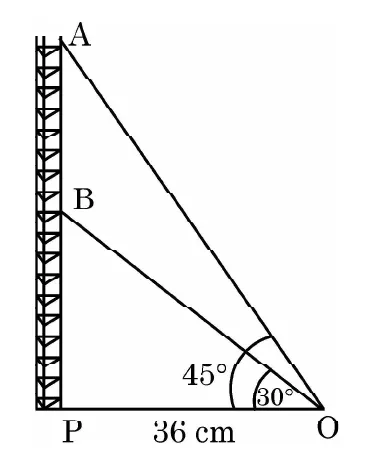
Case study 2. Radio towers are used for transmitting a range of communication services including radio and television. The tower will either act as an antenna itself or support one or more antennas on its structure. On a similar concept, a radio station tower was built in two Sections A and B. Tower is supported by wires from a point O. Distance between the base of the tower and point O is 36 cm. From point O, the angle of elevation of the top of the Section B is 30° and the angle of elevation of the top of Section A is 45°.

Based on the above information, answer the following questions:

(i) Find the length of the wire from the point O to the top of Section B. [1]

(ii) (a) Find the distance AB. [2]

OR

(ii) (b) Find the area of △OPB. [2]

(iii) Find the height of the Section A from the base of the tower. [1]

A vertical tower PA standing on the ground at P, with section B partway up and the top of section A at the top. Wires run from the ground point O, 36 cm from P, to B and to A. The angle at O to B is marked 30 degrees and to A is marked 45 degrees.
Solution
30°45°POBAOP = 36OB = 24√3AB = AP − PB = 36 − 12√3 = 12(3 − √3) cm
  1. (i) In the right triangle OPBOPB: cos⁡30∘=OPOB\cos 30^\circ = \dfrac{OP}{OB}, so 32=36OB\dfrac{\sqrt{3}}{2} = \dfrac{36}{OB} and OB=723=243OB = \dfrac{72}{\sqrt{3}} = 24\sqrt{3} cm.
  2. (ii)(a) tan⁡30∘=PB36\tan 30^\circ = \dfrac{PB}{36}, so PB=363=123PB = \dfrac{36}{\sqrt{3}} = 12\sqrt{3} cm. tan⁡45∘=AP36\tan 45^\circ = \dfrac{AP}{36}, so AP=36AP = 36 cm.
  3. AB=AP−PB=36−123=12(3−3)AB = AP - PB = 36 - 12\sqrt{3} = 12(3 - \sqrt{3}) cm.
  4. (ii)(b) Area of △OPB=12×OP×PB=12×36×123=2163\triangle OPB = \dfrac{1}{2} \times OP \times PB = \dfrac{1}{2} \times 36 \times 12\sqrt{3} = 216\sqrt{3} cm².
  5. (iii) The height of Section A from the base is AP=36AP = 36 cm.

Answer: (i) 24324\sqrt{3} cm   (ii)(a) 12(3−3)12(3 - \sqrt{3}) cm   (ii)(b) 2163216\sqrt{3} cm²   (iii) 3636 cm

Report an error on this question
Q38Probability4 marks

Case study 3. "Eight Ball" is a game played on a pool table with 15 balls numbered 1 to 15 and a "cue ball" that is solid and white. Of the 15 numbered balls, eight are solid (non-white) coloured and numbered 1 to 8 and seven are striped balls numbered 9 to 15. The 15 numbered pool balls (no cue ball) are placed in a large bowl and mixed, then one ball is drawn out at random.

Based on the above information, answer the following questions:

(i) What is the probability that the drawn ball bears number 8? [1]

(ii) (a) What is the probability that the drawn ball bears an even number? [2]

OR

(ii) (b) What is the probability that the drawn ball bears a number, which is a multiple of 3? [2]

(iii) What is the probability that the drawn ball is a solid coloured and bears an even number? [1]

Solution
  1. There are 1515 equally likely balls.
  2. (i) Only one ball bears 88: P=115P = \dfrac{1}{15}.
  3. (ii)(a) Even numbers from 11 to 1515: 2,4,6,8,10,12,142, 4, 6, 8, 10, 12, 14, which is 77 balls. P=715P = \dfrac{7}{15}.
  4. (ii)(b) Multiples of 33: 3,6,9,12,153, 6, 9, 12, 15, which is 55 balls. P=515=13P = \dfrac{5}{15} = \dfrac{1}{3}.
  5. (iii) Solid coloured balls are numbered 11 to 88, so the even ones are 2,4,6,82, 4, 6, 8. P=415P = \dfrac{4}{15}.

Answer: (i) 115\dfrac{1}{15}   (ii)(a) 715\dfrac{7}{15}   (ii)(b) 13\dfrac{1}{3}   (iii) 415\dfrac{4}{15}

Report an error on this question

Questions are from the official CBSE paper. Figures are described in words; see the PDF for the originals. Solutions are written by CogniGuru.

Revise this paper in 1 minute a chapter

Each chapter below is what the paper tested, with a one-minute animated lesson on the idea behind it.

Stuck on a step in any solution?

The CogniGuru AI tutor explains any doubt one minute at a time, in English or Hindi. Join the waitlist.

Mock quiz: 5 questions from this paper

Five real questions from this paper, one each from five chapters. About 2 minutes. See how much you know and where you stand among other students. Attempt free, with no login; log in only for your ranking and full report.

Question 1 of 5 · Q2 of the paperCoordinate Geometry

The distance of the point (−6,8)(-6, 8) from the xx-axis is:

0 of 5 answered

Related papers

  • Maths Standard 2022Coming soon
  • Maths Standard 2024
  • Maths Basic 2023Coming soon
  • Science 2023Coming soon

Common questions

Are these the official CBSE Class 10 Maths Standard 2023 questions?
Yes. The questions are from the official Mathematics (Standard) paper (set 30/6/1) that CBSE published after the March 2023 board exam. The solutions are written by CogniGuru and checked against the answer key CBSE published for this paper code.
Can I download the CBSE Class 10 Maths Standard 2023 question paper PDF?
Yes, the official paper PDF is free to download from this page, and so are our step-by-step solutions as a PDF. No login is needed to download either or to read the solutions.
Do all sets of the paper have the same questions?
No. CBSE sets several versions of each paper, with the same blueprint and similar questions in a different order and sometimes with different numbers. This page covers set 30/6/1.
How does the quiz work, and what does “where you stand” mean?
It is a mock quiz of 5 real multiple-choice questions from this paper, scored automatically in about 2 minutes. Your score is compared, anonymously, with other students who took the same quiz. Only the score is stored with the comparison, never your name or number.

Source

CBSE question paper archive, Class X, 2023 (Mathematics (Standard), set 30/6/1)
PDF