
CBSE · Class 10 · Mathematics (Standard) · Free

CBSE Class 10 Maths Standard 2024 Question Paper (Set 30/5/1) with Solutions

The official board paper (Q.P. Code 30/5/1, Series C5ABD/5). Free paper PDF and step-by-step solutions (also as a PDF to download) written by CogniGuru and checked against CBSE’s answer key. See the paper’s main topics in 1 minute, then quiz yourself to see how much you know and where you stand.

No login to download or read the solutions. Login only to see your quiz report in full.

Board
CBSE
Class
10
Subject
Maths Standard (041)
Year
2024
Set code
30/5/1
Max marks
80
Duration
3 hours
Questions
38 (Sections A to E)
Source
Official CBSE paper
Exam date
March 2024

Paper preview

Three pages of the official paper. Download the PDF for all 23.

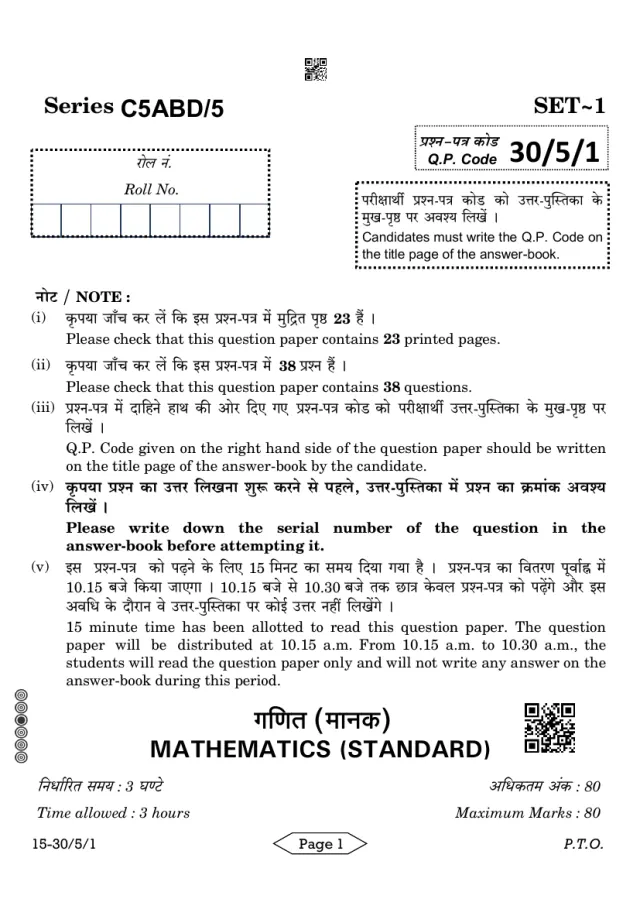
  • Cover page of the CBSE Class 10 Maths Standard 2024 paper, set 30/5/1

    Cover page

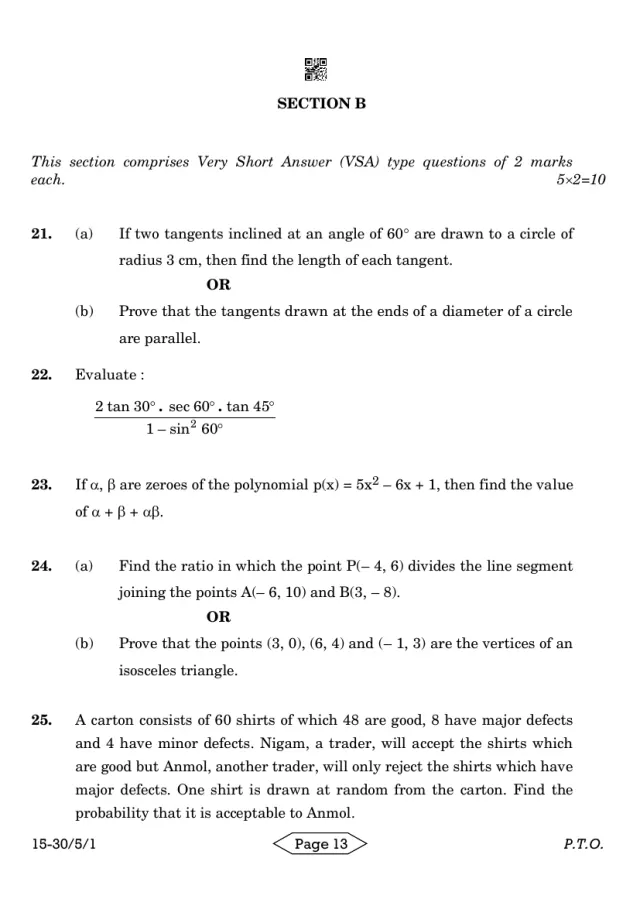
  • Section B of the CBSE Class 10 Maths Standard 2024 paper, set 30/5/1

    Section B

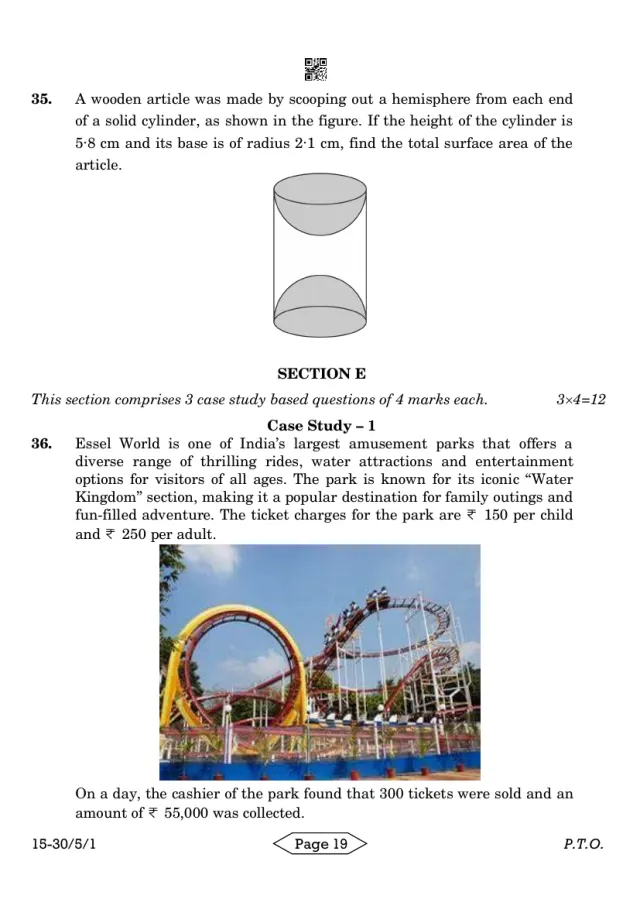
  • A case study with its figure from the CBSE Class 10 Maths Standard 2024 paper, set 30/5/1

    Case study

The main topics of this paper, in 1 minute

Your tutor walks you through the paper before you attempt it: the marks, the key ideas, the time plan and the traps.

1-minute paper analysis

With your tutor, in her voice

The main topics of this paper, in about a minute

A short, animated walk through the paper: how it is built, where the marks come from, the four ideas that matter most, how to plan your three hours, and the traps to avoid.

  1. 1The paper at a glance
  2. 2Where the marks come from
  3. 3Four ideas that keep paying off
  4. 4Plan your three hours
  5. 5Four traps to avoid

Sound on for the voice. Captions are shown, and you can mute any time.

Step-by-step solutions

Try each question first, then open its solution. Tap a number to jump.

Download solutions (PDF)

Section A: Multiple choice

20 questions, 1 mark each. MCQs (Q1 to Q18) and assertion-reason (Q19, Q20).

Q1Arithmetic Progressions1 mark

The next (4th) term of the A.P. 18, 50, 98, …\sqrt{18},\ \sqrt{50},\ \sqrt{98},\ \dots is:

  1. (A)128\sqrt{128}
  2. (B)140\sqrt{140}
  3. (C)162\sqrt{162}
  4. (D)200\sqrt{200}
Solution · answer (C)
  1. Simplify: 18=32\sqrt{18} = 3\sqrt{2}, 50=52\sqrt{50} = 5\sqrt{2}, 98=72\sqrt{98} = 7\sqrt{2}. The common difference is 222\sqrt{2}.
  2. The next term is 72+22=92=1627\sqrt{2} + 2\sqrt{2} = 9\sqrt{2} = \sqrt{162}.

Answer: (C) 162\sqrt{162}

Common mistake: Looking at the numbers under the root (18,50,9818, 50, 98). They are not an A.P.; the simplified terms 32,52,723\sqrt{2}, 5\sqrt{2}, 7\sqrt{2} are.

Report an error on this question
Q2Trigonometry1 mark

If x3=2sin⁡A\dfrac{x}{3} = 2\sin A and y3=2cos⁡A\dfrac{y}{3} = 2\cos A, then the value of x2+y2x^2 + y^2 is:

  1. (A)36
  2. (B)9
  3. (C)6
  4. (D)18
Solution · answer (A)
  1. x=6sin⁡Ax = 6\sin A and y=6cos⁡Ay = 6\cos A.
  2. x2+y2=36(sin⁡2A+cos⁡2A)=36x^2 + y^2 = 36(\sin^2 A + \cos^2 A) = 36.

Answer: (A) 36

Report an error on this question
Q3Trigonometry1 mark

If 4sec⁡θ−5=04\sec\theta - 5 = 0, then the value of cot⁡θ\cot\theta is:

  1. (A)34\dfrac{3}{4}
  2. (B)45\dfrac{4}{5}
  3. (C)53\dfrac{5}{3}
  4. (D)43\dfrac{4}{3}
Solution · answer (D)
  1. sec⁡θ=54\sec\theta = \dfrac{5}{4}, so cos⁡θ=45\cos\theta = \dfrac{4}{5}. Take hypotenuse 55 and adjacent side 44.
  2. The opposite side is 25−16=3\sqrt{25 - 16} = 3, so cot⁡θ=adjacentopposite=43\cot\theta = \dfrac{\text{adjacent}}{\text{opposite}} = \dfrac{4}{3}.

Answer: (D) 43\dfrac{4}{3}

Report an error on this question
Q4Linear Equations1 mark

Which out of the following type of straight lines will be represented by the system of equations 3x+4y=53x + 4y = 5 and 6x+8y=76x + 8y = 7?

  1. (A)Parallel
  2. (B)Intersecting
  3. (C)Coincident
  4. (D)Perpendicular to each other
Solution · answer (A)
  1. a1a2=36=12\dfrac{a_1}{a_2} = \dfrac{3}{6} = \dfrac{1}{2}, b1b2=48=12\dfrac{b_1}{b_2} = \dfrac{4}{8} = \dfrac{1}{2} and c1c2=57\dfrac{c_1}{c_2} = \dfrac{5}{7}.
  2. a1a2=b1b2≠c1c2\dfrac{a_1}{a_2} = \dfrac{b_1}{b_2} \neq \dfrac{c_1}{c_2}, so the lines are parallel.

Answer: (A) Parallel

Report an error on this question
Q5Quadratic Equations1 mark

The ratio of the sum and product of the roots of the quadratic equation 5x2−6x+21=05x^2 - 6x + 21 = 0 is:

  1. (A)5 : 21
  2. (B)2 : 7
  3. (C)21 : 5
  4. (D)7 : 2
Solution · answer (B)
  1. Sum of roots =−−65=65= -\dfrac{-6}{5} = \dfrac{6}{5} and product of roots =215= \dfrac{21}{5}.
  2. Ratio =65:215=6:21=2:7= \dfrac{6}{5} : \dfrac{21}{5} = 6 : 21 = 2 : 7.

Answer: (B) 2 : 7

Report an error on this question
Q6Statistics1 mark

For the data 2,9,x+6,2x+3,5,10,52, 9, x + 6, 2x + 3, 5, 10, 5; if the mean is 77, then the value of xx is:

  1. (A)9
  2. (B)6
  3. (C)5
  4. (D)3
Solution · answer (D)
  1. Sum =7×7=49= 7 \times 7 = 49, and the sum is 2+9+(x+6)+(2x+3)+5+10+5=40+3x2 + 9 + (x + 6) + (2x + 3) + 5 + 10 + 5 = 40 + 3x.
  2. 40+3x=4940 + 3x = 49, so x=3x = 3.

Answer: (D) 3

Report an error on this question
Q7Probability1 mark

One ticket is drawn at random from a bag containing tickets numbered 1 to 40. The probability that the selected ticket has a number which is a multiple of 7 is:

  1. (A)17\dfrac{1}{7}
  2. (B)18\dfrac{1}{8}
  3. (C)15\dfrac{1}{5}
  4. (D)740\dfrac{7}{40}
Solution · answer (B)
  1. Multiples of 77 up to 4040: 7,14,21,28,357, 14, 21, 28, 35. That is 55 numbers.
  2. P=540=18P = \dfrac{5}{40} = \dfrac{1}{8}.

Answer: (B) 18\dfrac{1}{8}

Report an error on this question
Q8Areas Related to Circles1 mark

The perimeter of the sector of a circle of radius 21 cm which subtends an angle of 60° at the centre of circle, is:

  1. (A)22 cm
  2. (B)43 cm
  3. (C)64 cm
  4. (D)462 cm
Solution · answer (C)
  1. Arc length =60360×2×227×21=22= \dfrac{60}{360} \times 2 \times \dfrac{22}{7} \times 21 = 22 cm.
  2. Perimeter == arc +2r=22+42=64+ 2r = 22 + 42 = 64 cm.

Answer: (C) 64 cm

Common mistake: Stopping at the arc length. The perimeter of a sector also includes the two radii.

Report an error on this question
Q9Areas Related to Circles1 mark

The length of an arc of a circle with radius 1212 cm is 10π10\pi cm. The angle subtended by the arc at the centre of the circle, is:

  1. (A)120∘120^\circ
  2. (B)6∘6^\circ
  3. (C)75∘75^\circ
  4. (D)150∘150^\circ
Solution · answer (D)
  1. Arc length =θ360×2πr= \dfrac{\theta}{360} \times 2\pi r: 10π=θ360×2π×12=θ360×24π10\pi = \dfrac{\theta}{360} \times 2\pi \times 12 = \dfrac{\theta}{360} \times 24\pi.
  2. θ=10×36024=150∘\theta = \dfrac{10 \times 360}{24} = 150^\circ.

Answer: (D) 150∘150^\circ

Report an error on this question
Q10Real Numbers1 mark

The greatest number which divides 281281 and 12491249, leaving remainder 55 and 77 respectively, is:

  1. (A)23
  2. (B)276
  3. (C)138
  4. (D)69
Solution · answer (C)
  1. The numbers that are exactly divisible are 281−5=276281 - 5 = 276 and 1249−7=12421249 - 7 = 1242.
  2. The greatest number is HCF(276,1242)\text{HCF}(276, 1242). 1242=4×276+1381242 = 4 \times 276 + 138 and 276=2×138276 = 2 \times 138, so the HCF is 138138.

Answer: (C) 138

Common mistake: Finding the HCF of 281 and 1249 directly. Subtract the remainders first.

Report an error on this question
Q11Arithmetic Progressions1 mark

The number of terms in the A.P. 3,6,9,12,…,1113, 6, 9, 12, \dots, 111 is:

  1. (A)36
  2. (B)40
  3. (C)37
  4. (D)30
Solution · answer (C)
  1. a=3a = 3, d=3d = 3 and an=111a_n = 111: 3+(n−1)×3=1113 + (n - 1) \times 3 = 111, so n−1=36n - 1 = 36 and n=37n = 37.

Answer: (C) 37

Report an error on this question
Q12Circles1 mark

A chord of a circle of radius 10 cm subtends a right angle at its centre. The length of the chord (in cm) is:

  1. (A)525\sqrt{2}
  2. (B)10210\sqrt{2}
  3. (C)52\dfrac{5}{\sqrt{2}}
  4. (D)5
Solution · answer (B)
  1. The two radii and the chord form a right triangle with legs 1010 and 1010.
  2. Chord =102+102=102= \sqrt{10^2 + 10^2} = 10\sqrt{2} cm.

Answer: (B) 10210\sqrt{2}

Report an error on this question
Q13Real Numbers1 mark

The LCM of three numbers 2828, 4444, 132132 is:

  1. (A)258
  2. (B)231
  3. (C)462
  4. (D)924
Solution · answer (D)
  1. 28=22×728 = 2^2 \times 7, 44=22×1144 = 2^2 \times 11, 132=22×3×11132 = 2^2 \times 3 \times 11.
  2. LCM =22×3×7×11=924= 2^2 \times 3 \times 7 \times 11 = 924.

Answer: (D) 924

Report an error on this question
Q14Real Numbers1 mark

If the product of two co-prime numbers is 553, then their HCF is:

  1. (A)1
  2. (B)553
  3. (C)7
  4. (D)79
Solution · answer (A)
  1. Co-prime numbers have no common factor other than 11, so their HCF is 11.

Answer: (A) 1

Report an error on this question
Q15Polynomials1 mark

If α\alpha and β\beta are the zeroes of the polynomial p(x)=kx2−30x+45kp(x) = kx^2 - 30x + 45k and α+β=αβ\alpha + \beta = \alpha\beta, then the value of kk is:

  1. (A)−23-\dfrac{2}{3}
  2. (B)−32-\dfrac{3}{2}
  3. (C)32\dfrac{3}{2}
  4. (D)23\dfrac{2}{3}
Solution · answer (D)
  1. α+β=30k\alpha + \beta = \dfrac{30}{k} and αβ=45kk=45\alpha\beta = \dfrac{45k}{k} = 45.
  2. 30k=45\dfrac{30}{k} = 45, so k=3045=23k = \dfrac{30}{45} = \dfrac{2}{3}.

Answer: (D) 23\dfrac{2}{3}

Report an error on this question
Q16Circles1 mark

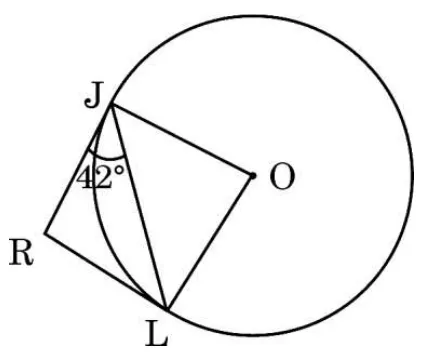
In the given figure, RJRJ and RLRL are two tangents to the circle. If ∠RJL=42∘\angle RJL = 42^\circ, then the measure of ∠JOL\angle JOL is:

A circle with centre O on the right. Two tangents RJ and RL from the outside point R on the left touch the circle at J (above) and L (below). The chord JL and the radii OJ and OL are drawn, and the angle RJL is marked 42 degrees.
  1. (A)42∘42^\circ
  2. (B)84∘84^\circ
  3. (C)96∘96^\circ
  4. (D)138∘138^\circ
Solution · answer (B)
42°96°84°ORJL∠JRL = 96°; ∠JOL = 180° − 96° = 84°
  1. Tangents from RR are equal: RJ=RLRJ = RL, so ∠RLJ=∠RJL=42∘\angle RLJ = \angle RJL = 42^\circ and ∠JRL=180∘−84∘=96∘\angle JRL = 180^\circ - 84^\circ = 96^\circ.
  2. OJ⊥RJOJ \perp RJ and OL⊥RLOL \perp RL, so in quadrilateral ORJLORJL: ∠JOL=360∘−90∘−90∘−96∘=84∘\angle JOL = 360^\circ - 90^\circ - 90^\circ - 96^\circ = 84^\circ.

Answer: (B) 84∘84^\circ

Report an error on this question
Q17Triangles1 mark

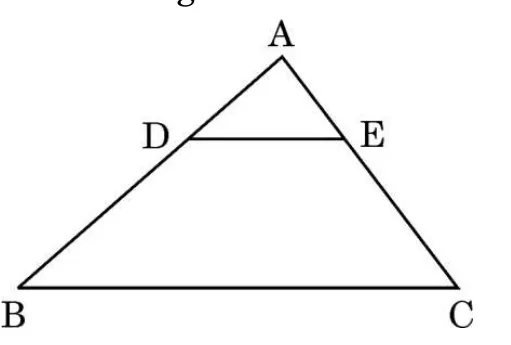
In the given figure, in △ABC\triangle ABC, DE∥BCDE \parallel BC. If AD=2.4AD = 2.4 cm, DB=4DB = 4 cm and AE=2AE = 2 cm, then the length of ACAC is:

Triangle ABC with a line DE drawn parallel to the base BC, D on AB and E on AC.
  1. (A)103\dfrac{10}{3} cm
  2. (B)310\dfrac{3}{10} cm
  3. (C)163\dfrac{16}{3} cm
  4. (D)1.21.2 cm
Solution · answer (C)
ABCDEEC = 10/3, so AC = 2 + 10/3 = 16/3 cmAE = 2
  1. DE∥BCDE \parallel BC, so ADDB=AEEC\dfrac{AD}{DB} = \dfrac{AE}{EC}: 2.44=2EC\dfrac{2.4}{4} = \dfrac{2}{EC}, so EC=82.4=103EC = \dfrac{8}{2.4} = \dfrac{10}{3} cm.
  2. AC=AE+EC=2+103=163AC = AE + EC = 2 + \dfrac{10}{3} = \dfrac{16}{3} cm.

Answer: (C) 163\dfrac{16}{3} cm

Common mistake: Giving EC=103EC = \dfrac{10}{3} (option A). The question asks for ACAC, which is AE+ECAE + EC.

Report an error on this question
Q18Triangles1 mark

If a vertical pole of length 7.5 m casts a shadow 5 m long on the ground and at the same time, a tower casts a shadow 24 m long, then the height of the tower is:

  1. (A)20 m
  2. (B)40 m
  3. (C)60 m
  4. (D)36 m
Solution · answer (D)
  1. At the same time the Sun makes the same angle, so the pole and the tower with their shadows form similar triangles.
  2. poleshadow=towershadow\dfrac{\text{pole}}{\text{shadow}} = \dfrac{\text{tower}}{\text{shadow}}: 7.55=h24\dfrac{7.5}{5} = \dfrac{h}{24}, so h=1.5×24=36h = 1.5 \times 24 = 36 m.

Answer: (D) 36 m

Report an error on this question
Q19Triangles1 mark

Assertion (A): ABCDABCD is a trapezium with DC∥ABDC \parallel AB. EE and FF are points on ADAD and BCBC respectively, such that EF∥ABEF \parallel AB. Then AEED=BFFC\dfrac{AE}{ED} = \dfrac{BF}{FC}.

Reason (R): Any line parallel to parallel sides of a trapezium divides the non-parallel sides proportionally.

  1. (A)Both A and R are true and R is the correct explanation of A
  2. (B)Both A and R are true, but R is not the correct explanation of A
  3. (C)A is true, but R is false
  4. (D)A is false, but R is true
Solution · answer (A)
  1. (R) A line parallel to the two parallel sides cuts the slanting sides in the same ratio. This is a standard result, so R is true.
  2. (A) is exactly this result applied to EFEF, so A is true and R explains A.

Answer: (A) Both true, and R explains A

Report an error on this question
Q20Polynomials1 mark

Assertion (A): Degree of a zero polynomial is not defined.

Reason (R): Degree of a non-zero constant polynomial is 00.

  1. (A)Both A and R are true and R is the correct explanation of A
  2. (B)Both A and R are true, but R is not the correct explanation of A
  3. (C)A is true, but R is false
  4. (D)A is false, but R is true
Solution · answer (B)
  1. (A) The zero polynomial has no non-zero term, so its degree is not defined. True.
  2. (R) A non-zero constant such as 5=5x05 = 5x^0 has degree 00. True.
  3. R is about non-zero constants and does not explain why the degree of the zero polynomial is undefined. So R is not the explanation of A.

Answer: (B) Both true, but R is not the correct explanation of A

Report an error on this question

Section B: Very short answer

5 questions, 2 marks each.

Q21Circles2 marks

(a) If two tangents inclined at an angle of 60∘60^\circ are drawn to a circle of radius 33 cm, then find the length of each tangent.

OR

(b) Prove that the tangents drawn at the ends of a diameter of a circle are parallel.

Solution
60°30°3√3OPABOP bisects ∠P: tan 30° = 3 / AP, so AP = 3√3 cm
OABBoth make 90° with AB, so they are parallel
  1. (a) Let the tangents PAPA and PBPB meet at PP with ∠APB=60∘\angle APB = 60^\circ. POPO bisects the angle, so ∠OPA=30∘\angle OPA = 30^\circ. OA⊥PAOA \perp PA.
  2. In △OAP\triangle OAP: tan⁡30∘=OAAP=3AP=13\tan 30^\circ = \dfrac{OA}{AP} = \dfrac{3}{AP} = \dfrac{1}{\sqrt{3}}, so AP=33AP = 3\sqrt{3} cm.
  3. (b) Let ABAB be a diameter with tangents PQPQ at AA and XYXY at BB. A tangent is perpendicular to the radius at the point of contact: ∠OAP=∠OBY=90∘\angle OAP = \angle OBY = 90^\circ.
  4. These are alternate interior angles on the transversal ABAB, and they are equal. So PQ∥XYPQ \parallel XY.

Answer: (a) 333\sqrt{3} cm   (b) proved

Report an error on this question
Q22Trigonometry2 marks

Evaluate: 2tan⁡30∘⋅sec⁡60∘⋅tan⁡45∘1−sin⁡260∘\dfrac{2\tan 30^\circ \cdot \sec 60^\circ \cdot \tan 45^\circ}{1 - \sin^2 60^\circ}

Solution
  1. Numerator: 2×13×2×1=432 \times \dfrac{1}{\sqrt{3}} \times 2 \times 1 = \dfrac{4}{\sqrt{3}}.
  2. Denominator: 1−(32)2=1−34=141 - \left(\dfrac{\sqrt{3}}{2}\right)^2 = 1 - \dfrac{3}{4} = \dfrac{1}{4}.
  3. Value =43×4=163=1633= \dfrac{4}{\sqrt{3}} \times 4 = \dfrac{16}{\sqrt{3}} = \dfrac{16\sqrt{3}}{3}.

Answer: 163=1633\dfrac{16}{\sqrt{3}} = \dfrac{16\sqrt{3}}{3}

Report an error on this question
Q23Polynomials2 marks

If α\alpha, β\beta are zeroes of the polynomial p(x)=5x2−6x+1p(x) = 5x^2 - 6x + 1, then find the value of α+β+αβ\alpha + \beta + \alpha\beta.

Solution
  1. α+β=−−65=65\alpha + \beta = -\dfrac{-6}{5} = \dfrac{6}{5} and αβ=15\alpha\beta = \dfrac{1}{5}.
  2. α+β+αβ=65+15=75\alpha + \beta + \alpha\beta = \dfrac{6}{5} + \dfrac{1}{5} = \dfrac{7}{5}.

Answer: 75\dfrac{7}{5}

Report an error on this question
Q24Coordinate Geometry2 marks

(a) Find the ratio in which the point P(−4,6)P(-4, 6) divides the line segment joining the points A(−6,10)A(-6, 10) and B(3,−8)B(3, -8).

OR

(b) Prove that the points (3,0)(3, 0), (6,4)(6, 4) and (−1,3)(-1, 3) are the vertices of an isosceles triangle.

Solution
  1. (a) Let PP divide ABAB in the ratio k:1k : 1. x=3k−6k+1=−4x = \dfrac{3k - 6}{k + 1} = -4, so 3k−6=−4k−43k - 6 = -4k - 4 and 7k=27k = 2, giving k=27k = \dfrac{2}{7}.
  2. The ratio is 2:72 : 7. (Check with yy: −8k+10k+1=−16/7+109/7=54/79/7=6\dfrac{-8k + 10}{k + 1} = \dfrac{-16/7 + 10}{9/7} = \dfrac{54/7}{9/7} = 6 ✓.)
  3. (b) Let A(3,0)A(3, 0), B(6,4)B(6, 4), C(−1,3)C(-1, 3). AB=9+16=5AB = \sqrt{9 + 16} = 5, BC=49+1=50BC = \sqrt{49 + 1} = \sqrt{50}, CA=16+9=5CA = \sqrt{16 + 9} = 5.
  4. AB=CAAB = CA, so two sides are equal: △ABC\triangle ABC is isosceles.

Answer: (a) 2:72 : 7   (b) proved (AB=CA=5AB = CA = 5)

Report an error on this question
Q25Probability2 marks

A carton consists of 60 shirts of which 48 are good, 8 have major defects and 4 have minor defects. Nigam, a trader, will accept the shirts which are good but Anmol, another trader, will only reject the shirts which have major defects. One shirt is drawn at random from the carton. Find the probability that it is acceptable to Anmol.

Solution
  1. Anmol rejects only the shirts with major defects, so he accepts 60−8=5260 - 8 = 52 shirts (the 4848 good and the 44 with minor defects).
  2. P=5260=1315P = \dfrac{52}{60} = \dfrac{13}{15}.

Answer: 1315\dfrac{13}{15}

Common mistake: Using 48, which is what Nigam accepts. Anmol accepts the good shirts and the minor-defect ones too.

Report an error on this question

Section C: Short answer

6 questions, 3 marks each.

Q26Real Numbers3 marks

(a) Prove that 3\sqrt{3} is an irrational number.

OR

(b) Prove that (2+3)2\left(\sqrt{2} + \sqrt{3}\right)^2 is an irrational number, given that 6\sqrt{6} is an irrational number.

Solution
  1. (a) Suppose 3=pq\sqrt{3} = \dfrac{p}{q} with p,qp, q co-prime and q≠0q \neq 0. Then 3q2=p23q^2 = p^2, so 33 divides pp. Write p=3ap = 3a: 9a2=3q29a^2 = 3q^2, so q2=3a2q^2 = 3a^2 and 33 divides qq.
  2. Both pp and qq are divisible by 33: a contradiction. So 3\sqrt{3} is irrational.
  3. (b) (2+3)2=2+3+26=5+26(\sqrt{2} + \sqrt{3})^2 = 2 + 3 + 2\sqrt{6} = 5 + 2\sqrt{6}. Suppose it is rational, =ab= \dfrac{a}{b} with integers a,ba, b and b≠0b \neq 0.
  4. Then 6=a−5b2b\sqrt{6} = \dfrac{a - 5b}{2b}, which is rational. But 6\sqrt{6} is irrational (given), a contradiction. So 5+265 + 2\sqrt{6} is irrational.

Answer: (a) proved   (b) proved

Report an error on this question
Q27Arithmetic Progressions3 marks

(a) If the sum of the first 1414 terms of an A.P. is 10501050 and the first term is 1010, then find the 2020th term and the nnth term.

OR

(b) The first term of an A.P. is 55, the last term is 4545 and the sum of all the terms is 400400. Find the number of terms and the common difference of the A.P.

Solution
  1. (a) S14=142[2×10+13d]=1050S_{14} = \dfrac{14}{2}[2 \times 10 + 13d] = 1050, so 20+13d=15020 + 13d = 150 and d=10d = 10.
  2. a20=10+19×10=200a_{20} = 10 + 19 \times 10 = 200 and an=10+(n−1)×10=10na_n = 10 + (n - 1) \times 10 = 10n.
  3. (b) Sn=n2(a+l)=n2(5+45)=25n=400S_n = \dfrac{n}{2}(a + l) = \dfrac{n}{2}(5 + 45) = 25n = 400, so n=16n = 16.
  4. a16=5+15d=45a_{16} = 5 + 15d = 45, so d=4015=83d = \dfrac{40}{15} = \dfrac{8}{3}.

Answer: (a) a20=200a_{20} = 200, an=10na_n = 10n   (b) n=16n = 16, d=83d = \dfrac{8}{3}

Report an error on this question
Q28Circles3 marks

Prove that the parallelogram circumscribing a circle is a rhombus.

Solution
  1. Let parallelogram ABCDABCD circumscribe a circle touching AB,BC,CD,DAAB, BC, CD, DA at P,Q,R,SP, Q, R, S. Tangents from a point are equal: AP=ASAP = AS, BP=BQBP = BQ, CR=CQCR = CQ, DR=DSDR = DS.
  2. Add: (AP+BP)+(CR+DR)=(AS+DS)+(BQ+CQ)(AP + BP) + (CR + DR) = (AS + DS) + (BQ + CQ), so AB+CD=AD+BCAB + CD = AD + BC.
  3. In a parallelogram AB=CDAB = CD and AD=BCAD = BC, so 2AB=2BC2AB = 2BC and AB=BCAB = BC. All four sides are equal: ABCDABCD is a rhombus.

Answer: Proved

Report an error on this question
Q29Trigonometry3 marks

Prove that: tan⁡A1−cot⁡A+cot⁡A1−tan⁡A=1+sec⁡A cosec A\dfrac{\tan A}{1 - \cot A} + \dfrac{\cot A}{1 - \tan A} = 1 + \sec A\,\mathrm{cosec}\,A

Solution
  1. tan⁡A1−cot⁡A=sin⁡2Acos⁡A(sin⁡A−cos⁡A)\dfrac{\tan A}{1 - \cot A} = \dfrac{\sin^2 A}{\cos A(\sin A - \cos A)} and cot⁡A1−tan⁡A=cos⁡2Asin⁡A(cos⁡A−sin⁡A)=−cos⁡2Asin⁡A(sin⁡A−cos⁡A)\dfrac{\cot A}{1 - \tan A} = \dfrac{\cos^2 A}{\sin A(\cos A - \sin A)} = -\dfrac{\cos^2 A}{\sin A(\sin A - \cos A)}.
  2. Sum =1sin⁡A−cos⁡A[sin⁡2Acos⁡A−cos⁡2Asin⁡A]=sin⁡3A−cos⁡3Asin⁡Acos⁡A(sin⁡A−cos⁡A)= \dfrac{1}{\sin A - \cos A}\left[\dfrac{\sin^2 A}{\cos A} - \dfrac{\cos^2 A}{\sin A}\right] = \dfrac{\sin^3 A - \cos^3 A}{\sin A\cos A(\sin A - \cos A)}.
  3. Using a3−b3=(a−b)(a2+ab+b2)a^3 - b^3 = (a - b)(a^2 + ab + b^2): =1+sin⁡Acos⁡Asin⁡Acos⁡A=1sin⁡Acos⁡A+1=1+sec⁡A cosec A= \dfrac{1 + \sin A\cos A}{\sin A\cos A} = \dfrac{1}{\sin A\cos A} + 1 = 1 + \sec A\,\mathrm{cosec}\,A = RHS.

Answer: Proved

Report an error on this question
Q30Probability3 marks

Three unbiased coins are tossed simultaneously. Find the probability of getting: (i) at least one head. (ii) exactly one tail. (iii) two heads and one tail.

Solution
  1. 88 equally likely outcomes: HHH,HHT,HTH,HTT,THH,THT,TTH,TTTHHH, HHT, HTH, HTT, THH, THT, TTH, TTT.
  2. (i) At least one head: all except TTTTTT: 78\dfrac{7}{8}.
  3. (ii) Exactly one tail: HHT,HTH,THHHHT, HTH, THH: 38\dfrac{3}{8}. (iii) Two heads and one tail: the same three outcomes: 38\dfrac{3}{8}.

Answer: (i) 78\dfrac{7}{8}   (ii) 38\dfrac{3}{8}   (iii) 38\dfrac{3}{8}

Report an error on this question
Q31Areas Related to Circles3 marks

An arc of a circle of radius 1010 cm subtends a right angle at the centre of the circle. Find the area of the corresponding major sector. (Use π=3.14\pi = 3.14)

Solution
OABminor 78.5major 235.5 cm²major = circle (314) − minor (78.5)
  1. Area of the circle =3.14×10×10=314= 3.14 \times 10 \times 10 = 314 cm².
  2. Area of the minor sector =90360×314=78.5= \dfrac{90}{360} \times 314 = 78.5 cm².
  3. Area of the major sector =314−78.5=235.5= 314 - 78.5 = 235.5 cm².

Answer: 235.5235.5 cm²

Common mistake: Giving the minor sector (78.5 cm²). The question asks for the major sector.

Report an error on this question

Section D: Long answer

4 questions, 5 marks each.

Q32Quadratic Equations5 marks

(a) Find the value of ‘kk’ for which the quadratic equation (k+1)x2−6(k+1)x+3(k+9)=0(k + 1)x^2 - 6(k + 1)x + 3(k + 9) = 0, k≠−1k \neq -1 has real and equal roots.

OR

(b) The age of a man is twice the square of the age of his son. Eight years hence, the age of the man will be 44 years more than three times the age of his son. Find their present ages.

Solution
  1. (a) Real and equal roots need D=0D = 0: 36(k+1)2−4(k+1)×3(k+9)=036(k + 1)^2 - 4(k + 1) \times 3(k + 9) = 0.
  2. 12(k+1)[3(k+1)−(k+9)]=012(k + 1)[3(k + 1) - (k + 9)] = 0, that is 12(k+1)(2k−6)=012(k + 1)(2k - 6) = 0. As k≠−1k \neq -1, 2k−6=02k - 6 = 0 and k=3k = 3.
  3. (b) Let the son's age be xx years. The man's age is 2x22x^2.
  4. Eight years later: 2x2+8=3(x+8)+42x^2 + 8 = 3(x + 8) + 4, so 2x2−3x−20=02x^2 - 3x - 20 = 0 and (2x+5)(x−4)=0(2x + 5)(x - 4) = 0.
  5. Age is positive, so x=4x = 4. The son is 44 years old and the man is 2×16=322 \times 16 = 32 years old.

Answer: (a) k=3k = 3   (b) son 44 years, man 3232 years

Report an error on this question
Q33Applications of Trigonometry5 marks

From a point on a bridge across the river, the angles of depressions of the banks on opposite sides of the river are 30∘30^\circ and 60∘60^\circ respectively. If the bridge is at a height of 44 m from the banks, find the width of the river.

Solution
30°60°4 mPFABAF = 4√3, FB = 4/√3: width = 16√3/3 ≈ 9.24 m
  1. Let PP be the point on the bridge, PF=4PF = 4 m, and let the banks be AA and BB, with ∠\angle of depression 30∘30^\circ to AA and 60∘60^\circ to BB.
  2. In △PFA\triangle PFA: tan⁡30∘=4AF=13\tan 30^\circ = \dfrac{4}{AF} = \dfrac{1}{\sqrt{3}}, so AF=43AF = 4\sqrt{3} m.
  3. In △PFB\triangle PFB: tan⁡60∘=4FB=3\tan 60^\circ = \dfrac{4}{FB} = \sqrt{3}, so FB=43FB = \dfrac{4}{\sqrt{3}} m.
  4. Width of the river =AF+FB=43+43=12+43=163=1633= AF + FB = 4\sqrt{3} + \dfrac{4}{\sqrt{3}} = \dfrac{12 + 4}{\sqrt{3}} = \dfrac{16}{\sqrt{3}} = \dfrac{16\sqrt{3}}{3} m ≈9.24\approx 9.24 m.

Answer: 1633\dfrac{16\sqrt{3}}{3} m ≈9.24\approx 9.24 m

Report an error on this question
Q34Triangles5 marks

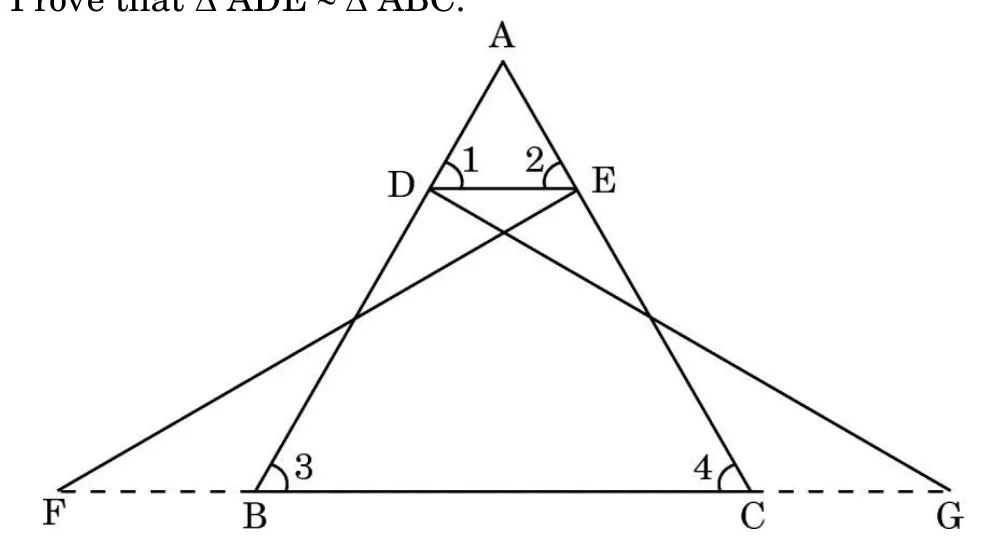
(a) In the given figure, △FEC≅△GDB\triangle FEC \cong \triangle GDB and ∠1=∠2\angle 1 = \angle 2. Prove that △ADE∼△ABC\triangle ADE \sim \triangle ABC.

OR

(b) Sides ABAB and ACAC and median ADAD of a △ABC\triangle ABC are respectively proportional to sides PQPQ and PRPR and median PMPM of another △PQR\triangle PQR. Show that △ABC∼△PQR\triangle ABC \sim \triangle PQR.

Triangle ABC with a short line DE across the top, D on AB and E on AC, angles 1 and 2 marked at D and E. The base BC is extended to F on the left and G on the right, and the lines FE and GD cross each other inside the triangle. Angles 3 and 4 are marked at B and C.
Solution
1234ABCDEFG∠3 = ∠4 → AB = AC; ∠1 = ∠2 → AD = AE; so AD/AB = AE/AC
  1. (a) △FEC≅△GDB\triangle FEC \cong \triangle GDB, so their corresponding angles are equal: ∠3=∠4\angle 3 = \angle 4 (at BB and CC).
  2. In △ABC\triangle ABC, ∠3=∠4\angle 3 = \angle 4, so AB=ACAB = AC. … (i) In △ADE\triangle ADE, ∠1=∠2\angle 1 = \angle 2, so AD=AEAD = AE. … (ii)
  3. Divide (ii) by (i): ADAB=AEAC\dfrac{AD}{AB} = \dfrac{AE}{AC}. By the converse of the Basic Proportionality Theorem, DE∥BCDE \parallel BC.
  4. So ∠1=∠3\angle 1 = \angle 3 and ∠2=∠4\angle 2 = \angle 4 (corresponding angles), and △ADE∼△ABC\triangle ADE \sim \triangle ABC (AA).
  5. (b) Produce ADAD to EE so that AD=DEAD = DE and join ECEC. Produce PMPM to LL so that PM=MLPM = ML and join LRLR. △ABD≅△ECD\triangle ABD \cong \triangle ECD (SAS), so AB=ECAB = EC. Similarly PQ=LRPQ = LR.
  6. Given ABPQ=ACPR=ADPM\dfrac{AB}{PQ} = \dfrac{AC}{PR} = \dfrac{AD}{PM}, we get ECLR=ACPR=2AD2PM=AEPL\dfrac{EC}{LR} = \dfrac{AC}{PR} = \dfrac{2AD}{2PM} = \dfrac{AE}{PL}. So △AEC∼△PLR\triangle AEC \sim \triangle PLR (SSS), giving ∠2=∠4\angle 2 = \angle 4 (as marked in the proof). Similarly ∠1=∠3\angle 1 = \angle 3.
  7. Adding both: ∠BAC=∠QPR\angle BAC = \angle QPR. With ABPQ=ACPR\dfrac{AB}{PQ} = \dfrac{AC}{PR}, △ABC∼△PQR\triangle ABC \sim \triangle PQR (SAS).

Answer: (a) △ADE∼△ABC\triangle ADE \sim \triangle ABC   (b) △ABC∼△PQR\triangle ABC \sim \triangle PQR

Report an error on this question
Q35Surface Areas and Volumes5 marks

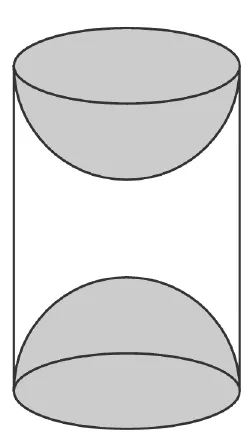
A wooden article was made by scooping out a hemisphere from each end of a solid cylinder, as shown in the figure. If the height of the cylinder is 5.85.8 cm and its base is of radius 2.12.1 cm, find the total surface area of the article.

A solid cylinder with a hemisphere scooped out of the top end and another from the bottom end, so each end is a hollow bowl.
Solution
ABCDh = 5.8 cmr = 2.1 cmTSA = 2πrh + 2 × 2πr² = 76.56 + 55.44 = 132 cm²
  1. After scooping, the flat ends are gone. The surface is the curved surface of the cylinder plus the curved surfaces of the two hemispherical hollows.
  2. Curved surface of the cylinder =2πrh=2×227×2.1×5.8=76.56= 2\pi r h = 2 \times \dfrac{22}{7} \times 2.1 \times 5.8 = 76.56 cm².
  3. Two hemispheres: 2×2πr2=4×227×2.1×2.1=55.442 \times 2\pi r^2 = 4 \times \dfrac{22}{7} \times 2.1 \times 2.1 = 55.44 cm².
  4. Total surface area =76.56+55.44=132= 76.56 + 55.44 = 132 cm².

Answer: 132132 cm²

Common mistake: Adding the two flat circles of the cylinder. They are completely scooped out, so they are not part of the surface.

Report an error on this question

Section E: Case studies

3 case studies, 4 marks each.

Q36Linear Equations4 marks

Case study 1. Essel World is one of India’s largest amusement parks that offers a diverse range of thrilling rides, water attractions and entertainment options for visitors of all ages. The park is known for its iconic “Water Kingdom” section, making it a popular destination for family outings and fun-filled adventure. The ticket charges for the park are ₹ 150 per child and ₹ 250 per adult. On a day, the cashier of the park found that 300 tickets were sold and an amount of ₹ 55,000 was collected.

Based on the above, answer the following questions:

(i) If the number of children visited be x and the number of adults visited be y, then write the given situation algebraically. [1]

(ii) (a) How many children visited the amusement park that day? [2]

OR

(ii) (b) How many adults visited the amusement park that day? [2]

(iii) How much amount will be collected if 250 children and 100 adults visit the amusement park? [1]

Figure: A photo of a roller coaster ride at an amusement park.

Solution
100200300400100200300400Ochildren xadults yx + y = 3003x + 5y = 1100(200, 100)
  1. (i) Total tickets: x+y=300x + y = 300. … (i) Total money: 150x+250y=55000150x + 250y = 55000, that is 3x+5y=11003x + 5y = 1100. … (ii)
  2. (ii)(a) From (i), y=300−xy = 300 - x. Put in (ii): 3x+5(300−x)=11003x + 5(300 - x) = 1100, so 3x+1500−5x=11003x + 1500 - 5x = 1100, −2x=−400-2x = -400 and x=200x = 200. 200200 children visited.
  3. (ii)(b) y=300−200=100y = 300 - 200 = 100. 100100 adults visited.
  4. (iii) 250×150+100×250=37500+25000=₹62,500250 \times 150 + 100 \times 250 = 37500 + 25000 = ₹62{,}500.

Answer: (i) x+y=300, 150x+250y=55000x + y = 300,\ 150x + 250y = 55000   (ii)(a) 200200   (ii)(b) 100100   (iii) ₹ 62,50062{,}500

Report an error on this question
Q37Coordinate Geometry4 marks

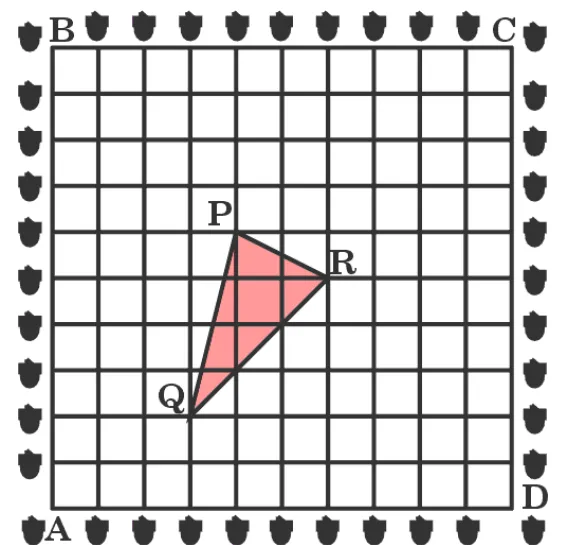
Case study 2. A garden is in the shape of a square. The gardener grew saplings of Ashoka tree on the boundary of the garden at the distance of 1 m from each other. He wants to decorate the garden with rose plants. He chose a triangular region inside the garden to grow rose plants. In the above situation, the gardener took help from the students of class 10. They made a chart for it which looks like the given figure.

Based on the above, answer the following questions:

(i) If A is taken as origin, what are the coordinates of the vertices of ΔPQR? [1]

(ii) (a) Find distances PQ and QR. [2]

OR

(ii) (b) Find the coordinates of the point which divides the line segment joining points P and R in the ratio 2 : 1 internally. [2]

(iii) Find out if ΔPQR is an isosceles triangle. [1]

A square garden ABCD drawn on a grid with A at the bottom left, B at the top left, C at the top right and D at the bottom right. Saplings are planted along the boundary. A shaded triangle PQR inside the grid has P near the top, Q at the lower left and R to the right.
Solution
1234567891012345678910OxyP(4, 6)Q(3, 2)R(6, 5)(16/3, 16/3)
  1. (i) With AA as the origin and the grid squares of side 11 m, reading off the grid: P=(4,6)P = (4, 6), Q=(3,2)Q = (3, 2), R=(6,5)R = (6, 5).
  2. (ii)(a) PQ=(4−3)2+(6−2)2=17PQ = \sqrt{(4 - 3)^2 + (6 - 2)^2} = \sqrt{17} and QR=(3−6)2+(2−5)2=18=32QR = \sqrt{(3 - 6)^2 + (2 - 5)^2} = \sqrt{18} = 3\sqrt{2}.
  3. (ii)(b) Section formula for PP to RR in the ratio 2:12 : 1: x=2×6+1×43=163x = \dfrac{2 \times 6 + 1 \times 4}{3} = \dfrac{16}{3} and y=2×5+1×63=163y = \dfrac{2 \times 5 + 1 \times 6}{3} = \dfrac{16}{3}. The point is (163,163)\left(\dfrac{16}{3}, \dfrac{16}{3}\right).
  4. (iii) PQ=17PQ = \sqrt{17}, QR=18QR = \sqrt{18} and PR=(4−6)2+(6−5)2=5PR = \sqrt{(4 - 6)^2 + (6 - 5)^2} = \sqrt{5}. No two sides are equal, so △PQR\triangle PQR is not isosceles.

Answer: (i) P(4,6), Q(3,2), R(6,5)P(4, 6),\ Q(3, 2),\ R(6, 5)   (ii)(a) 17\sqrt{17} and 18\sqrt{18}   (ii)(b) (163,163)\left(\dfrac{16}{3}, \dfrac{16}{3}\right)   (iii) not isosceles

Common mistake: In (ii)(b), swapping the ratio. For 2 : 1 from P, the weight 2 goes with the coordinates of R.

Report an error on this question
Q38Statistics4 marks

Case study 3. Activities like running or cycling reduce stress and the risk of mental disorders like depression. Running helps build endurance. Children develop stronger bones and muscles and are less prone to gain weight. The physical education teacher of a school has decided to conduct an inter school running tournament in his school premises. The time taken by a group of students to run 100 m, was noted as follows:

Based on the above, answer the following questions:

(i) What is the median class of the above given data? [1]

(ii) (a) Find the mean time taken by the students to finish the race. [2]

OR

(ii) (b) Find the mode of the above given data. [2]

(iii) How many students took time less than 60 seconds? [1]

Time (in seconds)0 – 2020 – 4040 – 6060 – 8080 – 100
Number of students8101363
Solution
20406080100246810121416Osecondsy8101363mode 46mean 43
Modal class and median class: 40 – 60.
  1. Cumulative frequencies: 8, 18, 31, 37, 408,\ 18,\ 31,\ 37,\ 40. N=40N = 40 and N2=20\dfrac{N}{2} = 20.
  2. (i) The first cumulative frequency above 2020 is 3131, so the median class is 40−6040 - 60.
  3. (ii)(a) Class marks xix_i: 10,30,50,70,9010, 30, 50, 70, 90. fixif_i x_i: 80, 300, 650, 420, 27080,\ 300,\ 650,\ 420,\ 270. ∑fixi=1720\sum f_i x_i = 1720. Mean =172040=43= \dfrac{1720}{40} = 43 seconds.
  4. (ii)(b) Modal class 40−6040 - 60: l=40l = 40, f1=13f_1 = 13, f0=10f_0 = 10, f2=6f_2 = 6, h=20h = 20. Mode =40+13−1026−10−6×20=40+310×20=46= 40 + \dfrac{13 - 10}{26 - 10 - 6} \times 20 = 40 + \dfrac{3}{10} \times 20 = 46 seconds.
  5. (iii) Time less than 6060 seconds: 8+10+13=318 + 10 + 13 = 31 students.

Answer: (i) 40−6040 - 60   (ii)(a) 4343 s   (ii)(b) 4646 s   (iii) 3131

Report an error on this question

Questions are from the official CBSE paper. Figures are described in words; see the PDF for the originals. Solutions are written by CogniGuru.

Revise this paper in 1 minute a chapter

Each chapter below is what the paper tested, with a one-minute animated lesson on the idea behind it.

Stuck on a step in any solution?

The CogniGuru AI tutor explains any doubt one minute at a time, in English or Hindi. Join the waitlist.

Mock quiz: 5 questions from this paper

Five real questions from this paper, one each from five chapters. About 2 minutes. See how much you know and where you stand among other students. Attempt free, with no login; log in only for your ranking and full report.

Question 1 of 5 · Q1 of the paperArithmetic Progressions

The next (4th) term of the A.P. 18, 50, 98, …\sqrt{18},\ \sqrt{50},\ \sqrt{98},\ \dots is:

0 of 5 answered

Related papers

Common questions

Are these the official CBSE Class 10 Maths Standard 2024 questions?
Yes. The questions are from the official Mathematics (Standard) paper (set 30/5/1) that CBSE published after the March 2024 board exam. The solutions are written by CogniGuru and checked against the answer key CBSE published for this paper code.
Can I download the CBSE Class 10 Maths Standard 2024 question paper PDF?
Yes, the official paper PDF is free to download from this page, and so are our step-by-step solutions as a PDF. No login is needed to download either or to read the solutions.
Do all sets of the paper have the same questions?
No. CBSE sets several versions of each paper, with the same blueprint and similar questions in a different order and sometimes with different numbers. This page covers set 30/5/1.
How does the quiz work, and what does “where you stand” mean?
It is a mock quiz of 5 real multiple-choice questions from this paper, scored automatically in about 2 minutes. Your score is compared, anonymously, with other students who took the same quiz. Only the score is stored with the comparison, never your name or number.

Source

CBSE question paper archive, Class X, 2024 (Mathematics (Standard), set 30/5/1)
PDF