CBSE · Class 10 · Science · Free

CBSE Class 10 Science 2025 Question Paper (Set 31/1/1) with Solutions

The official board paper (Q.P. Code 31/1/1, Series 1GEFH). Free paper PDF and step-by-step solutions (also as a PDF to download) written by CogniGuru and checked against CBSE’s answer key. See the paper’s main topics in 1 minute, then quiz yourself to see how much you know and where you stand.

No login to download or read the solutions. Login only to see your quiz report in full.

Board
CBSE
Class
10
Subject
Science (086)
Year
2025
Set code
31/1/1
Max marks
80
Duration
3 hours
Questions
39 (Sections A to E)
Source
Official CBSE paper
Exam date
March 2025

Paper preview

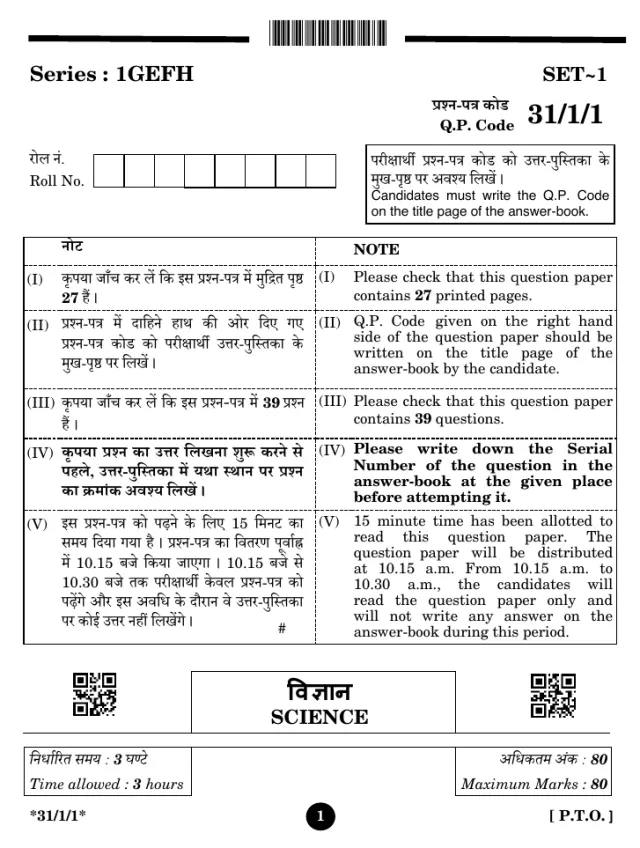
Three pages of the official paper. Download the PDF for all 27.

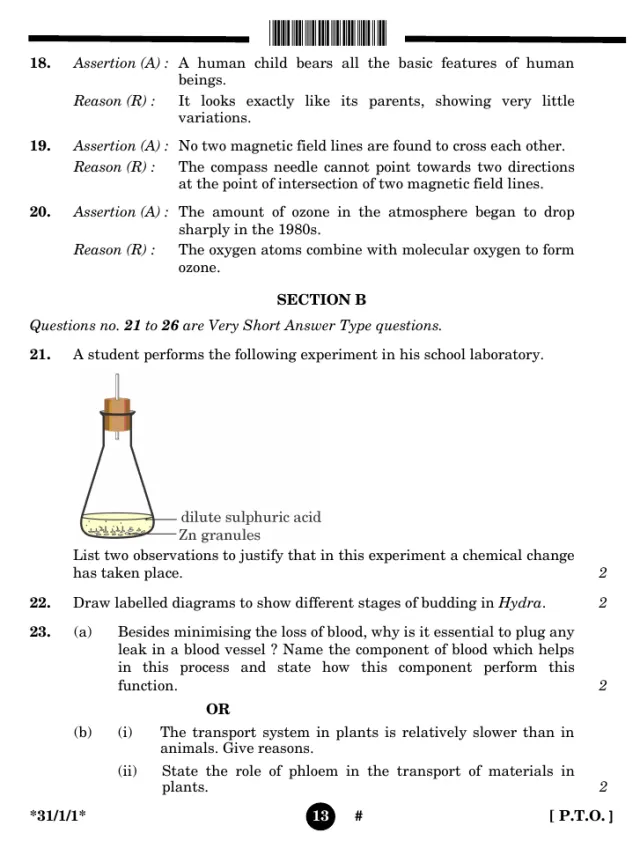
  • Cover page of the CBSE Class 10 Science 2025 paper, set 31/1/1

    Cover page

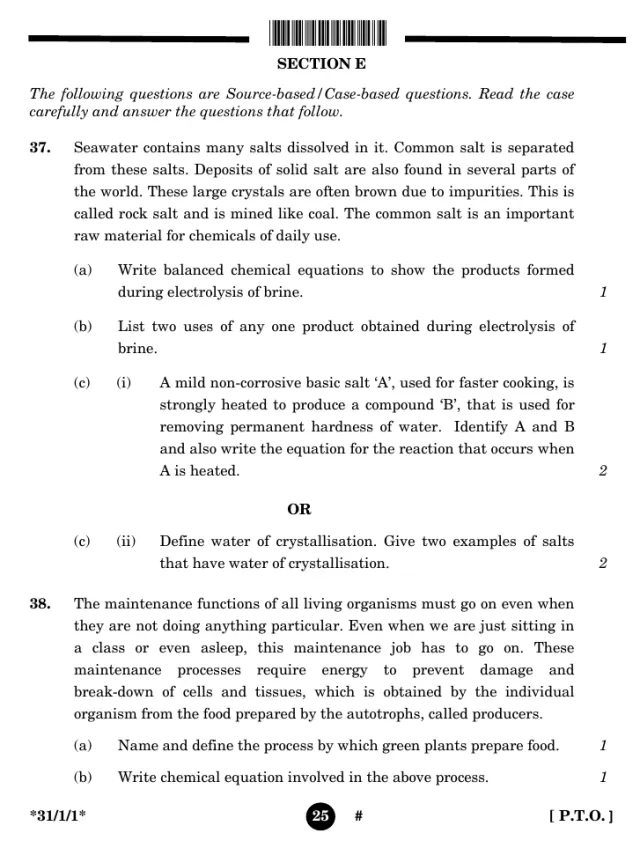
  • Section B of the CBSE Class 10 Science 2025 paper, set 31/1/1

    Section B

  • A case study with its figure from the CBSE Class 10 Science 2025 paper, set 31/1/1

    Case study

The main topics of this paper, in 1 minute

Your tutor walks you through the paper before you attempt it: the marks, the key ideas, the time plan and the traps.

1-minute paper analysis

With your tutor, in her voice

The main topics of this paper, in about a minute

A short, animated walk through the paper: how it is built, where the marks come from, the four ideas that matter most, how to plan your three hours, and the traps to avoid.

  1. 1The paper at a glance
  2. 2Where the marks come from
  3. 3Four ideas that keep paying off
  4. 4Plan your three hours
  5. 5Four traps to avoid

Sound on for the voice. Captions are shown, and you can mute any time.

Step-by-step solutions

Try each question first, then open its solution. Tap a number to jump.

Download solutions (PDF)

Section A: Multiple choice

20 questions, 1 mark each. MCQs (Q1 to Q16) and assertion-reason (Q17 to Q20).

Q1Chemical Reactions and Equations1 mark

Electrolysis of water is a decomposition reaction. The mass ratio (MH:MOM_H : M_O) of hydrogen and oxygen gases liberated at the electrodes during electrolysis of water is:

  1. (A)8 : 1
  2. (B)2 : 1
  3. (C)1 : 2
  4. (D)1 : 8
Solution · answer (D)
  1. 2H2O→2H2+O22\mathrm{H_2O} \rightarrow 2\mathrm{H_2} + \mathrm{O_2}. Twice as many molecules of hydrogen as oxygen are formed (the volume ratio is 2:12 : 1).
  2. Mass: 2×2=42 \times 2 = 4 g of H2\mathrm{H_2} for 3232 g of O2\mathrm{O_2}, so MH:MO=4:32=1:8M_H : M_O = 4 : 32 = 1 : 8.

Answer: (D) 1 : 8

Common mistake: Giving 2:12 : 1. That is the ratio of volumes, not masses; oxygen atoms are 1616 times heavier than hydrogen atoms.

Report an error on this question
Q2Metals and Non-metals1 mark

The products formed when Aluminium and Magnesium are burnt in the presence of air respectively are:

  1. (A)Al3O4\mathrm{Al_3O_4} and MgO2\mathrm{MgO_2}
  2. (B)Al2O3\mathrm{Al_2O_3} and MgO\mathrm{MgO}
  3. (C)Al3O4\mathrm{Al_3O_4} and MgO\mathrm{MgO}
  4. (D)Al2O3\mathrm{Al_2O_3} and MgO2\mathrm{MgO_2}
Solution · answer (B)
  1. Aluminium is Al3+\mathrm{Al^{3+}} and oxygen is O2−\mathrm{O^{2-}}: balance the charges, 2×(+3)=3×(−2)2 \times (+3) = 3 \times (-2), so the oxide is Al2O3\mathrm{Al_2O_3}.
  2. Magnesium is Mg2+\mathrm{Mg^{2+}}, which balances one O2−\mathrm{O^{2-}}: MgO\mathrm{MgO}.

Answer: (B) Al2O3\mathrm{Al_2O_3} and MgO\mathrm{MgO}

Report an error on this question
Q3Acids, Bases and Salts1 mark

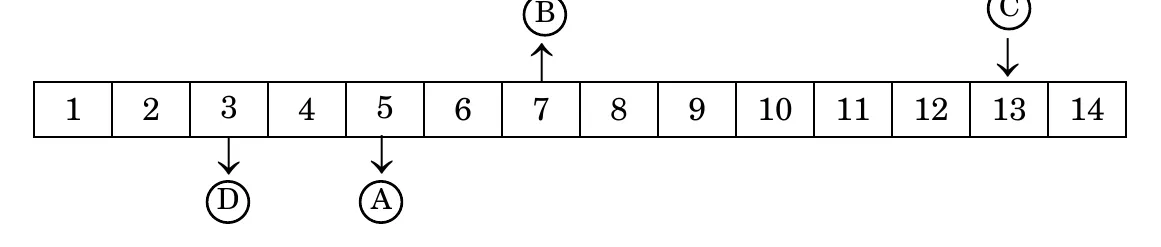
The following table shows the pH values of four solutions A, B, C and D on a pH scale. The solutions A, B, C and D respectively are of a:

A pH scale from 1 to 14. Solution D is marked at pH 3, A at pH 5, B at pH 7 and C at pH 13.
  1. (A)Strong acid, weak acid, neutral, strong base
  2. (B)Weak acid, neutral, weak base, strong base
  3. (C)Weak acid, neutral, strong base, weak base
  4. (D)Weak acid, neutral, strong base, strong acid
Solution · answer (D)
1234567891011121314Aweak acidDstrong acidBneutralCstrong baseBelow 7: acidic (lower = stronger)Above 7: basic (higher = stronger)
  1. Read the pH values: A=5A = 5, B=7B = 7, C=13C = 13, D=3D = 3.
  2. pH<7\mathrm{pH} < 7 is acidic, the lower the stronger: AA (55) is a weak acid and DD (33) is a strong acid. pH=7\mathrm{pH} = 7 is neutral (BB). pH>7\mathrm{pH} > 7 is basic: CC (1313) is a strong base.

Answer: (D) Weak acid, neutral, strong base, strong acid

Common mistake: Reading the solutions in the order of the scale (1 to 14) instead of in the order of the letters A, B, C, D.

Report an error on this question
Q4Acids, Bases and Salts1 mark

Consider the following reactions:

(i) Dilute hydrochloric acid reacts with sodium hydroxide.

(ii) Magnesium oxide reacts with dilute hydrochloric acid.

(iii) Carbon dioxide reacts with sodium hydroxide.

It is found that in each case:

  1. (A)Salt and water is formed.
  2. (B)Neutral salts are formed.
  3. (C)Hydrogen gas is formed.
  4. (D)Acidic salts are formed.
Solution · answer (A)
  1. (i) HCl+NaOH→NaCl+H2O\mathrm{HCl + NaOH \rightarrow NaCl + H_2O} (neutralisation).
  2. (ii) MgO+2HCl→MgCl2+H2O\mathrm{MgO + 2HCl \rightarrow MgCl_2 + H_2O} (a metal oxide is basic, so it neutralises the acid).
  3. (iii) CO2+2NaOH→Na2CO3+H2O\mathrm{CO_2 + 2NaOH \rightarrow Na_2CO_3 + H_2O} (a non-metal oxide is acidic, so it reacts with the base).
  4. In all three, a salt and water are formed. No hydrogen gas appears, and the salt in (iii) is a basic salt, not neutral or acidic.

Answer: (A) Salt and water is formed.

Report an error on this question
Q5Metals and Non-metals1 mark

Reaction between two elements A and B, forms a compound C. A loses electrons and B gains electrons. Which one of the following properties will not be shown by compound C?

  1. (A)It has high melting point.
  2. (B)It is highly soluble in water.
  3. (C)It has weak electrostatic forces of attraction between its oppositely charged ions.
  4. (D)It conducts electricity in its molten state or aqueous solution.
Solution · answer (C)
  1. When A gives electrons to B, an ionic compound forms.
  2. Ionic compounds have strong electrostatic forces between the oppositely charged ions. That is why they have high melting points, dissolve in water and conduct electricity when molten or dissolved.
  3. So the one property it does not show is “weak” forces of attraction.

Answer: (C) It has weak electrostatic forces of attraction between its oppositely charged ions.

Report an error on this question
Q6Metals and Non-metals1 mark

The metals obtained from their molten chlorides by the process of electrolytic reduction are:

  1. (A)Gold and silver
  2. (B)Calcium and magnesium
  3. (C)Aluminium and silver
  4. (D)Sodium and iron
Solution · answer (B)
  1. Metals high in the reactivity series (sodium, calcium, magnesium and so on) hold on to their oxygen or chlorine too strongly for carbon to reduce them. They are extracted by electrolysis of their molten chlorides.
  2. Gold and silver are very unreactive and occur native or are easily obtained, and iron is extracted by reduction of its oxide with carbon. So the pair is calcium and magnesium.

Answer: (B) Calcium and magnesium

Report an error on this question
Q7Metals and Non-metals1 mark

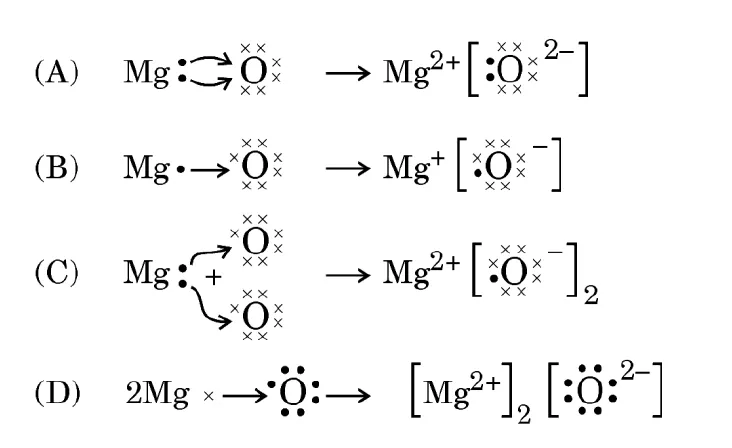
The formation of magnesium oxide is correctly shown in option:

Four electron-dot diagrams, A to D, each showing magnesium reacting with oxygen to form magnesium oxide.
  1. (A)(A) One Mg atom gives 22 electrons to one O atom: Mg2+\mathrm{Mg^{2+}} and O2−\mathrm{O^{2-}}
  2. (B)(B) One Mg atom gives 11 electron: Mg+\mathrm{Mg^{+}} and O−\mathrm{O^{-}}
  3. (C)(C) One Mg atom gives electrons to two O atoms: Mg2+\mathrm{Mg^{2+}} and two O−\mathrm{O^{-}} ions
  4. (D)(D) Two Mg atoms give electrons to one O atom: (Mg2+)2(\mathrm{Mg^{2+}})_2 and O2−\mathrm{O^{2-}}
Solution · answer (A)
  1. Magnesium has 22 outer electrons (2, 8, 2) and oxygen has 66 (2, 6) and needs 22 more to complete its octet.
  2. So one Mg atom transfers both its outer electrons to one O atom, giving Mg2+\mathrm{Mg^{2+}} and O2−\mathrm{O^{2-}} in the ratio 1:11 : 1: MgO\mathrm{MgO}.
  3. Option A shows exactly this. The other options show a wrong number of electrons moved or a wrong ratio of ions.

Answer: (A)

Report an error on this question
Q8Life Processes1 mark

Secretion of less saliva in mouth will effect the conversion of:

  1. (A)proteins into amino acids
  2. (B)fats into fatty acids and glycerol
  3. (C)starch into simple sugars
  4. (D)sugars into alcohol
Solution · answer (C)
  1. Saliva contains the enzyme salivary amylase, which starts breaking down starch in the mouth into simple sugars (maltose).
  2. With less saliva, this conversion is affected. Protein and fat digestion happen later, in the stomach and small intestine.

Answer: (C) starch into simple sugars

Report an error on this question
Q9Control and Coordination1 mark

The plant hormone whose concentration stimulates the cells to grow longer on the side of the shoot which is away from light is:

  1. (A)Cytokinins
  2. (B)Gibberellins
  3. (C)Adrenaline
  4. (D)Auxins
Solution · answer (D)
  1. Auxin collects on the shaded side of the shoot and makes the cells there grow longer. The shoot then bends towards the light.
  2. Adrenaline is an animal hormone, and cytokinins and gibberellins do not cause this bending.

Answer: (D) Auxins

Report an error on this question
Q10How do Organisms Reproduce?1 mark

The correct/true statement(s) for a bisexual flower is/are:

(i) They possess both stamen and pistil.

(ii) They possess either stamen or pistil.

(iii) They exhibit either self-pollination or cross-pollination.

(iv) They cannot produce fruits on their own.

  1. (A)(i) only
  2. (B)(iv) only
  3. (C)(i) and (iii)
  4. (D)(i) and (iv)
Solution · answer (C)
  1. A bisexual flower has both male (stamen) and female (pistil) parts, so (i) is true and (ii) is false.
  2. Because it has both parts, it can be self-pollinated or cross-pollinated, so (iii) is true. It can form fruits on its own after pollination and fertilisation, so (iv) is false.

Answer: (C) (i) and (iii)

Report an error on this question
Q11Heredity1 mark

If pea plants with round and green seeds (RRyy) are crossed with pea plants having wrinkled and yellow seeds (rrYY), the seeds developed by the plants of F1F_1 generation will be:

  1. (A)50% round and green
  2. (B)75% wrinkled and green
  3. (C)100% round and yellow
  4. (D)75% wrinkled and yellow
Solution · answer (C)
  1. The parents give only one kind of gamete each: RyRy from RRyyRRyy and rYrY from rrYYrrYY.
  2. Every F1F_1 plant is RrYyRrYy. Round (RR) is dominant over wrinkled and yellow (YY) is dominant over green, so all the seeds are round and yellow.

Answer: (C) 100% round and yellow

Common mistake: Writing the 9 : 3 : 3 : 1 ratio. That is for the F₂ generation, not F₁.

Report an error on this question
Q12Life Processes1 mark

The breakdown of glucose has taken the following pathway: Glucose → (a) → Pyruvate + Energy → (b) → Lactic acid + Energy. The sites ‘a’ and ‘b’ respectively are:

  1. (A)Mitochondria and Oxygen deficient muscle cells
  2. (B)Cytoplasm and Oxygen rich muscle cells
  3. (C)Cytoplasm and Yeast cells
  4. (D)Cytoplasm and Oxygen deficient muscle cells
Solution · answer (D)
  1. The first step, glucose to pyruvate, happens in the cytoplasm of every cell.
  2. Lactic acid forms when pyruvate is broken down without oxygen in our muscle cells (yeast makes ethanol instead). So ‘b’ is oxygen-deficient muscle cells.

Answer: (D) Cytoplasm and Oxygen deficient muscle cells

Report an error on this question
Q13Light: Reflection and Refraction1 mark

Mirror ‘X’ is used to concentrate sunlight in solar furnace and Mirror ‘Y’ is fitted on the side of the vehicle to see the traffic behind the driver. Which of the following statements are true for the two mirrors?

(i) The image formed by mirror ‘X’ is real, diminished and at its focus.

(ii) The image formed by mirror ‘Y’ is virtual, diminished and erect.

(iii) The image formed by mirror ‘X’ is virtual, diminished and erect.

(iv) The image formed by mirror ‘Y’ is real, diminished and at its focus.

  1. (A)(i) and (ii)
  2. (B)(ii) and (iii)
  3. (C)(iii) and (iv)
  4. (D)(i) and (iv)
Solution · answer (A)
  1. Mirror X concentrates sunlight, so it is a concave mirror. Sunlight comes from far away (infinity), and a concave mirror focuses it to a real, highly diminished point image at its focus. So (i) is true and (iii) is false.
  2. Mirror Y is a rear-view mirror, which is a convex mirror. A convex mirror always forms a virtual, erect and diminished image. So (ii) is true and (iv) is false.

Answer: (A) (i) and (ii)

Report an error on this question
Q14Human Eye and the Colourful World1 mark

An old person is suffering from an eye defect caused by weakening of ciliary muscles and diminishing flexibility of the eye lens. If the defect of vision is ‘a’ which can be corrected by lens ‘b’, then ‘a’ and ‘b’ respectively are:

  1. (A)hypermetropia and convex lens
  2. (B)presbyopia and bifocal lens
  3. (C)myopia and concave lens
  4. (D)myopia and bifocal lens
Solution · answer (B)
  1. Weak ciliary muscles and a stiffer lens with age cause presbyopia: the person cannot focus on both near and far objects.
  2. It is corrected with a bifocal lens (concave on the top for distance, convex at the bottom for reading).

Answer: (B) presbyopia and bifocal lens

Common mistake: Choosing hypermetropia. Presbyopia is the age-related defect; hypermetropia is caused by a short eyeball or a weak lens at any age.

Report an error on this question
Q15Our Environment1 mark

Which of the following groups do not constitute a food chain?

(i) Wolf, rabbit, grass, lion

(ii) Plankton, man, grasshopper, fish

(iii) Hawk, grass, snake, grasshopper, frog

(iv) Grass, snake, wolf, tiger

  1. (A)(i) and (iv)
  2. (B)(i) and (iii)
  3. (C)(ii) and (iii)
  4. (D)(ii) and (iv)
Solution · answer (D)
  1. A food chain starts with a producer and each organism is eaten by the next one. (i) grass →\rightarrow rabbit →\rightarrow wolf →\rightarrow lion and (iii) grass →\rightarrow grasshopper →\rightarrow frog →\rightarrow snake →\rightarrow hawk can both be put in a proper order, so they are chains.
  2. In (ii), man does not eat plankton in a chain with a grasshopper and fish, and in (iv) a snake does not eat grass, so neither can be arranged into a chain. These two do not constitute a food chain.

Answer: (D) (ii) and (iv)

Report an error on this question
Q16Our Environment1 mark

The percentage of solar energy which is not converted into food energy by the leaves of green plants in a terrestrial ecosystem is about:

  1. (A)1%
  2. (B)10%
  3. (C)90%
  4. (D)99%
Solution · answer (D)
  1. Green plants in a terrestrial ecosystem capture only about 1%1\% of the solar energy falling on their leaves and convert it into food energy.
  2. So about 100%−1%=99%100\% - 1\% = 99\% is not converted.

Answer: (D) 99%

Common mistake: Answering 1%. That is the energy that is converted; the question asks for the part that is not.

Report an error on this question
Q17Chemical Reactions and Equations1 mark

Assertion (A): Decomposition reactions are generally endothermic reactions.

Reason (R): Decomposition of organic matter into compost is an exothermic process.

  1. (A)Both A and R are true and R is the correct explanation of A
  2. (B)Both A and R are true, but R is not the correct explanation of A
  3. (C)A is true, but R is false
  4. (D)A is false, but R is true
Solution · answer (B)
  1. Assertion: most decomposition reactions need heat, light or electricity to break bonds, so they absorb energy. True.
  2. Reason: composting releases heat, so it is exothermic. True.
  3. But the reason is an exception to the rule in the assertion, so it does not explain it.

Answer: (B) Both A and R are true, but R is not the correct explanation of A

Report an error on this question
Q18Heredity1 mark

Assertion (A): A human child bears all the basic features of human beings.

Reason (R): It looks exactly like its parents, showing very little variations.

  1. (A)Both A and R are true and R is the correct explanation of A
  2. (B)Both A and R are true, but R is not the correct explanation of A
  3. (C)A is true, but R is false
  4. (D)A is false, but R is true
Solution · answer (C)
  1. Assertion: reproduction copies the basic body design, so a child has all the basic human features. True.
  2. Reason: a child does not look exactly like its parents; DNA copying is not perfect and sexual reproduction mixes the genes of two parents, so there are variations. False.

Answer: (C) A is true, but R is false

Report an error on this question
Q19Magnetic Effects of Electric Current1 mark

Assertion (A): No two magnetic field lines are found to cross each other.

Reason (R): The compass needle cannot point towards two directions at the point of intersection of two magnetic field lines.

  1. (A)Both A and R are true and R is the correct explanation of A
  2. (B)Both A and R are true, but R is not the correct explanation of A
  3. (C)A is true, but R is false
  4. (D)A is false, but R is true
Solution · answer (A)
  1. The direction of the field at a point is the direction a compass needle points there. A needle can point only one way, so a point cannot have two field directions.
  2. So two field lines can never cross. The reason is true and it is exactly why the assertion is true.

Answer: (A) Both A and R are true and R is the correct explanation of A

Report an error on this question
Q20Our Environment1 mark

Assertion (A): The amount of ozone in the atmosphere began to drop sharply in the 1980s.

Reason (R): The oxygen atoms combine with molecular oxygen to form ozone.

  1. (A)Both A and R are true and R is the correct explanation of A
  2. (B)Both A and R are true, but R is not the correct explanation of A
  3. (C)A is true, but R is false
  4. (D)A is false, but R is true
Solution · answer (B)
  1. The ozone layer thinned sharply in the 1980s, mainly because of chlorofluorocarbons (CFCs). Assertion: true.
  2. Ozone forms when an oxygen atom joins an oxygen molecule (O+O2→O3\mathrm{O + O_2 \rightarrow O_3}). Reason: true. But this is how ozone is made, not why it dropped, so it does not explain the assertion.

Answer: (B) Both A and R are true, but R is not the correct explanation of A

Report an error on this question

Section B: Very short answer

6 questions, 2 marks each (30 to 50 words).

Q21Chemical Reactions and Equations2 marks

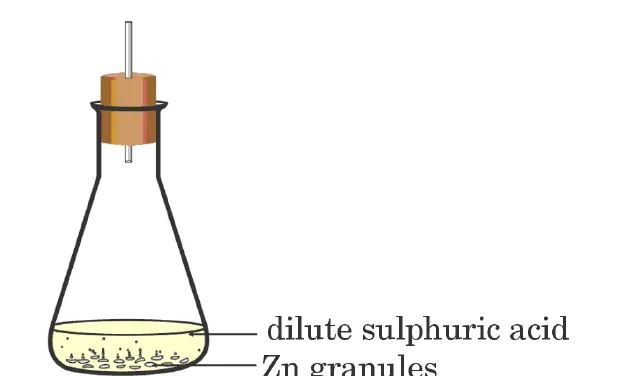
A student performs the following experiment in his school laboratory: a conical flask with a cork holds dilute sulphuric acid and granules of zinc. List two observations to justify that in this experiment a chemical change has taken place.

A conical flask closed with a cork, containing dilute sulphuric acid and granules of zinc at the bottom.
Solution
  1. The reaction is Zn+H2SO4→ZnSO4+H2\mathrm{Zn + H_2SO_4 \rightarrow ZnSO_4 + H_2}.
  2. Observation 1: bubbles of a gas (hydrogen) are given off from the surface of the zinc granules, so a new substance forms.
  3. Observation 2: the flask becomes warm, because the reaction gives out heat (a rise in temperature). The zinc granules also slowly get smaller and disappear.

Answer: Evolution of gas (hydrogen) and a rise in temperature

Report an error on this question
Q22How do Organisms Reproduce?2 marks

Draw labelled diagrams to show different stages of budding in Hydra.

Solution
1. Bud beginsbud2. Bud growstentacles3. Bud detachesyoung HydraparentThe bud grows as an outgrowth of the parent, then separates
  1. Budding in Hydra goes in stages:
  2. 1. A regenerative (dividing) cell group on the side of the parent divides and forms a small outgrowth, the bud.
  3. 2. The bud grows, develops a mouth and tentacles, and stays attached to the parent for a while.
  4. 3. The fully formed bud detaches from the parent and lives as a new, independent Hydra.

Answer: Bud forms, bud grows with tentacles, bud detaches (diagram above)

Report an error on this question
Q23Life Processes2 marks

(a) Besides minimising the loss of blood, why is it essential to plug any leak in a blood vessel? Name the component of blood which helps in this process and state how this component performs this function.

OR

(b) (i) The transport system in plants is relatively slower than in animals. Give reasons.

(ii) State the role of phloem in the transport of materials in plants.

Solution
  1. (a) A leak would lower the blood pressure and so reduce the efficiency of the pumping system (the heart), and the body would get less oxygen. The component that helps is the platelets, which gather at the injured spot and help the blood to clot, sealing the leak.
  2. (b)(i) Plants have low energy needs: they do not move and have a large proportion of dead cells in many tissues, so a slow transport system is enough.
  3. (ii) Phloem carries (translocates) the soluble products of photosynthesis, such as sucrose, from the leaves to the other parts of the plant, including storage organs of roots, fruits, seeds and growing organs. It also carries amino acids.

Answer: (a) To keep the blood pressure up; platelets clot the blood   (b) low energy needs; phloem translocates food from leaves

Report an error on this question
Q24Light: Reflection and Refraction2 marks

An object is placed at a distance of 6060 cm from a concave lens of focal length 3030 cm. Use lens formula to find the position of the image formed in this case.

Solution
FFOObjectImageu = −60 cmv = −20 cm (virtual, erect, diminished)
  1. With the new Cartesian sign convention, the object is on the left: u=−60u = -60 cm. A concave lens has a negative focal length: f=−30f = -30 cm.
  2. Lens formula: 1v−1u=1f\dfrac{1}{v} - \dfrac{1}{u} = \dfrac{1}{f}, so 1v=1f+1u=−130−160=−360=−120\dfrac{1}{v} = \dfrac{1}{f} + \dfrac{1}{u} = -\dfrac{1}{30} - \dfrac{1}{60} = -\dfrac{3}{60} = -\dfrac{1}{20}.
  3. v=−20v = -20 cm. The image is 2020 cm from the lens on the same side as the object (it is virtual, erect and diminished: m=vu=13m = \dfrac{v}{u} = \dfrac{1}{3}).

Answer: v=−20v = -20 cm: the image is 2020 cm in front of the lens, on the object's side

Common mistake: Dropping the sign of ff or uu. Both are negative here, and a sign slip gives a wrong (positive, real) image position.

Report an error on this question
Q25Electricity2 marks

(a) A wire of resistance R is cut into three equal parts. If these three parts are then joined in parallel, calculate the total resistance of the combination so formed.

OR

(b) Define electric power. When do we say that the power consumed in an electric circuit is 1 watt?

Solution
  1. (a) Each part has one third of the length, so its resistance is R3\dfrac{R}{3}.
  2. In parallel: 1Rp=3R+3R+3R=9R\dfrac{1}{R_p} = \dfrac{3}{R} + \dfrac{3}{R} + \dfrac{3}{R} = \dfrac{9}{R}, so Rp=R9R_p = \dfrac{R}{9}.
  3. (b) Electric power is the rate at which electrical energy is consumed (or dissipated) in a circuit: P=Wt=VIP = \dfrac{W}{t} = VI.
  4. The power is 11 watt when 11 joule of energy is used in 11 second, that is when a current of 11 A flows at a potential difference of 11 V (1 W=1 V×1 A1\ \mathrm{W} = 1\ \mathrm{V} \times 1\ \mathrm{A}).

Answer: (a) R9\dfrac{R}{9}   (b) rate of consuming electrical energy; 11 W =1= 1 J per second

Report an error on this question
Q26Our Environment2 marks

“Excessive use of chemicals and pesticides in agriculture adversely effect the environment.” Justify this statement.

Solution
  1. Chemicals and pesticides used by farmers get washed from the fields into the soil and into water bodies, and they affect the living (biotic) and non-living (abiotic) parts of the ecosystem.
  2. Most of these chemicals are not biodegradable, so they are taken in by plants and small organisms and pass up the food chain. They get concentrated at each trophic level (biological magnification), so the top consumers, including humans, carry the most.
  3. Thus the health of organisms at all trophic levels is affected, and soil fertility and water quality fall.

Answer: Non-biodegradable chemicals wash into soil and water and build up along the food chain

Report an error on this question

Section C: Short answer

7 questions, 3 marks each (50 to 80 words).

Q27Metals and Non-metals3 marks

(a) “Displacement reactions also play a key role in extracting metals in the middle of the reactivity series.” Justify this statement with two examples.

(b) Why can metals high up in the reactivity series not be obtained by reduction of their oxides by carbon?

Solution
  1. (a) A more reactive metal such as aluminium can displace a less reactive metal from its oxide, and the reaction gives out so much heat that the metal is obtained in the molten state. Examples:
  2. Fe2O3+2Al→2Fe+Al2O3+heat\mathrm{Fe_2O_3 + 2Al \rightarrow 2Fe + Al_2O_3 + heat} (the thermite reaction, used to weld railway tracks)
  3. 3MnO2+4Al→3Mn+2Al2O3+heat\mathrm{3MnO_2 + 4Al \rightarrow 3Mn + 2Al_2O_3 + heat}
  4. (b) Metals high in the reactivity series (K, Na, Ca, Mg, Al) have more affinity for oxygen than carbon has. So carbon cannot take the oxygen away from their oxides. They are obtained by electrolysis of their molten compounds.

Answer: Thermite reactions of aluminium; high metals bind oxygen more strongly than carbon does

Report an error on this question
Q28Metals and Non-metals3 marks

(a) With the help of an activity, explain the conditions under which iron articles get rusted.

OR

(b) (i) Name two metals which react violently with cold water. List any three observations which a student notes when these metals are dropped in a beaker containing water.

(ii) Write a test to identify the gas evolved (if any) during the reaction of these metals with water.

Solution
  1. (a) Take three test tubes A, B and C and put clean iron nails in each.
  2. A: pour ordinary water and cork it (air and water both present). B: pour boiled distilled water, add about 1 mL of oil on top and cork it (oil stops air from dissolving, so water but no air). C: put anhydrous calcium chloride and cork it (it absorbs moisture, so air but no water).
  3. After a few days the nails rust in test tube A only. So iron rusts only when it is exposed to both air (oxygen) and water.
  4. (b)(i) Sodium and potassium (lithium also reacts, less violently). Observations: a violent reaction takes place; a large amount of heat is given out; the metal moves on the water and the gas evolved may catch fire.
  5. (ii) The gas is hydrogen (2Na+2H2O→2NaOH+H2\mathrm{2Na + 2H_2O \rightarrow 2NaOH + H_2}). Bring a burning matchstick or splinter near it: it burns with a pop sound.

Answer: (a) Iron rusts in the presence of both air and water   (b) Na, K; the gas is hydrogen and burns with a pop

Report an error on this question
Q29Control and Coordination3 marks

Plants have neither a nervous system nor muscles, even then they respond to stimuli. For example, the leaves of chhui-mui (touch-me-not) plant when touched begin to fold up and droop.

(a) How is the information communicated in “touch-me-not” plants?

(b) What enables the plant cells to bring out the observable response?

(c) Differentiate the movement mentioned above from the movement of tendrils in a pea plant.

Solution
  1. (a) Plant cells use electrical and chemical means to pass the information that a touch has occurred from cell to cell.
  2. (b) The cells change their shape by changing the amount of water in them: some cells lose water and shrink, so the leaf folds and droops.
  3. (c) Touch-me-not (a nastic movement) is growth independent and does not take place in the direction of the stimulus. The tendril of a pea plant (a tropic movement, thigmotropism) is growth dependent: the cells on the side away from the support grow faster, and it moves in the direction of the stimulus.

Answer: Electro-chemical signals; cells change shape as water moves out; nastic (growth independent) vs tropic (growth dependent)

Report an error on this question
Q30Heredity3 marks

(a) What are chromosomes?

(b) Explain in brief how stability of DNA content of a species is ensured in sexually reproducing organisms?

Solution
  1. (a) Chromosomes are thread-like structures in the nucleus. They carry the genes that control the traits of an organism, and they contain the information for inheritance of features from the parents to the next generation, in the form of DNA (deoxyribonucleic acid) molecules.
  2. (b) Each body cell has two copies of every chromosome, one from the male parent and one from the female parent. During the formation of germ cells (gametes) the number is halved. When the male and female gametes fuse in fertilisation, the zygote gets back the normal number of chromosomes and the same amount of DNA. So the DNA content stays the same from one generation to the next.

Answer: Chromosomes carry genes (DNA); gametes have half the number and fertilisation restores it

Report an error on this question
Q31Light: Reflection and Refraction3 marks

Draw ray diagrams to show the nature, position and relative size of the image formed by a convex mirror when the object is placed (i) at infinity and (ii) between infinity and pole P of the mirror.

Solution
PFCimage at F(virtual, point-sized)(i) Object at infinity:image at F, virtual, highly diminished
PFCObjectImage(ii) Object between infinity and P:image between P and F, virtual, erect, diminished
  1. (i) Object at infinity: rays arrive parallel to the principal axis. After reflection they diverge and look as if they come from the focus F behind the mirror. The image is formed at F, virtual and erect, and highly diminished (point-sized).
  2. (ii) Object between infinity and the pole: the image is formed behind the mirror, between P and F. It is virtual, erect and diminished.
  3. Mark arrows on the rays and show the reflected rays going back as dashed lines to the image.

Answer: (i) at F, virtual, point-sized   (ii) between P and F, virtual, erect, diminished

Report an error on this question
Q32Electricity3 marks

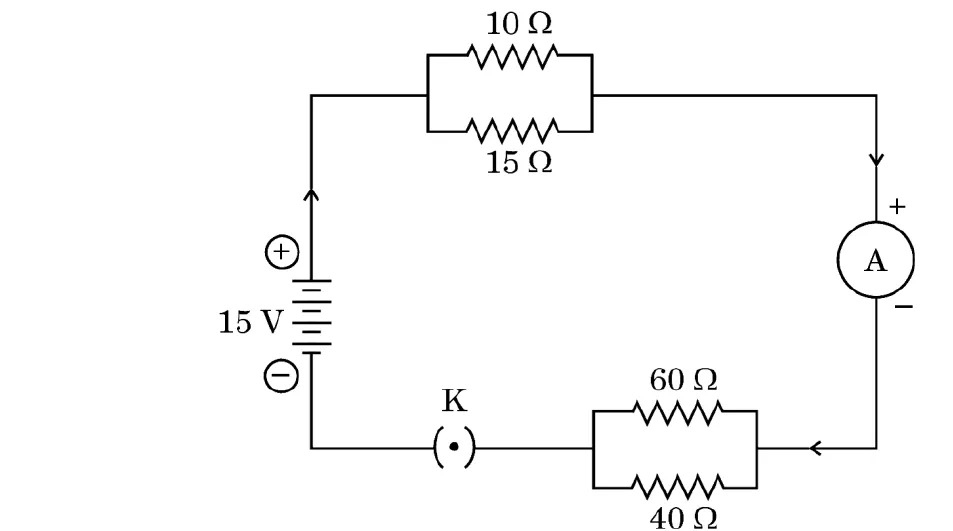
Consider the following electric circuit: a 15 V battery, a key K, an ammeter A, the resistors 10 Ω and 15 Ω joined in parallel in one part, and the resistors 60 Ω and 40 Ω joined in parallel in the other part, the two parts being in series.

Calculate the values of the following:

(a) The total resistance of the circuit

(b) The total current drawn from the source

(c) Potential difference across the parallel combination of 10 Ω and 15 Ω resistors

An electric circuit with a 15 volt battery, a key K and an ammeter. The 10 ohm and 15 ohm resistors are joined in parallel at the top, and the 60 ohm and 40 ohm resistors are joined in parallel at the bottom.
Solution
15 VR₁ = 6 Ω10 Ω ‖ 15 ΩR₂ = 24 Ω60 Ω ‖ 40 Ω1/R₁ = 1/10 + 1/15 = 1/6; 1/R₂ = 1/60 + 1/40 = 1/24R = 6 + 24 = 30 Ω; I = 15/30 = 0.5 AV across the 10 Ω ‖ 15 Ω pair = 0.5 × 6 = 3 V
  1. (a) The 10 Ω and 15 Ω pair in parallel: 1R1=110+115=3+230=16\dfrac{1}{R_1} = \dfrac{1}{10} + \dfrac{1}{15} = \dfrac{3 + 2}{30} = \dfrac{1}{6}, so R1=6 ΩR_1 = 6\ \Omega.
  2. The 60 Ω and 40 Ω pair in parallel: 1R2=160+140=2+3120=124\dfrac{1}{R_2} = \dfrac{1}{60} + \dfrac{1}{40} = \dfrac{2 + 3}{120} = \dfrac{1}{24}, so R2=24 ΩR_2 = 24\ \Omega.
  3. The two parts are in series: R=R1+R2=6+24=30 ΩR = R_1 + R_2 = 6 + 24 = 30\ \Omega.
  4. (b) I=VR=1530=0.5I = \dfrac{V}{R} = \dfrac{15}{30} = 0.5 A.
  5. (c) The same 0.50.5 A passes through the first parallel pair, so the potential difference across it is V1=IR1=0.5×6=3V_1 = I R_1 = 0.5 \times 6 = 3 V.

Answer: (a) 30 Ω30\ \Omega   (b) 0.50.5 A   (c) 33 V

Common mistake: Adding 10 + 15 + 60 + 40 as if all four were in series, or forgetting that the parallel pair is reduced first.

Report an error on this question
Q33Electricity3 marks

(a) Write the relationship between resistivity and resistance of a cylindrical conductor of length ll and area of cross-section AA. Hence derive the SI unit of resistivity.

(b) Why are alloys used in electrical heating devices?

Solution
  1. (a) R=ρlAR = \rho\dfrac{l}{A}, so ρ=RAl\rho = \dfrac{RA}{l}.
  2. Unit of ρ\rho =Ω×m2m=Ω m= \dfrac{\Omega \times \mathrm{m^2}}{\mathrm{m}} = \Omega\,\mathrm{m} (ohm metre).
  3. (b) Alloys have a higher resistivity than pure metals, so more heat is produced for the same current. They also do not oxidise (burn) readily at high temperatures, so they last long.

Answer: (a) R=ρl/AR = \rho l/A; unit Ω m\Omega\,\mathrm{m}   (b) higher resistivity and they do not burn readily

Report an error on this question

Section D: Long answer

3 questions, 5 marks each (80 to 120 words).

Q34Carbon and its Compounds5 marks

(a) (i) Draw two isomeric structures of Butene (C4H8C_4H_8).

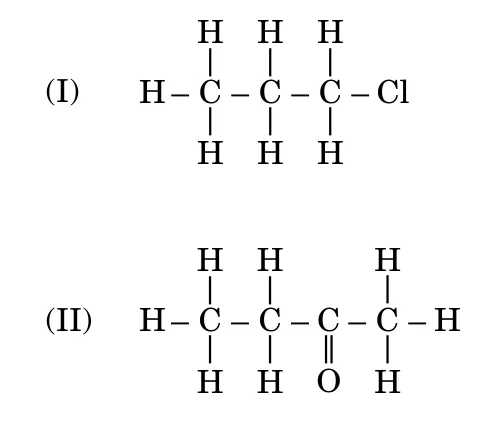
(ii) Name the following compounds: (I) H₃C–CH₂–CH₂–Cl drawn in full, with three carbon atoms in a chain and the chlorine on the last one; (II) a four-carbon chain with a C=O group on the third carbon.

(iii) Write the chemical equations for the following reactions. Mention one essential condition each for these reactions to take place. (I) Ethanol undergoes complete oxidation (II) Propene undergoes hydrogenation (III) Ethanoic acid reacts with ethanol

OR

(b) (i) A carbon compound X is a good solvent. On reaction with sodium, X forms two products Y and Z. Z is used to convert vegetable oil into vegetable ghee. Identify and name X, Y and Z. Also write the equation of reaction of X with sodium to justify your answer.

(ii) Write chemical equation to show what happens when ethanol: (I) burns in oxygen/air. (II) is heated at 443 K in excess conc. H2SO4H_2SO_4. (III) reacts with acidified potassium dichromate.

Two structural formulas. The first is a chain of three carbon atoms with hydrogen atoms and a chlorine atom on the last carbon. The second is a chain of four carbon atoms with an oxygen double-bonded to the third carbon.
Solution
CHHHCHCHHCHHHBut-1-ene: CH₂=CH–CH₂–CH₃CHHHCHCHCHHHBut-2-ene: CH₃–CH=CH–CH₃
  1. (a)(i) The two isomers of butene are but-1-ene, CH2=CH−CH2−CH3\mathrm{CH_2{=}CH{-}CH_2{-}CH_3}, and but-2-ene, CH3−CH=CH−CH3\mathrm{CH_3{-}CH{=}CH{-}CH_3} (drawn above). (2-methylpropene is a third isomer.)
  2. (ii) (I) CH3CH2CH2Cl\mathrm{CH_3CH_2CH_2Cl} is chloropropane (1-chloropropane). (II) The four-carbon chain with a C=O\mathrm{C{=}O} on the third carbon (a ketone) is butanone (butan-2-one), CH3COCH2CH3\mathrm{CH_3COCH_2CH_3}.
  3. (iii) (I) CH3CH2OH+2[O]→alk. KMnO4 or acidified K2Cr2O7, heatCH3COOH+H2O\mathrm{CH_3CH_2OH + 2[O] \xrightarrow{\text{alk. KMnO}_4 \text{ or acidified K}_2\text{Cr}_2\text{O}_7,\ \text{heat}} CH_3COOH + H_2O}.
  4. (II) CH3CH=CH2+H2→Ni / Pd catalystCH3CH2CH3\mathrm{CH_3CH{=}CH_2 + H_2 \xrightarrow{\text{Ni / Pd catalyst}} CH_3CH_2CH_3}.
  5. (III) CH3COOH+C2H5OH→conc. H2SO4CH3COOC2H5+H2O\mathrm{CH_3COOH + C_2H_5OH \xrightarrow{\text{conc. H}_2\text{SO}_4} CH_3COOC_2H_5 + H_2O} (ethyl ethanoate, an ester).
  6. (b)(i) XX is ethanol (C2H5OH\mathrm{C_2H_5OH}), YY is sodium ethoxide (C2H5ONa\mathrm{C_2H_5ONa}) and ZZ is hydrogen gas (H2\mathrm{H_2}), which turns vegetable oil into ghee.
  7. 2C2H5OH+2Na→2C2H5ONa+H2\mathrm{2C_2H_5OH + 2Na \rightarrow 2C_2H_5ONa + H_2}.
  8. (ii) (I) C2H5OH+3O2→2CO2+3H2O+heat+light\mathrm{C_2H_5OH + 3O_2 \rightarrow 2CO_2 + 3H_2O + heat + light}. (II) CH3CH2OH→conc. H2SO4, 443 KCH2=CH2+H2O\mathrm{CH_3CH_2OH \xrightarrow{\text{conc. H}_2\text{SO}_4,\ 443\ \text{K}} CH_2{=}CH_2 + H_2O} (dehydration gives ethene). (III) CH3CH2OH→acidified K2Cr2O7CH3COOH\mathrm{CH_3CH_2OH \xrightarrow{\text{acidified K}_2\text{Cr}_2\text{O}_7} CH_3COOH}.

Answer: (a) but-1-ene and but-2-ene; chloropropane; butanone; equations above   (b) X ethanol, Y sodium ethoxide, Z hydrogen

Common mistake: Writing the conditions as “catalyst” without naming it. Say nickel or palladium for hydrogenation, and concentrated sulphuric acid for esterification.

Report an error on this question
Q35How do Organisms Reproduce?5 marks

(a) (i) Write the functions of the following parts of human female reproductive system: (I) Ovary (II) Fallopian tube (III) Uterus

(ii) State briefly two contraceptive methods used by human males.

OR

(b) (i) Differentiate between self-pollination and cross-pollination.

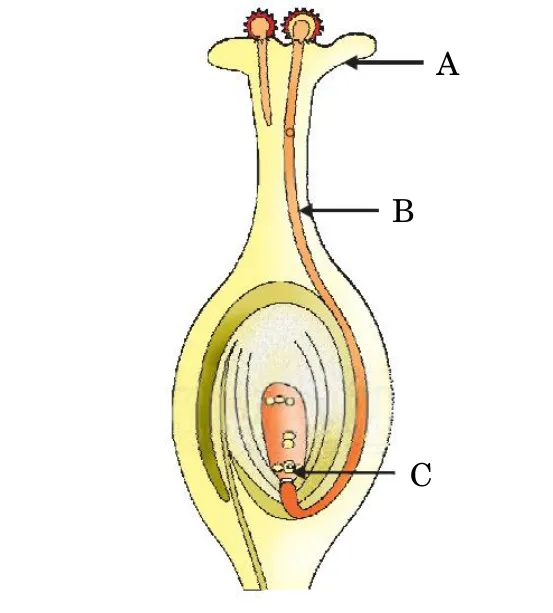
(ii) Identify A, B and C in the diagram given below and write one function of each.

A section through a flower pistil. A points to the stigma at the top, B to the pollen tube running down through the style, and C to the egg cell inside the ovule in the ovary.
Solution
  1. (a)(i) (I) Ovary: produces the female gametes (eggs) and the female hormones (oestrogen and progesterone). (II) Fallopian tube (oviduct): the site of fertilisation, where the egg and sperm meet. (III) Uterus: the site of implantation of the embryo and its development into a baby.
  2. (ii) Methods used by males: a mechanical barrier, the condom, which stops the sperms from reaching the egg; and a surgical method, vasectomy, in which the vas deferens is blocked or cut so sperms are not released.
  3. (b)(i) Self-pollination: pollen grains move from the anther of a flower to the stigma of the same flower. Cross-pollination: pollen grains move from the anther of one flower to the stigma of another flower of the same species.
  4. (ii) A is the stigma: it receives the pollen and provides a suitable surface for it to germinate. B is the pollen tube: it carries the male germ cells (gametes) down to the female gamete in the ovary. C is the egg cell (female germ cell): it fuses with the male gamete to form the zygote.

Answer: (a) ovary: eggs and hormones; fallopian tube: fertilisation; uterus: implantation; condoms, vasectomy   (b) A stigma, B pollen tube, C egg cell

Report an error on this question
Q36Light: Reflection and Refraction5 marks

(a) (i) The power of a lens ‘X’ is −2.5 D. Name the lens and determine its focal length in cm. For which eye defect of vision will an optician prescribe this type of lens as a corrective lens?

(ii) “The value of magnification ‘m’ for a lens is −2.” Using new Cartesian Sign Convention and considering that an object is placed at a distance of 20 cm from the optical centre of this lens, state: (I) the nature of the image formed; (II) size of the image compared to the size of the object; (III) position of the image, and (IV) sign of the height of the image.

(iii) The numerical values of the focal lengths of two lenses A and B are 10 cm and 20 cm respectively. Which one of the two will show higher degree of convergence/divergence? Give reason to justify your answer.

OR

(b) (i) Draw a ray diagram to show the refraction of a ray of light through a rectangular glass slab when it falls obliquely from air into glass.

(ii) State Snell’s law of refraction of light.

(iii) Differentiate between the virtual images formed by a convex lens and a concave lens on the basis of: (I) object distance, and (II) magnification.

Solution
FFO2F2FObjectImagem = v/u = −2, so v = +40 cmreal, inverted, twice the size, beyond 2F
glassairair∠i∠r∠eincident rayemergent rayrefracted rayBends towards the normal on entering;emergent ray ∥ incident ray (∠e = ∠i)
  1. (a)(i) A negative power means a concave (diverging) lens. f=1P=1−2.5 D=−0.4f = \dfrac{1}{P} = \dfrac{1}{-2.5\ \mathrm{D}} = -0.4 m =−40= -40 cm. A concave lens is prescribed for myopia (short-sightedness).
  2. (ii) For a lens m=vum = \dfrac{v}{u}. With m=−2m = -2 and u=−20u = -20 cm: v=mu=(−2)(−20)=+40v = m u = (-2)(-20) = +40 cm. (This lens is a convex lens, since a concave lens never forms a magnified, inverted image.)
  3. (I) The image is real and inverted. (II) It is magnified: twice the size of the object. (III) It is on the other side of the lens, 4040 cm from it, beyond 2F2F. (IV) The height of the image is negative.
  4. (iii) Power P=1fP = \dfrac{1}{f}, so the lens with the smaller focal length has the larger power. Lens A (1010 cm) shows the higher degree of convergence/divergence, because a shorter focal length means light is bent more.
  5. (b)(i) A ray bends towards the normal on entering the glass, and away from the normal on leaving, so the emergent ray is parallel to the incident ray but shifted sideways (diagram above).
  6. (ii) Snell’s law: for light of a given colour and a given pair of media, the ratio of the sine of the angle of incidence to the sine of the angle of refraction is constant: sin⁡isin⁡r=constant\dfrac{\sin i}{\sin r} = \text{constant}.
  7. (iii) Convex lens: the virtual image forms only when the object is between OO and FF, and the image is magnified. Concave lens: the virtual image forms for an object anywhere in front of the lens, and the image is diminished.

Answer: (a) concave lens, f=−40f = -40 cm, myopia; real, inverted, magnified, v=+40v = +40 cm, negative; lens A   (b) see diagram; Snell’s law; table

Common mistake: Taking v=−40v = -40 cm in (ii). For a lens the magnification is vu\dfrac{v}{u} with signs, so a negative mm with a negative uu gives a positive vv.

Report an error on this question

Section E: Case studies

3 case studies, 4 marks each.

Q37Acids, Bases and Salts4 marks

Case study 1. Seawater contains many salts dissolved in it. Common salt is separated from these salts. Deposits of solid salt are also found in several parts of the world. These large crystals are often brown due to impurities. This is called rock salt and is mined like coal. The common salt is an important raw material for chemicals of daily use.

(a) Write balanced chemical equations to show the products formed during electrolysis of brine. [1]

(b) List two uses of any one product obtained during electrolysis of brine. [1]

(c) (i) A mild non-corrosive basic salt ‘A’, used for faster cooking, is strongly heated to produce a compound ‘B’, that is used for removing permanent hardness of water. Identify A and B and also write the equation for the reaction that occurs when A is heated. [2]

OR

(c) (ii) Define water of crystallisation. Give two examples of salts that have water of crystallisation. [2]

Solution
  1. (a) 2NaCl(aq)+2H2O(l)→2NaOH(aq)+Cl2(g)+H2(g)\mathrm{2NaCl(aq) + 2H_2O(l) \rightarrow 2NaOH(aq) + Cl_2(g) + H_2(g)}. Chlorine forms at the anode and hydrogen at the cathode; sodium hydroxide stays in the solution.
  2. (b) Uses of sodium hydroxide: making soaps and detergents, paper making (also degreasing metals, artificial fibres). (Or hydrogen: fuel, and making margarine and ammonia; or chlorine: water treatment, PVC, bleach.) Any two uses of one product.
  3. (c)(i) A is sodium hydrogencarbonate (baking soda), NaHCO3\mathrm{NaHCO_3}; B is sodium carbonate (washing soda is its hydrated form), Na2CO3\mathrm{Na_2CO_3}. 2NaHCO3→heatNa2CO3+H2O+CO2\mathrm{2NaHCO_3 \xrightarrow{heat} Na_2CO_3 + H_2O + CO_2}.
  4. (c)(ii) Water of crystallisation is the fixed number of water molecules present in one formula unit of a salt. Examples: CuSO4⋅5H2O\mathrm{CuSO_4{\cdot}5H_2O} (blue vitriol) and CaSO4⋅2H2O\mathrm{CaSO_4{\cdot}2H_2O} (gypsum); also Na2CO3⋅10H2O\mathrm{Na_2CO_3{\cdot}10H_2O}.

Answer: (a) 2NaCl+2H2O→2NaOH+Cl2+H22\mathrm{NaCl} + 2\mathrm{H_2O} \rightarrow 2\mathrm{NaOH} + \mathrm{Cl_2} + \mathrm{H_2}   (c) A =NaHCO3= \mathrm{NaHCO_3}, B =Na2CO3= \mathrm{Na_2CO_3} (OR) fixed water molecules per formula unit

Report an error on this question
Q38Life Processes4 marks

Case study 2. The maintenance functions of all living organisms must go on even when they are not doing anything particular. Even when we are just sitting in a class or even asleep, this maintenance job has to go on. These maintenance processes require energy to prevent damage and break-down of cells and tissues, which is obtained by the individual organism from the food prepared by the autotrophs, called producers.

(a) Name and define the process by which green plants prepare food. [1]

(b) Write chemical equation involved in the above process. [1]

(c) (i) State in proper sequence the events that occur in synthesis of food by desert plants. [2]

OR

(c) (ii) Explain giving reasons what happens to the rate at which the green plants will prepare food (I) during cloudy weather, and (II) when stomata get blocked due to dust. [2]

Solution
  1. (a) Photosynthesis. It is the process by which green plants capture sunlight and convert it into chemical energy (food), with the help of chlorophyll, by turning carbon dioxide and water into carbohydrates.
  2. (b) 6CO2+6H2O→sunlight, chlorophyllC6H12O6+6O2\mathrm{6CO_2 + 6H_2O \xrightarrow{\text{sunlight, chlorophyll}} C_6H_{12}O_6 + 6O_2}.
  3. (c)(i) Desert plants: (1) they open their stomata at night and take in carbon dioxide, which they store as an intermediate acid; (2) in the day, chlorophyll absorbs light energy; (3) light energy is converted to chemical energy; (4) the stored intermediate is acted on by this energy and carbon dioxide is reduced to carbohydrate.
  4. (c)(ii) (I) In cloudy weather the rate of photosynthesis decreases, because less sunlight (light energy) reaches the leaves. (II) When the stomata are blocked by dust, the rate decreases, because carbon dioxide cannot enter and gas exchange is reduced.

Answer: (a) photosynthesis   (b) 6CO2+6H2O→C6H12O6+6O26\mathrm{CO_2} + 6\mathrm{H_2O} \rightarrow \mathrm{C_6H_{12}O_6} + 6\mathrm{O_2}   (c) see steps

Report an error on this question
Q39Magnetic Effects of Electric Current4 marks

Case study 3. In our homes, we receive the supply of electric power through a main supply also called mains, either supported through overhead electric poles or by underground cables. In our country the potential difference between the two wires (live wire and neutral wire) of this supply is 220 V.

(a) Write the colours of the insulation covers of the line wires through which supply comes to our homes. [1]

(b) What should be the current rating of the electric circuit (220 V) so that an electric iron of 1 kW power rating can be operated? [1]

(c) (i) What is the function of the earth wire? State the advantage of the earth wire in domestic electric appliances such as electric iron. [2]

OR

(c) (ii) List two precautions to be taken to avoid electrical accidents. State how these precautions prevent possible damage to the circuit/appliance. [2]

Solution
  1. (a) The live wire has red insulation and the neutral wire has black insulation (the earth wire is green).
  2. (b) P=1 kW=1000P = 1\ \mathrm{kW} = 1000 W and V=220V = 220 V. From P=VIP = VI: I=1000220=4.54I = \dfrac{1000}{220} = 4.54 A. The nearest standard rating above this is a 55 A circuit.
  3. (c)(i) The earth wire gives a low-resistance path to the ground for any leakage current. If the metal body of the iron becomes live, the current flows to the earth and the body stays at the potential of the earth, so the user does not get an electric shock.
  4. (c)(ii) Two precautions: use a fuse wire in the circuit (it melts and breaks the circuit when the current is too high, preventing damage from overloading), and connect the metallic body of appliances to the earth wire (it prevents electric shock from leakage of current).

Answer: (a) red (live) and black (neutral)   (b) 4.544.54 A, so a 55 A rating   (c) low-resistance path to earth, so no shock (OR) fuse and earth wire

Common mistake: Writing 4 A. The current is 4.54 A, which is more than 4, so the rating has to be the next standard value, 5 A.

Report an error on this question

Questions are from the official CBSE paper. Figures are described in words; see the PDF for the originals. Solutions are written by CogniGuru.

Revise this paper in 1 minute a chapter

Each chapter below is what the paper tested, with a one-minute animated lesson on the idea behind it.

Stuck on a step in any solution?

The CogniGuru AI tutor explains any doubt one minute at a time, in English or Hindi. Join the waitlist.

Mock quiz: 5 questions from this paper

Five real questions from this paper, one each from five chapters. About 2 minutes. See how much you know and where you stand among other students. Attempt free, with no login; log in only for your ranking and full report.

Question 1 of 5 · Q1 of the paperChemical Reactions and Equations

Electrolysis of water is a decomposition reaction. The mass ratio (MH:MOM_H : M_O) of hydrogen and oxygen gases liberated at the electrodes during electrolysis of water is:

0 of 5 answered

Related papers

Common questions

Are these the official CBSE Class 10 Science 2025 questions?
Yes. The questions are from the official Science paper (set 31/1/1) that CBSE published after the March 2025 board exam. The solutions are written by CogniGuru and checked against the answer key CBSE published for this paper code.
Can I download the CBSE Class 10 Science 2025 question paper PDF?
Yes, the official paper PDF is free to download from this page, and so are our step-by-step solutions as a PDF. No login is needed to download either or to read the solutions.
Do all sets of the paper have the same questions?
No. CBSE sets several versions of each paper, with the same blueprint and similar questions in a different order and sometimes with different numbers. This page covers set 31/1/1.
How does the quiz work, and what does “where you stand” mean?
It is a mock quiz of 5 real multiple-choice questions from this paper, scored automatically in about 2 minutes. Your score is compared, anonymously, with other students who took the same quiz. Only the score is stored with the comparison, never your name or number.

Source

CBSE question paper archive, Class X, 2025 (Science, set 31/1/1)
PDF