CBSE · Class 10 · Science · Free

CBSE Class 10 Science 2025 Question Paper (Set 31/2/1) with Solutions

The official board paper (Q.P. Code 31/2/1, Series GHF2E). Free paper PDF and step-by-step solutions (also as a PDF to download) written by CogniGuru and checked against CBSE’s answer key. See the paper’s main topics in 1 minute, then quiz yourself to see how much you know and where you stand.

No login to download or read the solutions. Login only to see your quiz report in full.

Board
CBSE
Class
10
Subject
Science (086)
Year
2025
Set code
31/2/1
Max marks
80
Duration
3 hours
Questions
39 (Sections A to E)
Source
Official CBSE paper
Exam date
March 2025

Paper preview

Three pages of the official paper. Download the PDF for all 27.

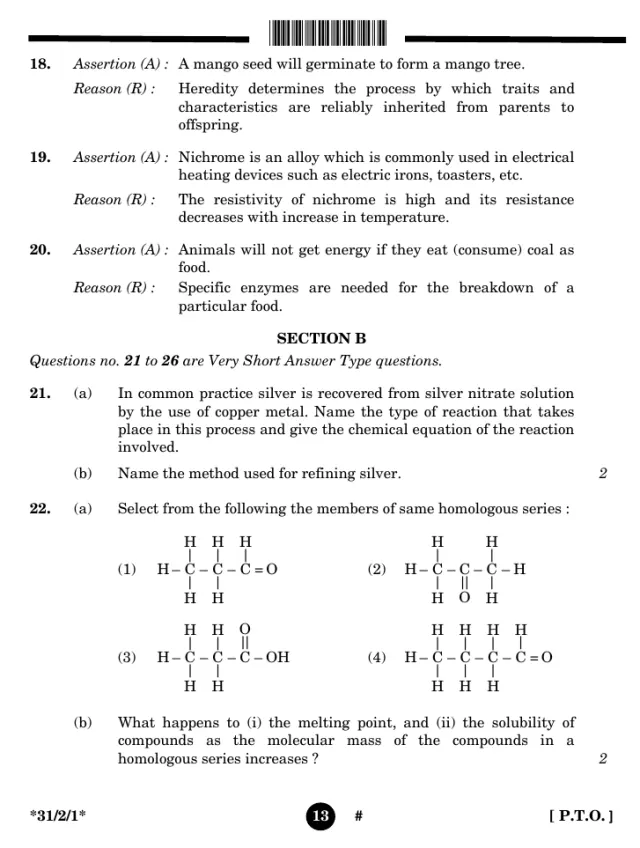
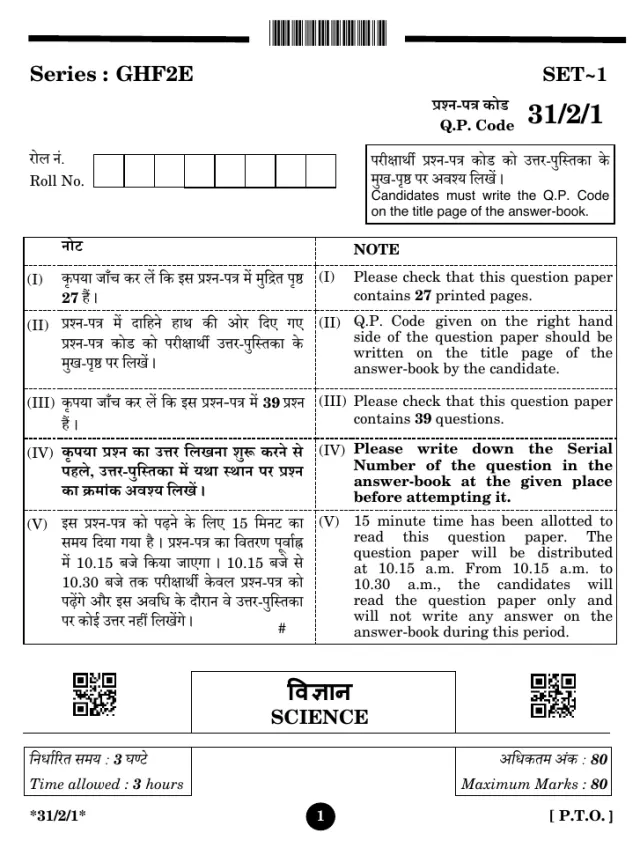
  • Cover page of the CBSE Class 10 Science 2025 paper, set 31/2/1

    Cover page

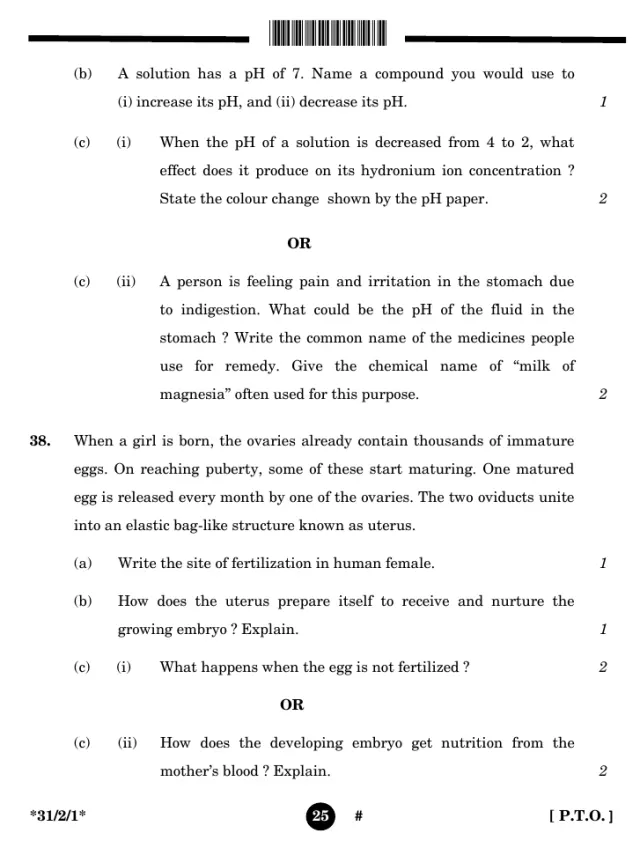
  • Section B of the CBSE Class 10 Science 2025 paper, set 31/2/1

    Section B

  • A case study with its figure from the CBSE Class 10 Science 2025 paper, set 31/2/1

    Case study

The main topics of this paper, in 1 minute

Your tutor walks you through the paper before you attempt it: the marks, the key ideas, the time plan and the traps.

1-minute paper analysis

With your tutor, in her voice

The main topics of this paper, in about a minute

A short, animated walk through the paper: how it is built, where the marks come from, the four ideas that matter most, how to plan your three hours, and the traps to avoid.

  1. 1The paper at a glance
  2. 2Where the marks come from
  3. 3Four ideas that keep paying off
  4. 4Plan your three hours
  5. 5Four traps to avoid

Sound on for the voice. Captions are shown, and you can mute any time.

Step-by-step solutions

Try each question first, then open its solution. Tap a number to jump.

Download solutions (PDF)

Section A: Multiple choice

20 questions, 1 mark each. MCQs (Q1 to Q16) and assertion-reason (Q17 to Q20).

Q1Chemical Reactions and Equations1 mark

The correct balanced chemical equation showing exothermic reaction in which natural gas burns in air is:

  1. (A)CH4+O2→CO2+2H2O\mathrm{CH_4 + O_2 \rightarrow CO_2 + 2H_2O}
  2. (B)CH4+2O2→2CO2+2H2O+Energy\mathrm{CH_4 + 2O_2 \rightarrow 2CO_2 + 2H_2O + Energy}
  3. (C)CH4+2O2→CO2+2H2O\mathrm{CH_4 + 2O_2 \rightarrow CO_2 + 2H_2O}
  4. (D)CH4+2O2→CO2+2H2O+Energy\mathrm{CH_4 + 2O_2 \rightarrow CO_2 + 2H_2O + Energy}
Solution · answer (D)
  1. Natural gas is methane. Count atoms: carbon 11 each side; hydrogen 44 each side with 2H2O2\mathrm{H_2O}; oxygen 2+2=42 + 2 = 4 on the right, so 2O22\mathrm{O_2} on the left.
  2. The reaction is exothermic, so the energy released is shown on the product side. Only option D is both balanced and shows the energy.

Answer: (D) CH4+2O2→CO2+2H2O+Energy\mathrm{CH_4 + 2O_2 \rightarrow CO_2 + 2H_2O + Energy}

Report an error on this question
Q2Acids, Bases and Salts1 mark

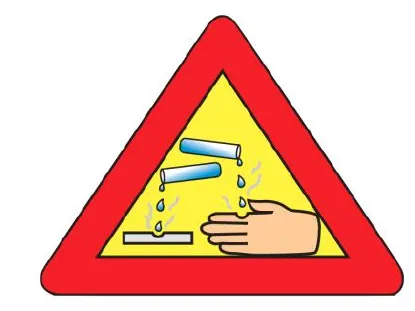
The warning sign shown in the given figure must invariably be displayed/pasted on the containers which contain hydroxide of:

A red triangular warning sign showing a liquid dripping from a tilted test tube onto a hand, the sign for a corrosive substance.
  1. (A)Aluminium
  2. (B)Calcium
  3. (C)Sodium
  4. (D)Magnesium
Solution · answer (C)
  1. The sign shows a liquid burning a hand: it warns of a corrosive substance.
  2. Sodium hydroxide is a strong, corrosive base. Calcium, magnesium and aluminium hydroxides are weak or sparingly soluble, so they are not marked in this way.

Answer: (C) Sodium

Report an error on this question
Q3Acids, Bases and Salts1 mark

The body of human beings works within the pH range of:

  1. (A)6.1 to 6.8
  2. (B)6.5 to 7.3
  3. (C)7.0 to 7.8
  4. (D)7.5 to 8.1
Solution · answer (C)
  1. Our body works in a narrow, slightly basic range of pH 7.07.0 to 7.87.8 (blood is about 7.47.4). Living organisms are sensitive to pH changes.

Answer: (C) 7.0 to 7.8

Report an error on this question
Q4Metals and Non-metals1 mark

Aluminium powder is used in thermit welding because:

  1. (A)Its reaction with iron is highly exothermic.
  2. (B)When it is heated with iron (III) oxide, molten iron is obtained.
  3. (C)When it is heated with iron (III) oxide, molten aluminium oxide is obtained to join railway tracks.
  4. (D)Its melting point is low as compared to iron and a molten alloy of iron and aluminium is formed on heating which is used to join railway tracks.
Solution · answer (B)
  1. Fe2O3+2Al→2Fe+Al2O3+heat\mathrm{Fe_2O_3 + 2Al \rightarrow 2Fe + Al_2O_3 + heat}.
  2. Aluminium is more reactive than iron, and the reaction gives out so much heat that the iron is produced in the molten state. This molten iron is poured on the gap between railway tracks to weld them.

Answer: (B) When it is heated with iron (III) oxide, molten iron is obtained.

Common mistake: Choosing A. The reaction of aluminium is with iron(III) oxide, not with iron, and the point of the process is the molten iron it makes.

Report an error on this question
Q5Metals and Non-metals1 mark

Two metals zinc and tin are dissolved separately in definite proportions in molten copper (the primary metal) to obtain two different alloys respectively known as:

  1. (A)Bronze and Brass
  2. (B)Brass and Solder
  3. (C)Brass and Bronze
  4. (D)Solder and Bronze
Solution · answer (C)
  1. Copper + zinc = brass. Copper + tin = bronze. (Solder is lead + tin.)
  2. In the order zinc, tin the alloys are brass and bronze.

Answer: (C) Brass and Bronze

Report an error on this question
Q6Life Processes1 mark

The opening and closing of stomata is regulated by:

  1. (A)CO2\mathrm{CO_2} concentration in stomata
  2. (B)Temperature in guard cells
  3. (C)O2\mathrm{O_2} concentration in stomata
  4. (D)Amount of water in guard cells
Solution · answer (D)
  1. The guard cells on both sides of a stomatal pore take in water and swell, which opens the pore. When they lose water they shrink and the pore closes.

Answer: (D) Amount of water in guard cells

Report an error on this question
Q7Life Processes1 mark

One-cell thick blood vessels are known as:

  1. (A)Alveoli
  2. (B)Capillaries
  3. (C)Arteries
  4. (D)Veins
Solution · answer (B)
  1. Capillaries have walls one cell thick, so materials can pass between the blood and the tissues. Arteries and veins have thick walls, and alveoli are air sacs in the lungs, not blood vessels.

Answer: (B) Capillaries

Report an error on this question
Q8Control and Coordination1 mark

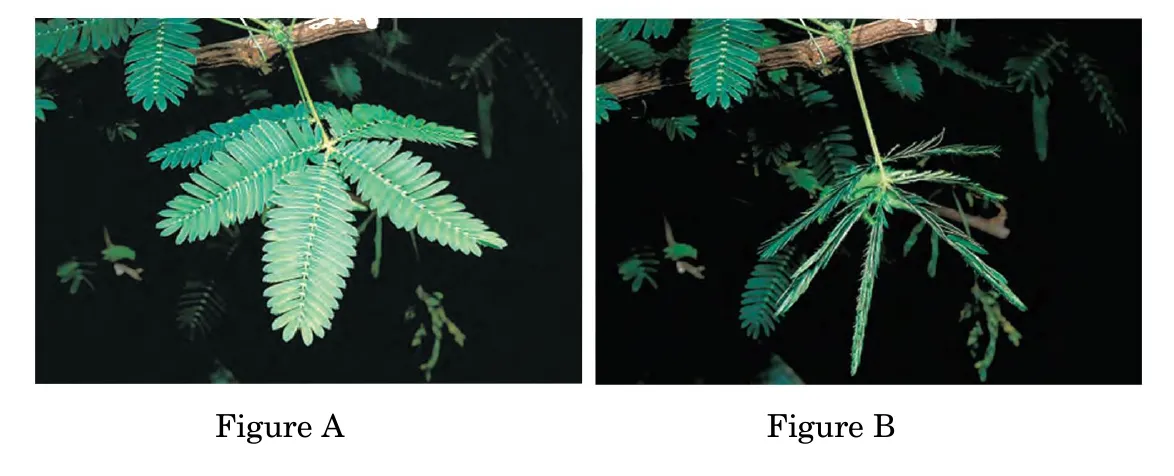
Observe the given figures A and B. When chhui-mui (sensitive) plant is touched, its leaves fold. This is due to:

Two photographs of a sensitive plant. In figure A the leaflets are spread open. In figure B, after touch, the leaflets have folded together and the leaf droops.
  1. (A)Hormonal effect
  2. (B)Thermal effect
  3. (C)Change in amount of water in cells
  4. (D)Electromagnetic effect
Solution · answer (C)
  1. The touch signal travels from cell to cell. The cells at the base of the leaf then lose water and shrink, so the leaf folds and droops. The plant has no muscles.

Answer: (C) Change in amount of water in cells

Report an error on this question
Q9How do Organisms Reproduce?1 mark

Bryophyllum produces new plant through:

  1. (A)Apical buds formed on the tip of the plant
  2. (B)Vegetative buds produced in the notches of the leaf
  3. (C)Flowers produced in the notches of the branches
  4. (D)Fruits formed on the branches of the plant
Solution · answer (B)
  1. Bryophyllum reproduces vegetatively: small buds form in the notches along the margin of a leaf, fall to the soil and grow into new plants.

Answer: (B) Vegetative buds produced in the notches of the leaf

Report an error on this question
Q10How do Organisms Reproduce?1 mark

The number of chromosomes in a cell division is halved. This kind of cell division is observed in:

  1. (A)Only testis
  2. (B)Only ovary
  3. (C)Ovary and testis both
  4. (D)All cells of the body
Solution · answer (C)
  1. Halving the chromosome number is meiosis, which forms the gametes. Sperms form in the testis and eggs form in the ovary, so it happens in both. Other body cells divide by mitosis and keep the number.

Answer: (C) Ovary and testis both

Report an error on this question
Q11Light: Reflection and Refraction1 mark

If the absolute refractive indices of two media X and Y are 65\dfrac{6}{5} and 43\dfrac{4}{3} respectively, then the refractive index of Y with respect to X will be:

  1. (A)109\dfrac{10}{9}
  2. (B)910\dfrac{9}{10}
  3. (C)98\dfrac{9}{8}
  4. (D)89\dfrac{8}{9}
Solution · answer (A)
  1. nXY=nYnX=4/36/5=43×56=2018=109n_{XY} = \dfrac{n_Y}{n_X} = \dfrac{4/3}{6/5} = \dfrac{4}{3} \times \dfrac{5}{6} = \dfrac{20}{18} = \dfrac{10}{9}.

Answer: (A) 109\dfrac{10}{9}

Common mistake: Inverting the ratio. "Y with respect to X" means nYn_Y divided by nXn_X.

Report an error on this question
Q12Light: Reflection and Refraction1 mark

An object is placed at a distance of 30 cm from the pole of a concave mirror. If its real and inverted image is formed at 60 cm in front of the mirror, the focal length of the mirror is:

  1. (A)−15 cm
  2. (B)−20 cm
  3. (C)+20 cm
  4. (D)+15 cm
Solution · answer (B)
  1. u=−30u = -30 cm and v=−60v = -60 cm (real image, in front of the mirror).
  2. 1f=1v+1u=−160−130=−360=−120\dfrac{1}{f} = \dfrac{1}{v} + \dfrac{1}{u} = -\dfrac{1}{60} - \dfrac{1}{30} = -\dfrac{3}{60} = -\dfrac{1}{20}, so f=−20f = -20 cm.

Answer: (B) −20 cm

Report an error on this question
Q13Light: Reflection and Refraction1 mark

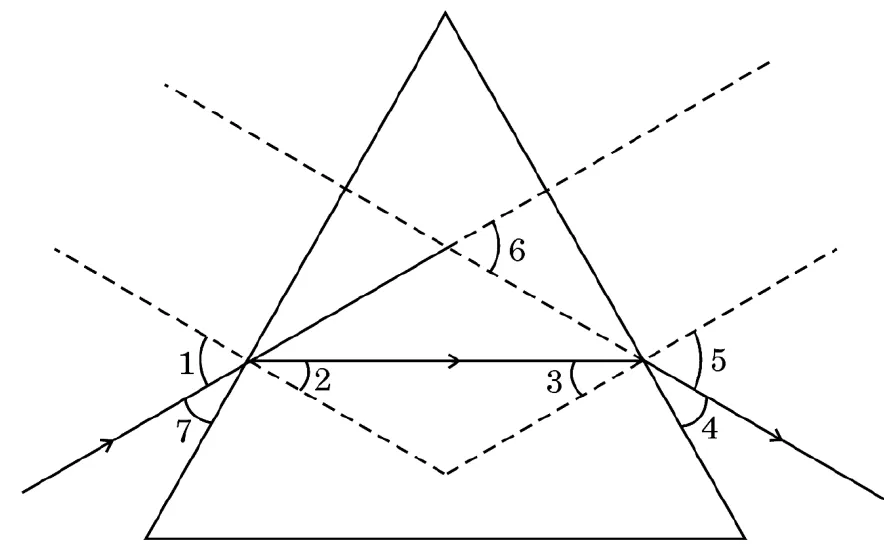
In the given figure the angle of incidence and the angle of deviation respectively are:

A ray of light passing through a glass prism, with normals drawn as dashed lines at both faces. The angles are numbered 1 to 7. Angle 1 is between the incident ray and the normal, angle 6 is between the extended incident ray and the emergent ray.
  1. (A)1 and 5
  2. (B)7 and 6
  3. (C)7 and 4
  4. (D)1 and 6
Solution · answer (D)
  1. The angle of incidence is measured between the incident ray and the normal at the first face: angle 11 (angle 77 is the angle with the surface itself).
  2. The angle of deviation is between the direction of the original (extended) incident ray and the emergent ray: angle 66.

Answer: (D) 1 and 6

Common mistake: Measuring the angle from the surface instead of from the normal.

Report an error on this question
Q14Electricity1 mark

An electric bulb is connected to a power supply of 220 V. If the current drawn by the bulb from the supply is 500 mA, the power of the bulb is:

  1. (A)11 W
  2. (B)110 W
  3. (C)220 W
  4. (D)1100 W
Solution · answer (B)
  1. I=500I = 500 mA =0.5= 0.5 A. P=VI=220×0.5=110P = VI = 220 \times 0.5 = 110 W.

Answer: (B) 110 W

Common mistake: Using 500 as the current and getting 110 000 W. Convert milliamperes to amperes first.

Report an error on this question
Q15Electricity1 mark

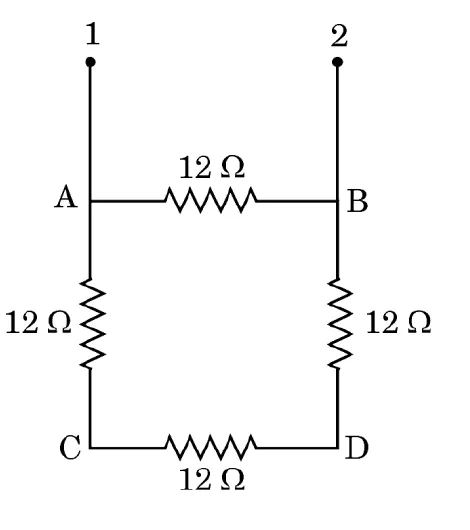
Four identical resistors of 12 Ω12\ \Omega each are connected in series to form a square ABCD as shown in the figure. The resistance of the network between the two points 1 and 2 is:

A square ABCD made of four 12 ohm resistors. Terminals 1 and 2 are connected at the corners A and B, the two ends of the top side.
  1. (A)48 Ω48\ \Omega
  2. (B)36 Ω36\ \Omega
  3. (C)9 Ω9\ \Omega
  4. (D)6 Ω6\ \Omega
Solution · answer (C)
1212 Ω12 Ω12 Ω12 ΩABCDPath A–C–D–B = 36 Ω in parallel with AB = 12 ΩR = (12 × 36)/(12 + 36) = 9 Ω
  1. Between points AA and BB there are two paths: the top resistor directly (12 Ω12\ \Omega), and the other three resistors in series, A→C→D→BA \to C \to D \to B (12+12+12=36 Ω12 + 12 + 12 = 36\ \Omega).
  2. These two paths are in parallel: 1R=112+136=3+136=19\dfrac{1}{R} = \dfrac{1}{12} + \dfrac{1}{36} = \dfrac{3 + 1}{36} = \dfrac{1}{9}, so R=9 ΩR = 9\ \Omega.

Answer: (C) 9 Ω9\ \Omega

Report an error on this question
Q16Our Environment1 mark

Identify from the following a group containing all non-biodegradable substances.

  1. (A)Leather, Glass, Plastic
  2. (B)Cotton, Wood, Nylon
  3. (C)DDT, Polyester, Glass
  4. (D)Leather, Silk, Wool
Solution · answer (C)
  1. Leather, cotton, wood, silk and wool come from living things and are broken down by decomposers, so they are biodegradable. Glass, plastic, nylon, polyester and DDT are not broken down by microbes.
  2. Only DDT, polyester and glass are all non-biodegradable.

Answer: (C) DDT, Polyester, Glass

Report an error on this question
Q17Metals and Non-metals1 mark

Assertion (A): The metals high up in the reactivity series cannot be obtained from their compounds by heating with carbon.

Reason (R): Displacement reactions can also be used to obtain metal.

  1. (A)Both A and R are true and R is the correct explanation of A
  2. (B)Both A and R are true, but R is not the correct explanation of A
  3. (C)A is true, but R is false
  4. (D)A is false, but R is true
Solution · answer (B)
  1. Assertion: true. Highly reactive metals hold on to oxygen more strongly than carbon does.
  2. Reason: true, a more reactive metal can displace a less reactive one from its compound. But this does not explain why carbon fails for the metals at the top.

Answer: (B) Both A and R are true, but R is not the correct explanation of A

Report an error on this question
Q18Heredity1 mark

Assertion (A): A mango seed will germinate to form a mango tree.

Reason (R): Heredity determines the process by which traits and characteristics are reliably inherited from parents to offspring.

  1. (A)Both A and R are true and R is the correct explanation of A
  2. (B)Both A and R are true, but R is not the correct explanation of A
  3. (C)A is true, but R is false
  4. (D)A is false, but R is true
Solution · answer (A)
  1. A mango seed always gives a mango tree because the traits of the parent are passed on reliably through the DNA. That is exactly what heredity means, so R explains A.

Answer: (A) Both A and R are true and R is the correct explanation of A

Report an error on this question
Q19Electricity1 mark

Assertion (A): Nichrome is an alloy which is commonly used in electrical heating devices such as electric irons, toasters, etc.

Reason (R): The resistivity of nichrome is high and its resistance decreases with increase in temperature.

  1. (A)Both A and R are true and R is the correct explanation of A
  2. (B)Both A and R are true, but R is not the correct explanation of A
  3. (C)A is true, but R is false
  4. (D)A is false, but R is true
Solution · answer (C)
  1. Assertion: true, nichrome has a high resistivity and does not burn at high temperatures.
  2. Reason: the resistivity is high, but the resistance of an alloy like nichrome changes very little with temperature (it does not decrease). So the reason is false.

Answer: (C) A is true, but R is false

Report an error on this question
Q20Life Processes1 mark

Assertion (A): Animals will not get energy if they eat (consume) coal as food.

Reason (R): Specific enzymes are needed for the breakdown of a particular food.

  1. (A)Both A and R are true and R is the correct explanation of A
  2. (B)Both A and R are true, but R is not the correct explanation of A
  3. (C)A is true, but R is false
  4. (D)A is false, but R is true
Solution · answer (A)
  1. Animals have no enzyme that can break down coal, so they cannot digest it or get energy from it. This is because each food needs its own specific enzyme, so R explains A.

Answer: (A) Both A and R are true and R is the correct explanation of A

Report an error on this question

Section B: Very short answer

6 questions, 2 marks each (30 to 50 words).

Q21Metals and Non-metals2 marks

(a) In common practice silver is recovered from silver nitrate solution by the use of copper metal. Name the type of reaction that takes place in this process and give the chemical equation of the reaction involved.

(b) Name the method used for refining silver.

Solution
  1. (a) It is a displacement reaction: copper is more reactive than silver, so it displaces silver from its salt solution. 2AgNO3+Cu→2Ag+Cu(NO3)2\mathrm{2AgNO_3 + Cu \rightarrow 2Ag + Cu(NO_3)_2}.
  2. (b) Silver is refined by electrolytic refining (pure silver on the cathode, impure silver as the anode, and silver nitrate solution as the electrolyte).

Answer: (a) displacement reaction   (b) electrolytic refining

Report an error on this question
Q22Carbon and its Compounds2 marks

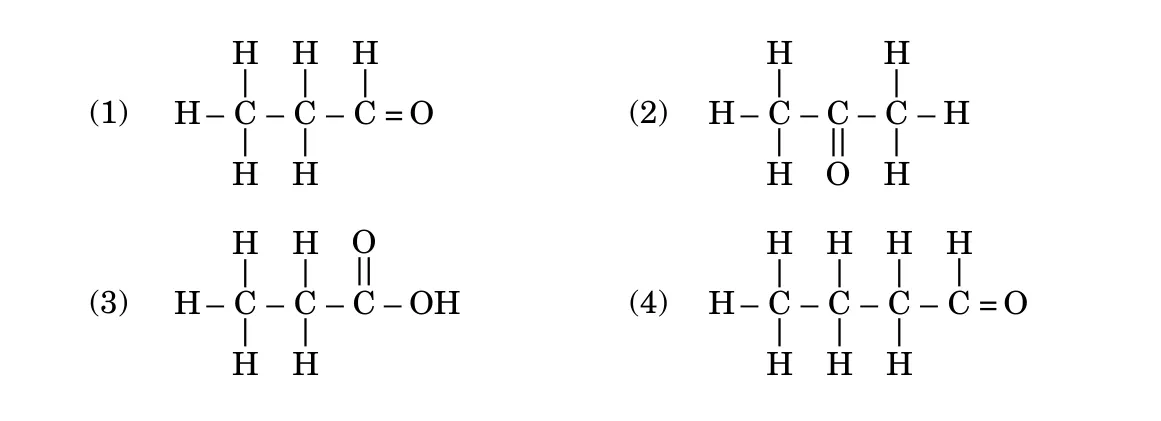
(a) Select from the following the members of same homologous series: (1) a three-carbon aldehyde, CH₃CH₂CHO; (2) a three-carbon ketone, CH₃COCH₃; (3) a three-carbon acid, CH₃CH₂COOH; (4) a four-carbon aldehyde, CH₃CH₂CH₂CHO.

(b) What happens to (i) the melting point, and (ii) the solubility of compounds as the molecular mass of the compounds in a homologous series increases?

Four structural formulas numbered 1 to 4. Number 1 is a three-carbon chain ending in a CHO group. Number 2 is a three-carbon chain with a C double bond O in the middle. Number 3 is a three-carbon chain ending in COOH. Number 4 is a four-carbon chain ending in CHO.
Solution
  1. (a) A homologous series has the same functional group, and each member differs from the next by a CH2\mathrm{CH_2} unit. (1) and (4) both end in the aldehyde group −CHO\mathrm{{-}CHO} and differ by one CH2\mathrm{CH_2}: propanal and butanal. (2) is a ketone and (3) is a carboxylic acid.
  2. (b)(i) The melting point increases as the molecular mass increases. (ii) The solubility (in water) shows a regular gradation: it decreases as the molecular mass increases.

Answer: (a) (1) and (4)   (b) melting point rises; solubility falls

Report an error on this question
Q23Control and Coordination2 marks

Name the parts of hind-brain of the human brain. Which part of the hind-brain controls involuntary actions such as blood pressure and salivation?

Solution
  1. The hind-brain has three parts: the pons, the medulla and the cerebellum.
  2. The medulla controls involuntary actions such as blood pressure, salivation and vomiting. (The cerebellum controls posture and balance.)

Answer: Pons, medulla and cerebellum; the medulla

Report an error on this question
Q24How do Organisms Reproduce?2 marks

(a) Write one function each of the following, in a seed: (i) Seed coat (ii) Cotyledon (iii) Radicle (iv) Plumule

OR

(b) Write the main steps to culture yeast in the laboratory.

Solution
  1. (a)(i) Seed coat: protects the seed. (ii) Cotyledon: stores food for the growing embryo. (iii) Radicle: grows into the root on germination. (iv) Plumule: grows into the shoot.
  2. (b) Take a test tube with about 1010 g of sugar in 100100 mL of water, add a pinch of yeast granules and keep it in a warm place for 11 to 22 hours. The yeast cells bud and multiply, and you can see them under a microscope.

Answer: (a) protects; stores food; root; shoot   (b) sugar solution + yeast, kept warm for 1–2 hours

Report an error on this question
Q25Light: Reflection and Refraction2 marks

(a) Out of the two lenses, one concave and the other convex, state which one will diverge a parallel beam of light falling on it. Draw a ray diagram to show the principal focus of the lens.

OR

(b) A ray of light after refraction from a convex lens emerges parallel to its principal axis. (i) Draw a labelled ray diagram to show it. (ii) In this case, the incident ray before refraction from the lens passes through a point on its principal axis. Name the point.

Solution
FOConcave lens: rays spread out and appear to come from F
  1. (a) The concave lens diverges a parallel beam. Its principal focus is the point on the axis from which the diverged rays appear to come (shown by the dashed lines).
  2. (b)(i) The incident ray passes through the principal focus of the convex lens on the side of the object, bends at the lens and emerges parallel to the principal axis. (ii) The point is the principal focus FF.

Answer: (a) concave lens, see diagram   (b) the principal focus F

Report an error on this question
Q26Electricity2 marks

An electric kettle is rated 750 W; 220 V. Can this kettle be used in a circuit which has a fuse of current rating 3 A? Give reason for your answer.

Solution
  1. I=PV=750220=3.41I = \dfrac{P}{V} = \dfrac{750}{220} = 3.41 A.
  2. The kettle draws 3.413.41 A, which is more than the 33 A rating of the fuse. The fuse wire would melt and break the circuit, so the kettle cannot be used with this fuse.

Answer: No: the kettle draws ≈3.4\approx 3.4 A, more than 33 A, so the fuse will melt

Report an error on this question

Section C: Short answer

7 questions, 3 marks each (50 to 80 words).

Q27Chemical Reactions and Equations3 marks

(a) (i) Define the term decomposition reaction. Write one chemical equation each for decomposition reaction where energy is supplied in the form of heat, light or electricity.

(ii) Decomposition of vegetable matter into compost is considered an exothermic reaction. Why?

OR

(b) Why are decomposition reactions called the opposite of combination reactions? Write one chemical equation each for these two types of reactions mentioning the name of the reactant(s) and the product(s) involved in the reactions.

Solution
  1. (a)(i) In a decomposition reaction a single reactant breaks down to give two or more products.
  2. Heat: CaCO3→heatCaO+CO2\mathrm{CaCO_3 \xrightarrow{heat} CaO + CO_2}. Light: 2AgCl→sunlight2Ag+Cl2\mathrm{2AgCl \xrightarrow{sunlight} 2Ag + Cl_2}. Electricity: 2H2O→electric current2H2+O2\mathrm{2H_2O \xrightarrow{electric\ current} 2H_2 + O_2}.
  3. (ii) Because heat is given out when vegetable matter is broken down by microbes, the reaction is exothermic.
  4. (b) A combination reaction joins two or more reactants into a single product, while a decomposition reaction splits a single reactant into two or more products, so the two are opposite.
  5. Combination: carbon + oxygen →\rightarrow carbon dioxide, C+O2→CO2+heat\mathrm{C + O_2 \rightarrow CO_2 + heat}. Decomposition: calcium carbonate →\rightarrow calcium oxide + carbon dioxide, CaCO3→heatCaO+CO2\mathrm{CaCO_3 \xrightarrow{heat} CaO + CO_2}.

Answer: (a) one reactant breaks into two or more products; heat is released in composting   (b) opposite processes, examples above

Report an error on this question
Q28Metals and Non-metals3 marks

Write the electron-dot structures of (i) sodium, and (ii) oxygen. Using these structures, show the formation of sodium oxide. Mark the anion and cation present in this compound. (At. No. – Sodium = 11 and Oxygen = 8)

Solution
Na (2, 8, 1)NaNa (2, 8, 1)NaO (2, 6)O2 Na⁺cationsO²⁻anion2Na + O → (Na⁺)₂ O²⁻ = Na₂O
  1. Sodium (atomic number 11) has the electron arrangement 2, 8, 1: one dot (electron) in its outer shell. Oxygen (atomic number 8) has 2, 6: six dots in its outer shell, and it needs two more to complete an octet.
  2. Each sodium atom gives its single outer electron to oxygen. Two sodium atoms give two electrons to one oxygen atom: 2Na→2Na++2e−\mathrm{2Na \rightarrow 2Na^+ + 2e^-} and O+2e−→O2−\mathrm{O + 2e^- \rightarrow O^{2-}}.
  3. The oppositely charged ions attract: (Na+)2 O2−\mathrm{(Na^+)_2\,O^{2-}}, that is Na2O\mathrm{Na_2O}. The cation is Na+\mathrm{Na^+} and the anion is O2−\mathrm{O^{2-}}.

Answer: Na2O\mathrm{Na_2O}: cation Na+\mathrm{Na^+}, anion O2−\mathrm{O^{2-}}

Report an error on this question
Q29Control and Coordination3 marks

(a) Define hormone.

(b) “Hormones should be secreted in precise quantities. We have a feedback mechanism through which this is done.” With the help of an example justify the statement.

Solution
  1. (a) Hormones are chemical messengers made in one part of the body that travel in the blood to a target organ or tissue and regulate a body function.
  2. (b) Example: when the blood sugar level rises, the cells of the pancreas detect it and make more insulin, which lowers the blood sugar. When the level falls, the pancreas cells sense this and reduce insulin secretion. So the amount of the hormone is adjusted by the effect it has: this is feedback regulation.

Answer: Hormones are chemical messengers; blood sugar and insulin form a feedback loop

Report an error on this question
Q30Heredity3 marks

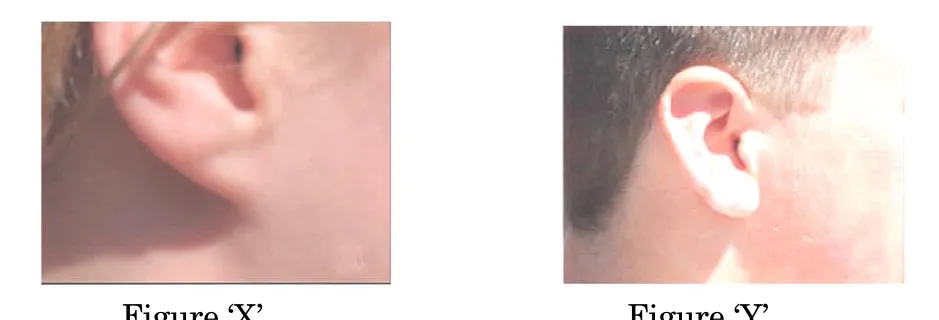
The lowest part of the ear called earlobe, is closely attached to the side of the head in some of us (Figure ‘X’), and not in others, called free earlobe (Figure ‘Y’). Attached and free earlobes are two variants found in human populations. The gene for free earlobe is dominant over attached earlobes.

(a) A man with attached earlobes marries a woman having free earlobes. 50% of their children have free earlobes and 50% have attached earlobes. Explain the inheritance of this trait and write the trait combinations of the progeny.

(b) Write the gene combinations of the father and the mother in the above case.

Two photographs of the side of a head. Figure X shows an ear with the earlobe attached to the head. Figure Y shows a free hanging earlobe.
Solution
  1. Let FF be the dominant gene for free earlobes and ff the recessive gene for attached earlobes. Attached earlobes can only be ffff.
  2. (b) The father has attached earlobes: ffff. Half the children have attached earlobes (ffff), so each of them gets an ff from the mother as well as from the father. Half have free earlobes, so the mother must carry both FF and ff: she is FfFf.
  3. (a) Cross ff×Ffff \times Ff. The father gives only ff. The mother gives FF or ff in equal numbers. The children are FfFf (free earlobes) and ffff (attached earlobes) in the ratio 1:11 : 1, that is 50%50\% each.

Answer: (a) FfFf : ffff = 1 : 1 (free : attached)   (b) father ffff, mother FfFf

Report an error on this question
Q31Light: Reflection and Refraction3 marks

A convex lens forms an 8.0 cm long image of a 2.0 cm long object which is kept at a distance of 6.0 cm from the optical centre of the lens. If the object and the image are on the same side of the lens, find (i) the nature of the image, (ii) the position of the image, and (iii) the focal length of the lens.

Solution
FOObjectImagem = 8/2 = 4 = v/u → v = −24 cm; 1/f = 1/v − 1/u = 1/8virtual, erect, magnified; f = +8 cm
  1. The object and image are on the same side of a convex lens, so the image is virtual (and erect, since the object is within the focal length).
  2. (i) The image is virtual and erect.
  3. (ii) h=+2.0h = +2.0 cm, h′=+8.0h' = +8.0 cm, u=−6.0u = -6.0 cm. m=h′h=vum = \dfrac{h'}{h} = \dfrac{v}{u}: 8.02.0=v−6.0\dfrac{8.0}{2.0} = \dfrac{v}{-6.0}, so v=−24v = -24 cm. The image is 2424 cm from the lens on the same side as the object.
  4. (iii) 1f=1v−1u=−124+16=−1+424=18\dfrac{1}{f} = \dfrac{1}{v} - \dfrac{1}{u} = -\dfrac{1}{24} + \dfrac{1}{6} = \dfrac{-1 + 4}{24} = \dfrac{1}{8}, so f=+8f = +8 cm.

Answer: (i) virtual and erect   (ii) v=−24v = -24 cm   (iii) f=+8f = +8 cm

Common mistake: Reading 8.0 cm and 6.0 cm as 80 cm and 60 cm: the decimal point is easy to miss in the printed paper.

Report an error on this question
Q32Electricity3 marks

Three resistors of 2 Ω2\ \Omega, 3 Ω3\ \Omega and 6 Ω6\ \Omega are connected in (i) series, and (ii) parallel. Draw the arrangements of the resistors and find the equivalent resistance of each arrangement.

Solution
(i) Series: R = 2 + 3 + 6 = 11 Ω2 Ω3 Ω6 Ω(ii) Parallel: 1/R = 1/2 + 1/3 + 1/6 = 1, so R = 1 Ω2 Ω3 Ω6 Ω
  1. (i) In series the resistances add: Rs=2+3+6=11 ΩR_s = 2 + 3 + 6 = 11\ \Omega.
  2. (ii) In parallel: 1Rp=12+13+16=3+2+16=1\dfrac{1}{R_p} = \dfrac{1}{2} + \dfrac{1}{3} + \dfrac{1}{6} = \dfrac{3 + 2 + 1}{6} = 1, so Rp=1 ΩR_p = 1\ \Omega.

Answer: (i) 11 Ω11\ \Omega   (ii) 1 Ω1\ \Omega

Report an error on this question
Q33Our Environment3 marks

Write the essential function performed by ozone at the higher levels of the atmosphere. How is it formed in the upper atmosphere? Write the name of the group of chemicals mainly responsible for the depletion of ozone layer.

Solution
  1. Function: the ozone layer shields the surface of the Earth from the harmful ultraviolet (UV) radiation of the Sun, which can cause skin cancer.
  2. Formation: UV radiation splits some molecular oxygen into free oxygen atoms, O2→O+O\mathrm{O_2 \rightarrow O + O}. These atoms combine with molecular oxygen to form ozone, O+O2→O3\mathrm{O + O_2 \rightarrow O_3}.
  3. The chemicals mainly responsible for ozone depletion are the chlorofluorocarbons (CFCs).

Answer: Absorbs UV; O + O₂ → O₃; CFCs

Report an error on this question

Section D: Long answer

3 questions, 5 marks each (80 to 120 words).

Q34Carbon and its Compounds5 marks

(a) (i) A compound ‘X’ having two carbon atoms in its molecule turns blue litmus red and 5 – 8% solution of ‘X’ in water is widely used as a preservative. Identify the compound ‘X’ and write its structure. [1½]

(ii) Compare its pH nature with a mineral acid. [½]

(iii) ‘X’ on reacting with alcohols produces sweet smelling compounds, used in making perfumes. Name the reaction and write its chemical equation. [1½]

(iv) When sodium carbonate is added to ‘X’, a colourless gas is produced which turns lime water milky. Write the chemical equation for the reaction giving the name of the salt produced. [1½]

OR

(b) (i) Differentiate between saturated and unsaturated hydrocarbons by giving one example each, with a structural formula.

(ii) Write the method of converting an unsaturated hydrocarbon into a saturated hydrocarbon. Name the industry where this reaction is commonly used.

(iii) Write the name and structure of a hydrocarbon having double bond and four carbon atoms in its one molecule.

Solution
  1. (a)(i) XX is ethanoic acid (acetic acid), CH3COOH\mathrm{CH_3COOH}. Its 55–8%8\% solution is vinegar. Structure: H−C(H)(H)−C(=O)−O−H\mathrm{H{-}C(H)(H){-}C(=O){-}O{-}H} (a methyl group joined to the carboxyl group).
  2. (ii) It is a weak acid, so the pH of its solution is higher than that of a mineral acid of the same concentration.
  3. (iii) Esterification: CH3COOH+CH3CH2OH→conc. H2SO4CH3COOCH2CH3+H2O\mathrm{CH_3COOH + CH_3CH_2OH \xrightarrow{conc.\ H_2SO_4} CH_3COOCH_2CH_3 + H_2O} (ethyl ethanoate).
  4. (iv) 2CH3COOH+Na2CO3→2CH3COONa+CO2+H2O\mathrm{2CH_3COOH + Na_2CO_3 \rightarrow 2CH_3COONa + CO_2 + H_2O}. The salt is sodium ethanoate (sodium acetate) and the gas is carbon dioxide.
  5. (b)(i) Saturated hydrocarbons have only single bonds between the carbon atoms (general formula CnH2n+2\mathrm{C_nH_{2n+2}}), for example propane, CH3CH2CH3\mathrm{CH_3CH_2CH_3}. Unsaturated hydrocarbons have at least one double or triple bond (general formulas CnH2n\mathrm{C_nH_{2n}} and CnH2n−2\mathrm{C_nH_{2n-2}}), for example propene, CH2=CH−CH3\mathrm{CH_2{=}CH{-}CH_3}.
  6. (ii) Add hydrogen in the presence of a nickel or palladium catalyst (hydrogenation). This is commonly used in the vegetable oil industry to turn oils into ghee.
  7. (iii) Butene, CH2=CH−CH2−CH3\mathrm{CH_2{=}CH{-}CH_2{-}CH_3} (but-1-ene), which has four carbon atoms and a double bond.

Answer: (a) ethanoic acid; higher pH than a mineral acid; esterification; sodium ethanoate   (b) see steps; hydrogenation with Ni/Pd; butene

Report an error on this question
Q35Life Processes5 marks

(a) (i) “The length of the small intestine in various animals depends on the food they eat.” Justify the statement.

(ii) Discuss the role of the pancreas and bile juice in the digestion of food in human beings.

(iii) How is the small intestine designed to absorb digested food?

OR

(b) (i) State the role of rings of cartilage present in the throat.

(ii) Discuss the role of the ribs and diaphragm when air is taken in during the breathing cycle.

(iii) Why do we get muscle cramps during heavy exercise? Explain.

Solution
  1. (a)(i) Herbivores such as cows eat grass, which is hard to digest because of cellulose, so they need a longer small intestine. Meat is easier to digest, so carnivores such as tigers have a shorter small intestine.
  2. (ii) The pancreas secretes pancreatic juice that contains trypsin to digest proteins and lipase to break down emulsified fats. Bile juice (from the liver) emulsifies fats, breaking large globules into smaller ones, and makes the medium alkaline so that the pancreatic enzymes can act.
  3. (iii) The inner wall of the small intestine has millions of finger-like projections called villi. They increase the surface area for absorption, and they are rich in blood vessels that carry the absorbed food to every cell of the body.
  4. (b)(i) The rings of cartilage keep the air passage from collapsing when there is no air in it.
  5. (ii) During inhalation the ribs are lifted up and outward and the diaphragm flattens (moves down). The chest cavity becomes larger, so air is sucked into the lungs (alveoli).
  6. (iii) During heavy exercise the muscle cells do not get enough oxygen, so they respire anaerobically: pyruvate is turned into lactic acid. The build-up of lactic acid in the muscles causes cramps.

Answer: (a) longer for cellulose; trypsin, lipase, bile; villi   (b) keep trachea open; ribs up, diaphragm flat; lactic acid

Report an error on this question
Q36Magnetic Effects of Electric Current5 marks

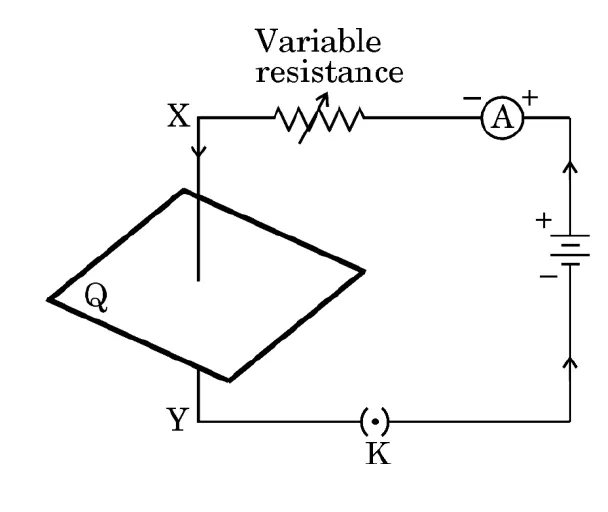
(a) The given figure shows the current passing through the straight conductor XY. (i) Copy the diagram and draw the magnetic field lines when current flows from conductor X to Y. (ii) Name and state the rule used in determining the direction of the magnetic field lines in the situation given above. (iii) State Fleming’s left hand rule. Using this rule, determine the direction of force applied on an electron entering a uniform magnetic field as shown in the figure.

OR

(b) (i) Define the term solenoid. Draw the pattern of the magnetic field lines in and around a current carrying straight solenoid. Mark on the pattern the (i) direction of current, (ii) direction of field lines near the ends of the solenoid, and (iii) region where the magnetic field is uniform. (ii) How would you make an electromagnet using a current carrying solenoid?

A circuit with a variable resistance, an ammeter, a battery and a key K. A straight conductor XY passes vertically through the middle of a square cardboard Q. Current flows from X down to Y.
Solution
Top viewCurrent X → Y goes into the page:field lines are clockwise circlesB →e⁻ moves upForce: out of the page
NS(i) direction of current(iii) inside: parallel, evenly spaced lines = uniform field(ii) outside: lines leave the N end and enter the S end
  1. (a)(i) The field lines are concentric circles on the cardboard, with the conductor at the centre. For current from X to Y (downward) they run clockwise when seen from above (from the X end).
  2. (ii) The right-hand thumb rule: imagine holding the current-carrying straight conductor in your right hand with the thumb pointing in the direction of the current. The fingers then wrap around the conductor in the direction of the magnetic field lines.
  3. (iii) Fleming’s left-hand rule: stretch the thumb, forefinger and middle finger of the left hand mutually perpendicular. If the forefinger points in the direction of the magnetic field and the middle finger in the direction of the current, then the thumb points in the direction of the force on the conductor.
  4. For the electron, the current is opposite to its motion. It moves up in a field pointing to the right, so the conventional current points down. The force is out of the plane of the paper (upwards towards the viewer).
  5. (b)(i) A solenoid is a coil of many circular turns of insulated copper wire wrapped closely in the shape of a cylinder. Its field pattern is like that of a bar magnet: inside, the lines are parallel and evenly spaced, so the field is uniform; outside, they leave the north end and enter the south end (diagram above).
  6. (ii) Place a piece of soft iron inside the current-carrying solenoid. The iron is magnetised by the field and forms an electromagnet.

Answer: (a) circles; right-hand thumb rule; Fleming’s left-hand rule, force out of the plane   (b) solenoid pattern; soft iron core

Report an error on this question

Section E: Case studies

3 case studies, 4 marks each.

Q37Acids, Bases and Salts4 marks

Case study 1. Acid-base indicators can be used to distinguish between an acid and a base. Universal indicator, a mixture of several indicators, shows different colours at different concentrations of acids and bases, thereby indicating their pH on the pH scale of 0 – 14. The pH of a solution is measured by pH paper, which is a paper impregnated with a universal indicator.

(a) Solution P is a strong acid while solution Q is a strong base. On the pH scale, where would you place the solutions P and Q? [1]

(b) A solution has a pH of 7. Name a compound you would use to (i) increase its pH, and (ii) decrease its pH. [1]

(c) (i) When the pH of a solution is decreased from 4 to 2, what effect does it produce on its hydronium ion concentration? State the colour change shown by the pH paper. [2]

OR

(c) (ii) A person is feeling pain and irritation in the stomach due to indigestion. What could be the pH of the fluid in the stomach? Write the common name of the medicines people use for remedy. Give the chemical name of “milk of magnesia” often used for this purpose. [2]

Solution
  1. (a) P (strong acid) lies at the low end, about pH 00 to 44. Q (strong base) lies at the high end, about pH 1212 to 1414.
  2. (b) (i) To increase the pH add a base such as sodium hydroxide, NaOH\mathrm{NaOH}. (ii) To decrease the pH add an acid such as hydrochloric acid, HCl\mathrm{HCl}.
  3. (c)(i) The hydronium ion concentration increases (a fall of 22 pH units makes it 100100 times larger). The pH paper changes from yellow/orange to red/pink.
  4. (c)(ii) Indigestion is caused by excess acid, so the pH of the stomach fluid is low, about 11 to 33. People take antacids (for example milk of magnesia). The chemical name of milk of magnesia is magnesium hydroxide, Mg(OH)2\mathrm{Mg(OH)_2}.

Answer: (a) P: pH 0–4; Q: pH 12–14   (b) NaOH, HCl   (c) [H3O+][\mathrm{H_3O^+}] increases, yellow/orange to red (OR) pH 1–3, antacid, Mg(OH)2\mathrm{Mg(OH)_2}

Report an error on this question
Q38How do Organisms Reproduce?4 marks

Case study 2. When a girl is born, the ovaries already contain thousands of immature eggs. On reaching puberty, some of these start maturing. One matured egg is released every month by one of the ovaries. The two oviducts unite into an elastic bag-like structure known as uterus.

(a) Write the site of fertilization in human female. [1]

(b) How does the uterus prepare itself to receive and nurture the growing embryo? Explain. [1]

(c) (i) What happens when the egg is not fertilized? [2]

OR

(c) (ii) How does the developing embryo get nutrition from the mother’s blood? Explain. [2]

Solution
  1. (a) Fertilisation takes place in the oviduct (fallopian tube).
  2. (b) The lining of the uterus becomes thick and spongy and is richly supplied with blood, so that it can nourish the growing embryo.
  3. (c)(i) The thick uterine lining is not needed, so it slowly breaks down and comes out through the vagina as blood and mucus along with the unfertilised egg. This is menstruation.
  4. (c)(ii) Through the placenta, a special disc-like tissue embedded in the uterine wall. It has villi on the embryo’s side and blood spaces on the mother’s side, so oxygen and nutrients pass from the mother’s blood to the embryo (and waste passes back to the mother).

Answer: (a) oviduct   (b) lining thickens with blood   (c) menstruation (OR) the placenta

Report an error on this question
Q39Human Eye and the Colourful World4 marks

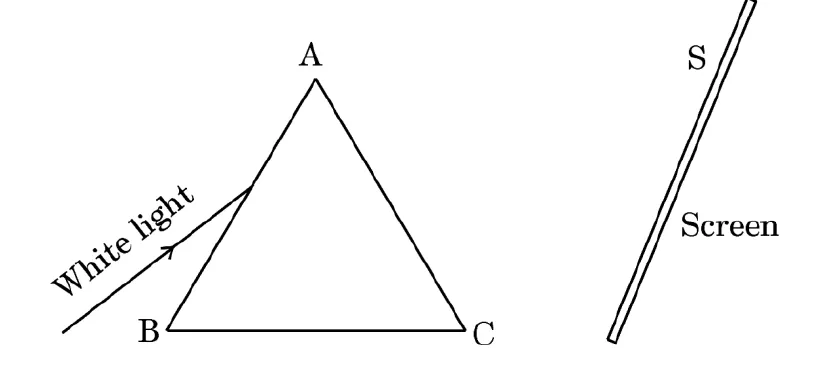
Case study 3. A person allowed a narrow beam of white light from the sun to enter a dark room through a small aperture and placed a glass prism in its path in such a manner that the beam falls on the face AB of the prism as shown in the figure. A screen S is placed on the other side of the prism, facing AC. On turning the prism slowly, a beautiful band of colours is obtained on the screen. It is the spectrum of sunlight.

(a) Name the phenomenon due to which a prism splits the incident white light into a band of colours. [1]

(b) State the reason of getting a band of seven colours in the above case. [1]

(c) (i) Explain with the help of a labelled ray diagram, an experimental arrangement to show the recombination of the spectrum of white light. [2]

OR

(c) (ii) Draw a labelled ray diagram to show the formation of a rainbow. [2]

A glass prism ABC with white light falling on the face AB from the lower left, and a screen S placed on the other side of the prism facing the face AC.
Solution
prism 1prism 2 (inverted)white lightwhite lightPrism 1 disperses white light; the second, inverted prism bends thecolours back together, and white light emerges
  1. (a) Dispersion of light.
  2. (b) Different colours of light bend through different angles with respect to the incident ray as they pass through the prism: violet bends the most and red the least. So the white light spreads out into seven colours.
  3. (c)(i) Place a second identical prism upside down next to the first one. The spectrum from the first prism falls on the second prism, which bends the colours back in the opposite way, and a beam of white light emerges from the other side of the second prism (diagram above).
  4. (c)(ii) A rainbow is formed by the dispersion of sunlight by small water droplets in the air. The light is refracted and dispersed on entering a droplet, reflected internally at the back of the droplet, and refracted again as it leaves, so a band of colours reaches the eye. The observer must stand with the Sun behind them. In the diagram, draw the Sun’s rays, the droplet, the red and violet rays and the observer’s eye with arrows.

Answer: (a) dispersion   (b) different colours bend by different angles   (c) inverted second prism recombines (OR) droplet: refraction, internal reflection, refraction

Report an error on this question

Questions are from the official CBSE paper. Figures are described in words; see the PDF for the originals. Solutions are written by CogniGuru.

Revise this paper in 1 minute a chapter

Each chapter below is what the paper tested, with a one-minute animated lesson on the idea behind it.

Stuck on a step in any solution?

The CogniGuru AI tutor explains any doubt one minute at a time, in English or Hindi. Join the waitlist.

Mock quiz: 5 questions from this paper

Five real questions from this paper, one each from five chapters. About 2 minutes. See how much you know and where you stand among other students. Attempt free, with no login; log in only for your ranking and full report.

Question 1 of 5 · Q1 of the paperChemical Reactions and Equations

The correct balanced chemical equation showing exothermic reaction in which natural gas burns in air is:

0 of 5 answered

Related papers

Common questions

Are these the official CBSE Class 10 Science 2025 questions?
Yes. The questions are from the official Science paper (set 31/2/1) that CBSE published after the March 2025 board exam. The solutions are written by CogniGuru and checked against the answer key CBSE published for this paper code.
Can I download the CBSE Class 10 Science 2025 question paper PDF?
Yes, the official paper PDF is free to download from this page, and so are our step-by-step solutions as a PDF. No login is needed to download either or to read the solutions.
Do all sets of the paper have the same questions?
No. CBSE sets several versions of each paper, with the same blueprint and similar questions in a different order and sometimes with different numbers. This page covers set 31/2/1.
How does the quiz work, and what does “where you stand” mean?
It is a mock quiz of 5 real multiple-choice questions from this paper, scored automatically in about 2 minutes. Your score is compared, anonymously, with other students who took the same quiz. Only the score is stored with the comparison, never your name or number.

Source

CBSE question paper archive, Class X, 2025 (Science, set 31/2/1)
PDF