

CBSE · Class 10 · Science · Free

CBSE Class 10 Science 2025 Question Paper (Set 31/4/1) with Solutions

The official board paper (Q.P. Code 31/4/1, Series EFHG4). Free paper PDF and step-by-step solutions (also as a PDF to download) written by CogniGuru and checked against CBSE’s answer key. See the paper’s main topics in 1 minute, then quiz yourself to see how much you know and where you stand.

No login to download or read the solutions. Login only to see your quiz report in full.

Board
CBSE
Class
10
Subject
Science (086)
Year
2025
Set code
31/4/1
Max marks
80
Duration
3 hours
Questions
39 (Sections A to E)
Source
Official CBSE paper
Exam date
March 2025

Paper preview

Three pages of the official paper. Download the PDF for all 24.

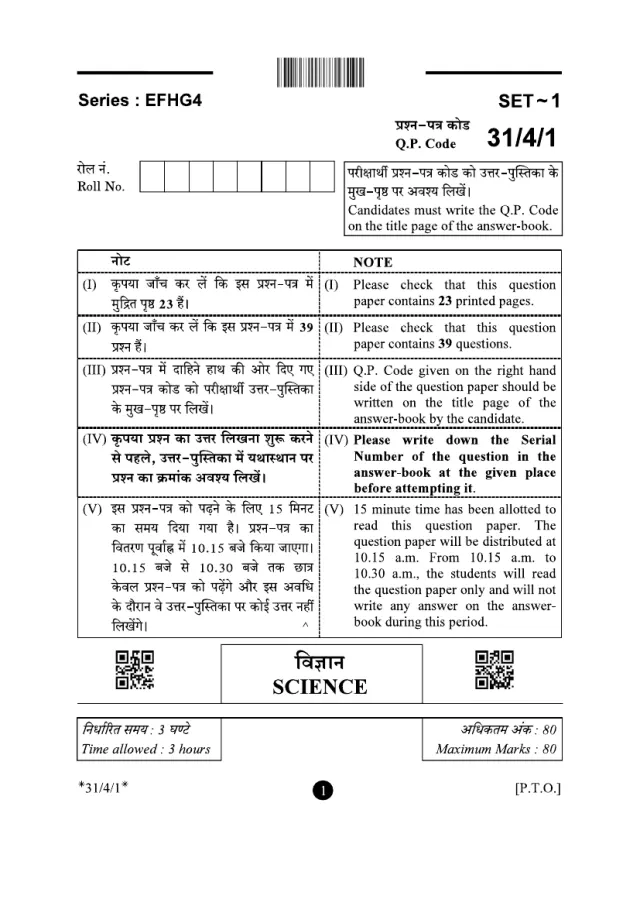
  • Cover page of the CBSE Class 10 Science 2025 paper, set 31/4/1

    Cover page

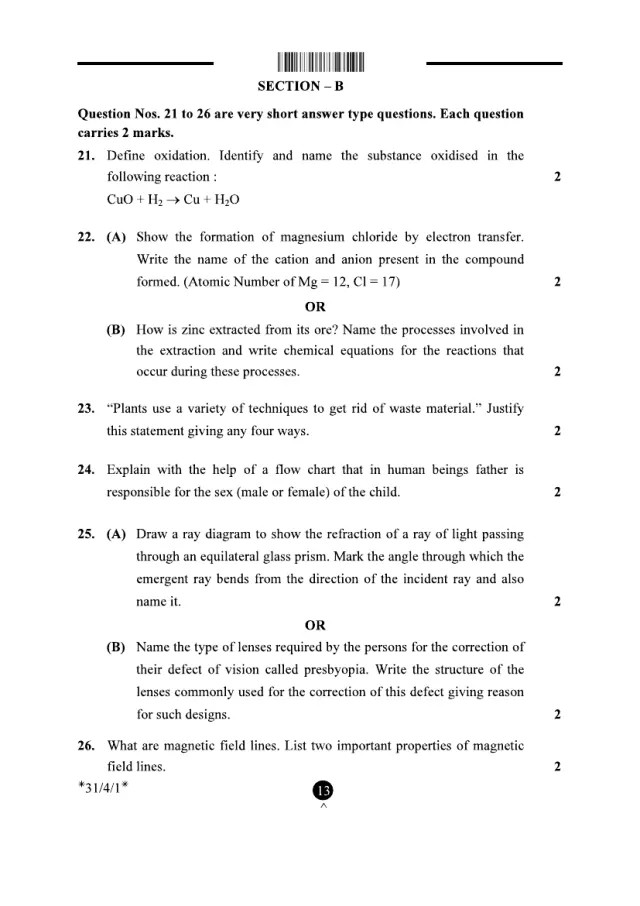
  • Section B of the CBSE Class 10 Science 2025 paper, set 31/4/1

    Section B

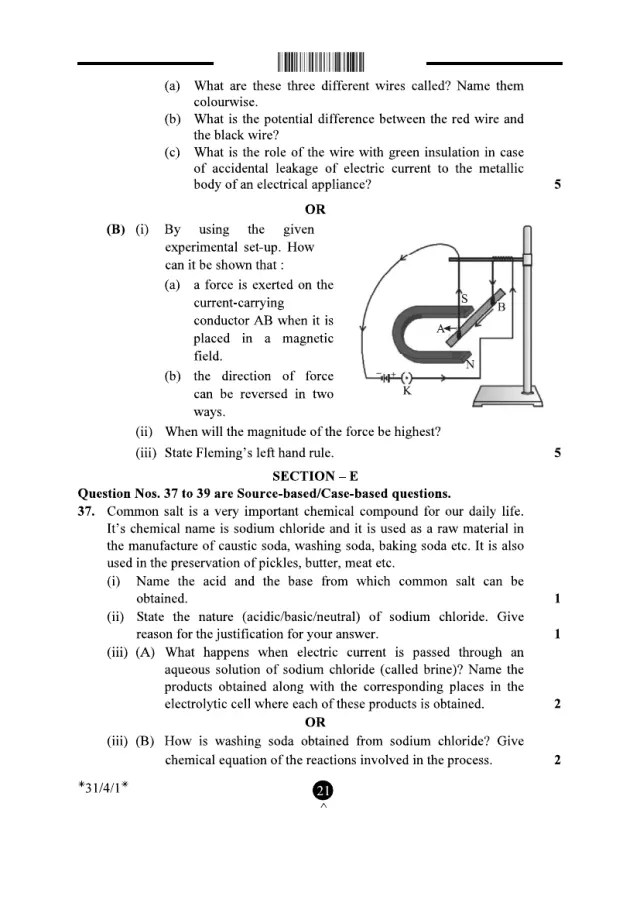
  • A case study with its figure from the CBSE Class 10 Science 2025 paper, set 31/4/1

    Case study

The main topics of this paper, in 1 minute

Your tutor walks you through the paper before you attempt it: the marks, the key ideas, the time plan and the traps.

1-minute paper analysis

With your tutor, in her voice

The main topics of this paper, in about a minute

A short, animated walk through the paper: how it is built, where the marks come from, the four ideas that matter most, how to plan your three hours, and the traps to avoid.

  1. 1The paper at a glance
  2. 2Where the marks come from
  3. 3Four ideas that keep paying off
  4. 4Plan your three hours
  5. 5Four traps to avoid

Sound on for the voice. Captions are shown, and you can mute any time.

Step-by-step solutions

Try each question first, then open its solution. Tap a number to jump.

Download solutions (PDF)

Section A: Multiple choice

20 questions, 1 mark each. MCQs (Q1 to Q16) and assertion-reason (Q17 to Q20).

Q1Chemical Reactions and Equations1 mark

In which one of the following situations a chemical reaction does not occur?

  1. (A)Milk is left open at room temperature during summer
  2. (B)Grapes get fermented
  3. (C)An iron nail is left exposed to humid atmosphere
  4. (D)Melting of glaciers
Solution · answer (D)
  1. Milk turning sour, fermentation of grapes and rusting of iron all form new substances: chemical reactions.
  2. Melting of a glacier only changes ice to water, a physical change in state with no new substance.

Answer: (D) Melting of glaciers

Report an error on this question
Q2Acids, Bases and Salts1 mark

In order to prepare dry hydrogen chloride gas in humid atmosphere the gas produced is passed through a guard tube (drying tube) which contains:

  1. (A)Calcium chloride
  2. (B)Calcium oxide
  3. (C)Calcium hydroxide
  4. (D)Calcium carbonate
Solution · answer (A)
  1. The drying agent must absorb moisture but not react with HCl. Calcium oxide, hydroxide and carbonate are basic, so they would react with the acid gas.
  2. Calcium chloride is neutral and takes up water, so it is used.

Answer: (A) Calcium chloride

Report an error on this question
Q3Metals and Non-metals1 mark

The property by virtue of which a solid material can be drawn into thin wires is called:

  1. (A)malleability
  2. (B)ductility
  3. (C)rigidity
  4. (D)resistivity
Solution · answer (B)
  1. Drawing into wires is ductility. (Beating into thin sheets is malleability.)

Answer: (B) ductility

Report an error on this question
Q4Carbon and its Compounds1 mark

Select from the following a hydrocarbon having one C–C bond and one C≡C\mathrm{C{\equiv}C} bond:

  1. (A)Benzene
  2. (B)Cyclohexane
  3. (C)Butyne
  4. (D)Propyne
Solution · answer (D)
  1. Propyne is CH3−C≡CH\mathrm{CH_3{-}C{\equiv}CH}: the three carbons have one C–C single bond and one C≡C triple bond. Butyne has two single bonds as well, and benzene and cyclohexane have rings.

Answer: (D) Propyne

Report an error on this question
Q5Life Processes1 mark

The essential element taken up from the soil by the plants to synthesize proteins is:

  1. (A)Phosphorus
  2. (B)Nitrogen
  3. (C)Iron
  4. (D)Magnesium
Solution · answer (B)
  1. Proteins are made of amino acids, which contain nitrogen. Plants take it from the soil as nitrates and nitrites.

Answer: (B) Nitrogen

Report an error on this question
Q6Life Processes1 mark

Select TRUE statements about lymph from the following:

A. Lymph vessels carry lymph through the body and finally open into larger arteries.

B. Lymph contains some amount of plasma, proteins and blood cells.

C. Lymph contains some amount of plasma, proteins and red blood cells.

D. Lymph vessels carry lymph through the body and finally open into larger veins.

  1. (A)A and B
  2. (B)B and D
  3. (C)A and C
  4. (D)C and D
Solution · answer (B)
  1. Lymph drains back into larger veins, not arteries, so D is true and A is false.
  2. Lymph is like blood plasma and carries proteins and white blood cells but no red blood cells. B (“blood cells”, i.e. the white ones) is the accepted true statement and C is false.

Answer: (B) B and D

Report an error on this question
Q7How do Organisms Reproduce?1 mark

Plants like rose and banana have lost the capacity to produce:

  1. (A)flowers
  2. (B)buds
  3. (C)seeds
  4. (D)fruits
Solution · answer (C)
  1. Rose and banana are propagated by vegetative methods (cutting, grafting, suckers). Over time they have lost the capacity to produce viable seeds.

Answer: (C) seeds

Report an error on this question
Q8How do Organisms Reproduce?1 mark

In a bisexual flower the male gametes are present in the:

  1. (A)anther
  2. (B)ovary
  3. (C)stigma
  4. (D)filament
Solution · answer (A)
  1. The anther makes the pollen grains, which carry the male gametes. The ovary and stigma are female parts, and the filament only holds up the anther.

Answer: (A) anther

Report an error on this question
Q9Heredity1 mark

When a pure-tall pea plant is crossed with a pure-dwarf pea plant, the percentage of tall pea plants in F1F_1 and F2F_2 generation pea plants will be respectively:

  1. (A)100%; 25%
  2. (B)100%; 50%
  3. (C)100%; 75%
  4. (D)100%; 100%
Solution · answer (C)
  1. TT×ttTT \times tt gives all TtTt in F1F_1, and tall is dominant: 100%100\% tall.
  2. Selfing Tt×TtTt \times Tt gives TT:Tt:tt=1:2:1TT : Tt : tt = 1 : 2 : 1, so 75%75\% are tall in F2F_2.

Answer: (C) 100%; 75%

Report an error on this question
Q10Light: Reflection and Refraction1 mark

To get an image of magnification −1 on a screen using a lens of focal length 20 cm, the object distance must be:

  1. (A)Less than 20 cm
  2. (B)30 cm
  3. (C)40 cm
  4. (D)80 cm
Solution · answer (C)
  1. m=−1m = -1 means a real, inverted image of the same size as the object. That happens when the object is at 2f2f: u=−2×20=−40u = -2 \times 20 = -40 cm. Check: 1v=1f+1u=120−140=140\dfrac{1}{v} = \dfrac{1}{f} + \dfrac{1}{u} = \dfrac{1}{20} - \dfrac{1}{40} = \dfrac{1}{40}, so v=40v = 40 cm and m=vu=−1m = \dfrac{v}{u} = -1 ✓.

Answer: (C) 40 cm

Report an error on this question
Q11Light: Reflection and Refraction1 mark

An optical device ‘X’ is placed obliquely in the path of a narrow parallel beam of light. If the emergent beam gets displaced laterally, the device ‘X’ is:

  1. (A)plane mirror
  2. (B)convex lens
  3. (C)glass slab
  4. (D)glass prism
Solution · answer (C)
  1. A rectangular glass slab bends the ray towards the normal on entering and away from the normal on leaving by equal amounts. The emergent ray is parallel to the incident ray, but shifted sideways (lateral displacement).

Answer: (C) glass slab

Report an error on this question
Q12Electricity1 mark

A piece of wire of resistance RR is cut lengthwise into three identical parts. These parts are then connected in parallel. If the equivalent resistance of this combination is R′R', then the value of R/R′R/R' is:

  1. (A)1/9
  2. (B)1/3
  3. (C)3
  4. (D)9
Solution · answer (D)
  1. The key takes this as cutting the wire into three equal pieces along its length. Each piece has length l3\dfrac{l}{3}, so its resistance is R3\dfrac{R}{3}.
  2. In parallel: 1R′=3R+3R+3R=9R\dfrac{1}{R'} = \dfrac{3}{R} + \dfrac{3}{R} + \dfrac{3}{R} = \dfrac{9}{R}, so R′=R9R' = \dfrac{R}{9} and RR′=9\dfrac{R}{R'} = 9.

Answer: (D) 9

About CBSE’s key: The word “lengthwise” could also mean cutting along the wire (into three thinner wires), which would give R′ = R. CBSE’s key follows the reading of three equal pieces cut across the length, so the answer is 9.

Report an error on this question
Q13Electricity1 mark

An electric bulb is rated 220220 V; 1111 W. The resistance of its filament when it glows with a power supply of 220220 V is:

  1. (A)4400 Ω4400\ \Omega
  2. (B)440 Ω440\ \Omega
  3. (C)400 Ω400\ \Omega
  4. (D)20 Ω20\ \Omega
Solution · answer (A)
  1. R=V2P=220×22011=4400 ΩR = \dfrac{V^2}{P} = \dfrac{220 \times 220}{11} = 4400\ \Omega.

Answer: (A) 4400 Ω4400\ \Omega

Report an error on this question
Q14Electricity1 mark

The minimum number of identical bulbs of rating 44 V; 66 W, that can work safely with desired brightness, when connected in series with a 240240 V mains supply is:

  1. (A)20
  2. (B)40
  3. (C)60
  4. (D)80
Solution · answer (C)
  1. Each bulb must have 44 V across it. In series the voltage divides equally, so the number of bulbs is 2404=60\dfrac{240}{4} = 60. (Each carries 64=1.5\dfrac{6}{4} = 1.5 A, the same current as its rating.)

Answer: (C) 60

Report an error on this question
Q15Our Environment1 mark

In the food chains given below. Select the most efficient food chain in terms of energy:

  1. (A)Grass →\rightarrow Grasshopper →\rightarrow Frog →\rightarrow Snake
  2. (B)Plants →\rightarrow Deer →\rightarrow Lion
  3. (C)Plants →\rightarrow Man
  4. (D)Phytoplankton →\rightarrow Zooplankton →\rightarrow Small Fish →\rightarrow Big Fish
Solution · answer (C)
  1. Only about 10%10\% of the energy passes to the next level, so the fewer the steps, the more energy reaches the last consumer.
  2. Plants → Man has the fewest trophic levels (two), so it is the most efficient.

Answer: (C) Plants → Man

Report an error on this question
Q16Our Environment1 mark

Which one of the following gets biomagnified at different levels in a food chain?

  1. (A)Carbon monoxide
  2. (B)CFC’s
  3. (C)DDT
  4. (D)Manure
Solution · answer (C)
  1. DDT, a pesticide, is not broken down, so it is passed up the food chain and builds up at each higher trophic level. CO and CFCs are gases, and manure is biodegradable.

Answer: (C) DDT

Report an error on this question
Q17Life Processes1 mark

Assertion (A): In large animals, oxygen can reach different parts of the animal’s body easily.

Reason (R): Respiratory pigments take up oxygen from the air and carry it to body tissues.

  1. (A)Both A and R are true and R is the correct explanation of A
  2. (B)Both A and R are true, but R is not the correct explanation of A
  3. (C)A is true, but R is false
  4. (D)A is false, but R is true
Solution · answer (D)
  1. In large animals diffusion alone is too slow, so oxygen does not reach all parts easily. That is why they need respiratory pigments such as haemoglobin to carry oxygen. So A is false and R is true.

Answer: (D) A is false, but R is true

Report an error on this question
Q18Acids, Bases and Salts1 mark

Assertion (A): Concentrated nitric acid is diluted by adding water slowly to acid with constant stirring.

Reason (R): Concentrated nitric acid is easily soluble in water.

  1. (A)Both A and R are true and R is the correct explanation of A
  2. (B)Both A and R are true, but R is not the correct explanation of A
  3. (C)A is true, but R is false
  4. (D)A is false, but R is true
Solution · answer (D)
  1. The correct way is to add the acid slowly to water with stirring, because dissolving gives out much heat. So A is false. R is true.

Answer: (D) A is false, but R is true

Common mistake: Adding water to the acid. Always add acid to water.

Report an error on this question
Q19Heredity1 mark

Assertion (A): In reptiles, the temperature at which the fertilized eggs are kept decides the sex of the offsprings.

Reason (R): Sex is not genetically determined in some animals.

  1. (A)Both A and R are true and R is the correct explanation of A
  2. (B)Both A and R are true, but R is not the correct explanation of A
  3. (C)A is true, but R is false
  4. (D)A is false, but R is true
Solution · answer (A)
  1. In some reptiles the incubation temperature decides the sex, which means that sex is not decided by chromosomes in them. So R explains A.

Answer: (A) Both A and R are true and R is the correct explanation of A

Report an error on this question
Q20Human Eye and the Colourful World1 mark

Assertion (A): When ciliary muscles contract, eye lens becomes thin.

Reason (R): Ciliary muscles control the power of the eye lens.

  1. (A)Both A and R are true and R is the correct explanation of A
  2. (B)Both A and R are true, but R is not the correct explanation of A
  3. (C)A is true, but R is false
  4. (D)A is false, but R is true
Solution · answer (D)
  1. When the ciliary muscles contract, the lens becomes thicker (its focal length gets shorter, for seeing near objects). They relax to make it thin. So A is false. R is true.

Answer: (D) A is false, but R is true

Report an error on this question

Section B: Very short answer

6 questions, 2 marks each (30 to 50 words).

Q21Chemical Reactions and Equations2 marks

Define oxidation. Identify and name the substance oxidised in the following reaction: CuO+H2→Cu+H2O\mathrm{CuO + H_2 \rightarrow Cu + H_2O}

Solution
  1. Oxidation is the gain of oxygen by a substance (or the loss of hydrogen, or the loss of electrons).
  2. In CuO+H2→Cu+H2O\mathrm{CuO + H_2 \rightarrow Cu + H_2O}, hydrogen gains oxygen to form water, so hydrogen (H2\mathrm{H_2}) is oxidised. (Copper oxide loses oxygen: it is reduced.)

Answer: Hydrogen is oxidised

Report an error on this question
Q22Metals and Non-metals2 marks

(A) Show the formation of magnesium chloride by electron transfer. Write the name of the cation and anion present in the compound formed. (Atomic Number Mg = 12, Cl = 17)

OR

(B) How is zinc extracted from its ore? Name the processes involved in the extraction and write chemical equations for the reactions that occur during these processes.

Solution
Mg (2, 8, 2)MgCl (2, 8, 7)ClClMg²⁺cation2 Cl⁻anionMg gives 1 electron to each Cl: MgCl₂
  1. (A) Magnesium (2, 8, 2) gives its two outer electrons, one to each of two chlorine atoms (2, 8, 7), which each need one. So Mg→Mg2++2e−\mathrm{Mg \rightarrow Mg^{2+} + 2e^-} and Cl+e−→Cl−\mathrm{Cl + e^- \rightarrow Cl^-} for each chlorine. The compound is MgCl2\mathrm{MgCl_2}. Cation: magnesium ion, Mg2+\mathrm{Mg^{2+}}. Anion: chloride ion, Cl−\mathrm{Cl^-}.
  2. (B) If the ore is zinc sulphide: roasting, 2ZnS+3O2→heat2ZnO+2SO2\mathrm{2ZnS + 3O_2 \xrightarrow{heat} 2ZnO + 2SO_2}, then reduction with carbon, ZnO+C→heatZn+CO\mathrm{ZnO + C \xrightarrow{heat} Zn + CO}.
  3. If the ore is zinc carbonate: calcination, ZnCO3→heatZnO+CO2\mathrm{ZnCO_3 \xrightarrow{heat} ZnO + CO_2}, then reduction, ZnO+C→heatZn+CO\mathrm{ZnO + C \xrightarrow{heat} Zn + CO}.

Answer: (A) Mg2+\mathrm{Mg^{2+}} and Cl−\mathrm{Cl^-}   (B) roasting or calcination, then reduction with carbon

Report an error on this question
Q23Life Processes2 marks

“Plants use a variety of techniques to get rid of waste material.” Justify this statement giving any four ways.

Solution
  1. Plants use these ways to get rid of wastes:
  2. 1. Oxygen, a waste of photosynthesis, leaves through the stomata. 2. Excess water goes out by transpiration. 3. Waste is stored in leaves, which are then shed. 4. Wastes are stored as resins and gums in old xylem. (Also: waste is stored in cell vacuoles, or given out into the soil.)

Answer: Oxygen through stomata; transpiration; shedding of leaves; resins and gums in old xylem

Report an error on this question
Q24Heredity2 marks

Explain with the help of a flow chart that in human beings father is responsible for the sex (male or female) of the child.

Solution
MotherFatherXXXYOvum: XSperm: XSperm: YFertilisationXX = girlXY = boyThe sperm decides: X gives a girl, Y gives a boy
  1. A woman has two X chromosomes (XX), so all her eggs carry an X. A man has one X and one Y (XY), so half his sperms carry X and half carry Y.
  2. If an X sperm fertilises the egg, the child is XX: a girl. If a Y sperm fertilises it, the child is XY: a boy. So the sperm, that is the father, decides the sex of the child.

Answer: X sperm + X egg gives a girl; Y sperm + X egg gives a boy

Report an error on this question
Q25Human Eye and the Colourful World2 marks

(A) Draw a ray diagram to show the refraction of a ray of light passing through an equilateral glass prism. Mark the angle through which the emergent ray bends from the direction of the incident ray and also name it.

OR

(B) Name the type of lenses required by the persons for the correction of their defect of vision called presbyopia. Write the structure of the lenses commonly used for the correction of this defect giving reason for such designs.

Solution
incident rayemergent rayδABCδ = angle of deviation: between the original direction (dashed)and the emergent ray
  1. (A) The ray bends towards the normal on entering the prism and away from the normal on leaving, so it is deviated towards the base. The angle δ between the original direction and the emergent ray is the angle of deviation (diagram above).
  2. (B) Presbyopia is corrected with bifocal lenses. The upper part is a concave lens, for seeing distant objects, and the lower part is a convex lens, for reading and seeing near objects. (A convex lens alone also corrects the near vision.) The two parts are designed so that the person can see both far and near clearly.

Answer: (A) angle of deviation δ   (B) bifocal lens: concave upper part, convex lower part

Report an error on this question
Q26Magnetic Effects of Electric Current2 marks

What are magnetic field lines? List two important properties of magnetic field lines.

Solution
  1. Magnetic field lines are the lines that represent the magnetic field around a magnet: the path along which a free north pole would tend to move.
  2. Properties (any two): no two field lines cross each other; outside the magnet they go from the north pole to the south pole; they are closed curves; inside the magnet they go from south to north; they are closer where the field is stronger.

Answer: Lines showing the field; they never cross and are closed curves

Report an error on this question

Section C: Short answer

7 questions, 3 marks each (50 to 80 words).

Q27Chemical Reactions and Equations3 marks

(A) Why do we balance a chemical equation? Name and state the law that suggests the balancing of a chemical equation. Balance the following chemical equation: Zn+H3PO4→Zn3(PO4)2+H2\mathrm{Zn + H_3PO_4 \rightarrow Zn_3(PO_4)_2 + H_2}

OR

(B) Define a precipitation reaction. Give its example and also express the reaction that occurs in the form of a balanced chemical equation.

Solution
  1. (A) We balance an equation so that the number of atoms of each element is the same before and after the reaction. This follows the law of conservation of mass: mass can neither be created nor destroyed in a chemical reaction.
  2. 3Zn+2H3PO4→Zn3(PO4)2+3H2\mathrm{3Zn + 2H_3PO_4 \rightarrow Zn_3(PO_4)_2 + 3H_2}.
  3. (B) A reaction in which an insoluble solid (a precipitate) is formed is a precipitation reaction. Example: sodium sulphate solution added to barium chloride solution gives a white precipitate of barium sulphate.
  4. Na2SO4(aq)+BaCl2(aq)→BaSO4(s)+2NaCl(aq)\mathrm{Na_2SO_4(aq) + BaCl_2(aq) \rightarrow BaSO_4(s) + 2NaCl(aq)}.

Answer: (A) 3Zn+2H3PO4→Zn3(PO4)2+3H23\mathrm{Zn} + 2\mathrm{H_3PO_4} \rightarrow \mathrm{Zn_3(PO_4)_2} + 3\mathrm{H_2}; law of conservation of mass   (B) BaSO4\mathrm{BaSO_4} precipitate

Report an error on this question
Q28Metals and Non-metals3 marks

Design an activity to show that metals are good conductors of heat and have high melting points.

Solution
  1. Take an aluminium or copper wire and clamp it to a stand. Fix a pin to the free end of the wire with a little wax.
  2. Heat the wire with a spirit lamp or a burner near the clamped end.
  3. Observation: the heat travels along the wire, the wax melts and the pin falls, but the wire itself does not melt.
  4. Conclusion: metals are good conductors of heat (the heat reached the far end quickly) and have a high melting point (the wire did not melt in the flame).

Answer: The wax melts and the pin falls, but the wire does not melt

Report an error on this question
Q29Life Processes3 marks

The digestion of food in human alimentary canal is a complex process. State the enzyme/salt present in the following and mention their function in the process of digestion: (i) Saliva (ii) Bile Juice (iii) Pancreatic Juice

Solution
  1. (i) Saliva contains salivary amylase, which breaks down starch into sugar (maltose).
  2. (ii) Bile juice contains bile salts. They make the food coming from the stomach alkaline and emulsify fats (break large globules into smaller ones).
  3. (iii) Pancreatic juice contains trypsin, which digests proteins, and lipase, which breaks down the emulsified fats.

Answer: (i) amylase: starch to sugar   (ii) bile salts: make food alkaline, emulsify fats   (iii) trypsin and lipase

Report an error on this question
Q30Control and Coordination3 marks

State two limitations of electrical impulses in multicellular organisms. Why is chemical communication better than electrical impulses as a means of communication between cells in multicellular organisms?

Solution
  1. Limitations: (1) electrical impulses reach only the cells that are connected by nervous tissue, not every cell in the body; (2) once a cell has generated and sent an impulse, it takes some time to reset before it can send another.
  2. Chemical communication is better because the chemical signals (hormones) can reach all the cells of the body, steadily and for a long time, so they bring about the desired changes everywhere, not just in connected cells.

Answer: Impulses reach only connected cells and need time to reset; chemical signals reach all cells

Report an error on this question
Q31Light: Reflection and Refraction3 marks

If we want to obtain a virtual and magnified image of an object by using a concave mirror of focal length 18 cm, where should the object be placed? Use mirror formula to determine the object distance for an image of magnification +2 produced by this mirror to justify your answer.

Solution
FPObjectImagem = +2, v = −2u: 1/(2u) = −1/18u = −9 cm (between P and F): virtual, erect, 2× size
  1. A concave mirror gives a virtual, erect, magnified image only when the object is between the pole PP and the focus FF, that is less than 1818 cm from the mirror.
  2. To check: f=−18f = -18 cm and m=+2=−vum = +2 = -\dfrac{v}{u}, so v=−2uv = -2u.
  3. Mirror formula 1v+1u=1f\dfrac{1}{v} + \dfrac{1}{u} = \dfrac{1}{f}: −12u+1u=12u=−118-\dfrac{1}{2u} + \dfrac{1}{u} = \dfrac{1}{2u} = -\dfrac{1}{18}, so u=−9u = -9 cm.
  4. The object is 99 cm in front of the mirror, between PP and FF, and the image is 1818 cm behind the mirror: virtual, erect and twice as large.

Answer: Between PP and FF; u=−9u = -9 cm

Report an error on this question
Q32Electricity3 marks

The electrical resistivity of three materials A, B and C at 20°C is given below. Resistivity of A is 10¹⁷ Ω m, of B is 44 × 10⁻⁶ Ω m and of C is 1.62 × 10⁻⁸ Ω m.

(i) Classify these materials as conductor, alloy and insulator.

(ii) Give one example of each of these materials and state one use of each material in the design of an electrical appliance say an electric stove or an electric iron.

MaterialResistivity (Ω m)
A10¹⁷
B44 × 10⁻⁶
C1.62 × 10⁻⁸
Solution
  1. (i) A has an extremely high resistivity: an insulator. C has a very low resistivity: a conductor. B lies in between and is far higher than the metals: an alloy.
  2. (ii) A: plastic (or rubber), used for the handle of an electric iron. B: nichrome, used as the heating element of an electric iron or stove. C: copper, used for the connecting wires.

Answer: (i) A insulator, B alloy, C conductor   (ii) plastic handle, nichrome heating element, copper wires

Report an error on this question
Q33Our Environment3 marks

What are decomposers? Give two examples. State how they maintain a balance in an ecosystem.

Solution
  1. Decomposers are micro-organisms that break down complex organic substances (dead plants and animals) into simple inorganic substances.
  2. Examples: bacteria and fungi.
  3. The simple substances go into the soil and are taken up again by the plants. So the nutrients are recycled and the balance of the ecosystem is maintained.

Answer: They break down dead matter into simple substances that plants use again; bacteria and fungi

Report an error on this question

Section D: Long answer

3 questions, 5 marks each (80 to 120 words).

Q34Carbon and its Compounds5 marks

(A) A carbon compound ‘A’ on heating with excess conc. H2SO4\mathrm{H_2SO_4} forms a compound ‘B’, which on addition of one mole of hydrogen gas in the presence of nickel catalyst forms a compound ‘C’. ‘C’ on combustion in air forms 2 moles of carbon dioxide and 3 moles of water. Identify ‘A’, ‘B’ and ‘C’ and write their structures. Give chemical equations of the reactions involved. Also state the role of concentrated sulphuric acid in the formation of ‘B’ from ‘A’.

OR

(B) A carbon compound ‘A’ is widely used as a preservative in pickles and has a molecular formula C2H4O2\mathrm{C_2H_4O_2}. This compound reacts with ethanol to form a sweet smelling compound ‘B’. (i) Identify the compound ‘A’ and write its structure. (ii) Write the chemical equation for the reaction of ‘A’ with ethanol to form compound ‘B’. State the role of presence of an acid in the reaction. (iii) How can we get compound ‘A’ back from ‘B’? (iv) How can ‘A’ be obtained from ethanol? (v) Name the gas produced when compound ‘A’ reacts with washing soda.

Solution
  1. (A) Burning CC gives 22 mol CO2\mathrm{CO_2} and 33 mol H2O\mathrm{H_2O}: C2H6+72O2→2CO2+3H2O\mathrm{C_2H_6 + \tfrac{7}{2}O_2 \rightarrow 2CO_2 + 3H_2O}, so CC is ethane, CH3−CH3\mathrm{CH_3{-}CH_3}. Adding one mole of H2\mathrm{H_2} with nickel means BB is ethene, CH2=CH2\mathrm{CH_2{=}CH_2}. Dehydration with conc. H2SO4\mathrm{H_2SO_4} gives ethene, so AA is ethanol, CH3CH2OH\mathrm{CH_3CH_2OH}.
  2. CH3CH2OH→conc. H2SO4, heatCH2=CH2+H2O\mathrm{CH_3CH_2OH \xrightarrow{conc.\ H_2SO_4,\ heat} CH_2{=}CH_2 + H_2O} and CH2=CH2+H2→NiCH3CH3\mathrm{CH_2{=}CH_2 + H_2 \xrightarrow{Ni} CH_3CH_3}.
  3. Role of conc. sulphuric acid: it is a dehydrating agent, it removes water from ethanol.
  4. (B)(i) AA is ethanoic acid (acetic acid), CH3COOH\mathrm{CH_3COOH}: the carbon with a C=O\mathrm{C{=}O} and an −OH\mathrm{{-}OH} attached to a CH3\mathrm{CH_3} group.
  5. (ii) CH3COOH+C2H5OH→acidCH3COOC2H5+H2O\mathrm{CH_3COOH + C_2H_5OH \xrightarrow{acid} CH_3COOC_2H_5 + H_2O} (ethyl ethanoate, BB, an ester). The acid acts as a catalyst.
  6. (iii) By adding sodium hydroxide solution to the ester (saponification gives the sodium salt of the acid), and then acidifying; or by hydrolysis of the ester with an acid or base.
  7. (iv) By oxidising ethanol with alkaline potassium permanganate or acidified potassium dichromate, on warming.
  8. (v) Carbon dioxide, CO2\mathrm{CO_2}.

Answer: (A) A ethanol, B ethene, C ethane; H2SO4\mathrm{H_2SO_4} is a dehydrating agent   (B) ethanoic acid; ester; hydrolysis; oxidation; CO2\mathrm{CO_2}

Report an error on this question
Q35How do Organisms Reproduce?5 marks

(A) (i) What is regeneration? Give one example of an organism that shows this process and one organism that does not. Why does regeneration not occur in the latter? (ii) Water in a pond appears dark green and contains filamentous structures. Name these structures and the method by which they reproduce. Explain the process.

OR

(B) (i) Name the part performing following functions in human male reproductive system: (a) Carries sperm (b) Production of male gametes (c) Whose secretion makes the transport of sperms easier (d) Provide suitable temperature for sperm formation. (ii) Write any two characteristics of sperms. (iii) What are surgical contraceptive methods? Give the side effect caused by this procedure.

Solution
  1. (A)(i) Regeneration is the ability of an organism to give rise to a new individual from its body parts: if it is cut into pieces, each piece can grow into a new organism. Planaria or Hydra shows it. Spirogyra does not (some complex animals do not either), because it does not have specialised cells which multiply to make the new cell types and tissues.
  2. (ii) The filamentous green structures are Spirogyra (algae). They reproduce by fragmentation: on maturing the filament breaks up into smaller pieces, and each piece grows into a new individual.
  3. (B)(i) (a) Vas deferens. (b) Testes. (c) Prostate gland (and seminal vesicles). (d) Scrotum.
  4. (ii) A sperm contains the genetic material (in its head), has a tail for movement, and is small in size.
  5. (iii) Surgical methods block the path of the gametes: in males the vas deferens is blocked (vasectomy) and in females the fallopian tube is blocked (tubectomy), so fertilisation cannot take place. Side effect: infection if the surgery is not done properly.

Answer: (A) planaria regenerates, Spirogyra does not; fragmentation   (B) vas deferens, testes, prostate, scrotum; vasectomy and tubectomy

Report an error on this question
Q36Magnetic Effects of Electric Current5 marks

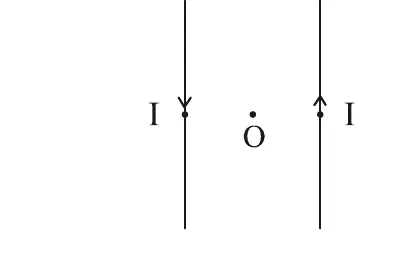
(A) (i) Draw the pattern of the magnetic field lines for the two parallel straight conductors carrying current of same magnitude ‘I’ in opposite directions as shown. Show the direction of magnetic field at a point O which is equidistant from the two conductors. (Consider that the conductors are inserted normal to the plane of a rectangular cardboard.)

(ii) In our houses we receive A.C. electric power of 220 V. In electric iron or electric heater cables having three wires with insulation of three different colours – red, black and green are used to draw current from the mains. (a) What are these three different wires called? Name them colourwise. (b) What is the potential difference between the red wire and the black wire? (c) What is the role of the wire with green insulation in case of accidental leakage of electric current to the metallic body of an electrical appliance?

OR

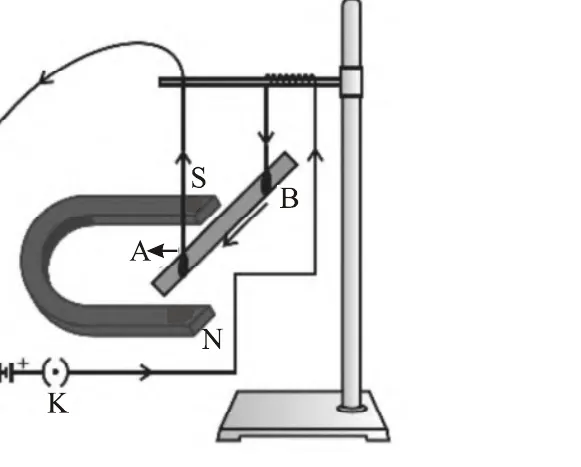
(B) (i) By using the given experimental set-up. How can it be shown that: (a) a force is exerted on the current-carrying conductor AB when it is placed in a magnetic field. (b) the direction of force can be reversed in two ways. (ii) When will the magnitude of the force be highest? (iii) State Fleming’s left hand rule.

Two parallel vertical conductors with an arrow marked I pointing down on the left one and up on the right one, and a point O halfway between them.A set-up with a horseshoe magnet and a metal rod AB hung on two wires from a stand, connected to a battery and a key K. The north pole N and south pole S of the magnet are marked.
Solution
OBI into pageI out of pageBoth fields at O point the same way (down), so they add up
  1. (A)(i) Each wire has concentric circular field lines around it: clockwise around the wire with current into the page and anticlockwise around the wire with current out of the page (diagram above, with the current in the left conductor taken as into the page). At the point O between the two wires, both fields point in the same direction, along the line joining down the page, so they add up.
  2. (ii)(a) The red wire is the live wire, the black wire is the neutral wire and the green wire is the earth wire. (b) The potential difference between the live (red) and the neutral (black) wire is 220220 V.
  3. (c) The earth wire is a safety measure. If current leaks to the metallic body of the appliance, the earth wire gives it a low-resistance path to the ground and keeps the body at the potential of the earth, so the user does not get a severe electric shock.
  4. (B)(i)(a) On closing the key, current flows through the rod AB placed in the field of the horseshoe magnet and the rod is displaced (it moves), which shows a force acts on it. (b) The direction of the force can be reversed by reversing the direction of the current, or by reversing the direction of the magnetic field (by interchanging the poles).
  5. (ii) The force is the greatest when the current is at right angles to the direction of the magnetic field.
  6. (iii) Fleming’s left-hand rule: stretch the thumb, the forefinger and the middle finger of the left hand so that they are mutually perpendicular. If the forefinger points in the direction of the magnetic field and the middle finger in the direction of the current, then the thumb points in the direction of the force on the conductor.

Answer: (A) opposite currents: fields add at O; live (red), neutral (black), earth (green); 220 V; low-resistance path to earth   (B) AB moves; reverse current or field; highest when I ⟂ B; Fleming’s rule

Report an error on this question

Section E: Case studies

3 case studies, 4 marks each.

Q37Acids, Bases and Salts4 marks

Case study 1. Common salt is a very important chemical compound for our daily life. It’s chemical name is sodium chloride and it is used as a raw material in the manufacture of caustic soda, washing soda, baking soda etc. It is also used in the preservation of pickles, butter, meat etc.

(i) Name the acid and the base from which common salt can be obtained. [1]

(ii) State the nature (acidic/basic/neutral) of sodium chloride. Give reason for the justification of your answer. [1]

(iii) (A) What happens when electric current is passed through an aqueous solution of sodium chloride (called brine)? Name the products obtained along with the corresponding places in the electrolytic cell where each of these products is obtained. [2]

OR

(iii) (B) How is washing soda obtained from sodium chloride? Give chemical equation of the reactions involved in the process. [2]

Solution
  1. (i) Hydrochloric acid (HCl) and sodium hydroxide (NaOH).
  2. (ii) Neutral, because it is a salt of a strong acid (HCl) and a strong base (NaOH).
  3. (iii)(A) The brine is electrolysed (the chlor-alkali process). Sodium hydroxide solution forms near the cathode, chlorine gas at the anode and hydrogen gas at the cathode.
  4. (iii)(B) NaCl+H2O+CO2+NH3→NH4Cl+NaHCO3\mathrm{NaCl + H_2O + CO_2 + NH_3 \rightarrow NH_4Cl + NaHCO_3}. Heating the baking soda gives sodium carbonate: 2NaHCO3→heatNa2CO3+H2O+CO2\mathrm{2NaHCO_3 \xrightarrow{heat} Na_2CO_3 + H_2O + CO_2}. Recrystallising sodium carbonate gives washing soda: Na2CO3+10H2O→Na2CO3⋅10H2O\mathrm{Na_2CO_3 + 10H_2O \rightarrow Na_2CO_3{\cdot}10H_2O}.

Answer: (i) HCl and NaOH   (ii) neutral   (iii) NaOH and H₂ at the cathode, Cl₂ at the anode (OR) washing soda from baking soda

Report an error on this question
Q38Control and Coordination4 marks

Case study 2. In life there are certain changes in the environment called ‘stimuli’ to which we respond appropriately. Touching a flame suddenly is a dangerous situation for us. One way is to think consciously about the possibility of burning and then moving the hand. But our body has been designed in such a way that we save ourself from such situations immediately.

(i) Name the action by which we protect ourself in the situation mentioned above and define it. [1]

(ii) Write the role of (a) motor and (b) relay neuron. [1]

(iii) (A) What are the two types of nervous system in human body? Name the components of each of them. [2]

OR

(iii) (B) Which part of the human brain is responsible for: (a) thinking (b) picking up a pencil (c) controlling blood pressure (d) controlling hunger [2]

Solution
  1. (i) A reflex action: a sudden, automatic response to a stimulus in the environment, without thinking.
  2. (ii)(a) The motor neuron carries the message from the spinal cord to the effector organ (the muscle). (b) The relay neuron connects the sensory neuron to the motor neuron.
  3. (iii)(A) The central nervous system, made of the brain and the spinal cord, and the peripheral nervous system, made of the cranial nerves and the spinal nerves.
  4. (B) (a) Thinking: the fore-brain (cerebrum). (b) Picking up a pencil: the cerebellum (hind-brain), which coordinates precise movements. (c) Blood pressure: the medulla (hind-brain). (d) Hunger: the fore-brain.

Answer: (i) reflex action   (ii) motor neuron to muscle; relay neuron joins sensory to motor   (iii) CNS and PNS (OR) cerebrum, cerebellum, medulla, fore-brain

Report an error on this question
Q39Human Eye and the Colourful World4 marks

Case study 3. The students in a class took a thick sheet of cardboard and made a small hole in its centre. Sunlight was allowed to fall on this small hole and they obtained a narrow beam of white light. A glass prism was taken and this white light was allowed to fall on one of its faces. The prism was turned slowly until the light that comes out of the opposite face of the prism appeared on the nearby screen. They studied this beautiful band of light and concluded that it is a spectrum of white light.

(i) Give any one more instance in which this type of spectrum is observed. [1]

(ii) What happens to white light in the above case? [1]

(iii) (A) List two conditions necessary to observe a rainbow. [2]

OR

(iii) (B) Draw a ray diagram to show the formation of a rainbow. Mark on it, points (a), (b) and (c) as given below: (a) Where dispersion of light occurs. (b) Where light gets reflected internally. (c) Where final refraction occurs. [2]

Solution
Sun’s ray (white)RV(a) dispersion(b) internalreflection(c) final refractionwater dropletSun behind the observer; violet bends most, red least
  1. (i) A rainbow (also, for example, the colours seen in a soap bubble).
  2. (ii) The white light is dispersed (split) into its seven colours by the prism, because each colour bends by a different angle.
  3. (iii)(A) Two conditions: water droplets must be present in the atmosphere, and the Sun must be at the back of the observer.
  4. (iii)(B) Dispersion happens at the first refraction as the light enters the droplet (a), the colours are reflected internally at the back of the droplet (b), and the final refraction happens as the light leaves the droplet (c) (diagram above).

Answer: (i) rainbow   (ii) dispersion   (iii) water droplets and the Sun behind the observer (OR) diagram with a, b, c

Report an error on this question

Questions are from the official CBSE paper. Figures are described in words; see the PDF for the originals. Solutions are written by CogniGuru.

Revise this paper in 1 minute a chapter

Each chapter below is what the paper tested, with a one-minute animated lesson on the idea behind it.

Stuck on a step in any solution?

The CogniGuru AI tutor explains any doubt one minute at a time, in English or Hindi. Join the waitlist.

Mock quiz: 5 questions from this paper

Five real questions from this paper, one each from five chapters. About 2 minutes. See how much you know and where you stand among other students. Attempt free, with no login; log in only for your ranking and full report.

Question 1 of 5 · Q1 of the paperChemical Reactions and Equations

In which one of the following situations a chemical reaction does not occur?

0 of 5 answered

Related papers

Common questions

Are these the official CBSE Class 10 Science 2025 questions?
Yes. The questions are from the official Science paper (set 31/4/1) that CBSE published after the March 2025 board exam. The solutions are written by CogniGuru and checked against the answer key CBSE published for this paper code.
Can I download the CBSE Class 10 Science 2025 question paper PDF?
Yes, the official paper PDF is free to download from this page, and so are our step-by-step solutions as a PDF. No login is needed to download either or to read the solutions.
Do all sets of the paper have the same questions?
No. CBSE sets several versions of each paper, with the same blueprint and similar questions in a different order and sometimes with different numbers. This page covers set 31/4/1.
How does the quiz work, and what does “where you stand” mean?
It is a mock quiz of 5 real multiple-choice questions from this paper, scored automatically in about 2 minutes. Your score is compared, anonymously, with other students who took the same quiz. Only the score is stored with the comparison, never your name or number.

Source

CBSE question paper archive, Class X, 2025 (Science, set 31/4/1)
PDF