
CBSE · Class 10 · Science · Free

CBSE Class 10 Science 2025 Question Paper (Set 31/5/1) with Solutions

The official board paper (Q.P. Code 31/5/1, Series 5EFGH). Free paper PDF and step-by-step solutions (also as a PDF to download) written by CogniGuru and checked against CBSE’s answer key. See the paper’s main topics in 1 minute, then quiz yourself to see how much you know and where you stand.

No login to download or read the solutions. Login only to see your quiz report in full.

Board
CBSE
Class
10
Subject
Science (086)
Year
2025
Set code
31/5/1
Max marks
80
Duration
3 hours
Questions
39 (Sections A to E)
Source
Official CBSE paper
Exam date
March 2025

Paper preview

Three pages of the official paper. Download the PDF for all 32.

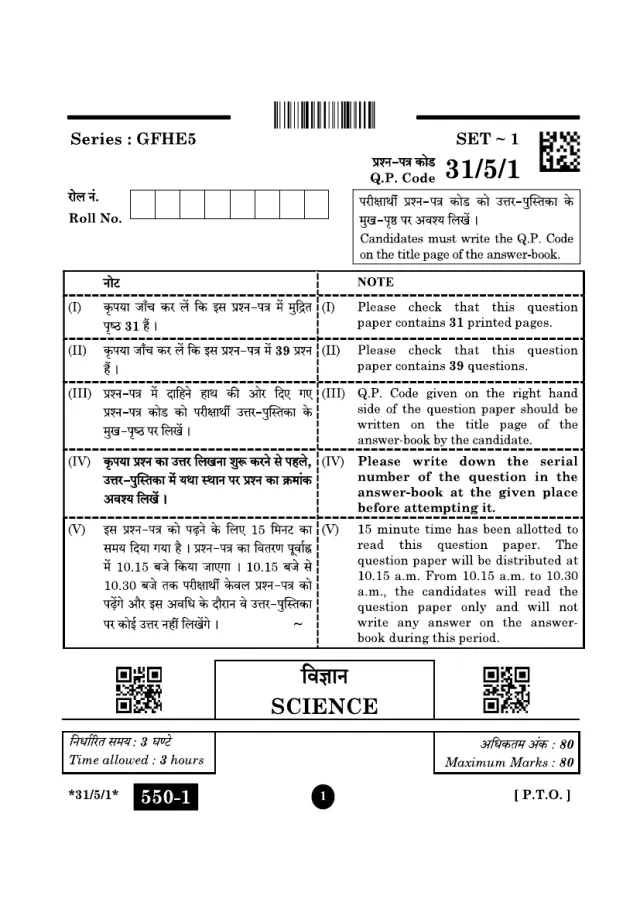
  • Cover page of the CBSE Class 10 Science 2025 paper, set 31/5/1

    Cover page

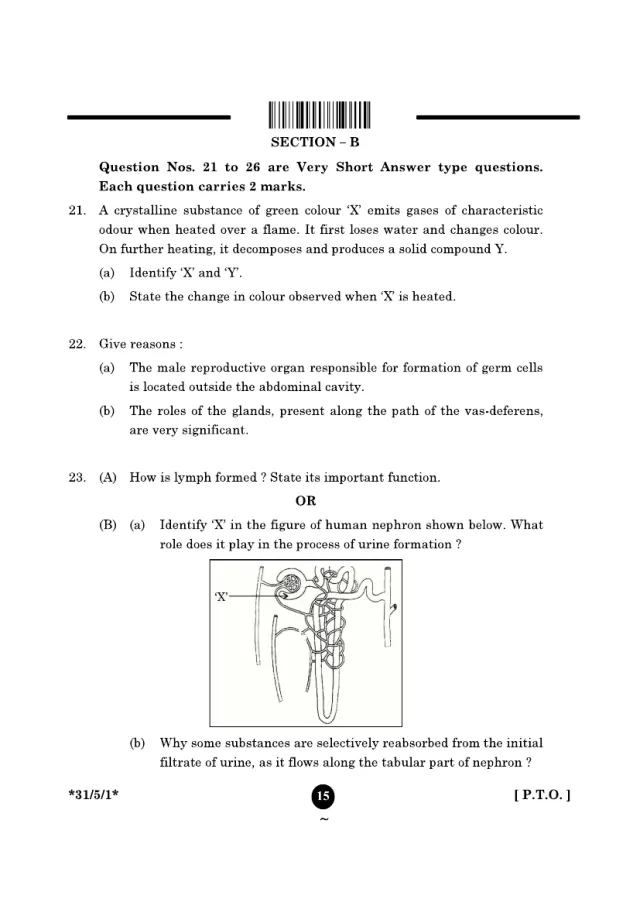
  • Section B of the CBSE Class 10 Science 2025 paper, set 31/5/1

    Section B

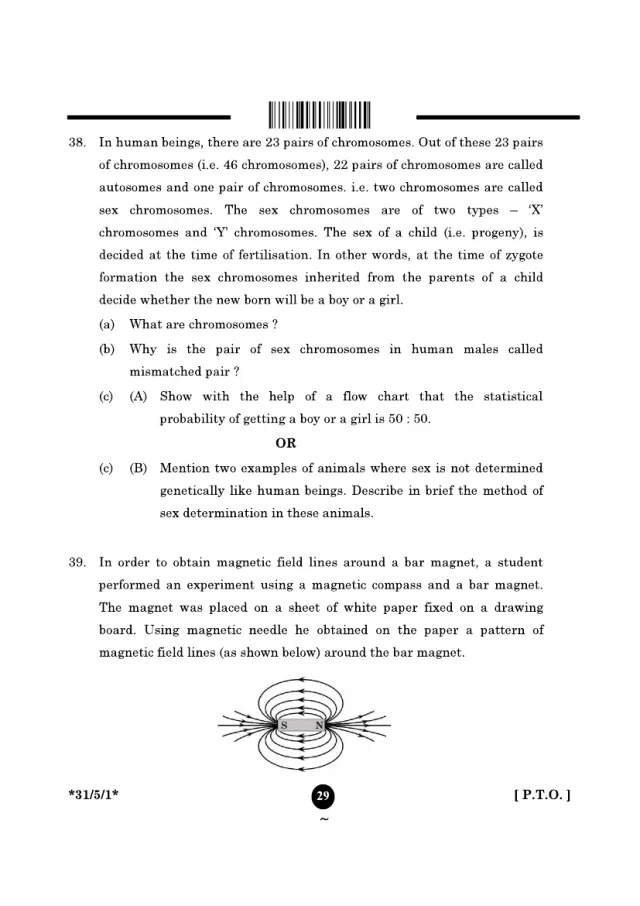
  • A case study with its figure from the CBSE Class 10 Science 2025 paper, set 31/5/1

    Case study

The main topics of this paper, in 1 minute

Your tutor walks you through the paper before you attempt it: the marks, the key ideas, the time plan and the traps.

1-minute paper analysis

With your tutor, in her voice

The main topics of this paper, in about a minute

A short, animated walk through the paper: how it is built, where the marks come from, the four ideas that matter most, how to plan your three hours, and the traps to avoid.

  1. 1The paper at a glance
  2. 2Where the marks come from
  3. 3Four ideas that keep paying off
  4. 4Plan your three hours
  5. 5Four traps to avoid

Sound on for the voice. Captions are shown, and you can mute any time.

Step-by-step solutions

Try each question first, then open its solution. Tap a number to jump.

Download solutions (PDF)

Section A: Multiple choice

20 questions, 1 mark each. MCQs (Q1 to Q16) and assertion-reason (Q17 to Q20).

Q1Chemical Reactions and Equations1 mark

The main observations while performing the experiment of burning magnesium ribbon in air are:

(i) Magnesium ribbon burns with a dazzling white flame.

(ii) A white powder is formed.

(iii) Magnesium ribbon vapourises.

(iv) Aqueous solution of the white powder turns blue litmus to red.

  1. (A)(i) and (iv)
  2. (B)(ii) and (iii)
  3. (C)(i) and (ii)
  4. (D)(iii) and (iv)
Solution · answer (C)
  1. 2Mg+O2→2MgO\mathrm{2Mg + O_2 \rightarrow 2MgO}. The ribbon burns with a dazzling white flame and leaves a white powder, magnesium oxide. Magnesium does not vapourise, and magnesium oxide is basic: its solution turns red litmus blue, not blue litmus red.

Answer: (C) (i) and (ii)

Report an error on this question
Q2Metals and Non-metals1 mark

A metal, M, displaces iron from aqueous solution of ferrous sulphate but fails to do so in case of aqueous solution of aluminium sulphate. The metal M is:

  1. (A)Magnesium
  2. (B)Copper
  3. (C)Lead
  4. (D)Zinc
Solution · answer (D)
  1. M is more reactive than iron but less reactive than aluminium. In the reactivity series Mg > Al > Zn > Fe > Pb > Cu, only zinc lies between aluminium and iron.

Answer: (D) Zinc

Report an error on this question
Q3Acids, Bases and Salts1 mark

A common feature observed in the crystals of washing soda, copper sulphate, gypsum and ferrous sulphate is that all:

  1. (A)exhibit basic nature
  2. (B)exhibit acidic nature
  3. (C)have fixed number of molecules of water of crystallisation in one formula unit of these salts.
  4. (D)are coloured
Solution · answer (C)
  1. They are hydrated salts: Na2CO3⋅10H2O\mathrm{Na_2CO_3{\cdot}10H_2O}, CuSO4⋅5H2O\mathrm{CuSO_4{\cdot}5H_2O}, CaSO4⋅2H2O\mathrm{CaSO_4{\cdot}2H_2O} and FeSO4⋅7H2O\mathrm{FeSO_4{\cdot}7H_2O}. Each has a fixed number of water molecules of crystallisation. (Gypsum is white, so “all coloured” is wrong.)

Answer: (C) have fixed number of molecules of water of crystallisation in one formula unit

Report an error on this question
Q4Metals and Non-metals1 mark

A metal, ‘X’, on treatment with sodium hydroxide liberates a gas ‘G’. It also liberates the same gas, ‘G’ on treatment with dilute sulphuric acid. Based on above information, ‘X’ and ‘G’ respectively are:

  1. (A)Copper and Sulphur dioxide
  2. (B)Zinc and Sulphur dioxide
  3. (C)Zinc and Hydrogen
  4. (D)Copper and Hydrogen
Solution · answer (C)
  1. Zinc reacts with both: Zn+2NaOH→Na2ZnO2+H2\mathrm{Zn + 2NaOH \rightarrow Na_2ZnO_2 + H_2} and Zn+H2SO4→ZnSO4+H2\mathrm{Zn + H_2SO_4 \rightarrow ZnSO_4 + H_2}. The gas is hydrogen. Copper does not react with dilute sulphuric acid or with sodium hydroxide.

Answer: (C) Zinc and Hydrogen

Report an error on this question
Q5Chemical Reactions and Equations1 mark

The values of aa, bb, cc and dd in the following balanced chemical equation are respectively: a Pb(NO3)2→heatb PbO+c NO2+d O2a\,\mathrm{Pb(NO_3)_2} \xrightarrow{heat} b\,\mathrm{PbO} + c\,\mathrm{NO_2} + d\,\mathrm{O_2}

  1. (A)1, 1, 2, 1
  2. (B)1, 1, 1, 2
  3. (C)2, 2, 1, 4
  4. (D)2, 2, 4, 1
Solution · answer (D)
  1. Take a=2a = 2: lead gives b=2b = 2; nitrogen 44 gives c=4c = 4; oxygen on the left is 1212, on the right 2+8+2d2 + 8 + 2d, so d=1d = 1.
  2. 2Pb(NO3)2→2PbO+4NO2+O2\mathrm{2Pb(NO_3)_2 \rightarrow 2PbO + 4NO_2 + O_2}.

Answer: (D) 2, 2, 4, 1

Report an error on this question
Q6Metals and Non-metals1 mark

During electrolytic refining of copper, the anode, the cathode and the electrolyte used respectively are:

  1. (A)Impure copper, pure copper, acidified copper sulphate solution
  2. (B)Pure copper, impure copper, sulphuric acid
  3. (C)Pure copper, impure copper, acidified copper sulphate solution
  4. (D)Impure copper, pure copper, distilled water
Solution · answer (A)
  1. The impure copper is the anode and dissolves, pure copper deposits on the cathode, and the electrolyte is acidified copper sulphate solution.

Answer: (A) Impure copper, pure copper, acidified copper sulphate solution

Report an error on this question
Q7Carbon and its Compounds1 mark

If we make carbon skeleton with four carbon atoms, the two different possible skeletons will be:

  1. (A)C–C–C with a C branch; C–C–C–C
  2. (B)C–C–C–C (straight); a branched chain of three C with one C attached to the middle carbon
  3. (C)C–C–C–C; a three-carbon chain with a two-carbon branch
  4. (D)C–C–C–C; a ring-like arrangement
Solution · answer (B)
  1. Four carbon atoms can form only two skeletons: a straight chain, C–C–C–C, and a branched chain with three carbons in a row and one carbon attached to the middle one. These are the isomers butane and 2-methylpropane.

Answer: (B) straight chain and the branched chain

Report an error on this question
Q8Life Processes1 mark

Listed below are the steps of nutrition in Amoeba. Select the correct sequence of these steps:

(i) Diffusion of simple nutrients into cytoplasm

(ii) Food vacuole formation

(iii) Formation of finger like temporary extensions of cell surface

(iv) Complex substances broken to simpler ones

(v) Undigested material thrown out of the cell surface

  1. (A)(iv), (i), (ii), (iii), (v)
  2. (B)(iii), (ii), (iv), (i), (v)
  3. (C)(ii), (i), (iv), (v), (iii)
  4. (D)(iii), (iv), (i), (ii), (v)
Solution · answer (B)
  1. Amoeba first puts out pseudopodia (iii) to engulf the food, forming a food vacuole (ii). Enzymes then break the complex food into simpler substances (iv), these diffuse into the cytoplasm (i), and the undigested material is thrown out (v).

Answer: (B) (iii), (ii), (iv), (i), (v)

Report an error on this question
Q9Control and Coordination1 mark

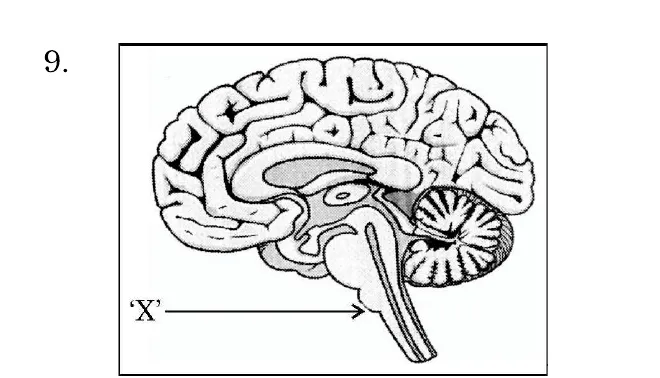
Which among the following is not a neural action controlled by the part of human brain labelled ‘X’ in the figure above?

A drawing of the human brain in side view. The label X points to the lowest part, the medulla, at the base of the brain where it joins the spinal cord.
  1. (A)Salivation
  2. (B)Hunger
  3. (C)Vomiting
  4. (D)Blood Pressure
Solution · answer (B)
  1. X is the medulla at the base of the brain. It controls involuntary actions such as salivation, vomiting and blood pressure. Hunger is controlled by the fore-brain (hypothalamus).

Answer: (B) Hunger

Report an error on this question
Q10How do Organisms Reproduce?1 mark

The modes of reproduction in Spirogyra and Planaria respectively are:

  1. (A)Regeneration and budding
  2. (B)Regeneration and fragmentation
  3. (C)Fragmentation and regeneration
  4. (D)Budding and regeneration
Solution · answer (C)
  1. Spirogyra breaks into pieces and each grows into a new filament: fragmentation. Planaria, if cut, regrows the missing body part: regeneration.

Answer: (C) Fragmentation and regeneration

Report an error on this question
Q11Control and Coordination1 mark

The plant hormones promoting rapid cell division in seeds and wilting of leaves respectively are:

  1. (A)Auxins and Abscisic acid
  2. (B)Cytokinins and Abscisic acid
  3. (C)Gibberellins and Auxins
  4. (D)Abscisic acid and Gibberellins
Solution · answer (B)
  1. Cytokinins promote cell division. Abscisic acid inhibits growth and causes wilting of leaves.

Answer: (B) Cytokinins and Abscisic acid

Report an error on this question
Q12Life Processes1 mark

In aerobic respiration, the steps are: breakdown of glucose to pyruvate and its further conversion to carbon dioxide. Both processes respectively occur in:

  1. (A)Vacuole and Cytoplasm
  2. (B)Chloroplast and Mitochondria
  3. (C)Mitochondria and Cytoplasm
  4. (D)Cytoplasm and Mitochondria
Solution · answer (D)
  1. Glucose is broken down to pyruvate in the cytoplasm. Pyruvate is then broken down to carbon dioxide and water, with the release of much energy, in the mitochondria.

Answer: (D) Cytoplasm and Mitochondria

Report an error on this question
Q13Light: Reflection and Refraction1 mark

In order to obtain large images of the teeth of patients, the dentist holds the concave mirror in such a manner that the teeth are positioned:

  1. (A)at the focus of mirror.
  2. (B)between pole and focus of the mirror.
  3. (C)between focus and centre of curvature of the mirror.
  4. (D)at the centre of curvature of the mirror.
Solution · answer (B)
  1. A concave mirror forms a large, virtual and erect image only when the object is between the pole and the focus.

Answer: (B) between pole and focus of the mirror

Report an error on this question
Q14Human Eye and the Colourful World1 mark

The possible way to restore clear vision of those people whose eyeball has elongated is the use of suitable:

  1. (A)bifocal lens
  2. (B)concave lens
  3. (C)converging lens
  4. (D)convex lens
Solution · answer (B)
  1. An elongated eyeball forms the image in front of the retina: myopia (short-sightedness). It is corrected with a concave lens, which diverges the light a little before the eye lens.

Answer: (B) concave lens

Report an error on this question
Q15Our Environment1 mark

The examples of natural and manmade (artificial) ecosystems are respectively:

  1. (A)Forests and ponds
  2. (B)Crop fields and lakes
  3. (C)Lakes and gardens
  4. (D)Crop fields and forests
Solution · answer (C)
  1. Lakes, forests and ponds are natural ecosystems. Gardens and crop fields are made by humans. Only “lakes and gardens” puts a natural one first and an artificial one second.

Answer: (C) Lakes and gardens

Report an error on this question
Q16Our Environment1 mark

Human activities that are affecting the environment are:

  1. (A)minimising the use of chlorofluorocarbons.
  2. (B)excessive use of disposable cups and plates.
  3. (C)maximising the use of reusable utensils for eating food and drinking fluids.
  4. (D)segregating the wastes into biodegradable and non-biodegradable before disposal.
Solution · answer (B)
  1. Using fewer CFCs, reusing utensils and segregating waste all help the environment. Excessive use of disposable cups and plates creates waste that harms it.

Answer: (B) excessive use of disposable cups and plates

Report an error on this question
Q17Chemical Reactions and Equations1 mark

Assertion (A): Silver chloride turns grey in sunlight.

Reason (R): Decomposition of silver chloride into silver and chlorine takes place by sunlight.

  1. (A)Both A and R are true and R is the correct explanation of A
  2. (B)Both A and R are true, but R is not the correct explanation of A
  3. (C)A is true, but R is false
  4. (D)A is false, but R is true
Solution · answer (A)
  1. 2AgCl→sunlight2Ag+Cl2\mathrm{2AgCl \xrightarrow{sunlight} 2Ag + Cl_2}. The grey colour is the silver that forms, so R explains A.

Answer: (A) Both A and R are true and R is the correct explanation of A

Report an error on this question
Q18How do Organisms Reproduce?1 mark

Assertion (A): The embryo gets nutrition from the mother’s blood with the help of a special tissue called placenta.

Reason (R): Placenta is a disc which is embedded in the uterine wall.

  1. (A)Both A and R are true and R is the correct explanation of A
  2. (B)Both A and R are true, but R is not the correct explanation of A
  3. (C)A is true, but R is false
  4. (D)A is false, but R is true
Solution · answer (B)
  1. Both are true. But being embedded in the uterine wall describes where the placenta is, not why it passes nutrients to the embryo (that is because of its villi and blood supply). So R does not explain A.

Answer: (B) Both A and R are true, but R is not the correct explanation of A

Report an error on this question
Q19Magnetic Effects of Electric Current1 mark

Assertion (A): The pattern of the magnetic field of a solenoid carrying a current is similar to that of a bar magnet.

Reason (R): The pattern of the magnetic field around a current carrying conductor is independent of the shape of the conductor.

  1. (A)Both A and R are true and R is the correct explanation of A
  2. (B)Both A and R are true, but R is not the correct explanation of A
  3. (C)A is true, but R is false
  4. (D)A is false, but R is true
Solution · answer (C)
  1. Assertion: true, a solenoid behaves like a bar magnet. Reason: false. The field pattern depends on the shape of the conductor: it is circles for a straight wire, and a bar-magnet pattern for a solenoid.

Answer: (C) A is true, but R is false

Report an error on this question
Q20Life Processes1 mark

Assertion (A): All organisms can make organic compounds like sugar and starch from inorganic substances using radiant energy of the sun.

Reason (R): The organisms which can produce food by photosynthesis are called producers.

  1. (A)Both A and R are true and R is the correct explanation of A
  2. (B)Both A and R are true, but R is not the correct explanation of A
  3. (C)A is true, but R is false
  4. (D)A is false, but R is true
Solution · answer (D)
  1. Only green plants, algae and some bacteria can photosynthesise. Animals and fungi cannot. So A is false. R, the definition of producers, is true.

Answer: (D) A is false, but R is true

Report an error on this question

Section B: Very short answer

6 questions, 2 marks each (30 to 50 words).

Q21Chemical Reactions and Equations2 marks

A crystalline substance of green colour ‘X’ emits gases of characteristic odour when heated over a flame. It first loses water and changes colour. On further heating, it decomposes and produces a solid compound Y.

(a) Identify ‘X’ and ‘Y’.

(b) State the change in colour observed when ‘X’ is heated.

Solution
  1. (a) XX is hydrated ferrous sulphate (green vitriol), FeSO4⋅7H2O\mathrm{FeSO_4{\cdot}7H_2O}. On strong heating it gives the solid YY, iron(III) oxide (ferric oxide), Fe2O3\mathrm{Fe_2O_3}, and gives off SO2\mathrm{SO_2} and SO3\mathrm{SO_3} with the smell of burning sulphur: 2FeSO4→Fe2O3+SO2+SO3\mathrm{2FeSO_4 \rightarrow Fe_2O_3 + SO_2 + SO_3}.
  2. (b) The green crystals first turn white (on losing the water) and then brown on further heating.

Answer: (a) X=FeSO4⋅7H2OX = \mathrm{FeSO_4{\cdot}7H_2O}, Y=Fe2O3Y = \mathrm{Fe_2O_3}   (b) green →\to white, then brown

Report an error on this question
Q22How do Organisms Reproduce?2 marks

Give reasons:

(a) The male reproductive organ responsible for formation of germ cells is located outside the abdominal cavity.

(b) The roles of the glands, present along the path of the vas-deferens, are very significant.

Solution
  1. (a) Sperm formation needs a temperature lower than the normal body temperature. The testes are in the scrotum, outside the abdominal cavity, where it is cooler.
  2. (b) The secretions of the glands (the prostate and seminal vesicles) make it easier for the sperms to be transported, and they give the sperms nutrition.

Answer: (a) cooler temperature for sperm formation   (b) help transport and nourish the sperms

Report an error on this question
Q23Life Processes2 marks

(A) How is lymph formed? State its important function.

OR

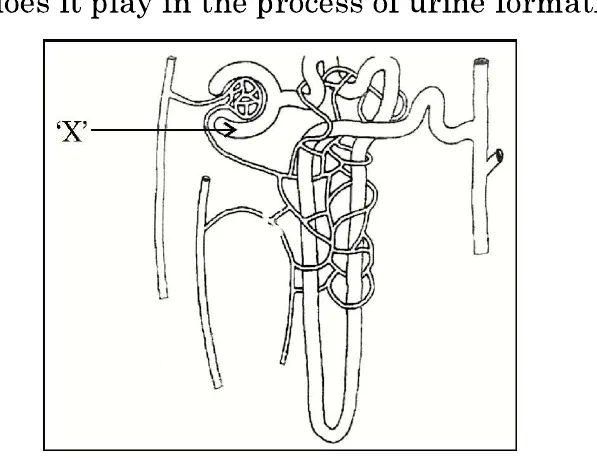
(B) (a) Identify ‘X’ in the figure of human nephron shown below. What role does it play in the process of urine formation? (b) Why some substances are selectively reabsorbed from the initial filtrate of urine, as it flows along the tubular part of nephron?

A drawing of a human nephron. X points to the cup-shaped structure that surrounds the tuft of capillaries at the top.
Solution
  1. (A) Through the pores in the walls of the capillaries, some plasma, proteins and blood cells escape into the spaces between cells in the tissues. This fluid is lymph. It carries digested and absorbed fat from the intestine, and drains excess fluid from the tissues back into the blood.
  2. (B)(a) X is the Bowman’s capsule. It collects the filtrate from the glomerulus (the blood capillaries).
  3. (b) The nephron adjusts how much water is lost and how much dissolved waste is removed, so the useful substances such as glucose, amino acids and salts, and the water the body needs, are taken back into the blood.

Answer: (A) escaped plasma forms lymph; carries fat and drains fluid   (B) Bowman’s capsule collects the filtrate; useful substances and water are retained

Report an error on this question
Q24Light: Reflection and Refraction2 marks

The values of absolute refractive indices of kerosene and water are 1.44 and 1.33 respectively. Compare the two media on the basis of their (a) optical density (b) mass density (c) relative speed of propagation of light. What do you infer on the basis of above comparisons?

BasisKerosene (1.44)Water (1.33)
(a) Optical densityhigherlower
(b) Mass densitylowerhigher
(c) Speed of lightlowerhigher
Solution
  1. A larger refractive index means a larger optical density and a lower speed of light: v=cnv = \dfrac{c}{n}. So kerosene is optically denser and light travels slower in it.
  2. But kerosene floats on water, so its mass density is less than that of water.
  3. Inference: an optically denser medium need not have a greater mass density.

Answer: Kerosene is optically denser, light is slower in it, but it has the lower mass density

Report an error on this question
Q25Electricity2 marks

(A) State two applications of Joule’s heating in domestic electric circuit.

OR

(B) (a) Establish the relationship between the commercial unit of electric energy and the SI unit of electric energy. (b) Determine the total resistance of the parallel combination of three resistances of 2 Ω, 4 Ω and 6 Ω.

Solution
  1. (A) Electric heater, electric iron (also a toaster, an electric kettle) use the heating effect. The electric fuse also works by it: the wire melts when too much current flows.
  2. (B)(a) 1 kWh=1000 W×3600 s=3.6×10⁶ J1\ \mathrm{kWh} = 1000\ \mathrm{W} \times 3600\ \mathrm{s} = 3.6 \times 10^6\ \mathrm{J}.
  3. (b) 1Rp=12+14+16=6+3+212=1112\dfrac{1}{R_p} = \dfrac{1}{2} + \dfrac{1}{4} + \dfrac{1}{6} = \dfrac{6 + 3 + 2}{12} = \dfrac{11}{12}, so Rp=1211≈1.09 ΩR_p = \dfrac{12}{11} \approx 1.09\ \Omega.

Answer: (A) heater, iron, fuse   (B) 1 kWh=3.6×1061\ \mathrm{kWh} = 3.6 \times 10^6 J; Rp≈1.09 ΩR_p \approx 1.09\ \Omega

Report an error on this question
Q26Our Environment2 marks

(a) Why are the organisms of first trophic level important in any food chain?

(b) Justify the following statement: ‘The flow of energy in an ecosystem is unidirectional.’

Solution
  1. (a) The organisms at the first trophic level, the producers, fix the energy of sunlight and make it available to the heterotrophs, the consumers.
  2. (b) The energy captured by the autotrophs does not return to the Sun, and the energy passed to the herbivores does not go back to the producers. As it moves from one trophic level to the next it is no longer available to the previous one. So the flow is only in one direction.

Answer: (a) producers fix solar energy for all consumers   (b) energy does not revert to the earlier level or the Sun

Report an error on this question

Section C: Short answer

7 questions, 3 marks each (50 to 80 words).

Q27Acids, Bases and Salts3 marks

Write chemical formula of washing soda. How is it obtained from baking soda? List two uses of washing soda.

Solution
  1. The formula of washing soda is Na2CO3⋅10H2O\mathrm{Na_2CO_3{\cdot}10H_2O}.
  2. Heating baking soda gives sodium carbonate: 2NaHCO3→heatNa2CO3+H2O+CO2\mathrm{2NaHCO_3 \xrightarrow{heat} Na_2CO_3 + H_2O + CO_2}. Recrystallising the sodium carbonate from water gives washing soda: Na2CO3+10H2O→Na2CO3⋅10H2O\mathrm{Na_2CO_3 + 10H_2O \rightarrow Na_2CO_3{\cdot}10H_2O}.
  3. Uses: in the glass, soap and paper industries; for removing the permanent hardness of water; as a cleansing agent for domestic use. (Any two.)

Answer: Na2CO3⋅10H2O\mathrm{Na_2CO_3{\cdot}10H_2O}; heat NaHCO3\mathrm{NaHCO_3} then recrystallise; glass/soap industry and softening water

Report an error on this question
Q28Metals and Non-metals3 marks

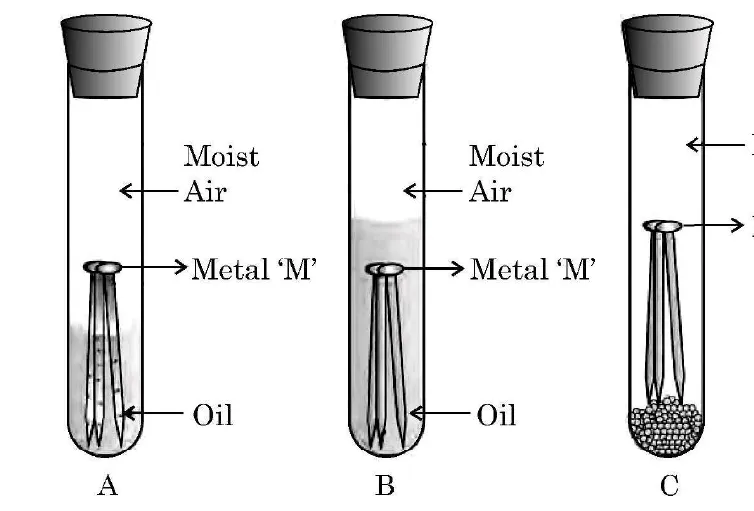
(A) Observe the following diagram showing an experiment to determine the conditions under which a metal ‘M’ corrodes. List your observations in each of the three cases A, B and C with reason, if the metal ‘M’ is generally protected against corrosion by the method of galvanisation.

OR

(B) (a) Show the formation of Aluminium Nitride (AlN) by the transfer of electrons. [At. no. of Al = 13; At. no. of N = 7] (b) “Ionic compounds are solids and are generally brittle and break into pieces when pressure is applied.” Give reason to justify the statement.

Three test tubes with a nail of metal M. Tube A contains moist air with the nail partly in oil. Tube B contains moist air above oil that covers the nail fully. Tube C contains dry air with granules that absorb moisture.
Solution
Al (2, 8, 3)AlN (2, 5)N3 e⁻Al³⁺cationN³⁻anionAl³⁺ + N³⁻ → AlN
  1. (A) M is iron (galvanisation protects iron). A: the part of the metal outside the oil is in moist air, so it corrodes (rusts); the part inside the oil does not, as it cannot react with moist air. B: the metal is fully covered by oil, so no moist air reaches it and it does not corrode. C: the air is dry, there is no moisture, so it does not corrode.
  2. (B)(a) Aluminium (2, 8, 3) gives up its three outer electrons, and nitrogen (2, 5) takes three to complete its octet: Al→Al3++3e−\mathrm{Al \rightarrow Al^{3+} + 3e^-} and N+3e−→N3−\mathrm{N + 3e^- \rightarrow N^{3-}}, giving AlN\mathrm{AlN}.
  3. (b) In an ionic solid positive and negative ions are held in a rigid lattice by strong electrostatic forces. When pressure is applied, layers of ions slide and like charges come face to face, so they repel and the crystal breaks.

Answer: (A) A: rusts above the oil; B and C: no corrosion   (B) Al³⁺ and N³⁻; brittle because like ions repel when layers slip

Report an error on this question
Q29Life Processes3 marks

(a) Write the name and one function of respiratory pigment found in human beings. (b) Why do lungs always contain a residual volume of air? (c) Why is ATP known as energy currency of the living beings?

Solution
  1. (a) Haemoglobin. It takes up oxygen from the lungs and carries it to the tissues that lack oxygen.
  2. (b) The residual volume of air stays in the lungs so that there is enough time for oxygen to be absorbed and for carbon dioxide to be released, even between breaths.
  3. (c) ATP provides energy for the various cellular processes, and it is the form in which the energy released in respiration is stored and passed on, so it is called the energy currency.

Answer: (a) haemoglobin carries oxygen   (b) more time for gas exchange   (c) ATP supplies energy for cell processes

Report an error on this question
Q30How do Organisms Reproduce?3 marks

(a) Define fertilisation. (b) What happens to Zygote, Ovule, Ovary and Stamens after fertilisation in a flowering plant?

Solution
  1. (a) Fertilisation is the fusion of the male and female gametes to form a zygote.
  2. (b) The zygote divides and forms the embryo. The ovule forms the seed. The ovary grows and forms the fruit. The stamens wither away (shrivel and fall off).

Answer: (a) fusion of gametes   (b) zygote → embryo, ovule → seed, ovary → fruit, stamens wither

Report an error on this question
Q31Human Eye and the Colourful World3 marks

The power of a lens is −0.25 D. Based on this information, find out:

(a) The type of lens and its focal length.

(b) The eye defect for which it may be used as a corrective lens.

(c) The nature and size of the image formed by this lens when an object is placed between F and 2F from the optical centre of this lens.

Solution
  1. (a) A negative power means a concave lens. f=1P=1−0.25=−4f = \dfrac{1}{P} = \dfrac{1}{-0.25} = -4 m.
  2. (b) Myopia (short-sightedness).
  3. (c) A concave lens always forms a virtual, erect and diminished image, wherever the object is placed.

Answer: (a) concave, f=−4f = -4 m   (b) myopia   (c) virtual, erect, diminished

Report an error on this question
Q32Electricity3 marks

The resistance of a wire of 0.01 cm radius is 7 ohms. If the resistivity of the material of the wire is 44 × 10⁻⁶ ohm meter, calculate the length of the wire.

Solution
  1. r=0.01r = 0.01 cm =10−4= 10^{-4} m, so A=πr2=227×10−8A = \pi r^2 = \dfrac{22}{7} \times 10^{-8} m². R=7 ΩR = 7\ \Omega and ρ=44×10−6 Ω m\rho = 44 \times 10^{-6}\ \Omega\,\mathrm{m}.
  2. R=ρlAR = \rho\dfrac{l}{A}, so l=RAρ=7×227×10−844×10−6=22×10−844×10−6=0.5×10⁻²l = \dfrac{RA}{\rho} = \dfrac{7 \times \frac{22}{7} \times 10^{-8}}{44 \times 10^{-6}} = \dfrac{22 \times 10^{-8}}{44 \times 10^{-6}} = 0.5 \times 10^{-2} m.

Answer: l=0.5×10⁻²l = 0.5 \times 10^{-2} m =0.5= 0.5 cm

Common mistake: Using the radius in cm. Convert 0.01 cm to 10⁻⁴ m before squaring it.

Report an error on this question
Q33Electricity3 marks

(a) “The third wire of earth connection is very important in domestic electric appliances.” Justify this statement. (b) List two precautions to be taken to avoid the overloading of domestic electric circuits.

Solution
  1. (a) The earth wire is a safety measure. If current leaks to the metal body of the appliance, the earth wire keeps the body at the potential of the earth, so the user does not get a severe shock.
  2. (b) Use a fuse of the proper rating, and do not connect too many appliances to a single socket.

Answer: (a) leakage current flows to the earth, so no shock   (b) proper fuse; do not overload a socket

Report an error on this question

Section D: Long answer

3 questions, 5 marks each (80 to 120 words).

Q34Carbon and its Compounds5 marks

(A) (a) What is meant by the term homologous series of carbon compounds? Write molecular formula of any two consecutive members of homologous series of ketones. (b) Write chemical equation of the reactions of ethanoic acid with (i) Sodium hydroxide and (ii) Ethanol (in the presence of an acid); giving the name of the products in each case. (c) Draw the structure of the molecule of benzene.

OR

(B) (a) Write the molecular formula of ethyne and draw its electron dot structure. (b) Write chemical equation to show the reaction of ethanol with (i) Sodium metal (ii) Ethanoic acid (in the presence of an acid) (iii) Acidified potassium dichromate. Write the name of the product formed in each case.

Solution
HHHHHHBenzene, C₆H₆: a ring of six carbons with alternate double bonds
  1. (A)(a) A homologous series is a series of carbon compounds with the same functional group, the same general formula and similar chemical properties, in which each member differs from the next by a CH2\mathrm{CH_2} unit. Two consecutive ketones: CH3COCH3\mathrm{CH_3COCH_3} (propanone) and CH3COC2H5\mathrm{CH_3COC_2H_5} (butanone).
  2. (b)(i) CH3COOH+NaOH→CH3COONa+H2O\mathrm{CH_3COOH + NaOH \rightarrow CH_3COONa + H_2O} (sodium ethanoate and water). (ii) CH3COOH+C2H5OH→acidCH3COOC2H5+H2O\mathrm{CH_3COOH + C_2H_5OH \xrightarrow{acid} CH_3COOC_2H_5 + H_2O} (ethyl ethanoate, an ester, and water).
  3. (c) Benzene, C₆H₆, is a ring of six carbon atoms with alternate double bonds and one hydrogen on each carbon (diagram above).
  4. (B)(a) Ethyne is C2H2\mathrm{C_2H_2}. Its electron dot structure is H:C:::C:H\mathrm{H{:}C{:::}C{:}H}: the two carbon atoms share three pairs of electrons (a triple bond) and each shares one pair with a hydrogen.
  5. (b)(i) 2C2H5OH+2Na→2C2H5ONa+H2\mathrm{2C_2H_5OH + 2Na \rightarrow 2C_2H_5ONa + H_2} (sodium ethoxide and hydrogen). (ii) C2H5OH+CH3COOH→acidCH3COOC2H5+H2O\mathrm{C_2H_5OH + CH_3COOH \xrightarrow{acid} CH_3COOC_2H_5 + H_2O} (ethyl ethanoate). (iii) C2H5OH→acidified K2Cr2O7, heatCH3COOH\mathrm{C_2H_5OH \xrightarrow{acidified\ K_2Cr_2O_7,\ heat} CH_3COOH} (ethanoic acid).

Answer: (A) same functional group and general formula; CH3COCH3\mathrm{CH_3COCH_3}, CH3COC2H5\mathrm{CH_3COC_2H_5}; sodium ethanoate; ethyl ethanoate; benzene ring   (B) C2H2\mathrm{C_2H_2}; sodium ethoxide; ester; ethanoic acid

Report an error on this question
Q35Control and Coordination5 marks

(A) (a) Analyse the given situations and interpret the possible reason for each: (i) Iodine deficiency in diet increases the possibility of a disease of swollen neck in a person. (ii) Some people in population may have very short heights (dwarfs). (iii) Thick facial hairs develop in boys at the age of 10-12 years. (b) Explain two reasons which necessitate the need of chemical communication in multicellular organisms.

OR

(B) (a) Differentiate between voluntary and involuntary action. (b) Define reflex action. With the help of a flow diagram, show the correct sequence of path of Nerve impulse from its place of origin.

Solution
ReceptorSensoryRelayMotorEffector(muscle or gland)e.g. skinspinal cordreceptor → sensory → relay (spinal cord) →motor neuron → effector: a quick response
  1. (A)(a)(i) Iodine is needed by the thyroid gland to make the hormone thyroxin. Without it the gland swells: goitre. (ii) A deficiency of growth hormone in childhood causes dwarfism. (iii) At puberty the testes secrete testosterone, which brings out the male features such as facial hair.
  2. (b) In a multicellular body the chemical signals (hormones) can reach all the cells steadily and for a long time, even those not joined by nerves. They also coordinate the growth, development and responses to the environment.
  3. (B)(a) Voluntary action: involves thinking, is controlled by the fore-brain and occurs according to our will (e.g. writing). Involuntary action: needs no thinking, is controlled by the hind-brain (medulla) or the spinal cord, and does not depend on our will (e.g. the heartbeat).
  4. (b) A reflex action is a sudden, automatic action in response to a stimulus in the environment. Path: receptor → sensory neuron → relay neuron (spinal cord) → motor neuron → effector (muscle or gland).

Answer: (A) thyroxin and goitre; growth hormone; testosterone; hormones reach every cell   (B) voluntary vs involuntary; receptor → sensory → relay → motor → effector

Report an error on this question
Q36Light: Reflection and Refraction5 marks

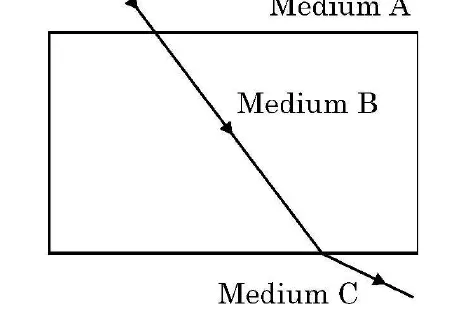
(A) (a) Observe the following diagram and compare (i) speed of light and (ii) optical densities of the three media A, B and C. Also give justification for your answer of any one of the two cases in terms of refractive indices of A, B and C. (b) Redraw the path of a ray of light through the three media, if the ray of light starting from medium A falls on the medium B (i) Obliquely and the optical density of medium B is made more than that of A and C. (ii) The ray falls normally from medium A to medium B.

OR

(B) Analyse the following observation table showing variation of image distance (v) with object distance (u) in case of a convex lens and answer the questions that follow without doing any calculations: (a) Determine the focal length of the lens. Give reason for your answer. (b) Find magnification of the image formed in Observation No. 3. (c) The numerical value of magnifications in cases of observation 1 and 2 is same. List two differences in the images formed in these two cases.

Observation numberObject distance u (cm)Image distance v (cm)
1−15−60
2−25+100
3−30+60
4−40+40
5−60+30
6−100+25
A rectangle split into media A at the top, B in the middle and C at the bottom. A ray goes straight through A and B without bending, then at the boundary of B and C it bends away from the normal.
Solution
AB (denser)CABC(i) obliquebends towards the normal in B(ii) normal: no bending
  1. (A)(a)(i) The ray goes through A to B without bending, so the speed of light is the same in A and B. At the boundary of B and C it bends away from the normal, so the speed in C is greater than in A and B.
  2. (ii) Optical density is the opposite of speed: A and B have the same optical density, and C is optically rarer than A and B. In terms of refractive index: n=cvn = \dfrac{c}{v}, so nA=nBn_A = n_B (no bending) and nCn_C is less than nAn_A and nBn_B (bending away from the normal).
  3. (b)(i) The ray falling obliquely on the denser B bends towards the normal, and it bends away from the normal on going into C. (ii) The ray falling normally goes straight through, with no bending (diagram above).
  4. (B)(a) In observation 4 the object and image distances are equal, u=−40u = -40 cm and v=+40v = +40 cm. For a convex lens this happens only when the object is at 2f2f (and the image at 2f2f too). So 2f=402f = 40 cm and f=20f = 20 cm.
  5. (b) m=vu=+60−30=−2m = \dfrac{v}{u} = \dfrac{+60}{-30} = -2.
  6. (c) Observation 1 (u=−15u = -15, v=−60v = -60): m=−60−15=+4m = \dfrac{-60}{-15} = +4, the image is virtual and erect (the object is inside ff). Observation 2 (u=−25u = -25, v=+100v = +100): m=100−25=−4m = \dfrac{100}{-25} = -4, the image is real and inverted. Both are magnified 4 times, but they differ in nature (virtual vs real) and orientation (erect vs inverted), and the first is on the same side as the object.

Answer: (A) same speed in A and B, faster in C; A = B denser than C; sketches (B) f = 20 cm; m = −2; virtual and erect vs real and inverted

Report an error on this question

Section E: Case studies

3 case studies, 4 marks each.

Q37Carbon and its Compounds4 marks

Case study 1. The combining capacity of various elements depends on the number of valence electrons. Also the reactivity of elements is explained as their tendency to attain a completely filled outer shell, that is, to attain a noble gas configuration. This may be either through gain of electrons or loss of electrons or sharing of electrons.

(a) An element A has atomic number 16, how will it attain its nearest noble gas configuration? [1]

(b) Write the number of (i) single and (ii) double covalent bonds in a molecule of butene (C4H8C_4H_8). [1]

(c) (A) Explain the formation of a molecule of ammonia (NH3NH_3), using electron dot structure. (Atomic number of nitrogen is 7) [2]

OR

(c) (B) Why does carbon share its valence electrons with other atoms of carbon or with atoms of other elements? [2]

Solution
NHHHone lone pairN (2, 5) shares 3 electrons with 3 H atoms:3 single covalent bonds, NH₃
  1. (a) Element A has the arrangement 2, 8, 6, so it has six outer electrons. It will gain (or share) two electrons to reach 2, 8, 8, the configuration of argon.
  2. (b) Butene is CH2=CH−CH2−CH3\mathrm{CH_2{=}CH{-}CH_2{-}CH_3}. (i) Single bonds: 22 C–C and 88 C–H, that is 1010. (ii) Double bonds: 11.
  3. (c)(A) Nitrogen (2, 5) has five outer electrons and needs three more. Each hydrogen has one electron and needs one more. Nitrogen shares one electron with each of three hydrogen atoms, forming three single covalent bonds, and keeps one lone pair (diagram above).
  4. (B) Carbon has four valence electrons. To get a noble gas configuration it would have to gain four electrons (forming C⁴⁻, which the nucleus of six protons cannot hold) or lose four (forming C⁴⁺, which needs a huge amount of energy). So it shares its electrons instead.

Answer: (a) gain or share 2 electrons   (b) 10 single and 1 double bond   (c) three N–H bonds, one lone pair (OR) a six-proton nucleus cannot hold or give four electrons easily

Report an error on this question
Q38Heredity4 marks

Case study 2. In human beings, there are 23 pairs of chromosomes. Out of these 23 pairs of chromosomes (i.e. 46 chromosomes), 22 pairs of chromosomes are called autosomes and one pair of chromosomes, i.e. two chromosomes are called sex chromosomes. The sex chromosomes are of two types – ‘X’ chromosomes and ‘Y’ chromosomes. The sex of a child (i.e. progeny), is decided at the time of fertilisation. In other words, at the time of zygote formation the sex chromosomes inherited from the parents of a child decide whether the new born will be a boy or a girl.

(a) What are chromosomes? [1]

(b) Why is the pair of sex chromosomes in human males called mismatched pair? [1]

(c) (A) Show with the help of a flow chart that the statistical probability of getting a boy or a girl is 50 : 50. [2]

OR

(c) (B) Mention two examples of animals where sex is not determined genetically like human beings. Describe in brief the method of sex determination in these animals. [2]

Solution
MotherFatherXXXYXXXYXX girlXY boyEach egg is X; half the sperms are X and half Y,so girl : boy = 50 : 50
  1. (a) Chromosomes are thread-like structures in the nucleus that carry the genes controlling the traits of an organism. They carry the information for inheritance of features from parents to the next generation in the form of DNA.
  2. (b) A human male has one normal-sized X chromosome and a short Y chromosome, so the two do not match in size.
  3. (c)(A) The mother (XX) gives an X in every egg. The father (XY) gives X in half his sperms and Y in the other half. So half the children are XX (girls) and half are XY (boys): 50:5050 : 50 (diagram above).
  4. (B) In some reptiles the temperature at which the fertilised eggs are kept decides the sex of the young. In snails the individual can change sex, so sex is not genetically fixed.

Answer: (a) carriers of genes (DNA)   (b) X is normal, Y is short   (c) X, X × X, Y gives girl : boy = 50 : 50 (OR) reptiles by temperature; snails change sex

Report an error on this question
Q39Magnetic Effects of Electric Current4 marks

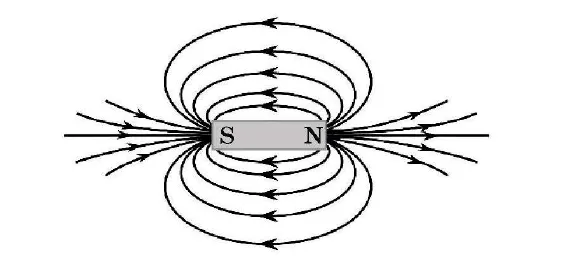
Case study 3. In order to obtain magnetic field lines around a bar magnet, a student performed an experiment using a magnetic compass and a bar magnet. The magnet was placed on a sheet of white paper fixed on a drawing board. Using magnetic needle he obtained on the paper a pattern of magnetic field lines (as shown below) around the bar magnet.

(a) By convention, the field lines emerge from north pole and merge at south pole. Why? Give reason. [1]

(b) State the relationship between strength of the magnetic field and the degree of closeness of the field lines. [1]

(c) (A) (i) No two field lines can ever intersect each other. Give reason. (ii) The magnetic field in a given region is uniform. Draw a diagram to represent it. [2]

OR

(c) (B) Draw the pattern of the magnetic field lines through and around a current carrying solenoid. What does the pattern of field lines inside the solenoid represent? [2]

A bar magnet with its south pole S on the left and north pole N on the right, and closed magnetic field lines drawn around it.
Solution
Uniform field:parallel, equally spacedNSSolenoid: uniform field insideLines never cross: at a crossing point the compassneedle would have to point two ways
  1. (a) By convention the direction of the field is the direction in which the north pole of a compass needle moves inside the field. The north pole of the needle is pushed away from the magnet’s north pole and pulled towards its south pole, so the lines go from north to south outside the magnet.
  2. (b) The closer together the field lines, the stronger the magnetic field.
  3. (c)(A)(i) If two lines crossed, at the point of intersection a compass needle would have to point in two directions at once, which is not possible. (ii) A uniform field is shown by parallel, equally spaced straight lines (diagram above).
  4. (B) Inside a current-carrying solenoid the field lines are parallel, equally spaced straight lines along the axis, which represents a uniform magnetic field. Outside, the pattern is like that of a bar magnet.

Answer: (a) the north pole of a needle moves from N to S   (b) closer lines mean a stronger field   (c) a needle cannot point two ways; parallel equally spaced lines (OR) uniform field inside

Report an error on this question

Questions are from the official CBSE paper. Figures are described in words; see the PDF for the originals. Solutions are written by CogniGuru.

Revise this paper in 1 minute a chapter

Each chapter below is what the paper tested, with a one-minute animated lesson on the idea behind it.

Stuck on a step in any solution?

The CogniGuru AI tutor explains any doubt one minute at a time, in English or Hindi. Join the waitlist.

Mock quiz: 5 questions from this paper

Five real questions from this paper, one each from five chapters. About 2 minutes. See how much you know and where you stand among other students. Attempt free, with no login; log in only for your ranking and full report.

Question 1 of 5 · Q1 of the paperChemical Reactions and Equations

The main observations while performing the experiment of burning magnesium ribbon in air are: (i) Magnesium ribbon burns with a dazzling white flame. (ii) A white powder is formed. (iii) Magnesium ribbon vapourises. (iv) Aqueous solution of the white powder turns blue litmus to red.

0 of 5 answered

Related papers

Common questions

Are these the official CBSE Class 10 Science 2025 questions?
Yes. The questions are from the official Science paper (set 31/5/1) that CBSE published after the March 2025 board exam. The solutions are written by CogniGuru and checked against the answer key CBSE published for this paper code.
Can I download the CBSE Class 10 Science 2025 question paper PDF?
Yes, the official paper PDF is free to download from this page, and so are our step-by-step solutions as a PDF. No login is needed to download either or to read the solutions.
Do all sets of the paper have the same questions?
No. CBSE sets several versions of each paper, with the same blueprint and similar questions in a different order and sometimes with different numbers. This page covers set 31/5/1.
How does the quiz work, and what does “where you stand” mean?
It is a mock quiz of 5 real multiple-choice questions from this paper, scored automatically in about 2 minutes. Your score is compared, anonymously, with other students who took the same quiz. Only the score is stored with the comparison, never your name or number.

Source

CBSE question paper archive, Class X, 2025 (Science, set 31/5/1)
PDF