
CBSE · Class 10 · Science · Free

CBSE Class 10 Science 2025 Question Paper (Set 31/6/1) with Solutions

The official board paper (Q.P. Code 31/6/1, Series GF6HE). Free paper PDF and step-by-step solutions (also as a PDF to download) written by CogniGuru and checked against CBSE’s answer key. See the paper’s main topics in 1 minute, then quiz yourself to see how much you know and where you stand.

No login to download or read the solutions. Login only to see your quiz report in full.

Board
CBSE
Class
10
Subject
Science (086)
Year
2025
Set code
31/6/1
Max marks
80
Duration
3 hours
Questions
39 (Sections A to E)
Source
Official CBSE paper
Exam date
March 2025

Paper preview

Three pages of the official paper. Download the PDF for all 32.

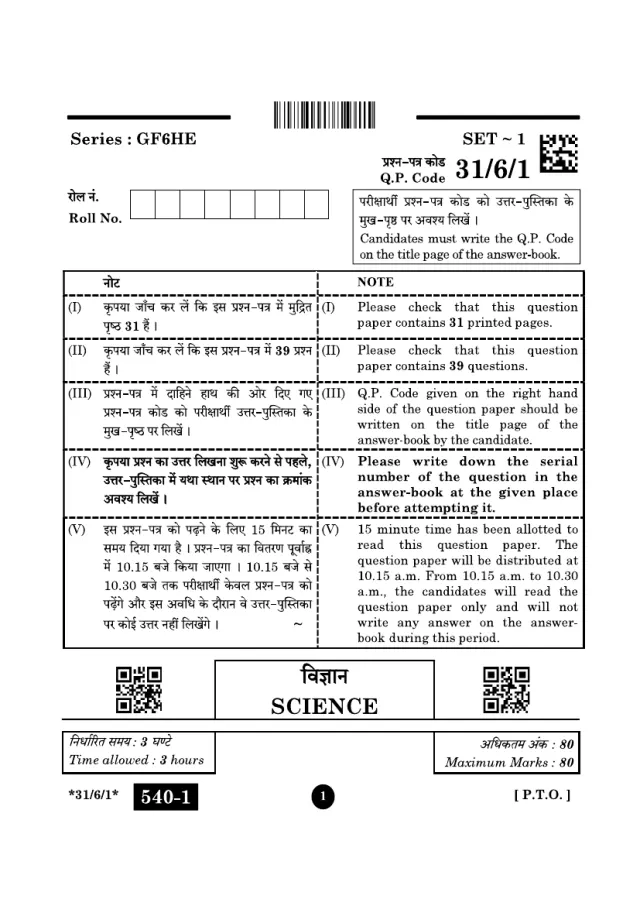
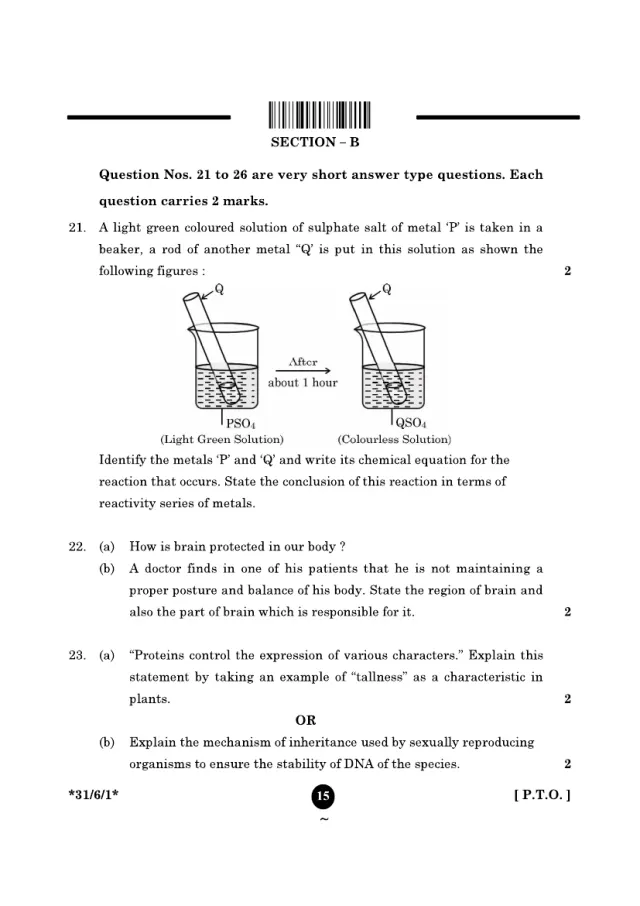
  • Cover page of the CBSE Class 10 Science 2025 paper, set 31/6/1

    Cover page

  • Section B of the CBSE Class 10 Science 2025 paper, set 31/6/1

    Section B

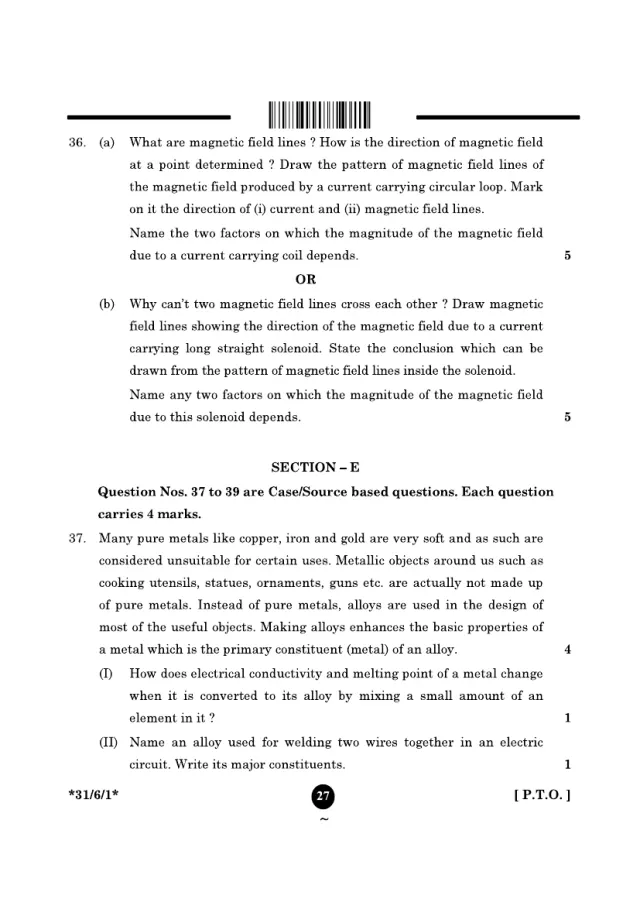
  • A case study with its figure from the CBSE Class 10 Science 2025 paper, set 31/6/1

    Case study

The main topics of this paper, in 1 minute

Your tutor walks you through the paper before you attempt it: the marks, the key ideas, the time plan and the traps.

1-minute paper analysis

With your tutor, in her voice

The main topics of this paper, in about a minute

A short, animated walk through the paper: how it is built, where the marks come from, the four ideas that matter most, how to plan your three hours, and the traps to avoid.

  1. 1The paper at a glance
  2. 2Where the marks come from
  3. 3Four ideas that keep paying off
  4. 4Plan your three hours
  5. 5Four traps to avoid

Sound on for the voice. Captions are shown, and you can mute any time.

Step-by-step solutions

Try each question first, then open its solution. Tap a number to jump.

Download solutions (PDF)

Section A: Multiple choice

20 questions, 1 mark each. MCQs (Q1 to Q16) and assertion-reason (Q17 to Q20).

Q1Chemical Reactions and Equations1 mark

In the following experimental setup of electrolysis of water, if P and Q are the gases collected in the test tubes enclosing the electrodes R and S, then select the option/options in which the matching is correct:

(i) P – Oxygen gas, R – Anode

(ii) P – Hydrogen gas, R – Cathode

(iii) Q – Hydrogen gas, S – Cathode

(iv) Q – Oxygen gas, S – Anode
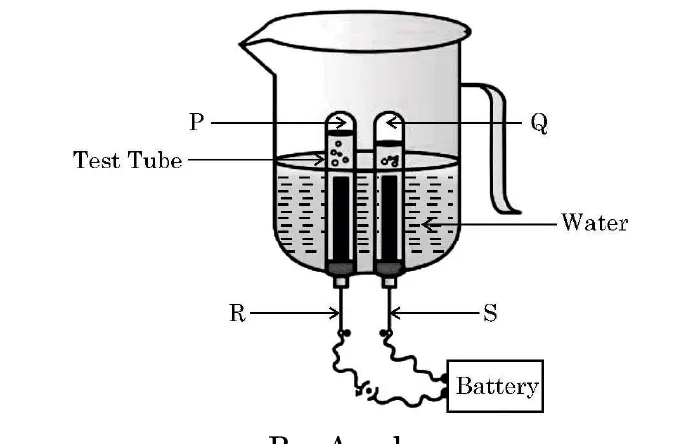
A beaker of water with two inverted test tubes, P and Q, over the electrodes R and S, which are joined to a battery. The tube P holds less gas than tube Q.
  1. (A)(i) and (ii)
  2. (B)(iii) and (iv)
  3. (C)(i) and (iii)
  4. (D)(ii) and (iv)
Solution · answer (C)
  1. 2H2O→2H2+O2\mathrm{2H_2O \rightarrow 2H_2 + O_2}. Twice as much hydrogen as oxygen forms. Hydrogen collects at the cathode (negative electrode) and oxygen at the anode. Tube P holds the smaller volume, so it is oxygen over the anode R, and Q is hydrogen over the cathode S.
  2. So (i) and (iii) are correct.

Answer: (C) (i) and (iii)

Report an error on this question
Q2Acids, Bases and Salts1 mark

You have three aqueous solutions A, B and C as given below: A – Potassium nitrate, B – Ammonium chloride, C – Sodium carbonate. The ascending order of the pH of these solutions is:

  1. (A)A < B < C
  2. (B)B < C < A
  3. (C)C < A < B
  4. (D)B < A < C
Solution · answer (D)
  1. Potassium nitrate is a salt of a strong acid and a strong base: neutral, pH 77. Ammonium chloride is a salt of a strong acid and a weak base: acidic, pH below 77. Sodium carbonate is a salt of a strong base and a weak acid: basic, pH above 77.
  2. So B < A < C.

Answer: (D) B < A < C

Report an error on this question
Q3Chemical Reactions and Equations1 mark

Select from the following a statement which is not true about burning of magnesium ribbon in air:

  1. (A)It burns with a dazzling white flame.
  2. (B)A white powder is formed on burning.
  3. (C)It is an endothermic reaction.
  4. (D)It is an example of a combination reaction.
Solution · answer (C)
  1. 2Mg+O2→2MgO\mathrm{2Mg + O_2 \rightarrow 2MgO} gives out a lot of heat and light, so it is exothermic, not endothermic. The other three statements are true.

Answer: (C) It is an endothermic reaction.

Report an error on this question
Q4Carbon and its Compounds1 mark

A Hydrocarbon which does not belong to the same homologous series of carbon compounds is:

  1. (A)C4H10\mathrm{C_4H_{10}}
  2. (B)C6H14\mathrm{C_6H_{14}}
  3. (C)C7H14\mathrm{C_7H_{14}}
  4. (D)C10H22\mathrm{C_{10}H_{22}}
Solution · answer (C)
  1. C4H10\mathrm{C_4H_{10}}, C6H14\mathrm{C_6H_{14}} and C10H22\mathrm{C_{10}H_{22}} fit the alkane formula CnH2n+2\mathrm{C_nH_{2n+2}}. C7H14\mathrm{C_7H_{14}} fits CnH2n\mathrm{C_nH_{2n}} (an alkene), a different series.

Answer: (C) C7H14\mathrm{C_7H_{14}}

Report an error on this question
Q5Metals and Non-metals1 mark

The colour of the solution observed after about 1 hour of placing iron nails in copper sulphate solution is:

  1. (A)Blue
  2. (B)Pale green
  3. (C)Yellow
  4. (D)Reddish brown
Solution · answer (B)
  1. Iron displaces copper: Fe+CuSO4→FeSO4+Cu\mathrm{Fe + CuSO_4 \rightarrow FeSO_4 + Cu}. The blue copper sulphate changes to pale green iron(II) sulphate, and reddish-brown copper coats the nail.

Answer: (B) Pale green

Common mistake: Choosing reddish brown. That is the colour of the deposit on the nail, not of the solution.

Report an error on this question
Q6Acids, Bases and Salts1 mark

Juice of tamarind turns blue litmus to red. It is because of the presence of a chemical compound called:

  1. (A)Acetic acid
  2. (B)Methanoic acid
  3. (C)Oxalic acid
  4. (D)Tartaric acid
Solution · answer (D)
  1. Tamarind contains tartaric acid. (Vinegar has acetic acid, ant sting has methanoic acid and tomato has oxalic acid.)

Answer: (D) Tartaric acid

Report an error on this question
Q7Acids, Bases and Salts1 mark

The water of crystallization is present in: (i) Bleaching Powder (ii) Plaster of Paris (iii) Washing Soda (iv) Baking Soda

  1. (A)(ii) and (iv)
  2. (B)(ii) and (iii)
  3. (C)(i) and (iii)
  4. (D)(i) and (iv)
Solution · answer (B)
  1. Plaster of Paris is CaSO4⋅12H2O\mathrm{CaSO_4{\cdot}\tfrac{1}{2}H_2O} and washing soda is Na2CO3⋅10H2O\mathrm{Na_2CO_3{\cdot}10H_2O}. Bleaching powder and baking soda have no water of crystallisation.

Answer: (B) (ii) and (iii)

Report an error on this question
Q8Heredity1 mark

A tall pea plant with round seeds (TTRRTTRR) is crossed with a short pea plant with wrinkled seeds (ttrrttrr). The F1F_1 generation will be:

  1. (A)25% tall with round seeds
  2. (B)50% tall with wrinkled seeds
  3. (C)75% tall with wrinkled seeds
  4. (D)100% tall with round seeds
Solution · answer (D)
  1. The parents give only TRTR and trtr, so every F1F_1 plant is TtRrTtRr. Tall and round are dominant, so all are tall with round seeds.

Answer: (D) 100% tall with round seeds

Report an error on this question
Q9Control and Coordination1 mark

A pair of endocrine glands located in the human brain is:

  1. (A)Parathyroid and Pituitary
  2. (B)Pineal and Thymus
  3. (C)Hypothalamus and Thymus
  4. (D)Hypothalamus and Pineal
Solution · answer (D)
  1. The hypothalamus, pituitary and pineal glands are in the brain. The thyroid, parathyroid and thymus are in the neck and chest. Only “hypothalamus and pineal” are both in the brain.

Answer: (D) Hypothalamus and Pineal

Report an error on this question
Q10How do Organisms Reproduce?1 mark

Select the option having correct matching of the organism given in Column I with the mode of reproduction in Column II:

Column I: P Leishmania, Q Spirogyra, R Planaria, S Plasmodium. Column II: 1 Regeneration, 2 Multiple Fission, 3 Binary Fission, 4 Fragmentation, 5 Budding.

  1. (A)P-4, Q-2, R-1, S-3
  2. (B)P-3, Q-4, R-5, S-2
  3. (C)P-3, Q-4, R-1, S-2
  4. (D)P-4, Q-3, R-2, S-1
Solution · answer (C)
  1. Leishmania divides by binary fission (3). Spirogyra reproduces by fragmentation (4). Planaria regenerates (1). Plasmodium divides by multiple fission (2).

Answer: (C) P-3, Q-4, R-1, S-2

Report an error on this question
Q11Life Processes1 mark

The basic filtration unit of the excretory system in human beings is:

  1. (A)Nephron
  2. (B)Urethra
  3. (C)Neuron
  4. (D)Urinary bladder
Solution · answer (A)
  1. The nephron, with its glomerulus and Bowman’s capsule, filters the blood. Each kidney has millions of them.

Answer: (A) Nephron

Report an error on this question
Q12Life Processes1 mark

In human alimentary canal, the digestive juice secreted by the gastric glands are:

  1. (A)Bile, Trypsin, Pepsin
  2. (B)Hydrochloric acid, Pepsin, Mucus
  3. (C)Lipase, Bile, Mucus
  4. (D)Salivary amylase, Pepsin, Bile
Solution · answer (B)
  1. The gastric glands in the stomach wall release hydrochloric acid, the enzyme pepsin and mucus. Bile is made by the liver, trypsin and lipase by the pancreas and amylase by the salivary glands.

Answer: (B) Hydrochloric acid, Pepsin, Mucus

Report an error on this question
Q13Light: Reflection and Refraction1 mark

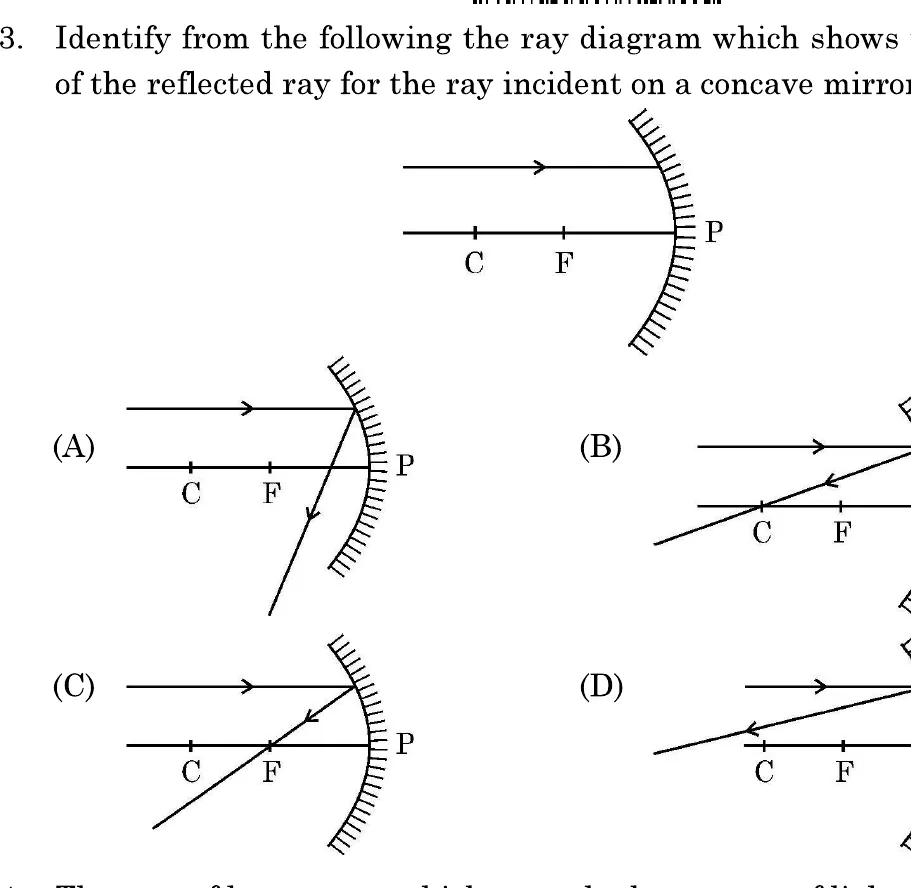
Identify from the following the ray diagram which shows the correct path of the reflected ray for the ray incident on a concave mirror as shown:

A concave mirror with centre of curvature C and focus F on the principal axis, and a ray of light travelling parallel to the axis and striking the mirror above the axis. Below it are four diagrams A to D showing possible reflected rays.
  1. (A)A: the reflected ray goes down and away from the axis
  2. (B)B: the reflected ray goes back towards C
  3. (C)C: the reflected ray passes through the focus F
  4. (D)D: the reflected ray goes back parallel to the axis
Solution · answer (C)
  1. A ray parallel to the principal axis is reflected by a concave mirror so that it passes through the principal focus F. Diagram C shows exactly this.

Answer: (C)

Report an error on this question
Q14Human Eye and the Colourful World1 mark

The part of human eye which controls the amount of light entering into it:

  1. (A)Iris
  2. (B)Cornea
  3. (C)Ciliary muscles
  4. (D)Pupil
Solution · answer (D)
  1. The pupil is the opening through which light enters, and its size is changed by the iris. CBSE’s key gives the pupil as the part which controls the amount of light entering (the iris is the muscle that changes its size).

Answer: (D) Pupil

About CBSE’s key: Both the iris and the pupil are involved: the iris changes the size of the pupil. CBSE’s key accepts the pupil.

Report an error on this question
Q15Our Environment1 mark

Consider the following food chain: Grass → Grasshopper → Frog → Snake → Eagle. If the amount of energy available at third trophic level is 50 kJ, the available energy at the producer level was:

  1. (A)0.5 kJ
  2. (B)5 kJ
  3. (C)500 kJ
  4. (D)5000 kJ
Solution · answer (D)
  1. Grass is the first level, grasshopper the second and frog the third. Only 10%10\% passes up each level, so the third level has 1100\dfrac{1}{100} of the producers’ energy: 50×100=500050 \times 100 = 5000 kJ.

Answer: (D) 5000 kJ

Report an error on this question
Q16Our Environment1 mark

The incorrect statement about ozone is:

  1. (A)It is a deadly poisonous gas.
  2. (B)It shields the surface of the earth from UV radiation from sun.
  3. (C)It is used as a refrigerant and in fire-extinguishers.
  4. (D)It is formed by combining oxygen molecule with free oxygen atom.
Solution · answer (C)
  1. Ozone is poisonous, it shields us from UV and it forms from O2+O\mathrm{O_2 + O}. It is not used as a refrigerant or in fire extinguishers (that is carbon dioxide or CFCs), so statement C is incorrect.

Answer: (C) It is used as a refrigerant and in fire-extinguishers

Report an error on this question
Q17Carbon and its Compounds1 mark

Assertion (A): Carbon and its compounds are our major sources of fuels.

Reason (R): Most of the carbon compounds on burning release a large amount of heat and light.

  1. (A)Both A and R are true and R is the correct explanation of A
  2. (B)Both A and R are true, but R is not the correct explanation of A
  3. (C)A is true, but R is false
  4. (D)A is false, but R is true
Solution · answer (A)
  1. Coal, petrol, LPG and wood are carbon compounds. They are good fuels because they release much heat and light on burning, so R explains A.

Answer: (A) Both A and R are true and R is the correct explanation of A

Report an error on this question
Q18Life Processes1 mark

Assertion (A): Xylem tissue moves water and minerals obtained from the soil by the roots.

Reason (R): Xylem tissue is found only in the roots of a plant.

  1. (A)Both A and R are true and R is the correct explanation of A
  2. (B)Both A and R are true, but R is not the correct explanation of A
  3. (C)A is true, but R is false
  4. (D)A is false, but R is true
Solution · answer (C)
  1. Assertion: true. Reason: false, as xylem runs through the roots, stem and leaves.

Answer: (C) A is true, but R is false

Report an error on this question
Q19Electricity1 mark

Assertion (A): In the common domestic circuits the earth wire is connected to a metallic plate buried deep inside the earth.

Reason (R): Earth wire ensures that any leakage of current to the metallic body of the appliance keeps its potential to that of the earth, so the user may not get a severe electric shock.

  1. (A)Both A and R are true and R is the correct explanation of A
  2. (B)Both A and R are true, but R is not the correct explanation of A
  3. (C)A is true, but R is false
  4. (D)A is false, but R is true
Solution · answer (A)
  1. The earth wire goes to a metal plate deep in the ground so that leakage current can flow away, and this keeps the appliance body at earth potential. R explains why A is done.

Answer: (A) Both A and R are true and R is the correct explanation of A

Report an error on this question
Q20Our Environment1 mark

Assertion (A): Food web is a network of several food chains operating in an ecosystem.

Reason (R): Food web decreases the stability of an ecosystem.

  1. (A)Both A and R are true and R is the correct explanation of A
  2. (B)Both A and R are true, but R is not the correct explanation of A
  3. (C)A is true, but R is false
  4. (D)A is false, but R is true
Solution · answer (C)
  1. Assertion: true. Reason: false. A food web gives many alternative food sources, so it increases the stability of an ecosystem.

Answer: (C) A is true, but R is false

Report an error on this question

Section B: Very short answer

6 questions, 2 marks each (30 to 50 words).

Q21Metals and Non-metals2 marks

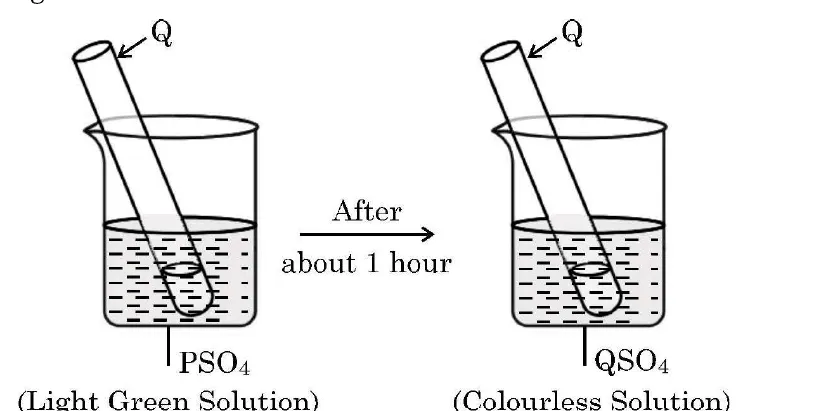
A light green coloured solution of sulphate salt of metal ‘P’ is taken in a beaker, a rod of another metal ‘Q’ is put in this solution as shown in the following figures (after about 1 hour the solution becomes colourless). Identify the metals ‘P’ and ‘Q’ and write its chemical equation for the reaction that occurs. State the conclusion of this reaction in terms of reactivity series of metals.

A beaker holding a light green solution of PSO4 with a rod of metal Q in it. After about 1 hour the solution is colourless QSO4.
Solution
  1. A light green sulphate solution is iron(II) sulphate, so PP is iron. The solution turns colourless, so QQ displaced iron and formed a colourless sulphate: QQ is zinc (or magnesium).
  2. FeSO4+Zn→ZnSO4+Fe\mathrm{FeSO_4 + Zn \rightarrow ZnSO_4 + Fe} (or FeSO4+Mg→MgSO4+Fe\mathrm{FeSO_4 + Mg \rightarrow MgSO_4 + Fe}).
  3. Conclusion: a more reactive metal displaces a less reactive metal from its salt solution, so zinc (or magnesium) is more reactive than iron.

Answer: P = Fe, Q = Zn (or Mg); FeSO4+Zn→ZnSO4+Fe\mathrm{FeSO_4 + Zn \rightarrow ZnSO_4 + Fe}; Zn is more reactive than Fe

Report an error on this question
Q22Control and Coordination2 marks

(a) How is brain protected in our body?

(b) A doctor finds in one of his patients that he is not maintaining a proper posture and balance of his body. State the region of brain and also the part of brain which is responsible for it.

Solution
  1. (a) The brain is protected by the bony box, the skull (cranium), and it is also cushioned by a fluid-filled balloon (the cerebrospinal fluid) around it.
  2. (b) The hind-brain, and in it the cerebellum, controls posture and balance.

Answer: (a) the skull and the fluid around it   (b) hind-brain, cerebellum

Report an error on this question
Q23Heredity2 marks

(a) “Proteins control the expression of various characters.” Explain this statement by taking an example of “tallness” as a characteristic in plants.

OR

(b) Explain the mechanism of inheritance used by sexually reproducing organisms to ensure the stability of DNA of the species.

Solution
  1. (a) The height of a plant depends on the amount of a plant hormone. How much hormone is made depends on how efficiently an enzyme (a protein) works, and the enzyme is made from a specific DNA sequence (a gene). If the enzyme works efficiently, plenty of hormone is made and the plant is tall.
  2. (b) Each cell has two copies of every chromosome, one from each parent. During gamete formation each gamete takes one chromosome from each pair, so it has a single set. When two gametes fuse, the normal number is restored, which keeps the DNA of the species stable.

Answer: (a) gene → enzyme → hormone → tallness   (b) gametes have one set; fertilisation restores two

Report an error on this question
Q24Light: Reflection and Refraction2 marks

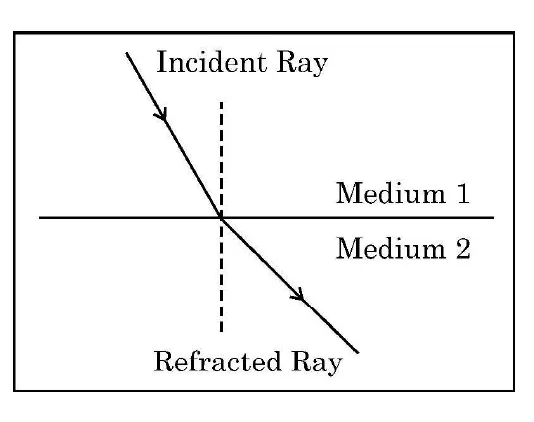
Study the figure in which the path of a ray of light going from Medium 1 to Medium 2 is shown. (a) Out of the two Media – Medium 1 and Medium 2, in which is the speed of light more? (b) State reason of bending of the refracted ray away from the normal. (c) Express refractive index of Medium 2 with respect to Medium 1 in terms of speed of light in two media.

A ray of light falling from Medium 1 on the boundary with Medium 2 and bending away from the normal in Medium 2.
Solution
  1. (a) The ray bends away from the normal in Medium 2, so Medium 2 is the rarer medium and the speed of light is more in Medium 2.
  2. (b) Light bends away from the normal when it goes from an optically denser medium to an optically rarer one, because its speed increases.
  3. (c) n21=speed of light in medium 1speed of light in medium 2n_{21} = \dfrac{\text{speed of light in medium 1}}{\text{speed of light in medium 2}}.

Answer: (a) Medium 2   (b) denser to rarer   (c) n21=v1v2n_{21} = \dfrac{v_1}{v_2}

Report an error on this question
Q25Human Eye and the Colourful World2 marks

(a) Give reasons: (i) The sky appears dark to passengers flying at very high altitude. (ii) ‘Danger’ signal lights are red in colour.

OR

(b) What is a rainbow? “We see a rainbow in the sky only after the rainfall.” Why?

Solution
  1. (a)(i) At very high altitude there is hardly any air or dust to scatter the sunlight, so scattering is not prominent and the sky looks dark. (ii) Red light is scattered the least by smoke or fog because it has the longest wavelength, so it can be seen from far away.
  2. (b) A rainbow is a natural spectrum appearing in the sky after a rain shower. After the rain, small water droplets are present in the air and act like tiny prisms: light is refracted and dispersed in them, and then reflected and refracted again.

Answer: (a) little scattering; red scatters least   (b) a spectrum made by water droplets, present only after rain

Report an error on this question
Q26Our Environment2 marks

We do not clean natural ponds or lakes whereas an aquarium or a swimming pool needs to be cleaned regularly. Why?

Solution
  1. Natural ponds and lakes have natural cleansing agents such as microbes (decomposers) which clean them. An aquarium or a swimming pool is an artificial ecosystem and has no decomposers.
  2. If it is not cleaned regularly, the waste keeps increasing, which is harmful to the fishes and the aquatic plants.

Answer: Natural ponds have decomposers; an aquarium does not, so its waste builds up

Report an error on this question

Section C: Short answer

7 questions, 3 marks each (50 to 80 words).

Q27Chemical Reactions and Equations3 marks

Write balanced chemical equation for the reactions that occur when (a) steam is passed over red hot iron. (b) natural gas is burnt in air. (c) glucose reacts with oxygen in the cells of our body and provides energy.

Solution
  1. (a) 3Fe+4H2O→Fe3O4+4H2\mathrm{3Fe + 4H_2O \rightarrow Fe_3O_4 + 4H_2}.
  2. (b) CH4+2O2→CO2+2H2O\mathrm{CH_4 + 2O_2 \rightarrow CO_2 + 2H_2O}.
  3. (c) C6H12O6+6O2→6CO2+6H2O+energy\mathrm{C_6H_{12}O_6 + 6O_2 \rightarrow 6CO_2 + 6H_2O + energy}.

Answer: (a) 3Fe+4H2O→Fe3O4+4H23\mathrm{Fe} + 4\mathrm{H_2O} \rightarrow \mathrm{Fe_3O_4} + 4\mathrm{H_2}   (b) CH4+2O2→CO2+2H2O\mathrm{CH_4} + 2\mathrm{O_2} \rightarrow \mathrm{CO_2} + 2\mathrm{H_2O}   (c) C6H12O6+6O2→6CO2+6H2O\mathrm{C_6H_{12}O_6} + 6\mathrm{O_2} \rightarrow 6\mathrm{CO_2} + 6\mathrm{H_2O}

Report an error on this question
Q28Acids, Bases and Salts3 marks

(a) State the chemical property in each case on which the following uses of baking soda are based upon: (i) as an anti-acid (ii) as a constituent in making baking powder (iii) in soda-acid fire-extinguishers

OR

(b) Write chemical equations to show what happens when an acid reacts with a (i) metal (ii) base and (iii) carbonate. Write the name of the main product formed in each case.

Solution
  1. (a)(i) Baking soda is a mild, non-corrosive basic salt, so it neutralises the excess acid in the stomach. (ii) It gives off carbon dioxide on reacting with a mild edible acid (tartaric acid), which makes the cake rise. (iii) In a fire extinguisher it acts as a base, reacts with the acid and gives carbon dioxide that puts out the fire.
  2. (b)(i) Zn+2HCl→ZnCl2+H2\mathrm{Zn + 2HCl \rightarrow ZnCl_2 + H_2} (zinc chloride and hydrogen). (ii) 2NaOH+H2SO4→Na2SO4+2H2O\mathrm{2NaOH + H_2SO_4 \rightarrow Na_2SO_4 + 2H_2O} (sodium sulphate). (iii) Na2CO3+2HCl→2NaCl+H2O+CO2\mathrm{Na_2CO_3 + 2HCl \rightarrow 2NaCl + H_2O + CO_2} (sodium chloride).

Answer: (a) basic (neutralises acid); releases CO₂ with an acid   (b) salt + hydrogen; salt + water; salt + water + CO₂

Report an error on this question
Q29Life Processes3 marks

Name the blood vessel that brings (i) oxygenated blood (ii) deoxygenated blood, to the human heart. Also name that chamber of the heart which receives deoxygenated blood and state how deoxygenated blood from this chamber is sent to lungs for oxygenation.

Solution
  1. (i) The pulmonary vein brings oxygenated blood from the lungs. (ii) The vena cava brings deoxygenated blood from the body.
  2. The right atrium receives the deoxygenated blood. It contracts and the blood passes into the right ventricle, which contracts and pumps the blood into the lungs through the pulmonary artery.

Answer: (i) pulmonary vein   (ii) vena cava; right atrium → right ventricle → pulmonary artery to the lungs

Report an error on this question
Q30Heredity3 marks

The gene combination of purple flowered pea plants is denoted as (WW) and that of white flowered pea plants as (ww), when these two plants are crossed F1F_1 generation is obtained. (a) List two observations made by Mendel in F1F_1 generation plants. (b) Give the (i) percentage of white flowered plants and (ii) ratio of the gene combinations WW, Ww and ww in F2F_2 generation. (c) Write one difference between dominant and recessive trait.

Solution
  1. (a) All the F1F_1 plants had purple flowers. No white-flowered plants were seen and no plants had mixed colours, so only the dominant trait of the parents showed. (All are WwWw.)
  2. (b) Selfing Ww×WwWw \times Ww gives WW:Ww:ww=1:2:1WW : Ww : ww = 1 : 2 : 1. (i) White flowers need wwww: 25%25\%. (ii) 1:2:11 : 2 : 1.
  3. (c) A dominant trait expresses itself even when the contrasting trait is present, while a recessive trait stays hidden (unexpressed) in the presence of its contrasting trait.

Answer: (a) all purple; no white or mixed   (b) 25%; 1 : 2 : 1   (c) dominant shows in the presence of the other trait; recessive does not

Report an error on this question
Q31Light: Reflection and Refraction3 marks

A student placed a candle flame at different distances from a convex lens and focused its image on a screen. He recorded his observation in tabular form as given below. Analyse the observation table and on the basis of your analysis only, answer the following questions (without doing any calculations): (a) What is the focal length of the convex lens used? Give reason to justify your answer. (b) Which one of the sets of observations is not correct and why? (c) Draw ray diagram to show image formation for any correct set of observation.

S.No.Distance of flame from the lens (cm)Distance of the image from the lens (cm)
1−90+18
2−60+20
3−40+24
4−30+30
5−24+40
6−20+60
7−18+90
8−12+120
Solution
FFOFlameImageRow 3: u = −40 cm, v = +24 cmreal, inverted, smaller, between F and 2F
  1. (a) In observation 4 the object and image distances are equal (−30-30 cm and +30+30 cm). This happens only when the object is at 2f2f, so 2f=302f = 30 cm and f=+15f = +15 cm.
  2. (b) Observation 8 is not correct. The flame is at 1212 cm, which is less than f=15f = 15 cm, so the object lies between the lens and the focus. Then the image is virtual and on the same side as the object, so it cannot be focused on a screen and vv cannot be +120+120 cm. (CBSE says vv should be −120-120 cm; by the lens formula it would actually be −60-60 cm, but the row is wrong either way.)
  3. (c) Take a correct set, for example observation 3 (u = −40 cm, v = +24 cm): the object is between 2F2F and FF... more exactly beyond 2F2F (30 cm), so the image is real, inverted and smaller, between FF and 2F2F on the other side (diagram above).

Answer: (a) f=+15f = +15 cm (object at 2f2f gives image at 2f2f)   (b) observation 8 (object inside ff)   (c) ray diagram

About CBSE’s key: The key says the image distance in observation 8 should be −120 cm. The lens formula gives −60 cm. The point of the question (observation 8 is the wrong one) is unaffected.

Report an error on this question
Q32Human Eye and the Colourful World3 marks

A person uses lenses of +2.0 D power in his spectacles for the correction of his vision. (a) Name the defect of vision the person is suffering from. (b) List two causes of this defect. (c) Determine the focal length of the lenses used in the spectacles.

Solution
  1. (a) A positive power means a convex lens, which corrects hypermetropia (far-sightedness).
  2. (b) The eyeball has become too small (shortened), or the focal length of the eye lens is too long (the lens is less convergent).
  3. (c) f=1P=1+2.0=+0.5f = \dfrac{1}{P} = \dfrac{1}{+2.0} = +0.5 m =+50= +50 cm.

Answer: (a) hypermetropia   (b) small eyeball; long focal length of the eye lens   (c) +0.5+0.5 m

Report an error on this question
Q33Electricity3 marks

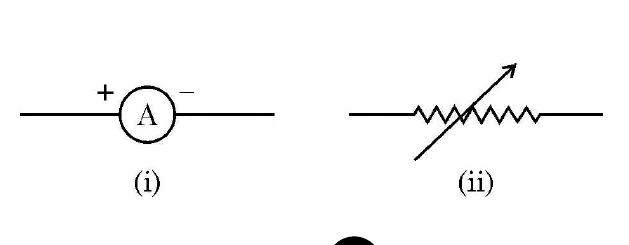
(a) Explain the statement “Potential difference between two points is 1 volt”. (b) What do the symbols given below represent in an electric circuit? Write one function of each. (i) a circle with the letter A (ii) a zig-zag resistor with an arrow through it.

Two circuit symbols. (i) A circle with the letter A inside, with a plus sign at one end and a minus sign at the other. (ii) A zig-zag resistor symbol with an arrow drawn diagonally across it.
Solution
  1. (a) The potential difference between two points is 1 volt if 1 joule of work is done to move a charge of 1 coulomb from one point to the other.
  2. (b)(i) An ammeter: it measures the electric current in a circuit. (ii) A rheostat (variable resistance): it is used to vary the resistance, and so the current, in a circuit.

Answer: (a) 1 J of work per 1 C   (b) ammeter measures current; rheostat varies the resistance

Report an error on this question

Section D: Long answer

3 questions, 5 marks each (80 to 120 words).

Q34Carbon and its Compounds5 marks

(a) Name an alcohol and a carboxylic acid having two carbon atoms in their structures. Draw their structures and state how this alcohol can be converted into a carboxylic acid. What happens when these two compounds react in the presence of an acid? Write chemical equations for the reactions involved in the two cases mentioned above.

OR

(b) What are soaps? Write the structure of a soap molecule. Explain the cleansing action of a soap. Why are soaps not considered suitable for washing clothes in a region where water is hard? How is this problem overcome?

Solution
  1. (a) The alcohol is ethanol, CH3CH2OH\mathrm{CH_3CH_2OH} (H−C(H)(H)−C(H)(H)−O−H\mathrm{H{-}C(H)(H){-}C(H)(H){-}O{-}H}), and the acid is ethanoic acid, CH3COOH\mathrm{CH_3COOH} (H−C(H)(H)−C(=O)−O−H\mathrm{H{-}C(H)(H){-}C(=O){-}O{-}H}).
  2. Oxidising ethanol with alkaline potassium permanganate or acidified potassium dichromate, with heating, gives the acid: C2H5OH→alk. KMnO4, heatCH3COOH\mathrm{C_2H_5OH \xrightarrow{alk.\ KMnO_4,\ heat} CH_3COOH}.
  3. In the presence of an acid catalyst they react to form an ester (esterification): C2H5OH+CH3COOH→acidCH3COOC2H5+H2O\mathrm{C_2H_5OH + CH_3COOH \xrightarrow{acid} CH_3COOC_2H_5 + H_2O}, ethyl ethanoate, a sweet-smelling ester.
  4. (b) Soaps are sodium or potassium salts of long-chain carboxylic acids. A soap molecule has a long hydrocarbon tail, which is hydrophobic (water-repelling), and an ionic head, which is hydrophilic (water-loving).
  5. Most dirt is oily and does not dissolve in water. In water the soap molecules form micelles: the tails point inwards and trap the oily dirt, and the heads point outwards towards the water. The micelles form an emulsion, which pulls the dirt out of the cloth and rinses off in water.
  6. Hard water contains calcium and magnesium salts, which react with soap to form an insoluble scum, so little foam forms and the soap is wasted. The problem is overcome by using detergents, or by removing the hardness of the water.

Answer: (a) ethanol and ethanoic acid; oxidation with KMnO4\mathrm{KMnO_4}; esterification gives ethyl ethanoate   (b) soaps are salts of fatty acids; micelles; scum in hard water; use detergents

Report an error on this question
Q35How do Organisms Reproduce?5 marks

(a) Define Puberty. List any two changes seen in boys at the time of puberty. (b) Why are testes in human males located outside the abdominal cavity in scrotum? (c) List any three techniques of contraception used by humans. Which one of these is not meant for males?

OR

(a) Name the part performing following functions in human female reproductive system: (i) production of eggs (ii) site of fertilization (iii) site of implantation (iv) entry of the sperms (b) What changes are observed in the uterus: (i) subsequent to implantation of zygote and (ii) if an egg does not get fertilized?

Solution
  1. (a) Puberty is the period of adolescence when the general body growth slows down and the reproductive tissues begin to mature. In boys: the voice cracks, thick hair grows on the face, and hair grows in the armpits and genital area.
  2. (b) Sperm formation needs a temperature lower than the normal body temperature, so the testes lie in the scrotum, outside the abdominal cavity.
  3. (c) Techniques of contraception: a mechanical barrier (a condom); chemical methods (oral pills); the loop or copper-T placed in the uterus; surgical methods (blocking the vas deferens or the fallopian tube). Oral pills and the copper-T are not meant for males.
  4. (OR)(a) (i) Ovary. (ii) Oviduct (fallopian tube). (iii) Uterus. (iv) Vagina.
  5. (b)(i) After the zygote is implanted it starts dividing. The uterine lining thickens and is richly supplied with blood vessels to nourish the developing embryo, and the placenta develops to give oxygen and food to it and take away waste. (ii) If the egg is not fertilised, the uterine lining slowly breaks down and comes out as blood and mucus along with the unfertilised egg.

Answer: (a) slowing of growth and maturing of reproductive tissue; voice change, facial hair   (b) cooler temperature   (c) condom, pills, loop, surgery; pills and loop not for males (OR) ovary, oviduct, uterus, vagina; thick lining and placenta; menstruation

Report an error on this question
Q36Magnetic Effects of Electric Current5 marks

(a) What are magnetic field lines? How is the direction of magnetic field at a point determined? Draw the pattern of magnetic field lines of the magnetic field produced by a current carrying circular loop. Mark on it the direction of (i) current and (ii) magnetic field lines. Name the two factors on which the magnitude of the magnetic field due to a current carrying coil depends.

OR

(b) Why can’t two magnetic field lines cross each other? Draw magnetic field lines showing the direction of the magnetic field due to a current carrying long straight solenoid. State the conclusion which can be drawn from the pattern of magnetic field lines inside the solenoid. Name any two factors on which the magnitude of the magnetic field due to this solenoid depends.

Solution
I inI outBNear the wire: circles; at the centre: straight, ⊥ to the loop
NSInside: parallel, evenly spaced lines = uniform fieldOutside: like a bar magnet (leave N, enter S)
  1. (a) Magnetic field lines are imaginary lines around a magnet that show the magnetic field. The direction of the field at a point is found by placing a small compass needle there: the direction its north pole points is the direction of the field.
  2. For a circular loop, the field lines are concentric circles near the wire, which become larger and straighter farther away, and at the centre of the loop the line is straight, perpendicular to the plane of the loop (diagram above, with the current and field directions marked).
  3. The magnitude of the field depends on the amount of current through the coil, on the number of turns in the coil and on the radius of the coil. (Any two.)
  4. (b) If two lines crossed, at the point of intersection a compass needle would point in two directions at the same point, which is not possible.
  5. The pattern for a solenoid is shown in the second diagram. Inside the solenoid the lines are parallel and equally spaced, so the magnetic field is the same (uniform) at all points inside it. The field of a solenoid depends on the number of turns, the current in it and the core material inside it. (Any two.)

Answer: (a) lines show the field; a compass needle gives its direction; current and number of turns (b) lines would have two directions at one point; uniform field inside a solenoid

Report an error on this question

Section E: Case studies

3 case studies, 4 marks each.

Q37Metals and Non-metals4 marks

Case study 1. Many pure metals like copper, iron and gold are very soft and as such are considered unsuitable for certain uses. Metallic objects around us such as cooking utensils, statues, ornaments, guns etc. are actually not made up of pure metals. Instead of pure metals, alloys are used in the design of most of the useful objects. Making alloys enhances the basic properties of a metal which is the primary constituent (metal) of an alloy.

(I) How does electrical conductivity and melting point of a metal change when it is converted to its alloy by mixing a small amount of an element in it? [1]

(II) Name an alloy used for welding two wires together in an electric circuit. Write its major constituents. [1]

(III) (a) What are alloys? How is ‘Brass’ (an alloy) prepared? [2]

OR

(III) (b) What is stainless steel? How is it prepared? Write one important property which makes it more useful in making cooking utensils as compared to its primary metal. [2]

Solution
  1. (I) The electrical conductivity decreases, and the melting point is usually lower than that of the pure metal (in a few cases it can be higher).
  2. (II) Solder, an alloy of lead (Pb) and tin (Sn).
  3. (III)(a) An alloy is a homogeneous mixture of two or more metals, or of a metal and a non-metal. Brass is prepared by mixing copper and zinc in a definite proportion.
  4. (b) Stainless steel is an alloy of steel (iron) with nickel and chromium. Iron is first mixed with a little carbon (about 0.05%) so that it becomes hard and strong, and then nickel and chromium are mixed in. It does not rust, which is why it is good for utensils.

Answer: (I) conductivity falls, melting point falls   (II) solder: lead and tin   (III) alloy = mixture; brass = Cu + Zn (OR) steel + Ni + Cr; does not rust

Report an error on this question
Q38Control and Coordination4 marks

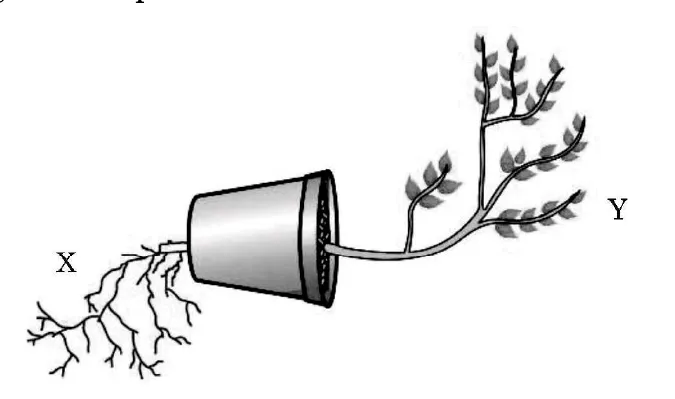
Case study 2. The growth movements of plant parts in which the direction of the stimulus determines the direction of the response is known as tropic movements or tropism. Plants also have non-directional movements which may not be growth dependent.

(I) Name the movement which causes ‘X’ and ‘Y’ to grow downwards and upwards respectively. (Refer above figure) [1]

(II) Write the name of a hormone that plays a major role in (i) falling of leaves (ii) rapid cell division [1]

(III) (a) Leaves of the sensitive plant move very quickly in response to ‘touch’. How is this stimulus of touch communicated and explain how the movement takes place? [2]

OR

(III) (b) Name the plant hormone which is synthesized at the shoot tip. How does this hormone help the plant to bend towards light? [2]

A potted plant lying on its side. The roots X grow downwards, towards the ground, and the shoot Y grows upwards, away from the ground.
Solution
  1. (I) Geotropism: X (the root) shows positive geotropism and Y (the shoot) shows negative geotropism (and the shoot shows positive phototropism).
  2. (II) (i) Abscisic acid. (ii) Cytokinin.
  3. (III)(a) The plant uses electrical-chemical means to pass the information about the touch from cell to cell. The cells then change shape by changing the amount of water in them: some swell and some shrink, so the leaves move.
  4. (b) Auxin. When light comes from one side, auxin diffuses towards the shady side of the shoot. There it makes the cells grow longer, so the side away from the light grows more and the plant bends towards the light.

Answer: (I) geotropism   (II) abscisic acid; cytokinin   (III) electrical-chemical signals, cells change shape with water (OR) auxin on the shady side

Report an error on this question
Q39Electricity4 marks

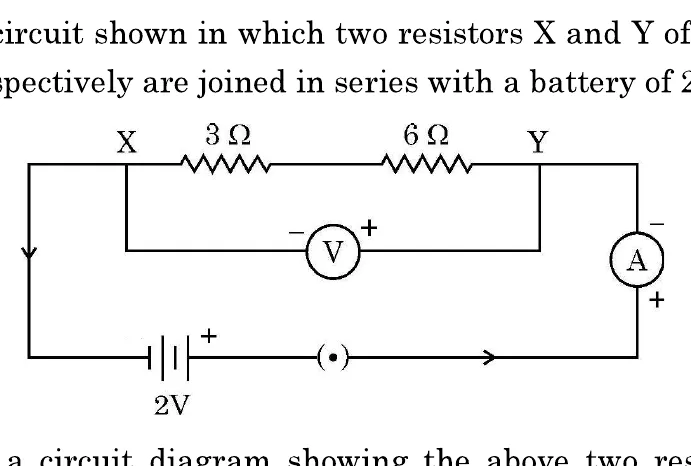
Case study 3. Study the circuit shown in which two resistors X and Y of resistances 3 Ω and 6 Ω respectively are joined in series with a battery of 2 V.

(I) Draw a circuit diagram showing the above two resistors X and Y joined in parallel with same battery and same ammeter and voltmeter. [1]

(II) In which combination of resistors will the (i) potential difference across X and Y and (ii) current through X and Y, be the same? [1]

(III) (a) Find the current drawn from the battery by the series combination of the two resistors (X and Y). [2]

OR

(III) (b) Determine the equivalent resistance of the parallel combination of the two resistors (X and Y). [2]

A circuit with a 2 volt battery, a key, an ammeter, and resistors X of 3 ohms and Y of 6 ohms in series, with a voltmeter connected across X and Y.
Solution
KX 3 ΩY 6 ΩAV2 VX and Y side by side: same voltage across both2 V battery, key K, ammeter A, voltmeter V across X and Y
  1. (I) Join X and Y side by side (in parallel) across the battery, keep the ammeter in the main line and connect the voltmeter across the parallel pair (diagram above).
  2. (II) (i) In the parallel combination, the potential difference is the same across X and Y. (ii) In the series combination, the same current flows through X and Y.
  3. (III)(a) In series R=3+6=9 ΩR = 3 + 6 = 9\ \Omega. I=VR=29=0.22I = \dfrac{V}{R} = \dfrac{2}{9} = 0.22 A.
  4. (b) In parallel: 1R=13+16=36=12\dfrac{1}{R} = \dfrac{1}{3} + \dfrac{1}{6} = \dfrac{3}{6} = \dfrac{1}{2}, so R=2 ΩR = 2\ \Omega.

Answer: (II) (i) parallel (ii) series   (III) I=0.22I = 0.22 A (OR) R=2 ΩR = 2\ \Omega

Report an error on this question

Questions are from the official CBSE paper. Figures are described in words; see the PDF for the originals. Solutions are written by CogniGuru.

Revise this paper in 1 minute a chapter

Each chapter below is what the paper tested, with a one-minute animated lesson on the idea behind it.

Stuck on a step in any solution?

The CogniGuru AI tutor explains any doubt one minute at a time, in English or Hindi. Join the waitlist.

Mock quiz: 5 questions from this paper

Five real questions from this paper, one each from five chapters. About 2 minutes. See how much you know and where you stand among other students. Attempt free, with no login; log in only for your ranking and full report.

Question 1 of 5 · Q2 of the paperAcids, Bases and Salts

You have three aqueous solutions A, B and C as given below: A – Potassium nitrate, B – Ammonium chloride, C – Sodium carbonate. The ascending order of the pH of these solutions is:

0 of 5 answered

Related papers

Common questions

Are these the official CBSE Class 10 Science 2025 questions?
Yes. The questions are from the official Science paper (set 31/6/1) that CBSE published after the March 2025 board exam. The solutions are written by CogniGuru and checked against the answer key CBSE published for this paper code.
Can I download the CBSE Class 10 Science 2025 question paper PDF?
Yes, the official paper PDF is free to download from this page, and so are our step-by-step solutions as a PDF. No login is needed to download either or to read the solutions.
Do all sets of the paper have the same questions?
No. CBSE sets several versions of each paper, with the same blueprint and similar questions in a different order and sometimes with different numbers. This page covers set 31/6/1.
How does the quiz work, and what does “where you stand” mean?
It is a mock quiz of 5 real multiple-choice questions from this paper, scored automatically in about 2 minutes. Your score is compared, anonymously, with other students who took the same quiz. Only the score is stored with the comparison, never your name or number.

Source

CBSE question paper archive, Class X, 2025 (Science, set 31/6/1)
PDF