CBSE · Class 10 · Mathematics (Basic) · Free

CBSE Class 10 Maths Basic 2023 Question Paper (Set 430/2/1) with Solutions

The official board paper (Q.P. Code 430/2/1, Series WX1YZ/2). Free paper PDF and step-by-step solutions (also as a PDF to download) written by CogniGuru and checked against CBSE’s answer key. See the paper’s main topics in 1 minute, then quiz yourself to see how much you know and where you stand.

No login to download or read the solutions. Login only to see your quiz report in full.

Board
CBSE
Class
10
Subject
Maths Basic (241)
Year
2023
Set code
430/2/1
Max marks
80
Duration
3 hours
Questions
38 (Sections A to E)
Source
Official CBSE paper
Exam date
March 2023

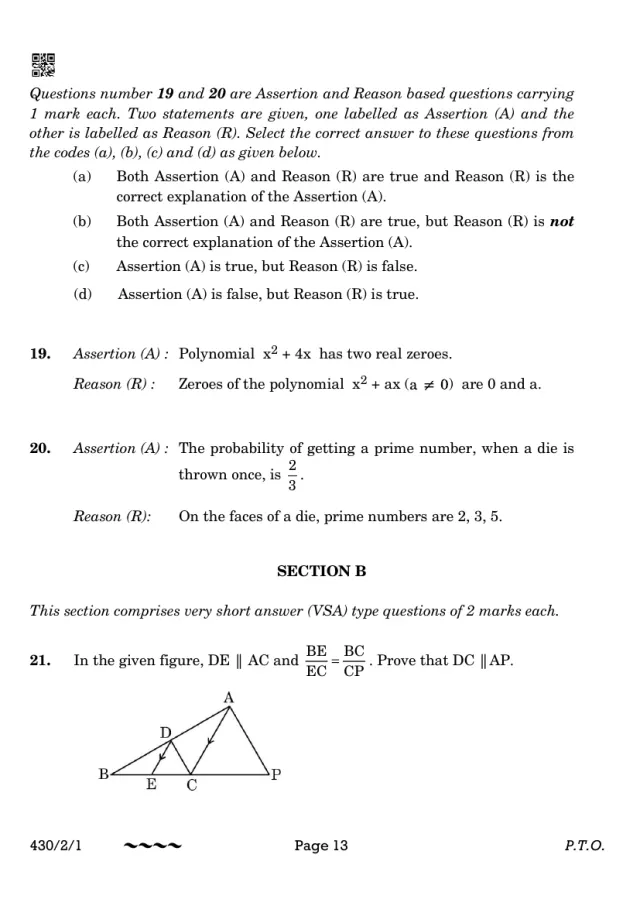
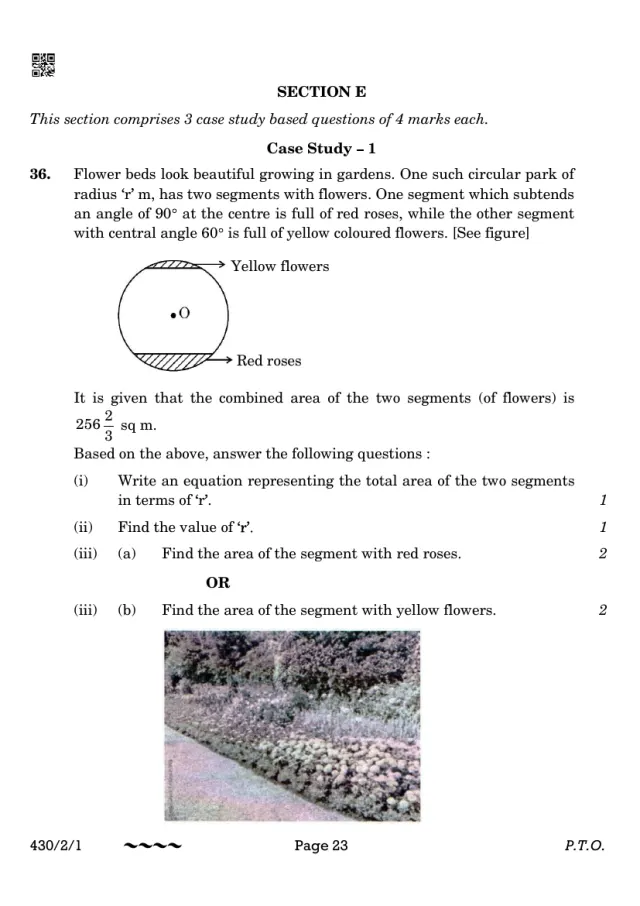
Paper preview

Three pages of the official paper. Download the PDF for all 27.
  • Cover page of the CBSE Class 10 Maths Basic 2023 paper, set 430/2/1

    Cover page

  • Section B of the CBSE Class 10 Maths Basic 2023 paper, set 430/2/1

    Section B

  • A case study with its figure from the CBSE Class 10 Maths Basic 2023 paper, set 430/2/1

    Case study

The main topics of this paper, in 1 minute

Your tutor walks you through the paper before you attempt it: the marks, the key ideas, the time plan and the traps.

1-minute paper analysis

With your tutor, in her voice

The main topics of this paper, in about a minute

A short, animated walk through the paper: how it is built, where the marks come from, the four ideas that matter most, how to plan your three hours, and the traps to avoid.

  1. 1The paper at a glance
  2. 2Where the marks come from
  3. 3Four ideas that keep paying off
  4. 4Plan your three hours
  5. 5Four traps to avoid

Sound on for the voice. Captions are shown, and you can mute any time.

Step-by-step solutions

Try each question first, then open its solution. Tap a number to jump.

Download solutions (PDF)

Section A: Multiple choice

20 questions, 1 mark each. MCQs (Q1 to Q18) and assertion-reason (Q19, Q20).

Q1Arithmetic Progressions1 mark

How many terms are there in the A.P. 14,19,24,29,…,11914, 19, 24, 29, \dots, 119?

  1. (A)18
  2. (B)14
  3. (C)22
  4. (D)21
Solution · answer (C)
  1. a=14a = 14, d=5d = 5 and an=119a_n = 119: 14+(n−1)×5=11914 + (n - 1) \times 5 = 119 gives (n−1)×5=105(n - 1) \times 5 = 105, so n=22n = 22.

Answer: (C) 22

Report an error on this question
Q2Coordinate Geometry1 mark

In what ratio does the xx-axis divide the line segment joining the points A(2,−3)A(2, -3) and B(5,6)B(5, 6)?

  1. (A)2 : 3
  2. (B)2 : 1
  3. (C)3 : 4
  4. (D)1 : 2
Solution · answer (D)
  1. On the xx-axis y=0y = 0. If the ratio is k:1k : 1, then y=6k−3k+1=0y = \dfrac{6k - 3}{k + 1} = 0, so k=12k = \dfrac{1}{2}.
  2. The ratio is 12:1=1:2\dfrac{1}{2} : 1 = 1 : 2. (The point is (3,0)(3, 0).)

Answer: (D) 1 : 2

Report an error on this question
Q3Trigonometry1 mark

9sec⁡2A−9tan⁡2A9\sec^2 A - 9\tan^2 A is equal to:

  1. (A)9
  2. (B)0
  3. (C)8
  4. (D)19\dfrac{1}{9}
Solution · answer (A)
  1. 9(sec⁡2A−tan⁡2A)=9×1=99(\sec^2 A - \tan^2 A) = 9 \times 1 = 9, using sec⁡2A−tan⁡2A=1\sec^2 A - \tan^2 A = 1.

Answer: (A) 9

Report an error on this question
Q4Trigonometry1 mark

The string of a kite in air is 5050 m long and it makes an angle of 60∘60^\circ with the horizontal. Assuming the string to be straight, the height of the kite from the ground is:

  1. (A)50350\sqrt{3} m
  2. (B)1003\dfrac{100}{\sqrt{3}} m
  3. (C)503\dfrac{50}{\sqrt{3}} m
  4. (D)25325\sqrt{3} m
Solution · answer (D)
60°ABK50 mhsin 60° = h/50 → h = 50 × √3/2 = 25√3 m
  1. sin⁡60∘=h50\sin 60^\circ = \dfrac{h}{50}, so h=50×32=253h = 50 \times \dfrac{\sqrt{3}}{2} = 25\sqrt{3} m.

Answer: (D) 25325\sqrt{3} m

Report an error on this question
Q5Circles1 mark

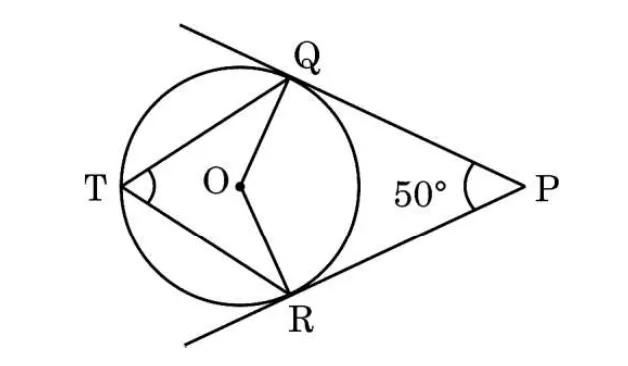
From a point PP, two tangents PQPQ and PRPR are drawn to a circle with centre at OO. TT is a point on the major arc QRQR of the circle. If ∠QPR=50∘\angle QPR = 50^\circ, then ∠QTR\angle QTR equals:

A circle with centre O. Two tangents from the outside point P on the right touch the circle at Q at the top and R at the bottom, with the angle at P marked 50 degrees. T is a point on the left of the circle and the radii OQ and OR are drawn.
  1. (A)50∘50^\circ
  2. (B)130∘130^\circ
  3. (C)65∘65^\circ
  4. (D)90∘90^\circ
Solution · answer (C)
OPQRT50°130°∠QOR = 180° − 50° = 130°, ∠QTR = ½ × 130° = 65°
  1. OQ⊥PQOQ \perp PQ and OR⊥PROR \perp PR, so in quadrilateral OQPROQPR: ∠QOR=360∘−90∘−90∘−50∘=130∘\angle QOR = 360^\circ - 90^\circ - 90^\circ - 50^\circ = 130^\circ.
  2. The angle at the centre is twice the angle at the major arc: ∠QTR=130∘2=65∘\angle QTR = \dfrac{130^\circ}{2} = 65^\circ.

Answer: (C) 65∘65^\circ

Report an error on this question
Q6Areas Related to Circles1 mark

The area of a sector of angle α\alpha (in degrees) of a circle with radius RR is:

  1. (A)α180×2πR\dfrac{\alpha}{180} \times 2\pi R
  2. (B)α360×2πR\dfrac{\alpha}{360} \times 2\pi R
  3. (C)α180×πR2\dfrac{\alpha}{180} \times \pi R^2
  4. (D)α360×πR2\dfrac{\alpha}{360} \times \pi R^2
Solution · answer (D)
  1. A sector of angle α\alpha is α360\dfrac{\alpha}{360} of the whole circle, so its area is α360×πR2\dfrac{\alpha}{360} \times \pi R^2. (Option B is the arc length, not the area.)

Answer: (D) α360×πR2\dfrac{\alpha}{360} \times \pi R^2

Report an error on this question
Q7Real Numbers1 mark

If the HCF of 360 and 64 is 8, then their LCM is:

  1. (A)2480
  2. (B)2780
  3. (C)512
  4. (D)2880
Solution · answer (D)
  1. HCF ×\times LCM == product of the numbers, so LCM =360×648=360×8=2880= \dfrac{360 \times 64}{8} = 360 \times 8 = 2880.

Answer: (D) 2880

Report an error on this question
Q8Surface Areas and Volumes1 mark

The curved surface area of a right circular cylinder of height 1414 cm is 8888 cm². The diameter of its circular base is:

  1. (A)2 cm
  2. (B)1 cm
  3. (C)4 cm
  4. (D)7 cm
Solution · answer (A)
  1. 2πrh=882\pi r h = 88: 2×227×r×14=882 \times \dfrac{22}{7} \times r \times 14 = 88, so 88r=8888r = 88 and r=1r = 1 cm. The diameter is 22 cm.

Answer: (A) 2 cm

Report an error on this question
Q9Probability1 mark

A die is rolled once. The probability that a composite number comes up, is:

  1. (A)12\dfrac{1}{2}
  2. (B)23\dfrac{2}{3}
  3. (C)13\dfrac{1}{3}
  4. (D)0
Solution · answer (C)
  1. The composite numbers on a die are 44 and 66 (11 is neither prime nor composite). P=26=13P = \dfrac{2}{6} = \dfrac{1}{3}.

Answer: (C) 13\dfrac{1}{3}

Report an error on this question
Q10Quadratic Equations1 mark

If the quadratic equation 9x2+bx+14=09x^2 + bx + \dfrac{1}{4} = 0 has equal roots, then the value of bb is:

  1. (A)0
  2. (B)−3-3 only
  3. (C)33 only
  4. (D)±3\pm 3
Solution · answer (D)
  1. Equal roots mean D=0D = 0: b2−4(9)(14)=b2−9=0b^2 - 4(9)\left(\dfrac{1}{4}\right) = b^2 - 9 = 0, so b=±3b = \pm 3.

Answer: (D) ±3\pm 3

Report an error on this question
Q11Surface Areas and Volumes1 mark

A solid is of the form of a cone of radius rr surmounted on a hemisphere of the same radius. If the height of the cone is the same as the diameter of its base, then the volume of the solid is:
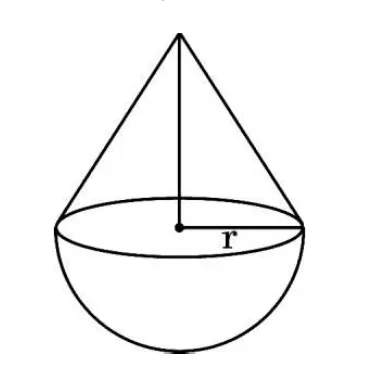
A solid made of a cone sitting on top of a hemisphere, with the radius r marked on the circular base where they meet.
  1. (A)πr3\pi r^3
  2. (B)43πr3\dfrac{4}{3}\pi r^3
  3. (C)3πr33\pi r^3
  4. (D)23πr3\dfrac{2}{3}\pi r^3
Solution · answer (B)
  1. The cone height is 2r2r: cone volume =13πr2(2r)=23πr3= \dfrac{1}{3}\pi r^2(2r) = \dfrac{2}{3}\pi r^3. The hemisphere volume is 23πr3\dfrac{2}{3}\pi r^3.
  2. Total =23πr3+23πr3=43πr3= \dfrac{2}{3}\pi r^3 + \dfrac{2}{3}\pi r^3 = \dfrac{4}{3}\pi r^3.

Answer: (B) 43πr3\dfrac{4}{3}\pi r^3

Report an error on this question
Q12Polynomials1 mark

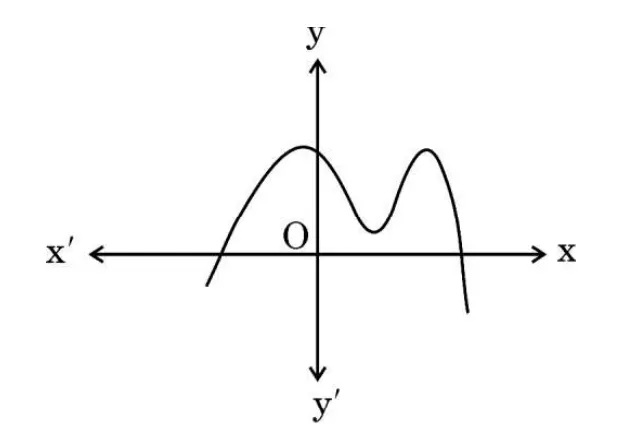
Graph of a polynomial p(x)p(x) is given in the figure. The number of zeroes of p(x)p(x) is:

A curve that starts below the x-axis on the left, crosses it, rises to a peak, dips to a valley that stays above the x-axis, rises to a second peak and then falls and crosses the x-axis again on the right.
  1. (A)2
  2. (B)3
  3. (C)4
  4. (D)5
Solution · answer (A)
  1. The zeroes are the points where the graph meets the xx-axis. It crosses once on the left and once on the right. The valley in the middle stays above the axis without touching it. So there are 22 zeroes.

Answer: (A) 2

Report an error on this question
Q13Linear Equations1 mark

The pair of linear equations x+2y−5=0x + 2y - 5 = 0 and 2x−4y+6=02x - 4y + 6 = 0:

  1. (A)is inconsistent
  2. (B)is consistent with many solutions
  3. (C)is consistent with a unique solution
  4. (D)is consistent with two solutions
Solution · answer (C)
  1. a1a2=12\dfrac{a_1}{a_2} = \dfrac{1}{2} and b1b2=2−4=−12\dfrac{b_1}{b_2} = \dfrac{2}{-4} = -\dfrac{1}{2}. The ratios differ, so the lines intersect at exactly one point: a unique solution.

Answer: (C) is consistent with a unique solution

Report an error on this question
Q14Probability1 mark

Which of the following numbers cannot be the probability of an event?

  1. (A)0.5
  2. (B)5%
  3. (C)10.5\dfrac{1}{0.5}
  4. (D)0.514\dfrac{0.5}{14}
Solution · answer (C)
  1. A probability lies between 00 and 11. 10.5=2>1\dfrac{1}{0.5} = 2 > 1, so it cannot be a probability. The others are 0.50.5, 0.050.05 and about 0.0360.036.

Answer: (C) 10.5\dfrac{1}{0.5}

Report an error on this question
Q15Trigonometry1 mark

The value of 2sin⁡230∘+3tan⁡260∘−cos⁡245∘2\sin^2 30^\circ + 3\tan^2 60^\circ - \cos^2 45^\circ is:

  1. (A)333\sqrt{3}
  2. (B)192\dfrac{19}{2}
  3. (C)94\dfrac{9}{4}
  4. (D)9
Solution · answer (D)
  1. 2(12)2+3(3)2−(12)2=12+9−12=92\left(\dfrac{1}{2}\right)^2 + 3(\sqrt{3})^2 - \left(\dfrac{1}{\sqrt{2}}\right)^2 = \dfrac{1}{2} + 9 - \dfrac{1}{2} = 9.

Answer: (D) 9

Report an error on this question
Q16Linear Equations1 mark

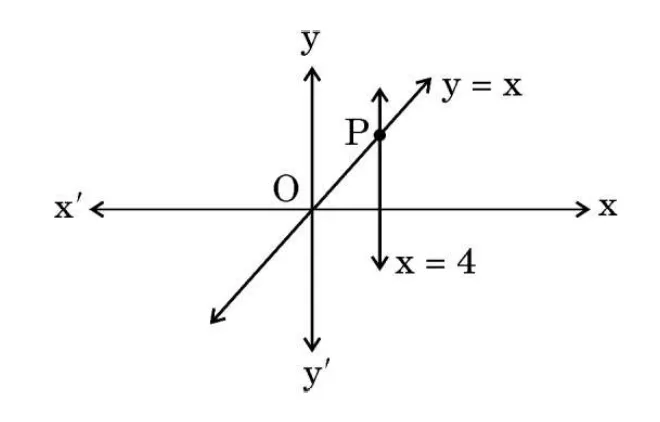
The lines represented by the linear equations y=xy = x and x=4x = 4 intersect at PP. The coordinates of the point PP are:

Axes with the slanted line y equals x through the origin and the vertical line x equals 4 meeting it at the point P above the x-axis.
  1. (A)(4, 0)
  2. (B)(4, 4)
  3. (C)(0, 4)
  4. (D)(−4, 4)
Solution · answer (B)
-2-1123456-2-1123456OxyP(4, 4)
  1. On the line x=4x = 4 put x=4x = 4 in y=xy = x: y=4y = 4. So P=(4,4)P = (4, 4).

Answer: (B) (4, 4)

Report an error on this question
Q17Statistics1 mark

Median and Mode of a distribution are 2525 and 2121 respectively. Mean of the data using the empirical relationship is:

  1. (A)27
  2. (B)29
  3. (C)18
  4. (D)293\dfrac{29}{3}
Solution · answer (A)
  1. Mode =3 Median−2 Mean= 3\,\text{Median} - 2\,\text{Mean}: 21=75−2 Mean21 = 75 - 2\,\text{Mean}, so 2 Mean=542\,\text{Mean} = 54 and Mean =27= 27.

Answer: (A) 27

Report an error on this question
Q18Trigonometry1 mark

If tan⁡A=25\tan A = \dfrac{2}{5}, then the value of 1−cos⁡2A1−sin⁡2A\dfrac{1 - \cos^2 A}{1 - \sin^2 A} is:

  1. (A)254\dfrac{25}{4}
  2. (B)425\dfrac{4}{25}
  3. (C)45\dfrac{4}{5}
  4. (D)54\dfrac{5}{4}
Solution · answer (B)
  1. 1−cos⁡2A1−sin⁡2A=sin⁡2Acos⁡2A=tan⁡2A=425\dfrac{1 - \cos^2 A}{1 - \sin^2 A} = \dfrac{\sin^2 A}{\cos^2 A} = \tan^2 A = \dfrac{4}{25}.

Answer: (B) 425\dfrac{4}{25}

Report an error on this question
Q19Polynomials1 mark

Assertion (A): Polynomial x2+4xx^2 + 4x has two real zeroes.

Reason (R): Zeroes of the polynomial x2+axx^2 + ax (a≠0)(a \neq 0) are 00 and aa.

  1. (A)Both A and R are true and R is the correct explanation of A
  2. (B)Both A and R are true, but R is not the correct explanation of A
  3. (C)A is true, but R is false
  4. (D)A is false, but R is true
Solution · answer (C)
  1. (A) x2+4x=x(x+4)=0x^2 + 4x = x(x + 4) = 0 gives x=0x = 0 and x=−4x = -4: two real zeroes. True.
  2. (R) x2+ax=x(x+a)=0x^2 + ax = x(x + a) = 0 gives 00 and −a-a, not aa. False.

Answer: (C) A is true, but R is false

Report an error on this question
Q20Probability1 mark

Assertion (A): The probability of getting a prime number, when a die is thrown once, is 23\dfrac{2}{3}.

Reason (R): On the faces of a die, prime numbers are 2,3,52, 3, 5.

  1. (A)Both A and R are true and R is the correct explanation of A
  2. (B)Both A and R are true, but R is not the correct explanation of A
  3. (C)A is true, but R is false
  4. (D)A is false, but R is true
Solution · answer (D)
  1. (R) The primes among 11 to 66 are 2,3,52, 3, 5. True.
  2. (A) That is 33 favourable outcomes, so P=36=12P = \dfrac{3}{6} = \dfrac{1}{2}, not 23\dfrac{2}{3}. False.

Answer: (D) A is false, but R is true

Report an error on this question

Section B: Very short answer

5 questions, 2 marks each.

Q21Triangles2 marks

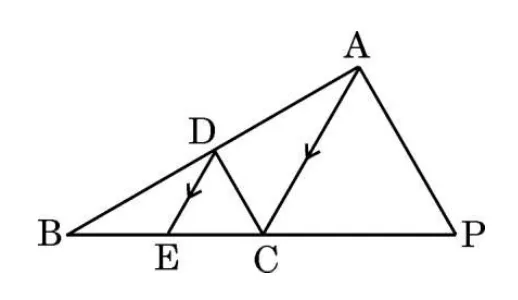
In the given figure, DE∥ACDE \parallel AC and BEEC=BCCP\dfrac{BE}{EC} = \dfrac{BC}{CP}. Prove that DC∥APDC \parallel AP.

A triangle with B on the left, P on the right and A at the top. C and E lie on BP with E between B and C, D lies on AB, and the segments DE, DC and AC are drawn with arrows showing DE parallel to AC.
Solution
ABPCDEDE ∥ AC: BE/EC = BD/DA; so BD/DA = BC/CP
  1. In △BAC\triangle BAC, DE∥ACDE \parallel AC, so by the basic proportionality theorem BEEC=BDDA\dfrac{BE}{EC} = \dfrac{BD}{DA}.
  2. It is given that BEEC=BCCP\dfrac{BE}{EC} = \dfrac{BC}{CP}, so BDDA=BCCP\dfrac{BD}{DA} = \dfrac{BC}{CP}.
  3. In △BAP\triangle BAP the line DCDC divides BABA and BPBP in the same ratio, so DC∥APDC \parallel AP by the converse of the basic proportionality theorem.

Answer: Proved

Report an error on this question
Q22Real Numbers2 marks

(a) Find the HCF of the numbers 540540 and 630630, using the prime factorisation method.

OR

(b) Show that (15)n(15)^n cannot end with the digit 00 for any natural number nn.

Solution
  1. (a) 540=22×33×5540 = 2^2 \times 3^3 \times 5 and 630=2×32×5×7630 = 2 \times 3^2 \times 5 \times 7. HCF == product of the smallest powers of the common primes =2×32×5=90= 2 \times 3^2 \times 5 = 90.
  2. (b) 15n=(3×5)n=3n×5n15^n = (3 \times 5)^n = 3^n \times 5^n. A number ending in 00 is divisible by 1010, so its prime factors must include both 22 and 55. The only primes in 15n15^n are 33 and 55, so it can never end in 00.

Answer: (a) 9090   (b) proved

Report an error on this question
Q23Coordinate Geometry2 marks

(a) Find the value(s) of xx so that PQ=QRPQ = QR, where the coordinates of P,QP, Q and RR are (6,−1)(6, -1), (1,3)(1, 3) and (x,8)(x, 8) respectively.

OR

(b) The vertices of a triangle are (−2,0)(-2, 0), (2,3)(2, 3) and (1,−3)(1, -3). Is the triangle equilateral, isosceles or scalene?

Solution
  1. (a) PQ2=(6−1)2+(−1−3)2=25+16=41PQ^2 = (6 - 1)^2 + (-1 - 3)^2 = 25 + 16 = 41 and QR2=(x−1)2+(8−3)2=(x−1)2+25QR^2 = (x - 1)^2 + (8 - 3)^2 = (x - 1)^2 + 25.
  2. PQ=QRPQ = QR gives (x−1)2+25=41(x - 1)^2 + 25 = 41, so (x−1)2=16(x - 1)^2 = 16 and x−1=±4x - 1 = \pm 4: x=5x = 5 or x=−3x = -3.
  3. (b) With A(−2,0)A(-2, 0), B(2,3)B(2, 3), C(1,−3)C(1, -3): AB=16+9=5AB = \sqrt{16 + 9} = 5, BC=1+36=37BC = \sqrt{1 + 36} = \sqrt{37} and CA=9+9=32CA = \sqrt{9 + 9} = 3\sqrt{2}. All three sides differ, so the triangle is scalene.

Answer: (a) x=5x = 5 or −3-3   (b) scalene

Report an error on this question
Q24Polynomials2 marks

Find the value of kk such that the polynomial p(x)=3x2+2kx+x−k−5p(x) = 3x^2 + 2kx + x - k - 5 has the sum of zeroes equal to half of their product.

Solution
  1. Write p(x)=3x2+(2k+1)x−(k+5)p(x) = 3x^2 + (2k + 1)x - (k + 5). Sum of zeroes =−2k+13= -\dfrac{2k + 1}{3} and product =−k+53= -\dfrac{k + 5}{3}.
  2. Sum =12×= \dfrac{1}{2} \times product: −2k+13=−k+56-\dfrac{2k + 1}{3} = -\dfrac{k + 5}{6}, so 2(2k+1)=k+52(2k + 1) = k + 5, that is 4k+2=k+54k + 2 = k + 5 and k=1k = 1.

Answer: k=1k = 1

Report an error on this question
Q25Probability2 marks

From a well-shuffled deck of 52 playing cards, all diamond cards are removed. Now, a card is drawn from the remaining pack at random. Find the probability that the selected card is a king.

Solution
  1. Cards left =52−13=39= 52 - 13 = 39. Kings left =3= 3 (the king of diamonds is gone). P=339=113P = \dfrac{3}{39} = \dfrac{1}{13}.

Answer: 113\dfrac{1}{13}

Report an error on this question

Section C: Short answer

6 questions, 3 marks each.

Q26Areas Related to Circles3 marks

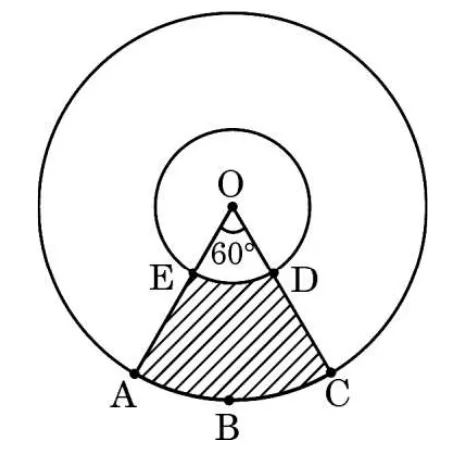
In the given figure, two concentric circles with centre OO are shown. Radii of the circles are 22 cm and 55 cm respectively. Find the area of the shaded region. (Use π=227\pi = \dfrac{22}{7})

Two concentric circles with centre O. A 60 degree angle at O cuts the small circle at E and D and the large circle at A and C. The region between the two arcs, from the small circle out to the large one, is shaded with lines.
Solution
OACED(60/360)π(5² − 2²) = (π/6) × 21 = 7π/2 = 11 cm²
  1. The shaded region is the big sector OACOAC with the small sector OEDOED removed, both with the angle 60∘60^\circ.
  2. Area of sector OAC=60360×π×52=25π6OAC = \dfrac{60}{360} \times \pi \times 5^2 = \dfrac{25\pi}{6} cm². Area of sector OED=60360×π×22=4π6OED = \dfrac{60}{360} \times \pi \times 2^2 = \dfrac{4\pi}{6} cm².
  3. Shaded area =25π−4π6=21π6=216×227=11= \dfrac{25\pi - 4\pi}{6} = \dfrac{21\pi}{6} = \dfrac{21}{6} \times \dfrac{22}{7} = 11 cm².

Answer: 1111 cm²

Report an error on this question
Q27Real Numbers3 marks

Prove that 4+234 + 2\sqrt{3} is an irrational number, given that 3\sqrt{3} is an irrational number.

Solution
  1. Suppose 4+23=pq4 + 2\sqrt{3} = \dfrac{p}{q} with integers p,qp, q and q≠0q \neq 0. Then 3=p−4q2q\sqrt{3} = \dfrac{p - 4q}{2q}.
  2. The right side is a rational number, but 3\sqrt{3} is irrational. This contradiction means the assumption is wrong, so 4+234 + 2\sqrt{3} is irrational.

Answer: Proved

Report an error on this question
Q28Circles3 marks

(a) A quadrilateral ABCDABCD is drawn to circumscribe a circle, as shown in the figure. Prove that AB+CD=AD+BCAB + CD = AD + BC.

OR

(b) Prove that the parallelogram circumscribing a circle is a rhombus.
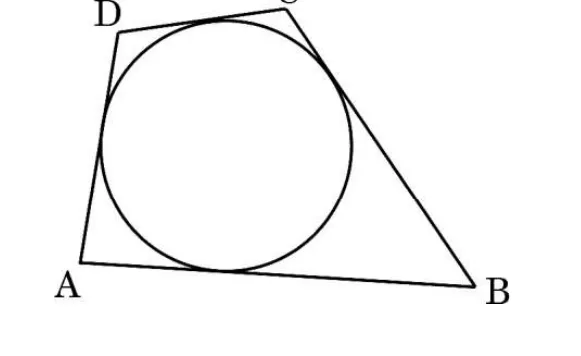
A quadrilateral ABCD drawn around a circle so that all four sides touch it, with D and C at the top, A at the bottom left and B at the right.
Solution
ABCDPQRSAP = AS, BP = BQ, CR = CQ, DR = DS ⇒ AB + CD = AD + BC
  1. (a) Let the circle touch AB,BC,CD,DAAB, BC, CD, DA at P,Q,R,SP, Q, R, S. Tangents from an outside point are equal: AP=ASAP = AS, BP=BQBP = BQ, CR=CQCR = CQ and DR=DSDR = DS.
  2. AB+CD=(AP+PB)+(CR+RD)=(AS+BQ)+(CQ+DS)=(AS+DS)+(BQ+CQ)=AD+BCAB + CD = (AP + PB) + (CR + RD) = (AS + BQ) + (CQ + DS) = (AS + DS) + (BQ + CQ) = AD + BC.
  3. (b) The same result holds for a parallelogram ABCDABCD drawn around a circle: AB+CD=AD+BCAB + CD = AD + BC. In a parallelogram AB=CDAB = CD and AD=BCAD = BC, so 2AB=2AD2AB = 2AD and AB=ADAB = AD. Adjacent sides are equal, so ABCDABCD is a rhombus.

Answer: Proved (both parts)

Report an error on this question
Q29Trigonometry3 marks

(a) Prove that 1−cos⁡θ1+cos⁡θ=(cosec⁡θ−cot⁡θ)2\dfrac{1 - \cos\theta}{1 + \cos\theta} = (\operatorname{cosec}\theta - \cot\theta)^2.

OR

(b) Prove that (1+1tan⁡2A)(1+1cot⁡2A)=1sin⁡2A−sin⁡4A\left(1 + \dfrac{1}{\tan^2 A}\right)\left(1 + \dfrac{1}{\cot^2 A}\right) = \dfrac{1}{\sin^2 A - \sin^4 A}.

Solution
  1. (a) LHS =(1−cos⁡θ)2(1+cos⁡θ)(1−cos⁡θ)=(1−cos⁡θ)2sin⁡2θ=(1−cos⁡θsin⁡θ)2=(cosec⁡θ−cot⁡θ)2== \dfrac{(1 - \cos\theta)^2}{(1 + \cos\theta)(1 - \cos\theta)} = \dfrac{(1 - \cos\theta)^2}{\sin^2\theta} = \left(\dfrac{1 - \cos\theta}{\sin\theta}\right)^2 = (\operatorname{cosec}\theta - \cot\theta)^2 = RHS.
  2. (b) LHS =(1+cos⁡2Asin⁡2A)(1+sin⁡2Acos⁡2A)=sin⁡2A+cos⁡2Asin⁡2A×cos⁡2A+sin⁡2Acos⁡2A=1sin⁡2Acos⁡2A= \left(1 + \dfrac{\cos^2 A}{\sin^2 A}\right)\left(1 + \dfrac{\sin^2 A}{\cos^2 A}\right) = \dfrac{\sin^2 A + \cos^2 A}{\sin^2 A} \times \dfrac{\cos^2 A + \sin^2 A}{\cos^2 A} = \dfrac{1}{\sin^2 A \cos^2 A}.
  3. Since cos⁡2A=1−sin⁡2A\cos^2 A = 1 - \sin^2 A: 1sin⁡2A(1−sin⁡2A)=1sin⁡2A−sin⁡4A=\dfrac{1}{\sin^2 A(1 - \sin^2 A)} = \dfrac{1}{\sin^2 A - \sin^4 A} = RHS.

Answer: Proved (both parts)

Report an error on this question
Q30Polynomials3 marks

Find the zeroes of the polynomial p(x)=2x2−7x−15p(x) = 2x^2 - 7x - 15 and verify the relationship between its coefficients and zeroes.

Solution
  1. 2x2−7x−15=2x2−10x+3x−15=2x(x−5)+3(x−5)=(2x+3)(x−5)2x^2 - 7x - 15 = 2x^2 - 10x + 3x - 15 = 2x(x - 5) + 3(x - 5) = (2x + 3)(x - 5). The zeroes are x=−32x = -\dfrac{3}{2} and x=5x = 5.
  2. Sum of zeroes =−32+5=72=−(−7)2=−ba= -\dfrac{3}{2} + 5 = \dfrac{7}{2} = -\dfrac{(-7)}{2} = -\dfrac{b}{a} ✓.
  3. Product of zeroes =−32×5=−152=ca= -\dfrac{3}{2} \times 5 = -\dfrac{15}{2} = \dfrac{c}{a} ✓.

Answer: Zeroes −32-\dfrac{3}{2} and 55; the relations are verified

Report an error on this question
Q31Coordinate Geometry3 marks

Prove that the points A(−1,0)A(-1, 0), B(3,1)B(3, 1), C(2,2)C(2, 2) and D(−2,1)D(-2, 1) are the vertices of a parallelogram ABCDABCD. Is it also a rectangle?

Solution
  1. Midpoint of AC=(−1+22,0+22)=(12,1)AC = \left(\dfrac{-1 + 2}{2}, \dfrac{0 + 2}{2}\right) = \left(\dfrac{1}{2}, 1\right). Midpoint of BD=(3−22,1+12)=(12,1)BD = \left(\dfrac{3 - 2}{2}, \dfrac{1 + 1}{2}\right) = \left(\dfrac{1}{2}, 1\right).
  2. The diagonals bisect each other, so ABCDABCD is a parallelogram.
  3. AC=32+22=13AC = \sqrt{3^2 + 2^2} = \sqrt{13} and BD=52+02=5BD = \sqrt{5^2 + 0^2} = 5. The diagonals are not equal (13≠5\sqrt{13} \neq 5), so it is not a rectangle.

Answer: A parallelogram, but not a rectangle

Report an error on this question

Section D: Long answer

4 questions, 5 marks each.

Q32Trigonometry5 marks

(a) From the top of a building 6060 m high, the angles of depression of the top and bottom of a tower are observed to be 30∘30^\circ and 60∘60^\circ respectively. Find the height of the tower. Also, find the distance between the building and the tower. (Use 3=1.732\sqrt{3} = 1.732)

OR

(b) The angle of elevation of the top of a building from a point AA on the ground is 30∘30^\circ. On moving a distance of 3030 m towards its base to the point BB, the angle of elevation changes to 45∘45^\circ. Find the height of the building and the distance of its base from point AA. (Use 3=1.732\sqrt{3} = 1.732)

Solution
30°ABCDE60 mx = 20√3 ≈ 34.64 mh = 40 m60°
30°45°ABCDh ≈ 40.98 m30 mh = x, h√3 = x + 30 → x = 15(√3 + 1)
  1. (a) Let the building be AB=60AB = 60, the tower CD=hCD = h and the distance AC=xAC = x. From the top BB, the angle of depression of the bottom CC is 60∘60^\circ, so in △BAC\triangle BAC, tan⁡60∘=60x\tan 60^\circ = \dfrac{60}{x} and x=603=203≈34.64x = \dfrac{60}{\sqrt{3}} = 20\sqrt{3} \approx 34.64 m.
  2. The top DD is 30∘30^\circ below BB, and the level drop is 60−h60 - h: tan⁡30∘=60−hx\tan 30^\circ = \dfrac{60 - h}{x}, so 60−h=2033=2060 - h = \dfrac{20\sqrt{3}}{\sqrt{3}} = 20 and h=40h = 40 m.
  3. (b) Let the building be CD=hCD = h, BC=xBC = x and AB=30AB = 30. At BB: tan⁡45∘=hx\tan 45^\circ = \dfrac{h}{x} gives h=xh = x. At AA: tan⁡30∘=hx+30\tan 30^\circ = \dfrac{h}{x + 30} gives 3h=x+30\sqrt{3}h = x + 30.
  4. Put x=hx = h: h(3−1)=30h(\sqrt{3} - 1) = 30, so h=303−1=15(3+1)=15×2.732=40.98h = \dfrac{30}{\sqrt{3} - 1} = 15(\sqrt{3} + 1) = 15 \times 2.732 = 40.98 m. The distance of the base from AA is x+30=70.98x + 30 = 70.98 m.

Answer: (a) tower 4040 m, distance 203≈34.6420\sqrt{3} \approx 34.64 m   (b) height ≈40.98\approx 40.98 m, distance ≈70.98\approx 70.98 m

Report an error on this question
Q33Statistics5 marks

Find the mean and the median of the following data:

Marks0–1010–2020–3030–4040–5050–6060–7070–80
Number of students351612132065
Solution
  1. Total N=3+5+16+12+13+20+6+5=80N = 3 + 5 + 16 + 12 + 13 + 20 + 6 + 5 = 80. Take the assumed mean a=35a = 35 and h=10h = 10, so u=x−3510u = \dfrac{x - 35}{10} for the class marks 5,15,…,755, 15, \dots, 75.
  2. u=−3,−2,−1,0,1,2,3,4u = -3, -2, -1, 0, 1, 2, 3, 4 and fu=−9,−10,−16,0,13,40,18,20fu = -9, -10, -16, 0, 13, 40, 18, 20, so ∑fu=56\sum fu = 56.
  3. Mean =35+10×5680=35+7=42= 35 + 10 \times \dfrac{56}{80} = 35 + 7 = 42.
  4. Cumulative frequencies: 3,8,24,36,49,69,75,803, 8, 24, 36, 49, 69, 75, 80. N2=40\dfrac{N}{2} = 40 lies in 40−5040 - 50, so the median class is 40−5040 - 50 with l=40l = 40, cf=36cf = 36, f=13f = 13, h=10h = 10.
  5. Median =40+40−3613×10=40+4013≈43.1= 40 + \dfrac{40 - 36}{13} \times 10 = 40 + \dfrac{40}{13} \approx 43.1.

Answer: Mean =42= 42; median ≈43.1\approx 43.1

Report an error on this question
Q34Triangles5 marks

If a line is drawn parallel to one side of a triangle to intersect the other two sides in distinct points, then prove that the other two sides are divided in the same ratio.

Solution
  1. **Given:** in △ABC\triangle ABC, DE∥BCDE \parallel BC with DD on ABAB and EE on ACAC. **To prove:** ADDB=AEEC\dfrac{AD}{DB} = \dfrac{AE}{EC}. **Construction:** join BEBE and CDCD, and draw DM⊥ACDM \perp AC and EN⊥ABEN \perp AB.
  2. ar(ADE)ar(BDE)=12×AD×EN12×DB×EN=ADDB\dfrac{\text{ar}(ADE)}{\text{ar}(BDE)} = \dfrac{\frac{1}{2} \times AD \times EN}{\frac{1}{2} \times DB \times EN} = \dfrac{AD}{DB}. (i)
  3. ar(ADE)ar(CDE)=12×AE×DM12×EC×DM=AEEC\dfrac{\text{ar}(ADE)}{\text{ar}(CDE)} = \dfrac{\frac{1}{2} \times AE \times DM}{\frac{1}{2} \times EC \times DM} = \dfrac{AE}{EC}. (ii)
  4. △BDE\triangle BDE and △CDE\triangle CDE are on the same base DEDE and between the same parallels DEDE and BCBC, so ar(BDE)=ar(CDE)\text{ar}(BDE) = \text{ar}(CDE). (iii)
  5. From (i), (ii) and (iii): ADDB=AEEC\dfrac{AD}{DB} = \dfrac{AE}{EC}.

Answer: Proved (basic proportionality theorem)

Report an error on this question
Q35Arithmetic Progressions5 marks

(a) If the sum of the first 77 terms of an A.P. is −14-14 and that of 1111 terms is −55-55, then find the sum of its first nn terms.

OR

(b) In an A.P., the sum of the first nn terms is 3n2+n3n^2 + n. Find the first term and the common difference of the A.P. Hence, find its 15th15^{\text{th}} term.

Solution
  1. (a) S7=72(2a+6d)=−14S_7 = \dfrac{7}{2}(2a + 6d) = -14 gives a+3d=−2a + 3d = -2. S11=112(2a+10d)=−55S_{11} = \dfrac{11}{2}(2a + 10d) = -55 gives a+5d=−5a + 5d = -5.
  2. Subtracting: 2d=−32d = -3, so d=−32d = -\dfrac{3}{2} and a=−2−3d=52a = -2 - 3d = \dfrac{5}{2}.
  3. Sn=n2[2(52)+(n−1)(−32)]=n4(13−3n)S_n = \dfrac{n}{2}\left[2\left(\dfrac{5}{2}\right) + (n - 1)\left(-\dfrac{3}{2}\right)\right] = \dfrac{n}{4}(13 - 3n).
  4. (b) a1=S1=3+1=4a_1 = S_1 = 3 + 1 = 4. S2=12+2=14S_2 = 12 + 2 = 14, so a2=S2−S1=10a_2 = S_2 - S_1 = 10 and d=10−4=6d = 10 - 4 = 6.
  5. a15=a+14d=4+14×6=88a_{15} = a + 14d = 4 + 14 \times 6 = 88.

Answer: (a) Sn=n(13−3n)4S_n = \dfrac{n(13 - 3n)}{4}   (b) a=4a = 4, d=6d = 6, a15=88a_{15} = 88

Report an error on this question

Section E: Case studies

3 case studies, 4 marks each.

Q36Areas Related to Circles4 marks

Case study 1. Flower beds look beautiful growing in gardens. One such circular park of radius rr m has two segments with flowers. One segment which subtends an angle of 90∘90^\circ at the centre is full of red roses, while the other segment with central angle 60∘60^\circ is full of yellow coloured flowers. [See figure] It is given that the combined area of the two segments (of flowers) is 25623256\dfrac{2}{3} sq m.

Based on the above, answer the following questions:

(i) Write an equation representing the total area of the two segments in terms of rr. [1]

(ii) Find the value of rr. [1]

(iii)(a) Find the area of the segment with red roses. [2]

OR

(iii)(b) Find the area of the segment with yellow flowers. [2]
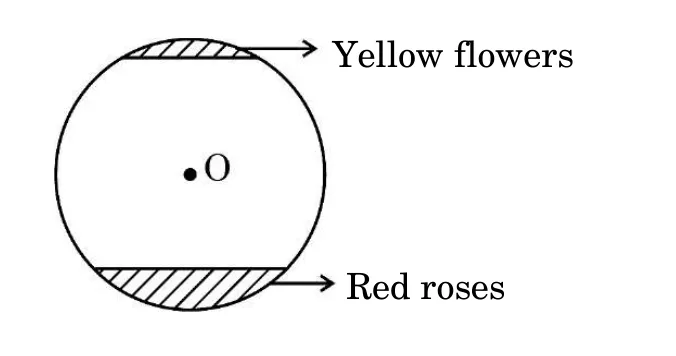
A circle with centre O. A shaded segment at the top is labelled yellow flowers and a shaded segment at the bottom is labelled red roses.
Solution
Ored segment:(1/4)πr² − (1/2)r²yellow segment:(1/6)πr² − (√3/4)r²segment = sector − triangle (the triangle has two sides r)
  1. (i) Red segment =90360πr2−12r2= \dfrac{90}{360}\pi r^2 - \dfrac{1}{2}r^2 (sector minus the right triangle with legs rr). Yellow segment =60360πr2−34r2= \dfrac{60}{360}\pi r^2 - \dfrac{\sqrt{3}}{4}r^2 (sector minus the equilateral triangle of side rr).
  2. So (π4−12)r2+(π6−34)r2=7703\left(\dfrac{\pi}{4} - \dfrac{1}{2}\right)r^2 + \left(\dfrac{\pi}{6} - \dfrac{\sqrt{3}}{4}\right)r^2 = \dfrac{770}{3}.
  3. (ii) With π=227\pi = \dfrac{22}{7} and 3=1.732\sqrt{3} = 1.732 the bracket is 0.7857−0.5+0.5238−0.4330=0.37650.7857 - 0.5 + 0.5238 - 0.4330 = 0.3765, so r2=256.670.3765≈681.7r^2 = \dfrac{256.67}{0.3765} \approx 681.7 and r≈26.1r \approx 26.1 m.
  4. (iii)(a) Red segment =(π4−12)r2≈0.2857×681.7≈194.7= \left(\dfrac{\pi}{4} - \dfrac{1}{2}\right)r^2 \approx 0.2857 \times 681.7 \approx 194.7 sq m (CBSE gives about 194.63194.63).
  5. (iii)(b) Yellow segment =(π6−34)r2≈0.0908×681.7≈61.9= \left(\dfrac{\pi}{6} - \dfrac{\sqrt{3}}{4}\right)r^2 \approx 0.0908 \times 681.7 \approx 61.9 sq m (CBSE gives about 62.0362.03). The two add to 25623256\dfrac{2}{3} ✓. The small differences are only rounding.

Answer: (i) equation above   (ii) r≈26.1r \approx 26.1 m   (iii) red ≈194.7\approx 194.7 sq m (OR) yellow ≈61.9\approx 61.9 sq m

Report an error on this question
Q37Circles4 marks

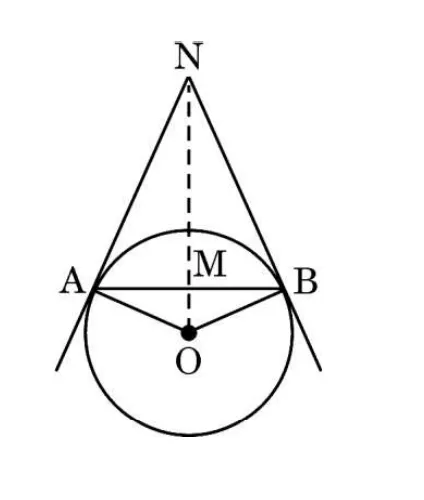
Case study 2. Circles play an important part in our life. When a circular object is hung on the wall with a cord at nail NN, the cords NANA and NBNB work like tangents. Observe the figure, given that ∠ANO=30∘\angle ANO = 30^\circ and OA=5OA = 5 cm.

Based on the above, answer the following questions:

(i) Find the distance ANAN. [1]

(ii) Find the measure of ∠AOB\angle AOB. [1]

(iii)(a) Find the total length of cords NANA, NBNB and the chord ABAB. [2]

OR

(iii)(b) If ∠ANO\angle ANO is 45∘45^\circ, then name the type of quadrilateral OANBOANB. Justify your answer. [2]

A circle hung on a wall: two cords NA and NB go from the nail N at the top to points A and B on the circle, with the centre O below, the chord AB crossing the line NO at M.
Solution
30°NOABMangle AOB = 120°AN = 5√3 cmtan 30° = 5/AN → AN = 5√3; ∠NOA = 60° → ∠AOB = 120°
  1. (i) OA⊥NAOA \perp NA (radius and tangent), so in the right triangle OANOAN, tan⁡30∘=OAAN=5AN\tan 30^\circ = \dfrac{OA}{AN} = \dfrac{5}{AN}. Hence AN=53AN = 5\sqrt{3} cm.
  2. (ii) ∠ANB=2×30∘=60∘\angle ANB = 2 \times 30^\circ = 60^\circ. In quadrilateral OANBOANB, ∠AOB=360∘−90∘−90∘−60∘=120∘\angle AOB = 360^\circ - 90^\circ - 90^\circ - 60^\circ = 120^\circ.
  3. (iii)(a) NA=NB=53NA = NB = 5\sqrt{3} (equal tangents) and ∠ANB=60∘\angle ANB = 60^\circ, so △NAB\triangle NAB is equilateral and AB=53AB = 5\sqrt{3} cm. Total length =3×53=153= 3 \times 5\sqrt{3} = 15\sqrt{3} cm.
  4. (iii)(b) If ∠ANO=45∘\angle ANO = 45^\circ then ∠ANB=90∘\angle ANB = 90^\circ, and ∠AOB=360∘−90∘−90∘−90∘=90∘\angle AOB = 360^\circ - 90^\circ - 90^\circ - 90^\circ = 90^\circ. All four angles of OANBOANB are 90∘90^\circ, so it is a rectangle, and OA=OBOA = OB (radii) makes it a square.

Answer: (i) 535\sqrt{3} cm   (ii) 120∘120^\circ   (iii) 15315\sqrt{3} cm (OR) a square

Report an error on this question
Q38Surface Areas and Volumes4 marks

Case study 3. A wooden toy is shown in the picture. This is a cuboidal wooden block of dimensions 1414 cm ×\times 1717 cm ×\times 44 cm. On its top there are seven cylindrical hollows for bees to fit in. Each cylindrical hollow is of height 33 cm and radius 22 cm.

Based on the above, answer the following questions:

(i) Find the volume of wood carved out to make one cylindrical hollow. [1]

(ii) Find the lateral surface area of the cuboid to paint it with green colour. [1]

(iii)(a) Find the volume of wood in the remaining cuboid after carving out seven cylindrical hollows. [2]

OR

(iii)(b) Find the surface area of the top surface of the cuboid to be painted yellow. [2]
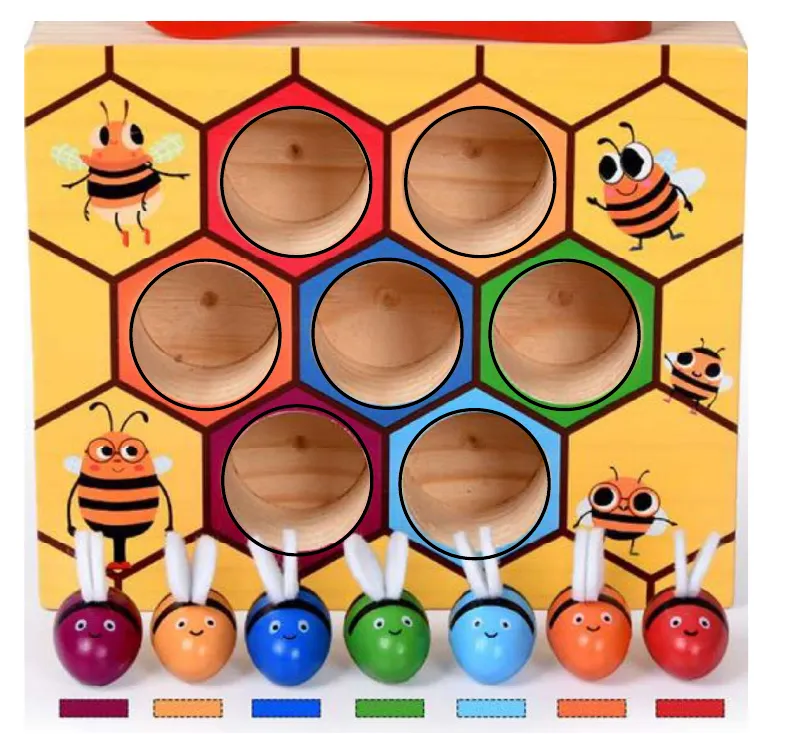
A yellow wooden toy block with seven round hollows on the top arranged like a honeycomb, with colourful bees below it.
Solution
  1. (i) One hollow: πr2h=227×2×2×3=2647≈37.7\pi r^2 h = \dfrac{22}{7} \times 2 \times 2 \times 3 = \dfrac{264}{7} \approx 37.7 cm³.
  2. (ii) Lateral surface area =2(l+b)h=2(14+17)×4=248= 2(l + b)h = 2(14 + 17) \times 4 = 248 cm².
  3. (iii)(a) Seven hollows: 7×2647=2647 \times \dfrac{264}{7} = 264 cm³. The block is 14×17×4=95214 \times 17 \times 4 = 952 cm³. Remaining =952−264=688= 952 - 264 = 688 cm³.
  4. (iii)(b) Top surface to paint =14×17−7×πr2=238−7×227×4=238−88=150= 14 \times 17 - 7 \times \pi r^2 = 238 - 7 \times \dfrac{22}{7} \times 4 = 238 - 88 = 150 cm².

Answer: (i) 2647≈37.7\dfrac{264}{7} \approx 37.7 cm³   (ii) 248248 cm²   (iii) 688688 cm³ (OR) 150150 cm²

Report an error on this question

Questions are from the official CBSE paper. Figures are described in words; see the PDF for the originals. Solutions are written by CogniGuru.

Revise this paper in 1 minute a chapter

Each chapter below is what the paper tested, with a one-minute animated lesson on the idea behind it.

Stuck on a step in any solution?

The CogniGuru AI tutor explains any doubt one minute at a time, in English or Hindi. Join the waitlist.

Mock quiz: 5 questions from this paper

Five real questions from this paper, one each from five chapters. About 2 minutes. See how much you know and where you stand among other students. Attempt free, with no login; log in only for your ranking and full report.

Question 1 of 5 · Q1 of the paperArithmetic Progressions

How many terms are there in the A.P. 14,19,24,29,…,11914, 19, 24, 29, \dots, 119?

0 of 5 answered

Related papers

Common questions

Are these the official CBSE Class 10 Maths Basic 2023 questions?
Yes. The questions are from the official Mathematics (Basic) paper (set 430/2/1) that CBSE published after the March 2023 board exam. The solutions are written by CogniGuru and checked against the answer key CBSE published for this paper code.
Can I download the CBSE Class 10 Maths Basic 2023 question paper PDF?
Yes, the official paper PDF is free to download from this page, and so are our step-by-step solutions as a PDF. No login is needed to download either or to read the solutions.
Do all sets of the paper have the same questions?
No. CBSE sets several versions of each paper, with the same blueprint and similar questions in a different order and sometimes with different numbers. This page covers set 430/2/1.
How does the quiz work, and what does “where you stand” mean?
It is a mock quiz of 5 real multiple-choice questions from this paper, scored automatically in about 2 minutes. Your score is compared, anonymously, with other students who took the same quiz. Only the score is stored with the comparison, never your name or number.

Source

CBSE question paper archive, Class X, 2023 (Mathematics (Basic), set 430/2/1)
PDF