CBSE · Class 10 · Mathematics (Basic) · Free

CBSE Class 10 Maths Basic 2023 Question Paper (Set 430/4/1) with Solutions

The official board paper (Q.P. Code 430/4/1, Series WX1YZ/4). Free paper PDF and step-by-step solutions (also as a PDF to download) written by CogniGuru and checked against CBSE’s answer key. See the paper’s main topics in 1 minute, then quiz yourself to see how much you know and where you stand.

No login to download or read the solutions. Login only to see your quiz report in full.

Board
CBSE
Class
10
Subject
Maths Basic (241)
Year
2023
Set code
430/4/1
Max marks
80
Duration
3 hours
Questions
38 (Sections A to E)
Source
Official CBSE paper
Exam date
March 2023

Paper preview

Three pages of the official paper. Download the PDF for all 15.

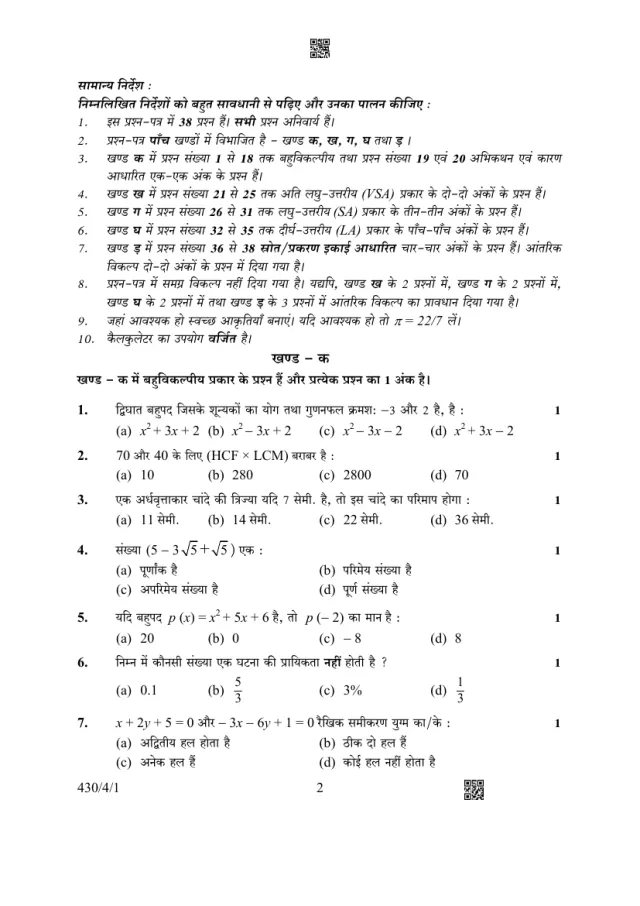
  • Cover page of the CBSE Class 10 Maths Basic 2023 paper, set 430/4/1

    Cover page

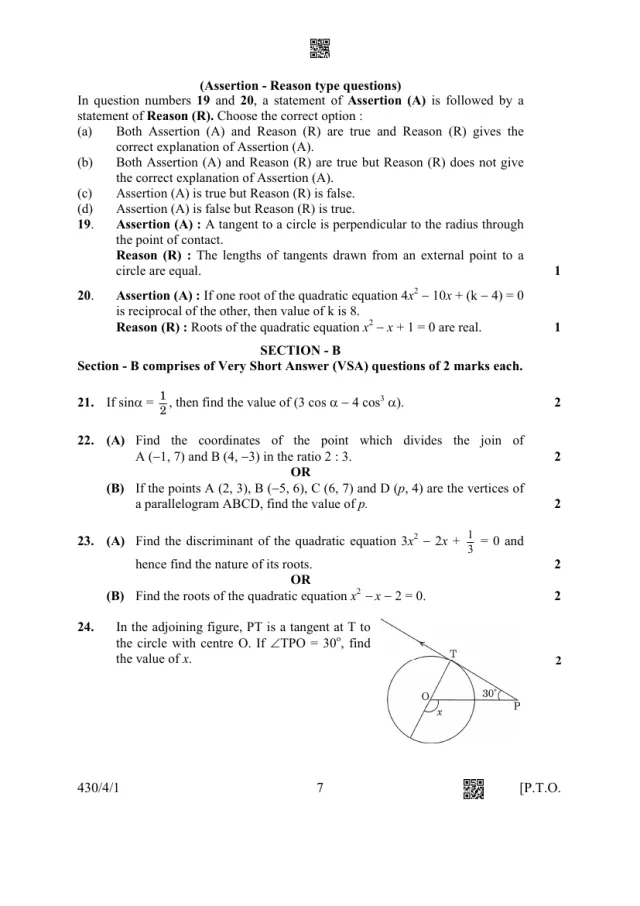
  • Section B of the CBSE Class 10 Maths Basic 2023 paper, set 430/4/1

    Section B

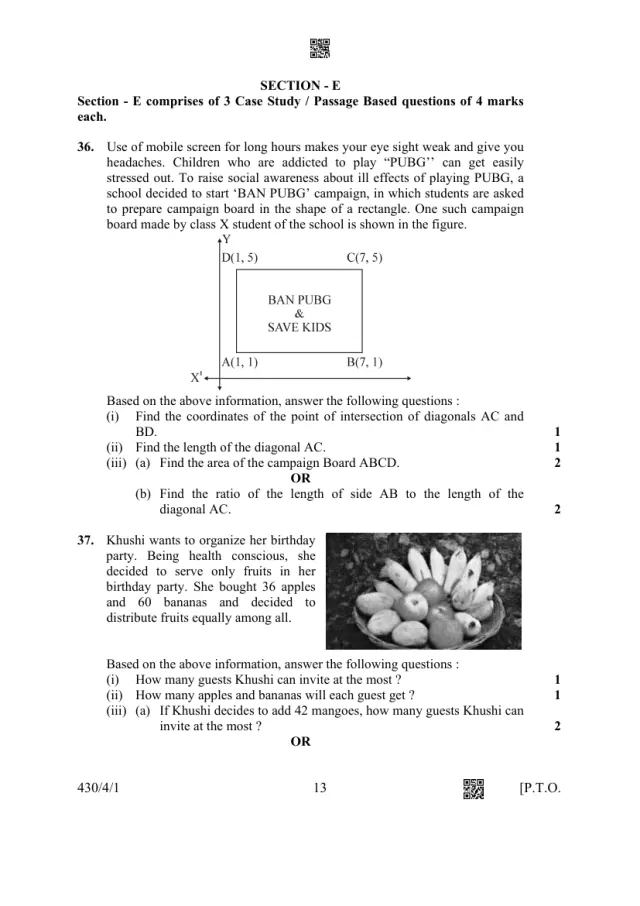
  • A case study with its figure from the CBSE Class 10 Maths Basic 2023 paper, set 430/4/1

    Case study

The main topics of this paper, in 1 minute

Your tutor walks you through the paper before you attempt it: the marks, the key ideas, the time plan and the traps.

1-minute paper analysis

With your tutor, in her voice

The main topics of this paper, in about a minute

A short, animated walk through the paper: how it is built, where the marks come from, the four ideas that matter most, how to plan your three hours, and the traps to avoid.

  1. 1The paper at a glance
  2. 2Where the marks come from
  3. 3Four ideas that keep paying off
  4. 4Plan your three hours
  5. 5Four traps to avoid

Sound on for the voice. Captions are shown, and you can mute any time.

Step-by-step solutions

Try each question first, then open its solution. Tap a number to jump.

Download solutions (PDF)

Section A: Multiple choice

20 questions, 1 mark each. MCQs (Q1 to Q18) and assertion-reason (Q19, Q20).

Q1Polynomials1 mark

A quadratic polynomial the sum and product of whose zeroes are −3-3 and 22 respectively, is:

  1. (A)x2+3x+2x^2 + 3x + 2
  2. (B)x2−3x+2x^2 - 3x + 2
  3. (C)x2−3x−2x^2 - 3x - 2
  4. (D)x2+3x−2x^2 + 3x - 2
Solution · answer (A)
  1. A polynomial with zeroes of sum SS and product PP is x2−Sx+P=x2−(−3)x+2=x2+3x+2x^2 - Sx + P = x^2 - (-3)x + 2 = x^2 + 3x + 2. (Check: the zeroes are −1-1 and −2-2.)

Answer: (A) x2+3x+2x^2 + 3x + 2

Report an error on this question
Q2Real Numbers1 mark

(HCF × LCM) for the numbers 70 and 40 is:

  1. (A)10
  2. (B)280
  3. (C)2800
  4. (D)70
Solution · answer (C)
  1. HCF ×\times LCM == the product of the two numbers =70×40=2800= 70 \times 40 = 2800.

Answer: (C) 2800

Report an error on this question
Q3Areas Related to Circles1 mark

If the radius of a semi-circular protractor is 7 cm, then its perimeter is:

  1. (A)11 cm
  2. (B)14 cm
  3. (C)22 cm
  4. (D)36 cm
Solution · answer (D)
  1. Perimeter =πr+2r=227×7+14=22+14=36= \pi r + 2r = \dfrac{22}{7} \times 7 + 14 = 22 + 14 = 36 cm. (Do not forget the straight edge, the diameter.)

Answer: (D) 36 cm

Report an error on this question
Q4Real Numbers1 mark

The number (5−35+5)(5 - 3\sqrt{5} + \sqrt{5}) is:

  1. (A)an integer
  2. (B)a rational number
  3. (C)an irrational number
  4. (D)a whole number
Solution · answer (C)
  1. 5−35+5=5−255 - 3\sqrt{5} + \sqrt{5} = 5 - 2\sqrt{5}. A rational number minus a non-zero multiple of the irrational 5\sqrt{5} is irrational.

Answer: (C) an irrational number

Report an error on this question
Q5Polynomials1 mark

If p(x)=x2+5x+6p(x) = x^2 + 5x + 6, then p(−2)p(-2) is:

  1. (A)20
  2. (B)0
  3. (C)−8
  4. (D)8
Solution · answer (B)
  1. p(−2)=4−10+6=0p(-2) = 4 - 10 + 6 = 0. So −2-2 is a zero of p(x)p(x).

Answer: (B) 0

Report an error on this question
Q6Probability1 mark

Which of the following cannot be the probability of an event?

  1. (A)0.1
  2. (B)53\dfrac{5}{3}
  3. (C)3%
  4. (D)13\dfrac{1}{3}
Solution · answer (B)
  1. A probability lies between 00 and 11. 53>1\dfrac{5}{3} > 1, so it cannot be a probability. The others are 0.10.1, 0.030.03 and 13\dfrac{1}{3}.

Answer: (B) 53\dfrac{5}{3}

Report an error on this question
Q7Linear Equations1 mark

The pair of linear equations x+2y+5=0x + 2y + 5 = 0 and −3x−6y+1=0-3x - 6y + 1 = 0 has:

  1. (A)a unique solution
  2. (B)exactly two solutions
  3. (C)infinitely many solutions
  4. (D)no solution
Solution · answer (D)
  1. a1a2=1−3\dfrac{a_1}{a_2} = \dfrac{1}{-3}, b1b2=2−6=1−3\dfrac{b_1}{b_2} = \dfrac{2}{-6} = \dfrac{1}{-3} and c1c2=51\dfrac{c_1}{c_2} = \dfrac{5}{1}. The first two ratios are equal and the third is different, so the lines are parallel and there is no solution.

Answer: (D) no solution

Report an error on this question
Q8Triangles1 mark

If △ABC∼△DEF\triangle ABC \sim \triangle DEF and ∠A=47∘\angle A = 47^\circ, ∠E=83∘\angle E = 83^\circ, then ∠C\angle C is equal to:

  1. (A)47∘47^\circ
  2. (B)50∘50^\circ
  3. (C)83∘83^\circ
  4. (D)130∘130^\circ
Solution · answer (B)
  1. Similar triangles have equal corresponding angles, so ∠B=∠E=83∘\angle B = \angle E = 83^\circ. Then ∠C=180∘−47∘−83∘=50∘\angle C = 180^\circ - 47^\circ - 83^\circ = 50^\circ.

Answer: (B) 50∘50^\circ

Report an error on this question
Q9Linear Equations1 mark

If the pair of linear equations x−y=1x - y = 1, x+ky=5x + ky = 5 has a unique solution x=2x = 2, y=1y = 1, then the value of kk is:

  1. (A)−2
  2. (B)−3
  3. (C)3
  4. (D)4
Solution · answer (C)
  1. The solution satisfies both equations. Put x=2x = 2, y=1y = 1 in x+ky=5x + ky = 5: 2+k=52 + k = 5, so k=3k = 3.

Answer: (C) 3

Report an error on this question
Q10Trigonometry1 mark

The value of 5sin⁡290∘−2cos⁡20∘5\sin^2 90^\circ - 2\cos^2 0^\circ is:

  1. (A)−2
  2. (B)5
  3. (C)3
  4. (D)−3
Solution · answer (C)
  1. sin⁡90∘=1\sin 90^\circ = 1 and cos⁡0∘=1\cos 0^\circ = 1, so the value is 5(1)−2(1)=35(1) - 2(1) = 3.

Answer: (C) 3

Report an error on this question
Q11Areas Related to Circles1 mark

The length of the arc of a circle of radius 1414 cm which subtends an angle of 60∘60^\circ at the centre of the circle is:

  1. (A)443\dfrac{44}{3} cm
  2. (B)883\dfrac{88}{3} cm
  3. (C)3083\dfrac{308}{3} cm
  4. (D)6163\dfrac{616}{3} cm
Solution · answer (A)
  1. Arc length =60360×2πr=16×2×227×14=16×88=443= \dfrac{60}{360} \times 2\pi r = \dfrac{1}{6} \times 2 \times \dfrac{22}{7} \times 14 = \dfrac{1}{6} \times 88 = \dfrac{44}{3} cm.

Answer: (A) 443\dfrac{44}{3} cm

Report an error on this question
Q12Trigonometry1 mark

The angle of elevation of the top of a 3030 m high tower at a point 3030 m away from the base of the tower is:

  1. (A)30∘30^\circ
  2. (B)45∘45^\circ
  3. (C)60∘60^\circ
  4. (D)90∘90^\circ
Solution · answer (B)
  1. tan⁡θ=3030=1\tan\theta = \dfrac{30}{30} = 1, so θ=45∘\theta = 45^\circ.

Answer: (B) 45∘45^\circ

Report an error on this question
Q13Statistics1 mark

The mode of the numbers 2, 3, 3, 4, 5, 4, 4, 5, 3, 4, 2, 6, 7 is:

  1. (A)2
  2. (B)3
  3. (C)4
  4. (D)5
Solution · answer (C)
  1. Counting: 22 appears 22 times, 33 appears 33 times, 44 appears 44 times, 55 appears 22 times, 66 and 77 once each. The most frequent value is 44.

Answer: (C) 4

Report an error on this question
Q14Probability1 mark

From a well-shuffled deck of 52 playing cards, a card is drawn at random. What is the probability of getting a red queen?

  1. (A)152\dfrac{1}{52}
  2. (B)126\dfrac{1}{26}
  3. (C)113\dfrac{1}{13}
  4. (D)1213\dfrac{12}{13}
Solution · answer (B)
  1. There are 22 red queens (hearts and diamonds) among 5252 cards: P=252=126P = \dfrac{2}{52} = \dfrac{1}{26}. (A queen of any colour would be 113\dfrac{1}{13}.)

Answer: (B) 126\dfrac{1}{26}

Report an error on this question
Q15Quadratic Equations1 mark

A quadratic equation whose one root is 2 and the sum of whose roots is zero, is:

  1. (A)x2+4=0x^2 + 4 = 0
  2. (B)x2−2=0x^2 - 2 = 0
  3. (C)4x2−1=04x^2 - 1 = 0
  4. (D)x2−4=0x^2 - 4 = 0
Solution · answer (D)
  1. The roots add to 00, so the other root is −2-2. The roots are 22 and −2-2, and the equation is (x−2)(x+2)=x2−4=0(x - 2)(x + 2) = x^2 - 4 = 0.

Answer: (D) x2−4=0x^2 - 4 = 0

Report an error on this question
Q16Quadratic Equations1 mark

Which of the following is not a quadratic equation?

  1. (A)2(x−1)2=4x2−2x+12(x - 1)^2 = 4x^2 - 2x + 1
  2. (B)2x−x2=x2+52x - x^2 = x^2 + 5
  3. (C)(2x+3)2+x2=3x2−5x(\sqrt{2}x + \sqrt{3})^2 + x^2 = 3x^2 - 5x
  4. (D)(x2+2x)2=x4+3+4x3(x^2 + 2x)^2 = x^4 + 3 + 4x^3
Solution · answer (C)
  1. (A) 2x2−4x+2=4x2−2x+12x^2 - 4x + 2 = 4x^2 - 2x + 1 gives 2x2+2x−1=02x^2 + 2x - 1 = 0: quadratic. (B) 2x−x2=x2+52x - x^2 = x^2 + 5 gives 2x2−2x+5=02x^2 - 2x + 5 = 0: quadratic.
  2. (C) 2x2+26x+3+x2=3x2−5x2x^2 + 2\sqrt{6}x + 3 + x^2 = 3x^2 - 5x gives (26+5)x+3=0(2\sqrt{6} + 5)x + 3 = 0. The x2x^2 terms cancel, so it is linear, not quadratic.
  3. (D) x4+4x3+4x2=x4+3+4x3x^4 + 4x^3 + 4x^2 = x^4 + 3 + 4x^3 gives 4x2−3=04x^2 - 3 = 0: quadratic.

Answer: (C) (2x+3)2+x2=3x2−5x(\sqrt{2}x + \sqrt{3})^2 + x^2 = 3x^2 - 5x

Report an error on this question
Q17Circles1 mark

How many tangents can be drawn to a circle from a point on it?

  1. (A)One
  2. (B)Two
  3. (C)Infinite
  4. (D)Zero
Solution · answer (A)
  1. From a point on the circle only one tangent can be drawn, the line perpendicular to the radius at that point. (From an outside point there are two; from an inside point none.)

Answer: (A) One

Report an error on this question
Q18Circles1 mark

The length of the tangent from an external point A to a circle, of radius 3 cm, is 4 cm. The distance of A from the centre of the circle is:

  1. (A)7 cm
  2. (B)5 cm
  3. (C)7\sqrt{7} cm
  4. (D)25 cm
Solution · answer (B)
  1. The radius to the point of contact is perpendicular to the tangent, so OA2=32+42=25OA^2 = 3^2 + 4^2 = 25 and OA=5OA = 5 cm.

Answer: (B) 5 cm

Report an error on this question
Q19Circles1 mark

Assertion (A): A tangent to a circle is perpendicular to the radius through the point of contact.

Reason (R): The lengths of tangents drawn from an external point to a circle are equal.

  1. (A)Both A and R are true and R is the correct explanation of A
  2. (B)Both A and R are true but R is not the correct explanation of A
  3. (C)A is true, but R is false
  4. (D)A is false, but R is true
Solution · answer (B)
  1. Both statements are standard true theorems. But equal tangent lengths do not explain why a tangent is perpendicular to the radius, so (R) is not the correct explanation of (A).

Answer: (B) Both A and R are true but R is not the correct explanation of A

Report an error on this question
Q20Quadratic Equations1 mark

Assertion (A): If one root of the quadratic equation 4x2−10x+(k−4)=04x^2 - 10x + (k - 4) = 0 is the reciprocal of the other, then the value of kk is 88.

Reason (R): The roots of the quadratic equation x2−x+1=0x^2 - x + 1 = 0 are real.

  1. (A)Both A and R are true and R is the correct explanation of A
  2. (B)Both A and R are true but R is not the correct explanation of A
  3. (C)A is true, but R is false
  4. (D)A is false, but R is true
Solution · answer (C)
  1. (A) Roots that are reciprocals have product 11: k−44=1\dfrac{k - 4}{4} = 1, so k=8k = 8. True.
  2. (R) D=(−1)2−4(1)(1)=−3<0D = (-1)^2 - 4(1)(1) = -3 < 0, so the roots are not real. False.

Answer: (C) A is true, but R is false

Report an error on this question

Section B: Very short answer

5 questions, 2 marks each.

Q21Trigonometry2 marks

If sin⁡α=12\sin\alpha = \dfrac{1}{2}, then find the value of (3cos⁡α−4cos⁡3α)(3\cos\alpha - 4\cos^3\alpha).

Solution
  1. sin⁡α=12\sin\alpha = \dfrac{1}{2} gives α=30∘\alpha = 30^\circ and cos⁡α=32\cos\alpha = \dfrac{\sqrt{3}}{2}.
  2. 3cos⁡α−4cos⁡3α=332−4×338=332−332=03\cos\alpha - 4\cos^3\alpha = \dfrac{3\sqrt{3}}{2} - 4 \times \dfrac{3\sqrt{3}}{8} = \dfrac{3\sqrt{3}}{2} - \dfrac{3\sqrt{3}}{2} = 0. (This is cos⁡3α=cos⁡90∘=0\cos 3\alpha = \cos 90^\circ = 0.)

Answer: 00

Report an error on this question
Q22Coordinate Geometry2 marks

(A) Find the coordinates of the point which divides the join of A(−1,7)A(-1, 7) and B(4,−3)B(4, -3) in the ratio 2:32 : 3.

OR

(B) If the points A(2,3)A(2, 3), B(−5,6)B(-5, 6), C(6,7)C(6, 7) and D(p,4)D(p, 4) are the vertices of a parallelogram ABCDABCD, find the value of pp.

Solution
  1. (A) x=2(4)+3(−1)5=55=1x = \dfrac{2(4) + 3(-1)}{5} = \dfrac{5}{5} = 1 and y=2(−3)+3(7)5=155=3y = \dfrac{2(-3) + 3(7)}{5} = \dfrac{15}{5} = 3. The point is (1,3)(1, 3).
  2. (B) The diagonals of a parallelogram bisect each other, so the midpoint of ACAC equals the midpoint of BDBD: (2+62,3+72)=(−5+p2,6+42)\left(\dfrac{2 + 6}{2}, \dfrac{3 + 7}{2}\right) = \left(\dfrac{-5 + p}{2}, \dfrac{6 + 4}{2}\right), that is (4,5)=(p−52,5)(4, 5) = \left(\dfrac{p - 5}{2}, 5\right).
  3. p−52=4\dfrac{p - 5}{2} = 4 gives p=13p = 13.

Answer: (A) (1,3)(1, 3)   (B) p=13p = 13

Report an error on this question
Q23Quadratic Equations2 marks

(A) Find the discriminant of the quadratic equation 3x2−2x+13=03x^2 - 2x + \dfrac{1}{3} = 0 and hence find the nature of its roots.

OR

(B) Find the roots of the quadratic equation x2−x−2=0x^2 - x - 2 = 0.

Solution
  1. (A) a=3a = 3, b=−2b = -2, c=13c = \dfrac{1}{3}: D=b2−4ac=4−4(3)(13)=4−4=0D = b^2 - 4ac = 4 - 4(3)\left(\dfrac{1}{3}\right) = 4 - 4 = 0. Since D=0D = 0, the roots are real and equal.
  2. (B) x2−x−2=(x−2)(x+1)=0x^2 - x - 2 = (x - 2)(x + 1) = 0, so x=2x = 2 or x=−1x = -1.

Answer: (A) D=0D = 0, real and equal roots   (B) x=2,−1x = 2, -1

Report an error on this question
Q24Circles2 marks

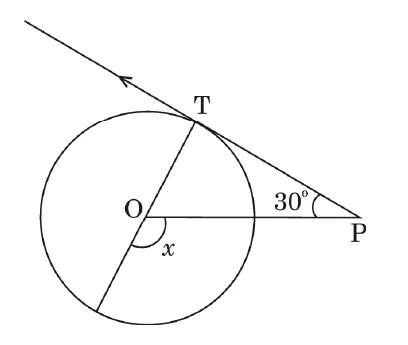
In the adjoining figure, PTPT is a tangent at TT to the circle with centre OO. If ∠TPO=30∘\angle TPO = 30^\circ, find the value of xx.

A circle with centre O and a tangent drawn from P on the right touching it at T at the top, with the angle at P marked 30 degrees. A line through T and O continues to the other side of the circle and the angle x is marked at O below.
Solution
120°OPTU30°60°∠OTP = 90°, ∠TOP = 60°, x = 180° − 60° = 120°
  1. OT⊥PTOT \perp PT (the radius is perpendicular to the tangent), so ∠OTP=90∘\angle OTP = 90^\circ.
  2. In △OTP\triangle OTP: ∠TOP=180∘−90∘−30∘=60∘\angle TOP = 180^\circ - 90^\circ - 30^\circ = 60^\circ.
  3. The line through TT and OO is straight, so x=180∘−60∘=120∘x = 180^\circ - 60^\circ = 120^\circ.

Answer: x=120∘x = 120^\circ

Report an error on this question
Q25Triangles2 marks

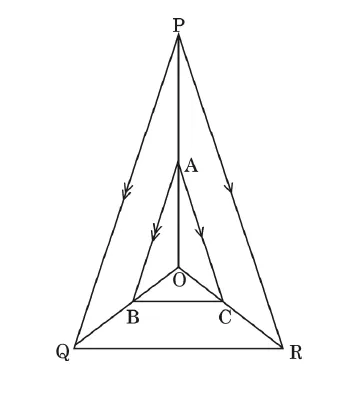
In the adjoining figure, AA, BB and CC are points on OPOP, OQOQ and OROR respectively such that AB∥PQAB \parallel PQ and AC∥PRAC \parallel PR. Show that BC∥QRBC \parallel QR.

A tall triangle PQR with a point O inside it. A, B and C lie on the lines OP, OQ and OR, with arrows showing AB parallel to PQ and AC parallel to PR.
Solution
PQROABCAB ∥ PQ and AC ∥ PR give OA/AP = OB/BQ = OC/CRso BC ∥ QR (converse of the basic proportionality theorem)
  1. In △OPQ\triangle OPQ, AB∥PQAB \parallel PQ, so by the basic proportionality theorem OAAP=OBBQ\dfrac{OA}{AP} = \dfrac{OB}{BQ}. (i)
  2. In △OPR\triangle OPR, AC∥PRAC \parallel PR, so OAAP=OCCR\dfrac{OA}{AP} = \dfrac{OC}{CR}. (ii)
  3. From (i) and (ii): OBBQ=OCCR\dfrac{OB}{BQ} = \dfrac{OC}{CR}. In △OQR\triangle OQR the line BCBC divides OQOQ and OROR in the same ratio, so BC∥QRBC \parallel QR by the converse of the basic proportionality theorem.

Answer: Shown

Report an error on this question

Section C: Short answer

6 questions, 3 marks each.

Q26Polynomials3 marks

Find the zeroes of the quadratic polynomial x2+6x+8x^2 + 6x + 8 and verify the relationship between the zeroes and the coefficients.

Solution
  1. x2+6x+8=(x+4)(x+2)x^2 + 6x + 8 = (x + 4)(x + 2). The zeroes are −4-4 and −2-2.
  2. Sum of zeroes =−4+(−2)=−6=−61=−ba= -4 + (-2) = -6 = -\dfrac{6}{1} = -\dfrac{b}{a} ✓.
  3. Product of zeroes =(−4)(−2)=8=81=ca= (-4)(-2) = 8 = \dfrac{8}{1} = \dfrac{c}{a} ✓.

Answer: Zeroes −4-4 and −2-2; the relations are verified

Report an error on this question
Q27Trigonometry3 marks

Prove that 1+tan⁡2A1+cot⁡2A=sec⁡2A−1\dfrac{1 + \tan^2 A}{1 + \cot^2 A} = \sec^2 A - 1.

Solution
  1. LHS =sec⁡2Acosec⁡2A=1/cos⁡2A1/sin⁡2A=sin⁡2Acos⁡2A= \dfrac{\sec^2 A}{\operatorname{cosec}^2 A} = \dfrac{1/\cos^2 A}{1/\sin^2 A} = \dfrac{\sin^2 A}{\cos^2 A}, using 1+tan⁡2A=sec⁡2A1 + \tan^2 A = \sec^2 A and 1+cot⁡2A=cosec⁡2A1 + \cot^2 A = \operatorname{cosec}^2 A.
  2. sin⁡2Acos⁡2A=1−cos⁡2Acos⁡2A=1cos⁡2A−1=sec⁡2A−1=\dfrac{\sin^2 A}{\cos^2 A} = \dfrac{1 - \cos^2 A}{\cos^2 A} = \dfrac{1}{\cos^2 A} - 1 = \sec^2 A - 1 = RHS.

Answer: Proved

Report an error on this question
Q28Linear Equations3 marks

(A) A lending library has a fixed charge for the first three days and an additional charge for each day thereafter. Rittik paid ₹ 2727 for a book kept for 77 days and Manmohan paid ₹ 2121 for a book kept for 55 days. Find the fixed charges and the charge for each extra day.

OR

(B) Find the values of aa and bb for which the system of linear equations 3x+4y=123x + 4y = 12, (a+b)x+2(a−b)y=24(a + b)x + 2(a - b)y = 24 has infinite number of solutions.

Solution
  1. (A) Let the fixed charge be ₹ xx and the charge per extra day ₹ yy. 77 days has 44 extra days and 55 days has 22 extra days: x+4y=27x + 4y = 27 and x+2y=21x + 2y = 21.
  2. Subtracting: 2y=62y = 6, so y=3y = 3 and x=21−6=15x = 21 - 6 = 15. The fixed charge is ₹ 1515 and each extra day costs ₹ 33.
  3. (B) Infinitely many solutions need 3a+b=42(a−b)=1224=12\dfrac{3}{a + b} = \dfrac{4}{2(a - b)} = \dfrac{12}{24} = \dfrac{1}{2}.
  4. So a+b=6a + b = 6 and 2(a−b)=82(a - b) = 8, that is a−b=4a - b = 4. Adding: 2a=102a = 10, so a=5a = 5 and b=1b = 1.

Answer: (A) fixed ₹ 1515, extra day ₹ 33   (B) a=5a = 5, b=1b = 1

Report an error on this question
Q29Probability3 marks

A die is rolled once. Find the probability of getting: (i) an even prime number (ii) a number greater than 44 (iii) an odd number.

Solution
  1. The sample space is {1,2,3,4,5,6}\{1, 2, 3, 4, 5, 6\}, with 66 equally likely outcomes.
  2. (i) The only even prime is 22: P=16P = \dfrac{1}{6}.
  3. (ii) Numbers greater than 44 are 5,65, 6: P=26=13P = \dfrac{2}{6} = \dfrac{1}{3}.
  4. (iii) Odd numbers are 1,3,51, 3, 5: P=36=12P = \dfrac{3}{6} = \dfrac{1}{2}.

Answer: (i) 16\dfrac{1}{6}   (ii) 13\dfrac{1}{3}   (iii) 12\dfrac{1}{2}

Report an error on this question
Q30Areas Related to Circles3 marks

Find the area of the sector of a circle of radius 77 cm and of central angle 90∘90^\circ. Also, find the area of the corresponding major sector.

Solution
  1. Area of the sector =90360×227×7×7=14×154=772=38.5= \dfrac{90}{360} \times \dfrac{22}{7} \times 7 \times 7 = \dfrac{1}{4} \times 154 = \dfrac{77}{2} = 38.5 cm².
  2. Area of the circle =227×7×7=154= \dfrac{22}{7} \times 7 \times 7 = 154 cm². The major sector is the rest: 154−38.5=115.5154 - 38.5 = 115.5 cm².

Answer: Sector 38.538.5 cm²; major sector 115.5115.5 cm²

Report an error on this question
Q31Circles3 marks

(A) Prove that the lengths of tangents drawn from an external point to a circle are equal.

OR

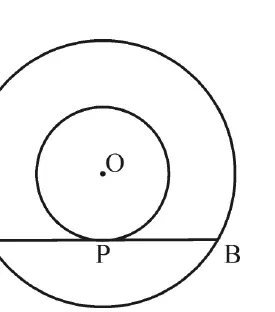
(B) Two concentric circles with centre OO are of radii 33 cm and 55 cm. Find the length of chord ABAB of the larger circle which touches the smaller circle at PP.

Two concentric circles with centre O, radii 3 and 5. A chord AB of the big circle touches the small circle at P directly below O.
Solution
OPAB35AP² = 5² − 3² = 16, AP = 4 = PB, so AB = 8 cm
  1. (A) **Given:** a circle with centre OO and tangents PQPQ, PRPR from the external point PP. **To prove:** PQ=PRPQ = PR. **Construction:** join OPOP, OQOQ, OROR.
  2. In △OPQ\triangle OPQ and △OPR\triangle OPR: OPOP is common, OQ=OROQ = OR (radii) and ∠OQP=∠ORP=90∘\angle OQP = \angle ORP = 90^\circ (radius and tangent). So △OPQ≅△OPR\triangle OPQ \cong \triangle OPR (RHS) and PQ=PRPQ = PR by CPCT.
  3. (B) Join OAOA and OPOP. ABAB touches the small circle at PP, so OP⊥ABOP \perp AB. The perpendicular from the centre bisects the chord: AP=PBAP = PB.
  4. In the right triangle OPAOPA: AP2=OA2−OP2=25−9=16AP^2 = OA^2 - OP^2 = 25 - 9 = 16, so AP=4AP = 4 cm and AB=8AB = 8 cm.

Answer: (A) proved   (B) AB=8AB = 8 cm

Report an error on this question

Section D: Long answer

4 questions, 5 marks each.

Q32Trigonometry5 marks

(A) The shadow of a tower standing on a level ground is found to be 4040 m longer when the Sun's altitude is 30∘30^\circ than when it was 60∘60^\circ. Find the height of the tower.

OR

(B) From the top of a 77 m high building, the angle of elevation of the top of a cable tower is 60∘60^\circ and the angle of depression of its foot is 45∘45^\circ. Determine the height of the tower.

Solution
60°30°ABCDh = 20√3 mx = 2040 mh = x√3 and √3h = x + 40 → x = 20, h = 20√3 ≈ 34.6 m
60°PBQEC7 mx = 745°tan 45° = 7/x → x = 7tan 60° = h/x → h = 7√3tower = 7 + 7√3 m
  1. (A) Let the tower be AB=hAB = h, the shadow at 60∘60^\circ be BC=xBC = x and the longer shadow be BD=x+40BD = x + 40. In △ABC\triangle ABC, tan⁡60∘=hx\tan 60^\circ = \dfrac{h}{x}, so h=3xh = \sqrt{3}x.
  2. In △ABD\triangle ABD, tan⁡30∘=hx+40\tan 30^\circ = \dfrac{h}{x + 40}, so x+40=3h=3xx + 40 = \sqrt{3}h = 3x. Hence 2x=402x = 40, x=20x = 20 m and h=203≈34.6h = 20\sqrt{3} \approx 34.6 m.
  3. (B) Let the building be PB=7PB = 7 m, the distance to the tower foot PQ=xPQ = x and the tower height above the level of BB be hh. In the right triangle at the foot, tan⁡45∘=7x\tan 45^\circ = \dfrac{7}{x}, so x=7x = 7 m.
  4. tan⁡60∘=hx\tan 60^\circ = \dfrac{h}{x} gives h=73h = 7\sqrt{3} m. The tower stands 77 m (up to the level of BB) plus hh above the ground: 7+73=7(1+3)≈19.17 + 7\sqrt{3} = 7(1 + \sqrt{3}) \approx 19.1 m.

Answer: (A) 203≈34.620\sqrt{3} \approx 34.6 m   (B) 7(1+3)≈19.17(1 + \sqrt{3}) \approx 19.1 m

Report an error on this question
Q33Arithmetic Progressions5 marks

(A) Find the sum of the first 2525 terms of the A.P. whose nthn^{\text{th}} term is given by an=5+6na_n = 5 + 6n. Also, find the ratio of 20th20^{\text{th}} term to 45th45^{\text{th}} term.

OR

(B) In an A.P., if Sn=3n2+5nS_n = 3n^2 + 5n and ak=164a_k = 164, find the value of kk.

Solution
  1. (A) a1=5+6=11a_1 = 5 + 6 = 11 and a2=5+12=17a_2 = 5 + 12 = 17, so d=6d = 6.
  2. S25=252[2(11)+24×6]=252(22+144)=252×166=2075S_{25} = \dfrac{25}{2}[2(11) + 24 \times 6] = \dfrac{25}{2}(22 + 144) = \dfrac{25}{2} \times 166 = 2075.
  3. a20a45=5+1205+270=125275=511\dfrac{a_{20}}{a_{45}} = \dfrac{5 + 120}{5 + 270} = \dfrac{125}{275} = \dfrac{5}{11}, a ratio of 5:115 : 11.
  4. (B) a1=S1=3+5=8a_1 = S_1 = 3 + 5 = 8 and S2=12+10=22S_2 = 12 + 10 = 22, so a2=22−8=14a_2 = 22 - 8 = 14 and d=14−8=6d = 14 - 8 = 6.
  5. ak=8+(k−1)×6=164a_k = 8 + (k - 1) \times 6 = 164 gives (k−1)×6=156(k - 1) \times 6 = 156, so k−1=26k - 1 = 26 and k=27k = 27.

Answer: (A) S25=2075S_{25} = 2075, ratio 5:115 : 11   (B) k=27k = 27

Report an error on this question
Q34Statistics5 marks

The following table gives the monthly consumption of electricity of 100 families:

Find the median of the above data.

Monthly consumption (in units)130–140140–150150–160160–170170–180180–190190–200
Number of families59172824107
Solution
  1. Cumulative frequencies: 5,14,31,59,83,93,1005, 14, 31, 59, 83, 93, 100. N=100N = 100 and N2=50\dfrac{N}{2} = 50.
  2. The first cumulative frequency above 5050 is 5959, so the median class is 160−170160 - 170 with l=160l = 160, cf=31cf = 31, f=28f = 28, h=10h = 10.
  3. Median =160+50−3128×10=160+19028≈160+6.8=166.8= 160 + \dfrac{50 - 31}{28} \times 10 = 160 + \dfrac{190}{28} \approx 160 + 6.8 = 166.8 units.

Answer: Median ≈166.8\approx 166.8 units

Report an error on this question
Q35Surface Areas and Volumes5 marks

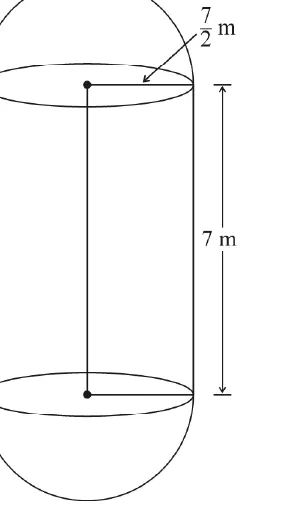
The boilers are used in thermal power plants to store water and then used to produce steam. One such boiler consists of a cylindrical part in middle and two hemispherical parts at its both ends.

Length of the cylindrical part is 77 m and radius of cylindrical part is 72\dfrac{7}{2} m. Find the total surface area and the volume of the boiler. Also, find the ratio of the volume of cylindrical part to the volume of one hemispherical part.

A boiler drawn as a cylinder with a hemisphere on each end. The length of the cylinder is marked 7 m and the radius 7 over 2 m.
Solution
  1. h=7h = 7 m and r=72r = \dfrac{7}{2} m. The two hemispheres together make a sphere.
  2. Total surface area =2πrh+4πr2=2πr(h+2r)=2×227×72×(7+7)=22×14=308= 2\pi r h + 4\pi r^2 = 2\pi r(h + 2r) = 2 \times \dfrac{22}{7} \times \dfrac{7}{2} \times (7 + 7) = 22 \times 14 = 308 m².
  3. Volume =πr2h+43πr3=227×494×7+43×227×3438=5392+5393=26956≈449.17= \pi r^2 h + \dfrac{4}{3}\pi r^3 = \dfrac{22}{7} \times \dfrac{49}{4} \times 7 + \dfrac{4}{3} \times \dfrac{22}{7} \times \dfrac{343}{8} = \dfrac{539}{2} + \dfrac{539}{3} = \dfrac{2695}{6} \approx 449.17 m³.
  4. Ratio of the cylinder to one hemisphere =πr2h23πr3=3h2r=217=3:1= \dfrac{\pi r^2 h}{\frac{2}{3}\pi r^3} = \dfrac{3h}{2r} = \dfrac{21}{7} = 3 : 1.

Answer: Surface area 308308 m²; volume 26956≈449.17\dfrac{2695}{6} \approx 449.17 m³; ratio 3:13 : 1

Report an error on this question

Section E: Case studies

3 case studies, 4 marks each.

Q36Coordinate Geometry4 marks

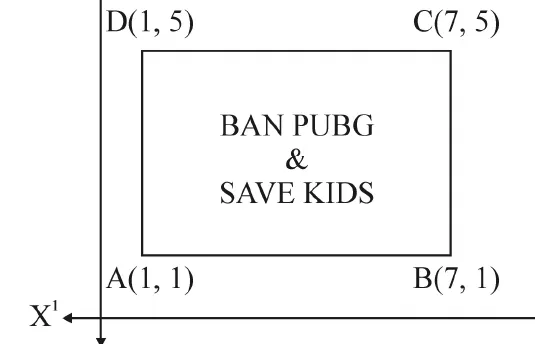
Case study 1. Use of mobile screen for long hours makes your eye sight weak and give you headaches. Children who are addicted to play “PUBG” can get easily stressed out. To raise social awareness about ill effects of playing PUBG, a school decided to start “BAN PUBG” campaign, in which students are asked to prepare campaign board in the shape of a rectangle. One such campaign board made by class X student of the school is shown in the figure, with A(1,1)A(1, 1), B(7,1)B(7, 1), C(7,5)C(7, 5) and D(1,5)D(1, 5).

Based on the above information, answer the following questions:

(i) Find the coordinates of the point of intersection of diagonals ACAC and BDBD. [1]

(ii) Find the length of the diagonal ACAC. [1]

(iii)(a) Find the area of the campaign Board ABCDABCD. [2]

OR

(iii)(b) Find the ratio of the length of side ABAB to the length of the diagonal ACAC. [2]

A rectangle on coordinate axes labelled BAN PUBG and SAVE KIDS with the corners A at 1 comma 1, B at 7 comma 1, C at 7 comma 5 and D at 1 comma 5.
Solution
12345678123456OxyA(1, 1)B(7, 1)C(7, 5)D(1, 5)(4, 3)
  1. (i) The diagonals of a rectangle bisect each other, so the point is the midpoint of ACAC: (1+72,1+52)=(4,3)\left(\dfrac{1 + 7}{2}, \dfrac{1 + 5}{2}\right) = (4, 3).
  2. (ii) AC=(7−1)2+(5−1)2=36+16=52=213AC = \sqrt{(7 - 1)^2 + (5 - 1)^2} = \sqrt{36 + 16} = \sqrt{52} = 2\sqrt{13}.
  3. (iii)(a) AB=(7−1)2+0=6AB = \sqrt{(7 - 1)^2 + 0} = 6 and BC=0+(5−1)2=4BC = \sqrt{0 + (5 - 1)^2} = 4. Area =6×4=24= 6 \times 4 = 24 square units.
  4. (iii)(b) ABAC=6213=313\dfrac{AB}{AC} = \dfrac{6}{2\sqrt{13}} = \dfrac{3}{\sqrt{13}}, a ratio of 3:133 : \sqrt{13}.

Answer: (i) (4,3)(4, 3)   (ii) 2132\sqrt{13}   (iii) 2424 square units (OR) 3:133 : \sqrt{13}

Report an error on this question
Q37Real Numbers4 marks

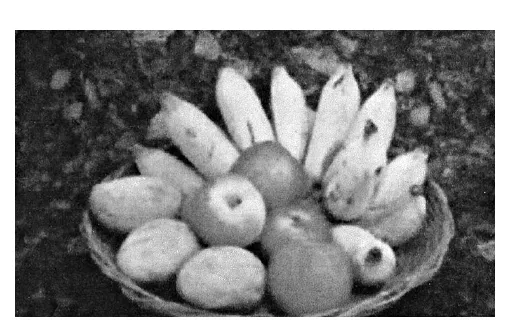
Case study 2. Khushi wants to organize her birthday party. Being health conscious, she decided to serve only fruits in her birthday party. She bought 36 apples and 60 bananas and decided to distribute fruits equally among all.

Based on the above information, answer the following questions:

(i) How many guests Khushi can invite at the most? [1]

(ii) How many apples and bananas will each guest get? [1]

(iii)(a) If Khushi decides to add 42 mangoes, how many guests Khushi can invite at the most? [2]

OR

(iii)(b) If the cost of 1 dozen of bananas is ₹ 60, the cost of 1 apple is ₹ 15 and cost of 1 mango is ₹ 20, find the total amount spent on 60 bananas, 36 apples and 42 mangoes. [2]

A grey-scale photograph of a basket full of apples, bananas and mangoes.
Solution
  1. (i) The fruits are shared equally, so the number of guests divides both 3636 and 6060. 36=22×3236 = 2^2 \times 3^2 and 60=22×3×560 = 2^2 \times 3 \times 5, so HCF =12= 12. At most 1212 guests.
  2. (ii) Each guest gets 36÷12=336 \div 12 = 3 apples and 60÷12=560 \div 12 = 5 bananas.
  3. (iii)(a) 42=2×3×742 = 2 \times 3 \times 7, so HCF(36,60,42)=2×3=6(36, 60, 42) = 2 \times 3 = 6. At most 66 guests.
  4. (iii)(b) A dozen bananas cost ₹ 6060, so 6060 bananas =5= 5 dozen =5×60=300= 5 \times 60 = 300. Apples: 36×15=54036 \times 15 = 540. Mangoes: 42×20=84042 \times 20 = 840. Total =300+540+840=₹ 1680= 300 + 540 + 840 = ₹\,1680.

Answer: (i) 1212   (ii) 33 apples, 55 bananas   (iii) 66 guests (OR) ₹ 16801680

Report an error on this question
Q38Triangles4 marks

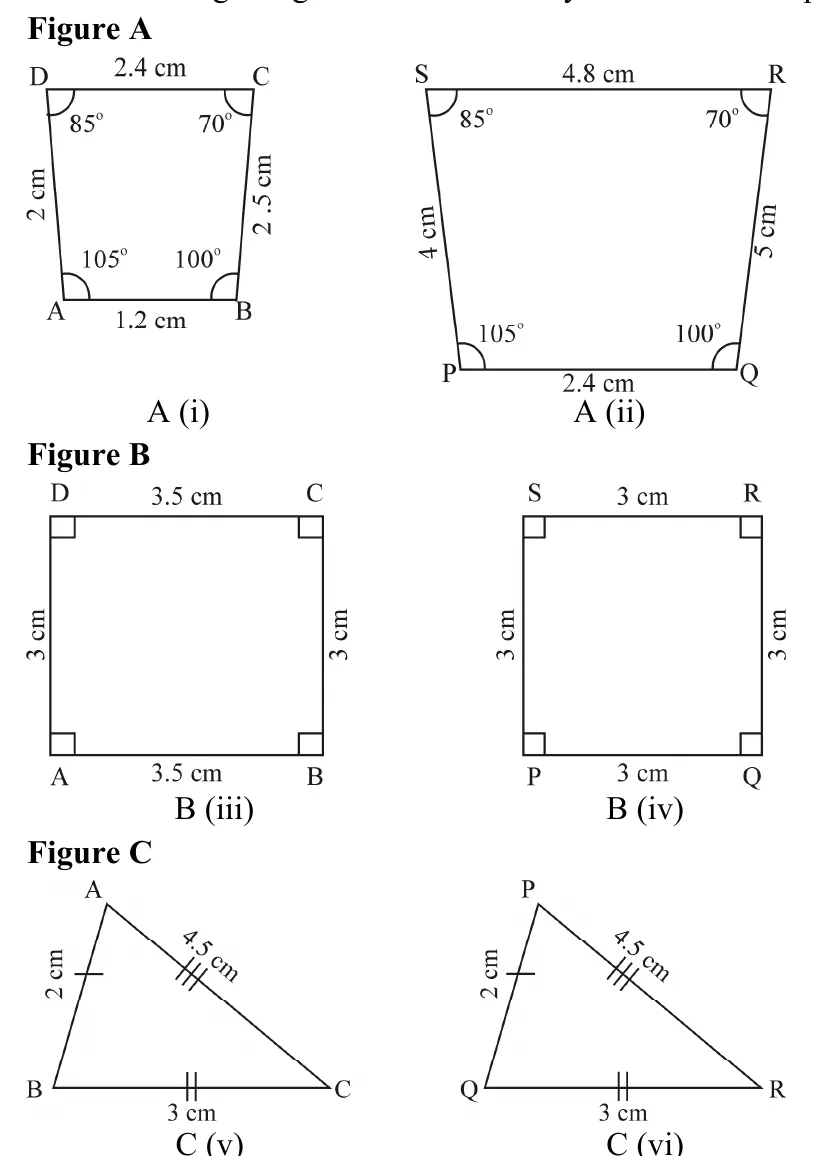
Case study 3. Observe the figures given below carefully and answer the questions: Figure A shows the pair of quadrilaterals A(i) and A(ii), Figure B shows the pair of squares B(iii) with side 3.5 cm and B(iv) with side 3 cm, and Figure C shows the pair of triangles C(v) and C(vi), each with sides 2 cm, 3 cm and 4.5 cm.

(i) Name the figure(s) wherein two figures are similar. [1]

(ii) Name the figure(s) wherein the figures are congruent. [1]

(iii)(a) Prove that congruent triangles are also similar but not the converse. [2]

OR

(iii)(b) What more is least needed for two similar triangles to be congruent? [2]

Three pairs of figures. Figure A: two quadrilaterals with the same angles, 85, 70, 105 and 100 degrees, the second with double the sides. Figure B: two squares, one of side 3.5 cm and one of side 3 cm. Figure C: two triangles with sides 2 cm, 3 cm and 4.5 cm.
Solution
  1. (i) In Figure A the angles match (85∘,70∘,105∘,100∘85^\circ, 70^\circ, 105^\circ, 100^\circ) and every side of A(ii) is twice the matching side of A(i) (1.2→2.41.2 \to 2.4, 2→42 \to 4, 2.4→4.82.4 \to 4.8, 2.5→52.5 \to 5), so the figures are similar. In Figure C the triangles are identical, so they are similar as well. The CBSE key gives **Figure A and Figure C**. (Strictly, any two squares are similar, so B(iii) and B(iv) also qualify, but the key does not list B.)
  2. (ii) Congruent figures are identical in size and shape. Only Figure C, with equal sides 2,3,4.52, 3, 4.5 in both triangles, is congruent (SSS).
  3. (iii)(a) If two triangles are congruent, their corresponding angles are equal, so by AA they are similar. The converse fails: similar triangles have sides in the same ratio, and that ratio need not be 11. For example, a triangle with sides 3,4,53, 4, 5 and one with sides 6,8,106, 8, 10 are similar but not congruent.
  4. (iii)(b) One pair of corresponding sides must be equal (then the ratio of similarity is 11 and the triangles are congruent).

Answer: (i) Figures A and C (as per the key)   (ii) Figure C   (iii) proved (OR) one pair of corresponding sides equal

Report an error on this question

Questions are from the official CBSE paper. Figures are described in words; see the PDF for the originals. Solutions are written by CogniGuru.

Revise this paper in 1 minute a chapter

Each chapter below is what the paper tested, with a one-minute animated lesson on the idea behind it.

Stuck on a step in any solution?

The CogniGuru AI tutor explains any doubt one minute at a time, in English or Hindi. Join the waitlist.

Mock quiz: 5 questions from this paper

Five real questions from this paper, one each from five chapters. About 2 minutes. See how much you know and where you stand among other students. Attempt free, with no login; log in only for your ranking and full report.

Question 1 of 5 · Q1 of the paperPolynomials

A quadratic polynomial the sum and product of whose zeroes are −3-3 and 22 respectively, is:

0 of 5 answered

Related papers

Common questions

Are these the official CBSE Class 10 Maths Basic 2023 questions?
Yes. The questions are from the official Mathematics (Basic) paper (set 430/4/1) that CBSE published after the March 2023 board exam. The solutions are written by CogniGuru and checked against the answer key CBSE published for this paper code.
Can I download the CBSE Class 10 Maths Basic 2023 question paper PDF?
Yes, the official paper PDF is free to download from this page, and so are our step-by-step solutions as a PDF. No login is needed to download either or to read the solutions.
Do all sets of the paper have the same questions?
No. CBSE sets several versions of each paper, with the same blueprint and similar questions in a different order and sometimes with different numbers. This page covers set 430/4/1.
How does the quiz work, and what does “where you stand” mean?
It is a mock quiz of 5 real multiple-choice questions from this paper, scored automatically in about 2 minutes. Your score is compared, anonymously, with other students who took the same quiz. Only the score is stored with the comparison, never your name or number.

Source

CBSE question paper archive, Class X, 2023 (Mathematics (Basic), set 430/4/1)
PDF