
Q1Arithmetic Progressions1 mark
The term of an A.P. is and its term is . The common difference of this A.P. is:
- (A)3
- (B)2
- (C)5
- (D)−2
The official board paper (Q.P. Code 430/5/1, Series WX1YZ/5). Free paper PDF and step-by-step solutions (also as a PDF to download) written by CogniGuru and checked against CBSE’s answer key. See the paper’s main topics in 1 minute, then quiz yourself to see how much you know and where you stand.
No login to download or read the solutions. Login only to see your quiz report in full.
Three pages of the official paper. Download the PDF for all 23.
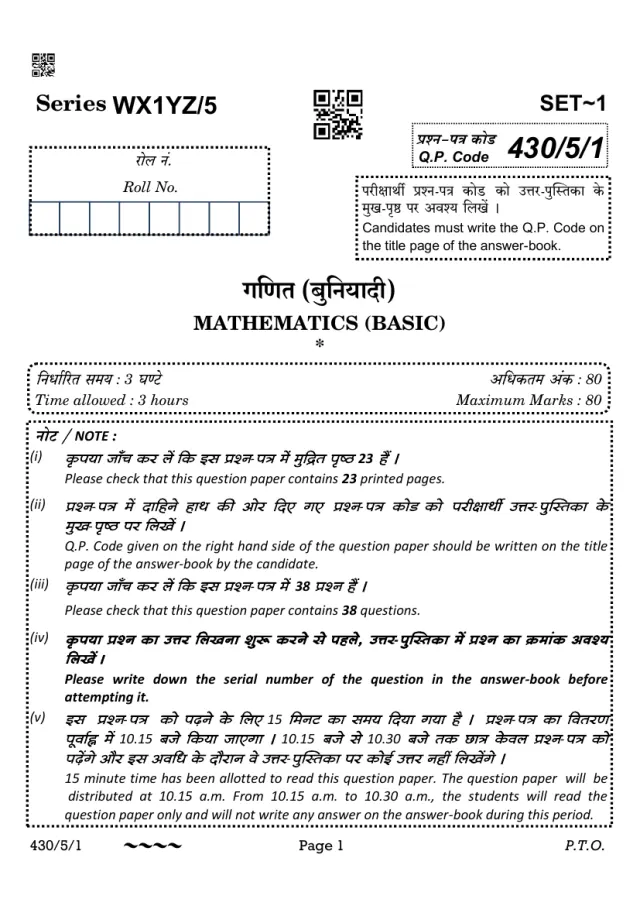
Cover page
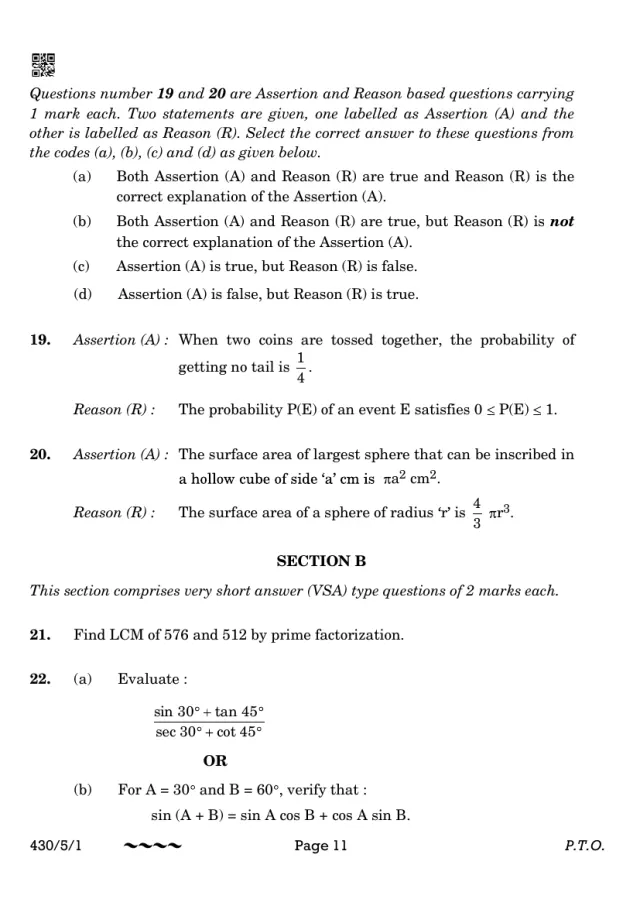
Section B
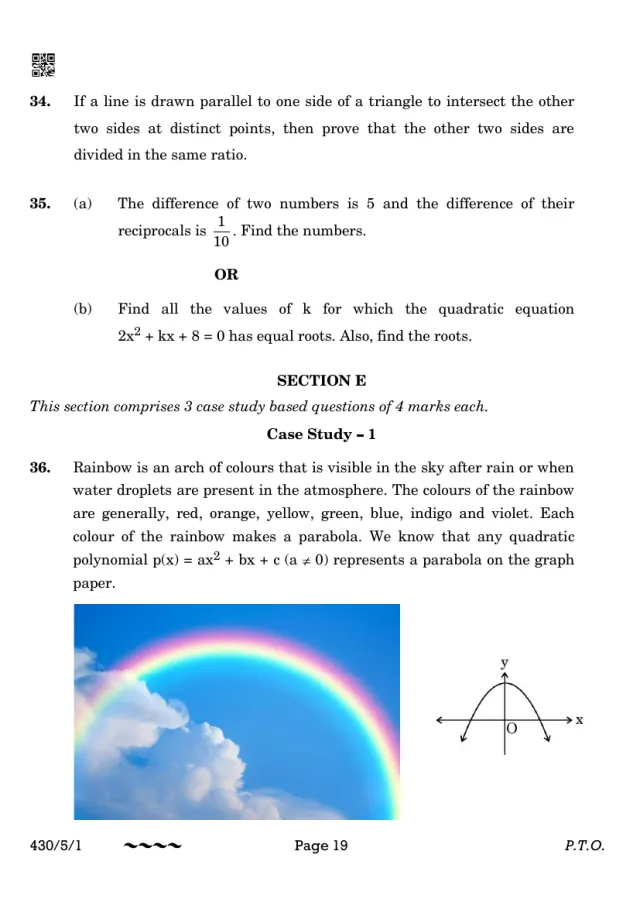
Case study
Your tutor walks you through the paper before you attempt it: the marks, the key ideas, the time plan and the traps.

1-minute paper analysis
With your tutor, in her voice
A short, animated walk through the paper: how it is built, where the marks come from, the four ideas that matter most, how to plan your three hours, and the traps to avoid.
Sound on for the voice. Captions are shown, and you can mute any time.
Try each question first, then open its solution. Tap a number to jump.
20 questions, 1 mark each. MCQs (Q1 to Q18) and assertion-reason (Q19, Q20).
The term of an A.P. is and its term is . The common difference of this A.P. is:
In the given figure, is the centre of a circle, is a chord and the tangent at makes an angle of with . The measure of is:
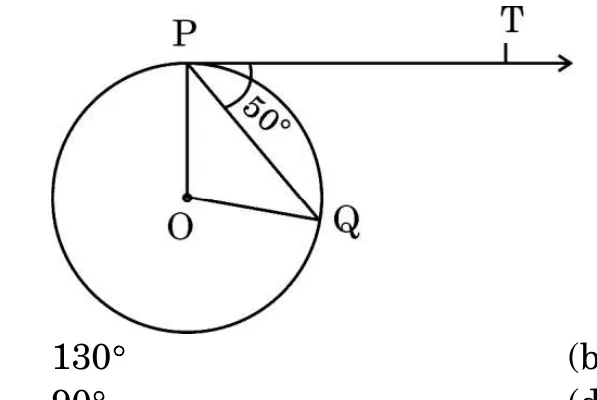
One card is drawn at random from a well shuffled deck of 52 playing cards. What is the probability of getting ‘4 of hearts’?
The distance between the points and is:
The value(s) of for which the roots of the quadratic equation are real, is:
LCM of and is:
If one zero of the quadratic polynomial is , then the value of is:
If the lines represented by the equations and are parallel, then the value of is:
Answer: (D)
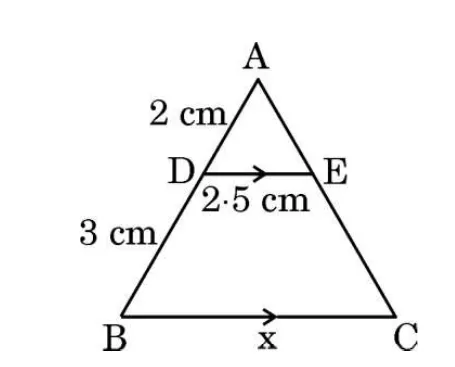
Report an error on this questionand their perimeters are cm and cm respectively. If cm, then equals:
Answer: (B) 7.5 cm
Report an error on this questionThe two roots of the equation are:
Answer: (C) real and equal
Report an error on this questionIf , then is equal to :
Answer: (B)
Report an error on this questionThe sum of the first 100 even natural numbers is:
In the given figure, cm, cm, cm and . The value of is:
A circle is of radius cm. The distance between two of its parallel tangents is:
Answer: (B) 6 cm
Report an error on this questionThe median class for the data given below is:
| Class | 20–40 | 40–60 | 60–80 | 80–100 | 100–120 |
|---|---|---|---|---|---|
| Frequency | 10 | 12 | 14 | 13 | 17 |
Answer: (D) 60 – 80
Report an error on this questionIf , then equals:
In two triangles and , it is given that . For these two triangles to be similar, which of the following should be true?
Answer: (C)
Report an error on this questionMean and median of some data are and respectively. Using the empirical relation, the mode of the data is:
Assertion (A): When two coins are tossed together, the probability of getting no tail is .
Reason (R): The probability of an event satisfies .
Answer: (B) Both A and R are true, but R is not the correct explanation of A
Report an error on this questionAssertion (A): The surface area of the largest sphere that can be inscribed in a hollow cube of side cm is cm².
Reason (R): The surface area of a sphere of radius is .
Answer: (C) A is true, but R is false
Report an error on this question5 questions, 2 marks each.
Find LCM of 576 and 512 by prime factorization.
(a) Evaluate:
OR
(b) For and , verify that .
Answer: (a) (b) verified
Report an error on this questionIn the given figure, tangents and are drawn to a circle centred at . If and cm, find lengths and .
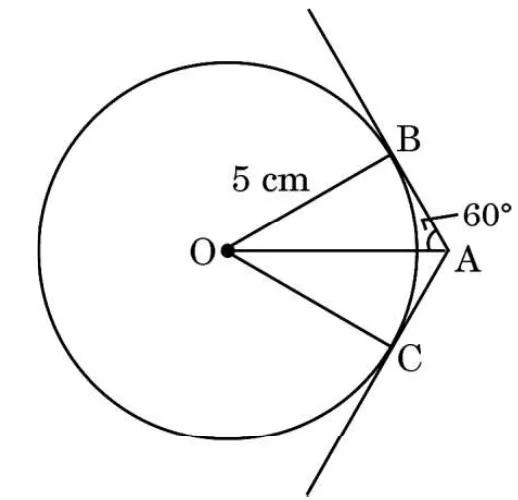
Answer: cm, cm
Report an error on this question(a) Show that , , and are vertices of a parallelogram .
OR
(b) Show that the points , and are vertices of a right-angled triangle.
Answer: (a) a parallelogram (b) right-angled at
Report an error on this questionFind the sum of the first terms of the A.P.:
6 questions, 3 marks each.
(a) Sabina went to a bank ATM to withdraw ₹ . She received ₹ and ₹ notes only. If Sabina got notes in all, how many notes of ₹ and ₹ did she receive?
OR
(b) Five years ago, Amit was thrice as old as Baljeet. Ten years hence, Amit shall be twice as old as Baljeet. What are their present ages?
Answer: (a) notes of ₹ , of ₹ (b) Amit years, Baljeet years
Report an error on this questionProve that is an irrational number, given that is an irrational number.
Answer: Proved
Report an error on this questionFind mean of the following data:
| Class | 0–15 | 15–30 | 30–45 | 45–60 | 60–75 | 75–90 |
|---|---|---|---|---|---|---|
| Frequency | 12 | 15 | 11 | 20 | 16 | 6 |
(a) Determine the ratio in which the point divides the line segment joining and . Also, find the value of .
OR
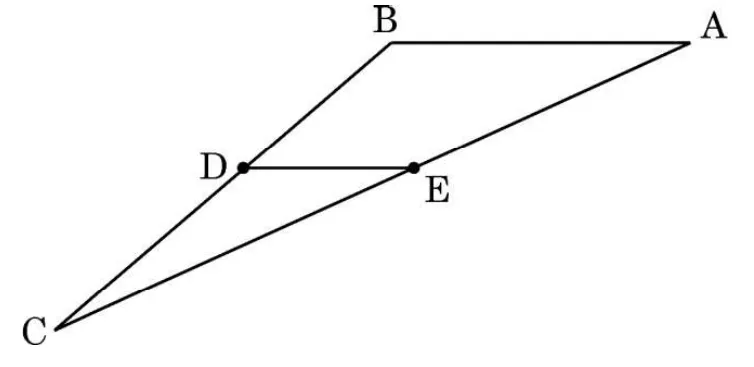
(b) In the given figure, in points and are mid-points of sides and respectively. If given vertices are , and , then verify the result .
Answer: (a) ratio , (b) verified
Report an error on this questionProve that: .
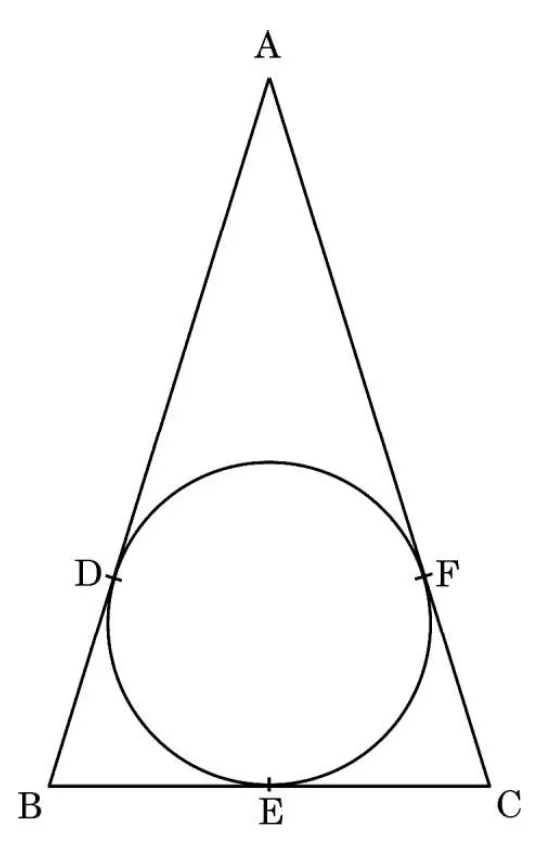
is an isosceles triangle with , circumscribed about a circle. Prove that is bisected at .
Answer: Proved
Report an error on this question4 questions, 5 marks each.
A person walking m towards a tower in a horizontal line through its base observes that angle of elevation of the top of the tower changes from to . Find the height of the tower and distance of the person, now, from the tower. (Use )
Answer: Height m; distance now m
Report an error on this question(a) In the given figure, is a chord of a circle of radius cm and centred at . Find the area of the shaded region if . Also, find length of minor arc .
OR
(b) and are arcs of two concentric circles of radii cm and cm respectively and centred at . Find the area of the shaded region if . Also, find the length of arc .
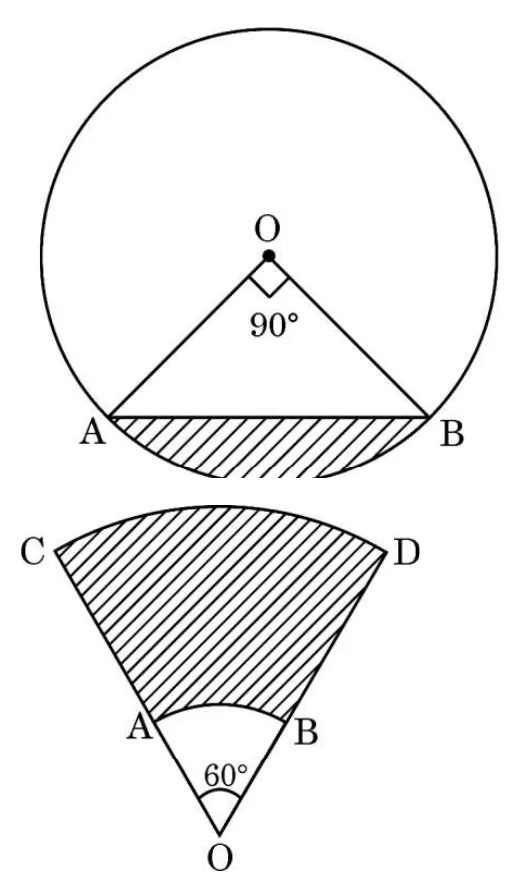
Answer: (a) cm², arc cm (b) cm², arc cm
Report an error on this questionIf a line is drawn parallel to one side of a triangle to intersect the other two sides at distinct points, then prove that the other two sides are divided in the same ratio.
Answer: Proved (basic proportionality theorem)
Report an error on this question(a) The difference of two numbers is and the difference of their reciprocals is . Find the numbers.
OR
(b) Find all the values of for which the quadratic equation has equal roots. Also, find the roots.
Answer: (a) or (b) , ; ,
Report an error on this question3 case studies, 4 marks each.
Case study 1. Rainbow is an arch of colours that is visible in the sky after rain or when water droplets are present in the atmosphere. The colours of the rainbow are generally red, orange, yellow, green, blue, indigo and violet. Each colour of the rainbow makes a parabola. We know that any quadratic polynomial represents a parabola on the graph paper.
Based on the above, answer the following questions:
(i) The graph of a rainbow is shown in the figure. Write the number of zeroes of the curve. [1]
(ii) If the graph of a rainbow does not intersect the -axis but intersects the -axis at one point, then how many zeroes will it have? [1]
(iii)(a) If a rainbow is represented by the quadratic polynomial , whose zeroes are and , find the value of and . [2]
OR
(iii)(b) The polynomial represents a rainbow. If is a zero of it, find the value of . [2]
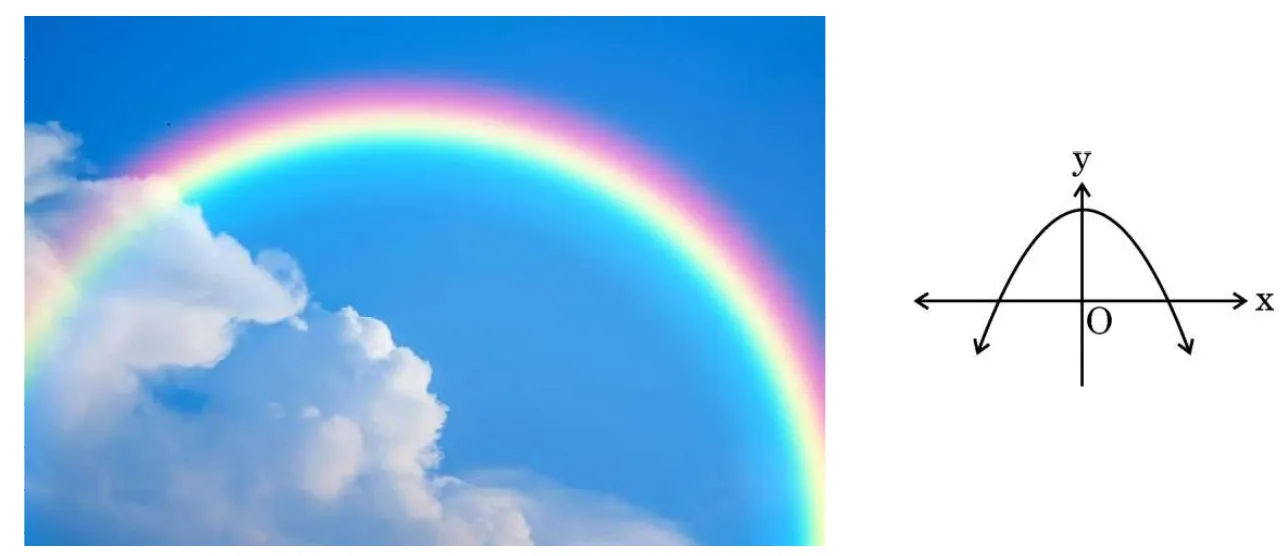
Answer: (i) (ii) (iii) , (OR)
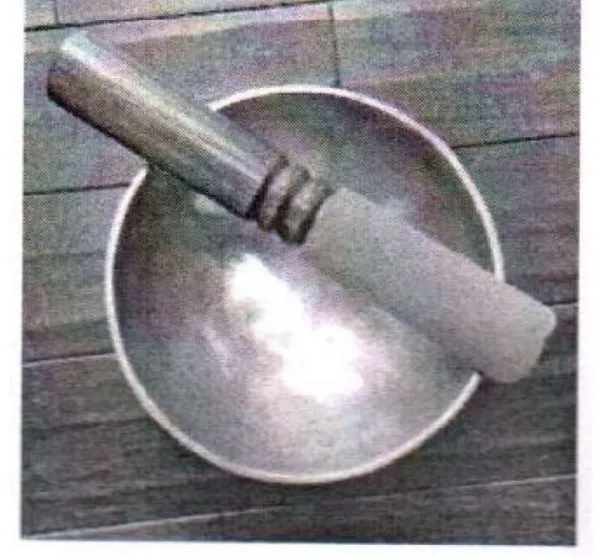
Report an error on this questionCase study 2. Singing bowls (hemispherical in shape) are commonly used in sound healing practices. Mallet (cylindrical in shape) is used to strike the bowl in a sequence to produce sound and vibration. One such bowl is shown here whose dimensions are: the hemispherical bowl has outer radius cm and inner radius cm. The mallet has height cm and radius cm.
Based on the above, answer the following questions:
(i) What is the volume of the material used in making the mallet? [1]
(ii) The bowl is to be polished from inside. Find the inner surface area of the bowl. [1]
(iii)(a) Find the volume of metal used to make the bowl. [2]
OR
(iii)(b) Find the total surface area of the mallet. (Use ) [2]
Answer: (i) cm³ (ii) cm² (iii) cm³ (OR) cm²
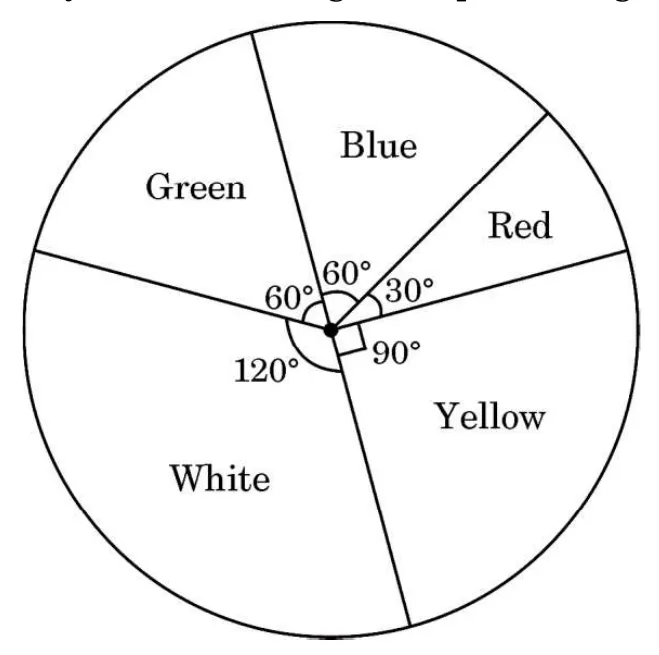
Report an error on this questionCase study 3. Some students were asked to list their favourite colour. The measure of each colour is shown by the central angle of a pie chart: red , blue , green , white and yellow .
Study the pie chart and answer the following questions:
(i) If a student is chosen at random, then find the probability of his/her favourite colour being white. [1]
(ii) What is the probability of his/her favourite colour being blue or green? [1]
(iii)(a) If students liked the colour yellow, how many students participated in the survey? [2]
OR
(iii)(b) What is the probability of the favourite colour being red or blue? [2]
Answer: (i) (ii) (iii) students (OR)
Report an error on this questionQuestions are from the official CBSE paper. Figures are described in words; see the PDF for the originals. Solutions are written by CogniGuru.
Each chapter below is what the paper tested, with a one-minute animated lesson on the idea behind it.
Trigonometry
Q11, Q16, Q22, Q30, Q32 (12 marks): standard values and the identity sin² + cos² = 1.
How to remember trig values at 0°, 30°, 45°, 60°, 90° — Class 10Triangles
Q9, Q13, Q17, Q34 (8 marks): similarity criteria, matching angles by sides, and the Basic Proportionality Theorem.
Why are two equal angles enough to prove triangles similar (AA)? — Class 10Congruence vs Similarity — why equal angles alone prove nothingCircles
Q2, Q14, Q23, Q31 (7 marks): a tangent is perpendicular to the radius, and tangents from one point are equal.
Why is a tangent perpendicular to the radius? — Class 10Quadratic Equations
Q5, Q10, Q35 (7 marks): the discriminant, standard form and solving by factorising.
Why does a quadratic have at most two real roots? — Class 10Probability
Q3, Q19, Q38 (6 marks): favourable outcomes over total outcomes, and sure events.
Why is probability always between 0 and 1? — Class 10Coordinate Geometry
Q4, Q24, Q29 (6 marks): the distance, mid-point and section formulas.
Why is the distance formula just Pythagoras? — Class 10Midpoint Formula vs Section Formula — Class 10Real Numbers
Q6, Q21, Q27 (6 marks): HCF and LCM, rational and irrational numbers, and proofs of irrationality.
Rational vs Irrational Numbers — is 22/7 actually equal to π?Why is √2 irrational? The proof — Class 10Polynomials
Q7, Q36 (5 marks): zeroes, their sum and product, and reading zeroes from a graph.
Why is the sum of zeroes −b/a and the product c/a? — Class 10Statistics
Q15, Q18, Q28 (5 marks): mean, median and mode of grouped data.
Mean vs Median vs Mode — why one outlier can lie to youArithmetic Progressions
Q1, Q12, Q25 (4 marks): the nth term and the sum of n terms.
Arithmetic vs Geometric Progression — why doubling always wins eventuallyLinear Equations
Q8, Q26 (4 marks): solving a pair of equations, graphing it, and when a pair is consistent.
When do two linear equations have no solution? — Class 10Stuck on a step in any solution?
The CogniGuru AI tutor explains any doubt one minute at a time, in English or Hindi. Join the waitlist.
Five real questions from this paper, one each from five chapters. About 2 minutes. See how much you know and where you stand among other students. Attempt free, with no login; log in only for your ranking and full report.
The term of an A.P. is and its term is . The common difference of this A.P. is:
0 of 5 answered