CBSE · Class 10 · Mathematics (Basic) · Free

CBSE Class 10 Maths Basic 2023 Question Paper (Set 430/6/1) with Solutions

The official board paper (Q.P. Code 430/6/1, Series WX1YZ/6). Free paper PDF and step-by-step solutions (also as a PDF to download) written by CogniGuru and checked against CBSE’s answer key. See the paper’s main topics in 1 minute, then quiz yourself to see how much you know and where you stand.

No login to download or read the solutions. Login only to see your quiz report in full.

Board
CBSE
Class
10
Subject
Maths Basic (241)
Year
2023
Set code
430/6/1
Max marks
80
Duration
3 hours
Questions
38 (Sections A to E)
Source
Official CBSE paper
Exam date
March 2023

Paper preview

Three pages of the official paper. Download the PDF for all 24.

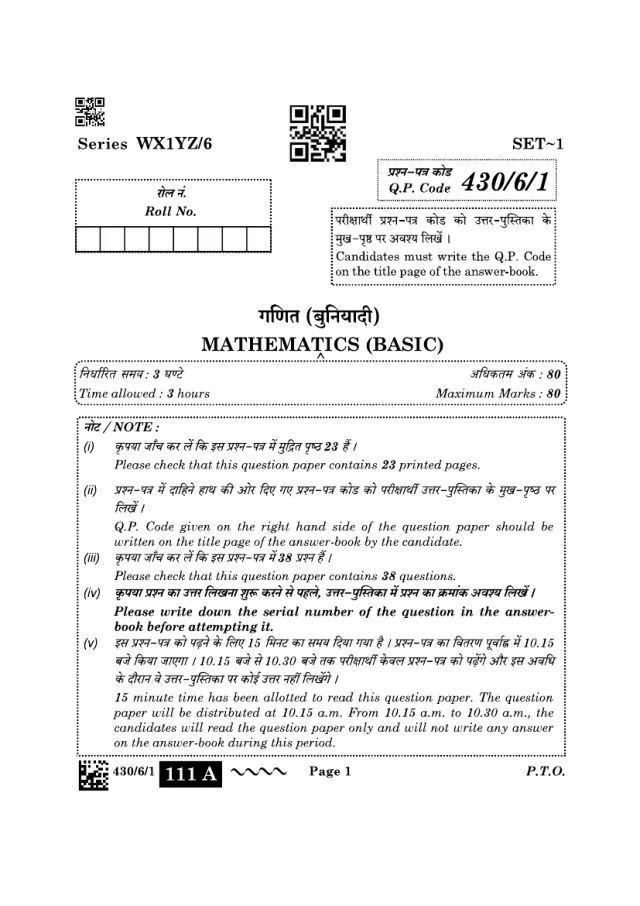
  • Cover page of the CBSE Class 10 Maths Basic 2023 paper, set 430/6/1

    Cover page

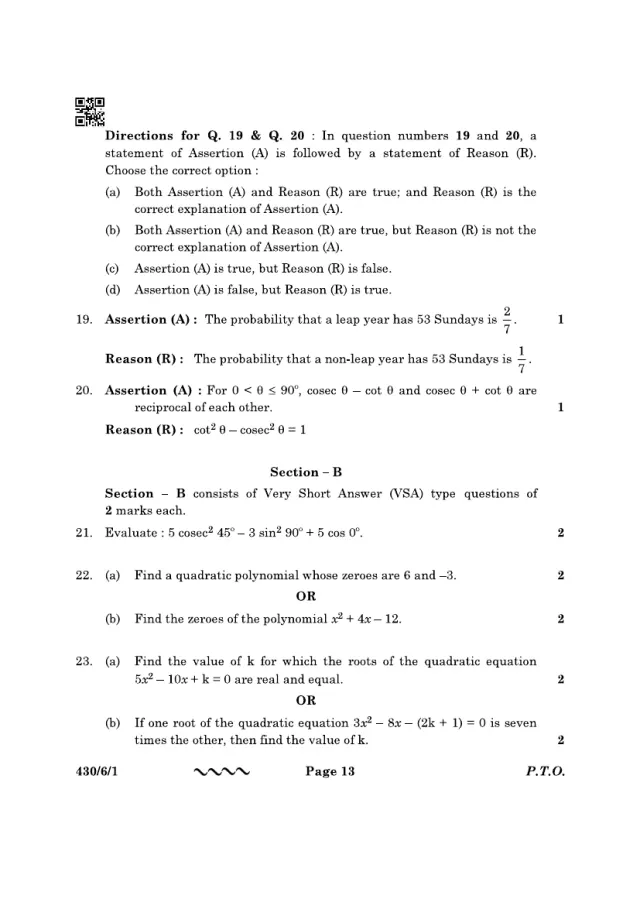
  • Section B of the CBSE Class 10 Maths Basic 2023 paper, set 430/6/1

    Section B

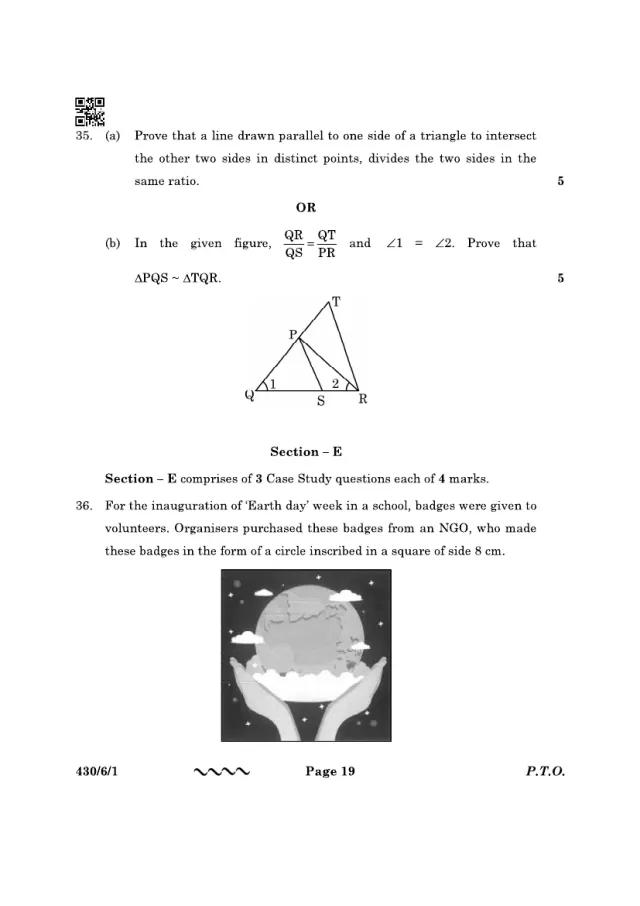
  • A case study with its figure from the CBSE Class 10 Maths Basic 2023 paper, set 430/6/1

    Case study

The main topics of this paper, in 1 minute

Your tutor walks you through the paper before you attempt it: the marks, the key ideas, the time plan and the traps.

1-minute paper analysis

With your tutor, in her voice

The main topics of this paper, in about a minute

A short, animated walk through the paper: how it is built, where the marks come from, the four ideas that matter most, how to plan your three hours, and the traps to avoid.

  1. 1The paper at a glance
  2. 2Where the marks come from
  3. 3Four ideas that keep paying off
  4. 4Plan your three hours
  5. 5Four traps to avoid

Sound on for the voice. Captions are shown, and you can mute any time.

Step-by-step solutions

Try each question first, then open its solution. Tap a number to jump.

Download solutions (PDF)

Section A: Multiple choice

20 questions, 1 mark each. MCQs (Q1 to Q18) and assertion-reason (Q19, Q20).

Q1Statistics1 mark

The time, in seconds, taken by 150 athletes to run a 100 m hurdle race are tabulated below:

The number of athletes who completed the race in less than 17 seconds is:

Time (sec.)13–1414–1515–1616–1717–1818–19
Number of Athletes245714820
  1. (A)11
  2. (B)71
  3. (C)82
  4. (D)68
Solution · answer (C)
  1. Athletes who took less than 1717 seconds are those in the classes up to 16−1716 - 17: 2+4+5+71=822 + 4 + 5 + 71 = 82. (This is the cumulative frequency at 1717.)

Answer: (C) 82

Report an error on this question
Q2Coordinate Geometry1 mark

The distance of the point (5,0)(5, 0) from the origin is:

  1. (A)0
  2. (B)5
  3. (C)5\sqrt{5}
  4. (D)525^2
Solution · answer (B)
  1. d=52+02=5d = \sqrt{5^2 + 0^2} = 5.

Answer: (B) 5

Report an error on this question
Q3Trigonometry1 mark

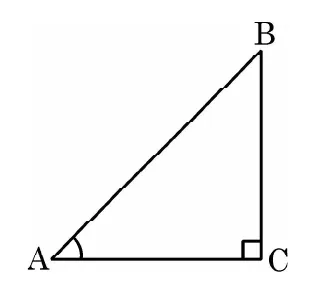
In △ABC\triangle ABC, right angled at CC, if tan⁡A=87\tan A = \dfrac{8}{7}, then the value of cot⁡B\cot B is:

A right triangle ABC with the right angle at C, A at the bottom left, C at the bottom right and B directly above C.
  1. (A)78\dfrac{7}{8}
  2. (B)87\dfrac{8}{7}
  3. (C)7113\dfrac{7}{\sqrt{113}}
  4. (D)8113\dfrac{8}{\sqrt{113}}
Solution · answer (B)
ACBBC = 8AC = 7cot B = adjacent/opposite = BC/AC = 8/7 = tan A
  1. tan⁡A=BCAC=87\tan A = \dfrac{BC}{AC} = \dfrac{8}{7}. At BB the side next to the angle is BCBC and the opposite side is ACAC, so cot⁡B=BCAC=87\cot B = \dfrac{BC}{AC} = \dfrac{8}{7}. (In general cot⁡B=tan⁡(90∘−B)=tan⁡A\cot B = \tan(90^\circ - B) = \tan A.)

Answer: (B) 87\dfrac{8}{7}

Report an error on this question
Q4Areas Related to Circles1 mark

Area of a quadrant of a circle of radius 77 cm is:

  1. (A)154154 cm²
  2. (B)7777 cm²
  3. (C)772\dfrac{77}{2} cm²
  4. (D)774\dfrac{77}{4} cm²
Solution · answer (C)
  1. 14πr2=14×227×49=1544=772\dfrac{1}{4}\pi r^2 = \dfrac{1}{4} \times \dfrac{22}{7} \times 49 = \dfrac{154}{4} = \dfrac{77}{2} cm².

Answer: (C) 772\dfrac{77}{2} cm²

Report an error on this question
Q5Real Numbers1 mark

If HCF (72,120)=24(72, 120) = 24, then LCM (72,120)(72, 120) is:

  1. (A)72
  2. (B)120
  3. (C)360
  4. (D)9640
Solution · answer (C)
  1. LCM =72×12024=3×120=360= \dfrac{72 \times 120}{24} = 3 \times 120 = 360.

Answer: (C) 360

Report an error on this question
Q6Probability1 mark

One card is drawn at random from a well-shuffled deck of 52 playing cards. What is the probability of getting a black king?

  1. (A)126\dfrac{1}{26}
  2. (B)113\dfrac{1}{13}
  3. (C)152\dfrac{1}{52}
  4. (D)12\dfrac{1}{2}
Solution · answer (A)
  1. There are 22 black kings (spades and clubs): P=252=126P = \dfrac{2}{52} = \dfrac{1}{26}.

Answer: (A) 126\dfrac{1}{26}

Report an error on this question
Q7Polynomials1 mark

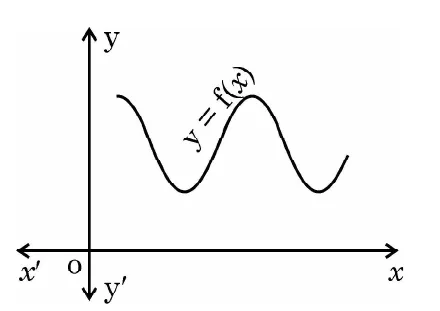
The graph of y=f(x)y = f(x) is shown in the figure for some polynomial f(x)f(x). The number of zeroes of f(x)f(x) is:

A wavy curve with two dips and a peak between them, drawn entirely above the x-axis so that it never meets it.
  1. (A)0
  2. (B)2
  3. (C)3
  4. (D)4
Solution · answer (A)
  1. The zeroes are the points where the graph meets the xx-axis. This curve lies completely above the axis and never touches it, so there are 00 zeroes.

Answer: (A) 0

Report an error on this question
Q8Linear Equations1 mark

The value of kk, if (6,k)(6, k) lies on the line represented by x−3y+6=0x - 3y + 6 = 0, is:

  1. (A)−4
  2. (B)12
  3. (C)−12
  4. (D)4
Solution · answer (D)
  1. Put x=6x = 6, y=ky = k: 6−3k+6=06 - 3k + 6 = 0, so 3k=123k = 12 and k=4k = 4.

Answer: (D) 4

Report an error on this question
Q9Real Numbers1 mark

The prime factorisation of the number 23042304 is:

  1. (A)28×322^8 \times 3^2
  2. (B)27×332^7 \times 3^3
  3. (C)28×312^8 \times 3^1
  4. (D)27×322^7 \times 3^2
Solution · answer (A)
  1. 2304=2×1152=22×576=23×288=24×144=28×9=28×322304 = 2 \times 1152 = 2^2 \times 576 = 2^3 \times 288 = 2^4 \times 144 = 2^8 \times 9 = 2^8 \times 3^2. (Check: 256×9=2304256 \times 9 = 2304 ✓.)

Answer: (A) 28×322^8 \times 3^2

Report an error on this question
Q10Real Numbers1 mark

If nn is a natural number, then 8n8^n cannot end with digit:

  1. (A)0
  2. (B)2
  3. (C)4
  4. (D)6
Solution · answer (A)
  1. 8n=23n8^n = 2^{3n} has only the prime factor 22. To end in 00 a number needs both 22 and 55 as factors, so 8n8^n never ends in 00. (Its last digits go 8,4,2,68, 4, 2, 6, repeating.)

Answer: (A) 0

Report an error on this question
Q11Statistics1 mark

The median of the first seven prime numbers is:

  1. (A)5
  2. (B)7
  3. (C)11
  4. (D)13
Solution · answer (B)
  1. The first seven primes are 2,3,5,7,11,13,172, 3, 5, 7, 11, 13, 17. The middle (fourth) value is 77.

Answer: (B) 7

Report an error on this question
Q12Coordinate Geometry1 mark

If (2,4)(2, 4) is the mid-point of the line-segment joining (6,3)(6, 3) and (a,5)(a, 5), then the value of aa is:

  1. (A)2
  2. (B)4
  3. (C)−4
  4. (D)−2
Solution · answer (D)
  1. 6+a2=2\dfrac{6 + a}{2} = 2 gives 6+a=46 + a = 4, so a=−2a = -2. (The yy-coordinate: 3+52=4\dfrac{3 + 5}{2} = 4 ✓.)

Answer: (D) −2

Report an error on this question
Q13Linear Equations1 mark

The value of kk for which the system of equations kx+2y=5kx + 2y = 5 and 3x+4y=13x + 4y = 1 have no solution, is:

  1. (A)k=32k = \dfrac{3}{2}
  2. (B)k≠32k \neq \dfrac{3}{2}
  3. (C)k≠23k \neq \dfrac{2}{3}
  4. (D)k=15k = 15
Solution · answer (A)
  1. No solution means parallel lines: k3=24≠51\dfrac{k}{3} = \dfrac{2}{4} \neq \dfrac{5}{1}. So k=32k = \dfrac{3}{2}, and the constants ratio 55 differs from 12\dfrac{1}{2} as needed.

Answer: (A) k=32k = \dfrac{3}{2}

Report an error on this question
Q14Circles1 mark

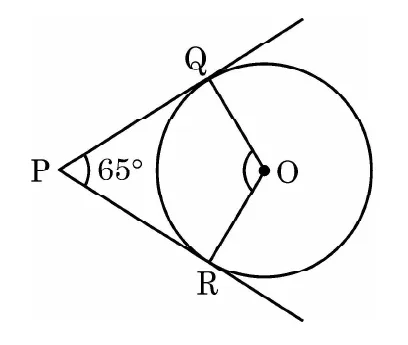
In the given figure, PQPQ and PRPR are tangents drawn from PP to the circle with centre OO such that ∠QPR=65∘\angle QPR = 65^\circ. The measure of ∠QOR\angle QOR is:

A circle with centre O and two tangents drawn from the outside point P on the left touching it at Q above and R below, with the angle at P marked 65 degrees.
  1. (A)65∘65^\circ
  2. (B)125∘125^\circ
  3. (C)115∘115^\circ
  4. (D)90∘90^\circ
Solution · answer (C)
OPQR65°115°∠OQP = ∠ORP = 90°, so ∠QOR = 360° − 90° − 90° − 65° = 115°
  1. OQ⊥PQOQ \perp PQ and OR⊥PROR \perp PR. In quadrilateral OQPROQPR: ∠QOR=360∘−90∘−90∘−65∘=115∘\angle QOR = 360^\circ - 90^\circ - 90^\circ - 65^\circ = 115^\circ.

Answer: (C) 115∘115^\circ

Report an error on this question
Q15Polynomials1 mark

The zeroes of the quadratic polynomial 16x2−916x^2 - 9 are:

  1. (A)34,34\dfrac{3}{4}, \dfrac{3}{4}
  2. (B)−34,34-\dfrac{3}{4}, \dfrac{3}{4}
  3. (C)916,916\dfrac{9}{16}, \dfrac{9}{16}
  4. (D)−34,−34-\dfrac{3}{4}, -\dfrac{3}{4}
Solution · answer (B)
  1. 16x2−9=(4x−3)(4x+3)=016x^2 - 9 = (4x - 3)(4x + 3) = 0, so x=34x = \dfrac{3}{4} or x=−34x = -\dfrac{3}{4}.

Answer: (B) −34,34-\dfrac{3}{4}, \dfrac{3}{4}

Report an error on this question
Q16Arithmetic Progressions1 mark

If −5,x,3-5, x, 3 are three consecutive terms of an A.P., then the value of xx is:

  1. (A)−2
  2. (B)2
  3. (C)1
  4. (D)−1
Solution · answer (D)
  1. The middle term is the average of its neighbours: x=−5+32=−1x = \dfrac{-5 + 3}{2} = -1.

Answer: (D) −1

Report an error on this question
Q17Probability1 mark

An unbiased die is thrown. The probability of getting an odd prime number is:

  1. (A)16\dfrac{1}{6}
  2. (B)12\dfrac{1}{2}
  3. (C)23\dfrac{2}{3}
  4. (D)13\dfrac{1}{3}
Solution · answer (D)
  1. The odd primes on a die are 33 and 55 (the number 22 is an even prime): P=26=13P = \dfrac{2}{6} = \dfrac{1}{3}.

Answer: (D) 13\dfrac{1}{3}

Report an error on this question
Q18Statistics1 mark

If the mean of 6,7,x,8,y,146, 7, x, 8, y, 14 is 99, then:

  1. (A)x+y=21x + y = 21
  2. (B)x+y=19x + y = 19
  3. (C)x−y=19x - y = 19
  4. (D)x−y=21x - y = 21
Solution · answer (B)
  1. The sum of the six numbers is 6×9=546 \times 9 = 54. So 6+7+x+8+y+14=546 + 7 + x + 8 + y + 14 = 54, that is 35+x+y=5435 + x + y = 54 and x+y=19x + y = 19.

Answer: (B) x+y=19x + y = 19

Report an error on this question
Q19Probability1 mark

Assertion (A): The probability that a leap year has 5353 Sundays is 27\dfrac{2}{7}.

Reason (R): The probability that a non-leap year has 5353 Sundays is 17\dfrac{1}{7}.

  1. (A)Both A and R are true and R is the correct explanation of A
  2. (B)Both A and R are true, but R is not the correct explanation of A
  3. (C)A is true, but R is false
  4. (D)A is false, but R is true
Solution · answer (B)
  1. (A) A leap year has 366=52×7+2366 = 52 \times 7 + 2 days, so there are two extra days. 5353 Sundays needs one of them to be a Sunday, which happens in 22 of the 77 equally likely pairs: P=27P = \dfrac{2}{7}. True.
  2. (R) A non-leap year has 365=52×7+1365 = 52 \times 7 + 1 days, so one extra day is a Sunday with P=17P = \dfrac{1}{7}. True. But the non-leap year result does not explain the leap year one.

Answer: (B) Both A and R are true, but R is not the correct explanation of A

Report an error on this question
Q20Trigonometry1 mark

Assertion (A): For 0<θ≤90∘0 < \theta \leq 90^\circ, cosec⁡θ−cot⁡θ\operatorname{cosec}\theta - \cot\theta and cosec⁡θ+cot⁡θ\operatorname{cosec}\theta + \cot\theta are reciprocal of each other.

Reason (R): cot⁡2θ−cosec⁡2θ=1\cot^2\theta - \operatorname{cosec}^2\theta = 1.

  1. (A)Both A and R are true and R is the correct explanation of A
  2. (B)Both A and R are true, but R is not the correct explanation of A
  3. (C)A is true, but R is false
  4. (D)A is false, but R is true
Solution · answer (C)
  1. (A) (cosec⁡θ−cot⁡θ)(cosec⁡θ+cot⁡θ)=cosec⁡2θ−cot⁡2θ=1(\operatorname{cosec}\theta - \cot\theta)(\operatorname{cosec}\theta + \cot\theta) = \operatorname{cosec}^2\theta - \cot^2\theta = 1, so they are reciprocals. True.
  2. (R) The correct identity is cosec⁡2θ−cot⁡2θ=1\operatorname{cosec}^2\theta - \cot^2\theta = 1, so cot⁡2θ−cosec⁡2θ=−1\cot^2\theta - \operatorname{cosec}^2\theta = -1. False.

Answer: (C) A is true, but R is false

Report an error on this question

Section B: Very short answer

5 questions, 2 marks each.

Q21Trigonometry2 marks

Evaluate: 5cosec⁡245∘−3sin⁡290∘+5cos⁡0∘5\operatorname{cosec}^2 45^\circ - 3\sin^2 90^\circ + 5\cos 0^\circ.

Solution
  1. 5(2)2−3(1)2+5(1)=10−3+5=125(\sqrt{2})^2 - 3(1)^2 + 5(1) = 10 - 3 + 5 = 12.

Answer: 1212

Report an error on this question
Q22Polynomials2 marks

(a) Find a quadratic polynomial whose zeroes are 66 and −3-3.

OR

(b) Find the zeroes of the polynomial x2+4x−12x^2 + 4x - 12.

Solution
  1. (a) Sum of zeroes =6+(−3)=3= 6 + (-3) = 3 and product =6×(−3)=−18= 6 \times (-3) = -18. The polynomial is x2−3x−18x^2 - 3x - 18 (or any non-zero multiple of it).
  2. (b) x2+4x−12=(x+6)(x−2)x^2 + 4x - 12 = (x + 6)(x - 2), so the zeroes are x=−6x = -6 and x=2x = 2.

Answer: (a) x2−3x−18x^2 - 3x - 18   (b) −6-6 and 22

Report an error on this question
Q23Quadratic Equations2 marks

(a) Find the value of kk for which the roots of the quadratic equation 5x2−10x+k=05x^2 - 10x + k = 0 are real and equal.

OR

(b) If one root of the quadratic equation 3x2−8x−(2k+1)=03x^2 - 8x - (2k + 1) = 0 is seven times the other, then find the value of kk.

Solution
  1. (a) a=5a = 5, b=−10b = -10, c=kc = k. Equal roots need D=0D = 0: 100−20k=0100 - 20k = 0, so k=5k = 5.
  2. (b) Let the roots be α\alpha and 7α7\alpha. Sum: 8α=838\alpha = \dfrac{8}{3}, so α=13\alpha = \dfrac{1}{3}. Product: 7α2=−2k+137\alpha^2 = -\dfrac{2k + 1}{3}, so 79=−2k+13\dfrac{7}{9} = -\dfrac{2k + 1}{3}.
  3. 2k+1=−732k + 1 = -\dfrac{7}{3}, so 2k=−1032k = -\dfrac{10}{3} and k=−53k = -\dfrac{5}{3}.

Answer: (a) k=5k = 5   (b) k=−53k = -\dfrac{5}{3}

Report an error on this question
Q24Probability2 marks

A box contains 20 discs which are numbered from 1 to 20. If one disc is drawn at random from the box, then find the probability that the number on the drawn disc is a (i) 2-digit number (ii) number less than 10.

Solution
  1. There are 2020 equally likely discs.
  2. (i) The 22-digit numbers are 1010 to 2020, that is 1111 numbers: P=1120P = \dfrac{11}{20}.
  3. (ii) Numbers less than 1010 are 11 to 99, that is 99 numbers: P=920P = \dfrac{9}{20}.

Answer: (i) 1120\dfrac{11}{20}   (ii) 920\dfrac{9}{20}

Report an error on this question
Q25Circles2 marks

From a point P, the length of the tangent to a circle is 24 cm and the distance of P from the centre of the circle is 25 cm. Find the radius of the circle.

Solution
OPT2425r² = OP² − PT² = 25² − 24² = 49, r = 7 cm
  1. The radius to the point of contact is perpendicular to the tangent, so OP2=OT2+PT2OP^2 = OT^2 + PT^2.
  2. r2=252−242=625−576=49r^2 = 25^2 - 24^2 = 625 - 576 = 49, so r=7r = 7 cm.

Answer: 77 cm

Report an error on this question

Section C: Short answer

6 questions, 3 marks each.

Q26Quadratic Equations3 marks

The sum of the reciprocals of Varun's age (in years) 33 years ago and 55 years from now is 13\dfrac{1}{3}. Find his present age.

Solution
  1. Let Varun's present age be xx years. 1x−3+1x+5=13\dfrac{1}{x - 3} + \dfrac{1}{x + 5} = \dfrac{1}{3} gives 2x+2(x−3)(x+5)=13\dfrac{2x + 2}{(x - 3)(x + 5)} = \dfrac{1}{3}.
  2. Cross-multiplying: 6x+6=x2+2x−156x + 6 = x^2 + 2x - 15, so x2−4x−21=0x^2 - 4x - 21 = 0 and (x−7)(x+3)=0(x - 7)(x + 3) = 0.
  3. x=7x = 7 or x=−3x = -3. An age cannot be negative, so Varun is 77 years old. (Check: 14+112=412=13\dfrac{1}{4} + \dfrac{1}{12} = \dfrac{4}{12} = \dfrac{1}{3} ✓.)

Answer: 77 years

Report an error on this question
Q27Statistics3 marks

A survey conducted on 20 households in a locality by a group of students resulted in the following frequency table for the number of family members in a household:

Find the median of this data.

Family size1–33–55–77–99–11
Number of Families78221
Solution
  1. Cumulative frequencies: 7,15,17,19,207, 15, 17, 19, 20. N=20N = 20 and N2=10\dfrac{N}{2} = 10, which lies in the class 3−53 - 5.
  2. l=3l = 3, cf=7cf = 7, f=8f = 8, h=2h = 2. Median =3+10−78×2=3+34=3.75= 3 + \dfrac{10 - 7}{8} \times 2 = 3 + \dfrac{3}{4} = 3.75.

Answer: Median =3.75= 3.75

Report an error on this question
Q28Triangles3 marks

(a) EE is a point on the side ADAD produced of a parallelogram ABCDABCD and BEBE intersects CDCD at FF. Show that △ABE∼△CFB\triangle ABE \sim \triangle CFB.

OR

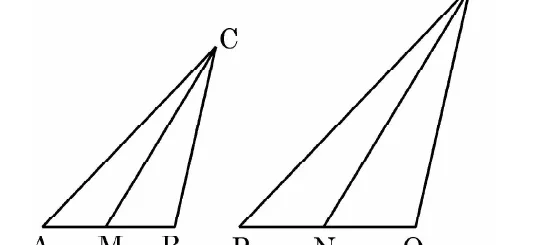
(b) In the given figure, CMCM and RNRN are respectively the medians of △ABC\triangle ABC and △PQR\triangle PQR. If △ABC∼△PQR\triangle ABC \sim \triangle PQR, then prove that △AMC∼△PNR\triangle AMC \sim \triangle PNR.

Two triangles ABC and PQR drawn side by side. In each, a median goes from the top vertex, C in the first and R in the second, to a mid-point on the base, M on AB and N on PQ.
Solution
  1. (a) In △ABE\triangle ABE and △CFB\triangle CFB: ∠A=∠C\angle A = \angle C (opposite angles of a parallelogram) and ∠AEB=∠CBF\angle AEB = \angle CBF (alternate interior angles, since AE∥BCAE \parallel BC with transversal BEBE).
  2. So △ABE∼△CFB\triangle ABE \sim \triangle CFB by AA similarity.
  3. (b) △ABC∼△PQR\triangle ABC \sim \triangle PQR gives ABPQ=ACPR\dfrac{AB}{PQ} = \dfrac{AC}{PR}. Since CMCM and RNRN are medians, AB=2AMAB = 2AM and PQ=2PNPQ = 2PN, so 2AM2PN=ACPR\dfrac{2AM}{2PN} = \dfrac{AC}{PR}, that is AMPN=ACPR\dfrac{AM}{PN} = \dfrac{AC}{PR}.
  4. Also ∠A=∠P\angle A = \angle P (similar triangles). By SAS similarity, △AMC∼△PNR\triangle AMC \sim \triangle PNR.

Answer: Proved (both parts)

Report an error on this question
Q29Coordinate Geometry3 marks

Find the co-ordinates of the points of trisection of the line-segment joining the points (5,3)(5, 3) and (4,5)(4, 5).

Solution
23456723456OxyA(5, 3)B(4, 5)C(14/3, 11/3)D(13/3, 13/3)
  1. Let A(5,3)A(5, 3), B(4,5)B(4, 5), and let CC and DD trisect ABAB. CC divides ABAB in the ratio 1:21 : 2: C=(1×4+2×53,1×5+2×33)=(143,113)C = \left(\dfrac{1 \times 4 + 2 \times 5}{3}, \dfrac{1 \times 5 + 2 \times 3}{3}\right) = \left(\dfrac{14}{3}, \dfrac{11}{3}\right).
  2. DD divides ABAB in the ratio 2:12 : 1: D=(2×4+1×53,2×5+1×33)=(133,133)D = \left(\dfrac{2 \times 4 + 1 \times 5}{3}, \dfrac{2 \times 5 + 1 \times 3}{3}\right) = \left(\dfrac{13}{3}, \dfrac{13}{3}\right).

Answer: (143,113)\left(\dfrac{14}{3}, \dfrac{11}{3}\right) and (133,133)\left(\dfrac{13}{3}, \dfrac{13}{3}\right)

Report an error on this question
Q30Real Numbers3 marks

Prove that 3−253 - 2\sqrt{5} is an irrational number, given that 5\sqrt{5} is an irrational number.

Solution
  1. Suppose 3−25=pq3 - 2\sqrt{5} = \dfrac{p}{q} with integers p,qp, q and q≠0q \neq 0. Then 5=3q−p2q\sqrt{5} = \dfrac{3q - p}{2q}.
  2. The right side is rational, but 5\sqrt{5} is irrational. This contradiction shows 3−253 - 2\sqrt{5} is irrational.

Answer: Proved

Report an error on this question
Q31Trigonometry3 marks

(a) Prove that cot⁡A−cos⁡Acot⁡A+cos⁡A=cos⁡2A(1+sin⁡A)2\dfrac{\cot A - \cos A}{\cot A + \cos A} = \dfrac{\cos^2 A}{(1 + \sin A)^2}.

OR

(b) Prove that (sec⁡θ+tan⁡θ)(1−sin⁡θ)=cos⁡θ(\sec\theta + \tan\theta)(1 - \sin\theta) = \cos\theta.

Solution
  1. (a) LHS =cos⁡Asin⁡A−cos⁡Acos⁡Asin⁡A+cos⁡A=cos⁡A (1−sin⁡A)cos⁡A (1+sin⁡A)=1−sin⁡A1+sin⁡A= \dfrac{\frac{\cos A}{\sin A} - \cos A}{\frac{\cos A}{\sin A} + \cos A} = \dfrac{\cos A\,(1 - \sin A)}{\cos A\,(1 + \sin A)} = \dfrac{1 - \sin A}{1 + \sin A}.
  2. Multiply top and bottom by (1+sin⁡A)(1 + \sin A): (1−sin⁡A)(1+sin⁡A)(1+sin⁡A)2=1−sin⁡2A(1+sin⁡A)2=cos⁡2A(1+sin⁡A)2=\dfrac{(1 - \sin A)(1 + \sin A)}{(1 + \sin A)^2} = \dfrac{1 - \sin^2 A}{(1 + \sin A)^2} = \dfrac{\cos^2 A}{(1 + \sin A)^2} = RHS.
  3. (b) LHS =(1cos⁡θ+sin⁡θcos⁡θ)(1−sin⁡θ)=(1+sin⁡θ)(1−sin⁡θ)cos⁡θ=1−sin⁡2θcos⁡θ=cos⁡2θcos⁡θ=cos⁡θ== \left(\dfrac{1}{\cos\theta} + \dfrac{\sin\theta}{\cos\theta}\right)(1 - \sin\theta) = \dfrac{(1 + \sin\theta)(1 - \sin\theta)}{\cos\theta} = \dfrac{1 - \sin^2\theta}{\cos\theta} = \dfrac{\cos^2\theta}{\cos\theta} = \cos\theta = RHS.

Answer: Proved (both parts)

Report an error on this question

Section D: Long answer

4 questions, 5 marks each.

Q32Trigonometry5 marks

(a) From a point on a bridge across a river, the angles of depression of the banks on opposite sides of the river are 30∘30^\circ and 45∘45^\circ respectively. If the bridge is at a height of 33 m from the banks, find the width of the river. (Use 3=1.73\sqrt{3} = 1.73)

OR

(b) From a point on the ground, the angle of elevation of the bottom and top of a transmission tower fixed at the top of a 2020 m high building are 45∘45^\circ and 60∘60^\circ respectively. Find the height of the tower. (Use 3=1.73\sqrt{3} = 1.73)

Solution
30°45°AQBP3 mAQ = 3√3, BQ = 3, so AB = 3(√3 + 1) ≈ 8.19 m
45°60°ADBC20 mh ≈ 14.6 mx = 20√3x = 20 + h → h = 20(√3 − 1)
  1. (a) Let the point on the bridge be PP, directly above QQ on the river with PQ=3PQ = 3 m, and let the banks be AA and BB. In △APQ\triangle APQ, tan⁡30∘=3AQ\tan 30^\circ = \dfrac{3}{AQ}, so AQ=33AQ = 3\sqrt{3} m.
  2. In △PBQ\triangle PBQ, tan⁡45∘=3BQ\tan 45^\circ = \dfrac{3}{BQ}, so BQ=3BQ = 3 m. The width AB=33+3=3(1.73+1)=8.19AB = 3\sqrt{3} + 3 = 3(1.73 + 1) = 8.19 m.
  3. (b) Let the building be BD=20BD = 20 m, the tower BC=hBC = h and the distance AD=xAD = x. In △ABD\triangle ABD, tan⁡45∘=20x\tan 45^\circ = \dfrac{20}{x}, so x=20x = 20 m.
  4. In △ACD\triangle ACD, tan⁡60∘=20+hx\tan 60^\circ = \dfrac{20 + h}{x}, so 3×20=20+h\sqrt{3} \times 20 = 20 + h and h=20(3−1)=20×0.73=14.6h = 20(\sqrt{3} - 1) = 20 \times 0.73 = 14.6 m.

Answer: (a) ≈8.19\approx 8.19 m   (b) 20(3−1)≈14.620(\sqrt{3} - 1) \approx 14.6 m

Report an error on this question
Q33Arithmetic Progressions5 marks

The first term of an A.P. is 2222, the last term is −6-6 and the sum of all the terms is 6464. Find the number of terms of the A.P. Also, find the common difference.

Solution
  1. Sn=n2(a+l)=64S_n = \dfrac{n}{2}(a + l) = 64: n2(22−6)=64\dfrac{n}{2}(22 - 6) = 64, so 8n=648n = 64 and n=8n = 8.
  2. a8=a+7d=−6a_8 = a + 7d = -6: 22+7d=−622 + 7d = -6, so 7d=−287d = -28 and d=−4d = -4. (Check: 22,18,14,10,6,2,−2,−622, 18, 14, 10, 6, 2, -2, -6 sum to 6464 ✓.)

Answer: n=8n = 8, d=−4d = -4

Report an error on this question
Q34Surface Areas and Volumes5 marks

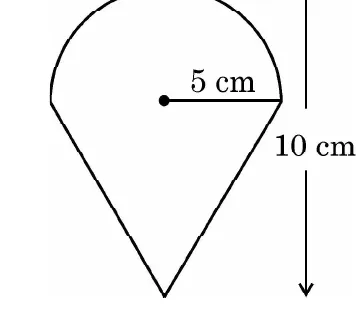
An ice-cream filled cone having radius 55 cm and height 1010 cm is as shown in the figure. Find the volume of the ice-cream in 77 such cones.

An ice-cream cone drawn as a pointed cone with a hemisphere on top. The radius 5 cm is marked from the centre of the flat top and the total height 10 cm is marked beside it.
Solution
Or = 5h = 5one cone = ⅓πr²h + ⅔πr³ = 22 × 25 × 15 / 21 cm³7 cones = 2750 cm³
  1. The ice-cream is a hemisphere of radius 55 cm on top of a cone. The conical part has height 10−5=510 - 5 = 5 cm.
  2. Volume of one ice-cream =13πr2h+23πr3=13πr2(h+2r)=13×227×25×(5+10)=22×25×1521= \dfrac{1}{3}\pi r^2 h + \dfrac{2}{3}\pi r^3 = \dfrac{1}{3}\pi r^2(h + 2r) = \dfrac{1}{3} \times \dfrac{22}{7} \times 25 \times (5 + 10) = \dfrac{22 \times 25 \times 15}{21} cm³.
  3. Seven cones: 7×22×25×1521=22×25×153=27507 \times \dfrac{22 \times 25 \times 15}{21} = \dfrac{22 \times 25 \times 15}{3} = 2750 cm³.

Answer: 27502750 cm³

Report an error on this question
Q35Triangles5 marks

(a) Prove that a line drawn parallel to one side of a triangle to intersect the other two sides in distinct points, divides the two sides in the same ratio.

OR

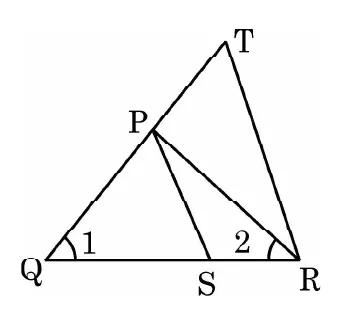
(b) In the given figure, QRQS=QTPR\dfrac{QR}{QS} = \dfrac{QT}{PR} and ∠1=∠2\angle 1 = \angle 2. Prove that △PQS∼△TQR\triangle PQS \sim \triangle TQR.

A triangle with Q at the bottom left, R at the bottom right and T at the top. P is on QT, S is on QR, and PS and PR are drawn, with the angles 1 at Q and 2 at R marked.
Solution
  1. (a) **Given:** in △ABC\triangle ABC, DE∥BCDE \parallel BC with DD on ABAB and EE on ACAC. **To prove:** ADDB=AEEC\dfrac{AD}{DB} = \dfrac{AE}{EC}. **Construction:** join BEBE and CDCD, and draw DM⊥ACDM \perp AC and EN⊥ABEN \perp AB.
  2. ar(ADE)ar(BDE)=12×AD×EN12×DB×EN=ADDB\dfrac{\text{ar}(ADE)}{\text{ar}(BDE)} = \dfrac{\frac{1}{2} \times AD \times EN}{\frac{1}{2} \times DB \times EN} = \dfrac{AD}{DB} (i) and ar(ADE)ar(CDE)=12×AE×DM12×EC×DM=AEEC\dfrac{\text{ar}(ADE)}{\text{ar}(CDE)} = \dfrac{\frac{1}{2} \times AE \times DM}{\frac{1}{2} \times EC \times DM} = \dfrac{AE}{EC} (ii).
  3. △BDE\triangle BDE and △CDE\triangle CDE have the same base DEDE and lie between the parallels DEDE and BCBC, so ar(BDE)=ar(CDE)\text{ar}(BDE) = \text{ar}(CDE) (iii). From (i), (ii), (iii): ADDB=AEEC\dfrac{AD}{DB} = \dfrac{AE}{EC}.
  4. (b) In △PQR\triangle PQR, ∠1=∠2\angle 1 = \angle 2 means PQ=PRPQ = PR (sides opposite equal angles). So QRQS=QTPR\dfrac{QR}{QS} = \dfrac{QT}{PR} becomes QRQS=QTPQ\dfrac{QR}{QS} = \dfrac{QT}{PQ}, that is QSQR=PQQT\dfrac{QS}{QR} = \dfrac{PQ}{QT}.
  5. In △PQS\triangle PQS and △TQR\triangle TQR: ∠Q\angle Q is common and QSQR=PQQT\dfrac{QS}{QR} = \dfrac{PQ}{QT}. By SAS similarity, △PQS∼△TQR\triangle PQS \sim \triangle TQR.

Answer: Proved (both parts)

Report an error on this question

Section E: Case studies

3 case studies, 4 marks each.

Q36Areas Related to Circles4 marks

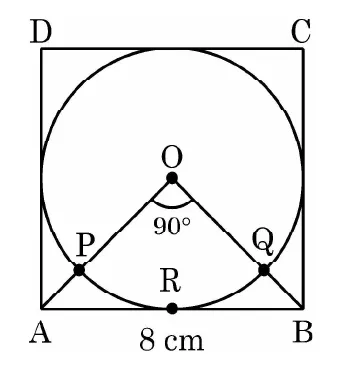
Case study 1. For the inauguration of ‘Earth day’ week in a school, badges were given to volunteers. Organisers purchased these badges from an NGO, who made these badges in the form of a circle inscribed in a square of side 88 cm. OO is the centre of the circle and ∠AOB=90∘\angle AOB = 90^\circ.

Based on the above information, answer the following questions:

(i) What is the area of square ABCD? [1]

(ii) What is the length of diagonal AC of square ABCD? [1]

(iii) Find the area of sector OPRQO. [2]

OR

(iii) Find the area of remaining part of square ABCD when area of circle is excluded. [2]

A square ABCD of side 8 cm with a circle inscribed in it, centre O. Points P, R and Q lie on the circle near the bottom side AB, and the 90 degree angle between OP and OQ is marked.
Solution
ABCDOPQRsector = ¼π(4²) = 88/7 cm²; square − circle = 64 − 352/7 = 96/7 cm²
  1. (i) Area of the square =82=64= 8^2 = 64 cm².
  2. (ii) AC=82+82=128=82AC = \sqrt{8^2 + 8^2} = \sqrt{128} = 8\sqrt{2} cm.
  3. (iii) The circle has radius 44 cm and ∠POQ=90∘\angle POQ = 90^\circ. Area of sector OPRQ=90360×227×4×4=887OPRQ = \dfrac{90}{360} \times \dfrac{22}{7} \times 4 \times 4 = \dfrac{88}{7} cm² ≈12.57\approx 12.57 cm².
  4. (iii) OR: area of the circle =227×4×4=3527= \dfrac{22}{7} \times 4 \times 4 = \dfrac{352}{7} cm². Remaining part =64−3527=967= 64 - \dfrac{352}{7} = \dfrac{96}{7} cm² ≈13.71\approx 13.71 cm².

Answer: (i) 6464 cm²   (ii) 828\sqrt{2} cm   (iii) 887\dfrac{88}{7} cm² (OR) 967\dfrac{96}{7} cm²

Report an error on this question
Q37Linear Equations4 marks

Case study 2. Lokesh, a production manager in Mumbai, hires a taxi everyday to go to his office. The taxi charges in Mumbai consists of a fixed charges together with the charges for the distance covered. His office is at a distance of 1010 km from his home. For a distance of 1010 km to his office, Lokesh paid ₹ 105105. While coming back home, he took another route. He covered a distance of 1515 km and the charges paid by him were ₹ 155155.

Based on the above information, answer the following questions:

(i) What are the fixed charges? [1]

(ii) What are the charges per km? [1]

(iii) If fixed charges are ₹ 20 and charges per km are ₹ 10, then how much Lokesh have to pay for travelling a distance of 10 km? [2]

OR

(iii) Find the total amount paid by Lokesh for travelling 10 km from home to office and 25 km from office to home. [Fixed charges and charges per km are as in (i) & (ii).] [2]

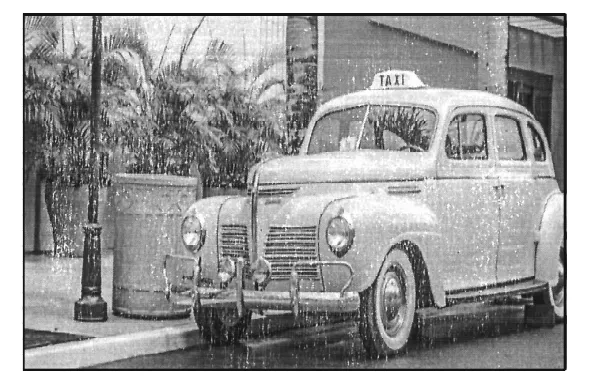
A grey photograph of an old taxi parked at a kerb beside a palm tree.
Solution
  1. Let the fixed charge be ₹ xx and the charge per km ₹ yy. x+10y=105x + 10y = 105 and x+15y=155x + 15y = 155.
  2. Subtracting: 5y=505y = 50, so y=10y = 10, and x=105−100=5x = 105 - 100 = 5.
  3. (i) Fixed charges =₹ 5= ₹\,5. (ii) Charges per km =₹ 10= ₹\,10.
  4. (iii) 20+10×10=₹ 12020 + 10 \times 10 = ₹\,120. (OR) Home to office =5+10×10=105= 5 + 10 \times 10 = 105 and office to home =5+25×10=255= 5 + 25 \times 10 = 255, so the total is 2x+35y=10+350=₹ 3602x + 35y = 10 + 350 = ₹\,360.

Answer: (i) ₹ 55   (ii) ₹ 1010   (iii) ₹ 120120 (OR) ₹ 360360

Report an error on this question
Q38Circles4 marks

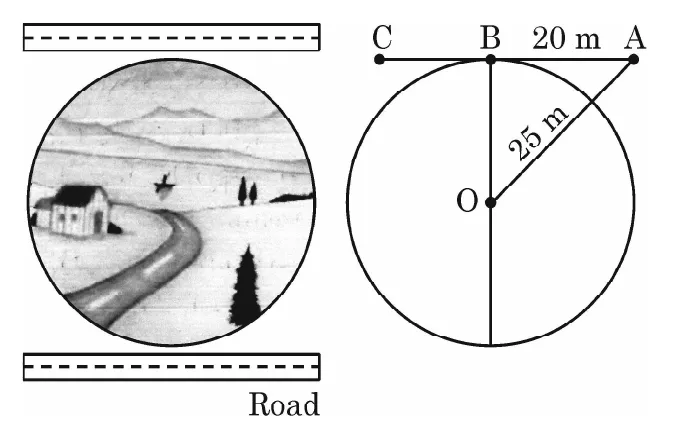
Case study 3. People of a circular village Dharamkot want to construct a road nearest to it. The road cannot pass through the village. But the people want the road at a shortest distance from the centre of the village. Suppose the road starts from AA which is outside the circular village (as shown in the figure) and touch the boundary of the circular village at BB such that AB=20AB = 20 m. Also the distance of the point AA from the centre OO of the village is 2525 m.

Based on the above information, answer the following questions:

(i) If B is the mid-point of AC, then find the distance AC. [1]

(ii) Find the shortest distance of the road from the centre of the village. [1]

(iii) Find the circumference of the village. [2]

OR

(iii) Find the area of the village. [2]

A picture of a village with a house and a curving road inside a circle, and next to it a diagram of a circle with centre O, a road CBA touching it at B with AB marked 20 m and OA marked 25 m.
Solution
OBAC20202515OB = √(25² − 20²) = 15 m; circumference = 660/7 m
  1. (i) BB is the mid-point of ACAC, so AC=2×AB=40AC = 2 \times AB = 40 m.
  2. (ii) The shortest distance of the road from the centre is the perpendicular OBOB (radius to the tangent). OB=252−202=225=15OB = \sqrt{25^2 - 20^2} = \sqrt{225} = 15 m.
  3. (iii) The radius is 1515 m, so the circumference =2πr=2×227×15=6607≈94.3= 2\pi r = 2 \times \dfrac{22}{7} \times 15 = \dfrac{660}{7} \approx 94.3 m.
  4. (iii) OR: area =πr2=227×15×15=49507≈707.1= \pi r^2 = \dfrac{22}{7} \times 15 \times 15 = \dfrac{4950}{7} \approx 707.1 m².

Answer: (i) 4040 m   (ii) 1515 m   (iii) 6607\dfrac{660}{7} m (OR) 49507\dfrac{4950}{7} m²

Report an error on this question

Questions are from the official CBSE paper. Figures are described in words; see the PDF for the originals. Solutions are written by CogniGuru.

Revise this paper in 1 minute a chapter

Each chapter below is what the paper tested, with a one-minute animated lesson on the idea behind it.

Stuck on a step in any solution?

The CogniGuru AI tutor explains any doubt one minute at a time, in English or Hindi. Join the waitlist.

Mock quiz: 5 questions from this paper

Five real questions from this paper, one each from five chapters. About 2 minutes. See how much you know and where you stand among other students. Attempt free, with no login; log in only for your ranking and full report.

Question 1 of 5 · Q2 of the paperCoordinate Geometry

The distance of the point (5,0)(5, 0) from the origin is:

0 of 5 answered

Related papers

Common questions

Are these the official CBSE Class 10 Maths Basic 2023 questions?
Yes. The questions are from the official Mathematics (Basic) paper (set 430/6/1) that CBSE published after the March 2023 board exam. The solutions are written by CogniGuru and checked against the answer key CBSE published for this paper code.
Can I download the CBSE Class 10 Maths Basic 2023 question paper PDF?
Yes, the official paper PDF is free to download from this page, and so are our step-by-step solutions as a PDF. No login is needed to download either or to read the solutions.
Do all sets of the paper have the same questions?
No. CBSE sets several versions of each paper, with the same blueprint and similar questions in a different order and sometimes with different numbers. This page covers set 430/6/1.
How does the quiz work, and what does “where you stand” mean?
It is a mock quiz of 5 real multiple-choice questions from this paper, scored automatically in about 2 minutes. Your score is compared, anonymously, with other students who took the same quiz. Only the score is stored with the comparison, never your name or number.

Source

CBSE question paper archive, Class X, 2023 (Mathematics (Basic), set 430/6/1)
PDF