CBSE · Class 10 · Mathematics (Basic) · Free

CBSE Class 10 Maths Basic 2024 Question Paper (Set 430/2/1) with Solutions

The official board paper (Q.P. Code 430/2/1, Series DA2AB). Free paper PDF and step-by-step solutions (also as a PDF to download) written by CogniGuru and checked against CBSE’s answer key. See the paper’s main topics in 1 minute, then quiz yourself to see how much you know and where you stand.

No login to download or read the solutions. Login only to see your quiz report in full.

Board
CBSE
Class
10
Subject
Maths Basic (241)
Year
2024
Set code
430/2/1
Max marks
80
Duration
3 hours
Questions
38 (Sections A to E)
Source
Official CBSE paper
Exam date
March 2024

Paper preview

Three pages of the official paper. Download the PDF for all 24.

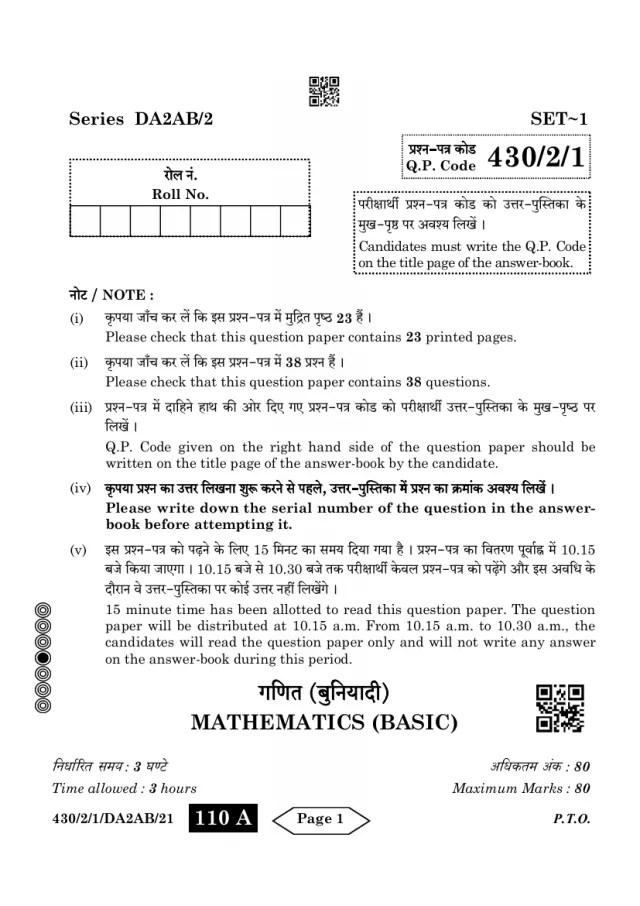
  • Cover page of the CBSE Class 10 Maths Basic 2024 paper, set 430/2/1

    Cover page

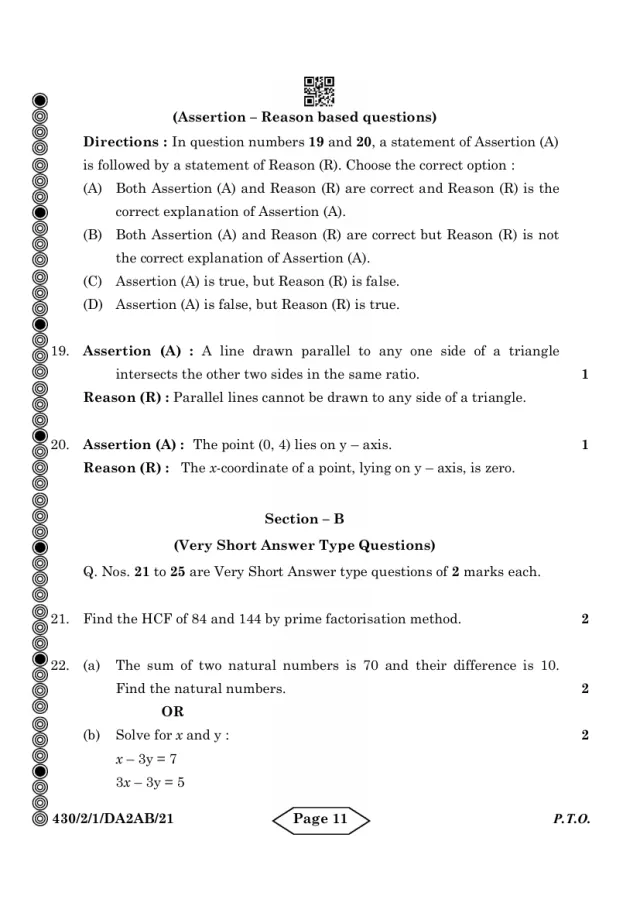
  • Section B of the CBSE Class 10 Maths Basic 2024 paper, set 430/2/1

    Section B

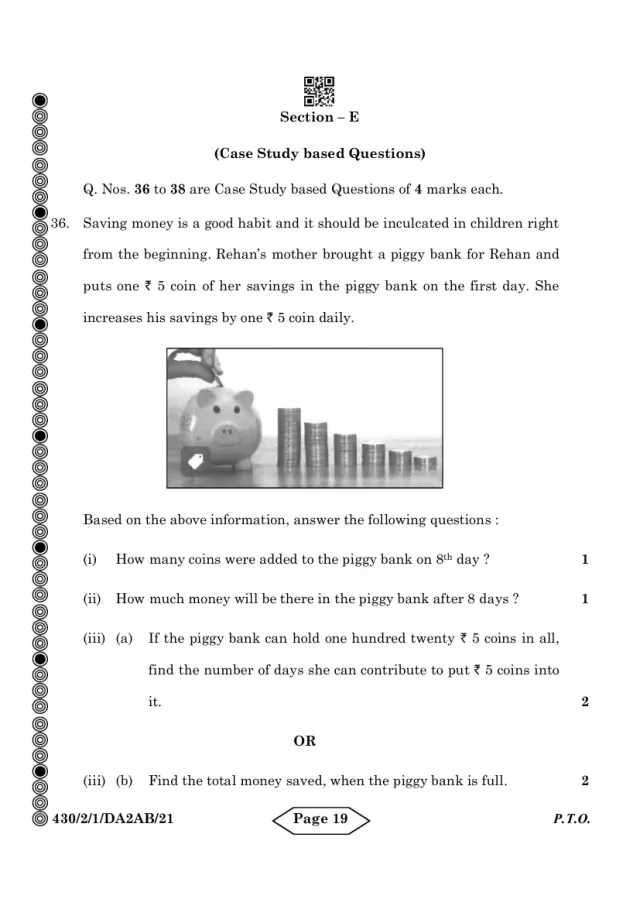
  • A case study with its figure from the CBSE Class 10 Maths Basic 2024 paper, set 430/2/1

    Case study

The main topics of this paper, in 1 minute

Your tutor walks you through the paper before you attempt it: the marks, the key ideas, the time plan and the traps.

1-minute paper analysis

With your tutor, in her voice

The main topics of this paper, in about a minute

A short, animated walk through the paper: how it is built, where the marks come from, the four ideas that matter most, how to plan your three hours, and the traps to avoid.

  1. 1The paper at a glance
  2. 2Where the marks come from
  3. 3Four ideas that keep paying off
  4. 4Plan your three hours
  5. 5Four traps to avoid

Sound on for the voice. Captions are shown, and you can mute any time.

Step-by-step solutions

Try each question first, then open its solution. Tap a number to jump.

Download solutions (PDF)

Section A: Multiple choice

20 questions, 1 mark each. MCQs (Q1 to Q18) and assertion-reason (Q19, Q20).

Q1Real Numbers1 mark

The HCF of smallest 22-digit number and the smallest composite number is:

  1. (A)2
  2. (B)20
  3. (C)40
  4. (D)4
Solution · answer (A)
  1. The smallest 22-digit number is 10=2×510 = 2 \times 5 and the smallest composite number is 4=224 = 2^2. HCF =2= 2.

Answer: (A) 2

Report an error on this question
Q2Linear Equations1 mark

The value of ‘kk’ for which the pair of linear equations x+y−4=0x + y - 4 = 0 and 2x+ky−8=02x + ky - 8 = 0 has infinitely many solutions, is:

  1. (A)k≠2k \neq 2
  2. (B)k≠−2k \neq -2
  3. (C)k=2k = 2
  4. (D)k=−2k = -2
Solution · answer (C)
  1. Infinitely many solutions need 12=1k=−4−8=12\dfrac{1}{2} = \dfrac{1}{k} = \dfrac{-4}{-8} = \dfrac{1}{2}, so k=2k = 2.

Answer: (C) k=2k = 2

Report an error on this question
Q3Quadratic Equations1 mark

Which of the following equations has 2 as a root?

  1. (A)x2−4x+5=0x^2 - 4x + 5 = 0
  2. (B)x2+3x−12=0x^2 + 3x - 12 = 0
  3. (C)2x2−7x+6=02x^2 - 7x + 6 = 0
  4. (D)3x2−6x−2=03x^2 - 6x - 2 = 0
Solution · answer (C)
  1. Substitute x=2x = 2: (A) 4−8+5=14 - 8 + 5 = 1; (B) 4+6−12=−24 + 6 - 12 = -2; (C) 8−14+6=08 - 14 + 6 = 0 ✓; (D) 12−12−2=−212 - 12 - 2 = -2. Only (C) gives 00.

Answer: (C) 2x2−7x+6=02x^2 - 7x + 6 = 0

Report an error on this question
Q4Arithmetic Progressions1 mark

In an A.P., if d=−4d = -4 and a7=4a_7 = 4, then the first term ‘aa’ is equal to:

  1. (A)6
  2. (B)7
  3. (C)20
  4. (D)28
Solution · answer (D)
  1. a7=a+6d=a−24=4a_7 = a + 6d = a - 24 = 4, so a=28a = 28.

Answer: (D) 28

Report an error on this question
Q5Coordinate Geometry1 mark

The distance of the point (5,4)(5, 4) from the origin is:

  1. (A)41
  2. (B)41\sqrt{41}
  3. (C)3
  4. (D)9
Solution · answer (B)
  1. 52+42=41\sqrt{5^2 + 4^2} = \sqrt{41}.

Answer: (B) 41\sqrt{41}

Report an error on this question
Q6Trigonometry1 mark

If sin⁡A=35\sin A = \dfrac{3}{5}, then value of cot⁡A\cot A is:

  1. (A)34\dfrac{3}{4}
  2. (B)43\dfrac{4}{3}
  3. (C)45\dfrac{4}{5}
  4. (D)54\dfrac{5}{4}
Solution · answer (B)
  1. Opposite =3= 3, hypotenuse =5= 5, adjacent =4= 4. cot⁡A=43\cot A = \dfrac{4}{3}.

Answer: (B) 43\dfrac{4}{3}

Report an error on this question
Q7Trigonometry1 mark

1+tan⁡2A1+cot⁡2A\dfrac{1 + \tan^2 A}{1 + \cot^2 A} is equal to:

  1. (A)sec⁡2A\sec^2 A
  2. (B)−1
  3. (C)cot⁡2A\cot^2 A
  4. (D)tan⁡2A\tan^2 A
Solution · answer (D)
  1. sec⁡2Acosec⁡2A=sin⁡2Acos⁡2A=tan⁡2A\dfrac{\sec^2 A}{\operatorname{cosec}^2 A} = \dfrac{\sin^2 A}{\cos^2 A} = \tan^2 A.

Answer: (D) tan⁡2A\tan^2 A

Report an error on this question
Q8Trigonometry1 mark

2tan⁡30∘1−tan⁡230∘\dfrac{2\tan 30^\circ}{1 - \tan^2 30^\circ} is equal to:

  1. (A)cos⁡60∘\cos 60^\circ
  2. (B)sin⁡60∘\sin 60^\circ
  3. (C)tan⁡60∘\tan 60^\circ
  4. (D)sin⁡30∘\sin 30^\circ
Solution · answer (C)
  1. 2/31−1/3=2/32/3=3=tan⁡60∘\dfrac{2/\sqrt{3}}{1 - 1/3} = \dfrac{2/\sqrt{3}}{2/3} = \sqrt{3} = \tan 60^\circ. (This is the double-angle formula tan⁡2A\tan 2A with A=30∘A = 30^\circ.)

Answer: (C) tan⁡60∘\tan 60^\circ

Report an error on this question
Q9Polynomials1 mark

A quadratic polynomial, the sum of whose zeroes is −5 and their product is 6, is:

  1. (A)x2+5x+6x^2 + 5x + 6
  2. (B)x2−5x+6x^2 - 5x + 6
  3. (C)x2−5x−6x^2 - 5x - 6
  4. (D)−x2+5x+6-x^2 + 5x + 6
Solution · answer (A)
  1. x2−(sum)x+product=x2−(−5)x+6=x2+5x+6x^2 - (\text{sum})x + \text{product} = x^2 - (-5)x + 6 = x^2 + 5x + 6.

Answer: (A) x2+5x+6x^2 + 5x + 6

Report an error on this question
Q10Polynomials1 mark

The zeroes of the polynomial 3x2+11x−43x^2 + 11x - 4 are:

  1. (A)13,4\dfrac{1}{3}, 4
  2. (B)−13,−4\dfrac{-1}{3}, -4
  3. (C)13,−4\dfrac{1}{3}, -4
  4. (D)−13,4\dfrac{-1}{3}, 4
Solution · answer (C)
  1. 3x2+11x−4=(3x−1)(x+4)3x^2 + 11x - 4 = (3x - 1)(x + 4), so the zeroes are 13\dfrac{1}{3} and −4-4.

Answer: (C) 13,−4\dfrac{1}{3}, -4

Report an error on this question
Q11Statistics1 mark

The annual rainfall record of a city for 66 days is given in the following table. The difference of upper limits of modal and median classes is:

Rainfall (in cm)0–1010–2020–3030–4040–5050–60
Number of days221081556
  1. (A)10
  2. (B)15
  3. (C)20
  4. (D)30
Solution · answer (C)
  1. The highest frequency 2222 is in 0−100 - 10, so the modal class is 0−100 - 10 (upper limit 1010).
  2. N=66N = 66, N2=33\dfrac{N}{2} = 33. Cumulative frequencies: 22,32,40,…22, 32, 40, \dots, so the median class is 20−3020 - 30 (upper limit 3030). The difference is 30−10=2030 - 10 = 20.

Answer: (C) 20

Report an error on this question
Q12Probability1 mark

If P(A)P(A) denotes the probability of an event AA, then:

  1. (A)P(A)<0P(A) < 0
  2. (B)P(A)>1P(A) > 1
  3. (C)0≤P(A)≤10 \leq P(A) \leq 1
  4. (D)−1≤P(A)≤1-1 \leq P(A) \leq 1
Solution · answer (C)
  1. A probability always lies between 00 (impossible event) and 11 (sure event): 0≤P(A)≤10 \leq P(A) \leq 1.

Answer: (C) 0≤P(A)≤10 \leq P(A) \leq 1

Report an error on this question
Q13Surface Areas and Volumes1 mark

The total surface area of a solid hemisphere of radius 77 cm is:

  1. (A)98π98\pi cm²
  2. (B)147π147\pi cm²
  3. (C)196π196\pi cm²
  4. (D)22823π228\tfrac{2}{3}\pi cm²
Solution · answer (B)
  1. Total surface area of a solid hemisphere =3πr2=3π×49=147π= 3\pi r^2 = 3\pi \times 49 = 147\pi cm².

Answer: (B) 147π147\pi cm²

Report an error on this question
Q14Areas Related to Circles1 mark

The difference of the areas of a minor sector of angle 120∘120^\circ and its corresponding major sector of a circle of radius 2121 cm, is:

  1. (A)231231 cm²
  2. (B)462462 cm²
  3. (C)346.5346.5 cm²
  4. (D)693693 cm²
Solution · answer (B)
  1. Minor sector =120360×227×212=462= \dfrac{120}{360} \times \dfrac{22}{7} \times 21^2 = 462 cm². Major sector (angle 240∘240^\circ) =924= 924 cm². Difference =924−462=462= 924 - 462 = 462 cm².

Answer: (B) 462462 cm²

Report an error on this question
Q15Linear Equations1 mark

The graph of a pair of linear equations a1x+b1y=c1a_1x + b_1y = c_1 and a2x+b2y=c2a_2x + b_2y = c_2 in two variables xx and yy represents parallel lines, if:

  1. (A)a1a2≠b1b2\dfrac{a_1}{a_2} \neq \dfrac{b_1}{b_2}
  2. (B)a1a2=b1b2=c1c2\dfrac{a_1}{a_2} = \dfrac{b_1}{b_2} = \dfrac{c_1}{c_2}
  3. (C)a1a2≠b1b2=c1c2\dfrac{a_1}{a_2} \neq \dfrac{b_1}{b_2} = \dfrac{c_1}{c_2}
  4. (D)a1a2=b1b2≠c1c2\dfrac{a_1}{a_2} = \dfrac{b_1}{b_2} \neq \dfrac{c_1}{c_2}
Solution · answer (D)
  1. Parallel lines never meet: the slopes are equal but the lines are different, so a1a2=b1b2≠c1c2\dfrac{a_1}{a_2} = \dfrac{b_1}{b_2} \neq \dfrac{c_1}{c_2}. This is option (D).

Answer: (D) a1a2=b1b2≠c1c2\dfrac{a_1}{a_2} = \dfrac{b_1}{b_2} \neq \dfrac{c_1}{c_2}

Report an error on this question
Q16Circles1 mark

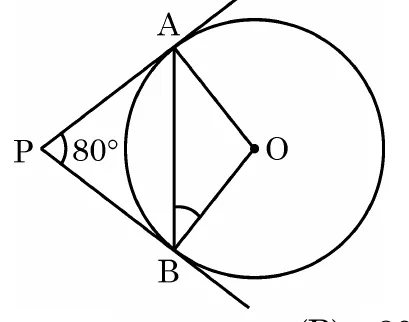
In the given figure, tangents PAPA and PBPB from a point PP to a circle with centre OO are inclined to each other at an angle of 80∘80^\circ. ∠ABO\angle ABO is equal to:

A circle with centre O on the right. Tangents from the outside point P on the left touch the circle at A (top) and B (bottom), with the angle at P marked 80 degrees. The chord AB is drawn and the angle ABO is marked.
  1. (A)40∘40^\circ
  2. (B)80∘80^\circ
  3. (C)100∘100^\circ
  4. (D)50∘50^\circ
Solution · answer (A)
80°OPAB40°∠AOB = 100°; OA = OB → ∠ABO = 40°
  1. OA⊥PAOA \perp PA and OB⊥PBOB \perp PB, so ∠AOB=180∘−80∘=100∘\angle AOB = 180^\circ - 80^\circ = 100^\circ.
  2. OA=OBOA = OB, so △OAB\triangle OAB is isosceles and ∠ABO=180∘−100∘2=40∘\angle ABO = \dfrac{180^\circ - 100^\circ}{2} = 40^\circ.

Answer: (A) 40∘40^\circ

Report an error on this question
Q17Circles1 mark

A line intersecting a circle in two distinct points is called a:

  1. (A)secant
  2. (B)chord
  3. (C)diameter
  4. (D)tangent
Solution · answer (A)
  1. A line that cuts a circle at two distinct points is a secant. (A chord is the segment between the two points, and a tangent touches at only one point.)

Answer: (A) secant

Report an error on this question
Q18Trigonometry1 mark

If a pole 66 m high casts a shadow 232\sqrt{3} m long on the ground, then the sun’s elevation is:

  1. (A)30∘30^\circ
  2. (B)45∘45^\circ
  3. (C)60∘60^\circ
  4. (D)90∘90^\circ
Solution · answer (C)
  1. tan⁡θ=623=3\tan\theta = \dfrac{6}{2\sqrt{3}} = \sqrt{3}, so θ=60∘\theta = 60^\circ.

Answer: (C) 60∘60^\circ

Report an error on this question
Q19Triangles1 mark

Assertion (A): A line drawn parallel to any one side of a triangle intersects the other sides in the same ratio.

Reason (R): Parallel lines cannot be drawn to any side of a triangle.

  1. (A)Both A and R are correct and R is the correct explanation of A
  2. (B)Both A and R are correct but R is not the correct explanation of A
  3. (C)A is true, but R is false
  4. (D)A is false, but R is true
Solution · answer (C)
  1. (A) This is the basic proportionality theorem (when the line meets the other two sides in distinct points). True.
  2. (R) A line parallel to a side can obviously be drawn through any point of the triangle. False.

Answer: (C) A is true, but R is false

Report an error on this question
Q20Coordinate Geometry1 mark

Assertion (A): The point (0,4)(0, 4) lies on yy-axis.

Reason (R): The xx-coordinate of a point, lying on yy-axis, is zero.

  1. (A)Both A and R are correct and R is the correct explanation of A
  2. (B)Both A and R are correct but R is not the correct explanation of A
  3. (C)A is true, but R is false
  4. (D)A is false, but R is true
Solution · answer (A)
  1. (R) Every point of the yy-axis has x=0x = 0. True.
  2. (A) (0,4)(0, 4) has x=0x = 0, so it is on the yy-axis. True, and (R) is exactly the reason.

Answer: (A) Both A and R are correct and R is the correct explanation of A

Report an error on this question

Section B: Very short answer

5 questions, 2 marks each.

Q21Real Numbers2 marks

Find the HCF of 84 and 144 by prime factorisation method.

Solution
  1. 84=2×2×3×784 = 2 \times 2 \times 3 \times 7 and 144=2×2×2×2×3×3144 = 2 \times 2 \times 2 \times 2 \times 3 \times 3.
  2. HCF == common primes at the smallest powers =2×2×3=12= 2 \times 2 \times 3 = 12.

Answer: 1212

Report an error on this question
Q22Linear Equations2 marks

(a) The sum of two natural numbers is 7070 and their difference is 1010. Find the natural numbers.

OR

(b) Solve for xx and yy: x−3y=7x - 3y = 7 and 3x−3y=53x - 3y = 5.

Solution
  1. (a) x+y=70x + y = 70 and x−y=10x - y = 10. Adding, 2x=802x = 80, so x=40x = 40 and y=30y = 30.
  2. (b) Subtracting the first from the second: 2x=−22x = -2, so x=−1x = -1. Then −1−3y=7-1 - 3y = 7 gives y=−83y = -\dfrac{8}{3}.

Answer: (a) 4040 and 3030   (b) x=−1x = -1, y=−83y = -\dfrac{8}{3}

Report an error on this question
Q23Probability2 marks

15 defective pens are accidentally mixed with 145 good ones. One pen is taken out at random from this lot. Determine the probability that the pen taken out is a good one.

Solution
  1. Total pens =145+15=160= 145 + 15 = 160. P(good)=145160=2932P(\text{good}) = \dfrac{145}{160} = \dfrac{29}{32}.

Answer: 2932\dfrac{29}{32}

Report an error on this question
Q24Triangles2 marks

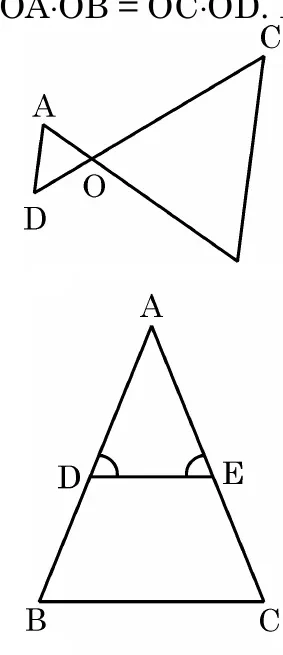
(a) In the given figure, OA⋅OB=OC⋅ODOA \cdot OB = OC \cdot OD. Prove that △AOD∼△COB\triangle AOD \sim \triangle COB.

OR

(b) In the given figure, ∠D=∠E\angle D = \angle E and ADDB=AEEC\dfrac{AD}{DB} = \dfrac{AE}{EC}. Prove that △ABC\triangle ABC is isosceles.

Two figures. First, two lines AB and CD crossing at O with the segments AD and CB joined. Second, a triangle ABC with a line DE across it, D on AB and E on AC, with the angles at D and E marked.
Solution
  1. (a) OA⋅OB=OC⋅ODOA \cdot OB = OC \cdot OD gives OAOC=ODOB\dfrac{OA}{OC} = \dfrac{OD}{OB}. ∠AOD=∠COB\angle AOD = \angle COB (vertically opposite angles), and the including sides are proportional, so △AOD∼△COB\triangle AOD \sim \triangle COB by SAS.
  2. (b) ADDB=AEEC\dfrac{AD}{DB} = \dfrac{AE}{EC} gives DE∥BCDE \parallel BC (converse of the basic proportionality theorem). Then ∠D=∠B\angle D = \angle B and ∠E=∠C\angle E = \angle C (corresponding angles).
  3. ∠D=∠E\angle D = \angle E is given, so ∠B=∠C\angle B = \angle C, and the sides opposite equal angles are equal: AB=ACAB = AC. △ABC\triangle ABC is isosceles.

Answer: Proved (both parts)

Report an error on this question
Q25Circles2 marks

Prove that the tangents drawn at the ends of a diameter of a circle are parallel to each other.

Solution
  1. Let ABAB be a diameter of the circle with centre OO, and let the tangents at AA and BB be ℓ\ell and mm.
  2. A radius is perpendicular to the tangent at the point of contact: ∠OAl=90∘\angle OAl = 90^\circ and ∠OBm=90∘\angle OBm = 90^\circ. So the alternate interior angles made by the transversal ABAB with ℓ\ell and mm are equal (90∘90^\circ each), hence ℓ∥m\ell \parallel m.

Answer: Proved

Report an error on this question

Section C: Short answer

6 questions, 3 marks each.

Q26Probability3 marks

Two dice are tossed simultaneously. Find the probability of getting (a) an even number on both the dice. (b) the sum of two numbers more than 9.

Solution
  1. There are 3636 equally likely outcomes.
  2. (a) Even on both: each die shows 2,42, 4 or 66, giving 3×3=93 \times 3 = 9 outcomes. P=936=14P = \dfrac{9}{36} = \dfrac{1}{4}.
  3. (b) Sum more than 99: (4,6),(5,5),(5,6),(6,4),(6,5),(6,6)(4,6), (5,5), (5,6), (6,4), (6,5), (6,6), which is 66. P=636=16P = \dfrac{6}{36} = \dfrac{1}{6}.

Answer: (a) 14\dfrac{1}{4}   (b) 16\dfrac{1}{6}

Report an error on this question
Q27Circles3 marks

(a) In two concentric circles, a chord of length 2424 cm of larger circle touches the smaller circle, whose radius is 55 cm. Find the radius of the larger circle.

OR

(b) Prove that the angle between the two tangents drawn from an external point to a circle is supplementary to the angle subtended by the line segment joining the points of contact at the centre.

Solution
OQAB512OB² = 5² + 12² = 169 → R = 13 cm
  1. (a) The chord ABAB touches the smaller circle at QQ, so OQ⊥ABOQ \perp AB and OQ=5OQ = 5. The perpendicular from the centre bisects the chord: QB=12QB = 12.
  2. OB2=OQ2+QB2=25+144=169OB^2 = OQ^2 + QB^2 = 25 + 144 = 169, so the radius of the larger circle is OB=13OB = 13 cm.
  3. (b) Let PQPQ and PRPR be tangents from PP to the circle with centre OO. OQ⊥PQOQ \perp PQ and OR⊥PROR \perp PR, so ∠OQP=∠ORP=90∘\angle OQP = \angle ORP = 90^\circ.
  4. In the quadrilateral OQPROQPR: 90∘+∠QPR+90∘+∠QOR=360∘90^\circ + \angle QPR + 90^\circ + \angle QOR = 360^\circ, so ∠QPR+∠QOR=180∘\angle QPR + \angle QOR = 180^\circ.

Answer: (a) 1313 cm   (b) proved

Report an error on this question
Q28Real Numbers3 marks

Prove that 7−357 - 3\sqrt{5} is an irrational number, given that 5\sqrt{5} is an irrational number.

Solution
  1. Suppose x=7−35x = 7 - 3\sqrt{5} is rational. Then 5=7−x3\sqrt{5} = \dfrac{7 - x}{3}, which is rational.
  2. This contradicts the given fact that 5\sqrt{5} is irrational, so 7−357 - 3\sqrt{5} is irrational.

Answer: Proved

Report an error on this question
Q29Polynomials3 marks

(a) Zeroes of the quadratic polynomial x2−3x+2x^2 - 3x + 2 are α\alpha and β\beta. Construct a quadratic polynomial whose zeroes are 2α+12\alpha + 1 and 2β+12\beta + 1.

OR

(b) Find the zeroes of the polynomial 4x2−4x+14x^2 - 4x + 1 and verify the relationship between the zeroes and the coefficients.

Solution
  1. (a) α+β=3\alpha + \beta = 3 and αβ=2\alpha\beta = 2. New sum =2(α+β)+2=8= 2(\alpha + \beta) + 2 = 8. New product =(2α+1)(2β+1)=4αβ+2(α+β)+1=8+6+1=15= (2\alpha + 1)(2\beta + 1) = 4\alpha\beta + 2(\alpha + \beta) + 1 = 8 + 6 + 1 = 15.
  2. The polynomial is x2−8x+15x^2 - 8x + 15 (or k(x2−8x+15)k(x^2 - 8x + 15)).
  3. (b) 4x2−4x+1=(2x−1)24x^2 - 4x + 1 = (2x - 1)^2, so both zeroes are 12\dfrac{1}{2}. Sum =1=−−44= 1 = -\dfrac{-4}{4} ✓. Product =14=14= \dfrac{1}{4} = \dfrac{1}{4} ✓.

Answer: (a) x2−8x+15x^2 - 8x + 15   (b) zeroes 12,12\dfrac{1}{2}, \dfrac{1}{2}; relations verified

Report an error on this question
Q30Trigonometry3 marks

Prove that tan⁡θ1−cot⁡θ+cot⁡θ1−tan⁡θ=1+sec⁡θcosec⁡θ\dfrac{\tan\theta}{1 - \cot\theta} + \dfrac{\cot\theta}{1 - \tan\theta} = 1 + \sec\theta\operatorname{cosec}\theta.

Solution
  1. LHS =sin⁡2θcos⁡θ(sin⁡θ−cos⁡θ)+cos⁡2θsin⁡θ(cos⁡θ−sin⁡θ)=sin⁡3θ−cos⁡3θsin⁡θcos⁡θ(sin⁡θ−cos⁡θ)= \dfrac{\sin^2\theta}{\cos\theta(\sin\theta - \cos\theta)} + \dfrac{\cos^2\theta}{\sin\theta(\cos\theta - \sin\theta)} = \dfrac{\sin^3\theta - \cos^3\theta}{\sin\theta\cos\theta(\sin\theta - \cos\theta)}.
  2. sin⁡3θ−cos⁡3θ=(sin⁡θ−cos⁡θ)(1+sin⁡θcos⁡θ)\sin^3\theta - \cos^3\theta = (\sin\theta - \cos\theta)(1 + \sin\theta\cos\theta), so LHS =1+sin⁡θcos⁡θsin⁡θcos⁡θ=sec⁡θcosec⁡θ+1== \dfrac{1 + \sin\theta\cos\theta}{\sin\theta\cos\theta} = \sec\theta\operatorname{cosec}\theta + 1 = RHS.

Answer: Proved

Report an error on this question
Q31Areas Related to Circles3 marks

A car has two wipers which do not overlap. Each wiper has a blade of length 21 cm sweeping through an angle of 120°. Find the area cleaned at each sweep of the blades.

Solution
  1. One wiper cleans a sector: 120360×227×21×21=462\dfrac{120}{360} \times \dfrac{22}{7} \times 21 \times 21 = 462 cm².
  2. The two wipers do not overlap, so the area cleaned at each sweep is 2×462=9242 \times 462 = 924 cm².

Answer: 924924 cm²

Report an error on this question

Section D: Long answer

4 questions, 5 marks each.

Q32Quadratic Equations5 marks

A cottage industry produces a certain number of toys in a day. The cost of production of each toy (in rupees) was found to be 55 minus the number of toys produced in a day. On a particular day, the total cost of production was ₹ 750. Find the total number of toys produced on that day.

Solution
  1. Let xx toys be produced. The cost of each is (55−x)(55 - x), so the total is x(55−x)=750x(55 - x) = 750.
  2. x2−55x+750=0x^2 - 55x + 750 = 0, so (x−25)(x−30)=0(x - 25)(x - 30) = 0 and x=25x = 25 or x=30x = 30.
  3. Both are valid (each cost, 3030 or 2525, is positive and the totals are 25×30=75025 \times 30 = 750). The industry made 2525 or 3030 toys that day.

Answer: 2525 or 3030 toys

Report an error on this question
Q33Trigonometry5 marks

A TV tower stands vertically on a bank of a canal. From a point on the other bank exactly opposite the tower, the angle of elevation of the top of the tower is 60∘60^\circ. From another point 2020 m away from this point on the line joining this point to the foot of the tower, the angle of elevation of the top of the tower is 30∘30^\circ. Find the height of the tower and the width of the canal. [Use 3=1.732\sqrt{3} = 1.732]

Solution
60°30°ABCDh = 17.32 mx = 10 m20 mh = x√3 and h = (x + 20)/√3 → x = 10
  1. Let the tower be AB=hAB = h, the nearer point CC with AC=xAC = x (the canal width), and the farther point DD with CD=20CD = 20.
  2. In △ABC\triangle ABC: tan⁡60∘=hx\tan 60^\circ = \dfrac{h}{x}, so h=x3h = x\sqrt{3}. (i)
  3. In △ABD\triangle ABD: tan⁡30∘=hx+20=13\tan 30^\circ = \dfrac{h}{x + 20} = \dfrac{1}{\sqrt{3}}, so 3 h=x+20\sqrt{3}\,h = x + 20. (ii)
  4. Substituting (i): 3x=x+203x = x + 20, so x=10x = 10 m. h=103=17.32h = 10\sqrt{3} = 17.32 m.

Answer: Height =17.32= 17.32 m; width of the canal =10= 10 m

Report an error on this question
Q34Triangles5 marks

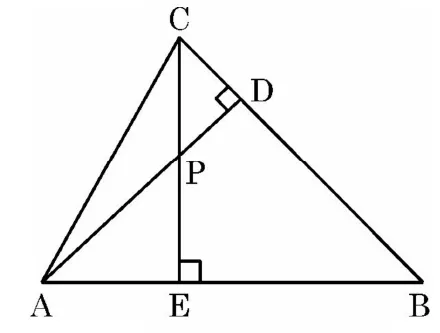
(a) In the given figure, altitudes CECE and ADAD of △ABC\triangle ABC intersect each other at the point PP. Show that (i) △AEP∼△CDP\triangle AEP \sim \triangle CDP (ii) △ABD∼△CBE\triangle ABD \sim \triangle CBE (iii) △AEP∼△ADB\triangle AEP \sim \triangle ADB.

OR

(b) ADAD and PMPM are medians of triangles ABCABC and PQRPQR, respectively, where △ABC∼△PQR\triangle ABC \sim \triangle PQR. Prove that ABPQ=ADPM\dfrac{AB}{PQ} = \dfrac{AD}{PM}.

A triangle ABC with the base AB at the bottom. The altitude CE falls on AB at E, and the altitude AD falls on the side CB at D, with the two altitudes crossing at P.
Solution
  1. (a)(i) In △AEP\triangle AEP and △CDP\triangle CDP: ∠APE=∠CPD\angle APE = \angle CPD (vertically opposite) and ∠AEP=∠CDP=90∘\angle AEP = \angle CDP = 90^\circ. By AA, △AEP∼△CDP\triangle AEP \sim \triangle CDP.
  2. (ii) In △ABD\triangle ABD and △CBE\triangle CBE: ∠B\angle B is common and ∠ADB=∠CEB=90∘\angle ADB = \angle CEB = 90^\circ. By AA, △ABD∼△CBE\triangle ABD \sim \triangle CBE.
  3. (iii) In △AEP\triangle AEP and △ADB\triangle ADB: ∠A\angle A is common and ∠AEP=∠ADB=90∘\angle AEP = \angle ADB = 90^\circ. By AA, △AEP∼△ADB\triangle AEP \sim \triangle ADB.
  4. (b) △ABC∼△PQR\triangle ABC \sim \triangle PQR gives ABPQ=BCQR\dfrac{AB}{PQ} = \dfrac{BC}{QR} and ∠B=∠Q\angle B = \angle Q. ADAD and PMPM are medians, so BC=2BDBC = 2BD and QR=2QMQR = 2QM: ABPQ=2BD2QM=BDQM\dfrac{AB}{PQ} = \dfrac{2BD}{2QM} = \dfrac{BD}{QM}.
  5. In △ABD\triangle ABD and △PQM\triangle PQM: ABPQ=BDQM\dfrac{AB}{PQ} = \dfrac{BD}{QM} and ∠B=∠Q\angle B = \angle Q. By SAS, △ABD∼△PQM\triangle ABD \sim \triangle PQM, so ABPQ=ADPM\dfrac{AB}{PQ} = \dfrac{AD}{PM}.

Answer: Proved (both parts)

Report an error on this question
Q35Surface Areas and Volumes5 marks

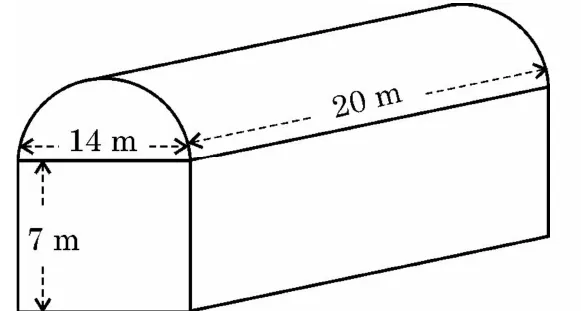
(a) A textile industry runs in a shed. This shed is in the shape of a cuboid surmounted by a half cylinder. If the base of the industry is of dimensions 14 m×20 m14\ \text{m} \times 20\ \text{m} and the height of the cuboidal portion is 77 m, find the volume of air that the industry can hold. Further, suppose the machinery in the industry occupies a total space of 400400 m³. Then, how much space is left in the industry?

OR

(b) From a solid cylinder of height 88 cm and radius 66 cm, a conical cavity of the same height and same radius is carved out. Find the total surface area of the remaining solid. (Take π=3.14\pi = 3.14)

A shed drawn as a box 14 m wide, 20 m long and 7 m high with a half-cylinder roof on top, the half-cylinder having diameter 14 m.
Solution
  1. (a) Cuboid: 20×14×7=196020 \times 14 \times 7 = 1960 m³. The half cylinder has radius 142=7\dfrac{14}{2} = 7 m and length 2020 m: 12πr2h=12×227×49×20=1540\dfrac{1}{2}\pi r^2 h = \dfrac{1}{2} \times \dfrac{22}{7} \times 49 \times 20 = 1540 m³.
  2. Air the shed can hold =1960+1540=3500= 1960 + 1540 = 3500 m³. Space left after the machinery =3500−400=3100= 3500 - 400 = 3100 m³.
  3. (b) Slant height of the cone l=62+82=10l = \sqrt{6^2 + 8^2} = 10 cm. The remaining solid has the curved surface of the cylinder, the bottom base, and the curved surface of the cone cavity (the top face is removed entirely).
  4. Surface area =2πrh+πr2+πrl=π(2×6×8+36+6×10)=π(96+36+60)=192π=192×3.14=602.88= 2\pi rh + \pi r^2 + \pi rl = \pi(2 \times 6 \times 8 + 36 + 6 \times 10) = \pi(96 + 36 + 60) = 192\pi = 192 \times 3.14 = 602.88 cm².

Answer: (a) 35003500 m³ of air; 31003100 m³ left   (b) 602.88602.88 cm²

Report an error on this question

Section E: Case studies

3 case studies, 4 marks each.

Q36Arithmetic Progressions4 marks

Case study 1. Saving money is a good habit and it should be inculcated in children right from the beginning. Rehan’s mother brought a piggy bank for Rehan and puts one ₹ 5 coin of her savings in the piggy bank on the first day. She increases his savings by one ₹ 5 coin daily.

Based on the above information, answer the following questions:

(i) How many coins were added to the piggy bank on 8th day? [1]

(ii) How much money will be there in the piggy bank after 8 days? [1]

(iii) (a) If the piggy bank can hold one hundred twenty ₹ 5 coins in all, find the number of days she can contribute to put ₹ 5 coins into it. [2]

OR

(iii) (b) Find the total money saved, when the piggy bank is full. [2]

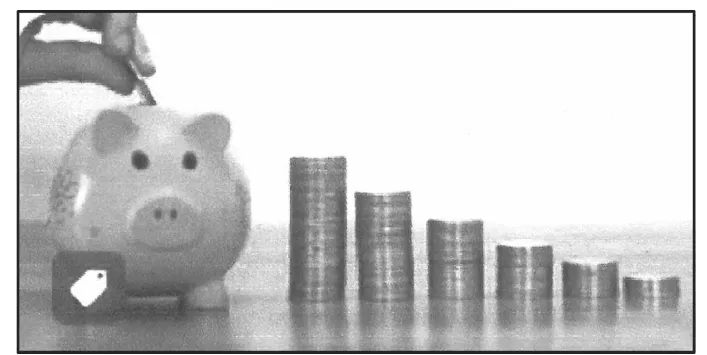
A photo of a piggy bank next to growing stacks of coins.
Solution
  1. The number of coins added each day is 1,2,3,…1, 2, 3, \dots, an A.P. with a=1a = 1 and d=1d = 1.
  2. (i) On the 8th8^{\text{th}} day 88 coins are added.
  3. (ii) Coins after 88 days =1+2+⋯+8=36= 1 + 2 + \dots + 8 = 36, worth 36×5=₹18036 \times 5 = ₹180. (The money added each day is 5,10,15,…5, 10, 15, \dots.)
  4. (iii)(a) n2[2(1)+(n−1)(1)]=120\dfrac{n}{2}[2(1) + (n - 1)(1)] = 120 gives n2+n−240=0n^2 + n - 240 = 0, so (n+16)(n−15)=0(n + 16)(n - 15) = 0 and n=15n = 15 (the root −16-16 is rejected): 1515 days.
  5. (iii)(b) The full bank holds 120120 coins worth 120×5=₹600120 \times 5 = ₹600.

Answer: (i) 88 coins   (ii) ₹ 180180   (iii)(a) 1515 days   (iii)(b) ₹ 600600

Report an error on this question
Q37Statistics4 marks

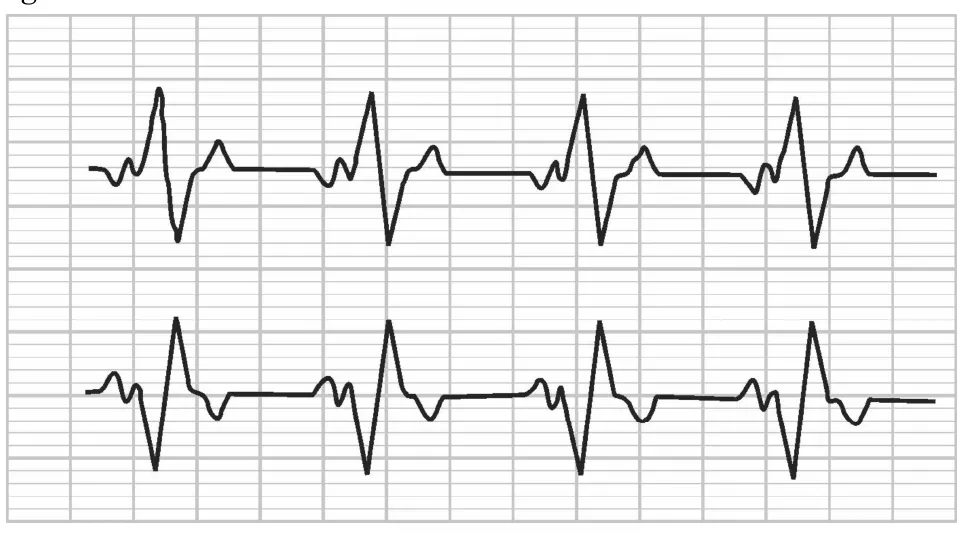
Case study 2. Heart Rate: The heart rate is one of the ‘vital signs’ of health in the human body. It measures the number of times per minute that the heart contracts or beats. While a normal heart rate does not guarantee that a person is free of health problems, it is a useful benchmark for identifying a range of health issues. Thirty women were examined by doctors of AIIMS and the number of heart beats per minute were recorded and summarized as follows:

Based on the above information, answer the following questions:

(i) How many women are having heart beat in the range 68 – 77? [1]

(ii) What is the median class of heart beats per minute for these women? [1]

(iii) (a) Find the modal value of heart beats per minute for these women. [2]

OR

(iii) (b) Find the median value of heart beats per minute for these women. [2]

Heart beats per minute65–6868–7171–7474–7777–8080–8383–86
Number of women2438742
Two heart-rate traces from an electrocardiogram, each showing a repeated spike pattern on a grid.
Solution
  1. (i) The range 68−7768 - 77 covers the classes 68−7168 - 71, 71−7471 - 74 and 74−7774 - 77: 4+3+8=154 + 3 + 8 = 15 women.
  2. (ii) N=30N = 30, N2=15\dfrac{N}{2} = 15. Cumulative frequencies: 2,6,9,17,24,28,302, 6, 9, 17, 24, 28, 30. The median class is 74−7774 - 77.
  3. (iii)(a) The modal class is 74−7774 - 77 (f1=8f_1 = 8, f0=3f_0 = 3, f2=7f_2 = 7, h=3h = 3): Mode =74+8−316−3−7×3=74+2.5=76.5= 74 + \dfrac{8 - 3}{16 - 3 - 7} \times 3 = 74 + 2.5 = 76.5.
  4. (iii)(b) Median =74+15−98×3=74+2.25=76.25= 74 + \dfrac{15 - 9}{8} \times 3 = 74 + 2.25 = 76.25.

Answer: (i) 1515   (ii) 74−7774 - 77   (iii)(a) 76.576.5   (iii)(b) 76.2576.25

Report an error on this question
Q38Coordinate Geometry4 marks

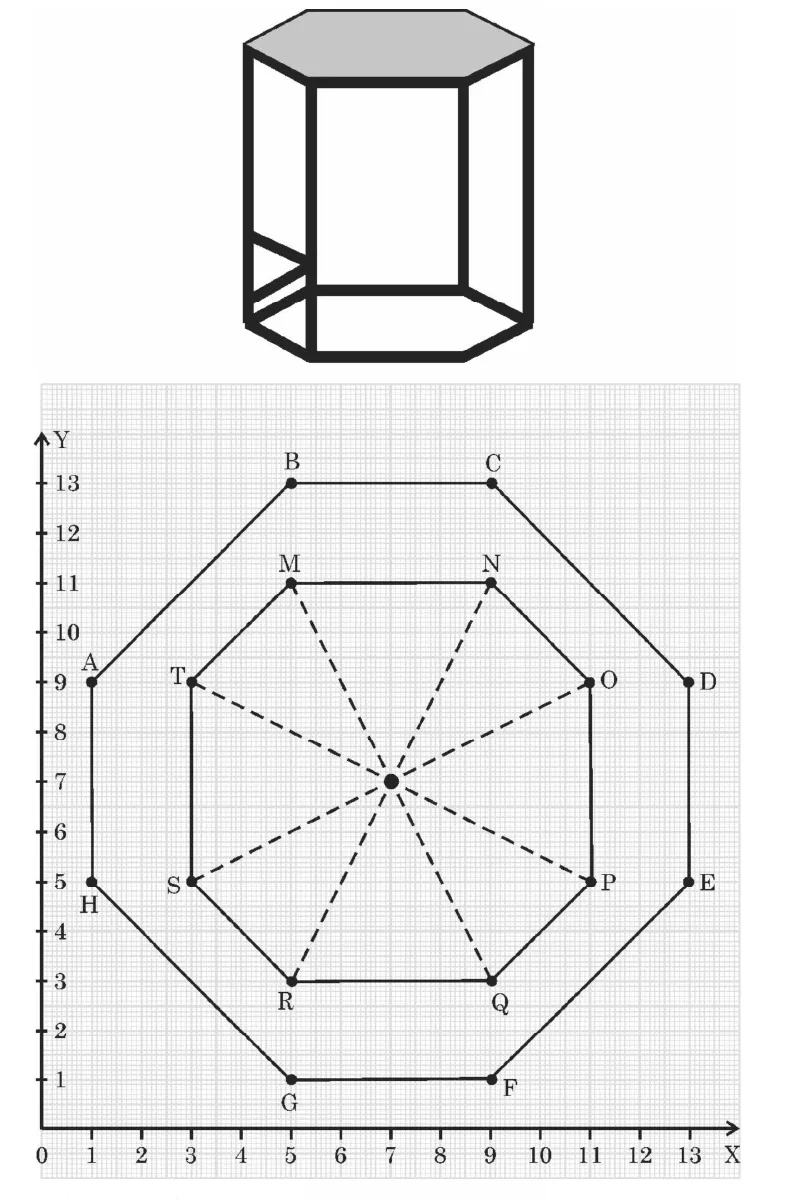
Case study 3. The top of a table is hexagonal in shape. On the basis of the information given in the figure (a grid on which the points A to T are marked), answer the following questions:

(i) Write the coordinates of A and B. [1]

(ii) Write the coordinates of the mid-point of line segment joining C and D. [1]

(iii) (a) Find the distance between M and Q. [2]

OR

(iii) (b) Find the coordinates of the point which divides the line segment joining M and N in the ratio 1 : 3 internally. [2]

A drawing of a table with an eight-sided top, and below it a grid with the points A to H on the outer shape and M, N, O, P, Q, R, S, T on the inner shape. The points A(1, 9), B(5, 13), C(9, 13) and D(13, 9) are on the upper outer edge, and M(5, 11), N(9, 11) and Q(9, 3) are on the inner shape.
Solution
2468101214162468101214OxyA(1, 9)B(5, 13)C(9, 13)D(13, 9)(11, 11)M(5, 11)N(9, 11)Q(9, 3)
  1. (i) Reading the grid: A=(1,9)A = (1, 9) and B=(5,13)B = (5, 13).
  2. (ii) C=(9,13)C = (9, 13) and D=(13,9)D = (13, 9). The mid-point is (9+132,13+92)=(11,11)\left(\dfrac{9 + 13}{2}, \dfrac{13 + 9}{2}\right) = (11, 11).
  3. (iii)(a) M=(5,11)M = (5, 11) and Q=(9,3)Q = (9, 3): MQ=(9−5)2+(3−11)2=16+64=80=45MQ = \sqrt{(9 - 5)^2 + (3 - 11)^2} = \sqrt{16 + 64} = \sqrt{80} = 4\sqrt{5} units.
  4. (iii)(b) M=(5,11)M = (5, 11) and N=(9,11)N = (9, 11). The point dividing MNMN in the ratio 1:31 : 3 is (1×9+3×54,1×11+3×114)=(6,11)\left(\dfrac{1 \times 9 + 3 \times 5}{4}, \dfrac{1 \times 11 + 3 \times 11}{4}\right) = (6, 11).

Answer: (i) A(1,9)A(1, 9), B(5,13)B(5, 13)   (ii) (11,11)(11, 11)   (iii)(a) 454\sqrt{5}   (iii)(b) (6,11)(6, 11)

Report an error on this question

Questions are from the official CBSE paper. Figures are described in words; see the PDF for the originals. Solutions are written by CogniGuru.

Revise this paper in 1 minute a chapter

Each chapter below is what the paper tested, with a one-minute animated lesson on the idea behind it.

Stuck on a step in any solution?

The CogniGuru AI tutor explains any doubt one minute at a time, in English or Hindi. Join the waitlist.

Mock quiz: 5 questions from this paper

Five real questions from this paper, one each from five chapters. About 2 minutes. See how much you know and where you stand among other students. Attempt free, with no login; log in only for your ranking and full report.

Question 1 of 5 · Q1 of the paperReal Numbers

The HCF of smallest 22-digit number and the smallest composite number is:

0 of 5 answered

Related papers

Common questions

Are these the official CBSE Class 10 Maths Basic 2024 questions?
Yes. The questions are from the official Mathematics (Basic) paper (set 430/2/1) that CBSE published after the March 2024 board exam. The solutions are written by CogniGuru and checked against the answer key CBSE published for this paper code.
Can I download the CBSE Class 10 Maths Basic 2024 question paper PDF?
Yes, the official paper PDF is free to download from this page, and so are our step-by-step solutions as a PDF. No login is needed to download either or to read the solutions.
Do all sets of the paper have the same questions?
No. CBSE sets several versions of each paper, with the same blueprint and similar questions in a different order and sometimes with different numbers. This page covers set 430/2/1.
How does the quiz work, and what does “where you stand” mean?
It is a mock quiz of 5 real multiple-choice questions from this paper, scored automatically in about 2 minutes. Your score is compared, anonymously, with other students who took the same quiz. Only the score is stored with the comparison, never your name or number.

Source

CBSE question paper archive, Class X, 2024 (Mathematics (Basic), set 430/2/1)
PDF