CBSE · Class 10 · Mathematics (Basic) · Free

CBSE Class 10 Maths Basic 2024 Question Paper (Set 430/4/1) with Solutions

The official board paper (Q.P. Code 430/4/1, Series 14). Free paper PDF and step-by-step solutions (also as a PDF to download) written by CogniGuru and checked against CBSE’s answer key. See the paper’s main topics in 1 minute, then quiz yourself to see how much you know and where you stand.

No login to download or read the solutions. Login only to see your quiz report in full.

Board
CBSE
Class
10
Subject
Maths Basic (241)
Year
2024
Set code
430/4/1
Max marks
80
Duration
3 hours
Questions
38 (Sections A to E)
Source
Official CBSE paper
Exam date
March 2024

Paper preview

Three pages of the official paper. Download the PDF for all 23.
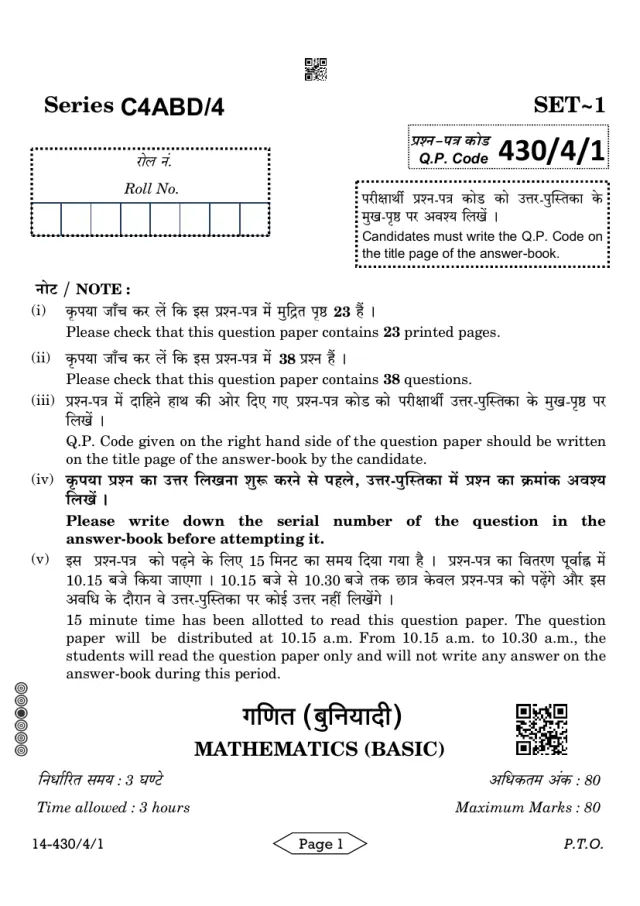
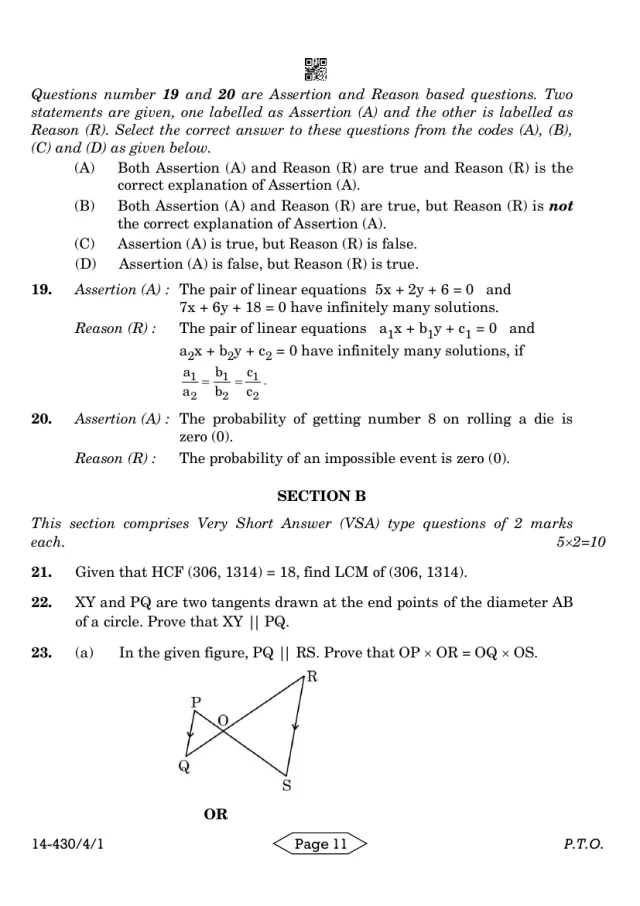
  • Cover page of the CBSE Class 10 Maths Basic 2024 paper, set 430/4/1

    Cover page

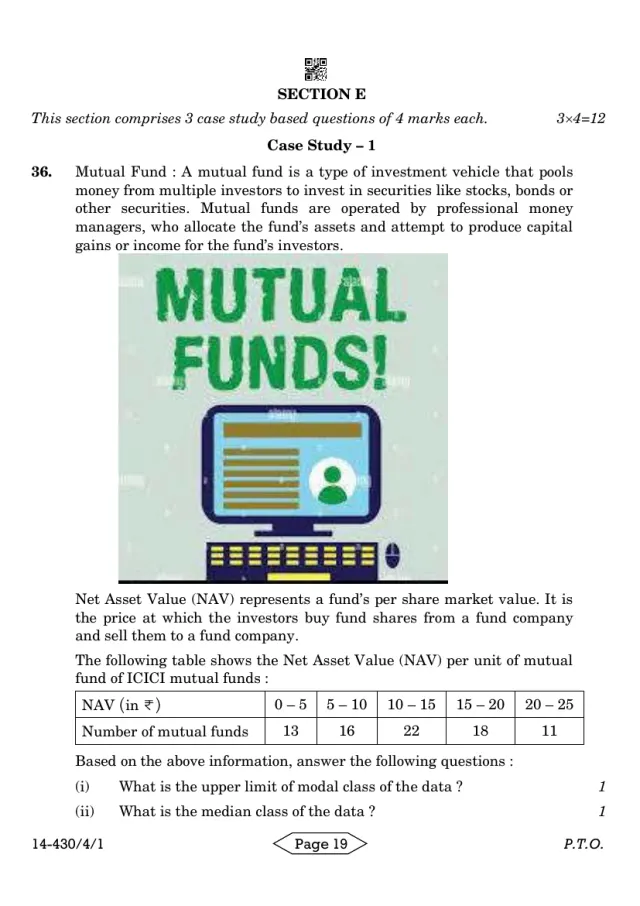
  • Section B of the CBSE Class 10 Maths Basic 2024 paper, set 430/4/1

    Section B

  • A case study with its figure from the CBSE Class 10 Maths Basic 2024 paper, set 430/4/1

    Case study

The main topics of this paper, in 1 minute

Your tutor walks you through the paper before you attempt it: the marks, the key ideas, the time plan and the traps.

1-minute paper analysis

With your tutor, in her voice

The main topics of this paper, in about a minute

A short, animated walk through the paper: how it is built, where the marks come from, the four ideas that matter most, how to plan your three hours, and the traps to avoid.

  1. 1The paper at a glance
  2. 2Where the marks come from
  3. 3Four ideas that keep paying off
  4. 4Plan your three hours
  5. 5Four traps to avoid

Sound on for the voice. Captions are shown, and you can mute any time.

Step-by-step solutions

Try each question first, then open its solution. Tap a number to jump.

Download solutions (PDF)

Section A: Multiple choice

20 questions, 1 mark each. MCQs (Q1 to Q18) and assertion-reason (Q19, Q20).

Q1Coordinate Geometry1 mark

The distance between the points (2,−1)(2, -1) and (−1,−5)(-1, -5) is:

  1. (A)15 units
  2. (B)5 units
  3. (C)25 units
  4. (D)41 units
Solution · answer (B)
  1. d=(−1−2)2+(−5+1)2=9+16=5d = \sqrt{(-1 - 2)^2 + (-5 + 1)^2} = \sqrt{9 + 16} = 5 units.

Answer: (B) 5 units

Report an error on this question
Q2Coordinate Geometry1 mark

If C(1,−1)C(1, -1) is the mid-point of the line segment ABAB joining points A(4,x)A(4, x) and B(−2,4)B(-2, 4), then value of xx is:

  1. (A)5
  2. (B)−5
  3. (C)6
  4. (D)−6
Solution · answer (D)
  1. The yy-coordinate of the mid-point: x+42=−1\dfrac{x + 4}{2} = -1, so x+4=−2x + 4 = -2 and x=−6x = -6. (Check the xx-coordinate: 4−22=1\dfrac{4 - 2}{2} = 1 ✓.)

Answer: (D) −6

Report an error on this question
Q3Probability1 mark

Which of the following relationship is correct?

  1. (A)P(E)=1+P(Eˉ)P(E) = 1 + P(\bar{E})
  2. (B)P(Eˉ)−P(E)=1P(\bar{E}) - P(E) = 1
  3. (C)P(E)+P(Eˉ)=1P(E) + P(\bar{E}) = 1
  4. (D)P(E)=2P(Eˉ)P(E) = 2P(\bar{E})
Solution · answer (C)
  1. An event and its complement together make the whole sample space: P(E)+P(Eˉ)=1P(E) + P(\bar{E}) = 1.

Answer: (C) P(E)+P(Eˉ)=1P(E) + P(\bar{E}) = 1

Report an error on this question
Q4Statistics1 mark

The following distribution gives the daily income of 50 workers of a factory. The lower limit of the modal class is:

Income (in ₹)400–424425–449450–474475–499500–524
Number of workers12148610
  1. (A)425
  2. (B)449
  3. (C)424.5
  4. (D)425.5
Solution · answer (C)
  1. The highest frequency is 1414, so the modal class is 425−449425 - 449.
  2. The classes have gaps (424424 then 425425), so they are first made continuous by subtracting 0.50.5 from each lower limit and adding 0.50.5 to each upper limit: the class becomes 424.5−449.5424.5 - 449.5. The lower limit is 424.5424.5.

Answer: (C) 424.5

Report an error on this question
Q5Trigonometry1 mark

A lamp post 99 m high casts a shadow 333\sqrt{3} m long on the ground. The Sun’s elevation at this moment is:

  1. (A)60∘60^\circ
  2. (B)90∘90^\circ
  3. (C)45∘45^\circ
  4. (D)30∘30^\circ
Solution · answer (A)
  1. tan⁡θ=933=3\tan\theta = \dfrac{9}{3\sqrt{3}} = \sqrt{3}, so θ=60∘\theta = 60^\circ.

Answer: (A) 60∘60^\circ

Report an error on this question
Q6Polynomials1 mark

If one zero of a quadratic polynomial kx2+4x+kkx^2 + 4x + k is 11, then the value of kk is:

  1. (A)2
  2. (B)−2
  3. (C)4
  4. (D)−4
Solution · answer (B)
  1. k(1)2+4(1)+k=0k(1)^2 + 4(1) + k = 0 gives 2k+4=02k + 4 = 0, so k=−2k = -2.

Answer: (B) −2

Report an error on this question
Q7Polynomials1 mark

The number of quadratic polynomials having zeroes −1-1 and 33 is:

  1. (A)1
  2. (B)2
  3. (C)3
  4. (D)more than 3
Solution · answer (D)
  1. k(x+1)(x−3)k(x + 1)(x - 3) has these zeroes for every non-zero constant kk, so there are infinitely many.

Answer: (D) more than 3

Report an error on this question
Q8Quadratic Equations1 mark

The roots of the quadratic equation x2−4=0x^2 - 4 = 0 is/are:

  1. (A)2 only
  2. (B)−2, 2
  3. (C)4 only
  4. (D)−4, 4
Solution · answer (B)
  1. x2=4x^2 = 4 gives x=2x = 2 or x=−2x = -2.

Answer: (B) −2, 2

Report an error on this question
Q9Quadratic Equations1 mark

Which of the following is **not** a quadratic equation?

  1. (A)(x−2)2+1=2x−3(x - 2)^2 + 1 = 2x - 3
  2. (B)(2x−1)(x−3)=(x+5)(x−1)(2x - 1)(x - 3) = (x + 5)(x - 1)
  3. (C)x(x+1)+8=(x+2)(x−2)x(x + 1) + 8 = (x + 2)(x - 2)
  4. (D)2x+3x=52x + \dfrac{3}{x} = 5
Solution · answer (C)
  1. (A) x2−4x+5=2x−3x^2 - 4x + 5 = 2x - 3 gives x2−6x+8=0x^2 - 6x + 8 = 0: quadratic. (B) 2x2−7x+3=x2+4x−52x^2 - 7x + 3 = x^2 + 4x - 5 gives x2−11x+8=0x^2 - 11x + 8 = 0: quadratic. (D) multiplying by xx gives 2x2−5x+3=02x^2 - 5x + 3 = 0: quadratic.
  2. (C) x2+x+8=x2−4x^2 + x + 8 = x^2 - 4 gives x+12=0x + 12 = 0, which is linear. So (C) is not quadratic.

Answer: (C) x(x+1)+8=(x+2)(x−2)x(x + 1) + 8 = (x + 2)(x - 2)

Report an error on this question
Q10Arithmetic Progressions1 mark

The common difference of an A.P., if a23−a19=32a_{23} - a_{19} = 32, is:

  1. (A)8
  2. (B)−8
  3. (C)−4
  4. (D)4
Solution · answer (A)
  1. a23−a19=(23−19)d=4d=32a_{23} - a_{19} = (23 - 19)d = 4d = 32, so d=8d = 8.

Answer: (A) 8

Report an error on this question
Q11Trigonometry1 mark

(1tan⁡2θ−1sin⁡2θ)\left(\dfrac{1}{\tan^2\theta} - \dfrac{1}{\sin^2\theta}\right) is equal to:

  1. (A)1
  2. (B)−1
  3. (C)sec⁡2θ\sec^2\theta
  4. (D)sin⁡2θ\sin^2\theta
Solution · answer (B)
  1. 1tan⁡2θ=cot⁡2θ\dfrac{1}{\tan^2\theta} = \cot^2\theta and 1sin⁡2θ=cosec⁡2θ\dfrac{1}{\sin^2\theta} = \operatorname{cosec}^2\theta, so the value is cot⁡2θ−cosec⁡2θ=−1\cot^2\theta - \operatorname{cosec}^2\theta = -1.

Answer: (B) −1

Report an error on this question
Q12Areas Related to Circles1 mark

The region between a chord and either of the two arcs of a circle is called:

  1. (A)an arc
  2. (B)a sector
  3. (C)a segment
  4. (D)a semicircle
Solution · answer (C)
  1. The region cut off by a chord, between the chord and an arc, is a segment (a sector is bounded by two radii and an arc).

Answer: (C) a segment

Report an error on this question
Q13Real Numbers1 mark

If 1080=2x×3y×51080 = 2^x \times 3^y \times 5, then (x−y)(x - y) is equal to:

  1. (A)6
  2. (B)−1
  3. (C)1
  4. (D)0
Solution · answer (D)
  1. 1080=23×33×51080 = 2^3 \times 3^3 \times 5, so x=3x = 3 and y=3y = 3. x−y=0x - y = 0.

Answer: (D) 0

Report an error on this question
Q14Circles1 mark

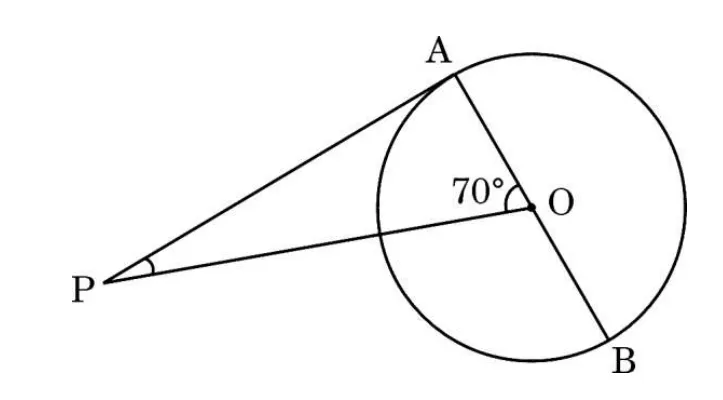
In the given figure, PAPA is a tangent from an external point PP to a circle with centre OO. If ∠AOP=70∘\angle AOP = 70^\circ, then the measure of ∠APO\angle APO is:

A circle with centre O and the diameter AB through O. The outside point P on the left is joined to A at the top by a tangent and to O. The angle AOP is marked 70 degrees.
  1. (A)70∘70^\circ
  2. (B)90∘90^\circ
  3. (C)110∘110^\circ
  4. (D)20∘20^\circ
Solution · answer (D)
70°OABP∠OAP = 90° → ∠APO = 180° − 90° − 70° = 20°
  1. OA⊥PAOA \perp PA (radius and tangent), so in the right triangle OAPOAP: ∠APO=180∘−90∘−70∘=20∘\angle APO = 180^\circ - 90^\circ - 70^\circ = 20^\circ.

Answer: (D) 20∘20^\circ

Report an error on this question
Q15Statistics1 mark

The median group in the following frequency distribution is:

Class0–1010–2020–3030–4040–5050–60
Frequency58201575
  1. (A)10 – 20
  2. (B)20 – 30
  3. (C)30 – 40
  4. (D)40 – 50
Solution · answer (B)
  1. N=60N = 60 and N2=30\dfrac{N}{2} = 30. Cumulative frequencies: 5,13,33,…5, 13, 33, \dots. The first one to reach 3030 is 3333, in the class 20−3020 - 30.

Answer: (B) 20 – 30

Report an error on this question
Q16Areas Related to Circles1 mark

In a circle of radius 2121 cm, if an arc subtends an angle of 60∘60^\circ at the centre of the circle, then the length of the arc is:

  1. (A)11 cm
  2. (B)44 cm
  3. (C)227\dfrac{22}{7} cm
  4. (D)22 cm
Solution · answer (D)
  1. Arc =60360×2×227×21=22= \dfrac{60}{360} \times 2 \times \dfrac{22}{7} \times 21 = 22 cm.

Answer: (D) 22 cm

Report an error on this question
Q17Circles1 mark

A tangent to a circle is a line that touches the circle at:

  1. (A)one point only
  2. (B)two points
  3. (C)three points
  4. (D)infinite number of points
Solution · answer (A)
  1. By definition, a tangent meets the circle at exactly one point.

Answer: (A) one point only

Report an error on this question
Q18Triangles1 mark

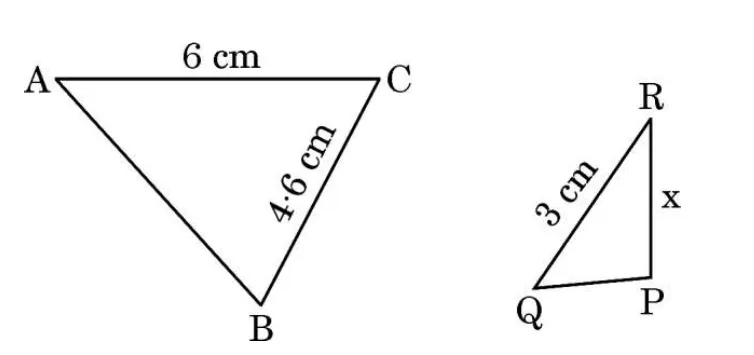
In the given figure, if △ABC∼△QPR\triangle ABC \sim \triangle QPR, then the value of xx is:

Two triangles. Triangle ABC has AC marked 6 cm and BC marked 4.6 cm. Triangle QPR is smaller, with QR marked 3 cm and PR marked x.
  1. (A)5.3 cm
  2. (B)4.6 cm
  3. (C)2.3 cm
  4. (D)4 cm
Solution · answer (C)
  1. △ABC∼△QPR\triangle ABC \sim \triangle QPR matches A↔QA \leftrightarrow Q, B↔PB \leftrightarrow P, C↔RC \leftrightarrow R. So AC↔QRAC \leftrightarrow QR and BC↔PRBC \leftrightarrow PR.
  2. ACQR=BCPR\dfrac{AC}{QR} = \dfrac{BC}{PR}: 63=4.6x\dfrac{6}{3} = \dfrac{4.6}{x}, so x=2.3x = 2.3 cm.

Answer: (C) 2.3 cm

Report an error on this question
Q19Linear Equations1 mark

Assertion (A): The pair of linear equations 5x+2y+6=05x + 2y + 6 = 0 and 7x+6y+18=07x + 6y + 18 = 0 have infinitely many solutions.

Reason (R): The pair of linear equations a1x+b1y+c1=0a_1x + b_1y + c_1 = 0 and a2x+b2y+c2=0a_2x + b_2y + c_2 = 0 have infinitely many solutions, if a1a2=b1b2=c1c2\dfrac{a_1}{a_2} = \dfrac{b_1}{b_2} = \dfrac{c_1}{c_2}.

  1. (A)Both A and R are true and R is the correct explanation of A
  2. (B)Both A and R are true, but R is not the correct explanation of A
  3. (C)A is true, but R is false
  4. (D)A is false, but R is true
Solution · answer (D)
  1. (R) This is the condition for coincident lines. True.
  2. (A) 57\dfrac{5}{7}, 26=13\dfrac{2}{6} = \dfrac{1}{3} and 618=13\dfrac{6}{18} = \dfrac{1}{3}: the first ratio is different, so the lines meet at one point. A has a unique solution, not infinitely many. False.

Answer: (D) A is false, but R is true

Report an error on this question
Q20Probability1 mark

Assertion (A): The probability of getting number 88 on rolling a die is zero (0)(0).

Reason (R): The probability of an impossible event is zero (0)(0).

  1. (A)Both A and R are true and R is the correct explanation of A
  2. (B)Both A and R are true, but R is not the correct explanation of A
  3. (C)A is true, but R is false
  4. (D)A is false, but R is true
Solution · answer (A)
  1. (R) An impossible event has no favourable outcomes, so its probability is 00. True.
  2. (A) A die has no face with 88, so it is an impossible event and P=0P = 0. True, and (R) is exactly why.

Answer: (A) Both A and R are true and R is the correct explanation of A

Report an error on this question

Section B: Very short answer

5 questions, 2 marks each.

Q21Real Numbers2 marks

Given that HCF(306,1314)=18\text{HCF}(306, 1314) = 18, find LCM(306,1314)\text{LCM}(306, 1314).

Solution
  1. HCF×LCM=\text{HCF} \times \text{LCM} = product of the numbers: LCM=306×131418=17×1314=22338\text{LCM} = \dfrac{306 \times 1314}{18} = 17 \times 1314 = 22338.

Answer: 22,33822{,}338

Report an error on this question
Q22Circles2 marks

XYXY and PQPQ are two tangents drawn at the end points of the diameter ABAB of a circle. Prove that XY∥PQXY \parallel PQ.

Solution
  1. Let OO be the centre; XYXY touches the circle at AA and PQPQ at BB. A tangent is perpendicular to the radius at the point of contact: ∠OAY=90∘\angle OAY = 90^\circ and ∠OBP=90∘\angle OBP = 90^\circ.
  2. These are alternate interior angles made by the transversal ABAB with XYXY and PQPQ, and they are equal. So XY∥PQXY \parallel PQ.

Answer: Proved

Report an error on this question
Q23Triangles2 marks

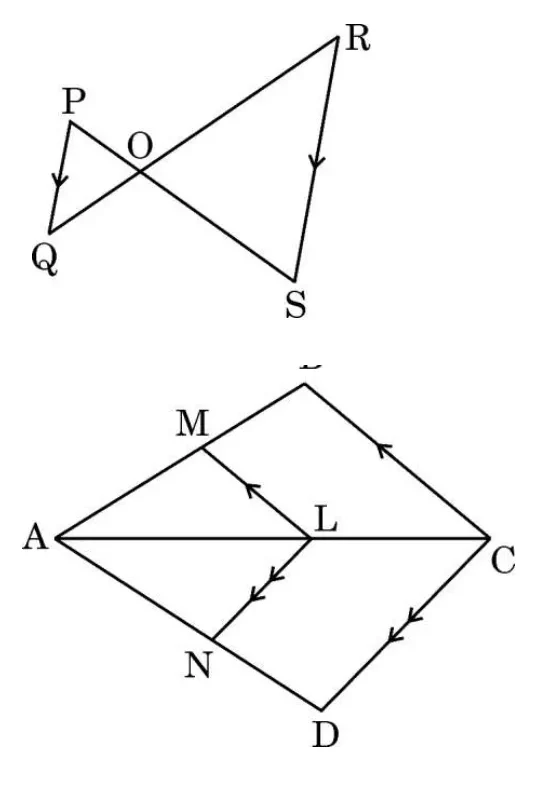
(a) In the given figure, PQ∥RSPQ \parallel RS. Prove that OP×OR=OQ×OSOP \times OR = OQ \times OS.

OR

(b) In the given figure, LM∥CBLM \parallel CB and LN∥CDLN \parallel CD. Prove that AMAN=ABAD\dfrac{AM}{AN} = \dfrac{AB}{AD}.

Two figures. First, two parallel segments PQ and RS with the lines PS and QR crossing at O. Second, a quadrilateral ABCD with the diagonal AC, a point L on AC, and the lines LM and LN drawn parallel to CB and CD, with M on AB and N on AD.
Solution
PQRSO△POQ ∼ △SOR (AA) → OP/OS = OQ/OR → OP × OR = OQ × OS
Sketch, not to scale.
  1. (a) In △POQ\triangle POQ and △SOR\triangle SOR: ∠POQ=∠SOR\angle POQ = \angle SOR (vertically opposite) and ∠OPQ=∠OSR\angle OPQ = \angle OSR (alternate angles, PQ∥SRPQ \parallel SR). By AA, △POQ∼△SOR\triangle POQ \sim \triangle SOR.
  2. So OPOS=OQOR\dfrac{OP}{OS} = \dfrac{OQ}{OR}, that is OP×OR=OQ×OSOP \times OR = OQ \times OS.
  3. (b) In △ABC\triangle ABC, LM∥CBLM \parallel CB, so AMAB=ALAC\dfrac{AM}{AB} = \dfrac{AL}{AC}. (i) In △ADC\triangle ADC, LN∥CDLN \parallel CD, so ANAD=ALAC\dfrac{AN}{AD} = \dfrac{AL}{AC}. (ii)
  4. From (i) and (ii): AMAB=ANAD\dfrac{AM}{AB} = \dfrac{AN}{AD}, hence AMAN=ABAD\dfrac{AM}{AN} = \dfrac{AB}{AD}.

Answer: Proved (both parts)

Report an error on this question
Q24Polynomials2 marks

(a) If α,β\alpha, \beta are zeroes of the polynomial 8x2+14x+38x^2 + 14x + 3, then find the value of (1α+1β)\left(\dfrac{1}{\alpha} + \dfrac{1}{\beta}\right).

OR

(b) Find a quadratic polynomial whose zeroes are −9-9 and 66.

Solution
  1. (a) α+β=−148=−74\alpha + \beta = -\dfrac{14}{8} = -\dfrac{7}{4} and αβ=38\alpha\beta = \dfrac{3}{8}. 1α+1β=α+βαβ=−7/43/8=−143\dfrac{1}{\alpha} + \dfrac{1}{\beta} = \dfrac{\alpha + \beta}{\alpha\beta} = \dfrac{-7/4}{3/8} = -\dfrac{14}{3}.
  2. (b) Sum =−9+6=−3= -9 + 6 = -3 and product =−54= -54. The polynomial is x2+3x−54x^2 + 3x - 54 (or k(x2+3x−54)k(x^2 + 3x - 54)).

Answer: (a) −143-\dfrac{14}{3}   (b) x2+3x−54x^2 + 3x - 54

Report an error on this question
Q25Trigonometry2 marks

Evaluate: sin⁡30∘cos⁡60∘+cos⁡30∘sin⁡60∘−cot⁡45∘\sin 30^\circ\cos 60^\circ + \cos 30^\circ\sin 60^\circ - \cot 45^\circ.

Solution
  1. 12×12+32×32−1=14+34−1=0\dfrac{1}{2} \times \dfrac{1}{2} + \dfrac{\sqrt{3}}{2} \times \dfrac{\sqrt{3}}{2} - 1 = \dfrac{1}{4} + \dfrac{3}{4} - 1 = 0.

Answer: 00

Report an error on this question

Section C: Short answer

6 questions, 3 marks each.

Q26Areas Related to Circles3 marks

A chord of a circle of radius 1010 cm subtends a right angle at the centre of the circle. Find the area of the corresponding (i) minor sector (ii) major sector. (Use π=3.14\pi = 3.14)

Solution
OABminor = 78.5 cm²major = 235.5 cm²314 − 78.5 = 235.5
  1. (i) Minor sector =90360×3.14×10×10=78.5= \dfrac{90}{360} \times 3.14 \times 10 \times 10 = 78.5 cm².
  2. (ii) Area of the circle =3.14×100=314= 3.14 \times 100 = 314 cm². Major sector =314−78.5=235.5= 314 - 78.5 = 235.5 cm².

Answer: (i) 78.578.5 cm²   (ii) 235.5235.5 cm²

Report an error on this question
Q27Circles3 marks

(a) Prove that opposite sides of a quadrilateral circumscribing a circle subtend supplementary angles at the centre of the circle.

OR

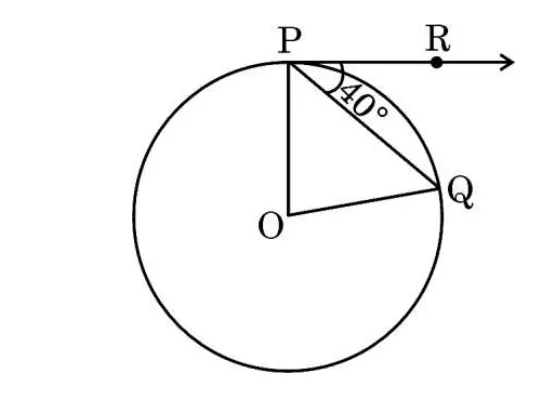
(b) If OO is the centre of a circle, PQPQ is a chord and the tangent PRPR at PP makes an angle of 40∘40^\circ with PQPQ, then find the measure of ∠POQ\angle POQ.

A circle with centre O, a chord PQ going down to the right from P at the top, and the tangent PR drawn horizontally to the right from P. The angle RPQ is marked 40 degrees.
Solution
40°OPQR80°∠OPQ = 90° − 40° = 50° = ∠OQP → ∠POQ = 80°
  1. (a) Let ABCDABCD circumscribe a circle with centre OO, touching AB,BC,CD,DAAB, BC, CD, DA at P,Q,R,SP, Q, R, S. In △AOP\triangle AOP and △AOS\triangle AOS: OAOA is common, OP=OSOP = OS (radii) and AP=ASAP = AS (tangents), so they are congruent (SSS) and ∠AOP=∠AOS\angle AOP = \angle AOS. In the same way at BB, CC and DD.
  2. The eight angles at OO add up to 360∘360^\circ and they come in four equal pairs: 2(∠AOP+∠BOP+∠COQ+∠DOR)=360∘2(\angle AOP + \angle BOP + \angle COQ + \angle DOR) = 360^\circ. So ∠AOB+∠COD=180∘\angle AOB + \angle COD = 180^\circ, and likewise ∠BOC+∠AOD=180∘\angle BOC + \angle AOD = 180^\circ.
  3. (b) OP⊥PROP \perp PR, so ∠OPQ=90∘−40∘=50∘\angle OPQ = 90^\circ - 40^\circ = 50^\circ. OP=OQOP = OQ (radii), so ∠OQP=50∘\angle OQP = 50^\circ.
  4. In △POQ\triangle POQ: ∠POQ=180∘−50∘−50∘=80∘\angle POQ = 180^\circ - 50^\circ - 50^\circ = 80^\circ.

Answer: (a) proved   (b) 80∘80^\circ

Report an error on this question
Q28Quadratic Equations3 marks

(a) Using quadratic formula, find the real roots of the equation 2x2+2x+9=02x^2 + 2x + 9 = 0, if they exist.

OR

(b) Find the values of ‘kk’ for which the quadratic equation kx2−2kx+6=0kx^2 - 2kx + 6 = 0 has real and equal roots. Also, find the roots.

Solution
  1. (a) D=22−4(2)(9)=4−72=−68<0D = 2^2 - 4(2)(9) = 4 - 72 = -68 < 0, so the equation has no real roots.
  2. (b) Equal roots need D=4k2−24k=4k(k−6)=0D = 4k^2 - 24k = 4k(k - 6) = 0, so k=0k = 0 or k=6k = 6. For k=0k = 0 the equation is 6=06 = 0, not a quadratic, so k=6k = 6.
  3. Then 6x2−12x+6=06x^2 - 12x + 6 = 0, that is x2−2x+1=(x−1)2=0x^2 - 2x + 1 = (x - 1)^2 = 0 and the root is x=1x = 1 (twice).

Answer: (a) no real roots   (b) k=6k = 6; roots 1,11, 1

Report an error on this question
Q29Probability3 marks

One card is drawn at random from a well-shuffled deck of 52 playing cards. Find the probability that the card drawn is: (i) a red king. (ii) not a black card. (iii) an ace of hearts.

Solution
  1. (i) There are 22 red kings: P=252=126P = \dfrac{2}{52} = \dfrac{1}{26}.
  2. (ii) Not black means red: 2626 cards. P=2652=12P = \dfrac{26}{52} = \dfrac{1}{2}.
  3. (iii) There is one ace of hearts: P=152P = \dfrac{1}{52}.

Answer: (i) 126\dfrac{1}{26}   (ii) 12\dfrac{1}{2}   (iii) 152\dfrac{1}{52}

Report an error on this question
Q30Real Numbers3 marks

Prove that 2+532 + 5\sqrt{3} is an irrational number, if it is given that 3\sqrt{3} is an irrational number.

Solution
  1. Suppose x=2+53x = 2 + 5\sqrt{3} is rational. Then 3=x−25\sqrt{3} = \dfrac{x - 2}{5}, which is rational.
  2. This contradicts the given fact that 3\sqrt{3} is irrational, so 2+532 + 5\sqrt{3} is irrational.

Answer: Proved

Report an error on this question
Q31Trigonometry3 marks

Prove that: (tan⁡A+sec⁡A)2+(tan⁡A−sec⁡A)2=2(1+sin⁡2A1−sin⁡2A)(\tan A + \sec A)^2 + (\tan A - \sec A)^2 = 2\left(\dfrac{1 + \sin^2 A}{1 - \sin^2 A}\right).

Solution
  1. LHS =tan⁡2A+2tan⁡Asec⁡A+sec⁡2A+tan⁡2A−2tan⁡Asec⁡A+sec⁡2A=2tan⁡2A+2sec⁡2A= \tan^2 A + 2\tan A\sec A + \sec^2 A + \tan^2 A - 2\tan A\sec A + \sec^2 A = 2\tan^2 A + 2\sec^2 A.
  2. =2(sin⁡2Acos⁡2A+1cos⁡2A)=2 1+sin⁡2Acos⁡2A=2 1+sin⁡2A1−sin⁡2A== 2\left(\dfrac{\sin^2 A}{\cos^2 A} + \dfrac{1}{\cos^2 A}\right) = 2\,\dfrac{1 + \sin^2 A}{\cos^2 A} = 2\,\dfrac{1 + \sin^2 A}{1 - \sin^2 A} = RHS.

Answer: Proved

Report an error on this question

Section D: Long answer

4 questions, 5 marks each.

Q32Surface Areas and Volumes5 marks

(a) Two cubes each of volume 125125 cm³ are joined end to end. Find the volume and the surface area of the resulting cuboid.

OR

(b) A solid is in the shape of a cone surmounted on a hemisphere with both their diameters being equal to 77 cm and the height of the cone is equal to its radius. Find the volume of the solid.

Solution
10 cm5V = 250 cm³; SA = 2(50 + 25 + 50) = 250 cm²
  1. (a) Each cube has side 1253=5\sqrt[3]{125} = 5 cm. The cuboid is 10×5×510 \times 5 \times 5 cm. Volume =2×125=250= 2 \times 125 = 250 cm³.
  2. Surface area =2(lb+bh+hl)=2(10×5+5×5+5×10)=2×125=250= 2(lb + bh + hl) = 2(10 \times 5 + 5 \times 5 + 5 \times 10) = 2 \times 125 = 250 cm².
  3. (b) r=72r = \dfrac{7}{2} cm and the cone height h=72h = \dfrac{7}{2} cm. Volume =23πr3+13πr2h=πr3= \dfrac{2}{3}\pi r^3 + \dfrac{1}{3}\pi r^2 h = \pi r^3 (since h=rh = r).
  4. =227×3438=5394=134.75= \dfrac{22}{7} \times \dfrac{343}{8} = \dfrac{539}{4} = 134.75 cm³.

Answer: (a) 250250 cm³ and 250250 cm²   (b) 5394=134.75\dfrac{539}{4} = 134.75 cm³

Report an error on this question
Q33Trigonometry5 marks

A contractor plans to install two slides for the children to play in a park. For the children below the age of 66 years, he prefers to have a slide whose top is at a height of 2.02.0 m and is inclined at an angle of 30∘30^\circ to the ground, whereas for older children, he wants to have a steep slide at a height of 4.04.0 m and inclined at an angle of 60∘60^\circ to the ground. What would be the length of the slide in each case?

Solution
30°ABC2 mslide = 4 myounger: 4 m; older: 8/√3 ≈ 4.62 m
  1. Younger children: in the right triangle with height 22 m and angle 30∘30^\circ: sin⁡30∘=2AC=12\sin 30^\circ = \dfrac{2}{AC} = \dfrac{1}{2}, so AC=4AC = 4 m.
  2. Older children: height 44 m and angle 60∘60^\circ: sin⁡60∘=4PR=32\sin 60^\circ = \dfrac{4}{PR} = \dfrac{\sqrt{3}}{2}, so PR=83=833≈4.62PR = \dfrac{8}{\sqrt{3}} = \dfrac{8\sqrt{3}}{3} \approx 4.62 m.

Answer: 44 m and 833≈4.62\dfrac{8\sqrt{3}}{3} \approx 4.62 m

Report an error on this question
Q34Triangles5 marks

(a) If BDBD and QMQM are medians of triangles ABCABC and PQRPQR, respectively, where △ABC∼△PQR\triangle ABC \sim \triangle PQR, prove that ABPQ=BDQM\dfrac{AB}{PQ} = \dfrac{BD}{QM}.

OR

(b) CDCD and GHGH are respectively the bisectors of ∠ACB\angle ACB and ∠EGF\angle EGF such that DD and HH lie on sides ABAB and FEFE of △ABC\triangle ABC and △FEG\triangle FEG respectively. If △ABC∼△FEG\triangle ABC \sim \triangle FEG, show that: (i) CDGH=ACFG\dfrac{CD}{GH} = \dfrac{AC}{FG} (ii) △DCB∼△HGE\triangle DCB \sim \triangle HGE.

Solution
  1. (a) △ABC∼△PQR\triangle ABC \sim \triangle PQR gives ABPQ=ACPR\dfrac{AB}{PQ} = \dfrac{AC}{PR} and ∠A=∠P\angle A = \angle P. BDBD and QMQM are medians, so AC=2ADAC = 2AD and PR=2PMPR = 2PM: ABPQ=ADPM\dfrac{AB}{PQ} = \dfrac{AD}{PM}.
  2. In △ABD\triangle ABD and △PQM\triangle PQM: ABPQ=ADPM\dfrac{AB}{PQ} = \dfrac{AD}{PM} and ∠A=∠P\angle A = \angle P. By SAS, △ABD∼△PQM\triangle ABD \sim \triangle PQM, so ABPQ=BDQM\dfrac{AB}{PQ} = \dfrac{BD}{QM}.
  3. (b)(i) △ABC∼△FEG\triangle ABC \sim \triangle FEG gives ∠ACB=∠FGE\angle ACB = \angle FGE, and halving, ∠1=∠3\angle 1 = \angle 3 and ∠2=∠4\angle 2 = \angle 4 (the bisected halves). Also ∠A=∠F\angle A = \angle F. In △ACD\triangle ACD and △FGH\triangle FGH: ∠A=∠F\angle A = \angle F and ∠1=∠3\angle 1 = \angle 3, so △ACD∼△FGH\triangle ACD \sim \triangle FGH (AA) and CDGH=ACFG\dfrac{CD}{GH} = \dfrac{AC}{FG}.
  4. (ii) In △DCB\triangle DCB and △HGE\triangle HGE: ∠B=∠E\angle B = \angle E (from the similarity) and ∠2=∠4\angle 2 = \angle 4. By AA, △DCB∼△HGE\triangle DCB \sim \triangle HGE.

Answer: Proved (both parts)

Report an error on this question
Q35Arithmetic Progressions5 marks

A manufacturer of TV sets produced 720 TV sets in the fourth year and 880 TV sets in the eighth year. Assuming that the production increases uniformly by a fixed number every year, find the production in the tenth year and the total production in the first seven years.

Solution
  1. Let the first year’s production be aa and the yearly increase dd. a4=a+3d=720a_4 = a + 3d = 720 (i) and a8=a+7d=880a_8 = a + 7d = 880 (ii).
  2. (ii) −- (i): 4d=1604d = 160, so d=40d = 40 and a=600a = 600.
  3. Production in the 10th10^{\text{th}} year =a10=600+9×40=960= a_{10} = 600 + 9 \times 40 = 960.
  4. Total in the first 77 years =S7=72[2(600)+6(40)]=72×1440=5040= S_7 = \dfrac{7}{2}[2(600) + 6(40)] = \dfrac{7}{2} \times 1440 = 5040.

Answer: 960960 TV sets in the 10th10^{\text{th}} year; 50405040 in the first 77 years

Report an error on this question

Section E: Case studies

3 case studies, 4 marks each.

Q36Statistics4 marks

Case study 1. Mutual Fund: A mutual fund is a type of investment vehicle that pools money from multiple investors to invest in securities like stocks, bonds or other securities. Net Asset Value (NAV) represents a fund’s per share market value. The following table shows the Net Asset Value (NAV) per unit of mutual fund of ICICI mutual funds:

Based on the above information, answer the following questions:

(i) What is the upper limit of modal class of the data? [1]

(ii) What is the median class of the data? [1]

(iii) (a) What is the mode NAV of mutual funds? [2]

OR

(iii) (b) What is the median NAV of mutual funds? [2]

NAV (in ₹)0–55–1010–1515–2020–25
Number of mutual funds1316221811
Solution
  1. (i) The highest frequency is 2222, so the modal class is 10−1510 - 15 and its upper limit is 1515.
  2. (ii) N=80N = 80 and N2=40\dfrac{N}{2} = 40. Cumulative frequencies: 13,29,51,69,8013, 29, 51, 69, 80. The median class is 10−1510 - 15.
  3. (iii)(a) l=10l = 10, f1=22f_1 = 22, f0=16f_0 = 16, f2=18f_2 = 18, h=5h = 5. Mode =10+22−1644−16−18×5=10+610×5=13= 10 + \dfrac{22 - 16}{44 - 16 - 18} \times 5 = 10 + \dfrac{6}{10} \times 5 = 13.
  4. (iii)(b) Median =l+N2−cff×h=10+40−2922×5=10+2.5=12.5= l + \dfrac{\frac{N}{2} - cf}{f} \times h = 10 + \dfrac{40 - 29}{22} \times 5 = 10 + 2.5 = 12.5.

Answer: (i) 1515   (ii) 10−1510 - 15   (iii)(a) 1313   (iii)(b) 12.512.5

Report an error on this question
Q37Coordinate Geometry4 marks

Case study 2. Resident Welfare Association (RWA) of Gulmohar Society in Delhi, have installed three electric poles A, B and C in the society’s common park. Despite these three poles, some parts of the park are still in the dark. So, RWA decides to have one more electric pole D in the park. The park can be modelled as a coordinate system given below.

On the basis of the above information, answer the following questions:

(i) What is the position of the pole C? [1]

(ii) What is the distance of the pole B from the corner O of the park? [1]

(iii) (a) Find the position of the fourth pole D so that the four points A, B, C and D form a parallelogram ABCD. [2]

OR

(iii) (b) Find the distance between poles A and C. [2]
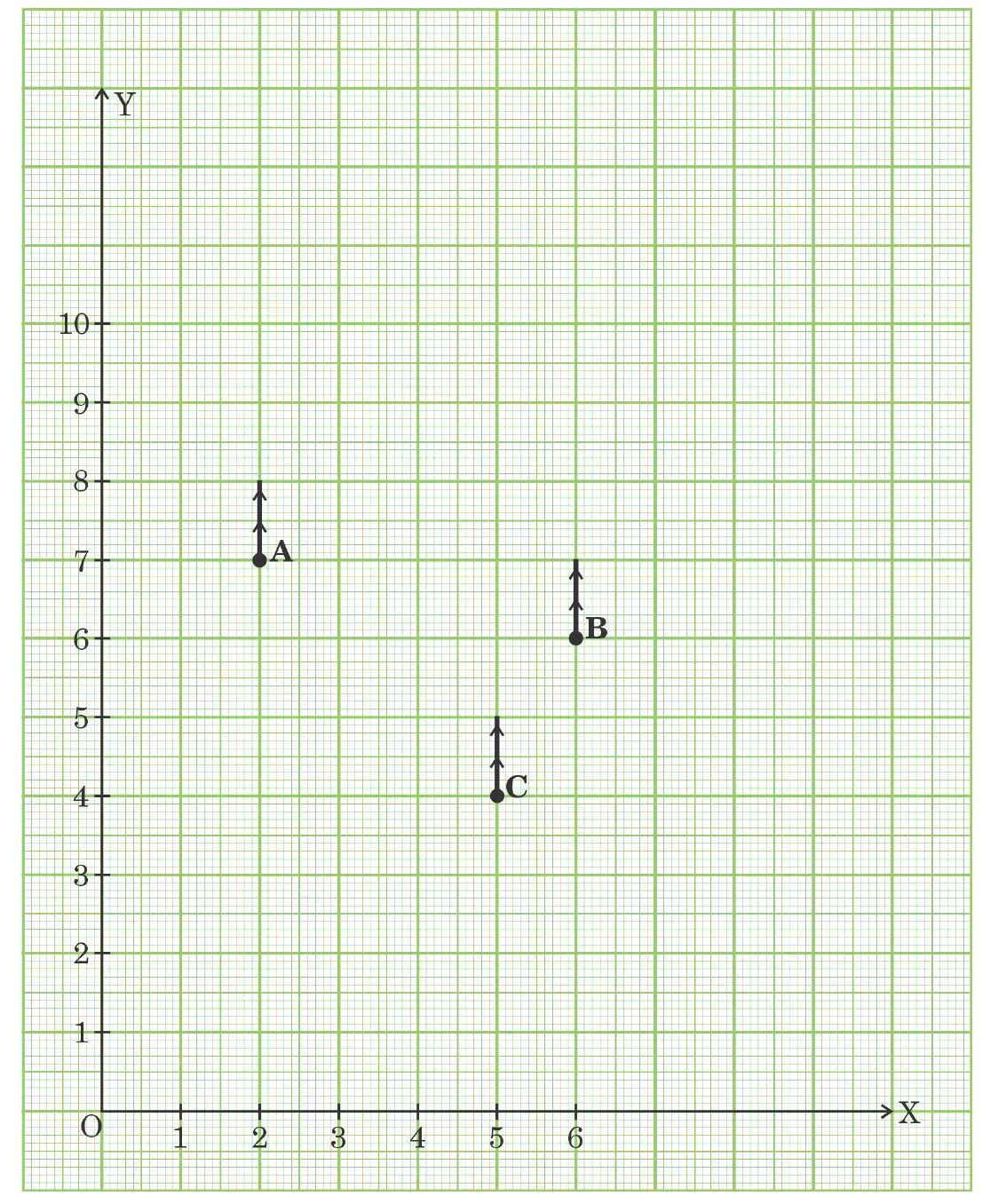
A coordinate grid with the origin O at the bottom left and axes X and Y. Three poles are marked: A at (2, 7), B at (6, 6) and C at (5, 4).
Solution
12345678123456789OxyA(2, 7)B(6, 6)C(5, 4)D(1, 5)
  1. (i) Reading the grid, C=(5,4)C = (5, 4).
  2. (ii) B=(6,6)B = (6, 6), so BO=62+62=72=62BO = \sqrt{6^2 + 6^2} = \sqrt{72} = 6\sqrt{2} units.
  3. (iii)(a) A(2,7)A(2, 7), B(6,6)B(6, 6), C(5,4)C(5, 4). In the parallelogram ABCDABCD the diagonals bisect each other: the mid-point of ACAC equals the mid-point of BDBD. (2+52,7+42)=(6+x2,6+y2)\left(\dfrac{2 + 5}{2}, \dfrac{7 + 4}{2}\right) = \left(\dfrac{6 + x}{2}, \dfrac{6 + y}{2}\right), so x=1x = 1 and y=5y = 5. D=(1,5)D = (1, 5).
  4. (iii)(b) AC=(5−2)2+(4−7)2=9+9=32AC = \sqrt{(5 - 2)^2 + (4 - 7)^2} = \sqrt{9 + 9} = 3\sqrt{2} units.

Answer: (i) (5,4)(5, 4)   (ii) 626\sqrt{2}   (iii)(a) D(1,5)D(1, 5)   (iii)(b) 323\sqrt{2}

Report an error on this question
Q38Linear Equations4 marks

Case study 3. Deepankar bought 3 notebooks and 2 pens for ₹ 80 and his friend Suryansh bought 4 notebooks and 3 pens for ₹ 110 from the school bookshop.

Based on the above information, answer the following questions:

(i) If the price of one notebook be ₹ x and the price of one pen be ₹ y, write the given situation algebraically. [1]

(ii) (a) What is the price of one notebook? [2]

OR

(ii) (b) What is the price of one pen? [2]

(iii) What is the total amount to be paid by Suryansh, if he purchases 6 notebooks and 3 pens? [1]

A photo of a desk with piles of books, an open notebook with reading glasses, and a pot of coloured pencils.
Solution
  1. (i) 3x+2y=803x + 2y = 80 and 4x+3y=1104x + 3y = 110.
  2. (ii) Multiply the first by 33 and the second by 22: 9x+6y=2409x + 6y = 240 and 8x+6y=2208x + 6y = 220. Subtracting, x=20x = 20. Then 2y=80−60=202y = 80 - 60 = 20 and y=10y = 10.
  3. (a) A notebook costs ₹ 2020. (b) A pen costs ₹ 1010.
  4. (iii) 6×20+3×10=120+30=₹1506 \times 20 + 3 \times 10 = 120 + 30 = ₹150.

Answer: (i) 3x+2y=803x + 2y = 80, 4x+3y=1104x + 3y = 110   (ii)(a) ₹ 2020   (ii)(b) ₹ 1010   (iii) ₹ 150150

Report an error on this question

Questions are from the official CBSE paper. Figures are described in words; see the PDF for the originals. Solutions are written by CogniGuru.

Revise this paper in 1 minute a chapter

Each chapter below is what the paper tested, with a one-minute animated lesson on the idea behind it.

Stuck on a step in any solution?

The CogniGuru AI tutor explains any doubt one minute at a time, in English or Hindi. Join the waitlist.

Mock quiz: 5 questions from this paper

Five real questions from this paper, one each from five chapters. About 2 minutes. See how much you know and where you stand among other students. Attempt free, with no login; log in only for your ranking and full report.

Question 1 of 5 · Q1 of the paperCoordinate Geometry

The distance between the points (2,−1)(2, -1) and (−1,−5)(-1, -5) is:

0 of 5 answered

Related papers

Common questions

Are these the official CBSE Class 10 Maths Basic 2024 questions?
Yes. The questions are from the official Mathematics (Basic) paper (set 430/4/1) that CBSE published after the March 2024 board exam. The solutions are written by CogniGuru and checked against the answer key CBSE published for this paper code.
Can I download the CBSE Class 10 Maths Basic 2024 question paper PDF?
Yes, the official paper PDF is free to download from this page, and so are our step-by-step solutions as a PDF. No login is needed to download either or to read the solutions.
Do all sets of the paper have the same questions?
No. CBSE sets several versions of each paper, with the same blueprint and similar questions in a different order and sometimes with different numbers. This page covers set 430/4/1.
How does the quiz work, and what does “where you stand” mean?
It is a mock quiz of 5 real multiple-choice questions from this paper, scored automatically in about 2 minutes. Your score is compared, anonymously, with other students who took the same quiz. Only the score is stored with the comparison, never your name or number.

Source

CBSE question paper archive, Class X, 2024 (Mathematics (Basic), set 430/4/1)
PDF