
Q1Real Numbers1 mark
for the numbers and is:
- (A)12
- (B)120
- (C)1200
- (D)40
The official board paper (Q.P. Code 430/5/1, Series 15). Free paper PDF and step-by-step solutions (also as a PDF to download) written by CogniGuru and checked against CBSE’s answer key. See the paper’s main topics in 1 minute, then quiz yourself to see how much you know and where you stand.
No login to download or read the solutions. Login only to see your quiz report in full.
Three pages of the official paper. Download the PDF for all 23.
Cover page
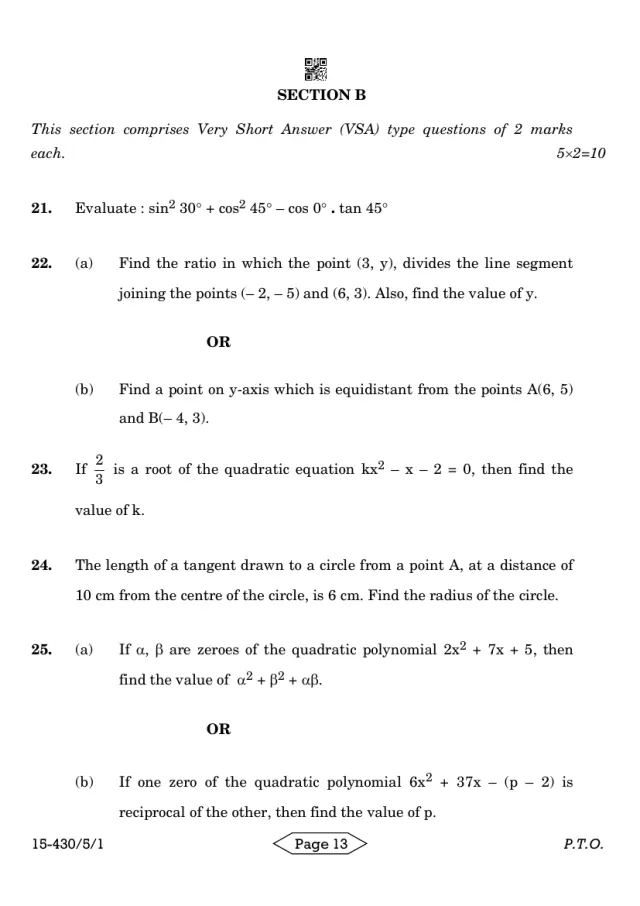
Section B
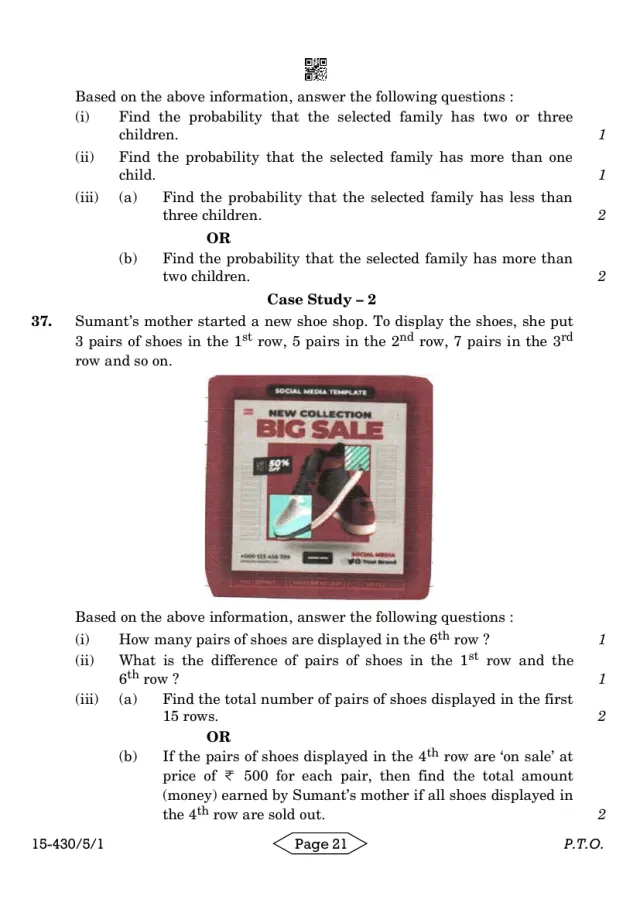
Case study
Your tutor walks you through the paper before you attempt it: the marks, the key ideas, the time plan and the traps.

1-minute paper analysis
With your tutor, in her voice
A short, animated walk through the paper: how it is built, where the marks come from, the four ideas that matter most, how to plan your three hours, and the traps to avoid.
Sound on for the voice. Captions are shown, and you can mute any time.
Try each question first, then open its solution. Tap a number to jump.
20 questions, 1 mark each. MCQs (Q1 to Q18) and assertion-reason (Q19, Q20).
for the numbers and is:
The roots of the quadratic equation are:
The pair of linear equations and have a unique solution, if:
If the mean and mode of a frequency distribution are 28 and 16 respectively, then its median is:
A die is rolled once. What is the probability of getting an odd prime number?
Answer: (B)
Report an error on this questionIf the area of a sector of a circle is of the area of the circle, then the central angle of the sector is:
Prime factorisation of is:
If is a whole number, then ends with an even digit, except for which value of ?
Answer: (D) 0
Report an error on this questionA tree casts a shadow m long on the ground, when the angle of elevation of the Sun is . The height of the tree is:
is equal to:
If , where is an acute angle, then the value of is:
The length of an arc of a circle with radius cm is cm. The central angle subtended by this arc at the centre, is:
If the angle between the two radii of a circle is , then the angle between the tangents at the ends of these radii, is:
Answer: (A)
Report an error on this questionThe discriminant of the quadratic equation is:
The mid-point of the line segment joining and is:
and are tangents drawn from an external point to a circle with centre and inclined to each other at an angle of . If the length of each tangent is cm, then the radius of the circle is:
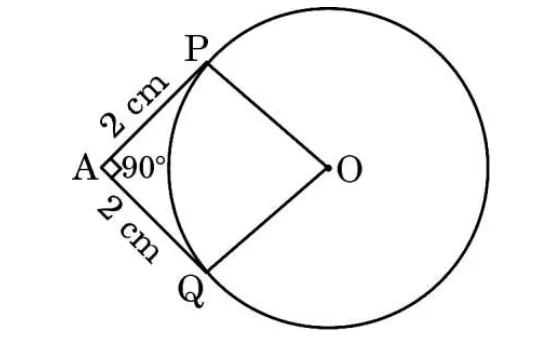
Answer: (B) 2 cm
Report an error on this questionIt is given that . If , , then is:
In the given figure, in , . If cm, cm, cm, cm, then the value of is:
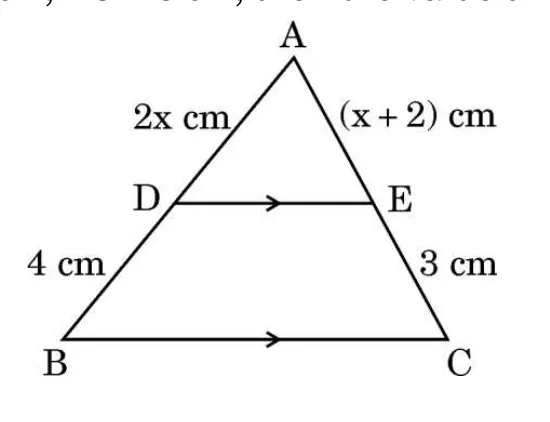
Assertion (A): The probability of getting number on rolling a die is zero .
Reason (R): The probability of an impossible event is zero .
Answer: (A) Both A and R are true and R is the correct explanation of A
Report an error on this questionAssertion (A): Common difference of the A.P. is .
Reason (R): Common difference of the A.P. is obtained by .
Answer: (D) A is false, but R is true
Report an error on this question5 questions, 2 marks each.
Evaluate: .
(a) Find the ratio in which the point divides the line segment joining the points and . Also, find the value of .
OR
(b) Find a point on -axis which is equidistant from the points and .
Answer: (a) ratio , (b)
Report an error on this questionIf is a root of the quadratic equation , then find the value of .
The length of a tangent drawn to a circle from a point , at a distance of cm from the centre of the circle, is cm. Find the radius of the circle.
Answer: cm
Report an error on this question(a) If are zeroes of the quadratic polynomial , then find the value of .
OR
(b) If one zero of the quadratic polynomial is reciprocal of the other, then find the value of .
Answer: (a) (b)
Report an error on this question6 questions, 3 marks each.
Prove that is an irrational number, given that is an irrational number.
Answer: Proved
Report an error on this questionFind the zeroes of the quadratic polynomial and verify the relationship between the zeroes and the coefficients of the polynomial.
Prove that: .
(a) Prove that the parallelogram circumscribing a circle is a rhombus.
OR
(b) Prove that the lengths of the tangents drawn from an external point to a circle are equal.
Answer: Proved (both parts)
Report an error on this question(a) A horse is tied with a m long rope at one corner of an equilateral triangular field having side m. Find the area of the field where the horse cannot graze.
OR
(b) The length of the minute hand of a clock is cm. Find the area swept by the minute hand between am and am.
Answer: (a) m² (b) cm²
Report an error on this questionFind the coordinates of the points of trisection of the line segment joining the points and .
4 questions, 5 marks each.
(a) A toy is in the form of a cone of radius cm mounted on a hemisphere of same radius. The total height of the toy is cm. Find the surface area of the toy.
OR
(b) A wooden article was made by scooping out a hemisphere from each end of a solid cylinder. If the height of the cylinder is cm and its base is of radius cm, then find the total surface area of the article.
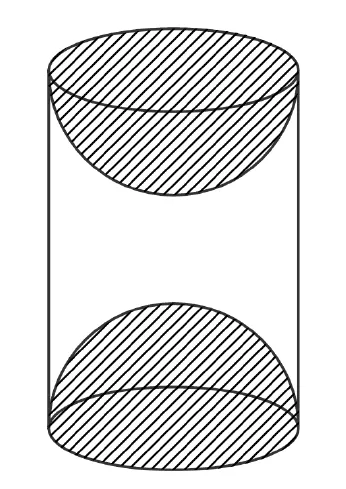
Answer: (a) cm² (b) cm²
Report an error on this questionThe ratio of monthly incomes of two persons is 9 : 7 and the ratio of their expenditures is 4 : 3. If each of them manages to save ₹ 2,000 per month, then find their monthly incomes.
Answer: ₹ and ₹
Report an error on this question(a) Sides , and median of are respectively proportional to sides , and median of . Show that .
OR
(b) Prove that if a line is drawn parallel to one side of a triangle to intersect the other two sides at distinct points, then the other two sides are divided in the same ratio.
Answer: Proved (both parts)
Report an error on this questionThe following frequency distribution table gives the monthly consumption of electricity of 70 consumers of a locality. Find the median of the data.
| Monthly consumption (in units) | 65–85 | 85–105 | 105–125 | 125–145 | 145–165 | 165–185 | 185–205 |
|---|---|---|---|---|---|---|---|
| Number of consumers | 7 | 8 | 7 | 20 | 14 | 9 | 5 |
Answer: units
Report an error on this question3 case studies, 4 marks each.
Case study 1. Family structure: In a recent survey of this year, 51% of the families in the United States of America had no children, 20% had one child, 19% had two children, 7% had three children and 3% had four or more children. A family is selected at random.
Based on the above information, answer the following questions:
(i) Find the probability that the selected family has two or three children. [1]
(ii) Find the probability that the selected family has more than one child. [1]
(iii) (a) Find the probability that the selected family has less than three children. [2]
OR
(iii) (b) Find the probability that the selected family has more than two children. [2]

Answer: (i) (ii) (iii)(a) (iii)(b)
Report an error on this questionCase study 2. Sumant’s mother started a new shoe shop. To display the shoes, she put 3 pairs of shoes in the 1st row, 5 pairs in the 2nd row, 7 pairs in the 3rd row and so on.
Based on the above information, answer the following questions:
(i) How many pairs of shoes are displayed in the 6th row? [1]
(ii) What is the difference of pairs of shoes in the 1st row and the 6th row? [1]
(iii) (a) Find the total number of pairs of shoes displayed in the first 15 rows. [2]
OR
(iii) (b) If the pairs of shoes displayed in the 4th row are ‘on sale’ at price of ₹ 500 for each pair, then find the total amount (money) earned by Sumant’s mother if all shoes displayed in the 4th row are sold out. [2]

Answer: (i) (ii) (iii)(a) pairs (iii)(b) ₹
Report an error on this questionCase study 3. Two poles of different heights stand on level ground and at a distance of 40 m. Both poles are supported by wires attached from the top of each pole to the bottom of the other. A coupling is placed at point C, where the two wires cross (as shown in the figure; the angle at A to the top Q of the taller pole is 60° and the angle at P to the top B of the shorter pole is 30°).
Based on the above information, answer the following questions:
(i) Find the height of pole AB. [1]
(ii) Find the height of pole PQ. [1]
(iii) (a) If the angle of elevation of the top of the pole PQ from the top of the pole AB is 30°, find the distance BQ. [2]
OR
(iii) (b) If the coupling is at a height of 20 m from the ground, how far down the wire from the smaller pole AB is the coupling? [2]
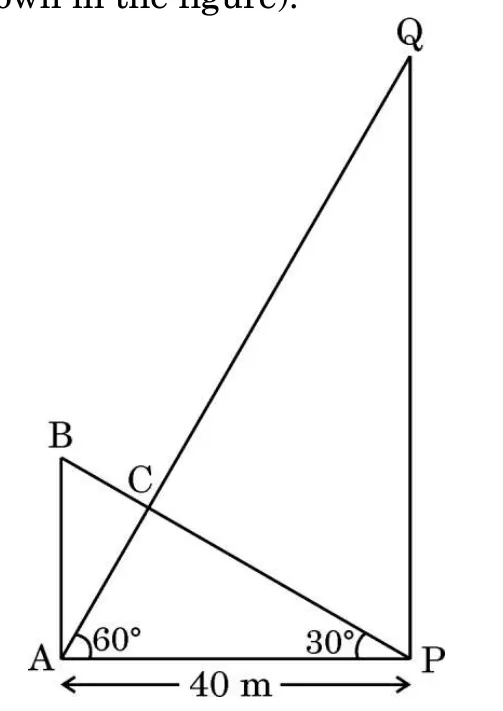
Answer: (i) m (ii) m (iii)(a) m (iii)(b) m
Report an error on this questionQuestions are from the official CBSE paper. Figures are described in words; see the PDF for the originals. Solutions are written by CogniGuru.
Each chapter below is what the paper tested, with a one-minute animated lesson on the idea behind it.
Trigonometry
Q9, Q10, Q11, Q21, Q28, Q38 (12 marks): standard values and the identity sin² + cos² = 1.
How to remember trig values at 0°, 30°, 45°, 60°, 90° — Class 10Circles
Q13, Q16, Q24, Q29 (7 marks): a tangent is perpendicular to the radius, and tangents from one point are equal.
Why is a tangent perpendicular to the radius? — Class 10Triangles
Q17, Q18, Q34 (7 marks): similarity criteria, matching angles by sides, and the Basic Proportionality Theorem.
Why are two equal angles enough to prove triangles similar (AA)? — Class 10Congruence vs Similarity — why equal angles alone prove nothingReal Numbers
Q1, Q7, Q8, Q26 (6 marks): HCF and LCM, rational and irrational numbers, and proofs of irrationality.
Rational vs Irrational Numbers — is 22/7 actually equal to π?Why is √2 irrational? The proof — Class 10Linear Equations
Q3, Q33 (6 marks): solving a pair of equations, graphing it, and when a pair is consistent.
When do two linear equations have no solution? — Class 10Statistics
Q4, Q35 (6 marks): mean, median and mode of grouped data.
Mean vs Median vs Mode — why one outlier can lie to youProbability
Q5, Q19, Q36 (6 marks): favourable outcomes over total outcomes, and sure events.
Why is probability always between 0 and 1? — Class 10Coordinate Geometry
Q15, Q22, Q31 (6 marks): the distance, mid-point and section formulas.
Why is the distance formula just Pythagoras? — Class 10Midpoint Formula vs Section Formula — Class 10Arithmetic Progressions
Q20, Q37 (5 marks): the nth term and the sum of n terms.
Arithmetic vs Geometric Progression — why doubling always wins eventuallyPolynomials
Q25, Q27 (5 marks): zeroes, their sum and product, and reading zeroes from a graph.
Why is the sum of zeroes −b/a and the product c/a? — Class 10Quadratic Equations
Q2, Q14, Q23 (4 marks): the discriminant, standard form and solving by factorising.
Why does a quadratic have at most two real roots? — Class 10Stuck on a step in any solution?
The CogniGuru AI tutor explains any doubt one minute at a time, in English or Hindi. Join the waitlist.
Five real questions from this paper, one each from five chapters. About 2 minutes. See how much you know and where you stand among other students. Attempt free, with no login; log in only for your ranking and full report.
for the numbers and is:
0 of 5 answered