CBSE · Class 10 · Mathematics (Standard) · Free

CBSE Class 10 Maths Standard 2024 Question Paper (Set 30/2/1) with Solutions

The official board paper (Q.P. Code 30/2/1, Series DA2AB/2). Free paper PDF and step-by-step solutions (also as a PDF to download) written by CogniGuru and checked against CBSE’s answer key. See the paper’s main topics in 1 minute, then quiz yourself to see how much you know and where you stand.

No login to download or read the solutions. Login only to see your quiz report in full.

Board
CBSE
Class
10
Subject
Maths Standard (041)
Year
2024
Set code
30/2/1
Max marks
80
Duration
3 hours
Questions
38 (Sections A to E)
Source
Official CBSE paper
Exam date
March 2024

Paper preview

Three pages of the official paper. Download the PDF for all 24.
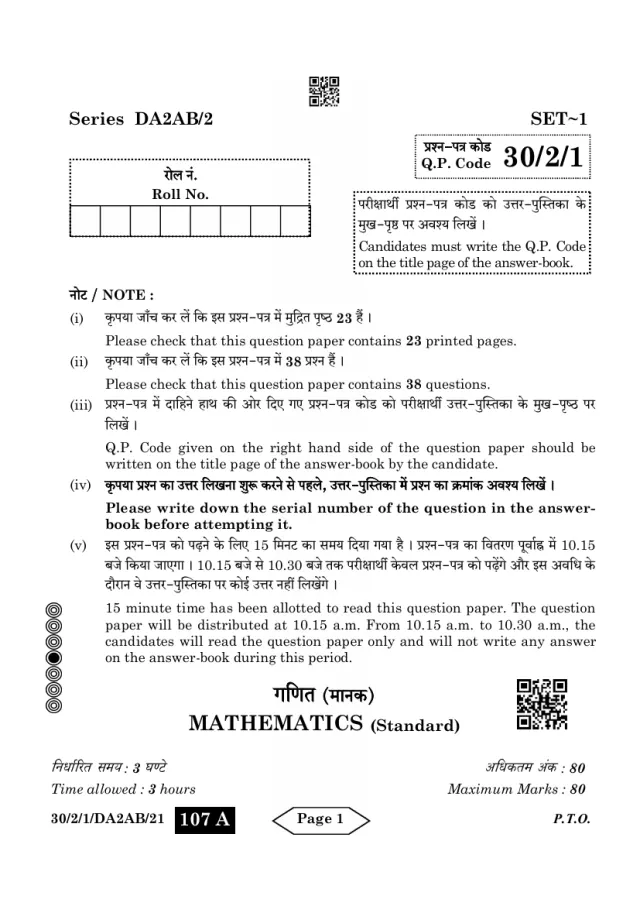
  • Cover page of the CBSE Class 10 Maths Standard 2024 paper, set 30/2/1

    Cover page

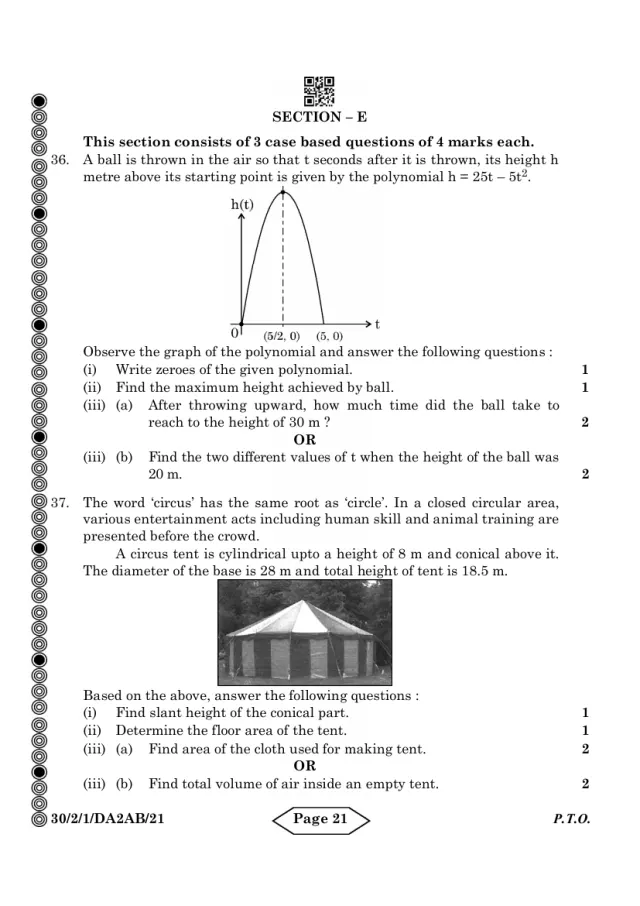
  • Section B of the CBSE Class 10 Maths Standard 2024 paper, set 30/2/1

    Section B

  • A case study with its figure from the CBSE Class 10 Maths Standard 2024 paper, set 30/2/1

    Case study

The main topics of this paper, in 1 minute

Your tutor walks you through the paper before you attempt it: the marks, the key ideas, the time plan and the traps.

1-minute paper analysis

With your tutor, in her voice

The main topics of this paper, in about a minute

A short, animated walk through the paper: how it is built, where the marks come from, the four ideas that matter most, how to plan your three hours, and the traps to avoid.

  1. 1The paper at a glance
  2. 2Where the marks come from
  3. 3Four ideas that keep paying off
  4. 4Plan your three hours
  5. 5Four traps to avoid

Sound on for the voice. Captions are shown, and you can mute any time.

Step-by-step solutions

Try each question first, then open its solution. Tap a number to jump.

Download solutions (PDF)

Section A: Multiple choice

20 questions, 1 mark each. MCQs (Q1 to Q18) and assertion-reason (Q19, Q20).

Q1Linear Equations1 mark

The value of kk for which the system of equations 3x−y+8=03x - y + 8 = 0 and 6x−ky+16=06x - ky + 16 = 0 has infinitely many solutions, is

  1. (A)−2
  2. (B)2
  3. (C)12\dfrac{1}{2}
  4. (D)−12-\dfrac{1}{2}
Solution · answer (B)
  1. Infinitely many solutions need a1a2=b1b2=c1c2\dfrac{a_1}{a_2} = \dfrac{b_1}{b_2} = \dfrac{c_1}{c_2}.
  2. 36=−1−k=816\dfrac{3}{6} = \dfrac{-1}{-k} = \dfrac{8}{16}. So 12=1k\dfrac{1}{2} = \dfrac{1}{k}, giving k=2k = 2.

Answer: (B) 2

Report an error on this question
Q2Coordinate Geometry1 mark

Point PP divides the line segment joining the points A(4,−5)A(4, -5) and B(1,2)B(1, 2) in the ratio 5:25 : 2. Co-ordinates of point PP are

  1. (A)(52,−32)\left(\dfrac{5}{2}, -\dfrac{3}{2}\right)
  2. (B)(117,0)\left(\dfrac{11}{7}, 0\right)
  3. (C)(137,0)\left(\dfrac{13}{7}, 0\right)
  4. (D)(0,137)\left(0, \dfrac{13}{7}\right)
Solution · answer (C)
  1. Section formula with m:n=5:2m : n = 5 : 2: x=5×1+2×47=137x = \dfrac{5 \times 1 + 2 \times 4}{7} = \dfrac{13}{7}.
  2. y=5×2+2×(−5)7=0y = \dfrac{5 \times 2 + 2 \times (-5)}{7} = 0. So P=(137,0)P = \left(\dfrac{13}{7}, 0\right).

Answer: (C) (137,0)\left(\dfrac{13}{7}, 0\right)

Report an error on this question
Q3Arithmetic Progressions1 mark

The common difference of an A.P. in which a15−a11=48a_{15} - a_{11} = 48, is

  1. (A)12
  2. (B)16
  3. (C)−12
  4. (D)−16
Solution · answer (A)
  1. a15−a11=(a+14d)−(a+10d)=4da_{15} - a_{11} = (a + 14d) - (a + 10d) = 4d.
  2. 4d=484d = 48, so d=12d = 12.

Answer: (A) 12

Report an error on this question
Q4Quadratic Equations1 mark

The quadratic equation x2+x+1=0x^2 + x + 1 = 0 has ______ roots.

  1. (A)real and equal
  2. (B)irrational
  3. (C)real and distinct
  4. (D)not-real
Solution · answer (D)
  1. D=b2−4ac=1−4=−3<0D = b^2 - 4ac = 1 - 4 = -3 < 0.
  2. A negative discriminant means there are no real roots: the roots are not real.

Answer: (D) not-real

Report an error on this question
Q5Real Numbers1 mark

If the HCF (2520,6600)=40(2520, 6600) = 40 and LCM (2520,6600)=252×k(2520, 6600) = 252 \times k, then the value of kk is

  1. (A)1650
  2. (B)1600
  3. (C)165
  4. (D)1625
Solution · answer (A)
  1. HCF×LCM=\text{HCF} \times \text{LCM} = product of the two numbers: 40×LCM=2520×660040 \times \text{LCM} = 2520 \times 6600.
  2. LCM=2520×660040=2520×165=415800\text{LCM} = \dfrac{2520 \times 6600}{40} = 2520 \times 165 = 415800.
  3. 415800=252×1650415800 = 252 \times 1650, so k=1650k = 1650.

Answer: (A) 1650

Report an error on this question
Q6Triangles1 mark

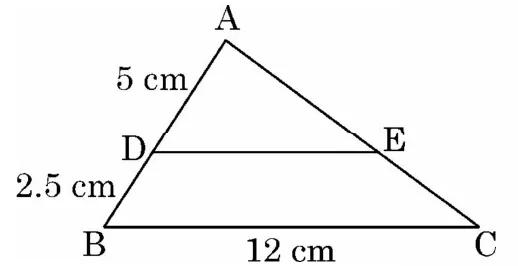
In the given figure △ABC\triangle ABC is shown. DEDE is parallel to BCBC. If AD=5AD = 5 cm, DB=2.5DB = 2.5 cm and BC=12BC = 12 cm, then DEDE is equal to

Triangle ABC with a line DE parallel to the base BC. AD is marked 5 cm, DB is 2.5 cm and BC is 12 cm.
  1. (A)10 cm
  2. (B)6 cm
  3. (C)8 cm
  4. (D)7.5 cm
Solution · answer (C)
ABCDEAD / AB = DE / BC = 5 / 7.5 = 2/3, so DE = 8 cm52.5
  1. DE∥BCDE \parallel BC, so △ADE∼△ABC\triangle ADE \sim \triangle ABC and DEBC=ADAB\dfrac{DE}{BC} = \dfrac{AD}{AB}.
  2. AB=AD+DB=5+2.5=7.5AB = AD + DB = 5 + 2.5 = 7.5 cm. DE12=57.5=23\dfrac{DE}{12} = \dfrac{5}{7.5} = \dfrac{2}{3}.
  3. DE=8DE = 8 cm.

Answer: (C) 8 cm

Common mistake: Using ADDB\dfrac{AD}{DB} as the ratio of DE:BCDE : BC. The ratio of DE:BCDE : BC is AD:ABAD : AB.

Report an error on this question
Q7Trigonometry1 mark

If sin⁡θ=cos⁡θ\sin\theta = \cos\theta, (0∘<θ<90∘)(0^\circ < \theta < 90^\circ), then value of (sec⁡θ⋅sin⁡θ)(\sec\theta \cdot \sin\theta) is:

  1. (A)12\dfrac{1}{\sqrt{2}}
  2. (B)2\sqrt{2}
  3. (C)1
  4. (D)0
Solution · answer (C)
  1. sec⁡θ⋅sin⁡θ=1cos⁡θ⋅sin⁡θ=tan⁡θ\sec\theta \cdot \sin\theta = \dfrac{1}{\cos\theta} \cdot \sin\theta = \tan\theta.
  2. sin⁡θ=cos⁡θ\sin\theta = \cos\theta gives tan⁡θ=1\tan\theta = 1 (and θ=45∘\theta = 45^\circ). So the value is 11.

Answer: (C) 1

Report an error on this question
Q8Probability1 mark

Two dice are rolled together. The probability of getting the sum of the two numbers to be more than 10, is

  1. (A)19\dfrac{1}{9}
  2. (B)16\dfrac{1}{6}
  3. (C)712\dfrac{7}{12}
  4. (D)112\dfrac{1}{12}
Solution · answer (D)
  1. Total outcomes =36= 36. A sum more than 1010 means 1111 or 1212.
  2. Sum 1111: (5,6),(6,5)(5, 6), (6, 5). Sum 1212: (6,6)(6, 6). That is 33 outcomes.
  3. P=336=112P = \dfrac{3}{36} = \dfrac{1}{12}.

Answer: (D) 112\dfrac{1}{12}

Report an error on this question
Q9Polynomials1 mark

If α\alpha and β\beta are zeroes of the polynomial 5x2+3x−75x^2 + 3x - 7, the value of 1α+1β\dfrac{1}{\alpha} + \dfrac{1}{\beta} is

  1. (A)−37-\dfrac{3}{7}
  2. (B)35\dfrac{3}{5}
  3. (C)37\dfrac{3}{7}
  4. (D)−57-\dfrac{5}{7}
Solution · answer (C)
  1. α+β=−35\alpha + \beta = -\dfrac{3}{5} and αβ=−75\alpha\beta = -\dfrac{7}{5}.
  2. 1α+1β=α+βαβ=−3/5−7/5=37\dfrac{1}{\alpha} + \dfrac{1}{\beta} = \dfrac{\alpha + \beta}{\alpha\beta} = \dfrac{-3/5}{-7/5} = \dfrac{3}{7}.

Answer: (C) 37\dfrac{3}{7}

Report an error on this question
Q10Triangles1 mark

The perimeters of two similar triangles ABCABC and PQRPQR are 5656 cm and 4848 cm respectively. PQ/ABPQ/AB is equal to

  1. (A)78\dfrac{7}{8}
  2. (B)67\dfrac{6}{7}
  3. (C)76\dfrac{7}{6}
  4. (D)87\dfrac{8}{7}
Solution · answer (B)
  1. For similar triangles the ratio of perimeters equals the ratio of corresponding sides.
  2. PQAB=perimeter of PQRperimeter of ABC=4856=67\dfrac{PQ}{AB} = \dfrac{\text{perimeter of } PQR}{\text{perimeter of } ABC} = \dfrac{48}{56} = \dfrac{6}{7}.

Answer: (B) 67\dfrac{6}{7}

Common mistake: Inverting the ratio. The question asks PQ/ABPQ / AB, with PQRPQR on top.

Report an error on this question
Q11Triangles1 mark

AB and CD are two chords of a circle intersecting at P. Choose the correct statement from the following:
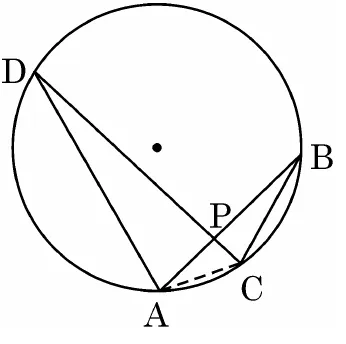
A circle with chords AB and CD crossing at the point P inside it. D is at the upper left, B at the right, A and C at the bottom, and the chords AC and BC are drawn.
  1. (A)△ADP∼△CBA\triangle ADP \sim \triangle CBA
  2. (B)△ADP∼△BPC\triangle ADP \sim \triangle BPC
  3. (C)△ADP∼△BCP\triangle ADP \sim \triangle BCP
  4. (D)△ADP∼△CBP\triangle ADP \sim \triangle CBP
Solution · answer (D)
DBAC∠DAB = ∠DCB (same arc), ∠APD = ∠CPB: △ADP ∼ △CBP
  1. In △ADP\triangle ADP and △CBP\triangle CBP: ∠DAP=∠DAB\angle DAP = \angle DAB and ∠BCP=∠BCD\angle BCP = \angle BCD are angles on the same arc DBDB, so they are equal.
  2. ∠APD=∠CPB\angle APD = \angle CPB (vertically opposite angles).
  3. So △ADP∼△CBP\triangle ADP \sim \triangle CBP (AA), with A↔CA \leftrightarrow C, D↔BD \leftrightarrow B, P↔PP \leftrightarrow P.

Answer: (D) △ADP∼△CBP\triangle ADP \sim \triangle CBP

Common mistake: Writing the vertices in the wrong order. The order of letters shows which angles match.

Report an error on this question
Q12Statistics1 mark

If value of each observation in a data is increased by 2, then median of the new data

  1. (A)increases by 2
  2. (B)increases by 2n
  3. (C)remains same
  4. (D)decreases by 2
Solution · answer (A)
  1. Adding 22 to every observation does not change their order, so the middle observation is still the same one, now 22 larger.
  2. So the median increases by 22. (The mean also increases by 22.)

Answer: (A) increases by 2

Report an error on this question
Q13Probability1 mark

A box contains cards numbered 6 to 55. A card is drawn at random from the box. The probability that the drawn card has a number which is a perfect square, is

  1. (A)750\dfrac{7}{50}
  2. (B)755\dfrac{7}{55}
  3. (C)110\dfrac{1}{10}
  4. (D)549\dfrac{5}{49}
Solution · answer (C)
  1. Cards 66 to 5555: 55−6+1=5055 - 6 + 1 = 50 cards.
  2. Perfect squares in this range: 9,16,25,36,499, 16, 25, 36, 49 (44 is below 66 and 6464 is above 5555). That is 55 squares.
  3. P=550=110P = \dfrac{5}{50} = \dfrac{1}{10}.

Answer: (C) 110\dfrac{1}{10}

Common mistake: Taking the total as 55. The cards start at 6, so there are 50 of them.

Report an error on this question
Q14Circles1 mark

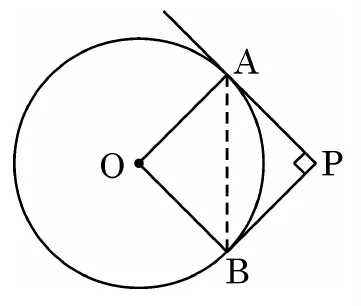
In the given figure, tangents PAPA and PBPB to the circle centred at OO, from point PP are perpendicular to each other. If PA=5PA = 5 cm, then length of ABAB is equal to

A circle with centre O and two perpendicular tangents PA and PB from the outside point P on the right. The chord AB is drawn as a dashed line.
  1. (A)5 cm
  2. (B)525\sqrt{2} cm
  3. (C)252\sqrt{5} cm
  4. (D)10 cm
Solution · answer (B)
55√2OAPBOAPB is a square, AB is its diagonal: 5√2 cm
  1. Tangents from PP are equal: PB=PA=5PB = PA = 5 cm. ∠P=90∘\angle P = 90^\circ.
  2. In right △APB\triangle APB: AB=PA2+PB2=25+25=52AB = \sqrt{PA^2 + PB^2} = \sqrt{25 + 25} = 5\sqrt{2} cm.

Answer: (B) 525\sqrt{2} cm

Report an error on this question
Q15Coordinate Geometry1 mark

XOYZXOYZ is a rectangle with vertices X(−3,0)X(-3, 0), O(0,0)O(0, 0), Y(0,4)Y(0, 4) and Z(x,y)Z(x, y). The length of its each diagonal is

  1. (A)5 units
  2. (B)5\sqrt{5} units
  3. (C)x2+y2\sqrt{x^2 + y^2} units
  4. (D)4 units
Solution · answer (A)
  1. The diagonals of a rectangle are equal. Use the diagonal XYXY: XY=(0+3)2+(4−0)2=9+16=5XY = \sqrt{(0 + 3)^2 + (4 - 0)^2} = \sqrt{9 + 16} = 5 units.

Answer: (A) 5 units

Report an error on this question
Q16Arithmetic Progressions1 mark

Which term of the A.P. −29,−26,−23,…,61-29, -26, -23, \dots, 61 is 1616?

  1. (A)11th11^{\text{th}}
  2. (B)16th16^{\text{th}}
  3. (C)10th10^{\text{th}}
  4. (D)31st31^{\text{st}}
Solution · answer (B)
  1. a=−29a = -29 and d=−26−(−29)=3d = -26 - (-29) = 3. an=a+(n−1)d=16a_n = a + (n - 1)d = 16.
  2. −29+3(n−1)=16-29 + 3(n - 1) = 16, so 3(n−1)=453(n - 1) = 45 and n−1=15n - 1 = 15, so n=16n = 16.

Answer: (B) 16th16^{\text{th}}

Report an error on this question
Q17Circles1 mark

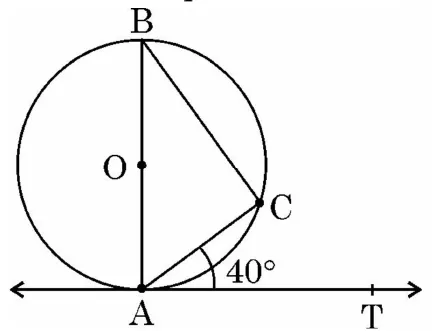
In the given figure, ATAT is tangent to a circle centred at OO. If ∠CAT=40∘\angle CAT = 40^\circ, then ∠CBA\angle CBA is equal to

A circle with centre O. The vertical diameter AB has A at the bottom and B at the top. A horizontal tangent AT at A, and a chord AC making an angle of 40 degrees with the tangent. B is joined to C.
  1. (A)70∘70^\circ
  2. (B)50∘50^\circ
  3. (C)65∘65^\circ
  4. (D)40∘40^\circ
Solution · answer (D)
40°40°OABCTtangent–chord angle = angle in the alternate segment
  1. The angle between a tangent and a chord equals the angle in the alternate segment.
  2. ∠CAT=∠CBA=40∘\angle CAT = \angle CBA = 40^\circ.

Answer: (D) 40∘40^\circ

Common mistake: Using the angle in a semicircle (90∘90^\circ) to get 50∘50^\circ. The tangent-chord angle theorem gives the answer directly.

Report an error on this question
Q18Statistics1 mark

After an examination, a teacher wants to know the marks obtained by maximum number of the students in her class. She requires to calculate ______ of marks.

  1. (A)median
  2. (B)mode
  3. (C)mean
  4. (D)range
Solution · answer (B)
  1. The value obtained by the largest number of students is the most frequent value: the mode.

Answer: (B) mode

Report an error on this question
Q19Trigonometry1 mark

Assertion (A): If sin⁡A=13\sin A = \dfrac{1}{3} (0∘<A<90∘)(0^\circ < A < 90^\circ), then the value of cos⁡A\cos A is 223\dfrac{2\sqrt{2}}{3}.

Reason (R): For every angle θ\theta, sin⁡2θ+cos⁡2θ=1\sin^2\theta + \cos^2\theta = 1.

  1. (A)Both A and R are true and R is the correct explanation of A
  2. (B)Both A and R are true, but R is not the correct explanation of A
  3. (C)A is true, but R is false
  4. (D)A is false, but R is true
Solution · answer (A)
  1. (R) sin⁡2θ+cos⁡2θ=1\sin^2\theta + \cos^2\theta = 1 is true for every angle.
  2. (A) cos⁡2A=1−19=89\cos^2 A = 1 - \dfrac{1}{9} = \dfrac{8}{9}, so cos⁡A=223\cos A = \dfrac{2\sqrt{2}}{3} (positive for an acute angle). True.
  3. The value of cos⁡A\cos A in (A) was found using (R), so R explains A.

Answer: (A) Both true, and R explains A

Report an error on this question
Q20Surface Areas and Volumes1 mark

Assertion (A): Two cubes each of edge length 1010 cm are joined together. The total surface area of newly formed cuboid is 12001200 cm².

Reason (R): Area of each surface of a cube of side 1010 cm is 100100 cm².

  1. (A)Both A and R are true and R is the correct explanation of A
  2. (B)Both A and R are true, but R is not the correct explanation of A
  3. (C)A is true, but R is false
  4. (D)A is false, but R is true
Solution · answer (D)
  1. (R) Each face of the cube is 10×10=10010 \times 10 = 100 cm². True.
  2. (A) Two cubes have 1212 faces, but the 22 joined faces are hidden, so the cuboid has 1010 faces: 10×100=100010 \times 100 = 1000 cm², not 12001200 cm². (Check: the cuboid is 20×10×1020 \times 10 \times 10 and 2(200+200+100)=10002(200 + 200 + 100) = 1000.) So A is false.

Answer: (D) A is false, R is true

Common mistake: Counting all 12 faces. When the cubes are joined, two faces disappear.

Report an error on this question

Section B: Very short answer

5 questions, 2 marks each.

Q21Real Numbers2 marks

Can the number (15)n(15)^n, nn being a natural number, end with the digit 00? Give reasons.

Solution
  1. 15n=(3×5)n=3n×5n15^n = (3 \times 5)^n = 3^n \times 5^n. Its only prime factors are 33 and 55.
  2. A number ends with 00 only if it is divisible by 10=2×510 = 2 \times 5, so it needs both 22 and 55 as prime factors. 15n15^n has no factor 22, so it can never end with 00.

Answer: No, 15n15^n cannot end with 00

Report an error on this question
Q22Coordinate Geometry2 marks

Find the type of triangle ABCABC formed whose vertices are A(1,0)A(1, 0), B(−5,0)B(-5, 0) and C(−2,5)C(-2, 5).

Solution
  1. AB=(−5−1)2+02=6AB = \sqrt{(-5 - 1)^2 + 0^2} = 6.
  2. BC=(−5+2)2+(0−5)2=9+25=34BC = \sqrt{(-5 + 2)^2 + (0 - 5)^2} = \sqrt{9 + 25} = \sqrt{34} and CA=(1+2)2+(0−5)2=34CA = \sqrt{(1 + 2)^2 + (0 - 5)^2} = \sqrt{34}.
  3. BC=CABC = CA and ABAB is different, so two sides are equal. It is not right-angled because BC2+CA2=68≠36=AB2BC^2 + CA^2 = 68 \neq 36 = AB^2. So △ABC\triangle ABC is isosceles.

Answer: △ABC\triangle ABC is an isosceles triangle

Report an error on this question
Q23Trigonometry2 marks

(a) Evaluate: 2sin⁡230∘sec⁡60∘+tan⁡260∘2\sin^2 30^\circ \sec 60^\circ + \tan^2 60^\circ.

OR

(b) If 2sin⁡(A+B)=32\sin(A + B) = \sqrt{3} and cos⁡(A−B)=1\cos(A - B) = 1, then find the measures of angles AA and BB. 0≤A,B,(A+B)≤90∘0 \le A, B, (A + B) \le 90^\circ.

Solution
  1. (a) 2×(12)2×2+(3)2=2×14×2+3=1+3=42 \times \left(\dfrac{1}{2}\right)^2 \times 2 + (\sqrt{3})^2 = 2 \times \dfrac{1}{4} \times 2 + 3 = 1 + 3 = 4.
  2. (b) sin⁡(A+B)=32\sin(A + B) = \dfrac{\sqrt{3}}{2} gives A+B=60∘A + B = 60^\circ. cos⁡(A−B)=1\cos(A - B) = 1 gives A−B=0∘A - B = 0^\circ.
  3. Adding: 2A=60∘2A = 60^\circ, so A=30∘A = 30^\circ and B=30∘B = 30^\circ.

Answer: (a) 44   (b) A=B=30∘A = B = 30^\circ

Report an error on this question
Q24Circles2 marks

In the given figure, AB and CD are tangents to a circle centred at O. Is ∠BAC = ∠DCA? Justify your answer.
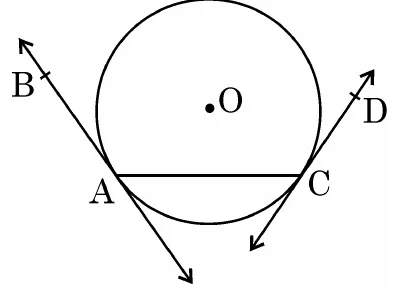
A circle with centre O and a chord AC at its lower part. Tangents at A and C are drawn: AB goes up and to the left from A, and CD goes up and to the right from C.
Solution
xxOACBDboth angles are 90° minus ∠OAC = ∠OCA
  1. Join OAOA and OCOC. OA=OCOA = OC (radii), so ∠OAC=∠OCA\angle OAC = \angle OCA.
  2. A tangent is perpendicular to the radius at the point of contact: ∠OAB=∠OCD=90∘\angle OAB = \angle OCD = 90^\circ.
  3. Subtract: ∠OAB−∠OAC=∠OCD−∠OCA\angle OAB - \angle OAC = \angle OCD - \angle OCA, that is ∠BAC=∠DCA\angle BAC = \angle DCA.
  4. Yes, ∠BAC=∠DCA\angle BAC = \angle DCA.

Answer: Yes, ∠BAC=∠DCA\angle BAC = \angle DCA

Report an error on this question
Q25Coordinate Geometry2 marks

(a) In what ratio is the line segment joining the points (3,−5)(3, -5) and (−1,6)(-1, 6) divided by the line y=xy = x?

OR

(b) A(3,0)A(3, 0), B(6,4)B(6, 4) and C(−1,3)C(-1, 3) are vertices of a triangle ABCABC. Find length of its median BEBE.

Solution
  1. (a) Let the point on y=xy = x divide the segment in the ratio k:1k : 1. It is (−k+3k+1, 6k−5k+1)\left(\dfrac{-k + 3}{k + 1},\ \dfrac{6k - 5}{k + 1}\right).
  2. It lies on y=xy = x, so −k+3=6k−5-k + 3 = 6k - 5, giving 7k=87k = 8 and k=87k = \dfrac{8}{7}. The ratio is 8:78 : 7.
  3. (b) EE is the mid-point of ACAC: E=(3−12, 0+32)=(1,32)E = \left(\dfrac{3 - 1}{2},\ \dfrac{0 + 3}{2}\right) = \left(1, \dfrac{3}{2}\right).
  4. BE=(6−1)2+(4−32)2=25+254=1254=552BE = \sqrt{(6 - 1)^2 + \left(4 - \dfrac{3}{2}\right)^2} = \sqrt{25 + \dfrac{25}{4}} = \sqrt{\dfrac{125}{4}} = \dfrac{5\sqrt{5}}{2}.

Answer: (a) 8:78 : 7   (b) 552\dfrac{5\sqrt{5}}{2}

Report an error on this question

Section C: Short answer

6 questions, 3 marks each.

Q26Arithmetic Progressions3 marks

(a) If the sum of first mm terms of an A.P. is same as sum of its first nn terms (m≠nm \neq n), then show that the sum of its first (m+n)(m + n) terms is zero.

OR

(b) In an A.P., the sum of three consecutive terms is 2424 and the sum of their squares is 194194. Find the numbers.

Solution
  1. (a) Sm=SnS_m = S_n: m2[2a+(m−1)d]=n2[2a+(n−1)d]\dfrac{m}{2}[2a + (m - 1)d] = \dfrac{n}{2}[2a + (n - 1)d].
  2. 2a(m−n)=d[(n2−n)−(m2−m)]=d(n−m)(n+m−1)2a(m - n) = d[(n^2 - n) - (m^2 - m)] = d(n - m)(n + m - 1). Divide by (m−n)(m - n): 2a=−d(m+n−1)2a = -d(m + n - 1), that is 2a+(m+n−1)d=02a + (m + n - 1)d = 0.
  3. Sm+n=m+n2[2a+(m+n−1)d]=m+n2×0=0S_{m+n} = \dfrac{m + n}{2}[2a + (m + n - 1)d] = \dfrac{m + n}{2} \times 0 = 0.
  4. (b) Let the three numbers be a−da - d, aa, a+da + d. Sum: 3a=243a = 24, so a=8a = 8.
  5. Squares: (8−d)2+64+(8+d)2=194(8 - d)^2 + 64 + (8 + d)^2 = 194, so 2d2+192=1942d^2 + 192 = 194 and d2=1d^2 = 1, d=±1d = \pm 1.
  6. The numbers are 7,8,97, 8, 9 (or 9,8,79, 8, 7).

Answer: (a) Sm+n=0S_{m+n} = 0   (b) 7,8,97, 8, 9

Report an error on this question
Q27Real Numbers3 marks

Prove that 5\sqrt{5} is an irrational number.

Solution
  1. Suppose 5=pq\sqrt{5} = \dfrac{p}{q} with p,qp, q co-prime and q≠0q \neq 0. Then 5q2=p25q^2 = p^2, so 55 divides p2p^2 and hence 55 divides pp. Write p=5ap = 5a.
  2. 25a2=5q225a^2 = 5q^2, so q2=5a2q^2 = 5a^2, so 55 divides q2q^2 and hence qq.
  3. 55 is a common factor of pp and qq, contradicting that they are co-prime. So 5\sqrt{5} is irrational.

Answer: Proved by contradiction

Report an error on this question
Q28Circles3 marks

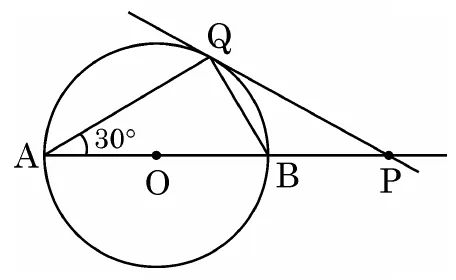
(a) In the given figure, PQPQ is tangent to a circle centred at OO and ∠BAQ=30∘\angle BAQ = 30^\circ; show that BP=BQBP = BQ.

OR

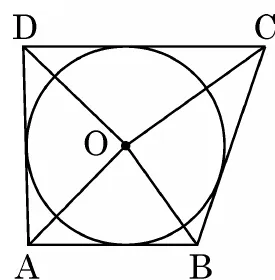
(b) In the given figure, ABAB, BCBC, CDCD and DADA are tangents to the circle with centre OO forming a quadrilateral ABCDABCD. Show that ∠AOB+∠COD=180∘\angle AOB + \angle COD = 180^\circ.

A circle with centre O on the horizontal line AP. A is on the left of the circle and B on the right. The tangent from P touches the circle at Q above B. AQ and BQ are joined and the angle BAQ is 30 degrees.A quadrilateral ABCD with its four sides tangent to a circle with centre O. The diagonals AC and BD pass through O.
Solution
30°30°30°OABQP∠BQP = ∠BAQ = 30°, ∠QBP = 120°, so ∠BPQ = 30° and BP = BQ
  1. (a) Join BQBQ. ABAB is a diameter, so ∠AQB=90∘\angle AQB = 90^\circ (angle in a semicircle).
  2. In △AQB\triangle AQB: ∠ABQ=180∘−90∘−30∘=60∘\angle ABQ = 180^\circ - 90^\circ - 30^\circ = 60^\circ, so the exterior angle ∠QBP=180∘−60∘=120∘\angle QBP = 180^\circ - 60^\circ = 120^\circ.
  3. By the tangent-chord theorem ∠BQP=∠BAQ=30∘\angle BQP = \angle BAQ = 30^\circ. In △BQP\triangle BQP: ∠BPQ=180∘−120∘−30∘=30∘\angle BPQ = 180^\circ - 120^\circ - 30^\circ = 30^\circ.
  4. ∠BPQ=∠BQP\angle BPQ = \angle BQP, so the sides opposite them are equal: BP=BQBP = BQ.
  5. (b) Let the circle touch AB,BC,CD,DAAB, BC, CD, DA at P,Q,R,SP, Q, R, S. Join OP,OQ,OR,OSOP, OQ, OR, OS. Tangents from a point are equal and the radii are equal, so △POB≅△QOB\triangle POB \cong \triangle QOB and ∠1=∠2\angle 1 = \angle 2. Similarly the other three pairs give ∠3=∠4\angle 3 = \angle 4, ∠5=∠6\angle 5 = \angle 6, ∠7=∠8\angle 7 = \angle 8.
  6. The angles around OO add up to 360∘360^\circ: 2(∠1+∠4+∠5+∠8)=360∘2(\angle 1 + \angle 4 + \angle 5 + \angle 8) = 360^\circ, so ∠1+∠8+∠4+∠5=180∘\angle 1 + \angle 8 + \angle 4 + \angle 5 = 180^\circ.
  7. ∠AOB=∠1+∠8\angle AOB = \angle 1 + \angle 8 and ∠COD=∠4+∠5\angle COD = \angle 4 + \angle 5, so ∠AOB+∠COD=180∘\angle AOB + \angle COD = 180^\circ.

Answer: (a) BP=BQBP = BQ   (b) ∠AOB+∠COD=180∘\angle AOB + \angle COD = 180^\circ

Report an error on this question
Q29Trigonometry3 marks

Prove that 1+sec⁡θ−tan⁡θ1+sec⁡θ+tan⁡θ=1−sin⁡θcos⁡θ\dfrac{1 + \sec\theta - \tan\theta}{1 + \sec\theta + \tan\theta} = \dfrac{1 - \sin\theta}{\cos\theta}.

Solution
  1. Write 1=sec⁡2θ−tan⁡2θ1 = \sec^2\theta - \tan^2\theta in the numerator: (sec⁡2θ−tan⁡2θ)+(sec⁡θ−tan⁡θ)(\sec^2\theta - \tan^2\theta) + (\sec\theta - \tan\theta).
  2. =(sec⁡θ−tan⁡θ)(sec⁡θ+tan⁡θ)+(sec⁡θ−tan⁡θ)=(sec⁡θ−tan⁡θ)(sec⁡θ+tan⁡θ+1)= (\sec\theta - \tan\theta)(\sec\theta + \tan\theta) + (\sec\theta - \tan\theta) = (\sec\theta - \tan\theta)(\sec\theta + \tan\theta + 1).
  3. So LHS =(sec⁡θ−tan⁡θ)(sec⁡θ+tan⁡θ+1)1+sec⁡θ+tan⁡θ=sec⁡θ−tan⁡θ= \dfrac{(\sec\theta - \tan\theta)(\sec\theta + \tan\theta + 1)}{1 + \sec\theta + \tan\theta} = \sec\theta - \tan\theta.
  4. =1cos⁡θ−sin⁡θcos⁡θ=1−sin⁡θcos⁡θ== \dfrac{1}{\cos\theta} - \dfrac{\sin\theta}{\cos\theta} = \dfrac{1 - \sin\theta}{\cos\theta} = RHS.

Answer: Proved

Report an error on this question
Q30Statistics3 marks

In a test, the marks obtained by 100 students (out of 50) are given below:

Find the mean marks of the students.

Marks obtained0 – 1010 – 2020 – 3030 – 4040 – 50
Number of students122334256
Solution
  1. Class marks xix_i: 5,15,25,35,455, 15, 25, 35, 45 and frequencies fif_i: 12,23,34,25,612, 23, 34, 25, 6 with ∑fi=100\sum f_i = 100.
  2. fixif_i x_i: 60, 345, 850, 875, 27060,\ 345,\ 850,\ 875,\ 270. Sum ∑fixi=2400\sum f_i x_i = 2400.
  3. Mean =2400100=24= \dfrac{2400}{100} = 24.

Answer: Mean marks = 24

Report an error on this question
Q31Quadratic Equations3 marks

In a 2-digit number, the digit at the unit’s place is 5 less than the digit at the ten’s place. The product of the digits is 36. Find the number.

Solution
  1. Let the digit at the ten's place be xx. The unit's digit is x−5x - 5.
  2. The product is 3636: x(x−5)=36x(x - 5) = 36, so x2−5x−36=0x^2 - 5x - 36 = 0.
  3. (x−9)(x+4)=0(x - 9)(x + 4) = 0. A digit cannot be negative, so x=9x = 9 and the unit's digit is 44.
  4. The number is 9494. (Check: 9×4=369 \times 4 = 36 ✓ and 9−4=59 - 4 = 5 ✓.)

Answer: The number is 94

Report an error on this question

Section D: Long answer

4 questions, 5 marks each.

Q32Linear Equations5 marks

(a) Using graphical method, solve the following system of equations: 3x+y+4=03x + y + 4 = 0 and 3x−y+2=03x - y + 2 = 0.

OR

(b) Tara scored 4040 marks in a test, getting 33 marks for each right answer and losing 11 mark for each wrong answer. Had 44 marks been awarded for each correct answer and 22 marks been deducted for each wrong answer, then Tara would have scored 5050 marks. Assuming that Tara attempted all questions, find the total number of questions in the test.

Solution
-4-3-2-112-6-5-4-3-2-11234Oxy3x + y + 4 = 03x − y + 2 = 0(−1, −1)(0, −4)(0, 2)
  1. (a) First line: y=−3x−4y = -3x - 4. Points: (0,−4)(0, -4), (−1,−1)(-1, -1), (−2,2)(-2, 2).
  2. Second line: y=3x+2y = 3x + 2. Points: (0,2)(0, 2), (−1,−1)(-1, -1), (1,5)(1, 5).
  3. Plot both lines. They cross at (−1,−1)(-1, -1), so x=−1x = -1 and y=−1y = -1.
  4. (b) Let the number of correct answers be xx and the number of wrong answers be yy. 3x−y=403x - y = 40. … (i) 4x−2y=504x - 2y = 50, that is 2x−y=252x - y = 25. … (ii)
  5. Subtract (ii) from (i): x=15x = 15. Then y=3×15−40=5y = 3 \times 15 - 40 = 5.
  6. Total number of questions =15+5=20= 15 + 5 = 20.

Answer: (a) x=−1, y=−1x = -1,\ y = -1   (b) 2020 questions

Report an error on this question
Q33Triangles5 marks

(a) If a line is drawn parallel to one side of a triangle to intersect the other two sides in distinct points, then prove that the other two sides are divided in the same ratio.

OR

(b) Sides ABAB and ACAC and median ADAD to △ABC\triangle ABC are respectively proportional to sides PQPQ and PRPR and median PMPM of another triangle PQRPQR. Show that △ABC∼△PQR\triangle ABC \sim \triangle PQR.

Solution
  1. (a) Given: △ABC\triangle ABC with DE∥BCDE \parallel BC. To prove: ADDB=AEEC\dfrac{AD}{DB} = \dfrac{AE}{EC}. Join BEBE and CDCD; draw EF⊥ABEF \perp AB and DG⊥ACDG \perp AC.
  2. ar(ADE)ar(BDE)=12⋅AD⋅EF12⋅DB⋅EF=ADDB\dfrac{\text{ar}(ADE)}{\text{ar}(BDE)} = \dfrac{\frac{1}{2} \cdot AD \cdot EF}{\frac{1}{2} \cdot DB \cdot EF} = \dfrac{AD}{DB} and ar(ADE)ar(CDE)=AEEC\dfrac{\text{ar}(ADE)}{\text{ar}(CDE)} = \dfrac{AE}{EC}.
  3. ar(BDE)=ar(CDE)\text{ar}(BDE) = \text{ar}(CDE) (same base DEDE, same parallels), so ADDB=AEEC\dfrac{AD}{DB} = \dfrac{AE}{EC}.
  4. (b) Produce ADAD to EE so that AD=DEAD = DE and join ECEC. Produce PMPM to NN so that PM=MNPM = MN and join NRNR.
  5. △ADB≅△EDC\triangle ADB \cong \triangle EDC (SAS), so AB=ECAB = EC. Similarly PQ=NRPQ = NR. Given ABPQ=ACPR=ADPM\dfrac{AB}{PQ} = \dfrac{AC}{PR} = \dfrac{AD}{PM}, we get ECNR=ACPR=AEPN\dfrac{EC}{NR} = \dfrac{AC}{PR} = \dfrac{AE}{PN} (as AE=2ADAE = 2AD and PN=2PMPN = 2PM).
  6. So △AEC∼△PNR\triangle AEC \sim \triangle PNR (SSS), giving ∠1=∠2\angle 1 = \angle 2. Similarly ∠3=∠4\angle 3 = \angle 4, so ∠1+∠3=∠2+∠4\angle 1 + \angle 3 = \angle 2 + \angle 4, that is ∠A=∠P\angle A = \angle P.
  7. With ABPQ=ACPR\dfrac{AB}{PQ} = \dfrac{AC}{PR} and ∠A=∠P\angle A = \angle P: △ABC∼△PQR\triangle ABC \sim \triangle PQR (SAS).

Answer: (a) BPT proved   (b) △ABC∼△PQR\triangle ABC \sim \triangle PQR

Report an error on this question
Q34Applications of Trigonometry5 marks

From the top of a 4545 m high light house, the angles of depression of two ships, on the opposite side of it, are observed to be 30∘30^\circ and 60∘60^\circ. If the line joining the ships passes through the foot of the light house, find the distance between the ships. (Use 3=1.73\sqrt{3} = 1.73)

Solution
30°60°45 m45√315√3ABPQPQ = 45√3 + 15√3 = 60√3 ≈ 103.8 m
  1. Let AB=45AB = 45 m be the lighthouse and let the ships be at PP (30∘30^\circ) and QQ (60∘60^\circ). Angle of depression equals angle of elevation from the ship.
  2. For the ship at 60∘60^\circ: tan⁡60∘=3=45BQ\tan 60^\circ = \sqrt{3} = \dfrac{45}{BQ}, so BQ=453=153BQ = \dfrac{45}{\sqrt{3}} = 15\sqrt{3} m.
  3. For the ship at 30∘30^\circ: tan⁡30∘=13=45BP\tan 30^\circ = \dfrac{1}{\sqrt{3}} = \dfrac{45}{BP}, so BP=453BP = 45\sqrt{3} m.
  4. The ships are on opposite sides, so PQ=BP+BQ=453+153=603=60×1.73=103.8PQ = BP + BQ = 45\sqrt{3} + 15\sqrt{3} = 60\sqrt{3} = 60 \times 1.73 = 103.8 m.

Answer: 603≈103.860\sqrt{3} \approx 103.8 m

Common mistake: Subtracting the two distances. The ships are on opposite sides of the lighthouse, so the distances add.

Report an error on this question
Q35Areas Related to Circles5 marks

The perimeter of a certain sector of a circle of radius 5.65.6 m is 20.020.0 m. Find the area of the sector.

Solution
5.6 m5.6 mOABarc = 8.8 m2r + arc = 11.2 + 8.8 = 20 m
  1. Perimeter of a sector =2r+θ360×2πr=20= 2r + \dfrac{\theta}{360} \times 2\pi r = 20.
  2. 2×5.6+θ360×2×227×5.6=202 \times 5.6 + \dfrac{\theta}{360} \times 2 \times \dfrac{22}{7} \times 5.6 = 20, so 11.2+θ360×35.2=2011.2 + \dfrac{\theta}{360} \times 35.2 = 20.
  3. θ360×35.2=8.8\dfrac{\theta}{360} \times 35.2 = 8.8, so θ360=14\dfrac{\theta}{360} = \dfrac{1}{4} and θ=90∘\theta = 90^\circ.
  4. Area =θ360×πr2=14×227×5.6×5.6=24.64= \dfrac{\theta}{360} \times \pi r^2 = \dfrac{1}{4} \times \dfrac{22}{7} \times 5.6 \times 5.6 = 24.64 m².

Answer: 24.6424.64 m²

Report an error on this question

Section E: Case studies

3 case studies, 4 marks each.

Q36Polynomials4 marks

Case study 1. A ball is thrown in the air so that tt seconds after it is thrown, its height hh metre above its starting point is given by the polynomial h=25t−5t2h = 25t - 5t^2.

Observe the graph of the polynomial and answer the following questions:

(i) Write zeroes of the given polynomial. [1]

(ii) Find the maximum height achieved by ball. [1]

(iii) (a) After throwing upward, how much time did the ball take to reach to the height of 30 m? [2]

OR

(iii) (b) Find the two different values of t when the height of the ball was 20 m. [2]
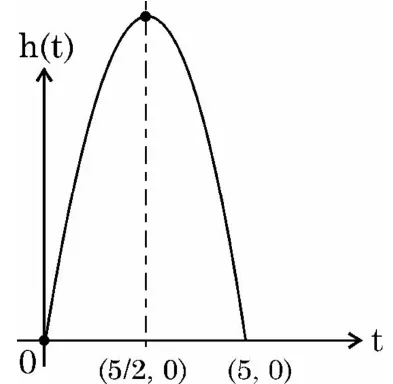
The graph of the height h against time t, an upside-down U-shaped curve starting at the origin, with its highest point above t equal to 5/2 and crossing the t-axis again at (5, 0).
Solution
123455101520253035Ot (s)h (m)0531.25 m
  1. (i) 25t−5t2=5t(5−t)=025t - 5t^2 = 5t(5 - t) = 0, so the zeroes are t=0t = 0 and t=5t = 5.
  2. (ii) The maximum is at the mid-point of the zeroes, t=52t = \dfrac{5}{2}: h=25×52−5×254=62.5−31.25=31.25h = 25 \times \dfrac{5}{2} - 5 \times \dfrac{25}{4} = 62.5 - 31.25 = 31.25 m =1254= \dfrac{125}{4} m.
  3. (iii)(a) 25t−5t2=3025t - 5t^2 = 30, so t2−5t+6=0t^2 - 5t + 6 = 0 and (t−2)(t−3)=0(t - 2)(t - 3) = 0. The ball reaches 3030 m at t=2t = 2 s (on the way up) and again at t=3t = 3 s (on the way down). Reaching it first takes t=2t = 2 seconds.
  4. (iii)(b) 25t−5t2=2025t - 5t^2 = 20, so t2−5t+4=0t^2 - 5t + 4 = 0 and (t−4)(t−1)=0(t - 4)(t - 1) = 0. The two values are t=1t = 1 s and t=4t = 4 s.

Answer: (i) 00 and 55   (ii) 1254=31.25\dfrac{125}{4} = 31.25 m   (iii)(a) 22 s   (iii)(b) t=1t = 1 and t=4t = 4

Common mistake: In (iii)(a), giving both 2 and 3. The question asks how long it took to reach 30 m, which is the first time, 2 s.

Report an error on this question
Q37Surface Areas and Volumes4 marks

Case study 2. The word ‘circus’ has the same root as ‘circle’. In a closed circular area, various entertainment acts including human skill and animal training are presented before the crowd. A circus tent is cylindrical upto a height of 8 m and conical above it. The diameter of the base is 28 m and total height of tent is 18.5 m.

Based on the above, answer the following questions:

(i) Find slant height of the conical part. [1]

(ii) Determine the floor area of the tent. [1]

(iii) (a) Find area of the cloth used for making tent. [2]

OR

(iii) (b) Find total volume of air inside an empty tent. [2]

Figure: A photo of a circus tent with a cylindrical wall and a cone-shaped roof in white and dark panels.

Solution
ABCDV8 mh = 10.5l = 17.5diameter 28 m (r = 14)l = √(10.5² + 14²) = 17.5 mcloth = 2πrh + πrl = 704 + 770 = 1474 m²
  1. Radius r=14r = 14 m. Height of the cylinder =8= 8 m, so the cone height =18.5−8=10.5= 18.5 - 8 = 10.5 m.
  2. (i) Slant height l=10.52+142=110.25+196=306.25=17.5l = \sqrt{10.5^2 + 14^2} = \sqrt{110.25 + 196} = \sqrt{306.25} = 17.5 m.
  3. (ii) Floor area =πr2=227×14×14=616= \pi r^2 = \dfrac{22}{7} \times 14 \times 14 = 616 m².
  4. (iii)(a) Cloth == curved surface of the cylinder ++ curved surface of the cone =2πrh+πrl=2×227×14×8+227×14×17.5=704+770=1474= 2\pi r h + \pi r l = 2 \times \dfrac{22}{7} \times 14 \times 8 + \dfrac{22}{7} \times 14 \times 17.5 = 704 + 770 = 1474 m².
  5. (iii)(b) Volume == cylinder ++ cone =πr2h+13πr2h′=227×14×14×8+13×227×14×14×10.5=4928+2156=7084= \pi r^2 h + \dfrac{1}{3}\pi r^2 h' = \dfrac{22}{7} \times 14 \times 14 \times 8 + \dfrac{1}{3} \times \dfrac{22}{7} \times 14 \times 14 \times 10.5 = 4928 + 2156 = 7084 m³.

Answer: (i) 17.517.5 m   (ii) 616616 m²   (iii)(a) 14741474 m²   (iii)(b) 70847084 m³

Common mistake: Including the circular base in the cloth. The tent cloth is only the curved surfaces of the cylinder and cone.

Report an error on this question
Q38Probability4 marks

Case study 3. In a survey on holidays, 120 people were asked to state which type of transport they used on their last holiday. The following pie chart shows the results of the survey.

Observe the pie chart and answer the following questions:

(i) If one person is selected at random, find the probability that he/she travelled by bus or ship. [1]

(ii) Which is most favourite mode of transport and how many people used it? [1]

(iii) (a) A person is selected at random. If the probability that he did not use train is 4/5, find the number of people who used train. [2]

OR

(iii) (b) The probability that randomly selected person used aeroplane is 7/60. Find the revenue collected by air company at the rate of ₹ 5,000 per person. [2]
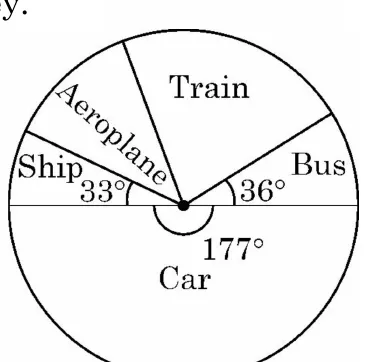
A pie chart divided into five sectors: Car with an angle of 177 degrees, Bus 36 degrees, Ship 33 degrees, and Train and Aeroplane for the rest.
Solution
Bus 36° (12)Train 72° (24)Aeroplane 42° (14)Ship 33° (11)Car 177° (59)people = angle / 360 × 120
  1. The angles in the pie chart add up to 360∘360^\circ and each sector is proportional to the number of people.
  2. (i) Bus is 36∘36^\circ and ship is 33∘33^\circ. P(bus or ship)=36+33360=69360=23120P(\text{bus or ship}) = \dfrac{36 + 33}{360} = \dfrac{69}{360} = \dfrac{23}{120}.
  3. (ii) The largest sector is the car, 177∘177^\circ. Number of people =177360×120=59= \dfrac{177}{360} \times 120 = 59. So car is the most favourite, used by 5959 people.
  4. (iii)(a) P(train)=1−45=15P(\text{train}) = 1 - \dfrac{4}{5} = \dfrac{1}{5}. Number of people who used train =15×120=24= \dfrac{1}{5} \times 120 = 24.
  5. (iii)(b) Number who used aeroplane =760×120=14= \dfrac{7}{60} \times 120 = 14. Revenue =14×5000=₹70,000= 14 \times 5000 = ₹70{,}000.

Answer: (i) 23120\dfrac{23}{120}   (ii) car, 5959 people   (iii)(a) 2424   (iii)(b) ₹ 70,00070{,}000

Report an error on this question

Questions are from the official CBSE paper. Figures are described in words; see the PDF for the originals. Solutions are written by CogniGuru.

Revise this paper in 1 minute a chapter

Each chapter below is what the paper tested, with a one-minute animated lesson on the idea behind it.

Stuck on a step in any solution?

The CogniGuru AI tutor explains any doubt one minute at a time, in English or Hindi. Join the waitlist.

Mock quiz: 5 questions from this paper

Five real questions from this paper, one each from five chapters. About 2 minutes. See how much you know and where you stand among other students. Attempt free, with no login; log in only for your ranking and full report.

Question 1 of 5 · Q1 of the paperLinear Equations

The value of kk for which the system of equations 3x−y+8=03x - y + 8 = 0 and 6x−ky+16=06x - ky + 16 = 0 has infinitely many solutions, is

0 of 5 answered

Related papers

Common questions

Are these the official CBSE Class 10 Maths Standard 2024 questions?
Yes. The questions are from the official Mathematics (Standard) paper (set 30/2/1) that CBSE published after the March 2024 board exam. The solutions are written by CogniGuru and checked against the answer key CBSE published for this paper code.
Can I download the CBSE Class 10 Maths Standard 2024 question paper PDF?
Yes, the official paper PDF is free to download from this page, and so are our step-by-step solutions as a PDF. No login is needed to download either or to read the solutions.
Do all sets of the paper have the same questions?
No. CBSE sets several versions of each paper, with the same blueprint and similar questions in a different order and sometimes with different numbers. This page covers set 30/2/1.
How does the quiz work, and what does “where you stand” mean?
It is a mock quiz of 5 real multiple-choice questions from this paper, scored automatically in about 2 minutes. Your score is compared, anonymously, with other students who took the same quiz. Only the score is stored with the comparison, never your name or number.

Source

CBSE question paper archive, Class X, 2024 (Mathematics (Standard), set 30/2/1)
PDF