
CBSE · Class 10 · Mathematics (Standard) · Free

CBSE Class 10 Maths Standard 2024 Question Paper (Set 30/3/1) with Solutions

The official board paper (Q.P. Code 30/3/1, Series CD1BA/3). Free paper PDF and step-by-step solutions (also as a PDF to download) written by CogniGuru and checked against CBSE’s answer key. See the paper’s main topics in 1 minute, then quiz yourself to see how much you know and where you stand.

No login to download or read the solutions. Login only to see your quiz report in full.

Board
CBSE
Class
10
Subject
Maths Standard (041)
Year
2024
Set code
30/3/1
Max marks
80
Duration
3 hours
Questions
38 (Sections A to E)
Source
Official CBSE paper
Exam date
March 2024

Paper preview

Three pages of the official paper. Download the PDF for all 24.

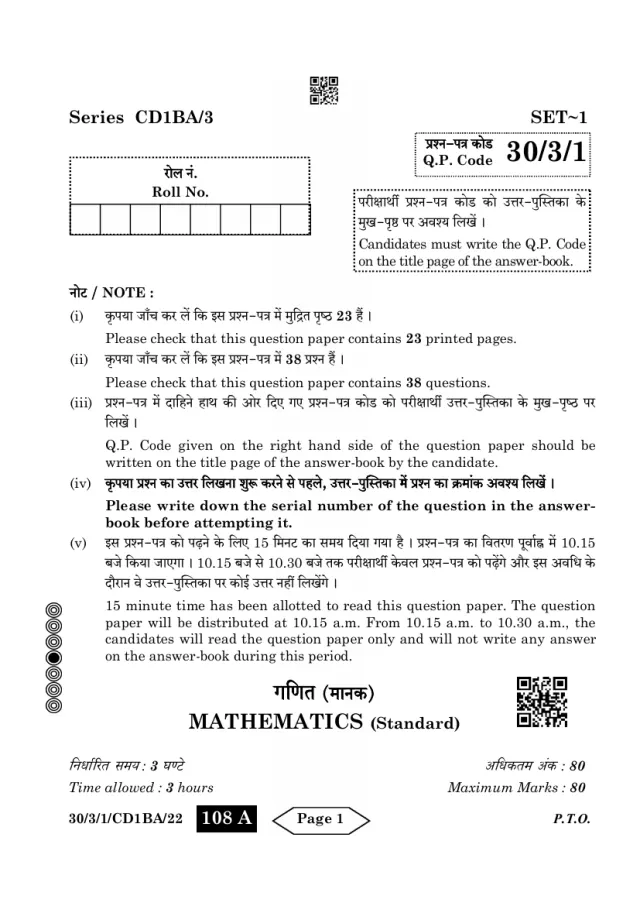
  • Cover page of the CBSE Class 10 Maths Standard 2024 paper, set 30/3/1

    Cover page

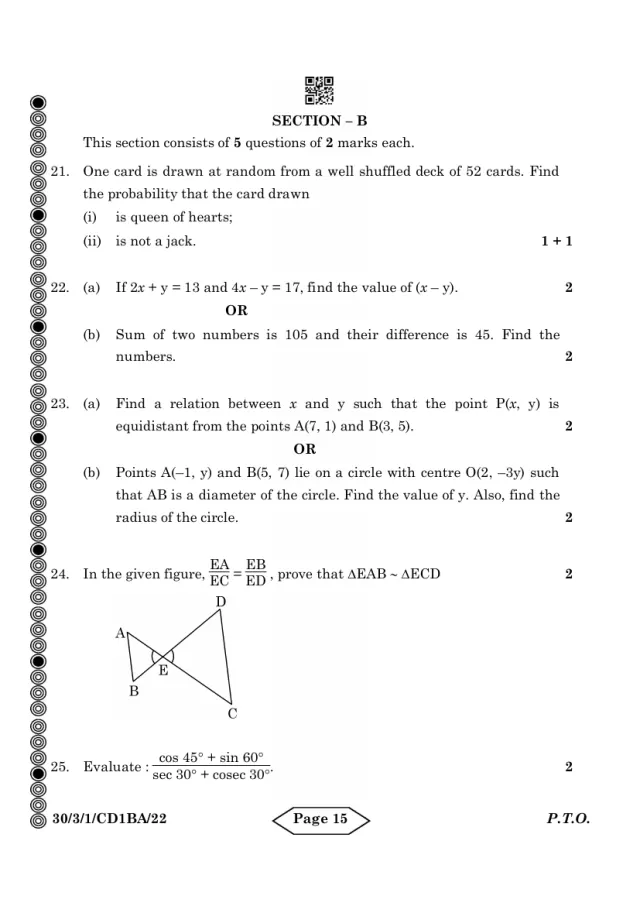
  • Section B of the CBSE Class 10 Maths Standard 2024 paper, set 30/3/1

    Section B

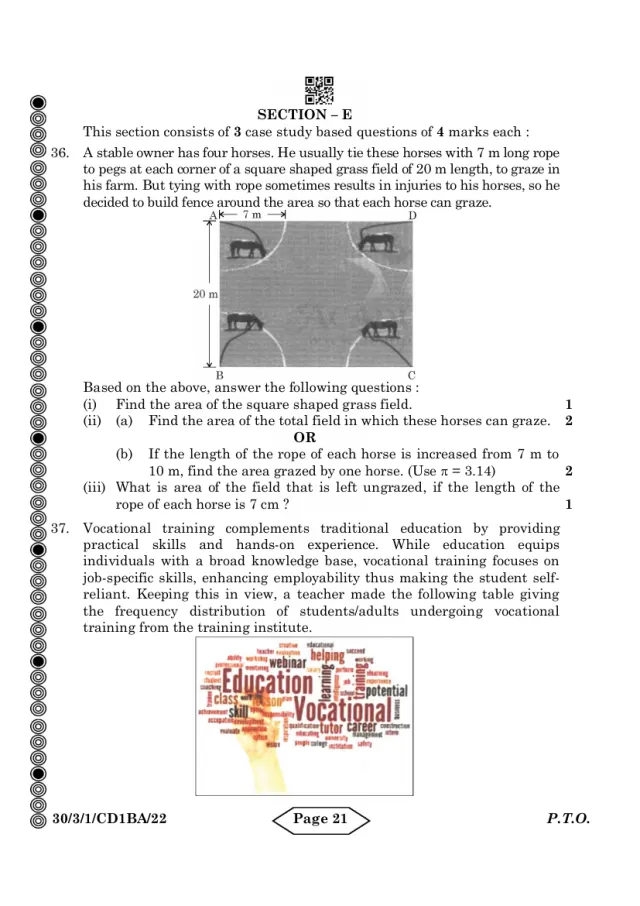
  • A case study with its figure from the CBSE Class 10 Maths Standard 2024 paper, set 30/3/1

    Case study

The main topics of this paper, in 1 minute

Your tutor walks you through the paper before you attempt it: the marks, the key ideas, the time plan and the traps.

1-minute paper analysis

With your tutor, in her voice

The main topics of this paper, in about a minute

A short, animated walk through the paper: how it is built, where the marks come from, the four ideas that matter most, how to plan your three hours, and the traps to avoid.

  1. 1The paper at a glance
  2. 2Where the marks come from
  3. 3Four ideas that keep paying off
  4. 4Plan your three hours
  5. 5Four traps to avoid

Sound on for the voice. Captions are shown, and you can mute any time.

Step-by-step solutions

Try each question first, then open its solution. Tap a number to jump.

Download solutions (PDF)

Section A: Multiple choice

20 questions, 1 mark each. MCQs (Q1 to Q18) and assertion-reason (Q19, Q20).

Q1Linear Equations1 mark

The pair of linear equations x+2y+5=0x + 2y + 5 = 0 and −3x=6y−1-3x = 6y - 1 has

  1. (A)unique solution
  2. (B)exactly two solutions
  3. (C)infinitely many solutions
  4. (D)no solution
Solution · answer (D)
  1. Write the second as 3x+6y−1=03x + 6y - 1 = 0. Then a1a2=13\dfrac{a_1}{a_2} = \dfrac{1}{3}, b1b2=26=13\dfrac{b_1}{b_2} = \dfrac{2}{6} = \dfrac{1}{3} and c1c2=5−1=−5\dfrac{c_1}{c_2} = \dfrac{5}{-1} = -5.
  2. a1a2=b1b2≠c1c2\dfrac{a_1}{a_2} = \dfrac{b_1}{b_2} \neq \dfrac{c_1}{c_2}, so the lines are parallel: no solution.

Answer: (D) no solution

Report an error on this question
Q2Arithmetic Progressions1 mark

The common difference of the A.P. 12x, 1−4x2x, 1−8x2x, …\dfrac{1}{2x},\ \dfrac{1 - 4x}{2x},\ \dfrac{1 - 8x}{2x},\ \dots is:

  1. (A)−2x
  2. (B)−2
  3. (C)2
  4. (D)2x
Solution · answer (B)
  1. d=1−4x2x−12x=−4x2x=−2d = \dfrac{1 - 4x}{2x} - \dfrac{1}{2x} = \dfrac{-4x}{2x} = -2.
  2. Check: 1−8x2x−1−4x2x=−4x2x=−2\dfrac{1 - 8x}{2x} - \dfrac{1 - 4x}{2x} = \dfrac{-4x}{2x} = -2 ✓.

Answer: (B) −2

Report an error on this question
Q3Probability1 mark

Two dice are thrown together. The probability that they show different numbers is:

  1. (A)16\dfrac{1}{6}
  2. (B)56\dfrac{5}{6}
  3. (C)13\dfrac{1}{3}
  4. (D)23\dfrac{2}{3}
Solution · answer (B)
  1. Total outcomes =36= 36. Same numbers: (1,1),(2,2),…,(6,6)(1,1), (2,2), \dots, (6,6), so 66 outcomes.
  2. P(different)=1−636=3036=56P(\text{different}) = 1 - \dfrac{6}{36} = \dfrac{30}{36} = \dfrac{5}{6}.

Answer: (B) 56\dfrac{5}{6}

Report an error on this question
Q4Probability1 mark

The probability of guessing the correct answer to a certain test question is x6\dfrac{x}{6}. If the probability of not guessing the correct answer to this question is 23\dfrac{2}{3}, then the value of xx is:

  1. (A)2
  2. (B)3
  3. (C)4
  4. (D)6
Solution · answer (A)
  1. P(correct)=1−23=13P(\text{correct}) = 1 - \dfrac{2}{3} = \dfrac{1}{3}.
  2. x6=13\dfrac{x}{6} = \dfrac{1}{3}, so x=2x = 2.

Answer: (A) 2

Report an error on this question
Q5Real Numbers1 mark

If a=22×3xa = 2^2 \times 3^x, b=22×3×5b = 2^2 \times 3 \times 5, c=22×3×7c = 2^2 \times 3 \times 7 and LCM(a,b,c)=3780\text{LCM}(a, b, c) = 3780, then xx is equal to

  1. (A)1
  2. (B)2
  3. (C)3
  4. (D)0
Solution · answer (C)
  1. 3780=22×33×5×73780 = 2^2 \times 3^3 \times 5 \times 7.
  2. LCM takes the greatest power of each prime, so the power of 33 in the LCM is max⁡(x,1)=3\max(x, 1) = 3, giving x=3x = 3.

Answer: (C) 3

Report an error on this question
Q6Polynomials1 mark

The zeroes of the quadratic polynomial 2x2−3x−92x^2 - 3x - 9 are:

  1. (A)3, −323,\ \dfrac{-3}{2}
  2. (B)−3, −32-3,\ \dfrac{-3}{2}
  3. (C)−3, 32-3,\ \dfrac{3}{2}
  4. (D)3, 323,\ \dfrac{3}{2}
Solution · answer (A)
  1. 2x2−3x−9=2x2−6x+3x−9=2x(x−3)+3(x−3)=(2x+3)(x−3)2x^2 - 3x - 9 = 2x^2 - 6x + 3x - 9 = 2x(x - 3) + 3(x - 3) = (2x + 3)(x - 3).
  2. The zeroes are x=3x = 3 and x=−32x = -\dfrac{3}{2}.

Answer: (A) 3, −323,\ -\dfrac{3}{2}

Report an error on this question
Q7Applications of Trigonometry1 mark

From a point on the ground, which is 3030 m away from the foot of a vertical tower, the angle of elevation of the top of the tower is found to be 60∘60^\circ. The height (in metres) of the tower is:

  1. (A)10310\sqrt{3}
  2. (B)30330\sqrt{3}
  3. (C)60
  4. (D)30
Solution · answer (B)
  1. tan⁡60∘=h30\tan 60^\circ = \dfrac{h}{30}, so h=303h = 30\sqrt{3} m.

Answer: (B) 30330\sqrt{3}

Report an error on this question
Q8Trigonometry1 mark

If cos⁡θ=32\cos\theta = \dfrac{\sqrt{3}}{2} and sin⁡ϕ=12\sin\phi = \dfrac{1}{2}, then tan⁡(θ+ϕ)\tan(\theta + \phi) is:

  1. (A)3\sqrt{3}
  2. (B)13\dfrac{1}{\sqrt{3}}
  3. (C)1
  4. (D)not defined
Solution · answer (A)
  1. cos⁡θ=32\cos\theta = \dfrac{\sqrt{3}}{2} gives θ=30∘\theta = 30^\circ, and sin⁡ϕ=12\sin\phi = \dfrac{1}{2} gives ϕ=30∘\phi = 30^\circ.
  2. tan⁡(θ+ϕ)=tan⁡60∘=3\tan(\theta + \phi) = \tan 60^\circ = \sqrt{3}.

Answer: (A) 3\sqrt{3}

Report an error on this question
Q9Circles1 mark

Maximum number of common tangents that can be drawn to two circles intersecting at two distinct points is:

  1. (A)4
  2. (B)3
  3. (C)2
  4. (D)1
Solution · answer (C)
  1. Two circles that do not meet have 44 common tangents; touching externally, 33; intersecting at two points, 22 (the two outer ones); touching internally, 11.
  2. So the maximum is 22.

Answer: (C) 2

Report an error on this question
Q10Circles1 mark

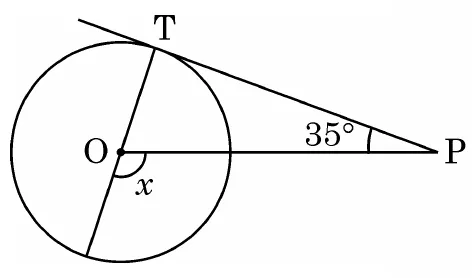
In the given figure, if PTPT is a tangent to a circle with centre OO and ∠TPO=35∘\angle TPO = 35^\circ, then the measure of ∠x\angle x is:

A circle with centre O and a diameter through T drawn from the top. P is outside on the right, with PT a tangent touching at T. The angle TPO is 35 degrees. The angle x is marked at O below the line OP, between OP and the lower part of the diameter.
  1. (A)110∘110^\circ
  2. (B)115∘115^\circ
  3. (C)120∘120^\circ
  4. (D)125∘125^\circ
Solution · answer (D)
35°55°xOPTS∠TOP = 90° − 35° = 55°; x = 180° − 55° = 125°
  1. OT⊥PTOT \perp PT (radius perpendicular to the tangent), so in △OTP\triangle OTP: ∠TOP=180∘−90∘−35∘=55∘\angle TOP = 180^\circ - 90^\circ - 35^\circ = 55^\circ.
  2. The diameter through TT is a straight line, so the angle xx on the other side of OPOP is 180∘−55∘=125∘180^\circ - 55^\circ = 125^\circ.

Answer: (D) 125∘125^\circ

Common mistake: Stopping at 55∘55^\circ. The angle marked xx is the supplementary angle on the other side of OPOP.

Report an error on this question
Q11Triangles1 mark

If the diagonals of a quadrilateral divide each other proportionally, then it is a:

  1. (A)parallelogram
  2. (B)rectangle
  3. (C)square
  4. (D)trapezium
Solution · answer (D)
  1. If the diagonals ACAC and BDBD meet at OO with OAOC=OBOD\dfrac{OA}{OC} = \dfrac{OB}{OD}, then △OAB∼△OCD\triangle OAB \sim \triangle OCD, so ∠OAB=∠OCD\angle OAB = \angle OCD and AB∥CDAB \parallel CD.
  2. Only one pair of opposite sides is guaranteed parallel, so the quadrilateral is a trapezium. (In a parallelogram the diagonals bisect each other, which is a special case of this ratio.)

Answer: (D) trapezium

Report an error on this question
Q12Triangles1 mark

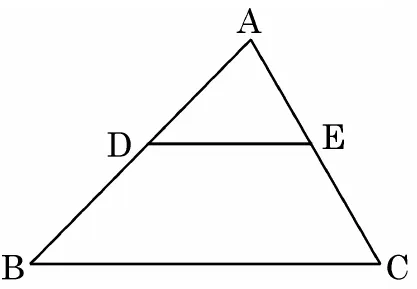
In △ABC\triangle ABC, DE∥BCDE \parallel BC (as shown in the figure). If AD=2AD = 2 cm, BD=3BD = 3 cm, BC=7.5BC = 7.5 cm, then the length of DEDE (in cm) is:

Triangle ABC with a line DE drawn parallel to the base BC, with D on AB and E on AC.
  1. (A)2.5
  2. (B)3
  3. (C)5
  4. (D)6
Solution · answer (B)
ABCDEDE / BC = AD / AB = 2 / 5, so DE = 3 cm23
  1. DE∥BCDE \parallel BC, so △ADE∼△ABC\triangle ADE \sim \triangle ABC: DEBC=ADAB\dfrac{DE}{BC} = \dfrac{AD}{AB}.
  2. AB=AD+DB=2+3=5AB = AD + DB = 2 + 3 = 5. DE7.5=25\dfrac{DE}{7.5} = \dfrac{2}{5}, so DE=3DE = 3 cm.

Answer: (B) 3

Report an error on this question
Q13Real Numbers1 mark

Given HCF(2520,6600)=40\text{HCF}(2520, 6600) = 40, LCM(2520,6600)=252×k\text{LCM}(2520, 6600) = 252 \times k, then the value of kk is:

  1. (A)1650
  2. (B)1600
  3. (C)165
  4. (D)1625
Solution · answer (A)
  1. HCF×LCM=2520×6600\text{HCF} \times \text{LCM} = 2520 \times 6600, so LCM=2520×660040=2520×165=415800\text{LCM} = \dfrac{2520 \times 6600}{40} = 2520 \times 165 = 415800.
  2. 415800=252×1650415800 = 252 \times 1650, so k=1650k = 1650.

Answer: (A) 1650

Report an error on this question
Q14Real Numbers1 mark

A pair of irrational numbers whose product is a rational number is:

  1. (A)(16,4)(\sqrt{16}, \sqrt{4})
  2. (B)(5,2)(\sqrt{5}, \sqrt{2})
  3. (C)(3,27)(\sqrt{3}, \sqrt{27})
  4. (D)(36,2)(\sqrt{36}, \sqrt{2})
Solution · answer (C)
  1. (A) 16=4\sqrt{16} = 4 and 4=2\sqrt{4} = 2 are rational, so it is not a pair of irrationals. (D) 36=6\sqrt{36} = 6 is rational.
  2. (B) 5×2=10\sqrt{5} \times \sqrt{2} = \sqrt{10} is irrational.
  3. (C) 3\sqrt{3} and 27=33\sqrt{27} = 3\sqrt{3} are both irrational, and 3×33=9\sqrt{3} \times 3\sqrt{3} = 9, rational. ✓

Answer: (C) (3,27)(\sqrt{3}, \sqrt{27})

Report an error on this question
Q15Probability1 mark

If a digit is chosen at random from the digits 1, 2, 3, 4, 5, 6, 7, 8, 9; then the probability that this digit is an odd prime number is:

  1. (A)13\dfrac{1}{3}
  2. (B)23\dfrac{2}{3}
  3. (C)49\dfrac{4}{9}
  4. (D)59\dfrac{5}{9}
Solution · answer (A)
  1. Odd prime digits among 11 to 99: 3,5,73, 5, 7. That is 33 out of 99.
  2. P=39=13P = \dfrac{3}{9} = \dfrac{1}{3}. (The prime 22 is even.)

Answer: (A) 13\dfrac{1}{3}

Report an error on this question
Q16Statistics1 mark

The mean of five observations is 15. If the mean of first three observations is 14 and that of the last three observations is 17, then the third observation is

  1. (A)20
  2. (B)19
  3. (C)18
  4. (D)17
Solution · answer (C)
  1. Sum of all five =5×15=75= 5 \times 15 = 75. Sum of the first three =3×14=42= 3 \times 14 = 42. Sum of the last three =3×17=51= 3 \times 17 = 51.
  2. The third observation is counted in both sums, so 42+51−75=1842 + 51 - 75 = 18.

Answer: (C) 18

Report an error on this question
Q17Areas Related to Circles1 mark

Perimeter of a sector of a circle whose central angle is 90° and radius 7 cm is:

  1. (A)35 cm
  2. (B)11 cm
  3. (C)22 cm
  4. (D)25 cm
Solution · answer (D)
  1. Arc length =90360×2πr=14×2×227×7=11= \dfrac{90}{360} \times 2\pi r = \dfrac{1}{4} \times 2 \times \dfrac{22}{7} \times 7 = 11 cm.
  2. Perimeter == arc +2r=11+14=25+ 2r = 11 + 14 = 25 cm.

Answer: (D) 25 cm

Common mistake: Stopping at the arc length (11 cm). The perimeter of a sector also includes the two radii.

Report an error on this question
Q18Circles1 mark

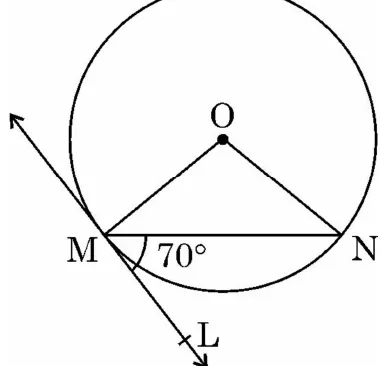
In the given figure, OO is the centre of the circle. MNMN is the chord and the tangent MLML at point MM makes an angle of 70∘70^\circ with MNMN. The measure of ∠MON\angle MON is:

A circle with centre O and a chord MN below it. The tangent ML touches the circle at M and runs down to the right, making an angle of 70 degrees with the chord MN. OM and ON are joined.
  1. (A)120∘120^\circ
  2. (B)140∘140^\circ
  3. (C)70∘70^\circ
  4. (D)90∘90^\circ
Solution · answer (B)
70°140°OMNLtangent–chord angle 70° = half of ∠MON, so ∠MON = 140°
  1. The angle between a tangent and a chord is 70∘70^\circ, so the angle in the alternate segment is 70∘70^\circ.
  2. The angle at the centre is twice the angle at the circumference on the same arc: ∠MON=2×70∘=140∘\angle MON = 2 \times 70^\circ = 140^\circ.

Answer: (B) 140∘140^\circ

Report an error on this question
Q19Coordinate Geometry1 mark

Assertion (A): The point which divides the line segment joining the points A(1,2)A(1, 2) and B(−1,1)B(-1, 1) internally in the ratio 1:21 : 2 is (−13,53)\left(\dfrac{-1}{3}, \dfrac{5}{3}\right).

Reason (R): The coordinates of the point which divides the line segment joining the points A(x1,y1)A(x_1, y_1) and B(x2,y2)B(x_2, y_2) in the ratio m1:m2m_1 : m_2 are (m1x2+m2x1m1+m2, m1y2+m2y1m1+m2)\left(\dfrac{m_1x_2 + m_2x_1}{m_1 + m_2},\ \dfrac{m_1y_2 + m_2y_1}{m_1 + m_2}\right).

  1. (A)Both A and R are true and R is the correct explanation of A
  2. (B)Both A and R are true, but R is not the correct explanation of A
  3. (C)A is true, but R is false
  4. (D)A is false, but R is true
Solution · answer (D)
  1. (R) This is the section formula, which is correct.
  2. (A) With m1:m2=1:2m_1 : m_2 = 1 : 2: x=1×(−1)+2×13=13x = \dfrac{1 \times (-1) + 2 \times 1}{3} = \dfrac{1}{3} and y=1×1+2×23=53y = \dfrac{1 \times 1 + 2 \times 2}{3} = \dfrac{5}{3}. The point is (13,53)\left(\dfrac{1}{3}, \dfrac{5}{3}\right), not (−13,53)\left(-\dfrac{1}{3}, \dfrac{5}{3}\right). So A is false.

Answer: (D) A is false, R is true

Report an error on this question
Q20Probability1 mark

Assertion (A): In a cricket match, a batsman hits a boundary 99 times out of 4545 balls he plays. The probability that in a given ball, he does not hit the boundary is 45\dfrac{4}{5}.

Reason (R): P(E)+P(not E)=1P(E) + P(\text{not } E) = 1.

  1. (A)Both A and R are true and R is the correct explanation of A
  2. (B)Both A and R are true, but R is not the correct explanation of A
  3. (C)A is true, but R is false
  4. (D)A is false, but R is true
Solution · answer (A)
  1. P(boundary)=945=15P(\text{boundary}) = \dfrac{9}{45} = \dfrac{1}{5}, so P(no boundary)=1−15=45P(\text{no boundary}) = 1 - \dfrac{1}{5} = \dfrac{4}{5}. A is true.
  2. R, P(E)+P(not E)=1P(E) + P(\text{not } E) = 1, is true and is exactly the rule used to get A. So R explains A.

Answer: (A) Both true, and R explains A

Report an error on this question

Section B: Very short answer

5 questions, 2 marks each.

Q21Probability2 marks

One card is drawn at random from a well shuffled deck of 52 cards. Find the probability that the card drawn

(i) is queen of hearts;

(ii) is not a jack.

Solution
  1. Total outcomes =52= 52.
  2. (i) There is 11 queen of hearts: P=152P = \dfrac{1}{52}.
  3. (ii) There are 44 jacks, so 52−4=4852 - 4 = 48 cards are not jacks. P=4852=1213P = \dfrac{48}{52} = \dfrac{12}{13}.

Answer: (i) 152\dfrac{1}{52}   (ii) 1213\dfrac{12}{13}

Report an error on this question
Q22Linear Equations2 marks

(a) If 2x+y=132x + y = 13 and 4x−y=174x - y = 17, find the value of (x−y)(x - y).

OR

(b) Sum of two numbers is 105105 and their difference is 4545. Find the numbers.

Solution
  1. (a) Add the equations: 6x=306x = 30, so x=5x = 5. Then y=13−10=3y = 13 - 10 = 3. x−y=5−3=2x - y = 5 - 3 = 2.
  2. (b) Let the numbers be xx and yy with x>yx > y: x+y=105x + y = 105 and x−y=45x - y = 45. Add: 2x=1502x = 150, so x=75x = 75 and y=30y = 30.

Answer: (a) 22   (b) 7575 and 3030

Report an error on this question
Q23Coordinate Geometry2 marks

(a) Find a relation between xx and yy such that the point P(x,y)P(x, y) is equidistant from the points A(7,1)A(7, 1) and B(3,5)B(3, 5).

OR

(b) Points A(−1,y)A(-1, y) and B(5,7)B(5, 7) lie on a circle with centre O(2,−3y)O(2, -3y) such that ABAB is a diameter of the circle. Find the value of yy. Also, find the radius of the circle.

Solution
  1. (a) PA=PBPA = PB, so PA2=PB2PA^2 = PB^2: (x−7)2+(y−1)2=(x−3)2+(y−5)2(x - 7)^2 + (y - 1)^2 = (x - 3)^2 + (y - 5)^2.
  2. −14x+49−2y+1=−6x+9−10y+25-14x + 49 - 2y + 1 = -6x + 9 - 10y + 25, so −8x+8y+16=0-8x + 8y + 16 = 0, that is x−y−2=0x - y - 2 = 0.
  3. (b) OO is the mid-point of the diameter ABAB: y+72=−3y\dfrac{y + 7}{2} = -3y, so y+7=−6yy + 7 = -6y and y=−1y = -1.
  4. Then O=(2,3)O = (2, 3) and B=(5,7)B = (5, 7). Radius =OB=(5−2)2+(7−3)2=9+16=5= OB = \sqrt{(5 - 2)^2 + (7 - 3)^2} = \sqrt{9 + 16} = 5.

Answer: (a) x−y−2=0x - y - 2 = 0   (b) y=−1y = -1, radius =5= 5

Report an error on this question
Q24Triangles2 marks

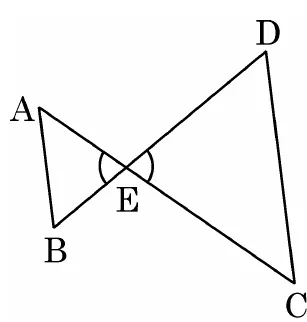
In the given figure, EAEC=EBED\dfrac{EA}{EC} = \dfrac{EB}{ED}, prove that △EAB∼△ECD\triangle EAB \sim \triangle ECD.

Two triangles meeting at the point E like a bow tie: triangle EAB on the left with A above and B below, and triangle ECD on the right with D above and C below. The angle AEB is marked equal to the angle CED.
Solution
EABCDEA/EC = EB/ED and ∠AEB = ∠CED: SAS similarity
  1. In △EAB\triangle EAB and △ECD\triangle ECD: EAEC=EBED\dfrac{EA}{EC} = \dfrac{EB}{ED} (given).
  2. ∠AEB=∠CED\angle AEB = \angle CED (vertically opposite angles).
  3. So △EAB∼△ECD\triangle EAB \sim \triangle ECD by SAS similarity.

Answer: △EAB∼△ECD\triangle EAB \sim \triangle ECD

Report an error on this question
Q25Trigonometry2 marks

Evaluate: cos⁡45∘+sin⁡60∘sec⁡30∘+cosec 30∘\dfrac{\cos 45^\circ + \sin 60^\circ}{\sec 30^\circ + \mathrm{cosec}\,30^\circ}.

Solution
  1. cos⁡45∘=12\cos 45^\circ = \dfrac{1}{\sqrt{2}}, sin⁡60∘=32\sin 60^\circ = \dfrac{\sqrt{3}}{2}, sec⁡30∘=23\sec 30^\circ = \dfrac{2}{\sqrt{3}}, cosec 30∘=2\mathrm{cosec}\,30^\circ = 2.
  2. Numerator =12+32=2+622= \dfrac{1}{\sqrt{2}} + \dfrac{\sqrt{3}}{2} = \dfrac{2 + \sqrt{6}}{2\sqrt{2}}. Denominator =23+2=2(1+3)3= \dfrac{2}{\sqrt{3}} + 2 = \dfrac{2(1 + \sqrt{3})}{\sqrt{3}}.
  3. Value =2+622×32(1+3)=23+3242(1+3)= \dfrac{2 + \sqrt{6}}{2\sqrt{2}} \times \dfrac{\sqrt{3}}{2(1 + \sqrt{3})} = \dfrac{2\sqrt{3} + 3\sqrt{2}}{4\sqrt{2}(1 + \sqrt{3})}.

Answer: 23+3242(1+3)\dfrac{2\sqrt{3} + 3\sqrt{2}}{4\sqrt{2}(1 + \sqrt{3})} (about 0.49870.4987)

Report an error on this question

Section C: Short answer

6 questions, 3 marks each.

Q26Arithmetic Progressions3 marks

(a) If the sum of first 77 terms of an A.P. is 4949 and that of first 1717 terms is 289289, find the sum of its first 2020 terms.

OR

(b) The ratio of the 1010th term to its 3030th term of an A.P. is 1:31 : 3 and the sum of its first six terms is 4242. Find the first term and the common difference of A.P.

Solution
  1. (a) S7=72(2a+6d)=49S_7 = \dfrac{7}{2}(2a + 6d) = 49, so a+3d=7a + 3d = 7. … (i) S17=172(2a+16d)=289S_{17} = \dfrac{17}{2}(2a + 16d) = 289, so a+8d=17a + 8d = 17. … (ii)
  2. Subtract: 5d=105d = 10, so d=2d = 2 and a=1a = 1. S20=202[2×1+19×2]=10×40=400S_{20} = \dfrac{20}{2}[2 \times 1 + 19 \times 2] = 10 \times 40 = 400.
  3. (b) a+9da+29d=13\dfrac{a + 9d}{a + 29d} = \dfrac{1}{3}: 3a+27d=a+29d3a + 27d = a + 29d, so a=da = d. … (i)
  4. S6=62(2a+5d)=42S_6 = \dfrac{6}{2}(2a + 5d) = 42, so 2a+5d=142a + 5d = 14. … (ii) Put a=da = d: 7d=147d = 14, so d=2d = 2 and a=2a = 2.

Answer: (a) S20=400S_{20} = 400   (b) a=2a = 2, d=2d = 2

Report an error on this question
Q27Polynomials3 marks

Find the zeroes of the quadratic polynomial x2−15x^2 - 15 and verify the relationship between the zeroes and the coefficients of the polynomial.

Solution
  1. x2−15=(x−15)(x+15)x^2 - 15 = (x - \sqrt{15})(x + \sqrt{15}), so the zeroes are 15\sqrt{15} and −15-\sqrt{15}.
  2. Sum of zeroes =15−15=0= \sqrt{15} - \sqrt{15} = 0. From the polynomial: −coeff of xcoeff of x2=−01=0-\dfrac{\text{coeff of } x}{\text{coeff of } x^2} = -\dfrac{0}{1} = 0 ✓.
  3. Product of zeroes =15×(−15)=−15= \sqrt{15} \times (-\sqrt{15}) = -15. From the polynomial: constantcoeff of x2=−151=−15\dfrac{\text{constant}}{\text{coeff of } x^2} = \dfrac{-15}{1} = -15 ✓.

Answer: Zeroes ±15\pm\sqrt{15}; relationships verified

Report an error on this question
Q28Linear Equations3 marks

Solve the following system of linear equations graphically: x−y+1=0x - y + 1 = 0 and x+y=5x + y = 5.

Solution
-1123456-1123456Oxyx − y + 1 = 0x + y = 5(2, 3)(0, 1)(0, 5)(4, 5)(5, 0)
  1. First line: y=x+1y = x + 1. Points: (0,1)(0, 1), (2,3)(2, 3), (4,5)(4, 5).
  2. Second line: y=5−xy = 5 - x. Points: (0,5)(0, 5), (2,3)(2, 3), (5,0)(5, 0).
  3. Plot both lines. They meet at (2,3)(2, 3), so x=2x = 2 and y=3y = 3.

Answer: x=2, y=3x = 2,\ y = 3

Report an error on this question
Q29Coordinate Geometry3 marks

(a) Find the ratio in which the line segment joining the points (5,3)(5, 3) and (−1,6)(-1, 6) is divided by YY-axis.

OR

(b) P(−2,5)P(-2, 5) and Q(3,2)Q(3, 2) are two points. Find the coordinates of the point RR on line segment PQPQ such that PR=2QRPR = 2QR.

Solution
  1. (a) The YY-axis has x=0x = 0. Let the segment from (5,3)(5, 3) to (−1,6)(-1, 6) be divided in the ratio k:1k : 1: x=−k+5k+1=0x = \dfrac{-k + 5}{k + 1} = 0.
  2. k=5k = 5. The ratio is 5:15 : 1.
  3. (b) PR=2QRPR = 2QR means PR:RQ=2:1PR : RQ = 2 : 1. x=2×3+1×(−2)3=43x = \dfrac{2 \times 3 + 1 \times (-2)}{3} = \dfrac{4}{3} and y=2×2+1×53=3y = \dfrac{2 \times 2 + 1 \times 5}{3} = 3.

Answer: (a) 5:15 : 1   (b) R=(43,3)R = \left(\dfrac{4}{3}, 3\right)

Report an error on this question
Q30Trigonometry3 marks

Prove that sin⁡θ−2sin⁡3θ2cos⁡3θ−cos⁡θ=tan⁡θ\dfrac{\sin\theta - 2\sin^3\theta}{2\cos^3\theta - \cos\theta} = \tan\theta.

Solution
  1. LHS =sin⁡θ(1−2sin⁡2θ)cos⁡θ(2cos⁡2θ−1)=tan⁡θ⋅1−2sin⁡2θ2cos⁡2θ−1= \dfrac{\sin\theta(1 - 2\sin^2\theta)}{\cos\theta(2\cos^2\theta - 1)} = \tan\theta \cdot \dfrac{1 - 2\sin^2\theta}{2\cos^2\theta - 1}.
  2. 2cos⁡2θ−1=2(1−sin⁡2θ)−1=1−2sin⁡2θ2\cos^2\theta - 1 = 2(1 - \sin^2\theta) - 1 = 1 - 2\sin^2\theta.
  3. So LHS =tan⁡θ⋅1−2sin⁡2θ1−2sin⁡2θ=tan⁡θ== \tan\theta \cdot \dfrac{1 - 2\sin^2\theta}{1 - 2\sin^2\theta} = \tan\theta = RHS.

Answer: Proved

Report an error on this question
Q31Circles3 marks

Prove that the tangents drawn at the end points of a chord of a circle makes equal angles with the chord.

Solution
  1. Let ABAB be a chord of a circle with centre OO, and let the tangents at AA and BB meet at PP. We prove ∠PAB=∠PBA\angle PAB = \angle PBA.
  2. Tangents from an external point are equal: PA=PBPA = PB.
  3. In △PAB\triangle PAB, PA=PBPA = PB, so the angles opposite them are equal: ∠PAB=∠PBA\angle PAB = \angle PBA.
  4. So the two tangents make equal angles with the chord.

Answer: Proved

Report an error on this question

Section D: Long answer

4 questions, 5 marks each.

Q32Quadratic Equations5 marks

(a) In a flight of 28002800 km, an aircraft was slowed down due to bad weather. Its average speed is reduced by 100100 km/h and by doing so, the time of flight is increased by 3030 minutes. Find the original duration of the flight.

OR

(b) The denominator of a fraction is one more than twice the numerator. If the sum of the fraction and its reciprocal is 216212\dfrac{16}{21}, find the fraction.

Solution
  1. (a) Let the original speed be xx km/h. Original time =2800x= \dfrac{2800}{x} and new time =2800x−100= \dfrac{2800}{x - 100}, which is 12\dfrac{1}{2} hour more.
  2. 2800x−100−2800x=12\dfrac{2800}{x - 100} - \dfrac{2800}{x} = \dfrac{1}{2}, so 2800×100x(x−100)=12\dfrac{2800 \times 100}{x(x - 100)} = \dfrac{1}{2} and x2−100x−560000=0x^2 - 100x - 560000 = 0.
  3. (x−800)(x+700)=0(x - 800)(x + 700) = 0. Speed is positive, so x=800x = 800 km/h. Original duration =2800800=3.5= \dfrac{2800}{800} = 3.5 hours =3= 3 h 3030 min.
  4. (b) Let the numerator be xx, so the denominator is 2x+12x + 1 and the fraction is x2x+1\dfrac{x}{2x + 1}. The sum with its reciprocal is x2x+1+2x+1x=5821\dfrac{x}{2x + 1} + \dfrac{2x + 1}{x} = \dfrac{58}{21}.
  5. 21[x2+(2x+1)2]=58x(2x+1)21[x^2 + (2x + 1)^2] = 58x(2x + 1), so 21(5x2+4x+1)=116x2+58x21(5x^2 + 4x + 1) = 116x^2 + 58x, giving 105x2+84x+21=116x2+58x105x^2 + 84x + 21 = 116x^2 + 58x and 11x2−26x−21=011x^2 - 26x - 21 = 0.
  6. (x−3)(11x+7)=0(x - 3)(11x + 7) = 0. A numerator is positive here, so x=3x = 3 and the fraction is 37\dfrac{3}{7}.

Answer: (a) 3.53.5 hours (33 h 3030 min)   (b) 37\dfrac{3}{7}

Common mistake: In (a), answering the original speed (800 km/h). The question asks for the original duration of the flight.

Report an error on this question
Q33Triangles5 marks

State and prove Basic Proportionality theorem.

Solution
  1. Statement: if a line is drawn parallel to one side of a triangle to intersect the other two sides in distinct points, then the other two sides are divided in the same ratio.
  2. Given: △ABC\triangle ABC with DE∥BCDE \parallel BC, where DD is on ABAB and EE is on ACAC. To prove: ADDB=AEEC\dfrac{AD}{DB} = \dfrac{AE}{EC}.
  3. Construction: join BEBE and CDCD. Draw DM⊥ACDM \perp AC and EN⊥ABEN \perp AB.
  4. ar(△ADE)=12×AD×EN\text{ar}(\triangle ADE) = \dfrac{1}{2} \times AD \times EN and ar(△BDE)=12×DB×EN\text{ar}(\triangle BDE) = \dfrac{1}{2} \times DB \times EN, so ar(ADE)ar(BDE)=ADDB\dfrac{\text{ar}(ADE)}{\text{ar}(BDE)} = \dfrac{AD}{DB}. … (i)
  5. ar(△ADE)=12×AE×DM\text{ar}(\triangle ADE) = \dfrac{1}{2} \times AE \times DM and ar(△CDE)=12×EC×DM\text{ar}(\triangle CDE) = \dfrac{1}{2} \times EC \times DM, so ar(ADE)ar(CDE)=AEEC\dfrac{\text{ar}(ADE)}{\text{ar}(CDE)} = \dfrac{AE}{EC}. … (ii)
  6. △BDE\triangle BDE and △CDE\triangle CDE are on the same base DEDE and between the same parallels DEDE and BCBC, so ar(BDE)=ar(CDE)\text{ar}(BDE) = \text{ar}(CDE). … (iii)
  7. From (i), (ii) and (iii): ADDB=AEEC\dfrac{AD}{DB} = \dfrac{AE}{EC}. Hence proved.

Answer: Basic Proportionality Theorem proved

Report an error on this question
Q34Applications of Trigonometry5 marks

From a point on the ground, the angles of elevation of the bottom and the top of a transmission tower fixed at the top of a 2020 m high building are 45∘45^\circ and 60∘60^\circ respectively. Find the height of the tower.

Solution
45°60°PFTUbuilding 20 mtower h ≈ 14.6 mx = 20 m
  1. Let the point be PP, at a distance xx from the foot FF of the building. The building has height FT=20FT = 20 m and the tower is TU=hTU = h m.
  2. Bottom of the tower (top of the building) at 45∘45^\circ: tan⁡45∘=20x=1\tan 45^\circ = \dfrac{20}{x} = 1, so x=20x = 20 m. … (i)
  3. Top of the tower at 60∘60^\circ: tan⁡60∘=h+20x=3\tan 60^\circ = \dfrac{h + 20}{x} = \sqrt{3}, so h+20=x3h + 20 = x\sqrt{3}. … (ii)
  4. Put x=20x = 20: h+20=203h + 20 = 20\sqrt{3}, so h=20(3−1)h = 20(\sqrt{3} - 1) m ≈14.64\approx 14.64 m.

Answer: Height of the tower =20(3−1)= 20(\sqrt{3} - 1) m ≈14.64\approx 14.64 m

Common mistake: Using hh alone with tan⁡60∘\tan 60^\circ. The 60∘60^\circ is measured to the top of the tower, at height h+20h + 20.

Report an error on this question
Q35Surface Areas and Volumes5 marks

(a) A solid iron pole consists of a solid cylinder of height 200200 cm and base diameter 2828 cm, which is surmounted by another cylinder of height 5050 cm and radius 77 cm. Find the mass of the pole, given that 11 cm³ of iron has approximately 88 g mass.

OR

(b) A medicine capsule is in the shape of a cylinder with two hemispheres stuck to each of its ends. The length of the entire capsule is 1414 mm and the diameter of the capsule is 44 mm, find its surface area. Also, find its volume.

Solution
10 mmr = 2total length 14 mm = 10 + 2 + 2
  1. (a) Lower cylinder: r=14r = 14 cm, h=200h = 200 cm. Upper cylinder: r=7r = 7 cm, h=50h = 50 cm.
  2. Volume =π×142×200+π×72×50=227×196×200+227×49×50=123200+7700=130900= \pi \times 14^2 \times 200 + \pi \times 7^2 \times 50 = \dfrac{22}{7} \times 196 \times 200 + \dfrac{22}{7} \times 49 \times 50 = 123200 + 7700 = 130900 cm³.
  3. Mass =130900×8= 130900 \times 8 g =1047200= 1047200 g =1047.2= 1047.2 kg.
  4. (b) Radius of each hemisphere == radius of the cylinder =2= 2 mm. Length of the cylindrical part =14−2−2=10= 14 - 2 - 2 = 10 mm.
  5. Surface area == CSA of the cylinder +2×+ 2 \times CSA of a hemisphere =2πrh+2×2πr2=2×227×2×10+4×227×4=880+3527=12327=176= 2\pi r h + 2 \times 2\pi r^2 = 2 \times \dfrac{22}{7} \times 2 \times 10 + 4 \times \dfrac{22}{7} \times 4 = \dfrac{880 + 352}{7} = \dfrac{1232}{7} = 176 mm².
  6. Volume =πr2h+2×23πr3=227×4×10+43×227×8=8807+70421=334421≈159.24= \pi r^2 h + 2 \times \dfrac{2}{3}\pi r^3 = \dfrac{22}{7} \times 4 \times 10 + \dfrac{4}{3} \times \dfrac{22}{7} \times 8 = \dfrac{880}{7} + \dfrac{704}{21} = \dfrac{3344}{21} \approx 159.24 mm³.

Answer: (a) 1047.21047.2 kg   (b) surface area 176176 mm², volume 334421≈159.24\dfrac{3344}{21} \approx 159.24 mm³

Common mistake: In (b), using 1414 mm as the length of the cylinder. The two hemispheres take 2+2=42 + 2 = 4 mm, leaving 1010 mm.

Report an error on this question

Section E: Case studies

3 case studies, 4 marks each.

Q36Areas Related to Circles4 marks

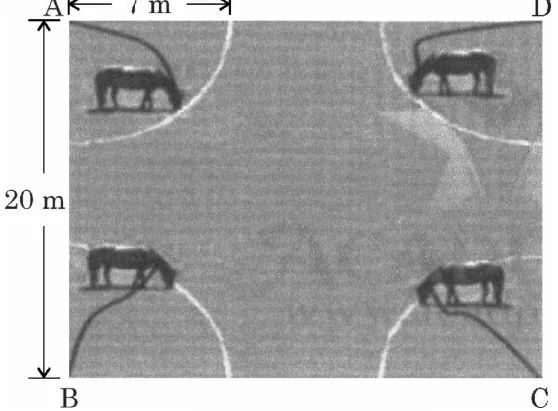
Case study 1. A stable owner has four horses. He usually tie these horses with 7 m long rope to pegs at each corner of a square shaped grass field of 20 m length, to graze in his farm. But tying with rope sometimes results in injuries to his horses, so he decided to build fence around the area so that each horse can graze.

Based on the above, answer the following questions:

(i) Find the area of the square shaped grass field. [1]

(ii) (a) Find the area of the total field in which these horses can graze. [2]

OR

(ii) (b) If the length of the rope of each horse is increased from 7 m to 10 m, find the area grazed by one horse. (Use π = 3.14) [2]

(iii) What is area of the field that is left ungrazed, if the length of the rope of each horse is 7 cm? [1]

A square grass field ABCD of side 20 m with a horse at each corner. A dimension marks the 7 m rope at the top left corner and 20 m along the side.
Solution
ADBC20 m × 20 m = 400 m²7 m4 quarter circles = π × 7² = 154 m²
  1. (i) Area of the square field =20×20=400= 20 \times 20 = 400 m².
  2. (ii)(a) Each horse grazes a quarter circle of radius 77 m, and the four quarter circles together make a full circle: area =πr2=227×7×7=154= \pi r^2 = \dfrac{22}{7} \times 7 \times 7 = 154 m².
  3. (ii)(b) With a 1010 m rope, one horse grazes a quarter circle: 14×3.14×10×10=78.5\dfrac{1}{4} \times 3.14 \times 10 \times 10 = 78.5 m².
  4. (iii) With a rope of length 77 cm, the four quarter circles together have area 227×7×7=154\dfrac{22}{7} \times 7 \times 7 = 154 cm² =0.0154= 0.0154 m². The area left ungrazed =400−0.0154=399.9846= 400 - 0.0154 = 399.9846 m².

Answer: (i) 400400 m²   (ii)(a) 154154 m²   (ii)(b) 78.578.5 m²   (iii) 399.9846399.9846 m²

Common mistake: In (iii), subtracting 154 from 400. The rope is 7 cm, not 7 m, so the grazed area is 154 cm², which is only 0.0154 m².

Report an error on this question
Q37Statistics4 marks

Case study 2. Vocational training complements traditional education by providing practical skills and hands-on experience. While education equips individuals with a broad knowledge base, vocational training focuses on job-specific skills, enhancing employability thus making the student self-reliant. Keeping this in view, a teacher made the following table giving the frequency distribution of students/adults undergoing vocational training from the training institute.

From the above answer the following questions:

(i) What is the lower limit of the modal class of the above data? [1]

(ii) (a) Find the median class of the above data. [2]

OR

(ii) (b) Find the number of participants of age less than 50 years who undergo vocational training. [2]

(iii) Give the empirical relationship between mean, median and mode. [1]

Age (in years)15–1920–2425–2930–3435–3940–4445–4950–54
Number of participants6213296371311104
Solution
152025303540455020406080100120140Oxy6213296371311104
Modal class and median class: 19.5 – 24.5.
  1. The ages are in inclusive classes, so convert them to continuous classes by subtracting 0.50.5 and adding 0.50.5: 14.5−19.5, 19.5−24.5, …, 49.5−54.514.5 - 19.5,\ 19.5 - 24.5,\ \dots,\ 49.5 - 54.5.
  2. (i) The highest frequency is 132132, so the modal class is 19.5−24.519.5 - 24.5 and its lower limit is 19.519.5.
  3. (ii)(a) Cumulative frequencies: 62, 194, 290, 327, 340, 351, 361, 36562,\ 194,\ 290,\ 327,\ 340,\ 351,\ 361,\ 365. N=365N = 365 and N2=182.5\dfrac{N}{2} = 182.5, which first falls within 194194, so the median class is 19.5−24.519.5 - 24.5.
  4. (ii)(b) Participants younger than 5050: all classes except 50−5450 - 54: 62+132+96+37+13+11+10=36162 + 132 + 96 + 37 + 13 + 11 + 10 = 361.
  5. (iii) 3 Median=Mode+2 Mean3\,\text{Median} = \text{Mode} + 2\,\text{Mean}.

Answer: (i) 19.519.5   (ii)(a) 19.5−24.519.5 - 24.5   (ii)(b) 361361   (iii) 3 Median=Mode+2 Mean3\,\text{Median} = \text{Mode} + 2\,\text{Mean}

Report an error on this question
Q38Real Numbers4 marks

Case study 3. Teaching Mathematics through activities is a powerful approach that enhances students’ understanding and engagement. Keeping this in mind, Ms. Mukta planned a prime number game for class 5 students. She announces the number 2 in her class and asked the first student to multiply it by a prime number and then pass it to second student. Second student also multiplied it by a prime number and passed it to third student. In this way by multiplying to a prime number, the last student got 173250.

Now, Mukta asked some questions as given below to the students:

(i) What is the least prime number used by students? [1]

(ii) (a) How many students are in the class? [2]

OR

(ii) (b) What is the highest prime number used by students? [2]

(iii) Which prime number has been used maximum times? [1]

Solution
233555711261890450225015750173250teacher says 2; the students multiply by 3, 3, 5, 5, 5, 7, 11173250 = 2 × 3² × 5³ × 7 × 11
  1. Prime factorise: 173250=2×86625=2×3×28875=2×32×9625=2×32×53×77=2×32×53×7×11173250 = 2 \times 86625 = 2 \times 3 \times 28875 = 2 \times 3^2 \times 9625 = 2 \times 3^2 \times 5^3 \times 77 = 2 \times 3^2 \times 5^3 \times 7 \times 11.
  2. The teacher announced 22, so the primes the students used are 3,3,5,5,5,7,113, 3, 5, 5, 5, 7, 11.
  3. (i) The least prime used by the students is 33.
  4. (ii)(a) Each student used one prime, so the number of students is 2+3+1+1=72 + 3 + 1 + 1 = 7 (two 33's, three 55's, one 77, one 1111).
  5. (ii)(b) The highest prime number used is 1111.
  6. (iii) The prime used the most times is 55 (three times).

Answer: (i) 33   (ii)(a) 77 students   (ii)(b) 1111   (iii) 55

Common mistake: In (i), answering 22. The number 22 was announced by the teacher, not used by a student.

Report an error on this question

Questions are from the official CBSE paper. Figures are described in words; see the PDF for the originals. Solutions are written by CogniGuru.

Revise this paper in 1 minute a chapter

Each chapter below is what the paper tested, with a one-minute animated lesson on the idea behind it.

Stuck on a step in any solution?

The CogniGuru AI tutor explains any doubt one minute at a time, in English or Hindi. Join the waitlist.

Mock quiz: 5 questions from this paper

Five real questions from this paper, one each from five chapters. About 2 minutes. See how much you know and where you stand among other students. Attempt free, with no login; log in only for your ranking and full report.

Question 1 of 5 · Q1 of the paperLinear Equations

The pair of linear equations x+2y+5=0x + 2y + 5 = 0 and −3x=6y−1-3x = 6y - 1 has

0 of 5 answered

Related papers

Common questions

Are these the official CBSE Class 10 Maths Standard 2024 questions?
Yes. The questions are from the official Mathematics (Standard) paper (set 30/3/1) that CBSE published after the March 2024 board exam. The solutions are written by CogniGuru and checked against the answer key CBSE published for this paper code.
Can I download the CBSE Class 10 Maths Standard 2024 question paper PDF?
Yes, the official paper PDF is free to download from this page, and so are our step-by-step solutions as a PDF. No login is needed to download either or to read the solutions.
Do all sets of the paper have the same questions?
No. CBSE sets several versions of each paper, with the same blueprint and similar questions in a different order and sometimes with different numbers. This page covers set 30/3/1.
How does the quiz work, and what does “where you stand” mean?
It is a mock quiz of 5 real multiple-choice questions from this paper, scored automatically in about 2 minutes. Your score is compared, anonymously, with other students who took the same quiz. Only the score is stored with the comparison, never your name or number.

Source

CBSE question paper archive, Class X, 2024 (Mathematics (Standard), set 30/3/1)
PDF