CBSE · Class 10 · Mathematics (Standard) · Free

CBSE Class 10 Maths Standard 2024 Question Paper (Set 30/4/1) with Solutions

The official board paper (Q.P. Code 30/4/1, Series C4ABD/4). Free paper PDF and step-by-step solutions (also as a PDF to download) written by CogniGuru and checked against CBSE’s answer key. See the paper’s main topics in 1 minute, then quiz yourself to see how much you know and where you stand.

No login to download or read the solutions. Login only to see your quiz report in full.

Board
CBSE
Class
10
Subject
Maths Standard (041)
Year
2024
Set code
30/4/1
Max marks
80
Duration
3 hours
Questions
38 (Sections A to E)
Source
Official CBSE paper
Exam date
March 2024

Paper preview

Three pages of the official paper. Download the PDF for all 23.
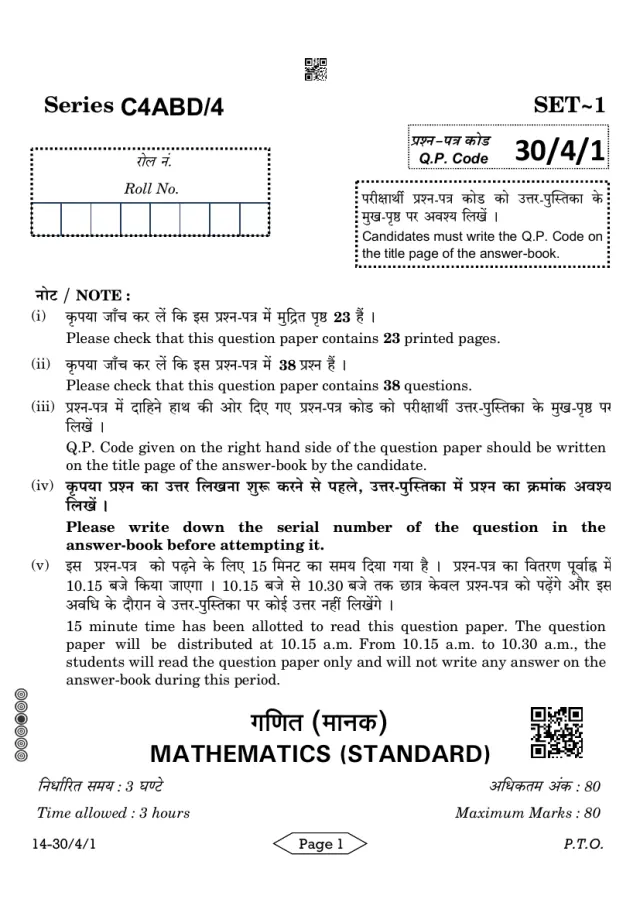
  • Cover page of the CBSE Class 10 Maths Standard 2024 paper, set 30/4/1

    Cover page

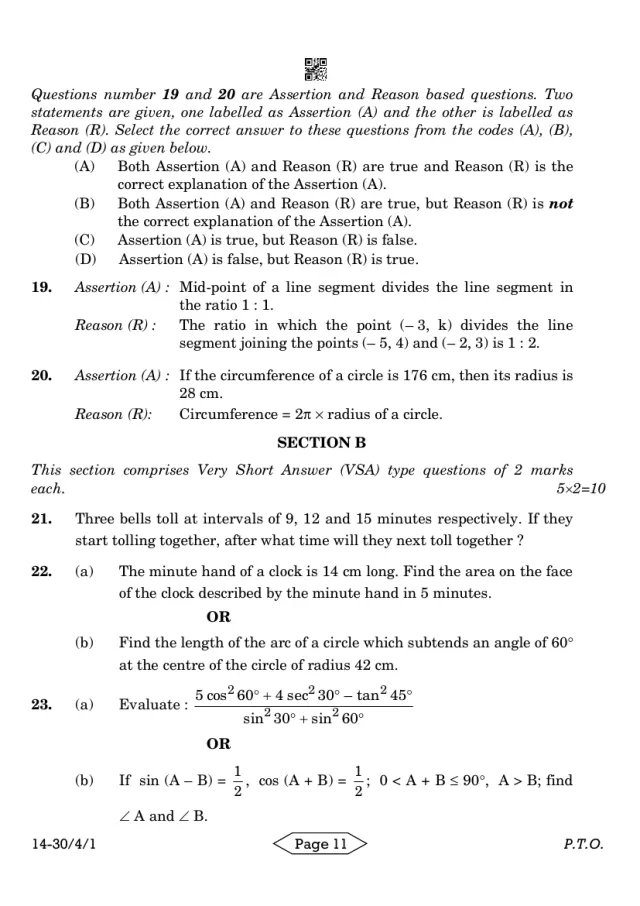
  • Section B of the CBSE Class 10 Maths Standard 2024 paper, set 30/4/1

    Section B

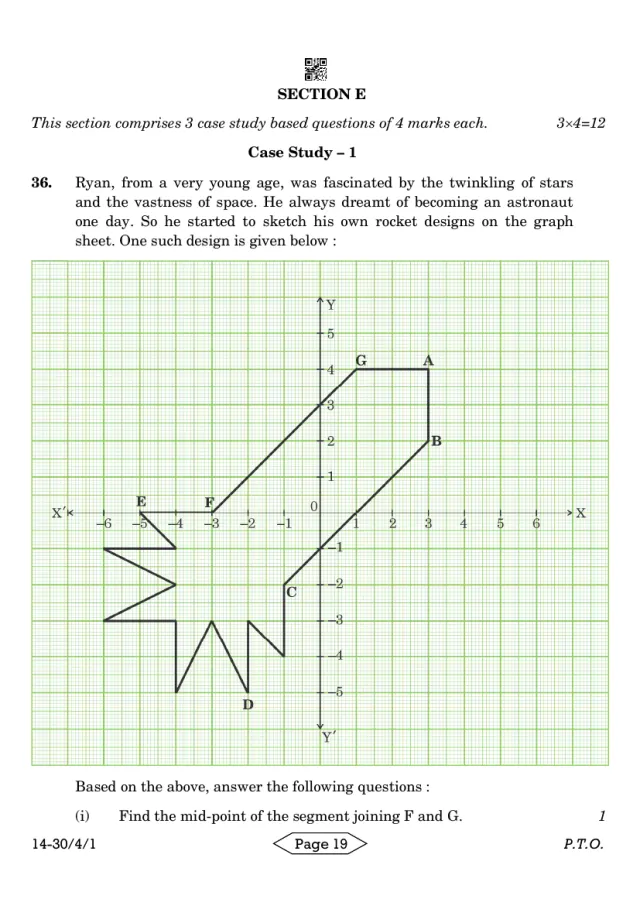
  • A case study with its figure from the CBSE Class 10 Maths Standard 2024 paper, set 30/4/1

    Case study

The main topics of this paper, in 1 minute

Your tutor walks you through the paper before you attempt it: the marks, the key ideas, the time plan and the traps.

1-minute paper analysis

With your tutor, in her voice

The main topics of this paper, in about a minute

A short, animated walk through the paper: how it is built, where the marks come from, the four ideas that matter most, how to plan your three hours, and the traps to avoid.

  1. 1The paper at a glance
  2. 2Where the marks come from
  3. 3Four ideas that keep paying off
  4. 4Plan your three hours
  5. 5Four traps to avoid

Sound on for the voice. Captions are shown, and you can mute any time.

Step-by-step solutions

Try each question first, then open its solution. Tap a number to jump.

Download solutions (PDF)

Section A: Multiple choice

20 questions, 1 mark each. MCQs (Q1 to Q18) and assertion-reason (Q19, Q20).

Q1Linear Equations1 mark

If ax+by=a2−b2ax + by = a^2 - b^2 and bx+ay=0bx + ay = 0, then the value of x+yx + y is:

  1. (A)a2−b2a^2 - b^2
  2. (B)a+ba + b
  3. (C)a−ba - b
  4. (D)a2+b2a^2 + b^2
Solution · answer (C)
  1. Add the two equations: (a+b)x+(a+b)y=a2−b2(a + b)x + (a + b)y = a^2 - b^2, that is (a+b)(x+y)=(a−b)(a+b)(a + b)(x + y) = (a - b)(a + b).
  2. So x+y=a−bx + y = a - b.

Answer: (C) a−ba - b

Report an error on this question
Q2Real Numbers1 mark

The HCF of two numbers 6565 and 104104 is 1313. If LCM of 6565 and 104104 is 40x40x, then the value of xx is:

  1. (A)5
  2. (B)13
  3. (C)40
  4. (D)8
Solution · answer (B)
  1. LCM=65×104HCF=65×10413=5×104=520\text{LCM} = \dfrac{65 \times 104}{\text{HCF}} = \dfrac{65 \times 104}{13} = 5 \times 104 = 520.
  2. 40x=52040x = 520, so x=13x = 13.

Answer: (B) 13

Report an error on this question
Q3Polynomials1 mark

If a polynomial p(x)p(x) is given by p(x)=x2−5x+6p(x) = x^2 - 5x + 6, then the value of p(1)+p(4)p(1) + p(4) is:

  1. (A)0
  2. (B)4
  3. (C)2
  4. (D)−4
Solution · answer (B)
  1. p(1)=1−5+6=2p(1) = 1 - 5 + 6 = 2 and p(4)=16−20+6=2p(4) = 16 - 20 + 6 = 2.
  2. p(1)+p(4)=2+2=4p(1) + p(4) = 2 + 2 = 4.

Answer: (B) 4

Report an error on this question
Q4Quadratic Equations1 mark

If the discriminant of the quadratic equation 3x2−2x+c=03x^2 - 2x + c = 0 is 1616, then the value of cc is:

  1. (A)1
  2. (B)0
  3. (C)−1
  4. (D)2
Solution · answer (C)
  1. D=b2−4ac=(−2)2−4×3×c=4−12cD = b^2 - 4ac = (-2)^2 - 4 \times 3 \times c = 4 - 12c.
  2. 4−12c=164 - 12c = 16, so −12c=12-12c = 12 and c=−1c = -1.

Answer: (C) −1

Report an error on this question
Q5Areas Related to Circles1 mark

If an arc subtends an angle of 90° at the centre of a circle, then the ratio of its length to the circumference of the circle is:

  1. (A)2 : 3
  2. (B)1 : 4
  3. (C)4 : 1
  4. (D)1 : 3
Solution · answer (B)
  1. Arc length =θ360×= \dfrac{\theta}{360} \times circumference =90360×= \dfrac{90}{360} \times circumference =14= \dfrac{1}{4} of the circumference.
  2. The ratio is 1:41 : 4.

Answer: (B) 1 : 4

Report an error on this question
Q6Areas Related to Circles1 mark

The area of the sector of a circle of radius 1212 cm is 60π60\pi cm². The central angle of this sector is:

  1. (A)120∘120^\circ
  2. (B)6∘6^\circ
  3. (C)75∘75^\circ
  4. (D)150∘150^\circ
Solution · answer (D)
  1. θ360×π×122=60π\dfrac{\theta}{360} \times \pi \times 12^2 = 60\pi, so θ360×144=60\dfrac{\theta}{360} \times 144 = 60.
  2. θ=60×360144=150∘\theta = \dfrac{60 \times 360}{144} = 150^\circ.

Answer: (D) 150∘150^\circ

Report an error on this question
Q7Statistics1 mark

If the difference of mode and median of a data is 24, then the difference of its median and mean is:

  1. (A)12
  2. (B)24
  3. (C)8
  4. (D)36
Solution · answer (A)
  1. Mode=3 Median−2 Mean\text{Mode} = 3\,\text{Median} - 2\,\text{Mean}, so Mode−Median=2 Median−2 Mean=2(Median−Mean)\text{Mode} - \text{Median} = 2\,\text{Median} - 2\,\text{Mean} = 2(\text{Median} - \text{Mean}).
  2. 24=2(Median−Mean)24 = 2(\text{Median} - \text{Mean}), so Median−Mean=12\text{Median} - \text{Mean} = 12.

Answer: (A) 12

Report an error on this question
Q8Probability1 mark

Two dice are tossed simultaneously. The probability of getting odd numbers on both the dice is:

  1. (A)636\dfrac{6}{36}
  2. (B)336\dfrac{3}{36}
  3. (C)1236\dfrac{12}{36}
  4. (D)936\dfrac{9}{36}
Solution · answer (D)
  1. Odd numbers on one die: 1,3,51, 3, 5 — 33 choices. Both dice: 3×3=93 \times 3 = 9 favourable outcomes out of 3636.
  2. P=936=14P = \dfrac{9}{36} = \dfrac{1}{4}.

Answer: (D) 936\dfrac{9}{36}

Report an error on this question
Q9Surface Areas and Volumes1 mark

The ratio of total surface area of a solid hemisphere to the square of its radius is:

  1. (A)2π:12\pi : 1
  2. (B)4π:14\pi : 1
  3. (C)3π:13\pi : 1
  4. (D)1:4π1 : 4\pi
Solution · answer (C)
  1. Total surface area of a solid hemisphere =2πr2+πr2=3πr2= 2\pi r^2 + \pi r^2 = 3\pi r^2.
  2. The ratio to r2r^2 is 3πr2:r2=3π:13\pi r^2 : r^2 = 3\pi : 1.

Answer: (C) 3π:13\pi : 1

Report an error on this question
Q10Trigonometry1 mark

If sin⁡θ=1\sin\theta = 1, then the value of 12sin⁡(θ2)\dfrac{1}{2}\sin\left(\dfrac{\theta}{2}\right) is:

  1. (A)122\dfrac{1}{2\sqrt{2}}
  2. (B)12\dfrac{1}{\sqrt{2}}
  3. (C)12\dfrac{1}{2}
  4. (D)0
Solution · answer (A)
  1. sin⁡θ=1\sin\theta = 1 gives θ=90∘\theta = 90^\circ, so θ2=45∘\dfrac{\theta}{2} = 45^\circ.
  2. 12sin⁡45∘=12×12=122\dfrac{1}{2}\sin 45^\circ = \dfrac{1}{2} \times \dfrac{1}{\sqrt{2}} = \dfrac{1}{2\sqrt{2}}.

Answer: (A) 122\dfrac{1}{2\sqrt{2}}

Report an error on this question
Q11Linear Equations1 mark

Two lines are given to be parallel. The equation of one of these lines is 5x−3y=25x - 3y = 2. The equation of the second line can be:

  1. (A)−15x−9y=5-15x - 9y = 5
  2. (B)15x+9y=515x + 9y = 5
  3. (C)9x−15y=69x - 15y = 6
  4. (D)−15x+9y=5-15x + 9y = 5
Solution · answer (D)
  1. Parallel lines have equal ratios of the xx and yy coefficients: a1a2=b1b2\dfrac{a_1}{a_2} = \dfrac{b_1}{b_2} with different constants.
  2. Compare 5x−3y−2=05x - 3y - 2 = 0 with −15x+9y−5=0-15x + 9y - 5 = 0: a1a2=5−15=−13\dfrac{a_1}{a_2} = \dfrac{5}{-15} = -\dfrac{1}{3}, b1b2=−39=−13\dfrac{b_1}{b_2} = \dfrac{-3}{9} = -\dfrac{1}{3} and c1c2=−2−5=25\dfrac{c_1}{c_2} = \dfrac{-2}{-5} = \dfrac{2}{5}.
  3. The first two ratios are equal and the third is different, so the lines are parallel. For the other options the xx and yy ratios differ (for example 515≠−39\dfrac{5}{15} \neq \dfrac{-3}{9}), so they are not parallel.

Answer: (D) −15x+9y=5-15x + 9y = 5

Report an error on this question
Q12Arithmetic Progressions1 mark

Three numbers in A.P. have the sum 30. What is its middle term?

  1. (A)4
  2. (B)10
  3. (C)16
  4. (D)8
Solution · answer (B)
  1. Let the three numbers be a−da - d, aa, a+da + d. Their sum is 3a=303a = 30, so a=10a = 10.
  2. The middle term is 1010.

Answer: (B) 10

Report an error on this question
Q13Triangles1 mark

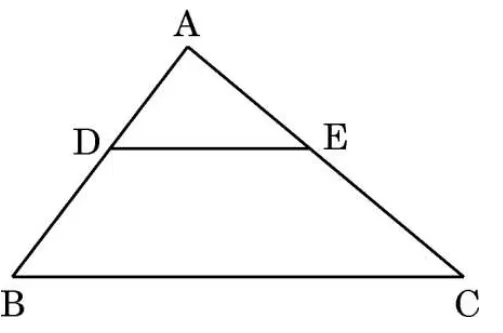
In △ABC\triangle ABC, DE∥BCDE \parallel BC (as shown in the figure). If AD=4AD = 4 cm, AB=9AB = 9 cm and AC=13.5AC = 13.5 cm, then the length of ECEC is:

Triangle ABC with a line DE drawn parallel to the base BC, D on AB and E on AC.
  1. (A)6 cm
  2. (B)7.5 cm
  3. (C)9 cm
  4. (D)5.7 cm
Solution · answer (B)
ABCDEAD/AB = AE/AC = 4/9: AE = 6, so EC = 13.5 − 6 = 7.5 cmAE = 6EC = 7.5
  1. DE∥BCDE \parallel BC, so ADAB=AEAC\dfrac{AD}{AB} = \dfrac{AE}{AC}: 49=AE13.5\dfrac{4}{9} = \dfrac{AE}{13.5}, so AE=6AE = 6 cm.
  2. EC=AC−AE=13.5−6=7.5EC = AC - AE = 13.5 - 6 = 7.5 cm.

Answer: (B) 7.5 cm

Common mistake: Giving AE=6AE = 6 cm (option A). The question asks for ECEC.

Report an error on this question
Q14Applications of Trigonometry1 mark

At some time of the day, the length of the shadow of a tower is equal to its height. Then, the Sun’s altitude at that time is:

  1. (A)30∘30^\circ
  2. (B)45∘45^\circ
  3. (C)60∘60^\circ
  4. (D)90∘90^\circ
Solution · answer (B)
  1. tan⁡θ=heightshadow=1\tan\theta = \dfrac{\text{height}}{\text{shadow}} = 1.
  2. So the Sun’s altitude is θ=45∘\theta = 45^\circ.

Answer: (B) 45∘45^\circ

Report an error on this question
Q15Circles1 mark

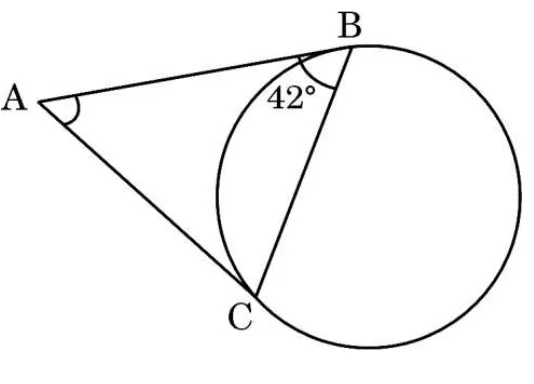
In the given figure, ABAB and ACAC are tangents to the circle. If ∠ABC=42∘\angle ABC = 42^\circ, then the measure of ∠BAC\angle BAC is:

A circle with two tangents AB and AC from the outside point A on the left. The chord BC is drawn and the angle ABC is marked 42 degrees.
  1. (A)96∘96^\circ
  2. (B)42∘42^\circ
  3. (C)106∘106^\circ
  4. (D)86∘86^\circ
Solution · answer (A)
ABCAB = AC, so ∠ACB = ∠ABC = 42°; ∠BAC = 180° − 84° = 96°
  1. Tangents from an external point are equal: AB=ACAB = AC.
  2. In the isosceles △ABC\triangle ABC: ∠ACB=∠ABC=42∘\angle ACB = \angle ABC = 42^\circ.
  3. ∠BAC=180∘−42∘−42∘=96∘\angle BAC = 180^\circ - 42^\circ - 42^\circ = 96^\circ.

Answer: (A) 96∘96^\circ

Report an error on this question
Q16Coordinate Geometry1 mark

The fourth vertex DD of a parallelogram ABCDABCD whose three vertices are A(−2,3)A(-2, 3), B(6,7)B(6, 7) and C(8,3)C(8, 3) is:

  1. (A)(0,1)(0, 1)
  2. (B)(0,−1)(0, -1)
  3. (C)(−1,0)(-1, 0)
  4. (D)(1,0)(1, 0)
Solution · answer (B)
  1. The diagonals ACAC and BDBD bisect each other, so A+C=B+DA + C = B + D coordinate by coordinate.
  2. D=A+C−B=(−2+8−6, 3+3−7)=(0,−1)D = A + C - B = (-2 + 8 - 6,\ 3 + 3 - 7) = (0, -1).

Answer: (B) (0,−1)(0, -1)

Report an error on this question
Q17Probability1 mark

For an event EE, if P(E)+P(E‾)=qP(E) + P(\overline{E}) = q, then the value of q2−4q^2 - 4 is:

  1. (A)−3
  2. (B)3
  3. (C)5
  4. (D)−5
Solution · answer (A)
  1. P(E)+P(E‾)=1P(E) + P(\overline{E}) = 1 always, so q=1q = 1.
  2. q2−4=1−4=−3q^2 - 4 = 1 - 4 = -3.

Answer: (A) −3

Report an error on this question
Q18Circles1 mark

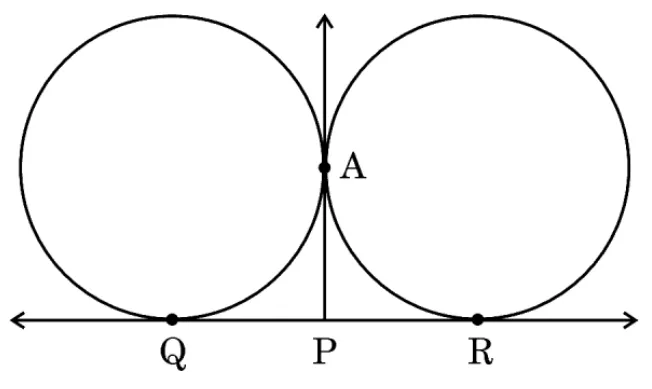
In the given figure, QRQR is a common tangent to the two given circles touching externally at AA. The tangent at AA meets QRQR at PP. If AP=4.2AP = 4.2 cm, then the length of QRQR is:

Two equal circles touching at the point A, side by side, with a common tangent QR along the bottom touching them at Q and R. The common tangent at A runs vertically down to P on QR.
  1. (A)4.2 cm
  2. (B)2.1 cm
  3. (C)8.4 cm
  4. (D)6.3 cm
Solution · answer (C)
4.2AQRPPQ = PA = PR = 4.2 (tangents from P), so QR = 8.4 cm
  1. Tangents drawn from PP to the left circle: PQ=PAPQ = PA. Tangents from PP to the right circle: PR=PAPR = PA.
  2. So PQ=PR=PA=4.2PQ = PR = PA = 4.2 cm and QR=PQ+PR=8.4QR = PQ + PR = 8.4 cm.

Answer: (C) 8.4 cm

Report an error on this question
Q19Coordinate Geometry1 mark

Assertion (A): Mid-point of a line segment divides the line segment in the ratio 1:11 : 1.

Reason (R): The ratio in which the point (−3,k)(-3, k) divides the line segment joining the points (−5,4)(-5, 4) and (−2,3)(-2, 3) is 1:21 : 2.

  1. (A)Both A and R are true and R is the correct explanation of A
  2. (B)Both A and R are true, but R is not the correct explanation of A
  3. (C)A is true, but R is false
  4. (D)A is false, but R is true
Solution · answer (C)
  1. (A) The mid-point is equidistant from the ends, so it divides the segment 1:11 : 1. True.
  2. (R) Let the point divide the segment in the ratio m:nm : n: −2m−5nm+n=−3\dfrac{-2m - 5n}{m + n} = -3, so −2m−5n=−3m−3n-2m - 5n = -3m - 3n and m=2nm = 2n. The ratio is 2:12 : 1, not 1:21 : 2. So R is false.

Answer: (C) A is true, R is false

Report an error on this question
Q20Areas Related to Circles1 mark

Assertion (A): If the circumference of a circle is 176176 cm, then its radius is 2828 cm.

Reason (R): Circumference =2π×= 2\pi \times radius of a circle.

  1. (A)Both A and R are true and R is the correct explanation of A
  2. (B)Both A and R are true, but R is not the correct explanation of A
  3. (C)A is true, but R is false
  4. (D)A is false, but R is true
Solution · answer (A)
  1. (R) The circumference of a circle is 2πr2\pi r. True.
  2. (A) 2πr=1762\pi r = 176: 2×227×r=1762 \times \dfrac{22}{7} \times r = 176, so r=176×744=28r = \dfrac{176 \times 7}{44} = 28 cm. True, and it uses the formula in R.

Answer: (A) Both true, and R explains A

Report an error on this question

Section B: Very short answer

5 questions, 2 marks each.

Q21Real Numbers2 marks

Three bells toll at intervals of 9, 12 and 15 minutes respectively. If they start tolling together, after what time will they next toll together?

Solution
  1. They toll together again after the LCM of 9,12,159, 12, 15.
  2. 9=329 = 3^2, 12=22×312 = 2^2 \times 3, 15=3×515 = 3 \times 5. LCM =22×32×5=180= 2^2 \times 3^2 \times 5 = 180.
  3. They next toll together after 180180 minutes (33 hours).

Answer: 180 minutes (3 hours)

Report an error on this question
Q22Areas Related to Circles2 marks

(a) The minute hand of a clock is 1414 cm long. Find the area on the face of the clock described by the minute hand in 55 minutes.

OR

(b) Find the length of the arc of a circle which subtends an angle of 60∘60^\circ at the centre of the circle of radius 4242 cm.

Solution
12345678910111230° × (π × 14²) / 360° = 154/3 ≈ 51.33 cm²
  1. (a) The minute hand makes 360∘360^\circ in 6060 minutes, so in 55 minutes it moves 36060×5=30∘\dfrac{360}{60} \times 5 = 30^\circ.
  2. Area =30360×227×14×14=112×616=1543= \dfrac{30}{360} \times \dfrac{22}{7} \times 14 \times 14 = \dfrac{1}{12} \times 616 = \dfrac{154}{3} cm² ≈51.33\approx 51.33 cm².
  3. (b) Arc length =60360×2×227×42=16×264=44= \dfrac{60}{360} \times 2 \times \dfrac{22}{7} \times 42 = \dfrac{1}{6} \times 264 = 44 cm.

Answer: (a) 1543≈51.33\dfrac{154}{3} \approx 51.33 cm²   (b) 4444 cm

Report an error on this question
Q23Trigonometry2 marks

(a) Evaluate: 5cos⁡260∘+4sec⁡230∘−tan⁡245∘sin⁡230∘+sin⁡260∘\dfrac{5\cos^2 60^\circ + 4\sec^2 30^\circ - \tan^2 45^\circ}{\sin^2 30^\circ + \sin^2 60^\circ}

OR

(b) If sin⁡(A−B)=12\sin(A - B) = \dfrac{1}{2}, cos⁡(A+B)=12\cos(A + B) = \dfrac{1}{2}; 0<A+B≤90∘0 < A + B \le 90^\circ, A>BA > B; find ∠A\angle A and ∠B\angle B.

Solution
  1. (a) Numerator: 5×(12)2+4×(23)2−12=54+163−1=15+64−1212=67125 \times \left(\dfrac{1}{2}\right)^2 + 4 \times \left(\dfrac{2}{\sqrt{3}}\right)^2 - 1^2 = \dfrac{5}{4} + \dfrac{16}{3} - 1 = \dfrac{15 + 64 - 12}{12} = \dfrac{67}{12}.
  2. Denominator: (12)2+(32)2=14+34=1\left(\dfrac{1}{2}\right)^2 + \left(\dfrac{\sqrt{3}}{2}\right)^2 = \dfrac{1}{4} + \dfrac{3}{4} = 1. So the value is 6712\dfrac{67}{12}.
  3. (b) sin⁡(A−B)=12\sin(A - B) = \dfrac{1}{2} gives A−B=30∘A - B = 30^\circ. cos⁡(A+B)=12\cos(A + B) = \dfrac{1}{2} gives A+B=60∘A + B = 60^\circ.
  4. Add: 2A=90∘2A = 90^\circ, so A=45∘A = 45^\circ and B=15∘B = 15^\circ.

Answer: (a) 6712\dfrac{67}{12}   (b) A=45∘, B=15∘A = 45^\circ,\ B = 15^\circ

Report an error on this question
Q24Circles2 marks

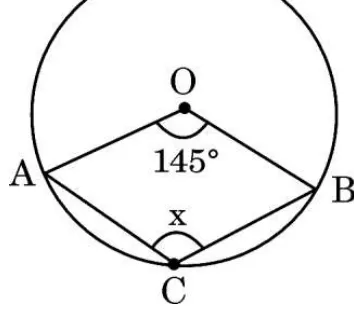
In the given figure, OO is the centre of the circle. If ∠AOB=145∘\angle AOB = 145^\circ, then find the value of xx.

A circle with centre O. Points A and B are on the circle on either side of O and C is on the circle at the bottom. The angle AOB at the centre is marked 145 degrees and the angle ACB is marked x.
Solution
145°xOABCangle at C = ½ (360° − 145°) = 107.5°
  1. Take a point PP on the major arc and join APAP and BPBP. The angle at the centre is double the angle at the circumference on the same arc: ∠APB=12×145∘=72.5∘\angle APB = \dfrac{1}{2} \times 145^\circ = 72.5^\circ.
  2. APBCAPBC is a cyclic quadrilateral, so opposite angles add to 180∘180^\circ: ∠APB+∠ACB=180∘\angle APB + \angle ACB = 180^\circ.
  3. x=∠ACB=180∘−72.5∘=107.5∘x = \angle ACB = 180^\circ - 72.5^\circ = 107.5^\circ.

Answer: x=107.5∘x = 107.5^\circ

Report an error on this question
Q25Triangles2 marks

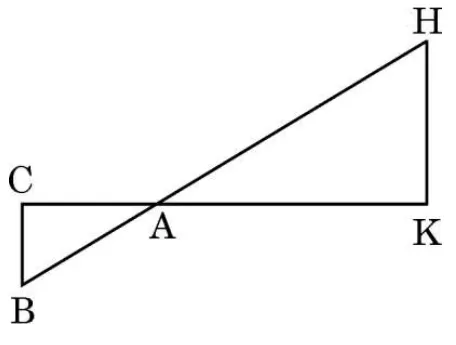
In the given figure, △AHK∼△ABC\triangle AHK \sim \triangle ABC. If AK=8AK = 8 cm, BC=3.2BC = 3.2 cm and HK=6.4HK = 6.4 cm, then find the length of ACAC.

Two triangles meeting at the point A like a bow tie: triangle AHK on the right with H above K, and triangle ABC on the left with C above B. C, A and K lie on one horizontal line.
Solution
6.43.28CAKHBHK / BC = AK / AC → 6.4/3.2 = 8/AC → AC = 4 cm
  1. △AHK∼△ABC\triangle AHK \sim \triangle ABC, so corresponding sides are proportional: HKBC=AKAC\dfrac{HK}{BC} = \dfrac{AK}{AC}.
  2. 6.43.2=8AC\dfrac{6.4}{3.2} = \dfrac{8}{AC}, so 2=8AC2 = \dfrac{8}{AC} and AC=4AC = 4 cm.

Answer: AC=4AC = 4 cm

Report an error on this question

Section C: Short answer

6 questions, 3 marks each.

Q26Trigonometry3 marks

Prove that sin⁡θ−cos⁡θ+1sin⁡θ+cos⁡θ−1=1sec⁡θ−tan⁡θ\dfrac{\sin\theta - \cos\theta + 1}{\sin\theta + \cos\theta - 1} = \dfrac{1}{\sec\theta - \tan\theta}

Solution
  1. Divide the numerator and the denominator of the LHS by cos⁡θ\cos\theta: tan⁡θ−1+sec⁡θtan⁡θ+1−sec⁡θ\dfrac{\tan\theta - 1 + \sec\theta}{\tan\theta + 1 - \sec\theta}.
  2. In the denominator write 1=sec⁡2θ−tan⁡2θ1 = \sec^2\theta - \tan^2\theta: tan⁡θ−sec⁡θ+(sec⁡θ−tan⁡θ)(sec⁡θ+tan⁡θ)=(sec⁡θ−tan⁡θ)(sec⁡θ+tan⁡θ−1)\tan\theta - \sec\theta + (\sec\theta - \tan\theta)(\sec\theta + \tan\theta) = (\sec\theta - \tan\theta)(\sec\theta + \tan\theta - 1).
  3. So LHS =tan⁡θ−1+sec⁡θ(sec⁡θ−tan⁡θ)(sec⁡θ+tan⁡θ−1)=1sec⁡θ−tan⁡θ== \dfrac{\tan\theta - 1 + \sec\theta}{(\sec\theta - \tan\theta)(\sec\theta + \tan\theta - 1)} = \dfrac{1}{\sec\theta - \tan\theta} = RHS.

Answer: Proved

Report an error on this question
Q27Probability3 marks

(a) Three coins are tossed simultaneously. What is the probability of getting (i) at least one head? (ii) exactly two tails? (iii) at most one tail?

OR

(b) A box contains 9090 discs which are numbered 11 to 9090. If one disc is drawn at random from the box, find the probability that it bears a: (i) 22-digit number less than 4040. (ii) number divisible by 55 and greater than 5050. (iii) a perfect square number.

Solution
  1. (a) 88 equally likely outcomes. (i) At least one head: all except TTTTTT: 78\dfrac{7}{8}. (ii) Exactly two tails: HTT,THT,TTHHTT, THT, TTH: 38\dfrac{3}{8}. (iii) At most one tail: HHH,HHT,HTH,THHHHH, HHT, HTH, THH: 48=12\dfrac{4}{8} = \dfrac{1}{2}.
  2. (b) Total =90= 90. (i) 22-digit numbers less than 4040: 1010 to 3939, that is 3030 numbers: 3090=13\dfrac{30}{90} = \dfrac{1}{3}.
  3. (ii) Divisible by 55 and greater than 5050: 55,60,65,70,75,80,85,9055, 60, 65, 70, 75, 80, 85, 90 — 88 numbers: 890=445\dfrac{8}{90} = \dfrac{4}{45}.
  4. (iii) Perfect squares from 11 to 9090: 1,4,9,16,25,36,49,64,811, 4, 9, 16, 25, 36, 49, 64, 81 — 99 numbers: 990=110\dfrac{9}{90} = \dfrac{1}{10}.

Answer: (a) 78, 38, 12\dfrac{7}{8},\ \dfrac{3}{8},\ \dfrac{1}{2}   (b) 13, 445, 110\dfrac{1}{3},\ \dfrac{4}{45},\ \dfrac{1}{10}

Report an error on this question
Q28Linear Equations3 marks

Rehana went to a bank to withdraw ₹ 2,000. She asked the cashier to give her ₹ 50 and ₹ 100 notes only. Rehana got 25 notes in all. Find how many notes of ₹ 50 and ₹ 100 did she receive.

Solution
  1. Let the number of ₹ 5050 notes be xx and of ₹ 100100 notes be yy. x+y=25x + y = 25. … (i)
  2. 50x+100y=200050x + 100y = 2000, that is x+2y=40x + 2y = 40. … (ii)
  3. Subtract (i) from (ii): y=15y = 15. Then x=10x = 10.
  4. Check: 10×50+15×100=500+1500=200010 \times 50 + 15 \times 100 = 500 + 1500 = 2000 ✓.

Answer: 1010 notes of ₹ 5050 and 1515 notes of ₹ 100100

Report an error on this question
Q29Polynomials3 marks

(a) Find the zeroes of the polynomial 4x2+4x−34x^2 + 4x - 3 and verify the relationship between zeroes and coefficients of the polynomial.

OR

(b) If α\alpha and β\beta are the zeroes of the polynomial x2+x−2x^2 + x - 2, then find the value of αβ+βα\dfrac{\alpha}{\beta} + \dfrac{\beta}{\alpha}.

Solution
  1. (a) 4x2+4x−3=4x2+6x−2x−3=2x(2x+3)−(2x+3)=(2x+3)(2x−1)4x^2 + 4x - 3 = 4x^2 + 6x - 2x - 3 = 2x(2x + 3) - (2x + 3) = (2x + 3)(2x - 1). The zeroes are −32-\dfrac{3}{2} and 12\dfrac{1}{2}.
  2. Sum =−32+12=−1=−44= -\dfrac{3}{2} + \dfrac{1}{2} = -1 = -\dfrac{4}{4} ✓. Product =−32×12=−34=ca= -\dfrac{3}{2} \times \dfrac{1}{2} = -\dfrac{3}{4} = \dfrac{c}{a} ✓.
  3. (b) α+β=−1\alpha + \beta = -1 and αβ=−2\alpha\beta = -2. αβ+βα=α2+β2αβ=(α+β)2−2αβαβ\dfrac{\alpha}{\beta} + \dfrac{\beta}{\alpha} = \dfrac{\alpha^2 + \beta^2}{\alpha\beta} = \dfrac{(\alpha + \beta)^2 - 2\alpha\beta}{\alpha\beta}.
  4. =1+4−2=−52= \dfrac{1 + 4}{-2} = -\dfrac{5}{2}.

Answer: (a) zeroes −32,12-\dfrac{3}{2}, \dfrac{1}{2}, verified   (b) −52-\dfrac{5}{2}

Report an error on this question
Q30Real Numbers3 marks

Prove that 2−35\dfrac{2 - \sqrt{3}}{5} is an irrational number, given that 3\sqrt{3} is an irrational number.

Solution
  1. Suppose 2−35\dfrac{2 - \sqrt{3}}{5} is rational, equal to pq\dfrac{p}{q} with integers p,qp, q and q≠0q \neq 0.
  2. 2−3=5pq2 - \sqrt{3} = \dfrac{5p}{q}, so 3=2−5pq=2q−5pq\sqrt{3} = 2 - \dfrac{5p}{q} = \dfrac{2q - 5p}{q}, which is rational.
  3. But 3\sqrt{3} is irrational (given), a contradiction. So 2−35\dfrac{2 - \sqrt{3}}{5} is irrational.

Answer: Proved

Report an error on this question
Q31Circles3 marks

Prove that the parallelogram circumscribing a circle is a rhombus.

Solution
ABCDPQRS
  1. Let parallelogram ABCDABCD circumscribe a circle touching AB,BC,CD,DAAB, BC, CD, DA at P,Q,R,SP, Q, R, S. Tangents from a point are equal: AP=ASAP = AS, BP=BQBP = BQ, CR=CQCR = CQ, DR=DSDR = DS.
  2. Add the four: AP+BP+CR+DR=AS+BQ+CQ+DSAP + BP + CR + DR = AS + BQ + CQ + DS, so AB+CD=AD+BCAB + CD = AD + BC.
  3. In a parallelogram AB=CDAB = CD and AD=BCAD = BC. So 2AB=2AD2AB = 2AD and AB=ADAB = AD. All four sides are equal, so ABCDABCD is a rhombus.

Answer: Proved

Report an error on this question

Section D: Long answer

4 questions, 5 marks each.

Q32Applications of Trigonometry5 marks

Two pillars of equal lengths stand on either side of a road which is 100100 m wide, exactly opposite to each other. At a point on the road between the pillars, the angles of elevation of the tops of the pillars are 60∘60^\circ and 30∘30^\circ. Find the length of each pillar and distance of the point on the road from the pillars. (Use 3=1.732\sqrt{3} = 1.732)

Solution
30°60°100 − xxBDPACh = √3 x = (100 − x)/√3 → x = 25 m, h = 25√3 ≈ 43.3 m
  1. Let the pillars be ABAB and CDCD, each of height hh, and let PP be on the road at distance xx from CDCD (so 100−x100 - x from ABAB).
  2. In △CDP\triangle CDP (angle 60∘60^\circ): tan⁡60∘=3=hx\tan 60^\circ = \sqrt{3} = \dfrac{h}{x}, so h=3 xh = \sqrt{3}\,x. … (i)
  3. In △ABP\triangle ABP (angle 30∘30^\circ): tan⁡30∘=13=h100−x\tan 30^\circ = \dfrac{1}{\sqrt{3}} = \dfrac{h}{100 - x}, so h=100−x3h = \dfrac{100 - x}{\sqrt{3}}. … (ii)
  4. Equate: 3 x=100−x3\sqrt{3}\,x = \dfrac{100 - x}{\sqrt{3}}, so 3x=100−x3x = 100 - x and x=25x = 25 m.
  5. h=253=25×1.732=43.3h = 25\sqrt{3} = 25 \times 1.732 = 43.3 m. The pillar is 43.343.3 m high, and PP is 2525 m from one pillar and 7575 m from the other.

Answer: Each pillar =43.3= 43.3 m; the point is 2525 m and 7575 m from the two pillars

Common mistake: Saying the point is 2525 m from the pillar with 30∘30^\circ. The 60∘60^\circ pillar is the nearer one (the steeper angle means closer).

Report an error on this question
Q33Triangles5 marks

(a) EE is a point on the side ADAD produced of a parallelogram ABCDABCD and BEBE intersects CDCD at FF. Show that △ABE∼△CFB\triangle ABE \sim \triangle CFB.

OR

(b) Sides ABAB, BCBC and the median ADAD of △ABC\triangle ABC are respectively proportional to sides PQPQ, QRQR and the median PMPM of another △PQR\triangle PQR. Prove that △ABC∼△PQR\triangle ABC \sim \triangle PQR.

Solution
ppqqABCDEF∠A = ∠C (opposite angles), ∠AEB = ∠CBF (alternate): AA
  1. (a) In △ABE\triangle ABE and △CFB\triangle CFB: ∠EAB=∠BCF\angle EAB = \angle BCF (opposite angles of a parallelogram).
  2. AE∥BCAE \parallel BC and BEBE is a transversal: ∠AEB=∠CBF\angle AEB = \angle CBF (alternate angles). So △ABE∼△CFB\triangle ABE \sim \triangle CFB by AA.
  3. (b) ABPQ=BCQR=ADPM\dfrac{AB}{PQ} = \dfrac{BC}{QR} = \dfrac{AD}{PM}. ADAD and PMPM are medians, so BC=2BDBC = 2BD and QR=2QMQR = 2QM. Then ABPQ=2BD2QM=ADPM\dfrac{AB}{PQ} = \dfrac{2BD}{2QM} = \dfrac{AD}{PM}, so ABPQ=BDQM=ADPM\dfrac{AB}{PQ} = \dfrac{BD}{QM} = \dfrac{AD}{PM}.
  4. So △ABD∼△PQM\triangle ABD \sim \triangle PQM (SSS), and ∠B=∠Q\angle B = \angle Q.
  5. In △ABC\triangle ABC and △PQR\triangle PQR: ABPQ=BCQR\dfrac{AB}{PQ} = \dfrac{BC}{QR} and ∠B=∠Q\angle B = \angle Q. So △ABC∼△PQR\triangle ABC \sim \triangle PQR (SAS).

Answer: (a) △ABE∼△CFB\triangle ABE \sim \triangle CFB   (b) △ABC∼△PQR\triangle ABC \sim \triangle PQR

Report an error on this question
Q34Quadratic Equations5 marks

(a) A train travels a distance of 9090 km at a constant speed. Had the speed been 1515 km/h more, it would have taken 3030 minutes less for the journey. Find the original speed of the train.

OR

(b) Find the value of ‘cc’ for which the quadratic equation (c+1)x2−6(c+1)x+3(c+9)=0(c + 1)x^2 - 6(c + 1)x + 3(c + 9) = 0; c≠−1c \neq -1 has real and equal roots.

Solution
  1. (a) Let the original speed be xx km/h. New speed =(x+15)= (x + 15) km/h. The new time is 3030 min =12= \dfrac{1}{2} hour less.
  2. 90x−90x+15=12\dfrac{90}{x} - \dfrac{90}{x + 15} = \dfrac{1}{2}, so 90×15x(x+15)=12\dfrac{90 \times 15}{x(x + 15)} = \dfrac{1}{2} and x2+15x−2700=0x^2 + 15x - 2700 = 0.
  3. (x+60)(x−45)=0(x + 60)(x - 45) = 0. Speed is positive, so x=45x = 45 km/h.
  4. (b) Real and equal roots need D=0D = 0: [−6(c+1)]2−4(c+1)×3(c+9)=0[-6(c + 1)]^2 - 4(c + 1) \times 3(c + 9) = 0.
  5. 12(c+1)[3(c+1)−(c+9)]=012(c + 1)[3(c + 1) - (c + 9)] = 0, that is 12(c+1)(2c−6)=012(c + 1)(2c - 6) = 0. Since c≠−1c \neq -1, 2c−6=02c - 6 = 0 and c=3c = 3.

Answer: (a) 4545 km/h   (b) c=3c = 3

Report an error on this question
Q35Statistics5 marks

The following table shows the ages of the patients admitted in a hospital during a year:

Find the mode and mean of the data given above.

Age (in years)5 – 1515 – 2525 – 3535 – 4545 – 5555 – 65
Number of patients6112123145
Solution
1020304050604812162024Oagey6112123145mode ≈ 36.81
Modal class: 35 – 45.
  1. Class marks xix_i: 10,20,30,40,50,6010, 20, 30, 40, 50, 60. Frequencies fif_i: 6,11,21,23,14,56, 11, 21, 23, 14, 5 with ∑fi=80\sum f_i = 80.
  2. fixif_i x_i: 60, 220, 630, 920, 700, 30060,\ 220,\ 630,\ 920,\ 700,\ 300. ∑fixi=2830\sum f_i x_i = 2830. Mean =283080=35.375= \dfrac{2830}{80} = 35.375 years.
  3. The highest frequency is 2323, so the modal class is 35−4535 - 45: l=35l = 35, f1=23f_1 = 23, f0=21f_0 = 21, f2=14f_2 = 14, h=10h = 10.
  4. Mode =35+23−212×23−21−14×10=35+2011≈36.81= 35 + \dfrac{23 - 21}{2 \times 23 - 21 - 14} \times 10 = 35 + \dfrac{20}{11} \approx 36.81 years.

Answer: Mean =35.375= 35.375 years and Mode ≈36.81\approx 36.81 years

Report an error on this question

Section E: Case studies

3 case studies, 4 marks each.

Q36Coordinate Geometry4 marks

Case study 1. Ryan, from a very young age, was fascinated by the twinkling of stars and the vastness of space. He always dreamt of becoming an astronaut one day. So he started to sketch his own rocket designs on the graph sheet. One such design is given below:

Based on the above, answer the following questions:

(i) Find the mid-point of the segment joining F and G. [1]

(ii) (a) What is the distance between the points A and C? [2]

OR

(ii) (b) Find the coordinates of the point which divides the line segment joining the points A and B in the ratio 1 : 3 internally. [2]

(iii) What are the coordinates of the point D? [1]
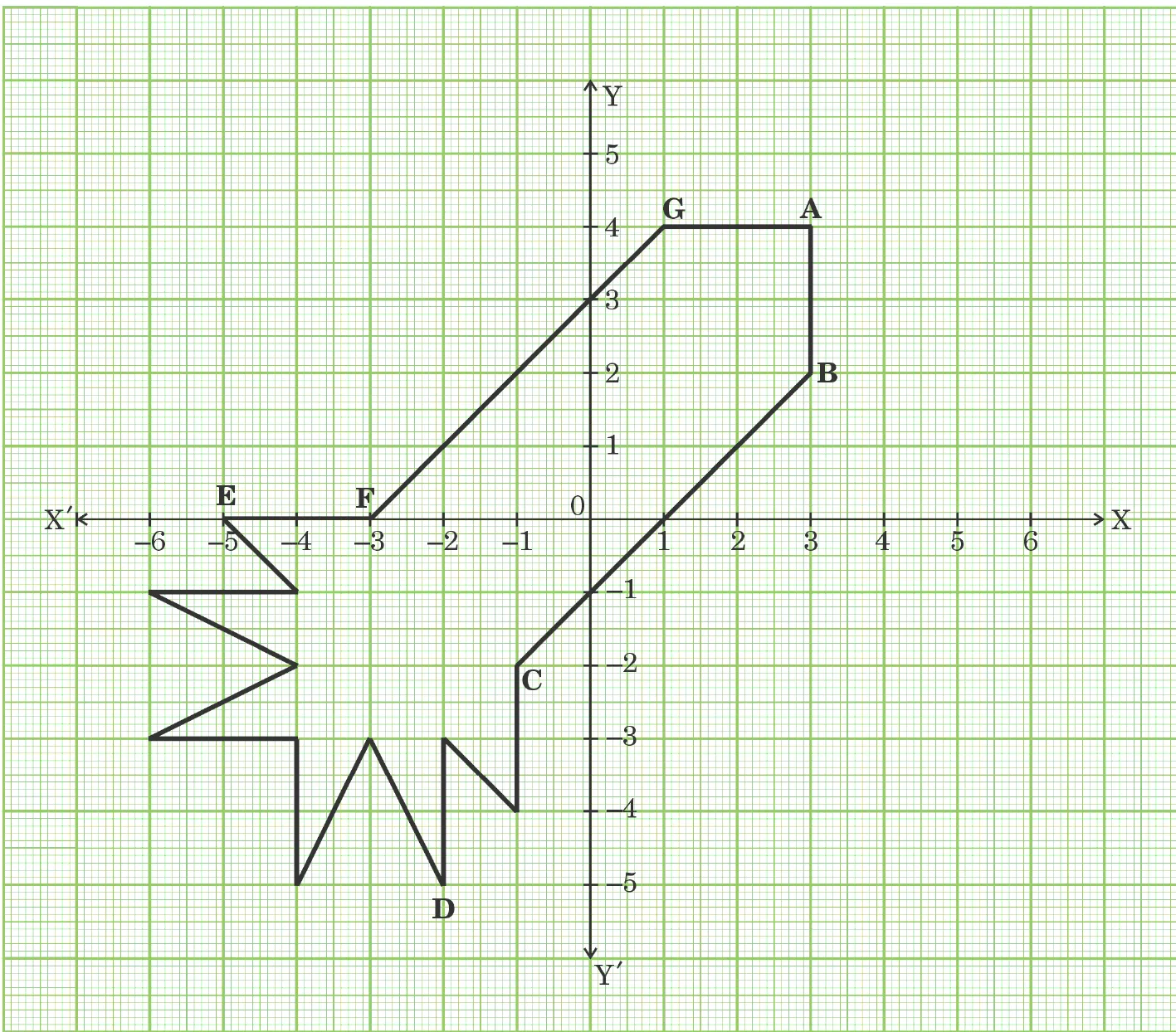
A rocket design drawn on graph paper: the outline runs through E(−5, 0), F(−3, 0), G(1, 4), A(3, 4), B(3, 2), C(−1, −2) and D(−2, −5), with the lower part drawn as zigzag fins.
Solution
-7-6-5-4-3-2-112345-6-5-4-3-2-1123456OxyEFGABCDmid FG (−1, 2)(3, 7/2)
Mid-point of FG = (−1, 2); AC = 2√13; point on AB = (3, 7/2).
  1. Read from the graph: F=(−3,0)F = (-3, 0), G=(1,4)G = (1, 4), A=(3,4)A = (3, 4), B=(3,2)B = (3, 2), C=(−1,−2)C = (-1, -2), D=(−2,−5)D = (-2, -5).
  2. (i) Mid-point of FG=(−3+12, 0+42)=(−1,2)FG = \left(\dfrac{-3 + 1}{2},\ \dfrac{0 + 4}{2}\right) = (-1, 2).
  3. (ii)(a) AC=(−1−3)2+(−2−4)2=16+36=52=213AC = \sqrt{(-1 - 3)^2 + (-2 - 4)^2} = \sqrt{16 + 36} = \sqrt{52} = 2\sqrt{13} units.
  4. (ii)(b) Section formula with m:n=1:3m : n = 1 : 3 from A(3,4)A(3, 4) to B(3,2)B(3, 2): x=1×3+3×34=3x = \dfrac{1 \times 3 + 3 \times 3}{4} = 3 and y=1×2+3×44=144=72y = \dfrac{1 \times 2 + 3 \times 4}{4} = \dfrac{14}{4} = \dfrac{7}{2}. The point is (3,72)\left(3, \dfrac{7}{2}\right).
  5. (iii) From the graph, D=(−2,−5)D = (-2, -5).

Answer: (i) (−1,2)(-1, 2)   (ii)(a) 2132\sqrt{13}   (ii)(b) (3,72)\left(3, \dfrac{7}{2}\right)   (iii) (−2,−5)(-2, -5)

Report an error on this question
Q37Arithmetic Progressions4 marks

Case study 2. Treasure Hunt is an exciting and adventurous game where participants follow a series of clues/numbers/maps to discover hidden treasures. Players engage in a thrilling quest, solving puzzles and riddles to unveil the location of the coveted prize. While playing a treasure hunt game, some clues (numbers) are hidden in various spots collectively forming an A.P. If the number on the nth spot is 20 + 4n, then answer the following questions to help the players in spotting the clues:

(i) Which number is on first spot? [1]

(ii) (a) Which spot is numbered as 112? [2]

OR

(ii) (b) What is the sum of all the numbers on the first 10 spots? [2]

(iii) Which number is on the (n – 2)th spot? [1]

Solution
51015202520406080100120Ospot ny20 + 4n2460112
  1. The number on the nnth spot is an=20+4na_n = 20 + 4n.
  2. (i) a1=20+4×1=24a_1 = 20 + 4 \times 1 = 24.
  3. (ii)(a) 20+4n=11220 + 4n = 112, so 4n=924n = 92 and n=23n = 23. Spot 2323.
  4. (ii)(b) a=24a = 24, d=4d = 4. S10=102[2×24+9×4]=5×84=420S_{10} = \dfrac{10}{2}[2 \times 24 + 9 \times 4] = 5 \times 84 = 420.
  5. (iii) an−2=20+4(n−2)=12+4na_{n-2} = 20 + 4(n - 2) = 12 + 4n.

Answer: (i) 2424   (ii)(a) spot 2323   (ii)(b) 420420   (iii) 12+4n12 + 4n

Common mistake: In (iii), writing 20+4n−220 + 4n - 2. Replace nn by (n−2)(n - 2) inside the formula.

Report an error on this question
Q38Surface Areas and Volumes4 marks

Case study 3. Tamper-proof tetra-packed milk guarantees both freshness and security. This milk ensures uncompromised quality, preserving the nutritional values within and making it a reliable choice for health-conscious individuals. 500 mL milk is packed in a cuboidal container of dimensions 15 cm × 8 cm × 5 cm. These milk packets are then packed in cuboidal cartons of dimensions 30 cm × 32 cm × 15 cm.

Based on the above given information, answer the following questions:

(i) Find the volume of the cuboidal carton. [1]

(ii) (a) Find the total surface area of a milk packet. [2]

OR

(ii) (b) How many milk packets can be filled in a carton? [2]

(iii) How much milk can the cup (as shown in the figure) hold? [1]
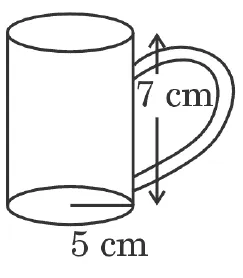
A cylindrical cup with a handle. The height of the cup is marked 7 cm and the base measurement is marked 5 cm.
Solution
ABCD30 cm (2 packets of 15 cm)32 cm (4 of 8 cm)8 per layer × 3 layers (15 ÷ 5) = 24 packets
  1. (i) Volume of the carton =30×32×15=14400= 30 \times 32 \times 15 = 14400 cm³.
  2. (ii)(a) Total surface area of a packet (15×8×515 \times 8 \times 5) =2(lb+bh+hl)=2(15×8+8×5+5×15)=2(120+40+75)=470= 2(lb + bh + hl) = 2(15 \times 8 + 8 \times 5 + 5 \times 15) = 2(120 + 40 + 75) = 470 cm².
  3. (ii)(b) Number of packets =volume of cartonvolume of a packet=30×32×1515×8×5=24= \dfrac{\text{volume of carton}}{\text{volume of a packet}} = \dfrac{30 \times 32 \times 15}{15 \times 8 \times 5} = 24.
  4. (iii) The cup is a cylinder of height 77 cm and radius 55 cm (as taken in CBSE's answer): V=πr2h=227×5×5×7=550V = \pi r^2 h = \dfrac{22}{7} \times 5 \times 5 \times 7 = 550 cm³ =550= 550 mL.

Answer: (i) 1440014400 cm³   (ii)(a) 470470 cm²   (ii)(b) 2424   (iii) 550550 mL

Report an error on this question

Questions are from the official CBSE paper. Figures are described in words; see the PDF for the originals. Solutions are written by CogniGuru.

Revise this paper in 1 minute a chapter

Each chapter below is what the paper tested, with a one-minute animated lesson on the idea behind it.

Stuck on a step in any solution?

The CogniGuru AI tutor explains any doubt one minute at a time, in English or Hindi. Join the waitlist.

Mock quiz: 5 questions from this paper

Five real questions from this paper, one each from five chapters. About 2 minutes. See how much you know and where you stand among other students. Attempt free, with no login; log in only for your ranking and full report.

Question 1 of 5 · Q1 of the paperLinear Equations

If ax+by=a2−b2ax + by = a^2 - b^2 and bx+ay=0bx + ay = 0, then the value of x+yx + y is:

0 of 5 answered

Related papers

Common questions

Are these the official CBSE Class 10 Maths Standard 2024 questions?
Yes. The questions are from the official Mathematics (Standard) paper (set 30/4/1) that CBSE published after the March 2024 board exam. The solutions are written by CogniGuru and checked against the answer key CBSE published for this paper code.
Can I download the CBSE Class 10 Maths Standard 2024 question paper PDF?
Yes, the official paper PDF is free to download from this page, and so are our step-by-step solutions as a PDF. No login is needed to download either or to read the solutions.
Do all sets of the paper have the same questions?
No. CBSE sets several versions of each paper, with the same blueprint and similar questions in a different order and sometimes with different numbers. This page covers set 30/4/1.
How does the quiz work, and what does “where you stand” mean?
It is a mock quiz of 5 real multiple-choice questions from this paper, scored automatically in about 2 minutes. Your score is compared, anonymously, with other students who took the same quiz. Only the score is stored with the comparison, never your name or number.

Source

CBSE question paper archive, Class X, 2024 (Mathematics (Standard), set 30/4/1)
PDF