
CBSE · Class 10 · Mathematics (Standard) · Free

CBSE Class 10 Maths Standard 2025 Question Paper (Set 30/2/1) with Solutions

The official board paper (Q.P. Code 30/2/1, Series EGFH2). Free paper PDF and step-by-step solutions (also as a PDF to download) written by CogniGuru and checked against CBSE’s answer key. See the paper’s main topics in 1 minute, then quiz yourself to see how much you know and where you stand.

No login to download or read the solutions. Login only to see your quiz report in full.

Board
CBSE
Class
10
Subject
Maths Standard (041)
Year
2025
Set code
30/2/1
Max marks
80
Duration
3 hours
Questions
38 (Sections A to E)
Source
Official CBSE paper
Exam date
March 2025

Paper preview

Three pages of the official paper. Download the PDF for all 27.

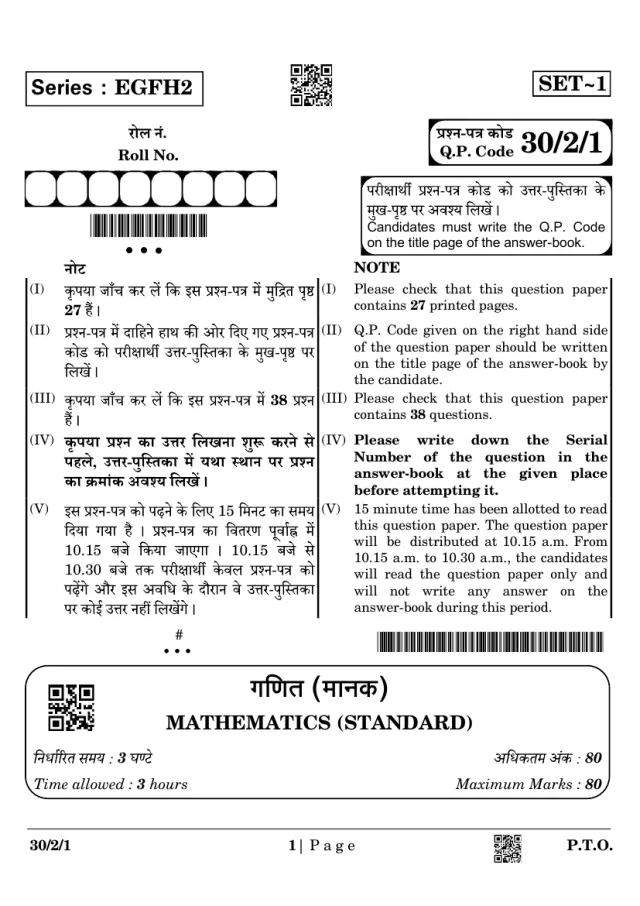
  • Cover page of the CBSE Class 10 Maths Standard 2025 paper, set 30/2/1

    Cover page

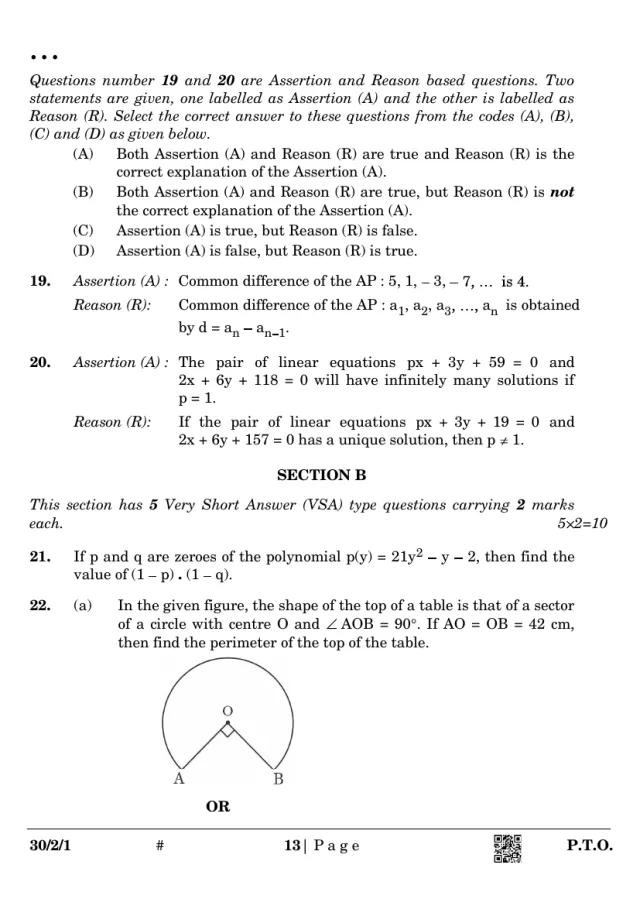
  • Section B of the CBSE Class 10 Maths Standard 2025 paper, set 30/2/1

    Section B

  • A case study with its figure from the CBSE Class 10 Maths Standard 2025 paper, set 30/2/1

    Case study

The main topics of this paper, in 1 minute

Your tutor walks you through the paper before you attempt it: the marks, the key ideas, the time plan and the traps.

1-minute paper analysis

With your tutor, in her voice

The main topics of this paper, in about a minute

A short, animated walk through the paper: how it is built, where the marks come from, the four ideas that matter most, how to plan your three hours, and the traps to avoid.

  1. 1The paper at a glance
  2. 2Where the marks come from
  3. 3Four ideas that keep paying off
  4. 4Plan your three hours
  5. 5Four traps to avoid

Sound on for the voice. Captions are shown, and you can mute any time.

Step-by-step solutions

Try each question first, then open its solution. Tap a number to jump.

Download solutions (PDF)

Section A: Multiple choice

20 questions, 1 mark each. MCQs (Q1 to Q18) and assertion-reason (Q19, Q20).

Q1Trigonometry1 mark

If 7cos⁡2θ+3sin⁡2θ=47\cos^2\theta + 3\sin^2\theta = 4, then the value of θ\theta is:

  1. (A)30∘30^\circ
  2. (B)45∘45^\circ
  3. (C)60∘60^\circ
  4. (D)90∘90^\circ
Solution · answer (C)
  1. Write 7cos⁡2θ+3sin⁡2θ=3(cos⁡2θ+sin⁡2θ)+4cos⁡2θ=3+4cos⁡2θ7\cos^2\theta + 3\sin^2\theta = 3(\cos^2\theta + \sin^2\theta) + 4\cos^2\theta = 3 + 4\cos^2\theta.
  2. So 3+4cos⁡2θ=43 + 4\cos^2\theta = 4, which gives cos⁡2θ=14\cos^2\theta = \dfrac{1}{4} and cos⁡θ=12\cos\theta = \dfrac{1}{2} (taking the acute angle).
  3. cos⁡60∘=12\cos 60^\circ = \dfrac{1}{2}, so θ=60∘\theta = 60^\circ.

Answer: (C) 60∘60^\circ

Common mistake: Trying the options one by one. Using sin⁡2θ+cos⁡2θ=1\sin^2\theta + \cos^2\theta = 1 gets the answer in two lines.

Report an error on this question
Q2Probability1 mark

The probability of drawing an even prime number out of numbers from 1 to 30 is:

  1. (A)130\dfrac{1}{30}
  2. (B)415\dfrac{4}{15}
  3. (C)730\dfrac{7}{30}
  4. (D)00
Solution · answer (A)
  1. The only even prime number is 22, so there is 11 favourable outcome.
  2. There are 3030 equally likely numbers, so the probability is 130\dfrac{1}{30}.

Answer: (A) 130\dfrac{1}{30}

Common mistake: Counting all even numbers (15) or all primes (10). The number has to be both even and prime.

Report an error on this question
Q3Quadratic Equations1 mark

The quadratic equation whose roots are 77 and 17\dfrac{1}{7} is:

  1. (A)7x2−50x+7=07x^2 - 50x + 7 = 0
  2. (B)7x2−50x+1=07x^2 - 50x + 1 = 0
  3. (C)7x2+50x−7=07x^2 + 50x - 7 = 0
  4. (D)7x2+50x−1=07x^2 + 50x - 1 = 0
Solution · answer (A)
  1. Sum of roots =7+17=507= 7 + \dfrac{1}{7} = \dfrac{50}{7} and product of roots =7×17=1= 7 \times \dfrac{1}{7} = 1.
  2. The equation is x2−(sum)x+product=0x^2 - (\text{sum})x + \text{product} = 0, that is x2−507x+1=0x^2 - \dfrac{50}{7}x + 1 = 0.
  3. Multiply by 77: 7x2−50x+7=07x^2 - 50x + 7 = 0.

Answer: (A) 7x2−50x+7=07x^2 - 50x + 7 = 0

Common mistake: Using a plus sign in front of 50x50x. The middle term is minus the sum of the roots.

Report an error on this question
Q4Real Numbers1 mark

The least number which is a perfect square and is divisible by each of 16, 20 and 50, is:

  1. (A)1200
  2. (B)100
  3. (C)3600
  4. (D)2400
Solution
  1. 16=2416 = 2^4, 20=22×520 = 2^2 \times 5, 50=2×5250 = 2 \times 5^2.
  2. LCM =24×52=400= 2^4 \times 5^2 = 400. Every common multiple is a multiple of 400400, so the least number divisible by all three is 400400.
  3. 400=202400 = 20^2 is already a perfect square, so the answer is 400400.
  4. None of the four options is 400, so the question as printed has no correct option. CBSE’s answer key says the same and awards the mark to every candidate.

Answer: 400400 (not among the options; CBSE awarded the mark to all)

Common mistake: Multiplying the LCM by another factor to "make it a square". Check first whether the LCM is already a perfect square.

Report an error on this question
Q5Coordinate Geometry1 mark

The coordinates of the end points of a diameter of a circle are (5,−2)(5, -2) and (5,2)(5, 2). The length of the radius of the circle is:

  1. (A)±2\pm 2
  2. (B)±4\pm 4
  3. (C)44
  4. (D)22
Solution · answer (D)
  1. Both points have x=5x = 5, so the diameter is vertical. Its length is 2−(−2)=42 - (-2) = 4.
  2. Radius =42=2= \dfrac{4}{2} = 2. A length cannot be negative, so it is not ±2\pm 2.

Answer: (D) 22

Report an error on this question
Q6Coordinate Geometry1 mark

The points (−5,0)(-5, 0), (5,0)(5, 0) and (0,4)(0, 4) are the vertices of a triangle which is a/an:

  1. (A)right-angled triangle
  2. (B)isosceles triangle
  3. (C)equilateral triangle
  4. (D)scalene triangle
Solution · answer (B)
  1. Let A(−5,0)A(-5, 0), B(5,0)B(5, 0), C(0,4)C(0, 4). AB=10AB = 10.
  2. AC=52+42=41AC = \sqrt{5^2 + 4^2} = \sqrt{41} and BC=52+42=41BC = \sqrt{5^2 + 4^2} = \sqrt{41}.
  3. Two sides are equal and the third is different, so it is isosceles. It is not right-angled because AC2+BC2=82≠100=AB2AC^2 + BC^2 = 82 \neq 100 = AB^2.

Answer: (B) isosceles triangle

Common mistake: Stopping at "the base is on the x-axis" and calling it right-angled. Check with the distance formula.

Report an error on this question
Q7Circles1 mark

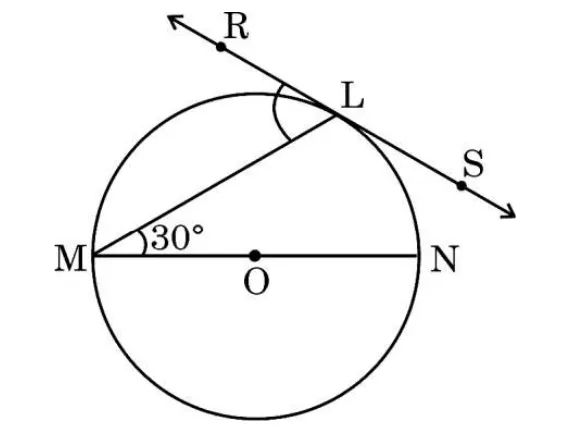
In the given figure, RSRS is the tangent to the circle at the point LL and MNMN is the diameter. If ∠NML=30∘\angle NML = 30^\circ, then ∠RLM\angle RLM is:

A circle with diameter MN and a point L on the circle. RS is the tangent at L, with R on the upper left and S on the lower right. The angle NML is 30 degrees.
  1. (A)30∘30^\circ
  2. (B)60∘60^\circ
  3. (C)90∘90^\circ
  4. (D)120∘120^\circ
Solution · answer (B)
30°60°60°MNLORS
Angle in a semicircle = 90°, so ∠LNM = 60°. The tangent-chord angle ∠RLM equals ∠LNM.
  1. MNMN is a diameter, so the angle in a semicircle ∠MLN=90∘\angle MLN = 90^\circ.
  2. In △MLN\triangle MLN: ∠LNM=180∘−90∘−30∘=60∘\angle LNM = 180^\circ - 90^\circ - 30^\circ = 60^\circ.
  3. The angle between a tangent and a chord equals the angle in the alternate segment: ∠RLM=∠LNM=60∘\angle RLM = \angle LNM = 60^\circ.

Answer: (B) 60∘60^\circ

Common mistake: Answering 30∘30^\circ, the angle at MM. The tangent-chord angle matches the angle on the opposite side of the chord, at NN.

Report an error on this question
Q8Triangles1 mark

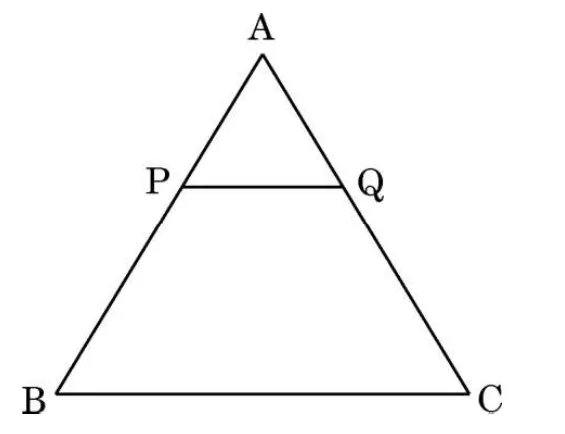
In the given figure, PQ∥BCPQ \parallel BC. If APPB=413\dfrac{AP}{PB} = \dfrac{4}{13} and AC=20.4AC = 20.4 cm, then the length of AQAQ is:

Triangle ABC with a line PQ drawn parallel to the base BC, with P on AB and Q on AC.
  1. (A)2.82.8 cm
  2. (B)5.85.8 cm
  3. (C)3.83.8 cm
  4. (D)4.84.8 cm
Solution · answer (D)
4.8 cm15.6 cmABCPQAQ : QC = 4 : 13, so AQ = 4/17 of AC
  1. PQ∥BCPQ \parallel BC, so by the Basic Proportionality Theorem AQQC=APPB=413\dfrac{AQ}{QC} = \dfrac{AP}{PB} = \dfrac{4}{13}.
  2. So AQAQ is 44 parts and QCQC is 1313 parts out of 4+13=174 + 13 = 17 parts of ACAC: AQAC=417\dfrac{AQ}{AC} = \dfrac{4}{17}.
  3. AQ=417×20.4=4×1.2=4.8AQ = \dfrac{4}{17} \times 20.4 = 4 \times 1.2 = 4.8 cm.

Answer: (D) 4.84.8 cm

Common mistake: Using 413×20.4\dfrac{4}{13} \times 20.4. The ratio 4:134 : 13 is for AQ:QCAQ : QC, not for AQ:ACAQ : AC.

Report an error on this question
Q9Triangles1 mark

Which of the following statements is incorrect?

  1. (A)Two congruent figures are always similar.
  2. (B)A square and a rhombus of the same area are always similar.
  3. (C)Two equilateral triangles are always similar.
  4. (D)Two similar triangles need not be congruent.
Solution · answer (B)
  1. Congruent figures have the same shape and size, so they are similar. (A) is correct.
  2. A square and a rhombus can have the same area, but a rhombus can have angles other than 90°. Similar figures need equal angles, so they are not always similar. (B) is incorrect.
  3. All angles of an equilateral triangle are 60°, so any two are similar. (C) is correct.
  4. Similar triangles can have different sizes, so they need not be congruent. (D) is correct.

Answer: (B) A square and a rhombus of the same area are always similar.

Common mistake: Thinking equal area means same shape. Similarity is about equal angles and proportional sides.

Report an error on this question
Q10Real Numbers1 mark

The sum of the exponents of prime factors in the prime factorisation of 4004 is:

  1. (A)5
  2. (B)4
  3. (C)3
  4. (D)2
Solution · answer (A)
  1. 4004=4×1001=22×10014004 = 4 \times 1001 = 2^2 \times 1001 and 1001=7×143=7×11×131001 = 7 \times 143 = 7 \times 11 \times 13.
  2. So 4004=22×71×111×1314004 = 2^2 \times 7^1 \times 11^1 \times 13^1.
  3. The exponents are 2,1,1,12, 1, 1, 1 and their sum is 55.

Answer: (A) 5

Common mistake: Counting the number of prime factors (four) instead of adding their exponents.

Report an error on this question
Q11Probability1 mark

In a cricket match, a batsman hits the boundary 77 times out of the 4242 balls he plays. The probability of his not hitting a boundary is:

  1. (A)17\dfrac{1}{7}
  2. (B)27\dfrac{2}{7}
  3. (C)56\dfrac{5}{6}
  4. (D)16\dfrac{1}{6}
Solution · answer (C)
  1. Balls without a boundary: 42−7=3542 - 7 = 35.
  2. P(no boundary)=3542=56P(\text{no boundary}) = \dfrac{35}{42} = \dfrac{5}{6}.
  3. Check: P(boundary)=742=16P(\text{boundary}) = \dfrac{7}{42} = \dfrac{1}{6}, and 16+56=1\dfrac{1}{6} + \dfrac{5}{6} = 1.

Answer: (C) 56\dfrac{5}{6}

Common mistake: Giving 16\dfrac{1}{6}, the probability of hitting a boundary. The question asks for NOT hitting one.

Report an error on this question
Q12Areas Related to Circles1 mark

If a large circular pizza is divided into 5 equal sectors, then the central angle of each sector will be:

  1. (A)60∘60^\circ
  2. (B)90∘90^\circ
  3. (C)45∘45^\circ
  4. (D)72∘72^\circ
Solution · answer (D)
  1. A full circle is 360∘360^\circ at the centre. Five equal sectors share it equally.
  2. Each angle =360∘5=72∘= \dfrac{360^\circ}{5} = 72^\circ.

Answer: (D) 72∘72^\circ

Report an error on this question
Q13Trigonometry1 mark

If sin⁡30∘tan⁡45∘=sec⁡60∘k\sin 30^\circ \tan 45^\circ = \dfrac{\sec 60^\circ}{k}, then the value of kk is:

  1. (A)44
  2. (B)33
  3. (C)22
  4. (D)11
Solution · answer (A)
  1. sin⁡30∘=12\sin 30^\circ = \dfrac{1}{2}, tan⁡45∘=1\tan 45^\circ = 1, sec⁡60∘=2\sec 60^\circ = 2.
  2. So 12×1=2k\dfrac{1}{2} \times 1 = \dfrac{2}{k}, which gives k=4k = 4.

Answer: (A) 44

Report an error on this question
Q14Linear Equations1 mark

The line represented by the equation x−y=0x - y = 0 is:

  1. (A)parallel to x-axis
  2. (B)parallel to y-axis
  3. (C)passing through the origin
  4. (D)passing through the point (3,2)(3, 2)
Solution · answer (C)
  1. x−y=0x - y = 0 is the same as y=xy = x, a line at 45∘45^\circ to the axes. It is not parallel to either axis.
  2. Put (0,0)(0, 0): 0−0=00 - 0 = 0 ✓, so it passes through the origin.
  3. Put (3,2)(3, 2): 3−2=1≠03 - 2 = 1 \neq 0, so it does not pass through (3,2)(3, 2).

Answer: (C) passing through the origin

Report an error on this question
Q15Arithmetic Progressions1 mark

The 10th10^{\text{th}} term of the AP 5, 194, 92, 174, …5,\ \dfrac{19}{4},\ \dfrac{9}{2},\ \dfrac{17}{4},\ \dots is:

  1. (A)114\dfrac{11}{4}
  2. (B)411\dfrac{4}{11}
  3. (C)134\dfrac{13}{4}
  4. (D)413\dfrac{4}{13}
Solution · answer (A)
  1. Write all terms over 44: 204, 194, 184, 174,…\dfrac{20}{4},\ \dfrac{19}{4},\ \dfrac{18}{4},\ \dfrac{17}{4}, \dots So a=5a = 5 and d=−14d = -\dfrac{1}{4}.
  2. a10=a+9d=5−94=20−94=114a_{10} = a + 9d = 5 - \dfrac{9}{4} = \dfrac{20 - 9}{4} = \dfrac{11}{4}.

Answer: (A) 114\dfrac{11}{4}

Common mistake: Using 10d10d instead of 9d9d. The nnth term is a+(n−1)da + (n - 1)d.

Report an error on this question
Q16Polynomials1 mark

If −4-4 is a zero of the polynomial p(x)=x2−x−(2+2k)p(x) = x^2 - x - (2 + 2k), then the value of kk is:

  1. (A)33
  2. (B)99
  3. (C)66
  4. (D)−9-9
Solution · answer (B)
  1. A zero makes the polynomial 00: p(−4)=(−4)2−(−4)−(2+2k)=0p(-4) = (-4)^2 - (-4) - (2 + 2k) = 0.
  2. 16+4−2−2k=016 + 4 - 2 - 2k = 0, so 18−2k=018 - 2k = 0 and k=9k = 9.

Answer: (B) 99

Common mistake: Losing a sign: −(−4)=+4-(-4) = +4, and the bracket (2+2k)(2 + 2k) is subtracted as a whole.

Report an error on this question
Q17Coordinate Geometry1 mark

The equation of a line parallel to the xx-axis and at a distance of 33 units below xx-axis is:

  1. (A)x=3x = 3
  2. (B)x=−3x = -3
  3. (C)y=−3y = -3
  4. (D)y=3y = 3
Solution · answer (C)
  1. A line parallel to the xx-axis is horizontal, so every point on it has the same yy value: its equation is y=cy = c.
  2. Below the xx-axis means yy is negative, and the distance is 33, so y=−3y = -3.

Answer: (C) y=−3y = -3

Common mistake: Writing x=−3x = -3. That is a vertical line, parallel to the yy-axis.

Report an error on this question
Q18Real Numbers1 mark

The HCF of 4040, 110110 and 360360 is:

  1. (A)40
  2. (B)110
  3. (C)360
  4. (D)10
Solution · answer (D)
  1. 40=23×540 = 2^3 \times 5, 110=2×5×11110 = 2 \times 5 \times 11, 360=23×32×5360 = 2^3 \times 3^2 \times 5.
  2. Common prime factors with the smallest powers: 21×51=102^1 \times 5^1 = 10.

Answer: (D) 10

Report an error on this question
Q19Arithmetic Progressions1 mark

Assertion (A): Common difference of the AP: 5,1,−3,−7,…5, 1, -3, -7, \dots is 44.

Reason (R): Common difference of the AP: a1,a2,a3,…,ana_1, a_2, a_3, \dots, a_n is obtained by d=an−an−1d = a_n - a_{n-1}.

  1. (A)Both A and R are true and R is the correct explanation of A
  2. (B)Both A and R are true, but R is not the correct explanation of A
  3. (C)A is true, but R is false
  4. (D)A is false, but R is true
Solution · answer (D)
  1. d=a2−a1=1−5=−4d = a_2 - a_1 = 1 - 5 = -4 (and −3−1=−4-3 - 1 = -4, −7−(−3)=−4-7 - (-3) = -4). The common difference is −4-4, not 44. So the assertion is false.
  2. The reason gives the correct rule, d=an−an−1d = a_n - a_{n-1}, so it is true.

Answer: (D) A is false, R is true

Common mistake: Dropping the minus sign. The terms are going down, so d is negative.

Report an error on this question
Q20Linear Equations1 mark

Assertion (A): The pair of linear equations px+3y+59=0px + 3y + 59 = 0 and 2x+6y+118=02x + 6y + 118 = 0 will have infinitely many solutions if p=1p = 1.

Reason (R): If the pair of linear equations px+3y+19=0px + 3y + 19 = 0 and 2x+6y+157=02x + 6y + 157 = 0 has a unique solution, then p≠1p \neq 1.

  1. (A)Both A and R are true and R is the correct explanation of A
  2. (B)Both A and R are true, but R is not the correct explanation of A
  3. (C)A is true, but R is false
  4. (D)A is false, but R is true
Solution · answer (B)
  1. (A) For infinitely many solutions we need p2=36=59118\dfrac{p}{2} = \dfrac{3}{6} = \dfrac{59}{118}. Here 36=12\dfrac{3}{6} = \dfrac{1}{2} and 59118=12\dfrac{59}{118} = \dfrac{1}{2}, so we need p2=12\dfrac{p}{2} = \dfrac{1}{2}, i.e. p=1p = 1. The assertion is true.
  2. (R) A unique solution needs p2≠36\dfrac{p}{2} \neq \dfrac{3}{6}, i.e. p≠1p \neq 1. The reason is true.
  3. But the reason is about a different pair of equations (constants 1919 and 157157) and a different case (unique solution). It does not explain why p=1p = 1 gives infinitely many solutions in the assertion. So R is not the explanation of A.

Answer: (B) Both true, but R is not the correct explanation of A

Common mistake: Choosing (A) because both statements mention p = 1. Check whether the reason actually explains the assertion.

Report an error on this question

Section B: Very short answer

5 questions, 2 marks each.

Q21Polynomials2 marks

If pp and qq are zeroes of the polynomial p(y)=21y2−y−2p(y) = 21y^2 - y - 2, then find the value of (1−p)(1−q)(1 - p)(1 - q).

Solution
  1. For 21y2−y−221y^2 - y - 2: sum of zeroes p+q=−−121=121p + q = -\dfrac{-1}{21} = \dfrac{1}{21} and product pq=−221pq = \dfrac{-2}{21}.
  2. (1−p)(1−q)=1−(p+q)+pq=1−121−221(1 - p)(1 - q) = 1 - (p + q) + pq = 1 - \dfrac{1}{21} - \dfrac{2}{21}.
  3. =21−1−221=1821=67= \dfrac{21 - 1 - 2}{21} = \dfrac{18}{21} = \dfrac{6}{7}.

Answer: 67\dfrac{6}{7}

Common mistake: Expanding with −(p+q)-(p + q) but then using +ba+\dfrac{b}{a} for the sum. The sum of zeroes is −ba-\dfrac{b}{a}.

Report an error on this question
Q22Areas Related to Circles2 marks

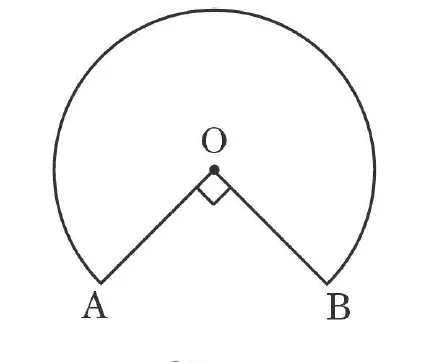
(a) In the given figure, the shape of the top of a table is that of a sector of a circle with centre OO and ∠AOB=90∘\angle AOB = 90^\circ. If AO=OB=42AO = OB = 42 cm, then find the perimeter of the top of the table.

OR

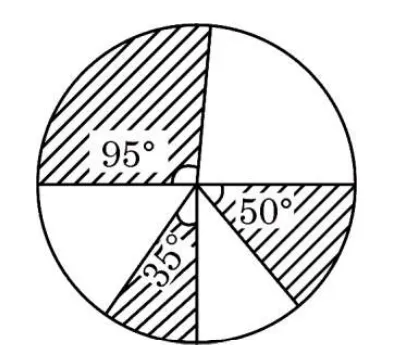
(b) In the given figure, three sectors of a circle of radius 55 cm, making angles 35∘35^\circ, 50∘50^\circ and 95∘95^\circ at the centre are shaded. Find the area of the shaded region. [Use π=227\pi = \dfrac{22}{7}]

The top of a table: a circle with a 90 degree wedge removed. O is the centre, A and B are the ends of the straight edges.A circle with three shaded sectors at the centre, with angles 95, 50 and 35 degrees.
Solution
42 cm42 cmOABmajor arc: 270°
The top is the major sector: 360° − 90° = 270°.
95°50°35°95° + 50° + 35° = 180°: half the circle
Rearranged side by side, the three sectors make exactly half of the circle.
  1. (a) The table top is the circle with the 90∘90^\circ wedge AOBAOB cut out, so the top is the major sector with angle 360∘−90∘=270∘360^\circ - 90^\circ = 270^\circ and radius 4242 cm.
  2. Length of the curved edge (major arc) =270360×2πr=34×2×227×42=34×264=198= \dfrac{270}{360} \times 2\pi r = \dfrac{3}{4} \times 2 \times \dfrac{22}{7} \times 42 = \dfrac{3}{4} \times 264 = 198 cm.
  3. The straight edges are the two radii, 42+42=8442 + 42 = 84 cm. Perimeter =198+84=282= 198 + 84 = 282 cm.
  4. (b) The three shaded sectors have the same radius, so their angles add: 95∘+50∘+35∘=180∘95^\circ + 50^\circ + 35^\circ = 180^\circ.
  5. Area =180360×πr2=12×227×5×5=2757= \dfrac{180}{360} \times \pi r^2 = \dfrac{1}{2} \times \dfrac{22}{7} \times 5 \times 5 = \dfrac{275}{7} cm² ≈39.29\approx 39.29 cm².

Answer: (a) 282282 cm   (b) 2757≈39.29\dfrac{275}{7} \approx 39.29 cm²

Common mistake: In (a), using the 90∘90^\circ angle for the arc. The table top is the big part, 270∘270^\circ, and the perimeter also needs the two radii.

Report an error on this question
Q23Trigonometry2 marks

If tan⁡A=3\tan A = \sqrt{3}, where AA is an acute angle, then find the value of sin⁡2A1+cos⁡2A\dfrac{\sin^2 A}{1 + \cos^2 A}.

Solution
60°1√32ABC
  1. tan⁡A=3=tan⁡60∘\tan A = \sqrt{3} = \tan 60^\circ, so A=60∘A = 60^\circ.
  2. sin⁡260∘=(32)2=34\sin^2 60^\circ = \left(\dfrac{\sqrt{3}}{2}\right)^2 = \dfrac{3}{4} and cos⁡260∘=(12)2=14\cos^2 60^\circ = \left(\dfrac{1}{2}\right)^2 = \dfrac{1}{4}.
  3. sin⁡2A1+cos⁡2A=3/41+1/4=3/45/4=35\dfrac{\sin^2 A}{1 + \cos^2 A} = \dfrac{3/4}{1 + 1/4} = \dfrac{3/4}{5/4} = \dfrac{3}{5}.

Answer: 35\dfrac{3}{5}

Report an error on this question
Q24Triangles2 marks

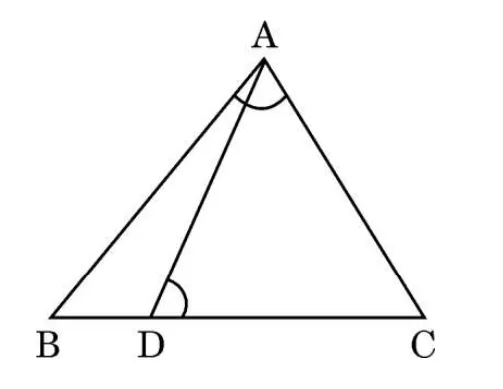
(a) In the given figure, DD is a point on the side BCBC of △ABC\triangle ABC such that ∠ADC=∠BAC\angle ADC = \angle BAC. Show that CA2=CD⋅CBCA^2 = CD \cdot CB.

OR

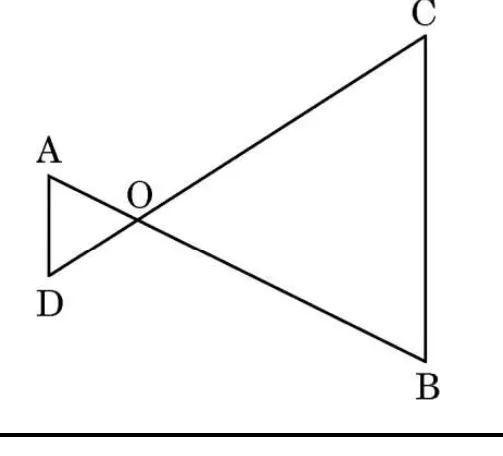
(b) In the given figure, OA⋅OB=OC⋅ODOA \cdot OB = OC \cdot OD. Show that ∠A=∠C\angle A = \angle C and ∠B=∠D\angle B = \angle D.

Triangle ABC with a point D on the side BC and a line drawn from A to D. The angle at A and the angle ADC are marked equal.Two triangles meeting at the point O: lines AB and CD cross at O, forming a bow-tie shape with A and D on the left and B and C on the right.
Solution
xxABCD
△CDA and △CAB share ∠C and have ∠ADC = ∠BAC, so they are similar (AA).
ADOBCOA/OC = OD/OB and ∠AOD = ∠COB: SAS
  1. (a) In △CDA\triangle CDA and △CAB\triangle CAB: ∠ADC=∠BAC\angle ADC = \angle BAC (given) and ∠C\angle C is common.
  2. So △CDA∼△CAB\triangle CDA \sim \triangle CAB by AA similarity.
  3. Corresponding sides are proportional: CDCA=CACB\dfrac{CD}{CA} = \dfrac{CA}{CB}, so CA2=CD⋅CBCA^2 = CD \cdot CB.
  4. (b) OA⋅OB=OC⋅ODOA \cdot OB = OC \cdot OD gives OAOC=ODOB\dfrac{OA}{OC} = \dfrac{OD}{OB}.
  5. In △AOD\triangle AOD and △COB\triangle COB: OAOC=ODOB\dfrac{OA}{OC} = \dfrac{OD}{OB} and ∠AOD=∠COB\angle AOD = \angle COB (vertically opposite angles).
  6. So △AOD∼△COB\triangle AOD \sim \triangle COB by SAS similarity, with A↔CA \leftrightarrow C and D↔BD \leftrightarrow B. Hence ∠A=∠C\angle A = \angle C and ∠D=∠B\angle D = \angle B.

Answer: (a) CA2=CD⋅CBCA^2 = CD \cdot CB   (b) ∠A=∠C, ∠B=∠D\angle A = \angle C,\ \angle B = \angle D

Common mistake: In (b), matching the vertices in the wrong order. The ratio OAOC=ODOB\dfrac{OA}{OC} = \dfrac{OD}{OB} pairs AA with CC and DD with BB.

Report an error on this question
Q25Circles2 marks

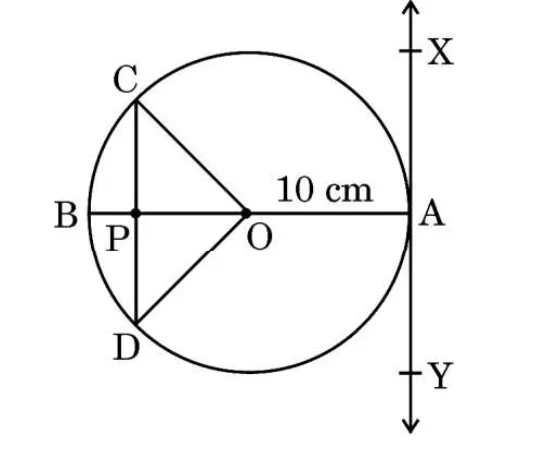
At point AA on the diameter ABAB of a circle of radius 1010 cm, tangent XAYXAY is drawn to the circle. Find the length of the chord CDCD parallel to XYXY at a distance of 1616 cm from AA.

A circle with centre O and diameter BA. The tangent XAY touches the circle at A. A chord CD, parallel to XY, crosses the diameter at P.
Solution
68OABPCDXY16 cm from A
AP = 16 cm and OA = 10 cm, so OP = 6 cm. In the right triangle OPC, CP = 8 cm.
  1. XYXY is a tangent at AA, so AB⊥XYAB \perp XY. The chord CD∥XYCD \parallel XY, so CD⊥ABCD \perp AB too, and ABAB bisects CDCD at PP.
  2. AP=16AP = 16 cm and OA=10OA = 10 cm, so OP=AP−OA=16−10=6OP = AP - OA = 16 - 10 = 6 cm (the chord is on the far side of the centre).
  3. In right triangle OPCOPC: CP2=OC2−OP2=102−62=64CP^2 = OC^2 - OP^2 = 10^2 - 6^2 = 64, so CP=8CP = 8 cm.
  4. CD=2×CP=16CD = 2 \times CP = 16 cm.

Answer: CD=16CD = 16 cm

Common mistake: Using OP=16OP = 16. The distance 1616 cm is measured from AA, not from the centre.

Report an error on this question

Section C: Short answer

6 questions, 3 marks each.

Q26Circles3 marks

(a) Prove that the parallelogram circumscribing a circle is a rhombus.

OR

(b) Prove that the angle between the two tangents drawn from an external point to a circle is supplementary to the angle subtended by the line-segment joining the points of contact at the centre.

Solution
ABCDPQRS
Tangents from a point are equal (same tick marks). Adding them gives AB + CD = AD + BC.
OPAB∠AOB + ∠APB = 360° − 90° − 90° = 180°
  1. (a) Let parallelogram ABCDABCD circumscribe a circle touching AB,BC,CD,DAAB, BC, CD, DA at P,Q,R,SP, Q, R, S.
  2. Tangents from an outside point are equal: AP=ASAP = AS, BP=BQBP = BQ, CR=CQCR = CQ, DR=DSDR = DS.
  3. Add all four: (AP+BP)+(CR+DR)=(AS+DS)+(BQ+CQ)(AP + BP) + (CR + DR) = (AS + DS) + (BQ + CQ), that is AB+CD=AD+BCAB + CD = AD + BC.
  4. In a parallelogram AB=CDAB = CD and AD=BCAD = BC, so 2AB=2BC2AB = 2BC and AB=BCAB = BC.
  5. So all four sides are equal: AB=BC=CD=DAAB = BC = CD = DA. A parallelogram with all sides equal is a rhombus.
  6. (b) Let PAPA and PBPB be tangents from PP to a circle with centre OO. Join OAOA and OBOB.
  7. A radius is perpendicular to the tangent at the point of contact, so ∠OAP=∠OBP=90∘\angle OAP = \angle OBP = 90^\circ.
  8. In quadrilateral OAPBOAPB the angles add up to 360∘360^\circ: ∠APB+∠AOB+90∘+90∘=360∘\angle APB + \angle AOB + 90^\circ + 90^\circ = 360^\circ, so ∠APB+∠AOB=180∘\angle APB + \angle AOB = 180^\circ.

Answer: Both proved

Common mistake: Writing the equal tangent lengths without stating the reason (tangents from an external point are equal).

Report an error on this question
Q27Trigonometry3 marks

(a) Prove that: (1+1tan⁡2θ)(1+1cot⁡2θ)=1sin⁡2θ−sin⁡4θ\left(1 + \dfrac{1}{\tan^2\theta}\right)\left(1 + \dfrac{1}{\cot^2\theta}\right) = \dfrac{1}{\sin^2\theta - \sin^4\theta}

OR

(b) Prove that: cosec θ−1cosec θ+1+cosec θ+1cosec θ−1=2sec⁡θ\sqrt{\dfrac{\mathrm{cosec}\,\theta - 1}{\mathrm{cosec}\,\theta + 1}} + \sqrt{\dfrac{\mathrm{cosec}\,\theta + 1}{\mathrm{cosec}\,\theta - 1}} = 2\sec\theta

Solution
  1. (a) 1tan⁡2θ=cot⁡2θ\dfrac{1}{\tan^2\theta} = \cot^2\theta and 1cot⁡2θ=tan⁡2θ\dfrac{1}{\cot^2\theta} = \tan^2\theta, so LHS=(1+cot⁡2θ)(1+tan⁡2θ)\text{LHS} = (1 + \cot^2\theta)(1 + \tan^2\theta).
  2. =cosec2θ⋅sec⁡2θ=1sin⁡2θ⋅1cos⁡2θ=1sin⁡2θ (1−sin⁡2θ)= \mathrm{cosec}^2\theta \cdot \sec^2\theta = \dfrac{1}{\sin^2\theta} \cdot \dfrac{1}{\cos^2\theta} = \dfrac{1}{\sin^2\theta\,(1 - \sin^2\theta)}.
  3. =1sin⁡2θ−sin⁡4θ=RHS= \dfrac{1}{\sin^2\theta - \sin^4\theta} = \text{RHS}.
  4. (b) Put c=cosec θc = \mathrm{cosec}\,\theta. Over a common root: (c−1)+(c+1)(c+1)(c−1)=2cc2−1\dfrac{(c - 1) + (c + 1)}{\sqrt{(c + 1)(c - 1)}} = \dfrac{2c}{\sqrt{c^2 - 1}}.
  5. c2−1=cosec2θ−1=cot⁡2θc^2 - 1 = \mathrm{cosec}^2\theta - 1 = \cot^2\theta, so this is 2 cosec θcot⁡θ=2×1sin⁡θ×sin⁡θcos⁡θ=2cos⁡θ=2sec⁡θ\dfrac{2\,\mathrm{cosec}\,\theta}{\cot\theta} = 2 \times \dfrac{1}{\sin\theta} \times \dfrac{\sin\theta}{\cos\theta} = \dfrac{2}{\cos\theta} = 2\sec\theta.

Answer: Both identities proved

Common mistake: In (a), forgetting 1−sin⁡2θ=cos⁡2θ1 - \sin^2\theta = \cos^2\theta when turning sec⁡2θ\sec^2\theta into the form on the right.

Report an error on this question
Q28Coordinate Geometry3 marks

If the mid-point of the line segment joining the points A(3,4)A(3, 4) and B(k,6)B(k, 6) is P(x,y)P(x, y) and x+y−10=0x + y - 10 = 0, then find the value of kk.

Solution
1234567891012345678910Oxyx + y = 10A(3, 4)B(7, 6)P(5, 5)
P = (5, 5) lies on x + y = 10 only when k = 7.
  1. Mid-point P=(3+k2, 4+62)=(3+k2, 5)P = \left(\dfrac{3 + k}{2},\ \dfrac{4 + 6}{2}\right) = \left(\dfrac{3 + k}{2},\ 5\right), so x=3+k2x = \dfrac{3 + k}{2} and y=5y = 5.
  2. Put in x+y−10=0x + y - 10 = 0: 3+k2+5−10=0\dfrac{3 + k}{2} + 5 - 10 = 0.
  3. 3+k2=5\dfrac{3 + k}{2} = 5, so 3+k=103 + k = 10 and k=7k = 7.

Answer: k=7k = 7

Common mistake: Forgetting to divide the sum of coordinates by 2 for the mid-point.

Report an error on this question
Q29Areas Related to Circles3 marks

The length of the hour hand of a clock is 10 cm. Find the area of the minor sector swept by the hour hand of the clock between 5 a.m. to 8 a.m. Also, find the area of the major sector.

Solution
12345678910111290°270°5 a.m.8 a.m.
In 3 hours the hour hand turns 3 × 30° = 90°.
  1. The hour hand makes a full turn of 360∘360^\circ in 1212 hours, so it turns 360∘12=30∘\dfrac{360^\circ}{12} = 30^\circ every hour.
  2. From 55 a.m. to 88 a.m. is 33 hours, so the angle is 3×30∘=90∘3 \times 30^\circ = 90^\circ. Radius r=10r = 10 cm. Use π=227\pi = \dfrac{22}{7}.
  3. Minor sector =90360×πr2=14×227×100=5507≈78.57= \dfrac{90}{360} \times \pi r^2 = \dfrac{1}{4} \times \dfrac{22}{7} \times 100 = \dfrac{550}{7} \approx 78.57 cm².
  4. Whole circle =πr2=227×100=22007= \pi r^2 = \dfrac{22}{7} \times 100 = \dfrac{2200}{7} cm².
  5. Major sector =22007−5507=16507≈235.71= \dfrac{2200}{7} - \dfrac{550}{7} = \dfrac{1650}{7} \approx 235.71 cm².

Answer: Minor sector 5507≈78.57\dfrac{550}{7} \approx 78.57 cm²; major sector 16507≈235.71\dfrac{1650}{7} \approx 235.71 cm²

Common mistake: Using 60∘60^\circ per hour (that is the minute hand: 6∘6^\circ per minute). The hour hand turns only 30∘30^\circ per hour.

Report an error on this question
Q30Real Numbers3 marks

Prove that 3\sqrt{3} is an irrational number.

Solution
  1. Suppose 3\sqrt{3} is rational. Then 3=pq\sqrt{3} = \dfrac{p}{q} with integers p,qp, q (q≠0q \neq 0) having no common factor.
  2. Squaring: 3q2=p23q^2 = p^2. So 33 divides p2p^2, and since 33 is prime, 33 divides pp. Write p=3ap = 3a.
  3. Then 3q2=9a23q^2 = 9a^2, so q2=3a2q^2 = 3a^2. So 33 divides q2q^2, and hence 33 divides qq.
  4. Now 33 is a common factor of pp and qq, which contradicts "no common factor". So 3\sqrt{3} is irrational.

Answer: Proved by contradiction

Common mistake: Skipping the reason that “3 divides p squared” gives “3 divides p”: it works because 3 is prime.

Report an error on this question
Q31Arithmetic Progressions3 marks

A sum of ₹ 2,0002{,}000 is invested at 7%7\% per annum simple interest. Calculate the interests at the end of 1st1^{\text{st}}, 2nd2^{\text{nd}} and 3rd3^{\text{rd}} year. Do these interests form an AP? If so, find the interest at the end of the 27th27^{\text{th}} year.

Solution
1234100200300400500Oyear₹I = 140n140280420
  1. Simple interest =P×R×T100= \dfrac{P \times R \times T}{100}. Each year adds 2000×7100=₹140\dfrac{2000 \times 7}{100} = ₹140.
  2. End of year 11: ₹140140. End of year 22: 2000×7×2100=₹280\dfrac{2000 \times 7 \times 2}{100} = ₹280. End of year 33: ₹420₹420.
  3. The list 140,280,420,…140, 280, 420, \dots goes up by 140140 each time (difference 280−140=140=420−280280 - 140 = 140 = 420 - 280), so yes, it is an AP with a=140a = 140 and d=140d = 140.
  4. Interest at the end of the 2727th year: a27=a+26d=140+26×140=140×27=₹3780a_{27} = a + 26d = 140 + 26 \times 140 = 140 \times 27 = ₹3780.

Answer: ₹140140, ₹280280, ₹420420; yes, an AP; ₹37803780 at the end of the 2727th year

Common mistake: Using the (n − 1) rule on the wrong number: here the nth term is simply 140 × n, and the 27th is 140 × 27.

Report an error on this question

Section D: Long answer

4 questions, 5 marks each.

Q32Applications of Trigonometry5 marks

(a) Two ships are sailing in the sea on either side of a lighthouse. The angles of depression to the two ships as observed from the top of the lighthouse are 60∘60^\circ and 45∘45^\circ, respectively. If the distance between the ships is 100(1+33)100\left(\dfrac{1 + \sqrt{3}}{\sqrt{3}}\right) m, then find the height of the lighthouse.

OR

(b) The angles of depression of the top and the bottom of an 88 m tall building from the top of another multistoried building are 30∘30^\circ and 45∘45^\circ, respectively. Find the height of the multistoried building and the distance between the two buildings.

Solution
60°45°60°45°hh/√3hABPQ
Alternate angles: the angle of depression from A equals the angle of elevation of A from the ship.
30°45°d8 mHABCDE
At 45° to the bottom, d = H. At 30° to the top, (H − 8)/d = tan 30°.
  1. (a) Let the lighthouse be AB=hAB = h, with the ships at PP (angle of depression 60∘60^\circ) and QQ (angle of depression 45∘45^\circ) on either side of BB.
  2. The angle of depression from AA equals the angle of elevation of AA from the ship (alternate angles). In △ABP\triangle ABP: tan⁡60∘=hPB\tan 60^\circ = \dfrac{h}{PB}, so PB=h3PB = \dfrac{h}{\sqrt{3}}.
  3. In △ABQ\triangle ABQ: tan⁡45∘=hBQ=1\tan 45^\circ = \dfrac{h}{BQ} = 1, so BQ=hBQ = h.
  4. PQ=PB+BQ=h3+h=h(1+33)PQ = PB + BQ = \dfrac{h}{\sqrt{3}} + h = h\left(\dfrac{1 + \sqrt{3}}{\sqrt{3}}\right).
  5. This equals 100(1+33)100\left(\dfrac{1 + \sqrt{3}}{\sqrt{3}}\right), so h=100h = 100 m.
  6. (b) Let the tall building have height HH and the buildings be dd apart. The bottom CC of the small building is seen at 45∘45^\circ: tan⁡45∘=Hd\tan 45^\circ = \dfrac{H}{d}, so d=Hd = H.
  7. The top DD of the small building is 88 m above CC, so it is H−8H - 8 below the observer's level. tan⁡30∘=H−8d=H−8H=13\tan 30^\circ = \dfrac{H - 8}{d} = \dfrac{H - 8}{H} = \dfrac{1}{\sqrt{3}}.
  8. 3(H−8)=H\sqrt{3}(H - 8) = H, so H(3−1)=83H(\sqrt{3} - 1) = 8\sqrt{3} and H=833−1=83(3+1)2=43(3+1)=12+43H = \dfrac{8\sqrt{3}}{\sqrt{3} - 1} = \dfrac{8\sqrt{3}(\sqrt{3} + 1)}{2} = 4\sqrt{3}(\sqrt{3} + 1) = 12 + 4\sqrt{3} m.
  9. The distance between the buildings is d=H=(12+43)d = H = (12 + 4\sqrt{3}) m ≈18.93\approx 18.93 m.

Answer: (a) 100100 m   (b) height (12+43)(12 + 4\sqrt{3}) m ≈18.93\approx 18.93 m; distance (12+43)(12 + 4\sqrt{3}) m

Common mistake: In (b), using HH for the height of the top of the small building. Its top is H−8H - 8 below the observer, and that is the side used with tan⁡30∘\tan 30^\circ.

Report an error on this question
Q33Quadratic Equations5 marks

(a) The sum of the areas of two squares is 5252 cm² and difference of their perimeters is 88 cm. Find the lengths of the sides of the two squares.

OR

(b) The time taken by a person to travel an upward distance of 150150 km was 2122\dfrac{1}{2} hours more than the time taken in the downward return journey. If he returned at a speed of 1010 km/h more than the speed while going up, find the speeds in each direction.

Solution
  1. (a) Let the sides be xx cm and yy cm with x>yx > y. Areas: x2+y2=52x^2 + y^2 = 52. … (i)
  2. Perimeters differ by 88: 4x−4y=84x - 4y = 8, so x−y=2x - y = 2 and x=y+2x = y + 2. … (ii)
  3. Put (ii) in (i): (y+2)2+y2=52(y + 2)^2 + y^2 = 52, so 2y2+4y+4=522y^2 + 4y + 4 = 52 and y2+2y−24=0y^2 + 2y - 24 = 0.
  4. (y+6)(y−4)=0(y + 6)(y - 4) = 0. A side cannot be negative, so y=4y = 4 and x=6x = 6.
  5. Check: 36+16=5236 + 16 = 52 ✓ and 4×6−4×4=84 \times 6 - 4 \times 4 = 8 ✓.
  6. (b) Let the speed going up be xx km/h, so the speed coming down is (x+10)(x + 10) km/h.
  7. Time up =150x= \dfrac{150}{x} and time down =150x+10= \dfrac{150}{x + 10}. The time up was 212=522\dfrac{1}{2} = \dfrac{5}{2} hours more: 150x−150x+10=52\dfrac{150}{x} - \dfrac{150}{x + 10} = \dfrac{5}{2}.
  8. Combine: 150×10x(x+10)=52\dfrac{150 \times 10}{x(x + 10)} = \dfrac{5}{2}, so x(x+10)=600x(x + 10) = 600 and x2+10x−600=0x^2 + 10x - 600 = 0.
  9. (x+30)(x−20)=0(x + 30)(x - 20) = 0. Speed cannot be negative, so x=20x = 20. The speed going up is 2020 km/h and coming down is 3030 km/h.

Answer: (a) 66 cm and 44 cm   (b) 2020 km/h up and 3030 km/h down

Common mistake: Leaving the negative root. Say clearly why a negative length or speed is rejected.

Report an error on this question
Q34Triangles5 marks

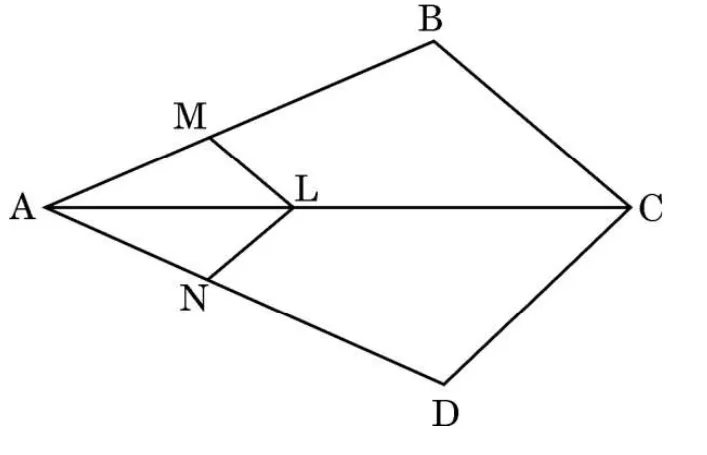
Prove that a line drawn parallel to one side of a triangle to intersect the other two sides in distinct points divides the other two sides in the same ratio. Hence, in the figure given below, prove that AMMB=ANND\dfrac{AM}{MB} = \dfrac{AN}{ND} where LM∥CBLM \parallel CB and LN∥CDLN \parallel CD.

A figure with a horizontal diagonal AC from left to right. B is above and D is below the diagonal. M is on AB, N is on AD and L is on AC, with LM parallel to CB and LN parallel to CD.
Solution
ABCDLMNAM/MB = AL/LC and AN/ND = AL/LC
  1. Basic Proportionality Theorem: if DE∥BCDE \parallel BC in △ABC\triangle ABC with DD on ABAB and EE on ACAC, then ADDB=AEEC\dfrac{AD}{DB} = \dfrac{AE}{EC}.
  2. Proof: join BEBE and CDCD. Triangles BDEBDE and DECDEC stand on the same base DEDE and lie between the same parallels DEDE and BCBC, so area(△BDE)=area(△DEC)\text{area}(\triangle BDE) = \text{area}(\triangle DEC).
  3. Triangles ADEADE and BDEBDE have the same height from EE, so area(ADE)area(BDE)=ADDB\dfrac{\text{area}(ADE)}{\text{area}(BDE)} = \dfrac{AD}{DB}. Triangles ADEADE and DECDEC have the same height from DD, so area(ADE)area(DEC)=AEEC\dfrac{\text{area}(ADE)}{\text{area}(DEC)} = \dfrac{AE}{EC}.
  4. The areas of BDEBDE and DECDEC are equal, so ADDB=AEEC\dfrac{AD}{DB} = \dfrac{AE}{EC}. This proves the theorem.
  5. Application. In △ABC\triangle ABC, LM∥CBLM \parallel CB with MM on ABAB and LL on ACAC, so AMMB=ALLC\dfrac{AM}{MB} = \dfrac{AL}{LC}. … (i)
  6. In △ADC\triangle ADC, LN∥CDLN \parallel CD with NN on ADAD and LL on ACAC, so ANND=ALLC\dfrac{AN}{ND} = \dfrac{AL}{LC}. … (ii)
  7. The right sides of (i) and (ii) are the same, so AMMB=ANND\dfrac{AM}{MB} = \dfrac{AN}{ND}.

Answer: Theorem proved and AMMB=ANND\dfrac{AM}{MB} = \dfrac{AN}{ND}

Common mistake: Using the theorem without first naming the triangle in which the line is parallel to a side.

Report an error on this question
Q35Statistics5 marks

Find the Mean and Mode of the following frequency distribution:

ClassFrequency
0 – 108
10 – 207
20 – 3015
30 – 4020
40 – 5012
50 – 608
60 – 7010
Solution
102030405060704812162024Oclassy87152012810mode ≈ 33.85
The modal class is 30 – 40 (frequency 20).
  1. Class marks xix_i: 5,15,25,35,45,55,655, 15, 25, 35, 45, 55, 65. Frequencies fif_i: 8,7,15,20,12,8,108, 7, 15, 20, 12, 8, 10, with ∑fi=80\sum f_i = 80.
  2. Products fixif_i x_i: 40, 105, 375, 700, 540, 440, 65040,\ 105,\ 375,\ 700,\ 540,\ 440,\ 650. Their sum is ∑fixi=2850\sum f_i x_i = 2850.
  3. Mean =∑fixi∑fi=285080=35.625= \dfrac{\sum f_i x_i}{\sum f_i} = \dfrac{2850}{80} = 35.625.
  4. The highest frequency is 2020, so the modal class is 30−4030 - 40: l=30l = 30, f1=20f_1 = 20, f0=15f_0 = 15, f2=12f_2 = 12, h=10h = 10.
  5. Mode =l+f1−f02f1−f0−f2×h=30+20−1540−15−12×10=30+513×10=30+5013≈33.85= l + \dfrac{f_1 - f_0}{2f_1 - f_0 - f_2} \times h = 30 + \dfrac{20 - 15}{40 - 15 - 12} \times 10 = 30 + \dfrac{5}{13} \times 10 = 30 + \dfrac{50}{13} \approx 33.85.

Answer: Mean =35.625= 35.625 and Mode ≈33.85\approx 33.85 (exactly 44013\dfrac{440}{13})

Common mistake: Using the wrong neighbours in the mode formula: f0f_0 is the frequency of the class BEFORE the modal class and f2f_2 of the class AFTER it.

Report an error on this question

Section E: Case studies

3 case studies, 4 marks each.

Q36Linear Equations4 marks

Case study 1. A school is organizing a grand cultural event to show the talent of its students. To accommodate the guests, the school plans to rent chairs and tables from a local supplier. It finds that rent for each chair is ₹50 and for each table is ₹200. The school spends ₹30,000 for renting the chairs and tables. Also, the total number of items (chairs and tables) rented are 300.

If the school rents ‘x’ chairs and ‘y’ tables, answer the following questions:

(i) Write down the pair of linear equations representing the given information. [1]

(ii) (a) Find the number of chairs and number of tables rented by the school. [2]

OR

(ii) (b) If the school wants to spend a maximum of ₹27,000 on 300 items (tables and chairs), then find the number of chairs and tables it can rent. [2]

(iii) What is maximum number of tables that can be rented in ₹30,000 if no chairs are rented? [1]

Figure: A photo of a hall set with rows of tables and chairs.

Solution
10020030040050060070050100150200250300350Ochairs xtables yx + y = 300x + 4y = 600x + 4y = 540(200, 100)
Part (ii)(a): the first two lines meet at (200, 100). Part (ii)(b): the first and the amber line meet at (220, 80).
  1. (i) Total items: x+y=300x + y = 300. Total rent: 50x+200y=3000050x + 200y = 30000, which simplifies (divide by 5050) to x+4y=600x + 4y = 600.
  2. (ii)(a) Subtract the first equation from the second: (x+4y)−(x+y)=600−300(x + 4y) - (x + y) = 600 - 300, so 3y=3003y = 300 and y=100y = 100. Then x=300−100=200x = 300 - 100 = 200. The school rents 200200 chairs and 100100 tables.
  3. (ii)(b) With a budget of ₹2700027000: 50x+200y=2700050x + 200y = 27000, i.e. x+4y=540x + 4y = 540. With x+y=300x + y = 300: 3y=2403y = 240, so y=80y = 80 and x=220x = 220. It can rent 220220 chairs and 8080 tables.
  4. (iii) With no chairs, all the money buys tables: 30000200=150\dfrac{30000}{200} = 150 tables.

Answer: (i) x+y=300, x+4y=600x + y = 300,\ x + 4y = 600   (ii)(a) 200200 chairs, 100100 tables   (ii)(b) 220220 chairs, 8080 tables   (iii) 150150

Common mistake: Keeping 50x+200y=3000050x + 200y = 30000 without simplifying. Dividing by 5050 makes the subtraction method easy.

Report an error on this question
Q37Probability4 marks

Case study 2. Rahul is a lucky charm for his cricket team. He has a jar of cards with numbers from 10 to 74. Before each match, he draws a card from the jar. If the card bears an even number, the team wins. If the number is even and divisible by 5, they win by a big margin. If the number is an odd number less than 30, they win by a small margin. And if the number is a prime number between 50 and 74, they lose.

Answer the following questions if Rahul draws a card today:

(i) What is the probability that Rahul draws a card with an even number? [1]

(ii) What is the probability that Rahul draws a card with an odd number less than 30? [1]

(iii) (a) What is the probability that Rahul draws a card with a prime number between 50 and 74? [2]

OR

(iii) (b) What is the probability that Rahul draws a card with an even number divisible by 5? [2]

Figure: A photo of a hand dropping a folded paper card into a glass jar full of cards.

Solution
  1. Total number of cards =74−10+1=65= 74 - 10 + 1 = 65 (the numbers 10,11,…,7410, 11, \dots, 74).
  2. (i) Even numbers from 1010 to 7474: 10,12,…,7410, 12, \dots, 74. Count =74−102+1=33= \dfrac{74 - 10}{2} + 1 = 33. So P(even)=3365P(\text{even}) = \dfrac{33}{65}.
  3. (ii) Odd numbers less than 3030 (from 1010): 11,13,15,17,19,21,23,25,27,2911, 13, 15, 17, 19, 21, 23, 25, 27, 29. That is 1010 numbers. P=1065=213P = \dfrac{10}{65} = \dfrac{2}{13}.
  4. (iii)(a) Primes between 5050 and 7474: 53,59,61,67,71,7353, 59, 61, 67, 71, 73. That is 66 numbers. P=665P = \dfrac{6}{65}.
  5. (iii)(b) Even numbers divisible by 55 are the multiples of 1010: 10,20,30,40,50,60,7010, 20, 30, 40, 50, 60, 70. That is 77 numbers. P=765P = \dfrac{7}{65}.

Answer: (i) 3365\dfrac{33}{65}   (ii) 213\dfrac{2}{13}   (iii)(a) 665\dfrac{6}{65}   (iii)(b) 765\dfrac{7}{65}

Common mistake: Taking the total as 74 or 64. The cards run from 10 to 74, so there are 65 of them.

Report an error on this question
Q38Surface Areas and Volumes4 marks

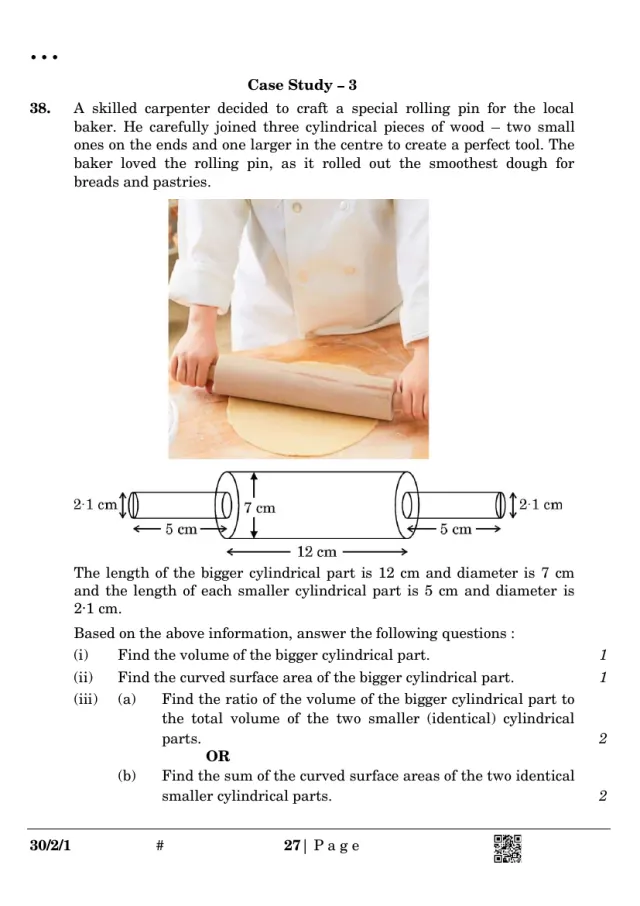
Case study 3. A skilled carpenter decided to craft a special rolling pin for the local baker. He carefully joined three cylindrical pieces of wood – two small ones on the ends and one larger in the centre to create a perfect tool. The baker loved the rolling pin, as it rolled out the smoothest dough for breads and pastries.

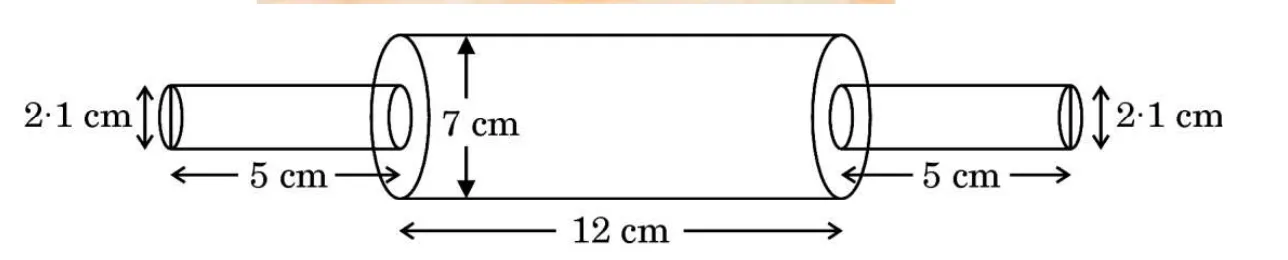
The length of the bigger cylindrical part is 12 cm and diameter is 7 cm and the length of each smaller cylindrical part is 5 cm and diameter is 2.1 cm.

Based on the above information, answer the following questions:

(i) Find the volume of the bigger cylindrical part. [1]

(ii) Find the curved surface area of the bigger cylindrical part. [1]

(iii) (a) Find the ratio of the volume of the bigger cylindrical part to the total volume of the two smaller (identical) cylindrical parts. [2]

OR

(iii) (b) Find the sum of the curved surface areas of the two identical smaller cylindrical parts. [2]

A drawing of the rolling pin with its dimensions: a bigger cylinder 12 cm long with diameter 7 cm, and two smaller cylinders 5 cm long with diameter 2.1 cm on either end.
Solution
12 cm5 cm5 cmdiameter 7 cm2.1 cm2.1 cm
  1. Bigger cylinder: diameter 77 cm, so r=3.5r = 3.5 cm, and length h=12h = 12 cm. Use π=227\pi = \dfrac{22}{7}.
  2. (i) Volume =πr2h=227×3.5×3.5×12=22×0.5×3.5×12=462= \pi r^2 h = \dfrac{22}{7} \times 3.5 \times 3.5 \times 12 = 22 \times 0.5 \times 3.5 \times 12 = 462 cm³.
  3. (ii) Curved surface area =2πrh=2×227×3.5×12=264= 2\pi r h = 2 \times \dfrac{22}{7} \times 3.5 \times 12 = 264 cm².
  4. (iii)(a) Each smaller cylinder: diameter 2.12.1 cm, so r=1.05r = 1.05 cm, and length 55 cm. Volume of one =227×1.05×1.05×5=17.325= \dfrac{22}{7} \times 1.05 \times 1.05 \times 5 = 17.325 cm³. Two of them: 2×17.325=34.652 \times 17.325 = 34.65 cm³.
  5. Ratio =462:34.65=46234.65=403= 462 : 34.65 = \dfrac{462}{34.65} = \dfrac{40}{3}, that is 40:340 : 3 (equivalently 3080:2313080 : 231).
  6. (iii)(b) Curved surface area of one small cylinder =2πrh=2×227×1.05×5=33= 2\pi r h = 2 \times \dfrac{22}{7} \times 1.05 \times 5 = 33 cm². For two: 2×33=662 \times 33 = 66 cm².

Answer: (i) 462462 cm³   (ii) 264264 cm²   (iii)(a) 40:340 : 3   (iii)(b) 6666 cm²

Common mistake: Using the diameter in place of the radius in πr2h\pi r^2 h. Halve the diameter first.

Report an error on this question

Questions are from the official CBSE paper. Figures are described in words; see the PDF for the originals. Solutions are written by CogniGuru.

Revise this paper in 1 minute a chapter

Each chapter below is what the paper tested, with a one-minute animated lesson on the idea behind it.

Stuck on a step in any solution?

The CogniGuru AI tutor explains any doubt one minute at a time, in English or Hindi. Join the waitlist.

Mock quiz: 5 questions from this paper

Five real questions from this paper, one each from five chapters. About 2 minutes. See how much you know and where you stand among other students. Attempt free, with no login; log in only for your ranking and full report.

Question 1 of 5 · Q3 of the paperQuadratic Equations

The quadratic equation whose roots are 77 and 17\dfrac{1}{7} is:

0 of 5 answered

Related papers

Common questions

Are these the official CBSE Class 10 Maths Standard 2025 questions?
Yes. The questions are from the official Mathematics (Standard) paper (set 30/2/1) that CBSE published after the March 2025 board exam. The solutions are written by CogniGuru and checked against the answer key CBSE published for this paper code.
Can I download the CBSE Class 10 Maths Standard 2025 question paper PDF?
Yes, the official paper PDF is free to download from this page, and so are our step-by-step solutions as a PDF. No login is needed to download either or to read the solutions.
Do all sets of the paper have the same questions?
No. CBSE sets several versions of each paper, with the same blueprint and similar questions in a different order and sometimes with different numbers. This page covers set 30/2/1.
Why does Q4 say none of the options is correct?
The least number divisible by 16, 20 and 50 is their LCM, 400, and 400 is already a perfect square. It is not among the options (1200, 100, 3600, 2400). CBSE’s own marking scheme says the correct option is not available and gives full marks to every candidate.
How does the quiz work, and what does “where you stand” mean?
It is a mock quiz of 5 real multiple-choice questions from this paper, scored automatically in about 2 minutes. Your score is compared, anonymously, with other students who took the same quiz. Only the score is stored with the comparison, never your name or number.

Source

CBSE question paper archive, Class X, 2025 (Mathematics (Standard), set 30/2/1)
PDF