CBSE · Class 10 · Mathematics (Standard) · Free

CBSE Class 10 Maths Standard 2025 Question Paper (Set 30/3/1) with Solutions

The official board paper (Q.P. Code 30/3/1, Series EF3GH). Free paper PDF and step-by-step solutions (also as a PDF to download) written by CogniGuru and checked against CBSE’s answer key. See the paper’s main topics in 1 minute, then quiz yourself to see how much you know and where you stand.

No login to download or read the solutions. Login only to see your quiz report in full.

Board
CBSE
Class
10
Subject
Maths Standard (041)
Year
2025
Set code
30/3/1
Max marks
80
Duration
3 hours
Questions
38 (Sections A to E)
Source
Official CBSE paper
Exam date
March 2025

Paper preview

Three pages of the official paper. Download the PDF for all 23.
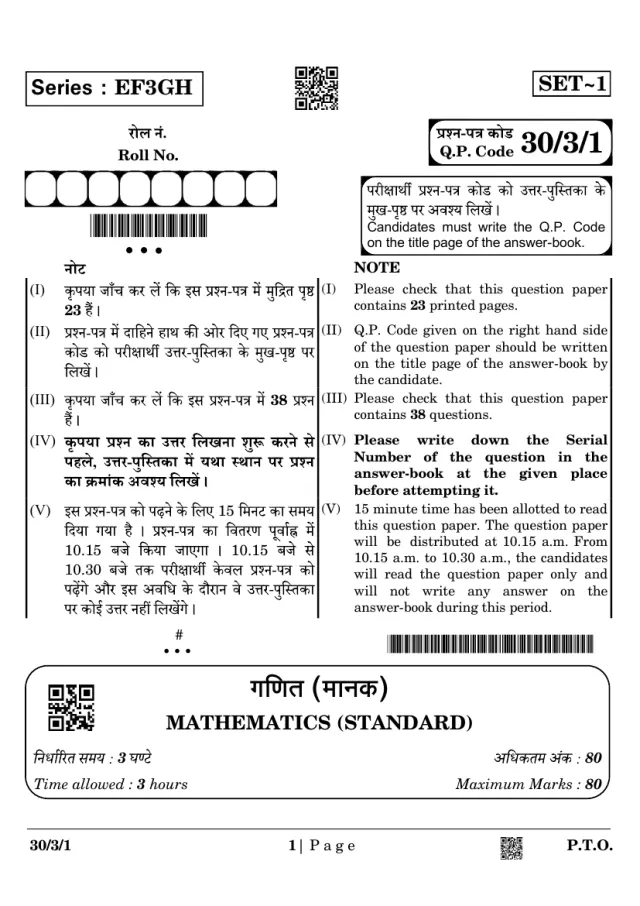
  • Cover page of the CBSE Class 10 Maths Standard 2025 paper, set 30/3/1

    Cover page

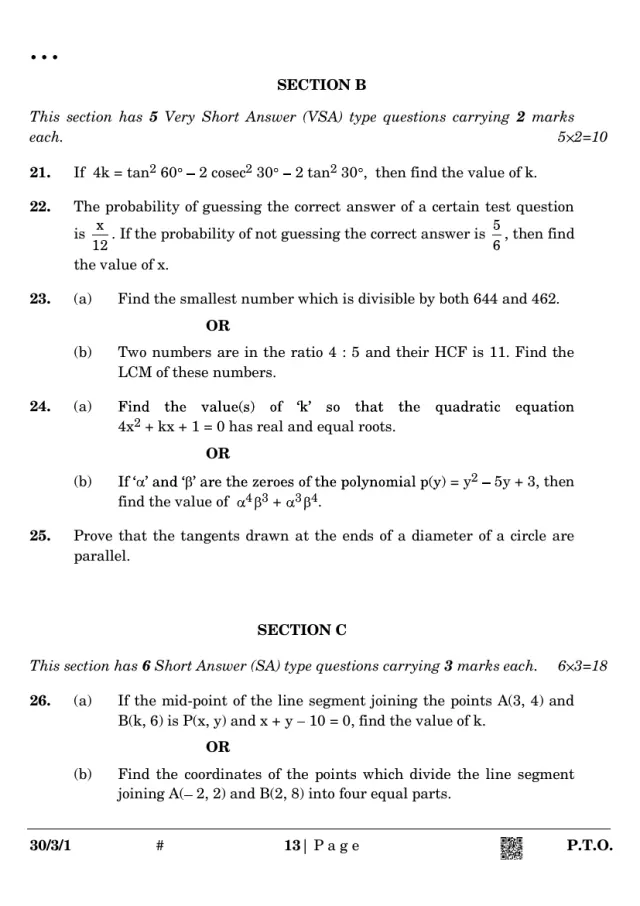
  • Section B of the CBSE Class 10 Maths Standard 2025 paper, set 30/3/1

    Section B

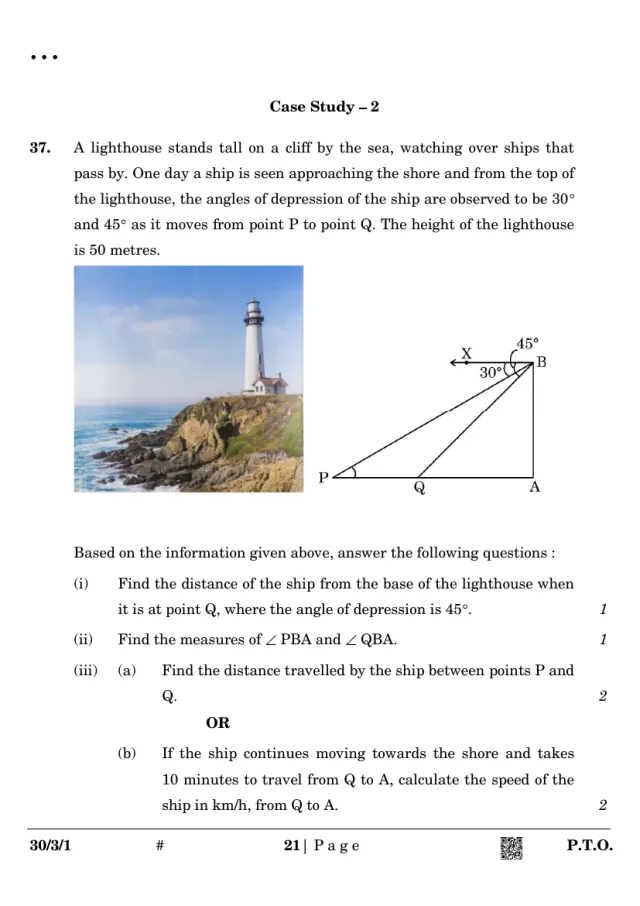
  • A case study with its figure from the CBSE Class 10 Maths Standard 2025 paper, set 30/3/1

    Case study

The main topics of this paper, in 1 minute

Your tutor walks you through the paper before you attempt it: the marks, the key ideas, the time plan and the traps.

1-minute paper analysis

With your tutor, in her voice

The main topics of this paper, in about a minute

A short, animated walk through the paper: how it is built, where the marks come from, the four ideas that matter most, how to plan your three hours, and the traps to avoid.

  1. 1The paper at a glance
  2. 2Where the marks come from
  3. 3Four ideas that keep paying off
  4. 4Plan your three hours
  5. 5Four traps to avoid

Sound on for the voice. Captions are shown, and you can mute any time.

Step-by-step solutions

Try each question first, then open its solution. Tap a number to jump.

Download solutions (PDF)

Section A: Multiple choice

20 questions, 1 mark each. MCQs (Q1 to Q18) and assertion-reason (Q19, Q20).

Q1Trigonometry1 mark

If tan⁡3θ=3\tan 3\theta = \sqrt{3}, then θ2\dfrac{\theta}{2} equals:

  1. (A)60∘60^\circ
  2. (B)30∘30^\circ
  3. (C)20∘20^\circ
  4. (D)10∘10^\circ
Solution · answer (D)
  1. tan⁡60∘=3\tan 60^\circ = \sqrt{3}, so 3θ=60∘3\theta = 60^\circ and θ=20∘\theta = 20^\circ.
  2. The question asks for θ2=20∘2=10∘\dfrac{\theta}{2} = \dfrac{20^\circ}{2} = 10^\circ.

Answer: (D) 10∘10^\circ

Common mistake: Stopping at θ=20∘\theta = 20^\circ. Read what is asked: θ2\dfrac{\theta}{2}.

Report an error on this question
Q2Real Numbers1 mark

If x is the LCM of 4, 6, 8 and y is the LCM of 3, 5, 7 and p is the LCM of x and y, then which of the following is true?

  1. (A)p=35xp = 35x
  2. (B)p=4yp = 4y
  3. (C)p=8xp = 8x
  4. (D)p=16yp = 16y
Solution · answer (A)
  1. 4=224 = 2^2, 6=2×36 = 2 \times 3, 8=238 = 2^3, so x=LCM=23×3=24x = \text{LCM} = 2^3 \times 3 = 24.
  2. 3,5,73, 5, 7 are primes, so y=3×5×7=105y = 3 \times 5 \times 7 = 105.
  3. p=LCM(24,105)p = \text{LCM}(24, 105). 24=23×324 = 2^3 \times 3 and 105=3×5×7105 = 3 \times 5 \times 7, so p=23×3×5×7=840p = 2^3 \times 3 \times 5 \times 7 = 840.
  4. 84024=35\dfrac{840}{24} = 35, so p=35xp = 35x.

Answer: (A) p=35xp = 35x

Report an error on this question
Q3Linear Equations1 mark

The value of kk for which the system of linear equations 6x+y=3k6x + y = 3k and 36x+6y=336x + 6y = 3 have infinitely many solutions is:

  1. (A)66
  2. (B)16\dfrac{1}{6}
  3. (C)12\dfrac{1}{2}
  4. (D)13\dfrac{1}{3}
Solution · answer (B)
  1. Infinitely many solutions need a1a2=b1b2=c1c2\dfrac{a_1}{a_2} = \dfrac{b_1}{b_2} = \dfrac{c_1}{c_2}.
  2. 636=16=3k3\dfrac{6}{36} = \dfrac{1}{6} = \dfrac{3k}{3}, so k=16k = \dfrac{1}{6}.

Answer: (B) 16\dfrac{1}{6}

Report an error on this question
Q4Polynomials1 mark

If α\alpha and β\beta are the zeroes of the polynomial p(x)=x2−ax−bp(x) = x^2 - ax - b, then the value of (α+β+αβ)(\alpha + \beta + \alpha\beta) is equal to:

  1. (A)a+ba + b
  2. (B)−a−b-a - b
  3. (C)a−ba - b
  4. (D)−a+b-a + b
Solution · answer (C)
  1. For x2−ax−bx^2 - ax - b: sum of zeroes α+β=−−a1=a\alpha + \beta = -\dfrac{-a}{1} = a.
  2. Product of zeroes αβ=−b1=−b\alpha\beta = \dfrac{-b}{1} = -b.
  3. α+β+αβ=a+(−b)=a−b\alpha + \beta + \alpha\beta = a + (-b) = a - b.

Answer: (C) a−ba - b

Common mistake: Using αβ=b\alpha\beta = b. The constant term is −b-b, so the product is −b-b.

Report an error on this question
Q5Quadratic Equations1 mark

If x12−3x=0\dfrac{x}{12} - \dfrac{3}{x} = 0, then the values of xx are:

  1. (A)±6\pm 6
  2. (B)±4\pm 4
  3. (C)±12\pm 12
  4. (D)±3\pm 3
Solution · answer (A)
  1. x12=3x\dfrac{x}{12} = \dfrac{3}{x}. Cross-multiply: x2=36x^2 = 36.
  2. So x=±6x = \pm 6.

Answer: (A) ±6\pm 6

Report an error on this question
Q6Coordinate Geometry1 mark

The line represented by x4+y6=1\dfrac{x}{4} + \dfrac{y}{6} = 1 intersects the xx-axis and yy-axis respectively at PP and QQ. The coordinates of the mid-point of line segment PQPQ are:

  1. (A)(2,3)(2, 3)
  2. (B)(3,2)(3, 2)
  3. (C)(2,0)(2, 0)
  4. (D)(0,3)(0, 3)
Solution · answer (A)
  1. On the xx-axis y=0y = 0: x4=1\dfrac{x}{4} = 1, so P=(4,0)P = (4, 0). On the yy-axis x=0x = 0: y6=1\dfrac{y}{6} = 1, so Q=(0,6)Q = (0, 6).
  2. Mid-point of PQ=(4+02, 0+62)=(2,3)PQ = \left(\dfrac{4 + 0}{2},\ \dfrac{0 + 6}{2}\right) = (2, 3).

Answer: (A) (2,3)(2, 3)

Report an error on this question
Q7Coordinate Geometry1 mark

Two of the vertices of △PQR\triangle PQR are P(−1,5)P(-1, 5) and Q(5,2)Q(5, 2). The coordinates of a point which divides PQPQ in the ratio 2:12 : 1 are:

  1. (A)(3,−3)(3, -3)
  2. (B)(5,5)(5, 5)
  3. (C)(3,3)(3, 3)
  4. (D)(5,1)(5, 1)
Solution · answer (C)
  1. Section formula with m:n=2:1m : n = 2 : 1: x=2×5+1×(−1)2+1=93=3x = \dfrac{2 \times 5 + 1 \times (-1)}{2 + 1} = \dfrac{9}{3} = 3.
  2. y=2×2+1×53=93=3y = \dfrac{2 \times 2 + 1 \times 5}{3} = \dfrac{9}{3} = 3. The point is (3,3)(3, 3).

Answer: (C) (3,3)(3, 3)

Common mistake: Swapping the ratio. For 2:12 : 1 from PP, the weight 22 goes with the coordinates of QQ.

Report an error on this question
Q8Circles1 mark

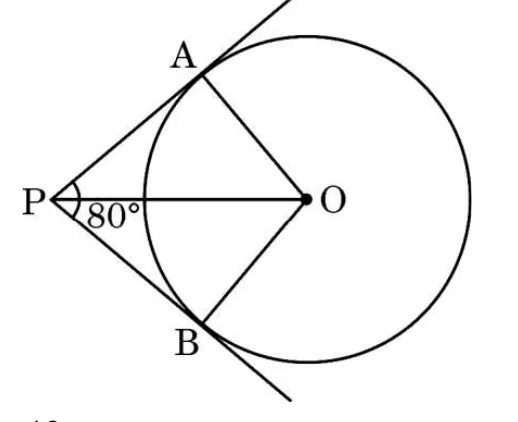
If tangents PAPA and PBPB drawn from an external point PP to the circle with centre OO are inclined to each other at an angle of 80∘80^\circ as shown in the given figure, then the measure of ∠POA\angle POA is:

A circle with centre O and two tangents PA and PB from the outside point P on the left. The angle between the tangents at P is 80 degrees.
  1. (A)40∘40^\circ
  2. (B)50∘50^\circ
  3. (C)60∘60^\circ
  4. (D)80∘80^\circ
Solution · answer (B)
80°50°OPABOP bisects ∠P: ∠OPA = 40°, so ∠POA = 90° − 40° = 50°
  1. ∠APB=80∘\angle APB = 80^\circ. The line POPO bisects it, so ∠OPA=40∘\angle OPA = 40^\circ.
  2. OA⊥PAOA \perp PA (radius to the point of contact), so ∠OAP=90∘\angle OAP = 90^\circ.
  3. In △OAP\triangle OAP: ∠POA=180∘−90∘−40∘=50∘\angle POA = 180^\circ - 90^\circ - 40^\circ = 50^\circ.

Answer: (B) 50∘50^\circ

Common mistake: Answering 40∘40^\circ, the angle at PP. The question asks for the angle at the centre.

Report an error on this question
Q9Trigonometry1 mark

(cot⁡θ+tan⁡θ)(\cot\theta + \tan\theta) equals:

  1. (A)cosec θsec⁡θ\mathrm{cosec}\,\theta \sec\theta
  2. (B)sin⁡θsec⁡θ\sin\theta \sec\theta
  3. (C)cos⁡θtan⁡θ\cos\theta \tan\theta
  4. (D)sin⁡θcos⁡θ\sin\theta \cos\theta
Solution · answer (A)
  1. cot⁡θ+tan⁡θ=cos⁡θsin⁡θ+sin⁡θcos⁡θ=cos⁡2θ+sin⁡2θsin⁡θcos⁡θ\cot\theta + \tan\theta = \dfrac{\cos\theta}{\sin\theta} + \dfrac{\sin\theta}{\cos\theta} = \dfrac{\cos^2\theta + \sin^2\theta}{\sin\theta\cos\theta}.
  2. =1sin⁡θcos⁡θ=1sin⁡θ⋅1cos⁡θ=cosec θsec⁡θ= \dfrac{1}{\sin\theta\cos\theta} = \dfrac{1}{\sin\theta} \cdot \dfrac{1}{\cos\theta} = \mathrm{cosec}\,\theta \sec\theta.

Answer: (A) cosec θsec⁡θ\mathrm{cosec}\,\theta \sec\theta

Report an error on this question
Q10Triangles1 mark

If in two triangles DEFDEF and PQRPQR, ∠D=∠Q\angle D = \angle Q and ∠R=∠E\angle R = \angle E, then which of the following is not true?

  1. (A)DEQR=DFPQ\dfrac{DE}{QR} = \dfrac{DF}{PQ}
  2. (B)EFPR=DFPQ\dfrac{EF}{PR} = \dfrac{DF}{PQ}
  3. (C)EFRP=DEQR\dfrac{EF}{RP} = \dfrac{DE}{QR}
  4. (D)DEPQ=EFRP\dfrac{DE}{PQ} = \dfrac{EF}{RP}
Solution · answer (D)
  1. Match the equal angles: D↔QD \leftrightarrow Q and E↔RE \leftrightarrow R, so F↔PF \leftrightarrow P. By AA, △DEF∼△QRP\triangle DEF \sim \triangle QRP.
  2. Corresponding sides are in proportion: DEQR=EFRP=DFQP\dfrac{DE}{QR} = \dfrac{EF}{RP} = \dfrac{DF}{QP}.
  3. Options (A), (B) and (C) are all taken from these equal ratios, so they are true.
  4. In (D), DEDE is paired with PQPQ, but DEDE corresponds to QRQR. So (D) is not true.

Answer: (D) DEPQ=EFRP\dfrac{DE}{PQ} = \dfrac{EF}{RP}

Common mistake: Pairing sides in the order the letters are written. Match the vertices by the equal angles first.

Report an error on this question
Q11Triangles1 mark

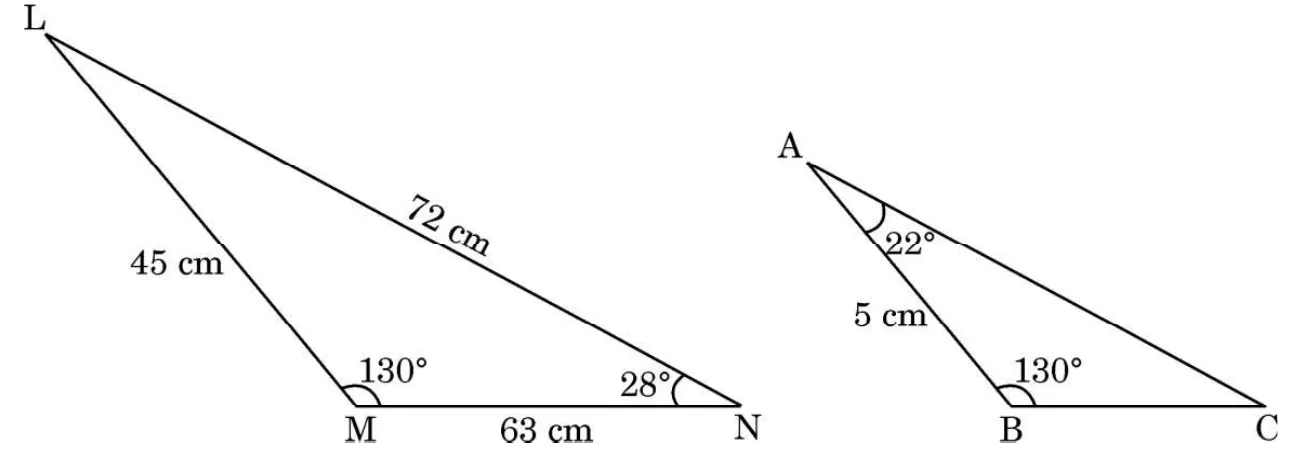
The measurements of △LMN\triangle LMN and △ABC\triangle ABC are shown in the figure given below. The length of side ACAC is:

Two triangles. Triangle LMN has LM = 45 cm, MN = 63 cm, LN = 72 cm, angle M = 130 degrees and angle N = 28 degrees. Triangle ABC has AB = 5 cm, angle B = 130 degrees and angle A = 22 degrees.
  1. (A)1616 cm
  2. (B)77 cm
  3. (C)88 cm
  4. (D)44 cm
Solution · answer (C)
  1. In △LMN\triangle LMN: ∠L=180∘−130∘−28∘=22∘\angle L = 180^\circ - 130^\circ - 28^\circ = 22^\circ.
  2. In △ABC\triangle ABC: ∠A=22∘\angle A = 22^\circ and ∠B=130∘\angle B = 130^\circ, so ∠C=28∘\angle C = 28^\circ.
  3. So △LMN∼△ABC\triangle LMN \sim \triangle ABC by AA with L↔AL \leftrightarrow A, M↔BM \leftrightarrow B, N↔CN \leftrightarrow C.
  4. LMAB=LNAC\dfrac{LM}{AB} = \dfrac{LN}{AC}: 455=72AC\dfrac{45}{5} = \dfrac{72}{AC}, so 9=72AC9 = \dfrac{72}{AC} and AC=8AC = 8 cm.

Answer: (C) 88 cm

Common mistake: Matching LNLN with BCBC. ACAC is opposite ∠B=130∘\angle B = 130^\circ, so it matches LNLN, which is opposite ∠M=130∘\angle M = 130^\circ.

Report an error on this question
Q12Surface Areas and Volumes1 mark

If the volumes of two cubes are in the ratio 8 : 125, then the ratio of their surface areas is:

  1. (A)8 : 125
  2. (B)4 : 25
  3. (C)2 : 5
  4. (D)16 : 25
Solution · answer (B)
  1. Volume of a cube =a3= a^3, so a13a23=8125\dfrac{a_1^3}{a_2^3} = \dfrac{8}{125} and a1a2=25\dfrac{a_1}{a_2} = \dfrac{2}{5}.
  2. Surface area =6a2= 6a^2, so the ratio of surface areas =(25)2=425= \left(\dfrac{2}{5}\right)^2 = \dfrac{4}{25}.

Answer: (B) 4 : 25

Common mistake: Squaring the volume ratio. First take the cube root to get the ratio of sides.

Report an error on this question
Q13Areas Related to Circles1 mark

If the area of a sector of circle of radius 3636 cm is 54π54\pi cm², then the length of the corresponding arc of the sector is:

  1. (A)8π8\pi cm
  2. (B)6π6\pi cm
  3. (C)4π4\pi cm
  4. (D)3π3\pi cm
Solution · answer (D)
  1. Area of a sector =12×arc length×r= \dfrac{1}{2} \times \text{arc length} \times r.
  2. 54π=12×l×36=18 l54\pi = \dfrac{1}{2} \times l \times 36 = 18\,l, so l=54π18=3πl = \dfrac{54\pi}{18} = 3\pi cm.

Answer: (D) 3π3\pi cm

Report an error on this question
Q14Probability1 mark

A die is thrown once. The probability of getting a number which is not a factor of 3636, is:

  1. (A)12\dfrac{1}{2}
  2. (B)23\dfrac{2}{3}
  3. (C)16\dfrac{1}{6}
  4. (D)56\dfrac{5}{6}
Solution · answer (C)
  1. Factors of 3636 are 1,2,3,4,6,9,12,18,361, 2, 3, 4, 6, 9, 12, 18, 36. Of the numbers 11 to 66 on a die, 1,2,3,4,61, 2, 3, 4, 6 are factors.
  2. The only number that is not a factor is 55, so there is 11 favourable outcome out of 66.
  3. P=16P = \dfrac{1}{6}.

Answer: (C) 16\dfrac{1}{6}

Report an error on this question
Q15Statistics1 mark

If the mean of 2,9,x+6,2x+3,5,10,52, 9, x + 6, 2x + 3, 5, 10, 5 is 77, then the value of xx is:

  1. (A)9
  2. (B)6
  3. (C)5
  4. (D)3
Solution · answer (D)
  1. There are 77 numbers and the mean is 77, so their sum is 7×7=497 \times 7 = 49.
  2. Sum =2+9+(x+6)+(2x+3)+5+10+5=40+3x= 2 + 9 + (x + 6) + (2x + 3) + 5 + 10 + 5 = 40 + 3x.
  3. 40+3x=4940 + 3x = 49, so 3x=93x = 9 and x=3x = 3.

Answer: (D) 3

Report an error on this question
Q16Coordinate Geometry1 mark

AOBCAOBC is a rectangle whose three vertices are A(0,2)A(0, 2), O(0,0)O(0, 0) and B(4,0)B(4, 0). The square of the length of its diagonal is equal to:

  1. (A)36
  2. (B)20
  3. (C)16
  4. (D)4
Solution · answer (B)
12345123OxyA(0, 2)OB(4, 0)C(4, 2)
The diagonal AB: 4² + 2² = 20.
  1. In rectangle AOBCAOBC the diagonals are ABAB and OCOC, and they are equal. Use ABAB, since both AA and BB are given.
  2. AB2=(4−0)2+(0−2)2=16+4=20AB^2 = (4 - 0)^2 + (0 - 2)^2 = 16 + 4 = 20.

Answer: (B) 20

Common mistake: Giving the side length (44 or 22). The question asks for the square of the diagonal.

Report an error on this question
Q17Polynomials1 mark

Zeroes of the polynomial p(x)=x2−32 x+4p(x) = x^2 - 3\sqrt{2}\,x + 4 are:

  1. (A)2, 22,\ \sqrt{2}
  2. (B)22, 22\sqrt{2},\ \sqrt{2}
  3. (C)42, −24\sqrt{2},\ -\sqrt{2}
  4. (D)2, 2\sqrt{2},\ 2
Solution · answer (B)
  1. Split the middle term: x2−22 x−2 x+4x^2 - 2\sqrt{2}\,x - \sqrt{2}\,x + 4, because 22×2=42\sqrt{2} \times \sqrt{2} = 4 and 22+2=322\sqrt{2} + \sqrt{2} = 3\sqrt{2}.
  2. =x(x−22)−2(x−22)=(x−22)(x−2)= x(x - 2\sqrt{2}) - \sqrt{2}(x - 2\sqrt{2}) = (x - 2\sqrt{2})(x - \sqrt{2}).
  3. The zeroes are 222\sqrt{2} and 2\sqrt{2}. Check: sum =32= 3\sqrt{2} ✓ and product =4= 4 ✓.

Answer: (B) 22, 22\sqrt{2},\ \sqrt{2}

Report an error on this question
Q18Triangles1 mark

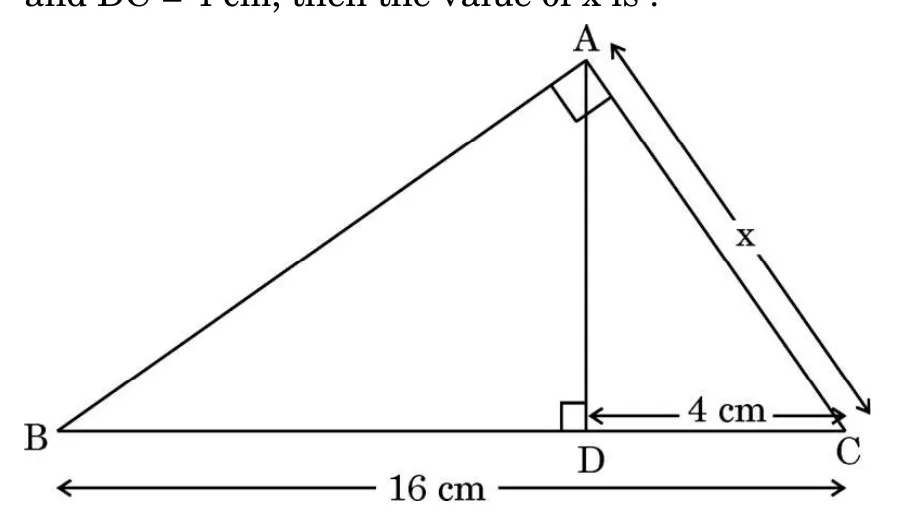
In the given figure, in △ABC\triangle ABC, AD⊥BCAD \perp BC and ∠BAC=90∘\angle BAC = 90^\circ. If BC=16BC = 16 cm and DC=4DC = 4 cm, then the value of xx is:

A right triangle ABC with the right angle at A and the altitude AD drawn to BC. DC is 4 cm and BC is 16 cm. The side AC is marked x.
  1. (A)44 cm
  2. (B)55 cm
  3. (C)88 cm
  4. (D)33 cm
Solution · answer (C)
412x = 8ABCDx² = BC × DC = 16 × 4 = 64
  1. In △ADC\triangle ADC and △BAC\triangle BAC: ∠ADC=∠BAC=90∘\angle ADC = \angle BAC = 90^\circ and ∠C\angle C is common. So △ADC∼△BAC\triangle ADC \sim \triangle BAC (AA).
  2. DCAC=ACBC\dfrac{DC}{AC} = \dfrac{AC}{BC}, so AC2=BC×DC=16×4=64AC^2 = BC \times DC = 16 \times 4 = 64.
  3. x=AC=8x = AC = 8 cm.

Answer: (C) 88 cm

Report an error on this question
Q19Applications of Trigonometry1 mark

Assertion (A): A ladder leaning against a wall, stands at a horizontal distance of 66 m from the wall. If the height of the wall up to which the ladder reaches is 88 m, then the length of the ladder is 1010 m.

Reason (R): The ladder makes an angle of 60∘60^\circ with the ground.

  1. (A)Both A and R are true and R is the correct explanation of A
  2. (B)Both A and R are true, but R is not the correct explanation of A
  3. (C)A is true, but R is false
  4. (D)A is false, but R is true
Solution · answer (C)
  1. (A) Ladder =62+82=100=10= \sqrt{6^2 + 8^2} = \sqrt{100} = 10 m. The assertion is true.
  2. (R) The angle with the ground θ\theta has tan⁡θ=86=43≠3=tan⁡60∘\tan\theta = \dfrac{8}{6} = \dfrac{4}{3} \neq \sqrt{3} = \tan 60^\circ. So the angle is not 60∘60^\circ and the reason is false.

Answer: (C) A is true, R is false

Common mistake: Accepting the reason because it sounds plausible. Check it with the given 6 m and 8 m.

Report an error on this question
Q20Circles1 mark

Assertion (A): If two tangents are drawn to a circle from an external point, then they subtend equal angles at the centre of the circle.

Reason (R): A parallelogram circumscribing a circle is a rhombus.

  1. (A)Both A and R are true and R is the correct explanation of A
  2. (B)Both A and R are true, but R is not the correct explanation of A
  3. (C)A is true, but R is false
  4. (D)A is false, but R is true
Solution · answer (B)
  1. (A) From an external point PP, PA=PBPA = PB, OA=OBOA = OB and OPOP is common, so △OAP≅△OBP\triangle OAP \cong \triangle OBP (SSS). So ∠AOP=∠BOP\angle AOP = \angle BOP: equal angles at the centre. True.
  2. (R) A parallelogram circumscribing a circle has AB+CD=AD+BCAB + CD = AD + BC, which forces all sides equal, so it is a rhombus. True.
  3. The reason is a separate result about parallelograms. It does not explain the assertion, so R is not the explanation of A.

Answer: (B) Both true, but R is not the correct explanation of A

Report an error on this question

Section B: Very short answer

5 questions, 2 marks each.

Q21Trigonometry2 marks

If 4k=tan⁡260∘−2 cosec230∘−2tan⁡230∘4k = \tan^2 60^\circ - 2\,\mathrm{cosec}^2 30^\circ - 2\tan^2 30^\circ, then find the value of kk.

Solution
  1. tan⁡60∘=3\tan 60^\circ = \sqrt{3}, so tan⁡260∘=3\tan^2 60^\circ = 3. cosec 30∘=2\mathrm{cosec}\,30^\circ = 2, so cosec230∘=4\mathrm{cosec}^2 30^\circ = 4. tan⁡30∘=13\tan 30^\circ = \dfrac{1}{\sqrt{3}}, so tan⁡230∘=13\tan^2 30^\circ = \dfrac{1}{3}.
  2. 4k=3−2×4−2×13=3−8−23=−5−23=−1734k = 3 - 2 \times 4 - 2 \times \dfrac{1}{3} = 3 - 8 - \dfrac{2}{3} = -5 - \dfrac{2}{3} = -\dfrac{17}{3}.
  3. k=−1712k = -\dfrac{17}{12}.

Answer: k=−1712k = -\dfrac{17}{12}

Common mistake: Forgetting the squares: the question has cosec230∘\mathrm{cosec}^2 30^\circ and tan⁡230∘\tan^2 30^\circ, not cosec 30∘\mathrm{cosec}\,30^\circ and tan⁡30∘\tan 30^\circ.

Report an error on this question
Q22Probability2 marks

The probability of guessing the correct answer of a certain test question is x12\dfrac{x}{12}. If the probability of not guessing the correct answer is 56\dfrac{5}{6}, then find the value of xx.

Solution
  1. P(E)+P(not E)=1P(E) + P(\text{not } E) = 1.
  2. x12+56=1\dfrac{x}{12} + \dfrac{5}{6} = 1, so x12=1−56=16\dfrac{x}{12} = 1 - \dfrac{5}{6} = \dfrac{1}{6}.
  3. x=126=2x = \dfrac{12}{6} = 2.

Answer: x=2x = 2

Report an error on this question
Q23Real Numbers2 marks

(a) Find the smallest number which is divisible by both 644644 and 462462.

OR

(b) Two numbers are in the ratio 4:54 : 5 and their HCF is 1111. Find the LCM of these numbers.

Solution
  1. (a) The smallest number divisible by both is their LCM. 644=22×7×23644 = 2^2 \times 7 \times 23 and 462=2×3×7×11462 = 2 \times 3 \times 7 \times 11.
  2. LCM =22×3×7×11×23=12×7×253=84×253=21252= 2^2 \times 3 \times 7 \times 11 \times 23 = 12 \times 7 \times 253 = 84 \times 253 = 21252.
  3. (b) Let the numbers be 4x4x and 5x5x, where xx is their HCF, so x=11x = 11. The numbers are 4444 and 5555.
  4. LCM =4×5×11=220= 4 \times 5 \times 11 = 220 (check: 44×55=2420=11×22044 \times 55 = 2420 = 11 \times 220 ✓).

Answer: (a) 2125221252   (b) 220220

Common mistake: In (b), using 4×5=204 \times 5 = 20 as the LCM. The common factor 1111 must be multiplied back.

Report an error on this question
Q24Quadratic Equations2 marks

(a) Find the value(s) of kk so that the quadratic equation 4x2+kx+1=04x^2 + kx + 1 = 0 has real and equal roots.

OR

(b) If α\alpha and β\beta are the zeroes of the polynomial p(y)=y2−5y+3p(y) = y^2 - 5y + 3, then find the value of α4β3+α3β4\alpha^4\beta^3 + \alpha^3\beta^4.

Solution
  1. (a) Real and equal roots need the discriminant D=b2−4ac=0D = b^2 - 4ac = 0.
  2. k2−4×4×1=0k^2 - 4 \times 4 \times 1 = 0, so k2=16k^2 = 16 and k=±4k = \pm 4.
  3. (b) For y2−5y+3y^2 - 5y + 3: α+β=5\alpha + \beta = 5 and αβ=3\alpha\beta = 3.
  4. α4β3+α3β4=α3β3(α+β)=(αβ)3(α+β)=27×5=135\alpha^4\beta^3 + \alpha^3\beta^4 = \alpha^3\beta^3(\alpha + \beta) = (\alpha\beta)^3(\alpha + \beta) = 27 \times 5 = 135.

Answer: (a) k=±4k = \pm 4   (b) 135135

Common mistake: In (a), giving only k=4k = 4. Both k=4k = 4 and k=−4k = -4 work.

Report an error on this question
Q25Circles2 marks

Prove that the tangents drawn at the ends of a diameter of a circle are parallel.

Solution
OABBoth make 90° with AB, so they are parallel
  1. Let ABAB be a diameter of a circle with centre OO, and let PQPQ and RSRS be the tangents at AA and BB.
  2. A tangent is perpendicular to the radius through the point of contact: OA⊥PQOA \perp PQ so ∠OAP=90∘\angle OAP = 90^\circ, and OB⊥RSOB \perp RS so ∠OBR=90∘\angle OBR = 90^\circ.
  3. OAOA and OBOB lie along the same line ABAB, so ABAB is a transversal to PQPQ and RSRS. Then ∠BAP=90∘\angle BAP = 90^\circ and ∠ABS=90∘\angle ABS = 90^\circ are alternate angles.
  4. Alternate angles are equal, so PQ∥RSPQ \parallel RS.

Answer: Proved

Common mistake: Not stating why the angle is 90°: the radius is perpendicular to the tangent at the point of contact.

Report an error on this question

Section C: Short answer

6 questions, 3 marks each.

Q26Coordinate Geometry3 marks

(a) If the mid-point of the line segment joining the points A(3,4)A(3, 4) and B(k,6)B(k, 6) is P(x,y)P(x, y) and x+y−10=0x + y - 10 = 0, find the value of kk.

OR

(b) Find the coordinates of the points which divide the line segment joining A(−2,2)A(-2, 2) and B(2,8)B(2, 8) into four equal parts.

Solution
-3-2-1123123456789OxyA(−2, 2)(−1, 3.5)(0, 5)(1, 6.5)B(2, 8)
  1. (a) Mid-point P=(3+k2, 4+62)=(3+k2, 5)P = \left(\dfrac{3 + k}{2},\ \dfrac{4 + 6}{2}\right) = \left(\dfrac{3 + k}{2},\ 5\right).
  2. Put in x+y−10=0x + y - 10 = 0: 3+k2+5−10=0\dfrac{3 + k}{2} + 5 - 10 = 0, so 3+k2=5\dfrac{3 + k}{2} = 5, 3+k=103 + k = 10 and k=7k = 7.
  3. (b) Let the three points be P1,P2,P3P_1, P_2, P_3. P2P_2 is the mid-point of ABAB: (−2+22, 2+82)=(0,5)\left(\dfrac{-2 + 2}{2},\ \dfrac{2 + 8}{2}\right) = (0, 5).
  4. P1P_1 is the mid-point of AA and P2P_2: (−2+02, 2+52)=(−1, 3.5)\left(\dfrac{-2 + 0}{2},\ \dfrac{2 + 5}{2}\right) = (-1,\ 3.5).
  5. P3P_3 is the mid-point of P2P_2 and BB: (0+22, 5+82)=(1, 6.5)\left(\dfrac{0 + 2}{2},\ \dfrac{5 + 8}{2}\right) = (1,\ 6.5).

Answer: (a) k=7k = 7   (b) (−1,72), (0,5), (1,132)(-1, \tfrac{7}{2}),\ (0, 5),\ (1, \tfrac{13}{2})

Common mistake: In (b), using the section formula with a wrong ratio. Three points make four equal parts: use mid-points, or ratios 1:31 : 3, 1:11 : 1, 3:13 : 1.

Report an error on this question
Q27Real Numbers3 marks

Prove that (53+23)\left(5\sqrt{3} + \dfrac{2}{3}\right) is an irrational number given that 3\sqrt{3} is an irrational number.

Solution
  1. Suppose 53+235\sqrt{3} + \dfrac{2}{3} is rational, equal to pq\dfrac{p}{q} with integers p,qp, q and q≠0q \neq 0.
  2. Then 53=pq−23=3p−2q3q5\sqrt{3} = \dfrac{p}{q} - \dfrac{2}{3} = \dfrac{3p - 2q}{3q}, so 3=3p−2q15q\sqrt{3} = \dfrac{3p - 2q}{15q}.
  3. pp and qq are integers, so 3p−2q15q\dfrac{3p - 2q}{15q} is a rational number. That would make 3\sqrt{3} rational.
  4. But 3\sqrt{3} is irrational (given). This is a contradiction, so our assumption was wrong. Hence 53+235\sqrt{3} + \dfrac{2}{3} is irrational.

Answer: Proved by contradiction

Common mistake: Writing the contradiction without saying which given fact it contradicts (that √3 is irrational).

Report an error on this question
Q28Trigonometry3 marks

(a) Prove that: sec⁡A−1sec⁡A+1+sec⁡A+1sec⁡A−1=2 cosec A\sqrt{\dfrac{\sec A - 1}{\sec A + 1}} + \sqrt{\dfrac{\sec A + 1}{\sec A - 1}} = 2\,\mathrm{cosec}\,A

OR

(b) Prove that: (1cos⁡A−cos⁡A)(1sin⁡A−sin⁡A)=1tan⁡A+cot⁡A\left(\dfrac{1}{\cos A} - \cos A\right)\left(\dfrac{1}{\sin A} - \sin A\right) = \dfrac{1}{\tan A + \cot A}

Solution
  1. (a) Put s=sec⁡As = \sec A. Over a common root: (s−1)+(s+1)(s+1)(s−1)=2ss2−1\dfrac{(s - 1) + (s + 1)}{\sqrt{(s + 1)(s - 1)}} = \dfrac{2s}{\sqrt{s^2 - 1}}.
  2. s2−1=sec⁡2A−1=tan⁡2As^2 - 1 = \sec^2 A - 1 = \tan^2 A, so this is 2sec⁡Atan⁡A=2×1cos⁡A×cos⁡Asin⁡A=2sin⁡A=2 cosec A\dfrac{2\sec A}{\tan A} = 2 \times \dfrac{1}{\cos A} \times \dfrac{\cos A}{\sin A} = \dfrac{2}{\sin A} = 2\,\mathrm{cosec}\,A.
  3. (b) 1cos⁡A−cos⁡A=1−cos⁡2Acos⁡A=sin⁡2Acos⁡A\dfrac{1}{\cos A} - \cos A = \dfrac{1 - \cos^2 A}{\cos A} = \dfrac{\sin^2 A}{\cos A} and 1sin⁡A−sin⁡A=cos⁡2Asin⁡A\dfrac{1}{\sin A} - \sin A = \dfrac{\cos^2 A}{\sin A}.
  4. LHS =sin⁡2Acos⁡A×cos⁡2Asin⁡A=sin⁡Acos⁡A= \dfrac{\sin^2 A}{\cos A} \times \dfrac{\cos^2 A}{\sin A} = \sin A \cos A.
  5. RHS: tan⁡A+cot⁡A=sin⁡2A+cos⁡2Asin⁡Acos⁡A=1sin⁡Acos⁡A\tan A + \cot A = \dfrac{\sin^2 A + \cos^2 A}{\sin A \cos A} = \dfrac{1}{\sin A \cos A}, so 1tan⁡A+cot⁡A=sin⁡Acos⁡A\dfrac{1}{\tan A + \cot A} = \sin A \cos A. LHS = RHS.

Answer: Both identities proved

Report an error on this question
Q29Areas Related to Circles3 marks

A chord of a circle of radius 10 cm subtends a right angle at the centre of the circle. Find the area of the corresponding minor segment. [Use π=3.14\pi = 3.14]

Solution
OABminor segmentsegment = sector (78.5) − triangle (50) = 28.5 cm²
  1. Area of minor segment == area of sector −- area of the triangle formed by the radii and the chord.
  2. Sector with θ=90∘\theta = 90^\circ: 90360×3.14×10×10=3144=78.5\dfrac{90}{360} \times 3.14 \times 10 \times 10 = \dfrac{314}{4} = 78.5 cm².
  3. Right triangle OABOAB with both legs 1010 cm: 12×10×10=50\dfrac{1}{2} \times 10 \times 10 = 50 cm².
  4. Minor segment =78.5−50=28.5= 78.5 - 50 = 28.5 cm².

Answer: 28.528.5 cm²

Common mistake: Giving the sector area (78.5) and forgetting to subtract the triangle.

Report an error on this question
Q30Probability3 marks

Three unbiased coins are tossed simultaneously. Find the probability of getting:

(a) exactly two tails

(b) at least one head

(c) at most two heads

Solution
  1. All outcomes: HHH,HHT,HTH,HTT,THH,THT,TTH,TTTHHH, HHT, HTH, HTT, THH, THT, TTH, TTT. That is 88 equally likely outcomes.
  2. (a) Exactly two tails: HTT,THT,TTHHTT, THT, TTH → 33 outcomes. P=38P = \dfrac{3}{8}.
  3. (b) At least one head: every outcome except TTTTTT → 77 outcomes. P=78P = \dfrac{7}{8}.
  4. (c) At most two heads: every outcome except HHHHHH → 77 outcomes. P=78P = \dfrac{7}{8}.

Answer: (a) 38\dfrac{3}{8}   (b) 78\dfrac{7}{8}   (c) 78\dfrac{7}{8}

Common mistake: Confusing “at least one” with “exactly one”. At least one head means 1, 2 or 3 heads.

Report an error on this question
Q31Circles3 marks

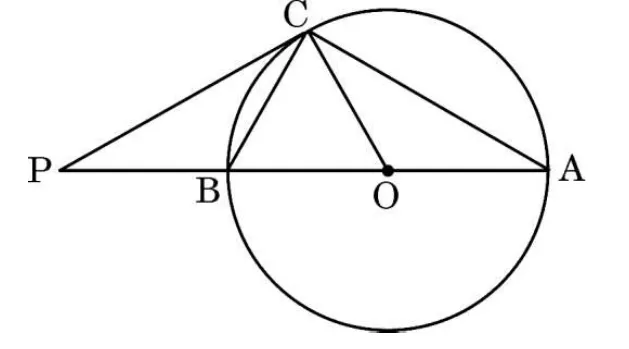
In the given figure, PCPC is a tangent to the circle at CC. AOBAOB is the diameter which when extended meets the tangent at PP. Find ∠CBA\angle CBA and ∠BCO\angle BCO, if ∠PCA=110∘\angle PCA = 110^\circ.

A circle with centre O and diameter AB extended to a point P on the left. PC is a tangent at C on the upper left of the circle. C is joined to B and to A.
Solution
20°70°OABCP∠PCB = 110° − 90° = 20°, ∠OCB = 90° − 20° = 70° = ∠CBA
  1. ABAB is a diameter, so the angle in a semicircle ∠ACB=90∘\angle ACB = 90^\circ.
  2. ∠PCA=∠PCB+∠BCA\angle PCA = \angle PCB + \angle BCA, so ∠PCB=110∘−90∘=20∘\angle PCB = 110^\circ - 90^\circ = 20^\circ.
  3. OC⊥PCOC \perp PC (radius to the tangent), so ∠PCB+∠BCO=90∘\angle PCB + \angle BCO = 90^\circ and ∠BCO=90∘−20∘=70∘\angle BCO = 90^\circ - 20^\circ = 70^\circ.
  4. OB=OCOB = OC (radii), so △OBC\triangle OBC is isosceles and ∠CBA=∠OBC=∠OCB=70∘\angle CBA = \angle OBC = \angle OCB = 70^\circ.

Answer: ∠CBA=70∘\angle CBA = 70^\circ and ∠BCO=70∘\angle BCO = 70^\circ

Common mistake: Forgetting that BB lies between PP and OO, so ∠PCA\angle PCA is made of two angles: ∠PCB\angle PCB and ∠BCA=90∘\angle BCA = 90^\circ.

Report an error on this question

Section D: Long answer

4 questions, 5 marks each.

Q32Linear Equations5 marks

The perimeter of an isosceles triangle is 3232 cm. If each equal side is 56\dfrac{5}{6}th of the base, find the area of the triangle.

Solution
1010128ABCDheight = √(10² − 6²) = 8, area = ½ × 12 × 8 = 48 cm²
  1. Let each equal side be xx cm and the base yy cm. Perimeter: 2x+y=322x + y = 32. … (i)
  2. Each equal side is 56\dfrac{5}{6} of the base: x=56yx = \dfrac{5}{6}y. … (ii)
  3. Put (ii) in (i): 53y+y=32\dfrac{5}{3}y + y = 32, so 83y=32\dfrac{8}{3}y = 32 and y=12y = 12. Then x=56×12=10x = \dfrac{5}{6} \times 12 = 10.
  4. The sides are 1010 cm, 1010 cm and 1212 cm. Semi-perimeter s=322=16s = \dfrac{32}{2} = 16 cm.
  5. Area =s(s−a)(s−b)(s−c)=16×6×6×4=4×6×2=48= \sqrt{s(s - a)(s - b)(s - c)} = \sqrt{16 \times 6 \times 6 \times 4} = 4 \times 6 \times 2 = 48 cm².
  6. Check by height: the height on the base is 102−62=8\sqrt{10^2 - 6^2} = 8, so area =12×12×8=48= \dfrac{1}{2} \times 12 \times 8 = 48 cm² ✓.

Answer: Area =48= 48 cm²

Common mistake: Taking the equal side as 65\dfrac{6}{5} of the base. "56\dfrac{5}{6}th of the base" means x=56yx = \dfrac{5}{6}y.

Report an error on this question
Q33Arithmetic Progressions5 marks

(a) The sum of the third term and the seventh term of an AP is 66 and their product is 88. Find the sum of the first sixteen terms of the AP.

OR

(b) The minimum age of children eligible to participate in a painting competition is 88 years. It is observed that the age of the youngest boy was 88 years and the ages of the participants, when seated in order of age, have a common difference of 44 months. If the sum of the ages of all the participants is 168168 years, find the age of the eldest participant in the painting competition.

Solution
  1. (a) a3+a7=(a+2d)+(a+6d)=2a+8d=6a_3 + a_7 = (a + 2d) + (a + 6d) = 2a + 8d = 6, so a+4d=3a + 4d = 3 and a=3−4da = 3 - 4d.
  2. a3⋅a7=(a+2d)(a+6d)=(3−2d)(3+2d)=9−4d2=8a_3 \cdot a_7 = (a + 2d)(a + 6d) = (3 - 2d)(3 + 2d) = 9 - 4d^2 = 8, so d2=14d^2 = \dfrac{1}{4} and d=±12d = \pm\dfrac{1}{2}.
  3. If d=12d = \dfrac{1}{2}: a=1a = 1 and S16=162[2×1+15×12]=8×9.5=76S_{16} = \dfrac{16}{2}\left[2 \times 1 + 15 \times \dfrac{1}{2}\right] = 8 \times 9.5 = 76.
  4. If d=−12d = -\dfrac{1}{2}: a=5a = 5 and S16=8[2×5+15×(−12)]=8×2.5=20S_{16} = 8\left[2 \times 5 + 15 \times \left(-\dfrac{1}{2}\right)\right] = 8 \times 2.5 = 20.
  5. (b) Ages in years: 8, 813, 823, 9,…8,\ 8\dfrac{1}{3},\ 8\dfrac{2}{3},\ 9, \dots (since 44 months =13= \dfrac{1}{3} year). So a=8a = 8 and d=13d = \dfrac{1}{3}.
  6. Sn=n2[16+(n−1)13]=168S_n = \dfrac{n}{2}\left[16 + (n - 1)\dfrac{1}{3}\right] = 168, so n(n+47)=1008n(n + 47) = 1008, that is n2+47n−1008=0n^2 + 47n - 1008 = 0.
  7. (n+63)(n−16)=0(n + 63)(n - 16) = 0. nn cannot be negative, so n=16n = 16.
  8. Eldest participant: a16=8+15×13=13a_{16} = 8 + 15 \times \dfrac{1}{3} = 13 years.

Answer: (a) S16=76S_{16} = 76 or 2020   (b) 1313 years

Common mistake: In (a), keeping only one value of dd. Both d=12d = \dfrac{1}{2} and d=−12d = -\dfrac{1}{2} fit, so there are two answers.

Report an error on this question
Q34Triangles5 marks

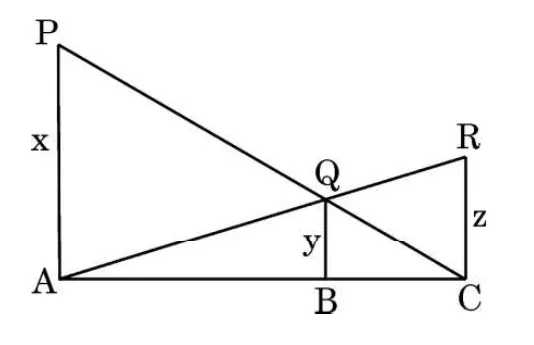
(a) In the given figure, PAPA, QBQB and RCRC are perpendicular to ACAC. If PA=xPA = x units, QB=yQB = y units and RC=zRC = z units, prove that 1x+1z=1y\dfrac{1}{x} + \dfrac{1}{z} = \dfrac{1}{y}.

OR

(b) Sides ABAB and BCBC and median ADAD of triangle ABCABC are respectively proportional to sides PQPQ and QRQR and median PMPM of △PQR\triangle PQR. Show that △ABC∼△PQR\triangle ABC \sim \triangle PQR.

Three vertical lines PA, QB and RC stand on the horizontal line AC, with lengths x, y and z. P is joined to C and A is joined to R, and they cross at Q.
Solution
xyzACPRBQAB/AC = y/z and BC/AC = y/x → add: 1 = y(1/z + 1/x)
  1. (a) QB∥RCQB \parallel RC (both perpendicular to ACAC). In △ABQ\triangle ABQ and △ACR\triangle ACR, ∠A\angle A is common and ∠ABQ=∠ACR=90∘\angle ABQ = \angle ACR = 90^\circ, so △ABQ∼△ACR\triangle ABQ \sim \triangle ACR (AA).
  2. ABAC=QBRC=yz\dfrac{AB}{AC} = \dfrac{QB}{RC} = \dfrac{y}{z}. … (i)
  3. Similarly QB∥PAQB \parallel PA, so △CBQ∼△CAP\triangle CBQ \sim \triangle CAP and BCAC=QBPA=yx\dfrac{BC}{AC} = \dfrac{QB}{PA} = \dfrac{y}{x}. … (ii)
  4. Add (i) and (ii): AB+BCAC=y(1z+1x)\dfrac{AB + BC}{AC} = y\left(\dfrac{1}{z} + \dfrac{1}{x}\right). Since AB+BC=ACAB + BC = AC, the left side is 11.
  5. So 1=y(1x+1z)1 = y\left(\dfrac{1}{x} + \dfrac{1}{z}\right), that is 1x+1z=1y\dfrac{1}{x} + \dfrac{1}{z} = \dfrac{1}{y}.
  6. (b) ADAD and PMPM are medians, so BD=BC2BD = \dfrac{BC}{2} and QM=QR2QM = \dfrac{QR}{2}. Given ABPQ=BCQR=ADPM\dfrac{AB}{PQ} = \dfrac{BC}{QR} = \dfrac{AD}{PM}, this gives ABPQ=2BD2QM=ADPM\dfrac{AB}{PQ} = \dfrac{2BD}{2QM} = \dfrac{AD}{PM}, so ABPQ=BDQM=ADPM\dfrac{AB}{PQ} = \dfrac{BD}{QM} = \dfrac{AD}{PM}.
  7. So △ABD∼△PQM\triangle ABD \sim \triangle PQM (SSS), which gives ∠B=∠Q\angle B = \angle Q.
  8. In △ABC\triangle ABC and △PQR\triangle PQR: ABPQ=BCQR\dfrac{AB}{PQ} = \dfrac{BC}{QR} and ∠B=∠Q\angle B = \angle Q. So △ABC∼△PQR\triangle ABC \sim \triangle PQR (SAS).

Answer: (a) 1x+1z=1y\dfrac{1}{x} + \dfrac{1}{z} = \dfrac{1}{y}   (b) △ABC∼△PQR\triangle ABC \sim \triangle PQR

Common mistake: In (a), using the wrong pair of similar triangles. QQ lies on both ARAR and PCPC, so use △ABQ∼△ACR\triangle ABQ \sim \triangle ACR and △CBQ∼△CAP\triangle CBQ \sim \triangle CAP.

Report an error on this question
Q35Surface Areas and Volumes5 marks

A vessel is in the form of an inverted cone. Its height is 88 cm and the radius of its top, which is open, is 55 cm. It is filled with water up to the brim. When lead shots, each of which is a sphere of radius 0.50.5 cm, are dropped into the vessel, one-fourth of the water flows out. Find the number of lead shots dropped in the vessel.

Solution
r = 5 cmh = 8 cmwater out = ¼ × 200π/3 = 50π/3; one shot = π/6; shots = 100
  1. Volume of water in the cone =13πr2h=13×π×52×8=200π3= \dfrac{1}{3}\pi r^2 h = \dfrac{1}{3} \times \pi \times 5^2 \times 8 = \dfrac{200\pi}{3} cm³.
  2. One-fourth flows out: volume of water out =14×200π3=50π3= \dfrac{1}{4} \times \dfrac{200\pi}{3} = \dfrac{50\pi}{3} cm³.
  3. This is the volume of the lead shots (they displace exactly that much water).
  4. Volume of one shot =43πr3=43×π×(12)3=4π24=π6= \dfrac{4}{3}\pi r^3 = \dfrac{4}{3} \times \pi \times \left(\dfrac{1}{2}\right)^3 = \dfrac{4\pi}{24} = \dfrac{\pi}{6} cm³.
  5. Number of shots =50π/3π/6=503×6=100= \dfrac{50\pi/3}{\pi/6} = \dfrac{50}{3} \times 6 = 100.

Answer: 100100 lead shots

Common mistake: Using the full cone volume instead of one-fourth of it. The shots displace only the water that flowed out.

Report an error on this question

Section E: Case studies

3 case studies, 4 marks each.

Q36Quadratic Equations4 marks

Case study 1. A garden designer is planning a rectangular lawn that is to be surrounded by a uniform walkway. The total area of the lawn and the walkway is 360 square metres. The width of the walkway is same on all sides. The dimensions of the lawn itself are 12 metres by 10 metres.

Based on the above information, answer the following questions:

(i) Formulate the quadratic equation representing the total area of the lawn and the walkway, taking width of walkway = x m. [1]

(ii) (a) Solve the quadratic equation to find the width of the walkway ‘x’. [2]

OR

(ii) (b) If the cost of paving the walkway at the rate of ₹ 50 per square metre is ₹ 12,000, calculate the area of the walkway. [2]

(iii) Find the perimeter of the lawn. [1]
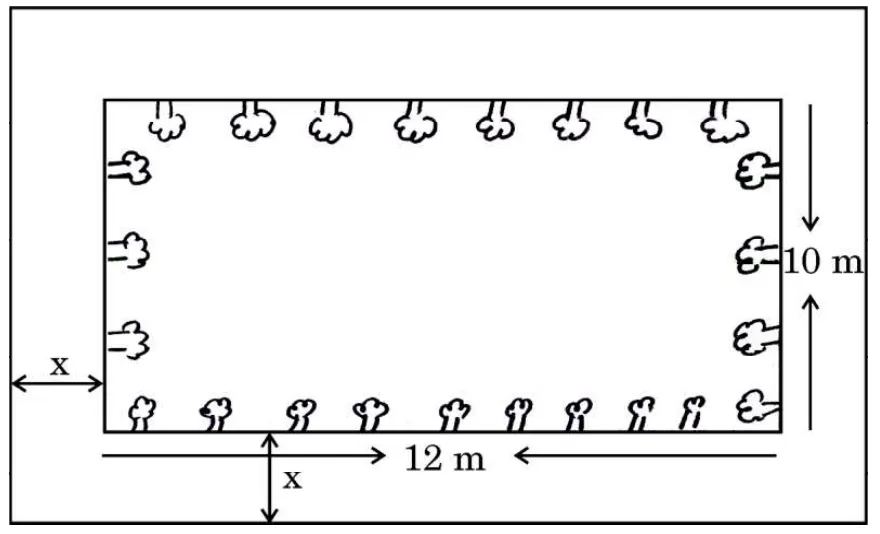
A diagram of a rectangular lawn 12 m by 10 m, with a walkway of width x metres on every side, and trees marked along the edges.
Solution
lawn 12 m × 10 mwalkway x = 4 m(12 + 2x) = 20 m(10 + 2x) = 18 m on the other side, area 20 × 18 = 360 m²
  1. (i) With a walkway of width xx on all sides, the whole rectangle is (12+2x)(12 + 2x) by (10+2x)(10 + 2x). Its area is 360360: (12+2x)(10+2x)=360(12 + 2x)(10 + 2x) = 360.
  2. Expanding: 120+24x+20x+4x2=360120 + 24x + 20x + 4x^2 = 360, so 4x2+44x−240=04x^2 + 44x - 240 = 0 and x2+11x−60=0x^2 + 11x - 60 = 0.
  3. (ii)(a) Factorise: x2+15x−4x−60=(x+15)(x−4)=0x^2 + 15x - 4x - 60 = (x + 15)(x - 4) = 0. The width cannot be negative, so x=4x = 4 m.
  4. (ii)(b) Area of the walkway =1200050=240= \dfrac{12000}{50} = 240 m². (Check: total 360360 − lawn 12×10=12012 \times 10 = 120 gives 240240 ✓, which matches x=4x = 4.)
  5. (iii) Perimeter of the lawn =2(12+10)=44= 2(12 + 10) = 44 m.

Answer: (i) x2+11x−60=0x^2 + 11x - 60 = 0   (ii)(a) x=4x = 4 m   (ii)(b) 240240 m²   (iii) 4444 m

Common mistake: Using (12+x)(10+x)(12 + x)(10 + x). The walkway is on both sides of each length, so it adds 2x2x.

Report an error on this question
Q37Applications of Trigonometry4 marks

Case study 2. A lighthouse stands tall on a cliff by the sea, watching over ships that pass by. One day a ship is seen approaching the shore and from the top of the lighthouse, the angles of depression of the ship are observed to be 30° and 45° as it moves from point P to point Q. The height of the lighthouse is 50 metres.

Based on the information given above, answer the following questions:

(i) Find the distance of the ship from the base of the lighthouse when it is at point Q, where the angle of depression is 45°. [1]

(ii) Find the measures of ∠PBA and ∠QBA. [1]

(iii) (a) Find the distance travelled by the ship between points P and Q. [2]

OR

(iii) (b) If the ship continues moving towards the shore and takes 10 minutes to travel from Q to A, calculate the speed of the ship in km/h, from Q to A. [2]
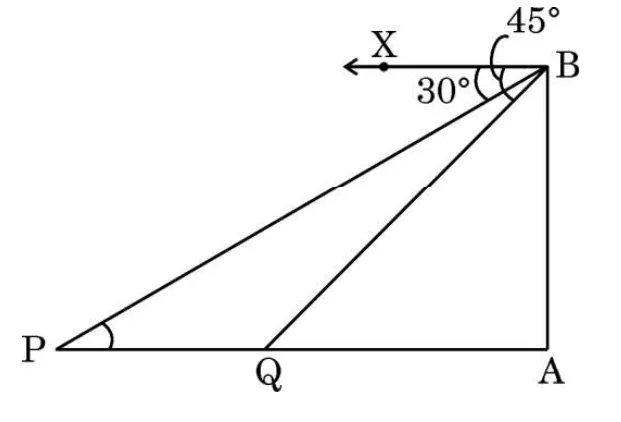
A diagram of the lighthouse: B is the top of the lighthouse and A is its base on the right. The ship is at P on the left at first and later at Q, nearer to A. The angles of depression at B are 30 degrees to P and 45 degrees to Q.
Solution
30°45°60°505050(√3 − 1)BAQP
Angle of depression 30° → ∠PBA = 90° − 30° = 60°.
  1. AB=50AB = 50 m. The angle of depression equals the angle of elevation of BB from the ship (alternate angles).
  2. (i) In △ABQ\triangle ABQ: tan⁡45∘=ABAQ=50AQ=1\tan 45^\circ = \dfrac{AB}{AQ} = \dfrac{50}{AQ} = 1, so AQ=50AQ = 50 m.
  3. (ii) BXBX is horizontal and BABA is vertical, so ∠XBA=90∘\angle XBA = 90^\circ. The angle of depression ∠XBP=30∘\angle XBP = 30^\circ, so ∠PBA=90∘−30∘=60∘\angle PBA = 90^\circ - 30^\circ = 60^\circ. Likewise ∠QBA=90∘−45∘=45∘\angle QBA = 90^\circ - 45^\circ = 45^\circ.
  4. (iii)(a) In △ABP\triangle ABP: tan⁡30∘=50AP=13\tan 30^\circ = \dfrac{50}{AP} = \dfrac{1}{\sqrt{3}}, so AP=503AP = 50\sqrt{3} m.
  5. PQ=AP−AQ=503−50=50(3−1)PQ = AP - AQ = 50\sqrt{3} - 50 = 50(\sqrt{3} - 1) m ≈36.6\approx 36.6 m.
  6. (iii)(b) From QQ to AA is 5050 m in 1010 minutes. Speed =5010=5= \dfrac{50}{10} = 5 m/min =5×60=300= 5 \times 60 = 300 m/h =0.3= 0.3 km/h.

Answer: (i) 5050 m   (ii) ∠PBA=60∘, ∠QBA=45∘\angle PBA = 60^\circ,\ \angle QBA = 45^\circ   (iii)(a) 50(3−1)50(\sqrt{3} - 1) m   (iii)(b) 0.30.3 km/h

Common mistake: Answering ∠PBA=30∘\angle PBA = 30^\circ. The angle of depression is measured from the horizontal, so ∠PBA=90∘−30∘=60∘\angle PBA = 90^\circ - 30^\circ = 60^\circ.

Report an error on this question
Q38Statistics4 marks

Case study 3. The India Meteorological Department observes seasonal and annual rainfall every year in different sub-divisions of our country. It helps them to compare and analyse the results. The table below shows sub-divisions wise seasonal (monsoon) rainfall (in mm) in 2023.

Based on the information given above, answer the following questions:

(i) Write the modal class. [1]

(ii) (a) Find the median of the given data. [2]

OR

(ii) (b) Find the mean rainfall in the season. [2]

(iii) If a sub-division having at least 800 mm rainfall during monsoon season is considered a good rainfall sub-division, then how many sub-divisions had good rainfall? [1]

Rainfall (mm)No. of sub-divisions
200 – 4003
400 – 6004
600 – 8007
800 – 10004
1000 – 12003
1200 – 14003
Solution
20040060080010001200140012345678Ommy347433median ≈ 742.86
The modal class is 600 – 800 (frequency 7).
  1. (i) The highest frequency is 77, so the modal class is 600−800600 - 800.
  2. (ii)(a) Cumulative frequencies: 3, 7, 14, 18, 21, 243,\ 7,\ 14,\ 18,\ 21,\ 24. N=24N = 24 and N2=12\dfrac{N}{2} = 12, so the median class is 600−800600 - 800 (first cumulative frequency above 1212).
  3. l=600l = 600, cf=7cf = 7, f=7f = 7, h=200h = 200. Median =l+N2−cff×h=600+12−77×200=600+10007≈742.86= l + \dfrac{\frac{N}{2} - cf}{f} \times h = 600 + \dfrac{12 - 7}{7} \times 200 = 600 + \dfrac{1000}{7} \approx 742.86 mm.
  4. (ii)(b) Class marks xix_i: 300,500,700,900,1100,1300300, 500, 700, 900, 1100, 1300. Products fixif_i x_i: 900,2000,4900,3600,3300,3900900, 2000, 4900, 3600, 3300, 3900. Their sum is ∑fixi=18600\sum f_i x_i = 18600.
  5. Mean =1860024=775= \dfrac{18600}{24} = 775 mm.
  6. (iii) At least 800800 mm: the classes 800−1000800 - 1000, 1000−12001000 - 1200 and 1200−14001200 - 1400 have 4+3+3=104 + 3 + 3 = 10 sub-divisions.

Answer: (i) 600−800600 - 800   (ii)(a) ≈742.86\approx 742.86 mm   (ii)(b) 775775 mm   (iii) 1010

Common mistake: Using NN instead of N2\dfrac{N}{2} to find the median class.

Report an error on this question

Questions are from the official CBSE paper. Figures are described in words; see the PDF for the originals. Solutions are written by CogniGuru.

Revise this paper in 1 minute a chapter

Each chapter below is what the paper tested, with a one-minute animated lesson on the idea behind it.

Stuck on a step in any solution?

The CogniGuru AI tutor explains any doubt one minute at a time, in English or Hindi. Join the waitlist.

Mock quiz: 5 questions from this paper

Five real questions from this paper, one each from five chapters. About 2 minutes. See how much you know and where you stand among other students. Attempt free, with no login; log in only for your ranking and full report.

Question 1 of 5 · Q1 of the paperTrigonometry

If tan⁡3θ=3\tan 3\theta = \sqrt{3}, then θ2\dfrac{\theta}{2} equals:

0 of 5 answered

Related papers

Common questions

Are these the official CBSE Class 10 Maths Standard 2025 questions?
Yes. The questions are from the official Mathematics (Standard) paper (set 30/3/1) that CBSE published after the March 2025 board exam. The solutions are written by CogniGuru and checked against the answer key CBSE published for this paper code.
Can I download the CBSE Class 10 Maths Standard 2025 question paper PDF?
Yes, the official paper PDF is free to download from this page, and so are our step-by-step solutions as a PDF. No login is needed to download either or to read the solutions.
Do all sets of the paper have the same questions?
No. CBSE sets several versions of each paper, with the same blueprint and similar questions in a different order and sometimes with different numbers. This page covers set 30/3/1.
How does the quiz work, and what does “where you stand” mean?
It is a mock quiz of 5 real multiple-choice questions from this paper, scored automatically in about 2 minutes. Your score is compared, anonymously, with other students who took the same quiz. Only the score is stored with the comparison, never your name or number.

Source

CBSE question paper archive, Class X, 2025 (Mathematics (Standard), set 30/3/1)
PDF