
CBSE · Class 10 · Mathematics (Standard) · Free

CBSE Class 10 Maths Standard 2025 Question Paper (Set 30/4/1) with Solutions

The official board paper (Q.P. Code 30/4/1, Series H4EFG). Free paper PDF and step-by-step solutions (also as a PDF to download) written by CogniGuru and checked against CBSE’s answer key. See the paper’s main topics in 1 minute, then quiz yourself to see how much you know and where you stand.

No login to download or read the solutions. Login only to see your quiz report in full.

Board
CBSE
Class
10
Subject
Maths Standard (041)
Year
2025
Set code
30/4/1
Max marks
80
Duration
3 hours
Questions
38 (Sections A to E)
Source
Official CBSE paper
Exam date
March 2025

Paper preview

Three pages of the official paper. Download the PDF for all 16.

  • Cover page of the CBSE Class 10 Maths Standard 2025 paper, set 30/4/1

    Cover page

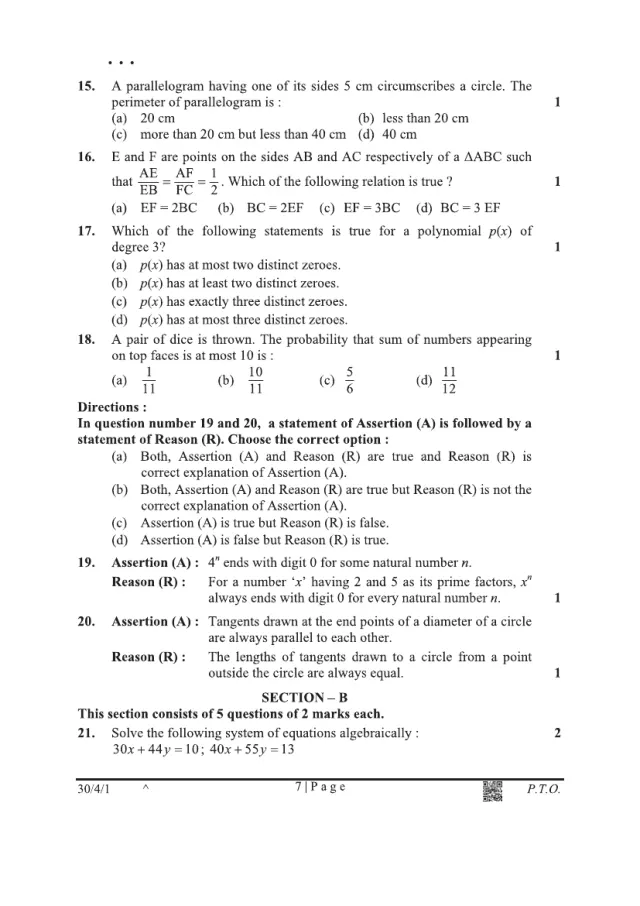
  • Section B of the CBSE Class 10 Maths Standard 2025 paper, set 30/4/1

    Section B

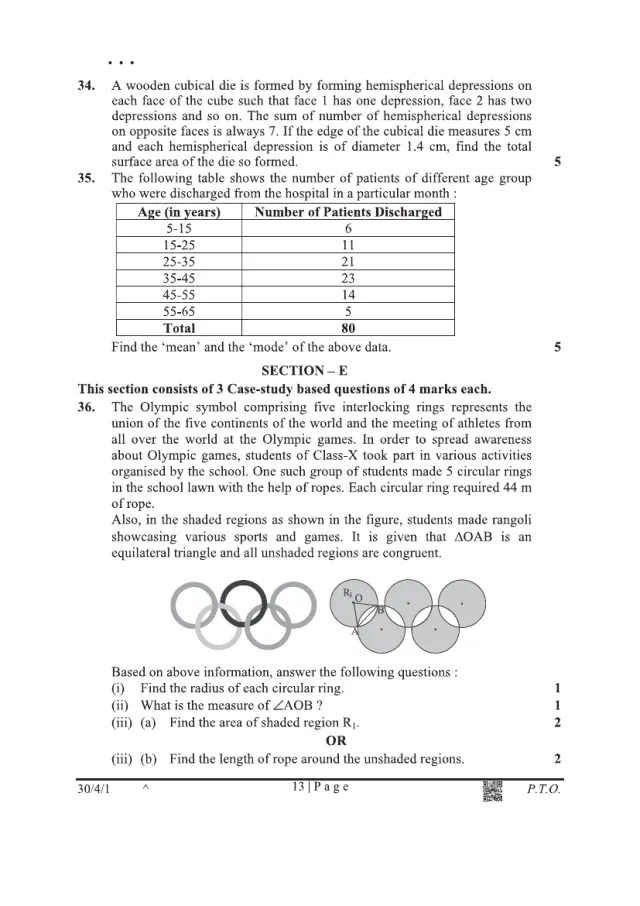
  • A case study with its figure from the CBSE Class 10 Maths Standard 2025 paper, set 30/4/1

    Case study

The main topics of this paper, in 1 minute

Your tutor walks you through the paper before you attempt it: the marks, the key ideas, the time plan and the traps.

1-minute paper analysis

With your tutor, in her voice

The main topics of this paper, in about a minute

A short, animated walk through the paper: how it is built, where the marks come from, the four ideas that matter most, how to plan your three hours, and the traps to avoid.

  1. 1The paper at a glance
  2. 2Where the marks come from
  3. 3Four ideas that keep paying off
  4. 4Plan your three hours
  5. 5Four traps to avoid

Sound on for the voice. Captions are shown, and you can mute any time.

Step-by-step solutions

Try each question first, then open its solution. Tap a number to jump.

Download solutions (PDF)

Section A: Multiple choice

20 questions, 1 mark each. MCQs (Q1 to Q18) and assertion-reason (Q19, Q20).

Q1Real Numbers1 mark

If x=ab3x = ab^3 and y=a3by = a^3 b, where aa and bb are prime numbers, then [HCF(x,y)−LCM(x,y)][\mathrm{HCF}(x, y) - \mathrm{LCM}(x, y)] is equal to:

  1. (A)1−a3b31 - a^3b^3
  2. (B)ab(1−ab)ab(1 - ab)
  3. (C)ab−a4b4ab - a^4b^4
  4. (D)ab(1−ab)(1+ab)ab(1 - ab)(1 + ab)
Solution · answer (D)
  1. x=a⋅b3x = a \cdot b^3 and y=a3⋅by = a^3 \cdot b. HCF takes the smaller power of each prime: HCF=a1b1=ab\mathrm{HCF} = a^1 b^1 = ab.
  2. LCM takes the greater power: LCM=a3b3\mathrm{LCM} = a^3 b^3.
  3. HCF−LCM=ab−a3b3=ab(1−a2b2)=ab(1−ab)(1+ab)\mathrm{HCF} - \mathrm{LCM} = ab - a^3b^3 = ab(1 - a^2b^2) = ab(1 - ab)(1 + ab).

Answer: (D) ab(1−ab)(1+ab)ab(1 - ab)(1 + ab)

Common mistake: Stopping at ab(1−a2b2)ab(1 - a^2b^2). Option (D) has this factorised further using 1−a2b2=(1−ab)(1+ab)1 - a^2b^2 = (1 - ab)(1 + ab).

Report an error on this question
Q2Real Numbers1 mark

(1+3)2−(1−3)2\left(1 + \sqrt{3}\right)^2 - \left(1 - \sqrt{3}\right)^2 is:

  1. (A)a positive rational number.
  2. (B)a negative integer.
  3. (C)a positive irrational number.
  4. (D)a negative irrational number.
Solution · answer (C)
  1. Use a2−b2=(a+b)(a−b)a^2 - b^2 = (a + b)(a - b) with a=1+3a = 1 + \sqrt{3} and b=1−3b = 1 - \sqrt{3}.
  2. a+b=2a + b = 2 and a−b=23a - b = 2\sqrt{3}, so the value is 2×23=432 \times 2\sqrt{3} = 4\sqrt{3}.
  3. 434\sqrt{3} is positive, and irrational because 3\sqrt{3} is irrational.

Answer: (C) a positive irrational number

Report an error on this question
Q3Quadratic Equations1 mark

The value of ‘aa’ for which ax2+x+a=0ax^2 + x + a = 0 has equal and positive roots is:

  1. (A)22
  2. (B)−2-2
  3. (C)12\dfrac{1}{2}
  4. (D)−12-\dfrac{1}{2}
Solution · answer (D)
  1. Equal roots need D=b2−4ac=0D = b^2 - 4ac = 0: 1−4a2=01 - 4a^2 = 0, so a2=14a^2 = \dfrac{1}{4} and a=±12a = \pm\dfrac{1}{2}.
  2. The equal root is x=−b2a=−12ax = -\dfrac{b}{2a} = -\dfrac{1}{2a}. For this to be positive, aa must be negative.
  3. So a=−12a = -\dfrac{1}{2}, and then x=−12×(−1/2)=1>0x = -\dfrac{1}{2 \times (-1/2)} = 1 > 0 ✓.

Answer: (D) −12-\dfrac{1}{2}

Common mistake: Choosing a=12a = \dfrac{1}{2}. Then the root is −1-1, which is equal but not positive.

Report an error on this question
Q4Coordinate Geometry1 mark

The distance of a point AA from xx-axis is 33 units. Which of the following cannot be coordinates of the point AA?

  1. (A)(1,3)(1, 3)
  2. (B)(−3,−3)(-3, -3)
  3. (C)(−3,3)(-3, 3)
  4. (D)(3,1)(3, 1)
Solution · answer (D)
  1. The distance of a point from the xx-axis is ∣y∣|y|, the absolute value of its yy-coordinate. So we need ∣y∣=3|y| = 3.
  2. (1,3)(1, 3): y=3y = 3 ✓. (−3,−3)(-3, -3): ∣y∣=3|y| = 3 ✓. (−3,3)(-3, 3): y=3y = 3 ✓. (3,1)(3, 1): ∣y∣=1≠3|y| = 1 \neq 3 ✗.

Answer: (D) (3,1)(3, 1)

Common mistake: Using the xx-coordinate. The distance from the xx-axis is the yy-coordinate.

Report an error on this question
Q5Probability1 mark

The number of red balls in a bag is 1010 more than the number of black balls. If the probability of drawing a red ball at random from this bag is 35\dfrac{3}{5}, then the total number of balls in the bag is:

  1. (A)50
  2. (B)60
  3. (C)80
  4. (D)40
Solution · answer (A)
  1. Let the black balls be bb. Red balls =b+10= b + 10 and total =2b+10= 2b + 10.
  2. b+102b+10=35\dfrac{b + 10}{2b + 10} = \dfrac{3}{5}, so 5b+50=6b+305b + 50 = 6b + 30 and b=20b = 20.
  3. Total =2×20+10=50= 2 \times 20 + 10 = 50. (Check: red =30= 30 and 3050=35\dfrac{30}{50} = \dfrac{3}{5} ✓.)

Answer: (A) 50

Report an error on this question
Q6Linear Equations1 mark

The value of ‘pp’ for which the equations px+3y=p−3px + 3y = p - 3, 12x+py=p12x + py = p has infinitely many solutions is:

  1. (A)−6-6 only
  2. (B)66 only
  3. (C)±6\pm 6
  4. (D)Any real number except ±6\pm 6
Solution · answer (B)
  1. Infinitely many solutions need p12=3p=p−3p\dfrac{p}{12} = \dfrac{3}{p} = \dfrac{p - 3}{p}.
  2. From the first two: p2=36p^2 = 36, so p=±6p = \pm 6.
  3. From the last two: 3p=p−3p\dfrac{3}{p} = \dfrac{p - 3}{p} gives 3=p−33 = p - 3, so p=6p = 6.
  4. Only p=6p = 6 satisfies all three. (For p=−6p = -6 the third ratio is −9−6=32\dfrac{-9}{-6} = \dfrac{3}{2}, not −12-\dfrac{1}{2}.)

Answer: (B) 66 only

Common mistake: Stopping at p=±6p = \pm 6. Use the third ratio to reject p=−6p = -6.

Report an error on this question
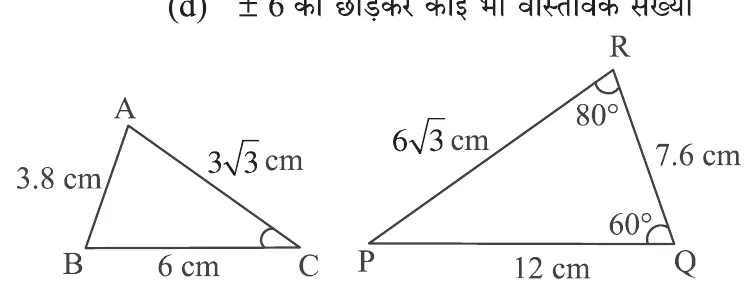
Q7Triangles1 mark

△ABC\triangle ABC and △PQR\triangle PQR are shown in the adjoining figures. The measure of ∠C\angle C is:

Two triangles. Triangle ABC has AB = 3.8 cm, AC = 3 root 3 cm and BC = 6 cm. Triangle PQR has PR = 6 root 3 cm, QR = 7.6 cm and PQ = 12 cm, with angle R = 80 degrees and angle Q = 60 degrees.
  1. (A)140∘140^\circ
  2. (B)80∘80^\circ
  3. (C)60∘60^\circ
  4. (D)40∘40^\circ
Solution · answer (D)
  1. Compare the sides: ABRQ=3.87.6=12\dfrac{AB}{RQ} = \dfrac{3.8}{7.6} = \dfrac{1}{2}, ACRP=3363=12\dfrac{AC}{RP} = \dfrac{3\sqrt{3}}{6\sqrt{3}} = \dfrac{1}{2} and BCQP=612=12\dfrac{BC}{QP} = \dfrac{6}{12} = \dfrac{1}{2}.
  2. All three ratios are equal, so △ABC∼△RQP\triangle ABC \sim \triangle RQP (SSS), with A↔RA \leftrightarrow R, B↔QB \leftrightarrow Q and C↔PC \leftrightarrow P.
  3. So ∠C=∠P=180∘−80∘−60∘=40∘\angle C = \angle P = 180^\circ - 80^\circ - 60^\circ = 40^\circ.

Answer: (D) 40∘40^\circ

Common mistake: Matching CC with RR just because they are in the same corner of the figure. Match the sides by their ratios first.

Report an error on this question
Q8Trigonometry1 mark

tan⁡2A=3tan⁡A\tan 2A = 3\tan A is true, when the measure of ∠A\angle A is:

  1. (A)90∘90^\circ
  2. (B)60∘60^\circ
  3. (C)45∘45^\circ
  4. (D)30∘30^\circ
Solution · answer (D)
  1. Let tan⁡A=u\tan A = u. tan⁡2A=2u1−u2\tan 2A = \dfrac{2u}{1 - u^2}, so 2u1−u2=3u\dfrac{2u}{1 - u^2} = 3u.
  2. For u≠0u \neq 0: 2=3(1−u2)2 = 3(1 - u^2), so u2=13u^2 = \dfrac{1}{3} and u=13u = \dfrac{1}{\sqrt{3}}.
  3. tan⁡A=13\tan A = \dfrac{1}{\sqrt{3}} gives A=30∘A = 30^\circ. Check: tan⁡60∘=3=3×13\tan 60^\circ = \sqrt{3} = 3 \times \dfrac{1}{\sqrt{3}} ✓.

Answer: (D) 30∘30^\circ

Common mistake: Using tan⁡2A=2tan⁡A\tan 2A = 2\tan A. The double-angle formula is 2tan⁡A1−tan⁡2A\dfrac{2\tan A}{1 - \tan^2 A}. Or simply test the options.

Report an error on this question
Q9Trigonometry1 mark

Which of the following statements is true?

  1. (A)sin⁡20∘>sin⁡70∘\sin 20^\circ > \sin 70^\circ
  2. (B)sin⁡20∘>cos⁡20∘\sin 20^\circ > \cos 20^\circ
  3. (C)cos⁡20∘>cos⁡70∘\cos 20^\circ > \cos 70^\circ
  4. (D)tan⁡20∘>tan⁡70∘\tan 20^\circ > \tan 70^\circ
Solution · answer (C)
  1. Between 0∘0^\circ and 90∘90^\circ, sine and tangent increase with the angle, and cosine decreases.
  2. (A) sin⁡20∘<sin⁡70∘\sin 20^\circ < \sin 70^\circ, so (A) is false. (D) tan⁡20∘<tan⁡70∘\tan 20^\circ < \tan 70^\circ, so (D) is false.
  3. (B) cos⁡20∘=sin⁡70∘>sin⁡20∘\cos 20^\circ = \sin 70^\circ > \sin 20^\circ, so (B) is false.
  4. (C) cos⁡20∘>cos⁡70∘\cos 20^\circ > \cos 70^\circ is true, because cosine falls as the angle grows.

Answer: (C) cos⁡20∘>cos⁡70∘\cos 20^\circ > \cos 70^\circ

Report an error on this question
Q10Applications of Trigonometry1 mark

A 3030 m long rope is tightly stretched and tied from the top of pole to the ground. If the rope makes an angle of 60∘60^\circ with the ground, the height of the pole is:

  1. (A)10310\sqrt{3} m
  2. (B)30330\sqrt{3} m
  3. (C)1515 m
  4. (D)15315\sqrt{3} m
Solution · answer (D)
60°30 m15 mh = 15√3 mTGRsin 60° = h / 30, so h = 15√3
  1. The pole, the ground and the rope form a right triangle. The rope is the hypotenuse (3030 m) and the pole is opposite the 60∘60^\circ angle.
  2. sin⁡60∘=h30\sin 60^\circ = \dfrac{h}{30}, so h=30×32=153h = 30 \times \dfrac{\sqrt{3}}{2} = 15\sqrt{3} m.

Answer: (D) 15315\sqrt{3} m

Common mistake: Using tan⁡60∘\tan 60^\circ or cos⁡60∘\cos 60^\circ. The rope is the hypotenuse, so the height is found with sine.

Report an error on this question
Q11Surface Areas and Volumes1 mark

On the top face of the wooden cube of side 77 cm, hemispherical depressions of radius 0.350.35 cm are to be formed by taking out the wood. The maximum number of depressions that can be formed is:

  1. (A)400
  2. (B)100
  3. (C)20
  4. (D)10
Solution · answer (B)
  1. Each depression has diameter 2×0.35=0.72 \times 0.35 = 0.7 cm.
  2. Along one edge of 77 cm, at most 70.7=10\dfrac{7}{0.7} = 10 depressions fit side by side.
  3. On the square face: 10×10=10010 \times 10 = 100.

Answer: (B) 100

Common mistake: Dividing the face area by the circle area (49π×0.352≈127\dfrac{49}{\pi \times 0.35^2} \approx 127). Circles cannot fill a square without gaps, so count them along the sides.

Report an error on this question
Q12Statistics1 mark

The cumulative frequency for calculating median is obtained by adding the frequencies of all the:

  1. (A)classes up to the median class
  2. (B)classes following the median class
  3. (C)classes preceding the median class
  4. (D)all classes
Solution · answer (C)
  1. In the median formula, cfcf is the cumulative frequency of the class just before the median class. It counts the frequencies of the classes preceding the median class.
  2. The median class itself is not included. Its own frequency is ff in the formula.

Answer: (C) classes preceding the median class

Report an error on this question
Q13Statistics1 mark

If mean and median of given set of observations are 10 and 11 respectively, then the value of mode is:

  1. (A)10.5
  2. (B)8
  3. (C)13
  4. (D)21
Solution · answer (C)
  1. The empirical relation is Mode=3×Median−2×Mean\text{Mode} = 3 \times \text{Median} - 2 \times \text{Mean}.
  2. Mode=3×11−2×10=33−20=13\text{Mode} = 3 \times 11 - 2 \times 10 = 33 - 20 = 13.

Answer: (C) 13

Report an error on this question
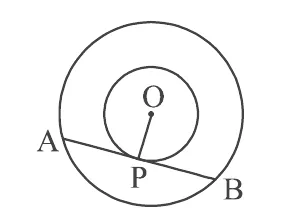
Q14Circles1 mark

In the adjoining figure, ABAB is the chord of the larger circle touching the smaller circle. The centre of both the circles is OO. If AB=2rAB = 2r and OP=rOP = r, then the radius of larger circle is:

Two circles with the same centre O. The chord AB of the larger circle touches the smaller circle at P, and OP is drawn.
  1. (A)2r2r
  2. (B)3r3r
  3. (C)22 r2\sqrt{2}\,r
  4. (D)2 r\sqrt{2}\,r
Solution · answer (D)
rrR = √2 rOPABOP ⊥ AB, so AP = PB = r and R² = r² + r² = 2r²
  1. ABAB touches the smaller circle at PP, so OP⊥ABOP \perp AB. The perpendicular from the centre bisects a chord: AP=AB2=rAP = \dfrac{AB}{2} = r.
  2. In right triangle OPAOPA: OA2=OP2+AP2=r2+r2=2r2OA^2 = OP^2 + AP^2 = r^2 + r^2 = 2r^2.
  3. The radius of the larger circle is OA=2 rOA = \sqrt{2}\,r.

Answer: (D) 2 r\sqrt{2}\,r

Report an error on this question
Q15Circles1 mark

A parallelogram having one of its sides 5 cm circumscribes a circle. The perimeter of parallelogram is:

  1. (A)20 cm
  2. (B)less than 20 cm
  3. (C)more than 20 cm but less than 40 cm
  4. (D)40 cm
Solution · answer (A)
  1. A parallelogram that circumscribes a circle is a rhombus (opposite sides are equal, and AB+CD=AD+BCAB + CD = AD + BC forces all four sides to be equal).
  2. All sides are 55 cm, so the perimeter is 4×5=204 \times 5 = 20 cm.

Answer: (A) 20 cm

Report an error on this question
Q16Triangles1 mark

EE and FF are points on the sides ABAB and ACAC respectively of a △ABC\triangle ABC such that AEEB=AFFC=12\dfrac{AE}{EB} = \dfrac{AF}{FC} = \dfrac{1}{2}. Which of the following relation is true?

  1. (A)EF=2BCEF = 2BC
  2. (B)BC=2EFBC = 2EF
  3. (C)EF=3BCEF = 3BC
  4. (D)BC=3EFBC = 3EF
Solution · answer (D)
  1. AEEB=AFFC\dfrac{AE}{EB} = \dfrac{AF}{FC}, so by the converse of the Basic Proportionality Theorem EF∥BCEF \parallel BC.
  2. So △AEF∼△ABC\triangle AEF \sim \triangle ABC. AEEB=12\dfrac{AE}{EB} = \dfrac{1}{2} means AEAE is 11 part out of 33 parts of ABAB: AEAB=13\dfrac{AE}{AB} = \dfrac{1}{3}.
  3. EFBC=AEAB=13\dfrac{EF}{BC} = \dfrac{AE}{AB} = \dfrac{1}{3}, so BC=3EFBC = 3EF.

Answer: (D) BC=3 EFBC = 3\,EF

Common mistake: Using 12\dfrac{1}{2} as the ratio EF:BCEF : BC. The ratio 1:21 : 2 is AE:EBAE : EB, so EF:BCEF : BC is 1:31 : 3.

Report an error on this question
Q17Polynomials1 mark

Which of the following statements is true for a polynomial p(x)p(x) of degree 33?

  1. (A)p(x)p(x) has at most two distinct zeroes.
  2. (B)p(x)p(x) has at least two distinct zeroes.
  3. (C)p(x)p(x) has exactly three distinct zeroes.
  4. (D)p(x)p(x) has at most three distinct zeroes.
Solution · answer (D)
  1. A polynomial of degree nn has at most nn zeroes. For degree 33, at most 33 distinct zeroes.
  2. It can have fewer: for example x3x^3 has only one zero and x3−xx^3 - x has three. So "at most two", "at least two" and "exactly three" are not always true.

Answer: (D) p(x)p(x) has at most three distinct zeroes.

Report an error on this question
Q18Probability1 mark

A pair of dice is thrown. The probability that sum of numbers appearing on top faces is at most 10 is:

  1. (A)111\dfrac{1}{11}
  2. (B)1011\dfrac{10}{11}
  3. (C)56\dfrac{5}{6}
  4. (D)1112\dfrac{11}{12}
Solution · answer (D)
  1. Two dice have 6×6=366 \times 6 = 36 equally likely outcomes.
  2. The sum is more than 1010 only for a sum of 1111: (5,6),(6,5)(5, 6), (6, 5), or 1212: (6,6)(6, 6). That is 33 outcomes.
  3. P(sum≤10)=1−336=3336=1112P(\text{sum} \le 10) = 1 - \dfrac{3}{36} = \dfrac{33}{36} = \dfrac{11}{12}.

Answer: (D) 1112\dfrac{11}{12}

Common mistake: Counting only the sum 1111 and forgetting the sum 1212.

Report an error on this question
Q19Real Numbers1 mark

Assertion (A): 4n4^n ends with digit 00 for some natural number nn.

Reason (R): For a number ‘xx’ having 22 and 55 as its prime factors, xnx^n always ends with digit 00 for every natural number nn.

  1. (A)Both A and R are true and R is the correct explanation of A
  2. (B)Both A and R are true, but R is not the correct explanation of A
  3. (C)A is true, but R is false
  4. (D)A is false, but R is true
Solution · answer (D)
  1. (A) 4n=22n4^n = 2^{2n} has only the prime factor 22, so it is not divisible by 55 and can never end in 00. (Its last digit is 44 or 66.) The assertion is false.
  2. (R) If xx has 22 and 55 among its prime factors, then xx is a multiple of 1010, and so is every power xnx^n. It ends in 00. The reason is true.

Answer: (D) A is false, R is true

Report an error on this question
Q20Circles1 mark

Assertion (A): Tangents drawn at the end points of a diameter of a circle are always parallel to each other.

Reason (R): The lengths of tangents drawn to a circle from a point outside the circle are always equal.

  1. (A)Both A and R are true and R is the correct explanation of A
  2. (B)Both A and R are true, but R is not the correct explanation of A
  3. (C)A is true, but R is false
  4. (D)A is false, but R is true
Solution · answer (B)
  1. (A) Each tangent is perpendicular to the diameter at its end, so the two tangents make equal alternate angles of 90∘90^\circ with the diameter: they are parallel. True.
  2. (R) Two tangents from an external point are equal in length. True.
  3. The parallel tangents in (A) come from "tangent ⊥\perp radius", not from the equal-length property. So R does not explain A.

Answer: (B) Both true, but R is not the correct explanation of A

Report an error on this question

Section B: Very short answer

5 questions, 2 marks each.

Q21Linear Equations2 marks

Solve the following system of equations algebraically: 30x+44y=1030x + 44y = 10; 40x+55y=1340x + 55y = 13.

Solution
  1. Multiply the first equation by 44 and the second by 33 to make the xx coefficients equal: 120x+176y=40120x + 176y = 40 … (i) and 120x+165y=39120x + 165y = 39 … (ii).
  2. Subtract (ii) from (i): 11y=111y = 1, so y=111y = \dfrac{1}{11}.
  3. Put in the first equation: 30x+44×111=1030x + 44 \times \dfrac{1}{11} = 10, so 30x+4=1030x + 4 = 10 and x=630=15x = \dfrac{6}{30} = \dfrac{1}{5}.
  4. Check in the second: 40×15+55×111=8+5=1340 \times \dfrac{1}{5} + 55 \times \dfrac{1}{11} = 8 + 5 = 13 ✓.

Answer: x=15x = \dfrac{1}{5}, y=111y = \dfrac{1}{11}

Report an error on this question
Q22Triangles2 marks

(A) A 1.51.5 m tall boy is walking away from the base of a lamp post which is 1212 m high, at the speed of 2.52.5 m/sec. Find the length of his shadow after 33 seconds.

OR

(B) In parallelogram ABCDABCD, side ADAD is produced to a point EE and BEBE intersects CDCD at FF. Prove that △ABE∼△CFB\triangle ABE \sim \triangle CFB.

Solution
7.5 mxABCDE12 m1.5 m1.5 / 12 = x / (7.5 + x)x = 15/14 ≈ 1.07 m
Not to scale: the shadow is very short.
ppqqABCDEF∠A = ∠C (opposite angles), ∠AEB = ∠CBF (alternate): AA
  1. (A) In 33 seconds the boy walks 2.5×3=7.52.5 \times 3 = 7.5 m from the base of the post. Let his shadow be xx m long.
  2. △ABE∼△CDE\triangle ABE \sim \triangle CDE (AA: both have a right angle and share the angle at EE), so CDAB=DEBE\dfrac{CD}{AB} = \dfrac{DE}{BE}.
  3. 1.512=x7.5+x\dfrac{1.5}{12} = \dfrac{x}{7.5 + x}, so 12x=1.5(7.5+x)=11.25+1.5x12x = 1.5(7.5 + x) = 11.25 + 1.5x and 10.5x=11.2510.5x = 11.25.
  4. x=11.2510.5=1514≈1.07x = \dfrac{11.25}{10.5} = \dfrac{15}{14} \approx 1.07 m.
  5. (B) In △ABE\triangle ABE and △CFB\triangle CFB: ∠A=∠C\angle A = \angle C (opposite angles of a parallelogram).
  6. AE∥BCAE \parallel BC and BEBE is a transversal, so ∠AEB=∠CBF\angle AEB = \angle CBF (alternate angles).
  7. So △ABE∼△CFB\triangle ABE \sim \triangle CFB by AA similarity.

Answer: (A) about 1.071.07 m   (B) proved

Common mistake: In (A), writing 1.512=x7.5\dfrac{1.5}{12} = \dfrac{x}{7.5}. The big triangle's base is the boy's distance plus the shadow, 7.5+x7.5 + x.

Report an error on this question
Q23Coordinate Geometry2 marks

Find the coordinates of the point CC which lies on the line ABAB produced such that AC=2BCAC = 2BC, where coordinates of points AA and BB are (−1,7)(-1, 7) and (4,−3)(4, -3) respectively.

Solution
-2246810-14-12-10-8-6-4-22468OxyA(−1, 7)B(4, −3)C(9, −13)
B is the mid-point of AC, so C = (2 × 4 − (−1), 2 × (−3) − 7) = (9, −13).
  1. CC is on ABAB produced (beyond BB) with AC=2BCAC = 2BC. Since AC=AB+BCAC = AB + BC, we get AB=BCAB = BC, so BB is the mid-point of ACAC.
  2. Let C=(x,y)C = (x, y). Mid-point of AC=(−1+x2, 7+y2)=(4,−3)AC = \left(\dfrac{-1 + x}{2},\ \dfrac{7 + y}{2}\right) = (4, -3).
  3. −1+x2=4\dfrac{-1 + x}{2} = 4 gives x=9x = 9, and 7+y2=−3\dfrac{7 + y}{2} = -3 gives y=−13y = -13.

Answer: C=(9,−13)C = (9, -13)

Common mistake: Using the section formula with ratio 2:12 : 1 internally. CC lies outside the segment, beyond BB.

Report an error on this question
Q24Trigonometry2 marks

(A) Find the value of xx for which (sin⁡A+cosec A)2+(cos⁡A+sec⁡A)2=x+tan⁡2A+cot⁡2A(\sin A + \mathrm{cosec}\,A)^2 + (\cos A + \sec A)^2 = x + \tan^2 A + \cot^2 A.

OR

(B) Evaluate the following: 3sin⁡30∘−4sin⁡330∘2sin⁡250∘+2cos⁡250∘\dfrac{3\sin 30^\circ - 4\sin^3 30^\circ}{2\sin^2 50^\circ + 2\cos^2 50^\circ}

Solution
  1. (A) Expand: sin⁡2A+cosec2A+2+cos⁡2A+sec⁡2A+2\sin^2 A + \mathrm{cosec}^2 A + 2 + \cos^2 A + \sec^2 A + 2.
  2. sin⁡2A+cos⁡2A=1\sin^2 A + \cos^2 A = 1, cosec2A=1+cot⁡2A\mathrm{cosec}^2 A = 1 + \cot^2 A and sec⁡2A=1+tan⁡2A\sec^2 A = 1 + \tan^2 A.
  3. LHS =1+(1+cot⁡2A)+(1+tan⁡2A)+4=7+tan⁡2A+cot⁡2A= 1 + (1 + \cot^2 A) + (1 + \tan^2 A) + 4 = 7 + \tan^2 A + \cot^2 A. So x=7x = 7.
  4. (B) Numerator: 3×12−4×(12)3=32−12=13 \times \dfrac{1}{2} - 4 \times \left(\dfrac{1}{2}\right)^3 = \dfrac{3}{2} - \dfrac{1}{2} = 1.
  5. Denominator: 2(sin⁡250∘+cos⁡250∘)=2×1=22(\sin^2 50^\circ + \cos^2 50^\circ) = 2 \times 1 = 2. The value is 12\dfrac{1}{2}.

Answer: (A) x=7x = 7   (B) 12\dfrac{1}{2}

Report an error on this question
Q25Probability2 marks

Two friends Anil and Ashraf were born in the December month in the year 2010. Find the probability that:

(i) they share same date of birth.

(ii) they have different dates of birth.

Solution
  1. December has 3131 days, so Ashraf's birthday can be any of 3131 dates, all equally likely.
  2. (i) For the same date as Anil, only 11 date works: P=131P = \dfrac{1}{31}.
  3. (ii) P(different)=1−131=3031P(\text{different}) = 1 - \dfrac{1}{31} = \dfrac{30}{31}.

Answer: (i) 131\dfrac{1}{31}   (ii) 3031\dfrac{30}{31}

Common mistake: Using 365 or 30 for the number of days. The month is December, so 31.

Report an error on this question

Section C: Short answer

6 questions, 3 marks each.

Q26Real Numbers3 marks

(A) Prove that 2\sqrt{2} is an irrational number.

OR

(B) Let xx and yy be two distinct prime numbers and p=x2y3p = x^2y^3, q=xy4q = xy^4, r=x5y2r = x^5y^2. Find the HCF and LCM of pp, qq and rr. Further check if HCF(p,q,r)×LCM(p,q,r)=p×q×r\mathrm{HCF}(p, q, r) \times \mathrm{LCM}(p, q, r) = p \times q \times r or not.

Solution
  1. (A) Suppose 2\sqrt{2} is rational: 2=pq\sqrt{2} = \dfrac{p}{q} with integers p,qp, q, q≠0q \neq 0, having no common factor.
  2. Squaring: 2q2=p22q^2 = p^2. So 22 divides p2p^2, and as 22 is prime, 22 divides pp. Write p=2ap = 2a.
  3. Then 4a2=2q24a^2 = 2q^2, so q2=2a2q^2 = 2a^2. So 22 divides q2q^2 and hence qq.
  4. Now 22 is a common factor of pp and qq, which contradicts our assumption. So 2\sqrt{2} is irrational.
  5. (B) p=x2y3p = x^2y^3, q=x1y4q = x^1y^4, r=x5y2r = x^5y^2. HCF takes the smallest powers: HCF=x y2\mathrm{HCF} = x\,y^2. LCM takes the greatest powers: LCM=x5y4\mathrm{LCM} = x^5y^4.
  6. HCF×LCM=x6y6\mathrm{HCF} \times \mathrm{LCM} = x^6y^6, while p×q×r=x2+1+5y3+4+2=x8y9p \times q \times r = x^{2+1+5}y^{3+4+2} = x^8y^9.
  7. These are not equal, so HCF(p,q,r)×LCM(p,q,r)≠p×q×r\mathrm{HCF}(p, q, r) \times \mathrm{LCM}(p, q, r) \neq p \times q \times r.

Answer: (A) proved   (B) HCF =xy2= xy^2, LCM =x5y4= x^5y^4; the product rule does not hold for three numbers

Common mistake: In (B), assuming HCF×LCM=\mathrm{HCF} \times \mathrm{LCM} = product. That rule is only for two numbers.

Report an error on this question
Q27Linear Equations3 marks

The monthly incomes of two persons are in the ratio 9:79 : 7 and their monthly expenditures are in the ratio 4:34 : 3. If each saved ₹ 5,0005{,}000, express the given situation algebraically as a system of linear equations in two variables. Hence, find their respective monthly incomes.

Solution
  1. Let the incomes be ₹ 9x9x and ₹ 7x7x, and the expenditures ₹ 4y4y and ₹ 3y3y.
  2. Savings == income −- expenditure =5000= 5000 for each: 9x−4y=50009x - 4y = 5000 … (i) and 7x−3y=50007x - 3y = 5000 … (ii).
  3. Multiply (i) by 33 and (ii) by 44: 27x−12y=1500027x - 12y = 15000 and 28x−12y=2000028x - 12y = 20000. Subtract: x=5000x = 5000.
  4. Incomes: 9x=9×5000=₹45,0009x = 9 \times 5000 = ₹45{,}000 and 7x=7×5000=₹35,0007x = 7 \times 5000 = ₹35{,}000.
  5. Check: y=10000y = 10000, so expenditures are 4000040000 and 3000030000, and the savings are 50005000 each ✓.

Answer: 9x−4y=5000, 7x−3y=50009x - 4y = 5000,\ 7x - 3y = 5000; incomes ₹ 45,00045{,}000 and ₹ 35,00035{,}000

Report an error on this question
Q28Coordinate Geometry3 marks

P(x,y)P(x, y), Q(−2,−3)Q(-2, -3) and R(2,3)R(2, 3) are the vertices of a right triangle PQRPQR right angled at PP. Find the relationship between xx and yy. Hence, find all possible values of xx for which y=2y = 2.

Solution
QRPP2Q(−2, −3), R(2, 3); P(±3, 2) lie on x² + y² = 13
A right angle at P means P is on the circle with diameter QR.
  1. Right angle at PP, so by Pythagoras PQ2+PR2=QR2PQ^2 + PR^2 = QR^2.
  2. PQ2=(x+2)2+(y+3)2PQ^2 = (x + 2)^2 + (y + 3)^2, PR2=(x−2)2+(y−3)2PR^2 = (x - 2)^2 + (y - 3)^2 and QR2=42+62=52QR^2 = 4^2 + 6^2 = 52.
  3. Adding: (x2+4x+4+y2+6y+9)+(x2−4x+4+y2−6y+9)=52(x^2 + 4x + 4 + y^2 + 6y + 9) + (x^2 - 4x + 4 + y^2 - 6y + 9) = 52, which gives 2x2+2y2+26=522x^2 + 2y^2 + 26 = 52.
  4. So x2+y2=13x^2 + y^2 = 13.
  5. For y=2y = 2: x2=13−4=9x^2 = 13 - 4 = 9, so x=3x = 3 or x=−3x = -3.

Answer: x2+y2=13x^2 + y^2 = 13; x=±3x = \pm 3

Common mistake: Giving only x=3x = 3. The equation x2=9x^2 = 9 has two roots, and both points are on the circle.

Report an error on this question
Q29Trigonometry3 marks

(A) Prove that cos⁡A+sin⁡A−1cos⁡A−sin⁡A+1=cosec A−cot⁡A\dfrac{\cos A + \sin A - 1}{\cos A - \sin A + 1} = \mathrm{cosec}\,A - \cot A

OR

(B) If cot⁡θ+cos⁡θ=p\cot\theta + \cos\theta = p and cot⁡θ−cos⁡θ=q\cot\theta - \cos\theta = q, prove that p2−q2=4pqp^2 - q^2 = 4\sqrt{pq}.

Solution
  1. (A) Divide the numerator and denominator of the LHS by sin⁡A\sin A: cot⁡A+1−cosec Acot⁡A−1+cosec A\dfrac{\cot A + 1 - \mathrm{cosec}\,A}{\cot A - 1 + \mathrm{cosec}\,A}.
  2. In the numerator write 1=cosec2A−cot⁡2A1 = \mathrm{cosec}^2 A - \cot^2 A: cot⁡A−cosec A+(cosec A−cot⁡A)(cosec A+cot⁡A)\cot A - \mathrm{cosec}\,A + (\mathrm{cosec}\,A - \cot A)(\mathrm{cosec}\,A + \cot A).
  3. =(cosec A−cot⁡A)[−1+cosec A+cot⁡A]= (\mathrm{cosec}\,A - \cot A)\left[-1 + \mathrm{cosec}\,A + \cot A\right], and the bracket is the same as the denominator. So LHS =cosec A−cot⁡A== \mathrm{cosec}\,A - \cot A = RHS.
  4. (B) p2−q2=(p+q)(p−q)=(2cot⁡θ)(2cos⁡θ)=4cot⁡θcos⁡θp^2 - q^2 = (p + q)(p - q) = (2\cot\theta)(2\cos\theta) = 4\cot\theta\cos\theta.
  5. pq=cot⁡2θ−cos⁡2θ=cos⁡2θ(cosec2θ−1)=cos⁡2θcot⁡2θpq = \cot^2\theta - \cos^2\theta = \cos^2\theta\left(\mathrm{cosec}^2\theta - 1\right) = \cos^2\theta\cot^2\theta, so 4pq=4cos⁡θcot⁡θ4\sqrt{pq} = 4\cos\theta\cot\theta.
  6. Both sides are 4cot⁡θcos⁡θ4\cot\theta\cos\theta, so p2−q2=4pqp^2 - q^2 = 4\sqrt{pq}.

Answer: Both proved

Report an error on this question
Q30Polynomials3 marks

α\alpha and β\beta are zeroes of a quadratic polynomial px2+qx+1px^2 + qx + 1. Form a quadratic polynomial whose zeroes are 2α\dfrac{2}{\alpha} and 2β\dfrac{2}{\beta}.

Solution
  1. For px2+qx+1px^2 + qx + 1: α+β=−qp\alpha + \beta = -\dfrac{q}{p} and αβ=1p\alpha\beta = \dfrac{1}{p}.
  2. Sum of the new zeroes =2α+2β=2(α+β)αβ=2×(−qp)×p=−2q= \dfrac{2}{\alpha} + \dfrac{2}{\beta} = \dfrac{2(\alpha + \beta)}{\alpha\beta} = 2 \times \left(-\dfrac{q}{p}\right) \times p = -2q.
  3. Product of the new zeroes =2α×2β=4αβ=4p= \dfrac{2}{\alpha} \times \dfrac{2}{\beta} = \dfrac{4}{\alpha\beta} = 4p.
  4. The polynomial is x2−(sum)x+product=x2+2qx+4px^2 - (\text{sum})x + \text{product} = x^2 + 2qx + 4p.

Answer: x2+2qx+4px^2 + 2qx + 4p

Common mistake: Forgetting the minus sign in "sum =−2q= -2q", which turns into +2qx+2qx in the polynomial.

Report an error on this question
Q31Circles3 marks

Rectangle ABCDABCD circumscribes the circle of radius 1010 cm. Prove that ABCDABCD is a square. Hence, find the perimeter of ABCDABCD.

Solution
20 cmABCDside = diameter = 20 cm, perimeter = 4 × 20 = 80 cm
  1. Let the circle touch AB,BC,CD,DAAB, BC, CD, DA at P,Q,R,SP, Q, R, S. Tangents from a point are equal: AP=ASAP = AS, BP=BQBP = BQ, CR=CQCR = CQ, DR=DSDR = DS.
  2. Add the four: AP+BP+CR+DR=AS+BQ+CQ+DSAP + BP + CR + DR = AS + BQ + CQ + DS, so AB+CD=AD+BCAB + CD = AD + BC. … (i)
  3. In a rectangle AB=CDAB = CD and BC=ADBC = AD. Then (i) gives 2AB=2AD2AB = 2AD, so AB=ADAB = AD.
  4. All four sides are equal and each angle is 90∘90^\circ, so ABCDABCD is a square.
  5. The side of the square equals the diameter of the circle: 2×10=202 \times 10 = 20 cm. Perimeter =4×20=80= 4 \times 20 = 80 cm.

Answer: ABCDABCD is a square; perimeter =80= 80 cm

Report an error on this question

Section D: Long answer

4 questions, 5 marks each.

Q32Quadratic Equations5 marks

(A) The sides of a right triangle are such that the longest side is 44 m more than the shortest side and the third side is 22 m less than the longest side. Find the length of each side of the triangle. Also, find the difference between the numerical values of the area and the perimeter of the given triangle.

OR

(B) Express the equation x−2x−3+x−4x−5=103\dfrac{x - 2}{x - 3} + \dfrac{x - 4}{x - 5} = \dfrac{10}{3}; (x≠3,5x \neq 3, 5) as a quadratic equation in standard form. Hence, find the roots of the equation so formed.

Solution
6 m (x)8 m (x + 2)10 m (x + 4)ABCarea 24 m², perimeter 24 m, difference 0
  1. (A) Let the shortest side be xx m. The longest side (hypotenuse) is (x+4)(x + 4) m and the third side is (x+4)−2=(x+2)(x + 4) - 2 = (x + 2) m.
  2. Pythagoras: (x+4)2=x2+(x+2)2(x + 4)^2 = x^2 + (x + 2)^2, so x2+8x+16=2x2+4x+4x^2 + 8x + 16 = 2x^2 + 4x + 4 and x2−4x−12=0x^2 - 4x - 12 = 0.
  3. (x−6)(x+2)=0(x - 6)(x + 2) = 0. A length cannot be negative, so x=6x = 6. The sides are 66 m, 88 m and 1010 m.
  4. Area =12×6×8=24= \dfrac{1}{2} \times 6 \times 8 = 24 m² and perimeter =6+8+10=24= 6 + 8 + 10 = 24 m. Difference =24−24=0= 24 - 24 = 0.
  5. (B) Put over a common denominator: (x−2)(x−5)+(x−4)(x−3)(x−3)(x−5)=103\dfrac{(x - 2)(x - 5) + (x - 4)(x - 3)}{(x - 3)(x - 5)} = \dfrac{10}{3}.
  6. Numerator: (x2−7x+10)+(x2−7x+12)=2x2−14x+22(x^2 - 7x + 10) + (x^2 - 7x + 12) = 2x^2 - 14x + 22. Denominator: x2−8x+15x^2 - 8x + 15.
  7. Cross-multiply: 3(2x2−14x+22)=10(x2−8x+15)3(2x^2 - 14x + 22) = 10(x^2 - 8x + 15), so 6x2−42x+66=10x2−80x+1506x^2 - 42x + 66 = 10x^2 - 80x + 150 and 4x2−38x+84=04x^2 - 38x + 84 = 0, that is 2x2−19x+42=02x^2 - 19x + 42 = 0.
  8. Factorise: 2x2−12x−7x+42=2x(x−6)−7(x−6)=(x−6)(2x−7)=02x^2 - 12x - 7x + 42 = 2x(x - 6) - 7(x - 6) = (x - 6)(2x - 7) = 0. So x=6x = 6 or x=72x = \dfrac{7}{2}, both allowed (≠3,5\neq 3, 5).

Answer: (A) sides 66 m, 88 m, 1010 m; difference 00   (B) 2x2−19x+42=02x^2 - 19x + 42 = 0; x=6x = 6 or 72\dfrac{7}{2}

Common mistake: In (A), taking the third side as x+2x + 2 and the longest side as x+2x + 2 too. The longest is x+4x + 4 and the third side is 22 less than it.

Report an error on this question
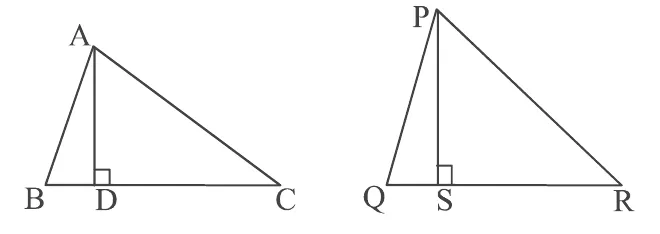
Q33Triangles5 marks

(A) The corresponding sides of △ABC\triangle ABC and △PQR\triangle PQR are in the ratio 3:53 : 5. AD⊥BCAD \perp BC and PS⊥QRPS \perp QR as shown in the following figures: (i) Prove that △ADC∼△PSR\triangle ADC \sim \triangle PSR. (ii) If AD=4AD = 4 cm, find the length of PSPS. (iii) Using (ii) find ar(△ABC):ar(△PQR)\text{ar}(\triangle ABC) : \text{ar}(\triangle PQR).

OR

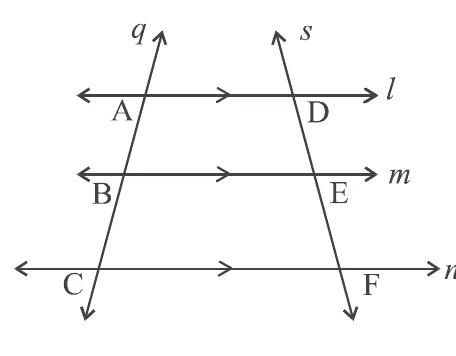
(B) State basic proportionality theorem. Use it to prove the following: If three parallel lines ll, mm, nn are intersected by transversals qq and ss as shown in the adjoining figure, then ABBC=DEEF\dfrac{AB}{BC} = \dfrac{DE}{EF}.

Two triangles ABC and PQR with the altitudes AD to BC and PS to QR drawn.Three parallel horizontal lines l, m and n cut by two transversals q and s. Transversal q meets them at A, B and C, and transversal s meets them at D, E and F.
Solution
  1. (A)(i) ABPQ=BCQR=ACPR=35\dfrac{AB}{PQ} = \dfrac{BC}{QR} = \dfrac{AC}{PR} = \dfrac{3}{5}, so △ABC∼△PQR\triangle ABC \sim \triangle PQR (SSS) and ∠C=∠R\angle C = \angle R.
  2. In △ADC\triangle ADC and △PSR\triangle PSR: ∠ADC=∠PSR=90∘\angle ADC = \angle PSR = 90^\circ and ∠C=∠R\angle C = \angle R. So △ADC∼△PSR\triangle ADC \sim \triangle PSR (AA).
  3. (ii) ADPS=ACPR=35\dfrac{AD}{PS} = \dfrac{AC}{PR} = \dfrac{3}{5}, so 4PS=35\dfrac{4}{PS} = \dfrac{3}{5} and PS=203PS = \dfrac{20}{3} cm.
  4. (iii) ar(△ABC)ar(△PQR)=12×BC×AD12×QR×PS=BCQR×ADPS=35×35=925\dfrac{\text{ar}(\triangle ABC)}{\text{ar}(\triangle PQR)} = \dfrac{\frac{1}{2} \times BC \times AD}{\frac{1}{2} \times QR \times PS} = \dfrac{BC}{QR} \times \dfrac{AD}{PS} = \dfrac{3}{5} \times \dfrac{3}{5} = \dfrac{9}{25}. The ratio is 9:259 : 25.
  5. (B) Basic Proportionality Theorem: if a line is drawn parallel to one side of a triangle to meet the other two sides in distinct points, it divides those sides in the same ratio.
  6. Proof of the result: join AFAF, meeting line mm at GG. In △ACF\triangle ACF, BG∥CFBG \parallel CF, so ABBC=AGGF\dfrac{AB}{BC} = \dfrac{AG}{GF}. … (i)
  7. In △FDA\triangle FDA, GE∥ADGE \parallel AD, so FEED=FGGA\dfrac{FE}{ED} = \dfrac{FG}{GA}, that is DEEF=AGGF\dfrac{DE}{EF} = \dfrac{AG}{GF}. … (ii)
  8. From (i) and (ii): ABBC=DEEF\dfrac{AB}{BC} = \dfrac{DE}{EF}.

Answer: (A) PS=203PS = \dfrac{20}{3} cm; ratio 9:259 : 25   (B) proved

Common mistake: Saying the areas are in the ratio 3:53 : 5. The ratio of areas of similar triangles is the square of the ratio of the sides: 9:259 : 25.

Report an error on this question
Q34Surface Areas and Volumes5 marks

A wooden cubical die is formed by forming hemispherical depressions on each face of the cube such that face 11 has one depression, face 22 has two depressions and so on. The sum of number of hemispherical depressions on opposite faces is always 77. If the edge of the cubical die measures 55 cm and each hemispherical depression is of diameter 1.41.4 cm, find the total surface area of the die so formed.

Solution
  1. Number of depressions =1+2+3+4+5+6=21= 1 + 2 + 3 + 4 + 5 + 6 = 21. Radius of each r=1.42=0.7r = \dfrac{1.4}{2} = 0.7 cm.
  2. Making a depression removes a flat circle πr2\pi r^2 from the face but adds the curved surface of a hemisphere 2πr22\pi r^2. So each depression adds 2πr2−πr2=πr22\pi r^2 - \pi r^2 = \pi r^2.
  3. TSA of the cube =6×52=150= 6 \times 5^2 = 150 cm².
  4. Net addition for 2121 depressions =21×πr2=21×227×0.7×0.7=3×22×0.49=32.34= 21 \times \pi r^2 = 21 \times \dfrac{22}{7} \times 0.7 \times 0.7 = 3 \times 22 \times 0.49 = 32.34 cm².
  5. Total surface area of the die =150+32.34=182.34= 150 + 32.34 = 182.34 cm².

Answer: 182.34182.34 cm²

Common mistake: Adding the hemisphere surface but forgetting to subtract the circular opening removed from the face.

Report an error on this question
Q35Statistics5 marks

The following table shows the number of patients of different age group who were discharged from the hospital in a particular month. Find the ‘mean’ and the ‘mode’ of the above data.

Age (in years)Number of Patients Discharged
5 – 156
15 – 2511
25 – 3521
35 – 4523
45 – 5514
55 – 655
Total80
Solution
1020304050604812162024Oagey6112123145mode ≈ 36.82
The modal class is 35 – 45 (frequency 23).
  1. Class marks xix_i: 10,20,30,40,50,6010, 20, 30, 40, 50, 60. Frequencies fif_i: 6,11,21,23,14,56, 11, 21, 23, 14, 5 with ∑fi=80\sum f_i = 80.
  2. Products fixif_i x_i: 60, 220, 630, 920, 700, 30060,\ 220,\ 630,\ 920,\ 700,\ 300. Their sum is ∑fixi=2830\sum f_i x_i = 2830.
  3. Mean =283080=2838=35.375≈35.38= \dfrac{2830}{80} = \dfrac{283}{8} = 35.375 \approx 35.38 years.
  4. Highest frequency is 2323, so the modal class is 35−4535 - 45: l=35l = 35, f1=23f_1 = 23, f0=21f_0 = 21, f2=14f_2 = 14, h=10h = 10.
  5. Mode =l+f1−f02f1−f0−f2×h=35+23−2146−21−14×10=35+2011=40511≈36.82= l + \dfrac{f_1 - f_0}{2f_1 - f_0 - f_2} \times h = 35 + \dfrac{23 - 21}{46 - 21 - 14} \times 10 = 35 + \dfrac{20}{11} = \dfrac{405}{11} \approx 36.82 years.

Answer: Mean ≈35.38\approx 35.38 years and Mode ≈36.82\approx 36.82 years

Report an error on this question

Section E: Case studies

3 case studies, 4 marks each.

Q36Areas Related to Circles4 marks

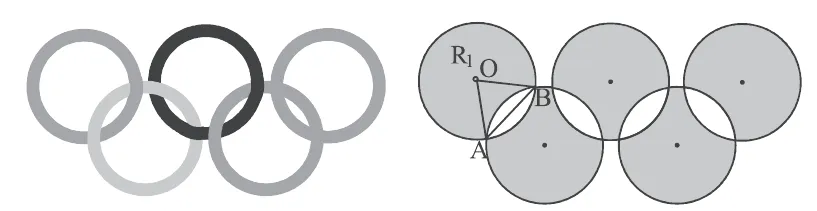
Case study 1. The Olympic symbol comprising five interlocking rings represents the union of the five continents of the world and the meeting of athletes from all over the world at the Olympic games. In order to spread awareness about Olympic games, students of Class-X took part in various activities organised by the school. One such group of students made 5 circular rings in the school lawn with the help of ropes. Each circular ring required 44 m of rope. Also, in the shaded regions as shown in the figure, students made rangoli showcasing various sports and games. It is given that ΔOAB is an equilateral triangle and all unshaded regions are congruent.

Based on above information, answer the following questions:

(i) Find the radius of each circular ring. [1]

(ii) What is the measure of ∠AOB? [1]

(iii) (a) Find the area of shaded region R₁. [2]

OR

(iii) (b) Find the length of rope around the unshaded regions. [2]

The five Olympic rings, and a diagram of the rings with the shaded regions. The region R1 is the top-left ring, with the equilateral triangle OAB drawn inside it.
Solution
60°7 m7 mOABone segment (amber) = sector − triangleR₁ = circle − 2 segments = 308/3 + 49√3/2 m²
  1. (i) The rope around a ring is its circumference: 2πr=442\pi r = 44, so 2×227×r=442 \times \dfrac{22}{7} \times r = 44 and r=7r = 7 m.
  2. (ii) △OAB\triangle OAB is equilateral, so each angle is 60∘60^\circ. ∠AOB=60∘\angle AOB = 60^\circ.
  3. (iii)(a) The white lens where two rings overlap is made of two equal segments standing on the chord ABAB. The shaded region R1R_1 is the whole circle minus these 22 segments. One segment == sector of 60∘60^\circ −- equilateral triangle OABOAB: 60360×227×7×7−34×7×7=773−4934\dfrac{60}{360} \times \dfrac{22}{7} \times 7 \times 7 - \dfrac{\sqrt{3}}{4} \times 7 \times 7 = \dfrac{77}{3} - \dfrac{49\sqrt{3}}{4}.
  4. R1=πr2−2×(segment)=154−2(773−4934)=154−1543+4932=3083+4932R_1 = \pi r^2 - 2 \times (\text{segment}) = 154 - 2\left(\dfrac{77}{3} - \dfrac{49\sqrt{3}}{4}\right) = 154 - \dfrac{154}{3} + \dfrac{49\sqrt{3}}{2} = \dfrac{308}{3} + \dfrac{49\sqrt{3}}{2} m².
  5. With 3=1.73\sqrt{3} = 1.73: R1≈102.67+42.39≈145.05R_1 \approx 102.67 + 42.39 \approx 145.05 m².
  6. (iii)(b) The unshaded regions are bounded by 88 equal arcs of 60∘60^\circ each. One arc =60360×2πr=16×44=223= \dfrac{60}{360} \times 2\pi r = \dfrac{1}{6} \times 44 = \dfrac{22}{3} m.
  7. Rope around the unshaded regions =8×223=1763= 8 \times \dfrac{22}{3} = \dfrac{176}{3} m ≈58.67\approx 58.67 m.

Answer: (i) 77 m   (ii) 60∘60^\circ   (iii)(a) 3083+4932≈145.05\dfrac{308}{3} + \dfrac{49\sqrt{3}}{2} \approx 145.05 m²   (iii)(b) 1763≈58.67\dfrac{176}{3} \approx 58.67 m

Common mistake: In (iii)(a), forgetting to subtract the triangle when finding a segment: segment == sector −- triangle.

Report an error on this question
Q37Arithmetic Progressions4 marks

Case study 2. Cable cars at hill stations are one of the major tourist attractions. On a hill station, the length of cable car ride from base point to top most point on the hill is 5000 m. Poles are installed at equal intervals on the way to provide support to the cables on which car moves. The distance of first pole from base point is 200 m and subsequent poles are installed at equal interval of 150 m. Further, the distance of last pole from the top is 300 m.

Based on above information, answer the following questions using Arithmetic Progression:

(i) Find the distance of 10th pole from the base. [1]

(ii) Find the distance between 15th pole and 25th pole. [1]

(iii) (a) Find the time taken by cable car to reach 15th pole from the top if it is moving at the speed of 5 m/sec and coming from top. [2]

OR

(iii) (b) Find the total number of poles installed along the entire journey. [2]

Figure: A picture of cable cars hanging from a cable supported by poles on a hillside.

Solution
1234567891011300600900120015001800Opole nmaₙ = 200 + (n − 1) × 1502001550
  1. The distances of the poles from the base form an AP: 200,350,500,…200, 350, 500, \dots with a=200a = 200 and d=150d = 150.
  2. (i) a10=a+9d=200+9×150=1550a_{10} = a + 9d = 200 + 9 \times 150 = 1550 m.
  3. (ii) Between the 1515th and 2525th pole there are 1010 intervals: a25−a15=10d=10×150=1500a_{25} - a_{15} = 10d = 10 \times 150 = 1500 m.
  4. (iii)(a) Coming from the top, the last pole is 300300 m from the top, and each earlier pole is 150150 m farther. The 1515th pole counted from the top is at 300+14×150=2400300 + 14 \times 150 = 2400 m from the top.
  5. Time =distancespeed=24005=480= \dfrac{\text{distance}}{\text{speed}} = \dfrac{2400}{5} = 480 seconds =8= 8 minutes.
  6. (iii)(b) The last pole is 300300 m from the top, so it is 5000−300=47005000 - 300 = 4700 m from the base. Let this be the nnth pole: 200+(n−1)×150=4700200 + (n - 1) \times 150 = 4700.
  7. (n−1)×150=4500(n - 1) \times 150 = 4500, so n−1=30n - 1 = 30 and n=31n = 31 poles.

Answer: (i) 15501550 m   (ii) 15001500 m   (iii)(a) 480480 s (8 min)   (iii)(b) 3131 poles

Common mistake: In (iii)(b), using 50005000 as the last pole's distance. The last pole is 300300 m before the top, at 47004700 m.

Report an error on this question
Q38Applications of Trigonometry4 marks

Case study 3. A drone was used to facilitate movement of an ambulance on the straight highway to a point P on the ground where there was an accident. The ambulance was travelling at the speed of 60 km/h. The drone stopped at a point Q, 100 m vertically above the point P. The angle of depression of the ambulance was found to be 30° at a particular instant.

Based on above information, answer the following questions:

(i) Represent the above situation with the help of a diagram. [1]

(ii) Find the distance between the ambulance and the site of accident (P) at the particular instant. (Use √3 = 1.73) [1]

(iii) (a) Find the time (in seconds) in which the angle of depression changes from 30° to 45°. [2]

OR

(iii) (b) How long (in seconds) will the ambulance take to reach point P from a point T on the highway such that angle of depression of the ambulance at T is 60° from the drone? [2]

Figure: A picture of a drone hovering above a road, with a police car and an ambulance driving towards the accident site.

Solution
30°45°60°100 mQPTNMPM = 100√3 ≈ 173 mPN = 100 mPT ≈ 57.7 m
Angle of depression: measured down from the horizontal at the drone.
  1. (i) QQ is 100100 m directly above PP. The ambulance is at MM on the road, and the angle of depression from QQ to MM is 30∘30^\circ (see the diagram above; it is the same as ∠QMP\angle QMP).
  2. (ii) In right triangle QPMQPM: tan⁡30∘=QPPM=100d=13\tan 30^\circ = \dfrac{QP}{PM} = \dfrac{100}{d} = \dfrac{1}{\sqrt{3}}, so d=1003=100×1.73=173d = 100\sqrt{3} = 100 \times 1.73 = 173 m.
  3. (iii)(a) At 45∘45^\circ the ambulance is at NN with tan⁡45∘=100PN=1\tan 45^\circ = \dfrac{100}{PN} = 1, so PN=100PN = 100 m. It has moved 173−100=73173 - 100 = 73 m.
  4. Speed =60= 60 km/h =60×518=503= 60 \times \dfrac{5}{18} = \dfrac{50}{3} m/s. Time =7350/3=21950≈4.4= \dfrac{73}{50/3} = \dfrac{219}{50} \approx 4.4 seconds.
  5. (iii)(b) At TT the angle of depression is 60∘60^\circ: tan⁡60∘=100PT=3\tan 60^\circ = \dfrac{100}{PT} = \sqrt{3}, so PT=1003=10033≈57.7PT = \dfrac{100}{\sqrt{3}} = \dfrac{100\sqrt{3}}{3} \approx 57.7 m.
  6. Time =1003/350/3=23≈3.5= \dfrac{100\sqrt{3}/3}{50/3} = 2\sqrt{3} \approx 3.5 seconds.

Answer: (ii) 173173 m   (iii)(a) ≈4.4\approx 4.4 s   (iii)(b) 23≈3.52\sqrt{3} \approx 3.5 s

Common mistake: Using 60×18560 \times \dfrac{18}{5} instead of 60×51860 \times \dfrac{5}{18} to change km/h into m/s.

Report an error on this question

Questions are from the official CBSE paper. Figures are described in words; see the PDF for the originals. Solutions are written by CogniGuru.

Revise this paper in 1 minute a chapter

Each chapter below is what the paper tested, with a one-minute animated lesson on the idea behind it.

Stuck on a step in any solution?

The CogniGuru AI tutor explains any doubt one minute at a time, in English or Hindi. Join the waitlist.

Mock quiz: 5 questions from this paper

Five real questions from this paper, one each from five chapters. About 2 minutes. See how much you know and where you stand among other students. Attempt free, with no login; log in only for your ranking and full report.

Question 1 of 5 · Q1 of the paperReal Numbers

If x=ab3x = ab^3 and y=a3by = a^3 b, where aa and bb are prime numbers, then [HCF(x,y)−LCM(x,y)][\mathrm{HCF}(x, y) - \mathrm{LCM}(x, y)] is equal to:

0 of 5 answered

Related papers

Common questions

Are these the official CBSE Class 10 Maths Standard 2025 questions?
Yes. The questions are from the official Mathematics (Standard) paper (set 30/4/1) that CBSE published after the March 2025 board exam. The solutions are written by CogniGuru and checked against the answer key CBSE published for this paper code.
Can I download the CBSE Class 10 Maths Standard 2025 question paper PDF?
Yes, the official paper PDF is free to download from this page, and so are our step-by-step solutions as a PDF. No login is needed to download either or to read the solutions.
Do all sets of the paper have the same questions?
No. CBSE sets several versions of each paper, with the same blueprint and similar questions in a different order and sometimes with different numbers. This page covers set 30/4/1.
How does the quiz work, and what does “where you stand” mean?
It is a mock quiz of 5 real multiple-choice questions from this paper, scored automatically in about 2 minutes. Your score is compared, anonymously, with other students who took the same quiz. Only the score is stored with the comparison, never your name or number.

Source

CBSE question paper archive, Class X, 2025 (Mathematics (Standard), set 30/4/1)
PDF