CBSE · Class 10 · Mathematics (Standard) · Free

CBSE Class 10 Maths Standard 2025 Question Paper (Set 30/5/1) with Solutions

The official board paper (Q.P. Code 30/5/1, Series EH5GF). Free paper PDF and step-by-step solutions (also as a PDF to download) written by CogniGuru and checked against CBSE’s answer key. See the paper’s main topics in 1 minute, then quiz yourself to see how much you know and where you stand.

No login to download or read the solutions. Login only to see your quiz report in full.

Board
CBSE
Class
10
Subject
Maths Standard (041)
Year
2025
Set code
30/5/1
Max marks
80
Duration
3 hours
Questions
38 (Sections A to E)
Source
Official CBSE paper
Exam date
March 2025

Paper preview

Three pages of the official paper. Download the PDF for all 24.

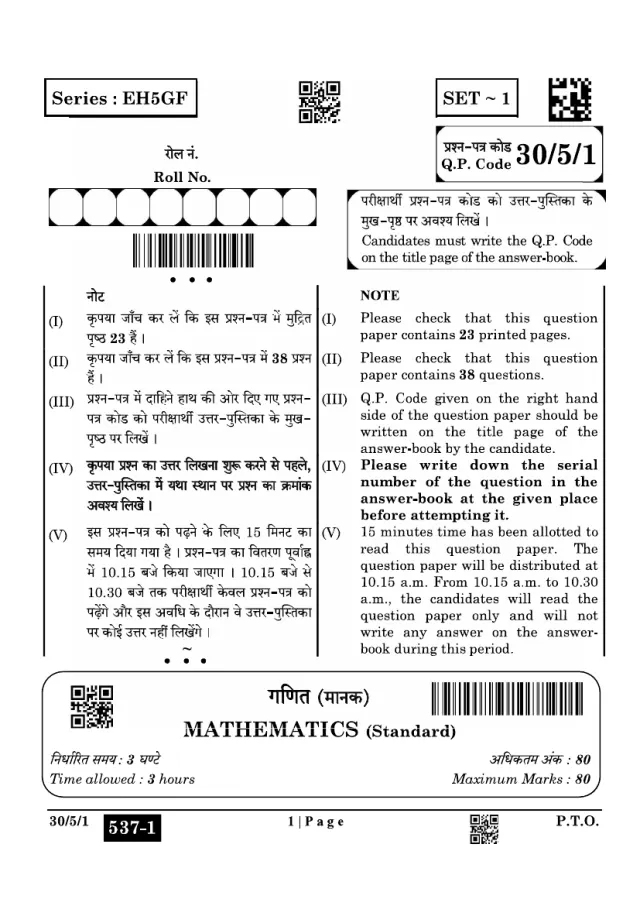
  • Cover page of the CBSE Class 10 Maths Standard 2025 paper, set 30/5/1

    Cover page

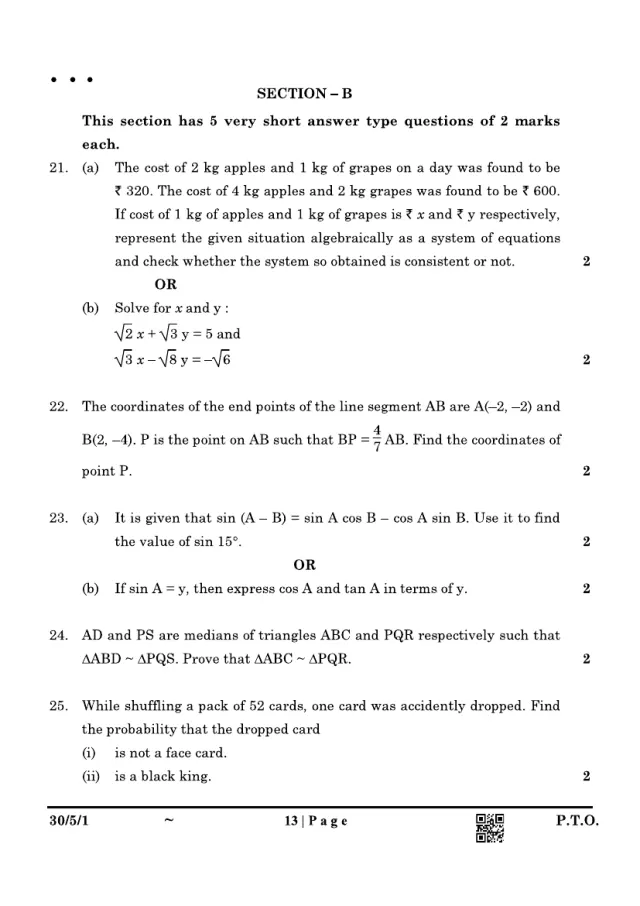
  • Section B of the CBSE Class 10 Maths Standard 2025 paper, set 30/5/1

    Section B

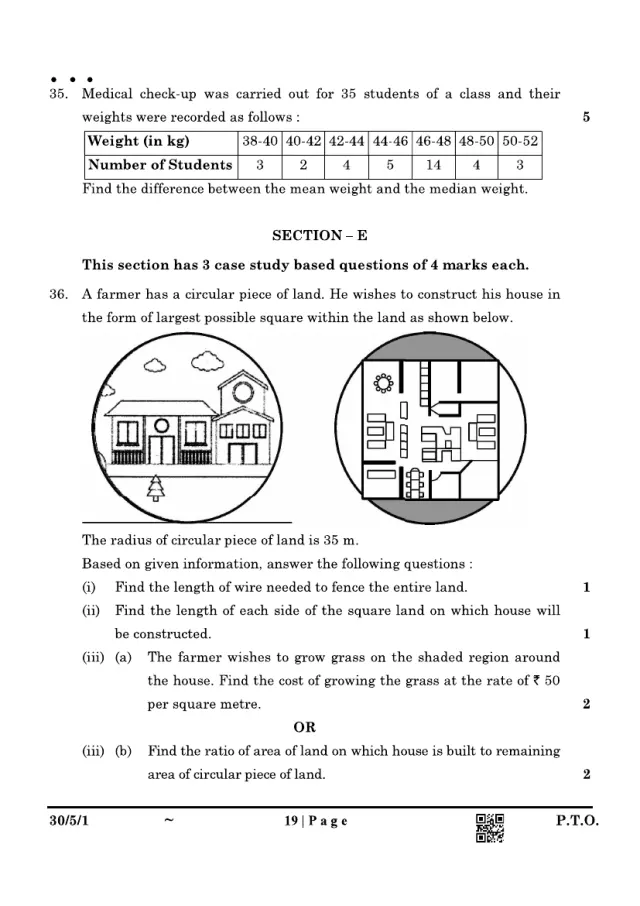
  • A case study with its figure from the CBSE Class 10 Maths Standard 2025 paper, set 30/5/1

    Case study

The main topics of this paper, in 1 minute

Your tutor walks you through the paper before you attempt it: the marks, the key ideas, the time plan and the traps.

1-minute paper analysis

With your tutor, in her voice

The main topics of this paper, in about a minute

A short, animated walk through the paper: how it is built, where the marks come from, the four ideas that matter most, how to plan your three hours, and the traps to avoid.

  1. 1The paper at a glance
  2. 2Where the marks come from
  3. 3Four ideas that keep paying off
  4. 4Plan your three hours
  5. 5Four traps to avoid

Sound on for the voice. Captions are shown, and you can mute any time.

Step-by-step solutions

Try each question first, then open its solution. Tap a number to jump.

Download solutions (PDF)

Section A: Multiple choice

20 questions, 1 mark each. MCQs (Q1 to Q18) and assertion-reason (Q19, Q20).

Q1Real Numbers1 mark

(3+2)2+(3−2)2\left(\sqrt{3} + 2\right)^2 + \left(\sqrt{3} - 2\right)^2 is a/an

  1. (A)positive rational number
  2. (B)negative rational number
  3. (C)positive irrational number
  4. (D)negative irrational number
Solution · answer (A)
  1. (3+2)2=3+43+4=7+43(\sqrt{3} + 2)^2 = 3 + 4\sqrt{3} + 4 = 7 + 4\sqrt{3} and (3−2)2=3−43+4=7−43(\sqrt{3} - 2)^2 = 3 - 4\sqrt{3} + 4 = 7 - 4\sqrt{3}.
  2. Adding, the 434\sqrt{3} terms cancel: 7+7=147 + 7 = 14, a positive rational number.

Answer: (A) positive rational number

Report an error on this question
Q2Real Numbers1 mark

Let x=a2b3cnx = a^2 b^3 c^n and y=a3bmc2y = a^3 b^m c^2, where a,b,ca, b, c are prime numbers. If LCM of xx and yy is a3b4c3a^3 b^4 c^3, then the value of m+nm + n is

  1. (A)10
  2. (B)7
  3. (C)6
  4. (D)5
Solution · answer (B)
  1. LCM takes the greater power of each prime.
  2. For bb: max⁡(3,m)=4\max(3, m) = 4, so m=4m = 4. For cc: max⁡(n,2)=3\max(n, 2) = 3, so n=3n = 3. (For aa: max⁡(2,3)=3\max(2, 3) = 3 ✓.)
  3. m+n=4+3=7m + n = 4 + 3 = 7.

Answer: (B) 7

Report an error on this question
Q3Real Numbers1 mark

For any prime number pp, if pp divides a2a^2, where aa is any real number then pp also divides

  1. (A)aa
  2. (B)a1/2a^{1/2}
  3. (C)a3/2a^{3/2}
  4. (D)a1/8a^{1/8}
Solution · answer (A)
  1. This is the key fact used in proofs of irrationality: if a prime pp divides a2a^2, then pp divides aa.
  2. (Because the prime factorisation of a2a^2 has the same primes as that of aa.)

Answer: (A) aa

Report an error on this question
Q4Quadratic Equations1 mark

Which of the following equations is a quadratic equation?

  1. (A)x2+1=(x−1)2x^2 + 1 = (x - 1)^2
  2. (B)(x+x)2=2xx\left(x + \sqrt{x}\right)^2 = 2x\sqrt{x}
  3. (C)x3+3x2=(x+1)3x^3 + 3x^2 = (x + 1)^3
  4. (D)(x+1)(x−1)=(x+1)2(x + 1)(x - 1) = (x + 1)^2
Solution · answer (B)
  1. (A) x2+1=x2−2x+1x^2 + 1 = x^2 - 2x + 1 gives 2x=02x = 0: linear.
  2. (B) x2+2xx+x=2xxx^2 + 2x\sqrt{x} + x = 2x\sqrt{x} gives x2+x=0x^2 + x = 0: quadratic. ✓
  3. (C) x3+3x2=x3+3x2+3x+1x^3 + 3x^2 = x^3 + 3x^2 + 3x + 1 gives 3x+1=03x + 1 = 0: linear.
  4. (D) x2−1=x2+2x+1x^2 - 1 = x^2 + 2x + 1 gives 2x+2=02x + 2 = 0: linear.

Answer: (B) (x+x)2=2xx\left(x + \sqrt{x}\right)^2 = 2x\sqrt{x}

Common mistake: Judging by the highest power you can see. Expand both sides first: the higher powers may cancel.

Report an error on this question
Q5Quadratic Equations1 mark

If x2+bx+b=0x^2 + bx + b = 0 has two real and distinct roots, then the value of bb can be

  1. (A)0
  2. (B)4
  3. (C)3
  4. (D)−3
Solution · answer (D)
  1. Real and distinct roots need D>0D > 0: b2−4b>0b^2 - 4b > 0, that is b(b−4)>0b(b - 4) > 0.
  2. This holds when b<0b < 0 or b>4b > 4. Among the options only −3-3 is in that range.
  3. (Check the others: b=0b = 0 and b=4b = 4 give D=0D = 0; b=3b = 3 gives D=9−12<0D = 9 - 12 < 0.)

Answer: (D) −3

Report an error on this question
Q6Coordinate Geometry1 mark

In the figure given below, points P,Q,RP, Q, R divides the line segment ABAB in four equal parts. The point QQ divides PBPB in the ratio

A line segment with five points marked in order: A, P, Q, R, B, equally spaced.
  1. (A)1 : 3
  2. (B)2 : 3
  3. (C)1 : 2
  4. (D)1 : 1
Solution · answer (C)
  1. Let each equal part be 11 unit. Then AP=PQ=QR=RB=1AP = PQ = QR = RB = 1.
  2. PQ=1PQ = 1 and QB=QR+RB=2QB = QR + RB = 2. So QQ divides PBPB in the ratio PQ:QB=1:2PQ : QB = 1 : 2.

Answer: (C) 1 : 2

Report an error on this question
Q7Probability1 mark

A bag contains red balls and black balls in the ratio 3 : 7. A ball is drawn at random. The probability that ball so drawn is black in colour, is

  1. (A)37\dfrac{3}{7}
  2. (B)0.3
  3. (C)0.7
  4. (D)17\dfrac{1}{7}
Solution · answer (C)
  1. Red : black =3:7= 3 : 7, so out of every 3+7=103 + 7 = 10 balls, 77 are black.
  2. P(black)=710=0.7P(\text{black}) = \dfrac{7}{10} = 0.7.

Answer: (C) 0.7

Common mistake: Using 37\dfrac{3}{7}, the ratio itself. A probability is a part over the whole: 710\dfrac{7}{10}.

Report an error on this question
Q8Triangles1 mark

Which of the following statements is false?

  1. (A)Two right triangles are always similar.
  2. (B)Two squares are always similar.
  3. (C)Two equilateral triangles are always similar.
  4. (D)Two circles are always similar.
Solution · answer (A)
  1. Two right triangles have one equal angle (90∘90^\circ) but the other angles can differ (for example 30∘30^\circ-60∘60^\circ and 45∘45^\circ-45∘45^\circ), so they need not be similar. (A) is false.
  2. Two squares have all angles 90∘90^\circ and sides in the same ratio; two equilateral triangles have all angles 60∘60^\circ; any two circles have the same shape. So (B), (C) and (D) are true.

Answer: (A) Two right triangles are always similar.

Report an error on this question
Q9Triangles1 mark

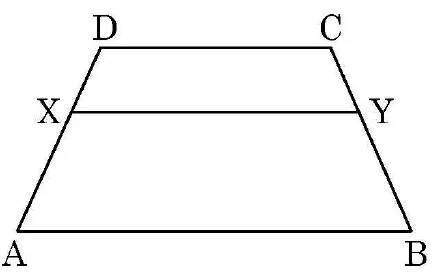
In the adjoining figure, ABCDABCD is a trapezium in which XY∥AB∥CDXY \parallel AB \parallel CD. If AX=23ADAX = \dfrac{2}{3}AD, then CY:YB=CY : YB =

A trapezium ABCD with D and C at the top and A and B at the bottom. A line XY is drawn parallel to the top and bottom sides, with X on AD and Y on BC.
  1. (A)2 : 3
  2. (B)3 : 2
  3. (C)1 : 3
  4. (D)1 : 2
Solution · answer (D)
ABCDXYDX : XA = 1 : 2same ratio on BC: CY : YB = 1 : 2
  1. AX=23ADAX = \dfrac{2}{3}AD, so XD=AD−AX=13ADXD = AD - AX = \dfrac{1}{3}AD. Hence DX:XA=1:2DX : XA = 1 : 2.
  2. Three parallel lines cut the two transversals ADAD and BCBC in the same ratio: DXXA=CYYB\dfrac{DX}{XA} = \dfrac{CY}{YB}.
  3. So CY:YB=1:2CY : YB = 1 : 2.

Answer: (D) 1 : 2

Common mistake: Answering 2:32 : 3 or 3:23 : 2 straight from the fraction. 23\dfrac{2}{3} is AX:ADAX : AD, not AX:XDAX : XD.

Report an error on this question
Q10Circles1 mark

Which of the following statements is false?

  1. (A)Infinite number of tangents can be drawn to a circle.
  2. (B)Infinite number of tangents can be drawn to a circle from a point outside the circle.
  3. (C)Infinite number of secants can be drawn to a circle from a point outside the circle.
  4. (D)Angle between tangent and diameter at point of contact is 90°.
Solution · answer (B)
  1. (A) Every point of the circle has one tangent, so there are infinitely many. True.
  2. (B) From a point outside a circle exactly 22 tangents can be drawn, not infinitely many. False.
  3. (C) Infinitely many secants pass through an outside point (rotate the line). True. (D) The tangent is perpendicular to the radius, hence to the diameter through the point of contact. True.

Answer: (B) Infinite number of tangents can be drawn to a circle from a point outside the circle.

Report an error on this question
Q11Circles1 mark

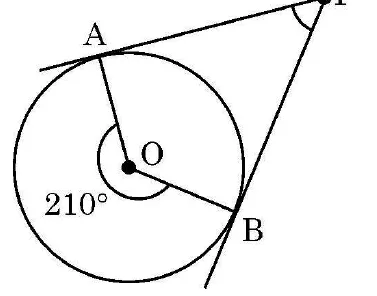
In the adjoining figure, PA and PB are tangents to a circle with centre O. The measure of angle APB is

A circle with centre O and two tangents from the outside point P at the upper right, touching the circle at A and B. The angle at O on the reflex side, between OA and OB, is marked 210 degrees.
  1. (A)210∘210^\circ
  2. (B)150∘150^\circ
  3. (C)105∘105^\circ
  4. (D)30∘30^\circ
Solution · answer (D)
150°30°OPAB∠AOB = 360° − 210° = 150°, ∠APB = 30°
  1. The marked 210∘210^\circ is the reflex angle at OO. The angle on the other side is ∠AOB=360∘−210∘=150∘\angle AOB = 360^\circ - 210^\circ = 150^\circ.
  2. OA⊥PAOA \perp PA and OB⊥PBOB \perp PB, so in quadrilateral OAPBOAPB: ∠APB=360∘−90∘−90∘−150∘=30∘\angle APB = 360^\circ - 90^\circ - 90^\circ - 150^\circ = 30^\circ.

Answer: (D) 30∘30^\circ

Common mistake: Using 210∘210^\circ directly. The angle between the radii that goes with the tangents is the smaller one, 150∘150^\circ.

Report an error on this question
Q12Trigonometry1 mark

1−tan⁡230∘1+tan⁡230∘\dfrac{1 - \tan^2 30^\circ}{1 + \tan^2 30^\circ} is equal to

  1. (A)sin⁡60∘\sin 60^\circ
  2. (B)cos⁡60∘\cos 60^\circ
  3. (C)tan⁡60∘\tan 60^\circ
  4. (D)sec⁡60∘\sec 60^\circ
Solution · answer (B)
  1. tan⁡30∘=13\tan 30^\circ = \dfrac{1}{\sqrt{3}}, so tan⁡230∘=13\tan^2 30^\circ = \dfrac{1}{3}.
  2. 1−131+13=2/34/3=12\dfrac{1 - \frac{1}{3}}{1 + \frac{1}{3}} = \dfrac{2/3}{4/3} = \dfrac{1}{2}.
  3. cos⁡60∘=12\cos 60^\circ = \dfrac{1}{2}. (This is the identity cos⁡2A=1−tan⁡2A1+tan⁡2A\cos 2A = \dfrac{1 - \tan^2 A}{1 + \tan^2 A} with A=30∘A = 30^\circ.)

Answer: (B) cos⁡60∘\cos 60^\circ

Report an error on this question
Q13Applications of Trigonometry1 mark

An observer 1.81.8 m tall stands away from a chimney at a distance of 38.238.2 m along the ground. The angle of elevation of top of chimney from the eyes of observer is 45∘45^\circ. The height of the chimney above the ground is

  1. (A)38.238.2 m
  2. (B)36.436.4 m
  3. (C)4040 m
  4. (D)(38.2)2(38.2)\sqrt{2} m
Solution · answer (C)
45°38.2 m38.2 mEFT1.8 mchimney = 38.2 + 1.8 = 40 m
  1. Draw a horizontal line from the observer's eyes to the chimney. The part of the chimney above this line is hh.
  2. tan⁡45∘=h38.2=1\tan 45^\circ = \dfrac{h}{38.2} = 1, so h=38.2h = 38.2 m.
  3. The eyes are 1.81.8 m above the ground, so the chimney's height =38.2+1.8=40= 38.2 + 1.8 = 40 m.

Answer: (C) 4040 m

Common mistake: Forgetting to add the observer’s height of 1.8 m. The 38.2 m is only the part above eye level.

Report an error on this question
Q14Circles1 mark

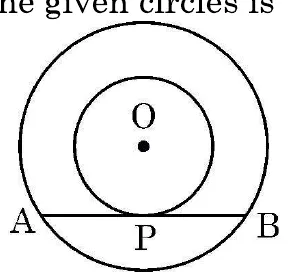
In the adjoining figure, the sum of radii of two concentric circles is 16 cm. The length of chord AB which touches the inner circle at P is 16 cm. The difference of the radii of the given circles is

Two circles with the same centre O. The chord AB of the larger circle touches the smaller circle at P.
  1. (A)8 cm
  2. (B)4 cm
  3. (C)2 cm
  4. (D)3 cm
Solution · answer (B)
r8ROPABR² − r² = 8² = 64, (R + r) = 16, so R − r = 4
  1. Let the radii be RR (large) and rr (small). R+r=16R + r = 16.
  2. OP⊥ABOP \perp AB and PP is the mid-point of the chord, so AP=8AP = 8 cm. In right triangle OPAOPA: R2=r2+82R^2 = r^2 + 8^2, so R2−r2=64R^2 - r^2 = 64.
  3. (R+r)(R−r)=64(R + r)(R - r) = 64 gives 16(R−r)=6416(R - r) = 64, so R−r=4R - r = 4 cm.
  4. (So R=10R = 10 and r=6r = 6.)

Answer: (B) 4 cm

Report an error on this question
Q15Surface Areas and Volumes1 mark

A cone of height 12 cm and slant height 13 cm is surmounted on a hemisphere having radius equal to that of cone. The entire height of the solid is

  1. (A)17 cm
  2. (B)18 cm
  3. (C)22 cm
  4. (D)23 cm
Solution · answer (A)
VLR1213r = 5r = √(13² − 12²) = 5, height = 12 + 5 = 17 cm
  1. Radius of the cone =l2−h2=132−122=25=5= \sqrt{l^2 - h^2} = \sqrt{13^2 - 12^2} = \sqrt{25} = 5 cm.
  2. The hemisphere has the same radius, 55 cm, so it adds a height of 55 cm.
  3. Entire height =12+5=17= 12 + 5 = 17 cm.

Answer: (A) 17 cm

Report an error on this question
Q16Statistics1 mark

If xx median +y+ y mean =z= z mode is the empirical relationship between mean, median and mode, then the value of x+y+zx + y + z is

  1. (A)6
  2. (B)3
  3. (C)2
  4. (D)1
Solution · answer (C)
  1. The empirical relationship is Mode=3 Median−2 Mean\text{Mode} = 3\,\text{Median} - 2\,\text{Mean}.
  2. Rewrite: 3 Median+(−2) Mean=1⋅Mode3\,\text{Median} + (-2)\,\text{Mean} = 1\cdot\text{Mode}. So x=3x = 3, y=−2y = -2, z=1z = 1.
  3. x+y+z=3−2+1=2x + y + z = 3 - 2 + 1 = 2.

Answer: (C) 2

Report an error on this question
Q17Statistics1 mark

Following data shows the marks obtained by 100 students in a class test:

The median will be the average of which two observations?

Marks obtained2029283342384325
Number of students628241524120
  1. (A)29 and 33
  2. (B)25 and 28
  3. (C)28 and 29
  4. (D)33 and 38
Solution · answer (C)
  1. The number of observations is n=100n = 100 (even), so the median is the average of the n2=50\dfrac{n}{2} = 50th and 5151st observations, after arranging in order.
  2. Arrange the marks in increasing order with cumulative frequency: 2020 (6), 2525 (26), 2828 (50), 2929 (78), 3333 (93), 3838 (97), 4242 (99), 4343 (100).
  3. The 5050th observation is 2828 (cumulative frequency reaches 5050 at 2828) and the 5151st is 2929.

Answer: (C) 28 and 29

Common mistake: Taking the 50th and 51st entries of the table as printed. The marks must be sorted first.

Report an error on this question
Q18Probability1 mark

The probability of getting a composite number greater than 3 on throwing a die is

  1. (A)16\dfrac{1}{6}
  2. (B)13\dfrac{1}{3}
  3. (C)12\dfrac{1}{2}
  4. (D)23\dfrac{2}{3}
Solution · answer (B)
  1. Numbers on a die: 1,2,3,4,5,61, 2, 3, 4, 5, 6. Greater than 33: 4,5,64, 5, 6.
  2. Of these, composite numbers are 44 and 66 (55 is prime). That is 22 favourable outcomes.
  3. P=26=13P = \dfrac{2}{6} = \dfrac{1}{3}.

Answer: (B) 13\dfrac{1}{3}

Report an error on this question
Q19Trigonometry1 mark

Assertion (A): For an acute angle θ\theta, sin⁡θ=35⇒cos⁡θ=−45\sin\theta = \dfrac{3}{5} \Rightarrow \cos\theta = -\dfrac{4}{5}.

Reason (R): For any value of θ\theta, (0∘≤θ≤90∘0^\circ \le \theta \le 90^\circ) sin⁡2θ+cos⁡2θ=1\sin^2\theta + \cos^2\theta = 1.

  1. (A)Both A and R are true and R is the correct explanation of A
  2. (B)Both A and R are true, but R is not the correct explanation of A
  3. (C)A is true, but R is false
  4. (D)A is false, but R is true
Solution · answer (D)
  1. (A) cos⁡2θ=1−925=1625\cos^2\theta = 1 - \dfrac{9}{25} = \dfrac{16}{25}, so cos⁡θ=±45\cos\theta = \pm\dfrac{4}{5}. For an acute angle cosine is positive, so cos⁡θ=+45\cos\theta = +\dfrac{4}{5}. The assertion (with the minus sign) is false.
  2. (R) sin⁡2θ+cos⁡2θ=1\sin^2\theta + \cos^2\theta = 1 is true for every angle. True.

Answer: (D) A is false, R is true

Report an error on this question
Q20Arithmetic Progressions1 mark

Assertion (A): For an A.P., 3,6,9,…,1983, 6, 9, \dots, 198, 10th10^{\text{th}} term from the end is 168168.

Reason (R): If ‘aa’ and ‘ll’ are the first term and last term of an A.P. with common difference ‘dd’, then nthn^{\text{th}} term from the end of the given A.P. is l−(n−1)dl - (n - 1)d.

  1. (A)Both A and R are true and R is the correct explanation of A
  2. (B)Both A and R are true, but R is not the correct explanation of A
  3. (C)A is true, but R is false
  4. (D)A is false, but R is true
Solution · answer (D)
  1. (R) Going backward from the last term, each step subtracts dd, so the nnth term from the end is l−(n−1)dl - (n - 1)d. True.
  2. (A) Here l=198l = 198 and d=3d = 3. The 1010th term from the end is 198−9×3=198−27=171198 - 9 \times 3 = 198 - 27 = 171, not 168168. So the assertion is false.

Answer: (D) A is false, R is true

Common mistake: Using 198−10×3=168198 - 10 \times 3 = 168. The first term from the end is ll itself, so the 1010th uses (n−1)=9(n - 1) = 9 steps.

Report an error on this question

Section B: Very short answer

5 questions, 2 marks each.

Q21Linear Equations2 marks

(a) The cost of 22 kg apples and 11 kg of grapes on a day was found to be ₹ 320320. The cost of 44 kg apples and 22 kg grapes was found to be ₹ 600600. If cost of 11 kg of apples and 11 kg of grapes is ₹ xx and ₹ yy respectively, represent the given situation algebraically as a system of equations and check whether the system so obtained is consistent or not.

OR

(b) Solve for xx and yy: 2 x+3 y=5\sqrt{2}\,x + \sqrt{3}\,y = 5 and 3 x−8 y=−6\sqrt{3}\,x - \sqrt{8}\,y = -\sqrt{6}.

Solution
  1. (a) The equations are 2x+y=3202x + y = 320 and 4x+2y=6004x + 2y = 600.
  2. a1a2=24=12\dfrac{a_1}{a_2} = \dfrac{2}{4} = \dfrac{1}{2}, b1b2=12\dfrac{b_1}{b_2} = \dfrac{1}{2} and c1c2=320600=815\dfrac{c_1}{c_2} = \dfrac{320}{600} = \dfrac{8}{15}.
  3. Since a1a2=b1b2≠c1c2\dfrac{a_1}{a_2} = \dfrac{b_1}{b_2} \neq \dfrac{c_1}{c_2}, the lines are parallel and the system has no solution: it is not consistent. (The second says 2x+y=3002x + y = 300, which contradicts 2x+y=3202x + y = 320.)
  4. (b) Multiply the first equation by 3\sqrt{3} and the second by 2\sqrt{2}: 6 x+3y=53\sqrt{6}\,x + 3y = 5\sqrt{3} and 6 x−4y=−23\sqrt{6}\,x - 4y = -2\sqrt{3}.
  5. Subtract: 7y=737y = 7\sqrt{3}, so y=3y = \sqrt{3}. Then 2 x+3=5\sqrt{2}\,x + 3 = 5, so x=22=2x = \dfrac{2}{\sqrt{2}} = \sqrt{2}.
  6. Check in the second: 3⋅2−8⋅3=6−26=−6\sqrt{3}\cdot\sqrt{2} - \sqrt{8}\cdot\sqrt{3} = \sqrt{6} - 2\sqrt{6} = -\sqrt{6} ✓.

Answer: (a) 2x+y=320, 4x+2y=6002x + y = 320,\ 4x + 2y = 600; not consistent   (b) x=2, y=3x = \sqrt{2},\ y = \sqrt{3}

Report an error on this question
Q22Coordinate Geometry2 marks

The coordinates of the end points of the line segment ABAB are A(−2,−2)A(-2, -2) and B(2,−4)B(2, -4). PP is the point on ABAB such that BP=47ABBP = \dfrac{4}{7}AB. Find the coordinates of point PP.

Solution
-3-2-1123-5-4-3-2-1OxyA(−2, −2)B(2, −4)P(−2/7, −20/7)
BP = 4/7 of AB means AP : PB = 3 : 4.
  1. BP=47ABBP = \dfrac{4}{7}AB, so AP=AB−BP=37ABAP = AB - BP = \dfrac{3}{7}AB. Hence AP:PB=3:4AP : PB = 3 : 4.
  2. Section formula with m:n=3:4m : n = 3 : 4: x=3×2+4×(−2)3+4=−27x = \dfrac{3 \times 2 + 4 \times (-2)}{3 + 4} = \dfrac{-2}{7}.
  3. y=3×(−4)+4×(−2)7=−207y = \dfrac{3 \times (-4) + 4 \times (-2)}{7} = \dfrac{-20}{7}.

Answer: P(−27, −207)P\left(-\dfrac{2}{7},\ -\dfrac{20}{7}\right)

Common mistake: Using the ratio 4:34 : 3. BP=47ABBP = \dfrac{4}{7}AB is measured from BB, so AP:PB=3:4AP : PB = 3 : 4.

Report an error on this question
Q23Trigonometry2 marks

(a) It is given that sin⁡(A−B)=sin⁡Acos⁡B−cos⁡Asin⁡B\sin(A - B) = \sin A\cos B - \cos A\sin B. Use it to find the value of sin⁡15∘\sin 15^\circ.

OR

(b) If sin⁡A=y\sin A = y, then express cos⁡A\cos A and tan⁡A\tan A in terms of yy.

Solution
  1. (a) 15∘=45∘−30∘15^\circ = 45^\circ - 30^\circ, so sin⁡15∘=sin⁡45∘cos⁡30∘−cos⁡45∘sin⁡30∘\sin 15^\circ = \sin 45^\circ\cos 30^\circ - \cos 45^\circ\sin 30^\circ.
  2. =12×32−12×12=3−122=6−24= \dfrac{1}{\sqrt{2}} \times \dfrac{\sqrt{3}}{2} - \dfrac{1}{\sqrt{2}} \times \dfrac{1}{2} = \dfrac{\sqrt{3} - 1}{2\sqrt{2}} = \dfrac{\sqrt{6} - \sqrt{2}}{4}.
  3. (b) cos⁡A=1−sin⁡2A=1−y2\cos A = \sqrt{1 - \sin^2 A} = \sqrt{1 - y^2} (for an acute angle).
  4. tan⁡A=sin⁡Acos⁡A=y1−y2\tan A = \dfrac{\sin A}{\cos A} = \dfrac{y}{\sqrt{1 - y^2}}.

Answer: (a) 6−24\dfrac{\sqrt{6} - \sqrt{2}}{4}   (b) cos⁡A=1−y2, tan⁡A=y1−y2\cos A = \sqrt{1 - y^2},\ \tan A = \dfrac{y}{\sqrt{1 - y^2}}

Report an error on this question
Q24Triangles2 marks

ADAD and PSPS are medians of triangles ABCABC and PQRPQR respectively such that △ABD∼△PQS\triangle ABD \sim \triangle PQS. Prove that △ABC∼△PQR\triangle ABC \sim \triangle PQR.

Solution
  1. △ABD∼△PQS\triangle ABD \sim \triangle PQS, so ABPQ=BDQS\dfrac{AB}{PQ} = \dfrac{BD}{QS} and ∠B=∠Q\angle B = \angle Q.
  2. ADAD and PSPS are medians, so BD=BC2BD = \dfrac{BC}{2} and QS=QR2QS = \dfrac{QR}{2}. Then BDQS=BCQR\dfrac{BD}{QS} = \dfrac{BC}{QR}, so ABPQ=BCQR\dfrac{AB}{PQ} = \dfrac{BC}{QR}.
  3. In △ABC\triangle ABC and △PQR\triangle PQR: ABPQ=BCQR\dfrac{AB}{PQ} = \dfrac{BC}{QR} and the included angles ∠B=∠Q\angle B = \angle Q. So △ABC∼△PQR\triangle ABC \sim \triangle PQR by SAS.

Answer: Proved

Common mistake: Forgetting to say that a median joins a vertex to the mid-point, which is why BD = BC/2.

Report an error on this question
Q25Probability2 marks

While shuffling a pack of 52 cards, one card was accidently dropped. Find the probability that the dropped card

(i) is not a face card.

(ii) is a black king.

Solution
  1. A pack has 5252 cards, with 1212 face cards (jack, queen and king of each of 44 suits). So there are 52−12=4052 - 12 = 40 cards that are not face cards.
  2. (i) P(not a face card)=4052=1013P(\text{not a face card}) = \dfrac{40}{52} = \dfrac{10}{13}.
  3. (ii) There are 22 black kings (spades and clubs): P=252=126P = \dfrac{2}{52} = \dfrac{1}{26}.

Answer: (i) 1013\dfrac{10}{13}   (ii) 126\dfrac{1}{26}

Common mistake: Counting only 4 face cards (the kings). Jack, queen and king are face cards: 12 in all.

Report an error on this question

Section C: Short answer

6 questions, 3 marks each.

Q26Real Numbers3 marks

(a) Prove that 3\sqrt{3} is an irrational number.

OR

(b) State true or false for each of the following statements and justify in each case: (i) 2×3×5×7+72 \times 3 \times 5 \times 7 + 7 is a composite number. (ii) 2×3×5×7+12 \times 3 \times 5 \times 7 + 1 is a composite number.

Solution
  1. (a) Suppose 3=pq\sqrt{3} = \dfrac{p}{q} with p,qp, q co-prime integers and q≠0q \neq 0. Squaring: 3q2=p23q^2 = p^2.
  2. So 33 divides p2p^2, and so 33 divides pp. Write p=3ap = 3a. Then 9a2=3q29a^2 = 3q^2, so q2=3a2q^2 = 3a^2 and 33 divides qq.
  3. Now 33 is a common factor of pp and qq, contradicting that they are co-prime. So 3\sqrt{3} is irrational.
  4. (b)(i) True. 2×3×5×7+7=7(2×3×5+1)=7×312 \times 3 \times 5 \times 7 + 7 = 7(2 \times 3 \times 5 + 1) = 7 \times 31, which has more than two factors (it is divisible by 77 and 3131).
  5. (b)(ii) False. 2×3×5×7+1=210+1=2112 \times 3 \times 5 \times 7 + 1 = 210 + 1 = 211, which is a prime number (it has only two factors, 11 and 211211).

Answer: (a) proved   (b)(i) True   (b)(ii) False

Common mistake: In (b), saying “true” because the number looks big. Actually factorise (i) and test (ii) for factors.

Report an error on this question
Q27Polynomials3 marks

Obtain the zeroes of the polynomial 7x2+18x−97x^2 + 18x - 9. Hence, write a polynomial each of whose zeroes is twice the zeroes of given polynomial.

Solution
  1. 7x2+18x−9=7x2+21x−3x−9=7x(x+3)−3(x+3)=(7x−3)(x+3)7x^2 + 18x - 9 = 7x^2 + 21x - 3x - 9 = 7x(x + 3) - 3(x + 3) = (7x - 3)(x + 3).
  2. The zeroes are x=37x = \dfrac{3}{7} and x=−3x = -3.
  3. The new zeroes are twice these: 67\dfrac{6}{7} and −6-6.
  4. Sum =67+(−6)=−367= \dfrac{6}{7} + (-6) = -\dfrac{36}{7} and product =67×(−6)=−367= \dfrac{6}{7} \times (-6) = -\dfrac{36}{7}.
  5. Polynomial: x2+367x−367x^2 + \dfrac{36}{7}x - \dfrac{36}{7}, or multiplying by 77: 7x2+36x−367x^2 + 36x - 36.

Answer: Zeroes −3-3 and 37\dfrac{3}{7}; new polynomial 7x2+36x−367x^2 + 36x - 36

Report an error on this question
Q28Linear Equations3 marks

Solve the following system of equations graphically: 2x−y−2=02x - y - 2 = 0 and −4x+y+4=0-4x + y + 4 = 0. Also, find the absolute difference between the ordinates of the points where given lines cut yy-axis.

Solution
-1123-5-4-3-2-1123Oxy2x − y − 2 = 0−4x + y + 4 = 0(1, 0)(0, −2)(0, −4)
  1. First line: y=2x−2y = 2x - 2. Points: (0,−2)(0, -2), (1,0)(1, 0), (2,2)(2, 2).
  2. Second line: y=4x−4y = 4x - 4. Points: (0,−4)(0, -4), (1,0)(1, 0), (2,4)(2, 4).
  3. Plot both. They cross at (1,0)(1, 0), so the solution is x=1x = 1, y=0y = 0.
  4. The lines cut the yy-axis at (0,−2)(0, -2) and (0,−4)(0, -4). The absolute difference of the ordinates is ∣−2−(−4)∣=2|-2 - (-4)| = 2.

Answer: x=1, y=0x = 1,\ y = 0; absolute difference =2= 2

Report an error on this question
Q29Coordinate Geometry3 marks

Find a relation between xx and yy such that P(x,y)P(x, y) is equidistant from the points A(3,5)A(3, 5) and B(7,1)B(7, 1). Hence, write the coordinates of the points on xx-axis and yy-axis which are equidistant from points AA and BB.

Solution
-112345678-3-2-11234567Oxyx − y = 2A(3, 5)B(7, 1)(2, 0)(0, −2)
  1. PA=PBPA = PB gives PA2=PB2PA^2 = PB^2: (x−3)2+(y−5)2=(x−7)2+(y−1)2(x - 3)^2 + (y - 5)^2 = (x - 7)^2 + (y - 1)^2.
  2. x2−6x+9+y2−10y+25=x2−14x+49+y2−2y+1x^2 - 6x + 9 + y^2 - 10y + 25 = x^2 - 14x + 49 + y^2 - 2y + 1, so 8x−8y=168x - 8y = 16, that is x−y=2x - y = 2.
  3. On the xx-axis y=0y = 0: x=2x = 2, so the point is (2,0)(2, 0).
  4. On the yy-axis x=0x = 0: −y=2-y = 2, so y=−2y = -2 and the point is (0,−2)(0, -2).

Answer: x−y=2x - y = 2; (2,0)(2, 0) on the xx-axis and (0,−2)(0, -2) on the yy-axis

Report an error on this question
Q30Trigonometry3 marks

(a) Prove the following trigonometric identity: 1+cosec Acosec A=cos⁡2A1−sin⁡A\dfrac{1 + \mathrm{cosec}\,A}{\mathrm{cosec}\,A} = \dfrac{\cos^2 A}{1 - \sin A}

OR

(b) Let 2A+B2A + B and A+2BA + 2B be acute angles such that sin⁡(2A+B)=32\sin(2A + B) = \dfrac{\sqrt{3}}{2} and tan⁡(A+2B)=1\tan(A + 2B) = 1. Find the value of cot⁡(4A−7B)\cot(4A - 7B).

Solution
  1. (a) LHS =1+1sin⁡A1sin⁡A=sin⁡A+11=sin⁡A+1= \dfrac{1 + \frac{1}{\sin A}}{\frac{1}{\sin A}} = \dfrac{\sin A + 1}{1} = \sin A + 1.
  2. Multiply and divide by (1−sin⁡A)(1 - \sin A): (1+sin⁡A)(1−sin⁡A)1−sin⁡A=1−sin⁡2A1−sin⁡A=cos⁡2A1−sin⁡A=\dfrac{(1 + \sin A)(1 - \sin A)}{1 - \sin A} = \dfrac{1 - \sin^2 A}{1 - \sin A} = \dfrac{\cos^2 A}{1 - \sin A} = RHS.
  3. (b) sin⁡(2A+B)=32\sin(2A + B) = \dfrac{\sqrt{3}}{2} with an acute angle gives 2A+B=60∘2A + B = 60^\circ. … (i)
  4. tan⁡(A+2B)=1\tan(A + 2B) = 1 gives A+2B=45∘A + 2B = 45^\circ. … (ii)
  5. Add: 3A+3B=105∘3A + 3B = 105^\circ, so A+B=35∘A + B = 35^\circ. Subtract (ii) from (i): A−B=15∘A - B = 15^\circ. Hence A=25∘A = 25^\circ and B=10∘B = 10^\circ.
  6. 4A−7B=100∘−70∘=30∘4A - 7B = 100^\circ - 70^\circ = 30^\circ, so cot⁡30∘=3\cot 30^\circ = \sqrt{3}.

Answer: (a) proved   (b) 3\sqrt{3}

Report an error on this question
Q31Circles3 marks

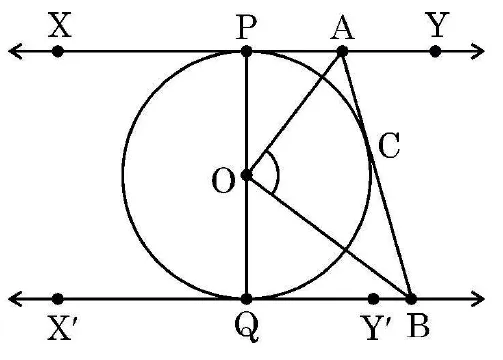
In the adjoining figure, XYXY and X′Y′X'Y' are parallel tangents to a circle with centre OO. Another tangent ABAB touches the circle at CC intersecting XYXY at AA and X′Y′X'Y' at BB. Prove that ABAB subtends right angle at the centre of the circle; or ∠AOB=90∘\angle AOB = 90^\circ.

A circle with centre O between two parallel horizontal tangents XY and X dash Y dash, touching at P on top and Q at the bottom. A third tangent AB touches the circle at C, meeting the top tangent at A and the bottom tangent at B. OA and OB are joined.
Solution
OCABPQPOQ is a straight line, so ∠AOB = 90°
  1. Join OCOC. PAPA and CACA are tangents from AA, with OP=OCOP = OC (radii) and OAOA common. So △POA≅△COA\triangle POA \cong \triangle COA (SSS), giving ∠POA=∠COA\angle POA = \angle COA.
  2. In the same way, △QOB≅△COB\triangle QOB \cong \triangle COB, so ∠QOB=∠COB\angle QOB = \angle COB.
  3. PQPQ is a diameter (the tangents are parallel, so PP, OO, QQ lie on one straight line). So ∠POA+∠COA+∠COB+∠QOB=180∘\angle POA + \angle COA + \angle COB + \angle QOB = 180^\circ.
  4. This is 2∠COA+2∠COB=180∘2\angle COA + 2\angle COB = 180^\circ, so ∠COA+∠COB=90∘\angle COA + \angle COB = 90^\circ.
  5. ∠AOB=∠COA+∠COB=90∘\angle AOB = \angle COA + \angle COB = 90^\circ.

Answer: ∠AOB=90∘\angle AOB = 90^\circ

Report an error on this question

Section D: Long answer

4 questions, 5 marks each.

Q32Quadratic Equations5 marks

(a) A 22-digit number is seven times the sum of its digits and two (22) more than 55 times the product of its digits. Find the number.

OR

(b) Find the value(s) of pp for which the quadratic equation given as (p+4)x2−(p+1)x+1=0(p + 4)x^2 - (p + 1)x + 1 = 0 has real and equal roots. Also, find the roots of the equation(s) so obtained.

Solution
  1. (a) Let the ones digit be xx and the tens digit be yy. The number is 10y+x10y + x.
  2. Seven times the sum of the digits: 10y+x=7(x+y)10y + x = 7(x + y), so 3y=6x3y = 6x and y=2xy = 2x. … (i)
  3. Two more than 55 times the product: 10y+x=5xy+210y + x = 5xy + 2. … (ii)
  4. Put (i) in (ii): 20x+x=10x2+220x + x = 10x^2 + 2, so 10x2−21x+2=010x^2 - 21x + 2 = 0 and (x−2)(10x−1)=0(x - 2)(10x - 1) = 0. The digit xx must be a whole number, so x=2x = 2 and y=4y = 4.
  5. The number is 4242. (Check: 7×6=427 \times 6 = 42 ✓ and 5×8+2=425 \times 8 + 2 = 42 ✓.)
  6. (b) Real and equal roots need D=0D = 0: [−(p+1)]2−4(p+4)(1)=0[-(p + 1)]^2 - 4(p + 4)(1) = 0, so p2+2p+1−4p−16=0p^2 + 2p + 1 - 4p - 16 = 0 and p2−2p−15=0p^2 - 2p - 15 = 0.
  7. (p−5)(p+3)=0(p - 5)(p + 3) = 0, so p=5p = 5 or p=−3p = -3.
  8. For p=5p = 5: 9x2−6x+1=09x^2 - 6x + 1 = 0, so (3x−1)2=0(3x - 1)^2 = 0 and x=13,13x = \dfrac{1}{3}, \dfrac{1}{3}.
  9. For p=−3p = -3: x2+2x+1=0x^2 + 2x + 1 = 0, so (x+1)2=0(x + 1)^2 = 0 and x=−1,−1x = -1, -1.

Answer: (a) 4242   (b) p=5p = 5: roots 13,13\dfrac{1}{3}, \dfrac{1}{3}; p=−3p = -3: roots −1,−1-1, -1

Common mistake: In (b), writing only p=5p = 5. Both values of pp make the roots equal, so give both with their roots.

Report an error on this question
Q33Triangles5 marks

If a line is drawn parallel to one side of a triangle intersecting the other two sides in distinct points then it divides the two sides in the same ratio. Prove it.

Also, state the converse of the above statement.

Solution
ABCDEDE ∥ BC ⟹ AD / DB = AE / EC
  1. Given: △ABC\triangle ABC with DE∥BCDE \parallel BC, where DD is on ABAB and EE is on ACAC. To prove: ADDB=AEEC\dfrac{AD}{DB} = \dfrac{AE}{EC}.
  2. Construction: join BEBE and CDCD. Draw EF⊥ABEF \perp AB and DG⊥ACDG \perp AC.
  3. ar(△ADE)=12×AD×EF\text{ar}(\triangle ADE) = \dfrac{1}{2} \times AD \times EF and ar(△BDE)=12×DB×EF\text{ar}(\triangle BDE) = \dfrac{1}{2} \times DB \times EF. So ar(ADE)ar(BDE)=ADDB\dfrac{\text{ar}(ADE)}{\text{ar}(BDE)} = \dfrac{AD}{DB}. … (i)
  4. Likewise ar(ADE)ar(CDE)=12×AE×DG12×EC×DG=AEEC\dfrac{\text{ar}(ADE)}{\text{ar}(CDE)} = \dfrac{\frac{1}{2} \times AE \times DG}{\frac{1}{2} \times EC \times DG} = \dfrac{AE}{EC}. … (ii)
  5. △BDE\triangle BDE and △CDE\triangle CDE are on the same base DEDE and between the same parallels DEDE and BCBC, so ar(BDE)=ar(CDE)\text{ar}(BDE) = \text{ar}(CDE). … (iii)
  6. From (i), (ii) and (iii): ADDB=AEEC\dfrac{AD}{DB} = \dfrac{AE}{EC}. Hence proved.
  7. Converse: if a line divides any two sides of a triangle in the same ratio, then the line is parallel to the third side.

Answer: Basic Proportionality Theorem proved, and its converse stated

Common mistake: Skipping the construction (join BE and CD, draw the perpendiculars). It carries marks in the CBSE scheme.

Report an error on this question
Q34Surface Areas and Volumes5 marks

(a) From one of the faces of a solid wooden cube of side 1414 cm, maximum number of hemispheres of diameter 1.41.4 cm are scooped out. Find the total number of hemispheres that can be scooped out. Also, find the total surface area of the remaining solid.

OR

(b) From a solid cylinder of height 2424 cm and radius 55 cm, two cones of height 1212 cm and radius 55 cm are hollowed out. Find the volume and surface area of the remaining solid.

Solution
ABCD14 cm10 × 10 = 100 hemispheres
ABCD24 cmslant 13height 12two cones meet in the middle; ends of the cylinder are gone
  1. (a) Along an edge of 1414 cm, hemispheres of diameter 1.41.4 cm fit 141.4=10\dfrac{14}{1.4} = 10 times. On the square face: 10×10=10010 \times 10 = 100 hemispheres. Radius r=0.7r = 0.7 cm.
  2. Scooping out each hemisphere removes a circle πr2\pi r^2 of the face and adds a curved surface 2πr22\pi r^2. Net gain per hemisphere =πr2= \pi r^2.
  3. TSA =6×142+100×πr2=1176+100×227×0.7×0.7=1176+154=1330= 6 \times 14^2 + 100 \times \pi r^2 = 1176 + 100 \times \dfrac{22}{7} \times 0.7 \times 0.7 = 1176 + 154 = 1330 cm².
  4. (b) Volume of the cylinder =πr2h=227×5×5×24=132007= \pi r^2 h = \dfrac{22}{7} \times 5 \times 5 \times 24 = \dfrac{13200}{7} cm³.
  5. Volume of two cones =2×13πr2h=2×13×227×5×5×12=44007= 2 \times \dfrac{1}{3}\pi r^2 h = 2 \times \dfrac{1}{3} \times \dfrac{22}{7} \times 5 \times 5 \times 12 = \dfrac{4400}{7} cm³.
  6. Volume of the remaining solid =132007−44007=88007≈1257.14= \dfrac{13200}{7} - \dfrac{4400}{7} = \dfrac{8800}{7} \approx 1257.14 cm³.
  7. Slant height of each cone l=122+52=13l = \sqrt{12^2 + 5^2} = 13 cm.
  8. Surface area == CSA of cylinder ++ CSA of two cones (the flat ends of the cylinder are completely hollowed away) =2πrh+2πrl=2×227×5×24+2×227×5×13=5280+28607=81407≈1162.86= 2\pi r h + 2\pi r l = 2 \times \dfrac{22}{7} \times 5 \times 24 + 2 \times \dfrac{22}{7} \times 5 \times 13 = \dfrac{5280 + 2860}{7} = \dfrac{8140}{7} \approx 1162.86 cm².

Answer: (a) 100100 hemispheres; TSA =1330= 1330 cm²   (b) volume 88007≈1257.14\dfrac{8800}{7} \approx 1257.14 cm³; surface area 81407≈1162.86\dfrac{8140}{7} \approx 1162.86 cm²

Common mistake: In (a), adding the hemisphere surface but forgetting to subtract the circular opening removed from the face.

Report an error on this question
Q35Statistics5 marks

Medical check-up was carried out for 35 students of a class and their weights were recorded as follows:

Find the difference between the mean weight and the median weight.

Weight (in kg)38–4040–4242–4444–4646–4848–5050–52
Number of Students32451443
Solution
3840424446485052246810121416Okgy32451443mean 45.8median 46.5
Median class: 46 – 48.
  1. Class marks xix_i: 39,41,43,45,47,49,5139, 41, 43, 45, 47, 49, 51. Take a=45a = 45 and h=2h = 2, so ui=xi−452=−3,−2,−1,0,1,2,3u_i = \dfrac{x_i - 45}{2} = -3, -2, -1, 0, 1, 2, 3.
  2. fiuif_i u_i: −9,−4,−4,0,14,8,9-9, -4, -4, 0, 14, 8, 9. Sum ∑fiui=14\sum f_i u_i = 14, with ∑fi=35\sum f_i = 35.
  3. Mean =a+∑fiui∑fi×h=45+1435×2=45+0.8=45.8= a + \dfrac{\sum f_i u_i}{\sum f_i} \times h = 45 + \dfrac{14}{35} \times 2 = 45 + 0.8 = 45.8 kg.
  4. Cumulative frequencies: 3,5,9,14,28,32,353, 5, 9, 14, 28, 32, 35. N2=17.5\dfrac{N}{2} = 17.5, so the median class is 46−4846 - 48 with l=46l = 46, cf=14cf = 14, f=14f = 14, h=2h = 2.
  5. Median =46+17.5−1414×2=46+0.5=46.5= 46 + \dfrac{17.5 - 14}{14} \times 2 = 46 + 0.5 = 46.5 kg.
  6. Difference =46.5−45.8=0.7= 46.5 - 45.8 = 0.7 kg.

Answer: Difference =0.7= 0.7 kg (mean 45.845.8 kg, median 46.546.5 kg)

Report an error on this question

Section E: Case studies

3 case studies, 4 marks each.

Q36Areas Related to Circles4 marks

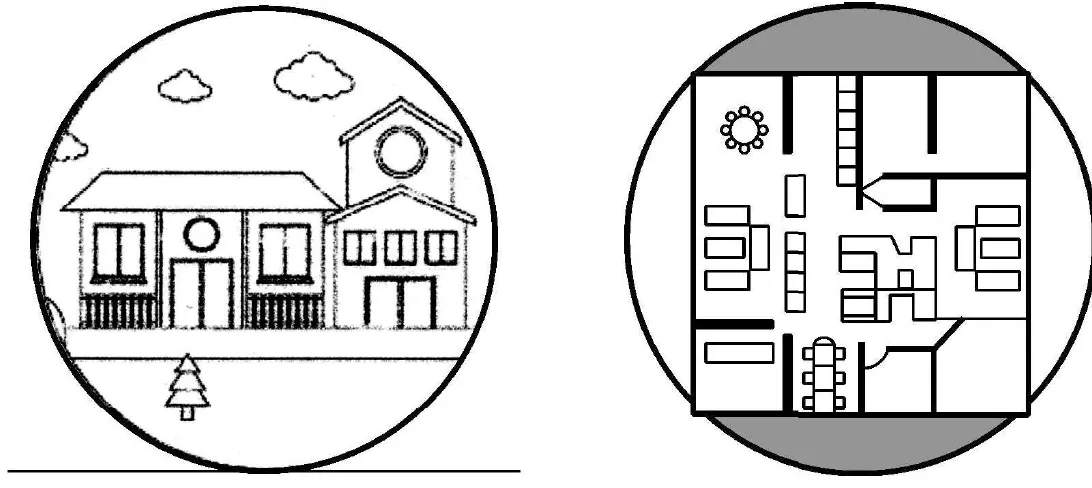
Case study 1. A farmer has a circular piece of land. He wishes to construct his house in the form of largest possible square within the land as shown below. The radius of circular piece of land is 35 m.

Based on given information, answer the following questions:

(i) Find the length of wire needed to fence the entire land. [1]

(ii) Find the length of each side of the square land on which house will be constructed. [1]

(iii) (a) The farmer wishes to grow grass on the shaded region around the house. Find the cost of growing the grass at the rate of ₹ 50 per square metre. [2]

OR

(iii) (b) Find the ratio of area of land on which house is built to remaining area of circular piece of land. [2]

A picture of a house inside a circle, next to a floor plan: the largest square drawn inside the circle, with the segments above and below the square shaded.
Solution
Ohouse (square)grass: top segmentdiagonal = 70 m; each segment = 350 m²
  1. (i) Length of wire to fence the whole land == circumference =2πr=2×227×35=220= 2\pi r = 2 \times \dfrac{22}{7} \times 35 = 220 m.
  2. (ii) The largest square in a circle has its diagonal equal to the diameter: 7070 m. Side =702=352= \dfrac{70}{\sqrt{2}} = 35\sqrt{2} m (≈49.5\approx 49.5 m).
  3. (iii)(a) The shaded region is the top and bottom segments. Each segment == sector of 90∘90^\circ −- triangle =90360×227×35×35−12×35×35=962.5−612.5=350= \dfrac{90}{360} \times \dfrac{22}{7} \times 35 \times 35 - \dfrac{1}{2} \times 35 \times 35 = 962.5 - 612.5 = 350 m².
  4. Two segments =700= 700 m². Cost =700×50=₹35,000= 700 \times 50 = ₹35{,}000.
  5. (iii)(b) Area of the house (square) =(352)2=2450= (35\sqrt{2})^2 = 2450 m². Area of the circle =227×35×35=3850= \dfrac{22}{7} \times 35 \times 35 = 3850 m². Remaining area =3850−2450=1400= 3850 - 2450 = 1400 m².
  6. Ratio =24501400=74= \dfrac{2450}{1400} = \dfrac{7}{4}, that is 7:47 : 4.

Answer: (i) 220220 m   (ii) 35235\sqrt{2} m   (iii)(a) ₹ 35,00035{,}000   (iii)(b) 7:47 : 4

Common mistake: In (iii)(a), taking circle −- square (14001400 m²). Only the top and bottom segments are shaded, which is half of that, 700700 m².

Report an error on this question
Q37Arithmetic Progressions4 marks

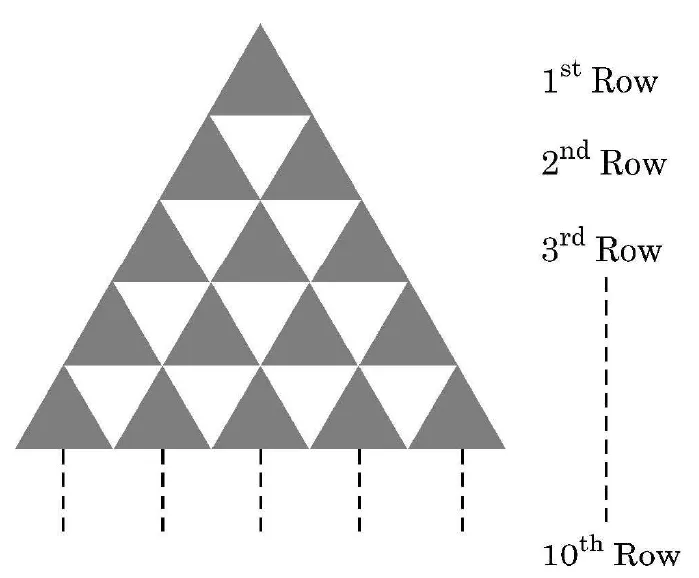
Case study 2. In an equilateral triangle of side 10 cm, equilateral triangles of side 1 cm are formed as shown in the figure below, such that there is one triangle in the first row, three triangles in the second row, five triangles in the third row and so on.

Based on given information, answer the following questions using Arithmetic Progression.

(i) How many triangles will be there in bottom most row? [1]

(ii) How many triangles will be there in fourth row from the bottom? [1]

(iii) (a) Find the total number of triangles of side 1 cm each till 8th row. [2]

OR

(iii) (b) How many more number of triangles are there from 5th row to 10th row than in first 4 rows? Show working. [2]

A large equilateral triangle made of small triangles, shaded and unshaded alternately, with 1 triangle in the first row, 3 in the second and so on down to the 10th row.
Solution
1234567891048121620Oxy135791113151719
Each row has 2 more triangles than the one above: an AP with a = 1 and d = 2.
  1. The numbers of triangles in the rows are 1,3,5,…1, 3, 5, \dots, an AP with a=1a = 1 and d=2d = 2. The side is 1010 cm, so there are 1010 rows.
  2. (i) Bottom most row is the 1010th: a10=1+9×2=19a_{10} = 1 + 9 \times 2 = 19 triangles.
  3. (ii) The fourth row from the bottom is the 77th row: a7=1+6×2=13a_7 = 1 + 6 \times 2 = 13 triangles. (Or start at the bottom: 19+3×(−2)=1319 + 3 \times (-2) = 13.)
  4. (iii)(a) S8=82[2×1+7×2]=4×16=64S_8 = \dfrac{8}{2}[2 \times 1 + 7 \times 2] = 4 \times 16 = 64 triangles.
  5. (iii)(b) Triangles in rows 55 to 1010 =S10−S4=102[2+9×2]−42[2+3×2]=100−16=84= S_{10} - S_4 = \dfrac{10}{2}[2 + 9 \times 2] - \dfrac{4}{2}[2 + 3 \times 2] = 100 - 16 = 84.
  6. First 44 rows: S4=16S_4 = 16. So rows 55 to 1010 have 84−16=6884 - 16 = 68 more triangles.

Answer: (i) 1919   (ii) 1313   (iii)(a) 6464   (iii)(b) 6868 more

Common mistake: In (iii)(b), stopping at 8484. The question asks how many MORE there are than in the first 44 rows: 84−16=6884 - 16 = 68.

Report an error on this question
Q38Applications of Trigonometry4 marks

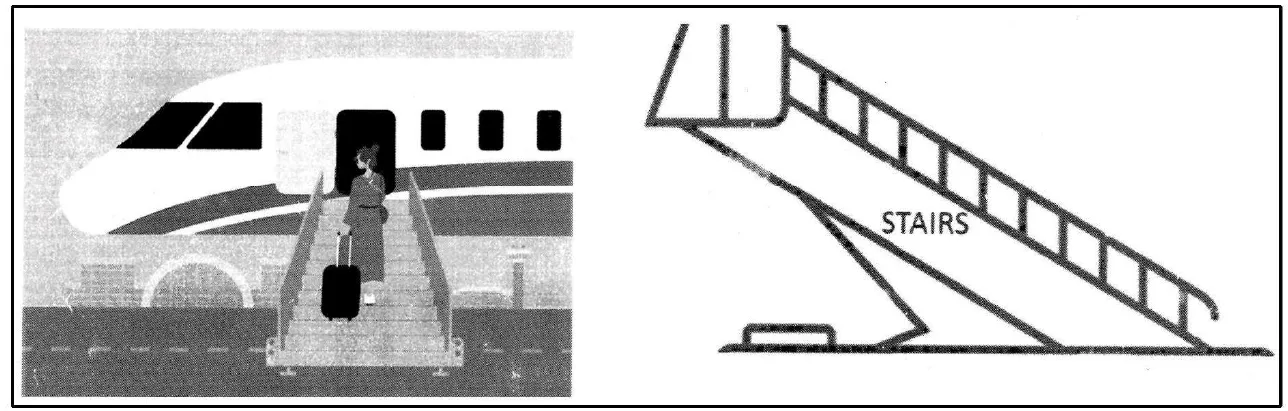
Case study 3. Passenger boarding stairs, sometimes referred to as boarding ramps, stair cars or aircraft steps, provide a mobile means to travel between the aircraft doors and the ground. Larger aircraft have door sills 5 to 20 feet (1 foot = 30 cm) high. Stairs facilitate safe boarding and de-boarding. An aircraft has a door sill at a height of 15 feet above the ground. A stair car is placed at a horizontal distance of 15 feet from the plane.

Based on given information, answer the questions given in part (i) and (ii).

(i) Find the angle at which stairs are inclined to reach the door sill 15 feet high above the ground. [1]

(ii) Find the length of stairs used to reach the door sill. [1]

Further, answer any one of the following questions:

(iii) (a) If the 20 feet long stairs is inclined at an angle of 60° to reach the door sill, then find the height of the door sill above the ground. (use √3 = 1.732) [2]

OR

(iii) (b) What should be the shortest possible length of stairs to reach the door sill of the plane 20 feet above the ground, if the angle of elevation cannot exceed 30°? Also, find the horizontal distance of base of stair car from the plane. [2]

A picture of an aircraft door with a stair car next to it, and a drawing of the stairs.
Solution
45°15 ft15 ft15√2 ≈ 21.21 ftBAS
30°20 ft40 ft20√3 ≈ 34.64 ftBAS
  1. (i) The stairs, the ground and the plane make a right triangle with height 1515 ft and base 1515 ft. tan⁡θ=1515=1\tan\theta = \dfrac{15}{15} = 1, so θ=45∘\theta = 45^\circ.
  2. (ii) sin⁡45∘=15l\sin 45^\circ = \dfrac{15}{l}, so l=152l = 15\sqrt{2} ft ≈21.21\approx 21.21 ft.
  3. (iii)(a) sin⁡60∘=h20\sin 60^\circ = \dfrac{h}{20}, so h=20×32=103=10×1.732=17.32h = 20 \times \dfrac{\sqrt{3}}{2} = 10\sqrt{3} = 10 \times 1.732 = 17.32 ft.
  4. (iii)(b) The shortest stairs correspond to the steepest allowed angle, 30∘30^\circ. sin⁡30∘=20l=12\sin 30^\circ = \dfrac{20}{l} = \dfrac{1}{2}, so l=40l = 40 ft.
  5. The horizontal distance: tan⁡30∘=20x=13\tan 30^\circ = \dfrac{20}{x} = \dfrac{1}{\sqrt{3}}, so x=203≈34.64x = 20\sqrt{3} \approx 34.64 ft.

Answer: (i) 45∘45^\circ   (ii) 152≈21.2115\sqrt{2} \approx 21.21 ft   (iii)(a) 17.3217.32 ft   (iii)(b) 4040 ft and 203≈34.6420\sqrt{3} \approx 34.64 ft

Common mistake: In (iii)(b), picking the largest angle. A smaller angle needs longer stairs, so the shortest stairs use the largest allowed angle, 30∘30^\circ.

Report an error on this question

Questions are from the official CBSE paper. Figures are described in words; see the PDF for the originals. Solutions are written by CogniGuru.

Revise this paper in 1 minute a chapter

Each chapter below is what the paper tested, with a one-minute animated lesson on the idea behind it.

Stuck on a step in any solution?

The CogniGuru AI tutor explains any doubt one minute at a time, in English or Hindi. Join the waitlist.

Mock quiz: 5 questions from this paper

Five real questions from this paper, one each from five chapters. About 2 minutes. See how much you know and where you stand among other students. Attempt free, with no login; log in only for your ranking and full report.

Question 1 of 5 · Q1 of the paperReal Numbers

(3+2)2+(3−2)2\left(\sqrt{3} + 2\right)^2 + \left(\sqrt{3} - 2\right)^2 is a/an

0 of 5 answered

Related papers

Common questions

Are these the official CBSE Class 10 Maths Standard 2025 questions?
Yes. The questions are from the official Mathematics (Standard) paper (set 30/5/1) that CBSE published after the March 2025 board exam. The solutions are written by CogniGuru and checked against the answer key CBSE published for this paper code.
Can I download the CBSE Class 10 Maths Standard 2025 question paper PDF?
Yes, the official paper PDF is free to download from this page, and so are our step-by-step solutions as a PDF. No login is needed to download either or to read the solutions.
Do all sets of the paper have the same questions?
No. CBSE sets several versions of each paper, with the same blueprint and similar questions in a different order and sometimes with different numbers. This page covers set 30/5/1.
How does the quiz work, and what does “where you stand” mean?
It is a mock quiz of 5 real multiple-choice questions from this paper, scored automatically in about 2 minutes. Your score is compared, anonymously, with other students who took the same quiz. Only the score is stored with the comparison, never your name or number.

Source

CBSE question paper archive, Class X, 2025 (Mathematics (Standard), set 30/5/1)
PDF