CBSE · Class 10 · Mathematics (Standard) · Free

CBSE Class 10 Maths Standard 2025 Question Paper (Set 30/6/1) with Solutions

The official board paper (Q.P. Code 30/6/1, Series F6EGH). Free paper PDF and step-by-step solutions (also as a PDF to download) written by CogniGuru and checked against CBSE’s answer key. See the paper’s main topics in 1 minute, then quiz yourself to see how much you know and where you stand.

No login to download or read the solutions. Login only to see your quiz report in full.

Board
CBSE
Class
10
Subject
Maths Standard (041)
Year
2025
Set code
30/6/1
Max marks
80
Duration
3 hours
Questions
38 (Sections A to E)
Source
Official CBSE paper
Exam date
March 2025

Paper preview

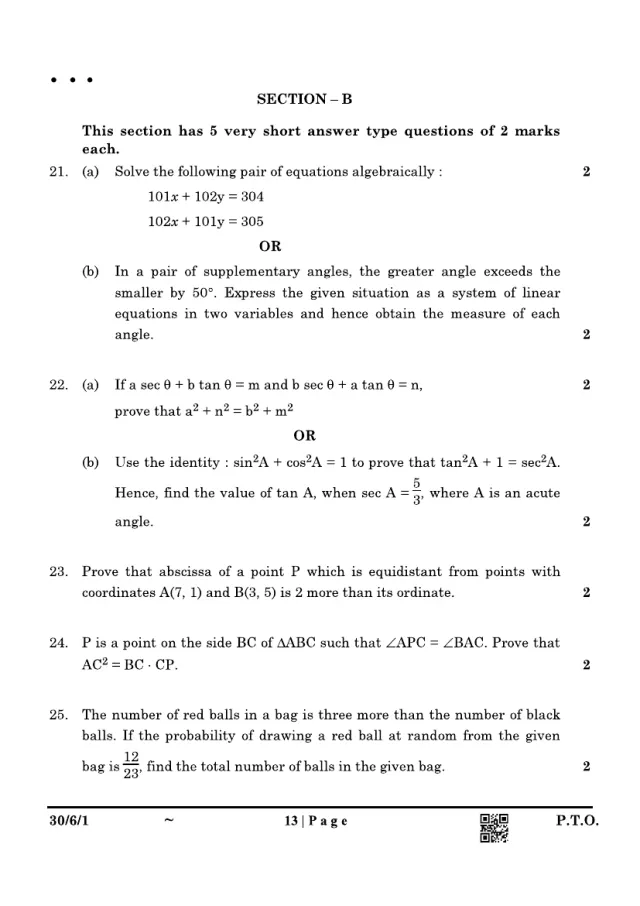
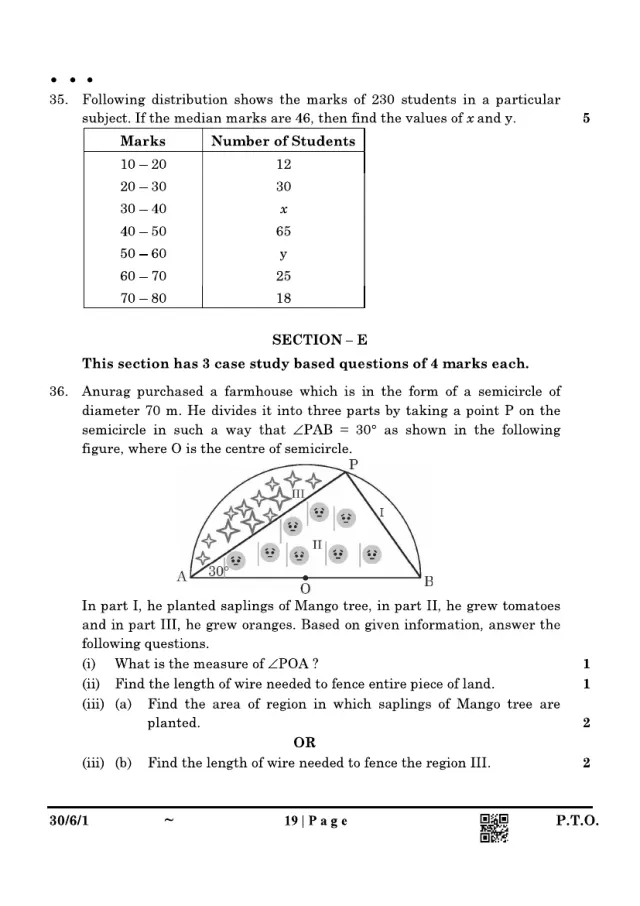
Three pages of the official paper. Download the PDF for all 24.

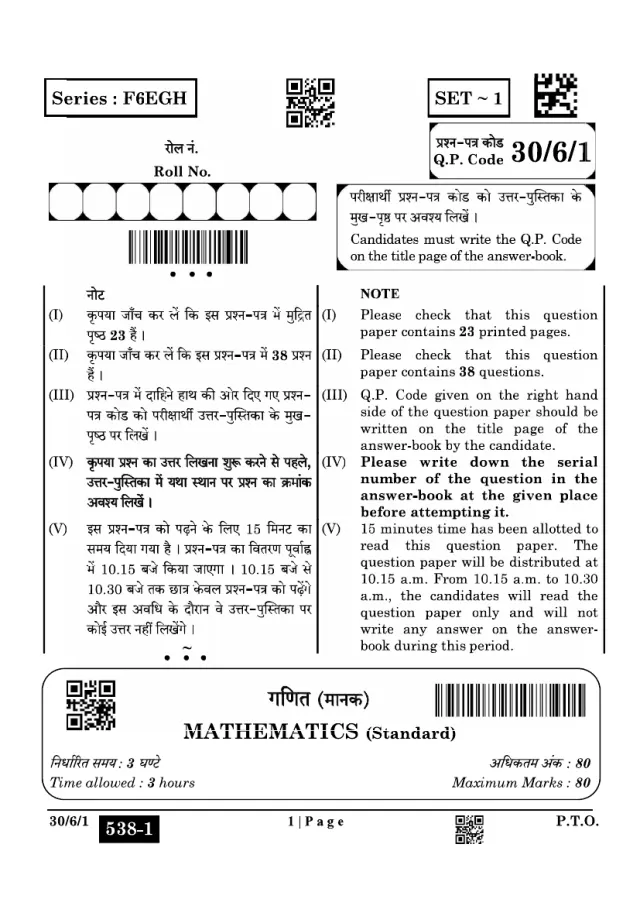
  • Cover page of the CBSE Class 10 Maths Standard 2025 paper, set 30/6/1

    Cover page

  • Section B of the CBSE Class 10 Maths Standard 2025 paper, set 30/6/1

    Section B

  • A case study with its figure from the CBSE Class 10 Maths Standard 2025 paper, set 30/6/1

    Case study

The main topics of this paper, in 1 minute

Your tutor walks you through the paper before you attempt it: the marks, the key ideas, the time plan and the traps.

1-minute paper analysis

With your tutor, in her voice

The main topics of this paper, in about a minute

A short, animated walk through the paper: how it is built, where the marks come from, the four ideas that matter most, how to plan your three hours, and the traps to avoid.

  1. 1The paper at a glance
  2. 2Where the marks come from
  3. 3Four ideas that keep paying off
  4. 4Plan your three hours
  5. 5Four traps to avoid

Sound on for the voice. Captions are shown, and you can mute any time.

Step-by-step solutions

Try each question first, then open its solution. Tap a number to jump.

Download solutions (PDF)

Section A: Multiple choice

20 questions, 1 mark each. MCQs (Q1 to Q18) and assertion-reason (Q19, Q20).

Q1Real Numbers1 mark

0.4\sqrt{0.4} is a/an

  1. (A)natural number
  2. (B)integer
  3. (C)rational number
  4. (D)irrational number
Solution · answer (D)
  1. 0.4=410=210\sqrt{0.4} = \sqrt{\dfrac{4}{10}} = \dfrac{2}{\sqrt{10}}.
  2. 1010 is not a perfect square, so 10\sqrt{10} is irrational, and a non-zero rational number divided by an irrational number is irrational.

Answer: (D) irrational number

Common mistake: Thinking 0.40.4 is rational so its root must be. A square root of a rational number is rational only when it is a perfect square ratio, like 0.25=0.5\sqrt{0.25} = 0.5.

Report an error on this question
Q2Real Numbers1 mark

Which of the following cannot be the unit digit of 8n8^n, where nn is a natural number?

  1. (A)4
  2. (B)2
  3. (C)0
  4. (D)6
Solution · answer (C)
  1. The unit digits of 81,82,83,84,…8^1, 8^2, 8^3, 8^4, \dots are 8,4,2,68, 4, 2, 6 and then repeat.
  2. So the unit digit can be 8,4,28, 4, 2 or 66, but never 00. (8n=23n8^n = 2^{3n} has no factor 55, so it is never divisible by 1010.)

Answer: (C) 0

Report an error on this question
Q3Quadratic Equations1 mark

Which of the following quadratic equations has real and equal roots?

  1. (A)(x+1)2=2x+1(x + 1)^2 = 2x + 1
  2. (B)x2+x=0x^2 + x = 0
  3. (C)x2−4=0x^2 - 4 = 0
  4. (D)x2+x+1=0x^2 + x + 1 = 0
Solution · answer (A)
  1. Check the discriminant D=b2−4acD = b^2 - 4ac of each.
  2. (A) x2+2x+1=2x+1x^2 + 2x + 1 = 2x + 1 gives x2=0x^2 = 0: D=0D = 0, equal roots 0,00, 0. ✓
  3. (B) D=1>0D = 1 > 0 (roots 0,−10, -1). (C) D=16>0D = 16 > 0 (roots ±2\pm 2). (D) D=1−4=−3<0D = 1 - 4 = -3 < 0 (no real roots).

Answer: (A) (x+1)2=2x+1(x + 1)^2 = 2x + 1

Common mistake: Reading (A) as already in standard form. Expand it first.

Report an error on this question
Q4Polynomials1 mark

If the zeroes of the polynomial ax2+bx+2abax^2 + bx + \dfrac{2a}{b} are reciprocal of each other, then the value of bb is

  1. (A)2
  2. (B)12\dfrac{1}{2}
  3. (C)−2
  4. (D)−12-\dfrac{1}{2}
Solution · answer (A)
  1. Zeroes that are reciprocals of each other have product 11.
  2. Product of zeroes =ca=2a/ba=2b= \dfrac{c}{a} = \dfrac{2a/b}{a} = \dfrac{2}{b}.
  3. 2b=1\dfrac{2}{b} = 1, so b=2b = 2.

Answer: (A) 2

Report an error on this question
Q5Coordinate Geometry1 mark

The distance of the point A(−3,−4)A(-3, -4) from xx-axis is

  1. (A)3
  2. (B)4
  3. (C)5
  4. (D)7
Solution · answer (B)
  1. The distance of a point from the xx-axis is the absolute value of its yy-coordinate.
  2. ∣−4∣=4|-4| = 4.

Answer: (B) 4

Common mistake: Answering 55 (the distance from the origin). The question is about the xx-axis only.

Report an error on this question
Q6Triangles1 mark

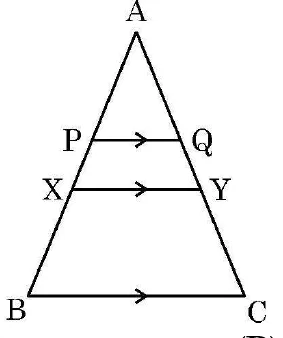
In the adjoining figure, PQ∥XY∥BCPQ \parallel XY \parallel BC, AP=2AP = 2 cm, PX=1.5PX = 1.5 cm and BX=4BX = 4 cm. If QY=0.75QY = 0.75 cm, then AQ+CY=AQ + CY =

Triangle ABC with two lines PQ and XY drawn parallel to the base BC. P and X are on AB, Q and Y are on AC, with P and Q nearer the top A.
  1. (A)6 cm
  2. (B)4.5 cm
  3. (C)3 cm
  4. (D)5.25 cm
Solution · answer (C)
ABCPXQYAP : AX = AQ : AY → AQ = 1; AX : AB = AY : AC → CY = 2AP = 2PX = 1.5XB = 4
  1. PQ∥XYPQ \parallel XY in △AXY\triangle AXY: APPX=AQQY\dfrac{AP}{PX} = \dfrac{AQ}{QY}, so 21.5=AQ0.75\dfrac{2}{1.5} = \dfrac{AQ}{0.75} and AQ=1AQ = 1 cm.
  2. AY=AQ+QY=1.75AY = AQ + QY = 1.75 cm and AX=AP+PX=3.5AX = AP + PX = 3.5 cm.
  3. XY∥BCXY \parallel BC in △ABC\triangle ABC: AXXB=AYYC\dfrac{AX}{XB} = \dfrac{AY}{YC}, so 3.54=1.75CY\dfrac{3.5}{4} = \dfrac{1.75}{CY} and CY=2CY = 2 cm.
  4. AQ+CY=1+2=3AQ + CY = 1 + 2 = 3 cm.

Answer: (C) 3 cm

Common mistake: Using APPB\dfrac{AP}{PB} directly. PP and QQ are parallel to XYXY, so compare with AXAX, not ABAB.

Report an error on this question
Q7Triangles1 mark

Given △ABC∼△PQR\triangle ABC \sim \triangle PQR, ∠A=30∘\angle A = 30^\circ and ∠Q=90∘\angle Q = 90^\circ. The value of (∠R+∠B)(\angle R + \angle B) is

  1. (A)90∘90^\circ
  2. (B)120∘120^\circ
  3. (C)150∘150^\circ
  4. (D)180∘180^\circ
Solution · answer (C)
  1. △ABC∼△PQR\triangle ABC \sim \triangle PQR means A↔PA \leftrightarrow P, B↔QB \leftrightarrow Q, C↔RC \leftrightarrow R. So ∠P=30∘\angle P = 30^\circ, ∠B=∠Q=90∘\angle B = \angle Q = 90^\circ.
  2. In △PQR\triangle PQR: ∠R=180∘−30∘−90∘=60∘\angle R = 180^\circ - 30^\circ - 90^\circ = 60^\circ.
  3. ∠R+∠B=60∘+90∘=150∘\angle R + \angle B = 60^\circ + 90^\circ = 150^\circ.

Answer: (C) 150∘150^\circ

Common mistake: Taking ∠A=30∘\angle A = 30^\circ to be in △PQR\triangle PQR without matching the letters. The order ABC↔PQRABC \leftrightarrow PQR decides which angles are equal.

Report an error on this question
Q8Probability1 mark

Two coins are tossed simultaneously. The probability of getting atleast one head is

  1. (A)14\dfrac{1}{4}
  2. (B)12\dfrac{1}{2}
  3. (C)34\dfrac{3}{4}
  4. (D)1
Solution · answer (C)
  1. Outcomes: HH,HT,TH,TTHH, HT, TH, TT — 44 in all.
  2. At least one head: HH,HT,THHH, HT, TH — 33 outcomes (only TTTT has none).
  3. P=34P = \dfrac{3}{4}.

Answer: (C) 34\dfrac{3}{4}

Report an error on this question
Q9Circles1 mark

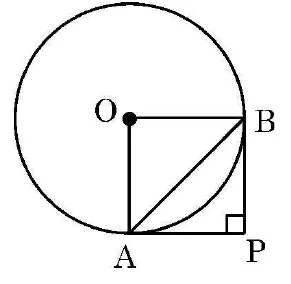
In the adjoining figure, PAPA and PBPB are tangents to a circle with centre OO such that ∠P=90∘\angle P = 90^\circ. If AB=32AB = 3\sqrt{2} cm, then the diameter of the circle is

A circle with centre O at the top left. Tangents from P at the bottom right touch the circle at A below O and B to the right of O, forming a square OAPB. The chord AB is drawn.
  1. (A)323\sqrt{2} cm
  2. (B)626\sqrt{2} cm
  3. (C)3 cm
  4. (D)6 cm
Solution · answer (D)
r3√2OBAPOAPB is a square: AB = r√2 = 3√2, r = 3
  1. OA⊥PAOA \perp PA and OB⊥PBOB \perp PB, and ∠P=90∘\angle P = 90^\circ. So OAPBOAPB has four right angles, and OA=OB=rOA = OB = r gives a square of side rr.
  2. ABAB is a diagonal of this square: AB=r2=32AB = r\sqrt{2} = 3\sqrt{2}, so r=3r = 3 cm.
  3. Diameter =2r=6= 2r = 6 cm.

Answer: (D) 6 cm

Common mistake: Calling AB the diameter. AB is a chord, the diagonal of the square OAPB.

Report an error on this question
Q10Circles1 mark

For a circle with centre O and radius 5 cm, which of the following statements is true?

P : Distance between every pair of parallel tangents is 5 cm.

Q : Distance between every pair of parallel tangents is 10 cm.

R : Distance between every pair of parallel tangents must be between 5 cm and 10 cm.

S : There does not exist a point outside the circle from where length of tangent is 5 cm.

  1. (A)P
  2. (B)Q
  3. (C)R
  4. (D)S
Solution · answer (B)
  1. A pair of parallel tangents touch the circle at the two ends of a diameter, so the distance between them is the diameter, 2×5=102 \times 5 = 10 cm, for every pair. So Q is true (and P, R are false).
  2. S is false: from a point 525\sqrt{2} cm from the centre, the tangent length is (52)2−52=5\sqrt{(5\sqrt{2})^2 - 5^2} = 5 cm.

Answer: (B) Q

Report an error on this question
Q11Circles1 mark

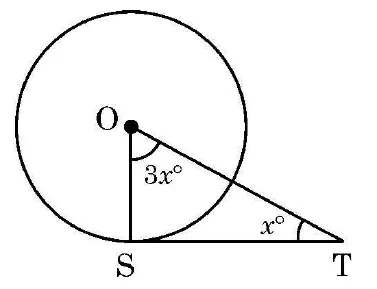
In the adjoining figure, TSTS is a tangent to a circle with centre OO. The value of 2x∘2x^\circ is

A circle with centre O. The radius OS goes down to S, and the tangent ST goes to the right to the point T. The angle at O is marked 3x degrees and the angle at T is marked x degrees.
  1. (A)22.5
  2. (B)45
  3. (C)67.5
  4. (D)90
Solution · answer (B)
3xxSTO3x + x = 90°, so x = 22.5° and 2x = 45°
  1. TSTS is a tangent, so OS⊥TSOS \perp TS and ∠OST=90∘\angle OST = 90^\circ.
  2. In △OST\triangle OST: 3x+x+90∘=180∘3x + x + 90^\circ = 180^\circ, so 4x=90∘4x = 90^\circ and x=22.5∘x = 22.5^\circ.
  3. 2x=45∘2x = 45^\circ.

Answer: (B) 45

Common mistake: Stopping at x=22.5x = 22.5. The question asks for 2x2x.

Report an error on this question
Q12Trigonometry1 mark

If x(2tan⁡30∘1+tan⁡230∘)=y(2tan⁡30∘1−tan⁡230∘)x\left(\dfrac{2\tan 30^\circ}{1 + \tan^2 30^\circ}\right) = y\left(\dfrac{2\tan 30^\circ}{1 - \tan^2 30^\circ}\right), then x:y=x : y =

  1. (A)1 : 1
  2. (B)1 : 2
  3. (C)2 : 1
  4. (D)4 : 1
Solution · answer (C)
  1. tan⁡30∘=13\tan 30^\circ = \dfrac{1}{\sqrt{3}}, so tan⁡230∘=13\tan^2 30^\circ = \dfrac{1}{3}.
  2. 2tan⁡30∘1+tan⁡230∘=2/34/3=32\dfrac{2\tan 30^\circ}{1 + \tan^2 30^\circ} = \dfrac{2/\sqrt{3}}{4/3} = \dfrac{\sqrt{3}}{2} (this is sin⁡60∘\sin 60^\circ).
  3. 2tan⁡30∘1−tan⁡230∘=2/32/3=3\dfrac{2\tan 30^\circ}{1 - \tan^2 30^\circ} = \dfrac{2/\sqrt{3}}{2/3} = \sqrt{3} (this is tan⁡60∘\tan 60^\circ).
  4. So x⋅32=y3x \cdot \dfrac{\sqrt{3}}{2} = y\sqrt{3}, giving x=2yx = 2y and x:y=2:1x : y = 2 : 1.

Answer: (C) 2 : 1

Report an error on this question
Q13Applications of Trigonometry1 mark

A peacock sitting on the top of a tree of height 1010 m observes a snake moving on the ground. If the snake is 10310\sqrt{3} m away from the base of the tree, then angle of depression of the snake from the eye of the peacock is

  1. (A)30∘30^\circ
  2. (B)45∘45^\circ
  3. (C)60∘60^\circ
  4. (D)90∘90^\circ
Solution · answer (A)
30°30°10 m10√3 mTGStan θ = 10 / 10√3 = 1/√3, so θ = 30°
  1. In the right triangle formed by the tree, the ground and the line of sight: tan⁡θ=heightdistance=10103=13\tan\theta = \dfrac{\text{height}}{\text{distance}} = \dfrac{10}{10\sqrt{3}} = \dfrac{1}{\sqrt{3}}.
  2. So θ=30∘\theta = 30^\circ at the snake. The angle of depression at the peacock equals this angle of elevation (alternate angles), 30∘30^\circ.

Answer: (A) 30∘30^\circ

Report an error on this question
Q14Surface Areas and Volumes1 mark

If a cone of greatest possible volume is hollowed out from a solid wooden cylinder, then the ratio of the volume of remaining wood to the volume of cone hollowed out is

  1. (A)1 : 1
  2. (B)1 : 3
  3. (C)2 : 1
  4. (D)3 : 1
Solution · answer (C)
ABCDconewoodcone = ⅓ of the cylinder; wood left = ⅔, so 2 : 1
  1. The greatest cone has the same base radius rr and the same height hh as the cylinder.
  2. Cone =13πr2h= \dfrac{1}{3}\pi r^2 h and cylinder =πr2h= \pi r^2 h, so the remaining wood =πr2h−13πr2h=23πr2h= \pi r^2 h - \dfrac{1}{3}\pi r^2 h = \dfrac{2}{3}\pi r^2 h.
  3. Remaining wood : cone =23:13=2:1= \dfrac{2}{3} : \dfrac{1}{3} = 2 : 1.

Answer: (C) 2 : 1

Report an error on this question
Q15Statistics1 mark

If the mode of some observations is 10 and sum of mean and median is 25, then the mean and median respectively are

  1. (A)12 and 13
  2. (B)13 and 12
  3. (C)10 and 15
  4. (D)15 and 10
Solution · answer (B)
  1. Mode =3 Median−2 Mean= 3\,\text{Median} - 2\,\text{Mean}, and Mean ++ Median =25= 25, so Mean =25−= 25 - Median.
  2. 10=3 Median−2(25−Median)=5 Median−5010 = 3\,\text{Median} - 2(25 - \text{Median}) = 5\,\text{Median} - 50, so Median =12= 12.
  3. Mean =25−12=13= 25 - 12 = 13. So the mean is 1313 and the median is 1212.

Answer: (B) 13 and 12

Common mistake: Reading the options as (median, mean). The question asks for the mean first.

Report an error on this question
Q16Statistics1 mark

If the maximum number of students has obtained 52 marks out of 80, then

  1. (A)52 is the mean of the data.
  2. (B)52 is the median of the data.
  3. (C)52 is the mode of the data.
  4. (D)52 is the range of the data.
Solution · answer (C)
  1. The mode is the value that occurs most often, that is the value obtained by the maximum number of students.
  2. So 5252 is the mode of the data.

Answer: (C) 52 is the mode of the data.

Report an error on this question
Q17Linear Equations1 mark

The system of equations 2x+1=02x + 1 = 0 and 3y−5=03y - 5 = 0 has

  1. (A)unique solution
  2. (B)two solutions
  3. (C)no solution
  4. (D)infinite number of solutions
Solution · answer (A)
  1. 2x+1=02x + 1 = 0 gives x=−12x = -\dfrac{1}{2} and 3y−5=03y - 5 = 0 gives y=53y = \dfrac{5}{3}.
  2. These are a vertical and a horizontal line, which always cross at exactly one point, (−12,53)\left(-\dfrac{1}{2}, \dfrac{5}{3}\right). A unique solution.

Answer: (A) unique solution

Report an error on this question
Q18Trigonometry1 mark

In a right triangle ABCABC, right-angled at AA, if sin⁡B=14\sin B = \dfrac{1}{4}, then the value of sec⁡B\sec B is

  1. (A)4
  2. (B)154\dfrac{\sqrt{15}}{4}
  3. (C)15\sqrt{15}
  4. (D)415\dfrac{4}{\sqrt{15}}
Solution · answer (D)
B14√15BACsec B = hypotenuse / adjacent = 4 / √15
  1. sin⁡B=ACBC=14\sin B = \dfrac{AC}{BC} = \dfrac{1}{4}. Take AC=1AC = 1 and BC=4BC = 4.
  2. AB=BC2−AC2=16−1=15AB = \sqrt{BC^2 - AC^2} = \sqrt{16 - 1} = \sqrt{15}.
  3. cos⁡B=ABBC=154\cos B = \dfrac{AB}{BC} = \dfrac{\sqrt{15}}{4}, so sec⁡B=1cos⁡B=415\sec B = \dfrac{1}{\cos B} = \dfrac{4}{\sqrt{15}}.

Answer: (D) 415\dfrac{4}{\sqrt{15}}

Common mistake: Giving cos⁡B=154\cos B = \dfrac{\sqrt{15}}{4} (option B). Secant is the reciprocal of cosine.

Report an error on this question
Q19Real Numbers1 mark

Assertion (A): For any two prime numbers pp and qq, their HCF is 11 and LCM is p+qp + q.

Reason (R): For any two natural numbers, HCF ×\times LCM == product of numbers.

  1. (A)Both A and R are true and R is the correct explanation of A
  2. (B)Both A and R are true, but R is not the correct explanation of A
  3. (C)A is true, but R is false
  4. (D)A is false, but R is true
Solution · answer (D)
  1. (A) For two different primes the HCF is 11, but the LCM is p×qp \times q, not p+qp + q (for p=2p = 2, q=3q = 3 the LCM is 66, not 55). The assertion is false.
  2. (R) HCF ×\times LCM == product of the two numbers is a true standard result.

Answer: (D) A is false, R is true

Report an error on this question
Q20Probability1 mark

In an experiment of throwing a die,

Assertion (A): Event E1E_1: getting a number less than 33 and Event E2E_2: getting a number greater than 33 are complementary events.

Reason (R): If two events EE and FF are complementary events, then P(E)+P(F)=1P(E) + P(F) = 1.

  1. (A)Both A and R are true and R is the correct explanation of A
  2. (B)Both A and R are true, but R is not the correct explanation of A
  3. (C)A is true, but R is false
  4. (D)A is false, but R is true
Solution · answer (D)
  1. (A) E1={1,2}E_1 = \{1, 2\} and E2={4,5,6}E_2 = \{4, 5, 6\}. Together they miss the outcome 33, so E2E_2 is not "not E1E_1". They are not complementary. The assertion is false.
  2. (R) Complementary events satisfy P(E)+P(F)=1P(E) + P(F) = 1. True.

Answer: (D) A is false, R is true

Report an error on this question

Section B: Very short answer

5 questions, 2 marks each.

Q21Linear Equations2 marks

(a) Solve the following pair of equations algebraically: 101x+102y=304101x + 102y = 304 and 102x+101y=305102x + 101y = 305.

OR

(b) In a pair of supplementary angles, the greater angle exceeds the smaller by 50∘50^\circ. Express the given situation as a system of linear equations in two variables and hence obtain the measure of each angle.

Solution
  1. (a) Add the equations: 203x+203y=609203x + 203y = 609, so x+y=3x + y = 3. … (i)
  2. Subtract the first from the second: x−y=1x - y = 1, that is −x+y=−1-x + y = -1. … (ii)
  3. From (i) and (ii): x=2x = 2 and y=1y = 1. (Check: 101×2+102=304101 \times 2 + 102 = 304 ✓.)
  4. (b) Let the smaller angle be xx and the greater angle yy. Supplementary: x+y=180x + y = 180. The greater exceeds the smaller by 5050: y=x+50y = x + 50.
  5. Put in: x+x+50=180x + x + 50 = 180, so x=65∘x = 65^\circ and y=115∘y = 115^\circ.

Answer: (a) x=2, y=1x = 2,\ y = 1   (b) x+y=180, y−x=50x + y = 180,\ y - x = 50; angles 65∘65^\circ and 115∘115^\circ

Report an error on this question
Q22Trigonometry2 marks

(a) If asec⁡θ+btan⁡θ=ma\sec\theta + b\tan\theta = m and bsec⁡θ+atan⁡θ=nb\sec\theta + a\tan\theta = n, prove that a2+n2=b2+m2a^2 + n^2 = b^2 + m^2.

OR

(b) Use the identity sin⁡2A+cos⁡2A=1\sin^2 A + \cos^2 A = 1 to prove that tan⁡2A+1=sec⁡2A\tan^2 A + 1 = \sec^2 A. Hence, find the value of tan⁡A\tan A, when sec⁡A=53\sec A = \dfrac{5}{3}, where AA is an acute angle.

Solution
  1. (a) m2=a2sec⁡2θ+b2tan⁡2θ+2absec⁡θtan⁡θm^2 = a^2\sec^2\theta + b^2\tan^2\theta + 2ab\sec\theta\tan\theta and n2=b2sec⁡2θ+a2tan⁡2θ+2absec⁡θtan⁡θn^2 = b^2\sec^2\theta + a^2\tan^2\theta + 2ab\sec\theta\tan\theta.
  2. Subtract: m2−n2=a2(sec⁡2θ−tan⁡2θ)+b2(tan⁡2θ−sec⁡2θ)=a2−b2m^2 - n^2 = a^2(\sec^2\theta - \tan^2\theta) + b^2(\tan^2\theta - \sec^2\theta) = a^2 - b^2 (as sec⁡2θ−tan⁡2θ=1\sec^2\theta - \tan^2\theta = 1).
  3. So m2−n2=a2−b2m^2 - n^2 = a^2 - b^2, that is a2+n2=b2+m2a^2 + n^2 = b^2 + m^2.
  4. (b) Divide sin⁡2A+cos⁡2A=1\sin^2 A + \cos^2 A = 1 by cos⁡2A\cos^2 A: tan⁡2A+1=sec⁡2A\tan^2 A + 1 = \sec^2 A.
  5. With sec⁡A=53\sec A = \dfrac{5}{3}: tan⁡2A=259−1=169\tan^2 A = \dfrac{25}{9} - 1 = \dfrac{16}{9}, so tan⁡A=43\tan A = \dfrac{4}{3} (positive, as AA is acute).

Answer: (a) proved   (b) tan⁡A=43\tan A = \dfrac{4}{3}

Report an error on this question
Q23Coordinate Geometry2 marks

Prove that abscissa of a point PP which is equidistant from points with coordinates A(7,1)A(7, 1) and B(3,5)B(3, 5) is 22 more than its ordinate.

Solution
123456789-11234567Oxyx − y = 2A(7, 1)B(3, 5)mid-point (5, 3)
The perpendicular bisector of AB: x − y = 2, so the abscissa is 2 more than the ordinate.
  1. Let P=(x,y)P = (x, y) with PA=PBPA = PB, so PA2=PB2PA^2 = PB^2.
  2. (x−7)2+(y−1)2=(x−3)2+(y−5)2(x - 7)^2 + (y - 1)^2 = (x - 3)^2 + (y - 5)^2.
  3. x2−14x+49+y2−2y+1=x2−6x+9+y2−10y+25x^2 - 14x + 49 + y^2 - 2y + 1 = x^2 - 6x + 9 + y^2 - 10y + 25, so −8x+8y=−16-8x + 8y = -16.
  4. x−y=2x - y = 2, that is x=y+2x = y + 2: the abscissa is 22 more than the ordinate.

Answer: x=y+2x = y + 2

Report an error on this question
Q24Triangles2 marks

PP is a point on the side BCBC of △ABC\triangle ABC such that ∠APC=∠BAC\angle APC = \angle BAC. Prove that AC2=BC⋅CPAC^2 = BC \cdot CP.

Solution
xxABCP
△APC ∼ △BAC (AA), so AC² = BC · CP.
  1. In △APC\triangle APC and △BAC\triangle BAC: ∠APC=∠BAC\angle APC = \angle BAC (given) and ∠C\angle C is common.
  2. So △APC∼△BAC\triangle APC \sim \triangle BAC by AA similarity.
  3. Corresponding sides are proportional: ACBC=CPAC\dfrac{AC}{BC} = \dfrac{CP}{AC}, so AC2=BC⋅CPAC^2 = BC \cdot CP.

Answer: AC2=BC⋅CPAC^2 = BC \cdot CP

Common mistake: Writing ACCP=BCAC\dfrac{AC}{CP} = \dfrac{BC}{AC} with the wrong pairing. Match the vertices in order: A↔BA \leftrightarrow B, P↔AP \leftrightarrow A, C↔CC \leftrightarrow C.

Report an error on this question
Q25Probability2 marks

The number of red balls in a bag is three more than the number of black balls. If the probability of drawing a red ball at random from the given bag is 1223\dfrac{12}{23}, find the total number of balls in the given bag.

Solution
  1. Let the black balls be xx. Red balls =x+3= x + 3 and the total =2x+3= 2x + 3.
  2. x+32x+3=1223\dfrac{x + 3}{2x + 3} = \dfrac{12}{23}, so 23x+69=24x+3623x + 69 = 24x + 36 and x=33x = 33.
  3. Total =2×33+3=69= 2 \times 33 + 3 = 69. (Check: red =36= 36 and 3669=1223\dfrac{36}{69} = \dfrac{12}{23} ✓.)

Answer: 69 balls

Report an error on this question

Section C: Short answer

6 questions, 3 marks each.

Q26Real Numbers3 marks

(a) Prove that 5\sqrt{5} is an irrational number.

OR

(b) Let p,qp, q and rr be three distinct prime numbers. Check whether p⋅q⋅r+qp \cdot q \cdot r + q is a composite number or not. Further, give an example for 33 distinct primes p,q,rp, q, r such that (i) p⋅q⋅r+1p \cdot q \cdot r + 1 is a composite number. (ii) p⋅q⋅r+1p \cdot q \cdot r + 1 is a prime number.

Solution
  1. (a) Suppose 5=pq\sqrt{5} = \dfrac{p}{q}, with p,qp, q co-prime and q≠0q \neq 0. Then 5q2=p25q^2 = p^2, so 55 divides p2p^2 and so 55 divides pp. Write p=5ap = 5a.
  2. Then 25a2=5q225a^2 = 5q^2, so q2=5a2q^2 = 5a^2, so 55 divides q2q^2 and hence qq. Now 55 divides both pp and qq, contradicting that they are co-prime. So 5\sqrt{5} is irrational.
  3. (b) pqr+q=q(pr+1)pqr + q = q(pr + 1). It has the factor qq and the factor (pr+1)>1(pr + 1) > 1, so it has more than two factors: it is a composite number.
  4. (i) Take p=3p = 3, q=5q = 5, r=7r = 7: pqr+1=105+1=106=2×53pqr + 1 = 105 + 1 = 106 = 2 \times 53, composite.
  5. (ii) Take p=2p = 2, q=3q = 3, r=5r = 5: pqr+1=30+1=31pqr + 1 = 30 + 1 = 31, which is prime.

Answer: (a) proved   (b) composite; (i) 106106   (ii) 3131

Common mistake: In (b), assuming pqr+1pqr + 1 is always prime or always composite. It can be either, so an example is needed for each.

Report an error on this question
Q27Polynomials3 marks

Find the zeroes of the polynomial p(x)=3x2−4x−4p(x) = 3x^2 - 4x - 4. Hence, write a polynomial whose each of the zeroes is 22 more than zeroes of p(x)p(x).

Solution
  1. 3x2−4x−4=3x2−6x+2x−4=3x(x−2)+2(x−2)=(3x+2)(x−2)3x^2 - 4x - 4 = 3x^2 - 6x + 2x - 4 = 3x(x - 2) + 2(x - 2) = (3x + 2)(x - 2).
  2. The zeroes are x=−23x = -\dfrac{2}{3} and x=2x = 2.
  3. The new zeroes are each 22 more: −23+2=43-\dfrac{2}{3} + 2 = \dfrac{4}{3} and 2+2=42 + 2 = 4.
  4. Sum =43+4=163= \dfrac{4}{3} + 4 = \dfrac{16}{3} and product =43×4=163= \dfrac{4}{3} \times 4 = \dfrac{16}{3}.
  5. Polynomial: x2−163x+163x^2 - \dfrac{16}{3}x + \dfrac{16}{3}, or multiplying by 33: 3x2−16x+163x^2 - 16x + 16.

Answer: Zeroes −23-\dfrac{2}{3} and 22; new polynomial 3x2−16x+163x^2 - 16x + 16

Report an error on this question
Q28Linear Equations3 marks

Check whether the following pair of equations is consistent or not. If consistent, solve graphically: x+3y=6x + 3y = 6 and 3y−2x=−123y - 2x = -12.

Solution
-112345678-5-4-3-2-1123Oxyx + 3y = 63y − 2x = −12(6, 0)
  1. Write as x+3y−6=0x + 3y - 6 = 0 and −2x+3y+12=0-2x + 3y + 12 = 0. a1a2=1−2\dfrac{a_1}{a_2} = \dfrac{1}{-2} and b1b2=33=1\dfrac{b_1}{b_2} = \dfrac{3}{3} = 1.
  2. a1a2≠b1b2\dfrac{a_1}{a_2} \neq \dfrac{b_1}{b_2}, so the lines intersect at one point: the pair is consistent.
  3. First line: (0,2)(0, 2), (3,1)(3, 1), (6,0)(6, 0). Second line: 3y=2x−123y = 2x - 12, points (0,−4)(0, -4), (3,−2)(3, -2), (6,0)(6, 0).
  4. The two lines cross at (6,0)(6, 0). So x=6x = 6, y=0y = 0.

Answer: Consistent; x=6, y=0x = 6,\ y = 0

Report an error on this question
Q29Coordinate Geometry3 marks

If the points A(6,1)A(6, 1), B(p,2)B(p, 2), C(9,4)C(9, 4) and D(7,q)D(7, q) are the vertices of a parallelogram ABCDABCD, then find the values of pp and qq. Hence, check whether ABCDABCD is a rectangle or not.

Solution
567891012345OxyA(6, 1)B(8, 2)C(9, 4)D(7, 3)
  1. The diagonals of a parallelogram bisect each other, so the mid-point of ACAC equals the mid-point of BDBD.
  2. Mid-point of AC=(6+92, 1+42)=(152, 52)AC = \left(\dfrac{6 + 9}{2},\ \dfrac{1 + 4}{2}\right) = \left(\dfrac{15}{2},\ \dfrac{5}{2}\right). Mid-point of BD=(p+72, 2+q2)BD = \left(\dfrac{p + 7}{2},\ \dfrac{2 + q}{2}\right).
  3. p+72=152\dfrac{p + 7}{2} = \dfrac{15}{2} gives p=8p = 8, and 2+q2=52\dfrac{2 + q}{2} = \dfrac{5}{2} gives q=3q = 3.
  4. Now B=(8,2)B = (8, 2) and D=(7,3)D = (7, 3). AC=32+32=32AC = \sqrt{3^2 + 3^2} = 3\sqrt{2} and BD=(−1)2+12=2BD = \sqrt{(-1)^2 + 1^2} = \sqrt{2}.
  5. The diagonals of a rectangle are equal. Here AC≠BDAC \neq BD, so ABCDABCD is not a rectangle.

Answer: p=8, q=3p = 8,\ q = 3; ABCDABCD is not a rectangle

Report an error on this question
Q30Trigonometry3 marks

(a) Prove that: cos⁡θ−2cos⁡3θsin⁡θ−2sin⁡3θ+cot⁡θ=0\dfrac{\cos\theta - 2\cos^3\theta}{\sin\theta - 2\sin^3\theta} + \cot\theta = 0.

OR

(b) Given that sin⁡θ+cos⁡θ=x\sin\theta + \cos\theta = x, prove that sin⁡4θ+cos⁡4θ=2−(x2−1)22\sin^4\theta + \cos^4\theta = \dfrac{2 - (x^2 - 1)^2}{2}.

Solution
  1. (a) Factorise: cos⁡θ(1−2cos⁡2θ)sin⁡θ(1−2sin⁡2θ)\dfrac{\cos\theta(1 - 2\cos^2\theta)}{\sin\theta(1 - 2\sin^2\theta)}. Write 1=sin⁡2θ+cos⁡2θ1 = \sin^2\theta + \cos^2\theta in each bracket.
  2. 1−2cos⁡2θ=sin⁡2θ−cos⁡2θ1 - 2\cos^2\theta = \sin^2\theta - \cos^2\theta and 1−2sin⁡2θ=cos⁡2θ−sin⁡2θ1 - 2\sin^2\theta = \cos^2\theta - \sin^2\theta. So the fraction is cot⁡θ×sin⁡2θ−cos⁡2θcos⁡2θ−sin⁡2θ=−cot⁡θ\cot\theta \times \dfrac{\sin^2\theta - \cos^2\theta}{\cos^2\theta - \sin^2\theta} = -\cot\theta.
  3. LHS =−cot⁡θ+cot⁡θ=0== -\cot\theta + \cot\theta = 0 = RHS.
  4. (b) Square sin⁡θ+cos⁡θ=x\sin\theta + \cos\theta = x: 1+2sin⁡θcos⁡θ=x21 + 2\sin\theta\cos\theta = x^2, so 2sin⁡θcos⁡θ=x2−12\sin\theta\cos\theta = x^2 - 1.
  5. RHS =2−(2sin⁡θcos⁡θ)22=2−4sin⁡2θcos⁡2θ2=1−2sin⁡2θcos⁡2θ= \dfrac{2 - (2\sin\theta\cos\theta)^2}{2} = \dfrac{2 - 4\sin^2\theta\cos^2\theta}{2} = 1 - 2\sin^2\theta\cos^2\theta.
  6. 1=(sin⁡2θ+cos⁡2θ)2=sin⁡4θ+cos⁡4θ+2sin⁡2θcos⁡2θ1 = (\sin^2\theta + \cos^2\theta)^2 = \sin^4\theta + \cos^4\theta + 2\sin^2\theta\cos^2\theta, so RHS =sin⁡4θ+cos⁡4θ== \sin^4\theta + \cos^4\theta = LHS.

Answer: Both proved

Report an error on this question
Q31Circles3 marks

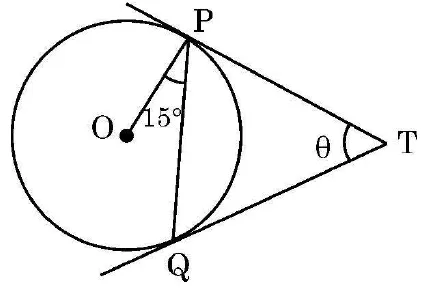
In the adjoining figure, TPTP and TQTQ are tangents drawn to a circle with centre OO. If ∠OPQ=15∘\angle OPQ = 15^\circ and ∠PTQ=θ\angle PTQ = \theta, then find the value of sin⁡2θ\sin 2\theta.

A circle with centre O and two tangents from T on the right, touching the circle at P above and Q below. The chord PQ is drawn, and the angle OPQ is marked 15 degrees.
Solution
θ15°OTPQ∠TPQ = 90° − 15° = 75° = ∠TQP, so θ = 30°
  1. OP⊥TPOP \perp TP, so ∠OPT=90∘\angle OPT = 90^\circ. Then ∠TPQ=∠OPT−∠OPQ=90∘−15∘=75∘\angle TPQ = \angle OPT - \angle OPQ = 90^\circ - 15^\circ = 75^\circ.
  2. Tangents from TT are equal: TP=TQTP = TQ, so ∠TQP=∠TPQ=75∘\angle TQP = \angle TPQ = 75^\circ.
  3. In △TPQ\triangle TPQ: θ=180∘−75∘−75∘=30∘\theta = 180^\circ - 75^\circ - 75^\circ = 30^\circ.
  4. sin⁡2θ=sin⁡60∘=32\sin 2\theta = \sin 60^\circ = \dfrac{\sqrt{3}}{2}.

Answer: sin⁡2θ=32\sin 2\theta = \dfrac{\sqrt{3}}{2}

Common mistake: Answering sin⁡30∘\sin 30^\circ. The question asks for sin⁡2θ\sin 2\theta, with θ=30∘\theta = 30^\circ.

Report an error on this question

Section D: Long answer

4 questions, 5 marks each.

Q32Quadratic Equations5 marks

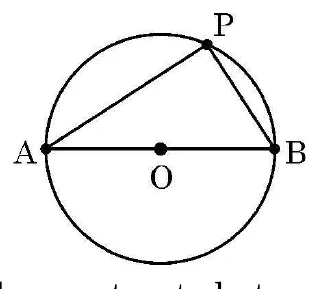
(a) There is a circular park of diameter 6565 m as shown in the following figure, where ABAB is a diameter. An entry gate is to be constructed at a point PP on the boundary of the park such that distance of PP from AA is 3535 m more than the distance of PP from BB. Find distance of point PP from AA and BB respectively.

OR

(b) Find the smallest value of pp for which the quadratic equation x2−2(p+1)x+p2=0x^2 - 2(p + 1)x + p^2 = 0 has real roots. Hence, find the roots of the equation so obtained.

A circle with horizontal diameter AB through the centre O. The point P is on the circle above the diameter, with A to P and P to B joined.
Solution
x + 35x65 mABP(x + 35)² + x² = 65², so x = 25
  1. (a) Let PB=xPB = x m. Then PA=(x+35)PA = (x + 35) m.
  2. ABAB is a diameter, so ∠APB=90∘\angle APB = 90^\circ (angle in a semicircle). By Pythagoras: (x+35)2+x2=652(x + 35)^2 + x^2 = 65^2.
  3. 2x2+70x+1225=42252x^2 + 70x + 1225 = 4225, so x2+35x−1500=0x^2 + 35x - 1500 = 0. Factorise: (x+60)(x−25)=0(x + 60)(x - 25) = 0.
  4. A distance is positive, so x=25x = 25. PB=25PB = 25 m and PA=25+35=60PA = 25 + 35 = 60 m.
  5. (b) Real roots need D≥0D \ge 0: [−2(p+1)]2−4×1×p2≥0[-2(p + 1)]^2 - 4 \times 1 \times p^2 \ge 0, so 4(p2+2p+1)−4p2≥04(p^2 + 2p + 1) - 4p^2 \ge 0 and 8p+4≥08p + 4 \ge 0.
  6. p≥−12p \ge -\dfrac{1}{2}, so the smallest value is p=−12p = -\dfrac{1}{2}.
  7. Put p=−12p = -\dfrac{1}{2}: x2−2(12)x+14=0x^2 - 2\left(\dfrac{1}{2}\right)x + \dfrac{1}{4} = 0, that is x2−x+14=0x^2 - x + \dfrac{1}{4} = 0 or 4x2−4x+1=04x^2 - 4x + 1 = 0. So (2x−1)2=0(2x - 1)^2 = 0 and x=12,12x = \dfrac{1}{2}, \dfrac{1}{2}.

Answer: (a) PA=60PA = 60 m, PB=25PB = 25 m   (b) p=−12p = -\dfrac{1}{2}; roots 12,12\dfrac{1}{2}, \dfrac{1}{2}

Common mistake: In (b), writing "D>0D > 0". Real roots include the equal case, so D≥0D \ge 0, which gives the smallest pp.

Report an error on this question
Q33Triangles5 marks

(a) If a line drawn parallel to one side of triangle intersecting the other two sides in distinct points divides the two sides in the same ratio, then it is parallel to third side. State and prove the converse of the above statement.

OR

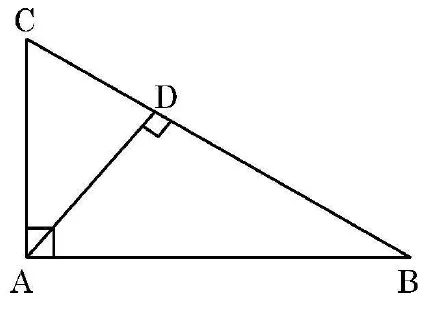
(b) In the adjoining figure, △CAB\triangle CAB is a right triangle, right angled at AA and AD⊥BCAD \perp BC. Prove that △ADB∼△CDA\triangle ADB \sim \triangle CDA. Further, if BC=10BC = 10 cm and CD=2CD = 2 cm, find the length of ADAD.

A right triangle CAB with the right angle at A at the bottom left, C directly above A and B to the right of A. The altitude AD is drawn from A to the hypotenuse CB.
Solution
82AD = 4BCDAAD² = BD × CD = 8 × 2 = 16
  1. (a) As printed, the English statement is already the converse of the Basic Proportionality Theorem (BPT), so "its converse" would be the BPT itself. CBSE's marking scheme notes that the English statement is not correct and gives full marks for a correct attempt: it expects the statement and proof of the BPT. Both are given here.
  2. BPT: if a line is drawn parallel to one side of a triangle to meet the other two sides in distinct points, it divides those sides in the same ratio.
  3. Proof: in △ABC\triangle ABC let DE∥BCDE \parallel BC with DD on ABAB and EE on ACAC. Join BEBE and CDCD. Triangles BDEBDE and CDECDE are on the same base DEDE and between the same parallels, so ar(BDE)=ar(CDE)\text{ar}(BDE) = \text{ar}(CDE).
  4. ar(ADE)ar(BDE)=ADDB\dfrac{\text{ar}(ADE)}{\text{ar}(BDE)} = \dfrac{AD}{DB} (same height from EE) and ar(ADE)ar(CDE)=AEEC\dfrac{\text{ar}(ADE)}{\text{ar}(CDE)} = \dfrac{AE}{EC} (same height from DD). The right sides have equal denominators in area, so ADDB=AEEC\dfrac{AD}{DB} = \dfrac{AE}{EC}.
  5. The statement as worded in the question, "if a line divides two sides in the same ratio, then it is parallel to the third side" (the converse), is proved by contradiction: if DEDE were not parallel to BCBC, draw DE′∥BCDE' \parallel BC. Then AE′E′C=ADDB=AEEC\dfrac{AE'}{E'C} = \dfrac{AD}{DB} = \dfrac{AE}{EC}, which forces E′=EE' = E, so DE∥BCDE \parallel BC.
  6. (b) In △ADB\triangle ADB and △CDA\triangle CDA: ∠ADB=∠CDA=90∘\angle ADB = \angle CDA = 90^\circ. Also ∠DAB=90∘−∠B\angle DAB = 90^\circ - \angle B, and in △CAB\triangle CAB (right angled at AA) ∠C=90∘−∠B\angle C = 90^\circ - \angle B, so ∠DAB=∠C\angle DAB = \angle C.
  7. So △ADB∼△CDA\triangle ADB \sim \triangle CDA (AA). Then ADCD=BDAD\dfrac{AD}{CD} = \dfrac{BD}{AD}, so AD2=BD×CDAD^2 = BD \times CD.
  8. BD=BC−CD=10−2=8BD = BC - CD = 10 - 2 = 8 cm. AD2=8×2=16AD^2 = 8 \times 2 = 16, so AD=4AD = 4 cm.

Answer: (a) BPT and its converse proved   (b) △ADB∼△CDA\triangle ADB \sim \triangle CDA; AD=4AD = 4 cm

Common mistake: In (b), using BD=10BD = 10. BD=BC−CD=8BD = BC - CD = 8 cm.

Report an error on this question
Q34Surface Areas and Volumes5 marks

From one face of a solid cube of side 1414 cm, the largest possible cone is carved out. Find the volume and surface area of the remaining solid. (Use π=227, 5=2.2)\left(\text{Use } \pi = \dfrac{22}{7},\ \sqrt{5} = 2.2\right)

Solution
ABCDbase: d = 14 cm (r = 7)cone, h = 14l = 7√5l = √(14² + 7²) = 7√5 ≈ 15.4 cm
  1. The largest cone on a face of side 1414 cm has base diameter 1414 cm, so r=7r = 7 cm, and height h=14h = 14 cm (the side of the cube).
  2. Slant height l=h2+r2=142+72=245=75=7×2.2=15.4l = \sqrt{h^2 + r^2} = \sqrt{14^2 + 7^2} = \sqrt{245} = 7\sqrt{5} = 7 \times 2.2 = 15.4 cm.
  3. Volume of the remaining solid == cube −- cone =143−13×227×72×14=2744−21563=8232−21563=60763≈2025.33= 14^3 - \dfrac{1}{3} \times \dfrac{22}{7} \times 7^2 \times 14 = 2744 - \dfrac{2156}{3} = \dfrac{8232 - 2156}{3} = \dfrac{6076}{3} \approx 2025.33 cm³.
  4. Surface area == cube −- base circle ++ curved surface of the cone =6×142−227×7×7+227×7×15.4= 6 \times 14^2 - \dfrac{22}{7} \times 7 \times 7 + \dfrac{22}{7} \times 7 \times 15.4.
  5. =1176−154+338.8=1360.8= 1176 - 154 + 338.8 = 1360.8 cm².

Answer: Volume =60763≈2025.33= \dfrac{6076}{3} \approx 2025.33 cm³; surface area =1360.8= 1360.8 cm²

Common mistake: Adding the circle area instead of subtracting it: the circular face of the cube is taken away and replaced by the cone’s curved surface.

Report an error on this question
Q35Statistics5 marks

Following distribution shows the marks of 230 students in a particular subject. If the median marks are 46, then find the values of x and y.

Marks10 – 2020 – 3030 – 4040 – 5050 – 6060 – 7070 – 80
Number of Students1230x65y2518
Solution
102030405060708010203040506070Omarksy12303465462518median 46
Median class 40 – 50; the red bars are the unknown frequencies x = 34 and y = 46.
  1. Total =230= 230: 12+30+x+65+y+25+18=23012 + 30 + x + 65 + y + 25 + 18 = 230, so 150+x+y=230150 + x + y = 230 and x+y=80x + y = 80. … (i)
  2. Cumulative frequencies: 12, 42, 42+x, 107+x, 107+x+y, …12,\ 42,\ 42 + x,\ 107 + x,\ 107 + x + y,\ \dots The median is 4646, which lies in the class 40−5040 - 50. So the median class is 40−5040 - 50, with l=40l = 40, f=65f = 65, cf=42+xcf = 42 + x, h=10h = 10, and N2=115\dfrac{N}{2} = 115.
  3. Median =l+N2−cff×h= l + \dfrac{\frac{N}{2} - cf}{f} \times h: 46=40+115−(42+x)65×1046 = 40 + \dfrac{115 - (42 + x)}{65} \times 10.
  4. 6=(73−x)×10656 = \dfrac{(73 - x) \times 10}{65}, so 73−x=6×6510=3973 - x = \dfrac{6 \times 65}{10} = 39 and x=34x = 34.
  5. From (i): y=80−34=46y = 80 - 34 = 46.

Answer: x=34x = 34 and y=46y = 46

Common mistake: Using cf=42cf = 42 without the xx. The class before 40−5040 - 50 is 30−4030 - 40, whose frequency is xx, so cf=42+xcf = 42 + x.

Report an error on this question

Section E: Case studies

3 case studies, 4 marks each.

Q36Areas Related to Circles4 marks

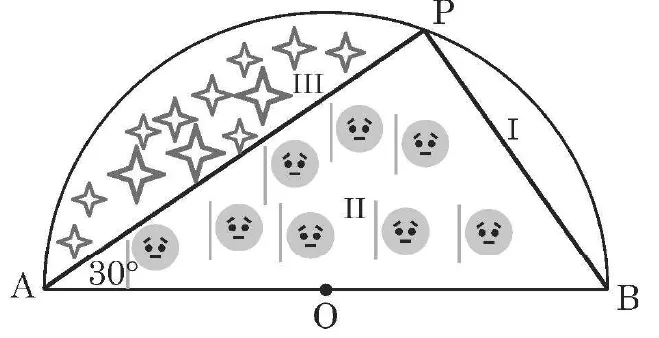
Case study 1. Anurag purchased a farmhouse which is in the form of a semicircle of diameter 70 m. He divides it into three parts by taking a point P on the semicircle in such a way that ∠PAB = 30° as shown in the following figure, where O is the centre of semicircle. In part I, he planted saplings of Mango tree, in part II, he grew tomatoes and in part III, he grew oranges.

Based on given information, answer the following questions.

(i) What is the measure of ∠POA? [1]

(ii) Find the length of wire needed to fence entire piece of land. [1]

(iii) (a) Find the area of region in which saplings of Mango tree are planted. [2]

OR

(iii) (b) Find the length of wire needed to fence the region III. [2]

A semicircular farmhouse with diameter AB through the centre O and a point P on the arc. P is joined to A and B, dividing the semicircle into region I near B, region II the triangle, and region III near A. The angle PAB is 30 degrees.
Solution
30°60°OABPIIIIII∠POB = 2 × 30° = 60°, so ∠POA = 180° − 60° = 120°
  1. (i) The angle at the centre is twice the angle at the circumference on the same arc: ∠POB=2×∠PAB=60∘\angle POB = 2 \times \angle PAB = 60^\circ. So ∠POA=180∘−60∘=120∘\angle POA = 180^\circ - 60^\circ = 120^\circ.
  2. (ii) Radius r=35r = 35 m. Fence the whole land: semicircular arc plus the diameter =πr+2r=227×35+70=110+70=180= \pi r + 2r = \dfrac{22}{7} \times 35 + 70 = 110 + 70 = 180 m.
  3. (iii)(a) Region I is the segment cut off by the chord PBPB. ∠POB=60∘\angle POB = 60^\circ and OP=OBOP = OB, so △OPB\triangle OPB is equilateral. Segment == sector −- triangle =60360×227×352−34×352= \dfrac{60}{360} \times \dfrac{22}{7} \times 35^2 - \dfrac{\sqrt{3}}{4} \times 35^2.
  4. =19253−122534= \dfrac{1925}{3} - \dfrac{1225\sqrt{3}}{4} m² ≈111.89\approx 111.89 m².
  5. (iii)(b) Region III is bounded by the arc APAP (central angle 120∘120^\circ) and the chord APAP. △ABP\triangle ABP is right angled at PP (angle in a semicircle), so AP=ABcos⁡30∘=70×32=353AP = AB\cos 30^\circ = 70 \times \dfrac{\sqrt{3}}{2} = 35\sqrt{3} m.
  6. Arc AP=120360×2×227×35=2203AP = \dfrac{120}{360} \times 2 \times \dfrac{22}{7} \times 35 = \dfrac{220}{3} m. Wire =2203+353= \dfrac{220}{3} + 35\sqrt{3} m ≈133.8\approx 133.8 m.

Answer: (i) 120∘120^\circ   (ii) 180180 m   (iii)(a) 19253−122534≈111.89\dfrac{1925}{3} - \dfrac{1225\sqrt{3}}{4} \approx 111.89 m²   (iii)(b) 2203+353≈133.8\dfrac{220}{3} + 35\sqrt{3} \approx 133.8 m

Common mistake: In (i), answering 60∘60^\circ, which is ∠POB\angle POB. The question asks for ∠POA=120∘\angle POA = 120^\circ.

Report an error on this question
Q37Arithmetic Progressions4 marks

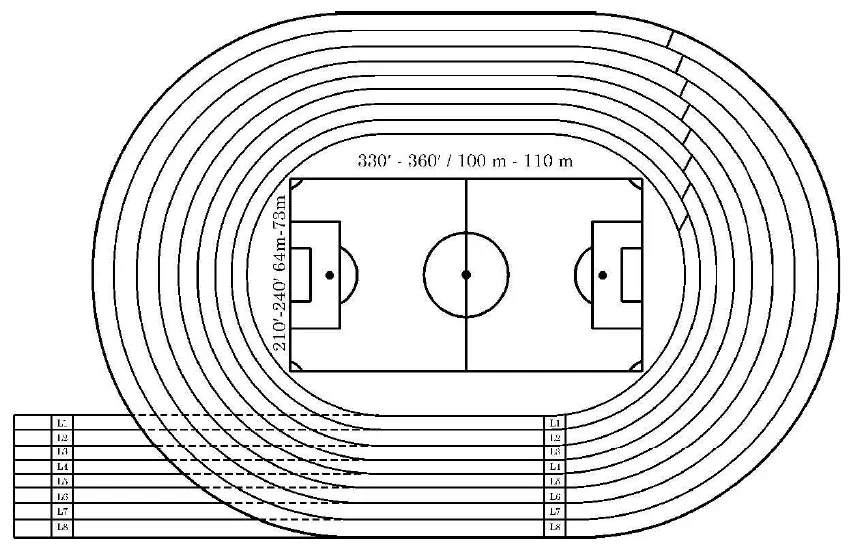
Case study 2. In order to organise Annual Sports Day, a school prepared an eight lane running track with an integrated football field inside the track area as shown below. The length of innermost lane of the track is 400 m and each subsequent lane is 7.6 m longer than the preceding lane.

Based on given information, answer the following questions, using concept of Arithmetic Progression.

(i) What is the length of the 6th lane? [1]

(ii) How long is the 8th lane than that of 4th lane? [1]

(iii) (a) While practicing for a race, a student took one round each in first six lanes. Find the total distance covered by the student. [2]

OR

(iii) (b) A student took one round each in lane 4 to lane 8. Find the total distance covered by the student. [2]

An eight-lane running track around a football field, with the lanes shown as nested ovals.
Solution
123456789390400410420430440450460Olaneyaₙ = 400 + (n − 1) × 7.6400438453.2
  1. The lane lengths form an AP: 400,407.6,415.2,…400, 407.6, 415.2, \dots with a=400a = 400 and d=7.6d = 7.6.
  2. (i) a6=a+5d=400+5×7.6=400+38=438a_6 = a + 5d = 400 + 5 \times 7.6 = 400 + 38 = 438 m.
  3. (ii) a8−a4=(8−4)d=4×7.6=30.4a_8 - a_4 = (8 - 4)d = 4 \times 7.6 = 30.4 m longer.
  4. (iii)(a) S6=62[2×400+5×7.6]=3×838=2514S_6 = \dfrac{6}{2}[2 \times 400 + 5 \times 7.6] = 3 \times 838 = 2514 m.
  5. (iii)(b) Lanes 44 to 88 =S8−S3=82[800+7×7.6]−32[800+2×7.6]=4×853.2−1.5×815.2=3412.8−1222.8=2190= S_8 - S_3 = \dfrac{8}{2}[800 + 7 \times 7.6] - \dfrac{3}{2}[800 + 2 \times 7.6] = 4 \times 853.2 - 1.5 \times 815.2 = 3412.8 - 1222.8 = 2190 m.

Answer: (i) 438438 m   (ii) 30.430.4 m   (iii)(a) 25142514 m   (iii)(b) 21902190 m

Common mistake: In (iii)(b), computing S8−S4S_8 - S_4. That leaves out lane 44. Lanes 44 to 88 are S8−S3S_8 - S_3.

Report an error on this question
Q38Applications of Trigonometry4 marks

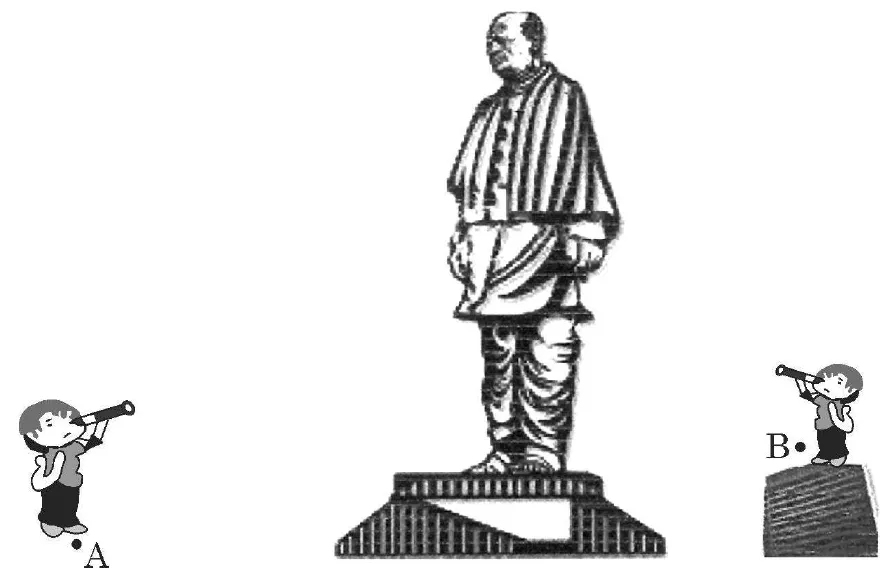
Case study 3. The Statue of Unity situated in Gujarat is the world’s largest Statue which stands over a 58 m high base. As part of the project, a student constructed an inclinometer and wishes to find the height of Statue of Unity using it. He noted following observations from two places:

Situation – I: The angle of elevation of the top of Statue from Place A which is 80√3 m away from the base of the Statue is found to be 60°.

Situation – II: The angle of elevation of the top of Statue from a Place B which is 40 m above the ground is found to be 30° and entire height of the Statue including the base is found to be 240 m.

Based on given information, answer the following questions:

(i) Represent the Situation – I with the help of a diagram. [1]

(ii) Represent the Situation – II with the help of a diagram. [1]

(iii) (a) Calculate the height of Statue excluding the base and also find the height including the base with the help of Situation – I. [2]

OR

(iii) (b) Find the horizontal distance of point B (Situation – II) from the Statue and the value of tan α, where α is the angle of elevation of top of base of the Statue from point B. [2]

A drawing of the Statue of Unity on its base, with an observer at place A on the ground on the left and another observer at place B, standing on a raised platform, on the right.
Solution
60°80√3 m240 mAGTKbase 58 m (K); statue alone = 240 − 58 = 182 m
30°200 mBGTKBH = 200√3 mtan α = 18 / 200√3 = 3√3/100
  1. (i), (ii) The two situations are drawn above: in each a right triangle is formed by the observer, the foot of the statue and the top of the statue.
  2. (iii)(a) Situation I: tan⁡60∘=height803\tan 60^\circ = \dfrac{\text{height}}{80\sqrt{3}}, so the height of the top above the ground =803×3=240= 80\sqrt{3} \times \sqrt{3} = 240 m. This is the height including the base.
  3. The base is 5858 m high, so the height of the statue excluding the base =240−58=182= 240 - 58 = 182 m.
  4. (iii)(b) Situation II: BB is 4040 m above the ground, so the top of the statue is 240−40=200240 - 40 = 200 m above BB. tan⁡30∘=200d=13\tan 30^\circ = \dfrac{200}{d} = \dfrac{1}{\sqrt{3}}, so the horizontal distance d=2003d = 200\sqrt{3} m.
  5. The top of the base is 5858 m high, which is 58−40=1858 - 40 = 18 m above BB. tan⁡α=182003=91003=33100\tan\alpha = \dfrac{18}{200\sqrt{3}} = \dfrac{9}{100\sqrt{3}} = \dfrac{3\sqrt{3}}{100}.

Answer: (iii)(a) 182182 m excluding the base, 240240 m including it   (iii)(b) 2003200\sqrt{3} m and tan⁡α=33100\tan\alpha = \dfrac{3\sqrt{3}}{100}

Common mistake: In (iii)(b), using 240240 or 5858 directly. The observer is 4040 m up, so measure the heights from BB: 200200 m and 1818 m.

Report an error on this question

Questions are from the official CBSE paper. Figures are described in words; see the PDF for the originals. Solutions are written by CogniGuru.

Revise this paper in 1 minute a chapter

Each chapter below is what the paper tested, with a one-minute animated lesson on the idea behind it.

Stuck on a step in any solution?

The CogniGuru AI tutor explains any doubt one minute at a time, in English or Hindi. Join the waitlist.

Mock quiz: 5 questions from this paper

Five real questions from this paper, one each from five chapters. About 2 minutes. See how much you know and where you stand among other students. Attempt free, with no login; log in only for your ranking and full report.

Question 1 of 5 · Q1 of the paperReal Numbers

0.4\sqrt{0.4} is a/an

0 of 5 answered

Related papers

Common questions

Are these the official CBSE Class 10 Maths Standard 2025 questions?
Yes. The questions are from the official Mathematics (Standard) paper (set 30/6/1) that CBSE published after the March 2025 board exam. The solutions are written by CogniGuru and checked against the answer key CBSE published for this paper code.
Can I download the CBSE Class 10 Maths Standard 2025 question paper PDF?
Yes, the official paper PDF is free to download from this page, and so are our step-by-step solutions as a PDF. No login is needed to download either or to read the solutions.
Do all sets of the paper have the same questions?
No. CBSE sets several versions of each paper, with the same blueprint and similar questions in a different order and sometimes with different numbers. This page covers set 30/6/1.
How does the quiz work, and what does “where you stand” mean?
It is a mock quiz of 5 real multiple-choice questions from this paper, scored automatically in about 2 minutes. Your score is compared, anonymously, with other students who took the same quiz. Only the score is stored with the comparison, never your name or number.

Source

CBSE question paper archive, Class X, 2025 (Mathematics (Standard), set 30/6/1)
PDF