CBSE · Class 10 · Mathematics (Basic) · Free

CBSE Class 10 Maths Basic 2024 Question Paper (Set 430/3/1) with Solutions

The official board paper (Q.P. Code 430/3/1, Series CD1BA). Free paper PDF and step-by-step solutions (also as a PDF to download) written by CogniGuru and checked against CBSE’s answer key. See the paper’s main topics in 1 minute, then quiz yourself to see how much you know and where you stand.

No login to download or read the solutions. Login only to see your quiz report in full.

Board
CBSE
Class
10
Subject
Maths Basic (241)
Year
2024
Set code
430/3/1
Max marks
80
Duration
3 hours
Questions
38 (Sections A to E)
Source
Official CBSE paper
Exam date
March 2024

Paper preview

Three pages of the official paper. Download the PDF for all 24.
  • Cover page of the CBSE Class 10 Maths Basic 2024 paper, set 430/3/1

    Cover page

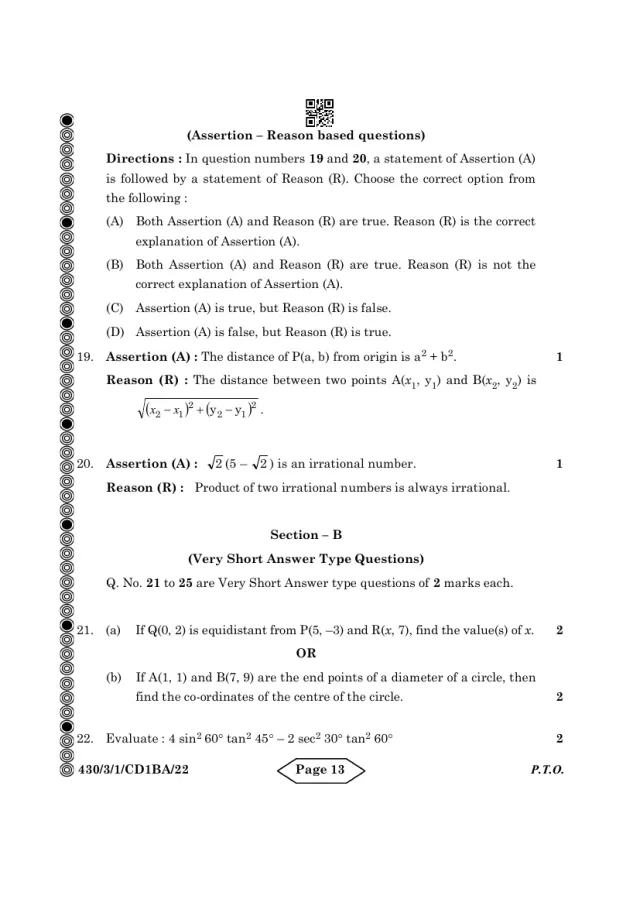
  • Section B of the CBSE Class 10 Maths Basic 2024 paper, set 430/3/1

    Section B

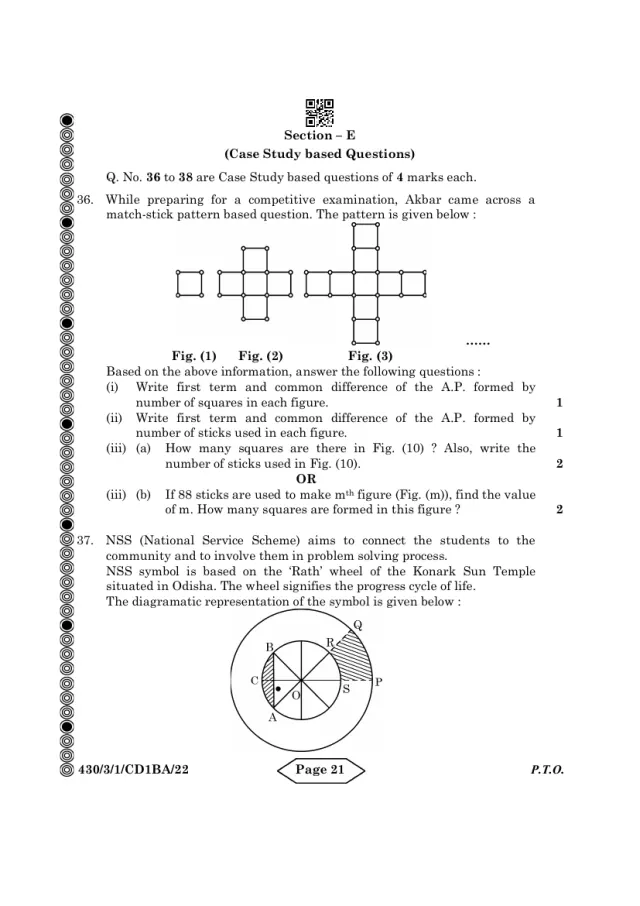
  • A case study with its figure from the CBSE Class 10 Maths Basic 2024 paper, set 430/3/1

    Case study

The main topics of this paper, in 1 minute

Your tutor walks you through the paper before you attempt it: the marks, the key ideas, the time plan and the traps.

1-minute paper analysis

With your tutor, in her voice

The main topics of this paper, in about a minute

A short, animated walk through the paper: how it is built, where the marks come from, the four ideas that matter most, how to plan your three hours, and the traps to avoid.

  1. 1The paper at a glance
  2. 2Where the marks come from
  3. 3Four ideas that keep paying off
  4. 4Plan your three hours
  5. 5Four traps to avoid

Sound on for the voice. Captions are shown, and you can mute any time.

Step-by-step solutions

Try each question first, then open its solution. Tap a number to jump.

Download solutions (PDF)

Section A: Multiple choice

20 questions, 1 mark each. MCQs (Q1 to Q18) and assertion-reason (Q19, Q20).

Q1Circles1 mark

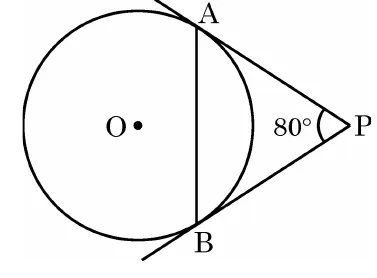
In the given figure, tangents PAPA and PBPB drawn from PP to circle are inclined to each other at an angle of 80∘80^\circ. The measure of ∠PAB\angle PAB is:

A circle with centre O on the left and the outside point P on the right. Tangents PA and PB touch the circle at A (top) and B (bottom), the angle at P is marked 80 degrees and the chord AB is drawn.
  1. (A)80∘80^\circ
  2. (B)60∘60^\circ
  3. (C)50∘50^\circ
  4. (D)40∘40^\circ
Solution · answer (C)
80°OPAB50°PA = PB → ∠PAB = (180° − 80°)/2 = 50°
  1. PA=PBPA = PB (tangents from PP), so △PAB\triangle PAB is isosceles and ∠PAB=180∘−80∘2=50∘\angle PAB = \dfrac{180^\circ - 80^\circ}{2} = 50^\circ.

Answer: (C) 50∘50^\circ

Report an error on this question
Q2Quadratic Equations1 mark

The value(s) of kk for which the quadratic equation 5x2−9kx+5=05x^2 - 9kx + 5 = 0 has real and equal roots, is/are:

  1. (A)−109\dfrac{-10}{9}
  2. (B)±910\pm\dfrac{9}{10}
  3. (C)109\dfrac{10}{9}
  4. (D)±109\pm\dfrac{10}{9}
Solution · answer (D)
  1. Equal roots need D=(9k)2−4(5)(5)=81k2−100=0D = (9k)^2 - 4(5)(5) = 81k^2 - 100 = 0, so k2=10081k^2 = \dfrac{100}{81} and k=±109k = \pm\dfrac{10}{9}.

Answer: (D) ±109\pm\dfrac{10}{9}

Report an error on this question
Q3Coordinate Geometry1 mark

The distance between the points A(−1,5)A(-1, 5) and B(6,−2)B(6, -2) is:

  1. (A)272\sqrt{7}
  2. (B)727\sqrt{2}
  3. (C)49
  4. (D)14
Solution · answer (B)
  1. d=(6+1)2+(−2−5)2=49+49=72d = \sqrt{(6 + 1)^2 + (-2 - 5)^2} = \sqrt{49 + 49} = 7\sqrt{2}.

Answer: (B) 727\sqrt{2}

Report an error on this question
Q4Polynomials1 mark

A quadratic polynomial whose zeroes are 33 and −2-2, is:

  1. (A)x2−x−6x^2 - x - 6
  2. (B)x2+x−6x^2 + x - 6
  3. (C)2x2−x−122x^2 - x - 12
  4. (D)x2+x+6x^2 + x + 6
Solution · answer (A)
  1. Sum =3+(−2)=1= 3 + (-2) = 1 and product =−6= -6. The polynomial is x2−x−6x^2 - x - 6. (Option (C) has the same zeroes only when divided by 22: 2x2−x−122x^2 - x - 12 has zeroes 1±974\dfrac{1 \pm \sqrt{97}}{4}, not 33 and −2-2.)

Answer: (A) x2−x−6x^2 - x - 6

Report an error on this question
Q5Linear Equations1 mark

The lines represented by linear equations x=ax = a and y=by = b (a≠ba \neq b) are:

  1. (A)intersecting at (a,b)(a, b)
  2. (B)intersecting at (b,a)(b, a)
  3. (C)parallel
  4. (D)coincident
Solution · answer (A)
  1. x=ax = a is a vertical line and y=by = b is a horizontal line. They meet at the single point with x=ax = a and y=by = b, that is (a,b)(a, b).

Answer: (A) intersecting at (a,b)(a, b)

Report an error on this question
Q6Triangles1 mark

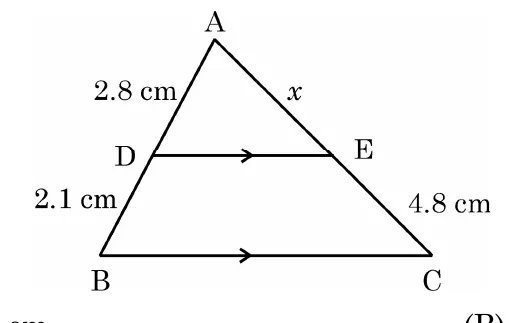
If in the given figure, DE∥BCDE \parallel BC. If AD=2.8AD = 2.8 cm, DB=2.1DB = 2.1 cm and EC=4.8EC = 4.8 cm, then the value of xx is:

A triangle ABC with A at the top and DE parallel to the base BC. AD is 2.8 cm, DB is 2.1 cm, AE is x and EC is 4.8 cm.
  1. (A)3.6 cm
  2. (B)2.4 cm
  3. (C)6.4 cm
  4. (D)4.8 cm
Solution · answer (C)
2.82.1x = 6.44.8ABCDEAD/DB = AE/EC → 2.8/2.1 = x/4.8 → x = 6.4 cm
  1. DE∥BCDE \parallel BC, so ADDB=AEEC\dfrac{AD}{DB} = \dfrac{AE}{EC}: 2.82.1=x4.8\dfrac{2.8}{2.1} = \dfrac{x}{4.8}, so x=2.8×4.82.1=6.4x = \dfrac{2.8 \times 4.8}{2.1} = 6.4 cm.

Answer: (C) 6.4 cm

Report an error on this question
Q7Trigonometry1 mark

In a right-angled triangle ABCABC, ∠A=90∘\angle A = 90^\circ and AB=ACAB = AC. The value of sin⁡C\sin C is:

  1. (A)0
  2. (B)32\dfrac{\sqrt{3}}{2}
  3. (C)12\dfrac{1}{2}
  4. (D)12\dfrac{1}{\sqrt{2}}
Solution · answer (D)
  1. AB=ACAB = AC makes the triangle isosceles right-angled, so ∠C=45∘\angle C = 45^\circ and sin⁡C=12\sin C = \dfrac{1}{\sqrt{2}}.

Answer: (D) 12\dfrac{1}{\sqrt{2}}

Report an error on this question
Q8Probability1 mark

A die is thrown once. The probability of getting a number less than 6 is:

  1. (A)0
  2. (B)56\dfrac{5}{6}
  3. (C)16\dfrac{1}{6}
  4. (D)1
Solution · answer (B)
  1. The numbers 11 to 55 are favourable: P=56P = \dfrac{5}{6}.

Answer: (B) 56\dfrac{5}{6}

Report an error on this question
Q9Circles1 mark

From an external point P, a tangent PA is drawn to a circle. The number of tangents through P parallel to PA is:

  1. (A)2
  2. (B)more than 2
  3. (C)1
  4. (D)0
Solution · answer (D)
  1. A tangent through PP parallel to PAPA would have to be a different line through PP with the same direction as PAPA. There is no such line, since the only line through PP with that direction is PAPA itself. So there are 00.

Answer: (D) 0

Report an error on this question
Q10Surface Areas and Volumes1 mark

If the volume of a sphere is 1121\dfrac{11}{21} cm³, then the radius of the sphere is:

  1. (A)2 cm
  2. (B)4 cm
  3. (C)12\dfrac{1}{2} cm
  4. (D)14\dfrac{1}{4} cm
Solution · answer (C)
  1. 43×227×r3=8821r3=1121\dfrac{4}{3} \times \dfrac{22}{7} \times r^3 = \dfrac{88}{21}r^3 = \dfrac{11}{21}, so r3=18r^3 = \dfrac{1}{8} and r=12r = \dfrac{1}{2} cm.

Answer: (C) 12\dfrac{1}{2} cm

Report an error on this question
Q11Polynomials1 mark

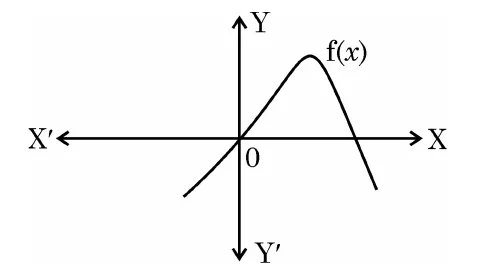
In the given figure, graph of a polynomial f(x)f(x) is shown. The number of zeroes of polynomial f(x)f(x) is:

A curve that crosses the x-axis near the origin going up, rises to a peak above the axis, and comes back down to cross the x-axis again on the right.
  1. (A)3
  2. (B)1
  3. (C)0
  4. (D)2
Solution · answer (D)
  1. The zeroes are the points where the graph meets the xx-axis. It crosses it at 22 points.

Answer: (D) 2

Report an error on this question
Q12Areas Related to Circles1 mark

In the given figure, two concentric circles of radii 55 cm and 33 cm have their centre OO. OABOAB is a sector of outer circle making an angle of 60∘60^\circ at the centre while OCDOCD is the sector of smaller circle. The area of the shaded region is:
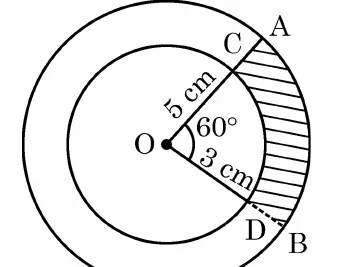
Two concentric circles with centre O. Two radii OA and OB, 60 degrees apart, run out to the outer circle and the shaded band lies between the inner circle arc CD and the outer arc AB.
  1. (A)7π2\dfrac{7\pi}{2} cm²
  2. (B)8π3\dfrac{8\pi}{3} cm²
  3. (C)25π6\dfrac{25\pi}{6} cm²
  4. (D)3π2\dfrac{3\pi}{2} cm²
Solution · answer (B)
60°OABCDarea = 60/360 × π(5² − 3²) = 16π/6 = 8π/3 cm²
  1. Area =60360π(52−32)=π6×16=8π3= \dfrac{60}{360}\pi(5^2 - 3^2) = \dfrac{\pi}{6} \times 16 = \dfrac{8\pi}{3} cm².

Answer: (B) 8π3\dfrac{8\pi}{3} cm²

Report an error on this question
Q13Statistics1 mark

If the mean and median of a data are 10 and 11 respectively, then mode of the data is:

  1. (A)12
  2. (B)8
  3. (C)20
  4. (D)13
Solution · answer (D)
  1. Mode=3 Median−2 Mean=33−20=13\text{Mode} = 3\,\text{Median} - 2\,\text{Mean} = 33 - 20 = 13.

Answer: (D) 13

Report an error on this question
Q14Probability1 mark

Two fair coins are tossed together. The probability of getting 2 heads, is:

  1. (A)12\dfrac{1}{2}
  2. (B)34\dfrac{3}{4}
  3. (C)14\dfrac{1}{4}
  4. (D)38\dfrac{3}{8}
Solution · answer (C)
  1. The outcomes are HH,HT,TH,TTHH, HT, TH, TT; only HHHH has 22 heads. P=14P = \dfrac{1}{4}.

Answer: (C) 14\dfrac{1}{4}

Report an error on this question
Q15Trigonometry1 mark

If cos⁡A=12\cos A = \dfrac{1}{2}, then tan⁡A\tan A is equal to:

  1. (A)13\dfrac{1}{\sqrt{3}}
  2. (B)3\sqrt{3}
  3. (C)3
  4. (D)32\dfrac{3}{2}
Solution · answer (B)
  1. cos⁡A=12\cos A = \dfrac{1}{2} gives A=60∘A = 60^\circ and tan⁡60∘=3\tan 60^\circ = \sqrt{3}.

Answer: (B) 3\sqrt{3}

Report an error on this question
Q16Surface Areas and Volumes1 mark

From a solid cube of side 14 cm, a sphere of maximum diameter is carved out. The radius of sphere is:

  1. (A)7 cm
  2. (B)14 cm
  3. (C)72\dfrac{7}{2} cm
  4. (D)14\sqrt{14} cm
Solution · answer (A)
  1. The biggest sphere has a diameter equal to the edge of the cube, 1414 cm, so the radius is 77 cm.

Answer: (A) 7 cm

Report an error on this question
Q17Arithmetic Progressions1 mark

The common difference of an A.P. whose nthn^{\text{th}} term is given by an=5n−1a_n = 5n - 1, is:

  1. (A)1
  2. (B)6
  3. (C)5
  4. (D)4
Solution · answer (C)
  1. an+1−an=(5(n+1)−1)−(5n−1)=5a_{n+1} - a_n = (5(n + 1) - 1) - (5n - 1) = 5.

Answer: (C) 5

Report an error on this question
Q18Statistics1 mark

If for a distribution, ∑1nfixi=132+5p\sum_{1}^{n} f_ix_i = 132 + 5p, ∑1nfi=20\sum_{1}^{n} f_i = 20 and the mean of the distribution is 8.18.1, then the value of pp is:

  1. (A)3
  2. (B)6
  3. (C)4
  4. (D)5
Solution · answer (B)
  1. Mean =132+5p20=8.1= \dfrac{132 + 5p}{20} = 8.1, so 132+5p=162132 + 5p = 162 and p=6p = 6.

Answer: (B) 6

Report an error on this question
Q19Coordinate Geometry1 mark

Assertion (A): The distance of P(a,b)P(a, b) from origin is a2+b2a^2 + b^2.

Reason (R): The distance between two points A(x1,y1)A(x_1, y_1) and B(x2,y2)B(x_2, y_2) is (x2−x1)2+(y2−y1)2\sqrt{(x_2 - x_1)^2 + (y_2 - y_1)^2}.

  1. (A)Both A and R are true and R is the correct explanation of A
  2. (B)Both A and R are true, R is not the correct explanation of A
  3. (C)A is true, but R is false
  4. (D)A is false, but R is true
Solution · answer (D)
  1. (R) This is the distance formula. True.
  2. (A) Using it with the origin (0,0)(0, 0), the distance is a2+b2\sqrt{a^2 + b^2}, not a2+b2a^2 + b^2. False.

Answer: (D) A is false, but R is true

Report an error on this question
Q20Real Numbers1 mark

Assertion (A): 2(5−2)\sqrt{2}(5 - \sqrt{2}) is an irrational number.

Reason (R): Product of two irrational numbers is always irrational.

  1. (A)Both A and R are true and R is the correct explanation of A
  2. (B)Both A and R are true, R is not the correct explanation of A
  3. (C)A is true, but R is false
  4. (D)A is false, but R is true
Solution · answer (C)
  1. (A) 2(5−2)=52−2\sqrt{2}(5 - \sqrt{2}) = 5\sqrt{2} - 2, which is irrational (an irrational number minus a rational one). True.
  2. (R) 2×2=2\sqrt{2} \times \sqrt{2} = 2 is rational, so the product of two irrationals need not be irrational. False.

Answer: (C) A is true, but R is false

Report an error on this question

Section B: Very short answer

5 questions, 2 marks each.

Q21Coordinate Geometry2 marks

(a) If Q(0,2)Q(0, 2) is equidistant from P(5,−3)P(5, -3) and R(x,7)R(x, 7), find the value(s) of xx.

OR

(b) If A(1,1)A(1, 1) and B(7,9)B(7, 9) are the end points of a diameter of a circle, then find the co-ordinates of the centre of the circle.

Solution
  1. (a) QP=QRQP = QR: (0−5)2+(2+3)2=(0−x)2+(2−7)2(0 - 5)^2 + (2 + 3)^2 = (0 - x)^2 + (2 - 7)^2, so 50=x2+2550 = x^2 + 25 and x2=25x^2 = 25, giving x=5x = 5 or x=−5x = -5 (the key lists x=5x = 5).
  2. (b) The centre is the mid-point of the diameter: (1+72,1+92)=(4,5)\left(\dfrac{1 + 7}{2}, \dfrac{1 + 9}{2}\right) = (4, 5).

Answer: (a) x=±5x = \pm 5   (b) (4,5)(4, 5)

Report an error on this question
Q22Trigonometry2 marks

Evaluate: 4sin⁡260∘tan⁡245∘−2sec⁡230∘tan⁡260∘4\sin^2 60^\circ \tan^2 45^\circ - 2\sec^2 30^\circ \tan^2 60^\circ.

Solution
  1. sin⁡60∘=32\sin 60^\circ = \dfrac{\sqrt{3}}{2}, tan⁡45∘=1\tan 45^\circ = 1, sec⁡30∘=23\sec 30^\circ = \dfrac{2}{\sqrt{3}}, tan⁡60∘=3\tan 60^\circ = \sqrt{3}.
  2. 4×34×1−2×43×3=3−8=−54 \times \dfrac{3}{4} \times 1 - 2 \times \dfrac{4}{3} \times 3 = 3 - 8 = -5.

Answer: −5-5

Report an error on this question
Q23Real Numbers2 marks

(a) Prove that −7−23-7 - 2\sqrt{3} is an irrational number, given that 3\sqrt{3} is an irrational number.

OR

(b) Explain why (7×11×13+2×11)(7 \times 11 \times 13 + 2 \times 11) is not a prime number.

Solution
  1. (a) Suppose x=−7−23x = -7 - 2\sqrt{3} is rational. Then 3=−7−x2\sqrt{3} = \dfrac{-7 - x}{2} is rational, which contradicts the given fact. So −7−23-7 - 2\sqrt{3} is irrational.
  2. (b) 7×11×13+2×11=11(7×13+2)=11×937 \times 11 \times 13 + 2 \times 11 = 11(7 \times 13 + 2) = 11 \times 93. It has more than two factors, so it is not prime.

Answer: (a) proved   (b) =11×93= 11 \times 93, not prime

Report an error on this question
Q24Coordinate Geometry2 marks

Find the ratio in which the yy-axis divides the line segment joining the points A(5,−6)A(5, -6) and B(−1,−4)B(-1, -4). Also, find the point of intersection.

Solution
  1. A point on the yy-axis has x=0x = 0. Let it divide ABAB in the ratio k:1k : 1: −k+5k+1=0\dfrac{-k + 5}{k + 1} = 0, so k=5k = 5. The ratio is 5:15 : 1.
  2. y=5(−4)+1(−6)6=−266=−133y = \dfrac{5(-4) + 1(-6)}{6} = -\dfrac{26}{6} = -\dfrac{13}{3}. The point is (0,−133)\left(0, -\dfrac{13}{3}\right).

Answer: Ratio 5:15 : 1; point (0,−133)\left(0, -\dfrac{13}{3}\right)

Report an error on this question
Q25Probability2 marks

There are 80 cards numbered from 1 to 80. One card is drawn at random from them. Find the probability that the number on the selected card is not divisible by 8.

Solution
  1. Multiples of 88 up to 8080: 8,16,…,808, 16, \dots, 80, which is 1010 cards. P(divisible by 8)=1080=18P(\text{divisible by } 8) = \dfrac{10}{80} = \dfrac{1}{8}.
  2. P(not divisible by 8)=1−18=78P(\text{not divisible by } 8) = 1 - \dfrac{1}{8} = \dfrac{7}{8}.

Answer: 78\dfrac{7}{8}

Report an error on this question

Section C: Short answer

6 questions, 3 marks each.

Q26Real Numbers3 marks

Find LCM and HCF of two numbers 336 and 54, using prime-factorisation method.

Solution
  1. 336=24×3×7336 = 2^4 \times 3 \times 7 and 54=2×3354 = 2 \times 3^3.
  2. HCF =2×3=6= 2 \times 3 = 6 and LCM =24×33×7=3024= 2^4 \times 3^3 \times 7 = 3024. (Check: 6×3024=18144=336×546 \times 3024 = 18144 = 336 \times 54 ✓.)

Answer: HCF =6= 6, LCM =3024= 3024

Report an error on this question
Q27Quadratic Equations3 marks

The altitude of a right-angled triangle is 77 cm less than its base. If its hypotenuse is 1717 cm long, then (a) represent the above information in the form of a quadratic equation; (b) find the length of the sides of the triangle.

Solution
  1. (a) Let the base be xx cm, so the altitude is (x−7)(x - 7) cm. Pythagoras: 172=x2+(x−7)217^2 = x^2 + (x - 7)^2, so 2x2−14x−240=02x^2 - 14x - 240 = 0, that is x2−7x−120=0x^2 - 7x - 120 = 0.
  2. (b) (x−15)(x+8)=0(x - 15)(x + 8) = 0. A length cannot be negative, so x=15x = 15. The sides other than the hypotenuse are 1515 cm and 88 cm.

Answer: (a) x2−7x−120=0x^2 - 7x - 120 = 0   (b) 1515 cm and 88 cm

Report an error on this question
Q28Surface Areas and Volumes3 marks

(a) A vessel is in the form of a hollow hemisphere surmounted by a hollow cylinder. The diameter of the hemisphere is 1414 cm and the total height of the vessel is 1313 cm. Find the inner surface area of the vessel.

OR

(b) A solid toy is in the form of a hemisphere surmounted by a right circular cone. The height of the cone is 22 cm and the diameter of the base is 44 cm. Determine the volume of the toy.

Solution
  1. (a) r=7r = 7 cm. The height of the cylinder is 13−7=613 - 7 = 6 cm. Inner surface area =2πrh+2πr2=2×227×7×6+2×227×7×7=264+308=572= 2\pi rh + 2\pi r^2 = 2 \times \dfrac{22}{7} \times 7 \times 6 + 2 \times \dfrac{22}{7} \times 7 \times 7 = 264 + 308 = 572 cm².
  2. (b) r=2r = 2 cm. Volume =13πr2h+23πr3=13×227×4×2+23×227×8=17621+35221=1767= \dfrac{1}{3}\pi r^2 h + \dfrac{2}{3}\pi r^3 = \dfrac{1}{3} \times \dfrac{22}{7} \times 4 \times 2 + \dfrac{2}{3} \times \dfrac{22}{7} \times 8 = \dfrac{176}{21} + \dfrac{352}{21} = \dfrac{176}{7} cm³ ≈25.14\approx 25.14 cm³.

Answer: (a) 572572 cm²   (b) 1767≈25.14\dfrac{176}{7} \approx 25.14 cm³

Report an error on this question
Q29Polynomials3 marks

Find the zeroes of the quadratic polynomial 5x2+3x−25x^2 + 3x - 2 and verify the relationship between the zeroes and the co-efficients.

Solution
  1. 5x2+3x−2=(5x−2)(x+1)5x^2 + 3x - 2 = (5x - 2)(x + 1), so the zeroes are 25\dfrac{2}{5} and −1-1.
  2. Sum =−1+25=−35=−35= -1 + \dfrac{2}{5} = -\dfrac{3}{5} = -\dfrac{3}{5} ✓. Product =−1×25=−25=−25= -1 \times \dfrac{2}{5} = -\dfrac{2}{5} = \dfrac{-2}{5} ✓.

Answer: Zeroes 25\dfrac{2}{5} and −1-1; relations verified

Report an error on this question
Q30Triangles3 marks

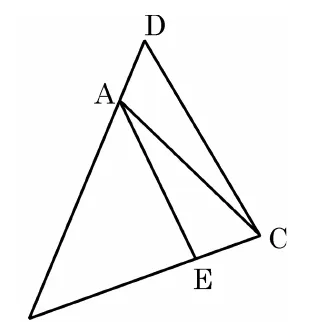
In the given figure, ∠ABC=∠ACB\angle ABC = \angle ACB and BCBE=BDAC\dfrac{BC}{BE} = \dfrac{BD}{AC}. Show that △ABE∼△DBC\triangle ABE \sim \triangle DBC and AE∥DCAE \parallel DC.

A triangle ABC with B at the bottom left and C on the right. D is above A, joined to C and B, and E is on BC with AE drawn.
Solution
  1. ∠ABC=∠ACB\angle ABC = \angle ACB, so AC=ABAC = AB. The given BCBE=BDAC\dfrac{BC}{BE} = \dfrac{BD}{AC} becomes BCBE=BDAB\dfrac{BC}{BE} = \dfrac{BD}{AB}, that is BEAB=BCBD\dfrac{BE}{AB} = \dfrac{BC}{BD}.
  2. In △ABE\triangle ABE and △DBC\triangle DBC: ∠B\angle B is common and the sides including it are proportional, ABDB=BEBC\dfrac{AB}{DB} = \dfrac{BE}{BC}. So △ABE∼△DBC\triangle ABE \sim \triangle DBC by SAS.
  3. Then ∠BAE=∠BDC\angle BAE = \angle BDC, which are corresponding angles for AEAE and DCDC with the transversal BDBD. So AE∥DCAE \parallel DC.

Answer: Shown

Report an error on this question
Q31Trigonometry3 marks

(a) Prove that (sin⁡θ+cosec⁡θ)2+(cos⁡θ+sec⁡θ)2=7+tan⁡2θ+cot⁡2θ(\sin\theta + \operatorname{cosec}\theta)^2 + (\cos\theta + \sec\theta)^2 = 7 + \tan^2\theta + \cot^2\theta.

OR

(b) If cos⁡A=513\cos A = \dfrac{5}{13}, then verify that cos⁡A1−tan⁡A+sin⁡A1−cot⁡A=cos⁡A+sin⁡A\dfrac{\cos A}{1 - \tan A} + \dfrac{\sin A}{1 - \cot A} = \cos A + \sin A.

Solution
  1. (a) LHS =sin⁡2θ+cosec⁡2θ+2sin⁡θcosec⁡θ+cos⁡2θ+sec⁡2θ+2cos⁡θsec⁡θ= \sin^2\theta + \operatorname{cosec}^2\theta + 2\sin\theta\operatorname{cosec}\theta + \cos^2\theta + \sec^2\theta + 2\cos\theta\sec\theta. With sin⁡θcosec⁡θ=cos⁡θsec⁡θ=1\sin\theta\operatorname{cosec}\theta = \cos\theta\sec\theta = 1: =1+(1+cot⁡2θ)+2+(1+tan⁡2θ)+2=7+tan⁡2θ+cot⁡2θ= 1 + (1 + \cot^2\theta) + 2 + (1 + \tan^2\theta) + 2 = 7 + \tan^2\theta + \cot^2\theta.
  2. (b) cos⁡A=513\cos A = \dfrac{5}{13} gives sin⁡A=1213\sin A = \dfrac{12}{13}, tan⁡A=125\tan A = \dfrac{12}{5} and cot⁡A=512\cot A = \dfrac{5}{12}.
  3. LHS =5/131−12/5+12/131−5/12=5/13−7/5+12/137/12=−2591+14491=11991=1713= \dfrac{5/13}{1 - 12/5} + \dfrac{12/13}{1 - 5/12} = \dfrac{5/13}{-7/5} + \dfrac{12/13}{7/12} = -\dfrac{25}{91} + \dfrac{144}{91} = \dfrac{119}{91} = \dfrac{17}{13}. RHS =513+1213=1713= \dfrac{5}{13} + \dfrac{12}{13} = \dfrac{17}{13} ✓.

Answer: (a) proved   (b) verified, both sides 1713\dfrac{17}{13}

Report an error on this question

Section D: Long answer

4 questions, 5 marks each.

Q32Statistics5 marks

Consider the following distribution of hourly wages of 50 workers of a factory:

Find the mean and the median of the above data.

Hourly wages (in ₹)100–120120–140140–160160–180180–200
Number of workers12148610
Solution
  1. N=50N = 50. Class marks: 110,130,150,170,190110, 130, 150, 170, 190. Take a=150a = 150, h=20h = 20: u=−2,−1,0,1,2u = -2, -1, 0, 1, 2. ∑fiui=−24−14+0+6+20=−12\sum f_iu_i = -24 - 14 + 0 + 6 + 20 = -12.
  2. Mean =150+−1250×20=150−4.8=145.2= 150 + \dfrac{-12}{50} \times 20 = 150 - 4.8 = 145.2.
  3. Cumulative frequencies: 12,26,34,40,5012, 26, 34, 40, 50. N2=25\dfrac{N}{2} = 25 lies in 120−140120 - 140: l=120l = 120, cf=12cf = 12, f=14f = 14, h=20h = 20. Median =120+25−1214×20=120+18.57≈138.57= 120 + \dfrac{25 - 12}{14} \times 20 = 120 + 18.57 \approx 138.57.

Answer: Mean =145.2= 145.2; median ≈138.57\approx 138.57

Report an error on this question
Q33Circles5 marks

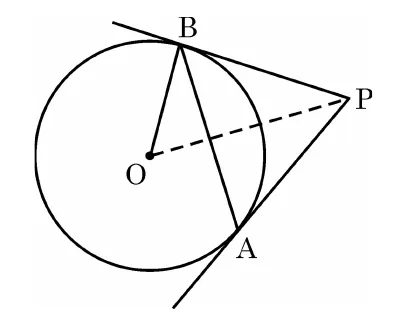
(a) In the given figure, ABAB is chord of length 66 cm of a circle of radius 55 cm. The tangents at AA and BB intersect at a point PP. Find the length of PBPB.

OR

(b) Prove that the parallelogram circumscribing a circle is a rhombus. Also, find area of the rhombus, if radius of the circle is 33 cm and length of one side of the rhombus is 1010 cm.

A circle with centre O and a chord AB. The tangents at A and B meet at P on the right, and the segments OP and OB are drawn dotted.
Solution
OABQP4PQ = x = 9/4PB = 15/4 cmx² + 9 = y², (x + 4)² = y² + 25 → x = 9/4
  1. (a) OPOP is the perpendicular bisector of ABAB, so BQ=QA=3BQ = QA = 3 cm, and in the right triangle OQBOQB: OQ=25−9=4OQ = \sqrt{25 - 9} = 4 cm.
  2. Let PQ=xPQ = x and PB=yPB = y. In △PQB\triangle PQB: x2+9=y2x^2 + 9 = y^2. In △OBP\triangle OBP (right angle at BB): (x+4)2=y2+25(x + 4)^2 = y^2 + 25.
  3. (x+4)2=x2+9+25(x + 4)^2 = x^2 + 9 + 25 gives 8x+16=348x + 16 = 34, so x=94x = \dfrac{9}{4}. y2=8116+9=22516y^2 = \dfrac{81}{16} + 9 = \dfrac{225}{16}, so PB=y=154=3.75PB = y = \dfrac{15}{4} = 3.75 cm.
  4. (b) Let the parallelogram ABCDABCD touch the circle at P,Q,R,SP, Q, R, S. Tangent lengths are equal: AP=ASAP = AS, BP=BQBP = BQ, CR=CQCR = CQ, DR=DSDR = DS. Adding: AB+CD=AD+BCAB + CD = AD + BC.
  5. In a parallelogram AB=CDAB = CD and AD=BCAD = BC, so 2AB=2BC2AB = 2BC and AB=BCAB = BC. All four sides are equal, so ABCDABCD is a rhombus.
  6. Area of the rhombus =4×ar(△AOB)=4×12×10×3=60= 4 \times \text{ar}(\triangle AOB) = 4 \times \dfrac{1}{2} \times 10 \times 3 = 60 cm² (each triangle has base the side 1010 and height the radius 33).

Answer: (a) PB=154PB = \dfrac{15}{4} cm   (b) proved; area =60= 60 cm²

Report an error on this question
Q34Trigonometry5 marks

Two poles of equal height are standing opposite each other on either side of a road, which is 100100 m wide. From a point somewhere between them on the road, the angles of elevation of the top of the poles are 60∘60^\circ and 30∘30^\circ respectively. Find the height of the poles and the distances of the point from the poles.

Solution
60°30°ABCDPy = 25x = 75h = 25√3 ≈ 43.3 mx = 3y, x + y = 100 → y = 25, x = 75
  1. Let the poles be ABAB and CDCD of height hh, and PP the point on ACAC, at distances yy from AA and xx from CC.
  2. tan⁡60∘=hy\tan 60^\circ = \dfrac{h}{y} gives h=y3h = y\sqrt{3}. (i) tan⁡30∘=hx\tan 30^\circ = \dfrac{h}{x} gives h=x3h = \dfrac{x}{\sqrt{3}}. (ii)
  3. From (i) and (ii): x=3yx = 3y. With x+y=100x + y = 100: 4y=1004y = 100, so y=25y = 25 m and x=75x = 75 m.
  4. h=253≈43.3h = 25\sqrt{3} \approx 43.3 m.

Answer: Height =253≈43.3= 25\sqrt{3} \approx 43.3 m; the point is 2525 m and 7575 m from the poles

Report an error on this question
Q35Linear Equations5 marks

(a) Using graphical method, solve the following pair of equations: x+2y=8x + 2y = 8 and 3x−2y=123x - 2y = 12.

OR

(b) The sum of the digits of a 22-digit number is 99. Also, nine times this number is twice the number obtained by reversing the order of the digits. Find the number.

Solution
-1123456789-7-6-5-4-3-2-112345Oxyx + 2y = 83x − 2y = 12(5, 1.5)
  1. (a) x+2y=8x + 2y = 8: points (0,4)(0, 4), (8,0)(8, 0), (2,3)(2, 3). 3x−2y=123x - 2y = 12: points (4,0)(4, 0), (0,−6)(0, -6), (6,3)(6, 3). The lines meet at (5,1.5)(5, 1.5), so x=5x = 5 and y=1.5y = 1.5. (Check: 5+3=85 + 3 = 8 ✓ and 15−3=1215 - 3 = 12 ✓.)
  2. (b) Let the tens digit be yy and the ones digit xx. x+y=9x + y = 9 and 9(10y+x)=2(10x+y)9(10y + x) = 2(10x + y), so 90y+9x=20x+2y90y + 9x = 20x + 2y, that is 88y=11x88y = 11x and x=8yx = 8y.
  3. 8y+y=98y + y = 9 gives y=1y = 1 and x=8x = 8. The number is 1818. (Check: 9×18=162=2×819 \times 18 = 162 = 2 \times 81 ✓.)

Answer: (a) x=5x = 5, y=1.5y = 1.5   (b) 1818

Report an error on this question

Section E: Case studies

3 case studies, 4 marks each.

Q36Arithmetic Progressions4 marks

Case study 1. While preparing for a competitive examination, Akbar came across a match-stick pattern based question. The pattern is given (Fig. (1) has 1 square, Fig. (2) has 5 squares in a plus shape, Fig. (3) has 9 squares, and so on).

Based on the above information, answer the following questions:

(i) Write first term and common difference of the A.P. formed by number of squares in each figure. [1]

(ii) Write first term and common difference of the A.P. formed by number of sticks used in each figure. [1]

(iii) (a) How many squares are there in Fig. (10)? Also, write the number of sticks used in Fig. (10). [2]

OR

(iii) (b) If 88 sticks are used to make m-th figure (Fig. (m)), find the value of m. How many squares are formed in this figure? [2]
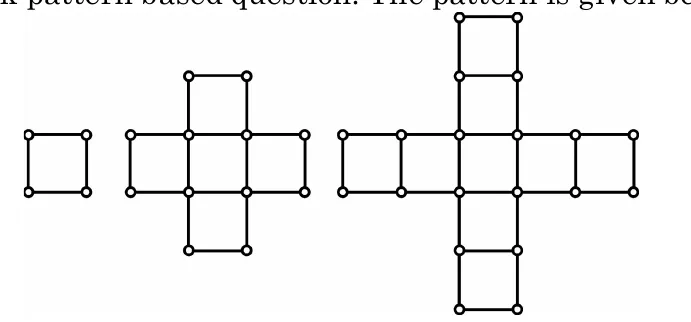
A match-stick pattern: Fig. (1) is a single square, Fig. (2) is a plus made of five squares, and Fig. (3) is a bigger plus made of nine squares, with dots at the corners of the sticks.
Solution
  1. (i) The squares in Fig. (1), (2), (3) are 1,5,9,…1, 5, 9, \dots, an A.P. with first term 11 and common difference 44.
  2. (ii) The sticks are 4,16,28,…4, 16, 28, \dots, an A.P. with first term 44 and common difference 1212.
  3. (iii)(a) Squares in Fig. (10) =1+9×4=37= 1 + 9 \times 4 = 37. Sticks in Fig. (10) =4+9×12=112= 4 + 9 \times 12 = 112.
  4. (iii)(b) 88=4+(m−1)×1288 = 4 + (m - 1) \times 12 gives m−1=7m - 1 = 7, so m=8m = 8. Squares in Fig. (8) =1+7×4=29= 1 + 7 \times 4 = 29.

Answer: (i) 11 and 44   (ii) 44 and 1212   (iii)(a) 3737 squares, 112112 sticks   (iii)(b) m=8m = 8, 2929 squares

Report an error on this question
Q37Areas Related to Circles4 marks

Case study 2. NSS (National Service Scheme) aims to connect the students to the community and to involve them in problem solving process. NSS symbol is based on the ‘Rath’ wheel of the Konark Sun Temple situated in Odisha. The wheel signifies the progress cycle of life. Observe the figure given above. The diameters of inner circle are equally placed. Given that OP = 21 cm, OS = 10 cm.

Based on the above information, answer the following questions:

(i) Find m∠ROS. [1]

(ii) Find the perimeter of sector OPQ. [1]

(iii) (a) Find the area of shaded region PQRS. [2]

OR

(iii) (b) Find the area of shaded region ACB i.e. the segment ACB. [2]
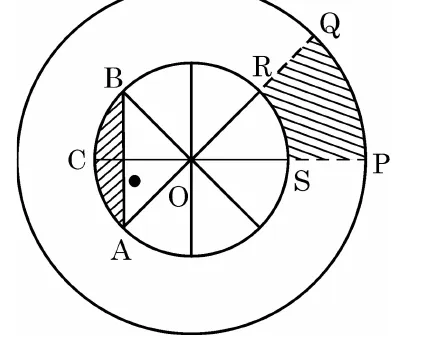
The NSS wheel: a large circle containing a smaller circle with four diameters through the centre O, with the sector OPQ of the outer circle and the sector ORS of the inner circle shaded, and a segment ACB at the left of the inner circle.
Solution
45°OPQSR1021PQRS ≈ 133.96 cm²perimeter OPQ = 58.5 cm
  1. (i) Four diameters equally placed make 88 equal angles at OO: ∠ROS=360∘8=45∘\angle ROS = \dfrac{360^\circ}{8} = 45^\circ.
  2. (ii) Perimeter of sector OPQ=OP+OQ+arc PQ=21+21+45360×2×227×21=42+16.5=58.5OPQ = OP + OQ + \text{arc } PQ = 21 + 21 + \dfrac{45}{360} \times 2 \times \dfrac{22}{7} \times 21 = 42 + 16.5 = 58.5 cm.
  3. (iii)(a) Area PQRS=sector OPQ−sector ORS=45360×227×(212−102)=18×227×341=375128≈133.96PQRS = \text{sector } OPQ - \text{sector } ORS = \dfrac{45}{360} \times \dfrac{22}{7} \times (21^2 - 10^2) = \dfrac{1}{8} \times \dfrac{22}{7} \times 341 = \dfrac{3751}{28} \approx 133.96 cm².
  4. (iii)(b) The segment ACBACB is cut off by the chord ABAB, which subtends 90∘90^\circ at OO (two sectors of 45∘45^\circ). Area =90360×227×100−12×10×10=5507−50=2007≈28.57= \dfrac{90}{360} \times \dfrac{22}{7} \times 100 - \dfrac{1}{2} \times 10 \times 10 = \dfrac{550}{7} - 50 = \dfrac{200}{7} \approx 28.57 cm².

Answer: (i) 45∘45^\circ   (ii) 58.558.5 cm   (iii)(a) ≈133.96\approx 133.96 cm²   (iii)(b) 2007≈28.57\dfrac{200}{7} \approx 28.57 cm²

Report an error on this question
Q38Triangles4 marks

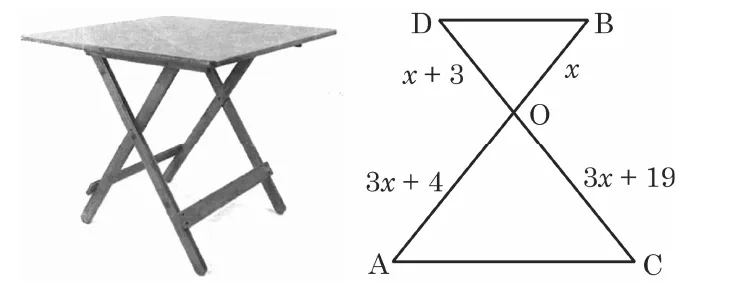
Case study 3. In the figure given below, a folding table is shown. The legs of the table are represented by line segments AB and CD intersecting at O. Join AC and BD. Considering table top is parallel to the ground, and OB = x, OD = x + 3, OC = 3x + 19 and OA = 3x + 4, answer the following questions:

(i) Prove that △OAC is similar to △OBD. [1]

(ii) Prove that OAAC=OBBD\dfrac{OA}{AC} = \dfrac{OB}{BD}. [1]

(iii) (a) Observe the figure and find the value of x. Hence, find the length of OC. [2]

OR

(iii) (b) Observe the figure and find BDAC\dfrac{BD}{AC}. [2]

A photo of a folding wooden table and a diagram of its legs: the segments AB and CD cross at O, with the table top BD at the top parallel to the ground AC at the bottom. The segments are labelled x, x + 3, 3x + 4 and 3x + 19.
Solution
ABCDO3x + 43x + 19xx + 3x = 2; OC = 25; BD/AC = 1/5
  1. (i) The table top BD∥ACBD \parallel AC (the ground), so ∠D=∠C\angle D = \angle C and ∠B=∠A\angle B = \angle A (alternate interior angles). By AA, △OAC∼△OBD\triangle OAC \sim \triangle OBD.
  2. (ii) Corresponding sides of similar triangles are proportional: OAOB=ACBD\dfrac{OA}{OB} = \dfrac{AC}{BD}, so OAAC=OBBD\dfrac{OA}{AC} = \dfrac{OB}{BD}.
  3. (iii)(a) OAOB=OCOD\dfrac{OA}{OB} = \dfrac{OC}{OD}: 3x+4x=3x+19x+3\dfrac{3x + 4}{x} = \dfrac{3x + 19}{x + 3}, so (3x+4)(x+3)=x(3x+19)(3x + 4)(x + 3) = x(3x + 19), that is 3x2+13x+12=3x2+19x3x^2 + 13x + 12 = 3x^2 + 19x and 6x=126x = 12, x=2x = 2. OC=3(2)+19=25OC = 3(2) + 19 = 25.
  4. (iii)(b) BDAC=OBOA=x3x+4=210=15\dfrac{BD}{AC} = \dfrac{OB}{OA} = \dfrac{x}{3x + 4} = \dfrac{2}{10} = \dfrac{1}{5}.

Answer: (i) proved   (ii) proved   (iii)(a) x=2x = 2, OC=25OC = 25   (iii)(b) 15\dfrac{1}{5}

Report an error on this question

Questions are from the official CBSE paper. Figures are described in words; see the PDF for the originals. Solutions are written by CogniGuru.

Revise this paper in 1 minute a chapter

Each chapter below is what the paper tested, with a one-minute animated lesson on the idea behind it.

Stuck on a step in any solution?

The CogniGuru AI tutor explains any doubt one minute at a time, in English or Hindi. Join the waitlist.

Mock quiz: 5 questions from this paper

Five real questions from this paper, one each from five chapters. About 2 minutes. See how much you know and where you stand among other students. Attempt free, with no login; log in only for your ranking and full report.

Question 1 of 5 · Q2 of the paperQuadratic Equations

The value(s) of kk for which the quadratic equation 5x2−9kx+5=05x^2 - 9kx + 5 = 0 has real and equal roots, is/are:

0 of 5 answered

Related papers

Common questions

Are these the official CBSE Class 10 Maths Basic 2024 questions?
Yes. The questions are from the official Mathematics (Basic) paper (set 430/3/1) that CBSE published after the March 2024 board exam. The solutions are written by CogniGuru and checked against the answer key CBSE published for this paper code.
Can I download the CBSE Class 10 Maths Basic 2024 question paper PDF?
Yes, the official paper PDF is free to download from this page, and so are our step-by-step solutions as a PDF. No login is needed to download either or to read the solutions.
Do all sets of the paper have the same questions?
No. CBSE sets several versions of each paper, with the same blueprint and similar questions in a different order and sometimes with different numbers. This page covers set 430/3/1.
How does the quiz work, and what does “where you stand” mean?
It is a mock quiz of 5 real multiple-choice questions from this paper, scored automatically in about 2 minutes. Your score is compared, anonymously, with other students who took the same quiz. Only the score is stored with the comparison, never your name or number.

Source

CBSE question paper archive, Class X, 2024 (Mathematics (Basic), set 430/3/1)
PDF